Title Hours
Module 6
Spectroscopic,
diffraction and
microscopic
techniques
Water purification methods - zeolites, ion-exchange resins and
reverse osmosis; Fuels and combustion -LCV, HCV, Bomb
calorimeter (numericals), Protective coatings for corrosion
control: cathodic and anodic protection - PVD technique;
Chemical sensors for environmental monitoring - gas sensors;
Overview of computational methodologies: energy minimization
and conformational analysis.
7
2
A combustible substance, which on combustion produces
a large amount of heat, which can be used for various
domestic and industrial purposes
Fuel
Fuels and Combustion
The process of combustion involves oxidation of carbon,
hydrogen etc. of the fuels to CO2, H2O, and the
difference in the energy of reactants and the products
are liberated as large amount of heat energy which is
utilized.
Combustion
Products + Heat
Fuel + O2
The primary or main source of fuels are coal and petroleum oils, the
amounts of which are dwindling day by day. These are stored fuels
available in earth's crust and are generally called "fossil fuels". 3
4
The term
combustion
refers to the
exothermal
oxidation of
a fuel, by air
or oxygen
FUEL
OCCURENCE PHYSICAL STATE
5
On the basis of occurrence
FUEL
PRIMARY OR
NATURAL FUEL
SECONDARY OR
ARTIFICIAL FUEL
6
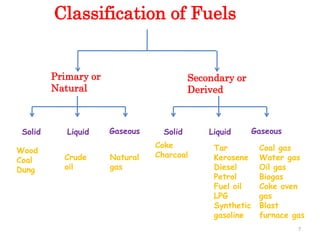
Classification of Fuels
Primary or
Natural
Secondary or
Derived
Solid Liquid Gaseous Solid Liquid Gaseous
Wood
Coal
Dung
Crude
oil
Natural
gas
Coke
Charcoal
Tar
Kerosene
Diesel
Petrol
Fuel oil
LPG
Synthetic
gasoline
Coal gas
Water gas
Oil gas
Biogas
Coke oven
gas
Blast
furnace gas
7
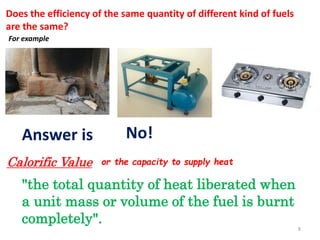
Does the efficiency of the same quantity of different kind of fuels
are the same?
For example
Answer is No!
Calorific Value or the capacity to supply heat
"the total quantity of heat liberated when
a unit mass or volume of the fuel is burnt
completely".
8
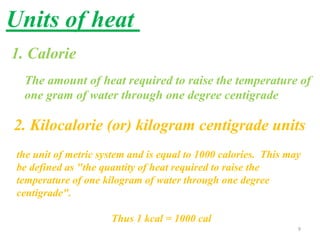
Units of heat
1. Calorie
2. Kilocalorie (or) kilogram centigrade units
the unit of metric system and is equal to 1000 calories. This may
be defined as "the quantity of heat required to raise the
temperature of one kilogram of water through one degree
centigrade".
Thus 1 kcal = 1000 cal
The amount of heat required to raise the temperature of
one gram of water through one degree centigrade
9
3. British thermal unit (B. Th. U.)
“the quantity of heat required to raise the temperature of one
pound of water through one degree Fahrenheit”
1 B. Th. U. = 252 cal = 0.252 k cal. (1°C × 9/5) + 32 = 33.8°F
1 k cal = 3.968 B. Th. U.
Units of heat continued
4. Centigrade Heat Unit (C. H. U.)
"quantity of heat required to raise the temperature of one pound of
water through one degree centigrade".
Thus, 1 k cal = 3.968 B. Th. U. = 2.2 C. H. U.
10
(1°C × 9/5) + 32 = 33.8°F
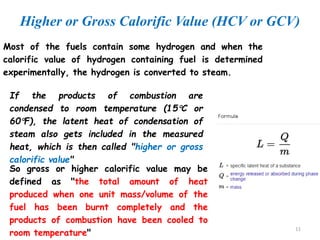
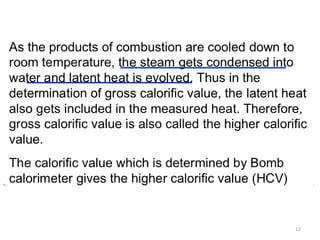
Higher or Gross Calorific Value (HCV or GCV)
Most of the fuels contain some hydrogen and when the
calorific value of hydrogen containing fuel is determined
experimentally, the hydrogen is converted to steam.
If the products of combustion are
condensed to room temperature (15C or
60F), the latent heat of condensation of
steam also gets included in the measured
heat, which is then called "higher or gross
calorific value"
So gross or higher calorific value may be
defined as "the total amount of heat
produced when one unit mass/volume of the
fuel has been burnt completely and the
products of combustion have been cooled to
room temperature"
11
12
Lower or Net Calorific Value (LCV)
In actual case of any fuel, the water vapour and moisture etc are not
condensed and escapes as such along with hot combustion gases. Hence a
lesser amount of heat is available. So, net or lower calorific value may be
defined as "the net heat produced when unit mass / volume of the fuel is burnt
completely and the products are permitted to escape".
Net or lower calorific value can be found from GCV value
NCV = GCV - Latent heat of water vapor formed
= GCV - Mass of hydrogen × 9 × latent heat of steam
1 part by mass of hydrogen produces 9 parts by mass of water.
The latent heat of steam is 587 k cal / kg or 1060 B. Th. U. / lb of
water vapour formed at room temperature. (ie 15C)
13
14
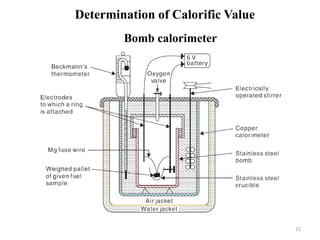
Determination of Calorific Value
Bomb calorimeter
15
16
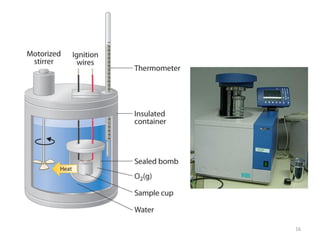
• What is a Bomb- or Combustion Calorimeter?
A Bomb-Calorimeter is used to measure the heat created by a
sample burned under an oxygen atmosphere in a closed vessel,
which is surrounded by water, under controlled conditions.
• The measurement result is called the Combustion-, Calorific- or
BTU-value
• 1g of solid or liquid matter is weighed into a crucible, and placed
inside a stainless steel container (the “Decomposition vessel”)
filled with oxygen. Than the sample is ignited through an ignition
wire inside the decomposition vessel and burned
• The reaction is carried out in insulated container, where the heat
evolved by the reaction causes the temperature of the contents to
change
• All organic matter is burned under these conditions, and oxidized.
Even inorganic matter will be oxidized to some extend 17
• The heat created during the burning process can be
determined in different ways
• By measuring the temperature increase
• The heat created by the combustion process is transferred to
known amount of water
18
19
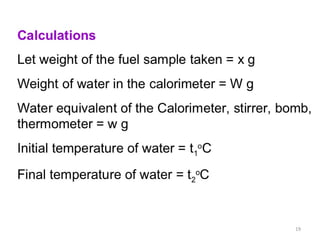
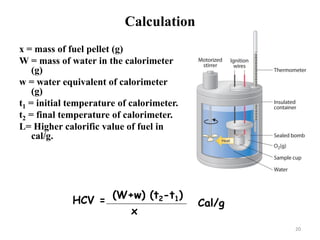
Calculation
x = mass of fuel pellet (g)
W = mass of water in the calorimeter
(g)
w = water equivalent of calorimeter
(g)
t1 = initial temperature of calorimeter.
t2 = final temperature of calorimeter.
L= Higher calorific value of fuel in
cal/g.
(W+w) (t2-t1)
x
HCV = Cal/g
20
Water Equivalent of the calorimeter is determined by
burning a fuel of known calorific value (benzoic acid (HCV
= 6,325 kcal/kg) and naphthalene (HCV = 9,688 kcal/kg)
If H is the percentage of hydrogen in fuel,
the mass of water produced from 1 g of fuel = (9/100)×H
= 0.09 H
Heat taken by water in forming steam = 0.09 H× 587 cal
(latent heat of steam = 587 cal/kg)
LCV = HCV – Latent heat of water formed
21
1. 0.72 gram of a fuel containing 80% carbon, when burnt in a
bomb calorimeter, increased the temperature of water from 27.3o
to 29.1oC. If the calorimeter contains 250 grams of water and its
water equivalents is 150 grams, calculate the HCV of the fuel. Give
your answer in KJ/Kg.
Solution. Here x= 0.72 g, W = 250g, t1 = 27.3oC, t2 = 29.1oC.
HCV of fuel (L) = (W + w) (t1 - t2) cal/g
x
= (250 + 150) × (29.1-27.3) kcal/kg = 1,000 × 4.2 kJ/Kg = 4.200 kJ/kg
0.72
22
2. On burning 0.83 of a solid fuel in a bomb calorimeter , the
temperature of 3,500g of water increased from 26.5oC to 29.2oC.
Water equivalent of calorimeter and latent heat of steam are
385.0g of and 587.0 Cal/g respectively. If the fuel contains 0.7%
hydrogen, calculate its gross and net calorific value.
Solution. Here wt. of fuel (x) = 0.83 g of ; wt of water (W) = 3,500
g; water equivalent of calorimeter (w) = 385 g ; (t2 - t) = (29.2oC -
26.5oC) = 2.7oC ; percentage of hydrogen (H) = 0.7% ; latent heat
of steam = 587 cal/g
Gross calorific value = (W + w) (t1 - t2) cal/g
x
= (3,500 +385) × 2.7 = 12,638 cal/g
0.83
NCV = [GCV – 0.09 H × 587]
= (12,63 8– 0.09 × 0.7 × 587) cal/g
= (12,638 – 37) cal/g = 12,601 cal/g 23
1. Fuse wire correction
2. Acid correction
3. Cooling correction
24
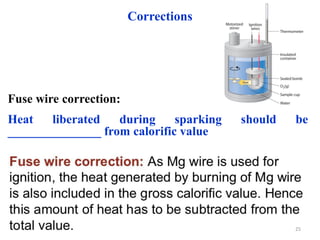
Corrections
Fuse wire correction:
Heat liberated during sparking should be
_______________ from calorific value
25
Acid correction:
Fuels containing Sulphur and Nitrogen if oxidized, the heats of formation of
H2SO4 and HNO3 should be subtracted (as the acid formations are
exothermic reactions)
26
27
Cooling correction:
The rate of cooling of the calorimeter from maximum temperature to room
temperature is noted. From this rate of cooling (i.e., dt°/min) and the actual time
taken for cooling (X min) then correction (dt × X) is called cooling correction
and is added to the (t2 . t1) term.
28
(W+w) (t2-t1+Cooling Correction) – (Acid + Fuse Correction)
Mass of the fuel (x)
GCV =
29
3. A sample of coal contains C =93%; H =6% and ash = 1%. The following data
were obtained when the above coal was tested in bomb calorimeter.
Wt. of coal burnt =0.92g
Wt. of water taken =550g
Water equivalent of calorimeter =2,200g
Rise in temperature =2.42 oC
Fuse wire correction =10.0 cal
Acid correction =50.0 cal
Calculate gross and net calorific value of the coal, assuming the latent heat of
condensation of steam as 580 cal/g.
Solution: Wt. of coal sample (x) = 0.92 g; wt. of water (W) =550 g;
water equivalent of calorimeter (w) = 2,200g;
temperature rise (t2-t1) = 2.42 oC;
acid correction = 50.0cal;
fuse wire correction = 10.0 cal;
latent heat of steam = 580 cal/g;
percentage of H =6%
30
GCV = (W + w) (t1 - t2) –[acid+fuse corrections]
x
= (550+2,200) × 2.42 – [50+10] cal
0.92g
= 7,168.5 cal/g.
NCV = [GCV – 0.09 H × latent heat steam]
= (7168.5 – 0.09 × 6 × 580) cal/g
= 6855.3 cal/g
31
Corrosion
Any process of deterioration and
consequent loss of solid metallic material,
through an unwanted chemical or
electrochemical attack by its environment
Metal metallic compounds + Energy
Corrosion
(Oxidation)
Extraction of
Metals
Types
• Dry or Chemical Corrosion
• Electrochemical Corrosion
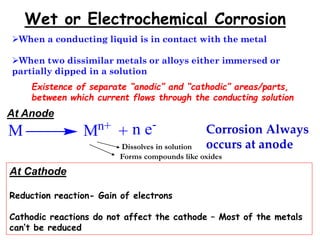
Wet or Electrochemical Corrosion
When a conducting liquid is in contact with the metal
When two dissimilar metals or alloys either immersed or
partially dipped in a solution
Existence of separate “anodic” and “cathodic” areas/parts,
between which current flows through the conducting solution
At Anode
M Mn+ n e-
+
Dissolves in solution
Forms compounds like oxides
Corrosion Always
occurs at anode
At Cathode
Reduction reaction- Gain of electrons
Cathodic reactions do not affect the cathode – Most of the metals
can’t be reduced
Cathodic Protection
To force the metal to be protected to
behave like a cathode
Sacrificial anodic
protection method
Impressed Current
Cathodic Protection
Metallic structure (to be protected) is
connected by a wire to a more anodic metal
Sacrificial anode Eg. Mg, Zn, Al and
their alloys
Protection of
Buried pipe lines
Underground cables
Marine structures
Ship- Hulls
Water-tanks
34
Cathodic Protection
Cathodic protection:
Principle is to make the base metal to be protected as cathode by
connecting to a highly anodic metallic plate.
Two methods of cathodic protection are known:
i) Sacrificial anodic protection
ii) Impressed current cathodic protection
i) Sacrificial anodic protection:
o The metallic structure to be protected is connected through a metal
wire to a more anodic metal.
o This will induce corrosion at the anodic metal.
o Thus the more anodic metal sacrifices itself and gets corroded
protecting the metallic structure.
o Sacrificial anodes known are Zn, Mg, Al and their alloys.
o Applications are: protection of underground pipelines, ship hulls and
other marine devices, water tanks.
35
Sacrificial anodic protection
Sacrificial anodic protection - concept
36
e-
Mg
Mg2+
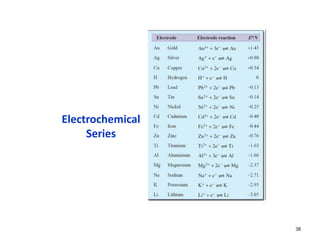
38
Electrochemical
Series
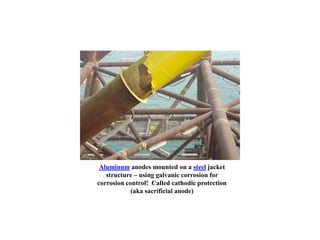
Aluminum anodes mounted on a steel jacket
structure – using galvanic corrosion for
corrosion control! Called cathodic protection
(aka sacrificial anode)
Another Example
Zinc is attached to the steel hull of the vessel
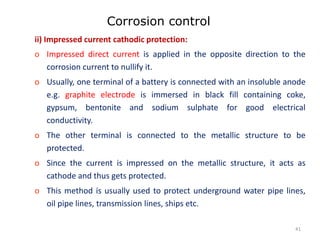
Corrosion control
ii) Impressed current cathodic protection:
o Impressed direct current is applied in the opposite direction to the
corrosion current to nullify it.
o Usually, one terminal of a battery is connected with an insoluble anode
e.g. graphite electrode is immersed in black fill containing coke,
gypsum, bentonite and sodium sulphate for good electrical
conductivity.
o The other terminal is connected to the metallic structure to be
protected.
o Since the current is impressed on the metallic structure, it acts as
cathode and thus gets protected.
o This method is usually used to protect underground water pipe lines,
oil pipe lines, transmission lines, ships etc.
41
Impressed Current Cathodic Protection
An impressed current is applied in opposite direction
to nullify the corrosion current, and covert corroding
metal from anode to cathode
Source for the impressed current - battery
+ -
-
+
Buried pipe
Cathodic
Source for
Impressed DC
Water pipeline
Oil pipeline
Transmission line
Marine piers
42
44
Water Softening Methods
❖ Zeolite (Permutit process)
❖ Ion-exchange
❖ Mixed bed ion-exchange
❖ Reverse Osmosis
Types of Hardness
Permanent Hardness (or) non-
carbonate hardness
- presence of chlorides and
sulphates of Ca, Mg and
other heavy metals
- Can’t be removed by simple
boiling
Temporary Hardness (or)
carbonate hardness
-Dissolved bicarbonate salts of Ca
and Mg and other heavy metals such
as iron
-Can be removed easily by boiling
Ca(HCO3)2 CaCO3 + H2O + CO2
Mg(HCO3)2 Mg(OH)2 + 2CO2
46
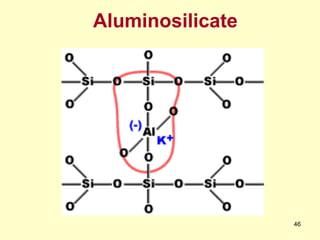
Aluminosilicate
47
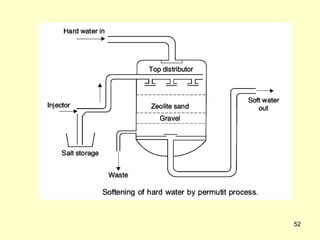
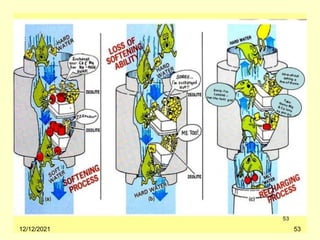
Zeolite (or) permutit process
Natrolite
Natural Zeolite
48
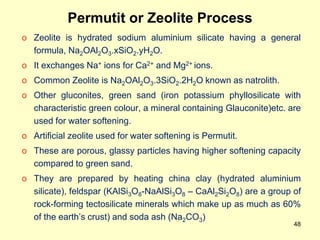
Permutit or Zeolite Process
o Zeolite is hydrated sodium aluminium silicate having a general
formula, Na2OAl2O3.xSiO2.yH2O.
o It exchanges Na+ ions for Ca2+ and Mg2+ ions.
o Common Zeolite is Na2OAl2O3.3SiO2.2H2O known as natrolith.
o Other gluconites, green sand (iron potassium phyllosilicate with
characteristic green colour, a mineral containing Glauconite)etc. are
used for water softening.
o Artificial zeolite used for water softening is Permutit.
o These are porous, glassy particles having higher softening capacity
compared to green sand.
o They are prepared by heating china clay (hydrated aluminium
silicate), feldspar (KAlSi3O8-NaAlSi3O8 – CaAl2Si2O8) are a group of
rock-forming tectosilicate minerals which make up as much as 60%
of the earth’s crust) and soda ash (Na2CO3)
Natural Zeolites:
1. Natrolite - Na2O. Al2O3 4SiO2 .2H 2O
2. Laumontite - CaO. Al2O3 4SiO2 .4H 2O
3. Harmotome - (BaO.K2O). Al2O3 5SiO2 .5H 2O
- Capable of exchanging its Na ions
12/12/2021 49
50
Artificial Zeolite
China clay
51
Brine solution
52
12/12/2021 53
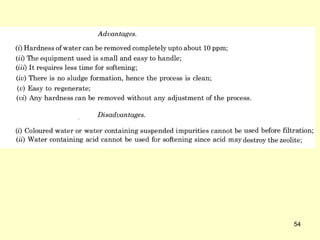
54
55
Ion-exchange Process
• Ion-exchange resins are insoluble, cross-linked, long chain organic
polymers with a microporous structure
• The functional groups attached to the groups are responsible for the
ion-exchanging properties.
o Acidic functional groups (-COOH, -SO3H etc.) exchange H+ for
cations &
o Basic functional groups (-NH2, =NH etc.) exchange OH- for
anions.
A. Cation-exchange Resins(RH+):
Styrene-divinyl benzene copolymers,
which on sulphonation or carboxylation,
become capable to exchange their
hydrogen ions with the cations in the
water
56
Styrene-divinyl benzene or amine-formaldehyde copolymers, which contain
amino or quaternary ammonium or quaternary phophonium or tertiary
sulphonium groups as an integral part of the resin matrix. These after
treatment with dil. NaOH solution capable to exchange their OH¯ ions with
the anions in the water
B. Anion-exchange resins (R’OH):
Ion-Exchange Process
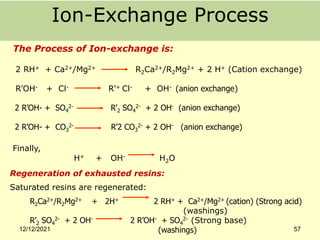
The Process of Ion-exchange is:
2 RH+ + Ca2+/Mg2+ R2Ca2+/R2Mg2+ + 2 H+ (Cation exchange)
R’OH- + Cl- R’+ Cl- + OH- (anion exchange)
2 R’OH- + SO4
2- R’2 SO4
2- + 2 OH- (anion exchange)
2 R’OH- + CO3
2- R’2 CO3
2- + 2 OH- (anion exchange)
Finally,
H+ + OH- H2O
Regeneration of exhausted resins:
Saturated resins are regenerated:
R2Ca2+/R2Mg2+ + 2H+ 2 RH+ + Ca2+/Mg2+ (cation) (Strong acid)
(washings)
R’2 SO4
2- + 2 OH- 2 R’OH- + SO4
2- (Strong base)
(washings)
12/12/2021 57
58
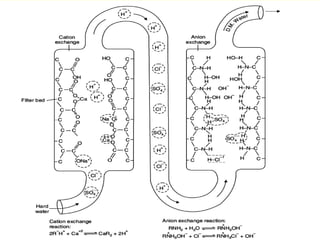
Note: Hard water should be first passed through the cation exchanger and
then Anion exchanger to avoid hydroxides of Ca2+ and Mg2+ getting formed
59
60
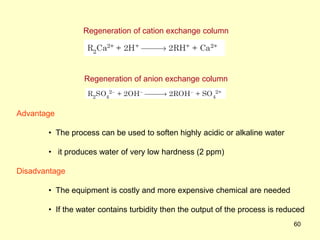
Regeneration of cation exchange column
Regeneration of anion exchange column
Advantage
• The process can be used to soften highly acidic or alkaline water
• it produces water of very low hardness (2 ppm)
Disadvantage
• The equipment is costly and more expensive chemical are needed
• If the water contains turbidity then the output of the process is reduced
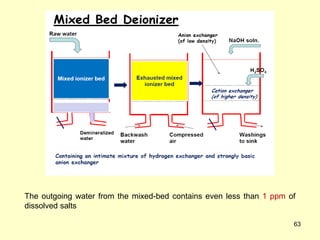
Mixed Bed Deionizer
12/12/2021 61
12/12/2021 62
63
The outgoing water from the mixed-bed contains even less than 1 ppm of
dissolved salts
Advantages & Disadvantages of
ion-exchange process
o Advantages:
- Can be used for highly acid and highly alkaline water
- Residual hardness of water is as low as 2 ppm.
- Very good for treating water for high pressure boilers
o Disadvantages:
- Expensive equipment and chemicals
- Turbidity of water should be < 10 ppm. Otherwise output will
reduce; turbidity needs to be coagulated before treatment.
- Needs skilled labour
12/12/2021 64
Reverse Osmosis
oWhen two solutions of unequal concentrations are
separated by a Semipermeable membrane,
solvent will flow from lower conc. to higher conc.
due to osmotic pressure
oThis phenomenon can be reversed by making the
solvent to flow in the opposite direction by applying
hydrostatic pressure on the concentrated side
(Reverse Osmosis)
oIn reverse osmosis, pressure of 15-40 kg/cm2 is
applied on the contaminated water compartment.
oThe water gets forced through the semipermeable
membrane leaving behind the dissolved solids.
oThus water is separated from the contaminants
rather than removing contaminants from water.
oBoth ionic and non-ionic impurities as well as
colloidal impurities are left behind.
oThis process is also called as “Super-filtration”
or “Hyper-filtration”
12/12/2021 66
Advantages of Reverse Osmosis
o Advantage is in removing ionic, non-ionic, colloidal and high molecular wt.
organic matter.
o It removes colloidal silica (which is not removed during demineralisation)
o Cost is only the replacement cost of membranes (life is 2 years)
o Membrane replacement is fast and hence uninterrupted water supply can
be ensured
o Because of the above reasons this process is being adopted for converting
sea water into potable water and for high pressure boilers.
12/12/2021 67

Combustion and fules

  • 1.
    Title Hours Module 6 Spectroscopic, diffractionand microscopic techniques Water purification methods - zeolites, ion-exchange resins and reverse osmosis; Fuels and combustion -LCV, HCV, Bomb calorimeter (numericals), Protective coatings for corrosion control: cathodic and anodic protection - PVD technique; Chemical sensors for environmental monitoring - gas sensors; Overview of computational methodologies: energy minimization and conformational analysis. 7
  • 2.
  • 3.
    A combustible substance,which on combustion produces a large amount of heat, which can be used for various domestic and industrial purposes Fuel Fuels and Combustion The process of combustion involves oxidation of carbon, hydrogen etc. of the fuels to CO2, H2O, and the difference in the energy of reactants and the products are liberated as large amount of heat energy which is utilized. Combustion Products + Heat Fuel + O2 The primary or main source of fuels are coal and petroleum oils, the amounts of which are dwindling day by day. These are stored fuels available in earth's crust and are generally called "fossil fuels". 3
  • 4.
    4 The term combustion refers tothe exothermal oxidation of a fuel, by air or oxygen
  • 5.
  • 6.
    On the basisof occurrence FUEL PRIMARY OR NATURAL FUEL SECONDARY OR ARTIFICIAL FUEL 6
  • 7.
    Classification of Fuels Primaryor Natural Secondary or Derived Solid Liquid Gaseous Solid Liquid Gaseous Wood Coal Dung Crude oil Natural gas Coke Charcoal Tar Kerosene Diesel Petrol Fuel oil LPG Synthetic gasoline Coal gas Water gas Oil gas Biogas Coke oven gas Blast furnace gas 7
  • 8.
    Does the efficiencyof the same quantity of different kind of fuels are the same? For example Answer is No! Calorific Value or the capacity to supply heat "the total quantity of heat liberated when a unit mass or volume of the fuel is burnt completely". 8
  • 9.
    Units of heat 1.Calorie 2. Kilocalorie (or) kilogram centigrade units the unit of metric system and is equal to 1000 calories. This may be defined as "the quantity of heat required to raise the temperature of one kilogram of water through one degree centigrade". Thus 1 kcal = 1000 cal The amount of heat required to raise the temperature of one gram of water through one degree centigrade 9
  • 10.
    3. British thermalunit (B. Th. U.) “the quantity of heat required to raise the temperature of one pound of water through one degree Fahrenheit” 1 B. Th. U. = 252 cal = 0.252 k cal. (1°C × 9/5) + 32 = 33.8°F 1 k cal = 3.968 B. Th. U. Units of heat continued 4. Centigrade Heat Unit (C. H. U.) "quantity of heat required to raise the temperature of one pound of water through one degree centigrade". Thus, 1 k cal = 3.968 B. Th. U. = 2.2 C. H. U. 10 (1°C × 9/5) + 32 = 33.8°F
  • 11.
    Higher or GrossCalorific Value (HCV or GCV) Most of the fuels contain some hydrogen and when the calorific value of hydrogen containing fuel is determined experimentally, the hydrogen is converted to steam. If the products of combustion are condensed to room temperature (15C or 60F), the latent heat of condensation of steam also gets included in the measured heat, which is then called "higher or gross calorific value" So gross or higher calorific value may be defined as "the total amount of heat produced when one unit mass/volume of the fuel has been burnt completely and the products of combustion have been cooled to room temperature" 11
  • 12.
  • 13.
    Lower or NetCalorific Value (LCV) In actual case of any fuel, the water vapour and moisture etc are not condensed and escapes as such along with hot combustion gases. Hence a lesser amount of heat is available. So, net or lower calorific value may be defined as "the net heat produced when unit mass / volume of the fuel is burnt completely and the products are permitted to escape". Net or lower calorific value can be found from GCV value NCV = GCV - Latent heat of water vapor formed = GCV - Mass of hydrogen × 9 × latent heat of steam 1 part by mass of hydrogen produces 9 parts by mass of water. The latent heat of steam is 587 k cal / kg or 1060 B. Th. U. / lb of water vapour formed at room temperature. (ie 15C) 13
  • 14.
  • 15.
    Determination of CalorificValue Bomb calorimeter 15
  • 16.
  • 17.
    • What isa Bomb- or Combustion Calorimeter? A Bomb-Calorimeter is used to measure the heat created by a sample burned under an oxygen atmosphere in a closed vessel, which is surrounded by water, under controlled conditions. • The measurement result is called the Combustion-, Calorific- or BTU-value • 1g of solid or liquid matter is weighed into a crucible, and placed inside a stainless steel container (the “Decomposition vessel”) filled with oxygen. Than the sample is ignited through an ignition wire inside the decomposition vessel and burned • The reaction is carried out in insulated container, where the heat evolved by the reaction causes the temperature of the contents to change • All organic matter is burned under these conditions, and oxidized. Even inorganic matter will be oxidized to some extend 17
  • 18.
    • The heatcreated during the burning process can be determined in different ways • By measuring the temperature increase • The heat created by the combustion process is transferred to known amount of water 18
  • 19.
  • 20.
    Calculation x = massof fuel pellet (g) W = mass of water in the calorimeter (g) w = water equivalent of calorimeter (g) t1 = initial temperature of calorimeter. t2 = final temperature of calorimeter. L= Higher calorific value of fuel in cal/g. (W+w) (t2-t1) x HCV = Cal/g 20
  • 21.
    Water Equivalent ofthe calorimeter is determined by burning a fuel of known calorific value (benzoic acid (HCV = 6,325 kcal/kg) and naphthalene (HCV = 9,688 kcal/kg) If H is the percentage of hydrogen in fuel, the mass of water produced from 1 g of fuel = (9/100)×H = 0.09 H Heat taken by water in forming steam = 0.09 H× 587 cal (latent heat of steam = 587 cal/kg) LCV = HCV – Latent heat of water formed 21
  • 22.
    1. 0.72 gramof a fuel containing 80% carbon, when burnt in a bomb calorimeter, increased the temperature of water from 27.3o to 29.1oC. If the calorimeter contains 250 grams of water and its water equivalents is 150 grams, calculate the HCV of the fuel. Give your answer in KJ/Kg. Solution. Here x= 0.72 g, W = 250g, t1 = 27.3oC, t2 = 29.1oC. HCV of fuel (L) = (W + w) (t1 - t2) cal/g x = (250 + 150) × (29.1-27.3) kcal/kg = 1,000 × 4.2 kJ/Kg = 4.200 kJ/kg 0.72 22
  • 23.
    2. On burning0.83 of a solid fuel in a bomb calorimeter , the temperature of 3,500g of water increased from 26.5oC to 29.2oC. Water equivalent of calorimeter and latent heat of steam are 385.0g of and 587.0 Cal/g respectively. If the fuel contains 0.7% hydrogen, calculate its gross and net calorific value. Solution. Here wt. of fuel (x) = 0.83 g of ; wt of water (W) = 3,500 g; water equivalent of calorimeter (w) = 385 g ; (t2 - t) = (29.2oC - 26.5oC) = 2.7oC ; percentage of hydrogen (H) = 0.7% ; latent heat of steam = 587 cal/g Gross calorific value = (W + w) (t1 - t2) cal/g x = (3,500 +385) × 2.7 = 12,638 cal/g 0.83 NCV = [GCV – 0.09 H × 587] = (12,63 8– 0.09 × 0.7 × 587) cal/g = (12,638 – 37) cal/g = 12,601 cal/g 23
  • 24.
    1. Fuse wirecorrection 2. Acid correction 3. Cooling correction 24
  • 25.
    Corrections Fuse wire correction: Heatliberated during sparking should be _______________ from calorific value 25
  • 26.
    Acid correction: Fuels containingSulphur and Nitrogen if oxidized, the heats of formation of H2SO4 and HNO3 should be subtracted (as the acid formations are exothermic reactions) 26
  • 27.
  • 28.
    Cooling correction: The rateof cooling of the calorimeter from maximum temperature to room temperature is noted. From this rate of cooling (i.e., dt°/min) and the actual time taken for cooling (X min) then correction (dt × X) is called cooling correction and is added to the (t2 . t1) term. 28
  • 29.
    (W+w) (t2-t1+Cooling Correction)– (Acid + Fuse Correction) Mass of the fuel (x) GCV = 29
  • 30.
    3. A sampleof coal contains C =93%; H =6% and ash = 1%. The following data were obtained when the above coal was tested in bomb calorimeter. Wt. of coal burnt =0.92g Wt. of water taken =550g Water equivalent of calorimeter =2,200g Rise in temperature =2.42 oC Fuse wire correction =10.0 cal Acid correction =50.0 cal Calculate gross and net calorific value of the coal, assuming the latent heat of condensation of steam as 580 cal/g. Solution: Wt. of coal sample (x) = 0.92 g; wt. of water (W) =550 g; water equivalent of calorimeter (w) = 2,200g; temperature rise (t2-t1) = 2.42 oC; acid correction = 50.0cal; fuse wire correction = 10.0 cal; latent heat of steam = 580 cal/g; percentage of H =6% 30
  • 31.
    GCV = (W+ w) (t1 - t2) –[acid+fuse corrections] x = (550+2,200) × 2.42 – [50+10] cal 0.92g = 7,168.5 cal/g. NCV = [GCV – 0.09 H × latent heat steam] = (7168.5 – 0.09 × 6 × 580) cal/g = 6855.3 cal/g 31
  • 32.
    Corrosion Any process ofdeterioration and consequent loss of solid metallic material, through an unwanted chemical or electrochemical attack by its environment Metal metallic compounds + Energy Corrosion (Oxidation) Extraction of Metals Types • Dry or Chemical Corrosion • Electrochemical Corrosion
  • 33.
    Wet or ElectrochemicalCorrosion When a conducting liquid is in contact with the metal When two dissimilar metals or alloys either immersed or partially dipped in a solution Existence of separate “anodic” and “cathodic” areas/parts, between which current flows through the conducting solution At Anode M Mn+ n e- + Dissolves in solution Forms compounds like oxides Corrosion Always occurs at anode At Cathode Reduction reaction- Gain of electrons Cathodic reactions do not affect the cathode – Most of the metals can’t be reduced
  • 34.
    Cathodic Protection To forcethe metal to be protected to behave like a cathode Sacrificial anodic protection method Impressed Current Cathodic Protection Metallic structure (to be protected) is connected by a wire to a more anodic metal Sacrificial anode Eg. Mg, Zn, Al and their alloys Protection of Buried pipe lines Underground cables Marine structures Ship- Hulls Water-tanks 34
  • 35.
    Cathodic Protection Cathodic protection: Principleis to make the base metal to be protected as cathode by connecting to a highly anodic metallic plate. Two methods of cathodic protection are known: i) Sacrificial anodic protection ii) Impressed current cathodic protection i) Sacrificial anodic protection: o The metallic structure to be protected is connected through a metal wire to a more anodic metal. o This will induce corrosion at the anodic metal. o Thus the more anodic metal sacrifices itself and gets corroded protecting the metallic structure. o Sacrificial anodes known are Zn, Mg, Al and their alloys. o Applications are: protection of underground pipelines, ship hulls and other marine devices, water tanks. 35
  • 36.
    Sacrificial anodic protection Sacrificialanodic protection - concept 36 e- Mg Mg2+
  • 38.
  • 39.
    Aluminum anodes mountedon a steel jacket structure – using galvanic corrosion for corrosion control! Called cathodic protection (aka sacrificial anode)
  • 40.
    Another Example Zinc isattached to the steel hull of the vessel
  • 41.
    Corrosion control ii) Impressedcurrent cathodic protection: o Impressed direct current is applied in the opposite direction to the corrosion current to nullify it. o Usually, one terminal of a battery is connected with an insoluble anode e.g. graphite electrode is immersed in black fill containing coke, gypsum, bentonite and sodium sulphate for good electrical conductivity. o The other terminal is connected to the metallic structure to be protected. o Since the current is impressed on the metallic structure, it acts as cathode and thus gets protected. o This method is usually used to protect underground water pipe lines, oil pipe lines, transmission lines, ships etc. 41
  • 42.
    Impressed Current CathodicProtection An impressed current is applied in opposite direction to nullify the corrosion current, and covert corroding metal from anode to cathode Source for the impressed current - battery + - - + Buried pipe Cathodic Source for Impressed DC Water pipeline Oil pipeline Transmission line Marine piers 42
  • 44.
    44 Water Softening Methods ❖Zeolite (Permutit process) ❖ Ion-exchange ❖ Mixed bed ion-exchange ❖ Reverse Osmosis
  • 45.
    Types of Hardness PermanentHardness (or) non- carbonate hardness - presence of chlorides and sulphates of Ca, Mg and other heavy metals - Can’t be removed by simple boiling Temporary Hardness (or) carbonate hardness -Dissolved bicarbonate salts of Ca and Mg and other heavy metals such as iron -Can be removed easily by boiling Ca(HCO3)2 CaCO3 + H2O + CO2 Mg(HCO3)2 Mg(OH)2 + 2CO2
  • 46.
  • 47.
    47 Zeolite (or) permutitprocess Natrolite Natural Zeolite
  • 48.
    48 Permutit or ZeoliteProcess o Zeolite is hydrated sodium aluminium silicate having a general formula, Na2OAl2O3.xSiO2.yH2O. o It exchanges Na+ ions for Ca2+ and Mg2+ ions. o Common Zeolite is Na2OAl2O3.3SiO2.2H2O known as natrolith. o Other gluconites, green sand (iron potassium phyllosilicate with characteristic green colour, a mineral containing Glauconite)etc. are used for water softening. o Artificial zeolite used for water softening is Permutit. o These are porous, glassy particles having higher softening capacity compared to green sand. o They are prepared by heating china clay (hydrated aluminium silicate), feldspar (KAlSi3O8-NaAlSi3O8 – CaAl2Si2O8) are a group of rock-forming tectosilicate minerals which make up as much as 60% of the earth’s crust) and soda ash (Na2CO3)
  • 49.
    Natural Zeolites: 1. Natrolite- Na2O. Al2O3 4SiO2 .2H 2O 2. Laumontite - CaO. Al2O3 4SiO2 .4H 2O 3. Harmotome - (BaO.K2O). Al2O3 5SiO2 .5H 2O - Capable of exchanging its Na ions 12/12/2021 49
  • 50.
  • 51.
  • 52.
  • 53.
  • 54.
  • 55.
    55 Ion-exchange Process • Ion-exchangeresins are insoluble, cross-linked, long chain organic polymers with a microporous structure • The functional groups attached to the groups are responsible for the ion-exchanging properties. o Acidic functional groups (-COOH, -SO3H etc.) exchange H+ for cations & o Basic functional groups (-NH2, =NH etc.) exchange OH- for anions. A. Cation-exchange Resins(RH+): Styrene-divinyl benzene copolymers, which on sulphonation or carboxylation, become capable to exchange their hydrogen ions with the cations in the water
  • 56.
    56 Styrene-divinyl benzene oramine-formaldehyde copolymers, which contain amino or quaternary ammonium or quaternary phophonium or tertiary sulphonium groups as an integral part of the resin matrix. These after treatment with dil. NaOH solution capable to exchange their OH¯ ions with the anions in the water B. Anion-exchange resins (R’OH):
  • 57.
    Ion-Exchange Process The Processof Ion-exchange is: 2 RH+ + Ca2+/Mg2+ R2Ca2+/R2Mg2+ + 2 H+ (Cation exchange) R’OH- + Cl- R’+ Cl- + OH- (anion exchange) 2 R’OH- + SO4 2- R’2 SO4 2- + 2 OH- (anion exchange) 2 R’OH- + CO3 2- R’2 CO3 2- + 2 OH- (anion exchange) Finally, H+ + OH- H2O Regeneration of exhausted resins: Saturated resins are regenerated: R2Ca2+/R2Mg2+ + 2H+ 2 RH+ + Ca2+/Mg2+ (cation) (Strong acid) (washings) R’2 SO4 2- + 2 OH- 2 R’OH- + SO4 2- (Strong base) (washings) 12/12/2021 57
  • 58.
    58 Note: Hard watershould be first passed through the cation exchanger and then Anion exchanger to avoid hydroxides of Ca2+ and Mg2+ getting formed
  • 59.
  • 60.
    60 Regeneration of cationexchange column Regeneration of anion exchange column Advantage • The process can be used to soften highly acidic or alkaline water • it produces water of very low hardness (2 ppm) Disadvantage • The equipment is costly and more expensive chemical are needed • If the water contains turbidity then the output of the process is reduced
  • 61.
  • 62.
  • 63.
    63 The outgoing waterfrom the mixed-bed contains even less than 1 ppm of dissolved salts
  • 64.
    Advantages & Disadvantagesof ion-exchange process o Advantages: - Can be used for highly acid and highly alkaline water - Residual hardness of water is as low as 2 ppm. - Very good for treating water for high pressure boilers o Disadvantages: - Expensive equipment and chemicals - Turbidity of water should be < 10 ppm. Otherwise output will reduce; turbidity needs to be coagulated before treatment. - Needs skilled labour 12/12/2021 64
  • 65.
    Reverse Osmosis oWhen twosolutions of unequal concentrations are separated by a Semipermeable membrane, solvent will flow from lower conc. to higher conc. due to osmotic pressure oThis phenomenon can be reversed by making the solvent to flow in the opposite direction by applying hydrostatic pressure on the concentrated side (Reverse Osmosis) oIn reverse osmosis, pressure of 15-40 kg/cm2 is applied on the contaminated water compartment. oThe water gets forced through the semipermeable membrane leaving behind the dissolved solids. oThus water is separated from the contaminants rather than removing contaminants from water. oBoth ionic and non-ionic impurities as well as colloidal impurities are left behind. oThis process is also called as “Super-filtration” or “Hyper-filtration”
  • 66.
  • 67.
    Advantages of ReverseOsmosis o Advantage is in removing ionic, non-ionic, colloidal and high molecular wt. organic matter. o It removes colloidal silica (which is not removed during demineralisation) o Cost is only the replacement cost of membranes (life is 2 years) o Membrane replacement is fast and hence uninterrupted water supply can be ensured o Because of the above reasons this process is being adopted for converting sea water into potable water and for high pressure boilers. 12/12/2021 67