Presented By Guided By
GoreA. S. Prof. Rodge M.K.
2010MME007
M.Tech. CAD/CAM
CAD Based Optimization
Department of Production
Engineering, SGGSIE&T, Nanded
Introduction
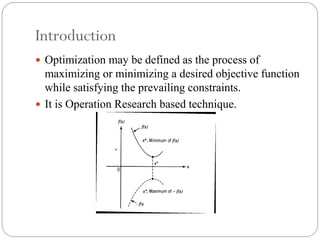
 Optimization may be defined as the process of
maximizing or minimizing a desired objective function
while satisfying the prevailing constraints.
 It is Operation Research based technique.
Statement of a Optimization Problem:
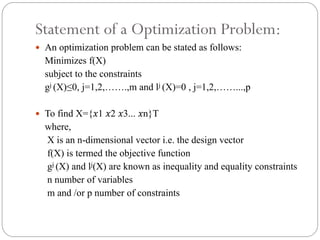
 An optimization problem can be stated as follows:
Minimizes f(X)
subject to the constraints
gj (X)≤0, j=1,2,…….,m and lj (X)=0 , j=1,2,……...,p
 To find X={𝑥1 𝑥2 𝑥3... 𝑥n}T
where,
X is an n-dimensional vector i.e. the design vector
f(X) is termed the objective function
gj (X) and lj(X) are known as inequality and equality constraints
n number of variables
m and /or p number of constraints
Objectives:
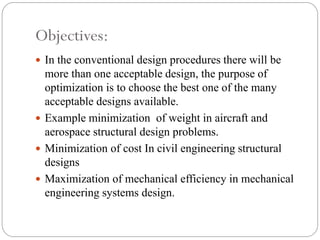
 In the conventional design procedures there will be
more than one acceptable design, the purpose of
optimization is to choose the best one of the many
acceptable designs available.
 Example minimization of weight in aircraft and
aerospace structural design problems.
 Minimization of cost In civil engineering structural
designs
 Maximization of mechanical efficiency in mechanical
engineering systems design.
Commonly used OptimizationTechniques
1. Mathematical ProgrammingTechniques : To find the
minimum of a function of several variables under a
prescribed set of constraints, e.g. sequential quadratic
programming (SQP)
2. Stochastic ProcessTechniques : To analyze problems
described by a set of random variables with known
probability distribution , e.g. queuing theory
3. StatisticalTechniques : To build empirical models from
experimental data through analysis, e.g. Design of
Experiments
Optimization based on Finite Elements
 Used for dynamic response, heat transfer, fluid flow,
deformation and stresses in a structure subjected to loads
and boundary conditions.
Classification :
a. Parameter or size optimization : The objective function is
typically weight of the structure and the constraints
reflecting limits on stress and displacement.
b. Shape optimization : deals with determining the outline of
a body, shape and/or size of a hole, etc. The main concept
is mesh parameterization
c. Topology optimization : distribution of material, creation
of holes, ribs or stiffeners, creation/deletion of elements,
etc.
Role of Optimization
Softwares used:
 ANSYS
 IDEAS
 CATIA
 Unigraphics NX
 TOSCA
Optimization Methods in ANSYS
 Subproblem Approximation:-
o It is an advanced zero-order method.
o Requires only the values of the dependent variables, and
not their derivatives.
o It converts problem to an unconstrained optimization
problem because minimization techniques for the latter
are more efficient.
o The conversion is done by adding penalties to the
objective function.
Optimization Methods in ANSYS
 First Order:-
o It is based on design sensitivities, for high accuracy.
o It converts the problem to an unconstrained one by
adding penalty functions to the objective function.
o finite element representation is minimized and not an
approximation.
o Both methods series of analysis-evaluation-modification
cycles.
ElementType
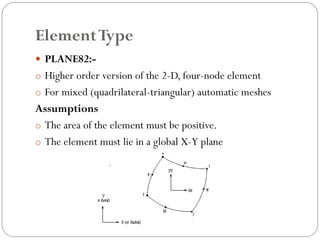
 PLANE82:-
o Higher order version of the 2-D, four-node element
o For mixed (quadrilateral-triangular) automatic meshes
Assumptions
o The area of the element must be positive.
o The element must lie in a global X-Y plane
Example:- Bracket
 Problem Formulation:-
o Minimize,
Volume = f(R1;R2;R3;R4;W) [10 mm3]
o Subject to,
0 ≤VM ≤ 349:33 [1 MPa]
25≤ R1 ≤ 45 [1 mm]
15 ≤ R2 ≤ 45 [1 mm]
5 ≤ R3 ≤ 45 [1 mm]
5 ≤ R4 ≤ 45 [1 mm]
5 ≤W ≤ 170 [1 mm]
Iterations
 Set 1:-
o V max- 344.58MPa
o Vol- 16199 mm3
 Set 2:-
o V max -283.73 MPa
o Vol-12956 mm3
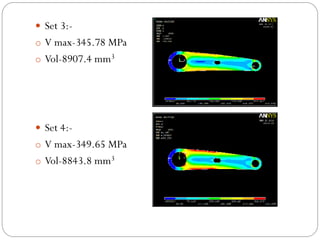
 Set 3:-
o V max-345.78 MPa
o Vol-8907.4 mm3
 Set 4:-
o V max-349.65 MPa
o Vol-8843.8 mm3
 Set 5:-
o V max-350.77 MPa
o Vol-8829.1 mm3
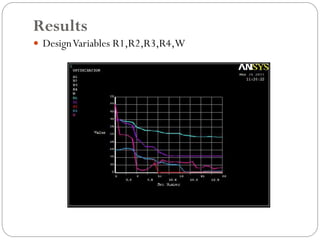
Results
 DesignVariables R1,R2,R3,R4,W
 Volume
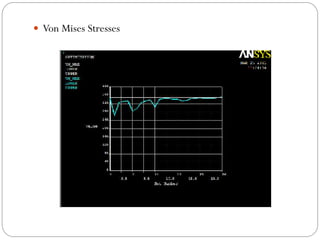
 Von Mises Stresses
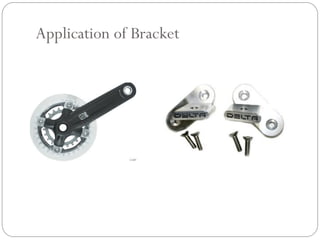
Application of Bracket
Conclusion
 The First order method is good method for optimization
 The optimization helps reduce 45.4% of the structure weight
 As material reduced then obviously cost is also reduced
References
 CAD Based Optimization by Celso Barcelos, Director of
Development MacNeal-Schwendler Corporation2003
 Multiphysics CAD-Based Design Optimization A. Vaidya, S.
Yang and J. St. Ville
 D. Spath, W. Neithardt and C. Bangert, “Integration of Topology
and Shape Optimization in the Design Process”, International
CIRP Design Seminar, Stockholm, June 2001.
 CAD-based Evolutionary Design Optimization with CATIA V5
Oliver KÄonig, Marc Winter mantel
 Structural optimization using ANSYS classic and radial basis
function based response surface models by Vijay Krishna
THE UNIVERSITY OFTEXAS AT ARLINGTON MAY 2009
 J.P. Leiva, and B.C. Watson, “Shape Optimization in the Genesis
Program”, Optimization in Industry II, Banff, Canada, Jun 6-100,
1999.
Thank You

Cad based shape optimization

  • 1.
    Presented By GuidedBy GoreA. S. Prof. Rodge M.K. 2010MME007 M.Tech. CAD/CAM CAD Based Optimization Department of Production Engineering, SGGSIE&T, Nanded
  • 2.
    Introduction  Optimization maybe defined as the process of maximizing or minimizing a desired objective function while satisfying the prevailing constraints.  It is Operation Research based technique.
  • 3.
    Statement of aOptimization Problem:  An optimization problem can be stated as follows: Minimizes f(X) subject to the constraints gj (X)≤0, j=1,2,…….,m and lj (X)=0 , j=1,2,……...,p  To find X={𝑥1 𝑥2 𝑥3... 𝑥n}T where, X is an n-dimensional vector i.e. the design vector f(X) is termed the objective function gj (X) and lj(X) are known as inequality and equality constraints n number of variables m and /or p number of constraints
  • 4.
    Objectives:  In theconventional design procedures there will be more than one acceptable design, the purpose of optimization is to choose the best one of the many acceptable designs available.  Example minimization of weight in aircraft and aerospace structural design problems.  Minimization of cost In civil engineering structural designs  Maximization of mechanical efficiency in mechanical engineering systems design.
  • 5.
    Commonly used OptimizationTechniques 1.Mathematical ProgrammingTechniques : To find the minimum of a function of several variables under a prescribed set of constraints, e.g. sequential quadratic programming (SQP) 2. Stochastic ProcessTechniques : To analyze problems described by a set of random variables with known probability distribution , e.g. queuing theory 3. StatisticalTechniques : To build empirical models from experimental data through analysis, e.g. Design of Experiments
  • 6.
    Optimization based onFinite Elements  Used for dynamic response, heat transfer, fluid flow, deformation and stresses in a structure subjected to loads and boundary conditions. Classification : a. Parameter or size optimization : The objective function is typically weight of the structure and the constraints reflecting limits on stress and displacement. b. Shape optimization : deals with determining the outline of a body, shape and/or size of a hole, etc. The main concept is mesh parameterization c. Topology optimization : distribution of material, creation of holes, ribs or stiffeners, creation/deletion of elements, etc.
  • 7.
  • 8.
    Softwares used:  ANSYS IDEAS  CATIA  Unigraphics NX  TOSCA
  • 9.
    Optimization Methods inANSYS  Subproblem Approximation:- o It is an advanced zero-order method. o Requires only the values of the dependent variables, and not their derivatives. o It converts problem to an unconstrained optimization problem because minimization techniques for the latter are more efficient. o The conversion is done by adding penalties to the objective function.
  • 10.
    Optimization Methods inANSYS  First Order:- o It is based on design sensitivities, for high accuracy. o It converts the problem to an unconstrained one by adding penalty functions to the objective function. o finite element representation is minimized and not an approximation. o Both methods series of analysis-evaluation-modification cycles.
  • 11.
    ElementType  PLANE82:- o Higherorder version of the 2-D, four-node element o For mixed (quadrilateral-triangular) automatic meshes Assumptions o The area of the element must be positive. o The element must lie in a global X-Y plane
  • 12.
  • 13.
     Problem Formulation:- oMinimize, Volume = f(R1;R2;R3;R4;W) [10 mm3] o Subject to, 0 ≤VM ≤ 349:33 [1 MPa] 25≤ R1 ≤ 45 [1 mm] 15 ≤ R2 ≤ 45 [1 mm] 5 ≤ R3 ≤ 45 [1 mm] 5 ≤ R4 ≤ 45 [1 mm] 5 ≤W ≤ 170 [1 mm]
  • 14.
    Iterations  Set 1:- oV max- 344.58MPa o Vol- 16199 mm3  Set 2:- o V max -283.73 MPa o Vol-12956 mm3
  • 15.
     Set 3:- oV max-345.78 MPa o Vol-8907.4 mm3  Set 4:- o V max-349.65 MPa o Vol-8843.8 mm3
  • 16.
     Set 5:- oV max-350.77 MPa o Vol-8829.1 mm3
  • 17.
  • 18.
  • 19.
     Von MisesStresses
  • 20.
  • 21.
    Conclusion  The Firstorder method is good method for optimization  The optimization helps reduce 45.4% of the structure weight  As material reduced then obviously cost is also reduced
  • 22.
    References  CAD BasedOptimization by Celso Barcelos, Director of Development MacNeal-Schwendler Corporation2003  Multiphysics CAD-Based Design Optimization A. Vaidya, S. Yang and J. St. Ville  D. Spath, W. Neithardt and C. Bangert, “Integration of Topology and Shape Optimization in the Design Process”, International CIRP Design Seminar, Stockholm, June 2001.  CAD-based Evolutionary Design Optimization with CATIA V5 Oliver KÄonig, Marc Winter mantel  Structural optimization using ANSYS classic and radial basis function based response surface models by Vijay Krishna THE UNIVERSITY OFTEXAS AT ARLINGTON MAY 2009  J.P. Leiva, and B.C. Watson, “Shape Optimization in the Genesis Program”, Optimization in Industry II, Banff, Canada, Jun 6-100, 1999.
  • 23.