‫َر‬‫د‬‫ـ‬ْ‫ق‬‫ـ‬ِ‫ن‬
،،،
‫لما‬
‫اننا‬ ‫نصدق‬
ْ
ْ‫ق‬ِ‫ن‬
‫َر‬‫د‬
LECTURE (2)
Optimum Design Problem Formulation
Assoc. Prof. Amr E. Mohamed
Introduction
❑ It is generally accepted that the proper definition and formulation of a
problem take roughly 50 percent of the total effort needed to solve it.
❑ Therefore, it is critical to follow well-defined procedures for
formulating design optimization problems.
❑ The optimum solution will be only as good as the formulation.
❑ For example, if we forget to include a critical constraint in the
formulation, the optimum solution will most likely violate it. Also, if we
have too many constraints, or if they are inconsistent, there may be no
solution.
2
The Problem Formulation Process
❑ The formulation of an optimum design problem involves translating a
descriptive statement of it into a well-defined mathematical statement.
❑ For most design optimization problems, we will use the following five-
step formulation procedure:
▪ Step 1: Project/problem description
▪ Step 2: Data and information collection
▪ Step 3: Definition of design variables
▪ Step 4: Optimization criterion
▪ Step 5: Formulation of constraints
3
Step 1: Project/Problem Description
❑ Are the Project Goals Clear?
❑ The formulation process begins by developing a descriptive statement
for the project/problem, usually by the project’s owner/sponsor.
❑ The statement describes the overall objectives of the project and the
requirements to be met.
4
Example: Design Of A Cantilever Beam—Problem Description
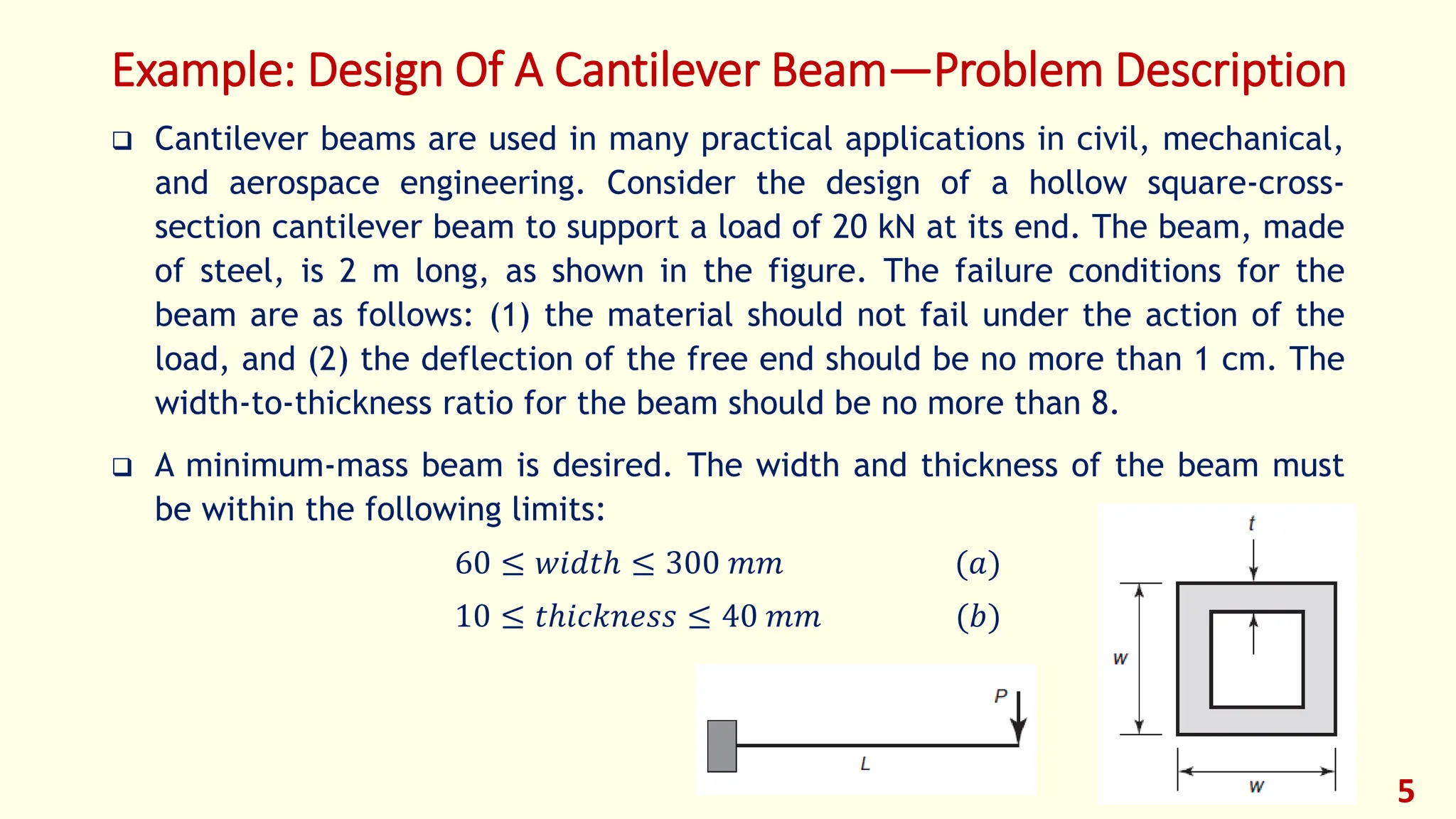
❑ Cantilever beams are used in many practical applications in civil, mechanical,
and aerospace engineering. Consider the design of a hollow square-cross-
section cantilever beam to support a load of 20 kN at its end. The beam, made
of steel, is 2 m long, as shown in the figure. The failure conditions for the
beam are as follows: (1) the material should not fail under the action of the
load, and (2) the deflection of the free end should be no more than 1 cm. The
width-to-thickness ratio for the beam should be no more than 8.
❑ A minimum-mass beam is desired. The width and thickness of the beam must
be within the following limits:
60 ≤ 𝑤𝑖𝑑𝑡ℎ ≤ 300 𝑚𝑚 (𝑎)
10 ≤ 𝑡ℎ𝑖𝑐𝑘𝑛𝑒𝑠𝑠 ≤ 40 𝑚𝑚 (𝑏)
5
Step 2: Data and Information Collection
❑ Is All the Information Available to Solve the Problem?
❑ To develop a mathematical formulation for the problem, we need to gather
information on material properties, performance requirements, resource
limits, cost of raw materials, and so forth.
❑ In addition, most problems require the capability to analyze trial designs.
❑ Therefore, analysis procedures and analysis tools must be identified at this
stage.
❑ For example, the finite-element method is commonly used for analysis of
structures, so the software tool available for such an analysis needs to be
identified.
❑ In many cases, the project statement is vague, and assumptions about
modeling of the problem need to be made in order to formulate and solve it.
6
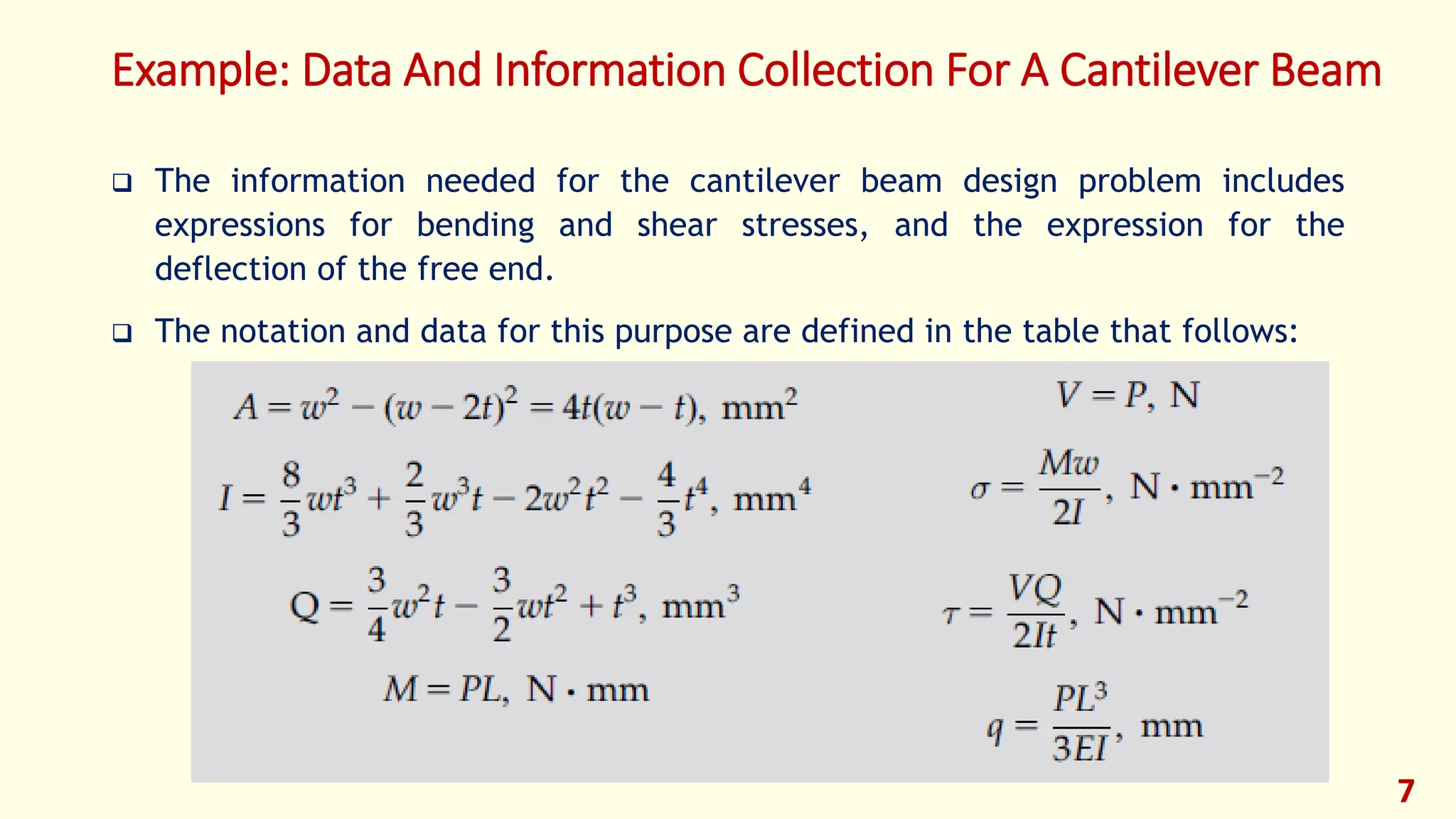
Example: Data And Information Collection For A Cantilever Beam
❑ The information needed for the cantilever beam design problem includes
expressions for bending and shear stresses, and the expression for the
deflection of the free end.
❑ The notation and data for this purpose are defined in the table that follows:
7
Step 3: Definition of Design Variables
❑ What Are These Variables? How Do I Identify Them?
❑ The next step in the formulation process is to identify a set of variables that
describe the system, called the design variables or optimization variables and are
regarded as free because we should be able to assign any value to them.
❑ A minimum number of design variables required to properly formulate a design
optimization problem must exist.
❑ The number of independent design variables gives the design degrees of freedom
for the problem.
❑ Different values for the variables produce different designs.
❑ The design variables should be independent of each other as far as possible. If
they are dependent, their values cannot be specified independently because there
are constraints between them.
❑ As many independent parameters as possible should be designated as design
variables at the problem formulation phase. Later on, some of the variables can
be assigned fixed values.
8
Example: Design Variables For A Cantilever Beam
❑ Only dimensions of the cross-section are identified as design variables for the
cantilever beam design problem; all other parameters are specified:
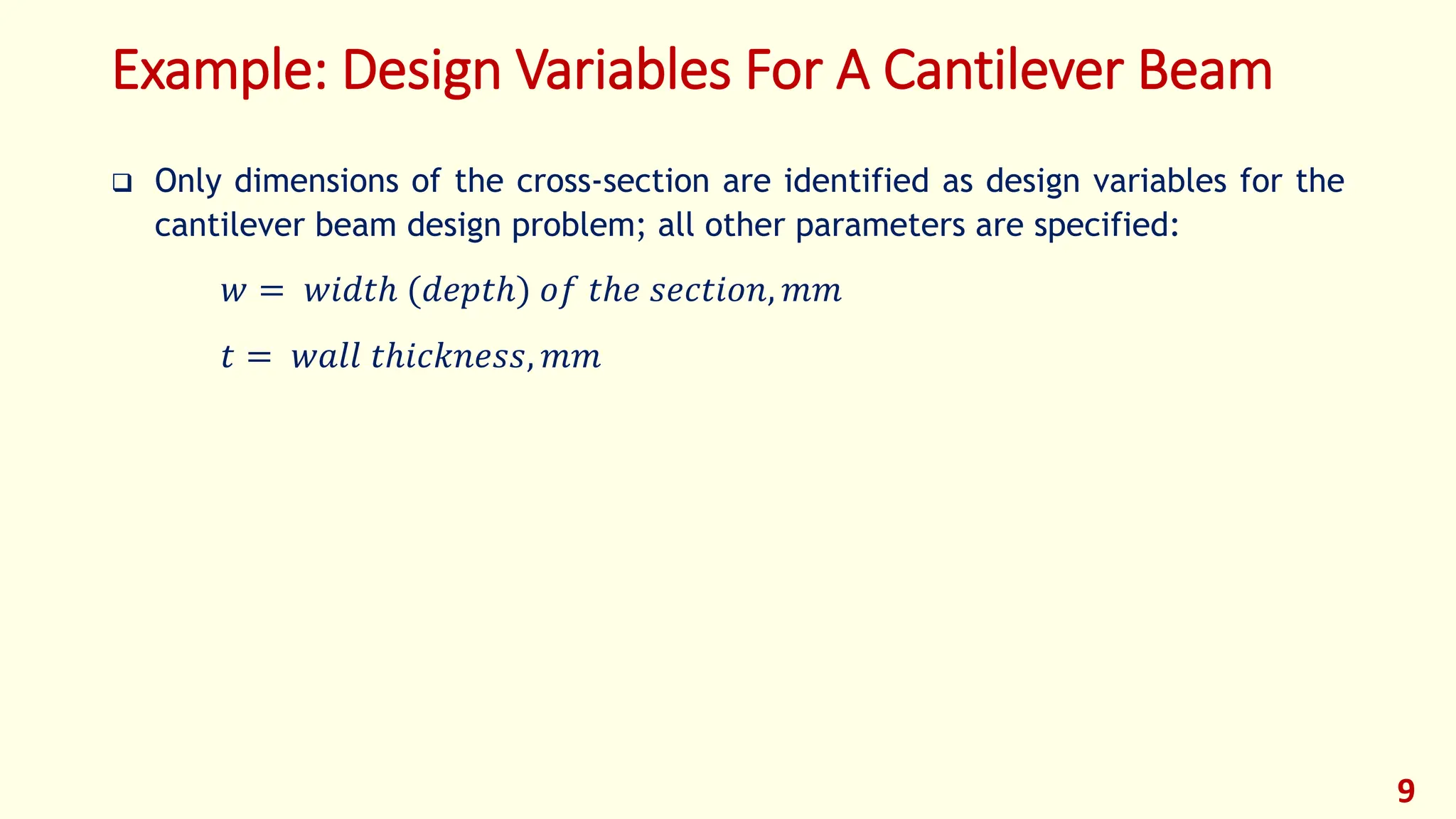
𝑤 = 𝑤𝑖𝑑𝑡ℎ (𝑑𝑒𝑝𝑡ℎ) 𝑜𝑓 𝑡ℎ𝑒 𝑠𝑒𝑐𝑡𝑖𝑜𝑛, 𝑚𝑚
𝑡 = 𝑤𝑎𝑙𝑙 𝑡ℎ𝑖𝑐𝑘𝑛𝑒𝑠𝑠, 𝑚𝑚
9
Step 4: Optimization Criterion
❑ How Do I Know that My Design Is the Best?
❑ We must have a criterion that associates a number with each design of many
feasible designs for a system.
❑ The criterion must be a scalar function of the design variable vector x.
❑ Such a criterion is usually called an objective function for the optimum design
problem, and it needs to be maximized or minimized depending on problem
requirements.
❑ A criterion that is to be minimized is usually called a cost function in
engineering literature, which is the term used throughout this text.
❑ The selection of a proper objective function is an important decision in the
design process.
❑ Some objective functions are cost (to be minimized), profit (to be maximized),
weight (to be minimized), energy expenditure (to be minimized), and, for
example, ride quality of a vehicle (to be maximized). 10
Example: Optimization Criterion For A Cantilever Beam
❑ For the Cantilever Beam design problem, the objective is to design a
minimum-mass cantilever beam.
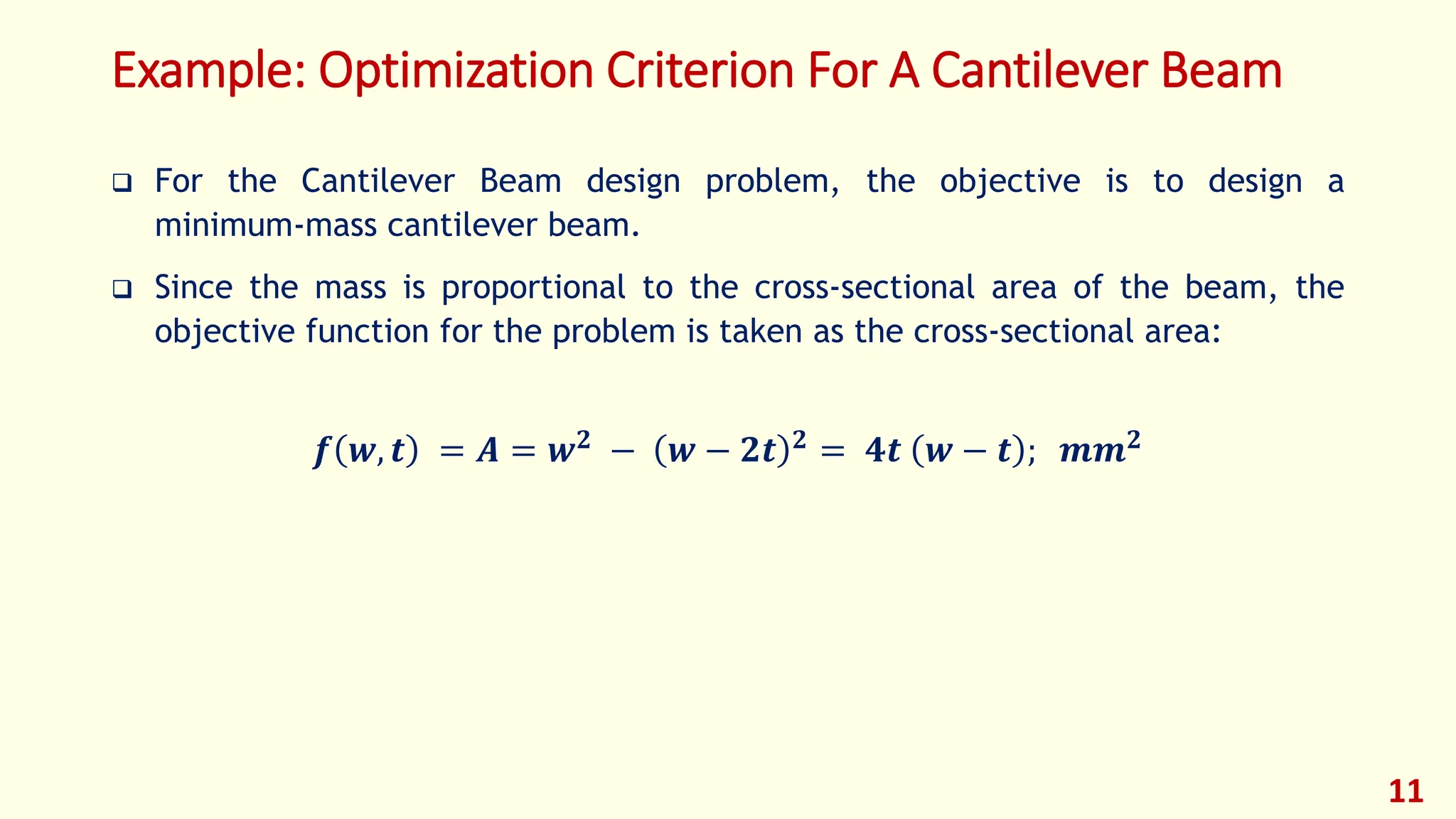
❑ Since the mass is proportional to the cross-sectional area of the beam, the
objective function for the problem is taken as the cross-sectional area:
𝒇 𝒘, 𝒕 = 𝑨 = 𝒘𝟐 − 𝒘 − 𝟐𝒕 𝟐 = 𝟒𝒕 𝒘 − 𝒕 ; 𝒎𝒎𝟐
11
Step 5: Formulation of Constraints
❑ What Restrictions Do I Have on My Design?
❑ All restrictions placed on the design are collectively called constraints. The
final step in the formulation process is to identify all constraints and develop
expressions for them.
❑ Most realistic systems must be designed and fabricated with the given
resources and must meet performance requirements.
❑ These constraints must depend on the design variables, that is, a meaningful
constraint must be a function of at least one design variable.
12
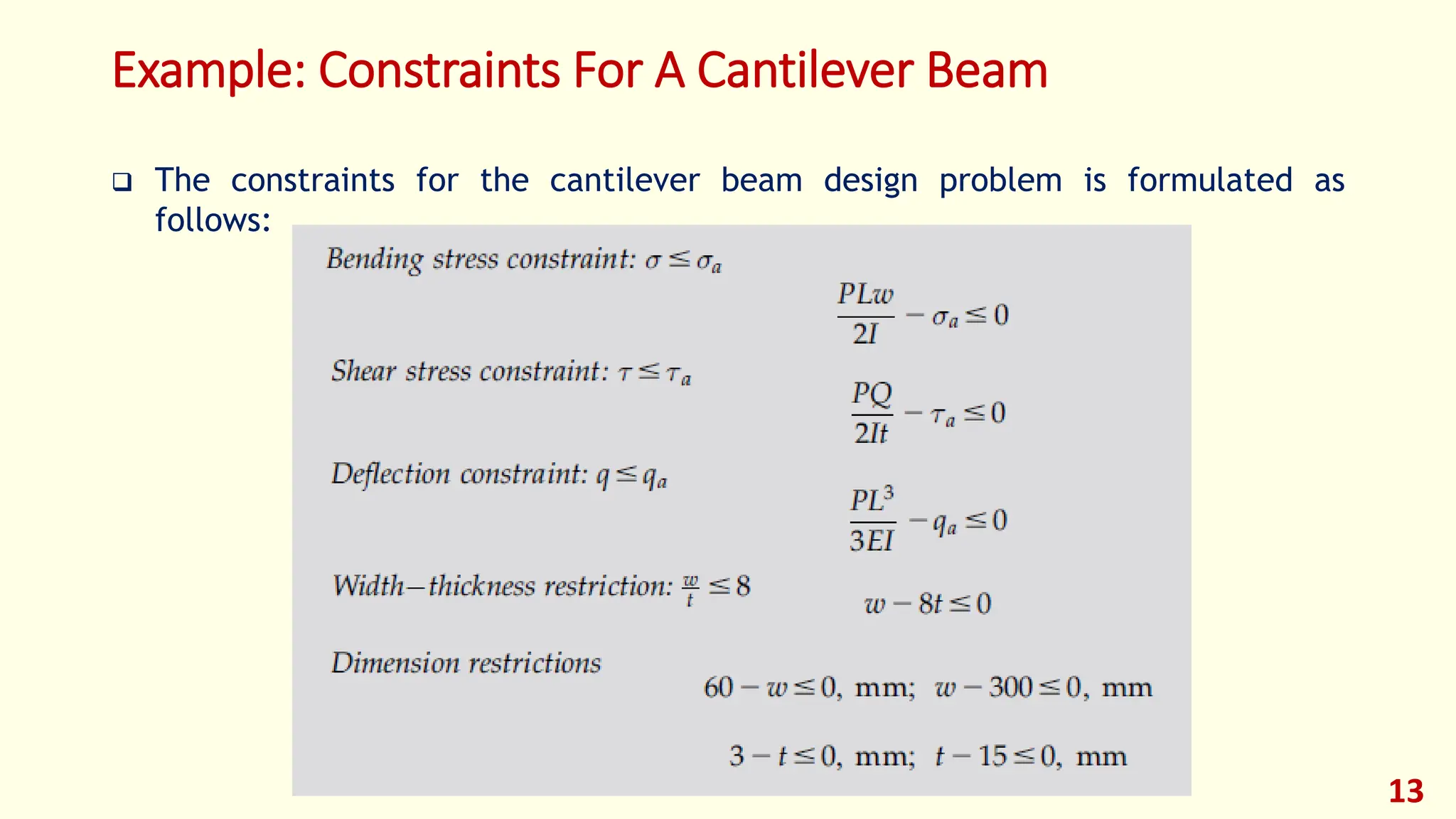
Example: Constraints For A Cantilever Beam
❑ The constraints for the cantilever beam design problem is formulated as
follows:
13
Example: DESIGN OF A CAN
14
Step 1: Project/Problem Description
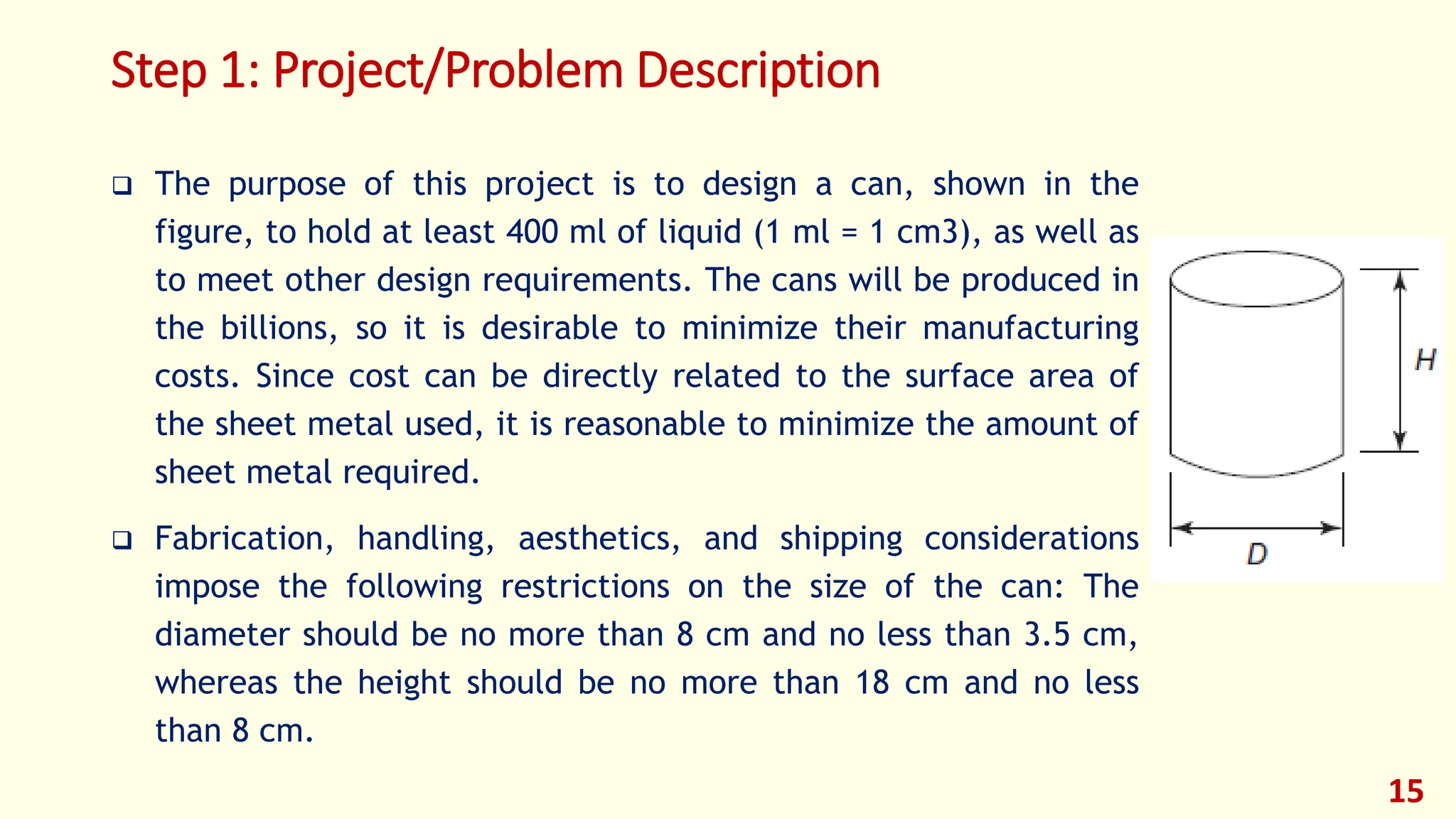
❑ The purpose of this project is to design a can, shown in the
figure, to hold at least 400 ml of liquid (1 ml = 1 cm3), as well as
to meet other design requirements. The cans will be produced in
the billions, so it is desirable to minimize their manufacturing
costs. Since cost can be directly related to the surface area of
the sheet metal used, it is reasonable to minimize the amount of
sheet metal required.
❑ Fabrication, handling, aesthetics, and shipping considerations
impose the following restrictions on the size of the can: The
diameter should be no more than 8 cm and no less than 3.5 cm,
whereas the height should be no more than 18 cm and no less
than 8 cm.
15
Step 2: Data And Information Collection
❑ Data for the problem are given in the project statement.
16
Step 3: Definition Of Design Variables
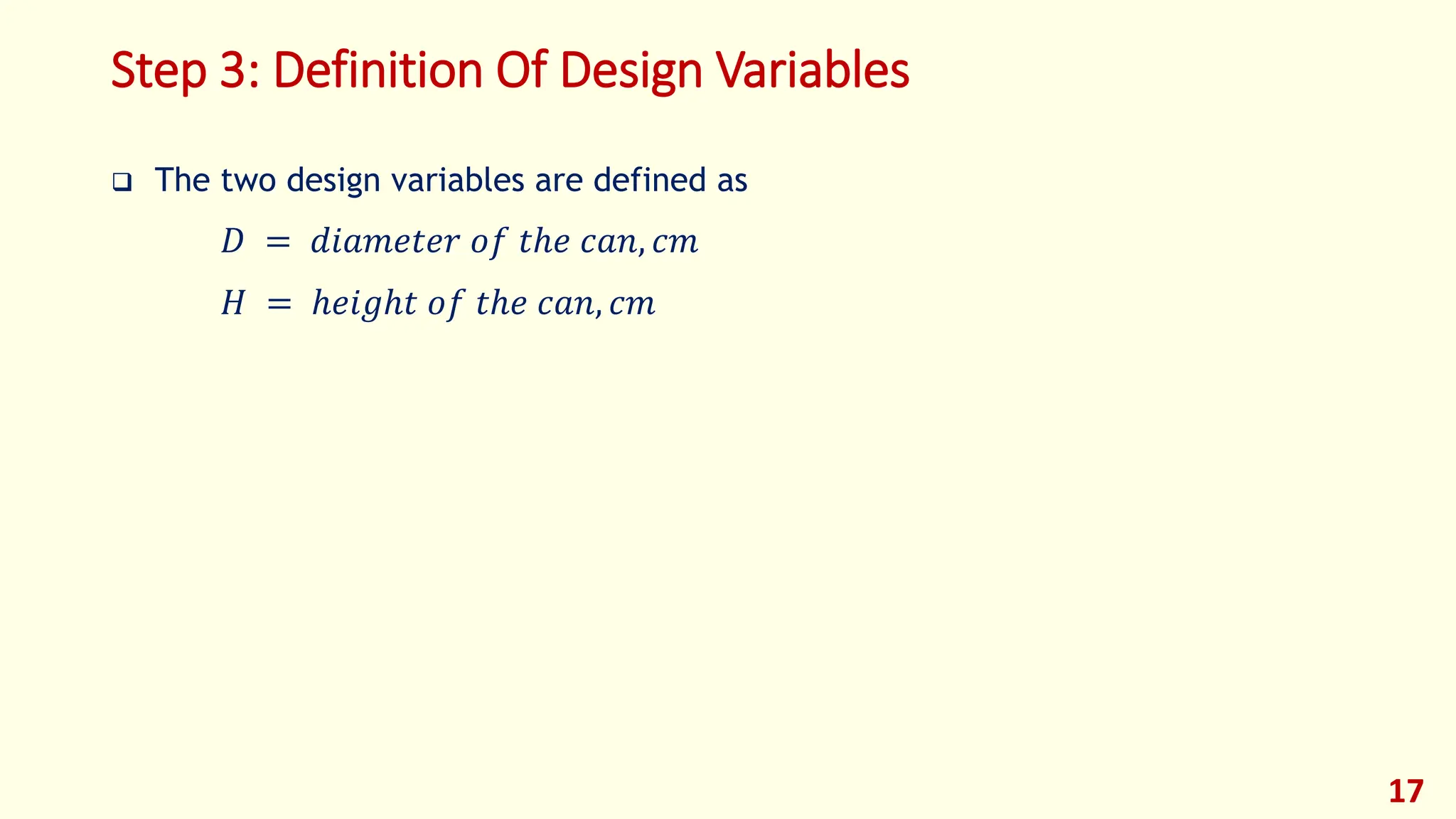
❑ The two design variables are defined as
𝐷 = 𝑑𝑖𝑎𝑚𝑒𝑡𝑒𝑟 𝑜𝑓 𝑡ℎ𝑒 𝑐𝑎𝑛, 𝑐𝑚
𝐻 = ℎ𝑒𝑖𝑔ℎ𝑡 𝑜𝑓 𝑡ℎ𝑒 𝑐𝑎𝑛, 𝑐𝑚
17
Step 4: Optimization Criterion
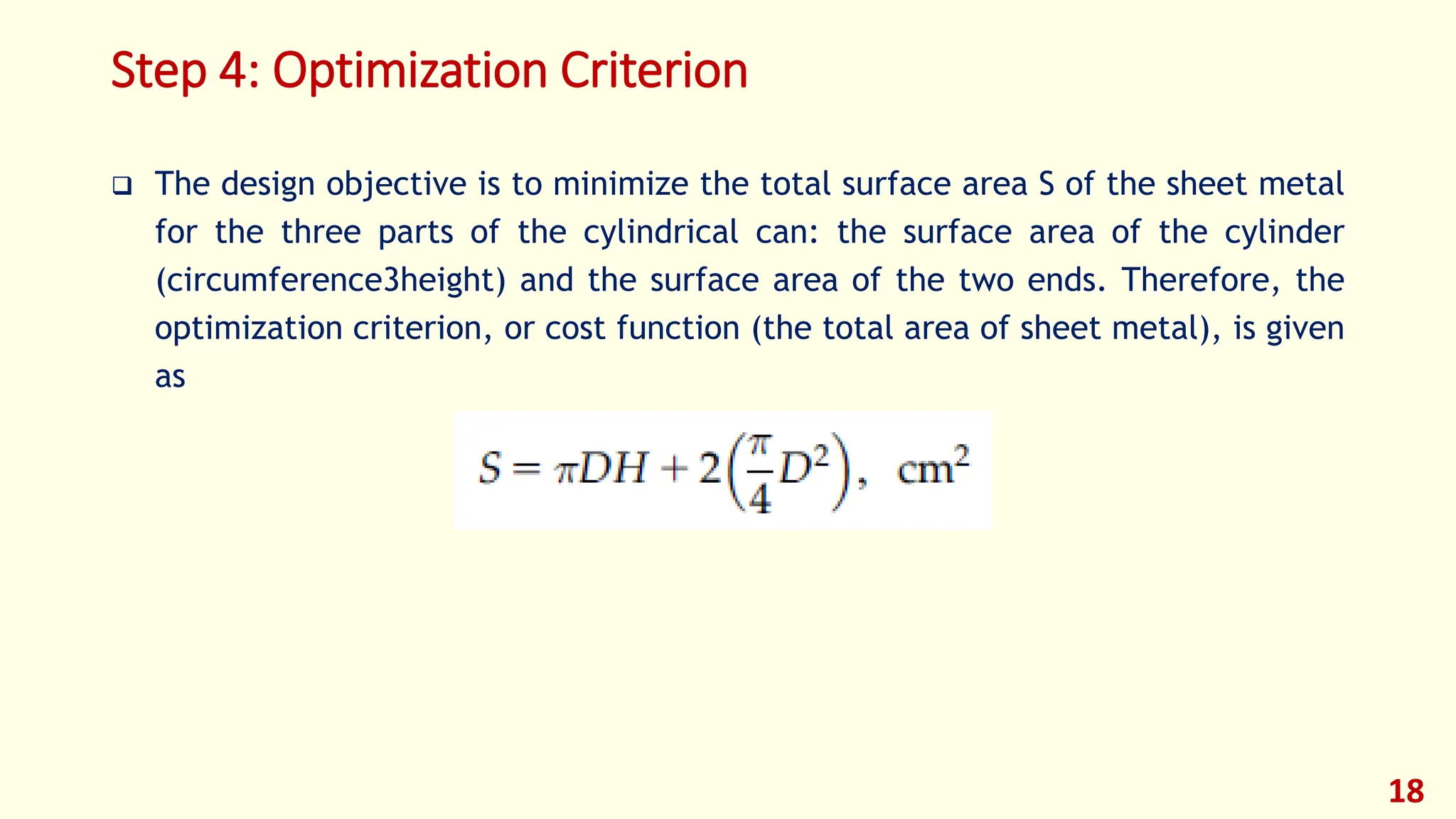
❑ The design objective is to minimize the total surface area S of the sheet metal
for the three parts of the cylindrical can: the surface area of the cylinder
(circumference3height) and the surface area of the two ends. Therefore, the
optimization criterion, or cost function (the total area of sheet metal), is given
as
18
Step 5: Formulation Of Constraints
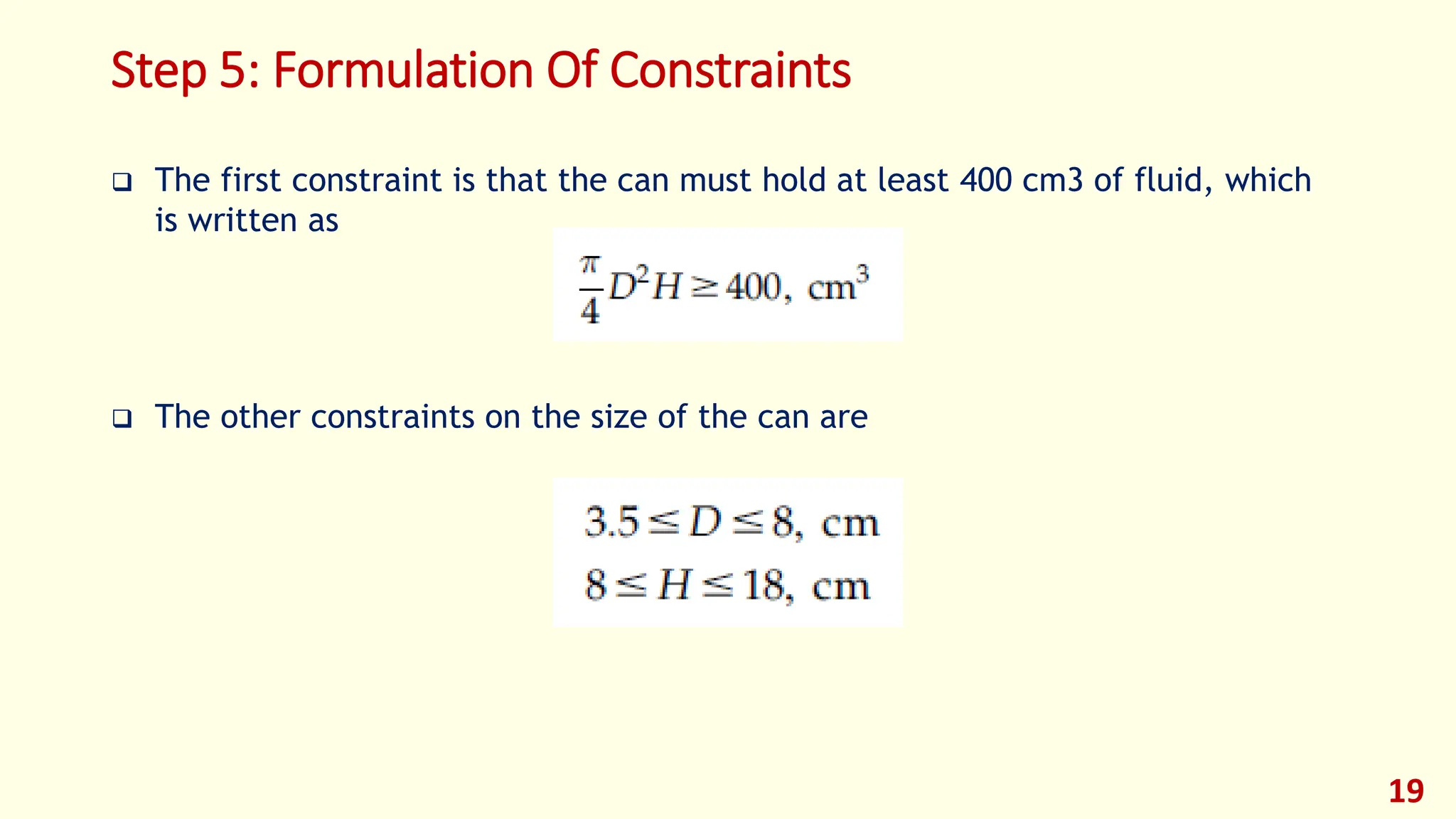
❑ The first constraint is that the can must hold at least 400 cm3 of fluid, which
is written as
❑ The other constraints on the size of the can are
19
20

CompEng - Lec02 - Optimum Design Problem Formulation.pdf

  • 1.
  • 2.
    Introduction ❑ It isgenerally accepted that the proper definition and formulation of a problem take roughly 50 percent of the total effort needed to solve it. ❑ Therefore, it is critical to follow well-defined procedures for formulating design optimization problems. ❑ The optimum solution will be only as good as the formulation. ❑ For example, if we forget to include a critical constraint in the formulation, the optimum solution will most likely violate it. Also, if we have too many constraints, or if they are inconsistent, there may be no solution. 2
  • 3.
    The Problem FormulationProcess ❑ The formulation of an optimum design problem involves translating a descriptive statement of it into a well-defined mathematical statement. ❑ For most design optimization problems, we will use the following five- step formulation procedure: ▪ Step 1: Project/problem description ▪ Step 2: Data and information collection ▪ Step 3: Definition of design variables ▪ Step 4: Optimization criterion ▪ Step 5: Formulation of constraints 3
  • 4.
    Step 1: Project/ProblemDescription ❑ Are the Project Goals Clear? ❑ The formulation process begins by developing a descriptive statement for the project/problem, usually by the project’s owner/sponsor. ❑ The statement describes the overall objectives of the project and the requirements to be met. 4
  • 5.
    Example: Design OfA Cantilever Beam—Problem Description ❑ Cantilever beams are used in many practical applications in civil, mechanical, and aerospace engineering. Consider the design of a hollow square-cross- section cantilever beam to support a load of 20 kN at its end. The beam, made of steel, is 2 m long, as shown in the figure. The failure conditions for the beam are as follows: (1) the material should not fail under the action of the load, and (2) the deflection of the free end should be no more than 1 cm. The width-to-thickness ratio for the beam should be no more than 8. ❑ A minimum-mass beam is desired. The width and thickness of the beam must be within the following limits: 60 ≤ 𝑤𝑖𝑑𝑡ℎ ≤ 300 𝑚𝑚 (𝑎) 10 ≤ 𝑡ℎ𝑖𝑐𝑘𝑛𝑒𝑠𝑠 ≤ 40 𝑚𝑚 (𝑏) 5
  • 6.
    Step 2: Dataand Information Collection ❑ Is All the Information Available to Solve the Problem? ❑ To develop a mathematical formulation for the problem, we need to gather information on material properties, performance requirements, resource limits, cost of raw materials, and so forth. ❑ In addition, most problems require the capability to analyze trial designs. ❑ Therefore, analysis procedures and analysis tools must be identified at this stage. ❑ For example, the finite-element method is commonly used for analysis of structures, so the software tool available for such an analysis needs to be identified. ❑ In many cases, the project statement is vague, and assumptions about modeling of the problem need to be made in order to formulate and solve it. 6
  • 7.
    Example: Data AndInformation Collection For A Cantilever Beam ❑ The information needed for the cantilever beam design problem includes expressions for bending and shear stresses, and the expression for the deflection of the free end. ❑ The notation and data for this purpose are defined in the table that follows: 7
  • 8.
    Step 3: Definitionof Design Variables ❑ What Are These Variables? How Do I Identify Them? ❑ The next step in the formulation process is to identify a set of variables that describe the system, called the design variables or optimization variables and are regarded as free because we should be able to assign any value to them. ❑ A minimum number of design variables required to properly formulate a design optimization problem must exist. ❑ The number of independent design variables gives the design degrees of freedom for the problem. ❑ Different values for the variables produce different designs. ❑ The design variables should be independent of each other as far as possible. If they are dependent, their values cannot be specified independently because there are constraints between them. ❑ As many independent parameters as possible should be designated as design variables at the problem formulation phase. Later on, some of the variables can be assigned fixed values. 8
  • 9.
    Example: Design VariablesFor A Cantilever Beam ❑ Only dimensions of the cross-section are identified as design variables for the cantilever beam design problem; all other parameters are specified: 𝑤 = 𝑤𝑖𝑑𝑡ℎ (𝑑𝑒𝑝𝑡ℎ) 𝑜𝑓 𝑡ℎ𝑒 𝑠𝑒𝑐𝑡𝑖𝑜𝑛, 𝑚𝑚 𝑡 = 𝑤𝑎𝑙𝑙 𝑡ℎ𝑖𝑐𝑘𝑛𝑒𝑠𝑠, 𝑚𝑚 9
  • 10.
    Step 4: OptimizationCriterion ❑ How Do I Know that My Design Is the Best? ❑ We must have a criterion that associates a number with each design of many feasible designs for a system. ❑ The criterion must be a scalar function of the design variable vector x. ❑ Such a criterion is usually called an objective function for the optimum design problem, and it needs to be maximized or minimized depending on problem requirements. ❑ A criterion that is to be minimized is usually called a cost function in engineering literature, which is the term used throughout this text. ❑ The selection of a proper objective function is an important decision in the design process. ❑ Some objective functions are cost (to be minimized), profit (to be maximized), weight (to be minimized), energy expenditure (to be minimized), and, for example, ride quality of a vehicle (to be maximized). 10
  • 11.
    Example: Optimization CriterionFor A Cantilever Beam ❑ For the Cantilever Beam design problem, the objective is to design a minimum-mass cantilever beam. ❑ Since the mass is proportional to the cross-sectional area of the beam, the objective function for the problem is taken as the cross-sectional area: 𝒇 𝒘, 𝒕 = 𝑨 = 𝒘𝟐 − 𝒘 − 𝟐𝒕 𝟐 = 𝟒𝒕 𝒘 − 𝒕 ; 𝒎𝒎𝟐 11
  • 12.
    Step 5: Formulationof Constraints ❑ What Restrictions Do I Have on My Design? ❑ All restrictions placed on the design are collectively called constraints. The final step in the formulation process is to identify all constraints and develop expressions for them. ❑ Most realistic systems must be designed and fabricated with the given resources and must meet performance requirements. ❑ These constraints must depend on the design variables, that is, a meaningful constraint must be a function of at least one design variable. 12
  • 13.
    Example: Constraints ForA Cantilever Beam ❑ The constraints for the cantilever beam design problem is formulated as follows: 13
  • 14.
  • 15.
    Step 1: Project/ProblemDescription ❑ The purpose of this project is to design a can, shown in the figure, to hold at least 400 ml of liquid (1 ml = 1 cm3), as well as to meet other design requirements. The cans will be produced in the billions, so it is desirable to minimize their manufacturing costs. Since cost can be directly related to the surface area of the sheet metal used, it is reasonable to minimize the amount of sheet metal required. ❑ Fabrication, handling, aesthetics, and shipping considerations impose the following restrictions on the size of the can: The diameter should be no more than 8 cm and no less than 3.5 cm, whereas the height should be no more than 18 cm and no less than 8 cm. 15
  • 16.
    Step 2: DataAnd Information Collection ❑ Data for the problem are given in the project statement. 16
  • 17.
    Step 3: DefinitionOf Design Variables ❑ The two design variables are defined as 𝐷 = 𝑑𝑖𝑎𝑚𝑒𝑡𝑒𝑟 𝑜𝑓 𝑡ℎ𝑒 𝑐𝑎𝑛, 𝑐𝑚 𝐻 = ℎ𝑒𝑖𝑔ℎ𝑡 𝑜𝑓 𝑡ℎ𝑒 𝑐𝑎𝑛, 𝑐𝑚 17
  • 18.
    Step 4: OptimizationCriterion ❑ The design objective is to minimize the total surface area S of the sheet metal for the three parts of the cylindrical can: the surface area of the cylinder (circumference3height) and the surface area of the two ends. Therefore, the optimization criterion, or cost function (the total area of sheet metal), is given as 18
  • 19.
    Step 5: FormulationOf Constraints ❑ The first constraint is that the can must hold at least 400 cm3 of fluid, which is written as ❑ The other constraints on the size of the can are 19
  • 20.