Florig, Sharmaine Grace B.
Ligtas, Lowela
Vulvar Cancer
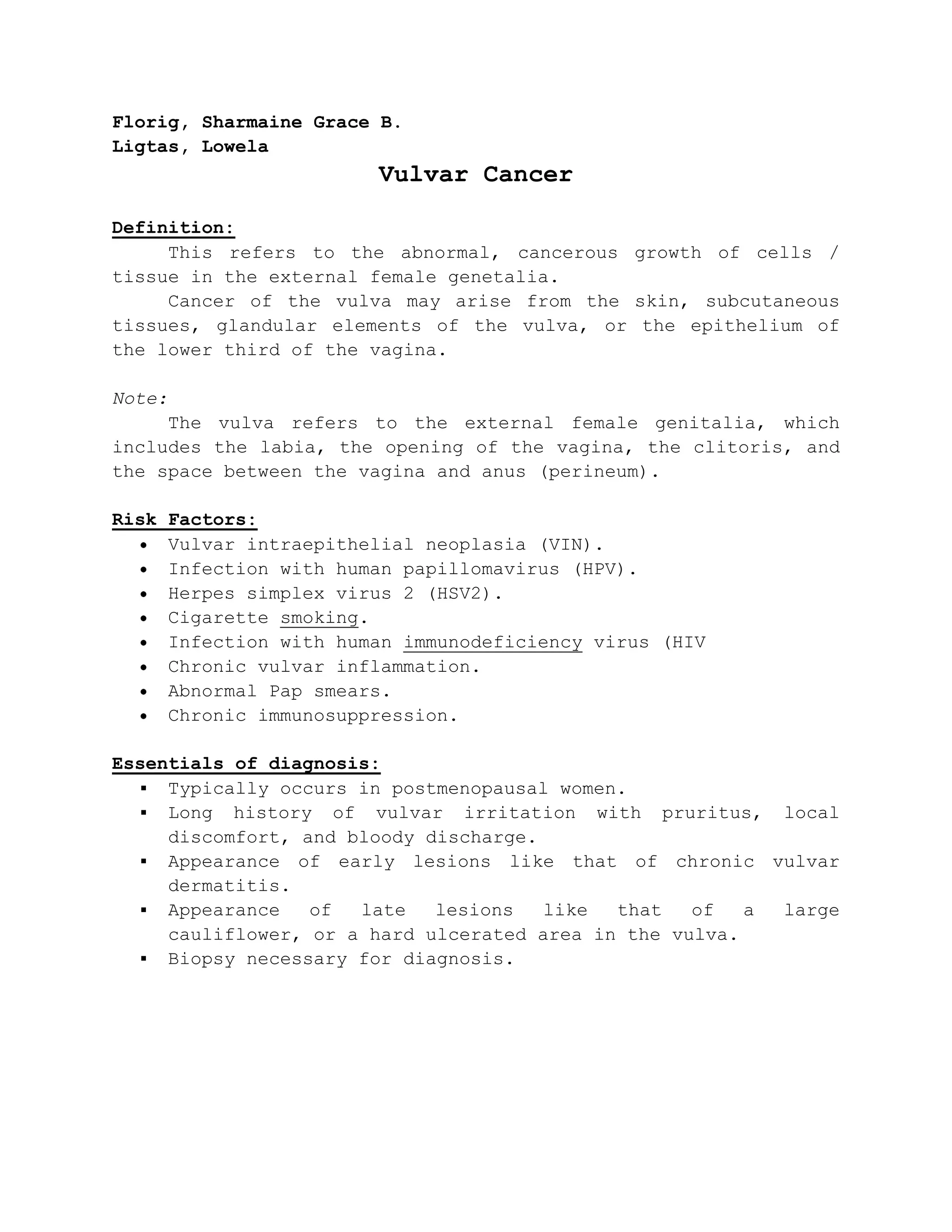
Definition:
This refers to the abnormal, cancerous growth of cells /
tissue in the external female genetalia.
Cancer of the vulva may arise from the skin, subcutaneous
tissues, glandular elements of the vulva, or the epithelium of
the lower third of the vagina.
Note:
The vulva refers to the external female genitalia, which
includes the labia, the opening of the vagina, the clitoris, and
the space between the vagina and anus (perineum).
Risk Factors:
Vulvar intraepithelial neoplasia (VIN).
Infection with human papillomavirus (HPV).
Herpes simplex virus 2 (HSV2).
Cigarette smoking.
Infection with human immunodeficiency virus (HIV
Chronic vulvar inflammation.
Abnormal Pap smears.
Chronic immunosuppression.
Essentials of diagnosis:
 Typically occurs in postmenopausal women.
 Long history of vulvar irritation with pruritus, local
discomfort, and bloody discharge.
 Appearance of early lesions like that of chronic vulvar
dermatitis.
 Appearance of late lesions like that of a large
cauliflower, or a hard ulcerated area in the vulva.
 Biopsy necessary for diagnosis.
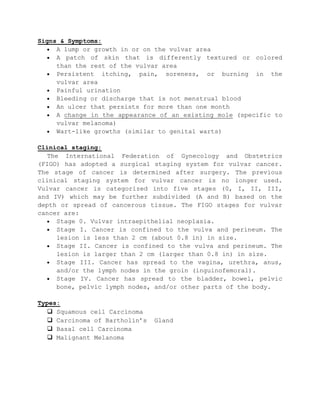
Signs & Symptoms:
A lump or growth in or on the vulvar area
A patch of skin that is differently textured or colored
than the rest of the vulvar area
Persistent itching, pain, soreness, or burning in the
vulvar area
Painful urination
Bleeding or discharge that is not menstrual blood
An ulcer that persists for more than one month
A change in the appearance of an existing mole (specific to
vulvar melanoma)
Wart-like growths (similar to genital warts)
Clinical staging:
The International Federation of Gynecology and Obstetrics
(FIGO) has adopted a surgical staging system for vulvar cancer.
The stage of cancer is determined after surgery. The previous
clinical staging system for vulvar cancer is no longer used.
Vulvar cancer is categorized into five stages (0, I, II, III,
and IV) which may be further subdivided (A and B) based on the
depth or spread of cancerous tissue. The FIGO stages for vulvar
cancer are:
Stage 0. Vulvar intraepithelial neoplasia.
Stage I. Cancer is confined to the vulva and perineum. The
lesion is less than 2 cm (about 0.8 in) in size.
Stage II. Cancer is confined to the vulva and perineum. The
lesion is larger than 2 cm (larger than 0.8 in) in size.
Stage III. Cancer has spread to the vagina, urethra, anus,
and/or the lymph nodes in the groin (inguinofemoral).
Stage IV. Cancer has spread to the bladder, bowel, pelvic
bone, pelvic lymph nodes, and/or other parts of the body.
Types:
 Squamous cell Carcinoma
 Carcinoma of Bartholin’s Gland
 Basal cell Carcinoma
 Malignant Melanoma
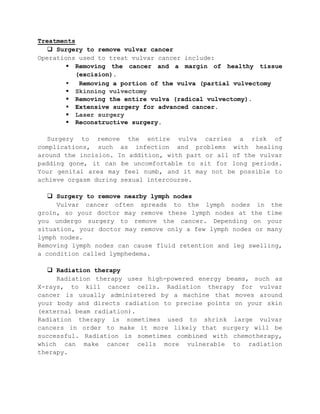
Treatments
 Surgery to remove vulvar cancer
Operations used to treat vulvar cancer include:
 Removing the cancer and a margin of healthy tissue
(excision).
 Removing a portion of the vulva (partial vulvectomy
 Skinning vulvectomy
 Removing the entire vulva (radical vulvectomy).
 Extensive surgery for advanced cancer.
 Laser surgery
 Reconstructive surgery.
Surgery to remove the entire vulva carries a risk of
complications, such as infection and problems with healing
around the incision. In addition, with part or all of the vulvar
padding gone, it can be uncomfortable to sit for long periods.
Your genital area may feel numb, and it may not be possible to
achieve orgasm during sexual intercourse.
 Surgery to remove nearby lymph nodes
Vulvar cancer often spreads to the lymph nodes in the
groin, so your doctor may remove these lymph nodes at the time
you undergo surgery to remove the cancer. Depending on your
situation, your doctor may remove only a few lymph nodes or many
lymph nodes.
Removing lymph nodes can cause fluid retention and leg swelling,
a condition called lymphedema.
 Radiation therapy
Radiation therapy uses high-powered energy beams, such as
X-rays, to kill cancer cells. Radiation therapy for vulvar
cancer is usually administered by a machine that moves around
your body and directs radiation to precise points on your skin
(external beam radiation).
Radiation therapy is sometimes used to shrink large vulvar
cancers in order to make it more likely that surgery will be
successful. Radiation is sometimes combined with chemotherapy,
which can make cancer cells more vulnerable to radiation
therapy.
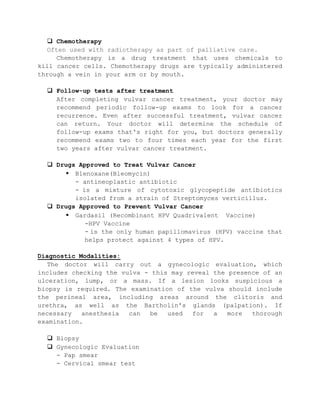
 Chemotherapy
Often used with radiotherapy as part of palliative care.
Chemotherapy is a drug treatment that uses chemicals to
kill cancer cells. Chemotherapy drugs are typically administered
through a vein in your arm or by mouth.
 Follow-up tests after treatment
After completing vulvar cancer treatment, your doctor may
recommend periodic follow-up exams to look for a cancer
recurrence. Even after successful treatment, vulvar cancer
can return. Your doctor will determine the schedule of
follow-up exams that's right for you, but doctors generally
recommend exams two to four times each year for the first
two years after vulvar cancer treatment.
 Drugs Approved to Treat Vulvar Cancer
 Blenoxane(Bleomycin)
- antineoplastic antibiotic
- is a mixture of cytotoxic glycopeptide antibiotics
isolated from a strain of Streptomyces verticillus.
 Drugs Approved to Prevent Vulvar Cancer
 Gardasil (Recombinant HPV Quadrivalent Vaccine)
-HPV Vaccine
- is the only human papillomavirus (HPV) vaccine that
helps protect against 4 types of HPV.
Diagnostic Modalities:
The doctor will carry out a gynecologic evaluation, which
includes checking the vulva - this may reveal the presence of an
ulceration, lump, or a mass. If a lesion looks suspicious a
biopsy is required. The examination of the vulva should include
the perineal area, including areas around the clitoris and
urethra, as well as the Bartholin's glands (palpation). If
necessary anesthesia can be used for a more thorough
examination.
 Biopsy
 Gynecologic Evaluation
- Pap smear
- Cervical smear test
 Further tests:
Depending on the results of the biopsy, the doctor may order
further tests:
Cystoscopy: The bladder is examined to determine whether
the cancer has spread to that area.
Proctoscopy: The rectum is examined to check whether the
cancer has spread to the rectal wall.
Imaging scans: Imaging scans can help the doctor determine
whether the cancer has spread, and if so, where to.
An MRI or CT scan may be used. X-rays may be used to
determine whether the cancer has reached the lungs.

Vulvar cancer report

  • 1.
    Florig, Sharmaine GraceB. Ligtas, Lowela Vulvar Cancer Definition: This refers to the abnormal, cancerous growth of cells / tissue in the external female genetalia. Cancer of the vulva may arise from the skin, subcutaneous tissues, glandular elements of the vulva, or the epithelium of the lower third of the vagina. Note: The vulva refers to the external female genitalia, which includes the labia, the opening of the vagina, the clitoris, and the space between the vagina and anus (perineum). Risk Factors: Vulvar intraepithelial neoplasia (VIN). Infection with human papillomavirus (HPV). Herpes simplex virus 2 (HSV2). Cigarette smoking. Infection with human immunodeficiency virus (HIV Chronic vulvar inflammation. Abnormal Pap smears. Chronic immunosuppression. Essentials of diagnosis:  Typically occurs in postmenopausal women.  Long history of vulvar irritation with pruritus, local discomfort, and bloody discharge.  Appearance of early lesions like that of chronic vulvar dermatitis.  Appearance of late lesions like that of a large cauliflower, or a hard ulcerated area in the vulva.  Biopsy necessary for diagnosis.
  • 2.
    Signs & Symptoms: Alump or growth in or on the vulvar area A patch of skin that is differently textured or colored than the rest of the vulvar area Persistent itching, pain, soreness, or burning in the vulvar area Painful urination Bleeding or discharge that is not menstrual blood An ulcer that persists for more than one month A change in the appearance of an existing mole (specific to vulvar melanoma) Wart-like growths (similar to genital warts) Clinical staging: The International Federation of Gynecology and Obstetrics (FIGO) has adopted a surgical staging system for vulvar cancer. The stage of cancer is determined after surgery. The previous clinical staging system for vulvar cancer is no longer used. Vulvar cancer is categorized into five stages (0, I, II, III, and IV) which may be further subdivided (A and B) based on the depth or spread of cancerous tissue. The FIGO stages for vulvar cancer are: Stage 0. Vulvar intraepithelial neoplasia. Stage I. Cancer is confined to the vulva and perineum. The lesion is less than 2 cm (about 0.8 in) in size. Stage II. Cancer is confined to the vulva and perineum. The lesion is larger than 2 cm (larger than 0.8 in) in size. Stage III. Cancer has spread to the vagina, urethra, anus, and/or the lymph nodes in the groin (inguinofemoral). Stage IV. Cancer has spread to the bladder, bowel, pelvic bone, pelvic lymph nodes, and/or other parts of the body. Types:  Squamous cell Carcinoma  Carcinoma of Bartholin’s Gland  Basal cell Carcinoma  Malignant Melanoma
  • 3.
    Treatments  Surgery toremove vulvar cancer Operations used to treat vulvar cancer include:  Removing the cancer and a margin of healthy tissue (excision).  Removing a portion of the vulva (partial vulvectomy  Skinning vulvectomy  Removing the entire vulva (radical vulvectomy).  Extensive surgery for advanced cancer.  Laser surgery  Reconstructive surgery. Surgery to remove the entire vulva carries a risk of complications, such as infection and problems with healing around the incision. In addition, with part or all of the vulvar padding gone, it can be uncomfortable to sit for long periods. Your genital area may feel numb, and it may not be possible to achieve orgasm during sexual intercourse.  Surgery to remove nearby lymph nodes Vulvar cancer often spreads to the lymph nodes in the groin, so your doctor may remove these lymph nodes at the time you undergo surgery to remove the cancer. Depending on your situation, your doctor may remove only a few lymph nodes or many lymph nodes. Removing lymph nodes can cause fluid retention and leg swelling, a condition called lymphedema.  Radiation therapy Radiation therapy uses high-powered energy beams, such as X-rays, to kill cancer cells. Radiation therapy for vulvar cancer is usually administered by a machine that moves around your body and directs radiation to precise points on your skin (external beam radiation). Radiation therapy is sometimes used to shrink large vulvar cancers in order to make it more likely that surgery will be successful. Radiation is sometimes combined with chemotherapy, which can make cancer cells more vulnerable to radiation therapy.
  • 4.
     Chemotherapy Often usedwith radiotherapy as part of palliative care. Chemotherapy is a drug treatment that uses chemicals to kill cancer cells. Chemotherapy drugs are typically administered through a vein in your arm or by mouth.  Follow-up tests after treatment After completing vulvar cancer treatment, your doctor may recommend periodic follow-up exams to look for a cancer recurrence. Even after successful treatment, vulvar cancer can return. Your doctor will determine the schedule of follow-up exams that's right for you, but doctors generally recommend exams two to four times each year for the first two years after vulvar cancer treatment.  Drugs Approved to Treat Vulvar Cancer  Blenoxane(Bleomycin) - antineoplastic antibiotic - is a mixture of cytotoxic glycopeptide antibiotics isolated from a strain of Streptomyces verticillus.  Drugs Approved to Prevent Vulvar Cancer  Gardasil (Recombinant HPV Quadrivalent Vaccine) -HPV Vaccine - is the only human papillomavirus (HPV) vaccine that helps protect against 4 types of HPV. Diagnostic Modalities: The doctor will carry out a gynecologic evaluation, which includes checking the vulva - this may reveal the presence of an ulceration, lump, or a mass. If a lesion looks suspicious a biopsy is required. The examination of the vulva should include the perineal area, including areas around the clitoris and urethra, as well as the Bartholin's glands (palpation). If necessary anesthesia can be used for a more thorough examination.  Biopsy  Gynecologic Evaluation - Pap smear - Cervical smear test
  • 5.
     Further tests: Dependingon the results of the biopsy, the doctor may order further tests: Cystoscopy: The bladder is examined to determine whether the cancer has spread to that area. Proctoscopy: The rectum is examined to check whether the cancer has spread to the rectal wall. Imaging scans: Imaging scans can help the doctor determine whether the cancer has spread, and if so, where to. An MRI or CT scan may be used. X-rays may be used to determine whether the cancer has reached the lungs.