Carcinoid Syndrome and
Endocrinology
Dr Vikram Singh Chauhan(MD, DM)
Consulting Endocrinologist: Dr
Chauhan’s Clinic and Jabalpur Hospital
& Research Center, Jabalpur
Carcinoid Tumours and Syndrome
• Carcinoid tumours (neuroendocrine
neoplasms) usually originate in hormone-
producing cells that line the small intestine or
other parts of the digestive tract; also occur in
the pancreas, lungs (bronchial carcinoid);
rarely testes or ovaries
• Carcinoid syndrome: diverse set of symptoms
due to excess hormones produced by
carcinoid tumours
Epidemiology
• Occurs mainly in gastrointestinal or lung related
NEN
• Incidence of carcinoid syndrome- 1 :100 000
population¹
• Carcinoid syndrome: prevalence of ~20% in
NENs²
• Small intestine(42%), rectum(27%),
bronchopulmonary(25%), stomach(8.7%)3
1. The Lancet Oncology, 18(4), 525–534. 2017
2. Neuroendocrinology, 90(4) 349–363 2009
3. Cancer 97:934–959 2003
• Carcinoid syndrome function of:
-- Tumour mass
-- extent and localization of metastases
-- localization of the primary tumour
• Most common in tumours originating in small
intestine and proximal colon: 40%-60% patients
with these tumours experience syndrome¹
• Less common: bronchial, midgut, rectal
• Syndromic patients: liver metastasis²
1. Am J Cardiol. 21:376-387 1968 2. J Am Med Assoc. 186:905-907 1963
Clinical Features
• Diarrhoea: occurs in ~80%
• Secretory– fluid & electrolyte imbalance
possible
• Due to increased GI motility caused by
hormones of tumour: serotonin, tachykinins,
histamines, kallikrein, and prostaglandins,
can stimulate peristalsis, electromechanical
activity and intestinal tone
Semin Gastrointest Dis. 10:156-172 1999
Clinical Features
• Flushing: ~70%
• 4 described types:
-- Erythematous: midgut carcinoid, disease onset
-- Violaceous: midgut carcinoid, later stages
-- Prolonged: malignant bronchial carcinoids
-- Bright red: gastric carcinoids(ECLomas)
• Usual areas: face, neck, and upper chest
Am J Cardiol. 21:376-387 1968
Clinical Features
Precipitating factors for flushing:
--Stress
-- Stimulation of the vagus nerve by brushing
of teeth or mastication
-- Ingestion of alcohol or tyramine-containing
foods such as cheese, coffee, chocolate, nuts,
avocado, bananas, and red wine
EurJ Endocrinol 177(5): 219–229 2017
J Am Acad Dermatol. 2006. 55(2): 193-208
Clinical Features
• Abdominal Pain: ~40%; related to mesenteric
fibrosis
• Wheezing/bronchospasm: 10-20%; related to
hormone excess
• Palpitations: upto 30 minutes
• Itching/skin rashes: histamine related
Endocrine Reviews, vol. 25, no. 3, pp. 458–511, 2004
Clinical Features
• Carcinoid Heart Disease: plaque-like
thickenings of the endocardium, valve leaflets,
atria, and ventricles¹,2
• 10% to 20% of the patients1,2
• Stenosis and regurgitation
• New collagen beneath endothelium of
endocardium: almost pathognomonic for
carcinoid heart disease1
1. Circulation. 77:264-269 1988
2. Am J Med. 36:5-34 1964
Clinical Features
• Carcinoid Heart Disease: Right sided fibrosis—
in patients with liver metastases who usually
also have the carcinoid syndrome
• Correlation between circulating levels of
serotonin and tachykinins and degree and
frequency of carcinoid heart lesions
• NT-proBNP: best diagnostic and prognostic
marker of carcinoid heart disease1
1. Int J Cardiol. 173:29-32 2014
Carcinoid Crisis
• Spontaneously or during induction of anesthesia,
embolization procedures, chemotherapy, or
infection
• Characterized by
--Severe flushing
--Diarrhea
--Hypotension
--Hyperthermia
--Tachycardia
• Octreotide (IV or SC) given pre, intra, and post op
N Engl J Med. 313:1229-1230 1985
Clinical Features
• Cushing syndrome: ectopic ACTH/CRH--
pulmonary and thymic carcinoids
• Acromegaly: ectopic GHRH-- foregut carcinoids
• Gastric carcinoids:
--Type 1—chronic atrophic gastritis
--Type 2– ZES
--Type 3– sporadic, more malignant, no
hypergastrinemia
Biosynthesis of Serotonin
Classification
Classification
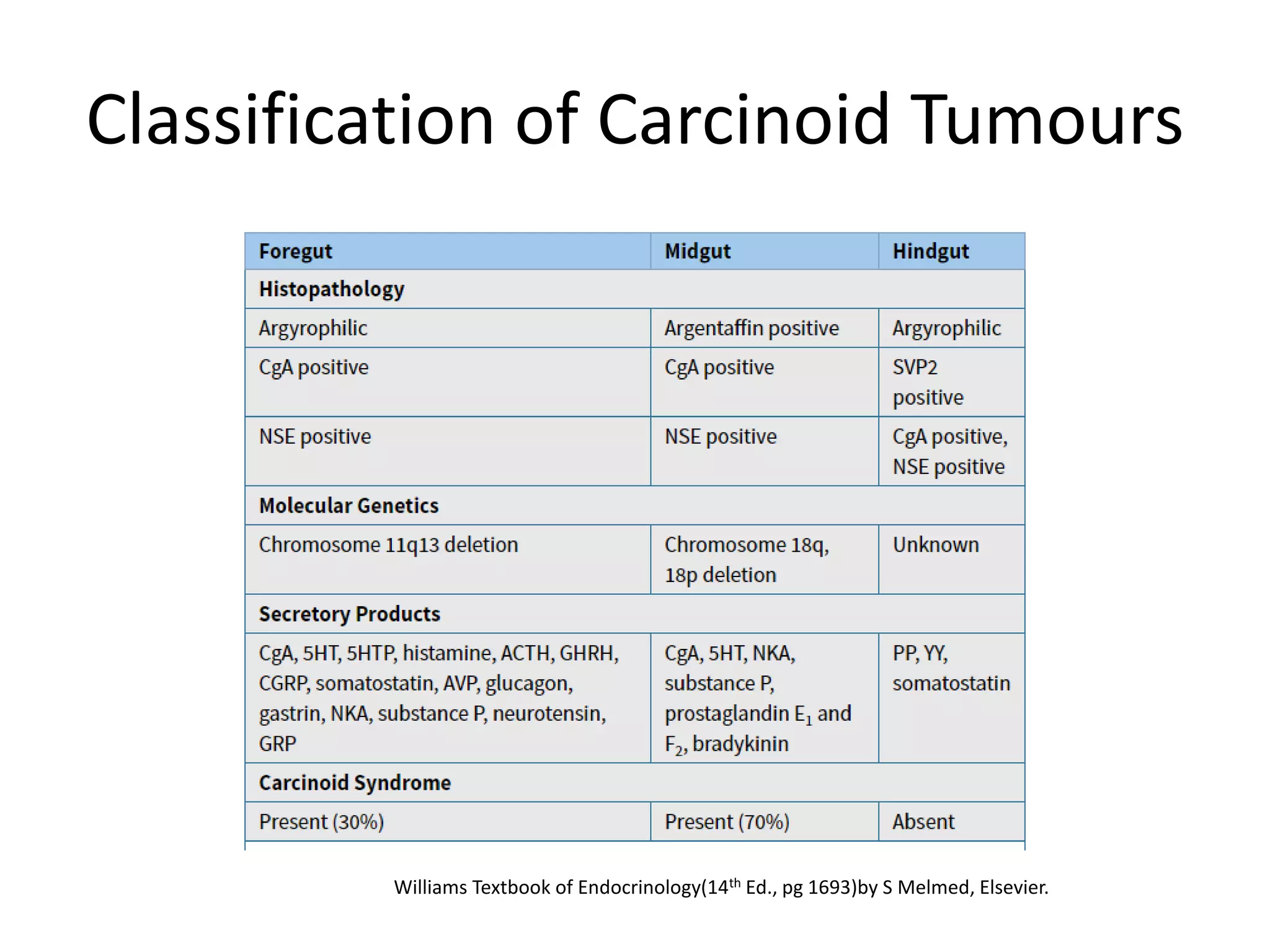
Classification of Carcinoid Tumours
Williams Textbook of Endocrinology(14th Ed., pg 1693)by S Melmed, Elsevier.
Diagnosis
• 24 hour urinary 5HIAA
• Less sensitive, more specific
• Serum CgA: more sensitive and less specific
than urinary 5HIAA
• Platelet serotonin levels
• Plasma NSE: less sensitive and specific than
CgA; useful in lung NENs and NENs with higher
proliferation
Interferences in 5HIAA Assays
False positive False negative
Endocrinology: Adult and Pediatric (7th ed., pg 2623)by JL Jameson, 2016, Elsevier Saunders.
Localization
• Whole-body SRS: preferred initial modality
earlier: 111In-DTPA-Phe-octreotide
(Octreoscan)
• 68Ga-DOTATATE/TOC-PET scanning: higher
sensitivity than Octreoscan
• CT/MRI: for liver metastasis
• 18F-DOPA-PET scanning using 11C5HTP: useful
to monitor therapy results
International Journal of Endocrine Oncology, 6(2). https://doi.org/10.2217/ije-
2019-0001
Treatment
• Tumour reduction and symptomatic control
• Long-acting somatostatin analogues:
cornerstones
• Bind to SSTR1, SSTR5, SSTR3: Lower growth factor
production & antiproliferative effect
• Octreotide, Octreotide LAR, Lanreotide
• Reduction in tumour size demonstrated with high
dose therapy
• Tachyphylaxis, GI side effects, gallstone
development
Treatment
• Interferon alpha 2a and alpha 2b
• Biochemical control and size reduction
• Can be combined with somatostatin
analogues
• Chronic fatigue syndrome, anemia,
luekopenia, thrombocytopenia, autoimmunity
development
Treatment
• Chemotherapy:
--Streptozotocin plus 5-fluorouracil
--Doxorubicin
--Cisplatin plus etoposide
--Dacarbazine plus 5-fluorouracil
--Temozolomide
• Attempted in foregut carcinoids(more
malignant)
• Cancer. 68:227-232 1991
• Ann Oncol. 6:77-79 1995
• Cancer. 83:372-378 1998
• Clin Cancer Res. 13:2986-2991 2007
Treatment
• Surgery: Debulking procedures
• Resection of local disease
• Hepatic artery embolization
Treatment
• External beam irradiation: palliative for brain
and bone mets
• Somatostatin analogue–based tumor-targeted
radioactive treatment: 125I-MIBG or 131I-MIBG,
111In-DTPA-octreotide, 90Y-DOTA-octreotide,
177Lu-DOTA-octreotate
Management: Proposed Algorithm
J Oncol.2020;2020:8341426
Thank You Very Much

Carcinoid Syndrome.pptx

  • 1.
    Carcinoid Syndrome and Endocrinology DrVikram Singh Chauhan(MD, DM) Consulting Endocrinologist: Dr Chauhan’s Clinic and Jabalpur Hospital & Research Center, Jabalpur
  • 2.
    Carcinoid Tumours andSyndrome • Carcinoid tumours (neuroendocrine neoplasms) usually originate in hormone- producing cells that line the small intestine or other parts of the digestive tract; also occur in the pancreas, lungs (bronchial carcinoid); rarely testes or ovaries • Carcinoid syndrome: diverse set of symptoms due to excess hormones produced by carcinoid tumours
  • 3.
    Epidemiology • Occurs mainlyin gastrointestinal or lung related NEN • Incidence of carcinoid syndrome- 1 :100 000 population¹ • Carcinoid syndrome: prevalence of ~20% in NENs² • Small intestine(42%), rectum(27%), bronchopulmonary(25%), stomach(8.7%)3 1. The Lancet Oncology, 18(4), 525–534. 2017 2. Neuroendocrinology, 90(4) 349–363 2009 3. Cancer 97:934–959 2003
  • 4.
    • Carcinoid syndromefunction of: -- Tumour mass -- extent and localization of metastases -- localization of the primary tumour • Most common in tumours originating in small intestine and proximal colon: 40%-60% patients with these tumours experience syndrome¹ • Less common: bronchial, midgut, rectal • Syndromic patients: liver metastasis² 1. Am J Cardiol. 21:376-387 1968 2. J Am Med Assoc. 186:905-907 1963
  • 5.
    Clinical Features • Diarrhoea:occurs in ~80% • Secretory– fluid & electrolyte imbalance possible • Due to increased GI motility caused by hormones of tumour: serotonin, tachykinins, histamines, kallikrein, and prostaglandins, can stimulate peristalsis, electromechanical activity and intestinal tone Semin Gastrointest Dis. 10:156-172 1999
  • 6.
    Clinical Features • Flushing:~70% • 4 described types: -- Erythematous: midgut carcinoid, disease onset -- Violaceous: midgut carcinoid, later stages -- Prolonged: malignant bronchial carcinoids -- Bright red: gastric carcinoids(ECLomas) • Usual areas: face, neck, and upper chest Am J Cardiol. 21:376-387 1968
  • 7.
    Clinical Features Precipitating factorsfor flushing: --Stress -- Stimulation of the vagus nerve by brushing of teeth or mastication -- Ingestion of alcohol or tyramine-containing foods such as cheese, coffee, chocolate, nuts, avocado, bananas, and red wine EurJ Endocrinol 177(5): 219–229 2017
  • 8.
    J Am AcadDermatol. 2006. 55(2): 193-208
  • 9.
    Clinical Features • AbdominalPain: ~40%; related to mesenteric fibrosis • Wheezing/bronchospasm: 10-20%; related to hormone excess • Palpitations: upto 30 minutes • Itching/skin rashes: histamine related Endocrine Reviews, vol. 25, no. 3, pp. 458–511, 2004
  • 10.
    Clinical Features • CarcinoidHeart Disease: plaque-like thickenings of the endocardium, valve leaflets, atria, and ventricles¹,2 • 10% to 20% of the patients1,2 • Stenosis and regurgitation • New collagen beneath endothelium of endocardium: almost pathognomonic for carcinoid heart disease1 1. Circulation. 77:264-269 1988 2. Am J Med. 36:5-34 1964
  • 11.
    Clinical Features • CarcinoidHeart Disease: Right sided fibrosis— in patients with liver metastases who usually also have the carcinoid syndrome • Correlation between circulating levels of serotonin and tachykinins and degree and frequency of carcinoid heart lesions • NT-proBNP: best diagnostic and prognostic marker of carcinoid heart disease1 1. Int J Cardiol. 173:29-32 2014
  • 12.
    Carcinoid Crisis • Spontaneouslyor during induction of anesthesia, embolization procedures, chemotherapy, or infection • Characterized by --Severe flushing --Diarrhea --Hypotension --Hyperthermia --Tachycardia • Octreotide (IV or SC) given pre, intra, and post op N Engl J Med. 313:1229-1230 1985
  • 13.
    Clinical Features • Cushingsyndrome: ectopic ACTH/CRH-- pulmonary and thymic carcinoids • Acromegaly: ectopic GHRH-- foregut carcinoids • Gastric carcinoids: --Type 1—chronic atrophic gastritis --Type 2– ZES --Type 3– sporadic, more malignant, no hypergastrinemia
  • 14.
  • 15.
  • 16.
  • 17.
    Classification of CarcinoidTumours Williams Textbook of Endocrinology(14th Ed., pg 1693)by S Melmed, Elsevier.
  • 18.
    Diagnosis • 24 hoururinary 5HIAA • Less sensitive, more specific • Serum CgA: more sensitive and less specific than urinary 5HIAA • Platelet serotonin levels • Plasma NSE: less sensitive and specific than CgA; useful in lung NENs and NENs with higher proliferation
  • 19.
    Interferences in 5HIAAAssays False positive False negative Endocrinology: Adult and Pediatric (7th ed., pg 2623)by JL Jameson, 2016, Elsevier Saunders.
  • 20.
    Localization • Whole-body SRS:preferred initial modality earlier: 111In-DTPA-Phe-octreotide (Octreoscan) • 68Ga-DOTATATE/TOC-PET scanning: higher sensitivity than Octreoscan • CT/MRI: for liver metastasis • 18F-DOPA-PET scanning using 11C5HTP: useful to monitor therapy results International Journal of Endocrine Oncology, 6(2). https://doi.org/10.2217/ije- 2019-0001
  • 21.
    Treatment • Tumour reductionand symptomatic control • Long-acting somatostatin analogues: cornerstones • Bind to SSTR1, SSTR5, SSTR3: Lower growth factor production & antiproliferative effect • Octreotide, Octreotide LAR, Lanreotide • Reduction in tumour size demonstrated with high dose therapy • Tachyphylaxis, GI side effects, gallstone development
  • 22.
    Treatment • Interferon alpha2a and alpha 2b • Biochemical control and size reduction • Can be combined with somatostatin analogues • Chronic fatigue syndrome, anemia, luekopenia, thrombocytopenia, autoimmunity development
  • 23.
    Treatment • Chemotherapy: --Streptozotocin plus5-fluorouracil --Doxorubicin --Cisplatin plus etoposide --Dacarbazine plus 5-fluorouracil --Temozolomide • Attempted in foregut carcinoids(more malignant) • Cancer. 68:227-232 1991 • Ann Oncol. 6:77-79 1995 • Cancer. 83:372-378 1998 • Clin Cancer Res. 13:2986-2991 2007
  • 24.
    Treatment • Surgery: Debulkingprocedures • Resection of local disease • Hepatic artery embolization
  • 25.
    Treatment • External beamirradiation: palliative for brain and bone mets • Somatostatin analogue–based tumor-targeted radioactive treatment: 125I-MIBG or 131I-MIBG, 111In-DTPA-octreotide, 90Y-DOTA-octreotide, 177Lu-DOTA-octreotate
  • 26.
    Management: Proposed Algorithm JOncol.2020;2020:8341426
  • 27.