IOSR Journal of Mechanical and Civil Engineering (IOSR-JMCE)
e-ISSN: 2278-1684,p-ISSN: 2320-334X, Volume 13, Issue 1 Ver. II (Jan. - Feb. 2016), PP 13-20
www.iosrjournals.org
DOI: 10.9790/1684-13121320 www.iosrjournals.org 13 | Page
Concrete beams Flexural under sustained loading
Abdelmonem Masmoudi1
Mongi Benouezdou2
Jamel Bouaziz3
1
Université de Sfax, Department of civil engineering, ENIS, Sfax, Tunisia
2
Visiting Professor at the University of Sharjah, College of Engineering, , United Arab Emirates.
3
Department of industrial chemistry, ENIS , Sfax, Tunisia
Abstract: Steel reinforced concrete structures are susceptible to corrosion in severe environments. Corrosion
limits the service life of structures, and results in expensive maintenance costs. GFRP composite bars are
excellent alternative to steel bars for reinforcing concrete structures in severe environments. However, there is
limited experience with the design and construction of GFRP reinforced concrete structures. This report
investigates some parameters used in design of GFRP reinforced concrete members following the Eurocode 2
recommendations. A ratio of Agfrp bar reinforcement equal to 2% is recommended to a stabilization of the
constraint in the bar. The compressed part of the concrete must be limited and does not exceed 40% useful
height of the beam.
Keywords: GFRP Bar reinforcement, failure, Flexural design, Sustained loading
I. Introduction
When considering a design utilizing GFRP Rebar, the differences in physical properties and
performance characteristics must be taken into account. Of chief importance to the designer is the fact that all
FRP’s are linear elastic up to failure and exhibit no ductility or yielding. In traditional steel reinforced concrete
design, a maximum amount of steel reinforcing has been specified so that the steel is the weak link in a structure.
When weakened, the steel rebars stretch or yield and give a warning of pending failure of the concrete member.
When using GFRP Rebars, ACI committee 440’s design guidelines recommend a minimum amount of GFRP
rebar rather than a maximum. If a member fails, the concrete will be the weak link and will crush in compression.
The crushing concrete will serve as the warning of failure and there will still be ample reserve tensile capacity in
the GFRP reinforcing. Another major difference is that serviceability will be more of a design limitation in GFRP
reinforced members than in steel reinforced members. Due to its lower modulus of elasticity, deflection and crack
width will affect the design. Deflection and crack width serviceability requirements will provide additional
warning of failure prior to compression failure of the concrete. In many instances, deflection and crack width will
control design. Detailed design guidance can be found in the American Concrete Institute publication "Guide for
the Design and Construction of Concrete Reinforced with FRP Bars". Design Guidelines for GFRP Reinforced
Concrete have been published 1,2,3,4].
K Coefficient in consideration of non –linear stress distribution
fct.eff Effective tensile just before cracking
fe Allowable stress immediately after cracking
σgfrp Characteristic constraint
ULS Ultimate Limit State
SLS Serviceability Limit State
g Regulatory safety coefficient
g GFRP bar deformation
gl Limit GFRP bar deformation
b Width of concrete beam
d Effective depth of cross section
h Depth of the concrete beam
E Modulus of elasticity of GFRP bar
Mrc Resistant Moment concrete
Muls Moment with the Ultimate Limit State
µ Reduced moment
Nc Compressive force in the concrete
Ngfrp GFRP bar traction effort
fc Stresses in the concrete
yul Position of the neutral axis
Concrete beams Flexural under sustained loading
DOI: 10.9790/1684-13121320 www.iosrjournals.org 14 | Page
Since the structural failure due to FRP reinforcing bar rupture is rather catastrophic, the over-reinforced
design concept that ensures that compressive failure of concrete takes place prior to the tensile failure of FRP has
been accepted 5,6,7].Nanni pointed out that, for FRP reinforced concrete beams, the balanced reinforced ratio,
which is defined as the reinforcement ratio producing a condition for simultaneous failure of the concrete and the
FRP reinforcing bar, is much lower than the practically adopted reinforcement ratio if the concrete is confined
8]. The modulus of elasticity of most available FRP materials is only 1/5 to 1/3 that of steel, which results in
larger deflections as well as larger crack widths under service loads in comparison with those of its counterpart
steel-reinforced concrete element for a given reinforcement ratio 9,10,11,12].
Strength and stiffness of a composite material are defined by the type, amount and orientation of the
strengthening fibers. The fibers of Schock Combar are oriented linearly, resulting in the highest possible axial
tensile strength, thus these GFRP bars remains linearly elastic up to failure. When the tensile strength of the
material is exceeded, yielding does not occur. However, GFRP shows relatively low tensile and compressive
strength perpendicular to the fibers 13].
Much research showed that same the decreases of 30% of the GFRP bars bond strength compared to
steel does not affect the correct operation of the reinforced concrete 14,15]. Active efforts are also underway for
a European Euro code 2 16], under the efforts of FIB Task Group 9.3 "FRP (Fibre Reinforced Polymer)
Reinforcement for Concrete Structures. The use of competent experienced engineering personnel should always
be employed in the design and construction of concrete reinforced structures.
II. Experimental Study
2.1 Beam description
A total of six RC beam specimens of dimensions, 150 mm x 200 mm x 2000 mm, were fabricated with
concrete cover of 20 mm. For the tensile reinforcement, two 12 mm diameter were used, and for the
compressive reinforcement, two 8 mm diameter. Properties of the GFRP and steel bars used in this study and the
details of beam cross-section are shown in table 117], and Figure 1.
Fig. 1 GFRP bars reinforcement and Beam
2.2 Test set-up and instrumentation
The beams were subjected to sustained loads for a period of 30 days to compare under sustained
loading the deflection of the beams reinforced with GFRP and steel bars in ambient laboratory condition. To
simulate the sustained loading, beams were placed at one-four points us shown in Fig 2.
Fig. 2 Beam test instrumentation
The mid-span deflection was monitored by a Linear Variable Displacement Transducer (LVDT) with
accuracy equal to 0.001mm, placed underneath the center of the beam. All the beams were tested simply
supported at the age of 28 days under four-point loading.
Pure bending is a condition of stress where a bending moment is applied to a beam without the
simultaneous application of axial, shear, or torsional forces. Pure bending is the flexure (bending) of a beam
Ø 8
2Ø 12 : Longitudinal reinforcement
: Transversal reinforcement
2000
Concrete beams Flexural under sustained loading
DOI: 10.9790/1684-13121320 www.iosrjournals.org 15 | Page
under a constant bending moment (M) therefore pure bending only occurs when the shear force (V) is equal to
zero, since dM/dx= V
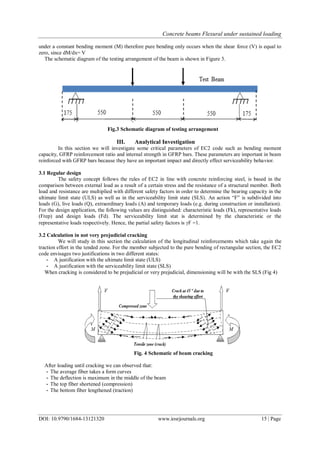
The schematic diagram of the testing arrangement of the beam is shown in Figure 3.
Fig.3 Schematic diagram of testing arrangement
III. Analytical Investigation
In this section we will investigate some critical parameters of EC2 code such as bending moment
capacity, GFRP reinforcement ratio and internal strength in GFRP bars. These parameters are important in beam
reinforced with GFRP bars because they have an important impact and directly effect serviceability behavior.
3.1 Regular design
The safety concept follows the rules of EC2 in line with concrete reinforcing steel, is based in the
comparison between external load as a result of a certain stress and the resistance of a structural member. Both
load and resistance are multiplied with different safety factors in order to determine the bearing capacity in the
ultimate limit state (ULS) as well as in the serviceability limit state (SLS). An action “F” is subdivided into
loads (G), live loads (Q), extraordinary loads (A) and temporary loads (e.g. during construction or installation).
For the design application, the following values are distinguished: characteristic loads (Fk), representative loads
(Frep) and design loads (Fd). The serviceability limit stat is determined by the characteristic or the
representative loads respectively. Hence, the partial safety factors is F =1.
3.2 Calculation in not very prejudicial cracking
We will study in this section the calculation of the longitudinal reinforcements which take again the
traction effort in the tended zone. For the member subjected to the pure bending of rectangular section, the EC2
code envisages two justifications in two different states:
- A justification with the ultimate limit state (ULS)
- A justification with the serviceability limit state (SLS)
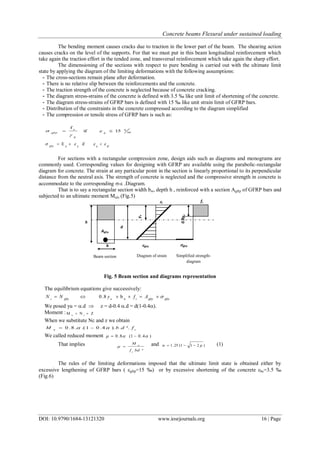
When cracking is considered to be prejudicial or very prejudicial, dimensioning will be with the SLS (Fig 4)
Fig. 4 Schematic of beam cracking
After loading until cracking we can observed that:
- The average fiber takes a form curves
- The deflection is maximum in the middle of the beam
- The top fiber shortened (compression)
- The bottom fiber lengthened (traction)
Concrete beams Flexural under sustained loading
DOI: 10.9790/1684-13121320 www.iosrjournals.org 16 | Page
The bending moment causes cracks due to traction in the lower part of the beam. The shearing action
causes cracks on the level of the supports. For that we must put in this beam longitudinal reinforcement which
take again the traction effort in the tended zone, and transversal reinforcement which take again the sharp effort.
The dimensioning of the sections with respect to pure bending is carried out with the ultimate limit
state by applying the diagram of the limiting deformations with the following assumptions:
- The cross-sections remain plane after deformation.
- There is no relative slip between the reinforcements and the concrete.
- The traction strength of the concrete is neglected because of concrete cracking.
- The diagram stress-strains of the concrete is defined with 3.5 ‰ like unit limit of shortening of the concrete.
- The diagram stress-strains of GFRP bars is defined with 15 ‰ like unit strain limit of GFRP bars.
- Distribution of the constraints in the concrete compressed according to the diagram simplified
- The compression or tensile stress of GFRP bars is such as:
00
0
g
e
15if
f
 ggfrp



glgg
ifE   ggfrp
For sections with a rectangular compression zone, design aids such as diagrams and monograms are
commonly used. Corresponding values for designing with GFRP are available using the parabolic-rectangular
diagram for concrete. The strain at any particular point in the section is linearly proportional to its perpendicular
distance from the neutral axis. The strength of concrete is neglected and the compressive strength in concrete is
accommodate to the corresponding - .Diagram.
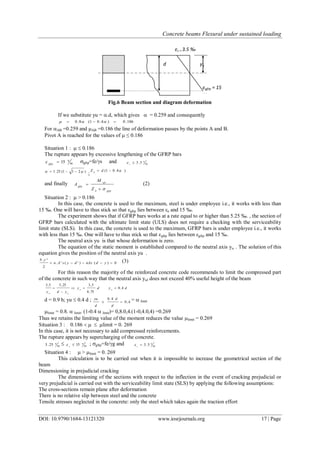
That is to say a rectangular section width bw, depth h , reinforced with a section Agfrp of GFRP bars and
subjected to an ultimate moment Muls (Fig.5)
Fig. 5 Beam section and diagrams representation
The equilibrium equations give successively:
gfrpgfrpcugfrpc
AfyNN  w
b8.0
We posed yu = .d  z = d-0.4 .d = d(1-0.4).
Moment : ZNM cu

When we substitute Nc and z we obtain
cu
fdbM ²..).4.01.(.8.0  
We called reduced moment )4.01(8.0  
That implies
²bdf
M
c
u
 and )211(25.1   (1)
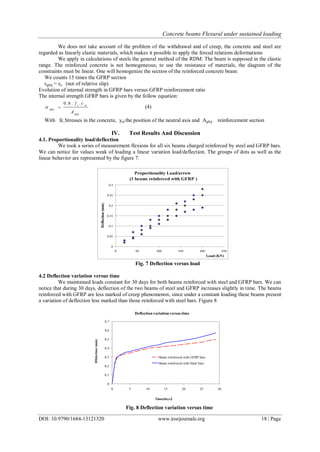
The rules of the limiting deformations imposed that the ultimate limit state is obtained either by
excessive lengthening of GFRP bars ( gfrp=15 ‰) or by excessive shortening of the concrete bc=3.5 ‰
(Fig.6)
Simplified strength-
diagram
Beam section Diagram of strain
yu
b
0.8yu
d
fc
gfrp
Agfrp
h
gfrp
c
Concrete beams Flexural under sustained loading
DOI: 10.9790/1684-13121320 www.iosrjournals.org 17 | Page
Fig.6 Beam section and diagram deformation
If we substitute yu = .d, which gives  = 0.259 and consequently
186.0)4.01(8.0  
For AB =0.259 and AB =0.186 the line of deformation passes by the points A and B.
Pivot A is reached for the values of  ≤ 0.186
Situation 1 :   0.186
The rupture appears by excessive lengthening of the GFRP bars
00
0
15gfrp
 gfrp=fe/s and 00
0
5.3c

)211(25.1  
;
)4.01(  dZ b
and finally
gfrpb
uls
gfrp
Z
M
A

 (2)
Situation 2 :  > 0.186
In this case, the concrete is used to the maximum, steel is under employee i.e., it works with less than
15 ‰. One will have to thus stick so that εgfrp lies between εe and 15 ‰.
The experiment shows that if GFRP bars works at a rate equal to or higher than 5.25 ‰. , the section of
GFRP bars calculated with the ultimate limit state (ULS) does not require a checking with the serviceability
limit state (SLS). In this case, the concrete is used to the maximum, GFRP bars is under employee i.e., it works
with less than 15 ‰. One will have to thus stick so that εgfrp lies between εgfrp and 15 ‰.
The neutral axis yu is that whose deformation is zero.
The equation of the static moment is established compared to the neutral axis yu . The solution of this
equation gives the position of the neutral axis yu .
0)()'('.
2
².
 ydnAsdysAn
yb (3)
For this reason the majority of the reinforced concrete code recommends to limit the compressed part
of the concrete in such way that the neutral axis yul does not exceed 40% useful height of the beam
dydy
ydy
uu
uu
4,0.
75,8
5,325,55,3



d = 0.9 h; yu  0.4 d ; 4,0
4.0

d
d
d
yu =  limit
limit = 0.8.  limit. (1-0.4  limit)= 0,8.0,4.(1-0,4.0,4) =0.269
Thus we retains the limiting value of the moment reduces the value limit = 0.269
Situation 3 : 0.186    limit = 0. 269
In this case, it is not necessary to add compressed reinforcements.
The rupture appears by supercharging of the concrete.
00
0
25.5  00
0
15s
 ; gfrp=fe/g and 00
0
5.3c

Situation 4 :  > limit = 0. 269
This calculation is to be carried out when it is impossible to increase the geometrical section of the
beam
Dimensioning in prejudicial cracking
The dimensioning of the sections with respect to the inflection in the event of cracking prejudicial or
very prejudicial is carried out with the serviceability limit state (SLS) by applying the following assumptions:
The cross-sections remain plane after deformation
There is no relative slip between steel and the concrete
Tensile stresses neglected in the concrete: only the steel which takes again the traction effort
εc = 3.5 ‰
εgfrp = 15
‰
d yu
Concrete beams Flexural under sustained loading
DOI: 10.9790/1684-13121320 www.iosrjournals.org 18 | Page
We does not take account of the problem of the withdrawal and of creep, the concrete and steel are
regarded as linearly elastic materials, which makes it possible to apply the forced relations deformations
We apply in calculations of steels the general method of the RDM: The beam is supposed in the elastic
range. The reinforced concrete is not homogeneous; to use the resistance of materials, the diagram of the
constraints must be linear. One will homogenize the section of the reinforced concrete beam:
We counts 15 times the GFRP section
εgfrp = εc (not of relative slip)
Evolution of internal strength in GFRP bars versus GFRP reinforcement ratio
The internal strength GFRP bars is given by the follow equation:
gfrp
ulc
gfrp
A
yf ..8.0
 (4)
With fc Stresses in the concrete, yul the position of the neutral axis and Agfrp reinforcement section
IV. Test Results And Discussion
4.1. Proportionality load/deflection
We took a series of measurement flexions for all six beams charged reinforced by steel and GFRP bars.
We can notice for values weak of loading a linear variation load/deflection. The groups of dots as well as the
linear behavior are represented by the figure 7.
Proportionality Load/arrow
(3 beams reinforced with GFRP )
0
0.05
0.1
0.15
0.2
0.25
0.3
0 50 100 150 200 250
Load (KN)
Deflection(mm).
Fig. 7 Deflection versus load
4.2 Deflection variation versus time
We maintained loads constant for 30 days for both beams reinforced with steel and GFRP bars. We can
notice that during 30 days, deflection of the two beams of steel and GFRP increases slightly in time. The beams
reinforced with GFRP are less marked of creep phenomenon, since under a constant loading these beams present
a variation of deflection less marked than those reinforced with steel bars. Figure 8
0
0,1
0,2
0,3
0,4
0,5
0,6
0,7
0 5 10 15 20 25 30
Dfelection(mm)
Time(days)
Deflectionvariationversus time
Beam reinforced with GFRP bars
Beam reinforced with Steel bars
Fig. 8 Deflection variation versus time
Concrete beams Flexural under sustained loading
DOI: 10.9790/1684-13121320 www.iosrjournals.org 19 | Page
4.3 Live load according to Mrc and the deflection
In comparison with the steel bars, the GFRP bars have a weaker modulus of elasticity, which leads to a
larger deflection, with equal load and span. Consequently, in much of case, the serviceability limit state (the
deflection) could control the dimensioning of a beam in bending. The live load was calculated in two manners.
The first process was to calculate Q according to Resistant Moment concrete Mrc calculation and the second
according to the deflection.
Fig. 9 : Evolution of the constraint versus GFP ratio
We can notice according to figure 9, that in two situations the deflection does not control dimensioning
in bending. In the range of value of Agfrp recommended (between Agfrp and 1.2* Agfrp ). This value recommended
(economic) corresponds to a stabilization of the constraint in the bar (0.02).
V. Conclusions
From the analytical and experimental investigation carried out, the following conclusions can be
drawn:
- For values weak of loading, there is a linear variation load/deflection.
- Deflection of the two beams of steel and GFRP increases slightly in time.
- Beams reinforced with GFRP are less marked of creep phenomenon.
- The effect of sustained loading is more detrimental in beams reinforced with steel bars than in those with
GFRP bars
- Deflection does not control dimensioning in bending. In the range of value of Agfrp recommended (between
Agfrp and 1.2* Agfrp ). This recommended value (economic) corresponds to a stabilization of the constraint in
the bar (Ratio = 0.02).
- The compressed part of the concrete in such way that the neutral axis yul must be limited and does not
exceed 40% useful height of the beam
Acknowledgements
The authors would like to thank the manufacturer of the GFRP Combar (Schöck, Baden-Baden,
Germany) for providing the GFRP bars. The opinion and analysis presented in this paper are those of the
authors.
References
[1] Design Guidelines for GFRP Reinforced Concrete (1997) published by the ASCE Journal of Composites for Construction (Aug
1997 Vol.1 No 3 ISSN 1090-0268 Coden: JCCOF2).
[2] ACI Committee 4401R-06, "Guide for the Design and Construction of Concrete Reinforced with FRP Bars, American Concrete
Institute, Farmington Hills. Branson, , McGraw-Hill, New York, 1977, 546pp
[3] ACI Committee 435, “State-of-the-Art Report, Deflection of Two Way Reinforced
[4] Concrete Floor Systems,” ACI SP 43-3, Deflections of Concrete Structures, 1974, pp. 55- 8182/23. Berkeley: EERC. University of
California, CA., USA
[5] Sonobe, Y et al, Design Guidelines for GFRP Reinforced Concrete building Structures (1997) Journal of Composite for
construction , V 1 No 3 Aug pp. 90-113
[6] Theriault et al. (1198), Effect of FRP reinforcement ratio and concrete strength on flexural behaviour on flexural of concrete beams.
Journal of Composite for construction , V 2 No 1 Feb. pp. 7-15
[7] Nanni.A (1993) Flexural behaviour and design of RC members using FRP reinforcement Journal of structural engineering V.119
No 11 Nov 1993 pp. 3344-339
[8] Nawy, E et al.(1971). Fiberglass reinforced concrete slabs and beams ASCE journal of the structural division V.97. N° ST9 pp.
2203-2215
[9] Nawy, E et al.(1997). Fiber glass reinforced concrete slabs and beams ASCE journal of the structural division V.103. N° ST2 pp.
421-428
0
100
200
300
400
500
600
700
0 0,01 0,02 0,03 0,04 0,05 0,06
GFRPbarstrength(MPa).
Ratio (GFRP)
Concrete beams Flexural under sustained loading
DOI: 10.9790/1684-13121320 www.iosrjournals.org 20 | Page
[10] Faza, S et al (1993) Theoretical and experimental correlation of behavior of concrete beams reinforced with fiber reinforced plastic
rebars. Proceeding of international symposium SP 138. A Nanni and C.W. Dolan. eds. American concrete institute Famington
Hills, Mich, 1993, pp. 599-614
[11] Benmokrane et al. (1996) Flexural response of concrete beams reinforced with FRP Reinforceing bars ACI Structural Journal V.93
N°.1 1996, pp46-55
[12] Aboutaha R (2004) Recommended Design for the GFRP Rebar Combar, Syracuse University, Department of Civil and
Environmental Engineering, Technical report, sponsored by Schok Bauteile GmbH ,U SA
[13] Masmoudi A., (2010), Effet de la température et de l’eau sur les propriétés d’adhérence des barres polymères renforcées de fibre de
verre avec le béton, Thèse de Doctorat ENIT Université Tunis el Manar, 176p
[14] ACI Committee 435, “Allowable Deflections”, ACI Journal, Proceedings V. 65, No. 6, 1968, pp. 433-444.
[15] Bank L. et al. (2003). A Model Specification for Composites for Civil Engineering Structures. Construction and Building
Materials,vol. 17(6-7), pp.405-437.
[16] EC2, Norme Européenne, Eurocode 2, (2008), Calcul des structures en béton, Partie1: règles générales et règles pour les bâtiments
[17] Schock Bauteil GmbH Combar (2006) Design Guideline for Concrete Structures Reinforced with Glass Fiber Reinforced Polymer
following the Requirements of DIN 1045-1and EC2 Issued Germany.26p

C013121320

  • 1.
    IOSR Journal ofMechanical and Civil Engineering (IOSR-JMCE) e-ISSN: 2278-1684,p-ISSN: 2320-334X, Volume 13, Issue 1 Ver. II (Jan. - Feb. 2016), PP 13-20 www.iosrjournals.org DOI: 10.9790/1684-13121320 www.iosrjournals.org 13 | Page Concrete beams Flexural under sustained loading Abdelmonem Masmoudi1 Mongi Benouezdou2 Jamel Bouaziz3 1 Université de Sfax, Department of civil engineering, ENIS, Sfax, Tunisia 2 Visiting Professor at the University of Sharjah, College of Engineering, , United Arab Emirates. 3 Department of industrial chemistry, ENIS , Sfax, Tunisia Abstract: Steel reinforced concrete structures are susceptible to corrosion in severe environments. Corrosion limits the service life of structures, and results in expensive maintenance costs. GFRP composite bars are excellent alternative to steel bars for reinforcing concrete structures in severe environments. However, there is limited experience with the design and construction of GFRP reinforced concrete structures. This report investigates some parameters used in design of GFRP reinforced concrete members following the Eurocode 2 recommendations. A ratio of Agfrp bar reinforcement equal to 2% is recommended to a stabilization of the constraint in the bar. The compressed part of the concrete must be limited and does not exceed 40% useful height of the beam. Keywords: GFRP Bar reinforcement, failure, Flexural design, Sustained loading I. Introduction When considering a design utilizing GFRP Rebar, the differences in physical properties and performance characteristics must be taken into account. Of chief importance to the designer is the fact that all FRP’s are linear elastic up to failure and exhibit no ductility or yielding. In traditional steel reinforced concrete design, a maximum amount of steel reinforcing has been specified so that the steel is the weak link in a structure. When weakened, the steel rebars stretch or yield and give a warning of pending failure of the concrete member. When using GFRP Rebars, ACI committee 440’s design guidelines recommend a minimum amount of GFRP rebar rather than a maximum. If a member fails, the concrete will be the weak link and will crush in compression. The crushing concrete will serve as the warning of failure and there will still be ample reserve tensile capacity in the GFRP reinforcing. Another major difference is that serviceability will be more of a design limitation in GFRP reinforced members than in steel reinforced members. Due to its lower modulus of elasticity, deflection and crack width will affect the design. Deflection and crack width serviceability requirements will provide additional warning of failure prior to compression failure of the concrete. In many instances, deflection and crack width will control design. Detailed design guidance can be found in the American Concrete Institute publication "Guide for the Design and Construction of Concrete Reinforced with FRP Bars". Design Guidelines for GFRP Reinforced Concrete have been published 1,2,3,4]. K Coefficient in consideration of non –linear stress distribution fct.eff Effective tensile just before cracking fe Allowable stress immediately after cracking σgfrp Characteristic constraint ULS Ultimate Limit State SLS Serviceability Limit State g Regulatory safety coefficient g GFRP bar deformation gl Limit GFRP bar deformation b Width of concrete beam d Effective depth of cross section h Depth of the concrete beam E Modulus of elasticity of GFRP bar Mrc Resistant Moment concrete Muls Moment with the Ultimate Limit State µ Reduced moment Nc Compressive force in the concrete Ngfrp GFRP bar traction effort fc Stresses in the concrete yul Position of the neutral axis
  • 2.
    Concrete beams Flexuralunder sustained loading DOI: 10.9790/1684-13121320 www.iosrjournals.org 14 | Page Since the structural failure due to FRP reinforcing bar rupture is rather catastrophic, the over-reinforced design concept that ensures that compressive failure of concrete takes place prior to the tensile failure of FRP has been accepted 5,6,7].Nanni pointed out that, for FRP reinforced concrete beams, the balanced reinforced ratio, which is defined as the reinforcement ratio producing a condition for simultaneous failure of the concrete and the FRP reinforcing bar, is much lower than the practically adopted reinforcement ratio if the concrete is confined 8]. The modulus of elasticity of most available FRP materials is only 1/5 to 1/3 that of steel, which results in larger deflections as well as larger crack widths under service loads in comparison with those of its counterpart steel-reinforced concrete element for a given reinforcement ratio 9,10,11,12]. Strength and stiffness of a composite material are defined by the type, amount and orientation of the strengthening fibers. The fibers of Schock Combar are oriented linearly, resulting in the highest possible axial tensile strength, thus these GFRP bars remains linearly elastic up to failure. When the tensile strength of the material is exceeded, yielding does not occur. However, GFRP shows relatively low tensile and compressive strength perpendicular to the fibers 13]. Much research showed that same the decreases of 30% of the GFRP bars bond strength compared to steel does not affect the correct operation of the reinforced concrete 14,15]. Active efforts are also underway for a European Euro code 2 16], under the efforts of FIB Task Group 9.3 "FRP (Fibre Reinforced Polymer) Reinforcement for Concrete Structures. The use of competent experienced engineering personnel should always be employed in the design and construction of concrete reinforced structures. II. Experimental Study 2.1 Beam description A total of six RC beam specimens of dimensions, 150 mm x 200 mm x 2000 mm, were fabricated with concrete cover of 20 mm. For the tensile reinforcement, two 12 mm diameter were used, and for the compressive reinforcement, two 8 mm diameter. Properties of the GFRP and steel bars used in this study and the details of beam cross-section are shown in table 117], and Figure 1. Fig. 1 GFRP bars reinforcement and Beam 2.2 Test set-up and instrumentation The beams were subjected to sustained loads for a period of 30 days to compare under sustained loading the deflection of the beams reinforced with GFRP and steel bars in ambient laboratory condition. To simulate the sustained loading, beams were placed at one-four points us shown in Fig 2. Fig. 2 Beam test instrumentation The mid-span deflection was monitored by a Linear Variable Displacement Transducer (LVDT) with accuracy equal to 0.001mm, placed underneath the center of the beam. All the beams were tested simply supported at the age of 28 days under four-point loading. Pure bending is a condition of stress where a bending moment is applied to a beam without the simultaneous application of axial, shear, or torsional forces. Pure bending is the flexure (bending) of a beam Ø 8 2Ø 12 : Longitudinal reinforcement : Transversal reinforcement 2000
  • 3.
    Concrete beams Flexuralunder sustained loading DOI: 10.9790/1684-13121320 www.iosrjournals.org 15 | Page under a constant bending moment (M) therefore pure bending only occurs when the shear force (V) is equal to zero, since dM/dx= V The schematic diagram of the testing arrangement of the beam is shown in Figure 3. Fig.3 Schematic diagram of testing arrangement III. Analytical Investigation In this section we will investigate some critical parameters of EC2 code such as bending moment capacity, GFRP reinforcement ratio and internal strength in GFRP bars. These parameters are important in beam reinforced with GFRP bars because they have an important impact and directly effect serviceability behavior. 3.1 Regular design The safety concept follows the rules of EC2 in line with concrete reinforcing steel, is based in the comparison between external load as a result of a certain stress and the resistance of a structural member. Both load and resistance are multiplied with different safety factors in order to determine the bearing capacity in the ultimate limit state (ULS) as well as in the serviceability limit state (SLS). An action “F” is subdivided into loads (G), live loads (Q), extraordinary loads (A) and temporary loads (e.g. during construction or installation). For the design application, the following values are distinguished: characteristic loads (Fk), representative loads (Frep) and design loads (Fd). The serviceability limit stat is determined by the characteristic or the representative loads respectively. Hence, the partial safety factors is F =1. 3.2 Calculation in not very prejudicial cracking We will study in this section the calculation of the longitudinal reinforcements which take again the traction effort in the tended zone. For the member subjected to the pure bending of rectangular section, the EC2 code envisages two justifications in two different states: - A justification with the ultimate limit state (ULS) - A justification with the serviceability limit state (SLS) When cracking is considered to be prejudicial or very prejudicial, dimensioning will be with the SLS (Fig 4) Fig. 4 Schematic of beam cracking After loading until cracking we can observed that: - The average fiber takes a form curves - The deflection is maximum in the middle of the beam - The top fiber shortened (compression) - The bottom fiber lengthened (traction)
  • 4.
    Concrete beams Flexuralunder sustained loading DOI: 10.9790/1684-13121320 www.iosrjournals.org 16 | Page The bending moment causes cracks due to traction in the lower part of the beam. The shearing action causes cracks on the level of the supports. For that we must put in this beam longitudinal reinforcement which take again the traction effort in the tended zone, and transversal reinforcement which take again the sharp effort. The dimensioning of the sections with respect to pure bending is carried out with the ultimate limit state by applying the diagram of the limiting deformations with the following assumptions: - The cross-sections remain plane after deformation. - There is no relative slip between the reinforcements and the concrete. - The traction strength of the concrete is neglected because of concrete cracking. - The diagram stress-strains of the concrete is defined with 3.5 ‰ like unit limit of shortening of the concrete. - The diagram stress-strains of GFRP bars is defined with 15 ‰ like unit strain limit of GFRP bars. - Distribution of the constraints in the concrete compressed according to the diagram simplified - The compression or tensile stress of GFRP bars is such as: 00 0 g e 15if f  ggfrp    glgg ifE   ggfrp For sections with a rectangular compression zone, design aids such as diagrams and monograms are commonly used. Corresponding values for designing with GFRP are available using the parabolic-rectangular diagram for concrete. The strain at any particular point in the section is linearly proportional to its perpendicular distance from the neutral axis. The strength of concrete is neglected and the compressive strength in concrete is accommodate to the corresponding - .Diagram. That is to say a rectangular section width bw, depth h , reinforced with a section Agfrp of GFRP bars and subjected to an ultimate moment Muls (Fig.5) Fig. 5 Beam section and diagrams representation The equilibrium equations give successively: gfrpgfrpcugfrpc AfyNN  w b8.0 We posed yu = .d  z = d-0.4 .d = d(1-0.4). Moment : ZNM cu  When we substitute Nc and z we obtain cu fdbM ²..).4.01.(.8.0   We called reduced moment )4.01(8.0   That implies ²bdf M c u  and )211(25.1   (1) The rules of the limiting deformations imposed that the ultimate limit state is obtained either by excessive lengthening of GFRP bars ( gfrp=15 ‰) or by excessive shortening of the concrete bc=3.5 ‰ (Fig.6) Simplified strength- diagram Beam section Diagram of strain yu b 0.8yu d fc gfrp Agfrp h gfrp c
  • 5.
    Concrete beams Flexuralunder sustained loading DOI: 10.9790/1684-13121320 www.iosrjournals.org 17 | Page Fig.6 Beam section and diagram deformation If we substitute yu = .d, which gives  = 0.259 and consequently 186.0)4.01(8.0   For AB =0.259 and AB =0.186 the line of deformation passes by the points A and B. Pivot A is reached for the values of  ≤ 0.186 Situation 1 :   0.186 The rupture appears by excessive lengthening of the GFRP bars 00 0 15gfrp  gfrp=fe/s and 00 0 5.3c  )211(25.1   ; )4.01(  dZ b and finally gfrpb uls gfrp Z M A   (2) Situation 2 :  > 0.186 In this case, the concrete is used to the maximum, steel is under employee i.e., it works with less than 15 ‰. One will have to thus stick so that εgfrp lies between εe and 15 ‰. The experiment shows that if GFRP bars works at a rate equal to or higher than 5.25 ‰. , the section of GFRP bars calculated with the ultimate limit state (ULS) does not require a checking with the serviceability limit state (SLS). In this case, the concrete is used to the maximum, GFRP bars is under employee i.e., it works with less than 15 ‰. One will have to thus stick so that εgfrp lies between εgfrp and 15 ‰. The neutral axis yu is that whose deformation is zero. The equation of the static moment is established compared to the neutral axis yu . The solution of this equation gives the position of the neutral axis yu . 0)()'('. 2 ².  ydnAsdysAn yb (3) For this reason the majority of the reinforced concrete code recommends to limit the compressed part of the concrete in such way that the neutral axis yul does not exceed 40% useful height of the beam dydy ydy uu uu 4,0. 75,8 5,325,55,3    d = 0.9 h; yu  0.4 d ; 4,0 4.0  d d d yu =  limit limit = 0.8.  limit. (1-0.4  limit)= 0,8.0,4.(1-0,4.0,4) =0.269 Thus we retains the limiting value of the moment reduces the value limit = 0.269 Situation 3 : 0.186    limit = 0. 269 In this case, it is not necessary to add compressed reinforcements. The rupture appears by supercharging of the concrete. 00 0 25.5  00 0 15s  ; gfrp=fe/g and 00 0 5.3c  Situation 4 :  > limit = 0. 269 This calculation is to be carried out when it is impossible to increase the geometrical section of the beam Dimensioning in prejudicial cracking The dimensioning of the sections with respect to the inflection in the event of cracking prejudicial or very prejudicial is carried out with the serviceability limit state (SLS) by applying the following assumptions: The cross-sections remain plane after deformation There is no relative slip between steel and the concrete Tensile stresses neglected in the concrete: only the steel which takes again the traction effort εc = 3.5 ‰ εgfrp = 15 ‰ d yu
  • 6.
    Concrete beams Flexuralunder sustained loading DOI: 10.9790/1684-13121320 www.iosrjournals.org 18 | Page We does not take account of the problem of the withdrawal and of creep, the concrete and steel are regarded as linearly elastic materials, which makes it possible to apply the forced relations deformations We apply in calculations of steels the general method of the RDM: The beam is supposed in the elastic range. The reinforced concrete is not homogeneous; to use the resistance of materials, the diagram of the constraints must be linear. One will homogenize the section of the reinforced concrete beam: We counts 15 times the GFRP section εgfrp = εc (not of relative slip) Evolution of internal strength in GFRP bars versus GFRP reinforcement ratio The internal strength GFRP bars is given by the follow equation: gfrp ulc gfrp A yf ..8.0  (4) With fc Stresses in the concrete, yul the position of the neutral axis and Agfrp reinforcement section IV. Test Results And Discussion 4.1. Proportionality load/deflection We took a series of measurement flexions for all six beams charged reinforced by steel and GFRP bars. We can notice for values weak of loading a linear variation load/deflection. The groups of dots as well as the linear behavior are represented by the figure 7. Proportionality Load/arrow (3 beams reinforced with GFRP ) 0 0.05 0.1 0.15 0.2 0.25 0.3 0 50 100 150 200 250 Load (KN) Deflection(mm). Fig. 7 Deflection versus load 4.2 Deflection variation versus time We maintained loads constant for 30 days for both beams reinforced with steel and GFRP bars. We can notice that during 30 days, deflection of the two beams of steel and GFRP increases slightly in time. The beams reinforced with GFRP are less marked of creep phenomenon, since under a constant loading these beams present a variation of deflection less marked than those reinforced with steel bars. Figure 8 0 0,1 0,2 0,3 0,4 0,5 0,6 0,7 0 5 10 15 20 25 30 Dfelection(mm) Time(days) Deflectionvariationversus time Beam reinforced with GFRP bars Beam reinforced with Steel bars Fig. 8 Deflection variation versus time
  • 7.
    Concrete beams Flexuralunder sustained loading DOI: 10.9790/1684-13121320 www.iosrjournals.org 19 | Page 4.3 Live load according to Mrc and the deflection In comparison with the steel bars, the GFRP bars have a weaker modulus of elasticity, which leads to a larger deflection, with equal load and span. Consequently, in much of case, the serviceability limit state (the deflection) could control the dimensioning of a beam in bending. The live load was calculated in two manners. The first process was to calculate Q according to Resistant Moment concrete Mrc calculation and the second according to the deflection. Fig. 9 : Evolution of the constraint versus GFP ratio We can notice according to figure 9, that in two situations the deflection does not control dimensioning in bending. In the range of value of Agfrp recommended (between Agfrp and 1.2* Agfrp ). This value recommended (economic) corresponds to a stabilization of the constraint in the bar (0.02). V. Conclusions From the analytical and experimental investigation carried out, the following conclusions can be drawn: - For values weak of loading, there is a linear variation load/deflection. - Deflection of the two beams of steel and GFRP increases slightly in time. - Beams reinforced with GFRP are less marked of creep phenomenon. - The effect of sustained loading is more detrimental in beams reinforced with steel bars than in those with GFRP bars - Deflection does not control dimensioning in bending. In the range of value of Agfrp recommended (between Agfrp and 1.2* Agfrp ). This recommended value (economic) corresponds to a stabilization of the constraint in the bar (Ratio = 0.02). - The compressed part of the concrete in such way that the neutral axis yul must be limited and does not exceed 40% useful height of the beam Acknowledgements The authors would like to thank the manufacturer of the GFRP Combar (Schöck, Baden-Baden, Germany) for providing the GFRP bars. The opinion and analysis presented in this paper are those of the authors. References [1] Design Guidelines for GFRP Reinforced Concrete (1997) published by the ASCE Journal of Composites for Construction (Aug 1997 Vol.1 No 3 ISSN 1090-0268 Coden: JCCOF2). [2] ACI Committee 4401R-06, "Guide for the Design and Construction of Concrete Reinforced with FRP Bars, American Concrete Institute, Farmington Hills. Branson, , McGraw-Hill, New York, 1977, 546pp [3] ACI Committee 435, “State-of-the-Art Report, Deflection of Two Way Reinforced [4] Concrete Floor Systems,” ACI SP 43-3, Deflections of Concrete Structures, 1974, pp. 55- 8182/23. Berkeley: EERC. University of California, CA., USA [5] Sonobe, Y et al, Design Guidelines for GFRP Reinforced Concrete building Structures (1997) Journal of Composite for construction , V 1 No 3 Aug pp. 90-113 [6] Theriault et al. (1198), Effect of FRP reinforcement ratio and concrete strength on flexural behaviour on flexural of concrete beams. Journal of Composite for construction , V 2 No 1 Feb. pp. 7-15 [7] Nanni.A (1993) Flexural behaviour and design of RC members using FRP reinforcement Journal of structural engineering V.119 No 11 Nov 1993 pp. 3344-339 [8] Nawy, E et al.(1971). Fiberglass reinforced concrete slabs and beams ASCE journal of the structural division V.97. N° ST9 pp. 2203-2215 [9] Nawy, E et al.(1997). Fiber glass reinforced concrete slabs and beams ASCE journal of the structural division V.103. N° ST2 pp. 421-428 0 100 200 300 400 500 600 700 0 0,01 0,02 0,03 0,04 0,05 0,06 GFRPbarstrength(MPa). Ratio (GFRP)
  • 8.
    Concrete beams Flexuralunder sustained loading DOI: 10.9790/1684-13121320 www.iosrjournals.org 20 | Page [10] Faza, S et al (1993) Theoretical and experimental correlation of behavior of concrete beams reinforced with fiber reinforced plastic rebars. Proceeding of international symposium SP 138. A Nanni and C.W. Dolan. eds. American concrete institute Famington Hills, Mich, 1993, pp. 599-614 [11] Benmokrane et al. (1996) Flexural response of concrete beams reinforced with FRP Reinforceing bars ACI Structural Journal V.93 N°.1 1996, pp46-55 [12] Aboutaha R (2004) Recommended Design for the GFRP Rebar Combar, Syracuse University, Department of Civil and Environmental Engineering, Technical report, sponsored by Schok Bauteile GmbH ,U SA [13] Masmoudi A., (2010), Effet de la température et de l’eau sur les propriétés d’adhérence des barres polymères renforcées de fibre de verre avec le béton, Thèse de Doctorat ENIT Université Tunis el Manar, 176p [14] ACI Committee 435, “Allowable Deflections”, ACI Journal, Proceedings V. 65, No. 6, 1968, pp. 433-444. [15] Bank L. et al. (2003). A Model Specification for Composites for Civil Engineering Structures. Construction and Building Materials,vol. 17(6-7), pp.405-437. [16] EC2, Norme Européenne, Eurocode 2, (2008), Calcul des structures en béton, Partie1: règles générales et règles pour les bâtiments [17] Schock Bauteil GmbH Combar (2006) Design Guideline for Concrete Structures Reinforced with Glass Fiber Reinforced Polymer following the Requirements of DIN 1045-1and EC2 Issued Germany.26p