
Green buildings: law and policy
  What still needs to be done

        Gordon McCreath, Partner

 CBI Breakfast Briefing, 9 September 2009
Pinsent Masons specialist knowledge


• IPF Sustainability Special Interest Group

• CBI Sustainability Group

• London Climate Change Partnership:

    – Better Buildings Partnership – Green Leases Forum
    – Financial and Liability Group

• JCT – Sustainability Review Panel

• UK Environmental Law Association – Climate Change Working
  Group
Agenda


• What do we have?

• Will it deliver in 2019? - some issues

• Some recent developments

• What still needs to be done?
What do we have?

•   Climate Change Act 2008
•   Carbon Reduction Commitment
•   Energy Performance Certificates and Display Energy Certificates
•   Building Regulations
•   Construction Site Waste Management Plans
•   Supplement to PPS1 on Climate Change
•   Supplement to PPS1 on Eco Towns
•   Planning & Energy Act 2008

•   Enhanced Capital Allowances
•   SDLT (Zero-Carbon Homes Relief) Regulations 2007
•   Lowered VAT rate for energy efficient materials
•   Landlord Energy Saving Allowance

•   Code for Sustainable Homes
•   Low Carbon Buildings Programme
•   Carbon Emissions Reduction Target
•   Warm Front, Decent Homes
•   Energy Saving Trust, Carbon Trust

•   BREEAM 2008, LEED, GREENSTAR, BPF–LES/TER
Will it deliver in 2019?

•   GBC: The definition of zero carbon (May 2008):
     – the definition of zero carbon is not achievable on 80% of new homes

•   GBC Report on Reducing CO2 from Existing Homes:
     – ...fundamentally there is a market failure. Many of the measures needed
       to improve the energy efficiency of the existing stock (such as loft
       insulation) are already cost effective. Yet…a mainstream market
       demand for energy efficiency work does not yet exist, even though there
       are overall financial and comfort benefits to the householder. This
       suggests that government intervention is required to correct the market
       failure.

•   Only 15 homes have met SDLT relief criteria: The Times 28.11.08
Some issues

•   Definition
•   Scattergun/unstable approach: policy, delivery bodies – unintended
    consequences. Long term policy certainty required
•   Data and awareness: lack of it, lack of consistency of methodology.
    Comparability required.
•   Theory and reality: EPCs and DECs
•   Link between sustainability and value
•   More incentives: rates, tax breaks, subsidised capital investment
•   Lifecycle analysis
•   Existing buildings
•   Delivery of decentralised energy
•   Non-domestic buildings
•   Landlords and tenants: who pays and who benefits?
•   Resources and skills: regulatory – inconsistent interpretation of PPS1
•   Resources and skills - supply chain
Definition

• Carbon compliance targets: reductions in emissions from 2006
  levels of 25% (2010), 44% (2013), 70% (2016)

• Code for Sustainable Homes: offsite provided externally accredited
  and additional

• Stamp Duty Regulations: required private wire connection for offsite

• Amendments to CSH technical guidance to bring in line

• Supplement to PPS1: onsite or near-site but not remote offsite

• Planning & Energy Act: in locality
Definition

•   Consultation:
     – onsite, except for directly connected LZC heat, for carbon compliance
       (i.e. target above)
     – No buy out mechanism
     – Directly connected offsite renewable electricity for allowable solutions
     – 2012 review

•   Removal of energy appliances and 70% confirmed for 2016 c.c. (July 09)

•   Consultation on amendments to Parts L and F of Building Regs

•   More to do: task group on energy efficiency metrics and standards

•   EPBD: must define it by 30 June 2011
Non-domestic buildings

• Account for 16.5% of UK’s total CO2 emissions

• 2019 “ambition”

• Various voluntary tools: green leases, BREEAM, LES-TER

• Not one size fits all

• Apply zero carbon homes standard of building regs plus planning
  and other tools

• Unregulated emissions may vary widely and therefore be difficult to
  monitor – could connect to use classes with allowances for
  unregulated emissions
Non-domestic buildings

•   Similar phased reductions but balance of carbon compliance and allowed
    solutions may be different for feasibility reasons

•   Doesn’t explicitly support a code – more likely to endorse sustainability tools
    that meet criteria as nationally described sustainable buildings standard for
    PPS1 – leaves it to industry to propose these and UK GBC has already set
    up task force.

•   Recognises that operation must also be covered and lifecycle analysis

•   Respondents support national tools and code

•   Need one metric

•   More to do: further detailed consultation later in year
Recast Energy Performance of Buildings Directive

•   To be implemented by 31.12.10 for public sector and 31.1.12 for other
    buildings: Government concern

•   Lifecycle: Achievement of cost-optimal levels of building energy
    performance for new buildings by June 2017

•   Consistency: Commission to set a broad framework for a comparative
    methodology for calculation energy performance. Methodology of
    calculating energy performance must incorporate European standards

•   Catching more buildings and systems:
     – all new buildings must consider feasibility of alternative heating and
       energy supply systems
     – all buildings must meet minimum energy performance requirements for
       major renovations, where technically, functionally and economically
       feasible
     – minimum energy performance requirements will apply to the installation
       of technical building systems, such as heating and lighting
Recast Energy Performance of Buildings Directive

•   Better information:

     – “EPC”s by 31 December 2010 for all buildings where a public authority
       occupies over 250 square metres of total useful floor area
     – EPCs must be displayed where one exists in publicly visited
       commercial buildings with a floor area over 250 square metres.
     – EPCs to contain recommendations on measures to be carried out
         • on a major renovation of building envelope or technical building
            system
         • to individual parts or elements of building (independent of
            renovation)
     – Energy performance indicator to be shown on advertisement for sale or
       rent
     – Member states must initiate information campaigns regarding how to
       enhance energy performance
Recast Energy Performance of Buildings Directive

•   “Member States” must draw up plans (the national plans) for “increasing the
    number of buildings where both carbon dioxide and primary energy
    consumption are low or equal to zero”

•   Member States must:

     – Define low and zero carbon buildings, in line with common principles to
       be established by the Commission

     – Set targets for % number of buildings which will be low or zero carbon in
       2015 and 2020

     – Separate targets must be set for residential, non-residential and public
       authority occupied buildings

     – Communicate the national plans to the European Commission by 30
       June 2011 and submit a progress report every 3 years
Existing buildings

•   Two thirds of housing stock by 2050 (assumes catch up from current market
    stagnation)

•   Heat and Energy Savings Strategy (applies to new too)
     – Great British Refurb: biggest programme since switch to North Sea gas
     – Target ambitions
     – CERT extension and CESP
     – Information: home energy advice by trained assessors triggered by e.g. refurb,
        and meters and better billing info, and encouraging take up of green leases and,
        in non-dom, BREEAM
     – Upgrade on refurb under EPBD 2 and Building Regs consultation
     – Will encourage district heating and CHP has a key role
     – Clean energy cash back: RHI and FIT (further consultation on RHI later in year
        with view to Apr 2011 introduction). Pay as you save.

•   Consultation on amendments to Building Regulations Parts L and F
     – Improvement when renovating but not where substantial alteration

•   CRC
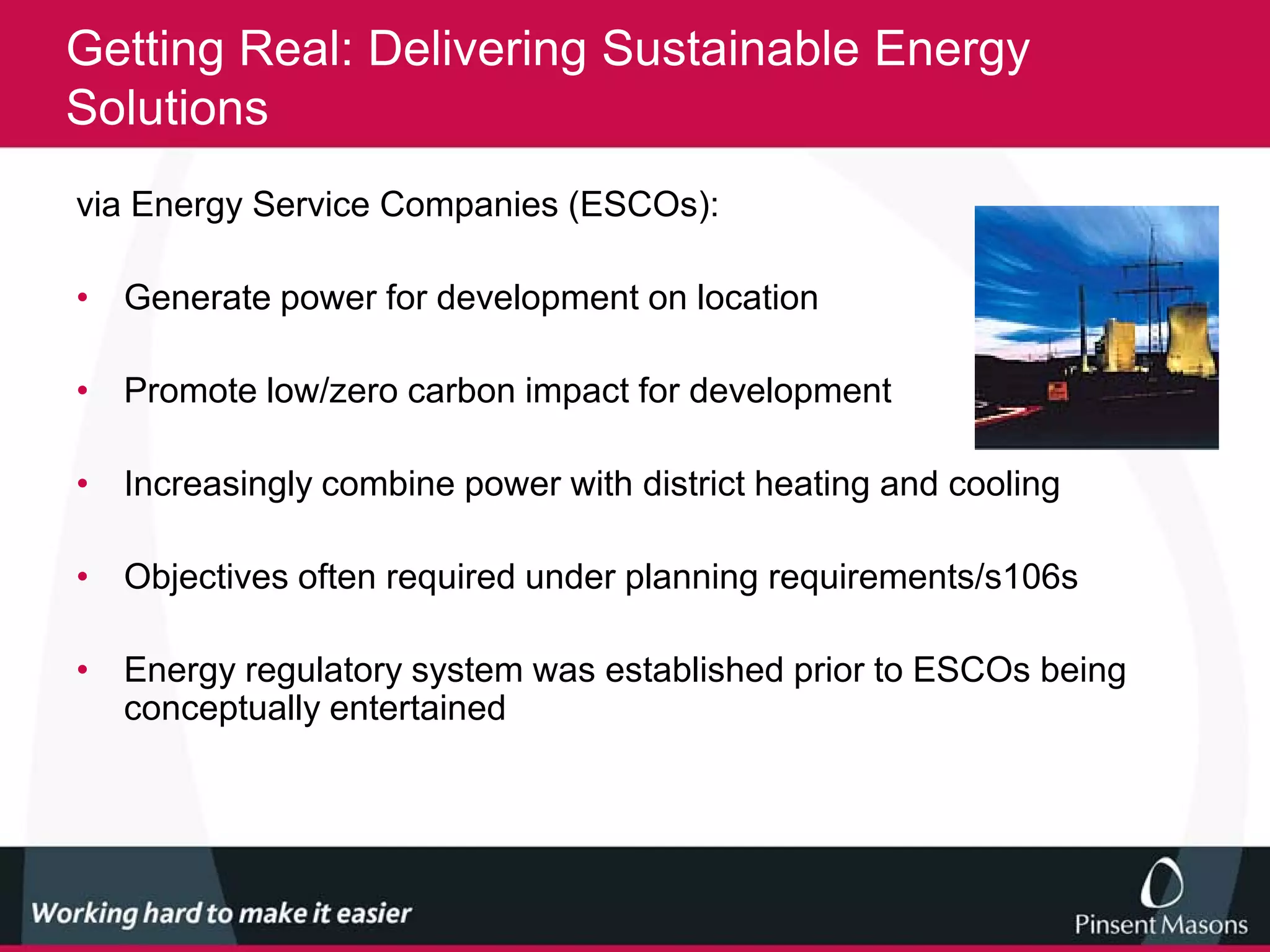
Getting Real: Delivering Sustainable Energy
Solutions
via Energy Service Companies (ESCOs):

• Generate power for development on location

• Promote low/zero carbon impact for development

• Increasingly combine power with district heating and cooling

• Objectives often required under planning requirements/s106s

• Energy regulatory system was established prior to ESCOs being
  conceptually entertained
Solutions for landlord and tenants

• Incentives and self help

• Green leases: new; difficult to persuade tenants?

• MoUs: existing

• Better Building Partnership Green Lease Toolkit

• CRC
Still to do

•   Much more to come

•   Finalisation of definition

•   Consistency

•   Operational ratings

•   Detail of and further incentives: RHI and FIT, business rates, stamp duty for
    non-domestic, ECA

•   Connect to value

•   Lifecycle

•   Development of market practice re landlord and tenant
Gordon McCreath
                         020 7490 6287
                         07881 855 163
              gordon.mccreath@pinsentmasons.com


  Pinsent Masons LLP is a limited liability partnership registered in England & Wales (registered number: OC333653) and regulated by
  the Solicitors Regulation Authority. The word 'partner', used in relation to the LLP, refers to a member of the LLP or an employee or
   consultant of the LLP or any affiliated firm who has equivalent standing and qualifications. A list of the members of the LLP, and of
   those non-members who are designated as partners, is displayed at the LLP's registered office: CityPoint, One Ropemaker Street,
                                                            London EC2Y 9AH.
We use 'Pinsent Masons' to refer to Pinsent Masons LLP and affiliated entities that practise under the name 'Pinsent Masons' or a name
 that incorporates those words. Reference to 'Pinsent Masons' is to Pinsent Masons LLP and/or one or more of those affiliated entities
             as the context requires. For important regulatory information please visit: www.pinsentmasons.com/regulatory.

CBI Property Breakfast Seminar: Gordon McCreath

  • 1.
    Green buildings: lawand policy What still needs to be done Gordon McCreath, Partner CBI Breakfast Briefing, 9 September 2009
  • 2.
    Pinsent Masons specialistknowledge • IPF Sustainability Special Interest Group • CBI Sustainability Group • London Climate Change Partnership: – Better Buildings Partnership – Green Leases Forum – Financial and Liability Group • JCT – Sustainability Review Panel • UK Environmental Law Association – Climate Change Working Group
  • 3.
    Agenda • What dowe have? • Will it deliver in 2019? - some issues • Some recent developments • What still needs to be done?
  • 4.
    What do wehave? • Climate Change Act 2008 • Carbon Reduction Commitment • Energy Performance Certificates and Display Energy Certificates • Building Regulations • Construction Site Waste Management Plans • Supplement to PPS1 on Climate Change • Supplement to PPS1 on Eco Towns • Planning & Energy Act 2008 • Enhanced Capital Allowances • SDLT (Zero-Carbon Homes Relief) Regulations 2007 • Lowered VAT rate for energy efficient materials • Landlord Energy Saving Allowance • Code for Sustainable Homes • Low Carbon Buildings Programme • Carbon Emissions Reduction Target • Warm Front, Decent Homes • Energy Saving Trust, Carbon Trust • BREEAM 2008, LEED, GREENSTAR, BPF–LES/TER
  • 5.
    Will it deliverin 2019? • GBC: The definition of zero carbon (May 2008): – the definition of zero carbon is not achievable on 80% of new homes • GBC Report on Reducing CO2 from Existing Homes: – ...fundamentally there is a market failure. Many of the measures needed to improve the energy efficiency of the existing stock (such as loft insulation) are already cost effective. Yet…a mainstream market demand for energy efficiency work does not yet exist, even though there are overall financial and comfort benefits to the householder. This suggests that government intervention is required to correct the market failure. • Only 15 homes have met SDLT relief criteria: The Times 28.11.08
  • 6.
    Some issues • Definition • Scattergun/unstable approach: policy, delivery bodies – unintended consequences. Long term policy certainty required • Data and awareness: lack of it, lack of consistency of methodology. Comparability required. • Theory and reality: EPCs and DECs • Link between sustainability and value • More incentives: rates, tax breaks, subsidised capital investment • Lifecycle analysis • Existing buildings • Delivery of decentralised energy • Non-domestic buildings • Landlords and tenants: who pays and who benefits? • Resources and skills: regulatory – inconsistent interpretation of PPS1 • Resources and skills - supply chain
  • 7.
    Definition • Carbon compliancetargets: reductions in emissions from 2006 levels of 25% (2010), 44% (2013), 70% (2016) • Code for Sustainable Homes: offsite provided externally accredited and additional • Stamp Duty Regulations: required private wire connection for offsite • Amendments to CSH technical guidance to bring in line • Supplement to PPS1: onsite or near-site but not remote offsite • Planning & Energy Act: in locality
  • 8.
    Definition • Consultation: – onsite, except for directly connected LZC heat, for carbon compliance (i.e. target above) – No buy out mechanism – Directly connected offsite renewable electricity for allowable solutions – 2012 review • Removal of energy appliances and 70% confirmed for 2016 c.c. (July 09) • Consultation on amendments to Parts L and F of Building Regs • More to do: task group on energy efficiency metrics and standards • EPBD: must define it by 30 June 2011
  • 9.
    Non-domestic buildings • Accountfor 16.5% of UK’s total CO2 emissions • 2019 “ambition” • Various voluntary tools: green leases, BREEAM, LES-TER • Not one size fits all • Apply zero carbon homes standard of building regs plus planning and other tools • Unregulated emissions may vary widely and therefore be difficult to monitor – could connect to use classes with allowances for unregulated emissions
  • 10.
    Non-domestic buildings • Similar phased reductions but balance of carbon compliance and allowed solutions may be different for feasibility reasons • Doesn’t explicitly support a code – more likely to endorse sustainability tools that meet criteria as nationally described sustainable buildings standard for PPS1 – leaves it to industry to propose these and UK GBC has already set up task force. • Recognises that operation must also be covered and lifecycle analysis • Respondents support national tools and code • Need one metric • More to do: further detailed consultation later in year
  • 11.
    Recast Energy Performanceof Buildings Directive • To be implemented by 31.12.10 for public sector and 31.1.12 for other buildings: Government concern • Lifecycle: Achievement of cost-optimal levels of building energy performance for new buildings by June 2017 • Consistency: Commission to set a broad framework for a comparative methodology for calculation energy performance. Methodology of calculating energy performance must incorporate European standards • Catching more buildings and systems: – all new buildings must consider feasibility of alternative heating and energy supply systems – all buildings must meet minimum energy performance requirements for major renovations, where technically, functionally and economically feasible – minimum energy performance requirements will apply to the installation of technical building systems, such as heating and lighting
  • 12.
    Recast Energy Performanceof Buildings Directive • Better information: – “EPC”s by 31 December 2010 for all buildings where a public authority occupies over 250 square metres of total useful floor area – EPCs must be displayed where one exists in publicly visited commercial buildings with a floor area over 250 square metres. – EPCs to contain recommendations on measures to be carried out • on a major renovation of building envelope or technical building system • to individual parts or elements of building (independent of renovation) – Energy performance indicator to be shown on advertisement for sale or rent – Member states must initiate information campaigns regarding how to enhance energy performance
  • 13.
    Recast Energy Performanceof Buildings Directive • “Member States” must draw up plans (the national plans) for “increasing the number of buildings where both carbon dioxide and primary energy consumption are low or equal to zero” • Member States must: – Define low and zero carbon buildings, in line with common principles to be established by the Commission – Set targets for % number of buildings which will be low or zero carbon in 2015 and 2020 – Separate targets must be set for residential, non-residential and public authority occupied buildings – Communicate the national plans to the European Commission by 30 June 2011 and submit a progress report every 3 years
  • 14.
    Existing buildings • Two thirds of housing stock by 2050 (assumes catch up from current market stagnation) • Heat and Energy Savings Strategy (applies to new too) – Great British Refurb: biggest programme since switch to North Sea gas – Target ambitions – CERT extension and CESP – Information: home energy advice by trained assessors triggered by e.g. refurb, and meters and better billing info, and encouraging take up of green leases and, in non-dom, BREEAM – Upgrade on refurb under EPBD 2 and Building Regs consultation – Will encourage district heating and CHP has a key role – Clean energy cash back: RHI and FIT (further consultation on RHI later in year with view to Apr 2011 introduction). Pay as you save. • Consultation on amendments to Building Regulations Parts L and F – Improvement when renovating but not where substantial alteration • CRC
  • 15.
    Getting Real: DeliveringSustainable Energy Solutions via Energy Service Companies (ESCOs): • Generate power for development on location • Promote low/zero carbon impact for development • Increasingly combine power with district heating and cooling • Objectives often required under planning requirements/s106s • Energy regulatory system was established prior to ESCOs being conceptually entertained
  • 16.
    Solutions for landlordand tenants • Incentives and self help • Green leases: new; difficult to persuade tenants? • MoUs: existing • Better Building Partnership Green Lease Toolkit • CRC
  • 17.
    Still to do • Much more to come • Finalisation of definition • Consistency • Operational ratings • Detail of and further incentives: RHI and FIT, business rates, stamp duty for non-domestic, ECA • Connect to value • Lifecycle • Development of market practice re landlord and tenant
  • 18.
    Gordon McCreath 020 7490 6287 07881 855 163 gordon.mccreath@pinsentmasons.com Pinsent Masons LLP is a limited liability partnership registered in England & Wales (registered number: OC333653) and regulated by the Solicitors Regulation Authority. The word 'partner', used in relation to the LLP, refers to a member of the LLP or an employee or consultant of the LLP or any affiliated firm who has equivalent standing and qualifications. A list of the members of the LLP, and of those non-members who are designated as partners, is displayed at the LLP's registered office: CityPoint, One Ropemaker Street, London EC2Y 9AH. We use 'Pinsent Masons' to refer to Pinsent Masons LLP and affiliated entities that practise under the name 'Pinsent Masons' or a name that incorporates those words. Reference to 'Pinsent Masons' is to Pinsent Masons LLP and/or one or more of those affiliated entities as the context requires. For important regulatory information please visit: www.pinsentmasons.com/regulatory.