Specifying Low Carbon Buildings
Recognising and reducing the risks


Will Ray
Specifying Low Carbon Buildings Conference
7/10/2010
Agenda

 Building the Future, Today - the big picture

 Low Carbon Building Accelerators – background

 What we found

 Doing it better
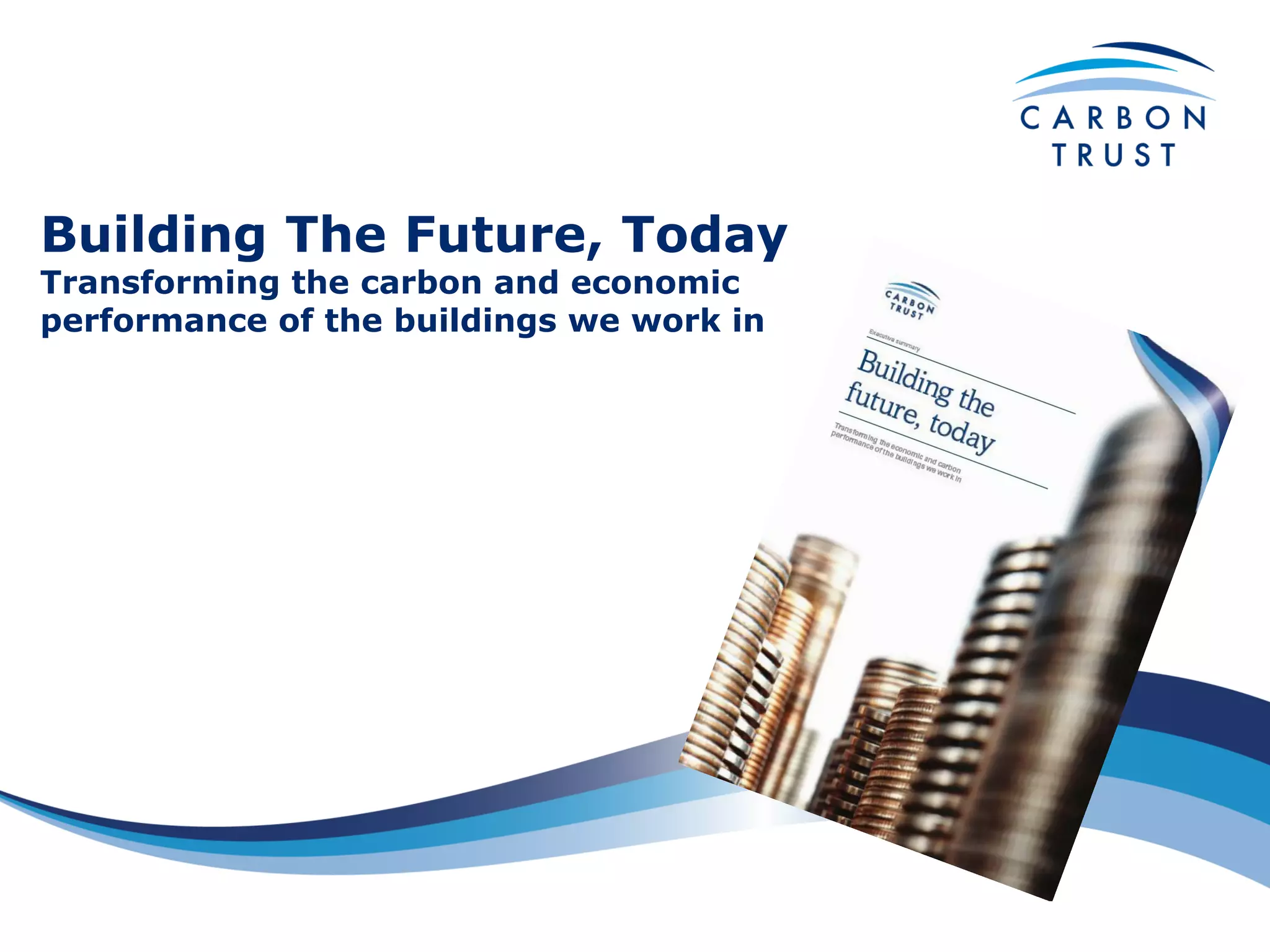
Building The Future, Today
Transforming the carbon and economic
performance of the buildings we work in
Building the future, today


  “What would a carbon reduction target of at
  least 80% mean for non-domestic buildings
  in the UK?”
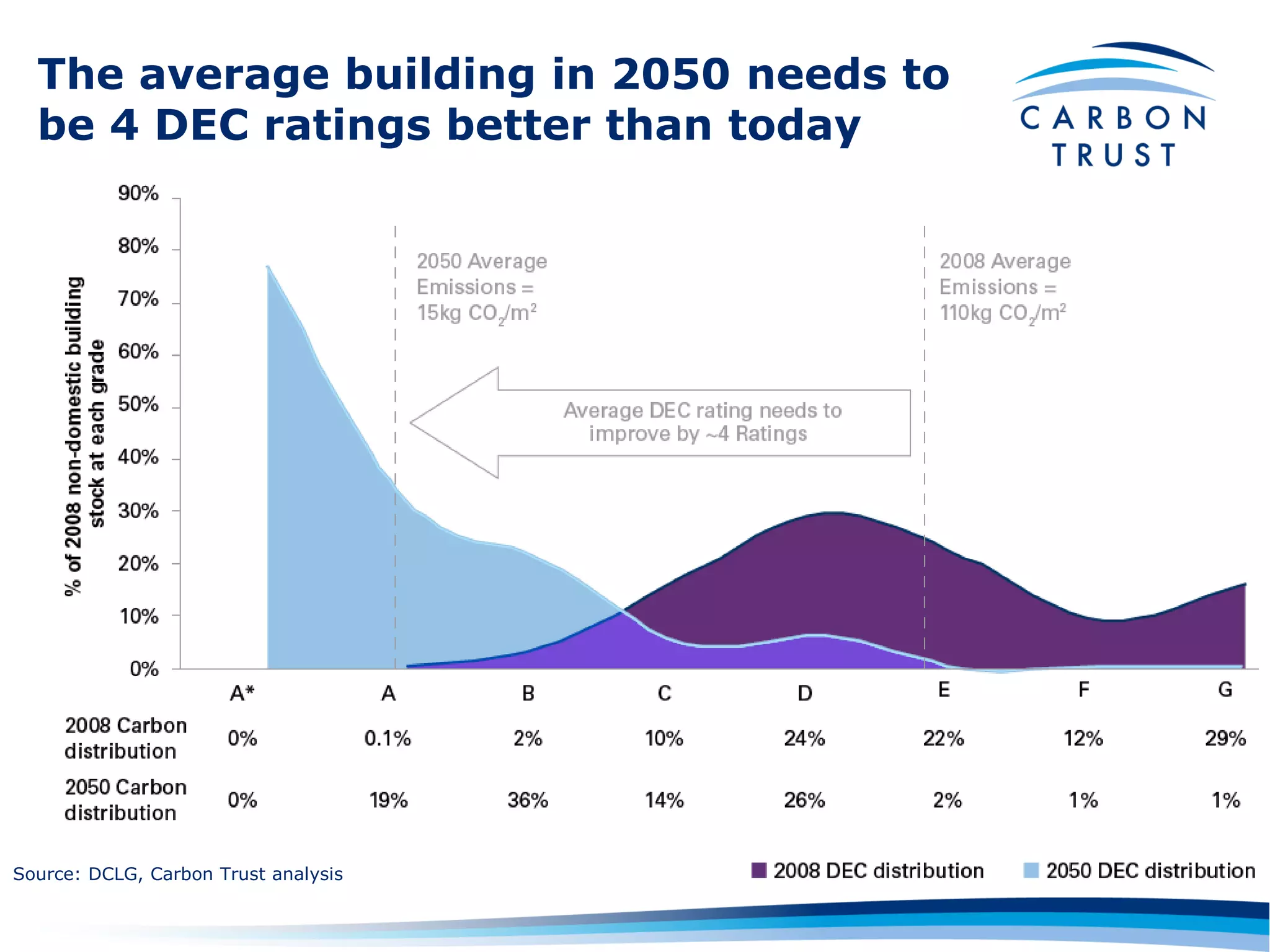
The average building in 2050 needs to
  be 4 DEC ratings better than today


Source: DCLG, Carbon Trust analysis
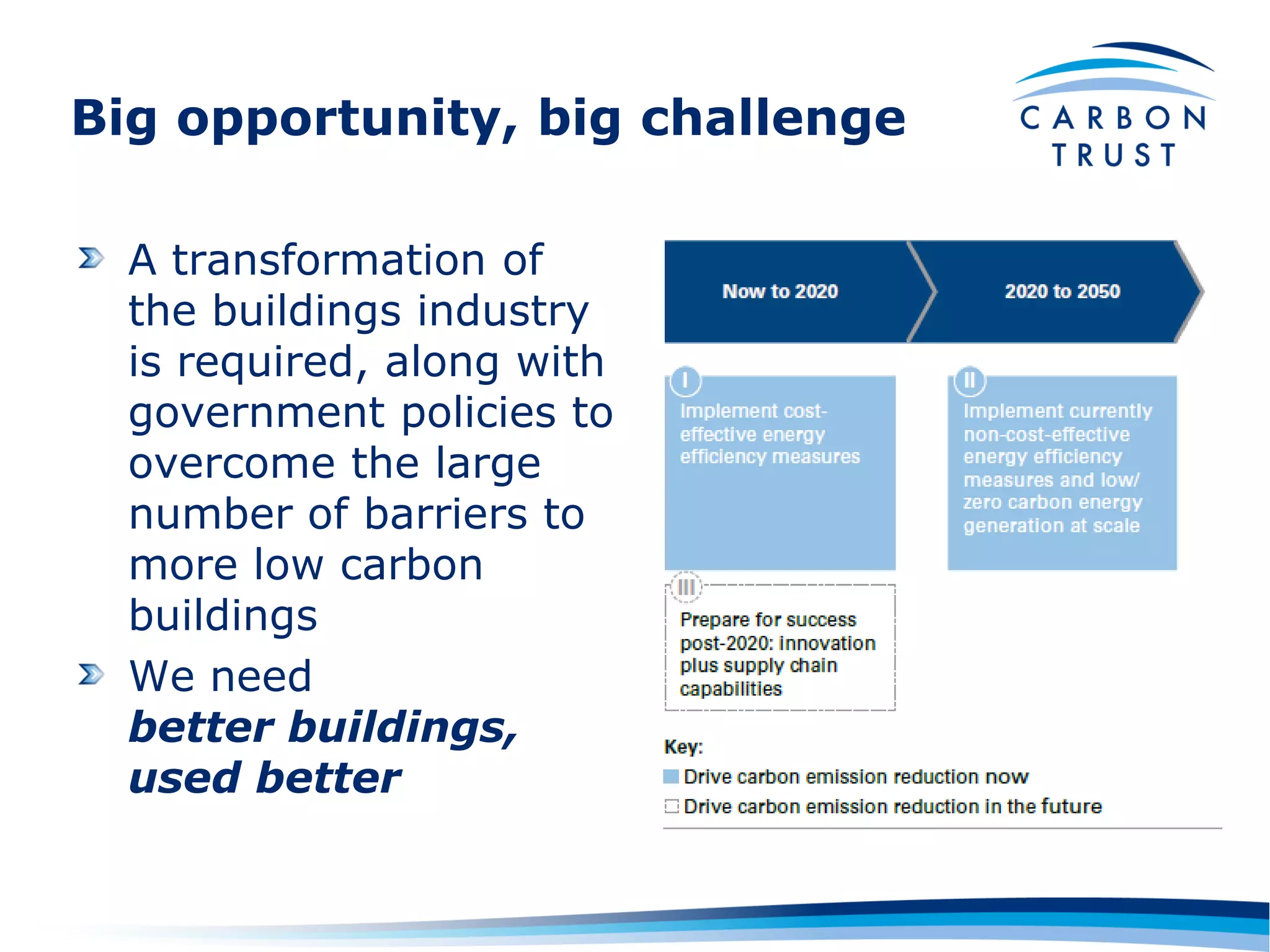
Big opportunity, big challenge

  A transformation of
  the buildings industry
  is required, along with
  government policies to
  overcome the large
  number of barriers to
  more low carbon
  buildings
  We need
  better buildings,
  used better
Agenda

 Building the Future, Today - the big picture

 Low Carbon Building Accelerators – background

 What we found

 Doing it better
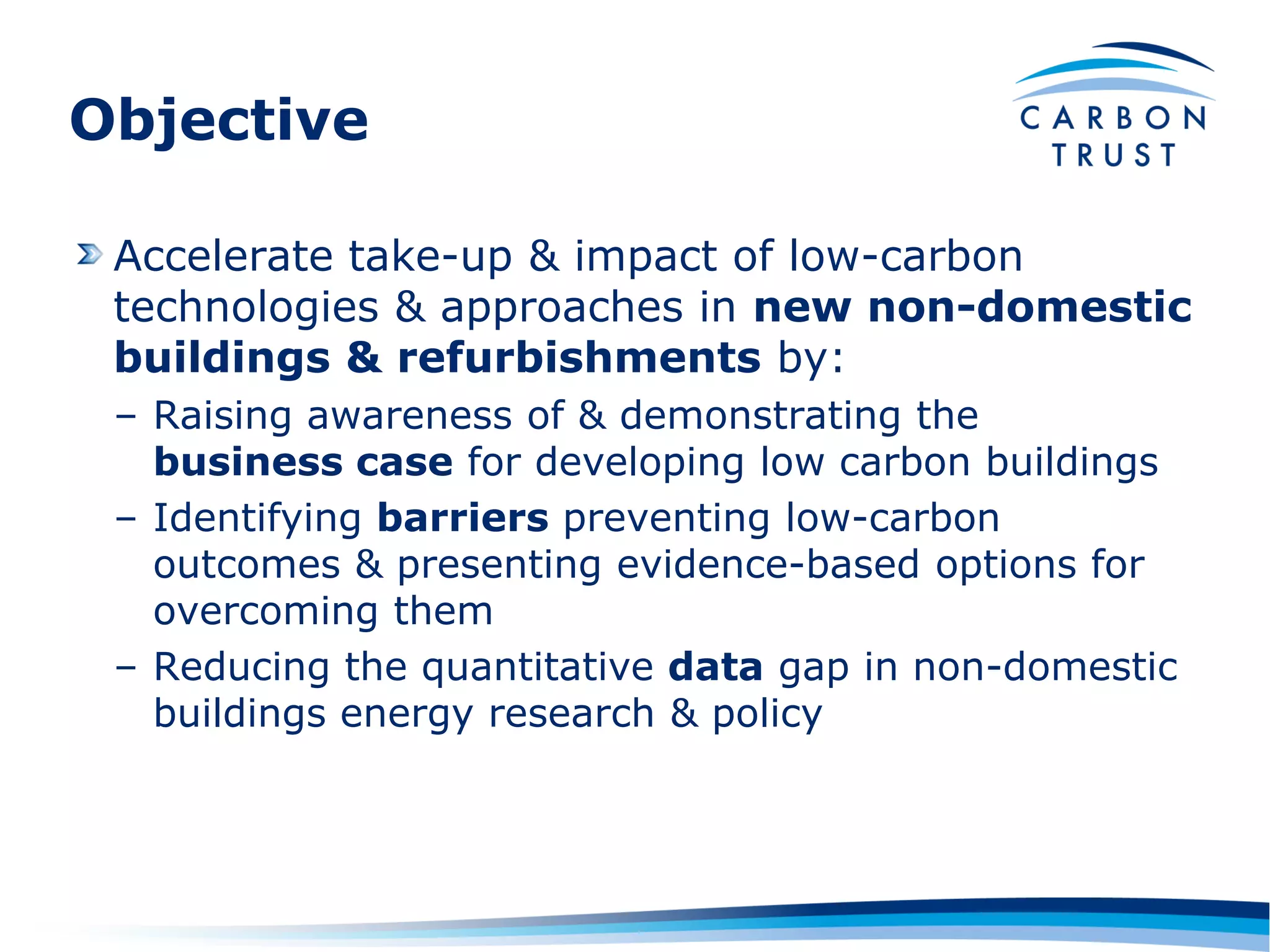
Objective

 Accelerate take-up & impact of low-carbon
 technologies & approaches in new non-domestic
 buildings & refurbishments by:
 – Raising awareness of & demonstrating the
   business case for developing low carbon buildings
 – Identifying barriers preventing low-carbon
   outcomes & presenting evidence-based options for
   overcoming them
 – Reducing the quantitative data gap in non-domestic
   buildings energy research & policy
Background

 Insights from real projects
 – Project team experiences, modelled
   & measured data
 – Monitoring operational performance vs predicted
 9 low carbon refurbishments running since 2005
 – Encouraging take-up of low-carbon measures
 19 low carbon new build running since 2006
 – projects going beyond Part L (2006) from “large”
   stream of DECC LCBP funding
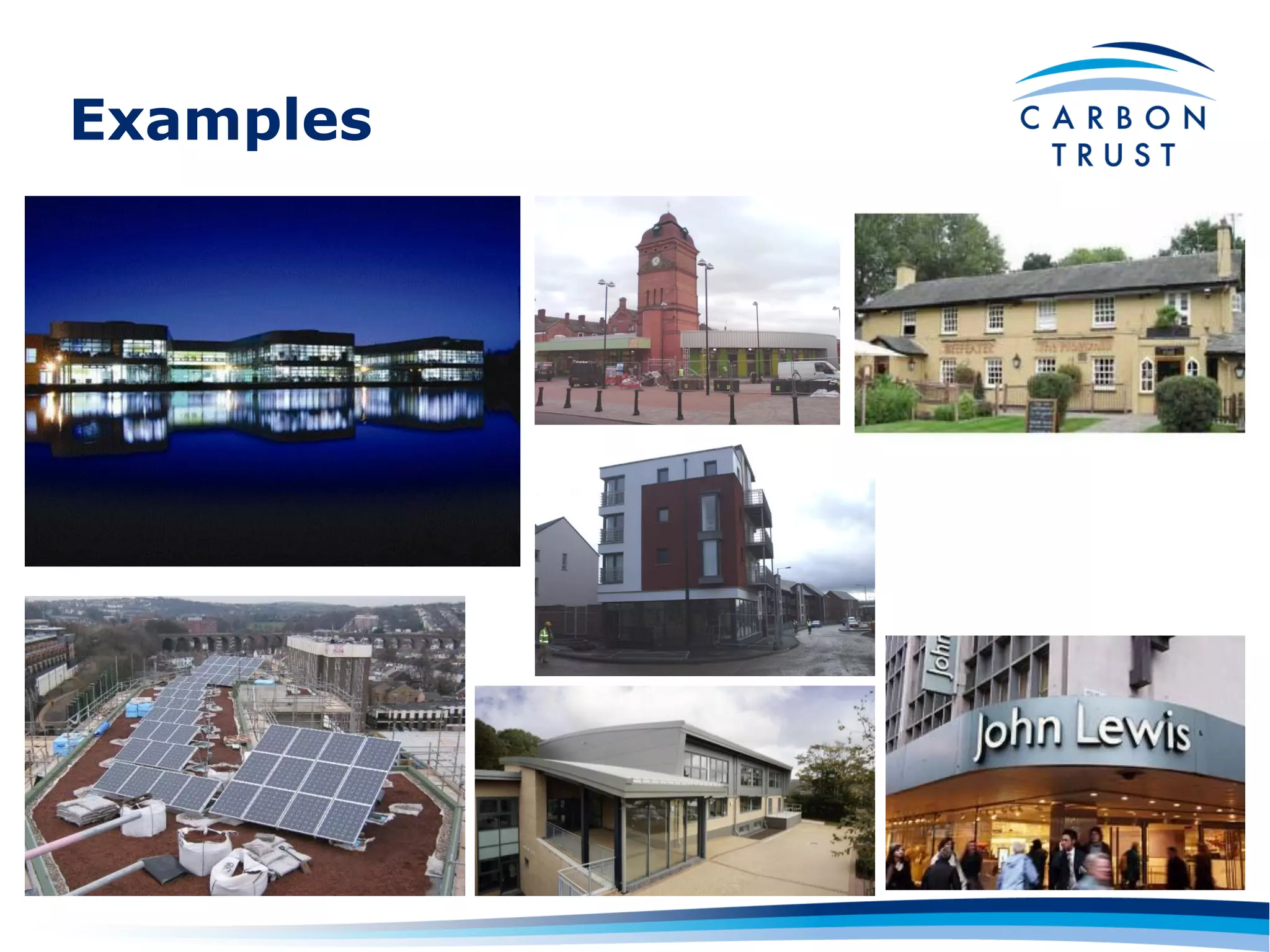
Examples
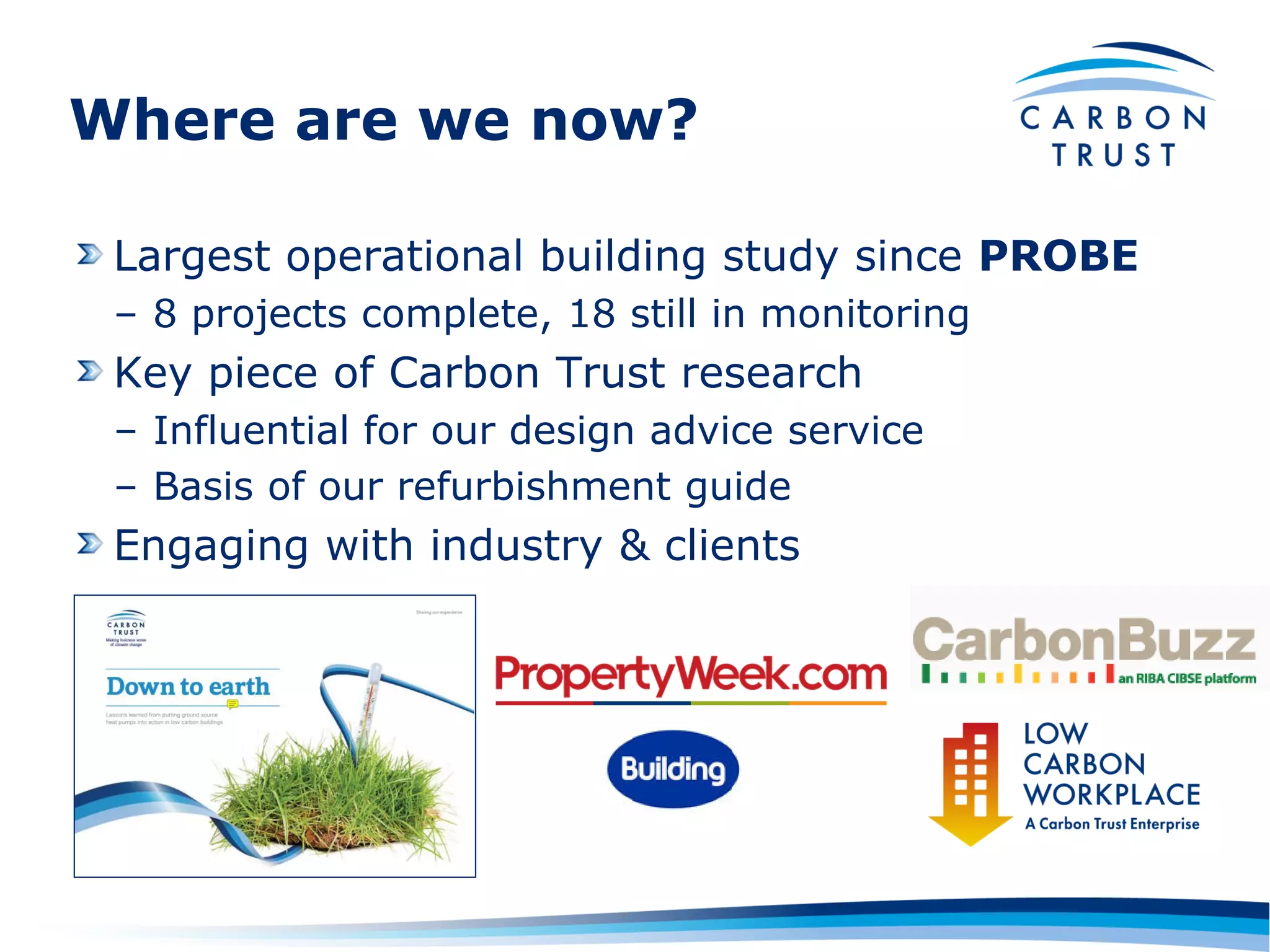
Where are we now?

 Largest operational building study since PROBE
 – 8 projects complete, 18 still in monitoring
 Key piece of Carbon Trust research
 – Influential for our design advice service
 – Basis of our refurbishment guide
 Engaging with industry & clients
Agenda

 Building the Future, Today - the big picture

 Low Carbon Building Accelerators – background

 What we found

 Doing it better
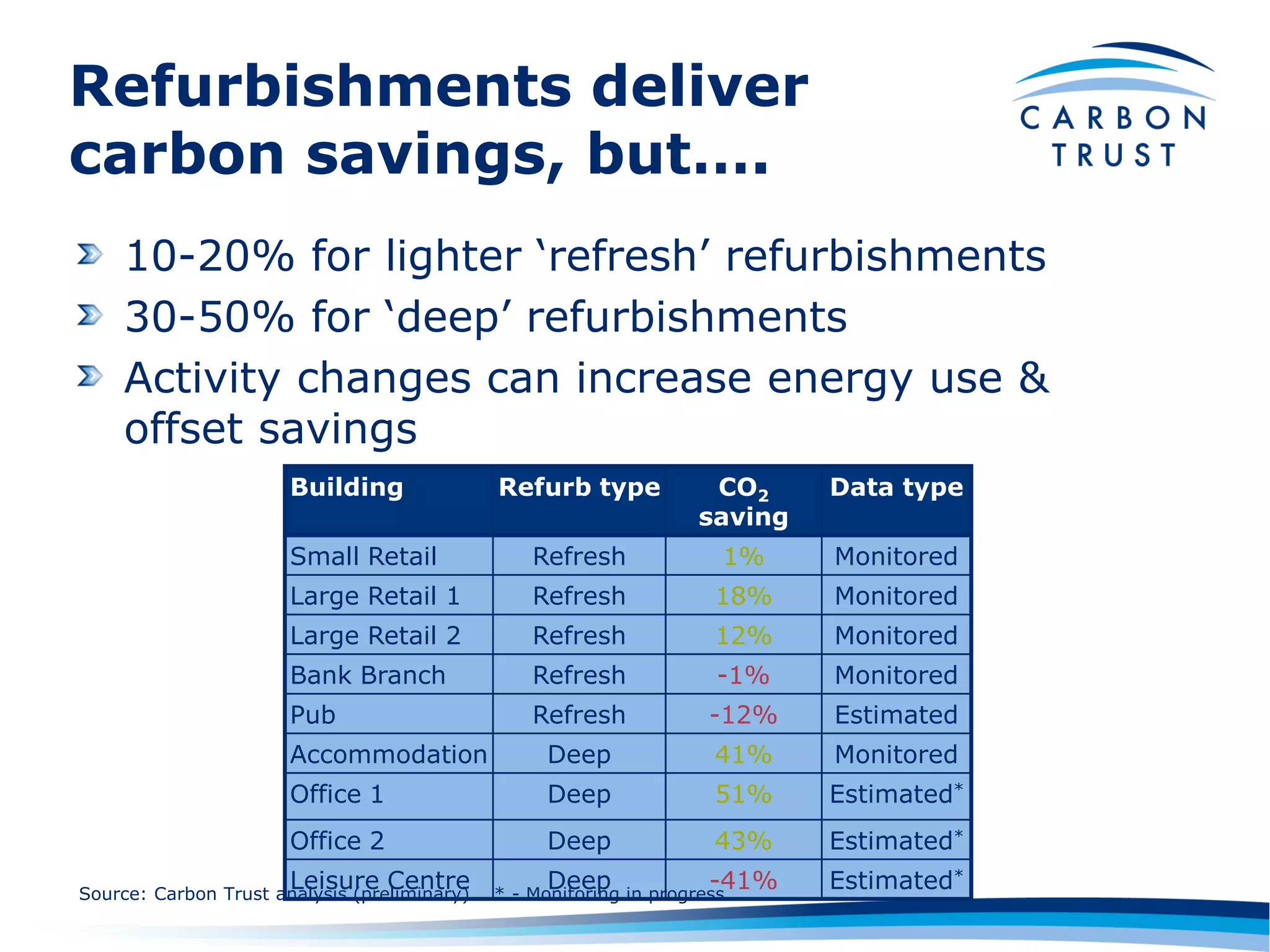
Refurbishments deliver
carbon savings, but….
    10-20% for lighter „refresh‟ refurbishments
    30-50% for „deep‟ refurbishments
    Activity changes can increase energy use &
    offset savings
                       Building               Refurb type             CO2     Data type
                                                                     saving
                       Small Retail               Refresh              1%     Monitored
                       Large Retail 1             Refresh             18%     Monitored
                       Large Retail 2             Refresh             12%     Monitored
                       Bank Branch                Refresh              -1%    Monitored
                       Pub                        Refresh             -12%    Estimated
                       Accommodation                Deep              41%     Monitored
                       Office 1                     Deep              51%     Estimated*
                       Office 2                     Deep              43%     Estimated*
                       Leisure Centre
Source: Carbon Trust analysis (preliminary)
                                                    Deep              -41%
                                              * - Monitoring in progress
                                                                              Estimated*
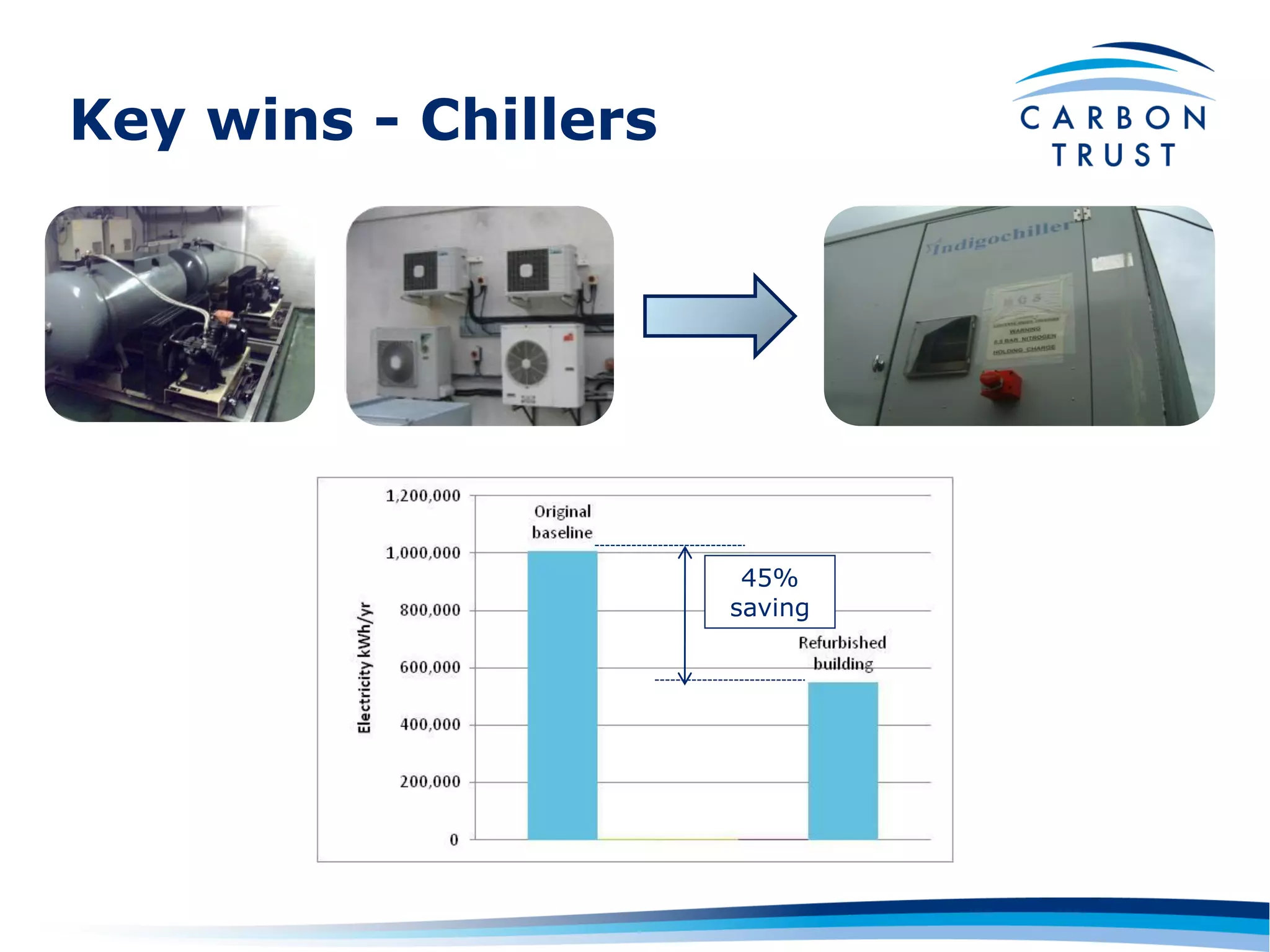
Key wins - Chillers


                       45%
                      saving
New build can perform,
but…
 Performance data still being collected

 Early evidence suggests many projects are not
 performing as intended
Performance appears to be
unrelated to cost

 Cost data is still to be compiled.
  – Preliminary evidence suggests cost of low carbon
    often “lost in the noise” of building costs OR
  – You can build a cheap low carbon building or an
    expensive one
 Example: 2 adjacent office buildings, near
 identical design & size
  – One building was cost-engineered by different
    contractor, dropping cost by >25%
  – Operational energy data shows cheaper building
    performs significantly better
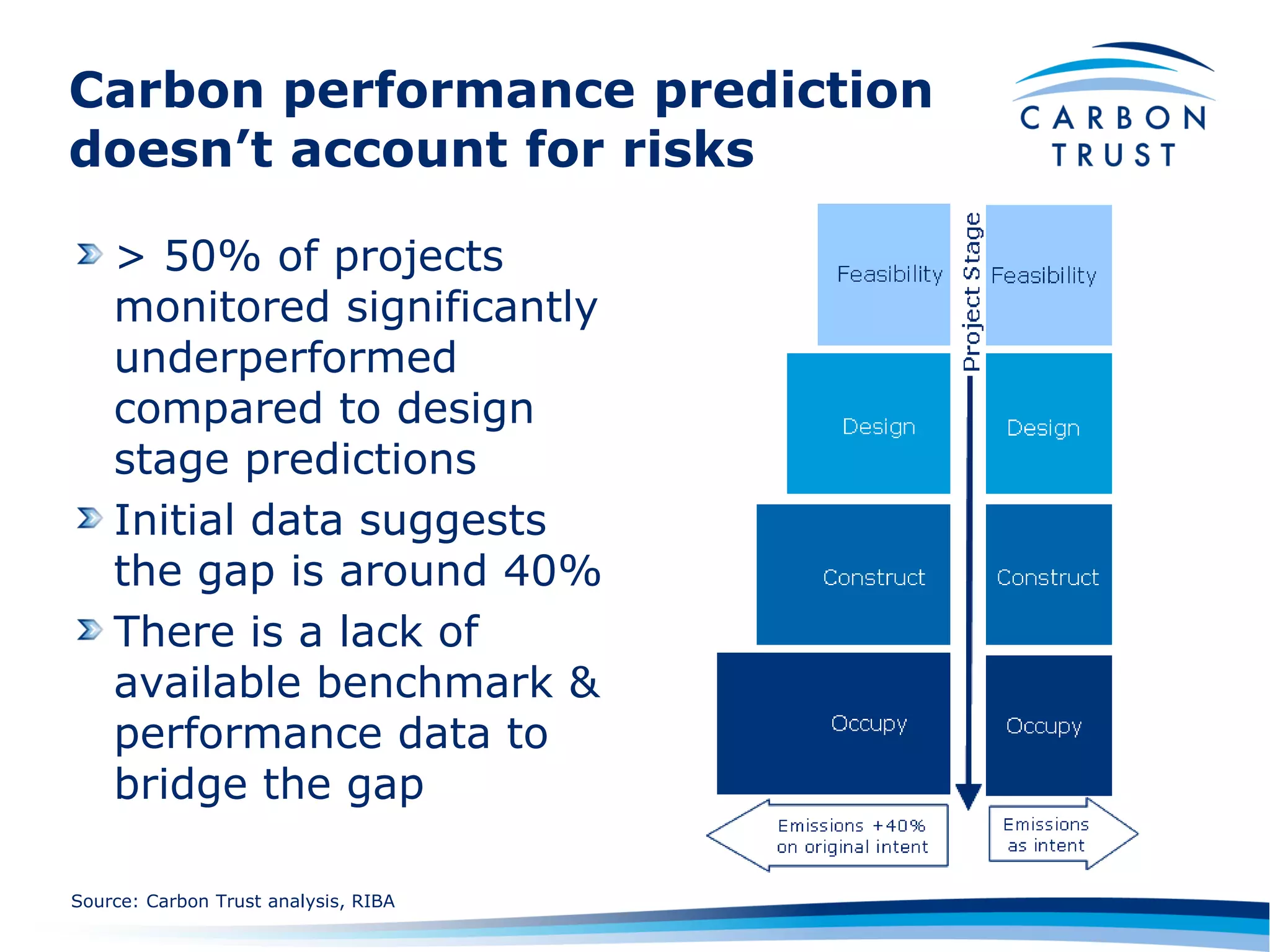
Carbon performance prediction
doesn’t account for risks

    > 50% of projects
    monitored significantly
    underperformed
    compared to design
    stage predictions
    Initial data suggests
    the gap is around 40%
    There is a lack of
    available benchmark &
    performance data to
    bridge the gap

Source: Carbon Trust analysis, RIBA
There are many sources of
risk, including
 Procurement methods, contracts & project
 management
 Commissioning
 Energy metering & monitoring processes
 “Unregulated” loads
 Missed opportunities
 BMS & control systems
 Renewable heat technologies
 System complexity
A skilled & engaged party, with a
long-term interest, is key to success

  Example 1: Office building owner-occupier with
  in-house technical team
   – Knowledge built from previous smaller projects
   – Tight process control
  Example 2: Client with deep green brand
   – Combined with a planning obligation that included
     energy performance target for year 3
  Example 3: Biomass ESCO for a community
  heating system
   – Contractual interest in technology performance
   – Long-term experience imported from Europe
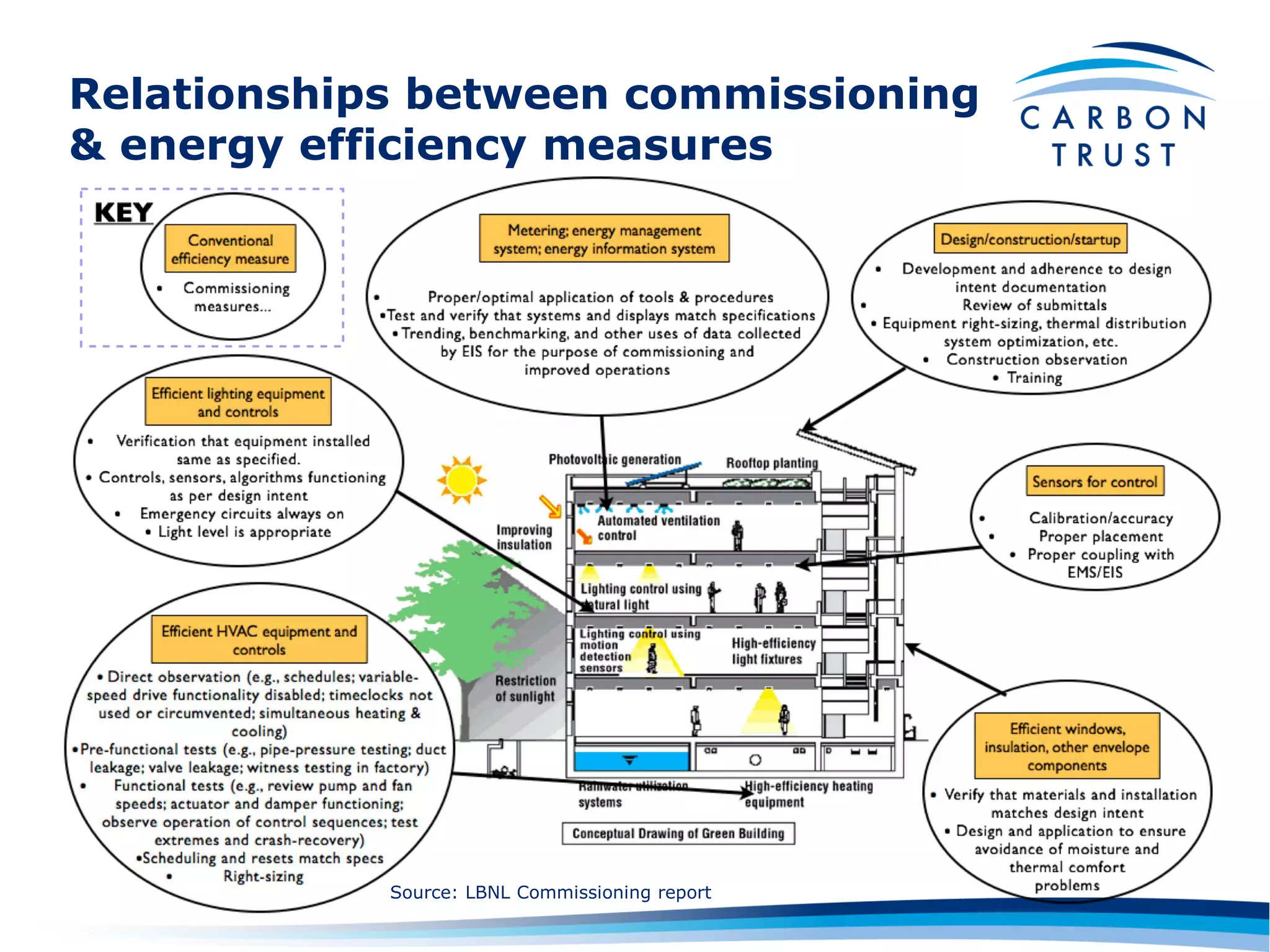
Commissioning is critical for
low carbon buildings

  > 40% of projects did not properly commission
  all building systems
  All new building projects required extended
  bedding-in periods (typically > 1 year)
   – to improve operation & realise benefits of low
     carbon technologies
  Typical impact currently being quantified
Relationships between commissioning
& energy efficiency measures


            Source: LBNL Commissioning report
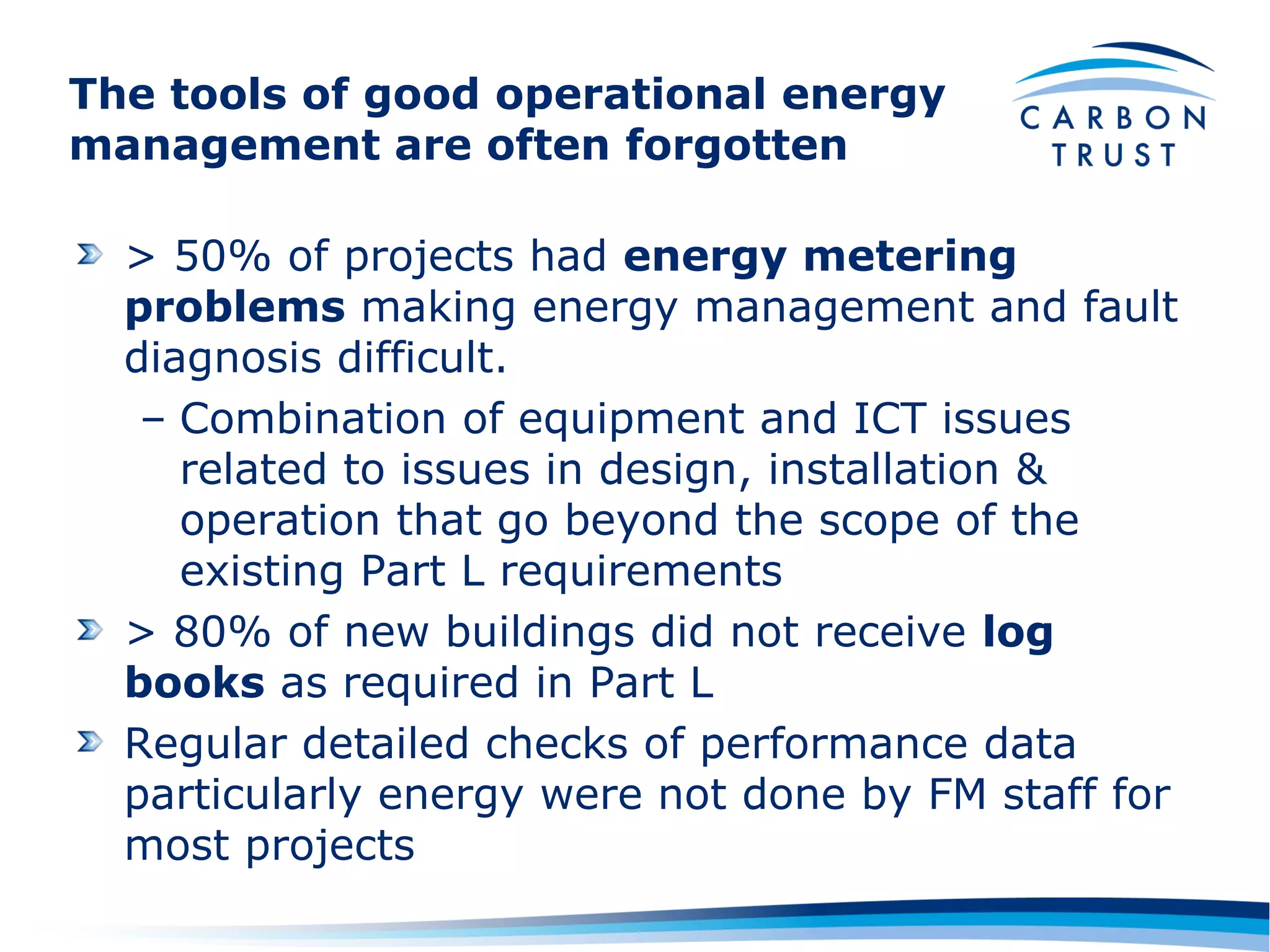
The tools of good operational energy
management are often forgotten

  > 50% of projects had energy metering
  problems making energy management and fault
  diagnosis difficult.
   – Combination of equipment and ICT issues
     related to issues in design, installation &
     operation that go beyond the scope of the
     existing Part L requirements
  > 80% of new buildings did not receive log
  books as required in Part L
  Regular detailed checks of performance data
  particularly energy were not done by FM staff for
  most projects
Increases in “un-regulated”
loads present a major risk
 Most projects (% to be confirmed) had large “un-
 regulated loads” (e.g. office or catering
 equipment)
 Increases in expected “un-regulated loads” offset
 carbon saving made in the building design or with
 low carbon technologies for many projects
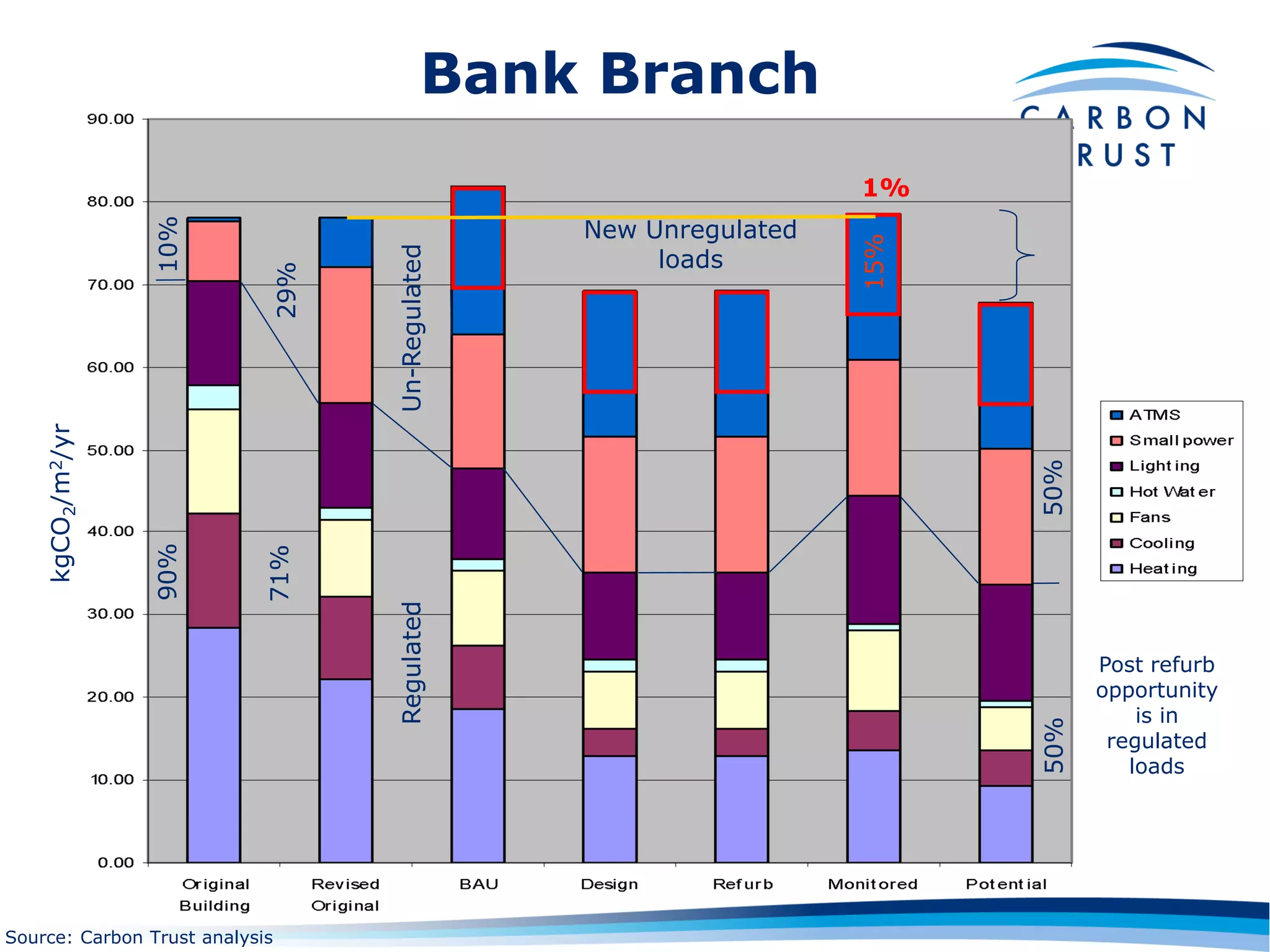
Bank Branch
                                                                   1%
                                                 New Unregulated
                  10%


                                                                   15%
                                                      loads


                                  Un-Regulated
                            29%
    kgCO2/m2/yr


                                                                         50%
                  90%


                           71%


                                  Regulated


                                                                               Post refurb
                                                                               opportunity
                                                                                   is in


                                                                         50%
                                                                                regulated
                                                                                  loads


Source: Carbon Trust analysis
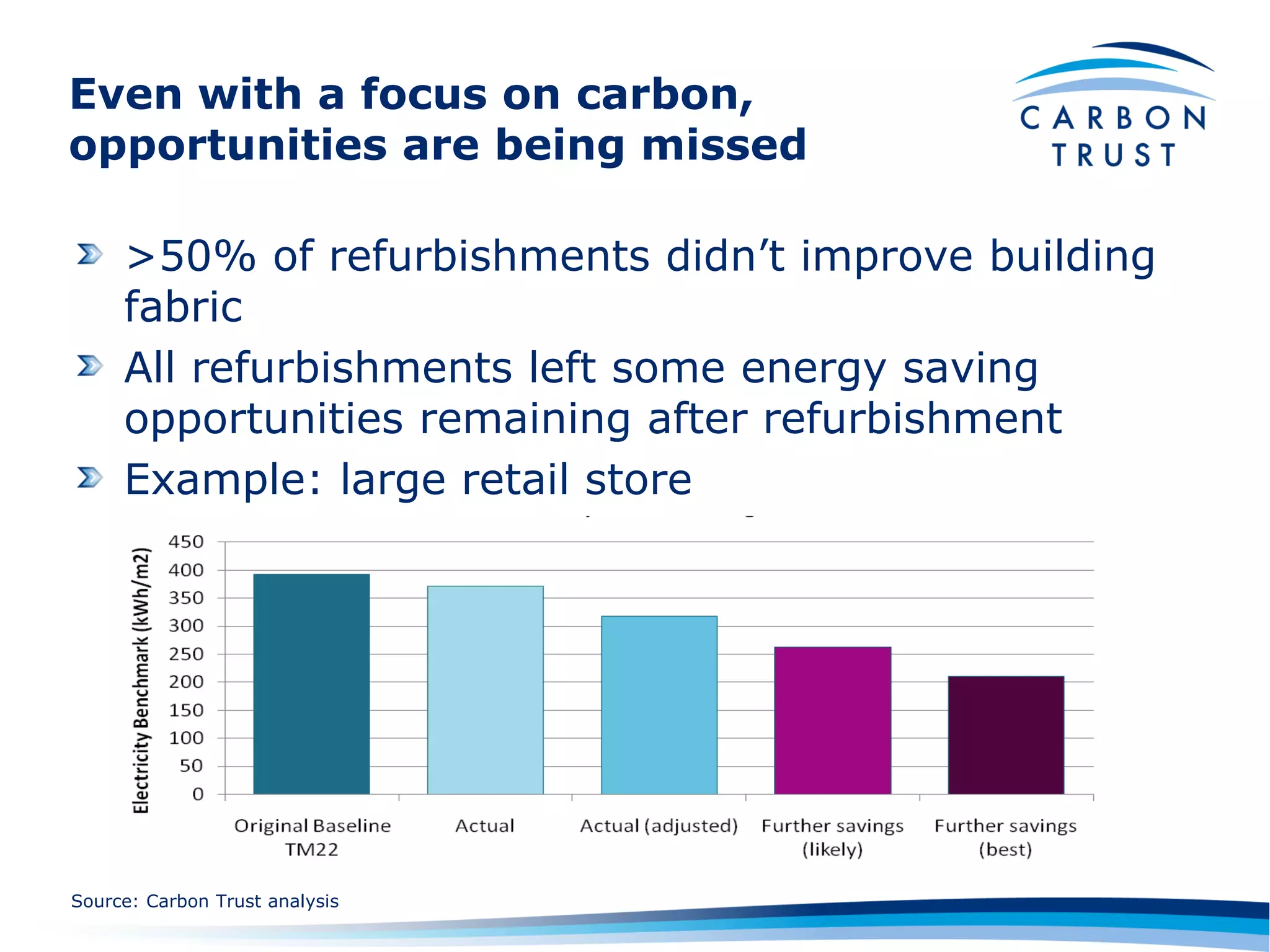
Even with a focus on carbon,
opportunities are being missed

     >50% of refurbishments didn‟t improve building
     fabric
     All refurbishments left some energy saving
     opportunities remaining after refurbishment
     Example: large retail store


Source: Carbon Trust analysis
Agenda

 Building the Future, Today - the big picture

 Low Carbon Building Accelerators – background

 What we found

 Doing it better
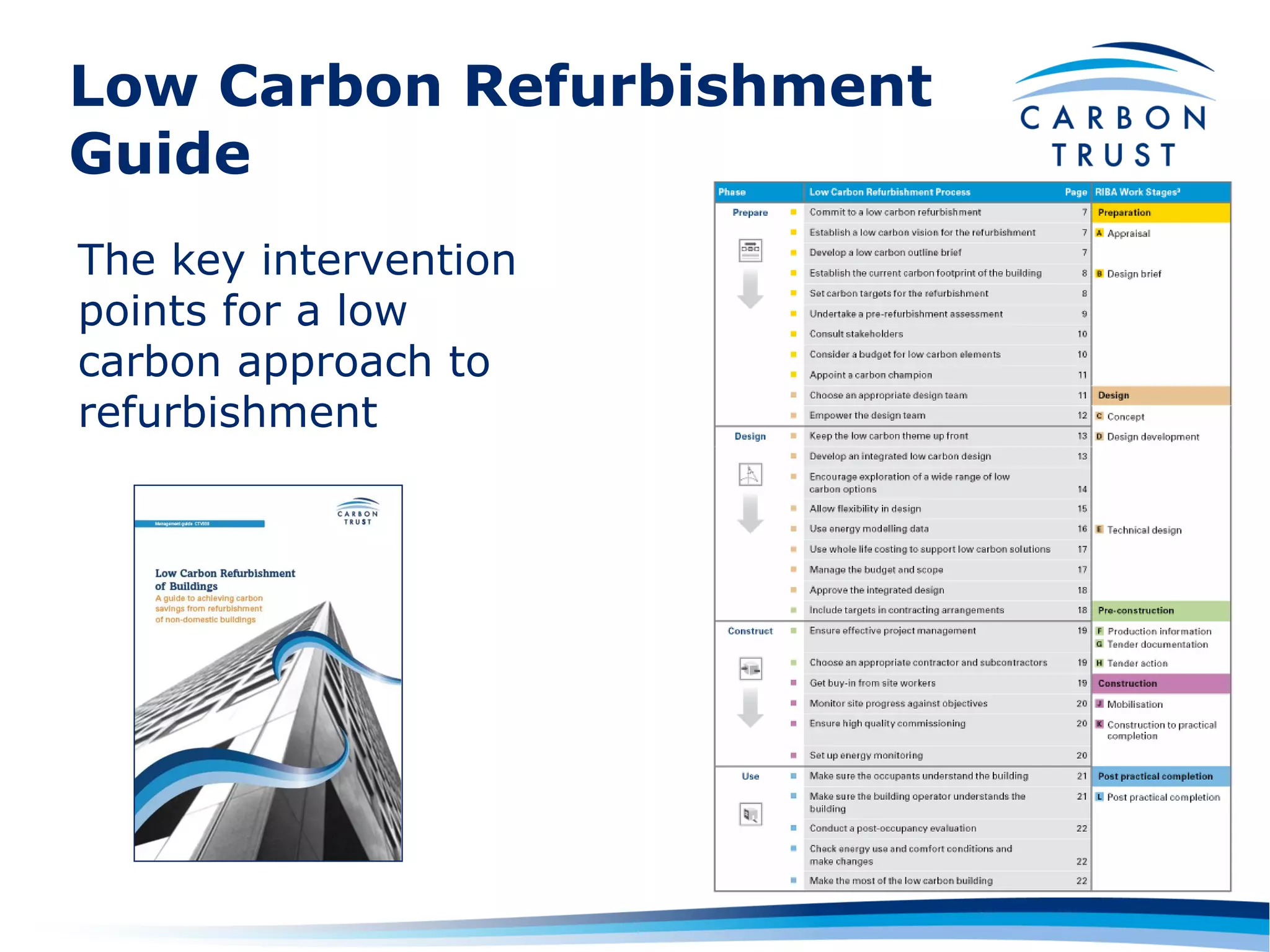
Low Carbon Refurbishment
Guide
The key intervention
points for a low
carbon approach to
refurbishment
Film case studies

 Refurbishment
  – MoD
  – Whitbread
  – Hampshire County Council

 New build
  –   Royal Horticultural Society
  –   Stoke Local Service Centre
  –   Pembrokeshire College
  –   Edge Hill University
  –   Fairglen Eco-community
  –   Woodbrook housing development
Further resources to come

 GSHP                    Commissioning
 PV                      Managing Risk
 Natural ventilation     Design to
 Biomass & community     performance gap
 heating                 (Carbon Buzz
 BMS & Controls          collaboration)
 Metering & monitoring   Procurement
                         (WRAP collaboration)
 Retrofitting
 renewables              Building performance
                         & carbon (PROBE lite)
                         Data archive
Questions?


         will.ray@carbontrust.co.uk


       www.carbontrust.co.uk/buildings
The Carbon Trust is grant funded by the Department for Environment,
Food and Rural Affairs, the Department for Business, Enterprise and
Regulatory Reform, the Scottish Government, the Welsh Assembly
Government and Invest Northern Ireland.
Whilst reasonable steps have been taken to ensure that the information
contained within this presentation is correct Will Ray, the Carbon Trust, its
agents, contractors and sub-contractors and the Government give no
warranty and make no representation as to its accuracy and accept no
liability for any errors or omissions.
The contents of this presentation are the copyright of the Carbon Trust
and may not be copied or republished without the prior written consent of
the Carbon Trust. The trademarks, service marks and logo used in this
presentation are the property of the Carbon Trust and no licence or right is
granted to use any such marks or logo.
© The Carbon Trust 2010. All rights reserved.
The Carbon Trust is a company limited by guarantee and registered in
England and Wales under Company Number 4190230 with its Registered
Office at: 8th Floor, 3 Clement‟s Inn, London, WC2A 2AZ.

Specifying low carbon buildings: recognising and reducing risks

  • 1.
    Specifying Low CarbonBuildings Recognising and reducing the risks Will Ray Specifying Low Carbon Buildings Conference 7/10/2010
  • 2.
    Agenda Building theFuture, Today - the big picture Low Carbon Building Accelerators – background What we found Doing it better
  • 3.
    Building The Future,Today Transforming the carbon and economic performance of the buildings we work in
  • 4.
    Building the future,today “What would a carbon reduction target of at least 80% mean for non-domestic buildings in the UK?”
  • 5.
    The average buildingin 2050 needs to be 4 DEC ratings better than today Source: DCLG, Carbon Trust analysis
  • 6.
    Big opportunity, bigchallenge A transformation of the buildings industry is required, along with government policies to overcome the large number of barriers to more low carbon buildings We need better buildings, used better
  • 7.
    Agenda Building theFuture, Today - the big picture Low Carbon Building Accelerators – background What we found Doing it better
  • 8.
    Objective Accelerate take-up& impact of low-carbon technologies & approaches in new non-domestic buildings & refurbishments by: – Raising awareness of & demonstrating the business case for developing low carbon buildings – Identifying barriers preventing low-carbon outcomes & presenting evidence-based options for overcoming them – Reducing the quantitative data gap in non-domestic buildings energy research & policy
  • 9.
    Background Insights fromreal projects – Project team experiences, modelled & measured data – Monitoring operational performance vs predicted 9 low carbon refurbishments running since 2005 – Encouraging take-up of low-carbon measures 19 low carbon new build running since 2006 – projects going beyond Part L (2006) from “large” stream of DECC LCBP funding
  • 10.
  • 11.
    Where are wenow? Largest operational building study since PROBE – 8 projects complete, 18 still in monitoring Key piece of Carbon Trust research – Influential for our design advice service – Basis of our refurbishment guide Engaging with industry & clients
  • 12.
    Agenda Building theFuture, Today - the big picture Low Carbon Building Accelerators – background What we found Doing it better
  • 13.
    Refurbishments deliver carbon savings,but…. 10-20% for lighter „refresh‟ refurbishments 30-50% for „deep‟ refurbishments Activity changes can increase energy use & offset savings Building Refurb type CO2 Data type saving Small Retail Refresh 1% Monitored Large Retail 1 Refresh 18% Monitored Large Retail 2 Refresh 12% Monitored Bank Branch Refresh -1% Monitored Pub Refresh -12% Estimated Accommodation Deep 41% Monitored Office 1 Deep 51% Estimated* Office 2 Deep 43% Estimated* Leisure Centre Source: Carbon Trust analysis (preliminary) Deep -41% * - Monitoring in progress Estimated*
  • 14.
    Key wins -Chillers 45% saving
  • 15.
    New build canperform, but… Performance data still being collected Early evidence suggests many projects are not performing as intended
  • 16.
    Performance appears tobe unrelated to cost Cost data is still to be compiled. – Preliminary evidence suggests cost of low carbon often “lost in the noise” of building costs OR – You can build a cheap low carbon building or an expensive one Example: 2 adjacent office buildings, near identical design & size – One building was cost-engineered by different contractor, dropping cost by >25% – Operational energy data shows cheaper building performs significantly better
  • 17.
    Carbon performance prediction doesn’taccount for risks > 50% of projects monitored significantly underperformed compared to design stage predictions Initial data suggests the gap is around 40% There is a lack of available benchmark & performance data to bridge the gap Source: Carbon Trust analysis, RIBA
  • 18.
    There are manysources of risk, including Procurement methods, contracts & project management Commissioning Energy metering & monitoring processes “Unregulated” loads Missed opportunities BMS & control systems Renewable heat technologies System complexity
  • 19.
    A skilled &engaged party, with a long-term interest, is key to success Example 1: Office building owner-occupier with in-house technical team – Knowledge built from previous smaller projects – Tight process control Example 2: Client with deep green brand – Combined with a planning obligation that included energy performance target for year 3 Example 3: Biomass ESCO for a community heating system – Contractual interest in technology performance – Long-term experience imported from Europe
  • 20.
    Commissioning is criticalfor low carbon buildings > 40% of projects did not properly commission all building systems All new building projects required extended bedding-in periods (typically > 1 year) – to improve operation & realise benefits of low carbon technologies Typical impact currently being quantified
  • 21.
    Relationships between commissioning &energy efficiency measures Source: LBNL Commissioning report
  • 22.
    The tools ofgood operational energy management are often forgotten > 50% of projects had energy metering problems making energy management and fault diagnosis difficult. – Combination of equipment and ICT issues related to issues in design, installation & operation that go beyond the scope of the existing Part L requirements > 80% of new buildings did not receive log books as required in Part L Regular detailed checks of performance data particularly energy were not done by FM staff for most projects
  • 23.
    Increases in “un-regulated” loadspresent a major risk Most projects (% to be confirmed) had large “un- regulated loads” (e.g. office or catering equipment) Increases in expected “un-regulated loads” offset carbon saving made in the building design or with low carbon technologies for many projects
  • 24.
    Bank Branch 1% New Unregulated 10% 15% loads Un-Regulated 29% kgCO2/m2/yr 50% 90% 71% Regulated Post refurb opportunity is in 50% regulated loads Source: Carbon Trust analysis
  • 25.
    Even with afocus on carbon, opportunities are being missed >50% of refurbishments didn‟t improve building fabric All refurbishments left some energy saving opportunities remaining after refurbishment Example: large retail store Source: Carbon Trust analysis
  • 26.
    Agenda Building theFuture, Today - the big picture Low Carbon Building Accelerators – background What we found Doing it better
  • 27.
    Low Carbon Refurbishment Guide Thekey intervention points for a low carbon approach to refurbishment
  • 28.
    Film case studies Refurbishment – MoD – Whitbread – Hampshire County Council New build – Royal Horticultural Society – Stoke Local Service Centre – Pembrokeshire College – Edge Hill University – Fairglen Eco-community – Woodbrook housing development
  • 29.
    Further resources tocome GSHP Commissioning PV Managing Risk Natural ventilation Design to Biomass & community performance gap heating (Carbon Buzz BMS & Controls collaboration) Metering & monitoring Procurement (WRAP collaboration) Retrofitting renewables Building performance & carbon (PROBE lite) Data archive
  • 30.
    Questions? will.ray@carbontrust.co.uk www.carbontrust.co.uk/buildings
  • 31.
    The Carbon Trustis grant funded by the Department for Environment, Food and Rural Affairs, the Department for Business, Enterprise and Regulatory Reform, the Scottish Government, the Welsh Assembly Government and Invest Northern Ireland. Whilst reasonable steps have been taken to ensure that the information contained within this presentation is correct Will Ray, the Carbon Trust, its agents, contractors and sub-contractors and the Government give no warranty and make no representation as to its accuracy and accept no liability for any errors or omissions. The contents of this presentation are the copyright of the Carbon Trust and may not be copied or republished without the prior written consent of the Carbon Trust. The trademarks, service marks and logo used in this presentation are the property of the Carbon Trust and no licence or right is granted to use any such marks or logo. © The Carbon Trust 2010. All rights reserved. The Carbon Trust is a company limited by guarantee and registered in England and Wales under Company Number 4190230 with its Registered Office at: 8th Floor, 3 Clement‟s Inn, London, WC2A 2AZ.