Living with minerals 4
Shaping UK minerals policy
    Globalism to localism
           7 November 2011
EU Raw Materials Supply Initiative
– update
Gwenole Cozigou, Director
European Commission Enterprise and
Industry
Directorate-General


Living with minerals 4: Shaping UK minerals policy
Globalism to localism
Living with minerals 4
Shaping UK minerals policy
    Globalism to localism
           7 November 2011
Case studies – the link between
minerals
and security of food supply and
other uses
Professor David Manning, Professor of
Soil Science
Newcastle University


Living with minerals 4: Shaping UK minerals policy
Globalism to localism
The Link Between Minerals and
   Security of Food Supply


 David Manning FGS CSci CGeol EurGeol
        Professor of Soil Science
         Newcastle University
At the heart of the problem
Global population is growing, but (overall) at a
decreasing rate:
                           7 billion in 2012
                           9 billion in 2050
At the heart of the problem
Global population is growing, but (overall) at a
decreasing rate:
                              7 billion in 2012
                              9 billion in 2050


  Africa: 1 billion in 2012
          2 billion in 2050
At the heart of the problem
The global population needs mineral resources.
GDP and mineral use correlate:


                       Minerals
                                                                              GDP


USGS: Rogich, D.G., and Matos, G.R., 2008, The global flows of metals and minerals: U.S. Geological
Survey Open-File Report 2008–1355, 11 p., available only online at http://pubs.usgs.gov/of/2008/1355/.
We need minerals more than ever
• As raw materials for industry
• As fuels
• As fertilisers
But there are pressures:
• How can we guarantee security of raw material
  supply?
• What about ‘peak phosphorus’?
• How can we reconcile fossil fuel use with climate
  change, and keep the lights on?
• What might the alternatives be?
We need to understand minerals more
             than ever
• And to use intelligence:
Fertiliser minerals
• These illustrate very well some of the
  paradoxes that exist
• They are absolutely essential to support
  human life
• When we remove a crop, we mine nutrients
  from the soil
• When we import a crop, do we pay the
  farmers enough to replace the nutrients?
The price of fertilisers has boomed:
Fertiliser prices
• Prices peaked in 2008
• N and P price rises matched those of oil,
  and came down to pre-2008 levels
• K has stayed high
• K reached $1000/tonne in some markets
  in 2008
• K is three times the price it was in 2007
  (now almost $500/tonne)
What about phosphorus?


•   Cordell, D., Drangert, J.-O., and White, S., (2009) The Story of Phosphorus: Global food security and food
    for thought. Global Environmental Change, 19, 292-305
16 countries produce 95% of the
 world’s P (159 MT phosphate rock)


30% global production   10-20% global production   1-10% global production
The phosphorus paradox
• People talk about ‘peak phosphorus’, based on
  analogies with oil


                               This does not take into account
                               the huge resource base; very
                               different from oil.


                           •   Cordell, D., Drangert, J.-O., and White, S., (2009)
                               The Story of Phosphorus: Global food security
                               and food for thought. Global Environmental
                               Change, 19, 292-305
Reserves are only part of the story
P resources are enormous (USGS)
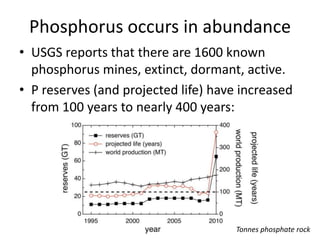
Phosphorus occurs in abundance
• USGS reports that there are 1600 known
  phosphorus mines, extinct, dormant, active.
• P reserves (and projected life) have increased
  from 100 years to nearly 400 years:


                                      Tonnes phosphate rock
Phosphorus occurs in abundance
• USGS reports that there are 1600 known
  phosphorus mines, extinct, dormant, active.
• P reserves (and projected life) have increased
  from 100 years to nearly 400 years:


          Financial Times, 7 September 2011


                                              Tonnes phosphate rock
The phosphorus paradox
• Why do we throw away so much P?
• Phosphate pollution is a major issue –
  how can we use P more sustainably?
  – Struvite (NH4MgPO4.6H2O)
  – Sewage as a source of P
We can recover P from waste waters
Potash (K)
• Very different to P
• Much more soluble
• More limited in terms of sources
• Not a pollutant, apparently
Difficult to recover from waste waters
Why is K so important?
K is a vital mineral component of all crops:


K that is consumed has to be replaced.
Demand for potash
• Although northern hemisphere countries have
  enough K inputs, there are major shortfalls in
  K addition elsewhere.
• Nutrient balance studies show that
  replacement of K removed with crops is often
  inadequate.
• Worldwide potash mine production needs to
  double to balance offtake at the present day.
Africa, for example:
Sheldrick and Lingard
(2004):
Africa, for example:
Sheldrick and Lingard   From FAO data:
(2004):                 Africa consumes 485000
                        T potash/year.
                        47/57 African countries
                        buy no K fertiliser.
                        About 1.5% of world
                        potash production feeds
                        15% of the world’s
                        population.
12 countries produce 99% of the
 world’s K (33.5 MT K2O equivalent)


35% global production   10-20% global production   1-10% global production
Potash production
• Very different to P:


                                Tonnes K2O
Potash is big
  business
Potash price and supply


• Unlikely to go below $350/tonne
• World production needs to double
• Suppliers control the market
90% of potash reserves are found in
          North America


35% global production   10-20% global production   1-10% global production
Fertiliser minerals present a challenge

• Will conventional products be accessible
  (price, logistics) to growing populations, which
  will double in Africa?
• How can we use our knowledge of
  geological/soil processes to fill the gaps in
  provision, if conventional fertilisers are
  inaccessible?
An urgent area for research
Conclusions
• Minerals are vital for society
• The challenge of the next 30 years is enormous
• We need intelligence and expertise of the type
  that the British Geological Survey provides
• The materials that we need to mine are in the
  ground
• Our universities need to create new knowledge
  to rise to the challenge

Living with Minerals 4 - Shaping UK minerals policy - Part 4

  • 1.
    Living with minerals4 Shaping UK minerals policy Globalism to localism 7 November 2011
  • 2.
    EU Raw MaterialsSupply Initiative – update Gwenole Cozigou, Director European Commission Enterprise and Industry Directorate-General Living with minerals 4: Shaping UK minerals policy Globalism to localism
  • 3.
    Living with minerals4 Shaping UK minerals policy Globalism to localism 7 November 2011
  • 4.
    Case studies –the link between minerals and security of food supply and other uses Professor David Manning, Professor of Soil Science Newcastle University Living with minerals 4: Shaping UK minerals policy Globalism to localism
  • 5.
    The Link BetweenMinerals and Security of Food Supply David Manning FGS CSci CGeol EurGeol Professor of Soil Science Newcastle University
  • 6.
    At the heartof the problem Global population is growing, but (overall) at a decreasing rate: 7 billion in 2012 9 billion in 2050
  • 7.
    At the heartof the problem Global population is growing, but (overall) at a decreasing rate: 7 billion in 2012 9 billion in 2050 Africa: 1 billion in 2012 2 billion in 2050
  • 8.
    At the heartof the problem The global population needs mineral resources. GDP and mineral use correlate: Minerals GDP USGS: Rogich, D.G., and Matos, G.R., 2008, The global flows of metals and minerals: U.S. Geological Survey Open-File Report 2008–1355, 11 p., available only online at http://pubs.usgs.gov/of/2008/1355/.
  • 9.
    We need mineralsmore than ever • As raw materials for industry • As fuels • As fertilisers But there are pressures: • How can we guarantee security of raw material supply? • What about ‘peak phosphorus’? • How can we reconcile fossil fuel use with climate change, and keep the lights on? • What might the alternatives be?
  • 10.
    We need tounderstand minerals more than ever • And to use intelligence:
  • 11.
    Fertiliser minerals • Theseillustrate very well some of the paradoxes that exist • They are absolutely essential to support human life • When we remove a crop, we mine nutrients from the soil • When we import a crop, do we pay the farmers enough to replace the nutrients?
  • 12.
    The price offertilisers has boomed:
  • 13.
    Fertiliser prices • Pricespeaked in 2008 • N and P price rises matched those of oil, and came down to pre-2008 levels • K has stayed high • K reached $1000/tonne in some markets in 2008 • K is three times the price it was in 2007 (now almost $500/tonne)
  • 14.
    What about phosphorus? • Cordell, D., Drangert, J.-O., and White, S., (2009) The Story of Phosphorus: Global food security and food for thought. Global Environmental Change, 19, 292-305
  • 15.
    16 countries produce95% of the world’s P (159 MT phosphate rock) 30% global production 10-20% global production 1-10% global production
  • 16.
    The phosphorus paradox •People talk about ‘peak phosphorus’, based on analogies with oil This does not take into account the huge resource base; very different from oil. • Cordell, D., Drangert, J.-O., and White, S., (2009) The Story of Phosphorus: Global food security and food for thought. Global Environmental Change, 19, 292-305
  • 17.
    Reserves are onlypart of the story P resources are enormous (USGS)
  • 18.
    Phosphorus occurs inabundance • USGS reports that there are 1600 known phosphorus mines, extinct, dormant, active. • P reserves (and projected life) have increased from 100 years to nearly 400 years: Tonnes phosphate rock
  • 19.
    Phosphorus occurs inabundance • USGS reports that there are 1600 known phosphorus mines, extinct, dormant, active. • P reserves (and projected life) have increased from 100 years to nearly 400 years: Financial Times, 7 September 2011 Tonnes phosphate rock
  • 20.
    The phosphorus paradox •Why do we throw away so much P? • Phosphate pollution is a major issue – how can we use P more sustainably? – Struvite (NH4MgPO4.6H2O) – Sewage as a source of P We can recover P from waste waters
  • 21.
    Potash (K) • Verydifferent to P • Much more soluble • More limited in terms of sources • Not a pollutant, apparently Difficult to recover from waste waters
  • 22.
    Why is Kso important? K is a vital mineral component of all crops: K that is consumed has to be replaced.
  • 23.
    Demand for potash •Although northern hemisphere countries have enough K inputs, there are major shortfalls in K addition elsewhere. • Nutrient balance studies show that replacement of K removed with crops is often inadequate. • Worldwide potash mine production needs to double to balance offtake at the present day.
  • 24.
    Africa, for example: Sheldrickand Lingard (2004):
  • 25.
    Africa, for example: Sheldrickand Lingard From FAO data: (2004): Africa consumes 485000 T potash/year. 47/57 African countries buy no K fertiliser. About 1.5% of world potash production feeds 15% of the world’s population.
  • 26.
    12 countries produce99% of the world’s K (33.5 MT K2O equivalent) 35% global production 10-20% global production 1-10% global production
  • 27.
    Potash production • Verydifferent to P: Tonnes K2O
  • 28.
  • 29.
    Potash price andsupply • Unlikely to go below $350/tonne • World production needs to double • Suppliers control the market
  • 30.
    90% of potashreserves are found in North America 35% global production 10-20% global production 1-10% global production
  • 31.
    Fertiliser minerals presenta challenge • Will conventional products be accessible (price, logistics) to growing populations, which will double in Africa? • How can we use our knowledge of geological/soil processes to fill the gaps in provision, if conventional fertilisers are inaccessible? An urgent area for research
  • 32.
    Conclusions • Minerals arevital for society • The challenge of the next 30 years is enormous • We need intelligence and expertise of the type that the British Geological Survey provides • The materials that we need to mine are in the ground • Our universities need to create new knowledge to rise to the challenge