INTRODUCING
LINDSY DOAN’S CHILD DEVELOPMENT HOME
Licensed Family Home Daycare
Lindsy Doan
BELIEFS AND VALUES
Jean Piaget once said “The principle goal of education is to create
men who are capable of doing new things, not simply of repeating what
other generations have done-men who are creative, inventive and
discoverers.” This quote no longer applies to just men, but to women as
well. Children need love, support, dedication and interest. They grow at a
phenomenal speed and make astounding discoveries in their communities
and environments. By supporting the children's imaginations and
discoveries, we are indeed preparing these wonderful children for a future.
Their futures. To present as Piaget defined as people "who are creative,
inventive and discoverers" we must first support the children as they are and
encourage them to grow into people they want to be.
Our facility believes in families. They play the most important role
in each child's education. Our goal is to support families. Each child is
unique and diverse. Every child deserves respect and support in their
development. The program will not hinder their growth and goals, but
challenge them to accomplish their dreams and discover answers to their
questions. By working with families, we become a team to make sure that
each child is supported with love, encouragement, respect and trust.
Children's development and learning should be encouraged. Despite the
experience and education that every educator has, we learn something new
every day. Children should be given the same opportunity. By
understanding their development and being a part of their new experiences,
we cherish the time that we have with them during the first years of their life
by providing positive growth and encouraging exploration. After all, the sky
is no longer the limit and education is never ending.
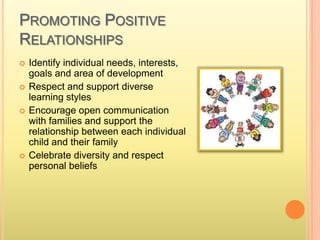
PROMOTING POSITIVE
RELATIONSHIPS
 Identify individual needs, interests,
goals and area of development
 Respect and support diverse
learning styles
 Encourage open communication
with families and support the
relationship between each individual
child and their family
 Celebrate diversity and respect
personal beliefs
EFFECTIVE TEACHING APPROACHES
 Connect practices with NAEYC standards
 Use assessment to evaluate development and guide curriculum
 Keep up with research to structure program in order to further meet
children’s needs
 Create a relationship with families and encourage teamwork to
support development
 Encourage play in a safe and healthy environment
CREATING A NOURISHING
CLASSROOM CULTURE
 Record observations daily and evaluate curriculum
on observations and assessment
 Respect diversity and beliefs
 Encourage children to ask questions and seek
answers
 Identify each child’s needs and find ways to cater to
needs in the classroom
 Encourage children to talk about their experiences
at home and in the community and incorporate their
understanding in the classroom
CURRICULUM
 Created and based on the
information that assessment
and standards provides
 Incorporate student interests
through observation, social
discussions and questions
 Apply curriculum in seven
areas of learning: Language
Arts, math, science, music, art
s and crafts, physical
education and motor skill
development
ONGOING ASSESSMENTS
 Desired Results Developmental Profile (DRDP)
 Identifies development in seven domains
 Gives educators an opportunity to gather information to facilitate further
development
 Supports ongoing observation and assessment to collect in individual student
portfolios
 Phonological Awareness
 Aligns with state standards to prepare children for reading
 Covers rhyme, syllables and phonemic awareness
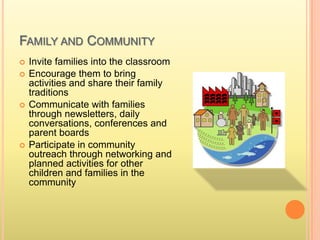
FAMILY AND COMMUNITY
 Invite families into the classroom
 Encourage them to bring
activities and share their family
traditions
 Communicate with families
through newsletters, daily
conversations, conferences and
parent boards
 Participate in community
outreach through networking and
planned activities for other
children and families in the
community
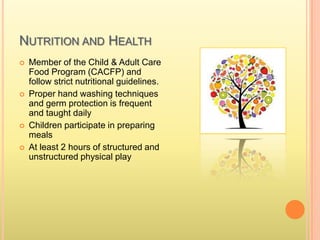
NUTRITION AND HEALTH
 Member of the Child & Adult Care
Food Program (CACFP) and
follow strict nutritional guidelines.
 Proper hand washing techniques
and germ protection is frequent
and taught daily
 Children participate in preparing
meals
 At least 2 hours of structured and
unstructured physical play
SAFE AND HEALTHY PHYSICAL
ENVIRONMENT
 Support social-emotional needs through positive
words
 Tools are cleaned weekly and are age appropriate
 Facility is kept neat and is cleaned frequently
 Teachers constantly scan environment for unsafe
scenarios
RESOURCES AND REFERENCES
 http://www.choosemyplate.gov/
 http://www.wested.org/desiredresults/training/form_drdp.htm

Byv5 vrrd doan_multimedia_powerpoint_presentation_for_parents

  • 1.
    INTRODUCING LINDSY DOAN’S CHILDDEVELOPMENT HOME Licensed Family Home Daycare Lindsy Doan
  • 2.
    BELIEFS AND VALUES JeanPiaget once said “The principle goal of education is to create men who are capable of doing new things, not simply of repeating what other generations have done-men who are creative, inventive and discoverers.” This quote no longer applies to just men, but to women as well. Children need love, support, dedication and interest. They grow at a phenomenal speed and make astounding discoveries in their communities and environments. By supporting the children's imaginations and discoveries, we are indeed preparing these wonderful children for a future. Their futures. To present as Piaget defined as people "who are creative, inventive and discoverers" we must first support the children as they are and encourage them to grow into people they want to be. Our facility believes in families. They play the most important role in each child's education. Our goal is to support families. Each child is unique and diverse. Every child deserves respect and support in their development. The program will not hinder their growth and goals, but challenge them to accomplish their dreams and discover answers to their questions. By working with families, we become a team to make sure that each child is supported with love, encouragement, respect and trust. Children's development and learning should be encouraged. Despite the experience and education that every educator has, we learn something new every day. Children should be given the same opportunity. By understanding their development and being a part of their new experiences, we cherish the time that we have with them during the first years of their life by providing positive growth and encouraging exploration. After all, the sky is no longer the limit and education is never ending.
  • 3.
    PROMOTING POSITIVE RELATIONSHIPS  Identifyindividual needs, interests, goals and area of development  Respect and support diverse learning styles  Encourage open communication with families and support the relationship between each individual child and their family  Celebrate diversity and respect personal beliefs
  • 4.
    EFFECTIVE TEACHING APPROACHES Connect practices with NAEYC standards  Use assessment to evaluate development and guide curriculum  Keep up with research to structure program in order to further meet children’s needs  Create a relationship with families and encourage teamwork to support development  Encourage play in a safe and healthy environment
  • 5.
    CREATING A NOURISHING CLASSROOMCULTURE  Record observations daily and evaluate curriculum on observations and assessment  Respect diversity and beliefs  Encourage children to ask questions and seek answers  Identify each child’s needs and find ways to cater to needs in the classroom  Encourage children to talk about their experiences at home and in the community and incorporate their understanding in the classroom
  • 6.
    CURRICULUM  Created andbased on the information that assessment and standards provides  Incorporate student interests through observation, social discussions and questions  Apply curriculum in seven areas of learning: Language Arts, math, science, music, art s and crafts, physical education and motor skill development
  • 7.
    ONGOING ASSESSMENTS  DesiredResults Developmental Profile (DRDP)  Identifies development in seven domains  Gives educators an opportunity to gather information to facilitate further development  Supports ongoing observation and assessment to collect in individual student portfolios  Phonological Awareness  Aligns with state standards to prepare children for reading  Covers rhyme, syllables and phonemic awareness
  • 8.
    FAMILY AND COMMUNITY Invite families into the classroom  Encourage them to bring activities and share their family traditions  Communicate with families through newsletters, daily conversations, conferences and parent boards  Participate in community outreach through networking and planned activities for other children and families in the community
  • 9.
    NUTRITION AND HEALTH Member of the Child & Adult Care Food Program (CACFP) and follow strict nutritional guidelines.  Proper hand washing techniques and germ protection is frequent and taught daily  Children participate in preparing meals  At least 2 hours of structured and unstructured physical play
  • 10.
    SAFE AND HEALTHYPHYSICAL ENVIRONMENT  Support social-emotional needs through positive words  Tools are cleaned weekly and are age appropriate  Facility is kept neat and is cleaned frequently  Teachers constantly scan environment for unsafe scenarios
  • 11.
    RESOURCES AND REFERENCES http://www.choosemyplate.gov/  http://www.wested.org/desiredresults/training/form_drdp.htm