8051 Architecture
Mrs. Hezal Lopes
Assistant Professor
DJSCE, Vile Parle(W)
The Microcontroller Architecture:
• Introduction to 8051 Microcontroller,
• Architecture,
• Interrupts of 8051
• The 8051 microcontroller was invented in 1980's by Intel.
• Its foundation is based on Harvard architecture and this microcontroller was developed
principally for bringing it to be used in Embedded Systems.
• At first it was created by using NMOS technology but the use of NMOS(N-channel metal-oxide
semiconductor) consumed more power to work therefore Intel re-launch the microcontroller
8051 using CMOS(complementary metal-oxide semiconductor) technology and new edition came
up with edition of letter 'C' in the title name, therefore the new modified version of
microcontroller is called by name 80C51.
• The 8051 microcontroller programming is performed in embedded C language using Keil
software.
Features of 8051 Microcontroller:
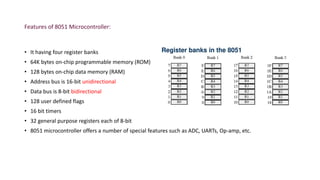
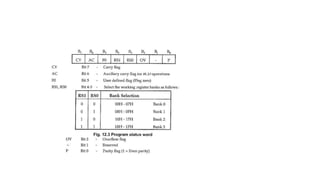
• It having four register banks
• 64K bytes on-chip programmable memory (ROM)
• 128 bytes on-chip data memory (RAM)
• Address bus is 16-bit unidirectional
• Data bus is 8-bit bidirectional
• 128 user defined flags
• 16 bit timers
• 32 general purpose registers each of 8-bit
• 8051 microcontroller offers a number of special features such as ADC, UARTs, Op-amp, etc.
Application of 8051 Microcontroller
Examples of embedded systems include the controllers in washing machines, the engine management systems in cars, and the
flight control systems in aircraft.
• Home automation: The 8051 microcontroller can be used in home automation systems to control lighting, temperature,
and security systems.
• Industrial control: The 8051 microcontroller is used in industrial control applications to control processes, machinery, and
equipment. It can also be used to monitor and control temperature, pressure, and other environmental factors.
• Robotics: The 8051 microcontroller is used in robotics applications to control the movement of robots, sensors, and
actuators.
• Automotive: The 8051 microcontroller is used in the automotive industry for engine control, anti-lock braking systems,
airbag control, and other applications.
• Medical devices: The 8051 microcontroller is used in medical devices for patient monitoring, drug delivery systems, and
other applications.
• Communication systems: The 8051 microcontroller is used in communication systems for data transmission, signal
processing, and other applications.
• Consumer electronics: The 8051 microcontroller is used in consumer electronics such as remote controls, digital cameras,
and smart home devices.
• What is Microcontroller?
• A microcomputer made on a single semiconductor chip is called single-chip microcomputer. Since, single chip
microcomputers are generally used in control applications, they are also called microcontrollers.
• Microcontroller contains all essential components of a microcomputer such as CPU, RAM, ROM/EPROM, I/O lines etc.
Some single chip microcontrollers contain devices to perform specific functions such as DMA channels, A/D converter,
serial port, pulse width modulation, etc.
• 8051 Architecture
• In 1980, Intel introduced a powerful 8051 series of 8 -bit microcontrollers.
• They are the second generation of 8-bit microcontrollers.
• The 8051 microcontrollers are used for a variety of applications involving limited calculations and relatively some control
strategies.
• They are used for industrial and commercial control applications, appliances control, instrumentation etc.
• The 8051 contains Boolean processor, full duplex serial port and power saving circuitry in addition to
essential components such as 8-bit CPU, RAM, ROM/EPROM/OTPROM, timer/counter and parallel I/O lines.
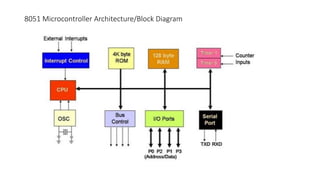
8051 Microcontroller Architecture/Block Diagram
• Basic components present internally inside 8051 Microcontroller architecture are:
• CPU (Central Processing Unit):
• CPU act as a mind of any processing machine.
• It synchronizes and manages all processes that are carried out in microcontroller.
• User has no power to control the functioning of CPU.
• It interprets the program stored in ROM and carries out from storage and then performs it projected duty.
• CPU manage the different types of registers available in 8051 microcontroller.
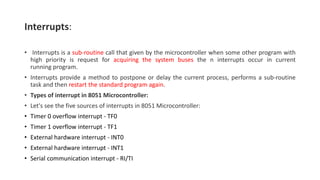
Interrupts:
• Interrupts is a sub-routine call that given by the microcontroller when some other program with
high priority is request for acquiring the system buses the n interrupts occur in current
running program.
• Interrupts provide a method to postpone or delay the current process, performs a sub-routine
task and then restart the standard program again.
• Types of interrupt in 8051 Microcontroller:
• Let's see the five sources of interrupts in 8051 Microcontroller:
• Timer 0 overflow interrupt - TF0
• Timer 1 overflow interrupt - TF1
• External hardware interrupt - INT0
• External hardware interrupt - INT1
• Serial communication interrupt - RI/TI
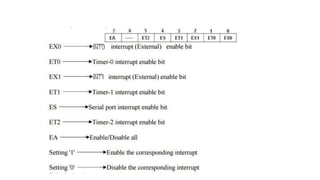
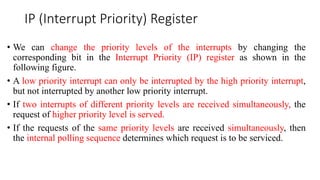
IP (Interrupt Priority) Register
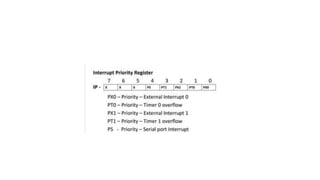
• We can change the priority levels of the interrupts by changing the
corresponding bit in the Interrupt Priority (IP) register as shown in the
following figure.
• A low priority interrupt can only be interrupted by the high priority interrupt,
but not interrupted by another low priority interrupt.
• If two interrupts of different priority levels are received simultaneously, the
request of higher priority level is served.
• If the requests of the same priority levels are received simultaneously, then
the internal polling sequence determines which request is to be serviced.
• Memory:
• For operation Micro-controller required a program.
• This program guides the microcontroller to perform the specific tasks.
• This program installed in microcontroller required some on chip memory for the storage of the program.
• Microcontroller also required memory for storage of data and operands for the short duration.
• In microcontroller 8051 there is code or program memory of 4 KB that is it has 4 KB ROM and it also comprise of data memory
(RAM) of 128 bytes.
• Oscillator:
• As the microcontroller is digital circuit therefore it needs timer for their operation.
• To perform timer operation inside microcontroller it required externally connected or on-chip oscillator.
• Microcontroller is used inside an embedded system for managing the function of devices.
• Therefore, 8051 uses the two 16 bit counters and timers.
• For the operation of this timers and counters the oscillator is used inside microcontroller.
• Bus : Bus is a group of wires which uses as a communication canal or acts as means of data transfer.
• The different bus configuration includes 8, 16 or more cables. Therefore, a bus can bear 8 bits, 16 bits all together.
• Types of buses in 8051 Microcontroller:
• Let's see the two types of bus used in 8051 microcontroller:
• Address Bus: 8051 microcontrollers is consisting of 16 bit address bus. It is generally be used for transferring the data
from Central Processing Unit to Memory.
• Data bus: 8051 microcontroller is consisting of 8 bits data bus. It is generally be used for transferring the data from
one peripherals position to other peripherals.
Thank You

Architecture of 8051 Microcontroller.pdf

  • 1.
    8051 Architecture Mrs. HezalLopes Assistant Professor DJSCE, Vile Parle(W)
  • 2.
    The Microcontroller Architecture: •Introduction to 8051 Microcontroller, • Architecture, • Interrupts of 8051
  • 3.
    • The 8051microcontroller was invented in 1980's by Intel. • Its foundation is based on Harvard architecture and this microcontroller was developed principally for bringing it to be used in Embedded Systems. • At first it was created by using NMOS technology but the use of NMOS(N-channel metal-oxide semiconductor) consumed more power to work therefore Intel re-launch the microcontroller 8051 using CMOS(complementary metal-oxide semiconductor) technology and new edition came up with edition of letter 'C' in the title name, therefore the new modified version of microcontroller is called by name 80C51. • The 8051 microcontroller programming is performed in embedded C language using Keil software.
  • 4.
    Features of 8051Microcontroller: • It having four register banks • 64K bytes on-chip programmable memory (ROM) • 128 bytes on-chip data memory (RAM) • Address bus is 16-bit unidirectional • Data bus is 8-bit bidirectional • 128 user defined flags • 16 bit timers • 32 general purpose registers each of 8-bit • 8051 microcontroller offers a number of special features such as ADC, UARTs, Op-amp, etc.
  • 6.
    Application of 8051Microcontroller Examples of embedded systems include the controllers in washing machines, the engine management systems in cars, and the flight control systems in aircraft. • Home automation: The 8051 microcontroller can be used in home automation systems to control lighting, temperature, and security systems. • Industrial control: The 8051 microcontroller is used in industrial control applications to control processes, machinery, and equipment. It can also be used to monitor and control temperature, pressure, and other environmental factors. • Robotics: The 8051 microcontroller is used in robotics applications to control the movement of robots, sensors, and actuators. • Automotive: The 8051 microcontroller is used in the automotive industry for engine control, anti-lock braking systems, airbag control, and other applications. • Medical devices: The 8051 microcontroller is used in medical devices for patient monitoring, drug delivery systems, and other applications. • Communication systems: The 8051 microcontroller is used in communication systems for data transmission, signal processing, and other applications. • Consumer electronics: The 8051 microcontroller is used in consumer electronics such as remote controls, digital cameras, and smart home devices.
  • 7.
    • What isMicrocontroller? • A microcomputer made on a single semiconductor chip is called single-chip microcomputer. Since, single chip microcomputers are generally used in control applications, they are also called microcontrollers. • Microcontroller contains all essential components of a microcomputer such as CPU, RAM, ROM/EPROM, I/O lines etc. Some single chip microcontrollers contain devices to perform specific functions such as DMA channels, A/D converter, serial port, pulse width modulation, etc.
  • 8.
    • 8051 Architecture •In 1980, Intel introduced a powerful 8051 series of 8 -bit microcontrollers. • They are the second generation of 8-bit microcontrollers. • The 8051 microcontrollers are used for a variety of applications involving limited calculations and relatively some control strategies. • They are used for industrial and commercial control applications, appliances control, instrumentation etc. • The 8051 contains Boolean processor, full duplex serial port and power saving circuitry in addition to essential components such as 8-bit CPU, RAM, ROM/EPROM/OTPROM, timer/counter and parallel I/O lines.
  • 9.
  • 10.
    • Basic componentspresent internally inside 8051 Microcontroller architecture are: • CPU (Central Processing Unit): • CPU act as a mind of any processing machine. • It synchronizes and manages all processes that are carried out in microcontroller. • User has no power to control the functioning of CPU. • It interprets the program stored in ROM and carries out from storage and then performs it projected duty. • CPU manage the different types of registers available in 8051 microcontroller.
  • 11.
    Interrupts: • Interrupts isa sub-routine call that given by the microcontroller when some other program with high priority is request for acquiring the system buses the n interrupts occur in current running program. • Interrupts provide a method to postpone or delay the current process, performs a sub-routine task and then restart the standard program again. • Types of interrupt in 8051 Microcontroller: • Let's see the five sources of interrupts in 8051 Microcontroller: • Timer 0 overflow interrupt - TF0 • Timer 1 overflow interrupt - TF1 • External hardware interrupt - INT0 • External hardware interrupt - INT1 • Serial communication interrupt - RI/TI
  • 13.
    IP (Interrupt Priority)Register • We can change the priority levels of the interrupts by changing the corresponding bit in the Interrupt Priority (IP) register as shown in the following figure. • A low priority interrupt can only be interrupted by the high priority interrupt, but not interrupted by another low priority interrupt. • If two interrupts of different priority levels are received simultaneously, the request of higher priority level is served. • If the requests of the same priority levels are received simultaneously, then the internal polling sequence determines which request is to be serviced.
  • 15.
    • Memory: • Foroperation Micro-controller required a program. • This program guides the microcontroller to perform the specific tasks. • This program installed in microcontroller required some on chip memory for the storage of the program. • Microcontroller also required memory for storage of data and operands for the short duration. • In microcontroller 8051 there is code or program memory of 4 KB that is it has 4 KB ROM and it also comprise of data memory (RAM) of 128 bytes. • Oscillator: • As the microcontroller is digital circuit therefore it needs timer for their operation. • To perform timer operation inside microcontroller it required externally connected or on-chip oscillator. • Microcontroller is used inside an embedded system for managing the function of devices. • Therefore, 8051 uses the two 16 bit counters and timers. • For the operation of this timers and counters the oscillator is used inside microcontroller.
  • 16.
    • Bus :Bus is a group of wires which uses as a communication canal or acts as means of data transfer. • The different bus configuration includes 8, 16 or more cables. Therefore, a bus can bear 8 bits, 16 bits all together. • Types of buses in 8051 Microcontroller: • Let's see the two types of bus used in 8051 microcontroller: • Address Bus: 8051 microcontrollers is consisting of 16 bit address bus. It is generally be used for transferring the data from Central Processing Unit to Memory. • Data bus: 8051 microcontroller is consisting of 8 bits data bus. It is generally be used for transferring the data from one peripherals position to other peripherals.
  • 17.