String Manipulation Instructions
– These are the instructions used for strings for
string movement, Load, Store, Comparison and
Scan.
– A string is a series of bytes or a series of words
in sequential memory locations.
– A ‘B’ in the instruction mnemonic is used to
specifically indicate that a string of bytes is to
be acted upon.
– A ‘W’ in the instruction mnemonic is used to
specifically indicate that a string of words is to
be acted upon.
MOVS/MOVSB/MOVSW
Syntax :-- MOVS destination, source
MOVSB
MOVSW
• The MOVS instruction is used to transfer a byte
or a word from the source string to the destination
string.
•The source must be in the data segment and the
destination in the extra segment.
• The offset of the source byte or a word must be
placed in SI register, which is represented as DS:SI
and the offset of the destination byte or a word
must be placed in DI register, which is represented
as ES:DI
MOVS/MOVSB/MOVSW (contd..)
•On the execution of the instruction, SI and DI are
automatically adjusted by one to the next
element of the source and destination.
•If the Direction Flag is reset (DF = 0), the
registers SI and DI will be incremented by one for
the byte movement and incremented by two for
the word movement.
•If the Direction Flag is set (DF = 1), the registers
SI and DI will be decremented by one for the byte
movement and decremented by two for the word
movement.
MOVS/MOVSB/MOVSW (contd..)
•The DS:SI and ES:DI register must be loaded prior
to the execution of the MOVS instruction.
•MOVSB and MOVSW are the implicit instructions
to move a byte or word string .
•The instruction MOVSB is used to transfer a byte
from the source to destination and the
instruction MOVSW is used to transfer a word
from the source to destination.
•In multiple byte or word moves, the count must
be loaded in CX register which functions as a
counter.
• Operation Performed :--
• ES:[DI]  DS:[SI]
• If a byte movement,
–For DF =0, SI  SI +1 & DI  DI +1
–For DF =1, SI  SI -1 & DI  DI - 1
• If a word movement,
–For DF =0, SI  SI +2 & DI  DI +2
–For DF =1, SI  SI -2 & DI  DI - 2
MOVS/MOVSB/MOVSW (contd..)
MOVS D_STRING, S_STRINGMOVSB ; moves a byteMOVSW ; moves a word
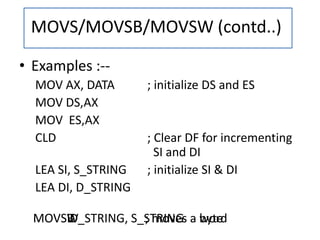
• Examples :--
MOV AX, DATA ; initialize DS and ES
MOV DS,AX
MOV ES,AX
CLD ; Clear DF for incrementing
SI and DI
LEA SI, S_STRING ; initialize SI & DI
LEA DI, D_STRING
MOVS/MOVSB/MOVSW (contd..)
LODS/LODSB/LODSW
Syntax :-- LODS source
LODSB
LODSW
• The LODS instruction is used to transfer a
byte or a word from the source string pointed
by SI in DS to AL for byte or AX for word
•The offset of the source byte or a word must
be placed in SI register, which is represented as
DS:SI
LODS/LODSB/LODSW (contd..)
•On the execution of the instruction, SI is
automatically adjusted by one to the next
element of the source and destination.
•If the Direction Flag is reset (DF = 0), the
registers SI will be incremented by one for the
byte movement and incremented by two for the
word movement.
•If the Direction Flag is set (DF = 1), the registers
SI will be decremented by one for the byte
movement and decremented by two for the word
movement.
LODS/LODSB/LODSW (contd..)
•On the execution of the instruction, SI is
automatically adjusted by one to the next
element of the source and destination.
•If the Direction Flag is reset (DF = 0), the register
SI will be incremented by one for the byte
movement and incremented by two for the word
movement.
•If the Direction Flag is set (DF = 1), the register SI
will be decremented by one for the byte
movement and decremented by two for the word
movement.
• Operation Performed :--
• If a byte movement,
–AL  DS:[SI]
–For DF =0, SI  SI +1
–For DF =1, SI  SI -1
• If a word movement,
–AX  DS:[SI]
–For DF =0, SI  SI +2
–For DF =1, SI  SI -2
LODS/LODSB/LODSW (contd..)
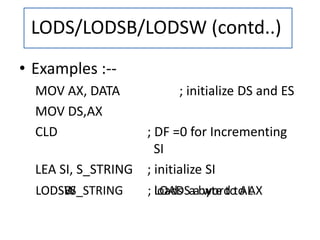
LODSW ; LOADS a word to AXLODS S_STRINGLODSB ; loads a byte to AL
• Examples :--
MOV AX, DATA ; initialize DS and ES
MOV DS,AX
CLD ; DF =0 for Incrementing
SI
LEA SI, S_STRING ; initialize SI
LODS/LODSB/LODSW (contd..)
STOS/STOSB/STOSW
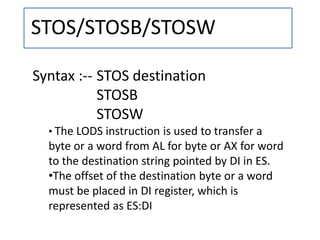
Syntax :-- STOS destination
STOSB
STOSW
• The LODS instruction is used to transfer a
byte or a word from AL for byte or AX for word
to the destination string pointed by DI in ES.
•The offset of the destination byte or a word
must be placed in DI register, which is
represented as ES:DI
STOS/STOSB/STOSW (contd..)
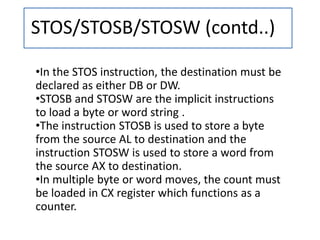
•In the STOS instruction, the destination must be
declared as either DB or DW.
•STOSB and STOSW are the implicit instructions
to load a byte or word string .
•The instruction STOSB is used to store a byte
from the source AL to destination and the
instruction STOSW is used to store a word from
the source AX to destination.
•In multiple byte or word moves, the count must
be loaded in CX register which functions as a
counter.
STOS/STOSB/STOSW (contd..)
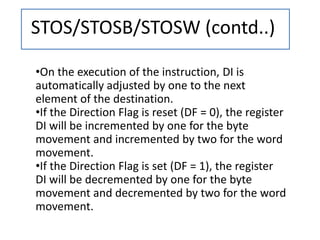
•On the execution of the instruction, DI is
automatically adjusted by one to the next
element of the destination.
•If the Direction Flag is reset (DF = 0), the register
DI will be incremented by one for the byte
movement and incremented by two for the word
movement.
•If the Direction Flag is set (DF = 1), the register
DI will be decremented by one for the byte
movement and decremented by two for the word
movement.
• Operation Performed :--
• If a byte movement,
–ES:[DI] AL
–For DF =0, DI  DI +1
–For DF =1, DI  DI -1
• If a word movement,
–ES:[DI]  AX
–For DF =0, DI  DI +2
–For DF =1, DI  DI -2
STOS/STOSB/STOSW (contd..)
STOSB ; Stores byte from AL to
destination
STOS D_STRING ; Stores a byte or word in
AL or AX dep on D_string
to D_string
• Examples :--
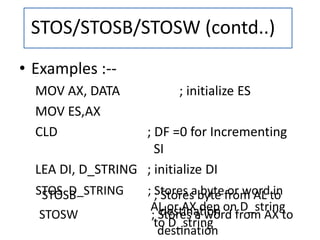
MOV AX, DATA ; initialize ES
MOV ES,AX
CLD ; DF =0 for Incrementing
SI
LEA DI, D_STRING ; initialize DI
STOSW ; Stores a word from AX to
destination
STOS/STOSB/STOSW (contd..)
CMPS/CMPSB/CMPSW
Syntax :-- CMPS destination, source
CMPSB
CMPSW
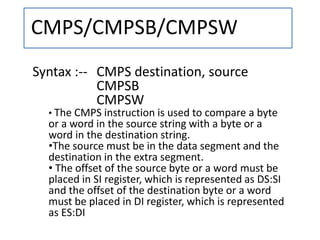
• The CMPS instruction is used to compare a byte
or a word in the source string with a byte or a
word in the destination string.
•The source must be in the data segment and the
destination in the extra segment.
• The offset of the source byte or a word must be
placed in SI register, which is represented as DS:SI
and the offset of the destination byte or a word
must be placed in DI register, which is represented
as ES:DI
CMPS/CMPSB/CMPSW (contd..)
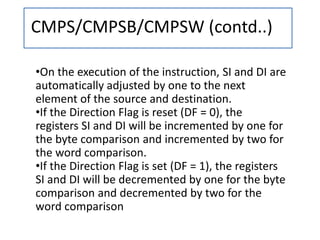
•On the execution of the instruction, SI and DI are
automatically adjusted by one to the next
element of the source and destination.
•If the Direction Flag is reset (DF = 0), the
registers SI and DI will be incremented by one for
the byte comparison and incremented by two for
the word comparison.
•If the Direction Flag is set (DF = 1), the registers
SI and DI will be decremented by one for the byte
comparison and decremented by two for the
word comparison
CMPS/CMPSB/CMPSW (contd..)
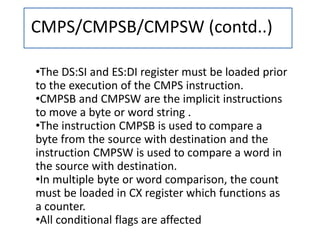
•The DS:SI and ES:DI register must be loaded prior
to the execution of the CMPS instruction.
•CMPSB and CMPSW are the implicit instructions
to move a byte or word string .
•The instruction CMPSB is used to compare a
byte from the source with destination and the
instruction CMPSW is used to compare a word in
the source with destination.
•In multiple byte or word comparison, the count
must be loaded in CX register which functions as
a counter.
•All conditional flags are affected
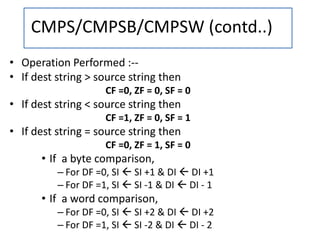
• Operation Performed :--
• If dest string > source string then
CF =0, ZF = 0, SF = 0
• If dest string < source string then
CF =1, ZF = 0, SF = 1
• If dest string = source string then
CF =0, ZF = 1, SF = 0
• If a byte comparison,
– For DF =0, SI  SI +1 & DI  DI +1
– For DF =1, SI  SI -1 & DI  DI - 1
• If a word comparison,
– For DF =0, SI  SI +2 & DI  DI +2
– For DF =1, SI  SI -2 & DI  DI - 2
CMPS/CMPSB/CMPSW (contd..)
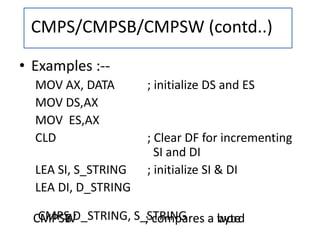
CMPSW ; compares a wordCMPS D_STRING, S_STRINGCMPSB ; compares a byte
• Examples :--
MOV AX, DATA ; initialize DS and ES
MOV DS,AX
MOV ES,AX
CLD ; Clear DF for incrementing
SI and DI
LEA SI, S_STRING ; initialize SI & DI
LEA DI, D_STRING
CMPS/CMPSB/CMPSW (contd..)
SCAS/SCASB/SCASW
Syntax :-- SCAS destination
SCASB
SCASW
• The SCAS instruction is used to scan a byte or
a word with a byte in AL or word in AX.
•The offset of the destination byte or a word
must be placed in DI register, which is
represented as ES:DI
SCAS/SCASB/SCASW (contd..)
•On the execution of the instruction, DI is
automatically adjusted by one to the next
element of the destination.
•If the Direction Flag is reset (DF = 0), the register
DI will be incremented by one for the byte scan
and incremented by two for the word scan.
•If the Direction Flag is set (DF = 1), the register
DI will be decremented by one for the byte scan
and decremented by two for the word scan
SCAS/SCASB/SCASW (contd..)
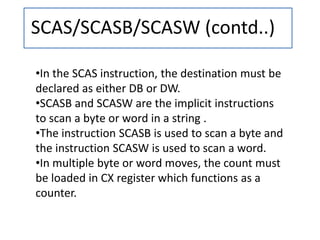
•In the SCAS instruction, the destination must be
declared as either DB or DW.
•SCASB and SCASW are the implicit instructions
to scan a byte or word in a string .
•The instruction SCASB is used to scan a byte and
the instruction SCASW is used to scan a word.
•In multiple byte or word moves, the count must
be loaded in CX register which functions as a
counter.
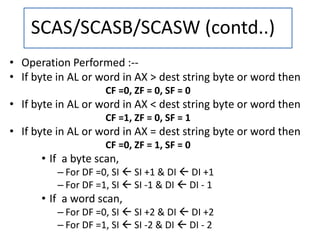
• Operation Performed :--
• If byte in AL or word in AX > dest string byte or word then
CF =0, ZF = 0, SF = 0
• If byte in AL or word in AX < dest string byte or word then
CF =1, ZF = 0, SF = 1
• If byte in AL or word in AX = dest string byte or word then
CF =0, ZF = 1, SF = 0
• If a byte scan,
– For DF =0, SI  SI +1 & DI  DI +1
– For DF =1, SI  SI -1 & DI  DI - 1
• If a word scan,
– For DF =0, SI  SI +2 & DI  DI +2
– For DF =1, SI  SI -2 & DI  DI - 2
SCAS/SCASB/SCASW (contd..)
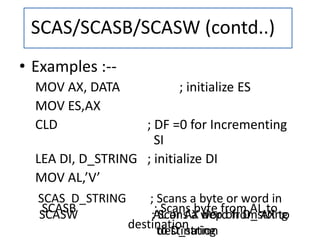
• Examples :--
MOV AX, DATA ; initialize ES
MOV ES,AX
CLD ; DF =0 for Incrementing
SI
LEA DI, D_STRING ; initialize DI
MOV AL,’V’
SCAS D_STRING ; Scans a byte or word in
AL or AX dep on D_string
to D_string
SCASB ; Scans byte from AL to
destination
SCASW ; Scans a word from AX to
destination
SCAS/SCASB/SCASW (contd..)
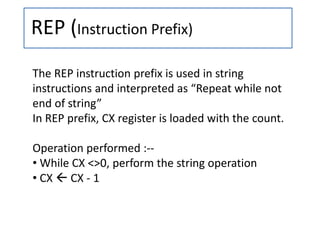
REP (Instruction Prefix)
The REP instruction prefix is used in string
instructions and interpreted as “Repeat while not
end of string”
In REP prefix, CX register is loaded with the count.
Operation performed :--
• While CX <>0, perform the string operation
• CX  CX - 1
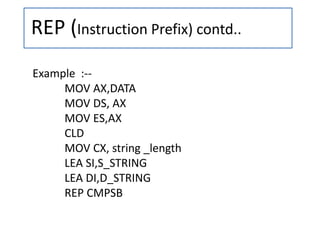
REP (Instruction Prefix) contd..
Example :--
MOV AX,DATA
MOV DS, AX
MOV ES,AX
CLD
MOV CX, string _length
LEA SI,S_STRING
LEA DI,D_STRING
REP CMPSB
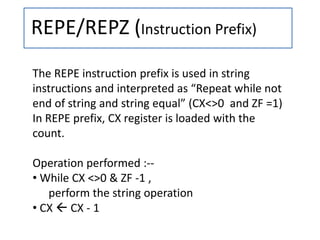
REPE/REPZ (Instruction Prefix)
The REPE instruction prefix is used in string
instructions and interpreted as “Repeat while not
end of string and string equal” (CX<>0 and ZF =1)
In REPE prefix, CX register is loaded with the
count.
Operation performed :--
• While CX <>0 & ZF -1 ,
perform the string operation
• CX  CX - 1
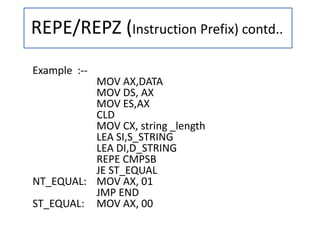
REPE/REPZ (Instruction Prefix) contd..
Example :--
MOV AX,DATA
MOV DS, AX
MOV ES,AX
CLD
MOV CX, string _length
LEA SI,S_STRING
LEA DI,D_STRING
REPE CMPSB
JE ST_EQUAL
NT_EQUAL: MOV AX, 01
JMP END
ST_EQUAL: MOV AX, 00
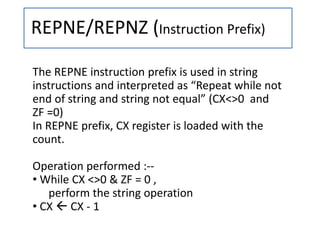
REPNE/REPNZ (Instruction Prefix)
The REPNE instruction prefix is used in string
instructions and interpreted as “Repeat while not
end of string and string not equal” (CX<>0 and
ZF =0)
In REPNE prefix, CX register is loaded with the
count.
Operation performed :--
• While CX <>0 & ZF = 0 ,
perform the string operation
• CX  CX - 1

Chap 8086 string

  • 1.
    String Manipulation Instructions –These are the instructions used for strings for string movement, Load, Store, Comparison and Scan. – A string is a series of bytes or a series of words in sequential memory locations. – A ‘B’ in the instruction mnemonic is used to specifically indicate that a string of bytes is to be acted upon. – A ‘W’ in the instruction mnemonic is used to specifically indicate that a string of words is to be acted upon.
  • 2.
    MOVS/MOVSB/MOVSW Syntax :-- MOVSdestination, source MOVSB MOVSW • The MOVS instruction is used to transfer a byte or a word from the source string to the destination string. •The source must be in the data segment and the destination in the extra segment. • The offset of the source byte or a word must be placed in SI register, which is represented as DS:SI and the offset of the destination byte or a word must be placed in DI register, which is represented as ES:DI
  • 3.
    MOVS/MOVSB/MOVSW (contd..) •On theexecution of the instruction, SI and DI are automatically adjusted by one to the next element of the source and destination. •If the Direction Flag is reset (DF = 0), the registers SI and DI will be incremented by one for the byte movement and incremented by two for the word movement. •If the Direction Flag is set (DF = 1), the registers SI and DI will be decremented by one for the byte movement and decremented by two for the word movement.
  • 4.
    MOVS/MOVSB/MOVSW (contd..) •The DS:SIand ES:DI register must be loaded prior to the execution of the MOVS instruction. •MOVSB and MOVSW are the implicit instructions to move a byte or word string . •The instruction MOVSB is used to transfer a byte from the source to destination and the instruction MOVSW is used to transfer a word from the source to destination. •In multiple byte or word moves, the count must be loaded in CX register which functions as a counter.
  • 5.
    • Operation Performed:-- • ES:[DI]  DS:[SI] • If a byte movement, –For DF =0, SI  SI +1 & DI  DI +1 –For DF =1, SI  SI -1 & DI  DI - 1 • If a word movement, –For DF =0, SI  SI +2 & DI  DI +2 –For DF =1, SI  SI -2 & DI  DI - 2 MOVS/MOVSB/MOVSW (contd..)
  • 6.
    MOVS D_STRING, S_STRINGMOVSB; moves a byteMOVSW ; moves a word • Examples :-- MOV AX, DATA ; initialize DS and ES MOV DS,AX MOV ES,AX CLD ; Clear DF for incrementing SI and DI LEA SI, S_STRING ; initialize SI & DI LEA DI, D_STRING MOVS/MOVSB/MOVSW (contd..)
  • 7.
    LODS/LODSB/LODSW Syntax :-- LODSsource LODSB LODSW • The LODS instruction is used to transfer a byte or a word from the source string pointed by SI in DS to AL for byte or AX for word •The offset of the source byte or a word must be placed in SI register, which is represented as DS:SI
  • 8.
    LODS/LODSB/LODSW (contd..) •On theexecution of the instruction, SI is automatically adjusted by one to the next element of the source and destination. •If the Direction Flag is reset (DF = 0), the registers SI will be incremented by one for the byte movement and incremented by two for the word movement. •If the Direction Flag is set (DF = 1), the registers SI will be decremented by one for the byte movement and decremented by two for the word movement.
  • 9.
    LODS/LODSB/LODSW (contd..) •On theexecution of the instruction, SI is automatically adjusted by one to the next element of the source and destination. •If the Direction Flag is reset (DF = 0), the register SI will be incremented by one for the byte movement and incremented by two for the word movement. •If the Direction Flag is set (DF = 1), the register SI will be decremented by one for the byte movement and decremented by two for the word movement.
  • 10.
    • Operation Performed:-- • If a byte movement, –AL  DS:[SI] –For DF =0, SI  SI +1 –For DF =1, SI  SI -1 • If a word movement, –AX  DS:[SI] –For DF =0, SI  SI +2 –For DF =1, SI  SI -2 LODS/LODSB/LODSW (contd..)
  • 11.
    LODSW ; LOADSa word to AXLODS S_STRINGLODSB ; loads a byte to AL • Examples :-- MOV AX, DATA ; initialize DS and ES MOV DS,AX CLD ; DF =0 for Incrementing SI LEA SI, S_STRING ; initialize SI LODS/LODSB/LODSW (contd..)
  • 12.
    STOS/STOSB/STOSW Syntax :-- STOSdestination STOSB STOSW • The LODS instruction is used to transfer a byte or a word from AL for byte or AX for word to the destination string pointed by DI in ES. •The offset of the destination byte or a word must be placed in DI register, which is represented as ES:DI
  • 13.
    STOS/STOSB/STOSW (contd..) •In theSTOS instruction, the destination must be declared as either DB or DW. •STOSB and STOSW are the implicit instructions to load a byte or word string . •The instruction STOSB is used to store a byte from the source AL to destination and the instruction STOSW is used to store a word from the source AX to destination. •In multiple byte or word moves, the count must be loaded in CX register which functions as a counter.
  • 14.
    STOS/STOSB/STOSW (contd..) •On theexecution of the instruction, DI is automatically adjusted by one to the next element of the destination. •If the Direction Flag is reset (DF = 0), the register DI will be incremented by one for the byte movement and incremented by two for the word movement. •If the Direction Flag is set (DF = 1), the register DI will be decremented by one for the byte movement and decremented by two for the word movement.
  • 15.
    • Operation Performed:-- • If a byte movement, –ES:[DI] AL –For DF =0, DI  DI +1 –For DF =1, DI  DI -1 • If a word movement, –ES:[DI]  AX –For DF =0, DI  DI +2 –For DF =1, DI  DI -2 STOS/STOSB/STOSW (contd..)
  • 16.
    STOSB ; Storesbyte from AL to destination STOS D_STRING ; Stores a byte or word in AL or AX dep on D_string to D_string • Examples :-- MOV AX, DATA ; initialize ES MOV ES,AX CLD ; DF =0 for Incrementing SI LEA DI, D_STRING ; initialize DI STOSW ; Stores a word from AX to destination STOS/STOSB/STOSW (contd..)
  • 17.
    CMPS/CMPSB/CMPSW Syntax :-- CMPSdestination, source CMPSB CMPSW • The CMPS instruction is used to compare a byte or a word in the source string with a byte or a word in the destination string. •The source must be in the data segment and the destination in the extra segment. • The offset of the source byte or a word must be placed in SI register, which is represented as DS:SI and the offset of the destination byte or a word must be placed in DI register, which is represented as ES:DI
  • 18.
    CMPS/CMPSB/CMPSW (contd..) •On theexecution of the instruction, SI and DI are automatically adjusted by one to the next element of the source and destination. •If the Direction Flag is reset (DF = 0), the registers SI and DI will be incremented by one for the byte comparison and incremented by two for the word comparison. •If the Direction Flag is set (DF = 1), the registers SI and DI will be decremented by one for the byte comparison and decremented by two for the word comparison
  • 19.
    CMPS/CMPSB/CMPSW (contd..) •The DS:SIand ES:DI register must be loaded prior to the execution of the CMPS instruction. •CMPSB and CMPSW are the implicit instructions to move a byte or word string . •The instruction CMPSB is used to compare a byte from the source with destination and the instruction CMPSW is used to compare a word in the source with destination. •In multiple byte or word comparison, the count must be loaded in CX register which functions as a counter. •All conditional flags are affected
  • 20.
    • Operation Performed:-- • If dest string > source string then CF =0, ZF = 0, SF = 0 • If dest string < source string then CF =1, ZF = 0, SF = 1 • If dest string = source string then CF =0, ZF = 1, SF = 0 • If a byte comparison, – For DF =0, SI  SI +1 & DI  DI +1 – For DF =1, SI  SI -1 & DI  DI - 1 • If a word comparison, – For DF =0, SI  SI +2 & DI  DI +2 – For DF =1, SI  SI -2 & DI  DI - 2 CMPS/CMPSB/CMPSW (contd..)
  • 21.
    CMPSW ; comparesa wordCMPS D_STRING, S_STRINGCMPSB ; compares a byte • Examples :-- MOV AX, DATA ; initialize DS and ES MOV DS,AX MOV ES,AX CLD ; Clear DF for incrementing SI and DI LEA SI, S_STRING ; initialize SI & DI LEA DI, D_STRING CMPS/CMPSB/CMPSW (contd..)
  • 22.
    SCAS/SCASB/SCASW Syntax :-- SCASdestination SCASB SCASW • The SCAS instruction is used to scan a byte or a word with a byte in AL or word in AX. •The offset of the destination byte or a word must be placed in DI register, which is represented as ES:DI
  • 23.
    SCAS/SCASB/SCASW (contd..) •On theexecution of the instruction, DI is automatically adjusted by one to the next element of the destination. •If the Direction Flag is reset (DF = 0), the register DI will be incremented by one for the byte scan and incremented by two for the word scan. •If the Direction Flag is set (DF = 1), the register DI will be decremented by one for the byte scan and decremented by two for the word scan
  • 24.
    SCAS/SCASB/SCASW (contd..) •In theSCAS instruction, the destination must be declared as either DB or DW. •SCASB and SCASW are the implicit instructions to scan a byte or word in a string . •The instruction SCASB is used to scan a byte and the instruction SCASW is used to scan a word. •In multiple byte or word moves, the count must be loaded in CX register which functions as a counter.
  • 25.
    • Operation Performed:-- • If byte in AL or word in AX > dest string byte or word then CF =0, ZF = 0, SF = 0 • If byte in AL or word in AX < dest string byte or word then CF =1, ZF = 0, SF = 1 • If byte in AL or word in AX = dest string byte or word then CF =0, ZF = 1, SF = 0 • If a byte scan, – For DF =0, SI  SI +1 & DI  DI +1 – For DF =1, SI  SI -1 & DI  DI - 1 • If a word scan, – For DF =0, SI  SI +2 & DI  DI +2 – For DF =1, SI  SI -2 & DI  DI - 2 SCAS/SCASB/SCASW (contd..)
  • 26.
    • Examples :-- MOVAX, DATA ; initialize ES MOV ES,AX CLD ; DF =0 for Incrementing SI LEA DI, D_STRING ; initialize DI MOV AL,’V’ SCAS D_STRING ; Scans a byte or word in AL or AX dep on D_string to D_string SCASB ; Scans byte from AL to destination SCASW ; Scans a word from AX to destination SCAS/SCASB/SCASW (contd..)
  • 27.
    REP (Instruction Prefix) TheREP instruction prefix is used in string instructions and interpreted as “Repeat while not end of string” In REP prefix, CX register is loaded with the count. Operation performed :-- • While CX <>0, perform the string operation • CX  CX - 1
  • 28.
    REP (Instruction Prefix)contd.. Example :-- MOV AX,DATA MOV DS, AX MOV ES,AX CLD MOV CX, string _length LEA SI,S_STRING LEA DI,D_STRING REP CMPSB
  • 29.
    REPE/REPZ (Instruction Prefix) TheREPE instruction prefix is used in string instructions and interpreted as “Repeat while not end of string and string equal” (CX<>0 and ZF =1) In REPE prefix, CX register is loaded with the count. Operation performed :-- • While CX <>0 & ZF -1 , perform the string operation • CX  CX - 1
  • 30.
    REPE/REPZ (Instruction Prefix)contd.. Example :-- MOV AX,DATA MOV DS, AX MOV ES,AX CLD MOV CX, string _length LEA SI,S_STRING LEA DI,D_STRING REPE CMPSB JE ST_EQUAL NT_EQUAL: MOV AX, 01 JMP END ST_EQUAL: MOV AX, 00
  • 31.
    REPNE/REPNZ (Instruction Prefix) TheREPNE instruction prefix is used in string instructions and interpreted as “Repeat while not end of string and string not equal” (CX<>0 and ZF =0) In REPNE prefix, CX register is loaded with the count. Operation performed :-- • While CX <>0 & ZF = 0 , perform the string operation • CX  CX - 1