FLAG MANIPULATION AND
PROCESSOR CONTROL INSTRUCTIONS
&
STRING INSTRUCTIONS
IN
STRU
CTIO
N
S
-
8086
By:
G.SUSMITHA
II M.Sc PHYSICS
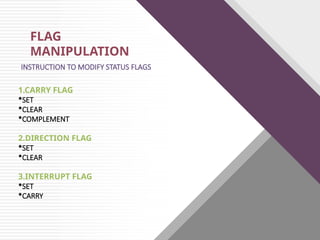
FLAG
MANIPULATION
INSTRUCTION TO MODIFY STATUS FLAGS
1.CARRY FLAG
*SET
*CLEAR
*COMPLEMENT
2.DIRECTION FLAG
*SET
*CLEAR
3.INTERRUPT FLAG
*SET
*CARRY
CLC( Clear carry flag CF) code= F8
This instruction resets the carry flag CF=0.Other flags
are not affected.
.
CARRY FLAG
CMC(Take complement of carry flag CF). Code= F5.
This instruction takes complement of the carry flag CF. If CF is
0, this instruction sets it to 1. If CF=1, this instruction resets it to
0.Other flags are not affected.
STC(Set carry flag CF to 1.) Code=F9.
No other flags are affected.
FLAG MANIPULATION
CLD(Clear direction flag DF) Code=FC
This instruction resets the direction flag DF to 0.
Other flags are not affected.
STD( Set direction flag DF to 1.) Code=FD
No other flags are affected.
DIRECTION FLAG
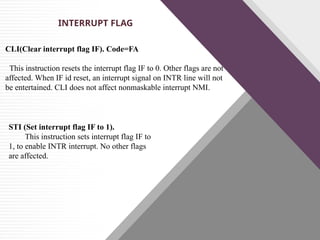
CLI(Clear interrupt flag IF). Code=FA
This instruction resets the interrupt flag IF to 0. Other flags are not
affected. When IF id reset, an interrupt signal on INTR line will not
be entertained. CLI does not affect nonmaskable interrupt NMI.
STI (Set interrupt flag IF to 1).
This instruction sets interrupt flag IF to
1, to enable INTR interrupt. No other flags
are affected.
INTERRUPT FLAG
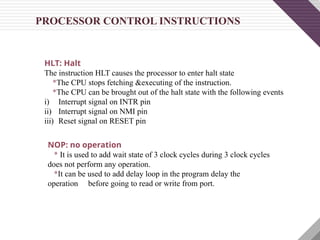
PROCESSOR CONTROL INSTRUCTIONS
HLT: Halt
The instruction HLT causes the processor to enter halt state
*The CPU stops fetching &executing of the instruction.
*The CPU can be brought out of the halt state with the following events
i) Interrupt signal on INTR pin
ii) Interrupt signal on NMI pin
iii) Reset signal on RESET pin
NOP: no operation
* It is used to add wait state of 3 clock cycles during 3 clock cycles
does not perform any operation.
*It can be used to add delay loop in the program delay the
operation before going to read or write from port.
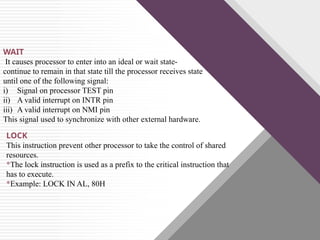
WAIT
It causes processor to enter into an ideal or wait state-
continue to remain in that state till the processor receives state
until one of the following signal:
i) Signal on processor TEST pin
ii) A valid interrupt on INTR pin
iii) A valid interrupt on NMI pin
This signal used to synchronize with other external hardware.
LOCK
This instruction prevent other processor to take the control of shared
resources.
*The lock instruction is used as a prefix to the critical instruction that
has to execute.
*Example: LOCK IN AL, 80H
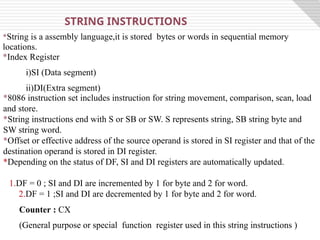
*8086 instruction set includes instruction for string movement, comparison, scan, load
and store.
*String instructions end with S or SB or SW. S represents string, SB string byte and
SW string word.
*Offset or effective address of the source operand is stored in SI register and that of the
destination operand is stored in DI register.
*Depending on the status of DF, SI and DI registers are automatically updated.
1.DF = 0 ; SI and DI are incremented by 1 for byte and 2 for word.
2.DF = 1 ;SI and DI are decremented by 1 for byte and 2 for word.
STRING INSTRUCTIONS
*String is a assembly language,it is stored bytes or words in sequential memory
locations.
*Index Register
i)SI (Data segment)
ii)DI(Extra segment)
Counter : CX
(General purpose or special function register used in this string instructions )
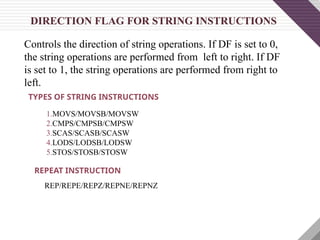
DIRECTION FLAG FOR STRING INSTRUCTIONS
Controls the direction of string operations. If DF is set to 0,
the string operations are performed from left to right. If DF
is set to 1, the string operations are performed from right to
left.
1.MOVS/MOVSB/MOVSW
2.CMPS/CMPSB/CMPSW
3.SCAS/SCASB/SCASW
4.LODS/LODSB/LODSW
5.STOS/STOSB/STOSW
REPEAT INSTRUCTION
REP/REPE/REPZ/REPNE/REPNZ
TYPES OF STRING INSTRUCTIONS
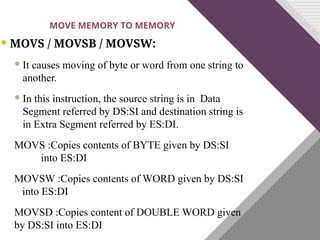
 MOVS / MOVSB / MOVSW:
 It causes moving of byte or word from one string to
another.
 In this instruction, the source string is in Data
Segment referred by DS:SI and destination string is
in Extra Segment referred by ES:DI.
MOVS :Copies contents of BYTE given by DS:SI
into ES:DI
MOVSW :Copies contents of WORD given by DS:SI
into ES:DI
MOVSD :Copies content of DOUBLE WORD given
by DS:SI into ES:DI
MOVE MEMORY TO MEMORY
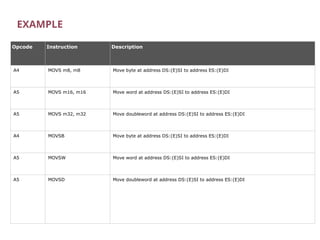
EXAMPLE
Opcode Instruction Description
A4 MOVS m8, m8 Move byte at address DS:(E)SI to address ES:(E)DI
A5 MOVS m16, m16 Move word at address DS:(E)SI to address ES:(E)DI
A5 MOVS m32, m32 Move doubleword at address DS:(E)SI to address ES:(E)DI
A4 MOVSB Move byte at address DS:(E)SI to address ES:(E)DI
A5 MOVSW Move word at address DS:(E)SI to address ES:(E)DI
A5 MOVSD Move doubleword at address DS:(E)SI to address ES:(E)DI
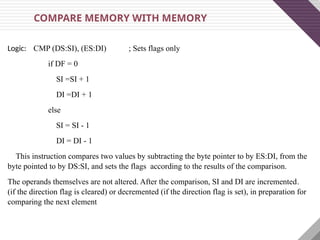
COMPARE MEMORY WITH MEMORY
Logic: CMP (DS:SI), (ES:DI) ; Sets flags only
if DF = 0
SI =SI + 1
DI =DI + 1
else
SI = SI - 1
DI = DI - 1
This instruction compares two values by subtracting the byte pointer to by ES:DI, from the
byte pointed to by DS:SI, and sets the flags according to the results of the comparison.
The operands themselves are not altered. After the comparison, SI and DI are incremented.
(if the direction flag is cleared) or decremented (if the direction flag is set), in preparation for
comparing the next element
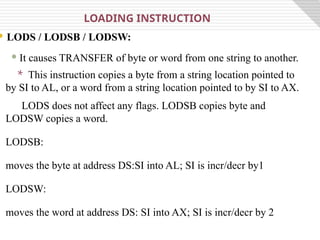
 LODS / LODSB / LODSW:
 It causes TRANSFER of byte or word from one string to another.
LOADING INSTRUCTION
* This instruction copies a byte from a string location pointed to
by SI to AL, or a word from a string location pointed to by SI to AX.
LODS does not affect any flags. LODSB copies byte and
LODSW copies a word.
LODSB:
moves the byte at address DS:SI into AL; SI is incr/decr by1
LODSW:
moves the word at address DS: SI into AX; SI is incr/decr by 2
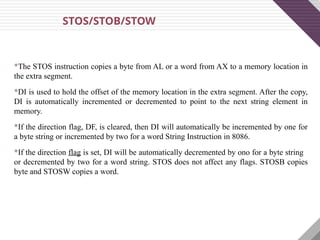
*The STOS instruction copies a byte from AL or a word from AX to a memory location in
the extra segment.
*DI is used to hold the offset of the memory location in the extra segment. After the copy,
DI is automatically incremented or decremented to point to the next string element in
memory.
*If the direction flag, DF, is cleared, then DI will automatically be incremented by one for
a byte string or incremented by two for a word String Instruction in 8086.
*If the direction flag is set, DI will be automatically decremented by ono for a byte string
or decremented by two for a word string. STOS does not affect any flags. STOSB copies
byte and STOSW copies a word.
STOS/STOB/STOW
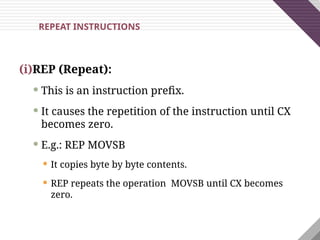
(i)REP (Repeat):
 This is an instruction prefix.
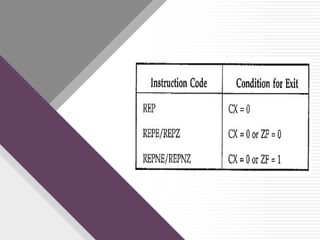
 It causes the repetition of the instruction until CX
becomes zero.
 E.g.: REP MOVSB
 It copies byte by byte contents.
 REP repeats the operation MOVSB until CX becomes
zero.
REPEAT INSTRUCTIONS
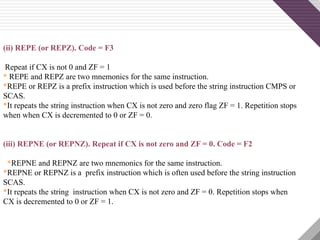
(ii) REPE (or REPZ). Code = F3
Repeat if CX is not 0 and ZF = 1
* REPE and REPZ are two mnemonics for the same instruction.
*REPE or REPZ is a prefix instruction which is used before the string instruction CMPS or
SCAS.
*It repeats the string instruction when CX is not zero and zero flag ZF = 1. Repetition stops
when when CX is decremented to 0 or ZF = 0.
(iii) REPNE (or REPNZ). Repeat if CX is not zero and ZF = 0. Code = F2
*REPNE and REPNZ are two mnemonics for the same instruction.
*REPNE or REPNZ is a prefix instruction which is often used before the string instruction
SCAS.
*It repeats the string instruction when CX is not zero and ZF = 0. Repetition stops when
CX is decremented to 0 or ZF = 1.
FLAG & PROCESSOR & STRING INSTRUCTIONS.pptx

FLAG & PROCESSOR & STRING INSTRUCTIONS.pptx

  • 1.
    FLAG MANIPULATION AND PROCESSORCONTROL INSTRUCTIONS & STRING INSTRUCTIONS IN STRU CTIO N S - 8086 By: G.SUSMITHA II M.Sc PHYSICS
  • 2.
    FLAG MANIPULATION INSTRUCTION TO MODIFYSTATUS FLAGS 1.CARRY FLAG *SET *CLEAR *COMPLEMENT 2.DIRECTION FLAG *SET *CLEAR 3.INTERRUPT FLAG *SET *CARRY
  • 3.
    CLC( Clear carryflag CF) code= F8 This instruction resets the carry flag CF=0.Other flags are not affected. . CARRY FLAG CMC(Take complement of carry flag CF). Code= F5. This instruction takes complement of the carry flag CF. If CF is 0, this instruction sets it to 1. If CF=1, this instruction resets it to 0.Other flags are not affected. STC(Set carry flag CF to 1.) Code=F9. No other flags are affected.
  • 4.
    FLAG MANIPULATION CLD(Clear directionflag DF) Code=FC This instruction resets the direction flag DF to 0. Other flags are not affected. STD( Set direction flag DF to 1.) Code=FD No other flags are affected. DIRECTION FLAG
  • 5.
    CLI(Clear interrupt flagIF). Code=FA This instruction resets the interrupt flag IF to 0. Other flags are not affected. When IF id reset, an interrupt signal on INTR line will not be entertained. CLI does not affect nonmaskable interrupt NMI. STI (Set interrupt flag IF to 1). This instruction sets interrupt flag IF to 1, to enable INTR interrupt. No other flags are affected. INTERRUPT FLAG
  • 6.
    PROCESSOR CONTROL INSTRUCTIONS HLT:Halt The instruction HLT causes the processor to enter halt state *The CPU stops fetching &executing of the instruction. *The CPU can be brought out of the halt state with the following events i) Interrupt signal on INTR pin ii) Interrupt signal on NMI pin iii) Reset signal on RESET pin NOP: no operation * It is used to add wait state of 3 clock cycles during 3 clock cycles does not perform any operation. *It can be used to add delay loop in the program delay the operation before going to read or write from port.
  • 7.
    WAIT It causes processorto enter into an ideal or wait state- continue to remain in that state till the processor receives state until one of the following signal: i) Signal on processor TEST pin ii) A valid interrupt on INTR pin iii) A valid interrupt on NMI pin This signal used to synchronize with other external hardware. LOCK This instruction prevent other processor to take the control of shared resources. *The lock instruction is used as a prefix to the critical instruction that has to execute. *Example: LOCK IN AL, 80H
  • 8.
    *8086 instruction setincludes instruction for string movement, comparison, scan, load and store. *String instructions end with S or SB or SW. S represents string, SB string byte and SW string word. *Offset or effective address of the source operand is stored in SI register and that of the destination operand is stored in DI register. *Depending on the status of DF, SI and DI registers are automatically updated. 1.DF = 0 ; SI and DI are incremented by 1 for byte and 2 for word. 2.DF = 1 ;SI and DI are decremented by 1 for byte and 2 for word. STRING INSTRUCTIONS *String is a assembly language,it is stored bytes or words in sequential memory locations. *Index Register i)SI (Data segment) ii)DI(Extra segment) Counter : CX (General purpose or special function register used in this string instructions )
  • 9.
    DIRECTION FLAG FORSTRING INSTRUCTIONS Controls the direction of string operations. If DF is set to 0, the string operations are performed from left to right. If DF is set to 1, the string operations are performed from right to left. 1.MOVS/MOVSB/MOVSW 2.CMPS/CMPSB/CMPSW 3.SCAS/SCASB/SCASW 4.LODS/LODSB/LODSW 5.STOS/STOSB/STOSW REPEAT INSTRUCTION REP/REPE/REPZ/REPNE/REPNZ TYPES OF STRING INSTRUCTIONS
  • 10.
     MOVS /MOVSB / MOVSW:  It causes moving of byte or word from one string to another.  In this instruction, the source string is in Data Segment referred by DS:SI and destination string is in Extra Segment referred by ES:DI. MOVS :Copies contents of BYTE given by DS:SI into ES:DI MOVSW :Copies contents of WORD given by DS:SI into ES:DI MOVSD :Copies content of DOUBLE WORD given by DS:SI into ES:DI MOVE MEMORY TO MEMORY
  • 11.
    EXAMPLE Opcode Instruction Description A4MOVS m8, m8 Move byte at address DS:(E)SI to address ES:(E)DI A5 MOVS m16, m16 Move word at address DS:(E)SI to address ES:(E)DI A5 MOVS m32, m32 Move doubleword at address DS:(E)SI to address ES:(E)DI A4 MOVSB Move byte at address DS:(E)SI to address ES:(E)DI A5 MOVSW Move word at address DS:(E)SI to address ES:(E)DI A5 MOVSD Move doubleword at address DS:(E)SI to address ES:(E)DI
  • 12.
    COMPARE MEMORY WITHMEMORY Logic: CMP (DS:SI), (ES:DI) ; Sets flags only if DF = 0 SI =SI + 1 DI =DI + 1 else SI = SI - 1 DI = DI - 1 This instruction compares two values by subtracting the byte pointer to by ES:DI, from the byte pointed to by DS:SI, and sets the flags according to the results of the comparison. The operands themselves are not altered. After the comparison, SI and DI are incremented. (if the direction flag is cleared) or decremented (if the direction flag is set), in preparation for comparing the next element
  • 13.
     LODS /LODSB / LODSW:  It causes TRANSFER of byte or word from one string to another. LOADING INSTRUCTION * This instruction copies a byte from a string location pointed to by SI to AL, or a word from a string location pointed to by SI to AX. LODS does not affect any flags. LODSB copies byte and LODSW copies a word. LODSB: moves the byte at address DS:SI into AL; SI is incr/decr by1 LODSW: moves the word at address DS: SI into AX; SI is incr/decr by 2
  • 14.
    *The STOS instructioncopies a byte from AL or a word from AX to a memory location in the extra segment. *DI is used to hold the offset of the memory location in the extra segment. After the copy, DI is automatically incremented or decremented to point to the next string element in memory. *If the direction flag, DF, is cleared, then DI will automatically be incremented by one for a byte string or incremented by two for a word String Instruction in 8086. *If the direction flag is set, DI will be automatically decremented by ono for a byte string or decremented by two for a word string. STOS does not affect any flags. STOSB copies byte and STOSW copies a word. STOS/STOB/STOW
  • 15.
    (i)REP (Repeat):  Thisis an instruction prefix.  It causes the repetition of the instruction until CX becomes zero.  E.g.: REP MOVSB  It copies byte by byte contents.  REP repeats the operation MOVSB until CX becomes zero. REPEAT INSTRUCTIONS
  • 16.
    (ii) REPE (orREPZ). Code = F3 Repeat if CX is not 0 and ZF = 1 * REPE and REPZ are two mnemonics for the same instruction. *REPE or REPZ is a prefix instruction which is used before the string instruction CMPS or SCAS. *It repeats the string instruction when CX is not zero and zero flag ZF = 1. Repetition stops when when CX is decremented to 0 or ZF = 0. (iii) REPNE (or REPNZ). Repeat if CX is not zero and ZF = 0. Code = F2 *REPNE and REPNZ are two mnemonics for the same instruction. *REPNE or REPNZ is a prefix instruction which is often used before the string instruction SCAS. *It repeats the string instruction when CX is not zero and ZF = 0. Repetition stops when CX is decremented to 0 or ZF = 1.