What isAssemblyLanguage?
 Each personal computerhasa microprocessorthatmanagesthe computer'sarithmetical,
logical andcontrol activities.
 Each familyof processorshasitsown setof instructionsforhandlingvariousoperationslike
gettinginputfrom
 keyboard,displayinginformationonscreenandperformingvariousotherjobs.These setof
instructionsare called'machine languageinstruction'.
 Processorunderstandsonlymachinelanguage instructionswhichare stringsof 1s and0s.
Howevermachine language istooobscure andcomplex forusinginsoftware development.
So the lowlevel assemblylanguage isdesignedforaspecificfamilyof processorsthat
representsvariousinstructionsinsymboliccode anda more understandable form.
Advantages of AssemblyLanguage
An understandingof assemblylanguage providesknowledge of:
 Interface of programswithOS,processorand BIOS;
 Representationof datainmemoryandotherexternal devices;
 How processoraccessesandexecutesinstruction;
 How instructions accessesandprocessdata;
 How a program accessexternal devices.
Other advantages of usingassemblylanguage are:
 It requireslessmemoryandexecutiontime;
 It allowshardware-specificcomplexjobsinaneasierway;
 It issuitable fortime-critical jobs;
 It ismost suitable forwritinginterruptservice routinesandothermemoryresident
programs.
An assemblyprogramcanbe dividedintothree sections:
 The data section
 The bss section
 The textsection
The data Section
The data sectionisusedfor declaringinitializeddataorconstants.Thisdata doesnot change at
runtime.Itcan declare variousconstantvalues,file namesorbuffersize etc.inthissection.
The syntax for declaringdata sectionis:
section.data
The bss Section
The bss sectionisusedfordeclaringvariables.The syntax fordeclaringbsssectionis:
section.bss
The textsection
The textsectionisusedforkeepingthe actual code.Thissectionmustbeginwiththe declaration
global main,whichtellsthe kernel wherethe programexecutionbegins.
The syntax for declaringtextsectionis:
section.text
global main
main:
8085 program to add two 8 bit numbers
Problem– Write an assemblylanguage programtoaddtwo8 bit numbersstoredataddress2050
and address2051 in 8085 microprocessor.The startingaddressof the programis takenas 2000
Example –
Algorithm
 Load the firstnumberfrommemorylocation2050 to accumualtor.
 Move the contentof accumulatorto registerH.
 Load the secondnumberfrommemorylocation2051 to accumaltor.
 Thenadd the contentof registerHand accumulatorusing“ADD” instructionandstoring
resultat 3050
 The carry generatedisrecoveredusing“ADC”commandandis storedat memorylocation
3051
Program –
MEMORY ADDRESS MNEMONICS COMMENT
2000 LDA 2050 A<-[2050]
2003 MOV H, A H<-A
2004 LDA 2051 A<-[2051]
2007 ADD H A<-A+H
2006 MOV L, A L←A
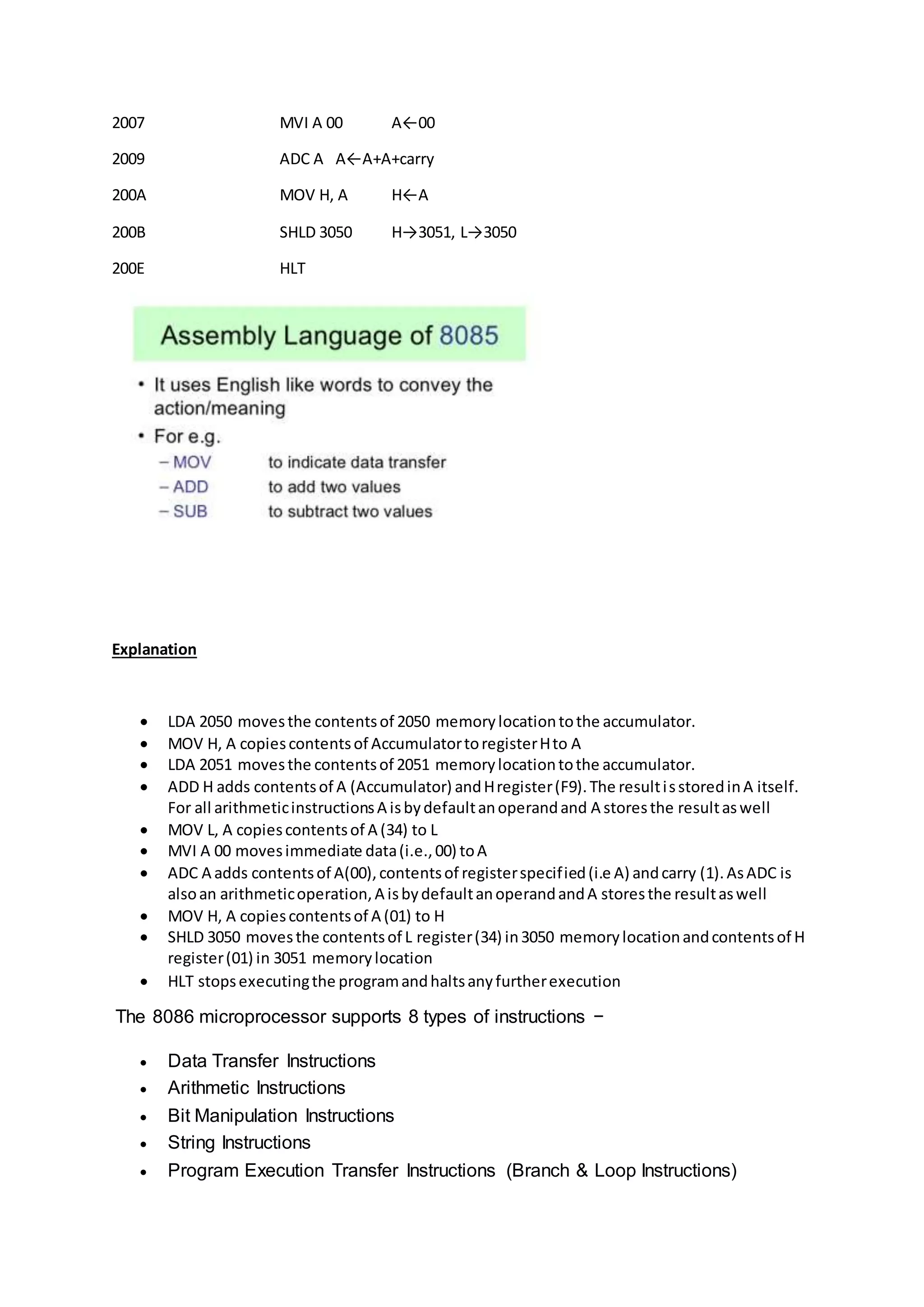
2007 MVI A 00 A←00
2009 ADC A A←A+A+carry
200A MOV H, A H←A
200B SHLD 3050 H→3051, L→3050
200E HLT
Explanation
 LDA 2050 movesthe contentsof 2050 memorylocationtothe accumulator.
 MOV H, A copiescontentsof AccumulatortoregisterHto A
 LDA 2051 movesthe contentsof 2051 memorylocationtothe accumulator.
 ADD H adds contentsof A (Accumulator) andHregister(F9).The resultisstoredinA itself.
For all arithmeticinstructionsA isbydefaultanoperandand A storesthe resultaswell
 MOV L, A copiescontentsof A (34) to L
 MVI A 00 movesimmediate data(i.e.,00) toA
 ADC A adds contentsof A(00),contentsof registerspecified(i.e A) andcarry (1).AsADC is
alsoan arithmeticoperation,A isbydefaultanoperandandA storesthe resultaswell
 MOV H, A copiescontentsof A (01) to H
 SHLD 3050 movesthe contentsof L register(34) in3050 memorylocationandcontentsof H
register(01) in 3051 memorylocation
 HLT stopsexecutingthe programandhaltsanyfurtherexecution
The 8086 microprocessor supports 8 types of instructions −
 Data Transfer Instructions
 Arithmetic Instructions
 Bit Manipulation Instructions
 String Instructions
 Program Execution Transfer Instructions (Branch & Loop Instructions)
 Processor Control Instructions
 Iteration Control Instructions
 Interrupt Instructions
Let us now discuss these instruction sets in detail.
Data Transfer Instructions
These instructions are used to transfer the data from the source operand to the
destination operand. Following are the list of instructions under this group −
Instruction to transfer a word
 MOV − Used to copy the byte or word from the provided source to the
provided destination.
 PPUSH − Used to put a word at the top of the stack.
 POP − Used to get a word from the top of the stack to the provided location.
 PUSHA − Used to put all the registers into the stack.
 POPA − Used to get words from the stack to all registers.
 XCHG − Used to exchange the data from two locations.
 XLAT − Used to translate a byte in AL using a table in the memory.
Instructions for input and output port transfer
 IN − Used to read a byte or word from the provided port to the accumulator.
 OUT − Used to send out a byte or word from the accumulator to the provided
port.
Instructions to transfer the address
 LEA − Used to load the address of operand into the provided register.
 LDS − Used to load DS register and other provided register from the memory
 LES − Used to load ES register and other provided register from the memory.
Instructions to transfer flag registers
 LAHF − Used to load AH with the low byte of the flag register.
 SAHF − Used to store AH register to low byte of the flag register.
 PUSHF − Used to copy the flag register at the top of the stack.
 POPF − Used to copy a word at the top of the stack to the flag register.
Arithmetic Instructions
These instructions are used to perform arithmetic operations like addition,
subtraction, multiplication, division, etc.
Following is the list of instructions under this group −
Instructions to perform addition
 ADD − Used to add the provided byte to byte/word to word.
 ADC − Used to add with carry.
 INC − Used to increment the provided byte/word by 1.
 AAA − Used to adjust ASCII after addition.
 DAA − Used to adjust the decimal after the addition/subtraction operation.
Instructions to perform subtraction
 SUB − Used to subtract the byte from byte/word from word.
 SBB − Used to perform subtraction with borrow.
 DEC − Used to decrement the provided byte/word by 1.
 NPG − Used to negate each bit of the provided byte/word and add 1/2’s
complement.
 CMP − Used to compare 2 provided byte/word.
 AAS − Used to adjust ASCII codes after subtraction.
 DAS − Used to adjust decimal after subtraction.
Instruction to perform multiplication
 MUL − Used to multiply unsigned byte by byte/word by word.
 IMUL − Used to multiply signed byte by byte/word by word.
 AAM − Used to adjust ASCII codes after multiplication.
Instructions to perform division
 DIV − Used to divide the unsigned word by byte or unsigned double word by
word.
 IDIV − Used to divide the signed word by byte or signed double word by
word.
 AAD − Used to adjust ASCII codes after division.
 CBW − Used to fill the upper byte of the word with the copies of sign bit of the
lower byte.
 CWD − Used to fill the upper word of the double word with the sign bit of the
lower word.
Bit Manipulation Instructions
These instructions are used to perform operations where data bits are involved, i.e.
operations like logical, shift, etc.
Following is the list of instructions under this group −
Instructions to perform logical operation
 NOT − Used to invert each bit of a byte or word.
 AND − Used for adding each bit in a byte/word with the corresponding bit in
another byte/word.
 OR − Used to multiply each bit in a byte/word with the corresponding bit in
another byte/word.
 XOR − Used to perform Exclusive-OR operation over each bit in a byte/word
with the corresponding bit in another byte/word.
 TEST − Used to add operands to update flags, without affecting operands.
Instructions to perform shift operations
 SHL/SAL − Used to shift bits of a byte/word towards left and put zero(S) in
LSBs.
 SHR − Used to shift bits of a byte/word towards the right and put zero(S) in
MSBs.
 SAR − Used to shift bits of a byte/word towards the right and copy the old
MSB into the new MSB.
Instructions to perform rotate operations
 ROL − Used to rotate bits of byte/word towards the left, i.e. MSB to LSB and
to Carry Flag [CF].
 ROR − Used to rotate bits of byte/word towards the right, i.e. LSB to MSB
and to Carry Flag [CF].
 RCR − Used to rotate bits of byte/word towards the right, i.e. LSB to CF and
CF to MSB.
 RCL − Used to rotate bits of byte/word towards the left, i.e. MSB to CF and
CF to LSB.
String Instructions
String is a group of bytes/words and their memory is always allocated in a
sequential order.
Following is the list of instructions under this group
 REP − Used to repeat the given instruction till CX ≠ 0.
 REPE/REPZ − Used to repeat the given instruction until CX = 0 or zero flag
ZF = 1.
 REPNE/REPNZ − Used to repeat the given instruction until CX = 0 or zero
flag ZF = 1.
 MOVS/MOVSB/MOVSW − Used to move the byte/word from one string to
another.
 COMS/COMPSB/COMPSW − Used to compare two string bytes/words.
 INS/INSB/INSW − Used as an input string/byte/word from the I/O port to the
provided memory location.
 OUTS/OUTSB/OUTSW − Used as an output string/byte/word from the
provided memory location to the I/O port.
 SCAS/SCASB/SCASW − Used to scan a string and compare its byte with a
byte in AL or string word with a word in AX.
 LODS/LODSB/LODSW − Used to store the string byte into AL or string word
into AX.
Program Execution Transfer Instructions (Branch and
Loop Instructions)
These instructions are used to transfer/branch the instructions during an execution.
It includes the following instructions −
Instructions to transfer the instruction during an execution without any condition −
 CALL − Used to call a procedure and save their return address to the stack.
 RET − Used to return from the procedure to the main program.
 JMP − Used to jump to the provided address to proceed to the next
instruction.
Instructions to transfer the instruction during an execution with some conditions −
 JA/JNBE − Used to jump if above/not below/equal instruction satisfies.
 JAE/JNB − Used to jump if above/not below instruction satisfies.
 JBE/JNA − Used to jump if below/equal/ not above instruction satisfies.
 JC − Used to jump if carry flag CF = 1
 JE/JZ − Used to jump if equal/zero flag ZF = 1
 JG/JNLE − Used to jump if greater/not less than/equal instruction satisfies.
 JGE/JNL − Used to jump if greater than/equal/not less than instruction
satisfies.
 JL/JNGE − Used to jump if less than/not greater than/equal instruction
satisfies.
 JLE/JNG − Used to jump if less than/equal/if not greater than instruction
satisfies.
 JNC − Used to jump if no carry flag (CF = 0)
 JNE/JNZ − Used to jump if not equal/zero flag ZF = 0
 JNO − Used to jump if no overflow flag OF = 0
 JNP/JPO − Used to jump if not parity/parity odd PF = 0
 JNS − Used to jump if not sign SF = 0
 JO − Used to jump if overflow flag OF = 1
 JP/JPE − Used to jump if parity/parity even PF = 1
 JS − Used to jump if sign flag SF = 1
Processor Control Instructions
These instructions are used to control the processor action by setting/resetting the
flag values.
Following are the instructions under this group −
 STC − Used to set carry flag CF to 1
 CLC − Used to clear/reset carry flag CF to 0
 CMC − Used to put complement at the state of carry flag CF.
 STD − Used to set the direction flag DF to 1
 CLD − Used to clear/reset the direction flag DF to 0
 STI − Used to set the interrupt enable flag to 1, i.e., enable INTR input.
 CLI − Used to clear the interrupt enable flag to 0, i.e., disable INTR input.
Iteration Control Instructions
These instructions are used to execute the given instructions for number of times.
Following is the list of instructions under this group −
 LOOP − Used to loop a group of instructions until the condition satisfies, i.e.,
CX = 0
 LOOPE/LOOPZ − Used to loop a group of instructions till it satisfies ZF = 1 &
CX = 0
 LOOPNE/LOOPNZ − Used to loop a group of instructions till it satisfies ZF =
0 & CX = 0
 JCXZ − Used to jump to the provided address if CX = 0
Interrupt Instructions
These instructions are used to call the interrupt during program execution.
 INT − Used to interrupt the program during execution and calling service
specified.
 INTO − Used to interrupt the program during execution if OF = 1
 IRET − Used to return from interrupt service to the main program

Assembly language

  • 1.
    What isAssemblyLanguage?  Eachpersonal computerhasa microprocessorthatmanagesthe computer'sarithmetical, logical andcontrol activities.  Each familyof processorshasitsown setof instructionsforhandlingvariousoperationslike gettinginputfrom  keyboard,displayinginformationonscreenandperformingvariousotherjobs.These setof instructionsare called'machine languageinstruction'.  Processorunderstandsonlymachinelanguage instructionswhichare stringsof 1s and0s. Howevermachine language istooobscure andcomplex forusinginsoftware development. So the lowlevel assemblylanguage isdesignedforaspecificfamilyof processorsthat representsvariousinstructionsinsymboliccode anda more understandable form. Advantages of AssemblyLanguage An understandingof assemblylanguage providesknowledge of:  Interface of programswithOS,processorand BIOS;  Representationof datainmemoryandotherexternal devices;  How processoraccessesandexecutesinstruction;  How instructions accessesandprocessdata;  How a program accessexternal devices. Other advantages of usingassemblylanguage are:  It requireslessmemoryandexecutiontime;  It allowshardware-specificcomplexjobsinaneasierway;  It issuitable fortime-critical jobs;  It ismost suitable forwritinginterruptservice routinesandothermemoryresident programs. An assemblyprogramcanbe dividedintothree sections:  The data section  The bss section  The textsection The data Section The data sectionisusedfor declaringinitializeddataorconstants.Thisdata doesnot change at runtime.Itcan declare variousconstantvalues,file namesorbuffersize etc.inthissection. The syntax for declaringdata sectionis: section.data The bss Section The bss sectionisusedfordeclaringvariables.The syntax fordeclaringbsssectionis: section.bss
  • 2.
    The textsection The textsectionisusedforkeepingtheactual code.Thissectionmustbeginwiththe declaration global main,whichtellsthe kernel wherethe programexecutionbegins. The syntax for declaringtextsectionis: section.text global main main: 8085 program to add two 8 bit numbers Problem– Write an assemblylanguage programtoaddtwo8 bit numbersstoredataddress2050 and address2051 in 8085 microprocessor.The startingaddressof the programis takenas 2000 Example – Algorithm  Load the firstnumberfrommemorylocation2050 to accumualtor.  Move the contentof accumulatorto registerH.  Load the secondnumberfrommemorylocation2051 to accumaltor.  Thenadd the contentof registerHand accumulatorusing“ADD” instructionandstoring resultat 3050  The carry generatedisrecoveredusing“ADC”commandandis storedat memorylocation 3051 Program – MEMORY ADDRESS MNEMONICS COMMENT 2000 LDA 2050 A<-[2050] 2003 MOV H, A H<-A 2004 LDA 2051 A<-[2051] 2007 ADD H A<-A+H 2006 MOV L, A L←A
  • 3.
    2007 MVI A00 A←00 2009 ADC A A←A+A+carry 200A MOV H, A H←A 200B SHLD 3050 H→3051, L→3050 200E HLT Explanation  LDA 2050 movesthe contentsof 2050 memorylocationtothe accumulator.  MOV H, A copiescontentsof AccumulatortoregisterHto A  LDA 2051 movesthe contentsof 2051 memorylocationtothe accumulator.  ADD H adds contentsof A (Accumulator) andHregister(F9).The resultisstoredinA itself. For all arithmeticinstructionsA isbydefaultanoperandand A storesthe resultaswell  MOV L, A copiescontentsof A (34) to L  MVI A 00 movesimmediate data(i.e.,00) toA  ADC A adds contentsof A(00),contentsof registerspecified(i.e A) andcarry (1).AsADC is alsoan arithmeticoperation,A isbydefaultanoperandandA storesthe resultaswell  MOV H, A copiescontentsof A (01) to H  SHLD 3050 movesthe contentsof L register(34) in3050 memorylocationandcontentsof H register(01) in 3051 memorylocation  HLT stopsexecutingthe programandhaltsanyfurtherexecution The 8086 microprocessor supports 8 types of instructions −  Data Transfer Instructions  Arithmetic Instructions  Bit Manipulation Instructions  String Instructions  Program Execution Transfer Instructions (Branch & Loop Instructions)
  • 4.
     Processor ControlInstructions  Iteration Control Instructions  Interrupt Instructions Let us now discuss these instruction sets in detail. Data Transfer Instructions These instructions are used to transfer the data from the source operand to the destination operand. Following are the list of instructions under this group − Instruction to transfer a word  MOV − Used to copy the byte or word from the provided source to the provided destination.  PPUSH − Used to put a word at the top of the stack.  POP − Used to get a word from the top of the stack to the provided location.  PUSHA − Used to put all the registers into the stack.  POPA − Used to get words from the stack to all registers.  XCHG − Used to exchange the data from two locations.  XLAT − Used to translate a byte in AL using a table in the memory. Instructions for input and output port transfer  IN − Used to read a byte or word from the provided port to the accumulator.  OUT − Used to send out a byte or word from the accumulator to the provided port. Instructions to transfer the address  LEA − Used to load the address of operand into the provided register.  LDS − Used to load DS register and other provided register from the memory  LES − Used to load ES register and other provided register from the memory. Instructions to transfer flag registers  LAHF − Used to load AH with the low byte of the flag register.  SAHF − Used to store AH register to low byte of the flag register.  PUSHF − Used to copy the flag register at the top of the stack.  POPF − Used to copy a word at the top of the stack to the flag register. Arithmetic Instructions
  • 5.
    These instructions areused to perform arithmetic operations like addition, subtraction, multiplication, division, etc. Following is the list of instructions under this group − Instructions to perform addition  ADD − Used to add the provided byte to byte/word to word.  ADC − Used to add with carry.  INC − Used to increment the provided byte/word by 1.  AAA − Used to adjust ASCII after addition.  DAA − Used to adjust the decimal after the addition/subtraction operation. Instructions to perform subtraction  SUB − Used to subtract the byte from byte/word from word.  SBB − Used to perform subtraction with borrow.  DEC − Used to decrement the provided byte/word by 1.  NPG − Used to negate each bit of the provided byte/word and add 1/2’s complement.  CMP − Used to compare 2 provided byte/word.  AAS − Used to adjust ASCII codes after subtraction.  DAS − Used to adjust decimal after subtraction. Instruction to perform multiplication  MUL − Used to multiply unsigned byte by byte/word by word.  IMUL − Used to multiply signed byte by byte/word by word.  AAM − Used to adjust ASCII codes after multiplication. Instructions to perform division  DIV − Used to divide the unsigned word by byte or unsigned double word by word.  IDIV − Used to divide the signed word by byte or signed double word by word.  AAD − Used to adjust ASCII codes after division.  CBW − Used to fill the upper byte of the word with the copies of sign bit of the lower byte.  CWD − Used to fill the upper word of the double word with the sign bit of the lower word.
  • 6.
    Bit Manipulation Instructions Theseinstructions are used to perform operations where data bits are involved, i.e. operations like logical, shift, etc. Following is the list of instructions under this group − Instructions to perform logical operation  NOT − Used to invert each bit of a byte or word.  AND − Used for adding each bit in a byte/word with the corresponding bit in another byte/word.  OR − Used to multiply each bit in a byte/word with the corresponding bit in another byte/word.  XOR − Used to perform Exclusive-OR operation over each bit in a byte/word with the corresponding bit in another byte/word.  TEST − Used to add operands to update flags, without affecting operands. Instructions to perform shift operations  SHL/SAL − Used to shift bits of a byte/word towards left and put zero(S) in LSBs.  SHR − Used to shift bits of a byte/word towards the right and put zero(S) in MSBs.  SAR − Used to shift bits of a byte/word towards the right and copy the old MSB into the new MSB. Instructions to perform rotate operations  ROL − Used to rotate bits of byte/word towards the left, i.e. MSB to LSB and to Carry Flag [CF].  ROR − Used to rotate bits of byte/word towards the right, i.e. LSB to MSB and to Carry Flag [CF].  RCR − Used to rotate bits of byte/word towards the right, i.e. LSB to CF and CF to MSB.  RCL − Used to rotate bits of byte/word towards the left, i.e. MSB to CF and CF to LSB. String Instructions String is a group of bytes/words and their memory is always allocated in a sequential order. Following is the list of instructions under this group
  • 7.
     REP −Used to repeat the given instruction till CX ≠ 0.  REPE/REPZ − Used to repeat the given instruction until CX = 0 or zero flag ZF = 1.  REPNE/REPNZ − Used to repeat the given instruction until CX = 0 or zero flag ZF = 1.  MOVS/MOVSB/MOVSW − Used to move the byte/word from one string to another.  COMS/COMPSB/COMPSW − Used to compare two string bytes/words.  INS/INSB/INSW − Used as an input string/byte/word from the I/O port to the provided memory location.  OUTS/OUTSB/OUTSW − Used as an output string/byte/word from the provided memory location to the I/O port.  SCAS/SCASB/SCASW − Used to scan a string and compare its byte with a byte in AL or string word with a word in AX.  LODS/LODSB/LODSW − Used to store the string byte into AL or string word into AX. Program Execution Transfer Instructions (Branch and Loop Instructions) These instructions are used to transfer/branch the instructions during an execution. It includes the following instructions − Instructions to transfer the instruction during an execution without any condition −  CALL − Used to call a procedure and save their return address to the stack.  RET − Used to return from the procedure to the main program.  JMP − Used to jump to the provided address to proceed to the next instruction. Instructions to transfer the instruction during an execution with some conditions −  JA/JNBE − Used to jump if above/not below/equal instruction satisfies.  JAE/JNB − Used to jump if above/not below instruction satisfies.  JBE/JNA − Used to jump if below/equal/ not above instruction satisfies.  JC − Used to jump if carry flag CF = 1  JE/JZ − Used to jump if equal/zero flag ZF = 1  JG/JNLE − Used to jump if greater/not less than/equal instruction satisfies.  JGE/JNL − Used to jump if greater than/equal/not less than instruction satisfies.  JL/JNGE − Used to jump if less than/not greater than/equal instruction satisfies.
  • 8.
     JLE/JNG −Used to jump if less than/equal/if not greater than instruction satisfies.  JNC − Used to jump if no carry flag (CF = 0)  JNE/JNZ − Used to jump if not equal/zero flag ZF = 0  JNO − Used to jump if no overflow flag OF = 0  JNP/JPO − Used to jump if not parity/parity odd PF = 0  JNS − Used to jump if not sign SF = 0  JO − Used to jump if overflow flag OF = 1  JP/JPE − Used to jump if parity/parity even PF = 1  JS − Used to jump if sign flag SF = 1 Processor Control Instructions These instructions are used to control the processor action by setting/resetting the flag values. Following are the instructions under this group −  STC − Used to set carry flag CF to 1  CLC − Used to clear/reset carry flag CF to 0  CMC − Used to put complement at the state of carry flag CF.  STD − Used to set the direction flag DF to 1  CLD − Used to clear/reset the direction flag DF to 0  STI − Used to set the interrupt enable flag to 1, i.e., enable INTR input.  CLI − Used to clear the interrupt enable flag to 0, i.e., disable INTR input. Iteration Control Instructions These instructions are used to execute the given instructions for number of times. Following is the list of instructions under this group −  LOOP − Used to loop a group of instructions until the condition satisfies, i.e., CX = 0  LOOPE/LOOPZ − Used to loop a group of instructions till it satisfies ZF = 1 & CX = 0  LOOPNE/LOOPNZ − Used to loop a group of instructions till it satisfies ZF = 0 & CX = 0  JCXZ − Used to jump to the provided address if CX = 0 Interrupt Instructions
  • 9.
    These instructions areused to call the interrupt during program execution.  INT − Used to interrupt the program during execution and calling service specified.  INTO − Used to interrupt the program during execution if OF = 1  IRET − Used to return from interrupt service to the main program