BYE-LAWS AND
CITY PLANNING FOR HERITAGE
HERITAGE CONSERVATION AND URBAN REGENERATION
THE CITY AS AN ARTIFACT : BUILDING
CONTROL IN MODERN PARIS
--- Norma Evenson
CASE STUDY
PARIS : VIEW OF THE PEOPLE
“A work of art doesn’t always involve a canvas or a block of
marble. A great city can be a work of art, a collective and
complex art, but a superior art.”
“most of them… exhibit an almost wearisome uniformity of style”
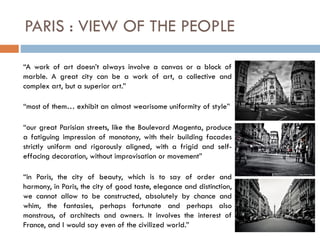
“our great Parisian streets, like the Boulevard Magenta, produce
a fatiguing impression of monotony, with their building facades
strictly uniform and rigorously aligned, with a frigid and self-
effacing decoration, without improvisation or movement”
“in Paris, the city of beauty, which is to say of order and
harmony, in Paris, the city of good taste, elegance and distinction,
we cannot allow to be constructed, absolutely by chance and
whim, the fantasies, perhaps fortunate and perhaps also
monstrous, of architects and owners. It involves the interest of
France, and I would say even of the civilized world.”
PARIS : CHANGING REGULATIONS
17th Century onwards, Parisian building facades
have been regulated. The laws and regulations
governing the facades have evolved through the
years, but no significant change was made to the
regulations till 1902.
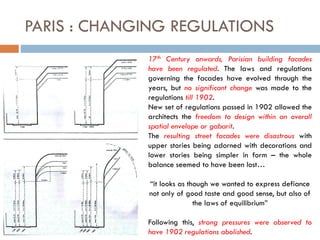
New set of regulations passed in 1902 allowed the
architects the freedom to design within an overall
spatial envelope or gabarit.
The resulting street facades were disastrous with
upper stories being adorned with decorations and
lower stories being simpler in form – the whole
balance seemed to have been lost…
“it looks as though we wanted to express defiance
not only of good taste and good sense, but also of
the laws of equilibrium”
Following this, strong pressures were observed to
have 1902 regulations abolished.
PARIS : CHANGING REGULATIONS
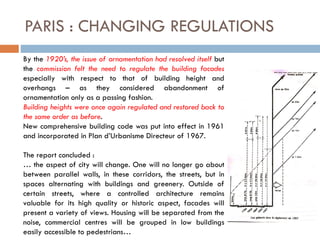
By the 1920’s, the issue of ornamentation had resolved itself but
the commission felt the need to regulate the building facades
especially with respect to that of building height and
overhangs – as they considered abandonment of
ornamentation only as a passing fashion.
Building heights were once again regulated and restored back to
the same order as before.
New comprehensive building code was put into effect in 1961
and incorporated in Plan d’Urbanisme Directeur of 1967.
The report concluded :
… the aspect of city will change. One will no longer go about
between parallel walls, in these corridors, the streets, but in
spaces alternating with buildings and greenery. Outside of
certain streets, where a controlled architecture remains
valuable for its high quality or historic aspect, facades will
present a variety of views. Housing will be separated from the
noise, commercial centres will be grouped in low buildings
easily accessible to pedestrians…
PARIS : CONCLUDING REMARKS
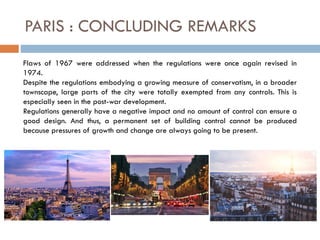
Flaws of 1967 were addressed when the regulations were once again revised in
1974.
Despite the regulations embodying a growing measure of conservatism, in a broader
townscape, large parts of the city were totally exempted from any controls. This is
especially seen in the post-war development.
Regulations generally have a negative impact and no amount of control can ensure a
good design. And thus, a permanent set of building control cannot be produced
because pressures of growth and change are always going to be present.
JAIPUR : THE PINK CITY
BLACK AND WHITE LUCKNOW
TRIDENT LAMPS IN KOLKATA
STREETS OF MUMBAI
EXAMPLES FROM ACROSS INDIA
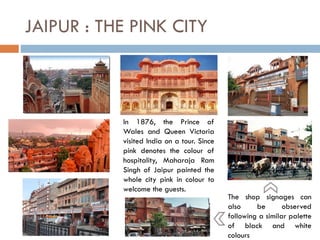
In 1876, the Prince of
Wales and Queen Victoria
visited India on a tour. Since
pink denotes the colour of
hospitality, Maharaja Ram
Singh of Jaipur painted the
whole city pink in colour to
welcome the guests.
JAIPUR : THE PINK CITY
The shop signages can
also be observed
following a similar palette
of black and white
colours
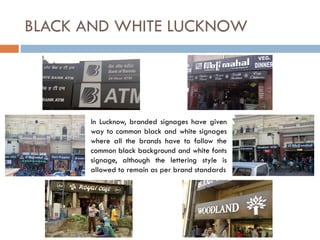
In Lucknow, branded signages have given
way to common black and white signages
where all the brands have to follow the
common black background and white fonts
signage, although the lettering style is
allowed to remain as per brand standards
BLACK AND WHITE LUCKNOW
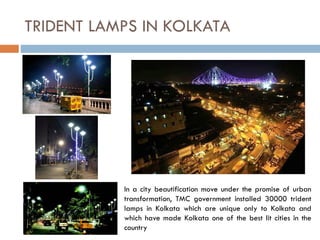
In a city beautification move under the promise of urban
transformation, TMC government installed 30000 trident
lamps in Kolkata which are unique only to Kolkata and
which have made Kolkata one of the best lit cities in the
country
TRIDENT LAMPS IN KOLKATA
JAIPUR
PONDICHERRY
CASE STUDY
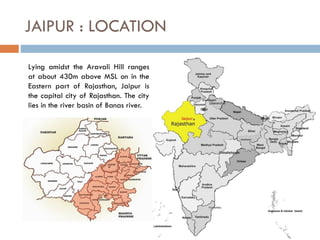
JAIPUR : LOCATION
Lying amidst the Aravali Hill ranges
at about 430m above MSL on in the
Eastern part of Rajasthan, Jaipur is
the capital city of Rajasthan. The city
lies in the river basin of Banas river.
JAIPUR : THE PINK CITY
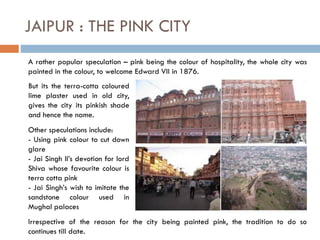
A rather popular speculation – pink being the colour of hospitality, the whole city was
painted in the colour, to welcome Edward VII in 1876.
But its the terra-cotta coloured
lime plaster used in old city,
gives the city its pinkish shade
and hence the name.
Other speculations include:
- Using pink colour to cut down
glare
- Jai Singh II’s devotion for lord
Shiva whose favourite colour is
terra cotta pink
- Jai Singh’s wish to imitate the
sandstone colour used in
Mughal palaces
Irrespective of the reason for the city being painted pink, the tradition to do so
continues till date.
JAIPUR : URBAN FORM AND IDENTITY
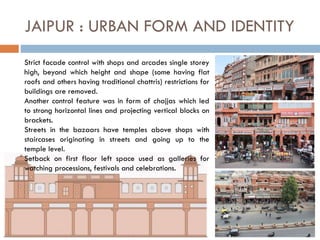
Strict facade control with shops and arcades single storey
high, beyond which height and shape (some having flat
roofs and others having traditional chattris) restrictions for
buildings are removed.
Another control feature was in form of chajjas which led
to strong horizontal lines and projecting vertical blocks on
brackets.
Streets in the bazaars have temples above shops with
staircases originating in streets and going up to the
temple level.
Setback on first floor left space used as galleries for
watching processions, festivals and celebrations.
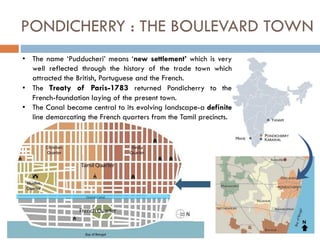
• The name ‘Pudducheri’ means ‘new settlement’ which is very
well reflected through the history of the trade town which
attracted the British, Portuguese and the French.
• The Treaty of Paris-1783 returned Pondicherry to the
French-foundation laying of the present town.
• The Canal became central to its evolving landscape-a definite
line demarcating the French quarters from the Tamil precincts.
PONDICHERRY : THE BOULEVARD TOWN
N
PONDICHERRY : LOOKING BACK
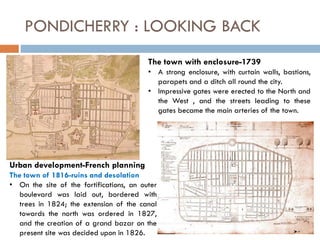
The town with enclosure-1739
• A strong enclosure, with curtain walls, bastions,
parapets and a ditch all round the city.
• Impressive gates were erected to the North and
the West , and the streets leading to these
gates became the main arteries of the town.
Urban development-French planning
The town of 1816-ruins and desolation
• On the site of the fortifications, an outer
boulevard was laid out, bordered with
trees in 1824; the extension of the canal
towards the north was ordered in 1827,
and the creation of a grand bazar on the
present site was decided upon in 1826.
Dutch invasion-1693
• No urbanism, the streets or lanes followed an irregular
pattern criss-crossed each other , without any shape or
symmetry.
• There was no town-planning in the native quarters of the
town in the western part, or in the eastern.
The planning of a new town(1693-99)
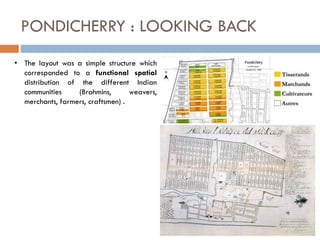
• Regular geometric layout
• Rectangular blocks of houses separated
by straight streets intersecting at right
angles.
• The layout was a simple structure which
corresponded to a functional spatial
distribution of the different Indian
communities (Brahmins, weavers,
merchants, farmers, craftsmen) .
PONDICHERRY : LOOKING BACK
PONDICHERRY : PRESENT
The town today
• The French or the White town developed along the coastline around the Government
Square surrounded by stately government buildings, while residential buildings interspersed
by institutional buildings extended on either side and along the beach.
• The Tamil or the Black town on the other hand, the commercial streets were considerably
modified after the transfer of territory with the construction of a number of new buildings.
Boulevards
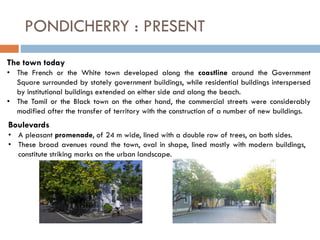
• A pleasant promenade, of 24 m wide, lined with a double row of trees, on both sides.
• These broad avenues round the town, oval in shape, lined mostly with modern buildings,
constitute striking marks on the urban landscape.
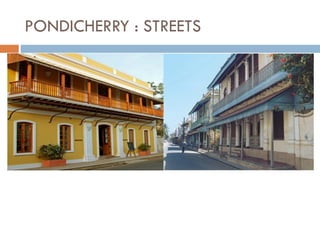
Secondary streets-French town
• The streets, mostly residential, are lined with
a large number of administrative buildings
and colonial houses with their principal
facade often perpendicular to the street and
extended by the boundary wall of an interior
garden.
PONDICHERRY : STREETS
Main streets
• The streets reflect the grid plan that determines the particular geometry of the town.
• They separate large rectangular blocks of houses and, except in the Muslim quarter, they
intersect at right angles.
Secondary street-Indian town
• The streets are lined with a variety
of different types of houses having
their tinnais (or raised levels with
wooden columns) open into the
streets.
PONDICHERRY : ROLE OF INTACH
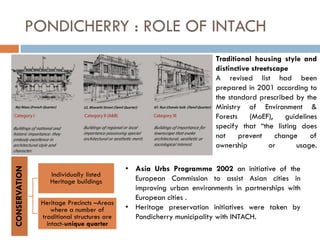
Traditional housing
style and distinctive
streetscape
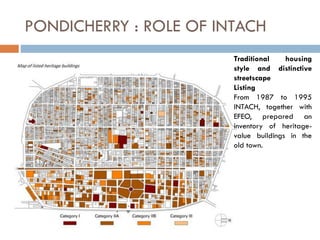
Listing
From 1987 to 1995
INTACH, together with
EFEO, prepared an
inventory of heritage-
value buildings in the
old town.
PONDICHERRY : ROLE OF INTACH
Traditional housing style and
distinctive streetscape
A revised list had been
prepared in 2001 according to
the standard prescribed by the
Ministry of Environment &
Forests (MoEF), guidelines
specify that “the listing does
not prevent change of
ownership or usage.
CONSERVATION
Individually listed
Heritage buildings
Heritage Precincts –Areas
where a number of
traditional structures are
intact-unique quarter
• Asia Urbs Programme 2002 an initiative of the
European Commission to assist Asian cities in
improving urban environments in partnerships with
European cities .
• Heritage preservation initiatives were taken by
Pondicherry municipality with INTACH.
PONDICHERRY : ROLE OF INTACHCONSERVATION
Model Street Restoration
Programme
Matching Grant Scheme
Street Signboards
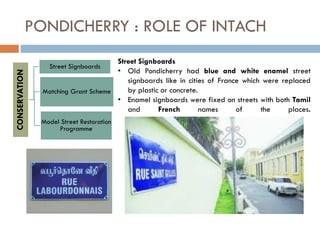
Street Signboards
• Old Pondicherry had blue and white enamel street
signboards like in cities of France which were replaced
by plastic or concrete.
• Enamel signboards were fixed on streets with both Tamil
and French names of the places.
PONDICHERRY : ROLE OF INTACH
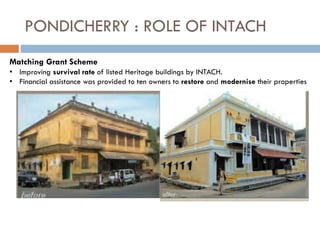
Matching Grant Scheme
• Improving survival rate of listed Heritage buildings by INTACH.
• Financial assistance was provided to ten owners to restore and modernise their properties
PONDICHERRY : ROLE OF INTACH
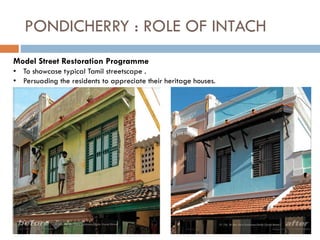
Model Street Restoration Programme
• To showcase typical Tamil streetscape .
• Persuading the residents to appreciate their heritage houses.
SUGGESTIONS TO REFLECT THE HERITAGE OF
VADODARA THROUGH THE BYE-LAWS
VADODARA : THE HERITAGE CITY
SUGGESTED REGULATIONS
MAJOR SUGGESTIONS:
 Incentives for private buildings
 Policy review for dying heritage
 Signage regulations
 Reclaiming historic spaces
WHICH MAY INCLUDE:
 Main street facades should have a similar character as that of heritage buildings
 Height of building should be restricted to match that of the surrounding
establishments
 Projections should be restricted and replicated in case of identified heritage
architectural character and style
 In case of commercial use, signages shall have to maintain a common design
 Developing relationship with the heritage buildings by using the heritage buildings
as functional public structures
CONCLUSION
CONCLUSION:
 In a city what changes continuously is its human fabric and what remains constant is its physical
identity. French a firm believer of the above notion have made an attempt to conserve the physical
identities of their cities amidst high end criticism through strict building regulations since time
immemorial.
 The building control set an orderliness in the urban fabric, restricting haphazard developments which
prevailed through modernism; Paris being a classic example. Though criticisms from architects, artists
and men of taste-the Modernists brought about some changes in the building control. It was believed
the control apparently turned the cities facades monotonous and frigid. The concept of building
control was detrimental to urban richness-Architectural militarism was what dominated the buildings
of Paris.
 The urban growth pattern has not left India untouched. The heritage towns designed with a vision,
function and a reflection of its creator are the most suffering. India witnesses absence of strict
building regulations control and an awareness of rich heritage it has. French ruled town of
Pondicherry followed the same ideology as of Paris but new developments have hampered the
heritage city which reflected distinct French and Tamil architecture styles of building. Initiatives by
organisations like INTACH of sensitising communities and people and the governing bodies of a city
may make a difference as reflected in cities like Jaipur and Pondicherry. A bottom up approach,
regulations in the policies and above all reclaiming our heritage is the need of the hour.
 Every building was once new and the radical form may eventually be regarded as an exemplar of
tradition. The physical identities can sustain if and only if the outlooks change, ugly may become
beautiful and rigid and monotonous may become harmonious and orderly. A city is not an artefact it
is a living entity which represents the people living within it.
PRESENTED BY:
HETAL JANI
KHYATI GULATI TEWARI
THANK YOU…

Bye Laws and City Planning

  • 1.
    BYE-LAWS AND CITY PLANNINGFOR HERITAGE HERITAGE CONSERVATION AND URBAN REGENERATION
  • 2.
    THE CITY ASAN ARTIFACT : BUILDING CONTROL IN MODERN PARIS --- Norma Evenson CASE STUDY
  • 3.
    PARIS : VIEWOF THE PEOPLE “A work of art doesn’t always involve a canvas or a block of marble. A great city can be a work of art, a collective and complex art, but a superior art.” “most of them… exhibit an almost wearisome uniformity of style” “our great Parisian streets, like the Boulevard Magenta, produce a fatiguing impression of monotony, with their building facades strictly uniform and rigorously aligned, with a frigid and self- effacing decoration, without improvisation or movement” “in Paris, the city of beauty, which is to say of order and harmony, in Paris, the city of good taste, elegance and distinction, we cannot allow to be constructed, absolutely by chance and whim, the fantasies, perhaps fortunate and perhaps also monstrous, of architects and owners. It involves the interest of France, and I would say even of the civilized world.”
  • 4.
    PARIS : CHANGINGREGULATIONS 17th Century onwards, Parisian building facades have been regulated. The laws and regulations governing the facades have evolved through the years, but no significant change was made to the regulations till 1902. New set of regulations passed in 1902 allowed the architects the freedom to design within an overall spatial envelope or gabarit. The resulting street facades were disastrous with upper stories being adorned with decorations and lower stories being simpler in form – the whole balance seemed to have been lost… “it looks as though we wanted to express defiance not only of good taste and good sense, but also of the laws of equilibrium” Following this, strong pressures were observed to have 1902 regulations abolished.
  • 5.
    PARIS : CHANGINGREGULATIONS By the 1920’s, the issue of ornamentation had resolved itself but the commission felt the need to regulate the building facades especially with respect to that of building height and overhangs – as they considered abandonment of ornamentation only as a passing fashion. Building heights were once again regulated and restored back to the same order as before. New comprehensive building code was put into effect in 1961 and incorporated in Plan d’Urbanisme Directeur of 1967. The report concluded : … the aspect of city will change. One will no longer go about between parallel walls, in these corridors, the streets, but in spaces alternating with buildings and greenery. Outside of certain streets, where a controlled architecture remains valuable for its high quality or historic aspect, facades will present a variety of views. Housing will be separated from the noise, commercial centres will be grouped in low buildings easily accessible to pedestrians…
  • 6.
    PARIS : CONCLUDINGREMARKS Flaws of 1967 were addressed when the regulations were once again revised in 1974. Despite the regulations embodying a growing measure of conservatism, in a broader townscape, large parts of the city were totally exempted from any controls. This is especially seen in the post-war development. Regulations generally have a negative impact and no amount of control can ensure a good design. And thus, a permanent set of building control cannot be produced because pressures of growth and change are always going to be present.
  • 7.
    JAIPUR : THEPINK CITY BLACK AND WHITE LUCKNOW TRIDENT LAMPS IN KOLKATA STREETS OF MUMBAI EXAMPLES FROM ACROSS INDIA
  • 8.
    In 1876, thePrince of Wales and Queen Victoria visited India on a tour. Since pink denotes the colour of hospitality, Maharaja Ram Singh of Jaipur painted the whole city pink in colour to welcome the guests. JAIPUR : THE PINK CITY The shop signages can also be observed following a similar palette of black and white colours
  • 9.
    In Lucknow, brandedsignages have given way to common black and white signages where all the brands have to follow the common black background and white fonts signage, although the lettering style is allowed to remain as per brand standards BLACK AND WHITE LUCKNOW
  • 10.
    In a citybeautification move under the promise of urban transformation, TMC government installed 30000 trident lamps in Kolkata which are unique only to Kolkata and which have made Kolkata one of the best lit cities in the country TRIDENT LAMPS IN KOLKATA
  • 11.
  • 12.
    JAIPUR : LOCATION Lyingamidst the Aravali Hill ranges at about 430m above MSL on in the Eastern part of Rajasthan, Jaipur is the capital city of Rajasthan. The city lies in the river basin of Banas river.
  • 13.
    JAIPUR : THEPINK CITY A rather popular speculation – pink being the colour of hospitality, the whole city was painted in the colour, to welcome Edward VII in 1876. But its the terra-cotta coloured lime plaster used in old city, gives the city its pinkish shade and hence the name. Other speculations include: - Using pink colour to cut down glare - Jai Singh II’s devotion for lord Shiva whose favourite colour is terra cotta pink - Jai Singh’s wish to imitate the sandstone colour used in Mughal palaces Irrespective of the reason for the city being painted pink, the tradition to do so continues till date.
  • 14.
    JAIPUR : URBANFORM AND IDENTITY Strict facade control with shops and arcades single storey high, beyond which height and shape (some having flat roofs and others having traditional chattris) restrictions for buildings are removed. Another control feature was in form of chajjas which led to strong horizontal lines and projecting vertical blocks on brackets. Streets in the bazaars have temples above shops with staircases originating in streets and going up to the temple level. Setback on first floor left space used as galleries for watching processions, festivals and celebrations.
  • 15.
    • The name‘Pudducheri’ means ‘new settlement’ which is very well reflected through the history of the trade town which attracted the British, Portuguese and the French. • The Treaty of Paris-1783 returned Pondicherry to the French-foundation laying of the present town. • The Canal became central to its evolving landscape-a definite line demarcating the French quarters from the Tamil precincts. PONDICHERRY : THE BOULEVARD TOWN N
  • 16.
    PONDICHERRY : LOOKINGBACK The town with enclosure-1739 • A strong enclosure, with curtain walls, bastions, parapets and a ditch all round the city. • Impressive gates were erected to the North and the West , and the streets leading to these gates became the main arteries of the town. Urban development-French planning The town of 1816-ruins and desolation • On the site of the fortifications, an outer boulevard was laid out, bordered with trees in 1824; the extension of the canal towards the north was ordered in 1827, and the creation of a grand bazar on the present site was decided upon in 1826.
  • 17.
    Dutch invasion-1693 • Nourbanism, the streets or lanes followed an irregular pattern criss-crossed each other , without any shape or symmetry. • There was no town-planning in the native quarters of the town in the western part, or in the eastern. The planning of a new town(1693-99) • Regular geometric layout • Rectangular blocks of houses separated by straight streets intersecting at right angles. • The layout was a simple structure which corresponded to a functional spatial distribution of the different Indian communities (Brahmins, weavers, merchants, farmers, craftsmen) . PONDICHERRY : LOOKING BACK
  • 18.
    PONDICHERRY : PRESENT Thetown today • The French or the White town developed along the coastline around the Government Square surrounded by stately government buildings, while residential buildings interspersed by institutional buildings extended on either side and along the beach. • The Tamil or the Black town on the other hand, the commercial streets were considerably modified after the transfer of territory with the construction of a number of new buildings. Boulevards • A pleasant promenade, of 24 m wide, lined with a double row of trees, on both sides. • These broad avenues round the town, oval in shape, lined mostly with modern buildings, constitute striking marks on the urban landscape.
  • 19.
    Secondary streets-French town •The streets, mostly residential, are lined with a large number of administrative buildings and colonial houses with their principal facade often perpendicular to the street and extended by the boundary wall of an interior garden. PONDICHERRY : STREETS Main streets • The streets reflect the grid plan that determines the particular geometry of the town. • They separate large rectangular blocks of houses and, except in the Muslim quarter, they intersect at right angles. Secondary street-Indian town • The streets are lined with a variety of different types of houses having their tinnais (or raised levels with wooden columns) open into the streets.
  • 20.
    PONDICHERRY : ROLEOF INTACH Traditional housing style and distinctive streetscape Listing From 1987 to 1995 INTACH, together with EFEO, prepared an inventory of heritage- value buildings in the old town.
  • 21.
    PONDICHERRY : ROLEOF INTACH Traditional housing style and distinctive streetscape A revised list had been prepared in 2001 according to the standard prescribed by the Ministry of Environment & Forests (MoEF), guidelines specify that “the listing does not prevent change of ownership or usage. CONSERVATION Individually listed Heritage buildings Heritage Precincts –Areas where a number of traditional structures are intact-unique quarter • Asia Urbs Programme 2002 an initiative of the European Commission to assist Asian cities in improving urban environments in partnerships with European cities . • Heritage preservation initiatives were taken by Pondicherry municipality with INTACH.
  • 22.
    PONDICHERRY : ROLEOF INTACHCONSERVATION Model Street Restoration Programme Matching Grant Scheme Street Signboards Street Signboards • Old Pondicherry had blue and white enamel street signboards like in cities of France which were replaced by plastic or concrete. • Enamel signboards were fixed on streets with both Tamil and French names of the places.
  • 23.
    PONDICHERRY : ROLEOF INTACH Matching Grant Scheme • Improving survival rate of listed Heritage buildings by INTACH. • Financial assistance was provided to ten owners to restore and modernise their properties
  • 24.
    PONDICHERRY : ROLEOF INTACH Model Street Restoration Programme • To showcase typical Tamil streetscape . • Persuading the residents to appreciate their heritage houses.
  • 25.
    SUGGESTIONS TO REFLECTTHE HERITAGE OF VADODARA THROUGH THE BYE-LAWS VADODARA : THE HERITAGE CITY
  • 26.
    SUGGESTED REGULATIONS MAJOR SUGGESTIONS: Incentives for private buildings  Policy review for dying heritage  Signage regulations  Reclaiming historic spaces WHICH MAY INCLUDE:  Main street facades should have a similar character as that of heritage buildings  Height of building should be restricted to match that of the surrounding establishments  Projections should be restricted and replicated in case of identified heritage architectural character and style  In case of commercial use, signages shall have to maintain a common design  Developing relationship with the heritage buildings by using the heritage buildings as functional public structures
  • 27.
    CONCLUSION CONCLUSION:  In acity what changes continuously is its human fabric and what remains constant is its physical identity. French a firm believer of the above notion have made an attempt to conserve the physical identities of their cities amidst high end criticism through strict building regulations since time immemorial.  The building control set an orderliness in the urban fabric, restricting haphazard developments which prevailed through modernism; Paris being a classic example. Though criticisms from architects, artists and men of taste-the Modernists brought about some changes in the building control. It was believed the control apparently turned the cities facades monotonous and frigid. The concept of building control was detrimental to urban richness-Architectural militarism was what dominated the buildings of Paris.  The urban growth pattern has not left India untouched. The heritage towns designed with a vision, function and a reflection of its creator are the most suffering. India witnesses absence of strict building regulations control and an awareness of rich heritage it has. French ruled town of Pondicherry followed the same ideology as of Paris but new developments have hampered the heritage city which reflected distinct French and Tamil architecture styles of building. Initiatives by organisations like INTACH of sensitising communities and people and the governing bodies of a city may make a difference as reflected in cities like Jaipur and Pondicherry. A bottom up approach, regulations in the policies and above all reclaiming our heritage is the need of the hour.  Every building was once new and the radical form may eventually be regarded as an exemplar of tradition. The physical identities can sustain if and only if the outlooks change, ugly may become beautiful and rigid and monotonous may become harmonious and orderly. A city is not an artefact it is a living entity which represents the people living within it.
  • 28.
    PRESENTED BY: HETAL JANI KHYATIGULATI TEWARI THANK YOU…