
BVS IN STEMI
DR.NILESH TAWADE
JASLOK HOSPITAL
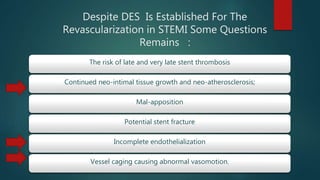
Despite DES Is Established For The
Revascularization in STEMI Some Questions
Remains :
The risk of late and very late stent thrombosis
Continued neo-intimal tissue growth and neo-atherosclerosis;
Mal-apposition
Potential stent fracture
Incomplete endothelialization
Vessel caging causing abnormal vasomotion.
.
 The results of the ABSORB trial showed the efficacy and
safety of a bioresorbable vascular scaffold (BVS)
BIO ABORBABLE SCAFFOLD
 On Premise that scaffolding & drug are only required on a temporary
basis following coronary interventions.
 Several studies support this concept and indicate that there is no
incremental clinical benefit of a permanent implant over time.
 Use of Absorbable scaffold eliminates the presence of a mechanical
restraint and offers potential of restoring natural vessel reactivity to
NITRIC OXIDE .
Vascular Reparative therapy
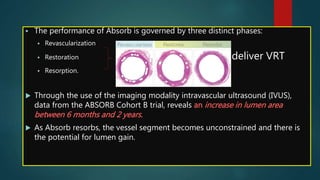
 The performance of Absorb is governed by three distinct phases:
 Revascularization
 Restoration these phases of Absorb performan-  deliver VRT
 Resorption.
 Through the use of the imaging modality intravascular ultrasound (IVUS),
data from the ABSORB Cohort B trial, reveals an increase in lumen area
between 6 months and 2 years.
 As Absorb resorbs, the vessel segment becomes unconstrained and there is
the potential for lumen gain.
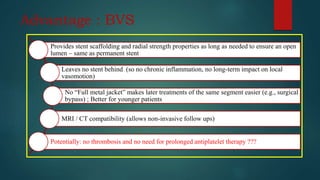
Advantage : BVS
Provides stent scaffolding and radial strength properties as long as needed to ensure an open
lumen – same as permanent stent
Leaves no stent behind (so no chronic inflammation, no long-term impact on local
vasomotion)
No “Full metal jacket” makes later treatments of the same segment easier (e.g., surgical
bypass) ; Better for younger patients
MRI / CT compatibility (allows non-invasive follow ups)
Potentially: no thrombosis and no need for prolonged antiplatelet therapy ???
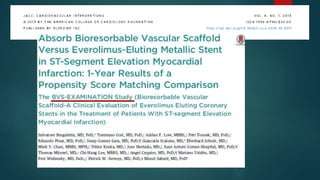
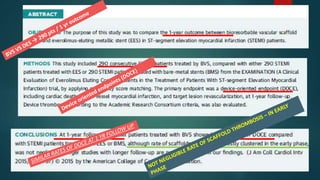
 Recently, a nonrandomized clinical trial comparing
BVS and DES implantation in patients with acute
coronary syndrome (ACS) has shown that the use of
BVS in this patient group is safe and has similar
outcomes to that of metal DES
Challenges of the scaffold implantation in ACS
 Improper vessel sizing  due to changes in the diameters of the vessel, which may appear
smaller when flow is diminished or constricted by high adrenergic stimulation.
 Adequate lesion preparation with predilations before scaffold implantation can potentially
increase the risk of distal embolization if the lesion contains a thrombus.
 Finally, the deployment technique with prolonged inflation time (stepwise inflation of 2
atmospheres every 5 seconds up to the assumed pressure while maintaining the inflated
balloon for 30 seconds) differs from the current approach with metallic stents.
 Experience in complex cases (bifurcation, ostial, CTO) is limited.
 High strut thickness may lead to vessel injury, nonlaminar flow, platelet deposition, and poor
deliverability.
 Calcification or tortuosity are technically challenging which requires the proper bed preparation.
 Regardless of lesion anatomy, pre-dilation is mandatory, direct stenting is not possible.
 Duration of DAPT with BVS is unclear. Current Recommendations 3 Years
Current limitations and challenges
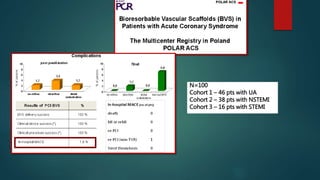
N=100
Cohort 1 – 46 pts with UA
Cohort 2 – 38 pts with NSTEMI
Cohort 3 – 16 pts with STEMI
The intent-to-treat population comprises a total of 49
patients.
DAPT AND BVS
 OCT STUDY finding suggests that in areas of high shear stress (eg, vessel curvatures,
tortuosity, bifurcations) neointimal cover of BVS struts might be incomplete even after
1 year.
 Most interventionist would not feel safe stopping DAPT in the current scenario.
 Some cases of a very late scaffold thrombosis after DAPT cessationsuggests that this
dreadful complication is still present, even in the bioresorbable era, hence predisposing
factors should be actively investigated.
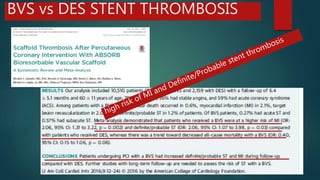
BVS vs DES STENT THROMBOSIS
SUMMARY
 In the Present SCENARIO of PCI in acute MI
Where there is a thrombogenic milieu
Possibility of distal embolization (with Predilatation and ?
Post dilatation )
The implantation of BVS in STEMI needs further studies and
evaluation

BVS IN STEMI

  • 1.
    BVS IN STEMI DR.NILESHTAWADE JASLOK HOSPITAL
  • 3.
    Despite DES IsEstablished For The Revascularization in STEMI Some Questions Remains : The risk of late and very late stent thrombosis Continued neo-intimal tissue growth and neo-atherosclerosis; Mal-apposition Potential stent fracture Incomplete endothelialization Vessel caging causing abnormal vasomotion.
  • 4.
    .  The resultsof the ABSORB trial showed the efficacy and safety of a bioresorbable vascular scaffold (BVS) BIO ABORBABLE SCAFFOLD
  • 5.
     On Premisethat scaffolding & drug are only required on a temporary basis following coronary interventions.  Several studies support this concept and indicate that there is no incremental clinical benefit of a permanent implant over time.  Use of Absorbable scaffold eliminates the presence of a mechanical restraint and offers potential of restoring natural vessel reactivity to NITRIC OXIDE . Vascular Reparative therapy
  • 6.
     The performanceof Absorb is governed by three distinct phases:  Revascularization  Restoration these phases of Absorb performan-  deliver VRT  Resorption.  Through the use of the imaging modality intravascular ultrasound (IVUS), data from the ABSORB Cohort B trial, reveals an increase in lumen area between 6 months and 2 years.  As Absorb resorbs, the vessel segment becomes unconstrained and there is the potential for lumen gain.
  • 7.
    Advantage : BVS Providesstent scaffolding and radial strength properties as long as needed to ensure an open lumen – same as permanent stent Leaves no stent behind (so no chronic inflammation, no long-term impact on local vasomotion) No “Full metal jacket” makes later treatments of the same segment easier (e.g., surgical bypass) ; Better for younger patients MRI / CT compatibility (allows non-invasive follow ups) Potentially: no thrombosis and no need for prolonged antiplatelet therapy ???
  • 8.
     Recently, anonrandomized clinical trial comparing BVS and DES implantation in patients with acute coronary syndrome (ACS) has shown that the use of BVS in this patient group is safe and has similar outcomes to that of metal DES
  • 9.
    Challenges of thescaffold implantation in ACS  Improper vessel sizing  due to changes in the diameters of the vessel, which may appear smaller when flow is diminished or constricted by high adrenergic stimulation.  Adequate lesion preparation with predilations before scaffold implantation can potentially increase the risk of distal embolization if the lesion contains a thrombus.  Finally, the deployment technique with prolonged inflation time (stepwise inflation of 2 atmospheres every 5 seconds up to the assumed pressure while maintaining the inflated balloon for 30 seconds) differs from the current approach with metallic stents.
  • 10.
     Experience incomplex cases (bifurcation, ostial, CTO) is limited.  High strut thickness may lead to vessel injury, nonlaminar flow, platelet deposition, and poor deliverability.  Calcification or tortuosity are technically challenging which requires the proper bed preparation.  Regardless of lesion anatomy, pre-dilation is mandatory, direct stenting is not possible.  Duration of DAPT with BVS is unclear. Current Recommendations 3 Years Current limitations and challenges
  • 11.
    N=100 Cohort 1 –46 pts with UA Cohort 2 – 38 pts with NSTEMI Cohort 3 – 16 pts with STEMI
  • 12.
    The intent-to-treat populationcomprises a total of 49 patients.
  • 15.
    DAPT AND BVS OCT STUDY finding suggests that in areas of high shear stress (eg, vessel curvatures, tortuosity, bifurcations) neointimal cover of BVS struts might be incomplete even after 1 year.  Most interventionist would not feel safe stopping DAPT in the current scenario.  Some cases of a very late scaffold thrombosis after DAPT cessationsuggests that this dreadful complication is still present, even in the bioresorbable era, hence predisposing factors should be actively investigated.
  • 16.
    BVS vs DESSTENT THROMBOSIS
  • 17.
    SUMMARY  In thePresent SCENARIO of PCI in acute MI Where there is a thrombogenic milieu Possibility of distal embolization (with Predilatation and ? Post dilatation ) The implantation of BVS in STEMI needs further studies and evaluation

Editor's Notes

  • #5 BIO ABORBABLE SCAFFOLD
  • #15 BVS VS DES  290 pts / 1 yr outcome Device oriented endpoints (DOCE) SIMILAR RATES OF DOCE AT 1 YR FOLLOW UP NOT NEGLIGIBLE RATE OF SCAFFOLD THROMBOSIS – IN EARLY PHASE
  • #17 high risk of mi and definite stent thrombosis