BIOABSORBABLE VASCULAR SCAFFOLD
• History & evolution of BVS
• Advantages
• Types of BVS
• Physiology of BVS
• Clinical trials of BVS
• Future perspectives of BVS
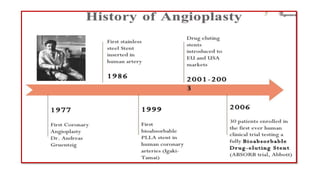
History of angioplasty
• First revolution- balloon angioplasty
• The invention of balloon angioplasty as a percutaneous treatment for
obstructive coronary disease by Andreas Gruntzig in 1977 was a huge
leap forward in cardiovascular medicine and undoubtedly will always
be remembered as a revolution in the field of revascularization
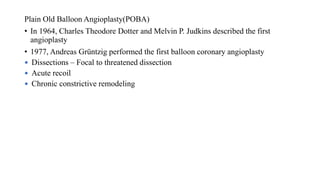
Plain Old Balloon Angioplasty(POBA)
• In 1964, Charles Theodore Dotter and Melvin P. Judkins described the first
angioplasty
• 1977, Andreas Grüntzig performed the first balloon coronary angioplasty
 Dissections – Focal to threatened dissection
 Acute recoil
 Chronic constrictive remodeling
• DISADVANTAGES
• Although late luminal enlargement and vascular remodeling could take place,
more often restenosis would occur instead.
• The restenosis would essentially be caused by
• constrictive remodeling and, to a lesser extent, by
• elastic recoil or the
• neointimal hyperplastic healing response.
• second revolution -BMS
• The advent of BMS and the landmark Belgian-Netherlands Stent Study (BENESTENT) and Stent
Restenosis Study (STRESS) trials have established BMS as the second revolution in interventional
cardiology.
• A solution to acute vessel occlusion by
• sealing the dissection flaps and
• preventing recoil &
• making emergency bypass surgery a rare occurrence.
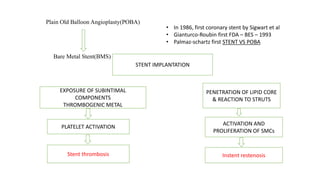
• In 1986, first coronary stent by Sigwart et al
• Gianturco-Roubin first FDA – BES – 1993
• Palmaz-schartz first STENT VS POBA
Plain Old Balloon Angioplasty(POBA)
Bare Metal Stent(BMS)
STENT IMPLANTATION
PENETRATION OF LIPID CORE
& REACTION TO STRUTS
EXPOSURE OF SUBINTIMAL
COMPONENTS
THROMBOGENIC METAL
ACTIVATION AND
PROLIFERATION OF SMCs
PLATELET ACTIVATION
Instent restenosis
Stent thrombosis
• Restenosis rates were further reduced from 32% to 22% at 7 months, but this rate
was still high, and neointimal hyperplasia inside the stent was even more
prominent than with angioplasty.
• Disadvantages (Because the vessel was now caged with metal)
• late luminal enlargement and
• advantageous vascular remodeling could no longer occur.
• late stent thrombosis (ST), was also first described.
• Serruys PW, Daemen J. Late stent thrombosis: a nuisance in both bare metal and drug-eluting
stents Circulation. 2007;
• Third revolution-DES
• The first 45 patients implanted with the sirolimus eluting Bx velocity stent
(Cordis, Johnson & Johnson, Warren, NJ) were found to have negligible
neointimal hyperplasia at follow-up.
• This was confirmed in the randomized comparison of a sirolimus-eluting stent
with a standard stent for coronary revascularization (RAVEL) study.
• Morice MC, Serruys PW A randomized comparison of a sirolimus-eluting stent with a standard
stent for coronary revascularization. N Engl J Med. 2002;346:
The RAVEL Study
A RAndomised (double blind) study with the Sirolimus coated BX™ VElocity
balloon expandable stent (CYPHER™) in the treatment of patients with De
Novo native coronary artery Lesions
M.C. Morice, P.W Serruys, J.E. Sousa, J. Fajadet, M. Perin, E. Ban Hayashi, A. Colombo, G. Schuler, P. Barragan, C.
Bode
The treatment of a de novo lesion with CYPHER™ appears feasible and
safe : no acute, subacute (30 days) or late occlusion occurred although
clopidogrel / ticlopidine was administered for only 2 months
Virtual elimination of neo-intimal in-stent proliferation: MLD post
deployment (2.43 mm) remains essentially unchanged at 6 months (2.42
mm) with no measurable late loss (-0.05 mm) Restenosis (0%) and no
evidence of edge effect
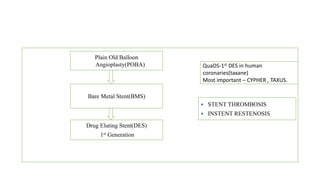
Plain Old Balloon
Angioplasty(POBA)
Bare Metal Stent(BMS)
Drug Eluting Stent(DES)
1st Generation
QuaDS-1st DES in human
coronaries(taxane)
Most important – CYPHER , TAXUS.
 STENT THROMBOSIS
 INSTENT RESTENOSIS
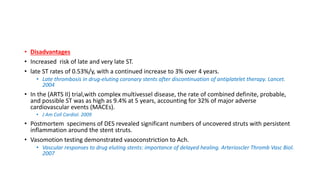
• Disadvantages
• Increased risk of late and very late ST.
• late ST rates of 0.53%/y, with a continued increase to 3% over 4 years.
• Late thrombosis in drug-eluting coronary stents after discontinuation of antiplatelet therapy. Lancet.
2004
• In the (ARTS II) trial,with complex multivessel disease, the rate of combined definite, probable,
and possible ST was as high as 9.4% at 5 years, accounting for 32% of major adverse
cardiovascular events (MACEs).
• J Am Coll Cardiol. 2009
• Postmortem specimens of DES revealed significant numbers of uncovered struts with persistent
inflammation around the stent struts.
• Vasomotion testing demonstrated vasoconstriction to Ach.
• Vascular responses to drug eluting stents: importance of delayed healing. Arterioscler Thromb Vasc Biol.
2007
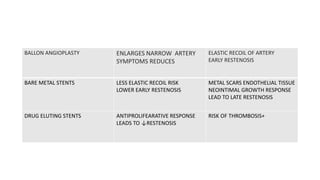
BALLON ANGIOPLASTY ENLARGES NARROW ARTERY
SYMPTOMS REDUCES
ELASTIC RECOIL OF ARTERY
EARLY RESTENOSIS
BARE METAL STENTS LESS ELASTIC RECOIL RISK
LOWER EARLY RESTENOSIS
METAL SCARS ENDOTHELIAL TISSUE
NEOINTIMAL GROWTH RESPONSE
LEAD TO LATE RESTENOSIS
DRUG ELUTING STENTS ANTIPROLIFEARATIVE RESPONSE
LEADS TO ↓RESTENOSIS
RISK OF THROMBOSIS+
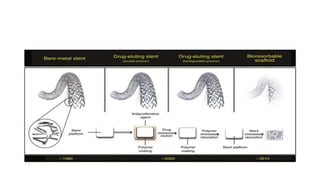
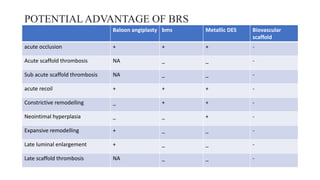
POTENTIALADVANTAGE OF BRS
Baloon angiplasty bms Metallic DES Biovascular
scaffold
acute occlusion + + + -
Acute scaffold thrombosis NA _ _ -
Sub acute scaffold thrombosis NA _ _ -
acute recoil + + + -
Constrictive remodelling _ + + -
Neointimal hyperplasia _ _ + -
Expansive remodelling + _ _ -
Late luminal enlargement + _ _ -
Late scaffold thrombosis NA _ _ -
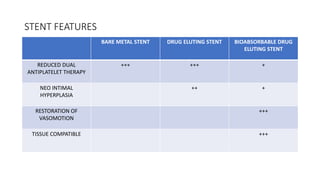
STENT FEATURES
BARE METAL STENT DRUG ELUTING STENT BIOABSORBABLE DRUG
ELUTING STENT
REDUCED DUAL
ANTIPLATELET THERAPY
+++ +++ +
NEO INTIMAL
HYPERPLASIA
++ +
RESTORATION OF
VASOMOTION
+++
TISSUE COMPATIBLE +++
ADVANTAGES of BVS
1. A reduction in adverse events such as ST.
• Because drug elution and scaffolding are temporary and are provided by the device only until the
vessel has healed, no foreign material such as nonendothelialized struts and drug polymers
(potential triggers for ST) can persist long term.
2.The removal,through bioabsorption of the rigid caging of the stented vessel.
• This can facilitate the return of vessel vasomotion, adaptive shear stress, late luminal
enlargement, and late expansive remodeling.
• Furthermore, this might reduce the problems of jailing of the ostium of side branches as seen
with permanent metallic stent struts.
3.A reduction in bleeding complications.
• No requirement for long-term dual antiplatelet therapy.
• This is particularly pertinent given that the elderly, who are at the greatest risk of bleeding.
• Furthermore, early discontinuation of dual antiplatelet therapy with current metallic DES,for
whatever indication, has consistently been shown to be an independent predictor of ST.
• Development and validation of a prognostic risk score for major bleeding in patients
undergoing percutaneous coronary intervention via the femoral approach. Eur Heart J. 2007;
4.An improvement in future treatment options.
• The treatment of complex multivessel disease frequently results in the use of multiple long DES;
for example, in the synergy between percutaneous coronary intervention with TAXUS and cardiac
surgery (SYNTAX) trial, the average number of stents was 4, and one third of patients had 100
mm of stent implanted.
• In such cases, repeat revascularization is potentially challenging.
• The use of a BRS would mean that there would potentially be no restriction on any future
percutaneous or surgical revascularization should they be needed.
5.Allowing noninvasive imaging (CT/MR angio.)
• Metallic stents can cause a blooming effect with these imaging modalities, making interpretation
more difficult.
• The (PLLA) scaffold should not restrict the use of CT or MRI because it is nonmetallic; once
bioabsorption has been completed with a BRS, it should also not restrict the use of CT or MRI
• Noninvasive imaging follow-up could therefore become an alternative to invasive imaging
followup.
• Artifact-free coronary magnetic resonance angiography and coronary vessel wall imaging in the
presence of a new, metallic, coronary magnetic resonance imaging stent. Circulation. 2005
6.Reservoir for the local delivery of drugs and genes.
• Because the duration of bioresorption is modifiable, according to the type of
polymers/copolymers, a tuned elution of multiple drugs can potentially be achievable (eg, early
elution of antiproliferative agent from a coated polymer and long-term elution of an
antiinflammatory or other agent from the backbone polymer).
7.Elimination of the concern that some patients have at the thought of having an implant in their
bodies for the rest of their lives.(esp. in young individuals)
• Ormiston JA, Serruys PW. Bioabsorbable coronary stents. Circ Cardiovasc Interv. 2009;2:255–
260.
8.VASCULAR REPARATIVE THERAPY
• On Premise that scaffolding & drug are only required on a temporary basis following coronary
interventions.
• Several studies support this concept and indicate that there is no incremental clinical benefit of a
permanent implant over time.
• The use of Absorb eliminates the presence of a mechanical restraint and offers the potential of
restoring natural vessel reactivity.
• Incidence of restenosis after successful coronary angioplasty: a time-related phenomenon. A
quantitative angiographic study in 342 consecutive patients at 1, 2, 3, and 4 months.
Circulation, 1988.
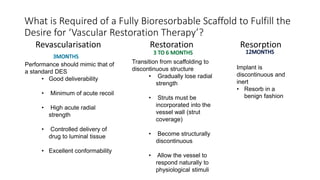
• While stent performance is characterized by a single phase (Revascularization),
the performance of Absorb is governed by three distinct phases:
• Revascularization
• Restoration
• Resorption.
• Together, these phases of Absorb performance deliver VRT
1
RESCULARISATION
• The rescularisation phase is when absorb resvascularizes the
vessel like a best in class DES
• Absorb achieves this goal by offering good deliverability ,a
minimum of acute recoil ,high radial strength and controlled
release of the anti prolifferative drug everolimus to minimize
neointimal growth
• The late lumen loss is comparable to those observed in best
in class DES
2
RESTORATION
• During the restoration phase,absorb gradually ceases
providing luminal support and evolves from an intact scaffold
to a discontinuous structure embedded within neointimal
tissue
• Absorb no longer mechanically restrains the vessel allowing it
to return to a more natural ,uncaged state without the
presence of a permanent metallic stent
• Vasomotion is possible as early as 12months post procedure
3
ON
• The resorption phase is the final process in which the
discontinuous scaffold structure disappears,because there is
no longer a structure that mechanically restrains the vessel,a
more natural vascular response to physiological stimuli is
possible
• Absorb is now an inert implant designed to benignly resorb
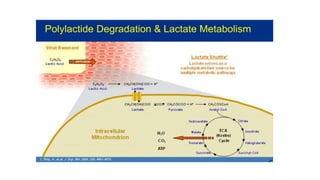
into the vessel wall.it degrades to lactic acid and ultimately the
What is Required of a Fully Bioresorbable Scaffold to Fulfill the
Desire for ‘Vascular Restoration Therapy’?
Revascularisation Restoration Resorption
Performance should mimic that of
a standard DES
• Good deliverability
• Minimum of acute recoil
• High acute radial
strength
• Controlled delivery of
drug to luminal tissue
• Excellent conformability
Transition from scaffolding to
discontinuous structure
• Gradually lose radial
strength
• Struts must be
incorporated into the
vessel wall (strut
coverage)
• Become structurally
discontinuous
• Allow the vessel to
respond naturally to
physiological stimuli
Implant is
discontinuous and
inert
• Resorb in a
benign fashion
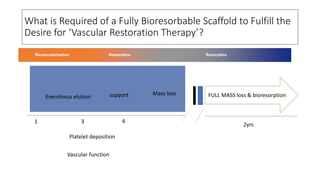
What is Required of a Fully Bioresorbable Scaffold to Fulfill the
Desire for ‘Vascular Restoration Therapy’?
Revascularization Restoration Resorption
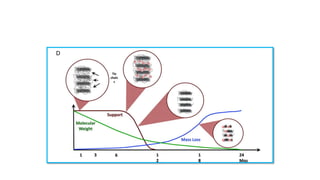
FULL MASS loss & bioresorption
1 6
2yrs
3
Everolimus elution support Mass loss
Platelet deposition
Vascular function
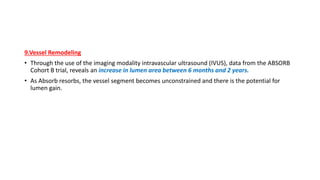
9.Vessel Remodeling
• Through the use of the imaging modality intravascular ultrasound (IVUS), data from the ABSORB
Cohort B trial, reveals an increase in lumen area between 6 months and 2 years.
• As Absorb resorbs, the vessel segment becomes unconstrained and there is the potential for
lumen gain.
10.Vasomotion
• As Absorb resorbs, the treated vessel segment is able to react to changes in blood flow and
physiological stimuli that may occur with exercise or certain drugs.
• By no longer supporting or caging the vessel, there is the potential for allowing the vessel to
respond naturally to physiological stimuli, which could provide unique benefits.
Restoration to a More Natural State with Absorb
Another appealing long-term benefit of Absorb is the possibility of progressive restoration of
Absorb-treated vessel segments to a more natural state as the polymeric scaffold undergoes
degradation.
• Restore vasomotor tone for regulation of coronary blood flow
• Restore vessel compliance and cyclic strain in response to pulsatile flow
• Enable adaptive shear stress, allowing the vessel to regain its ability to maintain quiescent
homeostasis
• Permit accommodative, beneficial remodeling.
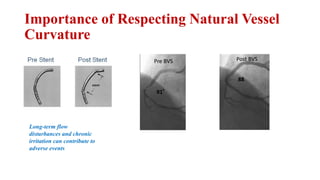
Importance of Respecting Natural Vessel
Curvature
91°
88
Long-term flow
disturbances and chronic
irritation can contribute to
adverse events
Pre BVS Post BVS
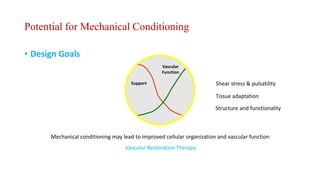
Potential for Mechanical Conditioning
• Design Goals
Support
Vascular
Function
Mechanical conditioning may lead to improved cellular organization and vascular function
Vascular Restoration Therapy
Shear stress & pulsatility
Tissue adaptation
Structure and functionality
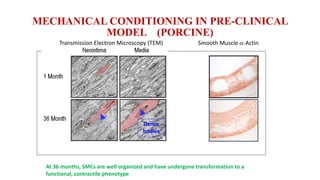
MECHANICAL CONDITIONING IN PRE-CLINICAL
MODEL (PORCINE)
Transmission Electron Microscopy (TEM) Smooth Muscle -Actin
Dense
bodies
At 36 months, SMCs are well organized and have undergone transformation to a
functional, contractile phenotype
• An occlusive vessel segment that is first implanted with Absorb has the potential to restore to a
more natural state.
• In the event of restenosis (tissue regrowth) at the treated site, more treatment options are
available – another Absorb, a DES or even balloon angioplasty.
• Furthermore, the more natural state can make re-treatment easier, given the recognized
difficulties involved in treatment of in-stent restenosis
Fourth revolution
• All these problems promise to be solved with the advent of fully biodegradable scaffolds.
• Offers the possibility of
• Transient scaffolding of the vessel to prevent acute vessel closure and recoil &
• Transiently eluting an antiproliferative drug to counteract the constrictive remodeling and
excessive neointimal hyperplasia
Development of BRS
• The efforts to create BRS started 32years ago.
• The first experimental studies using a nonbiodegradable polyethylene-terephthalate braided
mesh stents in porcine animal models were published in 1992.
• In 1996, it was reported in porcine coronary arteries negative consequences after implantation of
the Wiktor stent coated with 5 different types of biodegradable polymers ,all resulting in marked
inflammation leading to neointimal hyperplasia and/or thrombus formation.
• Development of a polymer endovascular prosthesis and its implantation in porcine arteries. J
Interv Cardiol. 1992;5:175–185.
• Lincoff et al -- high-molecular-weight (321 kDa) PLLA was well tolerated and effective,
where as a stent coated with low-molecular-weight (80 kDa) PLLA was associated with an
intense inflammatory neointimal response.
• They also proved the feasibility of drug elution from the PLLA, although no suppression
of neointimal hyperplasia was reported.
-Lincoff AM, Schwartz RS, van Beusekom HM. Circulation. 1996;94:1690 –1697.
• In 1998, Yamawaki et al reported that in the porcine model the fully biodegradable PLLA
stent with tyrosine kinase inhibitor efficiently suppressed proliferative stimuli caused by
balloon injury.
• Yamawaki T, Shimokawa H, Kozai T. J Am Coll Cardiol. 1998;32:780 –786.
The technology failed to develop an ideal polymer that could limit inflammation and
restenosis and secondarily because of the growing interest in metallic DES.
The key mechanical traits for ideal material :
• High -elastic moduli to impart radial stiffness,
• Large -break strains to impart the ability to withstand deformations from the crimped to
expanded states, and
• Low -yield strains to reduce the amount of recoil and overinflation necessary to achieve a
target deployment.
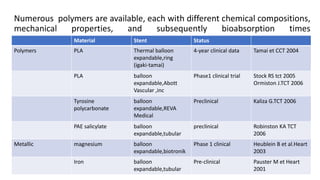
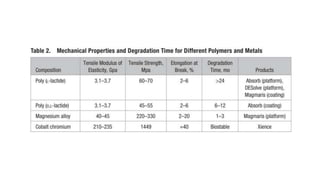
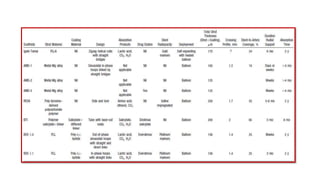
Numerous polymers are available, each with different chemical compositions,
mechanical properties, and subsequently bioabsorption times
Material Stent Status
Polymers PLA Thermal balloon
expandable,ring
(igaki-tamai)
4-year clinical data Tamai et CCT 2004
PLA balloon
expandable,Abott
Vascular ,inc
Phase1 clinical trial Stock RS tct 2005
Ormiston J.TCT 2006
Tyrosine
polycarbonate
balloon
expandable,REVA
Medical
Preclinical Kaliza G.TCT 2006
PAE salicylate balloon
expandable,tubular
preclinical Robinston KA TCT
2006
Metallic magnesium balloon
expandable,biotronik
Phase 1 clinical Heublein B et al.Heart
2003
Iron balloon
expandable,tubular
Pre-clinical Pauster M et Heart
2001
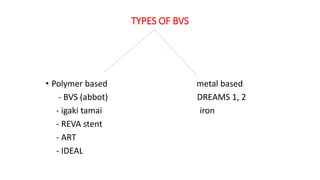
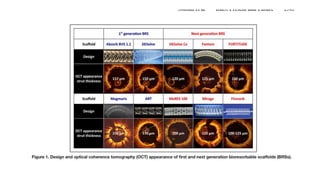
TYPES OF BVS
• Polymer based metal based
- BVS (abbot) DREAMS 1, 2
- igaki tamai iron
- REVA stent
- ART
- IDEAL
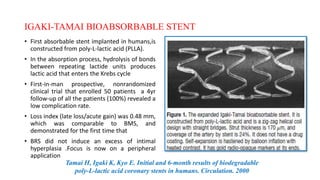
IGAKI-TAMAI BIOABSORBABLE STENT
• First absorbable stent implanted in humans,is
constructed from poly-L-lactic acid (PLLA).
• In the absorption process, hydrolysis of bonds
between repeating lactide units produces
lactic acid that enters the Krebs cycle
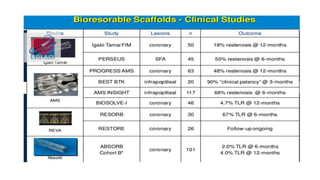
• First-in-man prospective, nonrandomized
clinical trial that enrolled 50 patients a 4yr
follow-up of all the patients (100%) revealed a
low complication rate.
• Loss index (late loss/acute gain) was 0.48 mm,
which was comparable to BMS, and
demonstrated for the first time that
• BRS did not induce an excess of intimal
hyperplasia .Focus is now on a peripheral
application
Tamai H, Igaki K, Kyo E. Initial and 6-month results of biodegradable
poly-L-lactic acid coronary stents in humans. Circulation. 2000
• Despite these impressive results, the failure of the stent to progress was related primarily to the
use of heat to induce self-expansion. There were concerns that this could cause necrosis of the
arterial wall, leading to excessive intimal hyperplasia or increased platelet adhesion, leading to ST.
• Biodegradable peripheral Igaki-Tamai stents PERSEUS study,the stent became available in Europe
for peripheral use;
• Biamino G, Schmidt A, Scheinert D. Treatment of SFA lesions with PLLA biodegradable stents:
results of the PERSEUS Study. J Endovasc Ther. 2005;12:5.
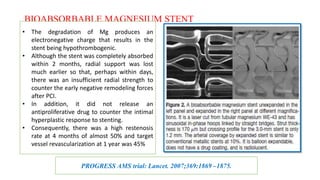
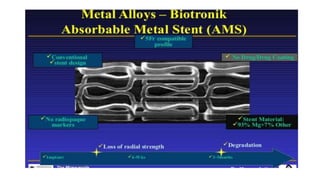
BIOABSORBABLE MAGNESIUM STENT
• The degradation of Mg produces an
electronegative charge that results in the
stent being hypothrombogenic.
• Although the stent was completely absorbed
within 2 months, radial support was lost
much earlier so that, perhaps within days,
there was an insufficient radial strength to
counter the early negative remodeling forces
after PCI.
• In addition, it did not release an
antiproliferative drug to counter the intimal
hyperplastic response to stenting.
• Consequently, there was a high restenosis
rate at 4 months of almost 50% and target
vessel revascularization at 1 year was 45%
PROGRESS AMS trial: Lancet. 2007;369:1869 –1875.
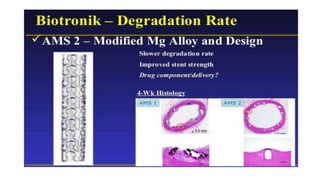
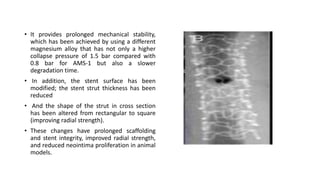
• It provides prolonged mechanical stability,
which has been achieved by using a different
magnesium alloy that has not only a higher
collapse pressure of 1.5 bar compared with
0.8 bar for AMS-1 but also a slower
degradation time.
• In addition, the stent surface has been
modified; the stent strut thickness has been
reduced
• And the shape of the strut in cross section
has been altered from rectangular to square
(improving radial strength).
• These changes have prolonged scaffolding
and stent integrity, improved radial strength,
and reduced neointima proliferation in animal
models.
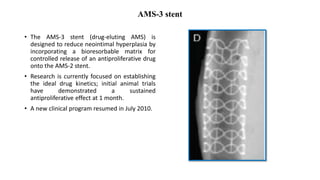
AMS-3 stent
• The AMS-3 stent (drug-eluting AMS) is
designed to reduce neointimal hyperplasia by
incorporating a bioresorbable matrix for
controlled release of an antiproliferative drug
onto the AMS-2 stent.
• Research is currently focused on establishing
the ideal drug kinetics; initial animal trials
have demonstrated a sustained
antiproliferative effect at 1 month.
• A new clinical program resumed in July 2010.
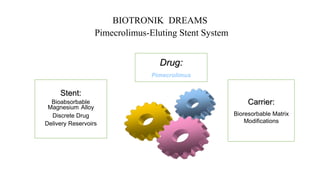
BIOTRONIK DREAMS
Pimecrolimus-Eluting Stent System
Drug:
Pimecrolimus
Stent:
Bioabsorbable
Magnesium Alloy
Discrete Drug
Delivery Reservoirs
Carrier:
Bioresorbable Matrix
Modifications
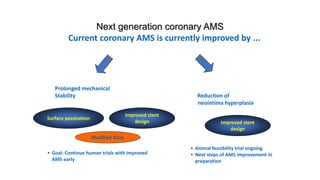
Next generation coronary AMS
Current coronary AMS is currently improved by ...
Prolonged mechanical
Stability Reduction of
neointima hyperplasia
Surface passivation
Improved stent
design Improved stent
design
Modified Alloy
• Animal feasibility trial ongoing
• Next steps of AMS improvement in
preparation
• Goal: Continue human trials with improved
AMS early
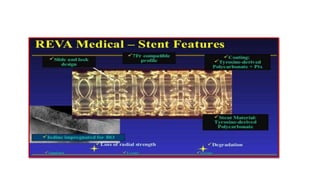
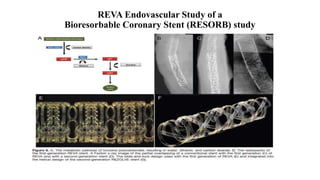
REVA Endovascular Study of a
Bioresorbable Coronary Stent (RESORB) study
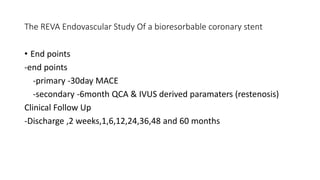
The REVA Endovascular Study Of a bioresorbable coronary stent
• End points
-end points
-primary -30day MACE
-secondary -6month QCA & IVUS derived paramaters (restenosis)
Clinical Follow Up
-Discharge ,2 weeks,1,6,12,24,36,48 and 60 months
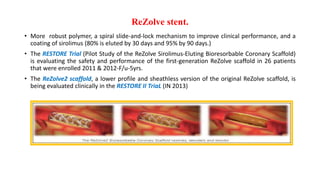
ReZolve stent.
• More robust polymer, a spiral slide-and-lock mechanism to improve clinical performance, and a
coating of sirolimus (80% is eluted by 30 days and 95% by 90 days.)
• The RESTORE Trial (Pilot Study of the ReZolve Sirolimus-Eluting Bioresorbable Coronary Scaffold)
is evaluating the safety and performance of the first-generation ReZolve scaffold in 26 patients
that were enrolled 2011 & 2012-F/u-5yrs.
• The ReZolve2 scaffold, a lower profile and sheathless version of the original ReZolve scaffold, is
being evaluated clinically in the RESTORE II TriaL (IN 2013)
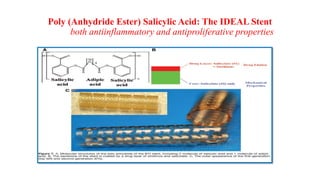
Poly (Anhydride Ester) Salicylic Acid: The IDEAL Stent
both antiinflammatory and antiproliferative properties
• Whisper trial, a stent with strut thickness of 200 m and a crossing profile of 2.0 mm with a stent-
to artery coverage of 65% was implanted in 8 patients.
• Because of higher-than-expected intimal hyperplasia, a subsequent design iteration will have
thinner struts, a higher dose of sirolimus, and a lower percent wall coverage.
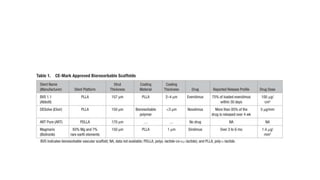
Everolimus-Eluting PLLA Stent: BVS Scaffold
• The BVS stent design is characterized by a crossing profile of 1.4 mm with circumferential hoops
of PLLA.
• The struts are 150 m thick and are either directly joined or linked by straight bridges.
• Both ends of the stent have 2 adjacent radiopaque platinum markers. The radial strength = BMS.
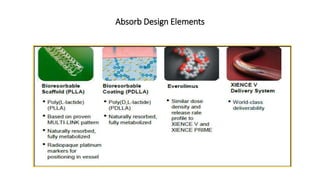
• The backbone of the BVS device is made of semicrystalline polymer called PLLA.
• The coating consists of poly D,L-lactide acid (PDLLA), which is a random copolymer of D and L-
lactic acid with lower crystallinity than the BVS backbone.
• The coating contains and controls the release of the antiproliferative drug everolimus.
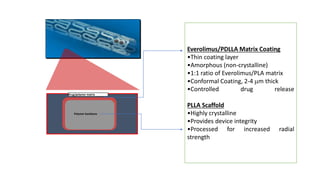
Polymer backbone
Drug/polymer matrix
Everolimus/PDLLA Matrix Coating
•Thin coating layer
•Amorphous (non-crystalline)
•1:1 ratio of Everolimus/PLA matrix
•Conformal Coating, 2-4 m thick
•Controlled drug release
PLLA Scaffold
•Highly crystalline
•Provides device integrity
•Processed for increased radial
strength
Absorb Design Elements
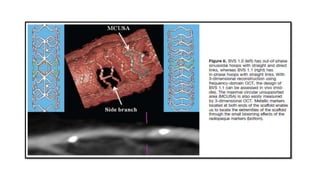
• Two versions of the stent have been developed.
• The design of the BVS stent Revision 1.0 consists of circumferential out-of-phase zigzag hoops of
PLLA with a strut thickness of 150 μm, linked either directly or by straight bridges, with two
radiopaque markers at each end which enable a good visualization on angiography.
• The BVS Revision 1.1 consists of the same polymer, but different process refinements allow the
stent to increase its radial force, provide radial support for a longer time, and, consequently, avoid
the slightly higher, but nonsignificant, recoil shown by QCA.
• MCUSA- This stent version has a different strut distribution, reducing the maximum circular
unsupported cross-sectional area, in contrast to BVS Revision 1.0.
• It is currently under evaluation in the Cohort B of the non-randomized ABSORB trial
(NCT00856856) in 80 patients.
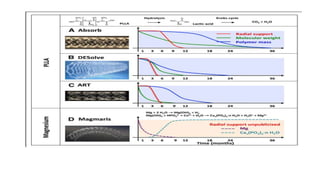
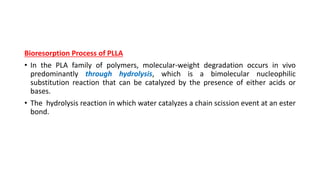
Bioresorption Process of PLLA
• In the PLA family of polymers, molecular-weight degradation occurs in vivo
predominantly through hydrolysis, which is a bimolecular nucleophilic
substitution reaction that can be catalyzed by the presence of either acids or
bases.
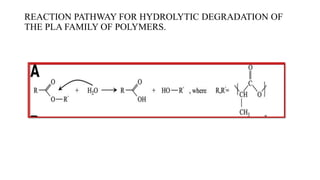
• The hydrolysis reaction in which water catalyzes a chain scission event at an ester
bond.
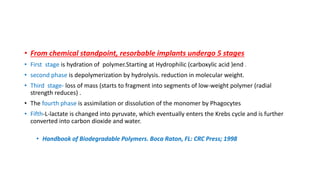
• From chemical standpoint, resorbable implants undergo 5 stages
• First stage is hydration of polymer.Starting at Hydrophilic (carboxylic acid )end .
• second phase is depolymerization by hydrolysis. reduction in molecular weight.
• Third stage- loss of mass (starts to fragment into segments of low-weight polymer (radial
strength reduces) .
• The fourth phase is assimilation or dissolution of the monomer by Phagocytes
• Fifth-L-lactate is changed into pyruvate, which eventually enters the Krebs cycle and is further
converted into carbon dioxide and water.
• Handbook of Biodegradable Polymers. Boca Raton, FL: CRC Press; 1998
REACTION PATHWAY FOR HYDROLYTIC DEGRADATION OF
THE PLA FAMILY OF POLYMERS.
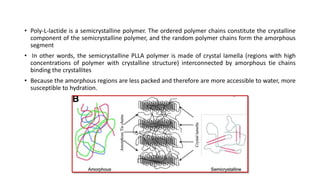
• Poly-L-lactide is a semicrystalline polymer. The ordered polymer chains constitute the crystalline
component of the semicrystalline polymer, and the random polymer chains form the amorphous
segment
• In other words, the semicrystalline PLLA polymer is made of crystal lamella (regions with high
concentrations of polymer with crystalline structure) interconnected by amorphous tie chains
binding the crystallites
• Because the amorphous regions are less packed and therefore are more accessible to water, more
susceptible to hydration.
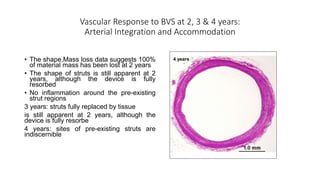
Vascular Response to BVS at 2, 3 & 4 years:
Arterial Integration and Accommodation
4 years
• The shape,Mass loss data suggests 100%
of material mass has been lost at 2 years
• The shape of struts is still apparent at 2
years, although the device is fully
resorbed
• No inflammation around the pre-existing
strut regions
3 years: struts fully replaced by tissue
is still apparent at 2 years, although the
device is fully resorbe
4 years: sites of pre-existing struts are
indiscernible
• No inflammation around the pre-existing
strut regions
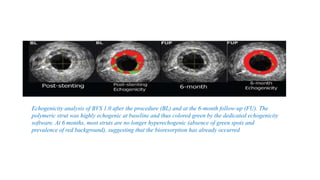
Echogenicity analysis of BVS 1.0 after the procedure (BL) and at the 6-month follow-up (FU). The
polymeric strut was highly echogenic at baseline and thus colored green by the dedicated echogenicity
software. At 6 months, most struts are no longer hyperechogenic (absence of green spots and
prevalence of red background), suggesting that the bioresorption has already occurred
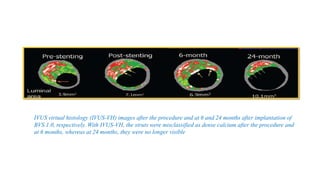
IVUS virtual histology (IVUS-VH) images after the procedure and at 6 and 24 months after implantation of
BVS 1.0, respectively. With IVUS-VH, the struts were misclassified as dense calcium after the procedure and
at 6 months, whereas at 24 months, they were no longer visible
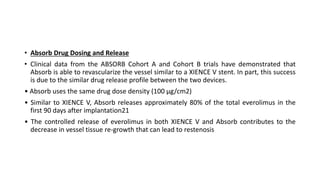
• Absorb Drug Dosing and Release
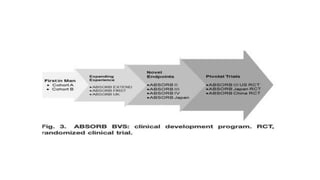
• Clinical data from the ABSORB Cohort A and Cohort B trials have demonstrated that
Absorb is able to revascularize the vessel similar to a XIENCE V stent. In part, this success
is due to the similar drug release profile between the two devices.
• Absorb uses the same drug dose density (100 μg/cm2)
• Similar to XIENCE V, Absorb releases approximately 80% of the total everolimus in the
first 90 days after implantation21
• The controlled release of everolimus in both XIENCE V and Absorb contributes to the
decrease in vessel tissue re-growth that can lead to restenosis
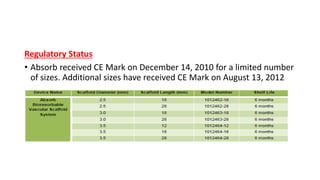
Regulatory Status
• Absorb received CE Mark on December 14, 2010 for a limited number
of sizes. Additional sizes have received CE Mark on August 13, 2012
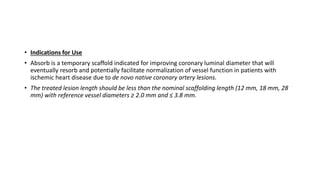
• Indications for Use
• Absorb is a temporary scaffold indicated for improving coronary luminal diameter that will
eventually resorb and potentially facilitate normalization of vessel function in patients with
ischemic heart disease due to de novo native coronary artery lesions.
• The treated lesion length should be less than the nominal scaffolding length (12 mm, 18 mm, 28
mm) with reference vessel diameters ≥ 2.0 mm and ≤ 3.8 mm.
• Implantation of Absorb
• Absorb is implanted into the patient’s coronary arteries via a percutaneous intervention.
The procedure of implanting an Absorb should only be performed by physicians who
have received appropriate training. The implantation procedure of an Absorb is similar to
a metallic stent; however, additional attention is needed to ensure:
• Careful selection of the scaffold diameter for the target lesion reference vessel
diameter
• Thorough lesion preparation prior to scaffold implantation to optimize scaffold
deployment
• Safe advancement of Absorb across the lesion.
BIOABSORBABLE VASCULAR SCAFFOLD AND ITS APPLICATIONOLD.pptx

BIOABSORBABLE VASCULAR SCAFFOLD AND ITS APPLICATIONOLD.pptx

  • 1.
    BIOABSORBABLE VASCULAR SCAFFOLD •History & evolution of BVS • Advantages • Types of BVS • Physiology of BVS • Clinical trials of BVS • Future perspectives of BVS
  • 3.
    History of angioplasty •First revolution- balloon angioplasty • The invention of balloon angioplasty as a percutaneous treatment for obstructive coronary disease by Andreas Gruntzig in 1977 was a huge leap forward in cardiovascular medicine and undoubtedly will always be remembered as a revolution in the field of revascularization
  • 4.
    Plain Old BalloonAngioplasty(POBA) • In 1964, Charles Theodore Dotter and Melvin P. Judkins described the first angioplasty • 1977, Andreas Grüntzig performed the first balloon coronary angioplasty  Dissections – Focal to threatened dissection  Acute recoil  Chronic constrictive remodeling
  • 5.
    • DISADVANTAGES • Althoughlate luminal enlargement and vascular remodeling could take place, more often restenosis would occur instead. • The restenosis would essentially be caused by • constrictive remodeling and, to a lesser extent, by • elastic recoil or the • neointimal hyperplastic healing response.
  • 6.
    • second revolution-BMS • The advent of BMS and the landmark Belgian-Netherlands Stent Study (BENESTENT) and Stent Restenosis Study (STRESS) trials have established BMS as the second revolution in interventional cardiology. • A solution to acute vessel occlusion by • sealing the dissection flaps and • preventing recoil & • making emergency bypass surgery a rare occurrence.
  • 7.
    • In 1986,first coronary stent by Sigwart et al • Gianturco-Roubin first FDA – BES – 1993 • Palmaz-schartz first STENT VS POBA Plain Old Balloon Angioplasty(POBA) Bare Metal Stent(BMS) STENT IMPLANTATION PENETRATION OF LIPID CORE & REACTION TO STRUTS EXPOSURE OF SUBINTIMAL COMPONENTS THROMBOGENIC METAL ACTIVATION AND PROLIFERATION OF SMCs PLATELET ACTIVATION Instent restenosis Stent thrombosis
  • 8.
    • Restenosis rateswere further reduced from 32% to 22% at 7 months, but this rate was still high, and neointimal hyperplasia inside the stent was even more prominent than with angioplasty. • Disadvantages (Because the vessel was now caged with metal) • late luminal enlargement and • advantageous vascular remodeling could no longer occur. • late stent thrombosis (ST), was also first described. • Serruys PW, Daemen J. Late stent thrombosis: a nuisance in both bare metal and drug-eluting stents Circulation. 2007;
  • 9.
    • Third revolution-DES •The first 45 patients implanted with the sirolimus eluting Bx velocity stent (Cordis, Johnson & Johnson, Warren, NJ) were found to have negligible neointimal hyperplasia at follow-up. • This was confirmed in the randomized comparison of a sirolimus-eluting stent with a standard stent for coronary revascularization (RAVEL) study. • Morice MC, Serruys PW A randomized comparison of a sirolimus-eluting stent with a standard stent for coronary revascularization. N Engl J Med. 2002;346:
  • 10.
    The RAVEL Study ARAndomised (double blind) study with the Sirolimus coated BX™ VElocity balloon expandable stent (CYPHER™) in the treatment of patients with De Novo native coronary artery Lesions M.C. Morice, P.W Serruys, J.E. Sousa, J. Fajadet, M. Perin, E. Ban Hayashi, A. Colombo, G. Schuler, P. Barragan, C. Bode The treatment of a de novo lesion with CYPHER™ appears feasible and safe : no acute, subacute (30 days) or late occlusion occurred although clopidogrel / ticlopidine was administered for only 2 months Virtual elimination of neo-intimal in-stent proliferation: MLD post deployment (2.43 mm) remains essentially unchanged at 6 months (2.42 mm) with no measurable late loss (-0.05 mm) Restenosis (0%) and no evidence of edge effect
  • 11.
    Plain Old Balloon Angioplasty(POBA) BareMetal Stent(BMS) Drug Eluting Stent(DES) 1st Generation QuaDS-1st DES in human coronaries(taxane) Most important – CYPHER , TAXUS.  STENT THROMBOSIS  INSTENT RESTENOSIS
  • 12.
    • Disadvantages • Increasedrisk of late and very late ST. • late ST rates of 0.53%/y, with a continued increase to 3% over 4 years. • Late thrombosis in drug-eluting coronary stents after discontinuation of antiplatelet therapy. Lancet. 2004 • In the (ARTS II) trial,with complex multivessel disease, the rate of combined definite, probable, and possible ST was as high as 9.4% at 5 years, accounting for 32% of major adverse cardiovascular events (MACEs). • J Am Coll Cardiol. 2009 • Postmortem specimens of DES revealed significant numbers of uncovered struts with persistent inflammation around the stent struts. • Vasomotion testing demonstrated vasoconstriction to Ach. • Vascular responses to drug eluting stents: importance of delayed healing. Arterioscler Thromb Vasc Biol. 2007
  • 14.
    BALLON ANGIOPLASTY ENLARGESNARROW ARTERY SYMPTOMS REDUCES ELASTIC RECOIL OF ARTERY EARLY RESTENOSIS BARE METAL STENTS LESS ELASTIC RECOIL RISK LOWER EARLY RESTENOSIS METAL SCARS ENDOTHELIAL TISSUE NEOINTIMAL GROWTH RESPONSE LEAD TO LATE RESTENOSIS DRUG ELUTING STENTS ANTIPROLIFEARATIVE RESPONSE LEADS TO ↓RESTENOSIS RISK OF THROMBOSIS+
  • 15.
    POTENTIALADVANTAGE OF BRS Baloonangiplasty bms Metallic DES Biovascular scaffold acute occlusion + + + - Acute scaffold thrombosis NA _ _ - Sub acute scaffold thrombosis NA _ _ - acute recoil + + + - Constrictive remodelling _ + + - Neointimal hyperplasia _ _ + - Expansive remodelling + _ _ - Late luminal enlargement + _ _ - Late scaffold thrombosis NA _ _ -
  • 16.
    STENT FEATURES BARE METALSTENT DRUG ELUTING STENT BIOABSORBABLE DRUG ELUTING STENT REDUCED DUAL ANTIPLATELET THERAPY +++ +++ + NEO INTIMAL HYPERPLASIA ++ + RESTORATION OF VASOMOTION +++ TISSUE COMPATIBLE +++
  • 17.
    ADVANTAGES of BVS 1.A reduction in adverse events such as ST. • Because drug elution and scaffolding are temporary and are provided by the device only until the vessel has healed, no foreign material such as nonendothelialized struts and drug polymers (potential triggers for ST) can persist long term.
  • 18.
    2.The removal,through bioabsorptionof the rigid caging of the stented vessel. • This can facilitate the return of vessel vasomotion, adaptive shear stress, late luminal enlargement, and late expansive remodeling. • Furthermore, this might reduce the problems of jailing of the ostium of side branches as seen with permanent metallic stent struts.
  • 19.
    3.A reduction inbleeding complications. • No requirement for long-term dual antiplatelet therapy. • This is particularly pertinent given that the elderly, who are at the greatest risk of bleeding. • Furthermore, early discontinuation of dual antiplatelet therapy with current metallic DES,for whatever indication, has consistently been shown to be an independent predictor of ST. • Development and validation of a prognostic risk score for major bleeding in patients undergoing percutaneous coronary intervention via the femoral approach. Eur Heart J. 2007;
  • 20.
    4.An improvement infuture treatment options. • The treatment of complex multivessel disease frequently results in the use of multiple long DES; for example, in the synergy between percutaneous coronary intervention with TAXUS and cardiac surgery (SYNTAX) trial, the average number of stents was 4, and one third of patients had 100 mm of stent implanted. • In such cases, repeat revascularization is potentially challenging. • The use of a BRS would mean that there would potentially be no restriction on any future percutaneous or surgical revascularization should they be needed.
  • 21.
    5.Allowing noninvasive imaging(CT/MR angio.) • Metallic stents can cause a blooming effect with these imaging modalities, making interpretation more difficult. • The (PLLA) scaffold should not restrict the use of CT or MRI because it is nonmetallic; once bioabsorption has been completed with a BRS, it should also not restrict the use of CT or MRI • Noninvasive imaging follow-up could therefore become an alternative to invasive imaging followup. • Artifact-free coronary magnetic resonance angiography and coronary vessel wall imaging in the presence of a new, metallic, coronary magnetic resonance imaging stent. Circulation. 2005
  • 23.
    6.Reservoir for thelocal delivery of drugs and genes. • Because the duration of bioresorption is modifiable, according to the type of polymers/copolymers, a tuned elution of multiple drugs can potentially be achievable (eg, early elution of antiproliferative agent from a coated polymer and long-term elution of an antiinflammatory or other agent from the backbone polymer).
  • 24.
    7.Elimination of theconcern that some patients have at the thought of having an implant in their bodies for the rest of their lives.(esp. in young individuals) • Ormiston JA, Serruys PW. Bioabsorbable coronary stents. Circ Cardiovasc Interv. 2009;2:255– 260.
  • 25.
    8.VASCULAR REPARATIVE THERAPY •On Premise that scaffolding & drug are only required on a temporary basis following coronary interventions. • Several studies support this concept and indicate that there is no incremental clinical benefit of a permanent implant over time. • The use of Absorb eliminates the presence of a mechanical restraint and offers the potential of restoring natural vessel reactivity. • Incidence of restenosis after successful coronary angioplasty: a time-related phenomenon. A quantitative angiographic study in 342 consecutive patients at 1, 2, 3, and 4 months. Circulation, 1988.
  • 26.
    • While stentperformance is characterized by a single phase (Revascularization), the performance of Absorb is governed by three distinct phases: • Revascularization • Restoration • Resorption. • Together, these phases of Absorb performance deliver VRT
  • 27.
    1 RESCULARISATION • The rescularisationphase is when absorb resvascularizes the vessel like a best in class DES • Absorb achieves this goal by offering good deliverability ,a minimum of acute recoil ,high radial strength and controlled release of the anti prolifferative drug everolimus to minimize neointimal growth • The late lumen loss is comparable to those observed in best in class DES 2 RESTORATION • During the restoration phase,absorb gradually ceases providing luminal support and evolves from an intact scaffold to a discontinuous structure embedded within neointimal tissue • Absorb no longer mechanically restrains the vessel allowing it to return to a more natural ,uncaged state without the presence of a permanent metallic stent • Vasomotion is possible as early as 12months post procedure 3 ON • The resorption phase is the final process in which the discontinuous scaffold structure disappears,because there is no longer a structure that mechanically restrains the vessel,a more natural vascular response to physiological stimuli is possible • Absorb is now an inert implant designed to benignly resorb into the vessel wall.it degrades to lactic acid and ultimately the
  • 28.
    What is Requiredof a Fully Bioresorbable Scaffold to Fulfill the Desire for ‘Vascular Restoration Therapy’? Revascularisation Restoration Resorption Performance should mimic that of a standard DES • Good deliverability • Minimum of acute recoil • High acute radial strength • Controlled delivery of drug to luminal tissue • Excellent conformability Transition from scaffolding to discontinuous structure • Gradually lose radial strength • Struts must be incorporated into the vessel wall (strut coverage) • Become structurally discontinuous • Allow the vessel to respond naturally to physiological stimuli Implant is discontinuous and inert • Resorb in a benign fashion
  • 29.
    What is Requiredof a Fully Bioresorbable Scaffold to Fulfill the Desire for ‘Vascular Restoration Therapy’? Revascularization Restoration Resorption FULL MASS loss & bioresorption 1 6 2yrs 3 Everolimus elution support Mass loss Platelet deposition Vascular function
  • 31.
    9.Vessel Remodeling • Throughthe use of the imaging modality intravascular ultrasound (IVUS), data from the ABSORB Cohort B trial, reveals an increase in lumen area between 6 months and 2 years. • As Absorb resorbs, the vessel segment becomes unconstrained and there is the potential for lumen gain.
  • 32.
    10.Vasomotion • As Absorbresorbs, the treated vessel segment is able to react to changes in blood flow and physiological stimuli that may occur with exercise or certain drugs. • By no longer supporting or caging the vessel, there is the potential for allowing the vessel to respond naturally to physiological stimuli, which could provide unique benefits.
  • 33.
    Restoration to aMore Natural State with Absorb Another appealing long-term benefit of Absorb is the possibility of progressive restoration of Absorb-treated vessel segments to a more natural state as the polymeric scaffold undergoes degradation. • Restore vasomotor tone for regulation of coronary blood flow • Restore vessel compliance and cyclic strain in response to pulsatile flow • Enable adaptive shear stress, allowing the vessel to regain its ability to maintain quiescent homeostasis • Permit accommodative, beneficial remodeling.
  • 34.
    Importance of RespectingNatural Vessel Curvature 91° 88 Long-term flow disturbances and chronic irritation can contribute to adverse events Pre BVS Post BVS
  • 35.
    Potential for MechanicalConditioning • Design Goals Support Vascular Function Mechanical conditioning may lead to improved cellular organization and vascular function Vascular Restoration Therapy Shear stress & pulsatility Tissue adaptation Structure and functionality
  • 36.
    MECHANICAL CONDITIONING INPRE-CLINICAL MODEL (PORCINE) Transmission Electron Microscopy (TEM) Smooth Muscle -Actin Dense bodies At 36 months, SMCs are well organized and have undergone transformation to a functional, contractile phenotype
  • 37.
    • An occlusivevessel segment that is first implanted with Absorb has the potential to restore to a more natural state. • In the event of restenosis (tissue regrowth) at the treated site, more treatment options are available – another Absorb, a DES or even balloon angioplasty. • Furthermore, the more natural state can make re-treatment easier, given the recognized difficulties involved in treatment of in-stent restenosis
  • 38.
    Fourth revolution • Allthese problems promise to be solved with the advent of fully biodegradable scaffolds. • Offers the possibility of • Transient scaffolding of the vessel to prevent acute vessel closure and recoil & • Transiently eluting an antiproliferative drug to counteract the constrictive remodeling and excessive neointimal hyperplasia
  • 39.
    Development of BRS •The efforts to create BRS started 32years ago. • The first experimental studies using a nonbiodegradable polyethylene-terephthalate braided mesh stents in porcine animal models were published in 1992. • In 1996, it was reported in porcine coronary arteries negative consequences after implantation of the Wiktor stent coated with 5 different types of biodegradable polymers ,all resulting in marked inflammation leading to neointimal hyperplasia and/or thrombus formation. • Development of a polymer endovascular prosthesis and its implantation in porcine arteries. J Interv Cardiol. 1992;5:175–185.
  • 40.
    • Lincoff etal -- high-molecular-weight (321 kDa) PLLA was well tolerated and effective, where as a stent coated with low-molecular-weight (80 kDa) PLLA was associated with an intense inflammatory neointimal response. • They also proved the feasibility of drug elution from the PLLA, although no suppression of neointimal hyperplasia was reported. -Lincoff AM, Schwartz RS, van Beusekom HM. Circulation. 1996;94:1690 –1697. • In 1998, Yamawaki et al reported that in the porcine model the fully biodegradable PLLA stent with tyrosine kinase inhibitor efficiently suppressed proliferative stimuli caused by balloon injury. • Yamawaki T, Shimokawa H, Kozai T. J Am Coll Cardiol. 1998;32:780 –786. The technology failed to develop an ideal polymer that could limit inflammation and restenosis and secondarily because of the growing interest in metallic DES.
  • 41.
    The key mechanicaltraits for ideal material : • High -elastic moduli to impart radial stiffness, • Large -break strains to impart the ability to withstand deformations from the crimped to expanded states, and • Low -yield strains to reduce the amount of recoil and overinflation necessary to achieve a target deployment.
  • 42.
    Numerous polymers areavailable, each with different chemical compositions, mechanical properties, and subsequently bioabsorption times Material Stent Status Polymers PLA Thermal balloon expandable,ring (igaki-tamai) 4-year clinical data Tamai et CCT 2004 PLA balloon expandable,Abott Vascular ,inc Phase1 clinical trial Stock RS tct 2005 Ormiston J.TCT 2006 Tyrosine polycarbonate balloon expandable,REVA Medical Preclinical Kaliza G.TCT 2006 PAE salicylate balloon expandable,tubular preclinical Robinston KA TCT 2006 Metallic magnesium balloon expandable,biotronik Phase 1 clinical Heublein B et al.Heart 2003 Iron balloon expandable,tubular Pre-clinical Pauster M et Heart 2001
  • 44.
    TYPES OF BVS •Polymer based metal based - BVS (abbot) DREAMS 1, 2 - igaki tamai iron - REVA stent - ART - IDEAL
  • 46.
    IGAKI-TAMAI BIOABSORBABLE STENT •First absorbable stent implanted in humans,is constructed from poly-L-lactic acid (PLLA). • In the absorption process, hydrolysis of bonds between repeating lactide units produces lactic acid that enters the Krebs cycle • First-in-man prospective, nonrandomized clinical trial that enrolled 50 patients a 4yr follow-up of all the patients (100%) revealed a low complication rate. • Loss index (late loss/acute gain) was 0.48 mm, which was comparable to BMS, and demonstrated for the first time that • BRS did not induce an excess of intimal hyperplasia .Focus is now on a peripheral application Tamai H, Igaki K, Kyo E. Initial and 6-month results of biodegradable poly-L-lactic acid coronary stents in humans. Circulation. 2000
  • 47.
    • Despite theseimpressive results, the failure of the stent to progress was related primarily to the use of heat to induce self-expansion. There were concerns that this could cause necrosis of the arterial wall, leading to excessive intimal hyperplasia or increased platelet adhesion, leading to ST. • Biodegradable peripheral Igaki-Tamai stents PERSEUS study,the stent became available in Europe for peripheral use; • Biamino G, Schmidt A, Scheinert D. Treatment of SFA lesions with PLLA biodegradable stents: results of the PERSEUS Study. J Endovasc Ther. 2005;12:5.
  • 48.
    BIOABSORBABLE MAGNESIUM STENT •The degradation of Mg produces an electronegative charge that results in the stent being hypothrombogenic. • Although the stent was completely absorbed within 2 months, radial support was lost much earlier so that, perhaps within days, there was an insufficient radial strength to counter the early negative remodeling forces after PCI. • In addition, it did not release an antiproliferative drug to counter the intimal hyperplastic response to stenting. • Consequently, there was a high restenosis rate at 4 months of almost 50% and target vessel revascularization at 1 year was 45% PROGRESS AMS trial: Lancet. 2007;369:1869 –1875.
  • 51.
    • It providesprolonged mechanical stability, which has been achieved by using a different magnesium alloy that has not only a higher collapse pressure of 1.5 bar compared with 0.8 bar for AMS-1 but also a slower degradation time. • In addition, the stent surface has been modified; the stent strut thickness has been reduced • And the shape of the strut in cross section has been altered from rectangular to square (improving radial strength). • These changes have prolonged scaffolding and stent integrity, improved radial strength, and reduced neointima proliferation in animal models.
  • 52.
    AMS-3 stent • TheAMS-3 stent (drug-eluting AMS) is designed to reduce neointimal hyperplasia by incorporating a bioresorbable matrix for controlled release of an antiproliferative drug onto the AMS-2 stent. • Research is currently focused on establishing the ideal drug kinetics; initial animal trials have demonstrated a sustained antiproliferative effect at 1 month. • A new clinical program resumed in July 2010.
  • 53.
    BIOTRONIK DREAMS Pimecrolimus-Eluting StentSystem Drug: Pimecrolimus Stent: Bioabsorbable Magnesium Alloy Discrete Drug Delivery Reservoirs Carrier: Bioresorbable Matrix Modifications
  • 54.
    Next generation coronaryAMS Current coronary AMS is currently improved by ... Prolonged mechanical Stability Reduction of neointima hyperplasia Surface passivation Improved stent design Improved stent design Modified Alloy • Animal feasibility trial ongoing • Next steps of AMS improvement in preparation • Goal: Continue human trials with improved AMS early
  • 56.
    REVA Endovascular Studyof a Bioresorbable Coronary Stent (RESORB) study
  • 57.
    The REVA EndovascularStudy Of a bioresorbable coronary stent • End points -end points -primary -30day MACE -secondary -6month QCA & IVUS derived paramaters (restenosis) Clinical Follow Up -Discharge ,2 weeks,1,6,12,24,36,48 and 60 months
  • 58.
    ReZolve stent. • Morerobust polymer, a spiral slide-and-lock mechanism to improve clinical performance, and a coating of sirolimus (80% is eluted by 30 days and 95% by 90 days.) • The RESTORE Trial (Pilot Study of the ReZolve Sirolimus-Eluting Bioresorbable Coronary Scaffold) is evaluating the safety and performance of the first-generation ReZolve scaffold in 26 patients that were enrolled 2011 & 2012-F/u-5yrs. • The ReZolve2 scaffold, a lower profile and sheathless version of the original ReZolve scaffold, is being evaluated clinically in the RESTORE II TriaL (IN 2013)
  • 59.
    Poly (Anhydride Ester)Salicylic Acid: The IDEAL Stent both antiinflammatory and antiproliferative properties
  • 60.
    • Whisper trial,a stent with strut thickness of 200 m and a crossing profile of 2.0 mm with a stent- to artery coverage of 65% was implanted in 8 patients. • Because of higher-than-expected intimal hyperplasia, a subsequent design iteration will have thinner struts, a higher dose of sirolimus, and a lower percent wall coverage.
  • 61.
    Everolimus-Eluting PLLA Stent:BVS Scaffold • The BVS stent design is characterized by a crossing profile of 1.4 mm with circumferential hoops of PLLA. • The struts are 150 m thick and are either directly joined or linked by straight bridges. • Both ends of the stent have 2 adjacent radiopaque platinum markers. The radial strength = BMS. • The backbone of the BVS device is made of semicrystalline polymer called PLLA. • The coating consists of poly D,L-lactide acid (PDLLA), which is a random copolymer of D and L- lactic acid with lower crystallinity than the BVS backbone. • The coating contains and controls the release of the antiproliferative drug everolimus.
  • 62.
    Polymer backbone Drug/polymer matrix Everolimus/PDLLAMatrix Coating •Thin coating layer •Amorphous (non-crystalline) •1:1 ratio of Everolimus/PLA matrix •Conformal Coating, 2-4 m thick •Controlled drug release PLLA Scaffold •Highly crystalline •Provides device integrity •Processed for increased radial strength
  • 63.
  • 65.
    • Two versionsof the stent have been developed. • The design of the BVS stent Revision 1.0 consists of circumferential out-of-phase zigzag hoops of PLLA with a strut thickness of 150 μm, linked either directly or by straight bridges, with two radiopaque markers at each end which enable a good visualization on angiography.
  • 66.
    • The BVSRevision 1.1 consists of the same polymer, but different process refinements allow the stent to increase its radial force, provide radial support for a longer time, and, consequently, avoid the slightly higher, but nonsignificant, recoil shown by QCA. • MCUSA- This stent version has a different strut distribution, reducing the maximum circular unsupported cross-sectional area, in contrast to BVS Revision 1.0. • It is currently under evaluation in the Cohort B of the non-randomized ABSORB trial (NCT00856856) in 80 patients.
  • 71.
    Bioresorption Process ofPLLA • In the PLA family of polymers, molecular-weight degradation occurs in vivo predominantly through hydrolysis, which is a bimolecular nucleophilic substitution reaction that can be catalyzed by the presence of either acids or bases. • The hydrolysis reaction in which water catalyzes a chain scission event at an ester bond.
  • 72.
    • From chemicalstandpoint, resorbable implants undergo 5 stages • First stage is hydration of polymer.Starting at Hydrophilic (carboxylic acid )end . • second phase is depolymerization by hydrolysis. reduction in molecular weight. • Third stage- loss of mass (starts to fragment into segments of low-weight polymer (radial strength reduces) . • The fourth phase is assimilation or dissolution of the monomer by Phagocytes • Fifth-L-lactate is changed into pyruvate, which eventually enters the Krebs cycle and is further converted into carbon dioxide and water. • Handbook of Biodegradable Polymers. Boca Raton, FL: CRC Press; 1998
  • 73.
    REACTION PATHWAY FORHYDROLYTIC DEGRADATION OF THE PLA FAMILY OF POLYMERS.
  • 74.
    • Poly-L-lactide isa semicrystalline polymer. The ordered polymer chains constitute the crystalline component of the semicrystalline polymer, and the random polymer chains form the amorphous segment • In other words, the semicrystalline PLLA polymer is made of crystal lamella (regions with high concentrations of polymer with crystalline structure) interconnected by amorphous tie chains binding the crystallites • Because the amorphous regions are less packed and therefore are more accessible to water, more susceptible to hydration.
  • 76.
    Vascular Response toBVS at 2, 3 & 4 years: Arterial Integration and Accommodation 4 years • The shape,Mass loss data suggests 100% of material mass has been lost at 2 years • The shape of struts is still apparent at 2 years, although the device is fully resorbed • No inflammation around the pre-existing strut regions 3 years: struts fully replaced by tissue is still apparent at 2 years, although the device is fully resorbe 4 years: sites of pre-existing struts are indiscernible • No inflammation around the pre-existing strut regions
  • 79.
    Echogenicity analysis ofBVS 1.0 after the procedure (BL) and at the 6-month follow-up (FU). The polymeric strut was highly echogenic at baseline and thus colored green by the dedicated echogenicity software. At 6 months, most struts are no longer hyperechogenic (absence of green spots and prevalence of red background), suggesting that the bioresorption has already occurred
  • 80.
    IVUS virtual histology(IVUS-VH) images after the procedure and at 6 and 24 months after implantation of BVS 1.0, respectively. With IVUS-VH, the struts were misclassified as dense calcium after the procedure and at 6 months, whereas at 24 months, they were no longer visible
  • 82.
    • Absorb DrugDosing and Release • Clinical data from the ABSORB Cohort A and Cohort B trials have demonstrated that Absorb is able to revascularize the vessel similar to a XIENCE V stent. In part, this success is due to the similar drug release profile between the two devices. • Absorb uses the same drug dose density (100 μg/cm2) • Similar to XIENCE V, Absorb releases approximately 80% of the total everolimus in the first 90 days after implantation21 • The controlled release of everolimus in both XIENCE V and Absorb contributes to the decrease in vessel tissue re-growth that can lead to restenosis
  • 83.
    Regulatory Status • Absorbreceived CE Mark on December 14, 2010 for a limited number of sizes. Additional sizes have received CE Mark on August 13, 2012
  • 84.
    • Indications forUse • Absorb is a temporary scaffold indicated for improving coronary luminal diameter that will eventually resorb and potentially facilitate normalization of vessel function in patients with ischemic heart disease due to de novo native coronary artery lesions. • The treated lesion length should be less than the nominal scaffolding length (12 mm, 18 mm, 28 mm) with reference vessel diameters ≥ 2.0 mm and ≤ 3.8 mm.
  • 85.
    • Implantation ofAbsorb • Absorb is implanted into the patient’s coronary arteries via a percutaneous intervention. The procedure of implanting an Absorb should only be performed by physicians who have received appropriate training. The implantation procedure of an Absorb is similar to a metallic stent; however, additional attention is needed to ensure: • Careful selection of the scaffold diameter for the target lesion reference vessel diameter • Thorough lesion preparation prior to scaffold implantation to optimize scaffold deployment • Safe advancement of Absorb across the lesion.