Coronary Stents Design
        Part C – Biodegradable stents and
        Future Solutions
                                                                     Dr. Amir Kraitzer


The contents of materials available on this presentation are reserved. Content may not be reproduced,
published, or transferred except with the prior written permission of Dr. Amir Kraitzer
Biodegradable Stents (BDS)
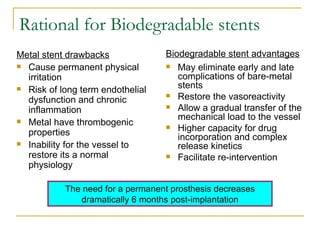
Rational for Biodegradable stents
Metal stent drawbacks             Biodegradable stent advantages
 Cause permanent physical         May eliminate early and late
  irritation                         complications of bare-metal
 Risk of long term endothelial      stents
                                   Restore the vasoreactivity
  dysfunction and chronic
                                   Allow a gradual transfer of the
  inflammation
 Metal have thrombogenic
                                     mechanical load to the vessel
                                   Higher capacity for drug
  properties                         incorporation and complex
 Inability for the vessel to        release kinetics
  restore its a normal             Facilitate re-intervention
  physiology

           The need for a permanent prosthesis decreases
              dramatically 6 months post-implantation
Design considerations
   Overall time and rate of degradation
       a very rapid degradation rate can be associated with
        inflammation
   Biocompatibility of degradation products to prevent
    toxicity
   Mechanical properties
       Mechanical recoil
       Strut size
       Creep
       Embolization of degraded particles
   Drug load
   Radiopacity
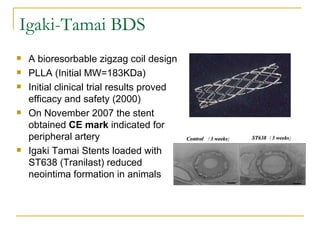
Igaki-Tamai BDS
   A bioresorbable zigzag coil design
   PLLA (Initial MW=183KDa)
   Initial clinical trial results proved
    efficacy and safety (2000)
   On November 2007 the stent
    obtained CE mark indicated for
    peripheral artery
   Igaki Tamai Stents loaded with
    ST638 (Tranilast) reduced
    neointima formation in animals
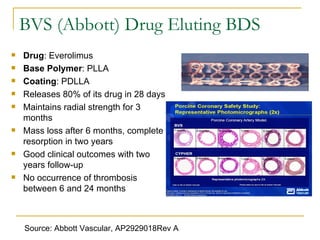
BVS (Abbott) Drug Eluting BDS
   Drug: Everolimus
   Base Polymer: PLLA
   Coating: PDLLA
   Releases 80% of its drug in 28 days
   Maintains radial strength for 3
    months
   Mass loss after 6 months, complete
    resorption in two years
   Good clinical outcomes with two
    years follow-up
   No occurrence of thrombosis
    between 6 and 24 months


    Source: Abbott Vascular, AP2929018Rev A
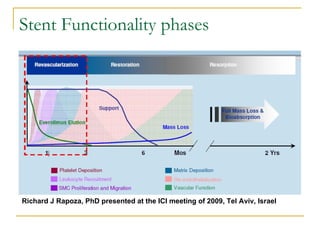
Stent Functionality phases


Richard J Rapoza, PhD presented at the ICI meeting of 2009, Tel Aviv, Israel
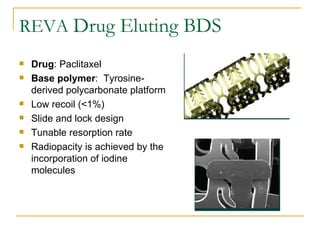
REVA Drug Eluting BDS
   Drug: Paclitaxel
   Base polymer: Tyrosine-
    derived polycarbonate platform
   Low recoil (<1%)
   Slide and lock design
   Tunable resorption rate
   Radiopacity is achieved by the
    incorporation of iodine
    molecules
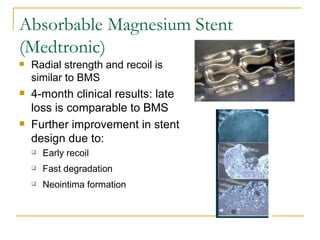
Absorbable Magnesium Stent
(Medtronic)
   Radial strength and recoil is
    similar to BMS
   4-month clinical results: late
    loss is comparable to BMS
   Further improvement in stent
    design due to:
       Early recoil
       Fast degradation
       Neointima formation
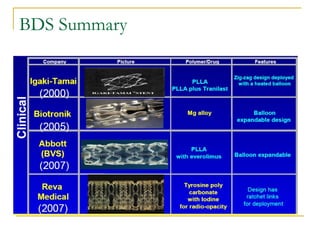
BDS Summary
New Concepts

    Pro-healing approach
    Drug eluting balloon
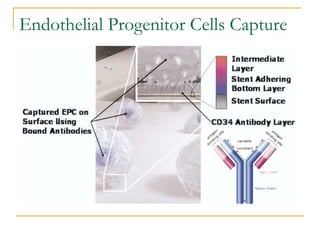
Endothelial Progenitor Cells Capture
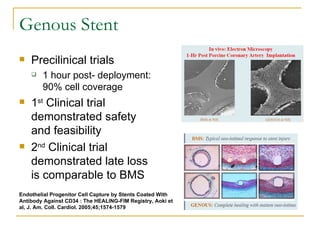
Genous Stent
   Precilinical trials
       1 hour post- deployment:
        90% cell coverage
   1st Clinical trial
    demonstrated safety
    and feasibility
   2nd Clinical trial
    demonstrated late loss
    is comparable to BMS
Endothelial Progenitor Cell Capture by Stents Coated With
Antibody Against CD34 : The HEALING-FIM Registry, Aoki et
al, J. Am. Coll. Cardiol. 2005;45;1574-1579
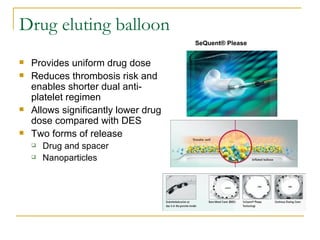
Drug eluting balloon
                                      SeQuent® Please


   Provides uniform drug dose
   Reduces thrombosis risk and
    enables shorter dual anti-
    platelet regimen
   Allows significantly lower drug
    dose compared with DES
   Two forms of release
       Drug and spacer
       Nanoparticles
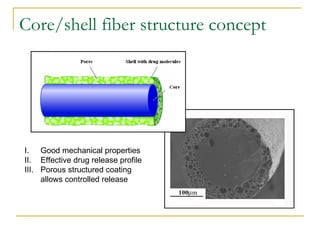
Core/shell fiber structure concept


I. Good mechanical properties
II. Effective drug release profile
III. Porous structured coating
     allows controlled release
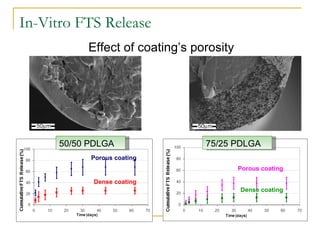
In-Vitro FTS Release
           Effect of coating’s porosity


      50/50 PDLGA                75/25 PDLGA
            Porous coating
                                          Porous coating

            Dense coating
                                          Dense coating
References
   Amir Kraitzer, Yoel Kloog, Meital Zilberman, Approaches for
    Prevention of Restenosis, J Biomed Mater Res Part B: Appl
    Biomater 85B: 583–603, 2008
   Gladius Lewis, Review: Materials, Fluid Dynamics, and Solid
    Mechanics Aspects of Coronary Artery Stents: A State-of-the-Art
    Review, Biomed Mater Res Part B: Appl Biomater 86B: 569–590,
    2008
   Meital Zilberman, Amir Kraitzer, Orly Grinberg and Jonathan J.
    Elsner, Drug-Eluting Medical Implants, In : Handbook of European
    Pharmacology, 2008
   Update on Bioabsorbable Stents: From Bench to Clinical, RON
    WAKSMAN, Journal of Interventional Cardiology, Vol. 19, No. 5,
    2006
Thank you

Coronary Stent Deisgn Part C

  • 1.
    Coronary Stents Design Part C – Biodegradable stents and Future Solutions Dr. Amir Kraitzer The contents of materials available on this presentation are reserved. Content may not be reproduced, published, or transferred except with the prior written permission of Dr. Amir Kraitzer
  • 2.
  • 3.
    Rational for Biodegradablestents Metal stent drawbacks Biodegradable stent advantages  Cause permanent physical  May eliminate early and late irritation complications of bare-metal  Risk of long term endothelial stents  Restore the vasoreactivity dysfunction and chronic  Allow a gradual transfer of the inflammation  Metal have thrombogenic mechanical load to the vessel  Higher capacity for drug properties incorporation and complex  Inability for the vessel to release kinetics restore its a normal  Facilitate re-intervention physiology The need for a permanent prosthesis decreases dramatically 6 months post-implantation
  • 4.
    Design considerations  Overall time and rate of degradation  a very rapid degradation rate can be associated with inflammation  Biocompatibility of degradation products to prevent toxicity  Mechanical properties  Mechanical recoil  Strut size  Creep  Embolization of degraded particles  Drug load  Radiopacity
  • 5.
    Igaki-Tamai BDS  A bioresorbable zigzag coil design  PLLA (Initial MW=183KDa)  Initial clinical trial results proved efficacy and safety (2000)  On November 2007 the stent obtained CE mark indicated for peripheral artery  Igaki Tamai Stents loaded with ST638 (Tranilast) reduced neointima formation in animals
  • 6.
    BVS (Abbott) DrugEluting BDS  Drug: Everolimus  Base Polymer: PLLA  Coating: PDLLA  Releases 80% of its drug in 28 days  Maintains radial strength for 3 months  Mass loss after 6 months, complete resorption in two years  Good clinical outcomes with two years follow-up  No occurrence of thrombosis between 6 and 24 months Source: Abbott Vascular, AP2929018Rev A
  • 7.
    Stent Functionality phases RichardJ Rapoza, PhD presented at the ICI meeting of 2009, Tel Aviv, Israel
  • 8.
    REVA Drug ElutingBDS  Drug: Paclitaxel  Base polymer: Tyrosine- derived polycarbonate platform  Low recoil (<1%)  Slide and lock design  Tunable resorption rate  Radiopacity is achieved by the incorporation of iodine molecules
  • 9.
    Absorbable Magnesium Stent (Medtronic)  Radial strength and recoil is similar to BMS  4-month clinical results: late loss is comparable to BMS  Further improvement in stent design due to:  Early recoil  Fast degradation  Neointima formation
  • 10.
  • 12.
    New Concepts  Pro-healing approach  Drug eluting balloon
  • 13.
  • 14.
    Genous Stent  Precilinical trials  1 hour post- deployment: 90% cell coverage  1st Clinical trial demonstrated safety and feasibility  2nd Clinical trial demonstrated late loss is comparable to BMS Endothelial Progenitor Cell Capture by Stents Coated With Antibody Against CD34 : The HEALING-FIM Registry, Aoki et al, J. Am. Coll. Cardiol. 2005;45;1574-1579
  • 15.
    Drug eluting balloon SeQuent® Please  Provides uniform drug dose  Reduces thrombosis risk and enables shorter dual anti- platelet regimen  Allows significantly lower drug dose compared with DES  Two forms of release  Drug and spacer  Nanoparticles
  • 16.
    Core/shell fiber structureconcept I. Good mechanical properties II. Effective drug release profile III. Porous structured coating allows controlled release
  • 17.
    In-Vitro FTS Release Effect of coating’s porosity 50/50 PDLGA 75/25 PDLGA Porous coating Porous coating Dense coating Dense coating
  • 18.
    References  Amir Kraitzer, Yoel Kloog, Meital Zilberman, Approaches for Prevention of Restenosis, J Biomed Mater Res Part B: Appl Biomater 85B: 583–603, 2008  Gladius Lewis, Review: Materials, Fluid Dynamics, and Solid Mechanics Aspects of Coronary Artery Stents: A State-of-the-Art Review, Biomed Mater Res Part B: Appl Biomater 86B: 569–590, 2008  Meital Zilberman, Amir Kraitzer, Orly Grinberg and Jonathan J. Elsner, Drug-Eluting Medical Implants, In : Handbook of European Pharmacology, 2008  Update on Bioabsorbable Stents: From Bench to Clinical, RON WAKSMAN, Journal of Interventional Cardiology, Vol. 19, No. 5, 2006
  • 19.