
Emerging
Markets
Introduction

   Some Examples of
Expansion into Emerging
       Markets
Starbucks uses joint venture to enter
           Indian market
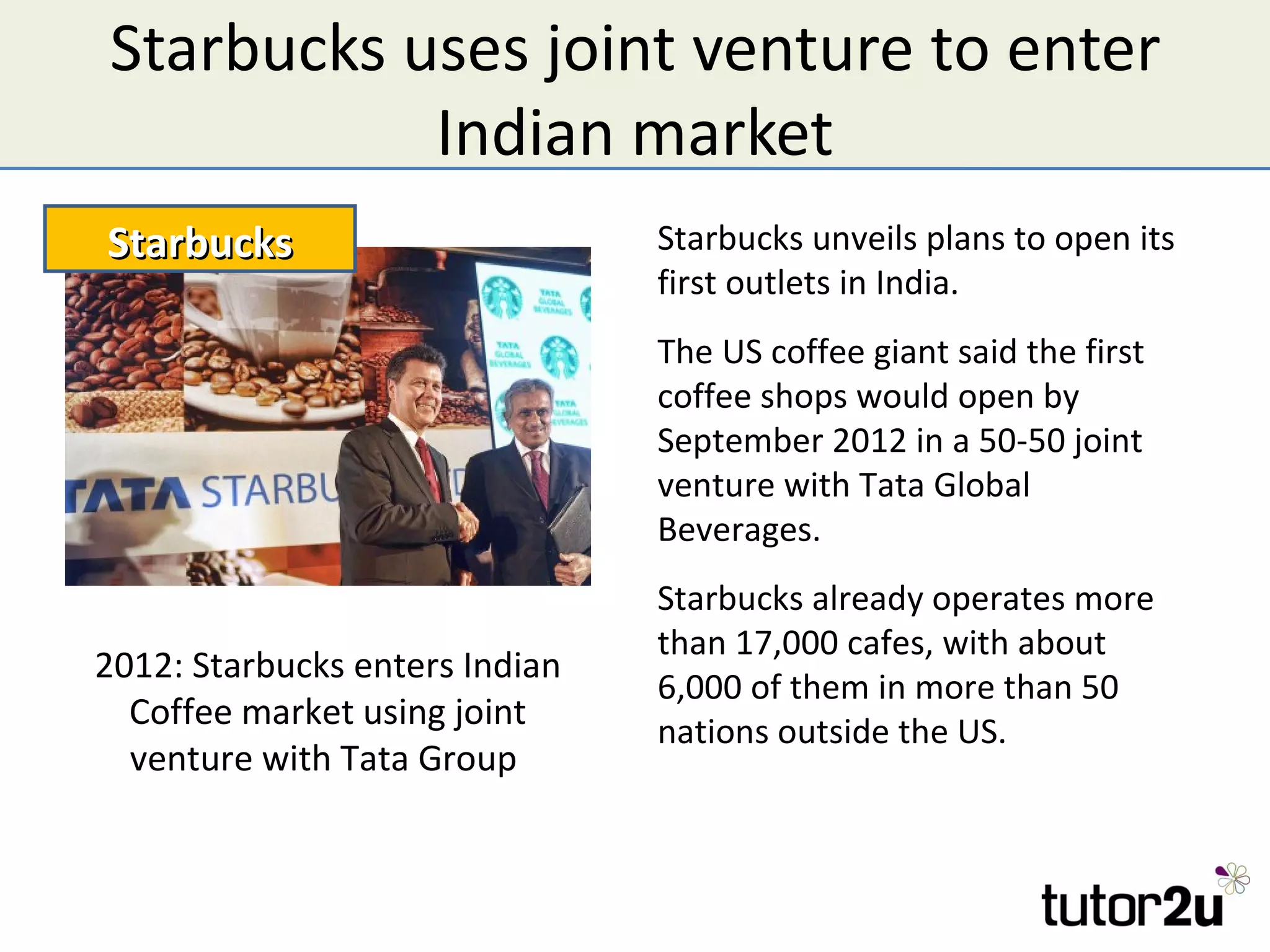
Starbucks                       Starbucks unveils plans to open its
                                first outlets in India.
                                The US coffee giant said the first
                                coffee shops would open by
                                September 2012 in a 50-50 joint
                                venture with Tata Global
                                Beverages.
                                Starbucks already operates more
                                than 17,000 cafes, with about
2012: Starbucks enters Indian
                                6,000 of them in more than 50
  Coffee market using joint     nations outside the US.
  venture with Tata Group
Jaguar Land Rover into India
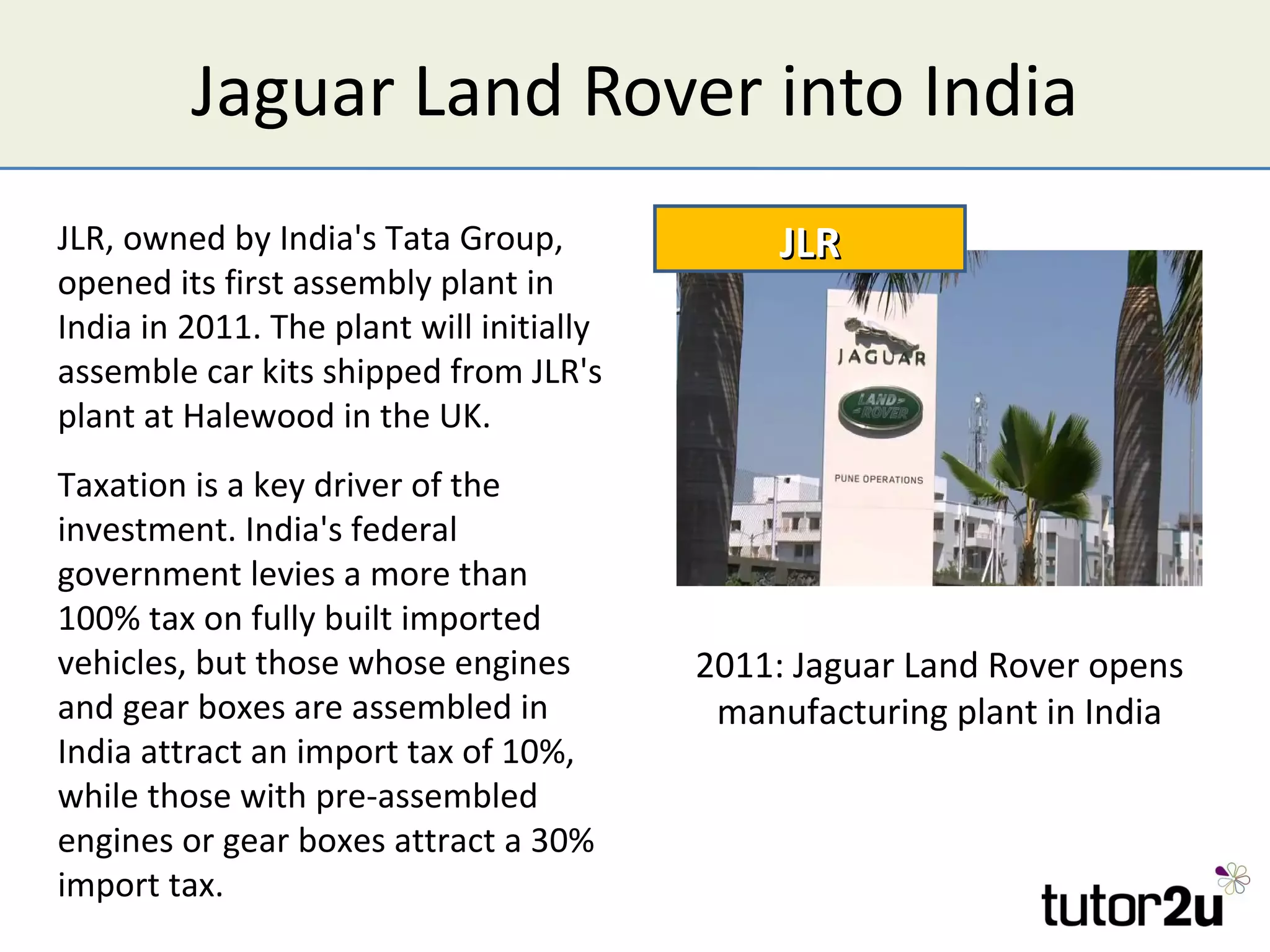
JLR, owned by India's Tata Group,              JLR
opened its first assembly plant in
India in 2011. The plant will initially
assemble car kits shipped from JLR's
plant at Halewood in the UK.
Taxation is a key driver of the
investment. India's federal
government levies a more than
100% tax on fully built imported
vehicles, but those whose engines         2011: Jaguar Land Rover opens
and gear boxes are assembled in            manufacturing plant in India
India attract an import tax of 10%,
while those with pre-assembled
engines or gear boxes attract a 30%
import tax.
Heinz into Brazil and China
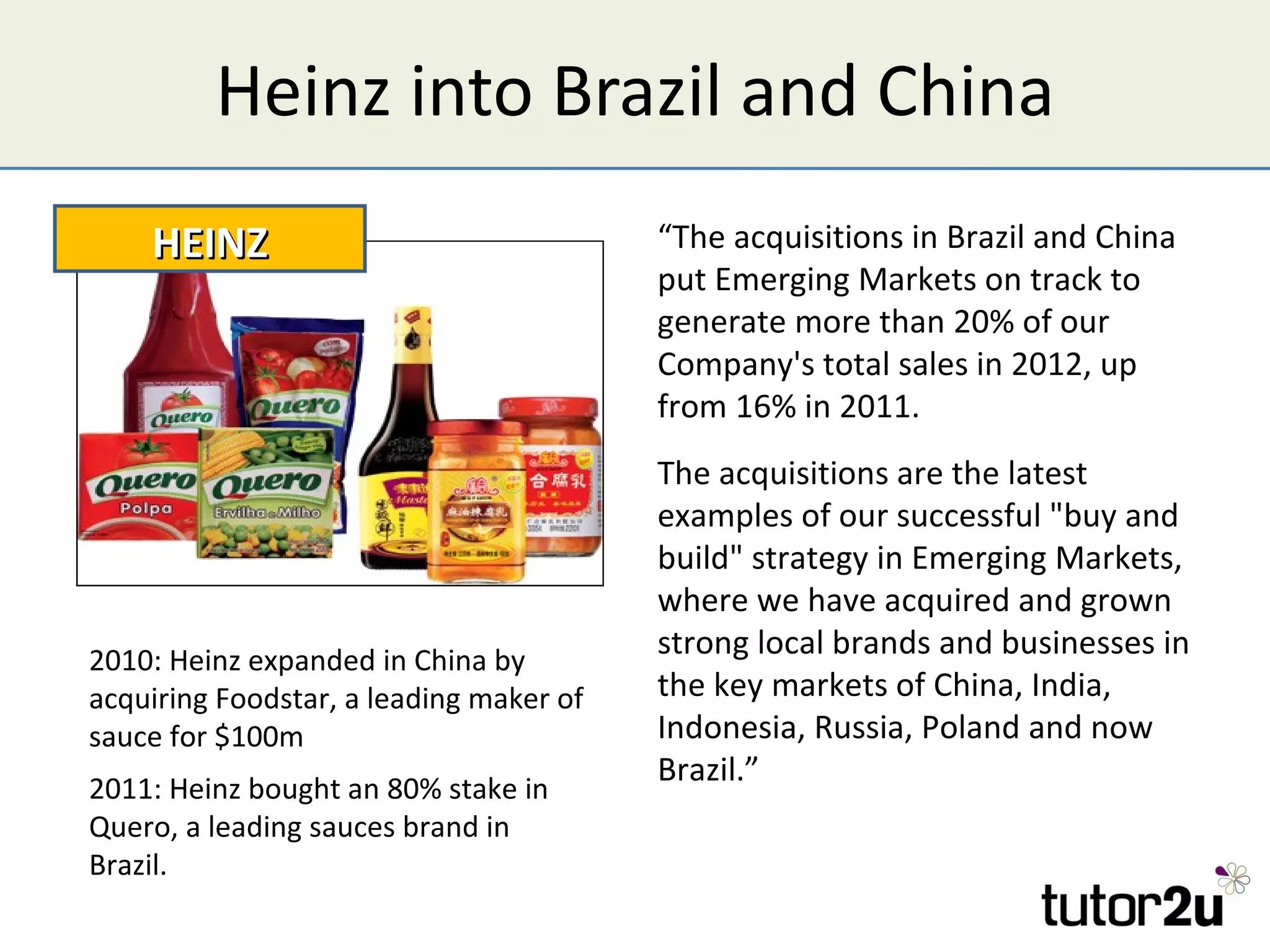
    HEINZ                                “The acquisitions in Brazil and China
                                         put Emerging Markets on track to
                                         generate more than 20% of our
                                         Company's total sales in 2012, up
                                         from 16% in 2011.
                                         The acquisitions are the latest
                                         examples of our successful "buy and
                                         build" strategy in Emerging Markets,
                                         where we have acquired and grown
2010: Heinz expanded in China by
                                         strong local brands and businesses in
acquiring Foodstar, a leading maker of   the key markets of China, India,
sauce for $100m                          Indonesia, Russia, Poland and now
                                         Brazil.”
2011: Heinz bought an 80% stake in
Quero, a leading sauces brand in
Brazil.
Samsung invests in Chinese production

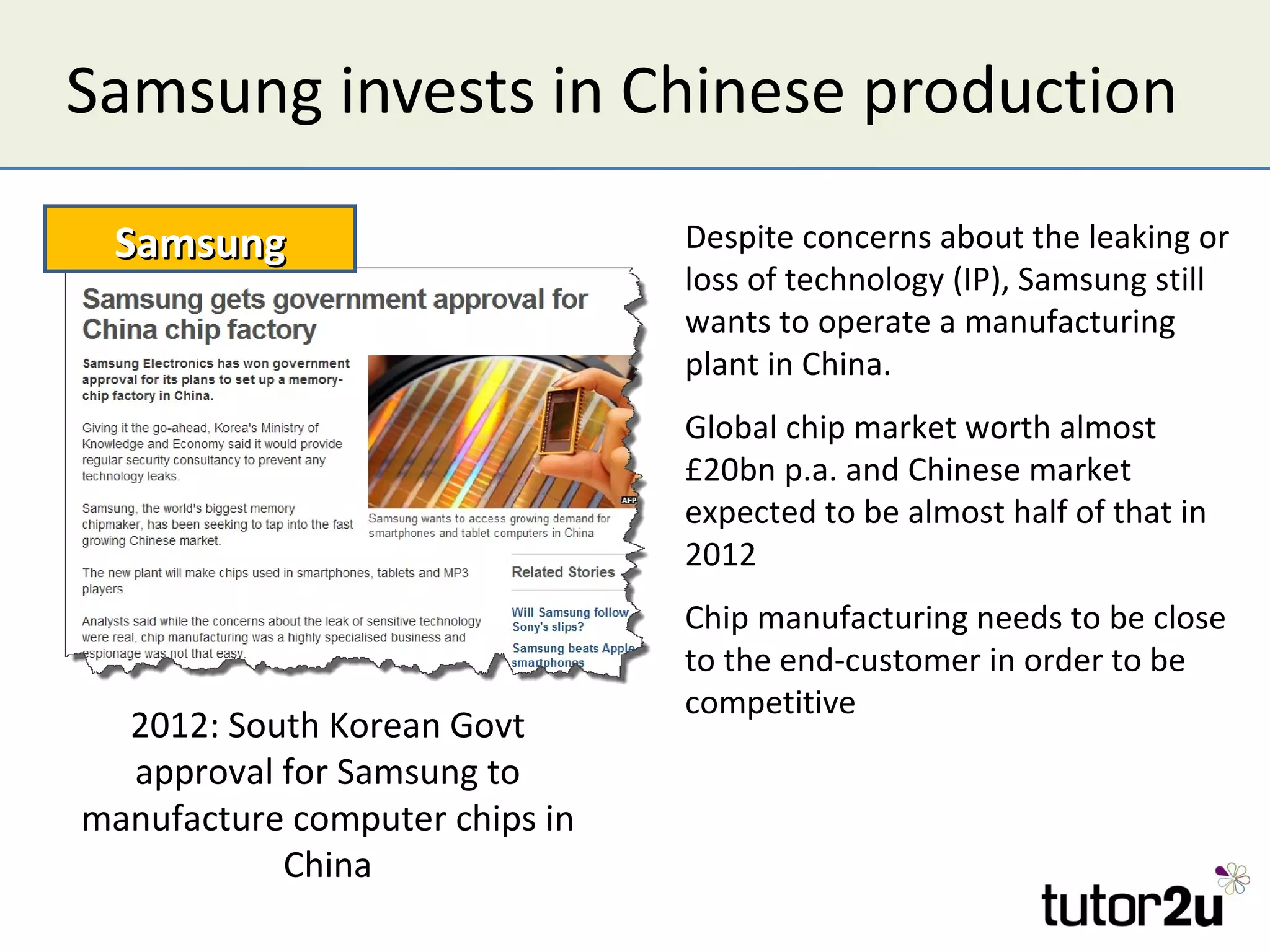
 Samsung                        Despite concerns about the leaking or
                                loss of technology (IP), Samsung still
                                wants to operate a manufacturing
                                plant in China.
                                Global chip market worth almost
                                £20bn p.a. and Chinese market
                                expected to be almost half of that in
                                2012
                                Chip manufacturing needs to be close
                                to the end-customer in order to be
                                competitive
  2012: South Korean Govt
  approval for Samsung to
manufacture computer chips in
           China
Diageo’s Chinese Takeover

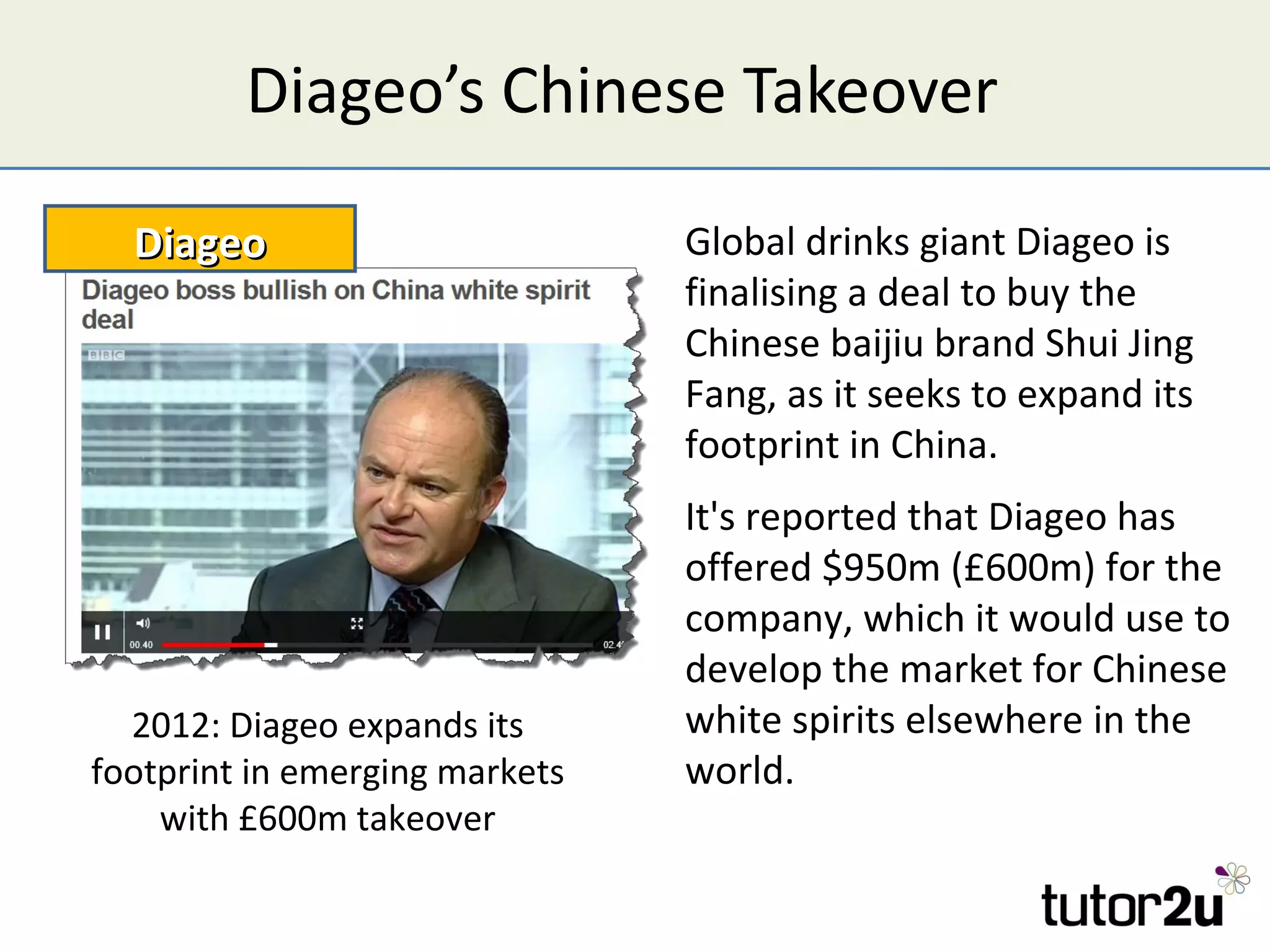
  Diageo                        Global drinks giant Diageo is
                                finalising a deal to buy the
                                Chinese baijiu brand Shui Jing
                                Fang, as it seeks to expand its
                                footprint in China.
                                It's reported that Diageo has
                                offered $950m (£600m) for the
                                company, which it would use to
                                develop the market for Chinese
  2012: Diageo expands its      white spirits elsewhere in the
footprint in emerging markets   world.
    with £600m takeover
Chinese investment in the West
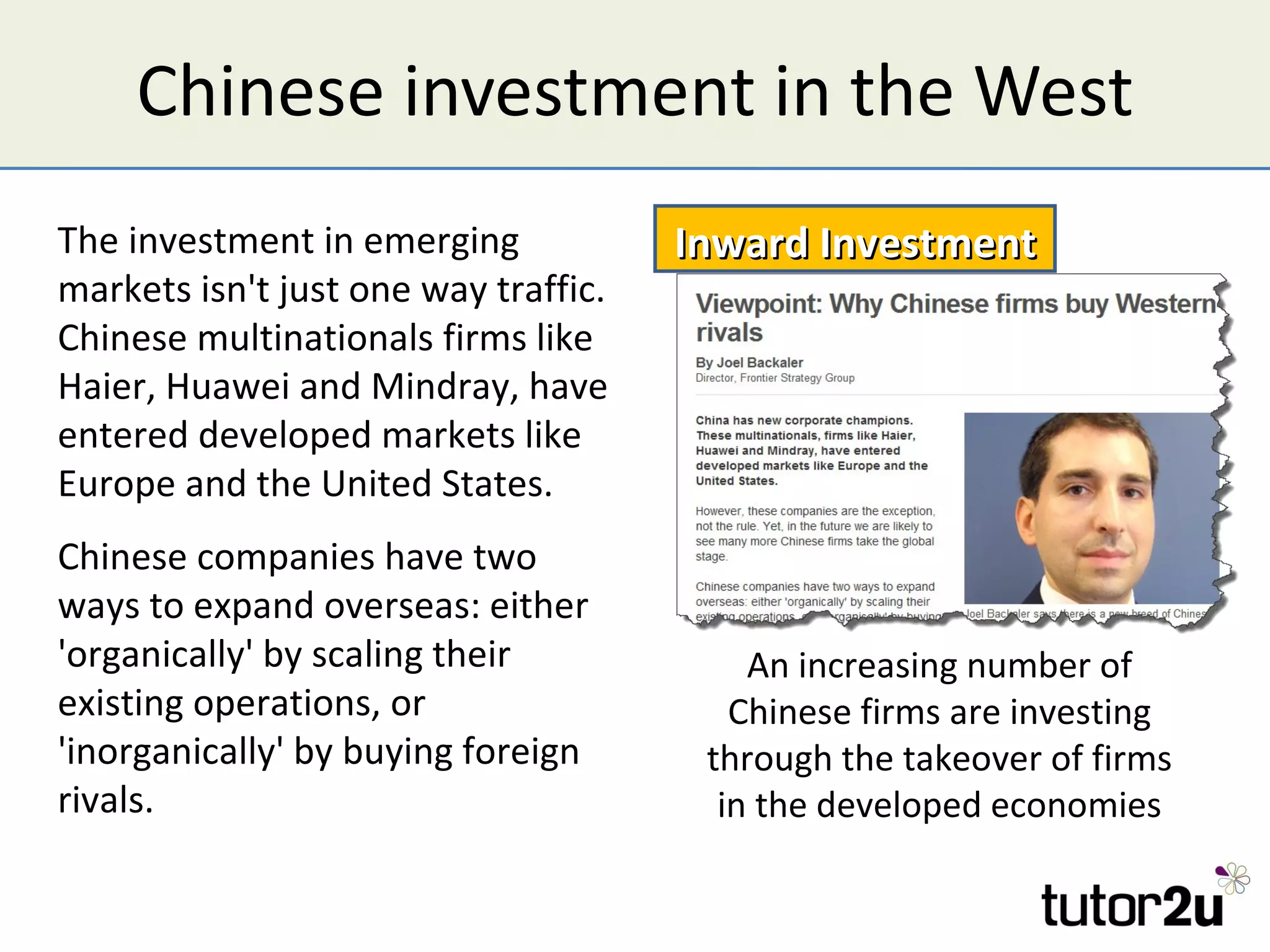
The investment in emerging            Inward Investment
markets isn't just one way traffic.
Chinese multinationals firms like
Haier, Huawei and Mindray, have
entered developed markets like
Europe and the United States.
Chinese companies have two
ways to expand overseas: either
'organically' by scaling their            An increasing number of
existing operations, or                  Chinese firms are investing
'inorganically' by buying foreign      through the takeover of firms
rivals.                                 in the developed economies
Reckitt’s targets emerging markets
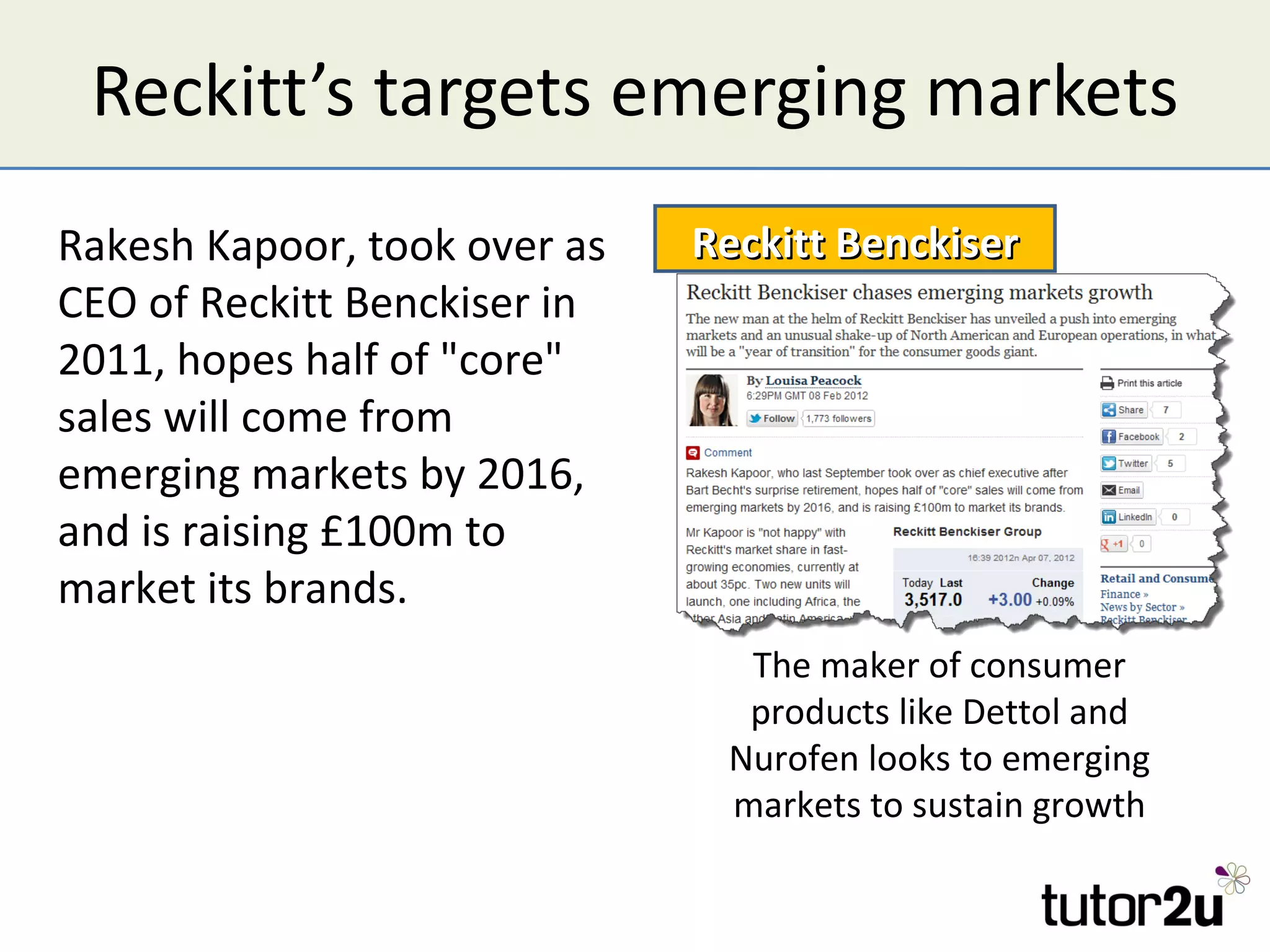
Rakesh Kapoor, took over as   Reckitt Benckiser
CEO of Reckitt Benckiser in
2011, hopes half of "core"
sales will come from
emerging markets by 2016,
and is raising £100m to
market its brands.
                                The maker of consumer
                                products like Dettol and
                               Nurofen looks to emerging
                               markets to sustain growth
What is an “emerging market”?

  “Emerging market” is
   used to describe a
country in the process of
    rapid growth and
     industrialisation
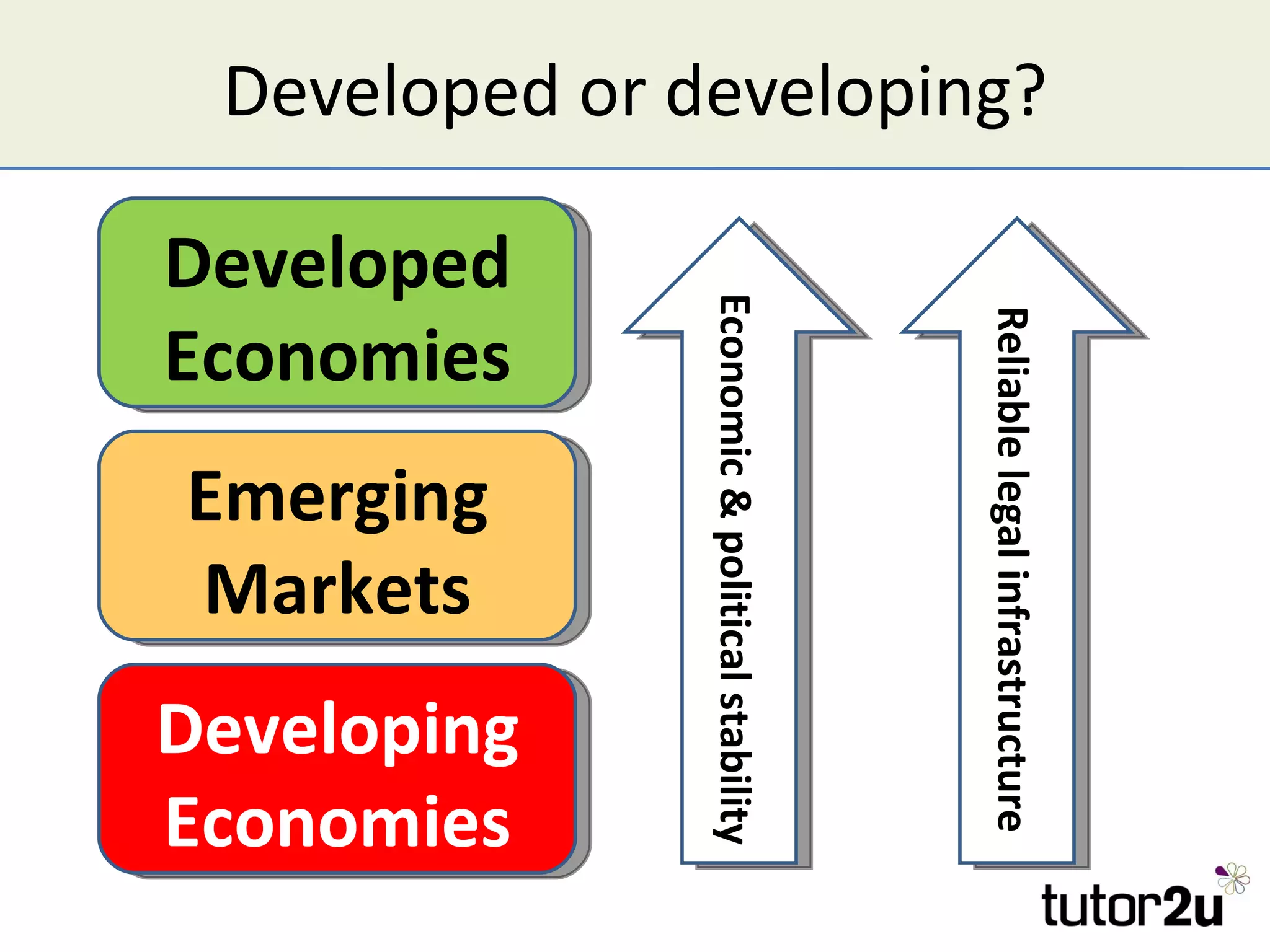
Developed or developing?

Developed


               Economic & political stability


                                                Reliable legal infrastructure
Economies
Emerging
Markets
Developing
Economies
Features of emerging markets
• Economies making a transition
• Rapid industrialisation (i.e. development of
  secondary & tertiary sectors)
• Have potential to become developed economies
• Faster long-term economic growth than most
  developed economies
• Many inhabitants still in poverty
• Businesses struggle to access global markets
  (e.g. trade barriers)
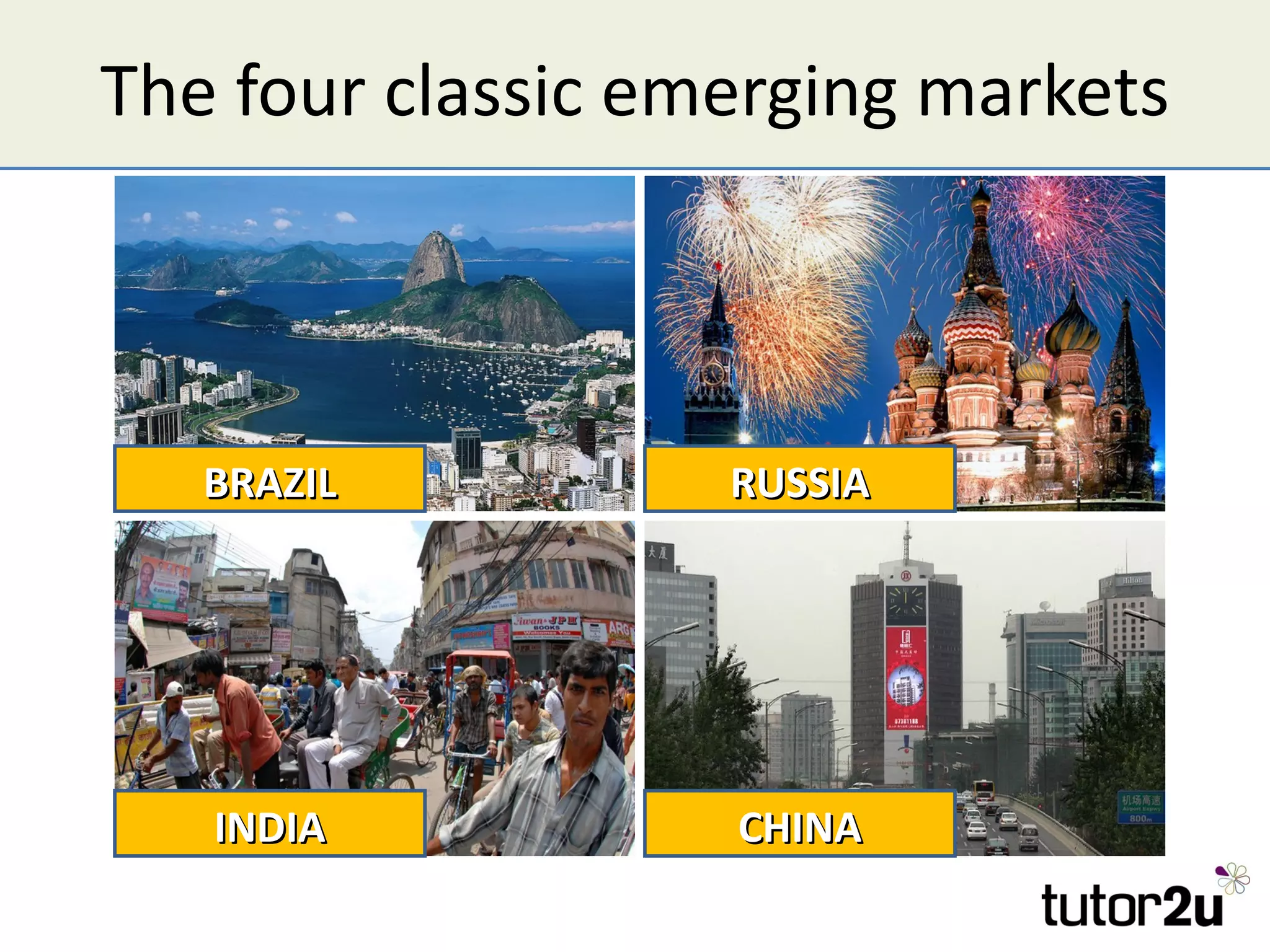
The four classic emerging markets


   BRAZIL          RUSSIA


   INDIA           CHINA
Rise of the BRICs

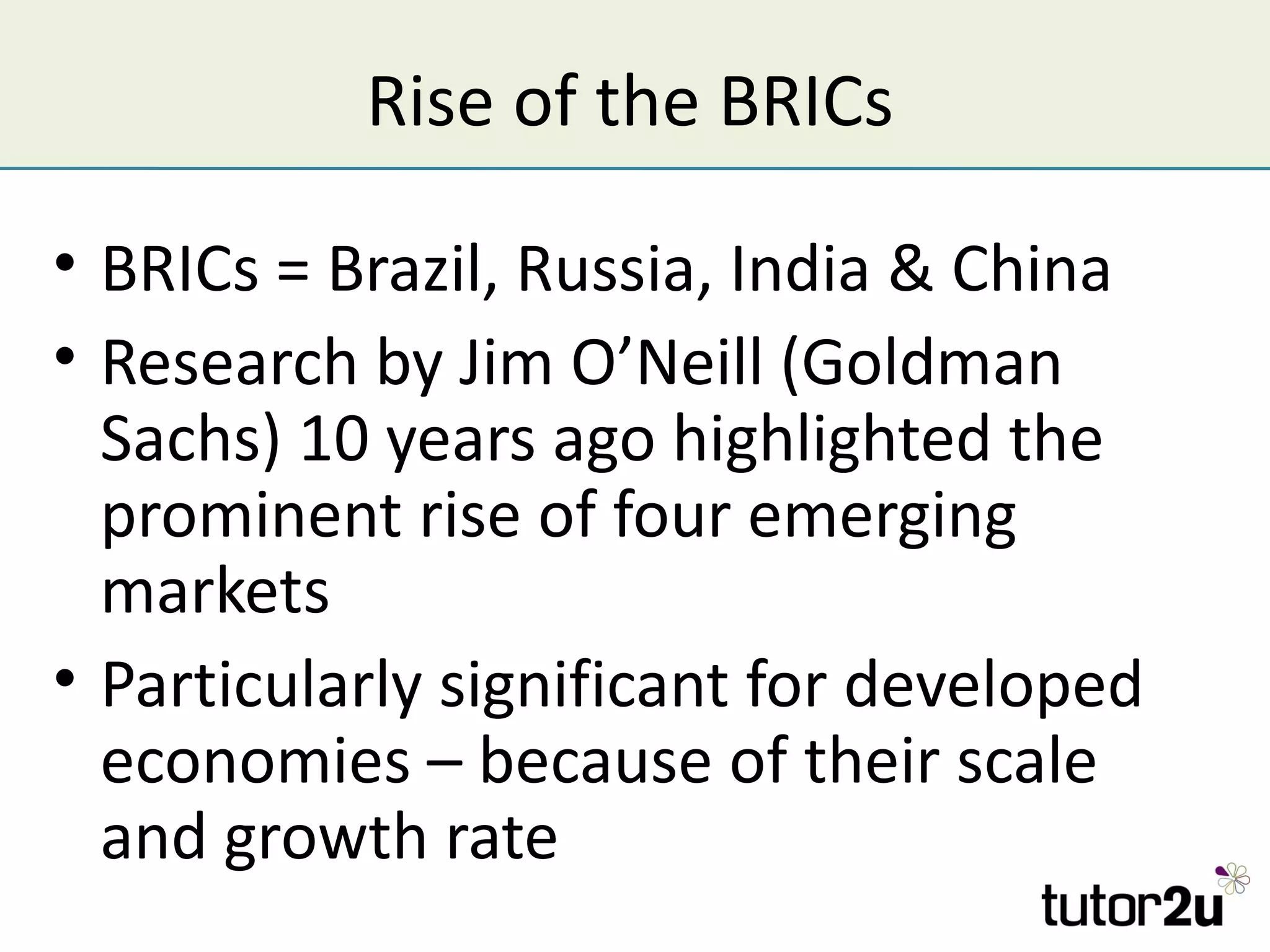
• BRICs = Brazil, Russia, India & China
• Research by Jim O’Neill (Goldman
  Sachs) 10 years ago highlighted the
  prominent rise of four emerging
  markets
• Particularly significant for developed
  economies – because of their scale
  and growth rate
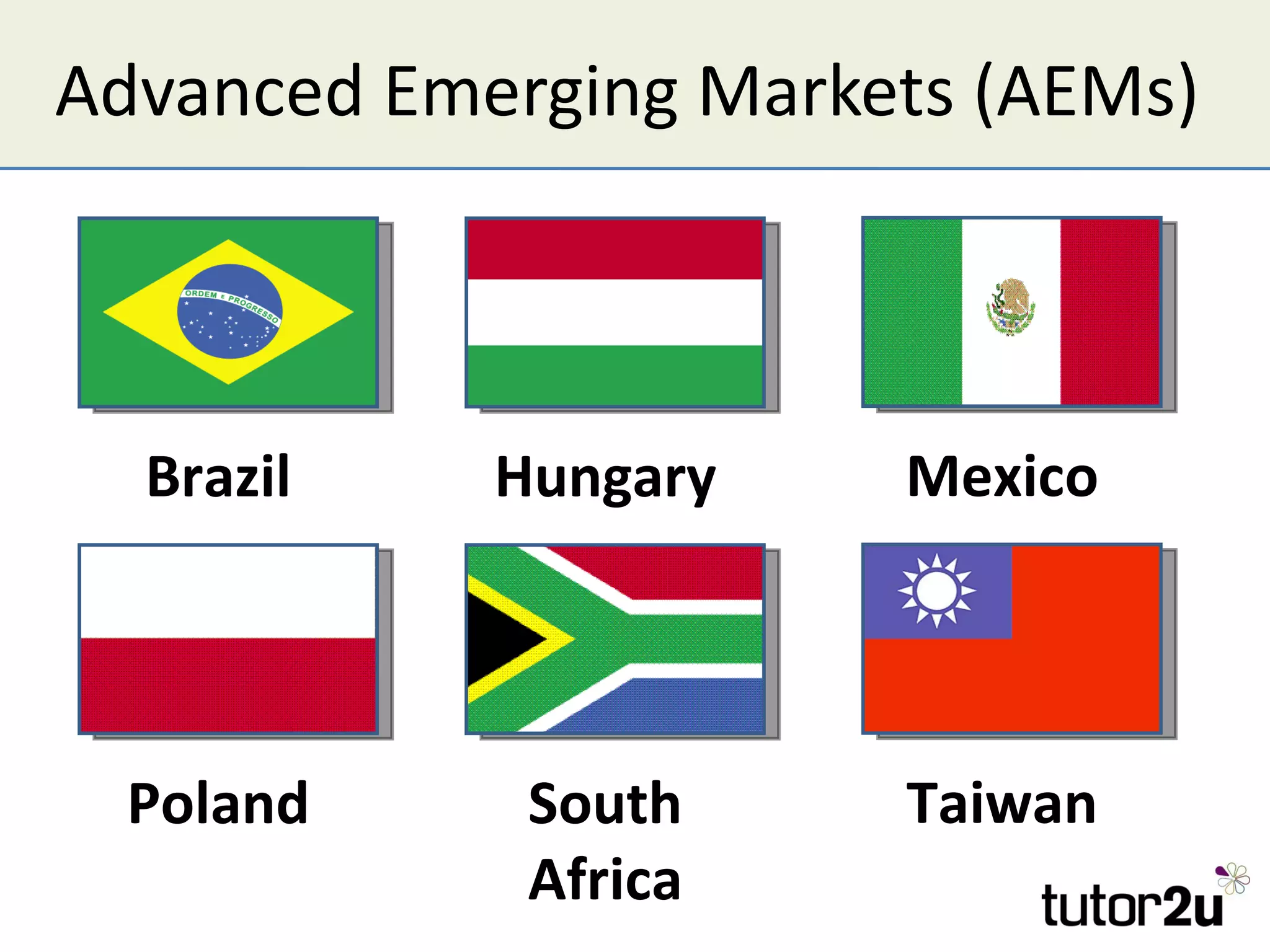
Advanced Emerging Markets (AEMs)


  Brazil    Hungary    Mexico


  Poland     South     Taiwan
             Africa
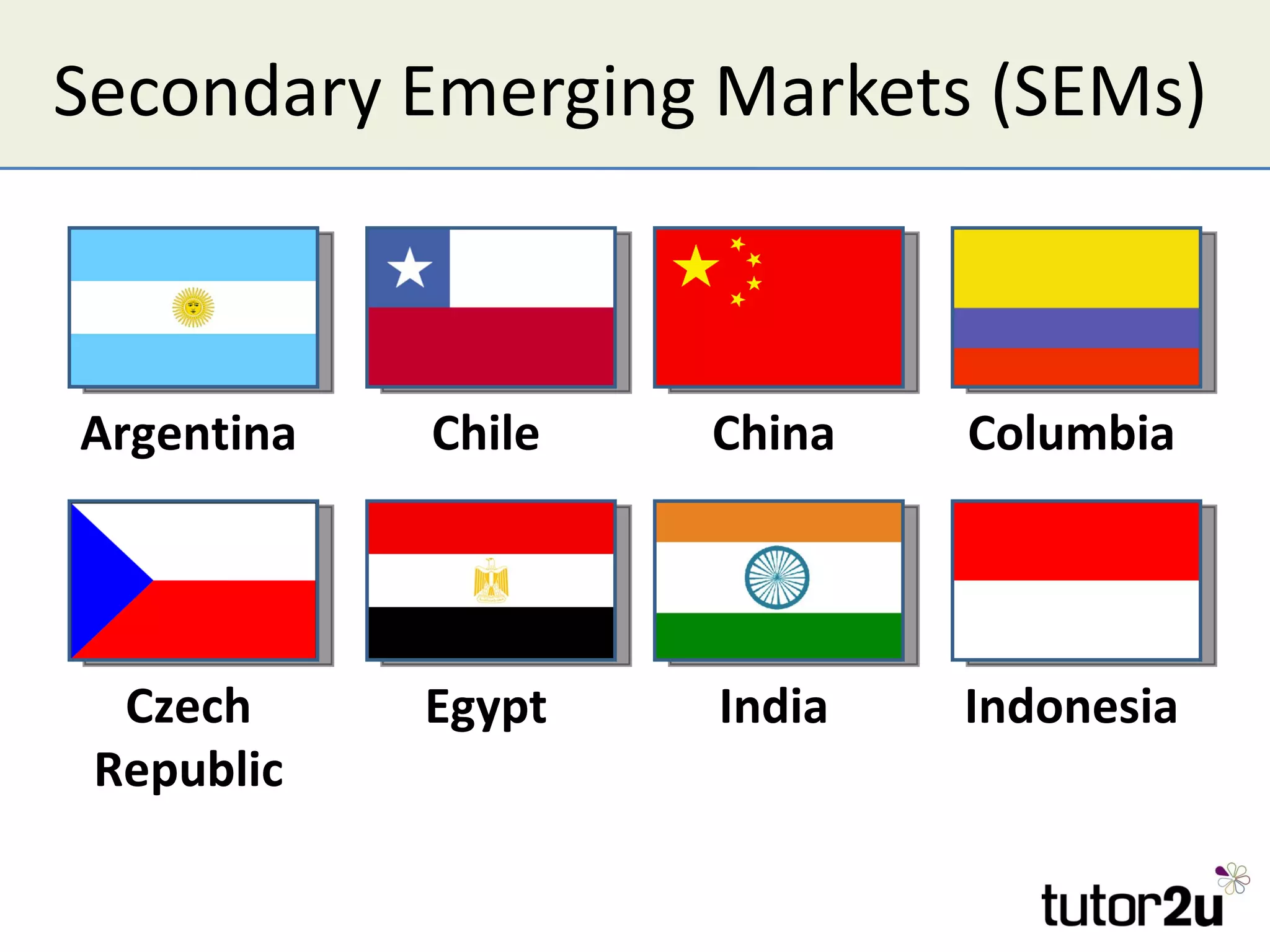
Secondary Emerging Markets (SEMs)


Argentina   Chile   China   Columbia


  Czech     Egypt   India   Indonesia
 Republic
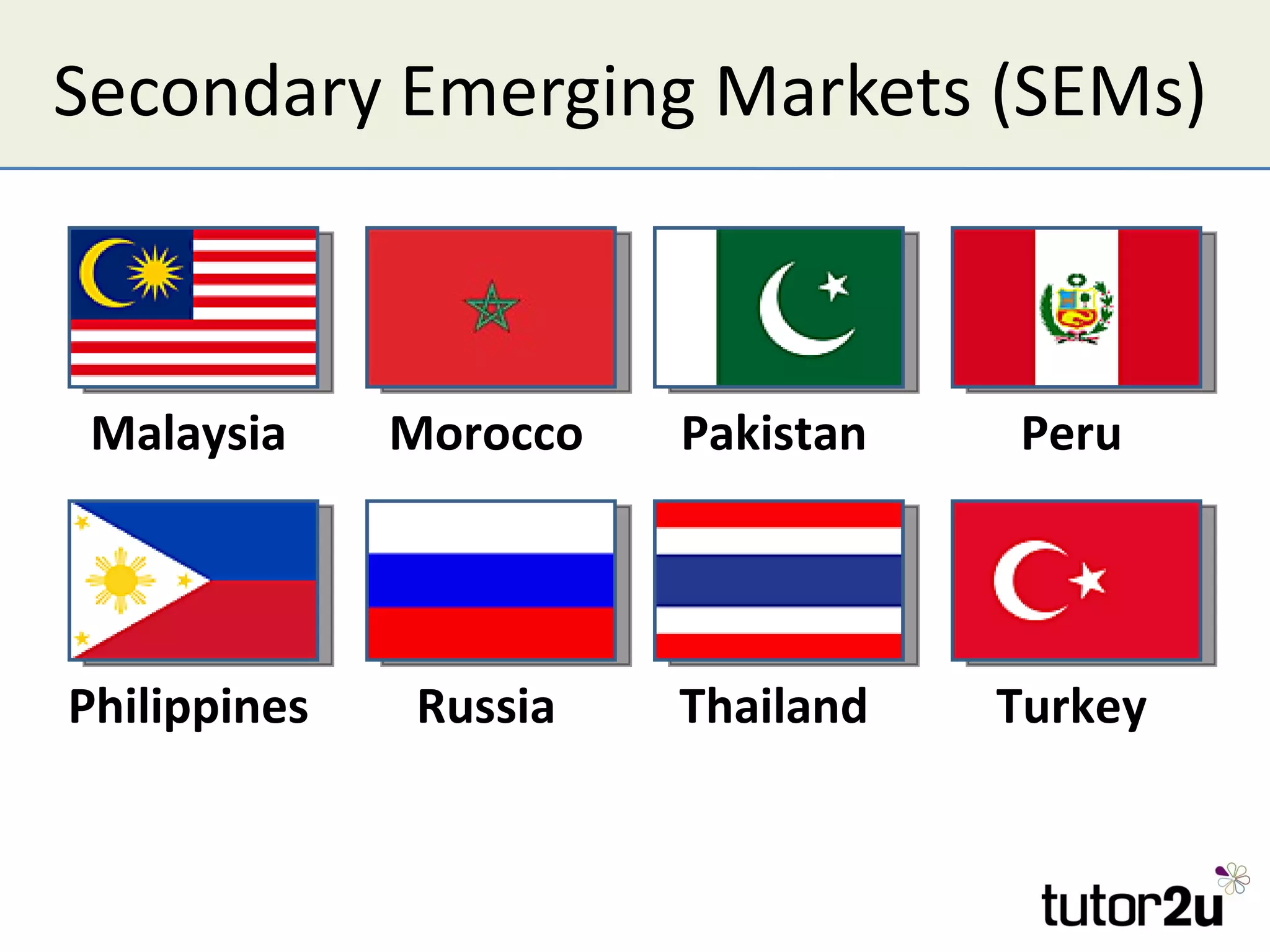
Secondary Emerging Markets (SEMs)


 Malaysia     Morocco   Pakistan   Peru


Philippines   Russia    Thailand   Turkey
Threats from emerging markets
• Increasingly large pool of skilled, but
  low-cost labour
• Undervalued currencies make their
  exports cheaper
• Inadequate protection of brand and
  other intellectual property
• State subsidy of industries to make
  them more competitive globally
Opportunities in emerging markets
• Growing numbers of educated middle class
  consumers - = growing consumer spending
• Cultural shifts – e.g. higher demand for personal
  products, private education & healthcare
• Demand for infrastructure and other products &
  services from developed economies
• Source of high-skilled but low-cost labour
  (outsourcing / offshoring)
• Great potential for joint ventures and
  acquisitions
Key risks and threat of emerging markets

 • Political instability
 • Cultural differences / sensitivities
 • Variable approaches to financial & legal
   dealings (e.g. contractual law)
 • Corruption and bureaucracy still an issue
 • Emerging markets becoming major exporters
 • Low-cost production makes developed
   economies uncompetitive in some markets
Example – Indian IT “exports”

                    India now
                 dominates the
                 global market
                for offshoring of
                   IT-enabled
                     services
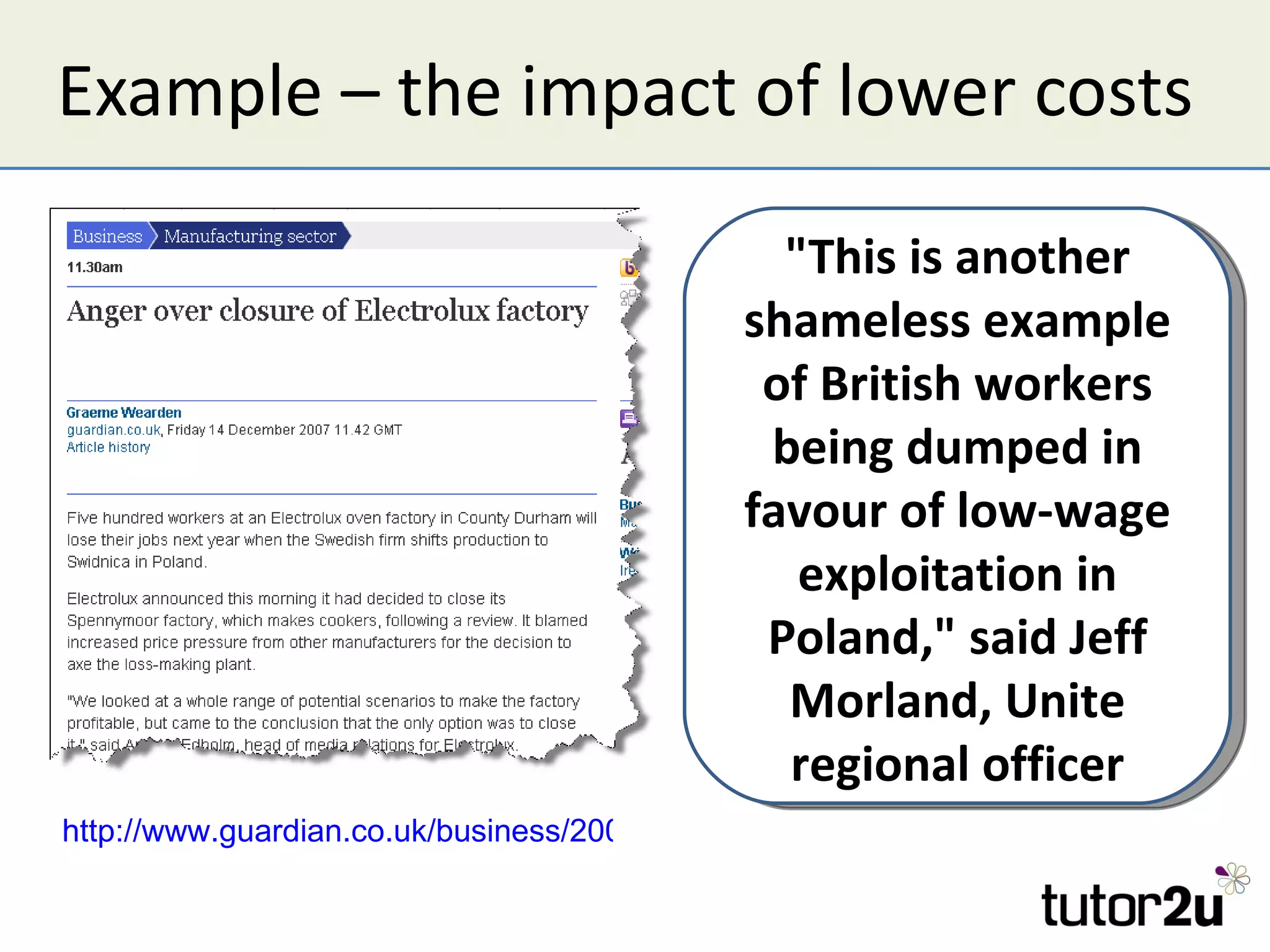
Example – the impact of lower costs

                                                "This is another
                                              shameless example
                                               of British workers
                                               being dumped in
                                              favour of low-wage
                                                 exploitation in
                                               Poland," said Jeff
                                                Morland, Unite
                                                regional officer
http://www.guardian.co.uk/business/2007/dec/14/manufacturing.ireland
Emerging Markets as part
     of a strategy of
 International Expansion
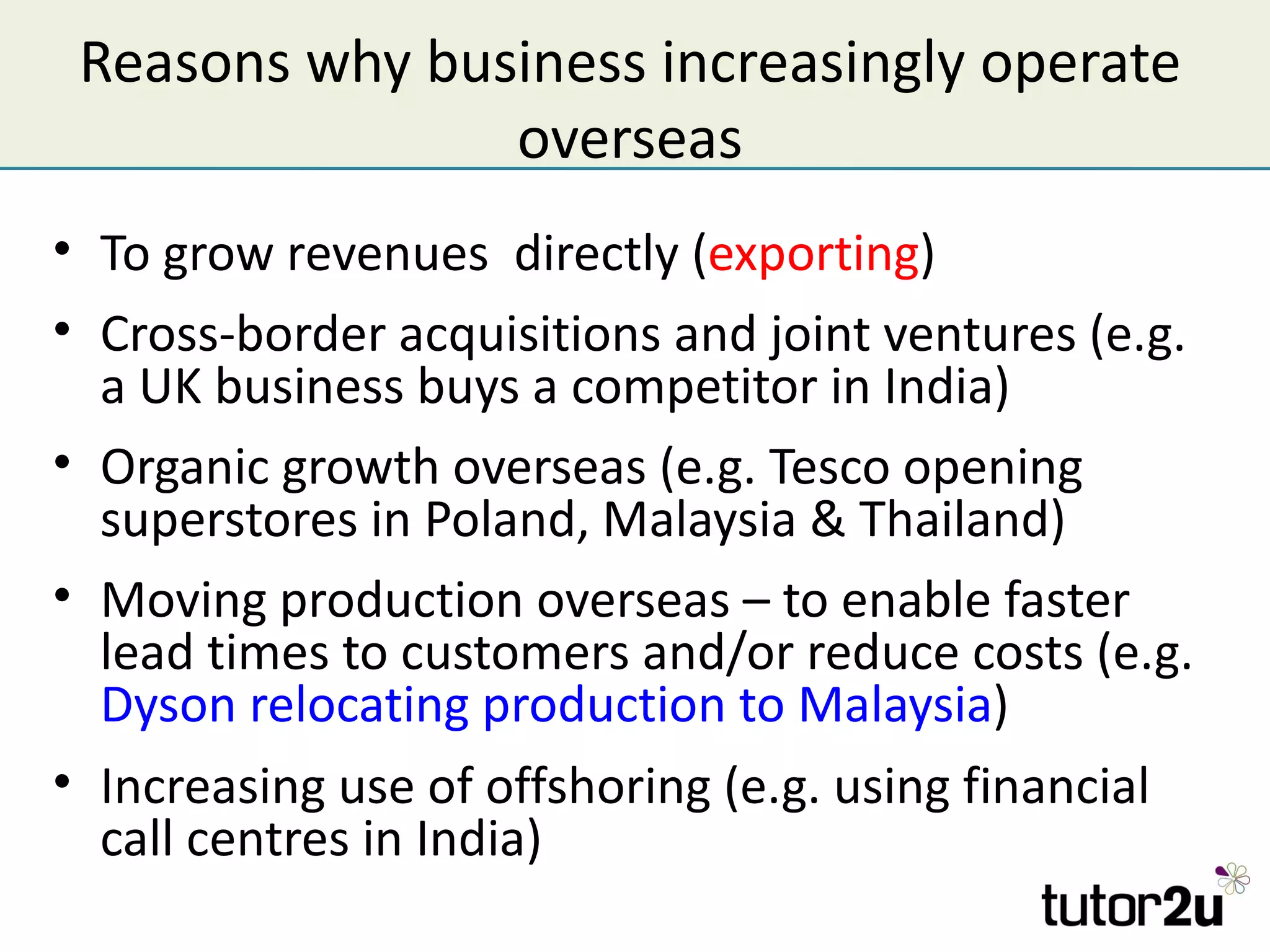
Reasons why business increasingly operate
                overseas
• To grow revenues directly (exporting)
• Cross-border acquisitions and joint ventures (e.g.
  a UK business buys a competitor in India)
• Organic growth overseas (e.g. Tesco opening
  superstores in Poland, Malaysia & Thailand)
• Moving production overseas – to enable faster
  lead times to customers and/or reduce costs (e.g.
  Dyson relocating production to Malaysia)
• Increasing use of offshoring (e.g. using financial
  call centres in India)
Attraction of international markets
• Stronger economic growth in emerging economies
  such as China, India, Brazil and Russia
• Market saturation and maturity (slow or declining
  sales) in domestic markets
• Easier to reach international customers using e-
  commerce
• Greater government support for businesses wishing to
  expand overseas (exports seen as a source of economic
  growth)
• Shareholder pressure to grow revenues and profits
  through international expansion
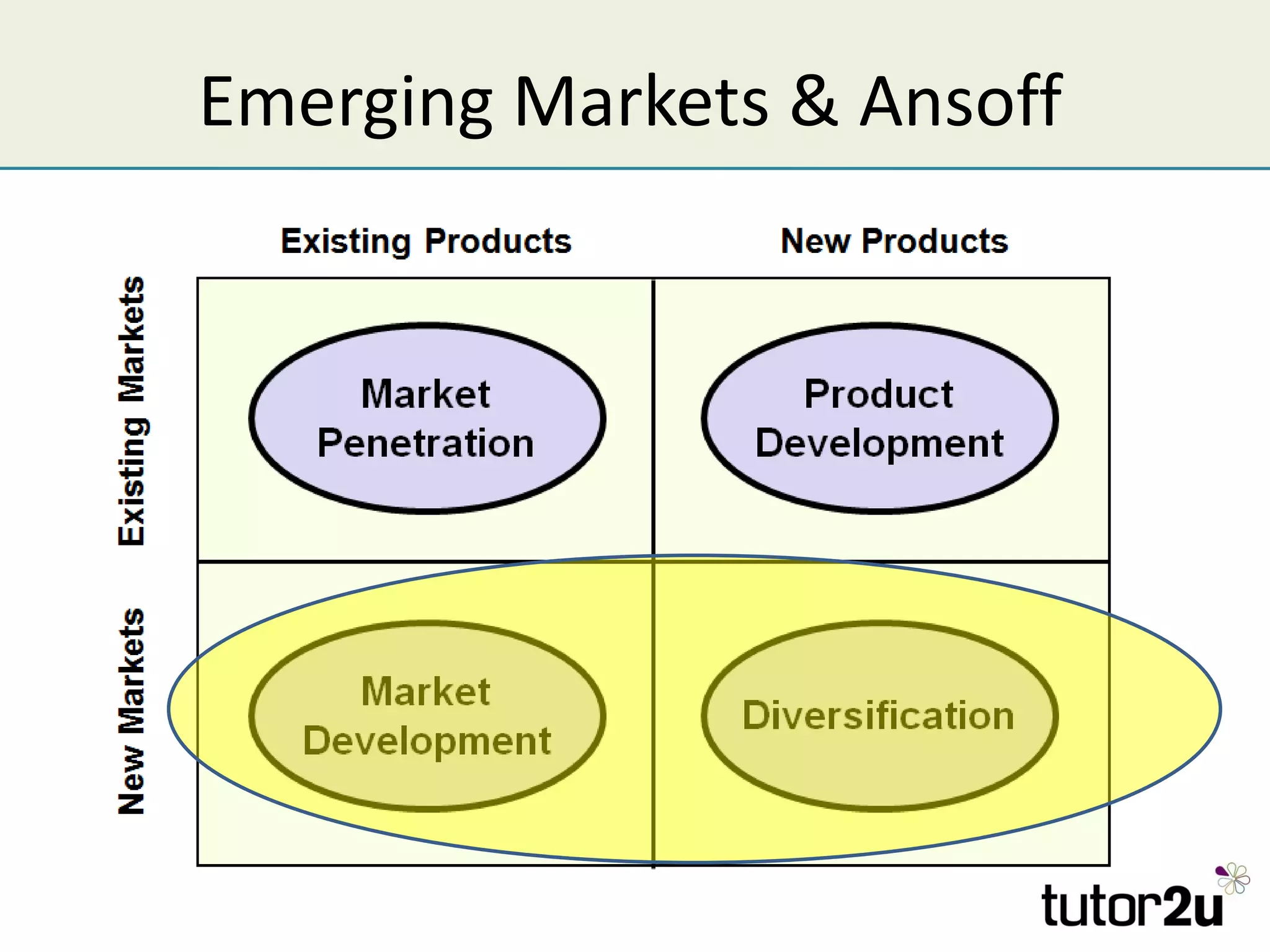
Emerging Markets & Ansoff
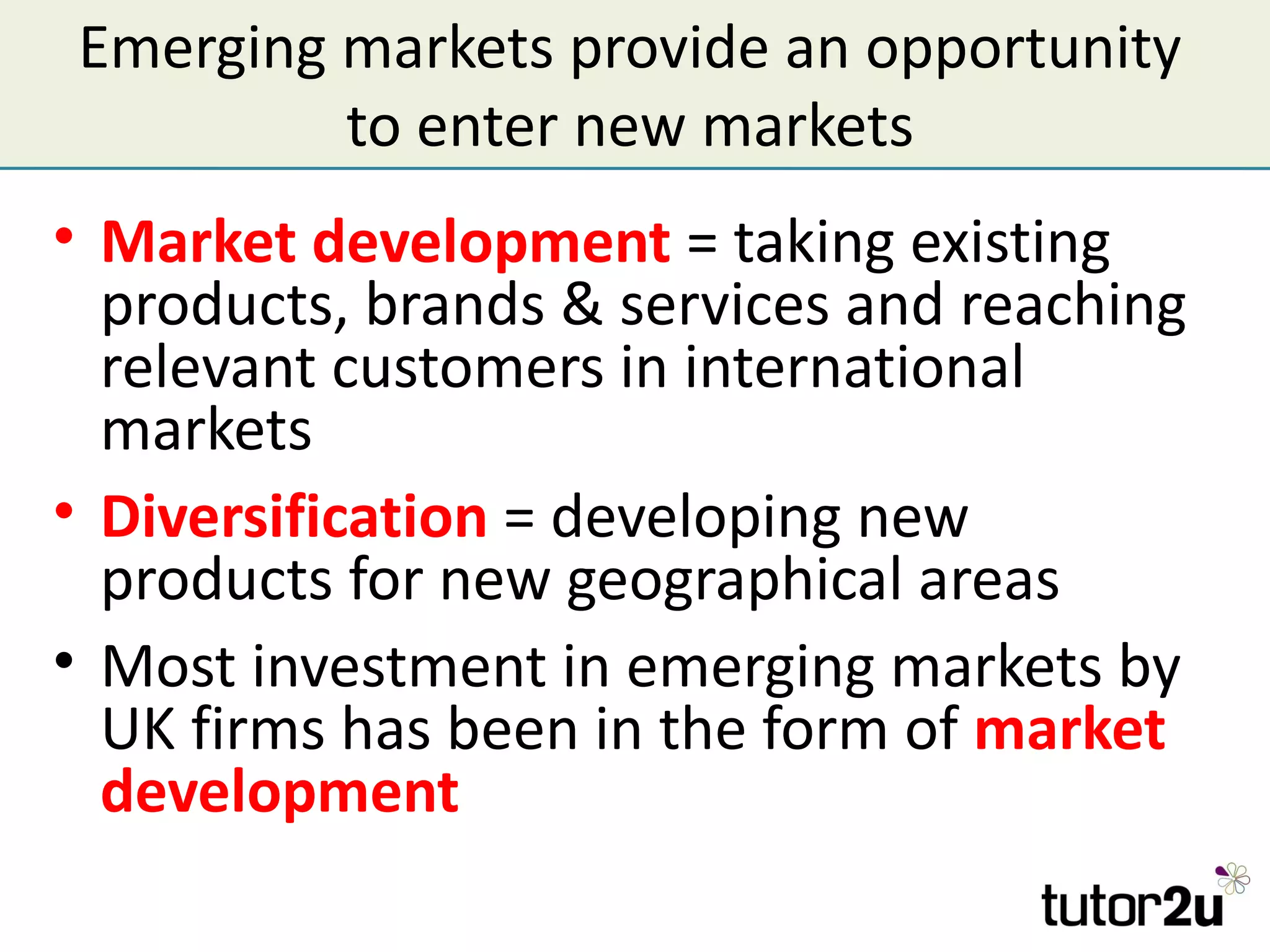
Emerging markets provide an opportunity
         to enter new markets
• Market development = taking existing
  products, brands & services and reaching
  relevant customers in international
  markets
• Diversification = developing new
  products for new geographical areas
• Most investment in emerging markets by
  UK firms has been in the form of market
  development
Global brands have led the stampede into
             emerging markets

• The most important reason for
  expansion into emerging markets
• Global brands need to operate globally
• By definition they need to be active in
  fast-growing emerging markets as well
  as having established market shares in
  developed economies
Methods of reaching emerging markets
Exporting direct   The UK business takes orders from international customers and
to customers       ships them to the customer destination
Selling via        A distribution or agency contract is made with one or more
overseas agents    intermediaries
or distributors    Distributors & agents may buy stock to service local demand
                   The customer is owned by the distributor or agent
Opening an         Involves physically setting up one or more business locations in
operation          the target markets
overseas           Initially may just be a sales office – potentially leading onto
                   production facilities (depends on product)
Joint venture or  The business acquires or invests in an existing business that
buying a business operates in the target market
overseas
Key international risk factors
• Cultural differences
   – A business needs to understand local cultural influences in order to
     sell its products effectively. For example, a product may be viewed as
     a basic commodity at home, but not in the target overseas market.
     The sales and marketing approach will need to reflect this.
• Language issues
   – Although the common business language worldwide is now English,
     there could still be language issues. Can the business market its
     product effectively in the local language? Will it have access to
     professional translators and marketing agencies?
• Legislation
   – Legislation varies widely in overseas markets and will affect how to
     sell into them. A business must make sure it adheres to local laws. It
     will also need to consider how to find and select partners in overseas
     countries, as well as how to investigate the freight and
     communications options available.
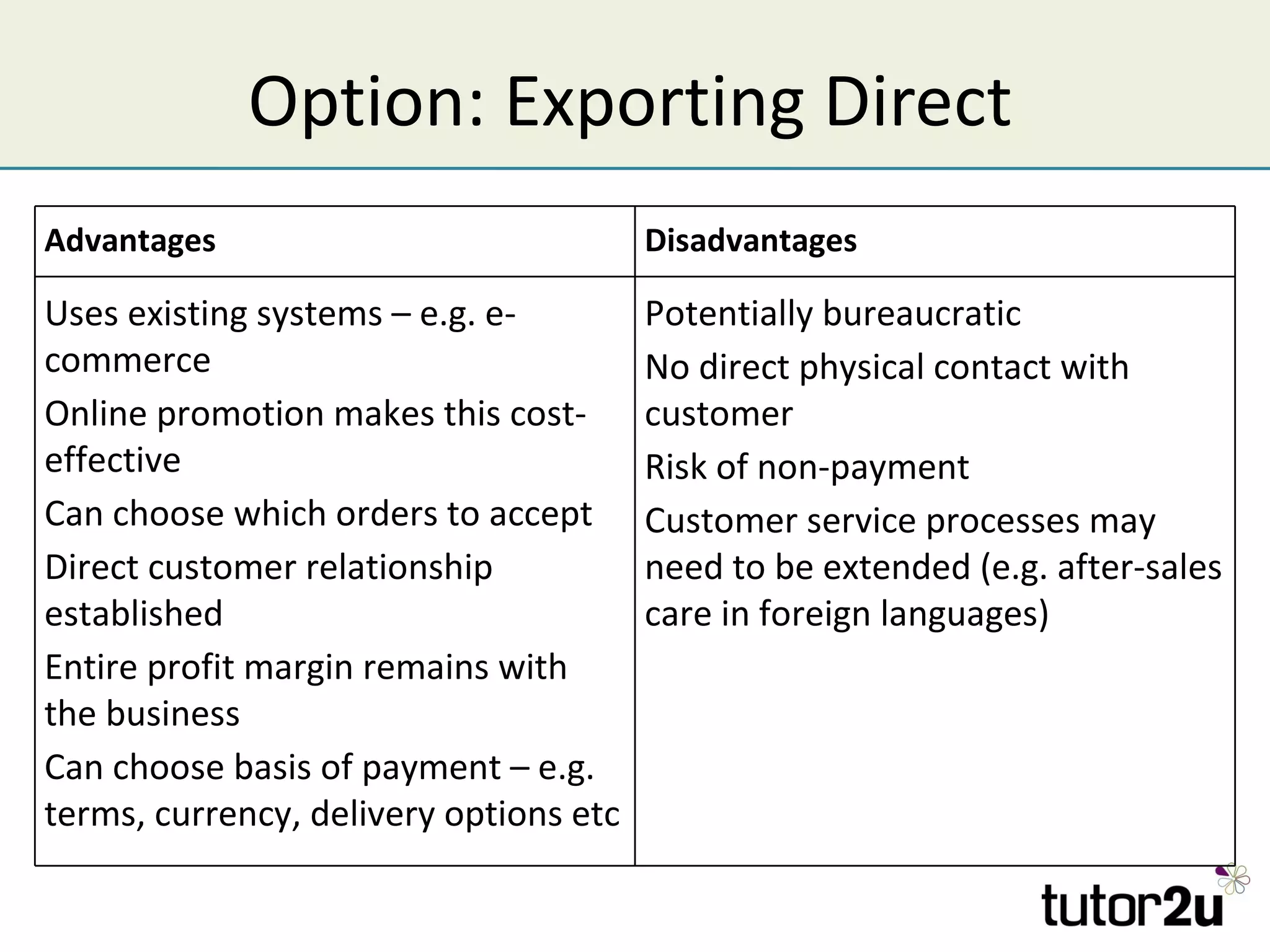
Option: Exporting Direct
Advantages                              Disadvantages

Uses existing systems – e.g. e-         Potentially bureaucratic
commerce                                No direct physical contact with
Online promotion makes this cost-       customer
effective                               Risk of non-payment
Can choose which orders to accept       Customer service processes may
Direct customer relationship            need to be extended (e.g. after-sales
established                             care in foreign languages)
Entire profit margin remains with
the business
Can choose basis of payment – e.g.
terms, currency, delivery options etc
Option: Sell Via Agents / Distributors
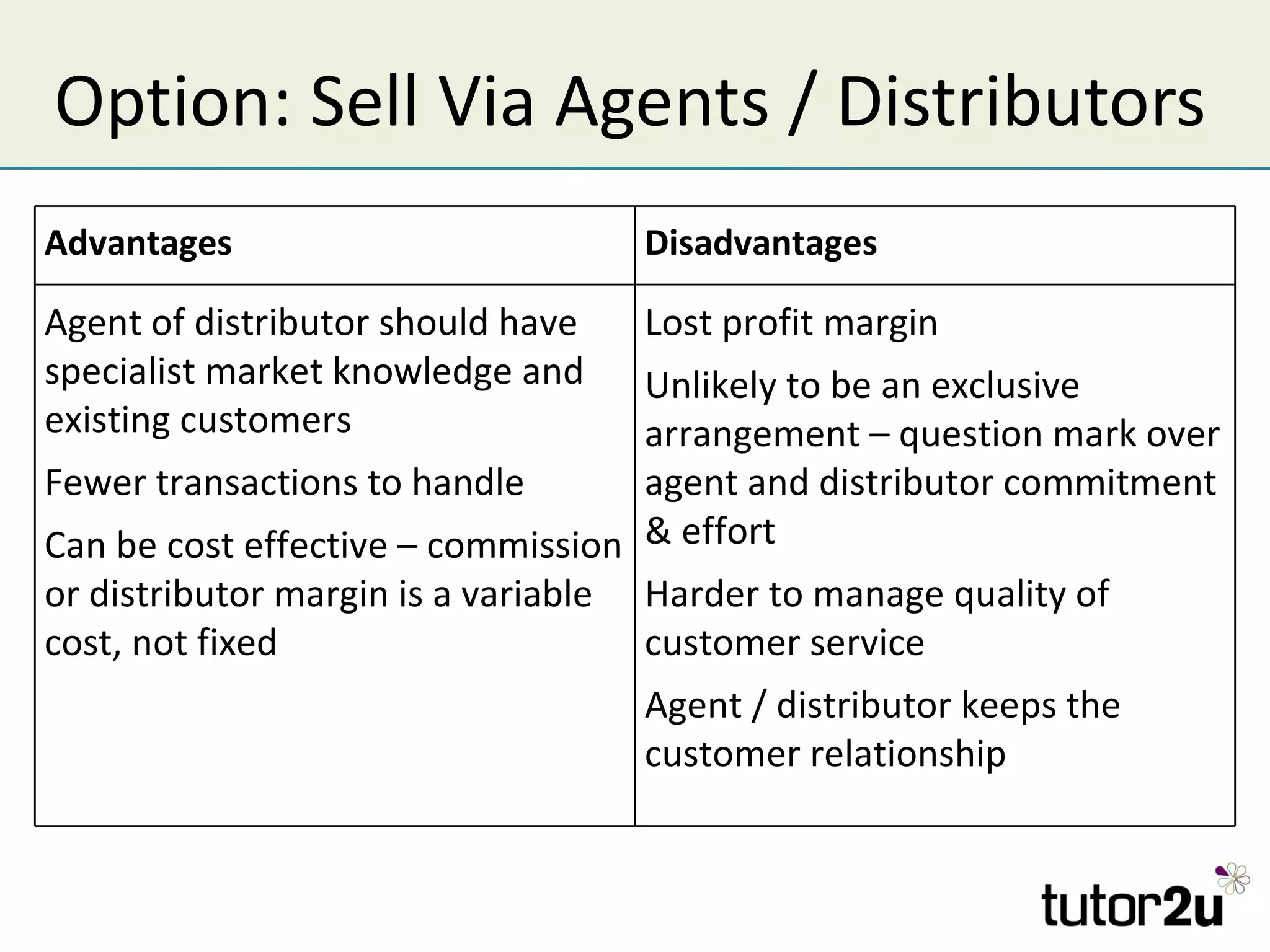
Advantages                         Disadvantages

Agent of distributor should have   Lost profit margin
specialist market knowledge and     Unlikely to be an exclusive
existing customers                  arrangement – question mark over
Fewer transactions to handle        agent and distributor commitment
Can be cost effective – commission & effort
or distributor margin is a variable Harder to manage quality of
cost, not fixed                     customer service
                                   Agent / distributor keeps the
                                   customer relationship
Option: Open Overseas Operation
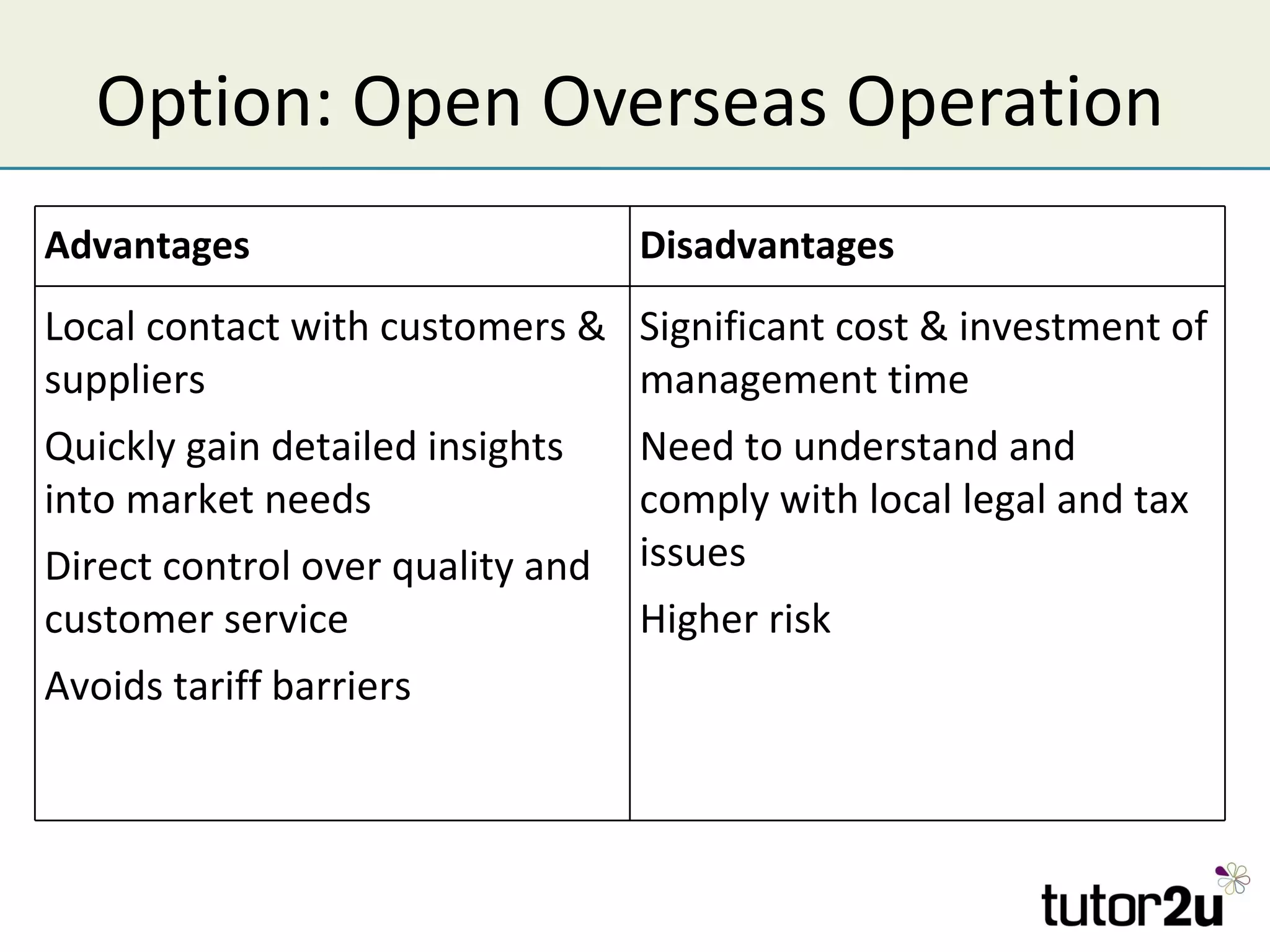
Advantages                        Disadvantages
Local contact with customers & Significant cost & investment of
suppliers                      management time
Quickly gain detailed insights    Need to understand and
into market needs                 comply with local legal and tax
Direct control over quality and   issues
customer service                  Higher risk
Avoids tariff barriers
Option: Joint Venture or Acquisition
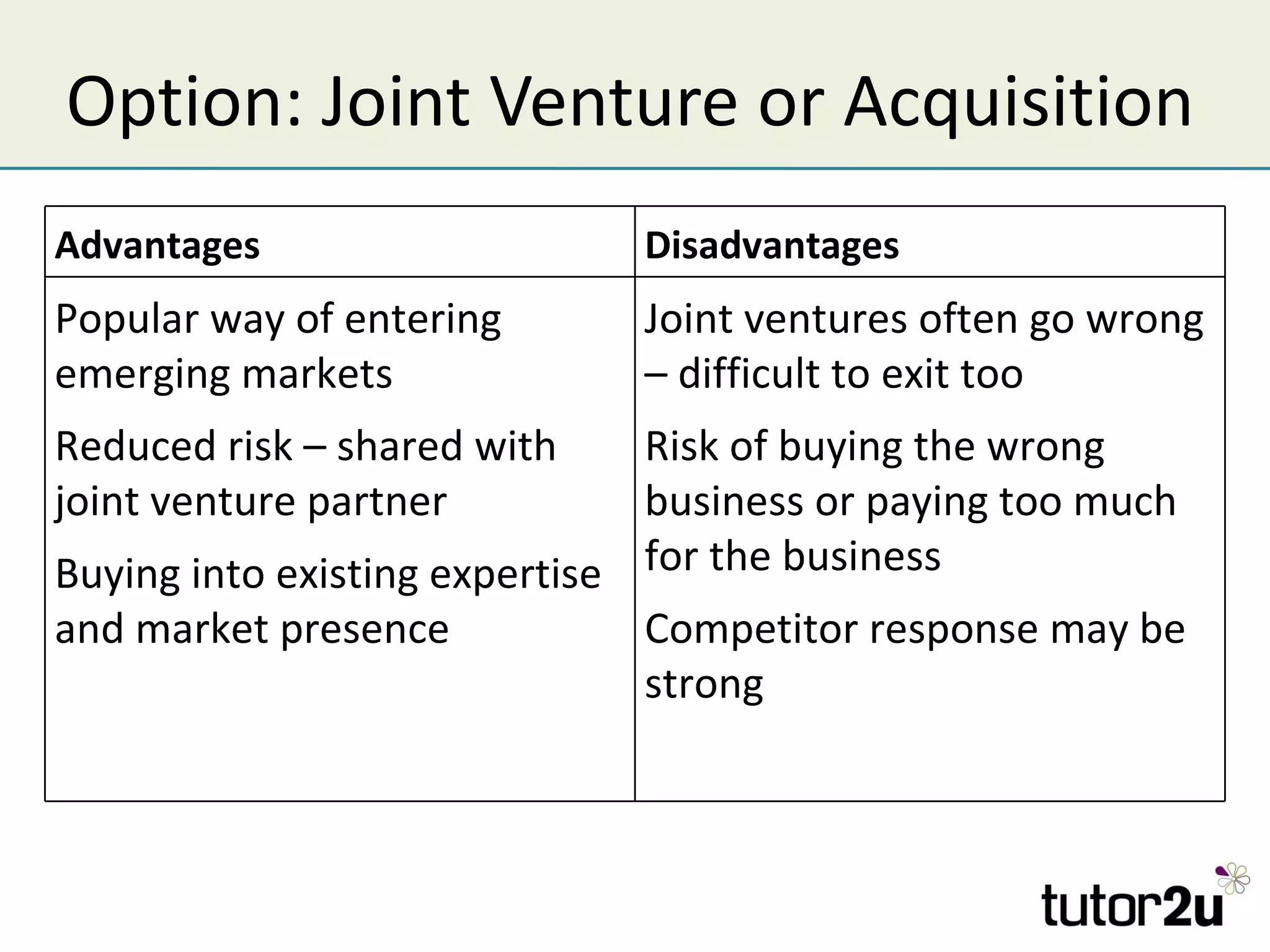
Advantages                    Disadvantages
Popular way of entering       Joint ventures often go wrong
emerging markets              – difficult to exit too
Reduced risk – shared with     Risk of buying the wrong
joint venture partner          business or paying too much
Buying into existing expertise for the business
and market presence            Competitor response may be
                               strong
Keep up-to-date with business
stories, resources, quizzes and
 worksheets for your business
    course. Click the logo!

Business & Emerging Markets

  • 1.
  • 2.
    Introduction Some Examples of Expansion into Emerging Markets
  • 3.
    Starbucks uses jointventure to enter Indian market Starbucks Starbucks unveils plans to open its first outlets in India. The US coffee giant said the first coffee shops would open by September 2012 in a 50-50 joint venture with Tata Global Beverages. Starbucks already operates more than 17,000 cafes, with about 2012: Starbucks enters Indian 6,000 of them in more than 50 Coffee market using joint nations outside the US. venture with Tata Group
  • 4.
    Jaguar Land Roverinto India JLR, owned by India's Tata Group, JLR opened its first assembly plant in India in 2011. The plant will initially assemble car kits shipped from JLR's plant at Halewood in the UK. Taxation is a key driver of the investment. India's federal government levies a more than 100% tax on fully built imported vehicles, but those whose engines 2011: Jaguar Land Rover opens and gear boxes are assembled in manufacturing plant in India India attract an import tax of 10%, while those with pre-assembled engines or gear boxes attract a 30% import tax.
  • 5.
    Heinz into Braziland China HEINZ “The acquisitions in Brazil and China put Emerging Markets on track to generate more than 20% of our Company's total sales in 2012, up from 16% in 2011. The acquisitions are the latest examples of our successful "buy and build" strategy in Emerging Markets, where we have acquired and grown 2010: Heinz expanded in China by strong local brands and businesses in acquiring Foodstar, a leading maker of the key markets of China, India, sauce for $100m Indonesia, Russia, Poland and now Brazil.” 2011: Heinz bought an 80% stake in Quero, a leading sauces brand in Brazil.
  • 6.
    Samsung invests inChinese production Samsung Despite concerns about the leaking or loss of technology (IP), Samsung still wants to operate a manufacturing plant in China. Global chip market worth almost £20bn p.a. and Chinese market expected to be almost half of that in 2012 Chip manufacturing needs to be close to the end-customer in order to be competitive 2012: South Korean Govt approval for Samsung to manufacture computer chips in China
  • 7.
    Diageo’s Chinese Takeover Diageo Global drinks giant Diageo is finalising a deal to buy the Chinese baijiu brand Shui Jing Fang, as it seeks to expand its footprint in China. It's reported that Diageo has offered $950m (£600m) for the company, which it would use to develop the market for Chinese 2012: Diageo expands its white spirits elsewhere in the footprint in emerging markets world. with £600m takeover
  • 8.
    Chinese investment inthe West The investment in emerging Inward Investment markets isn't just one way traffic. Chinese multinationals firms like Haier, Huawei and Mindray, have entered developed markets like Europe and the United States. Chinese companies have two ways to expand overseas: either 'organically' by scaling their An increasing number of existing operations, or Chinese firms are investing 'inorganically' by buying foreign through the takeover of firms rivals. in the developed economies
  • 9.
    Reckitt’s targets emergingmarkets Rakesh Kapoor, took over as Reckitt Benckiser CEO of Reckitt Benckiser in 2011, hopes half of "core" sales will come from emerging markets by 2016, and is raising £100m to market its brands. The maker of consumer products like Dettol and Nurofen looks to emerging markets to sustain growth
  • 10.
    What is an“emerging market”? “Emerging market” is used to describe a country in the process of rapid growth and industrialisation
  • 11.
    Developed or developing? Developed Economic & political stability Reliable legal infrastructure Economies Emerging Markets Developing Economies
  • 12.
    Features of emergingmarkets • Economies making a transition • Rapid industrialisation (i.e. development of secondary & tertiary sectors) • Have potential to become developed economies • Faster long-term economic growth than most developed economies • Many inhabitants still in poverty • Businesses struggle to access global markets (e.g. trade barriers)
  • 13.
    The four classicemerging markets BRAZIL RUSSIA INDIA CHINA
  • 14.
    Rise of theBRICs • BRICs = Brazil, Russia, India & China • Research by Jim O’Neill (Goldman Sachs) 10 years ago highlighted the prominent rise of four emerging markets • Particularly significant for developed economies – because of their scale and growth rate
  • 15.
    Advanced Emerging Markets(AEMs) Brazil Hungary Mexico Poland South Taiwan Africa
  • 16.
    Secondary Emerging Markets(SEMs) Argentina Chile China Columbia Czech Egypt India Indonesia Republic
  • 17.
    Secondary Emerging Markets(SEMs) Malaysia Morocco Pakistan Peru Philippines Russia Thailand Turkey
  • 18.
    Threats from emergingmarkets • Increasingly large pool of skilled, but low-cost labour • Undervalued currencies make their exports cheaper • Inadequate protection of brand and other intellectual property • State subsidy of industries to make them more competitive globally
  • 19.
    Opportunities in emergingmarkets • Growing numbers of educated middle class consumers - = growing consumer spending • Cultural shifts – e.g. higher demand for personal products, private education & healthcare • Demand for infrastructure and other products & services from developed economies • Source of high-skilled but low-cost labour (outsourcing / offshoring) • Great potential for joint ventures and acquisitions
  • 20.
    Key risks andthreat of emerging markets • Political instability • Cultural differences / sensitivities • Variable approaches to financial & legal dealings (e.g. contractual law) • Corruption and bureaucracy still an issue • Emerging markets becoming major exporters • Low-cost production makes developed economies uncompetitive in some markets
  • 21.
    Example – IndianIT “exports” India now dominates the global market for offshoring of IT-enabled services
  • 22.
    Example – theimpact of lower costs "This is another shameless example of British workers being dumped in favour of low-wage exploitation in Poland," said Jeff Morland, Unite regional officer http://www.guardian.co.uk/business/2007/dec/14/manufacturing.ireland
  • 23.
    Emerging Markets aspart of a strategy of International Expansion
  • 24.
    Reasons why businessincreasingly operate overseas • To grow revenues directly (exporting) • Cross-border acquisitions and joint ventures (e.g. a UK business buys a competitor in India) • Organic growth overseas (e.g. Tesco opening superstores in Poland, Malaysia & Thailand) • Moving production overseas – to enable faster lead times to customers and/or reduce costs (e.g. Dyson relocating production to Malaysia) • Increasing use of offshoring (e.g. using financial call centres in India)
  • 25.
    Attraction of internationalmarkets • Stronger economic growth in emerging economies such as China, India, Brazil and Russia • Market saturation and maturity (slow or declining sales) in domestic markets • Easier to reach international customers using e- commerce • Greater government support for businesses wishing to expand overseas (exports seen as a source of economic growth) • Shareholder pressure to grow revenues and profits through international expansion
  • 26.
  • 27.
    Emerging markets providean opportunity to enter new markets • Market development = taking existing products, brands & services and reaching relevant customers in international markets • Diversification = developing new products for new geographical areas • Most investment in emerging markets by UK firms has been in the form of market development
  • 28.
    Global brands haveled the stampede into emerging markets • The most important reason for expansion into emerging markets • Global brands need to operate globally • By definition they need to be active in fast-growing emerging markets as well as having established market shares in developed economies
  • 29.
    Methods of reachingemerging markets Exporting direct The UK business takes orders from international customers and to customers ships them to the customer destination Selling via A distribution or agency contract is made with one or more overseas agents intermediaries or distributors Distributors & agents may buy stock to service local demand The customer is owned by the distributor or agent Opening an Involves physically setting up one or more business locations in operation the target markets overseas Initially may just be a sales office – potentially leading onto production facilities (depends on product) Joint venture or The business acquires or invests in an existing business that buying a business operates in the target market overseas
  • 30.
    Key international riskfactors • Cultural differences – A business needs to understand local cultural influences in order to sell its products effectively. For example, a product may be viewed as a basic commodity at home, but not in the target overseas market. The sales and marketing approach will need to reflect this. • Language issues – Although the common business language worldwide is now English, there could still be language issues. Can the business market its product effectively in the local language? Will it have access to professional translators and marketing agencies? • Legislation – Legislation varies widely in overseas markets and will affect how to sell into them. A business must make sure it adheres to local laws. It will also need to consider how to find and select partners in overseas countries, as well as how to investigate the freight and communications options available.
  • 31.
    Option: Exporting Direct Advantages Disadvantages Uses existing systems – e.g. e- Potentially bureaucratic commerce No direct physical contact with Online promotion makes this cost- customer effective Risk of non-payment Can choose which orders to accept Customer service processes may Direct customer relationship need to be extended (e.g. after-sales established care in foreign languages) Entire profit margin remains with the business Can choose basis of payment – e.g. terms, currency, delivery options etc
  • 32.
    Option: Sell ViaAgents / Distributors Advantages Disadvantages Agent of distributor should have Lost profit margin specialist market knowledge and Unlikely to be an exclusive existing customers arrangement – question mark over Fewer transactions to handle agent and distributor commitment Can be cost effective – commission & effort or distributor margin is a variable Harder to manage quality of cost, not fixed customer service Agent / distributor keeps the customer relationship
  • 33.
    Option: Open OverseasOperation Advantages Disadvantages Local contact with customers & Significant cost & investment of suppliers management time Quickly gain detailed insights Need to understand and into market needs comply with local legal and tax Direct control over quality and issues customer service Higher risk Avoids tariff barriers
  • 34.
    Option: Joint Ventureor Acquisition Advantages Disadvantages Popular way of entering Joint ventures often go wrong emerging markets – difficult to exit too Reduced risk – shared with Risk of buying the wrong joint venture partner business or paying too much Buying into existing expertise for the business and market presence Competitor response may be strong
  • 35.
    Keep up-to-date withbusiness stories, resources, quizzes and worksheets for your business course. Click the logo!