Consumer
Behavior -
Decision Making
• An understanding of consumer behavior is necessary for
the long-term success and survival of a firm.
• Consumer decision making is viewed as the edifice of
the marketing concept, an important orientation in
marketing management.
• The marketer should be able to determine needs and
wants of the target segment and provide product and
service offerings more effectively and efficiently than
competitors.
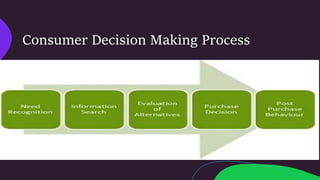
Consumer Decision Making Process
Types of Consumer Decision Making
• Extensive Problem Solving
In extensive decision making, the consumers have no established or set
criteria for evaluating a product in a particular category.
Here the consumers have not narrowed the number of brands from
which they would like to consider and so their decision-making efforts
can be classified as extensive problem solving.
In this set of problem-solving phase, the consumer needs a lot of
information to set a criteria based on specific brands could be judged.
Types of Consumer Decision Making
• Limited Problem Solving
Here the consumers have already set the basic criteria or standard for
evaluating the products. However, they have not fully set the established
preferences and they search for additional information to discriminate
among other products or brands.
Types of Consumer Decision Making
• Routinized Response Behavior
Here, in routinized response behavior, consumers have experience with
the product, and they have set the criteria for which they tend to
evaluate the brands they are considering.
In some situations, they may want to collect a small amount of additional
information, while in others they may simply review what they are aware
about.
Views of Consumer Decision Making
• An Economic View
Consumers have generally been assumed to make rational decisions. The
economic view of consumer decision making is being criticized by researchers
because a consumer is assumed to possess the following traits to behave
rationally −
 Firstly, they need to be aware of all the alternatives present in the market
 Secondly, they must be able to efficiently rank the products as per their benefits.
 Lastly, they must also know the best alternative that suits them as per their requirements.
In the world of perfect competition, consumers rarely have all the information to
make the so called ‘perfect decision.’
Views of Consumer Decision Making
• A Passive View
Passive view is totally opposite to the economic view.
Here, it is assumed that consumers are impulsive and irrational while
making a purchase.
The main limitation of this view is that consumers also seek
information about the alternatives available and make rational or wise
decisions and purchase the products or services that provides the
greatest satisfaction.
Views of Consumer Decision Making
• A Cognitive View
The cognitive model helps individuals to focus on the processes
through which they can get information about selected brands.
In the framework of cognitive view, the consumer very actively
searches for such products or services that can fulfill all their
requirements.
Views of Consumer Decision Making
• An Emotional View
Consumers are associated with deep feelings or emotions such
as, fear, love, hope etc. These emotions are likely to be highly
involving.
Pre-Purchase & Post-Purchase Behavior
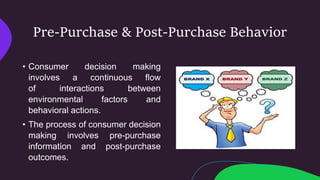
• Consumer decision making
involves a continuous flow
of interactions between
environmental factors and
behavioral actions.
• The process of consumer decision
making involves pre-purchase
information and post-purchase
outcomes.
Pre-Purchase Behavior
• When a consumer realizes the needs, he goes for an information search.
He does the same, so that he can make the right decision. He gathers the
information about the following −
Product Brands
Products Variations
Product Quality
Product Alternatives.
• The consumer can gather information about a product depending on his
age, gender, education and product’s price, risk and acceptance.
Types of Information Search Activities
• Specific
Specific kind of activities are directly related to the problem. These kinds of requirements
need immediate assistance.
• Ongoing
Consumers go on with their research for a particular period if they decide or if they want to
buy a particular product. Ongoing activities basically show the work in progress.
• Incidental
Now, anything that we observe incidentally or just accidentally or naturally comes under
incidental research. Such information can be observed in our daily routine lives.
Information sources
• Internal Sources
• External Sources
Post-Purchase Behavior
• All the activities and experiences that follow purchase are included in
the post purchase behavior.
• Usually, after making a purchase, consumers experience post-
purchase dissonance.
• They sometimes regret their decisions made.
• It mainly occurs due to a large number of alternatives available, good
performance of alternatives or attractiveness of alternatives, etc.
Post-Purchase Behavior
• The marketers sometimes need to assure the consumer that
the choice made by them is the right one.
• The seller can mention or even highlight the important features
or attributes and benefits of the product to address and solve
their concerns if any.
Post-Purchase Behavior
• A high level of post-purchase dissonance is negatively related to
the level of satisfaction which the consumer draws out of product
usage.
• To reduce post-purchase dissonance, consumers may
sometimes even return or exchange the product.

Consumer behavior - Decision making & Types

  • 1.
  • 2.
    • An understandingof consumer behavior is necessary for the long-term success and survival of a firm. • Consumer decision making is viewed as the edifice of the marketing concept, an important orientation in marketing management. • The marketer should be able to determine needs and wants of the target segment and provide product and service offerings more effectively and efficiently than competitors.
  • 3.
  • 4.
    Types of ConsumerDecision Making • Extensive Problem Solving In extensive decision making, the consumers have no established or set criteria for evaluating a product in a particular category. Here the consumers have not narrowed the number of brands from which they would like to consider and so their decision-making efforts can be classified as extensive problem solving. In this set of problem-solving phase, the consumer needs a lot of information to set a criteria based on specific brands could be judged.
  • 5.
    Types of ConsumerDecision Making • Limited Problem Solving Here the consumers have already set the basic criteria or standard for evaluating the products. However, they have not fully set the established preferences and they search for additional information to discriminate among other products or brands.
  • 6.
    Types of ConsumerDecision Making • Routinized Response Behavior Here, in routinized response behavior, consumers have experience with the product, and they have set the criteria for which they tend to evaluate the brands they are considering. In some situations, they may want to collect a small amount of additional information, while in others they may simply review what they are aware about.
  • 7.
    Views of ConsumerDecision Making • An Economic View Consumers have generally been assumed to make rational decisions. The economic view of consumer decision making is being criticized by researchers because a consumer is assumed to possess the following traits to behave rationally −  Firstly, they need to be aware of all the alternatives present in the market  Secondly, they must be able to efficiently rank the products as per their benefits.  Lastly, they must also know the best alternative that suits them as per their requirements. In the world of perfect competition, consumers rarely have all the information to make the so called ‘perfect decision.’
  • 8.
    Views of ConsumerDecision Making • A Passive View Passive view is totally opposite to the economic view. Here, it is assumed that consumers are impulsive and irrational while making a purchase. The main limitation of this view is that consumers also seek information about the alternatives available and make rational or wise decisions and purchase the products or services that provides the greatest satisfaction.
  • 9.
    Views of ConsumerDecision Making • A Cognitive View The cognitive model helps individuals to focus on the processes through which they can get information about selected brands. In the framework of cognitive view, the consumer very actively searches for such products or services that can fulfill all their requirements.
  • 10.
    Views of ConsumerDecision Making • An Emotional View Consumers are associated with deep feelings or emotions such as, fear, love, hope etc. These emotions are likely to be highly involving.
  • 11.
    Pre-Purchase & Post-PurchaseBehavior • Consumer decision making involves a continuous flow of interactions between environmental factors and behavioral actions. • The process of consumer decision making involves pre-purchase information and post-purchase outcomes.
  • 12.
    Pre-Purchase Behavior • Whena consumer realizes the needs, he goes for an information search. He does the same, so that he can make the right decision. He gathers the information about the following − Product Brands Products Variations Product Quality Product Alternatives. • The consumer can gather information about a product depending on his age, gender, education and product’s price, risk and acceptance.
  • 13.
    Types of InformationSearch Activities • Specific Specific kind of activities are directly related to the problem. These kinds of requirements need immediate assistance. • Ongoing Consumers go on with their research for a particular period if they decide or if they want to buy a particular product. Ongoing activities basically show the work in progress. • Incidental Now, anything that we observe incidentally or just accidentally or naturally comes under incidental research. Such information can be observed in our daily routine lives.
  • 14.
    Information sources • InternalSources • External Sources
  • 15.
    Post-Purchase Behavior • Allthe activities and experiences that follow purchase are included in the post purchase behavior. • Usually, after making a purchase, consumers experience post- purchase dissonance. • They sometimes regret their decisions made. • It mainly occurs due to a large number of alternatives available, good performance of alternatives or attractiveness of alternatives, etc.
  • 16.
    Post-Purchase Behavior • Themarketers sometimes need to assure the consumer that the choice made by them is the right one. • The seller can mention or even highlight the important features or attributes and benefits of the product to address and solve their concerns if any.
  • 17.
    Post-Purchase Behavior • Ahigh level of post-purchase dissonance is negatively related to the level of satisfaction which the consumer draws out of product usage. • To reduce post-purchase dissonance, consumers may sometimes even return or exchange the product.