Formal Project Reports
Lecture # 4
EN-223 Research Project & Presentation
Lecture Outline
• Recommendations
• References
• Appendices
• Grammar, Usage and Style
4.1 Recommendations
• A recommendation is a statement suggesting a particular course of
action
• Not all reports include recommendations.
• But if required, recommendations should emerge from the
conclusions of the report.
• Recommendations come at the end of reports, and they often are
the final product of a study in formal reports.
• This section is important to those who must act on the findings e.g.
manufacturer, lab technicians, business executives, researchers etc.
4.1 Recommendations (cont.)
• Recommendations may involve:
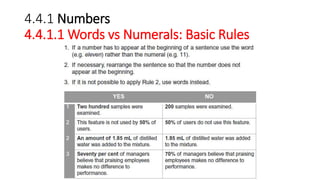
• strategies, procedures or techniques for solving the problem(s)
• an indication of further work which needs to be completed
• A series of recommendations may be worded in instructional
language; for example, each beginning with a verb.
• For Example,
• Reduce production rate 50 percent.
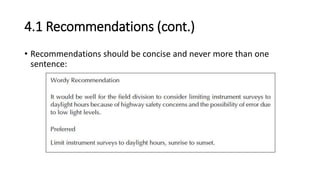
4.1 Recommendations (cont.)
• Recommendations should be concise and never more than one
sentence:
4.1 Recommendations (cont.)
• Recommendations do not include discussion.
• As the discussions supporting the recommendations should have already
been presented in the discussion section.
• The Conclusions and Recommendations may be combined or not.
• If there are no recommendations to be made as a result of the
project, just call this section Conclusions.
4.1 Recommendations (cont.)
• When there is only one recommendation, try to make it part of a
short paragraph.
• However, do not add new information or discussion.
• It is never appropriate to enumerate conclusions or
recommendations with only one item.
• If the purpose of a technical report is to present the results of, for
example, an analytical service, it may be inappropriate to have
recommendations.
4.1 Recommendations (cont.)
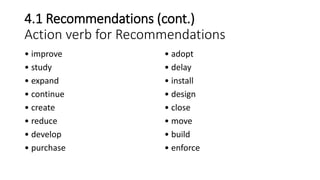
Action verb for Recommendations
• improve
• study
• expand
• continue
• create
• reduce
• develop
• purchase
• adopt
• delay
• install
• design
• close
• move
• build
• enforce
4.1 Recommendations (cont.)
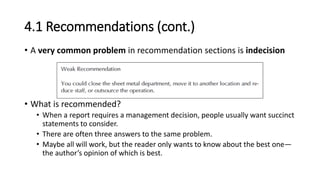
• A very common problem in recommendation sections is indecision
• What is recommended?
• When a report requires a management decision, people usually want succinct
statements to consider.
• There are often three answers to the same problem.
• Maybe all will work, but the reader only wants to know about the best one—
the author’s opinion of which is best.
4.2 References
• The heading for this list will be References.
• The reference section lists the works of others that you referred.
• Why references?
• The objective is to add credibility to your work.
• A reference list shows that you have examined the literature as background
to see if others have done similar work or if the work has never been done
previously by others.
• This is especially true with published articles.
• What is in references?
• It includes books, journals, articles and unpublished works such as company
or organization reports or university theses.
4.2 References (cont.)
• How are they cited?
• References are often cited in the text with square brackets [10], but this may
depend on the style for a given publication.
• Why square brackets?
• Brackets are good, because they are distinct and can be easily found when
you are editing the text electronically.
• Never list a reference that cannot be obtained by the reader.
4.2 References (cont.)
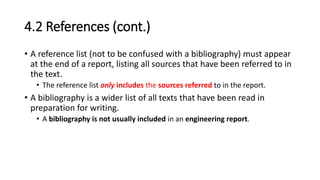
• A reference list (not to be confused with a bibliography) must appear
at the end of a report, listing all sources that have been referred to in
the text.
• The reference list only includes the sources referred to in the report.
• A bibliography is a wider list of all texts that have been read in
preparation for writing.
• A bibliography is not usually included in an engineering report.
4.2 References (cont.)
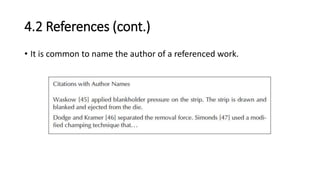
• It is common to name the author of a referenced work.
4.2 References (cont.)
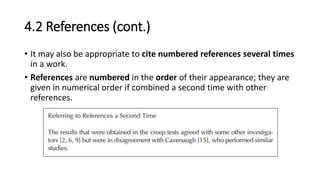
• It may also be appropriate to cite numbered references several times
in a work.
• References are numbered in the order of their appearance; they are
given in numerical order if combined a second time with other
references.
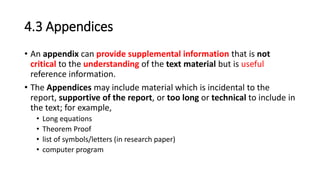
4.3 Appendices
• An appendix can provide supplemental information that is not
critical to the understanding of the text material but is useful
reference information.
• The Appendices may include material which is incidental to the
report, supportive of the report, or too long or technical to include in
the text; for example,
• Long equations
• Theorem Proof
• list of symbols/letters (in research paper)
• computer program
4.3 Appendices (cont.)
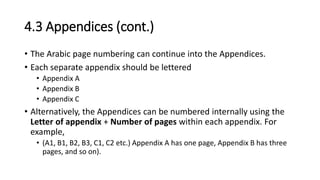
• The Arabic page numbering can continue into the Appendices.
• Each separate appendix should be lettered
• Appendix A
• Appendix B
• Appendix C
• Alternatively, the Appendices can be numbered internally using the
Letter of appendix + Number of pages within each appendix. For
example,
• (A1, B1, B2, B3, C1, C2 etc.) Appendix A has one page, Appendix B has three
pages, and so on).
4.3 Appendices (cont.)
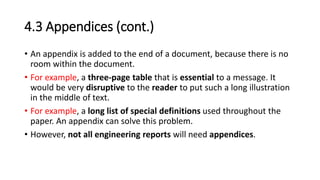
• An appendix is added to the end of a document, because there is no
room within the document.
• For example, a three-page table that is essential to a message. It
would be very disruptive to the reader to put such a long illustration
in the middle of text.
• For example, a long list of special definitions used throughout the
paper. An appendix can solve this problem.
• However, not all engineering reports will need appendices.
4.3 Appendices (cont.)
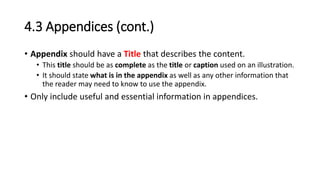
• Appendix should have a Title that describes the content.
• This title should be as complete as the title or caption used on an illustration.
• It should state what is in the appendix as well as any other information that
the reader may need to know to use the appendix.
• Only include useful and essential information in appendices.
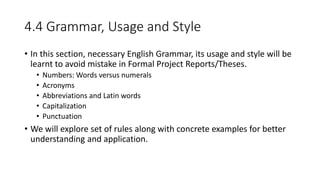
4.4 Grammar, Usage and Style
• In this section, necessary English Grammar, its usage and style will be
learnt to avoid mistake in Formal Project Reports/Theses.
• Numbers: Words versus numerals
• Acronyms
• Abbreviations and Latin words
• Capitalization
• Punctuation
• We will explore set of rules along with concrete examples for better
understanding and application.
4.4.1 Numbers
4.4.1.1 Words vs Numerals: Basic Rules
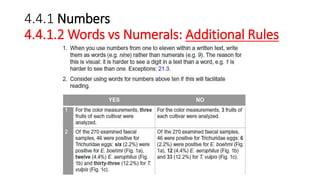
4.4.1 Numbers
4.4.1.2 Words vs Numerals: Additional Rules
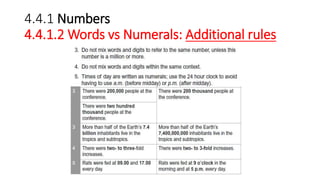
4.4.1 Numbers
4.4.1.2 Words vs Numerals: Additional rules
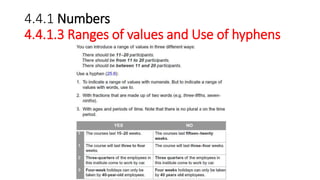
4.4.1 Numbers
4.4.1.3 Ranges of values and Use of hyphens
4.4.1 Numbers
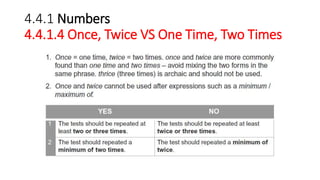
4.4.1.4 Once, Twice VS One Time, Two Times
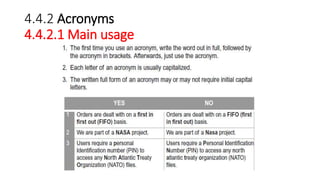
4.4.2 Acronyms
4.4.2.1 Main usage
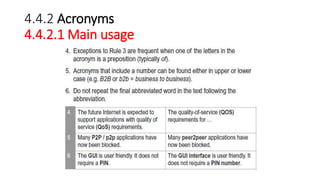
4.4.2 Acronyms
4.4.2.1 Main usage
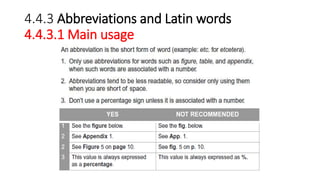
4.4.3 Abbreviations and Latin words
4.4.3.1 Main usage
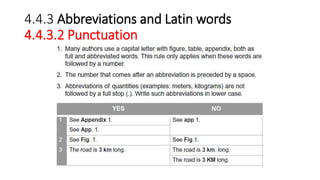
4.4.3 Abbreviations and Latin words
4.4.3.2 Punctuation
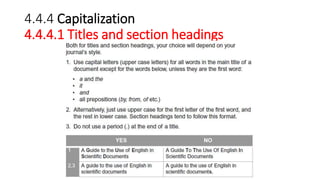
4.4.4 Capitalization
4.4.4.1 Titles and section headings
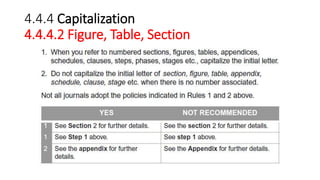
4.4.4 Capitalization
4.4.4.2 Figure, Table, Section
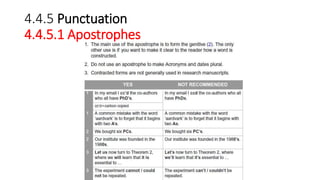
4.4.5 Punctuation
4.4.5.1 Apostrophes
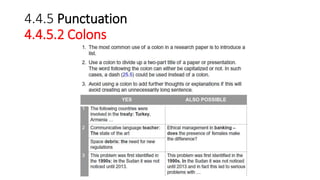
4.4.5 Punctuation
4.4.5.2 Colons
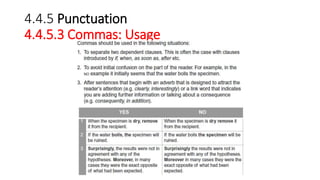
4.4.5 Punctuation
4.4.5.3 Commas: Usage
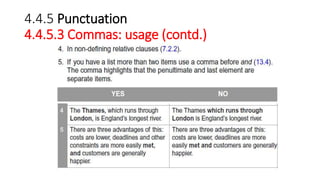
4.4.5 Punctuation
4.4.5.3 Commas: usage (contd.)
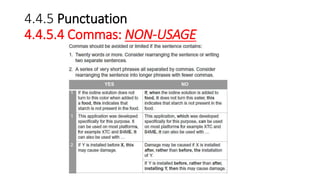
4.4.5 Punctuation
4.4.5.4 Commas: NON-USAGE
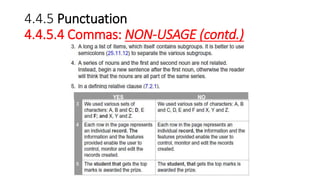
4.4.5 Punctuation
4.4.5.4 Commas: NON-USAGE (contd.)
Bibliography
• K. G. Budinski, Engineers' guide to technical writing, ASM
International, 2001.
• Matthews, J. R., & Matthews, R. W. (2014). Successful scientific
writing. Cambridge University Press.
• Wallwork, A. (2012). English for Academic Research: Grammar, Usage
and Style. Springer Science & Business Media.

Communication Skills Lectures # 4.pptx

  • 1.
    Formal Project Reports Lecture# 4 EN-223 Research Project & Presentation
  • 2.
    Lecture Outline • Recommendations •References • Appendices • Grammar, Usage and Style
  • 3.
    4.1 Recommendations • Arecommendation is a statement suggesting a particular course of action • Not all reports include recommendations. • But if required, recommendations should emerge from the conclusions of the report. • Recommendations come at the end of reports, and they often are the final product of a study in formal reports. • This section is important to those who must act on the findings e.g. manufacturer, lab technicians, business executives, researchers etc.
  • 4.
    4.1 Recommendations (cont.) •Recommendations may involve: • strategies, procedures or techniques for solving the problem(s) • an indication of further work which needs to be completed • A series of recommendations may be worded in instructional language; for example, each beginning with a verb. • For Example, • Reduce production rate 50 percent.
  • 5.
    4.1 Recommendations (cont.) •Recommendations should be concise and never more than one sentence:
  • 6.
    4.1 Recommendations (cont.) •Recommendations do not include discussion. • As the discussions supporting the recommendations should have already been presented in the discussion section. • The Conclusions and Recommendations may be combined or not. • If there are no recommendations to be made as a result of the project, just call this section Conclusions.
  • 7.
    4.1 Recommendations (cont.) •When there is only one recommendation, try to make it part of a short paragraph. • However, do not add new information or discussion. • It is never appropriate to enumerate conclusions or recommendations with only one item. • If the purpose of a technical report is to present the results of, for example, an analytical service, it may be inappropriate to have recommendations.
  • 8.
    4.1 Recommendations (cont.) Actionverb for Recommendations • improve • study • expand • continue • create • reduce • develop • purchase • adopt • delay • install • design • close • move • build • enforce
  • 9.
    4.1 Recommendations (cont.) •A very common problem in recommendation sections is indecision • What is recommended? • When a report requires a management decision, people usually want succinct statements to consider. • There are often three answers to the same problem. • Maybe all will work, but the reader only wants to know about the best one— the author’s opinion of which is best.
  • 10.
    4.2 References • Theheading for this list will be References. • The reference section lists the works of others that you referred. • Why references? • The objective is to add credibility to your work. • A reference list shows that you have examined the literature as background to see if others have done similar work or if the work has never been done previously by others. • This is especially true with published articles. • What is in references? • It includes books, journals, articles and unpublished works such as company or organization reports or university theses.
  • 11.
    4.2 References (cont.) •How are they cited? • References are often cited in the text with square brackets [10], but this may depend on the style for a given publication. • Why square brackets? • Brackets are good, because they are distinct and can be easily found when you are editing the text electronically. • Never list a reference that cannot be obtained by the reader.
  • 12.
    4.2 References (cont.) •A reference list (not to be confused with a bibliography) must appear at the end of a report, listing all sources that have been referred to in the text. • The reference list only includes the sources referred to in the report. • A bibliography is a wider list of all texts that have been read in preparation for writing. • A bibliography is not usually included in an engineering report.
  • 13.
    4.2 References (cont.) •It is common to name the author of a referenced work.
  • 14.
    4.2 References (cont.) •It may also be appropriate to cite numbered references several times in a work. • References are numbered in the order of their appearance; they are given in numerical order if combined a second time with other references.
  • 15.
    4.3 Appendices • Anappendix can provide supplemental information that is not critical to the understanding of the text material but is useful reference information. • The Appendices may include material which is incidental to the report, supportive of the report, or too long or technical to include in the text; for example, • Long equations • Theorem Proof • list of symbols/letters (in research paper) • computer program
  • 16.
    4.3 Appendices (cont.) •The Arabic page numbering can continue into the Appendices. • Each separate appendix should be lettered • Appendix A • Appendix B • Appendix C • Alternatively, the Appendices can be numbered internally using the Letter of appendix + Number of pages within each appendix. For example, • (A1, B1, B2, B3, C1, C2 etc.) Appendix A has one page, Appendix B has three pages, and so on).
  • 17.
    4.3 Appendices (cont.) •An appendix is added to the end of a document, because there is no room within the document. • For example, a three-page table that is essential to a message. It would be very disruptive to the reader to put such a long illustration in the middle of text. • For example, a long list of special definitions used throughout the paper. An appendix can solve this problem. • However, not all engineering reports will need appendices.
  • 18.
    4.3 Appendices (cont.) •Appendix should have a Title that describes the content. • This title should be as complete as the title or caption used on an illustration. • It should state what is in the appendix as well as any other information that the reader may need to know to use the appendix. • Only include useful and essential information in appendices.
  • 19.
    4.4 Grammar, Usageand Style • In this section, necessary English Grammar, its usage and style will be learnt to avoid mistake in Formal Project Reports/Theses. • Numbers: Words versus numerals • Acronyms • Abbreviations and Latin words • Capitalization • Punctuation • We will explore set of rules along with concrete examples for better understanding and application.
  • 20.
    4.4.1 Numbers 4.4.1.1 Wordsvs Numerals: Basic Rules
  • 21.
    4.4.1 Numbers 4.4.1.2 Wordsvs Numerals: Additional Rules
  • 22.
    4.4.1 Numbers 4.4.1.2 Wordsvs Numerals: Additional rules
  • 23.
    4.4.1 Numbers 4.4.1.3 Rangesof values and Use of hyphens
  • 24.
    4.4.1 Numbers 4.4.1.4 Once,Twice VS One Time, Two Times
  • 25.
  • 26.
  • 27.
    4.4.3 Abbreviations andLatin words 4.4.3.1 Main usage
  • 28.
    4.4.3 Abbreviations andLatin words 4.4.3.2 Punctuation
  • 29.
  • 30.
  • 31.
  • 32.
  • 33.
  • 34.
  • 35.
  • 36.
  • 37.
    Bibliography • K. G.Budinski, Engineers' guide to technical writing, ASM International, 2001. • Matthews, J. R., & Matthews, R. W. (2014). Successful scientific writing. Cambridge University Press. • Wallwork, A. (2012). English for Academic Research: Grammar, Usage and Style. Springer Science & Business Media.