

Presented by- group 4

                      Kshitij singh
                    Ginil vincent
            Sree deep mukherjee
                      Aamir altaf
                 Shantanu kumar
BPR changes processes and
            not
 functions, departments,
   geographies or tasks.
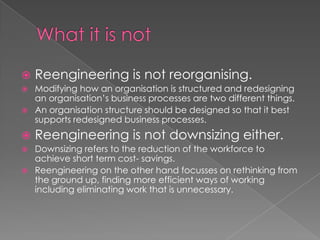
   Reengineering is not reorganising.
   Modifying how an organisation is structured and redesigning
    an organisation’s business processes are two different things.
   An organisation structure should be designed so that it best
    supports redesigned business processes.
   Reengineering is not downsizing either.
   Downsizing refers to the reduction of the workforce to
    achieve short term cost- savings.
   Reengineering on the other hand focusses on rethinking from
    the ground up, finding more efficient ways of working
    including eliminating work that is unnecessary.
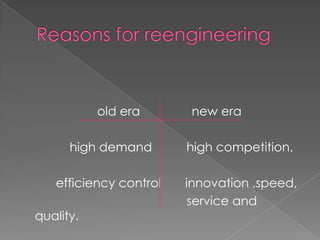
old era       new era

      high demand       high competition.

   efficiency control   innovation ,speed,
                         service and
quality.
 Empowering employees.
 Eliminating waste, unnecessary
  management overhead, and obsolete
  or inefficient processes.
 Producing often significant reductions in
  cost and cycle times.
 Helding top organisations stay on top
  and low achievers to become effective
  competitors.
 Business climate made reengineering
  necessary in U.S.A.
 Business face so many troubles like:


   Assembly line model of production, where customer waited
    in line for delivery.
   Competition within the country is very low.
   Global competition was largely non-existent.
 Japanese organisations entered into USA
  market.
 Japanese were too smart, they move
  small market into world markets with
  extraordinary quality and manufacturing
  philosophy. They cut out necessary
  waste like:
   Safety stock inventories.
   Multiple suppliers.
   External inspection.
   Low cost in regular basis.
   High quality.
 US adopted japanese paradigm
  because of:
 They realised that economies of scale is
  not important as economy of time.
 They opted for flexibility and multi- skilling
  techniques in work –culture and this
  created the ability to respond i.e discard
  old and narrow focussed to new
  innovation works.
 Customers response became the
  primary objective rather than the growth
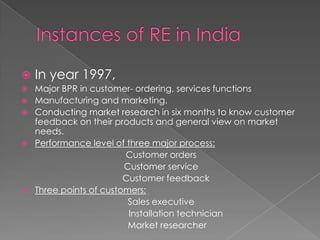
   In year 1997,
   Major BPR in customer- ordering, services functions
   Manufacturing and marketing.
   Conducting market research in six months to know customer
    feedback on their products and general view on market
    needs.
   Performance level of three major process:
                         Customer orders
                         Customer service
                         Customer feedback
   Three points of customers:
                          Sales executive
                          Installation technician
                          Market researcher
 Leasing and financing company.
 Manufacturing company.
 News paper publishers.
Business process reengineering

Business process reengineering

  • 1.
    Presented by- group4 Kshitij singh Ginil vincent Sree deep mukherjee Aamir altaf Shantanu kumar
  • 3.
    BPR changes processesand not functions, departments, geographies or tasks.
  • 4.
    Reengineering is not reorganising.  Modifying how an organisation is structured and redesigning an organisation’s business processes are two different things.  An organisation structure should be designed so that it best supports redesigned business processes.  Reengineering is not downsizing either.  Downsizing refers to the reduction of the workforce to achieve short term cost- savings.  Reengineering on the other hand focusses on rethinking from the ground up, finding more efficient ways of working including eliminating work that is unnecessary.
  • 5.
    old era new era high demand high competition. efficiency control innovation ,speed, service and quality.
  • 8.
     Empowering employees. Eliminating waste, unnecessary management overhead, and obsolete or inefficient processes.  Producing often significant reductions in cost and cycle times.  Helding top organisations stay on top and low achievers to become effective competitors.
  • 9.
     Business climatemade reengineering necessary in U.S.A.  Business face so many troubles like:  Assembly line model of production, where customer waited in line for delivery.  Competition within the country is very low.  Global competition was largely non-existent.
  • 10.
     Japanese organisationsentered into USA market.  Japanese were too smart, they move small market into world markets with extraordinary quality and manufacturing philosophy. They cut out necessary waste like:  Safety stock inventories.  Multiple suppliers.  External inspection.  Low cost in regular basis.  High quality.
  • 11.
     US adoptedjapanese paradigm because of:  They realised that economies of scale is not important as economy of time.  They opted for flexibility and multi- skilling techniques in work –culture and this created the ability to respond i.e discard old and narrow focussed to new innovation works.  Customers response became the primary objective rather than the growth
  • 12.
    In year 1997,  Major BPR in customer- ordering, services functions  Manufacturing and marketing.  Conducting market research in six months to know customer feedback on their products and general view on market needs.  Performance level of three major process: Customer orders Customer service Customer feedback  Three points of customers: Sales executive Installation technician Market researcher
  • 13.
     Leasing andfinancing company.  Manufacturing company.  News paper publishers.