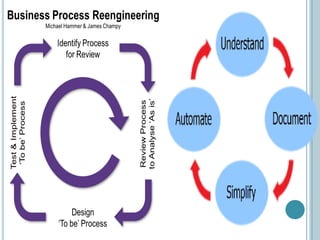
BUSINESS PROCESS
RE-ENGINEERING
1
Professor,
Entrepreneur & Lawyer.
Puttu Guru Prasad,Puttu Guru Prasad,
M.Com. M.B.A., L.L.B., M.Phil. PGDFTM.
AP.SET., ICFAI TMF., (PhD) at JNTUK.
Senior Faculty for Management Science,
VVIT-NamburVVIT-Nambur
My Blog: puttuguru.blogspot.in
93 94 96 98 98, 807 444 95 39,
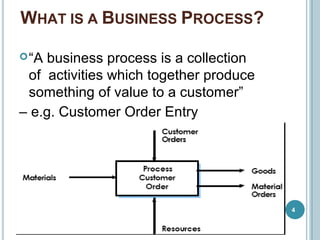
WHAT IS A BUSINESS PROCESS?
“A business process is a collection
of activities which together produce
something of value to a customer”
– e.g. Customer Order Entry
4
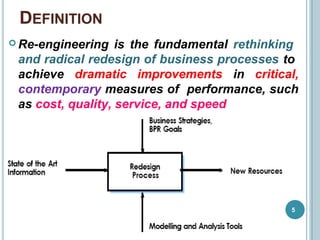
DEFINITION
 Re-engineering is the fundamental rethinking
and radical redesign of business processes to
achieve dramatic improvements in critical,
contemporary measures of performance, such
as cost, quality, service, and speed
5
WHAT TO RE-ENGINEER?
BPR changes processes, and not
functions, departments,
geographies or tasks.
6
WHAT IT IS NOT?
7
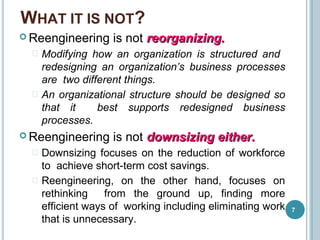
 Reengineering is not reorganizing.reorganizing.
 Modifying how an organization is structured and
redesigning an organization’s business processes
are two different things.
 An organizational structure should be designed so
that it best supports redesigned business
processes.
 Reengineering is not downsizing either.downsizing either.
 Downsizing focuses on the reduction of workforce
to achieve short-term cost savings.
 Reengineering, on the other hand, focuses on
rethinking from the ground up, finding more
efficient ways of working including eliminating work
that is unnecessary.
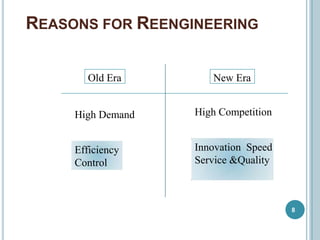
REASONS FOR REENGINEERING
Old Era New Era
High Demand
Efficiency
Control
High Competition
Innovation Speed
Service &Quality
8
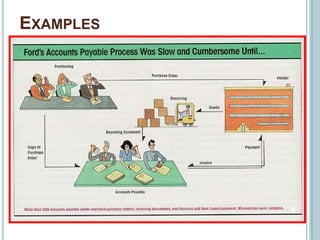
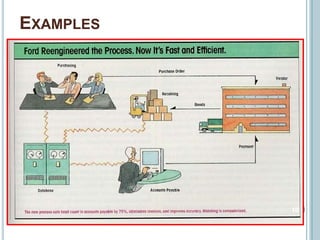
EXAMPLES
9
EXAMPLES
10
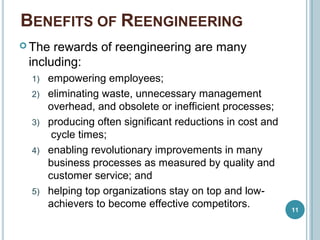
BENEFITS OF REENGINEERING
11
 The rewards of reengineering are many
including:
1) empowering employees;
2) eliminating waste, unnecessary management
overhead, and obsolete or inefficient processes;
3) producing often significant reductions in cost and
cycle times;
4) enabling revolutionary improvements in many
business processes as measured by quality and
customer service; and
5) helping top organizations stay on top and low-
achievers to become effective competitors.
BUSINESS PROCESS
REENGINEERING
Imperative for Survival
Methodology
Steps
1
1
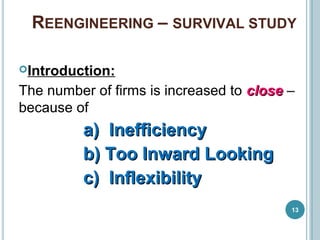
REENGINEERING – SURVIVAL STUDY
13
Introduction:
The number of firms is increased to closeclose –
because of
a)a) InefficiencyInefficiency
b)b) Too Inward LookingToo Inward Looking
c)c) InflexibilityInflexibility
REENGINEERING – SURVIVAL STUDY
14
Similar changes occurred in developed and developing
nations also and still facing a similar challenge.
Example:
Ford Motor Company faced business extinctionextinction at one
time and found the paths to renewed success and
inspires others.
Business Reengineering –
Process thro’ which the continuous success and survival
is indicated (by Americans).
Term is invented by Michael Hammer.
REENGINEERING IMPERATIVE IN USA
The business climate made reengineering
necessary in the United States.
US gave great industrial philosophers like
Adam Smith and Henry Ford. But at
one time their business was also in
trouble.
This situation arises because of three
main reasons. They are,(follows->)
14
REENGINEERING IMPERATIVE IN USA
a)The Assembly line model of production, where
customer waited in line for delivery
b) Competition within the country is very low.
c) Global competition was largely non-existent.
To recover from this situation, FORD changed from
their Production Supremacy to Supplier primacy,
when the Model T Ford released in the market.
Henry Ford said “I will give the customer any color“I will give the customer any color
of car he wants – so long as it’s black.”of car he wants – so long as it’s black.”
REENGINEERING – SURVIVAL STUDY
Japanese organizations entered into
America (after War)
Japanese were too smart, they move small
market into world markets with
extraordinary quality and manufacturing
philosophy. They cut out unnecessary
waste such as,
1. Safety stock Inventories
2. Multiple suppliers
3. External Inspection
4. High Quality
5. Low cost in regular basis
15
 US adopted the Japanese paradigm because of :
1. They recognized that economy of scale is not as
important as economy of time. So, the entire
approach was to be flexible and respond quickly
to changing customer needs.
2. They opted for flexibility and multi- skilling
techniques in work culture and this created the
ability to respond. i.e. discard old and narrow
focused to new innovations in work.
3. Customer’s response become the primary
objective rather than the growth alone.
JAPANESE
PARADIGM
16
REENGINEERING SCENARIO IN EUROPE
In Europe,
-Quiet Transformations are taking place vitally.
- For example,
-Lubricants division of a large oil company has cut
its order delivery time to 40% ( from 6weeks to
19 days).
-Eliminated $200 millions in inventory and
doubled its profits.
-It aims in overall reduction in operating
expenses to 35%.
IMPERATIVE IN INDIA
20
 The first country realized the value of destruction and
destroyer.
 Quality competitions by
 ISO 9000 and TQM
 Computerization of processes
 Many reasons for lacking:
 Blaming technology by system professionals
 Users blame technology and system professionals
 Top management blames both users and system
professionals.
 Consultants blame all others.
 Global environment is pulling Indian organizations into
- Customer orientation
- quick response time
- quality imperatives
- cost minimization
Conclusion:
- environmental pull
- technology push
- Economic liberalization
21
IIMPERATIVE INMPERATIVE IN IINDIANDIA
 Cant do redefine their mission and objectives
 clinically reassess the key business processes
 achieve improvements in process efficiency and
effectiveness thro’ BPR.
Examples:
- HP, Pepsi abroad, Federal Express
22
IMPERATIVE IN INDIA
INSTANCES OF RE IN INDIAN ORG
23
 In year 1997,
Major BPR in customer ordering , services
functions
Manufacturing and marketing
Organizing market research once in six
months to know customer feedback on their
products and general view on market
needs
 Performance levels of 3 major process:
- Customer orders
- Customer service
- Customer feedback
 Three points of customers:
- Sales executive
- Installation technician
- Market Researcher
INSTANCES IN RE IN INDIA
24
 Leasing and financing company
 Manufacturing company
 News paper publishers

8. business process re engineering pgp2

  • 1.
    BUSINESS PROCESS RE-ENGINEERING 1 Professor, Entrepreneur &Lawyer. Puttu Guru Prasad,Puttu Guru Prasad, M.Com. M.B.A., L.L.B., M.Phil. PGDFTM. AP.SET., ICFAI TMF., (PhD) at JNTUK. Senior Faculty for Management Science, VVIT-NamburVVIT-Nambur My Blog: puttuguru.blogspot.in 93 94 96 98 98, 807 444 95 39,
  • 4.
    WHAT IS ABUSINESS PROCESS? “A business process is a collection of activities which together produce something of value to a customer” – e.g. Customer Order Entry 4
  • 5.
    DEFINITION  Re-engineering isthe fundamental rethinking and radical redesign of business processes to achieve dramatic improvements in critical, contemporary measures of performance, such as cost, quality, service, and speed 5
  • 6.
    WHAT TO RE-ENGINEER? BPRchanges processes, and not functions, departments, geographies or tasks. 6
  • 7.
    WHAT IT ISNOT? 7  Reengineering is not reorganizing.reorganizing.  Modifying how an organization is structured and redesigning an organization’s business processes are two different things.  An organizational structure should be designed so that it best supports redesigned business processes.  Reengineering is not downsizing either.downsizing either.  Downsizing focuses on the reduction of workforce to achieve short-term cost savings.  Reengineering, on the other hand, focuses on rethinking from the ground up, finding more efficient ways of working including eliminating work that is unnecessary.
  • 8.
    REASONS FOR REENGINEERING OldEra New Era High Demand Efficiency Control High Competition Innovation Speed Service &Quality 8
  • 9.
  • 10.
  • 11.
    BENEFITS OF REENGINEERING 11 The rewards of reengineering are many including: 1) empowering employees; 2) eliminating waste, unnecessary management overhead, and obsolete or inefficient processes; 3) producing often significant reductions in cost and cycle times; 4) enabling revolutionary improvements in many business processes as measured by quality and customer service; and 5) helping top organizations stay on top and low- achievers to become effective competitors.
  • 12.
    BUSINESS PROCESS REENGINEERING Imperative forSurvival Methodology Steps 1 1
  • 13.
    REENGINEERING – SURVIVALSTUDY 13 Introduction: The number of firms is increased to closeclose – because of a)a) InefficiencyInefficiency b)b) Too Inward LookingToo Inward Looking c)c) InflexibilityInflexibility
  • 14.
    REENGINEERING – SURVIVALSTUDY 14 Similar changes occurred in developed and developing nations also and still facing a similar challenge. Example: Ford Motor Company faced business extinctionextinction at one time and found the paths to renewed success and inspires others. Business Reengineering – Process thro’ which the continuous success and survival is indicated (by Americans). Term is invented by Michael Hammer.
  • 15.
    REENGINEERING IMPERATIVE INUSA The business climate made reengineering necessary in the United States. US gave great industrial philosophers like Adam Smith and Henry Ford. But at one time their business was also in trouble. This situation arises because of three main reasons. They are,(follows->) 14
  • 16.
    REENGINEERING IMPERATIVE INUSA a)The Assembly line model of production, where customer waited in line for delivery b) Competition within the country is very low. c) Global competition was largely non-existent. To recover from this situation, FORD changed from their Production Supremacy to Supplier primacy, when the Model T Ford released in the market. Henry Ford said “I will give the customer any color“I will give the customer any color of car he wants – so long as it’s black.”of car he wants – so long as it’s black.”
  • 17.
    REENGINEERING – SURVIVALSTUDY Japanese organizations entered into America (after War) Japanese were too smart, they move small market into world markets with extraordinary quality and manufacturing philosophy. They cut out unnecessary waste such as, 1. Safety stock Inventories 2. Multiple suppliers 3. External Inspection 4. High Quality 5. Low cost in regular basis 15
  • 18.
     US adoptedthe Japanese paradigm because of : 1. They recognized that economy of scale is not as important as economy of time. So, the entire approach was to be flexible and respond quickly to changing customer needs. 2. They opted for flexibility and multi- skilling techniques in work culture and this created the ability to respond. i.e. discard old and narrow focused to new innovations in work. 3. Customer’s response become the primary objective rather than the growth alone. JAPANESE PARADIGM 16
  • 19.
    REENGINEERING SCENARIO INEUROPE In Europe, -Quiet Transformations are taking place vitally. - For example, -Lubricants division of a large oil company has cut its order delivery time to 40% ( from 6weeks to 19 days). -Eliminated $200 millions in inventory and doubled its profits. -It aims in overall reduction in operating expenses to 35%.
  • 20.
    IMPERATIVE IN INDIA 20 The first country realized the value of destruction and destroyer.  Quality competitions by  ISO 9000 and TQM  Computerization of processes  Many reasons for lacking:  Blaming technology by system professionals  Users blame technology and system professionals  Top management blames both users and system professionals.  Consultants blame all others.
  • 21.
     Global environmentis pulling Indian organizations into - Customer orientation - quick response time - quality imperatives - cost minimization Conclusion: - environmental pull - technology push - Economic liberalization 21 IIMPERATIVE INMPERATIVE IN IINDIANDIA
  • 22.
     Cant doredefine their mission and objectives  clinically reassess the key business processes  achieve improvements in process efficiency and effectiveness thro’ BPR. Examples: - HP, Pepsi abroad, Federal Express 22 IMPERATIVE IN INDIA
  • 23.
    INSTANCES OF REIN INDIAN ORG 23  In year 1997, Major BPR in customer ordering , services functions Manufacturing and marketing Organizing market research once in six months to know customer feedback on their products and general view on market needs  Performance levels of 3 major process: - Customer orders - Customer service - Customer feedback  Three points of customers: - Sales executive - Installation technician - Market Researcher
  • 24.
    INSTANCES IN REIN INDIA 24  Leasing and financing company  Manufacturing company  News paper publishers