BUSINESS ORGANIZATION
DEVELOPMENT OF BUSINESS
or
BUSINESS DEVELOPMENT (BD)
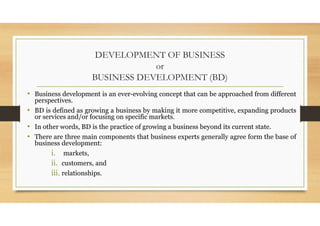
• Business development is an ever-evolving concept that can be approached from different
perspectives.
• BD is defined as growing a business by making it more competitive, expanding products
or services and/or focusing on specific markets.
• In other words, BD is the practice of growing a business beyond its current state.
• There are three main components that business experts generally agree form the base of
business development:
i. markets,
ii. customers, and
iii. relationships.
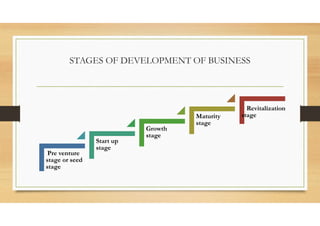
STAGES OF DEVELOPMENT OF BUSINESS
Pre venture
stage or seed
stage
Start up
stage
Growth
stage
Maturity
stage
Revitalization
stage
STAGES OF DEVELOPMENT OF BUSINESS
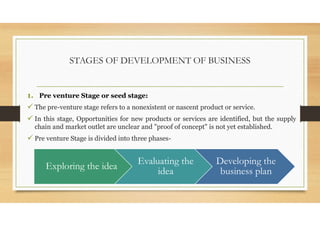
1. Pre venture Stage or seed stage:
 The pre-venture stage refers to a nonexistent or nascent product or service.
 In this stage, Opportunities for new products or services are identified, but the supply
chain and market outlet are unclear and "proof of concept" is not yet established.
 Pre venture Stage is divided into three phases-
Exploring the idea
Evaluating the
idea
Developing the
business plan
DEVELOPMENT OF BUSINESS
or
BUSINESS DEVELOPMENT (BD)
i. Exploring the idea:
The Latin root of explore is explorare, meaning "investigate or search out. All business starts
with an idea. It needs to explore business ideas that idea has truly potential. Either it works or
not. Will it make money? Go for market research and analysis.
ii. Evaluating the idea:
After identifying the business ideas, it needs to determine which business ideas offer valuable
opportunities and are worth pursuing. Evaluating new ideas is one of the most challenging parts
of the job. new ideas always have a lot of uncertainty involved and little data to back them up.
So, it is required to carefully evaluating and understanding the strengths and weakness of
business ideas in terms of market opportunities, finance, business structure and board
governance, and industry regulation, etc and decide which ones to implement right away, which
ones to test or pilot, which ones to keep for later, and which ones to outright discard.
DEVELOPMENT OF BUSINESS
or
BUSINESS DEVELOPMENT (BD)
iii. Developing business plan:
A business plan is a key tool which is developed to assist the individual/ group in achieving its
goals and objectives. A Business plan includes-
 business objectives
 Marketing plan- 4ps
 Management and human resources plan
 Financial plan
 The environmental plan (regulating requirements and community)
 The risk management and contingency plan etc.
DEVELOPMENT OF BUSINESS
or
BUSINESS DEVELOPMENT (BD)
2. Start up stage
The start-up stage is characterized by launching the business, establishing products,
building a customer base, perhaps hiring the first employee(s), setting up organizational
systems, achieving break-even sales targets, and establishing a track record for product
quality and service. In this stage, business plan is implemented.
DEVELOPMENT OF BUSINESS
or
BUSINESS DEVELOPMENT (BD)
3. Growth stage
Enterprises in the growth stage experience a significant expansion in overall sales volume
and in the number and variety of customers or markets. They may expand the products or
services offered, and usually have an established brand identity in the marketplace. Due to
this growth they hire more employees, improve or invest in new infrastructure and
equipment, make improvements to internal systems, and improve their efficiency and
productivity.
DEVELOPMENT OF BUSINESS
or
BUSINESS DEVELOPMENT (BD)
4. Maturity stage
Mature businesses have achieved a solid business model that, because of
either market conditions or the preferences of owners, appears sustainable.
However, without dramatic change, companies in this stage are unlikely to
expand significantly. Even though they may have achieved strong brand
recognition, and a solid repeat customer base, mature businesses often face
challenges, including sustaining themselves in a rapidly changing and
competitive marketplace.
DEVELOPMENT OF BUSINESS
or
BUSINESS DEVELOPMENT (BD)
5. Revitalization stage
A revitalization stage arises when external or internal activities (or both)
force a mature business to a tipping point. A downward trend may ensue, or
innovating competitors may introduce new ideas, products, or services to
revive the sector. Taking action in the maturity stage can send an
organization in new directions. Innovation and diversification can lead to
new products and new markets
Meaning of Business Organization
• Business Organization is an entity formed for the purpose of carrying on
commercial enterprise that describes how businesses are structured and
how to produce goods or services and meet needs of the customers.
• Business organization means bringing together various components of
business such as workforce, raw-materials, machines, capital, energy, etc.,
putting them on work systematically, and coordinating and controlling’
their activities effectively to achieve the objective of earning profit.
• The Business Organization aims to focus on either generating profit (for
profit organization) or improving society (not for profit).
Meaning of Business Organization
• In the opinion of J.W. Shulze, "organization is a combination of necessary beings,
materials, tools, equipment, working space apparatus and finance brought together in a
systematic and effective correlation to accomplish some desired objective".
• Oliver Sheldon defined business organization as " the process of combining the work
which individuals and groups have to perform with the facilities necessary for its
execution so that they provide the best channels for efficient, systematic, positive and
coordinated application of the available effort".
• As viewed by F.J. Wright, "organization is the arranging or combining of resources to
achieve an economic aim--either with the resources available to achieve the maximum
result or profit, or to achieve a given aim with the least possible expenditure of
resources".
Characteristics of Business Organization
• Group of people
• Predetermined aims and objectives
• Coordination and co-operation in the working
• Arrangement of various resources
• Direction, operation and control of business activity
• Delegating authority according to responsibility

Bo2

  • 1.
  • 2.
    DEVELOPMENT OF BUSINESS or BUSINESSDEVELOPMENT (BD) • Business development is an ever-evolving concept that can be approached from different perspectives. • BD is defined as growing a business by making it more competitive, expanding products or services and/or focusing on specific markets. • In other words, BD is the practice of growing a business beyond its current state. • There are three main components that business experts generally agree form the base of business development: i. markets, ii. customers, and iii. relationships.
  • 3.
    STAGES OF DEVELOPMENTOF BUSINESS Pre venture stage or seed stage Start up stage Growth stage Maturity stage Revitalization stage
  • 4.
    STAGES OF DEVELOPMENTOF BUSINESS 1. Pre venture Stage or seed stage:  The pre-venture stage refers to a nonexistent or nascent product or service.  In this stage, Opportunities for new products or services are identified, but the supply chain and market outlet are unclear and "proof of concept" is not yet established.  Pre venture Stage is divided into three phases- Exploring the idea Evaluating the idea Developing the business plan
  • 5.
    DEVELOPMENT OF BUSINESS or BUSINESSDEVELOPMENT (BD) i. Exploring the idea: The Latin root of explore is explorare, meaning "investigate or search out. All business starts with an idea. It needs to explore business ideas that idea has truly potential. Either it works or not. Will it make money? Go for market research and analysis. ii. Evaluating the idea: After identifying the business ideas, it needs to determine which business ideas offer valuable opportunities and are worth pursuing. Evaluating new ideas is one of the most challenging parts of the job. new ideas always have a lot of uncertainty involved and little data to back them up. So, it is required to carefully evaluating and understanding the strengths and weakness of business ideas in terms of market opportunities, finance, business structure and board governance, and industry regulation, etc and decide which ones to implement right away, which ones to test or pilot, which ones to keep for later, and which ones to outright discard.
  • 6.
    DEVELOPMENT OF BUSINESS or BUSINESSDEVELOPMENT (BD) iii. Developing business plan: A business plan is a key tool which is developed to assist the individual/ group in achieving its goals and objectives. A Business plan includes-  business objectives  Marketing plan- 4ps  Management and human resources plan  Financial plan  The environmental plan (regulating requirements and community)  The risk management and contingency plan etc.
  • 7.
    DEVELOPMENT OF BUSINESS or BUSINESSDEVELOPMENT (BD) 2. Start up stage The start-up stage is characterized by launching the business, establishing products, building a customer base, perhaps hiring the first employee(s), setting up organizational systems, achieving break-even sales targets, and establishing a track record for product quality and service. In this stage, business plan is implemented.
  • 8.
    DEVELOPMENT OF BUSINESS or BUSINESSDEVELOPMENT (BD) 3. Growth stage Enterprises in the growth stage experience a significant expansion in overall sales volume and in the number and variety of customers or markets. They may expand the products or services offered, and usually have an established brand identity in the marketplace. Due to this growth they hire more employees, improve or invest in new infrastructure and equipment, make improvements to internal systems, and improve their efficiency and productivity.
  • 9.
    DEVELOPMENT OF BUSINESS or BUSINESSDEVELOPMENT (BD) 4. Maturity stage Mature businesses have achieved a solid business model that, because of either market conditions or the preferences of owners, appears sustainable. However, without dramatic change, companies in this stage are unlikely to expand significantly. Even though they may have achieved strong brand recognition, and a solid repeat customer base, mature businesses often face challenges, including sustaining themselves in a rapidly changing and competitive marketplace.
  • 10.
    DEVELOPMENT OF BUSINESS or BUSINESSDEVELOPMENT (BD) 5. Revitalization stage A revitalization stage arises when external or internal activities (or both) force a mature business to a tipping point. A downward trend may ensue, or innovating competitors may introduce new ideas, products, or services to revive the sector. Taking action in the maturity stage can send an organization in new directions. Innovation and diversification can lead to new products and new markets
  • 11.
    Meaning of BusinessOrganization • Business Organization is an entity formed for the purpose of carrying on commercial enterprise that describes how businesses are structured and how to produce goods or services and meet needs of the customers. • Business organization means bringing together various components of business such as workforce, raw-materials, machines, capital, energy, etc., putting them on work systematically, and coordinating and controlling’ their activities effectively to achieve the objective of earning profit. • The Business Organization aims to focus on either generating profit (for profit organization) or improving society (not for profit).
  • 12.
    Meaning of BusinessOrganization • In the opinion of J.W. Shulze, "organization is a combination of necessary beings, materials, tools, equipment, working space apparatus and finance brought together in a systematic and effective correlation to accomplish some desired objective". • Oliver Sheldon defined business organization as " the process of combining the work which individuals and groups have to perform with the facilities necessary for its execution so that they provide the best channels for efficient, systematic, positive and coordinated application of the available effort". • As viewed by F.J. Wright, "organization is the arranging or combining of resources to achieve an economic aim--either with the resources available to achieve the maximum result or profit, or to achieve a given aim with the least possible expenditure of resources".
  • 13.
    Characteristics of BusinessOrganization • Group of people • Predetermined aims and objectives • Coordination and co-operation in the working • Arrangement of various resources • Direction, operation and control of business activity • Delegating authority according to responsibility