What Is a Business Plan?
•Business Plan
• A business plan is a written narrative, typically 25 to 35
pages long, that describes what a new business plans to
accomplish.
•Dual-Use Document
• For most new ventures, the business plan is a dual-purpose
document used both inside and outside the firm.
4-1
Why Reads the Business Plan—And What
Are They Looking For?
4-2
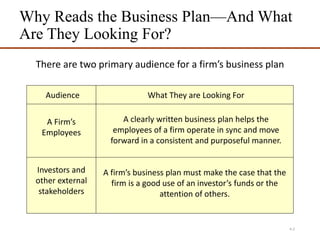
There are two primary audience for a firm’s business plan
Audience What They are Looking For
A Firm’s
Employees
Investors and
other external
stakeholders
A clearly written business plan helps the
employees of a firm operate in sync and move
forward in a consistent and purposeful manner.
A firm’s business plan must make the case that the
firm is a good use of an investor’s funds or the
attention of others.
Guidelines for Writing a Business Plan
1 of 5
•Structure of the Business Plan
• To make the best impression a business plan should follow
a conventional structure, such as the outline for the
business plan shown in the chapter.
• Although some entrepreneurs want to demonstrate
creativity, departing from the basic structure of the
conventional business plan is usually a mistake.
• Typically, investors are busy people and want a plan where
they can easily find critical information.
4-3
Guidelines for Writing a Business Plan
2 of 5
•Structure of the Business Plan (continued)
• Software Packages
• There are many software packages available that employ an
interactive, menu-driven approach to assist in the writing of a
business plan.
• Some of these programs are very helpful. However, entrepreneurs
should avoid a boilerplate plan that looks as though it came from a
“canned” source.
• Sense of Excitement
• Along with facts and figures, a business plan needs to project a
sense of anticipation and excitement about the possibilities that
surround a new venture.
4-4
Guidelines for Writing a Business Plan
3 of 5
•Content of the Business Plan
• The business plan should give clear and concise
information on all the important aspects of the proposed
venture.
• It must be long enough to provide sufficient information
yet short enough to maintain reader interest.
• For most plans, 25 to 35 pages is sufficient.
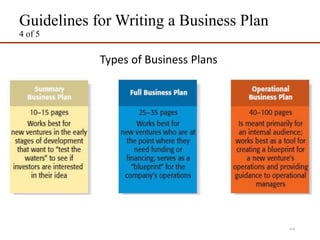
•Types of Business Plans
• There are three types of business plans, which are shown
on the next slide.
4-5
Guidelines for Writing a Business Plan
4 of 5
4-6
Types of Business Plans
Guidelines for Writing a Business Plan
5 of 5
•Recognizing the Elements of the Plan May Change
• It’s important to recognize that the plan will usually
change while written.
• New insights invariably emerge when an entrepreneur or a
team of entrepreneurs immerse themselves in writing the
plan and start getting feedback from others.
4-7
Outline of Business Plan
•Outline of Business Plan
• A suggested outline of a business plan is shown on the next
several slides.
• Most business plans do not include all the elements
introduced in the sample plan; we include them here for the
purpose of completeness.
• Each entrepreneur must decided which elements to include in
his or her plan.
4-8
Section 1: Executive Summary
1 of 2
•Executive Summary
• The executive summary is a short overview of the entire
business plan
• It provides a busy reader with everything that needs to be
known about the new venture’s distinctive nature.
• An executive summary shouldn’t exceed two single-space
pages.
4-9
Section 1: Executive Summary
2 of 2
4-10
Executive Summary
Key Insights
• In many instances an investor will
ask for a copy of a firm’s executive
summary and will ask for a copy of
the entire plan only if the executive
summary is sufficiently convincing.
• The executive summary, then, is
arguably the most important
section of a business plan.
Section 2: Company Description
1 of 2
•Company Description
• The main body of the business plan beings with a general
description of the company.
• Items to include in this section:
• Company description.
• Company history.
• Mission statement.
• Products and services.
• Current status.
• Legal status and ownership.
• Key partnerships (if any).
4-11
Section 2: Company Description
2 of 2
4-12
Company Description
Key Insights
• While at first glance this section
may seem less important than the
others, it is extremely important.
• It demonstrates to your reader
that
you know how to translate an idea
into a business.
Section 3: Industry Analysis
1 of 2
•Industry Analysis
• This section should being by describing the industry the
business will enter in terms of its size, growth rate, and
sales projections.
• Items to include in this section:
• Industry size, growth rate, and sales projections.
• Industry structure.
• Nature of participants.
• Key success factors.
• Industry trends.
• Long-term prospects.
4-13
Section 3: Industry Analysis
2 of 2
4-14
Industry Analysis
Key Insights
• Before a business selects a target
market it should have a good grasp
of its industry—including where its
promising areas are and where its
points of vulnerability are.
• The industry that a company
participates in largely defines the
playing field that a firm will
participate in.
Section 4: Market Analysis
1 of 2
•Market Analysis
• The market analysis breaks the industry into segments and
zeros in on the specific segment (or target market) to
which the firm will try to appeal.
• Items to include in this section:
• Market segmentation and target market selection.
• Buyer behavior.
• Competitor analysis.
4-15
Section 3: Market Analysis
2 of 2
4-16
Market Analysis
Key Insights
• Most startups do not service their
entire industry. Instead, they focus
on servicing a specific (target)
market within the industry.
• It’s important to include a section
in
the market analysis that deals with
the behavior of the consumers in
the
market. The more a startup knows
about the consumers in its target
market, the more it can tailor its
products or service appropriately.
Section 4: Marketing Plan
1 of 2
•Marketing Plan
• The marketing plan focuses on how the business will
market and sell its product or service.
• Items to include in this section:
• Overall marketing strategy.
• Product, price, promotions, and distribution.
4-17
Section 4: Marketing Plan
2 of 2
4-18
Marketing Plan
Key Insights
• The best way to describe a startup’s
marketing plan is to start by
articulating its marketing strategy,
positioning, and points of
differentiation, and then talk about
how these overall aspects of the
plan will be supported by price,
promotional mix, and distribution
strategy.
Section 5: Management Team and Company
Structure
1 of 2
•Management Team and Company Structure
• The management team of a new venture typically consists
of the founder or founders and a handful of key
management personnel.
• Items to include in this section:
• Management team.
• Board of directors.
• Board of advisers.
• Company structure.
4-19
Section 5: Management Team and Company
Structure
2 of 2
4-20
Management Team and
Company Structure
Key Insights
• This is a critical section of a
business plan.
• Many investors and others who
read the business plan look first at
the executive summary and then go
directly to the management team
section to assess the strength of the
people starting the firm.
Section 6: Operations Plan
1 of 2
•Operations Plan
• Outlines how your business will be run and how your
product or service will be produced.
• A useful way to illustrate how your business will be run is
to describe it in terms of “back stage” (unseen to the
customer) and “front stage” (seen by the customer)
activities.
• Items to include in this section:
• General approach to operations.
• Business location.
• Facilities and equipment.
4-21
Section 6: Operations Plan
2 of 2
4-22
Operations Plan
Key Insights
• Your have to strike a careful balance
between adequately describing this
topic and providing too much
detail.
• As a result, it is best to keep this
section short and crisp.
Section 7: Product (or Service) Design and
Development Plan
1 of 2
•Product (or Service) Design and Development Plan
• If you’re developing a completely new product or service,
you need to include a section that focuses on the status of
your development efforts.
• Items to include in this section:
• Development status and tasks.
• Challenges and risks.
• Intellectual property.
4-23
Section 7: Product (or Service) Design and
Development Plan
2 of 2
4-24
Product (or Service)
Design and Development
Plan
Key Insights
• Many seemingly promising startups
never get off the ground because
their product development efforts
stall or turn out to be more difficult
than expected.
• Its important to convince the reader
of your plan that this won’t happen
to you.
Section 8: Financial Projections
1 of 2
•Financial Projections
• The final section of a business plan presents a firm’s pro
forma (or projected) financial projections.
• Items to include in this section:
• Sources and uses of funds statement.
• Assumptions sheet.
• Pro forma income statements.
• Pro forma balance sheets.
• Pro forma cash flows.
• Ratio analysis.
4-25
Section 8: Financial Projections
2 of 2
4-26
Financial Projections
Key Insights
• Having completed the earlier
sections of the plan, its easy to see
why the financial projections come
last.
• They take the plans you’ve
developed and express them in
financial terms.
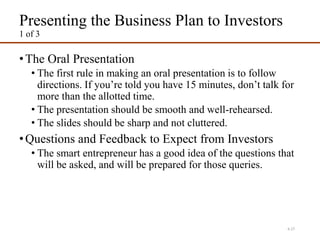
Presenting the Business Plan to Investors
1 of 3
•The Oral Presentation
• The first rule in making an oral presentation is to follow
directions. If you’re told you have 15 minutes, don’t talk for
more than the allotted time.
• The presentation should be smooth and well-rehearsed.
• The slides should be sharp and not cluttered.
•Questions and Feedback to Expect from Investors
• The smart entrepreneur has a good idea of the questions that
will be asked, and will be prepared for those queries.
4-27
Presenting the Business Plan to Investors
2 of 3
4-28
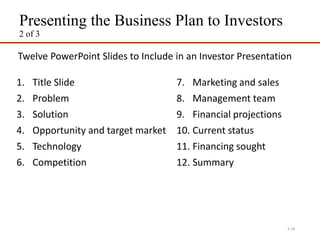
Twelve PowerPoint Slides to Include in an Investor Presentation
1. Title Slide
2. Problem
3. Solution
4. Opportunity and target market
5. Technology
6. Competition
7. Marketing and sales
8. Management team
9. Financial projections
10. Current status
11. Financing sought
12. Summary
Presenting the Business Plan to Investors
3 of 3
4-29
• It’s also important to
look sharp when
presenting a business
plan.
• This new venture team
is going over its
PowerPoint slides one
last time before an
investor presentation.

Business plan (2)

  • 1.
    What Is aBusiness Plan? •Business Plan • A business plan is a written narrative, typically 25 to 35 pages long, that describes what a new business plans to accomplish. •Dual-Use Document • For most new ventures, the business plan is a dual-purpose document used both inside and outside the firm. 4-1
  • 2.
    Why Reads theBusiness Plan—And What Are They Looking For? 4-2 There are two primary audience for a firm’s business plan Audience What They are Looking For A Firm’s Employees Investors and other external stakeholders A clearly written business plan helps the employees of a firm operate in sync and move forward in a consistent and purposeful manner. A firm’s business plan must make the case that the firm is a good use of an investor’s funds or the attention of others.
  • 3.
    Guidelines for Writinga Business Plan 1 of 5 •Structure of the Business Plan • To make the best impression a business plan should follow a conventional structure, such as the outline for the business plan shown in the chapter. • Although some entrepreneurs want to demonstrate creativity, departing from the basic structure of the conventional business plan is usually a mistake. • Typically, investors are busy people and want a plan where they can easily find critical information. 4-3
  • 4.
    Guidelines for Writinga Business Plan 2 of 5 •Structure of the Business Plan (continued) • Software Packages • There are many software packages available that employ an interactive, menu-driven approach to assist in the writing of a business plan. • Some of these programs are very helpful. However, entrepreneurs should avoid a boilerplate plan that looks as though it came from a “canned” source. • Sense of Excitement • Along with facts and figures, a business plan needs to project a sense of anticipation and excitement about the possibilities that surround a new venture. 4-4
  • 5.
    Guidelines for Writinga Business Plan 3 of 5 •Content of the Business Plan • The business plan should give clear and concise information on all the important aspects of the proposed venture. • It must be long enough to provide sufficient information yet short enough to maintain reader interest. • For most plans, 25 to 35 pages is sufficient. •Types of Business Plans • There are three types of business plans, which are shown on the next slide. 4-5
  • 6.
    Guidelines for Writinga Business Plan 4 of 5 4-6 Types of Business Plans
  • 7.
    Guidelines for Writinga Business Plan 5 of 5 •Recognizing the Elements of the Plan May Change • It’s important to recognize that the plan will usually change while written. • New insights invariably emerge when an entrepreneur or a team of entrepreneurs immerse themselves in writing the plan and start getting feedback from others. 4-7
  • 8.
    Outline of BusinessPlan •Outline of Business Plan • A suggested outline of a business plan is shown on the next several slides. • Most business plans do not include all the elements introduced in the sample plan; we include them here for the purpose of completeness. • Each entrepreneur must decided which elements to include in his or her plan. 4-8
  • 9.
    Section 1: ExecutiveSummary 1 of 2 •Executive Summary • The executive summary is a short overview of the entire business plan • It provides a busy reader with everything that needs to be known about the new venture’s distinctive nature. • An executive summary shouldn’t exceed two single-space pages. 4-9
  • 10.
    Section 1: ExecutiveSummary 2 of 2 4-10 Executive Summary Key Insights • In many instances an investor will ask for a copy of a firm’s executive summary and will ask for a copy of the entire plan only if the executive summary is sufficiently convincing. • The executive summary, then, is arguably the most important section of a business plan.
  • 11.
    Section 2: CompanyDescription 1 of 2 •Company Description • The main body of the business plan beings with a general description of the company. • Items to include in this section: • Company description. • Company history. • Mission statement. • Products and services. • Current status. • Legal status and ownership. • Key partnerships (if any). 4-11
  • 12.
    Section 2: CompanyDescription 2 of 2 4-12 Company Description Key Insights • While at first glance this section may seem less important than the others, it is extremely important. • It demonstrates to your reader that you know how to translate an idea into a business.
  • 13.
    Section 3: IndustryAnalysis 1 of 2 •Industry Analysis • This section should being by describing the industry the business will enter in terms of its size, growth rate, and sales projections. • Items to include in this section: • Industry size, growth rate, and sales projections. • Industry structure. • Nature of participants. • Key success factors. • Industry trends. • Long-term prospects. 4-13
  • 14.
    Section 3: IndustryAnalysis 2 of 2 4-14 Industry Analysis Key Insights • Before a business selects a target market it should have a good grasp of its industry—including where its promising areas are and where its points of vulnerability are. • The industry that a company participates in largely defines the playing field that a firm will participate in.
  • 15.
    Section 4: MarketAnalysis 1 of 2 •Market Analysis • The market analysis breaks the industry into segments and zeros in on the specific segment (or target market) to which the firm will try to appeal. • Items to include in this section: • Market segmentation and target market selection. • Buyer behavior. • Competitor analysis. 4-15
  • 16.
    Section 3: MarketAnalysis 2 of 2 4-16 Market Analysis Key Insights • Most startups do not service their entire industry. Instead, they focus on servicing a specific (target) market within the industry. • It’s important to include a section in the market analysis that deals with the behavior of the consumers in the market. The more a startup knows about the consumers in its target market, the more it can tailor its products or service appropriately.
  • 17.
    Section 4: MarketingPlan 1 of 2 •Marketing Plan • The marketing plan focuses on how the business will market and sell its product or service. • Items to include in this section: • Overall marketing strategy. • Product, price, promotions, and distribution. 4-17
  • 18.
    Section 4: MarketingPlan 2 of 2 4-18 Marketing Plan Key Insights • The best way to describe a startup’s marketing plan is to start by articulating its marketing strategy, positioning, and points of differentiation, and then talk about how these overall aspects of the plan will be supported by price, promotional mix, and distribution strategy.
  • 19.
    Section 5: ManagementTeam and Company Structure 1 of 2 •Management Team and Company Structure • The management team of a new venture typically consists of the founder or founders and a handful of key management personnel. • Items to include in this section: • Management team. • Board of directors. • Board of advisers. • Company structure. 4-19
  • 20.
    Section 5: ManagementTeam and Company Structure 2 of 2 4-20 Management Team and Company Structure Key Insights • This is a critical section of a business plan. • Many investors and others who read the business plan look first at the executive summary and then go directly to the management team section to assess the strength of the people starting the firm.
  • 21.
    Section 6: OperationsPlan 1 of 2 •Operations Plan • Outlines how your business will be run and how your product or service will be produced. • A useful way to illustrate how your business will be run is to describe it in terms of “back stage” (unseen to the customer) and “front stage” (seen by the customer) activities. • Items to include in this section: • General approach to operations. • Business location. • Facilities and equipment. 4-21
  • 22.
    Section 6: OperationsPlan 2 of 2 4-22 Operations Plan Key Insights • Your have to strike a careful balance between adequately describing this topic and providing too much detail. • As a result, it is best to keep this section short and crisp.
  • 23.
    Section 7: Product(or Service) Design and Development Plan 1 of 2 •Product (or Service) Design and Development Plan • If you’re developing a completely new product or service, you need to include a section that focuses on the status of your development efforts. • Items to include in this section: • Development status and tasks. • Challenges and risks. • Intellectual property. 4-23
  • 24.
    Section 7: Product(or Service) Design and Development Plan 2 of 2 4-24 Product (or Service) Design and Development Plan Key Insights • Many seemingly promising startups never get off the ground because their product development efforts stall or turn out to be more difficult than expected. • Its important to convince the reader of your plan that this won’t happen to you.
  • 25.
    Section 8: FinancialProjections 1 of 2 •Financial Projections • The final section of a business plan presents a firm’s pro forma (or projected) financial projections. • Items to include in this section: • Sources and uses of funds statement. • Assumptions sheet. • Pro forma income statements. • Pro forma balance sheets. • Pro forma cash flows. • Ratio analysis. 4-25
  • 26.
    Section 8: FinancialProjections 2 of 2 4-26 Financial Projections Key Insights • Having completed the earlier sections of the plan, its easy to see why the financial projections come last. • They take the plans you’ve developed and express them in financial terms.
  • 27.
    Presenting the BusinessPlan to Investors 1 of 3 •The Oral Presentation • The first rule in making an oral presentation is to follow directions. If you’re told you have 15 minutes, don’t talk for more than the allotted time. • The presentation should be smooth and well-rehearsed. • The slides should be sharp and not cluttered. •Questions and Feedback to Expect from Investors • The smart entrepreneur has a good idea of the questions that will be asked, and will be prepared for those queries. 4-27
  • 28.
    Presenting the BusinessPlan to Investors 2 of 3 4-28 Twelve PowerPoint Slides to Include in an Investor Presentation 1. Title Slide 2. Problem 3. Solution 4. Opportunity and target market 5. Technology 6. Competition 7. Marketing and sales 8. Management team 9. Financial projections 10. Current status 11. Financing sought 12. Summary
  • 29.
    Presenting the BusinessPlan to Investors 3 of 3 4-29 • It’s also important to look sharp when presenting a business plan. • This new venture team is going over its PowerPoint slides one last time before an investor presentation.