


Does learning solve business
performance problems?
By Javier Amaro
What is value?
• Think about a training program that you
recently implemented.
• How would you define the value delivered by
the program?
What is the value of training?
New definition of value
Be balanced, with qualitative and quantitative
data
Contain financial and nonfinancial perspectives
Reflect strategic and tactical issues
Satisfy all key stakeholders
Be consistent in collection and analysis
Be grounded in conservative standards
Come from credible sources
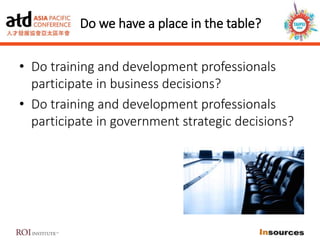
Do we have a place in the table?
• Do training and development professionals
participate in business decisions?
• Do training and development professionals
participate in government strategic decisions?
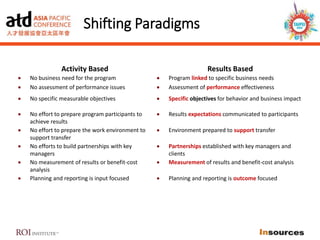
Shifting Paradigms
Activity Based Results Based
 No business need for the program  Program linked to specific business needs
 No assessment of performance issues  Assessment of performance effectiveness
 No specific measurable objectives  Specific objectives for behavior and business impact
 No effort to prepare program participants to
achieve results
 Results expectations communicated to participants
 No effort to prepare the work environment to
support transfer
 Environment prepared to support transfer
 No efforts to build partnerships with key
managers
 Partnerships established with key managers and
clients
 No measurement of results or benefit-cost
analysis
 Measurement of results and benefit-cost analysis
 Planning and reporting is input focused  Planning and reporting is outcome focused
Training Solutions Provider?
Become a business partner
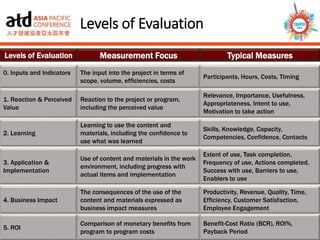
Levels of Evaluation
10
Levels of Evaluation Measurement Focus
0. Inputs and Indicators The input into the project in terms of
scope, volume, efficiencies, costs
Participants, Hours, Costs, Timing
1. Reaction & Perceived
Value
Reaction to the project or program,
including the perceived value
Relevance, Importance, Usefulness,
Appropriateness, Intent to use,
Motivation to take action
2. Learning
Learning to use the content and
materials, including the confidence to
use what was learned
Skills, Knowledge, Capacity,
Competencies, Confidence, Contacts
3. Application &
Implementation
Use of content and materials in the work
environment, including progress with
actual items and implementation
Extent of use, Task completion,
Frequency of use, Actions completed,
Success with use, Barriers to use,
Enablers to use
4. Business Impact
The consequences of the use of the
content and materials expressed as
business impact measures
Productivity, Revenue, Quality, Time,
Efficiency, Customer Satisfaction,
Employee Engagement
Typical Measures
5. ROI
Comparison of monetary benefits from
program to program costs
Benefit-Cost Ratio (BCR), ROI%,
Payback Period
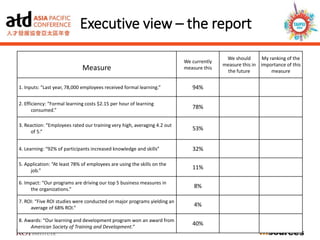
Executive view – the report
Measure
We currently
measure this
We should
measure this in
the future
My ranking of the
importance of this
measure
1. Inputs: “Last year, 78,000 employees received formal learning.” 94%
2. Efficiency: “Formal learning costs $2.15 per hour of learning
consumed.”
78%
3. Reaction: “Employees rated our training very high, averaging 4.2 out
of 5.”
53%
4. Learning: “92% of participants increased knowledge and skills” 32%
5. Application: “At least 78% of employees are using the skills on the
job.”
11%
6. Impact: “Our programs are driving our top 5 business measures in
the organizations.”
8%
7. ROI: “Five ROI studies were conducted on major programs yielding an
average of 68% ROI.”
4%
8. Awards: “Our learning and development program won an award from
American Society of Training and Development.”
40%
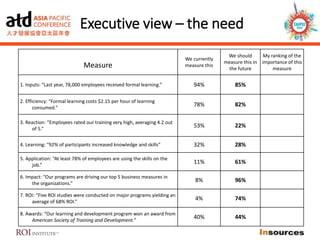
Executive view – the need
Measure
We currently
measure this
We should
measure this in
the future
My ranking of the
importance of this
measure
1. Inputs: “Last year, 78,000 employees received formal learning.” 94% 85%
2. Efficiency: “Formal learning costs $2.15 per hour of learning
consumed.”
78% 82%
3. Reaction: “Employees rated our training very high, averaging 4.2 out
of 5.”
53% 22%
4. Learning: “92% of participants increased knowledge and skills” 32% 28%
5. Application: “At least 78% of employees are using the skills on the
job.”
11% 61%
6. Impact: “Our programs are driving our top 5 business measures in
the organizations.”
8% 96%
7. ROI: “Five ROI studies were conducted on major programs yielding an
average of 68% ROI.”
4% 74%
8. Awards: “Our learning and development program won an award from
American Society of Training and Development.”
40% 44%
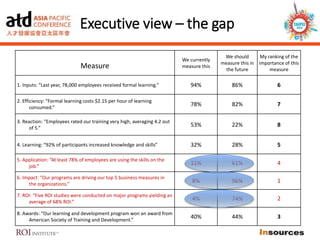
Executive view – the gap
Measure
We currently
measure this
We should
measure this in
the future
My ranking of the
importance of this
measure
1. Inputs: “Last year, 78,000 employees received formal learning.” 94% 86% 6
2. Efficiency: “Formal learning costs $2.15 per hour of learning
consumed.”
78% 82% 7
3. Reaction: “Employees rated our training very high, averaging 4.2 out
of 5.”
53% 22% 8
4. Learning: “92% of participants increased knowledge and skills” 32% 28% 5
5. Application: “At least 78% of employees are using the skills on the
job.”
11% 61% 4
6. Impact: “Our programs are driving our top 5 business measures in
the organizations.”
8% 96% 1
7. ROI: “Five ROI studies were conducted on major programs yielding an
average of 68% ROI.”
4% 74% 2
8. Awards: “Our learning and development program won an award from
American Society of Training and Development.”
40% 44% 3
Fear of negative ROI
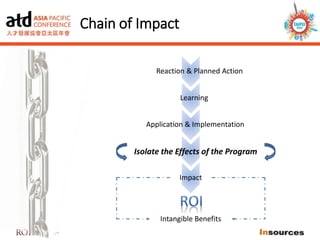
Chain of Impact
Reaction & Planned Action
Learning
Application & Implementation
Isolate the Effects of the Program
Intangible Benefits
Impact
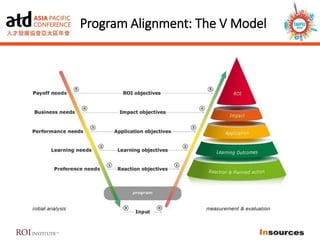
Program Alignment: The V Model
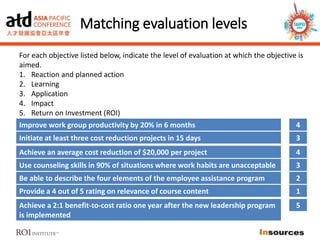
Matching evaluation levels
Improve work group productivity by 20% in 6 months 4
Initiate at least three cost reduction projects in 15 days 3
Achieve an average cost reduction of $20,000 per project 4
Use counseling skills in 90% of situations where work habits are unacceptable 3
Be able to describe the four elements of the employee assistance program 2
Provide a 4 out of 5 rating on relevance of course content 1
Achieve a 2:1 benefit-to-cost ratio one year after the new leadership program
is implemented
5
For each objective listed below, indicate the level of evaluation at which the objective is
aimed.
1. Reaction and planned action
2. Learning
3. Application
4. Impact
5. Return on Investment (ROI)
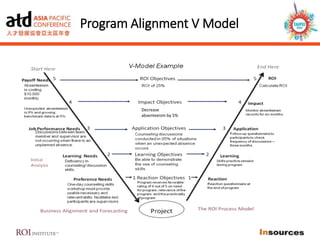
Program Alignment V Model
Decrease
absenteeism by 5%
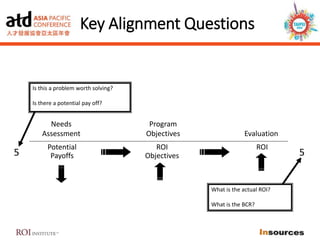
Key Alignment Questions
Potential ROI ROI
Payoffs Objectives5 5
Is this a problem worth solving?
Is there a potential pay off?
What is the actual ROI?
What is the BCR?
Needs Program
Assessment Objectives Evaluation
Needs Program
Assessment Objectives Evaluation
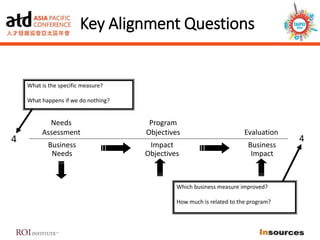
Business Impact Business
Needs Objectives Impact
Key Alignment Questions
4 4
What is the specific measure?
What happens if we do nothing?
Which business measure improved?
How much is related to the program?
Needs Program
Assessment Objectives Evaluation
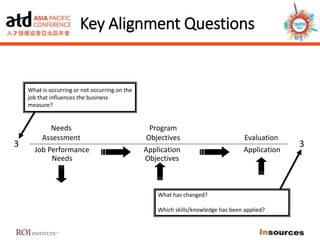
Job Performance Application Application
Needs Objectives
Key Alignment Questions
3 3
What is occurring or not occurring on the
job that influences the business
measure?
What has changed?
Which skills/knowledge has been applied?
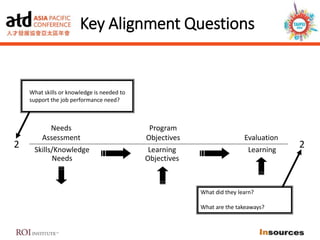
Skills/Knowledge Learning Learning
Needs Objectives
Needs Program
Assessment Objectives Evaluation
Key Alignment Questions
2 2
What skills or knowledge is needed to
support the job performance need?
What did they learn?
What are the takeaways?
Preferences Reaction Reaction &
Objectives Planned Action
Needs Program
Assessment Objectives Evaluation
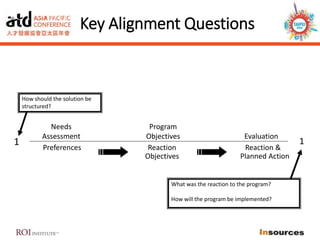
Key Alignment Questions
1 1
How should the solution be
structured?
What was the reaction to the program?
How will the program be implemented?
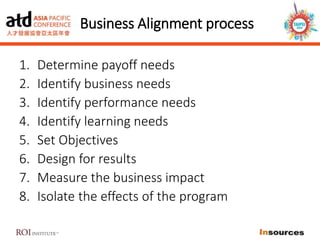
Business Alignment process
1. Determine payoff needs
2. Identify business needs
3. Identify performance needs
4. Identify learning needs
5. Set Objectives
6. Design for results
7. Measure the business impact
8. Isolate the effects of the program
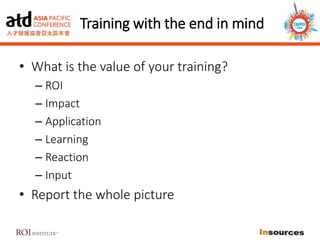
Training with the end in mind
• What is the value of your training?
– ROI
– Impact
– Application
– Learning
– Reaction
– Input
• Report the whole picture
Build up Capabilities in ROI
• ROI Certification program
– Sydney from 7th to 11th December 2015
– http://insources.com.au/index.php/roi/roi-
certification
Feedback Counts!
Your feedback helps ATD 2015 APC continue to
provide top-notch educational programs that
help you stay on top of a changing profession.
Evaluation forms for this session are available
via the mobile app and at the following link:
https://zh.surveymonkey.com/r/ATD2015APC

Does your learning solution solve business performance problems?

  • 1.
    Does learning solvebusiness performance problems? By Javier Amaro
  • 2.
    What is value? •Think about a training program that you recently implemented. • How would you define the value delivered by the program?
  • 3.
    What is thevalue of training?
  • 4.
    New definition ofvalue Be balanced, with qualitative and quantitative data Contain financial and nonfinancial perspectives Reflect strategic and tactical issues Satisfy all key stakeholders Be consistent in collection and analysis Be grounded in conservative standards Come from credible sources
  • 5.
    Do we havea place in the table?
  • 6.
    Do we havea place in the table? • Do training and development professionals participate in business decisions? • Do training and development professionals participate in government strategic decisions?
  • 7.
    Shifting Paradigms Activity BasedResults Based  No business need for the program  Program linked to specific business needs  No assessment of performance issues  Assessment of performance effectiveness  No specific measurable objectives  Specific objectives for behavior and business impact  No effort to prepare program participants to achieve results  Results expectations communicated to participants  No effort to prepare the work environment to support transfer  Environment prepared to support transfer  No efforts to build partnerships with key managers  Partnerships established with key managers and clients  No measurement of results or benefit-cost analysis  Measurement of results and benefit-cost analysis  Planning and reporting is input focused  Planning and reporting is outcome focused
  • 8.
  • 9.
  • 10.
    Levels of Evaluation 10 Levelsof Evaluation Measurement Focus 0. Inputs and Indicators The input into the project in terms of scope, volume, efficiencies, costs Participants, Hours, Costs, Timing 1. Reaction & Perceived Value Reaction to the project or program, including the perceived value Relevance, Importance, Usefulness, Appropriateness, Intent to use, Motivation to take action 2. Learning Learning to use the content and materials, including the confidence to use what was learned Skills, Knowledge, Capacity, Competencies, Confidence, Contacts 3. Application & Implementation Use of content and materials in the work environment, including progress with actual items and implementation Extent of use, Task completion, Frequency of use, Actions completed, Success with use, Barriers to use, Enablers to use 4. Business Impact The consequences of the use of the content and materials expressed as business impact measures Productivity, Revenue, Quality, Time, Efficiency, Customer Satisfaction, Employee Engagement Typical Measures 5. ROI Comparison of monetary benefits from program to program costs Benefit-Cost Ratio (BCR), ROI%, Payback Period
  • 11.
    Executive view –the report Measure We currently measure this We should measure this in the future My ranking of the importance of this measure 1. Inputs: “Last year, 78,000 employees received formal learning.” 94% 2. Efficiency: “Formal learning costs $2.15 per hour of learning consumed.” 78% 3. Reaction: “Employees rated our training very high, averaging 4.2 out of 5.” 53% 4. Learning: “92% of participants increased knowledge and skills” 32% 5. Application: “At least 78% of employees are using the skills on the job.” 11% 6. Impact: “Our programs are driving our top 5 business measures in the organizations.” 8% 7. ROI: “Five ROI studies were conducted on major programs yielding an average of 68% ROI.” 4% 8. Awards: “Our learning and development program won an award from American Society of Training and Development.” 40%
  • 12.
    Executive view –the need Measure We currently measure this We should measure this in the future My ranking of the importance of this measure 1. Inputs: “Last year, 78,000 employees received formal learning.” 94% 85% 2. Efficiency: “Formal learning costs $2.15 per hour of learning consumed.” 78% 82% 3. Reaction: “Employees rated our training very high, averaging 4.2 out of 5.” 53% 22% 4. Learning: “92% of participants increased knowledge and skills” 32% 28% 5. Application: “At least 78% of employees are using the skills on the job.” 11% 61% 6. Impact: “Our programs are driving our top 5 business measures in the organizations.” 8% 96% 7. ROI: “Five ROI studies were conducted on major programs yielding an average of 68% ROI.” 4% 74% 8. Awards: “Our learning and development program won an award from American Society of Training and Development.” 40% 44%
  • 13.
    Executive view –the gap Measure We currently measure this We should measure this in the future My ranking of the importance of this measure 1. Inputs: “Last year, 78,000 employees received formal learning.” 94% 86% 6 2. Efficiency: “Formal learning costs $2.15 per hour of learning consumed.” 78% 82% 7 3. Reaction: “Employees rated our training very high, averaging 4.2 out of 5.” 53% 22% 8 4. Learning: “92% of participants increased knowledge and skills” 32% 28% 5 5. Application: “At least 78% of employees are using the skills on the job.” 11% 61% 4 6. Impact: “Our programs are driving our top 5 business measures in the organizations.” 8% 96% 1 7. ROI: “Five ROI studies were conducted on major programs yielding an average of 68% ROI.” 4% 74% 2 8. Awards: “Our learning and development program won an award from American Society of Training and Development.” 40% 44% 3
  • 14.
  • 15.
    Chain of Impact Reaction& Planned Action Learning Application & Implementation Isolate the Effects of the Program Intangible Benefits Impact
  • 16.
  • 17.
    Matching evaluation levels Improvework group productivity by 20% in 6 months 4 Initiate at least three cost reduction projects in 15 days 3 Achieve an average cost reduction of $20,000 per project 4 Use counseling skills in 90% of situations where work habits are unacceptable 3 Be able to describe the four elements of the employee assistance program 2 Provide a 4 out of 5 rating on relevance of course content 1 Achieve a 2:1 benefit-to-cost ratio one year after the new leadership program is implemented 5 For each objective listed below, indicate the level of evaluation at which the objective is aimed. 1. Reaction and planned action 2. Learning 3. Application 4. Impact 5. Return on Investment (ROI)
  • 18.
    Program Alignment VModel Decrease absenteeism by 5%
  • 19.
    Key Alignment Questions PotentialROI ROI Payoffs Objectives5 5 Is this a problem worth solving? Is there a potential pay off? What is the actual ROI? What is the BCR? Needs Program Assessment Objectives Evaluation
  • 20.
    Needs Program Assessment ObjectivesEvaluation Business Impact Business Needs Objectives Impact Key Alignment Questions 4 4 What is the specific measure? What happens if we do nothing? Which business measure improved? How much is related to the program?
  • 21.
    Needs Program Assessment ObjectivesEvaluation Job Performance Application Application Needs Objectives Key Alignment Questions 3 3 What is occurring or not occurring on the job that influences the business measure? What has changed? Which skills/knowledge has been applied?
  • 22.
    Skills/Knowledge Learning Learning NeedsObjectives Needs Program Assessment Objectives Evaluation Key Alignment Questions 2 2 What skills or knowledge is needed to support the job performance need? What did they learn? What are the takeaways?
  • 23.
    Preferences Reaction Reaction& Objectives Planned Action Needs Program Assessment Objectives Evaluation Key Alignment Questions 1 1 How should the solution be structured? What was the reaction to the program? How will the program be implemented?
  • 24.
    Business Alignment process 1.Determine payoff needs 2. Identify business needs 3. Identify performance needs 4. Identify learning needs 5. Set Objectives 6. Design for results 7. Measure the business impact 8. Isolate the effects of the program
  • 25.
    Training with theend in mind • What is the value of your training? – ROI – Impact – Application – Learning – Reaction – Input • Report the whole picture
  • 26.
    Build up Capabilitiesin ROI • ROI Certification program – Sydney from 7th to 11th December 2015 – http://insources.com.au/index.php/roi/roi- certification
  • 27.
    Feedback Counts! Your feedbackhelps ATD 2015 APC continue to provide top-notch educational programs that help you stay on top of a changing profession. Evaluation forms for this session are available via the mobile app and at the following link: https://zh.surveymonkey.com/r/ATD2015APC