Hungary
4th February, 2014
Etiquette is an unwritten rule
synonymous with manners

2
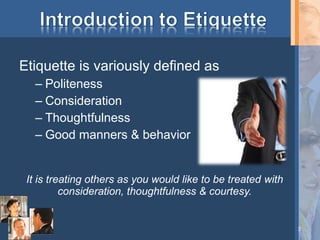
Etiquette is variously defined as
– Politeness
– Consideration
– Thoughtfulness
– Good manners & behavior

It is treating others as you would like to be treated with
consideration, thoughtfulness & courtesy.

3
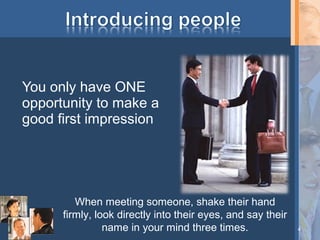
You only have ONE
opportunity to make a
good first impression

When meeting someone, shake their hand
firmly, look directly into their eyes, and say their
name in your mind three times.

4
Words only account for 7% of an initial
impression.
Vocal quality accounts for another 38%.
The rest of 55% of any first impression is
based on non-verbal perceptions of
appearance and behavior.

5
To gain and increase
respect, first establish your
presence in a room, then
smile.

6
Construct an introduction that is
interesting and catchy, yet still
professional

Think of it as a one or two
sound bite commercial
A sound bite, the length of time available
in television to engage viewers' attention
before they tune out, has decreased to 7
seconds currently because we are all so
overexposed to visual and oral stimuli.
7
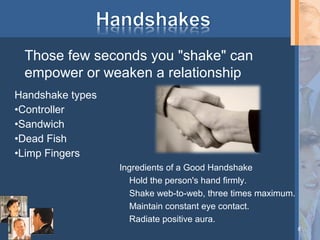
Those few seconds you "shake" can
empower or weaken a relationship
Handshake types
•Controller
•Sandwich
•Dead Fish
•Limp Fingers
Ingredients of a Good Handshake
Hold the person's hand firmly.
Shake web-to-web, three times maximum.
Maintain constant eye contact.
Radiate positive aura.
8
Make it and keep it!
When to look
Begin as soon as you engage
someone in a conversation.
Where to look
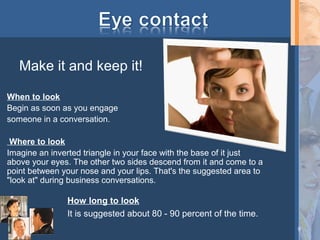
Imagine an inverted triangle in your face with the base of it just
above your eyes. The other two sides descend from it and come to a
point between your nose and your lips. That's the suggested area to
"look at" during business conversations.

How long to look
It is suggested about 80 - 90 percent of the time.
9
The most important point
about introductions is to
make them

Failing to do so causes embarrassment and
discomfort.
10
• In business, introductions are based on power and
hierarchy
• Gender plays no role in business etiquette; nor does
it affect the order of introductions.
• Introduce someone from your firm to a client or
customer.
• Introduce a junior executive to a senior executive.
• As you say each of the individuals' names, look at
him or her.
• The way you respond to someone else's
introduction is just as important as making the
introduction
• Always stand for introductions and offer your hand.
11
• Confess and express sincerity and warmth.
Say: „I am so sorry. I have completely
blanked on your name.”
• Ask the person to please repeat his or her
name.
• Ask the person how he or she prefers to be
addressed.
• Try „The set up”. Send a set up person
tover to introduce himself and then report
back to you.
12
• Never leave your home or office without your cards
and plenty of them.
• Keep your cards in a quality business card case that
protects them from wear and tear.
• Invest in quality business cards.
• Know where your business cards are at all times.
• Hand them out with discretion. Never assume
someone wants your card, ask first!
• Never ask a senior executive for his or her card ; many
will exchange cards with others of similar rank.

13
• Give and receive cards with your right hand–the hand
of discretion.
• Give the card so the person who is receiving it can
read it without having to turn it around.
• Always make a comment about a card when you
receive it.
• Keep your business cards up to date.
• Don't write notes to yourself on someone else's
business card during the exchange unless they appear
relevant.

14
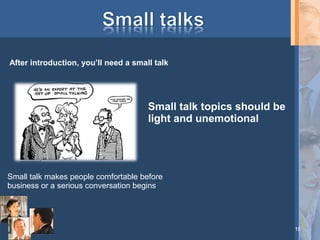
After introduction, you’ll need a small talk

Small talk topics should be
light and unemotional

Small talk makes people comfortable before
business or a serious conversation begins

15
16
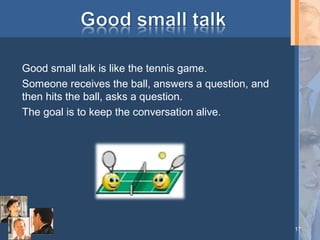
Good small talk is like the tennis game.
Someone receives the ball, answers a question, and
then hits the ball, asks a question.
The goal is to keep the conversation alive.

17
Conversational skills can be acquired if we are willing to
do some preparation:
• Look the person up on LinkedIn to find out about his or
her interests and achievements
• Arm yourself for conversation: you need topics and
materials to discuss so keep yoursel up-to-date on
current issues
• Use „safe” topics

18
• The weather: it affects us all
• A good book: this is a sign of an intelligent, aware,
curious individual which will reflect well on you.
• Transportation: We all have direct experience.
• Your surroundings: This can be anything from the
actual room or to the city itself.
• Sports
19
Do not ask about:
•religious beliefs
•financial situation
•any illness
•details about a divorce or an affair
•someone's weight, height, shoe size, age or
mental health.
•harmful gossip; and
•telling racial, ethnic, and sexually oriented
jokes
20
• First, observe. Your small talk will be more
effective if you take the time to look for the best
possible icebreaker.
• Stay safe.
• Ask open-ended questions.
• Make strong eye-contact, the key indicater of your
interest and respect.
• Be aware of your body language revealing how
you really feel.

21
22

Business etiquette establishing rapport

  • 1.
  • 2.
    Etiquette is anunwritten rule synonymous with manners 2
  • 3.
    Etiquette is variouslydefined as – Politeness – Consideration – Thoughtfulness – Good manners & behavior It is treating others as you would like to be treated with consideration, thoughtfulness & courtesy. 3
  • 4.
    You only haveONE opportunity to make a good first impression When meeting someone, shake their hand firmly, look directly into their eyes, and say their name in your mind three times. 4
  • 5.
    Words only accountfor 7% of an initial impression. Vocal quality accounts for another 38%. The rest of 55% of any first impression is based on non-verbal perceptions of appearance and behavior. 5
  • 6.
    To gain andincrease respect, first establish your presence in a room, then smile. 6
  • 7.
    Construct an introductionthat is interesting and catchy, yet still professional Think of it as a one or two sound bite commercial A sound bite, the length of time available in television to engage viewers' attention before they tune out, has decreased to 7 seconds currently because we are all so overexposed to visual and oral stimuli. 7
  • 8.
    Those few secondsyou "shake" can empower or weaken a relationship Handshake types •Controller •Sandwich •Dead Fish •Limp Fingers Ingredients of a Good Handshake Hold the person's hand firmly. Shake web-to-web, three times maximum. Maintain constant eye contact. Radiate positive aura. 8
  • 9.
    Make it andkeep it! When to look Begin as soon as you engage someone in a conversation. Where to look Imagine an inverted triangle in your face with the base of it just above your eyes. The other two sides descend from it and come to a point between your nose and your lips. That's the suggested area to "look at" during business conversations. How long to look It is suggested about 80 - 90 percent of the time. 9
  • 10.
    The most importantpoint about introductions is to make them Failing to do so causes embarrassment and discomfort. 10
  • 11.
    • In business,introductions are based on power and hierarchy • Gender plays no role in business etiquette; nor does it affect the order of introductions. • Introduce someone from your firm to a client or customer. • Introduce a junior executive to a senior executive. • As you say each of the individuals' names, look at him or her. • The way you respond to someone else's introduction is just as important as making the introduction • Always stand for introductions and offer your hand. 11
  • 12.
    • Confess andexpress sincerity and warmth. Say: „I am so sorry. I have completely blanked on your name.” • Ask the person to please repeat his or her name. • Ask the person how he or she prefers to be addressed. • Try „The set up”. Send a set up person tover to introduce himself and then report back to you. 12
  • 13.
    • Never leaveyour home or office without your cards and plenty of them. • Keep your cards in a quality business card case that protects them from wear and tear. • Invest in quality business cards. • Know where your business cards are at all times. • Hand them out with discretion. Never assume someone wants your card, ask first! • Never ask a senior executive for his or her card ; many will exchange cards with others of similar rank. 13
  • 14.
    • Give andreceive cards with your right hand–the hand of discretion. • Give the card so the person who is receiving it can read it without having to turn it around. • Always make a comment about a card when you receive it. • Keep your business cards up to date. • Don't write notes to yourself on someone else's business card during the exchange unless they appear relevant. 14
  • 15.
    After introduction, you’llneed a small talk Small talk topics should be light and unemotional Small talk makes people comfortable before business or a serious conversation begins 15
  • 16.
  • 17.
    Good small talkis like the tennis game. Someone receives the ball, answers a question, and then hits the ball, asks a question. The goal is to keep the conversation alive. 17
  • 18.
    Conversational skills canbe acquired if we are willing to do some preparation: • Look the person up on LinkedIn to find out about his or her interests and achievements • Arm yourself for conversation: you need topics and materials to discuss so keep yoursel up-to-date on current issues • Use „safe” topics 18
  • 19.
    • The weather:it affects us all • A good book: this is a sign of an intelligent, aware, curious individual which will reflect well on you. • Transportation: We all have direct experience. • Your surroundings: This can be anything from the actual room or to the city itself. • Sports 19
  • 20.
    Do not askabout: •religious beliefs •financial situation •any illness •details about a divorce or an affair •someone's weight, height, shoe size, age or mental health. •harmful gossip; and •telling racial, ethnic, and sexually oriented jokes 20
  • 21.
    • First, observe.Your small talk will be more effective if you take the time to look for the best possible icebreaker. • Stay safe. • Ask open-ended questions. • Make strong eye-contact, the key indicater of your interest and respect. • Be aware of your body language revealing how you really feel. 21
  • 22.