PHIL 3108
BUSINESS ETHICS
Outcome 1
Introduction to Ethics
Ethics - Definition
• Ethics is a set of principles prescribing a
behavior code, explains what is good and bad
or what is right and wrong.
• It gives outlines to moral duties and
obligations.
• Ethics is a system of moral principles.
Ethics - Definition
• Oxford Dictionary defines Ethics as “the
science of morals in human conduct”.
• It is a set of moral principles or values that
govern behavior .
• Ethics is the science of morality of conduct -
deals with proper and improper actions of
human being.
Origin of Ethics
• The word ‘Ethics’ came from the Greek word
‘Ethos’ meaning “Character”.
Dimensions covered by Ethics
• Moral bases of what is good and bad.
• Determines the rights and responsibilities of
individuals and organizations.
• Guide how to live a good life.
Sources of Ethics and Vales
• Religion
• Tradition
• Cultures
• Philosophies
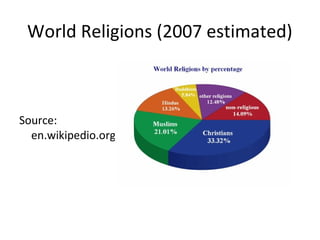
World Religions (2007 estimated)
Source:
en.wikipedio.org
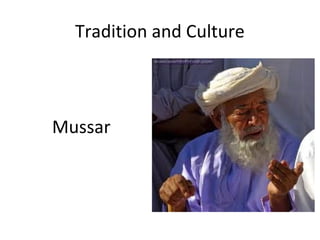
Tradition and Culture
Mussar
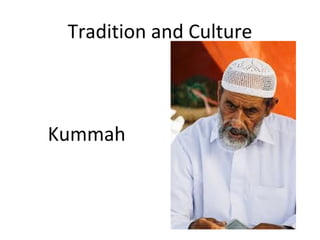
Tradition and Culture
Kummah
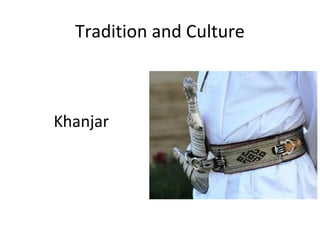
Tradition and Culture
Khanjar
Bases of Ethics in Islam
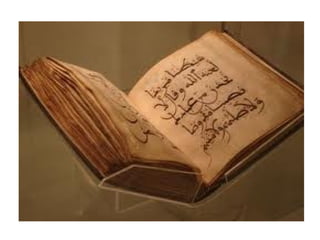
• Holy Qu’ran
• Traditions of Prohet (Sunnah)
Work Ethics
• Application of morals and ethical standards to
different work situations.
• Deals with the issues of right and wrong of
activities, decisions and situations.
• Applicable to business situations, professional
life and organizational settings.
Business
• An economic activity which involves
production and transaction of goods and
services for the purposes of sale at a profit.
• Examples: Manufacturing, Trading,
transportation, banking, finance, insurance,
etc.
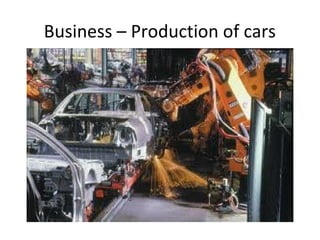
Business – Production of cars
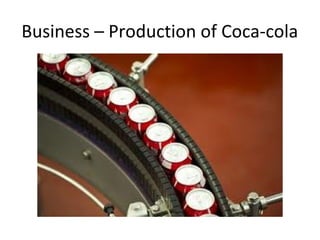
Business – Production of Coca-cola
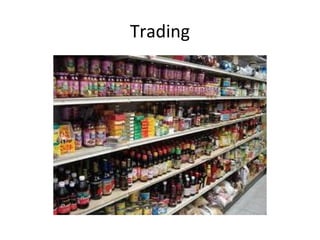
Trading
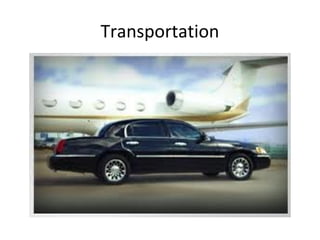
Transportation
Business Ethics
Deals with right and wrong in doing business.
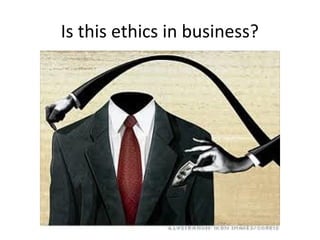
Is this ethics in business?
Business Ethics - Examples
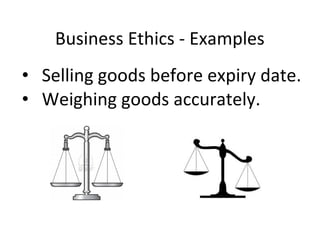
• Selling goods before expiry date.
• Weighing goods accurately.
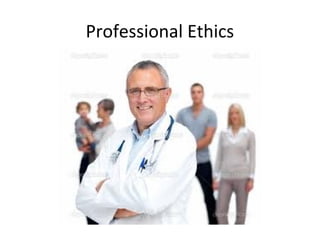
Professional Ethics
Profession
• An occupation or practice
• Requiring specialized knowledge and skills
• Through education and practical experience
Professional Ethics
Values and principles that guide
• a profession and
• the decisions made.
Organization
• A group of persons associated by some
common objectives
• Organization is viewed as a single unit
TOP Companies in Oman
• Oman Telecommunications Company
• Bank Muscat
• Shell Oman Marketing Company
• Gulfar Engineering & Contracting
• Al Maha Petroleum Products Marketing Co.
• Oman Oil marketing Company
• Renaissance Services
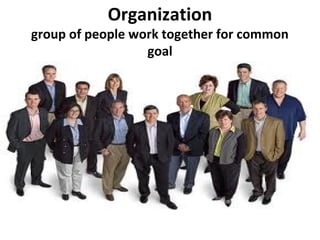
Organization
group of people work together for common
goal
Importance of Works Ethics
1. Increases goodwill
Ethical standards enhance reputation of
employees, professionals and organizations.
2. Increases mutual trust and
confidence
• Organizational ethics helps develop trust and
confidence among the people (customers,
employees, suppliers).
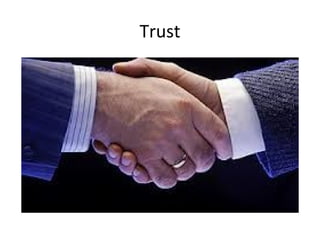
Trust
3. Safe work environment
• An employee, who follows ethical standards in
doing his job, is released from unwanted
tensions and worries.
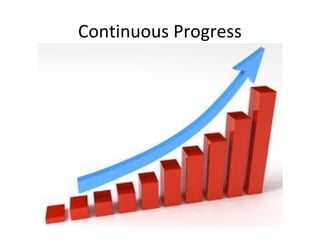
4. Continuous Progress
• An employee with high ethical standards
can make regular and continuous
progress in his career.
• Similarly an organization which adheres
to high ethical standards can flourish to
more heights.
Continuous Progress
5.Increases competency
• Nowadays any profession or business is highly
diverse and competitive.
• Ethical standards make professionals and
organizations competent to face all these
challenges.
Factors influencing Work Ethics
• 1.Personal values: The personal beliefs
of the individuals working in an
organization also influence work ethics.
• For example Mr. Humaid considers hard
work as his personal quality. He sits at
his laboratory late hours to complete the
experiments.
Personal Values - Examples
• Love
• Kindness
• Respect
• Humor
• Honesty
2.Social values
• The values existing in the societies
encourage people to follow ethical practices
and discourage them from doing unethical
practices.
• For Example : Equality is a social value. A
community which considers this value treats
all people equally.
Social Values - Examples
• Justice (Fairness)
• Liberty (authority & freedom)
• Freedom (liberty & independence)
3. Organization/ Industry norms
In some organizations/industries specific
codes of conduct have been laid down
which acts as the base for ethical
practices in those places
Example
In some companies encourage their
employees not to use the company
phones for personal use.
To support this norm they give special
telephone allowance for the staff.
4.Government rules and regulations
• Government regulations provide
guidelines for acceptable practices.
• For example, the government has made
it compulsory for tobacco companies to
give a statutory warning “smoking is
injurious to health” in the
advertisements for cigarettes
Important Terms
1. Values
2. Norms
3. Attitudes
Values
• Values are the important principles
shared by the members of a society
about what is good or bad and
desirable or undesirable.
• They influence a person’s behavior and
attitude.
• They guide the people on all situations.
• Some common values are honesty,
justice and equality.
Values
• Values act as the foundations of ethics
and morals.
• If values are trees then ethics is its fruits.
Values are…..
• Positive
• Negative
• Neutral
Positive values
• Anything which is good for the individual or
society is called positive value.
• Examples: Mercy, justice, being truthful, being
fair with others etc.
Negative values
• Anything which is bad for the individual or
society is called negative value.
• Example: Cheating, lying, stealing and greed
etc.
Neutral Values
• Deal with what we like or desire.
• Example: Money, fame, and status.
Norms
• Norms are expectations of a proper
behavior in a society.
• Example: Omani men are supposed
to wear Dishdasha and Khanjar
while attending a social or official
function.
What is Attitude?
Attitude
• Attitude is approach of an individual towards something,
someone, some place, or events, etc.
• Attitude may be positive or negative.
• It varies from person to person; time to time and situation
to situation.
• When you use ‘like’ and ‘dislike’ you are expressing an
attitude.
• Example: One person may like tea and another person may
like coffee.
Types of Values
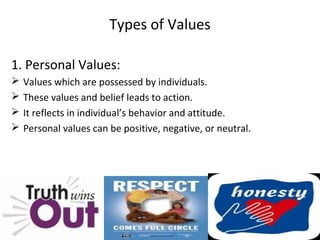
1. Personal Values:
 Values which are possessed by individuals.
 These values and belief leads to action.
 It reflects in individual’s behavior and attitude.
 Personal values can be positive, negative, or neutral.
2. Social Values
• Based on the welfare and wellbeing of one particular
society.
• May include equality, justice, liberty, freedom etc.
• Examples: Helping your friend, neighbors and other.
3.Economic Values
• Values related to earning and spending money.
• E.g. Spending money in a correct way
Charging correct price for the product etc
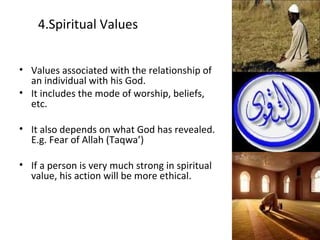
4.Spiritual Values
• Values associated with the relationship of
an individual with his God.
• It includes the mode of worship, beliefs,
etc.
• It also depends on what God has revealed.
E.g. Fear of Allah (Taqwa’)
• If a person is very much strong in spiritual
value, his action will be more ethical.
5.Technical Values
• Values associated with the use of science and technology.
• E.g. Using of nuclear science and other technologies for the
benefit of human being not for killing or harming anyone.
Technology
Examples
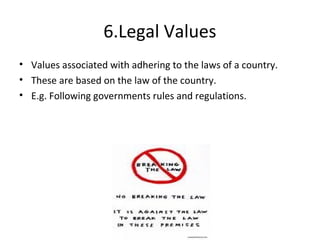
6.Legal Values
• Values associated with adhering to the laws of a country.
• These are based on the law of the country.
• E.g. Following governments rules and regulations.
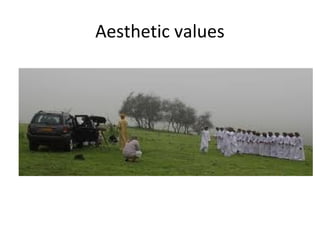
7.Aesthetic Values
• These are based on beauty and neatness.
• E.g. Not to destroy a colorful flower
Keeping the classroom and office neat and clean.
Aesthetic Values
Examples
Aesthetic values
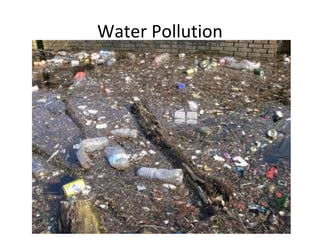
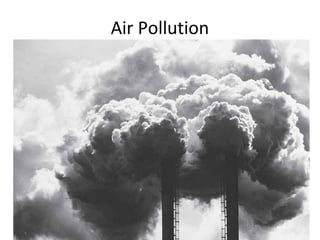
8.Ecological Values
• It is based on living system and environment.
• E.g. Not to pollute water, space, and environment.
Water Pollution
Air Pollution
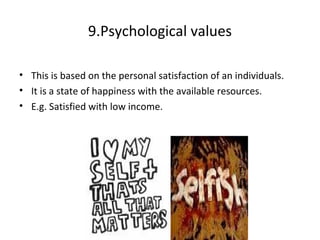
9.Psychological values
• This is based on the personal satisfaction of an individuals.
• It is a state of happiness with the available resources.
• E.g. Satisfied with low income.

Business ethics outcome 1

  • 1.
  • 2.
  • 3.
    Ethics - Definition •Ethics is a set of principles prescribing a behavior code, explains what is good and bad or what is right and wrong. • It gives outlines to moral duties and obligations. • Ethics is a system of moral principles.
  • 4.
    Ethics - Definition •Oxford Dictionary defines Ethics as “the science of morals in human conduct”. • It is a set of moral principles or values that govern behavior . • Ethics is the science of morality of conduct - deals with proper and improper actions of human being.
  • 5.
    Origin of Ethics •The word ‘Ethics’ came from the Greek word ‘Ethos’ meaning “Character”.
  • 6.
    Dimensions covered byEthics • Moral bases of what is good and bad. • Determines the rights and responsibilities of individuals and organizations. • Guide how to live a good life.
  • 7.
    Sources of Ethicsand Vales • Religion • Tradition • Cultures • Philosophies
  • 8.
    World Religions (2007estimated) Source: en.wikipedio.org
  • 9.
  • 10.
  • 11.
  • 12.
    Bases of Ethicsin Islam • Holy Qu’ran • Traditions of Prohet (Sunnah)
  • 14.
    Work Ethics • Applicationof morals and ethical standards to different work situations. • Deals with the issues of right and wrong of activities, decisions and situations. • Applicable to business situations, professional life and organizational settings.
  • 15.
    Business • An economicactivity which involves production and transaction of goods and services for the purposes of sale at a profit. • Examples: Manufacturing, Trading, transportation, banking, finance, insurance, etc.
  • 16.
  • 17.
  • 18.
  • 19.
  • 20.
    Business Ethics Deals withright and wrong in doing business.
  • 21.
    Is this ethicsin business?
  • 22.
    Business Ethics -Examples • Selling goods before expiry date. • Weighing goods accurately.
  • 23.
  • 24.
    Profession • An occupationor practice • Requiring specialized knowledge and skills • Through education and practical experience
  • 25.
    Professional Ethics Values andprinciples that guide • a profession and • the decisions made.
  • 26.
    Organization • A groupof persons associated by some common objectives • Organization is viewed as a single unit
  • 27.
    TOP Companies inOman • Oman Telecommunications Company • Bank Muscat • Shell Oman Marketing Company • Gulfar Engineering & Contracting • Al Maha Petroleum Products Marketing Co. • Oman Oil marketing Company • Renaissance Services
  • 28.
    Organization group of peoplework together for common goal
  • 29.
    Importance of WorksEthics 1. Increases goodwill Ethical standards enhance reputation of employees, professionals and organizations.
  • 30.
    2. Increases mutualtrust and confidence • Organizational ethics helps develop trust and confidence among the people (customers, employees, suppliers).
  • 31.
  • 32.
    3. Safe workenvironment • An employee, who follows ethical standards in doing his job, is released from unwanted tensions and worries.
  • 33.
    4. Continuous Progress •An employee with high ethical standards can make regular and continuous progress in his career. • Similarly an organization which adheres to high ethical standards can flourish to more heights.
  • 34.
  • 35.
    5.Increases competency • Nowadaysany profession or business is highly diverse and competitive. • Ethical standards make professionals and organizations competent to face all these challenges.
  • 36.
    Factors influencing WorkEthics • 1.Personal values: The personal beliefs of the individuals working in an organization also influence work ethics. • For example Mr. Humaid considers hard work as his personal quality. He sits at his laboratory late hours to complete the experiments.
  • 37.
    Personal Values -Examples • Love • Kindness • Respect • Humor • Honesty
  • 38.
    2.Social values • Thevalues existing in the societies encourage people to follow ethical practices and discourage them from doing unethical practices. • For Example : Equality is a social value. A community which considers this value treats all people equally.
  • 39.
    Social Values -Examples • Justice (Fairness) • Liberty (authority & freedom) • Freedom (liberty & independence)
  • 40.
    3. Organization/ Industrynorms In some organizations/industries specific codes of conduct have been laid down which acts as the base for ethical practices in those places
  • 41.
    Example In some companiesencourage their employees not to use the company phones for personal use. To support this norm they give special telephone allowance for the staff.
  • 42.
    4.Government rules andregulations • Government regulations provide guidelines for acceptable practices. • For example, the government has made it compulsory for tobacco companies to give a statutory warning “smoking is injurious to health” in the advertisements for cigarettes
  • 43.
    Important Terms 1. Values 2.Norms 3. Attitudes
  • 44.
    Values • Values arethe important principles shared by the members of a society about what is good or bad and desirable or undesirable. • They influence a person’s behavior and attitude. • They guide the people on all situations. • Some common values are honesty, justice and equality.
  • 45.
    Values • Values actas the foundations of ethics and morals. • If values are trees then ethics is its fruits.
  • 46.
  • 47.
    Positive values • Anythingwhich is good for the individual or society is called positive value. • Examples: Mercy, justice, being truthful, being fair with others etc.
  • 48.
    Negative values • Anythingwhich is bad for the individual or society is called negative value. • Example: Cheating, lying, stealing and greed etc.
  • 49.
    Neutral Values • Dealwith what we like or desire. • Example: Money, fame, and status.
  • 50.
    Norms • Norms areexpectations of a proper behavior in a society. • Example: Omani men are supposed to wear Dishdasha and Khanjar while attending a social or official function.
  • 51.
  • 52.
    Attitude • Attitude isapproach of an individual towards something, someone, some place, or events, etc. • Attitude may be positive or negative. • It varies from person to person; time to time and situation to situation. • When you use ‘like’ and ‘dislike’ you are expressing an attitude. • Example: One person may like tea and another person may like coffee.
  • 53.
    Types of Values 1.Personal Values:  Values which are possessed by individuals.  These values and belief leads to action.  It reflects in individual’s behavior and attitude.  Personal values can be positive, negative, or neutral.
  • 54.
    2. Social Values •Based on the welfare and wellbeing of one particular society. • May include equality, justice, liberty, freedom etc. • Examples: Helping your friend, neighbors and other.
  • 55.
    3.Economic Values • Valuesrelated to earning and spending money. • E.g. Spending money in a correct way Charging correct price for the product etc
  • 56.
    4.Spiritual Values • Valuesassociated with the relationship of an individual with his God. • It includes the mode of worship, beliefs, etc. • It also depends on what God has revealed. E.g. Fear of Allah (Taqwa’) • If a person is very much strong in spiritual value, his action will be more ethical.
  • 57.
    5.Technical Values • Valuesassociated with the use of science and technology. • E.g. Using of nuclear science and other technologies for the benefit of human being not for killing or harming anyone.
  • 58.
  • 59.
    6.Legal Values • Valuesassociated with adhering to the laws of a country. • These are based on the law of the country. • E.g. Following governments rules and regulations.
  • 60.
    7.Aesthetic Values • Theseare based on beauty and neatness. • E.g. Not to destroy a colorful flower Keeping the classroom and office neat and clean.
  • 61.
  • 62.
  • 63.
    8.Ecological Values • Itis based on living system and environment. • E.g. Not to pollute water, space, and environment.
  • 64.
  • 65.
  • 66.
    9.Psychological values • Thisis based on the personal satisfaction of an individuals. • It is a state of happiness with the available resources. • E.g. Satisfied with low income.