GOLLIS UNIVERSITY
SCHOOL OF GRADUATE STUDIES &
RESEARCH (SGSR)
Course: Master of Arts in Human resource Management
Course unit: Business Ethics
Introduction to business Ethics
Lecturer: Dr Buyera Saidi
Introduction to ethics. Definition
Business ethics are the moral and
ethical principles that guide how a
business operates and behaves.
They apply to all aspects of a
business, including how it treats
its employees, suppliers, and
customers.
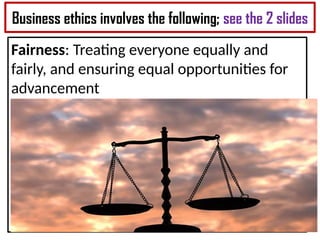
Business ethics involves the following; see the 2 slides
Fairness: Treating everyone equally and
fairly, and ensuring equal opportunities for
advancement
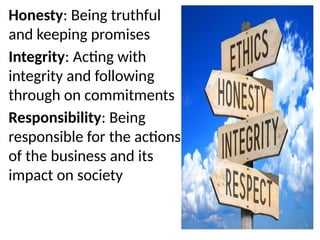
Honesty: Being truthful
and keeping promises
Integrity: Acting with
integrity and following
through on commitments
Responsibility: Being
responsible for the actions
of the business and its
impact on society
ETHICS – a sub-discipline of philosophy concerned with
issues of right and wrong in human conduct. It is
concerned with good and bad; what is authentic and not
authentic; and with the notions of duty, obligation, and
moral responsibility. ETHICS provides an objective basis
upon which judgments are rendered regarding right or
wrong behavior. Ethics originates from the Greek word
"Ethos" which means custom, character or the normal
state of a person or group. i.e. the characteristic spirit,
values, beliefs, practices, attitudes, aspirations of a social
group or culture. Examples: an Aristocratic ethos; a
materialistic ethos. Ethics involves study of moral
obligation involving the distinction between right and
wrong. Therefore, Business Ethics: refers to ethics on right
or wrong in the workplace – value management.
Morals and morality
Morals can result from Religion, Philosophy and Family
teachings, among others. Morality is concerned with the
social practices defining right and wrong. Morals provide a
means of preserving a people and ensuring stable social
order. Ethics on the other provides a critical reflection on
morality by allowing us to step back and examine, analyze,
and organize basis of choice of good or bad in order to
enhance morality (more abstract). It looks for consistency,
logic, order, coherence, conflicts in choices, etc.
Ethical theory and moral philosophies provide guidelines for
justification of right or wrong actions when settling human
conflict. No one moral philosophy is universally accepted by
everyone!
Morality versus prudence
Rules of prudence promote self-
interest, doing what is prudent for
oneself. However, rules of morality
promote the interest of other
people. Nevertheless, morality and
prudence should generally work
hand-in-hand if a business is to
succeed.
Ethics, Morality and Law
Morality and ethics begin where the
law is unclear or not defined! The
law often represents an ethical
minimum. Ethics often represents a
standard that exceeds the legal
minimum.
Ethics and Islam
Islamic ethics are based on the Qur'an, the practices of the Prophet Muhammad -
SAW, and the practices of the Muslim community. They are a result of monotheistic
faith and are intended to guide a person's behavior.
Principles
Command the good and forbid evil: The Qur'an commands people to do good and
avoid evil in all aspects of life.
Do no harm: Islamic scholars have proposed the principle of La Darar wa la Derar
which means "Do no harm".
Consider the reason behind an action: Muslims may consider the reason behind an
action, such as being forced to steal due to poverty.
Be honest and trustworthy: The Prophet Muhammad was known as al-amin, which
means trustworthy.
Be humble and tolerant: Islamic social ethics encourage humility, tolerance, and
civility.
Sources
Qur'an: The primary source of Islamic law, along with the Sunnah.
Sunnah: The sayings and practices of the Prophet Muhammad.
Fiqh: The study of the rules for living properly found in the Qur'an & Sunnah.
Ethics and Conscience
Ethical conscience is the inner sense of what
is right or wrong in one's conduct or motives
impelling one towards a certain action.
However, conscience is subjective & may vary
from person to person & time to time & it is
altered by circumstance, religious belief, life
experiences, & training, & may not be
consistent from day to day. Therefore, moral
justification must then be based on a source
external to conscience itself.
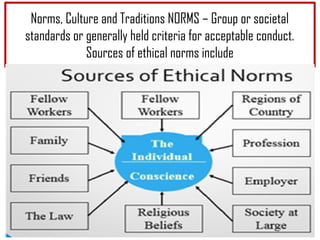
Norms, Culture and Traditions NORMS – Group or societal
standards or generally held criteria for acceptable conduct.
Sources of ethical norms include
Principles and values
VALUES: Individual beliefs which motivate & guide behavior.
These are abstract ideals that shape an individual’s thinking
and behavior by imposing a moral compass where one
beliefs that one process or end state to be more preferable
than another. The values can be instrumental or terminal.
Instrumental values accede that a certain way of behaving is
appropriate in all situations – “means”. While terminal
values is the enduring belief in the attainment of a certain
end state – “ends”.
Moral principles are standards of behaviour of right & wrong
that are accepted by an individual or social group. It may be
based on precept that rule personal conduct or categorical
imperative that behaviour should be determined by duty.
Ethics and integrity
Ethics and integrity are a set of principles that guide a
person's behavior and decision-making. They are vital in the
workplace because they help build trust & a positive culture.
Ethics:
-A set of principles that guide behavior and decision-making
-Concerned with what is right or wrong, & what is
acceptable or unacceptable
Integrity:
-The adherence to a strong moral code and the consistent
demonstration of honesty, transparency, and fairness
-The willingness to do what's right, even when no one is
watching
Ethics and accountability
Ethics & accountability are principles that guide how people
behave & how they are held responsible for their actions. They are
important in public service and governance, & can help maintain
public trust.
Ethics
-The principles, standards, or codes that guide how people behave
-Doing the right thing
-Upholding values like integrity, transparency, and fairness
Accountability
-Being responsible for a system, its behavior, and its potential
impacts
-Being answerable for actions, decisions, and products
-Ensuring transparency and disclosure
Ethics and transparency
Ethics and transparency are guiding principles that promote
accountability and trust. They can be applied in government,
businesses, and other organizations.
Benefits of ethics and transparency
Trust: Transparency helps build trust in organizations & with the
public
Accountability: Transparency holds people and organizations
accountable for their actions
Fairness: Transparency ensures that actions are just and fair
Compliance: Transparency helps ensure compliance with laws and
regulations
Reputation: Transparency can enhance an organization's reputation
Performance: Transparency can help improve performance
Corruption: Transparency can help reduce corruption and bribery
Significance of business ethics
-Focus on business ethics by business organizations is becoming
crucial because of contemporary business problems such as:
-Consumer trust of businesses is declining
-No sector is exempt from ethical misconduct
-Stakeholders demands for ethics initiatives: Investors,
Employees, Customers, Interest groups, Legal system, and General
Business Community
-Reports of unethical behavior are on the rise
-Pronounced society’s evaluation of right or wrong affects its
ability to achieve its business goals through civil society and other
institutions
-Individual ethics alone is not sufficient
-Studying business ethics helps identify ethical issues to key
stakeholders
Scope & areas of focus of business ethics
A living wage
Consumer’s Bill of Rights
Bribery and fraud
Deceptive advertising
Price collusion
Product safety
The environment
Ethical Legal compliance
Self-regulation
Free trade
END OF LECTURE ONE

Chapter 1- Introduction to Business Ethics.pptx

  • 1.
    GOLLIS UNIVERSITY SCHOOL OFGRADUATE STUDIES & RESEARCH (SGSR) Course: Master of Arts in Human resource Management Course unit: Business Ethics Introduction to business Ethics Lecturer: Dr Buyera Saidi
  • 2.
    Introduction to ethics.Definition Business ethics are the moral and ethical principles that guide how a business operates and behaves. They apply to all aspects of a business, including how it treats its employees, suppliers, and customers.
  • 3.
    Business ethics involvesthe following; see the 2 slides Fairness: Treating everyone equally and fairly, and ensuring equal opportunities for advancement
  • 4.
    Honesty: Being truthful andkeeping promises Integrity: Acting with integrity and following through on commitments Responsibility: Being responsible for the actions of the business and its impact on society
  • 5.
    ETHICS – asub-discipline of philosophy concerned with issues of right and wrong in human conduct. It is concerned with good and bad; what is authentic and not authentic; and with the notions of duty, obligation, and moral responsibility. ETHICS provides an objective basis upon which judgments are rendered regarding right or wrong behavior. Ethics originates from the Greek word "Ethos" which means custom, character or the normal state of a person or group. i.e. the characteristic spirit, values, beliefs, practices, attitudes, aspirations of a social group or culture. Examples: an Aristocratic ethos; a materialistic ethos. Ethics involves study of moral obligation involving the distinction between right and wrong. Therefore, Business Ethics: refers to ethics on right or wrong in the workplace – value management.
  • 6.
    Morals and morality Moralscan result from Religion, Philosophy and Family teachings, among others. Morality is concerned with the social practices defining right and wrong. Morals provide a means of preserving a people and ensuring stable social order. Ethics on the other provides a critical reflection on morality by allowing us to step back and examine, analyze, and organize basis of choice of good or bad in order to enhance morality (more abstract). It looks for consistency, logic, order, coherence, conflicts in choices, etc. Ethical theory and moral philosophies provide guidelines for justification of right or wrong actions when settling human conflict. No one moral philosophy is universally accepted by everyone!
  • 7.
    Morality versus prudence Rulesof prudence promote self- interest, doing what is prudent for oneself. However, rules of morality promote the interest of other people. Nevertheless, morality and prudence should generally work hand-in-hand if a business is to succeed.
  • 8.
    Ethics, Morality andLaw Morality and ethics begin where the law is unclear or not defined! The law often represents an ethical minimum. Ethics often represents a standard that exceeds the legal minimum.
  • 9.
    Ethics and Islam Islamicethics are based on the Qur'an, the practices of the Prophet Muhammad - SAW, and the practices of the Muslim community. They are a result of monotheistic faith and are intended to guide a person's behavior. Principles Command the good and forbid evil: The Qur'an commands people to do good and avoid evil in all aspects of life. Do no harm: Islamic scholars have proposed the principle of La Darar wa la Derar which means "Do no harm". Consider the reason behind an action: Muslims may consider the reason behind an action, such as being forced to steal due to poverty. Be honest and trustworthy: The Prophet Muhammad was known as al-amin, which means trustworthy. Be humble and tolerant: Islamic social ethics encourage humility, tolerance, and civility. Sources Qur'an: The primary source of Islamic law, along with the Sunnah. Sunnah: The sayings and practices of the Prophet Muhammad. Fiqh: The study of the rules for living properly found in the Qur'an & Sunnah.
  • 10.
    Ethics and Conscience Ethicalconscience is the inner sense of what is right or wrong in one's conduct or motives impelling one towards a certain action. However, conscience is subjective & may vary from person to person & time to time & it is altered by circumstance, religious belief, life experiences, & training, & may not be consistent from day to day. Therefore, moral justification must then be based on a source external to conscience itself.
  • 11.
    Norms, Culture andTraditions NORMS – Group or societal standards or generally held criteria for acceptable conduct. Sources of ethical norms include
  • 12.
    Principles and values VALUES:Individual beliefs which motivate & guide behavior. These are abstract ideals that shape an individual’s thinking and behavior by imposing a moral compass where one beliefs that one process or end state to be more preferable than another. The values can be instrumental or terminal. Instrumental values accede that a certain way of behaving is appropriate in all situations – “means”. While terminal values is the enduring belief in the attainment of a certain end state – “ends”. Moral principles are standards of behaviour of right & wrong that are accepted by an individual or social group. It may be based on precept that rule personal conduct or categorical imperative that behaviour should be determined by duty.
  • 13.
    Ethics and integrity Ethicsand integrity are a set of principles that guide a person's behavior and decision-making. They are vital in the workplace because they help build trust & a positive culture. Ethics: -A set of principles that guide behavior and decision-making -Concerned with what is right or wrong, & what is acceptable or unacceptable Integrity: -The adherence to a strong moral code and the consistent demonstration of honesty, transparency, and fairness -The willingness to do what's right, even when no one is watching
  • 14.
    Ethics and accountability Ethics& accountability are principles that guide how people behave & how they are held responsible for their actions. They are important in public service and governance, & can help maintain public trust. Ethics -The principles, standards, or codes that guide how people behave -Doing the right thing -Upholding values like integrity, transparency, and fairness Accountability -Being responsible for a system, its behavior, and its potential impacts -Being answerable for actions, decisions, and products -Ensuring transparency and disclosure
  • 15.
    Ethics and transparency Ethicsand transparency are guiding principles that promote accountability and trust. They can be applied in government, businesses, and other organizations. Benefits of ethics and transparency Trust: Transparency helps build trust in organizations & with the public Accountability: Transparency holds people and organizations accountable for their actions Fairness: Transparency ensures that actions are just and fair Compliance: Transparency helps ensure compliance with laws and regulations Reputation: Transparency can enhance an organization's reputation Performance: Transparency can help improve performance Corruption: Transparency can help reduce corruption and bribery
  • 16.
    Significance of businessethics -Focus on business ethics by business organizations is becoming crucial because of contemporary business problems such as: -Consumer trust of businesses is declining -No sector is exempt from ethical misconduct -Stakeholders demands for ethics initiatives: Investors, Employees, Customers, Interest groups, Legal system, and General Business Community -Reports of unethical behavior are on the rise -Pronounced society’s evaluation of right or wrong affects its ability to achieve its business goals through civil society and other institutions -Individual ethics alone is not sufficient -Studying business ethics helps identify ethical issues to key stakeholders
  • 17.
    Scope & areasof focus of business ethics A living wage Consumer’s Bill of Rights Bribery and fraud Deceptive advertising Price collusion Product safety The environment Ethical Legal compliance Self-regulation Free trade
  • 18.