ETHICS
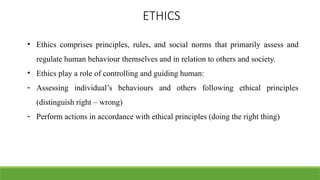
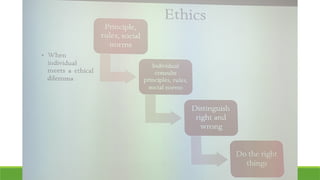
• Ethics comprisesprinciples, rules, and social norms that primarily assess and
regulate human behaviour themselves and in relation to others and society.
• Ethics play a role of controlling and guiding human:
- Assessing individual’s behaviours and others following ethical principles
(distinguish right – wrong)
- Perform actions in accordance with ethical principles (doing the right thing)
4.
ETHICS (…)
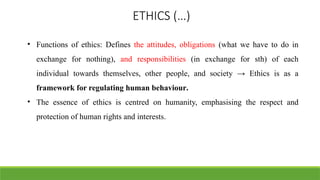
• Functionsof ethics: Defines the attitudes, obligations (what we have to do in
exchange for nothing), and responsibilities (in exchange for sth) of each
individual towards themselves, other people, and society → Ethics is as a
framework for regulating human behaviour.
• The essence of ethics is centred on humanity, emphasising the respect and
protection of human rights and interests.
5.
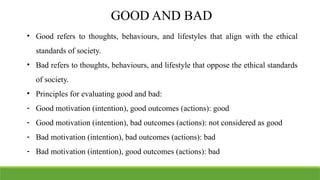
GOOD AND BAD
•Good refers to thoughts, behaviours, and lifestyles that align with the ethical
standards of society.
• Bad refers to thoughts, behaviours, and lifestyle that oppose the ethical standards
of society.
• Principles for evaluating good and bad:
- Good motivation (intention), good outcomes (actions): good
- Good motivation (intention), bad outcomes (actions): not considered as good
- Bad motivation (intention), bad outcomes (actions): bad
- Bad motivation (intention), good outcomes (actions): bad
6.
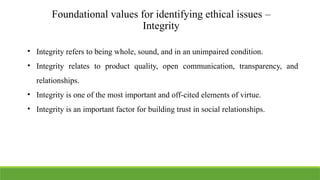
Foundational values foridentifying ethical issues –
Integrity
• Integrity refers to being whole, sound, and in an unimpaired condition.
• Integrity relates to product quality, open communication, transparency, and
relationships.
• Integrity is one of the most important and off-cited elements of virtue.
• Integrity is an important factor for building trust in social relationships.
7.
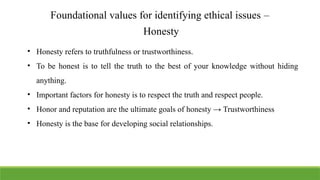
Foundational values foridentifying ethical issues –
Honesty
• Honesty refers to truthfulness or trustworthiness.
• To be honest is to tell the truth to the best of your knowledge without hiding
anything.
• Important factors for honesty is to respect the truth and respect people.
• Honor and reputation are the ultimate goals of honesty → Trustworthiness
• Honesty is the base for developing social relationships.
8.
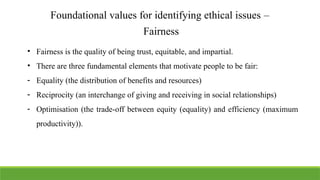
Foundational values foridentifying ethical issues –
Fairness
• Fairness is the quality of being trust, equitable, and impartial.
• There are three fundamental elements that motivate people to be fair:
- Equality (the distribution of benefits and resources)
- Reciprocity (an interchange of giving and receiving in social relationships)
- Optimisation (the trade-off between equity (equality) and efficiency (maximum
productivity)).
9.
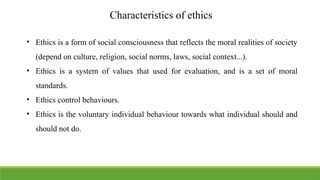
Characteristics of ethics
•Ethics is a form of social consciousness that reflects the moral realities of society
(depend on culture, religion, social norms, laws, social context...).
• Ethics is a system of values that used for evaluation, and is a set of moral
standards.
• Ethics control behaviours.
• Ethics is the voluntary individual behaviour towards what individual should and
should not do.
10.
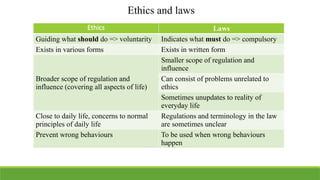
Ethics and laws
EthicsLaws
Guiding what should do => voluntarity Indicates what must do => compulsory
Exists in various forms Exists in written form
Broader scope of regulation and
influence (covering all aspects of life)
Smaller scope of regulation and
influence
Can consist of problems unrelated to
ethics
Sometimes unupdates to reality of
everyday life
Close to daily life, concerns to normal
principles of daily life
Regulations and terminology in the law
are sometimes unclear
Prevent wrong behaviours To be used when wrong behaviours
happen
11.
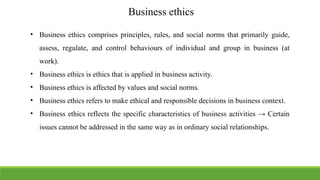
Business ethics
• Businessethics comprises principles, rules, and social norms that primarily guide,
assess, regulate, and control behaviours of individual and group in business (at
work).
• Business ethics is ethics that is applied in business activity.
• Business ethics is affected by values and social norms.
• Business ethics refers to make ethical and responsible decisions in business context.
• Business ethics reflects the specific characteristics of business activities → Certain
issues cannot be addressed in the same way as in ordinary social relationships.
12.
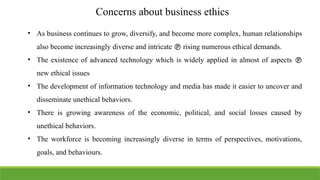
Concerns about businessethics
• As business continues to grow, diversify, and become more complex, human relationships
also become increasingly diverse and intricate rising numerous ethical demands.
• The existence of advanced technology which is widely applied in almost of aspects
new ethical issues
• The development of information technology and media has made it easier to uncover and
disseminate unethical behaviors.
• There is growing awareness of the economic, political, and social losses caused by
unethical behaviors.
• The workforce is becoming increasingly diverse in terms of perspectives, motivations,
goals, and behaviours.
13.
Concerns about businessethics
• There is a growing demand for higher standards for employees, leaders, and government
officials.
• Suppliers, partners, and customers prefer to work with companies that are highly regarded
for their ethical standards.
• The positive impact of ethical business practices on companies and the adverse
consequences of unethical business conduct.
• …
14.
Subjects and scopeof application in business ethics
• Subjects of regulation: individuals and entities involved in business relationships
(employees, managers, investors, suppliers, intermediaries, customers, competitors, etc.).
• Scope of application: social institutions, organisations, and stakeholders (political
organizations, government agencies, enterprises, labour unions, social organisations, etc.);
all activities of the involved entities.
15.
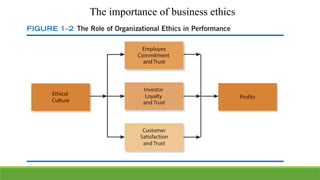
The importance ofbusiness ethics
• Control behaviours of business entities.
• Enhancing the quality of business operations.
• Building trust, commitment, and dedication among employees toward the business.
• Satisfying customers and bringing trust.
• Creating trust and loyalty among investors toward the business.
• Improving profitability for businesses and the strength of the economy.
• …
#4 Obligation (như trong họ hàng phải tôn trọng, nghe lời người lớn, đi nghĩa vụ quân sự)
Responsibility (ví dụ như đóng thuế)
Tesla gây ra các vấn đề đạo đức (lốp, không nhận diện được con người, nên bảo vệ người đi đường hay bảo vệ người lái