Partnership Notes 2020 | BELARMA
Page 1 of 24
PARTNERSHIP
Governing law in our jurisdiction
Before the new Civil Code (RA No. 386) took effect on Aug.3, 1950,
commercial or mercantile partnerships were governed by the Code of
Commerce and non-commercial or civil partnerships by the old
Spanish Civil Code.
The New Civil Code superseded the old Civil Code. It expressly
repealed in toto the provisions of the Code of Commerce relating to
partnerships.
There is no more distinction between commercial and civil
partnerships.
CHAPTER 1
GENERAL PROVISIONS
Art. 1767. By the contract of partnership two or more persons bind
themselves to contribute money, property, or industry to a common
fund, with the intention of dividing the profits among themselves.
Two or more persons may also form a partnership for the exercise
of a profession.
Concept of partnership
The above Article gives the legal definition of partnership from the
viewpoint of a contract.
General Professional Partnership
Paragraph 2 relates to a partnership for the exercise of a profession
or a general professional partnership.
A profession has been defined as a “a group of men pursuing a
learned art as a common calling in the spirit of public service – no less
a public service because it may incidentally ne a means of livelihood.”
Strictly speaking, the practice of a profession is not a business or an
enterprise for profit. However, the law allows the joint pursuit thereof
by 2 or more persons as partners.
The law does not allow individuals to practice a profession as a
corporate entity. Personal qualifications for such practice cannot be
possessed by a corporation.
Partnership for the practice of law
(1) A mere association for non-business purpose. – The right to
practice law is not a natural or constitutional right but is in the
nature of a privilege or franchise. It cannot be likened to
partnerships formed by other professionals or for business.
Thus, the use of nom de plume, assumed, or trade name in law
practice is improper.
(2) Distinguished from business – The practice of law is intimately
related to the administration of justice and should not be
considered like an ordinary “money-making trade”.
Characteristics elements of partnership
(1) Consensual
(2) Nominate
(3) Bilateral
(4) Onerous
(5) Commutative
(6) Principal
(7) Preparatory
Essential features of a partnership (VLM-LP)
(1) There must be a valid contract;
(2) The parties (2 or more persons) must have legal capacity
to enter into the contract;
(3) There must be a mutual contribution of money, property,
or industry to a common fund;
(4) The object must be lawful, and
(5) The primary purposes must be to carry on a business for
profits and to divide the same among the parties.
I. Existence of a valid contract
(1) Partnership relation fundamentally contractual – Partnership is a
voluntary relation created by agreement of the parties. There is
no such thing as a partnership created by law or by operation or
implication of law alone.
(a) Form – No formality is required in setting up a general
partnership unless it falls within the Statute of Frauds.
However, there are formal requirements for creating a
limited partnership.
(b) Articles of Partnership – it is customary to embody the terms
of the association in a written documents known as “Articles
of Partnership”.
(c) Requisites – COC [(1) Consent and capacity of the
contracting parties; (2) Object which is the subject matter of
the contract; (3) Cause which is established.]
(2) Partnership relation fiduciary in nature – Partnership is a
personal relation in which the element of delectus personae
exists, involving as it does trust and confidence between the
partners.
(a) Right to choose co-partners – Unless otherwise provided in
the partnership agreement, no one can become a member
of the partnership association without the consent of all the
other associates. The fiduciary nature of the partnership
relation and the liability of each partner for the acts of others
within the scope of partnership business require that each
person be granted the right to choose with whom he will be
associated in the firm.
(b) Power to dissolve the partnership – Any one of the partners
may, at his sole pleasure, dictate a dissolution of the
partnership at will. He must, however, act in good faith,
not that the attendance of bad faith can prevent the
dissolution of the partnership but that it can result in a
liability for damages. (Ortega v. CA)
(3) Application of principles of estoppel
A partnership liability may be imposed upon a person under principles
of estoppel where he holds himself out, or permits himself to be held
out, as a partner in an enterprise. In such a case, there is no actual or
legal partnership relation but merely a partnership liability imposed by
law in favor of third persons.
II. Legal capacity of the parties to enter into the contract
The word “persons”, as used in Art. 1767, may be interpreted to mean
persons in the biological sense (individuals) or persons in the legal
sense (juridical entities). Thus, a partner may be a human being, a
partnership, a corporation, or a joint venture.
(1) Individuals
Any person capable of entering into contractual relations may be
partner.
Hence, the following cannot give their consent to the partnership:
(a) Unemancipated minors
(b) Insane of demented persons
(c) Deaf-mutes who do not know how to write
(d) Persons who are suffering from civil interdiction; and
(e) Incompetents who are under guardianship.
Under Art. 1782, persons who are prohibited from giving each other
any donation or advantage cannot enter into a universal partnership.
(2) Partnerships
There is no prohibition against a partnership being a partner in
another partnership.
(3) Corporations
The doctrine adopted by our SC is that, unless authorized by
statute or by its charter, a corporation is without capacity or
power to enter into a contract of partnership. (Mendiola v. CA)
This limitation is based on public policy, since in a partnership
the corporation would be bound by the acts of persons who are
not its duly appointed and authorized agents and officers, which
would be entirely inconsistent with the policy of the law that the
corporation shall manage its own affairs separately and
exclusively.
Bar Question (1994)
Can two corporations organize a general partnership under
the Civil Code of the Philippines?
No, a corporation is managed by its board of directors. If the
corporation were to become a partner, co-partners would have the
power to make the corporation party to transactions in an
irregular manner since the partners are not agents subject to the
control of the Board of Directors. But a corporation may enter
into a joint venture with another corporation as long as the nature
of the venture is in line with the business authorized by its charter
(Tuason & Co., Inc. v. Bolano, 95 Phil. 106).
Can a corporation and an individual form a general
partnership?
No. A corporation may not be a general partner because the
principle of mutual agency in general partnership allowing the
other general partner to bind the corporation will violate the
corporation law principle that only the board of directors may bind
the corporation.
Partnership Notes 2020 | BELARMA
Page 2 of 24
III. Mutual Contribution of Money, Property, or Industry to a
Common Fund
(1) Existence of proprietary interest
It is the essence of partnership. Without the element of mutual
contribution to a common fund, there can be no partnership,
although its presence is not necessarily a conclusive evidence of
the existence of partnership.
(2) Form of contribution
It is not required that the contribution should all be equal, nor
even necessary that they all be of the same nature. The
contribution may be in 3 forms, or any 2 or 1 of them.
(a) Money
-currency which is legal tender in the PH. Checks, etc are
not money but only representatives of money.
Consequently, there is no contribution of money until they
have been cashed.
(b) Property
May be real, personal, corporeal or incorporeal.
(c) Industry
A partnership may therefore, exist even if it is shown that
the partners have not contributed any capital of their own to
a “common fund” for the contribution may be in the form of
credit or industry not necessarily cash or fixed assets. (Lim
Tong Lim v. Philippine Fishing Gear Industries, Inc.)
(3) Contribution of industry
The law does not specify the kind of industry that a partner may
contribute. A limited partner in a limited partnership, however,
cannot contribute mere industry or services.
(4) Proof of Contribution
Proof is necessary that there be contribution of money, property,
or industry to a common fund with the intention of dividing the
income or profits obtained therefrom.
Lim Tong Lim v. Philippine Fishing Gear Industries, Inc.
It is clear that there was among, petitioner Chua and Yao, a
partnership engaged in the fishing business. They purchased
boats, which constituted the main assets of the partnership, and
they agreed that the proceeds from the sales and operations
thereof would be divided among them.
Lim was a partner, and not a lessor.
Technically, it is true that petitioner did not directly act on behalf of
the corporation. However, having reaped the benefits of the
contract entered into by persons with whom he previously had an
existing relationship, he is deemed part of said association and is
covered by the scope of the doctrine of corporation by estoppel.
Hence, he should be held jointly liable with Chua and Yao.
IV. Legality of the Object
As in other kinds of contract, the purpose of partnership must be lawful
otherwise, no partnership can arise as the contract is inexistent and
void ab initio.
V. Purpose to carry on a business for profits
(1) The very reason for existence of partnership.
Sharing of profits
1. Not necessarily in equal shares
2. Not conclusive evidence of partnership (only presumptive)
Sharing of losses
1. Necessary corollary of sharing in profits
2. Agreement not necessary
If only the share of each partner in the profits has been
agreed upon, the share of each in the losses shall be in the
same proportion.
Generally, a stipulation which excludes 1 or more partners from any
share in the profits or losses is void. (Art. 1799)
Art. 1768. The partnership has a juridical personality separate and
distinct from that of each of the partners, even in case of failure to
comply with the requirements of Article 1772, first paragraph.
Partnership, a juridical person.
As an independent juridical person, a partnership may enter into
contracts, acquire and possess property of all kinds in its name, as
well as incur obligations and bring civil or criminal actions in conformity
with the laws and regulations of its organizations.
Effect of failure to comply with statutory requirements
(1) Under Art. 1772
Even in case of failure to comply with the requirements of
execution of a public instrument and registration of the same with
the SEC in cases when the partnership capital exceeds P3,000,
such partnership still acquires juridical personality. (Reason:
impracticality)
(2) Under Art. 1773 and 1775
However, in these articles, the partnership shall not acquire any
juridical personality because the contract itself is void.
To organize a partnership is not an absolute right but a privilege
which may be enjoyed only under such terms as the State may
deem necessary to impose.
Art. 1769. In determining whether a partnership exists, these rules
shall apply:
(1) Except as provided by Article 1825, persons who are not
partners as to each other are not partners as to third persons;
(2) Co-ownership or co-possession does not of itself establish a
partnership, whether such-co-owners or co-possessors do or do
not share any profits made by the use of the property;
(3) The sharing of gross returns does not of itself establish a
partnership, whether or not the persons sharing them have a joint
or common right or interest in any property from which the returns
are derived;
(4) The receipt by a person of a share of the profits of a business
is prima facie evidence that he is a partner in the business, but no
such inference shall be drawn if such profits were received in
payment: (DWAIC)
(a) As a debt by installments or otherwise;
(b) As wages of an employee or rent to a landlord;
(c) As an annuity to a widow or representative of a
deceased partner;
(d) As interest on a loan, though the amount of payment
vary with the profits of the business;
(e) As the consideration for the sale of a goodwill of a
business or other property by installments or otherwise.
Rules to determine existence of partnership.
Art. 1769 lays down the rules for determining whether or not the
association is one of partnership.
Where existence is disputed
The existence of a partnership may be disputed by an interested party.
The issue as to whether a partnership exists is a factual matter to be
decided on the basis of all circumstances. No single factor usually is
controlling. Where circumstances taken singly may be inadequate to
prove the intent to form a partnership, nevertheless, the collective
effect of these circumstances may be such as to support a finding of
the existence of the parties’ intent. (Heirs of Tan Eng Kee v. CA)
Persons not partners as to each other
GR: Persons who are not partners as to each other are not partners
as to third persons.
EXC: Partnership by estoppel – A partnership can never exist as to
third persons if no contract of partnership, express or implied, has
been entered into between the parties themselves. The exception
refers to partnership by estoppel. Thus, where persons by their acts,
consent, or representations have misled third persons or parties into
believing that the former are partners in a non-existing partnership,
such persons become subject to liabilities of partners to all who, in
good faith, deal with them in their apparent relations.
Co-ownership or co-possession
There is co-ownership (or co-possession) whenever the ownership (or
co-possession) of an undivided thing or right belongs to different
persons.
(1) Clear intent to derive profits from operation of business.
There must be clear intent to form a partnership.
(2) Existence of fiduciary relationship
If the parties are merely co-owners, there is no fiduciary
relationship between them. If the parties are partners in the
business undertaking, there is a well-defined fiduciary
relationship between them as partners.
Ona v. CIR
In this case, the heirs agreed, after partition, to use common
properties and income therefrom as a common fund with the
Partnership Notes 2020 | BELARMA
Page 3 of 24
intention of making profit for them in proportion to their shares in
the inheritance.
In this case, the co-ownership is automatically converted into a
partnership.
If, after such partition, an heir allows his shares to be held in
common with his co-heirs under a single management to be used
with the intent of making profit thereby in proportion to his share,
there can be no doubt that, even if no document or instrument were
executed for the purpose, for tax purposes, at least, an
unregistered partnership is formed.
Gatchalian v. Collector of Internal Revenue
Two persons contributed money to buy a sweepstakes ticket with
the intention to divide the prize which they may win.
In this case, they formed a partnership.
Obillos, Jr. v. Commissioner of Internal Revenue
Children sold lots given by their father and divided the proceeds.
Did they form a partnership?
No. The division of profits was merely incidental. They were co-
owners pure and simple. To consider them as partners would
obliterate the distinction between a co-ownership and a
partnership.
The original purpose was to divide the lots for residential purposes.
The division of profits was merely incidental to the dissolution of
the co-ownership.
There must also be an unmistakable intention to form a
partnership. Art. 1769 provides that “the sharing of gross returns
does not of itself establish a partnership whether or not the persons
sharing them have a joint or common right or interest in any
property from which the returns are derived.”
(3) Persons living together without benefit of marriage
Under Art. 147 of the Family Code, the property acquired by a man
and a woman who live together as husband and wife shall be
governed by the rules on co-ownership.
Sharing of gross returns
1. Not even presumptive evidence of partnership.
2. The reason behind this rule is a practical one, for when a
business is carried on in behalf of a given person as partner,
he is conceived as being interested in its failures as well as
its successes; it is the chance of gain or loss which
characterizes a business, whether in the form of partnership
or otherwise.
3. Where there is evidence of mutual management.
Where, however, there is further evidence of mutual
management and control, a partnership may result, even
though the agreement calls for a portion of gross returns.
Receipt of share in the profits
1. Strong presumptive evidence of partnership.
The sharing of profits and losses is prima facie evidence of
an intention to form a partnership but not a conclusive
evidence.
2. When no such inference will be drawn.
If one of the parties can prove that the profits were shared
for one of the reasons listed in Art. 1769(4) (DWAIC), no
partnership exists.
3. Sharing of profits as owner.
It is not merely the sharing of profits, but the sharing of them
as co-owner of the business or undertaking, that makes one
a partner.
Burden of proof and presumption
The burden of proving the existence of a partnership rests on the party
having the affirmative of that issue.
Legal intention is the crux of partnership.
AFISCO Insurance Corp. v. CA
Pursuant to “reinsurance treaties”, a number of local insurance
firms formed themselves into a “pool” in order to facilitate the
handling of business contracted with a non-resident foreign
insurance company.
In this case, the pool of machinery insurers formed a partnership.
Object or purpose of partnership
Art. 1770. A partnership must have a lawful object or purpose, and
must be established for the common benefit or interest of the
partners.
When an unlawful partnership is dissolved by a judicial decree, the
profits shall be confiscated in favor of the State, without prejudice
to the provisions of the Penal Code governing the confiscation of
the instruments and effects of a crime.
Effects of an unlawful partnership
(1) The contract is void ab initio and the partnership never existed in
the eyes of the law, and consequently;
(2) Neither partner has the right to require the division of the profits,
if any;
(3) The profits shall be confiscated in favor of the Government.
(4) The instruments or tools and proceeds of the crime shall also be
forfeited in favor of the Government; and
(5) The contributions of the partners shall not be confiscated unless
they fall under Number 3.
Dissolution of an unlawful partnership
(1) By operation of law
A partnership is dissolved by operation of law upon the
happening of an event which makes it unlawful for business of
the partnership to be carried on, or for the members of the
partnership.
(2) By judicial decree
A judicial decree is not necessary to dissolve an unlawful
partnership. However, it may sometimes be advisable that a
judicial decree of dissolution be secured for the convenience and
peace of mind of the parties.
Art. 1771. A partnership may be constituted in any form, except
where immovable property or real rights are contributed thereto, in
which case a public instrument shall be necessary.
Form of partnership contract
GR: No special form is required for the validity or existence. It may be
made orally or in writing.
EXC: Where immovable property or real rights are contributed. –
Where a public instrument is necessary. Otherwise, the contract is
void. To affect third persons, the transfer of real property to the
partnership must be duly registered in the Registry of Property of the
province or city where the property contributed is located.
Another EXC: When partnership agreement covered by Statute of
Frauds. – An agreement to enter into a partnership at a future time,
which “by its terms is not to be performed within a year from the
making thereof” is covered by Statute of Frauds. Such agreement is
unenforceable unless the same be in writing or at least evidenced by
some note or memorandum thereof subscribed by the parties.
Art. 1772. Every contract of partnership having a capital of three
thousand pesos or more, in money or property, shall appear in a
public instrument, which must be recorded in the Office of the
Securities and Exchange Commission.
Failure to comply with the requirements of the preceding
paragraph shall not affect the liability of the partnership and
the members thereof to third persons.
Registration of partnership
(1) Partnership with capital of P3,000 or more.
2 requirements:
(a) Contract must be in a public instrument.
(b) It must be recorded or registered with the SEC
However, failure to comply with the above requirements does not
prevent the formation of the partnership or affects its liability and
that of the partners to third persons.
(2) Purpose of registration.
It is a condition for the issuance of licenses to engage in business
or trade.
(3) When partnership considered registered.
From the date the partnership papers are presented to and left
for record in the Commission.
Art. 1773. A contract of partnership is void, whenever immovable
property is contributed thereto, if an inventory of said property is
Partnership Notes 2020 | BELARMA
Page 4 of 24
not made, signed by the parties, and attached to the public
instrument.
Partnership with contribution of immovable property
Requirements:
(1) The contract must be in a public instrument.
(2) An inventory of the property contributed must be made,
signed by the parties, and attached to the public instrument.
The absence of either formality renders the contract VOID.
As to third persons
A de facto partnership or partnership by estoppel may exist this is
because Art. 1773 is intended primarily to protect third persons. There
is nothing to prevent the court from considering the partnership
agreement an ordinary contract from which the parties’ rights and
obligations to each other may be inferred and enforced. (Torres v.
CA)
When inventory is not required
(1) Immovable property is not contributed.
(2) Property contributed is personal.
Art. 1774. Any immovable property or an interest therein may be
acquired in the partnership name. Title so acquired can be
conveyed only in the partnership name.
Acquisition or conveyance of property by partnership.
Since a partnership has juridical personality separate from and
independent of that of the persons or member composing it, it is but
logical and natural that immovable property may be acquired in the
partnership name.
Art. 1775. Associations and societies, whose articles are kept
secret among the members, and wherein any one of the members
may contract in his own name with third persons, shall have no
juridical personality, and shall be governed by the provisions
relating to co-ownership.
Secret partnerships without juridical personality
It is essential that the partners are fully informed not only of the
agreement but of all matters affecting the partnership.
Importance of giving publicity to articles of partnership
For the protection not only of the members themselves but also third
persons from fraud and deceit to which otherwise they would be easy
victims.
Art. 1776. As to its object, a partnership is either universal or
particular. As regards the liability of the partners, a partnership
may be general or limited.
Classifications of partnership
(1) As to the extent of its subject matter
(a) Universal partnership
1. Universal partnership of all present property
2. Universal partnership of profits
(b) Particular partnership
(2) As to liability of the partners
(a) General partnership
One consisting of general partners who are liable pro rata
and subsidiarily and sometimes solidarily with their
separate property for partnership debts; or
(b) Limited partnership
One formed by 2 or more persons having as members 1 or
more general partners and 1 or more limited partners, the
latter not being personally liable for the obligations of the
partnership.
(3) As to its duration
(a) Partnership with a fixed term
(b) Partnership at will
(c) Partnership for a particular undertaking
(4) As to legality of its existence
(a) De jure partnership
(b) De facto partnership
(5) As to representation to others
(a) Ordinary or real partnership
One which in reality is not a partnership, but is considered
a partnership only in relation to those who, by their conduct
or admission, are precluded to deny or disprove its
existence.
(b) Ostensible partnership or partnership by estoppel
One which in reality is not a partnership, but is considered
a partnership only in relation to those who, by their conduct
or admission, are precluded to deny or disprove its
existence.
(6) As to publicity
(a) Secret partnership
(b) Open or notorious partnership
(7) As to purpose
(a) Commercial or industrial partnership
(b) Professional or non-trading partnership
Kinds of partners
Partners are classified as according to their interests in the
partnership business, or their obligations to the partnership, or their
liabilities to 3rd
persons.
1.) Under the Civil Code
(a) Capitalist partner
(b) Industrial partner
(c) General partner / Real partner
(d) Limited partner / Special partner
(e) Managing partner
(f) Liquidating partner
(g) Partner by estoppel / Partner by implication / nominal
partner / quasi-partner
(h) Continuing partner
(i) Surviving partner
(j) Subpartner
2.) Other classifications
(a) Ostensible partner
He is one who takes active part and known to the public as
a partner in the business, whether or not he has actual
interest in the firm. Thus, he may be an actual partner or a
nominal partner. If he is not actually a partner, he is subject
to liability by the doctrine of estoppel.
(b) Secret partner
(c) Silent partner
(d) Dormant partner / Sleeping partner
(e) Original partner
(f) Incoming partner
(g) Retiring partner
Art. 1777. A universal partnership may refer to all the present
property or to all the profits.
Art. 1778. A partnership of all present property is that in which the
partners contribute all the property which actually belongs to them
to a common fund, with the intention of dividing the same among
themselves, as well as all the profits which they may acquire
therewith.
Art. 1779. In a universal partnership of all present property, the
property which belongs to each of the partners at the time of the
constitution of the partnership, becomes the common property of
all the partners, as well as all the profits which they may acquire
therewith.
A stipulation for the common enjoyment of any other profits may
also be made; but the property which the partners may acquire
subsequently by inheritance, legacy, or donation cannot be
included in such stipulation, except the fruits thereof.
Universal partnership of all present property
It is one in which the partners contribute all the properties which
actually belong to each one of them at the time of the constitution of
the partnership to a common fund, with the intention of dividing the
same among themselves as well as the profits which they may acquire
therewith.
The following become the common property of all the partners:
(1) Property which belonged to each of them at the time of the
constitution of the partnership; and
(2) Profits which they may acquire from the property
contributed.
Contribution of future property
GR: Future properties cannot be contributed.
EXC: “Profits” or gains that may be derived therefrom.
The position of a partner is like that of a donor, and donations cannot
comprehend future property. Thus, property subsequently acquired by
(1) Inheritance, (2) Legacy, or (3) Donation cannot be included by
stipulation except the fruits thereof. Hence, any stipulation including
property so acquired is void.
Profits from other sources (not from the properties contributed) will
become common property only if there is a stipulation.
Partnership Notes 2020 | BELARMA
Page 5 of 24
Art. 1780. A universal partnership of profits comprises all that
the partners may acquire by their industry or work during the
existence of the partnership.
Movable or immovable property which each of the partners may
possess at the time of the celebration of the contract shall continue
to pertain exclusively to each, only the usufruct passing to the
partnership.
Universal partnership of profits
It is one which comprises all that the partners may acquire by their
industry or work during the existence of the partnership and the
usufruct of movable or immovable property which each of the partners
may possess at the time of the celebration of the contract.
(1) Ownership of present and future property
Partners retain their ownership over their present and future
property. What passes to the partnership are the profits or
income and the use or usufruct of the same.
(2) Profits acquired through chance
They are not included because the law speaks only of profits.
(3) Fruits or property subsequently acquired
Fruits of property subsequently acquired by the partners do not
belong to the partnership. Such profits may, however, be
included by express stipulation.
Art. 1781. Articles of universal partnership, entered into without
specification of its nature, only constitute a universal partnership of
profits.
Presumption in favor of universal partnership of profits
The reason is that a universal partnership of profits imposes less
obligations on the partners, since they preserve the ownership of their
separate property.
Art. 1782. Persons who are prohibited from giving each other
any donation or advantage cannot enter into universal
partnership.
Limitations upon the right to form a universal partnership
(1) Persons prohibited to give donations
The reason is that each of the partners virtually makes a donation. To
allow persons who are prohibited to give each other any donation or
advantage to form a universal partnership will be like permitting them
to do indirectly what the law expressly prohibits.
A partnership formed in violation of this article is NULL and VOID.
A husband and wife, however, may enter into a particular partnership
or be members thereof.
Art. 1783. A particular partnership has for its object determinate
things, their use or fruits, or specific undertaking, or the exercise of
a profession or vocation.
Particular partnership
CHAPTER 2
OBLIGATIONS OF THE PARTNERS
Section 1. – Obligations of the Partners
Among Themselves
Relations created by a contract of partnership
A contract of partnership gives rise to at least 4 distinct juridical
relations, namely:
(1) Relations among the partners themselves;
(2) Relations of the partners with the partnership;
(3) Relations of the partnership with 3rd
persons with whom it
contracts; and
(4) Relations of the partners with such 3rd
persons.
Rights and obligations, in general, of partners inter se.
(1) Partnership relationship essentially one of mutual trust and
confidence.
-Each partner is, in one sense, a trustee and at the same
time a cestui que trust.
(2) Fiduciary relationship remains until partnership terminated.
The fiduciary obligation of a partner remains until the
relationship is terminated.
(3) Relationship in a limited partnership.
-does not involve the element of trust and confidence
Commencement and term of partnership
Article 1784.
A partnership begins from the moment of the execution of the
contract, unless it is otherwise stipulated.
No time limit to life of partnership.
Future partnership
The partners may stipulate some other date for the commencement
of the partnership. Hence, there can be a future partnership which at
the moment has no juridical existence yet.
Continuation of partnership beyond fixed term
Article 1785.
When a partnership for a fixed term or particular undertaking is
continued after the termination of such term or particular
undertaking without any express agreement, the rights and duties
of the partners remain the same as they were at such termination,
so far as is consistent with a partnership at will.
A continuation of the business by the partners or such of them as
habitually acted therein during the term, without any settlement or
liquidation of the partnership affairs, is prima facie evidence of a
continuation of the partnership.
A partnership with a fixed term is one in which the term of its existence
has been agreed upon expressly or impliedly. The expiration of the
term thus fixed or the accomplishment of the particular undertaking
specified will cause the automatic dissolution of the partnership.
The partnership however may be extended or renewed by the
partners expressly or impliedly. In such case, the rights and duties of
the partners remain the same.
With such continuation, the partnership for a fixed term or particular
undertaking is dissolved and a new one, a partnership at will, is
created by implied agreement.
Verily, any one of the partners may, at his sole pleasure, dictate a
dissolution of the partnership for as long as it is in good faith. (Ortega
v. CA)
Obligations with respect to contribution of property
Article 1786.
Every partner is a debtor of the partnership for whatever he may
have promised to contribute thereto.
He shall also be bound for warranty in case of eviction with
regard to specific and determinate things which he may have
contributed to the partnership, in the same cases and in the same
manner as the vendor is bound with respect to the vendee. He
shall also be liable for the fruits thereof from the time they
should have been delivered, without the need of any demand.
Failure to contribute is to make the partner ipso jure a debtor of the
partnership even in the absence of any demand.
Remedy of other partners
Action for specific performance with damages and interest from the
defaulting partner from the time he should have complied with his
obligation.
Lozana v. Depakakibo
The money or property contributed by a partner becomes the
property of the partnership. It necessarily follows that the same
cannot be withdrawn or disposed of by the contributing partner
without the consent or approval of the partnership or other
partners.
Appraisal of goods or property contributed
Article 1787.
When the capital or a part thereof which a partner is bound to
contribute consists of goods, their appraisal must be made in the
manner prescribed in the contract of partnership, and in the
absence of stipulation, it shall be made by experts chosen by the
partners, and according to current prices, the subsequent changes
thereof being for account of the partnership.
The appraisal of the value of the goods contributed is necessary to
determine how much has been contributed by the partners.
Obligations with respect to contribution of money and money
converted to personal use
Article 1788.
Partnership Notes 2020 | BELARMA
Page 6 of 24
A partner who has undertaken to contribute a sum of money and
fails to do so becomes a debtor for the interest and damages from
the time he should have complied with his obligation.
The same rule applies to any amount he may have taken from the
partnership coffers, and his liability shall begin from the time he
converted the amount to his own use.
The guilty partner is liable for interest and damages not from the time
judicial or extrajudicial demand is made but from the time he should
have complied with his obligation or from the time he converted the
amount to his own use.
Moran Jr v. CA
In a case, a partner in a construction venture, who, contrary to the
terms of the partnership, failed to contribute his share in the capital
of the partnership, was ordered by the court to reimburse his co-
partner whatever amount the latter invested in or spent for the
partnership on account of the construction projects.
US v. Clarin
The mere failure on the part of an industrial partner to return to the
capitalist partner the capital brought by him into the partnership is
not an act constituting the crime of estafa. The money having been
received by the partnership, the business commenced and profits
accrued, the action that lies with the partner who furnished capital
for the recovery of his money is a civil one arising from the
partnership contract for a liquidation of the partnership and a levy
on its assets if there should be any.
Obligations of industrial partner
Article 1789.
An industrial partner cannot engage in business for himself,
unless the partnership expressly permits him to do so; and if he
should do so, the capitalist partners may either exclude him from
the firm or avail themselves of the benefits which he may have
obtained in violation of this provision, with a right to damages in
either case.
An industrial partner is one who contributes his industry, labor, or
services to the partnership. He is considered the owner of his
services, which is his contribution to the common fund.
He becomes a debtor of the partnership for his work or services from
the moment the partnership relation begins.
Action for specific performance not available as remedy because
this will amount to involuntary servitude which, as a rule, is prohibited
by the Constitution.
The prohibition is absolute and applies whether the industrial partner
is to engage in the same business in which the partnership is engaged
or in any kind of business.
Reason: To prevent any conflict of interest between the industrial
partner and the partnership and to insure faithful compliance by said
partner with his prestation. (Evangelista & Co. v. Abad Santos)
*For capitalist partners, prohibition is only relative – only to any
operation which is of the same kind of business in which the
partnership is engaged unless there is a stipulation to the contrary.
Remedies where industrial partner engages in business
(1) The capitalist partners have the right to exclude him from
the firm or to avail themselves of the benefits which he may
have obtained. In either case, capitalist partners have a
right to damages. Permission must be express. Mere
toleration will not exempt the industrial partner from liability.
(2) Individual partners also entitled to remedy.
Since they are equally prejudiced by the act of their co-
partner engaging in business for himself.
Extent of contribution partnership capital
Article 1790
Unless there is a stipulation to the contrary, the partners shall
contribute equal shares to the capital of the partnership.
Obligation of Capitalist Partner to contribute additional capital
Article 1791. If there is no agreement to the contrary, in case of
an imminent loss of the business of the partnership, any
partner who refuses to contribute an additional share to the capital,
except an industrial partner, to save the venture, shall be obliged
to sell his interest to the other partners.
GR: A capitalist partner is not bound to contribute to the partnership
more than what he agreed to contribute.
EXC: In case of an imminent loss of the business, and there is no
agreement to the contrary, he is under obligation to contribute
additional share to save the venture.
If he refuses to contribute, he shall be obliged to sell his interest to the
other partners.
EXC to the EXC: An industrial partner is excused because he already
contributed his entire industry, he can do nothing further.
Reason for the sanction
Such refusal to contribute reflects his lack of interest in the
continuance of the partnership. It is unjust for him to remain in reaping
the benefits of the efforts of others.
Obligation of managing partner who collects debts
Article 1792.
If a partner authorized to manage collects a demandable sum
which was owed to him in his own name, from a person who owed
the partnership another sum also demandable, the sum thus
collected shall be applied to the two credits in proportion to their
amounts, even though he may have given a receipt for his own
credit only; but should he have given it for the account of the
partnership credit, the amount shall be fully applied to the latter.
The provisions of this article are understood to be without prejudice
to the right granted to the other debtor by article 1252, but only if
the personal credit of the partner should be more onerous to him.
(Right of debtor to application of payment)
Reason for applying payment to partnership credit
Good faith demands that the partner vested with the management of
the partnership attends more to the interest of the partnership than to
his own.
This Article does not apply where the partner is not authorized to
manage, for there can be no ground for suspicion. However, where
the manner of management has not been agreed upon and all
partners participate in the management, then every partner shall be
considered a managing partner for purposes of Art. 1792.
Right of debtor to application for payment
Under the 2nd
paragraph, debtor is given the right to prefer payment
of the credit of the partner if it should be more onerous to him. (Art.
1252)
Obligation of partner who receives share of partnership credit
Article 1793.
A partner who has received, in whole or in part, his share of a
partnership credit, when the other partners have not collected
theirs, shall be obliged, if the debtor should thereafter become
insolvent, to bring to the partnership capital what he received
even though he may have given receipt for his share only.
In the present Article, there is only 1 credit – credit in favor of the
partnership. Furthermore, the present Art applies whether the partner
who receives his share of the partnership credit is authorized to
manage or not.
Reason for imposing obligation to return
The debt of insolvent debtor becomes a bad debt. It would be unjust
or unfair for the receiving partner not to share in the loss with the other
partners.
The above provision is based on the community of interest among the
partners, which is one of the underlying principles of the contract of
partnership.
Obligation of partner for damages to partnership
Article 1794.
Every partner is responsible to the partnership for damages
suffered by it through his fault, and he cannot compensate them
with the profits and benefits which he may have earned for the
Partnership Notes 2020 | BELARMA
Page 7 of 24
partnership by his industry. However, the courts may equitably
lessen this responsibility if through the partner's extraordinary
efforts in other activities of the partnership, unusual profits have
been realized.
GR: Any Person guilty of negligence or fault in the fulfillment of his
obligation shall be liable for damages.
Compensation of damages with profits earned for partnership by
guilty partner
GR: Damages not generally subject to set-off
EXC: If unusual profits are realized through the extraordinary efforts
of the partner at fault, the courts may equitably mitigate or lessen
his liability for damages.
Note that even in this case, the partner at fault is still not allowed to
compensate such damages with the profits earned.
Risk of loss of things contributed
Article 1795.
The risk of specific and determinate things, which are not
fungible, contributed to the partnership so that only their use and
fruits may be for the common benefit, shall be borne by the
partner who owns them.
If the things contribute are fungible, or cannot be kept without
deteriorating, or if they were contributed to be sold, the risk shall
be borne by the partnership. In the absence of stipulation, the
risk of the things brought and appraised in the inventory, shall also
be borne by the partnership, and in such case the claim shall be
limited to the value at which they were appraised.
Case Who bears
risk of loss
Reason
Specific and determinate
things which are not
fungible where only the
use is contributed
Partner He remains the
owner of the things
(like car)
Specific and determinate
things the ownership of
which is transferred to the
partnership
Partnership Being the owner
Fungible things or things
which cannot be kept
without deteriorating
even if they are contributed
only for the use of the
partnership
Partnership Evidently, the
ownership is
transferred since
use is impossible
without the things
(e.g. oil, wine) being
consumed or
impaired
Things contributed to be
sold
Partnership There cannot be
any doubt that the
partnership was
intended to be the
owner, otherwise,
the partnership
could not effect the
sale
Things brought and
appraised in the inventory
Partnership Intention of the
parties was to
contribute the price
of the things
contributed with an
appraisal in the
inventory. There is
thus an implied sale
Before delivery, the risk of loss is borne by the partner since he
remains their owner.
Responsibility of the partnership to the partners
Article 1796.
The partnership shall be responsible to every partner for the
amounts he may have disbursed on behalf of the partnership
and for the corresponding interest, from the time the expense are
made; it shall also answer to each partner for the obligations he
may have contracted in good faith in the interest of the
partnership business, and for risks in consequence of its
management.
In the absence of any stipulation, every partner is an agent of the
partnership for the purpose of its business.
Hence the partnership has the obligation to:
(1) Refund amounts disbursed by the partner in behalf of the
partnership plus the corresponding interest from the time
the expenses are made
(2) Answer for obligations the partner may have contracted in
good faith in the interest of the partnership
(3) Answer for risks in consequence of its management
Being a mere agent, the partner is not personally liable provided,
however, that he is free from all fault and he acted within the scope of
his authority.
Rules for distribution of profits and losses
Article 1797.
The losses and profits shall be distributed in conformity with the
agreement. If only the share of each partner in the profits has been
agreed upon, the share of each in the losses shall be in the same
proportion.
In the absence of stipulation, the share of each partner in the
profits and losses shall be in proportion to what he may have
contributed, but the industrial partner shall not be liable for the
losses. As for the profits, the industrial partner shall receive such
share as may be just and equitable under the circumstances. If
besides his services he has contributed capital, he shall also
receive a share in the profits in proportion to his capital.
(1) Distribution of Profits:
(a) The partners share the profits according to their
agreement subject to Article 1799.
(b) If there is no such agreement:
1) The share of each capitalist partner shall be in
proportion to his capital contribution. (Based on
presumed will of the partners)
2) The industrial partner shall receive such share,
which must be satisfied first before the capitalist
partners shall divide the profits, as may be just
and equitable under the circumstances.
Ramnani v. Court of Appeals
2 brothers engaged in a business venture, with one furnishing the
capital and the other contributing industry.
SC ruled that “Justice and equity dictate that the 2 share equally
the fruit of their joint investment and efforts.”
Moran, Jr. v. CA
A partner is entitled to receive only his share of the profits actually
realized by the venture. Even when an assurance was made by a
partner that they would earn a huge amount of profits, in the
absence of fraud, the other partner cannot claim a right to recover
the profits promised where the business was highly speculative
and turned out to be a failure. Hidden risks in any business
venture have to be considered.
(2) Distribution of Losses:
(a) The losses shall be distributed according to their
agreement subject to Art. 1799. In the absence of
agreement, losses are divided in the same proportion
as profits would have been shared.
(b) If no agreement, but there is profit sharing ratio, the
share of each in the loss shall be in accordance with
such ratio, but the industrial partner shall NOT be
liable for losses.
(c) If there is also no profit-sharing ratio, then losses shall
be borne by the partners in proportion to their capital
contributions, but the purely industrial partner shall not
be liable for the losses.
Designation by a third person of partners’ shares in profits and
losses
Article 1798.
If the partners have agreed to intrust to a third person the
designation of the share of each one in the profits and losses,
such designation may be impugned only when it is manifestly
inequitable. In no case may a partner who has begun to execute
the decision of the third person, or who has not impugned the same
within a period of three months from the time he had knowledge
thereof, complain of such decision.
The designation of losses and profits cannot be intrusted to
one of the partners. (this prohibition is necessary to guarantee
Partnership Notes 2020 | BELARMA
Page 8 of 24
the utmost impartiality in the distribution of shares in the profits and
losses)
The designation of the share in the profits and losses may be
delegated to a third person by common consent.
GR: Designation of third person would generally be binding.
EXC: If it is manifestly inequitable. (must be impugned within 3
months from time he had knowledge, otherwise he is deemed to have
given his consent or is guilty of estoppel)
Stipulation excluding a partner from any share in profits or
losses – VOID
Article 1799.
A stipulation which excludes one or more partners from any share
in the profits or losses is void.
(1) Stipulation generally void, but partnership subsists.
(2) Such stipulation may be a factor to show that no partnership
exists.
(3) Where the one excluded from any share in the profits or
losses is not intended by the parties to become a partner,
the stipulation is, of course, VALID.
(4) Where person excluded from losses is industrial partner,
the stipulation is naturally VALID as an exception to the
general rule in Art. 1799. This is without prejudice to the
rights of third persons.
(5) Parties can still stipulate for unequal shares in the profits or
losses even if their respective contributions are equal,
unless inequality is so gross.
Rights and obligations with respect to management
Article 1800.
The partner who has been appointed manager in the articles of
partnership may execute all acts of administration despite the
opposition of his partners, unless he should act in bad faith; and
his power is irrevocable without just or lawful cause. The vote of
the partners representing the controlling interest shall be
necessary for such revocation of power.
A power granted after the partnership has been constituted may
be revoked at any time.
Appointment as manager in
the Articles of Partnership
Appointment as manager
AFTER the constitution of the
partnership
He may execute all acts of
administration (not those of
strict ownership in Art. 1818)
notwithstanding the opposition
of the other partners, unless he
acts in bad faith.
Power is revocable only upon
just and lawful cause and
upon the vote of partners
representing controlling
interest.
May be revoked at any time for
any cause whatsoever.
Reason:
Revocation represents a
change in the terms of the
contract.
Reason:
Revocation is not founded on
change of will on the part of the
partners, the appointment not
being a condition of the
contract. It merely being a
simple contract of agency,
which is revocable at any time.
Scope of power of a managing partner
GR: MP has all the powers of a general agent as well as all incidental
powers necessary to carry out the object of the partnership.
EXC: When the powers of the manager are specifically restricted or
expressly withheld. An MP cannot also exercise powers which are
neither necessary nor incidental to carry out the object of the
partnership.
Compensation for services rendered
GR: Partner generally not entitled to compensation.
EXC: In proper cases, the law may imply a contract for compensation.
Where respective duties of 2 or more managing partners are NOT
specified
Article 1801.
If two or more partners have been intrusted with the management
of the partnership without specification of their respective duties,
or without a stipulation that one of them shall not act without the
consent of all the others, each one may separately execute all acts
of administration, but if any of them should oppose the acts of the
others, the decision of the majority shall prevail. In case of a tie,
the matter shall be decided by the partners owning the controlling
interest.
Each 1 may separately perform acts of administration.
Requisites for application of rule
(a) 2 or more partners have been appointed as managers;
(b) No specification of their respective duties;
(c) There is no stipulation that one of them shall not act without
the consent of all of the others.
Where unanimity of action stipulated
Article 1802.
In case it should have been stipulated that none of the managing
partners shall act without the consent of the others, the
concurrence of all shall be necessary for the validity of the acts,
and the absence or disability of any one of them cannot be alleged,
unless there is imminent danger of grave or irreparable injury to
the partnership.
The partners may stipulate that none of the managing partners shall
act without the consent of the others. In such a case, the unanimous
consent of all the managing partners shall be necessary for the
validity of their acts.
Litton v. Hill & Cerron
If a third person seeks the enforcement of a contract entered into
by a partner in violation of stipulation that none of the partners shall
act without the consent of the others, that third person has a right
to, presume that managing partners with whom he contracts has,
in the ordinary course of business, the consent of his co-partner
for otherwise he would not enter into the contract.
Consent of managing partners not necessary in routine transactions
Rules when manner of management has not been agreed upon
Article 1803.
When the manner of management has not been agreed upon,
the following rules shall be observed:
(1) All the partners shall be considered agents and whatever
any one of them may do alone shall bind the partnership, without
prejudice to the provisions of article 1801.
(2) None of the partners may, without the consent of the others,
make any important alteration in the immovable property of
the partnership, even if it may be useful to the partnership. But if
the refusal of consent by the other partners is manifestly
prejudicial to the interest of the partnership, the court's
intervention may be sought.
GR: Unanimous consent required for alteration of immovable
property
EXC: Refusal to give consent is manifestly prejudicial to the
interest of the partnership where the intervention of the court
nay be sought for
Bachrach v. La Protectora
A contract was entered into by a partner without the consent of the
others, there being no agreement with regard to the manner of
management.
Are the partnership and the partners liable for said
indebtedness?
Yes. There being no agreement with regard to the management,
all the partners are considered agents of the partnership. He must
be deemed to have authority to contract the indebtedness in
question inasmuch as it was incurred in the prosecution of the
partnership business.
Contract of subpartnership
Article 1804.
Partnership Notes 2020 | BELARMA
Page 9 of 24
Every partner may associate another person with him in his share,
but the associate shall not be admitted into the partnership without
the consent of all the other partners, even if the partner having an
associate should be a manager.
Such associate is sometimes referred to as a subpartner.
Subpartnership – The partnership formed between a member of a
partnership and a third person for a division of the profits coming from
him from the partnership.
Subpartnership agreements do not in any wise affect the composition,
existence, or operations of the firm. The subpartners are partners inter
se, but in the absence of the mutual assent of all the parties, a
subpartner does not become a member of the partnership, even
though the agreement is known to the other partners.
Hence, he does not acquire the rights of a partner nor is he liable for
its debts.
Reason for this rule: A partnership is based on mutual trust and
confidence among the partners. Furthermore, the inclusion of a
subpartner as a new partner will in effect be a modification of the
original contract of partnership requiring the unanimous consent of all
the partners.
*Prohibition applies even if the person associated is already a partner.
Keeping of partnership books
Article 1805.
The partnership books shall be kept, subject to any agreement
between the partners, at the principal place of business of the
partnership, and every partner shall at any reasonable hour have
access to and may inspect and copy any of them.
This right is granted to enable the partners to have true and full
information of all things affecting the partnership.
“Any Reasonable hour” – this phrase has been interpreted to mean
reasonable hours on business days throughout the year and not
merely during some arbitrary period of a few days chosen by the
managing partners.
Duty to render information
Article 1806.
Partners shall render on demand true and full information of all
things affecting the partnership to any partner or the legal
representative of any deceased partner or of any partner under
legal disability.
Good faith not only requires that a partner should not make any false
statement but also that he should abstain from any concealment.
The use of the words “on demand” does not mean that a partner is
under no obligation to make a voluntary disclosure of information
affecting the partnership.
Partner accountable as fiduciary
Article 1807.
Every partner must account to the partnership for any benefit, and
hold as trustee for it any profits derived by him without the consent
of the other partners from any transaction connected with the
formation, conduct, or liquidation of the partnership or from any use
by him of its property.
The relation between the partners is essentially fiduciary involving
trust and confidence, each partner being considered in law, as he is,
in fact, the confidential agent of the others and of the business itself.
The duties of a partner are analogous to those of a trustee.
Duties of a partner
(1) Duty to act for common benefit.
(2) Duty begins during formation of partnership.
(3) Duty continues even after dissolution of partnership.
(4) Duty to account for secret and similar profits. (Art. 1807)
(5) Duty to account for earnings accruing even after termination
of partnership.
(6) Duty to make full disclosure of information belonging to the
partnership. (Art. 1806)
(7) Duty not to acquire interest or right adverse to partnership.
Prohibition against capitalist partner engaging in business
Article 1808.
The capitalist partners cannot engage for their own account in any
operation which is of the kind of business in which the
partnership is engaged, unless there is a stipulation to the contrary.
Any capitalist partner violating this prohibition shall bring to the
common funds any profits accruing to him from his transactions,
and shall personally bear all the losses.
Prohibition relative
The prohibition against the capitalist partner to engage in business is
relative, unlike the industrial partner who is absolutely prohibited
from engaging in any business for himself. (Art. 1789)
Reason for prohibition:
The relationship of partners is fiduciary and imposes upon them the
obligation of the utmost good faith in the dealings with one another
with respect to partnership affairs.
Right of partner to a formal account
Article 1809.
Any partner shall have the right to a formal account as to
partnership affairs:
(1) If he is wrongfully excluded from the partnership business or
possession of its property by his co-partners;
(2) If the right exists under the terms of any agreement;
(3) As provided by article 1807;
(4) Whenever other circumstances render it just and reasonable.
GR: During the existence of the partnership, a partnership is not
entitled to a formal account of partnership affairs, principally business
transactions or dealings.
Reason: The rights of a partner to know partnership affairs are amply
protected in Art. 1805 and 1806.
EXC: In the special and unusual situations enumerated under Art.
1809, the justification for a formal accounting even before dissolution
of the partnership cannot be doubted.
Section 2. – Property Rights of a Partner
Extent of property rights of a partner
Art. 1810. The property rights of a partner are:
(1) His rights in specific partnership property;
(2) His interest in the partnership (share in the profits and
surplus); and
(3) His right to participate in the management.
*Principal Rights
PARTNERSHIP PROPERTY PARTNERSHIP CAPITAL
Changes in value
Partnership property is
VARIABLE – its value may
vary from day-to-day with
changes in the market value of
the partnership assets
Partnership Capital is
CONSTANT – it remains
unchanged as the amount
fixed by agreement of the
partners, and is not affected by
fluctuations in the value of
partnership property, although
it may be increased or
diminished by unanimous
consent of the partners
Assets included
Includes not only the original
capital contributions of the
partners, but all the property
subsequently acquired on
account of the partnership
Represents the aggregate of
the individual contributions
made by the partners in
establishing or continuing the
partnership.
Ownership of certain property
(1) Property used by the partnership – If no express agreement that
property used by partnership constitutes partnership property, such
use does not make it partnership property.
Intent of the parties is the controlling factor.
(2) Property acquired by a partner with partnership funds –
Presumed to be partnership property, unless a contrary intention
appears.
*But if the property was acquired after dissolution but before the
winding up of the partnership affairs, it would be his separate property
but he would be liable to account to the partnership for the funds used
in its acquisition.
Partnership Notes 2020 | BELARMA
Page 10 of 24
(3) Property carried in partnership books as partnership asset –
a very strong inference that it is partnership property.
(4) Other factors tending to indicate ownership – the fact that the
income generated by the property is received by the partnership is
evidence that the partnership is the owner.
*sole fact that partnership funds were used to repair property
purchased with funds of an individual partner is NOT sufficient as
basis to show that the property now belongs to the partnership.
Nature of a partner’s right in specific partnership property
Art. 1811. A partner is co-owner with his partners of specific
partnership property.
The incidents of this co-ownership are such that:
(1) A partner, subject to the provisions of this Title and to any
agreement between the partners, has an equal right with his
partners to possess specific partnership property for partnership
purposes; but he has no right to possess such property for any
other purpose without the consent of his partners;
(2) A partner's right in specific partnership property is not
assignable except in connection with the assignment of rights of
all the partners in the same property;
(3) A partner's right in specific partnership property is not subject
to attachment or execution, except on a claim against the
partnership. When partnership property is attached for a
partnership debt the partners, or any of them, or the
representatives of a deceased partner, cannot claim any right
under the homestead or exemption laws;
(4) A partner's right in specific partnership property is not subject
to legal support under Article 291.
Co-owner
A partner is a co-owner with his partners of specific partnership
property, but the rules on co-ownership do not necessarily apply.
Tangible property contemplated
Art. 1811 contemplates tangible property and not intangible thing such
as the beneficial right to a land of the public domain like a fishpond.
Deluao v. Casteel
A fishpond of the public domain can never be considered a specific
partnership property because only its use and enjoyment, never its
title or ownership, is granted to specific private persons.
Legal incidents of co-ownership of partners in partnership
property
(1) Equal right of possession for partnership purposes
(2) Right not assignable
(3) Right limited to share of what remains after partnership
debts have been paid
Equal right of possession for partnership purposes
Ordinarily, a partner has an equal right to possess specific partnership
property for partnership purposes. None of the partners can possess
and use the specific partnership property other than for “partnership
purposes”.
- Should any of them use the property for his own benefit to
the exclusion of his partners, he must account, like any
stranger, to the others for the profits derived therefrom or
the value of his wrongful possession or occupation. A
partner who is wrongfully excluded from the possession of
partnership property by his co-partner has a right to formal
account from the latter, and even apply to a judicial decree
of dissolution.
- On the death of a partner, his right in specific partnership
property vests in the surviving partners, not in the legal
representative of the deceased partner (except when he
was the last surviving partner). Surviving partners have the
right to wind-up the business, and the executor of the
deceased partner cannot insist on participating in the
winding-up process.
- By agreement, the right to possess specific partnership
property may be surrendered.
- The possession of partnership property by one partner is
the possession of all partners until his possession becomes
adverse.
Right not assignable
GR: A partner cannot separately assign his right to specific
partnership property but all of them can assign their rights in the
same property.
- Right is not assignable because it is impossible to
determine the extent of his beneficial interest in the property
until after the liquidation of partnership affairs.
- The consent of all the partners, either express or implied, is
the source and limit of a partner’s right to deal with
partnership property for any but a partnership purpose.
- Primary reason for non-assignability: to prevent
interference by outsiders in partnership affairs; protects
rights of other partners and partnership creditors to have
partnership assets applied to firm debts; it is often
impossible to measure or value a partner’s beneficial
interest
- An authorized assignment by a partner of his right in
specific partnership property is VOID, but it may be
regarded as a valid assignment of the partner’s interest in
the partnership.
EXC: The law allows a retiring partner to assign his rights in
partnership property to the partner or partners continuing the
business.
Right limited to share of what remains after partnership debts
have been paid
A partner has no interest in partnership property
- Consequently, specific partnership property is NOT subject
to attachment, execution, garnishment, or injunction,
without the consent of all partners except on claim against
the partnership.
- For the same reason that the property belongs to the
partnership, the partners cannot claim any right under the
homestead or exemption laws when it is attached for
partnership debts.
- But a partner’s interest in the partnership itself may be
levied upon by a judgment creditor because it is actually his
property, by means of a “charging order”. (Art. 1814)
- The right of partners to specific partnership property is NOT
subject to legal support under Art. 195 of the Family Code.
Reason: Property belongs to the partnership and not to the
partners. But their interest in the partnership is, of course,
subject to legal support.
In short, separate creditors of an individual partner may reach the
interest of a partner in the partnership, BUT they cannot go after any
specific partner property.
Nature of partner’s interest in the partnership
Art. 1812. A partner's interest in the partnership is his share of the
profits and surplus.
Share in the profits and surplus – partner’s interest in the
partnership consists of his proportionate share in the undistributed
profits during the life of the partnership as a going concern and his
share in the undistributed surplus after its dissolution.
(a) Profit – excess of returns over expenditure in a transaction
or series of transactions; or the net income of the
partnership for a given period of time.
(b) Surplus – assets of the partnership after partnership debts
and liabilities are paid and settled and the rights of the
partners among themselves are adjusted. It is the excess
of assets over liabilities.
Partner’s interest not a debt due from partnership
A partner is NOT A CREDITOR of the partnership for the amount of
his share. The interest of a partner in a going partnership business
where there has been no settlement of his account is NOT A DEBT
DUE to the partner by partnership and, therefore, is NOT SUBJECT
to attachment or execution on a judgment recovered against the
individual partner.
Effect of assignment of partner’s whole interest in the
partnership
Art. 1813. A conveyance by a partner of his whole interest in the
partnership does not of itself dissolve the partnership, or, as
against the other partners in the absence of agreement, entitle the
assignee, during the continuance of the partnership, to interfere in
the management or administration of the partnership business or
affairs, or to require any information or account of partnership
transactions, or to inspect the partnership books; but it merely
entitles the assignee to receive in accordance with his
contract the profits to which the assigning partner would
otherwise be entitled. However, in case of fraud in the
Partnership Notes 2020 | BELARMA
Page 11 of 24
management of the partnership, the assignee may avail himself of
the usual remedies.
In case of a dissolution of the partnership, the assignee is entitled
to receive his assignor's interest and may require an account from
the date only of the last account agreed to by all the partners.
A partner’s right in specific partnership property is NOT assignable but
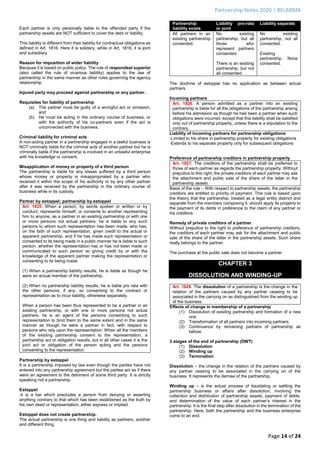
he may assign his interest in the partnership to any of his co-partners
or to a third person without the consent of the other partners, in the
absence of agreement to the contrary.
(1) Rights withheld from assignee
(a) To interfere in the management;
(b) To require any information or account; or
(c) To inspect any of the partnership books.
(2) Status and rights of assignor as partner unaffected
The legal effect of such a conveyance is the same as that
of a partner associating another in his share or interest. The
assignment does not divest the assignor of his status and
rights as a partner nor operate as a dissolution of the
partnership. The law however, provides the non-assigning
partners with a ground for dissolving the partnership if they
so desire.
Rights of assignee of partner’s interest
The transfer by a partner of his partnership interest does not make
the assignee of such interest a partner in the partnership. The
only rights of the transferee or assignee are as follows:
(1) To receive in accordance with his contract the profits
accruing to the assigning partner.(Machuca v. Chuidian)
(2) To avail himself of the usual remedies provided by law in
the event of fraud in the management.
(3) To receive the assignor’s interest in case of dissolution; and
(4) To require an account of partnership affairs, but only in case
the partnership is dissolved, and such account shall cover
the period from the date only of the last account agreed to
by all the partners.
The mere act of assignment with nothing more, does not bring about
the dissolution of the partnership.
Remedies of separate judgment creditor of a partner
Art. 1814. Without prejudice to the preferred rights of partnership
creditors under Article 1827, on due application to a competent
court by any judgment creditor of a partner, the court which
entered the judgment, or any other court, may charge the interest
of the debtor partner with payment of the unsatisfied amount of
such judgment debt with interest thereon; and may then or later
appoint a receiver of his share of the profits, and of any other
money due or to fall due to him in respect of the partnership, and
make all other orders, directions, accounts and inquiries which the
debtor partner might have made, or which the circumstances of the
case may require.
The interest charged may be redeemed at any time before
foreclosure, or in case of a sale being directed by the court, may
be purchased without thereby causing a dissolution:
(1) With separate property, by any one or more of the partners; or
(2) With partnership property, by any one or more of the partners
with the consent of all the partners whose interests are not so
charged or sold.
Nothing in this Title shall be held to deprive a partner of his right, if
any, under the exemption laws, as regards his interest in the
partnership.
(1) Application for a “charging order” after securing judgment on
his credit
A separate creditor of a partner cannot attach or levy upon specific
partnership property for the satisfaction of his credit. What he can do
is to secure a judgment on his credit and then apply to the proper court
for a “charging order”, subjecting the interest of the debtor partner
in the partnership with the payment of the unsatisfied amount of such
judgment with interest thereon with the least interference. By virtue
the charging order, any amount or portion thereof which the
partnership would otherwise pay to the debtor-partner should instead
be given to the judgment creditor.
However, this remedy is without prejudice to the preferred rights of
partnership creditors under Article 1827. It means that claims of
partnership creditors must be satisfied first before the separate
creditors of the partners can be paid out of the interest charged.
(2) Availability of other remedies
This charging order is an exclusive remedy so a writ of execution will
not be proper. The court may resort to other courses of action
provided (i.e. appointment of receiver, sale of interest, etc) in Art. 1814
if the judgment debt remains unsatisfied, notwithstanding the
issuance of the charging order.
Redemption or purchase of interest charged
(1) Redemptioner – The interest of the debtor-partner so
charged may be redeemed or purchased with the separate
property of any 1 or more of the partners, or with partnership
property but with consent of all partners whose interests are
not so charged or sold.
(2) Redemption price – The value of the partner’s interest in the
partnership has no bearing on the redemption price which
is likely to be lower since it will be dependent on the amount
of the unsatisfied judgment debt.
(3) Right of redeeming non-debtor partner – For this reason,
the redeeming non-debtor partner, it is believed, does not
acquire absolute ownership over the debtor-partner’s
interest but holds it in trust for him consistent with
principles of fiduciary relationship.
Right of partner under exemption laws
Under Art. 1811, a partner cannot claim any right under the
homestead laws or exemption laws when specific partnership
property is attached for partnership debt.
With respect however, to the partner’s interest in the partnership, the
partner may avail himself of the exemption laws after partnership
debts have been paid. A partner’s interest in the partnership is really
his property.
Section 3. – Obligations of the Partners with
Regard to Third Persons
Requirement of a firm name
Art. 1815. Every partnership shall operate under a firm name,
which may or may not include the name of one or more of the
partners.
Those who, not being members of the partnership, include their
names in the firm name, shall be subject to the liability of a partner.
Firm
It is the name, title, or style under which a company transacts
business; a partnership of 2 or more persons; a commercial house.
Importance of firm name
It is necessary to distinguish the partnership which has a distinct and
separate juridical personality from the individuals composing the
partnership and from other partnerships and entities.
Under the Business Name Law, such firm name must be registered
with the Bureau of Commerce (now with the Intellectual Property
Office created under RA 8293).
Right of partners to choose first name
GR: They may adopt any firm name desired.
The firm name may be:
- That of an individual partner
- Surnames of all the partners
- Surname of 1 or more of the members with the addition of
“and Company”
- It may consist of individual names wholly distinct from the
names of any of the members
- It may be a name purely fanciful or fictitious.
But whatever the firm name may be, the signature of the firm name is,
in law, the signature of the several partners’ name.
(a) Use of misleading name – partners cannot use a name that
is identical or deceptively confusingly similar to that of any
existing partnership or corporation
(b) Use of names of deceased partners – In the choice of a firm
name, the continued use of the name of a deceased partner
is permissible provided that the firm indicates in all its
communications that said partner is deceased.
(c) Retention of disbarred lawyer’s name in firm name – the
retention (or use) of a disbarred lawyer’s name in the firm
name may mislead the public into believing that the lawyer
is still authorized to practice law.
Liability for inclusion of non-partner’s name in firm name
Partnership Notes 2020 | BELARMA
Page 12 of 24
GR: Persons who, not being partners, include their names in the firm
name DO NOT acquire the rights of a partner BUT they shall be
subject to the liability of a partner insofar as third persons without
notice are concerned. Such persons become partners by estoppel.
EXC: Art. 1815 does not cover the case of a limited partner who allows
his name to be included in the firm name.
Liability for contractual obligations of the partnership
Art. 1816. All partners, including industrial ones, shall be liable pro
rata with all their property and after all the partnership assets have
been exhausted, for the contracts which may be entered into in the
name and for the account of the partnership, under its signature
and by a person authorized to act for the partnership. However,
any partner may enter into a separate obligation to perform a
partnership contract.
Partnership liability – Partners are principals to the other partners
and agents for them and the partnership. They are liable to third
persons who have dealt with one of them in the same way that a
principal is liable to third persons who have dealt with an agent.
GR: A partner has a right to make all partners liable for contracts he
makes for the partnership in the name and for the account of the
partnership but only if the partner was authorized.
Individual liability – A partner, however, may assume a separate
undertaking in his name with a third party to perform a partnership
contract or make himself solidarily liable on a partnership contract.
Nature of individual liability of partners
Their individual liability is pro rata and subsidiary.
Pro rata – The term must be understood to mean equally or jointly,
and not proportionately which is its literal meaning, because the pro-
rating is based on the number of partners and not on the amount of
their contributions to the common fund, subject to adjustment among
the partners.
*The fact that a partner has left the country and the payment of his
liability cannot be enforced or his liability is condoned by the creditor
cannot increase the liability of the other partners. Art. 1816 refers to
the extent of the share of the partners in the partnership liability for its
contractual debts.
Subsidiary or secondary – because the partners become personally
liable only after all the partnership assets have been exhausted. Thus,
the partners are liable as guarantors in favor of the partnership
creditors to the extent that the assets of the firm are not sufficient to
meet its obligations. They may be joined as party defendants in the
same action against the partnership subject to their right to prior
exhaustion of partnership property. (Compania Maritima v.
Munoz, PNB v. Lo)
Liability of industrial partner
Even, the industrial partner who, ordinarily, is not liable for losses
would have to pay but, of course, he can recover the amount he has
paid from the capitalist partners unless there is an agreement to the
contrary.
Island Sales, Inc. v. United Pioneers General Construction
Company
In the instant case, there were 5 general partners when the
promissory note in question was executed for and in behalf of the
partnership. Since the liability of the partners are pro rata, the
liability of each partner shall be limited to only 1/5 of the obligations
of X company. The fact that the complaint was dismissed against
one of the partners, does not unmake him as a general partner in
the defendant company.
Distinction between a liability and a loss
The inability of a partnership to pay debt to a third party at a particular
time does not necessarily mean that the partnership business, as a
whole, has been operated at a loss.
Compania Maritima v. Munoz
The exemption of the industrial partner to pay losses relates
exclusively to the settlement of the partnership affairs among the
partners themselves and has nothing to do with the liabilities of the
partners to third persons. An industrial partner is not exempted
from liability to third persons for the debts of the partnership.
Pacific Commercial Co. v. Aboitiz & Martinez
Art. 1816 refers to “liabilities” while Article 1797 speaks of “losses”.
There is, therefore, no conflict between the 2 articles.
No distinction between obligations and losses
Stipulation against liability
Art. 1817. Any stipulation against the liability laid down in the
preceding article shall be void, except as among the partners.
Such stipulation is void and of no effect insofar as it affects the rights
of third persons. It is valid and enforceable only as among the
partners.
Power of partner as agent of partnership
Art. 1818. Every partner is an agent of the partnership for the
purpose of its business, and the act of every partner, including the
execution in the partnership name of any instrument, for apparently
carrying on in the usual way the business of the partnership of
which he is a member binds the partnership, unless the partner
so acting has in fact no authority to act for the partnership in the
particular matter, and the person with whom he is dealing has
knowledge of the fact that he has no such authority.
An act of a partner which is not apparently for the carrying on
of business of the partnership in the usual way does not bind
the partnership unless authorized by the other partners.
Except when authorized by the other partners or unless they have
abandoned the business, one or more but less than all the partners
have no authority to:
(1) Assign the partnership property in trust for creditors or on the
assignee's promise to pay the debts of the partnership;
(2) Dispose of the goodwill of the business;
(3) Do any other act which would make it impossible to carry on
the ordinary business of a partnership;
(4) Confess a judgment;
(5) Enter into a compromise concerning a partnership claim or
liability;
(6) Submit a partnership claim or liability to arbitration;
(7) Renounce a claim of the partnership.
No act of a partner in contravention of a restriction on authority
shall bind the partnership to persons having knowledge of the
restriction.
In the absence of an agreement to the contrary, all partners have
equal rights in the management and conduct of the partnership
business.
Presumption that acting partner has authority to bind
partnership
There is a general presumption that each individual partner is an
agent of the firm and that he has authority to bind the firm in carrying
on the partnership transactions. The presumption is sufficient to
permit third persons to hold the firm liable on transactions entered into
by any one of the members of the firm acting apparently in its behalf
and within the scope of his authority. (Goquiolay v. Sycip;
Munasque v. CA)
The partnership is bound to honor a contract entered into by a partner
who has the apparent authority but lacks the actual authority. The
partner will be liable to the partnership for any losses to it. Obviously,
the partnership is not liable where the acting partner does not even
have apparent authority.
Third parties should not assume that a partner has unlimited
authority.
Generally, a partner has no authority to do the acts enumerated in the
third paragraph of Article 1818.
Liability of partnership for acts of partners
The acts of a partner mentioned in Article 1818 may be grouped into
3.
(1) Acts for apparently carrying on in the usual way the
business of the partnership. (par. 1)
Partnership Notes 2020 | BELARMA
Page 13 of 24
(2) Acts of strict dominion or ownership (par. 2 and 3)
(3) Acts in contravention of a restriction on authority (par. 4)
Acts for apparently carrying on in the usual way the business of
the partnership
2 requisites in order that the partnership will not be liable
(a) The partner so acting has in fact no authority; and
(b) The third person knows that the acting partner has no
authority.
Usual way – may be interpreted as meaning usual for the particular
partnership or usual for similar partnerships.
Conveyance of real property belonging to the partnership
Art. 1819. Where title to real property is in the partnership name,
any partner may convey title to such property by a conveyance
executed in the partnership name; but the partnership may recover
such property unless the partner's act binds the partnership under
the provisions of the first paragraph of article 1818, or unless such
property has been conveyed by the grantee or a person claiming
through such grantee to a holder for value without knowledge
that the partner, in making the conveyance, has exceeded his
authority.
Where title to real property is in the name of the partnership, a
conveyance executed by a partner, in his own name, passes the
equitable interest of the partnership, provided the act is one within
the authority of the partner under the provisions of the first
paragraph of Article 1818.
Where title to real property is in the name of one or more but not
all the partners, and the record does not disclose the right of the
partnership, the partners in whose name the title stands may
convey title to such property, but the partnership may recover such
property if the partners' act does not bind the partnership under the
provisions of the first paragraph of Article 1818, unless the
purchaser or his assignee, is a holder for value, without
knowledge.
Where the title to real property is in the name of one or more or all
the partners, or in a third person in trust for the partnership, a
conveyance executed by a partner in the partnership name, or in
his own name, passes the equitable interest of the partnership,
provided the act is one within the authority of the partner under the
provisions of the first paragraph of Article 1818.
Where the title to real property is in the name of all the partners a
conveyance executed by all the partners passes all their rights in
such property.
The ownership of real estate is prima facie that indicated by the
muniment of title.
The presumption is that, property purchased with partnership funds
belongs to the partnership unless a contrary intent is shown.
Under the article, the real property may be registered or owned in the
name of:
(a) The partnership (pars. 1 and 2)
(b) 1 or more but not all the partners (par.3)
(c) 1 or more or all the partners, or in a third persons in trust for
the partnership (par. 4)
(d) All the partners.
“Conveyance” – TN that the right to mortgage is included in the right
to convey. This is different from the rule in agency that a special power
to sell excludes the power to mortgage.
Par. 1, 3, and 5 – what is conveyed is title or ownership
Par. 2 and 4 – what is conveyed is merely the equitable interest
Equitable interest - one not duly recognized by law but in equity
alone; it is a right or interest in property which, under well-recognized
equitable principles, should be and is convertible into a legal right or
title.
Innocent purchasers without notice
Regardless of the fact that one partner cannot convey partnership
realty without the concurrence of his co-partners, it is fundamental that
innocent purchasers without notice may be protected.
Title of property conveyed in partnership name
Under Article 1819, a conveyance by a partner of partnership property
in the partnership name even though without authority, cannot be
recovered by the partnership where it has been conveyed by the
grantee to a holder for value and without notice or knowledge that
the partner, in making the conveyance, had exceeded his authority.
(par. 1 and 3)
Admission by a partner
Art. 1820. An admission or representation made by any partner
concerning partnership affairs within the scope of his authority in
accordance with this Title is evidence against the partnership.
*The partnership is bound even if the admissions harm the business.
This is because of the relation of agency between them.
GR: A person is not bound by the act, admission, statement, or
agreement of another of which he has no knowledge or to which he
has not given his consent.
EXC: By virtue of a particular relation between them.
Existence of partnership must be proved
Before the partnership can be charged with the admission of a partner
under Art. 1820, the partnership relation must be shown and proof of
that fact must be made by evidence other than the admission itself.
Notice to, or knowledge of, a partner of matter affecting
partnership affairs.
Art. 1821. Notice to any partner of any matter relating to
partnership affairs, and the knowledge of the partner acting in the
particular matter, acquired while a partner or then present to his
mind, and the knowledge of any other partner who reasonably
could and should have communicated it to the acting partner,
operate as notice to or knowledge of the partnership, except in the
case of fraud on the partnership, committed by or with the consent
of that partner.
Like the law of agency, the law of partnership imputes notice to, or
knowledge of, any partner of any matter relating to partnership affairs
to the partnership except in case of fraud.
Reason: Members of a partnership stand in a fiduciary relationship to
one another, and it is presumed that the partners disclose to one
another all relevant information concerning partnership business.
Notice to a partner is as good a notice given to each of the
partners.
Liability arising from partner’s wrongful act or omission or
breach of trust
Art. 1822. Where, by any wrongful act or omission of any partner
acting in the ordinary course of the business of the partnership or
with the authority of co-partners, loss or injury is caused to any
person, not being a partner in the partnership, or any penalty is
incurred, the partnership is liable therefor to the same extent as
the partner so acting or omitting to act. (n)
Art. 1823. The partnership is bound to make good the loss:
(1) Where one partner acting within the scope of his apparent
authority receives money or property of a third person and
misapplies it; and
(2) Where the partnership in the course of its business receives
money or property of a third person and the money or property so
received is misapplied by any partner while it is in the custody of
the partnership. (n)
Art. 1824. All partners are liable solidarily with the partnership for
everything chargeable to the partnership under Articles 1822 and
1823.
Solidary Liability – The above three Article provide for the solidary
liability of all the partners.
Partnership Notes 2020 | BELARMA
Page 14 of 24
Each partner is only personally liable to the offended party if the
partnership assets are NOT sufficient to cover the debt or liability.
This liability is different from their liability for contractual obligations as
defined in Art. 1816. Here it is solidary, while in Art. 1816, it is joint
and subsidiary.
Reason for imposition of wider liability
Because it is based on public policy. The rule of respondeat superior
(also called the rule of vicarious liability) applies to the law of
partnership in the same manner as other rules governing the agency
relationship.
Injured party may proceed against partnership or any partner.
Requisites for liability of partnership
(a) The partner must be guilty of a wrongful act or omission;
and
(b) He must be acting in the ordinary course of business, or
with the authority of his co-partners even if the act is
unconnected with the business.
Criminal liability for criminal acts
A non-acting partner in a partnership engaged in a lawful business is
NOT criminally liable for the criminal acts of another partner but he is
criminally liable if the partnership is involved in an unlawful enterprise
with his knowledge or consent.
Misapplication of money or property of a third person
The partnership is liable for any losses suffered by a third person
whose money or property is misappropriated by a partner who
received it within the scope of his authority or by any other partner
after it was received by the partnership in the ordinary course of
business while in its custody.
Partner by estoppel; partnership by estoppel
Art. 1825. When a person, by words spoken or written or by
conduct, represents himself, or consents to another representing
him to anyone, as a partner in an existing partnership or with one
or more persons not actual partners, he is liable to any such
persons to whom such representation has been made, who has,
on the faith of such representation, given credit to the actual or
apparent partnership, and if he has made such representation or
consented to its being made in a public manner he is liable to such
person, whether the representation has or has not been made or
communicated to such person so giving credit by or with the
knowledge of the apparent partner making the representation or
consenting to its being made:
(1) When a partnership liability results, he is liable as though he
were an actual member of the partnership;
(2) When no partnership liability results, he is liable pro rata with
the other persons, if any, so consenting to the contract or
representation as to incur liability, otherwise separately.
When a person has been thus represented to be a partner in an
existing partnership, or with one or more persons not actual
partners, he is an agent of the persons consenting to such
representation to bind them to the same extent and in the same
manner as though he were a partner in fact, with respect to
persons who rely upon the representation. When all the members
of the existing partnership consent to the representation, a
partnership act or obligation results; but in all other cases it is the
joint act or obligation of the person acting and the persons
consenting to the representation.
Partnership by estoppel
It is a partnership imposed by law even though the parties have not
entered into any partnership agreement but the parties act as if there
were an agreement to the detriment of some third party. It is strictly
speaking not a partnership.
Estoppel
-it is a bar which precludes a person from denying or asserting
anything contrary to that which has been established as the truth by
his own deed or representation, either express or implied.
Estoppel does not create partnership.
The actual partnership is one thing and liability as partners, another
and different thing.
Partnership
liability exists
Liability pro-rata
or joint
Liability separate
All partners in an
existing partnership
consented.
No existing
partnership, but all
those who
represent partners
consented.
There is an existing
partnership, but not
all consented.
No existing
partnership, not all
consented.
Existing
partnership. None
consented.
The doctrine of estoppel has no application as between actual
partners.
Incoming partners
Art. 1826. A person admitted as a partner into an existing
partnership is liable for all the obligations of the partnership arising
before his admission as though he had been a partner when such
obligations were incurred, except that this liability shall be satisfied
only out of partnership property, unless there is a stipulation to the
contrary.
Liability of incoming partners for partnership obligations
-Limited to his share in partnership property for existing obligations
-Extends to his separate property only for subsequent obligations
Preference of partnership creditors in partnership property
Art. 1827. The creditors of the partnership shall be preferred to
those of each partner as regards the partnership property. Without
prejudice to this right, the private creditors of each partner may ask
the attachment and public sale of the share of the latter in the
partnership assets.
Basis of the rule – With respect to partnership assets, the partnership
creditors are entitled to priority of payment. This rule is based upon
the theory that the partnership, treated as a legal entity distinct and
separate from the members composing it, should apply its property to
the payment of its debts in preference to the claim of any partner or
his creditors.
Remedy of private creditors of a partner
Without prejudice to the right to preference of partnership creditors,
the creditors of each partner may ask for the attachment and public
sale of the share of the latter in the partnership assets. Such share
really belongs to the partner.
The purchase at the public sale does not become a partner.
CHAPTER 3
DISSOLUTION AND WINDING-UP
Art. 1828. The dissolution of a partnership is the change in the
relation of the partners caused by any partner ceasing to be
associated in the carrying on as distinguished from the winding up
of the business.
Effects of change in membership of a partnership
(1) Dissolution of existing partnership and formation of a new
one.
(2) Transformation of all partners into incoming partners.
(3) Continuance by remaining partners of partnership as
before.
3 stages of the end of partnership (DWT)
(1) Dissolution
(2) Winding up
(3) Termination
Dissolution – the change in the relation of the partners caused by
any partner ceasing to be associated in the carrying on of the
business. It represents the demise of the partnership.
Winding up – is the actual process of liquidating or settling the
partnership business or affairs after dissolution, involving the
collection and distribution of partnership assets, payment of debts,
and determination of the value of each partner’s interest in the
partnership. It is the final step after dissolution in the termination of the
partnership. Here, both the partnership and the business enterprise
come to an end.
Partnership Notes 2020 | BELARMA
Page 15 of 24
Termination – that point in time when all partnership affairs are
completely wind-up and finally settled. It signifies the end of
partnership life.
Art. 1829. On dissolution the partnership is not terminated, but
continues until the winding up of partnership affairs is completed.
Effects of dissolution and winding-up
(1) Partnership not automatically terminated.
(2) Partnership continues for a limited purpose.
(3) Transaction of new business prohibited.
(4) It is only after winding up is accomplished that the existence
of the partnership is terminated.
Thus dissolution refers to the change in partnership relation and not
the actual cessation of the partnership business.
Art. 1830. Dissolution is caused:
(1) Without violation of the agreement between the partners:
(a) By the termination of the definite term or particular
undertaking specified in the agreement;
(b) By the express will of any partner, who must act in good
faith, when no definite term or particular is specified;
(c) By the express will of all the partners who have not
assigned their interests or suffered them to be charged for
their separate debts, either before or after the termination
of any specified term or particular undertaking;
(d) By the expulsion of any partner from the business bona
fide in accordance with such a power conferred by the
agreement between the partners;
(2) In contravention of the agreement between the partners, where
the circumstances do not permit a dissolution under any other
provision of this article, by the express will of any partner at any
time;
(3) By any event which makes it unlawful for the business of the
partnership to be carried on or for the members to carry it on in
partnership;
(4) When a specific thing which a partner had promised to
contribute to the partnership, perishes before the delivery; in any
case by the loss of the thing, when the partner who contributed it
having reserved the ownership thereof, has only transferred to the
partnership the use or enjoyment of the same; but the partnership
shall not be dissolved by the loss of the thing when it occurs after
the partnership has acquired the ownership thereof;
(5) By the death of any partner;
(6) By the insolvency of any partner or of the partnership;
(7) By the civil interdiction of any partner;
(8) By decree of court under the following article. (1700a and
1701a)
Causes of Dissolution (list exclusive)
The events that cause dissolution of a partnership may be divided into
4 categories:
(a) Act of the parties not in violation of their agreement;
(b) Act of the parties in violation of their agreement;
(c) Operation of law;
(d) Court decree.
Effect of sale or assignment by 1 partner of his entire interest in
the partnership to a third person
It does not ipso facto bring about the dissolution of the partnership.
The assignment merely provides a ground for the other partners to
dissolve the partnership or for the purchase. That it produces
dissolution may be inferred, however, from the definition of dissolution
under Art. 1828. But the dissolution created in such case is only
technical, and not actual, i.e., only in the sense that his connection
with the partnership is terminated.
Dissolution effected without violation of partnership agreement
4 ways by which a partnership may be dissolved without violation of
the partnership agreement:
(1) Termination of the definite term or particular undertaking
(2) By the express will of any partner.
- Provided done in good fault and is a partnership at will.
(3) By the express will of ALL the partners.
(4) – No particular form of agreement is necessary to dissolve
a partnership by consent.
(5) By expulsion of any partner.
The expulsion must be in good faith, and strictly in
accordance with the power conferred by the agreement
between the partners.
Dissolution effected in contravention of partnership agreement
Any partner may cause the dissolution of the partnership at any time
without the consent of his co-partners for ANY reason. Such
dissolution however is a contravention of the agreement.
The withdrawing partner is liable for damages for unjustified
dissolution but in no case can he be compelled to remain in the
partnership. With his withdrawal, the number of members is
decreased; hence, its dissolution.
A partner guilty of wrongful dissolution is NOT given the right to wind
up partnership affairs.
Power of dissolution always exists. – No person can be compelled
either to become a partner or to remain one. The relation of partners
is one of mutual agency.
Business becomes unlawful
Dissolution may be cause involuntarily when a supervening event
makes the business itself of the partnership unlawful.
Loss of specific thing
Loss before delivery
Partnership is DISSOLVED
because there is no
contribution inasmuch as the
thing to be contributed cannot
be substituted with another.
There is failure of a partner to
fulfill his obligation.
Loss after delivery
Partnership is NOT
DISSOLVED but it assumes the
loss of the thing having
acquired ownership thereof.
Loss where only use or
enjoyment contributed
The loss of the specific thing
before or after delivery
dissolves the partnership
because in either case, the
partner cannot fulfill his
undertaking to make available
the use of the specific thing
contributed.
Death of any partner
The deceased partner ceases to be associated in the carrying of the
business; hence, the ipso facto dissolution of the partnership by his
death by operation of law.
A view has been expressed that the death of one of the partners does
not ipso facto dissolve the partnership when, by common agreement,
the surviving partners and the heirs of the deceased decide to
continue, the said agreement being in such case considered as a
continuation of the original contract of partnership. In such a case,
however, there is a dissolution of the partnership without winding up,
and a continuance of the partnership without winding up, and a
continuance of the business of the dissolved partnership by a new
partnership.
Insolvency of any partner or of partnership
The insolvency of the partner or of the partnership must be adjudged
by a court.
Civil interdiction of any partner
A partnership requires the capacity of the partners. A person under
civil interdiction (or civil death) cannot validly give consent, and his
capacity to act is limited thereby.
Right to expel a partner
In the absence of an express agreement to that effect, there exists no
right or power of any member, or even a majority of the members, to
expel all other members of the firm at will.
Judicial determination as to dissolution
Art. 1831. On application by or for a partner the court shall decree
a dissolution whenever:
Partnership Notes 2020 | BELARMA
Page 16 of 24
(1) A partner has been declared insane in any judicial proceeding
or is shown to be of unsound mind;
(2) A partner becomes in any other way incapable of performing
his part of the partnership contract;
(3) A partner has been guilty of such conduct as tends to affect
prejudicially the carrying on of the business;
(4) A partner wilfully or persistently commits a breach of the
partnership agreement, or otherwise so conducts himself in
matters relating to the partnership business that it is not reasonably
practicable to carry on the business in partnership with him;
(5) The business of the partnership can only be carried on at a
loss;
(6) Other circumstances render a dissolution equitable.
On the application of the purchaser of a partner's interest under
Article 1813 or 1814:
(1) After the termination of the specified term or particular
undertaking;
(2) At any time if the partnership was a partnership at will when the
interest was assigned or when the charging order was issued.
Grounds for dissolution by decree of court
Dissolution of a partnership may be decreed judicially on application,
either:
(1) By a partner in the cases mentioned in par.1 nos. 1-6; or
(2) By the purchaser or assignee of a partner’s interest under
par. 2, nos. 1 and 2.
I. On application by a partner:
(a) Insanity
(b) Incapacity
(c) Misconduct and persistent breach of partnership agreement
(d) Other circumstances
II. On application by a purchaser of a partner’s interest
Art. 1832. Except so far as may be necessary to wind up
partnership affairs or to complete transactions begun but not then
finished, dissolution terminates all authority of any partner to act
for the partnership:
(1) With respect to the partners:
(a) When the dissolution is not by the act, insolvency or death of a
partner; or
(b) When the dissolution is by such act, insolvency or death of a
partner, in cases where article 1833 so requires;
(2) With respect to persons not partners, as declared in article
1834.
Effect of dissolution on authority of partner
GR: Upon dissolution, the partnership ceases to be a going concern
and the partner’s power of representation is confined only to acts
incident to winding up or completing transactions begun but not then
finished.
EXC:
(a) Insofar as the partners themselves are concerned
The authority of any partner to bind the partnership by a
new contract is immediately terminated when the
dissolution is NOT by the act, insolvency, or death of a
partner.
When the dissolution is by such act, insolvency, or death,
the termination of authority depends upon whether or not
the partner had knowledge or notice of the dissolution as
provided in Art. 1833.
(b) With respect to third persons
The partnership is generally bound by the new contract
although the authority of the acting partner as it affects his
co-partners is already deemed terminated under Art. 1832
and 1833. In such a case, however, the innocent partners
can always recover from the acting partner.
Art. 1833. Where the dissolution is caused by the act, death or
insolvency of a partner, each partner is liable to his co-partners for
his share of any liability created by any partner acting for the
partnership as if the partnership had not been dissolved unless:
(1) The dissolution being by act of any partner, the partner acting
for the partnership had knowledge of the dissolution; or
(2) The dissolution being by the death or insolvency of a partner,
the partner acting for the partnership had knowledge or notice of
the death or insolvency.
AID (act, death, or insolvency)
The above article speaks of dissolution caused by the act, insolvency,
or death of a partner.
GR: Under Art. 1833, the authority of a partner to act for the
partnership may still continue notwithstanding its dissolution.
EXC: When a partner has knowledge (dissolution by act of partner) or
knowledge or notice of a fact (dissolution by death or insolvency).
Knowledge of Fact Notice of Fact
A person has knowledge of fact
within the meaning of this Act
not only when he has actual
knowledge thereof, but also
when he has knowledge of
such other facts as in the
circumstances show bad faith.
A person has notice of fact
within the meaning of this Act
when the person who claims
the benefit of the notice:
(a) States the fact to
such person, or
(b) Delivers through the
mail or by other
means of
communication, a
written statement of
the fact to such
person or to a proper
person at his place of
business or
residence.
It must be noted that Art. 1833 applies only if the contract of the
partner binds the partnership. If the partnership is not bound (Art.
1834, par. 4), only the acting partner is personally liable.
Power of partner to bind dissolved partnership to third persons
Art. 1834. After dissolution, a partner can bind the partnership,
except as provided in the third paragraph of this article:
(1) By any act appropriate for winding up partnership affairs or
completing transactions unfinished at dissolution;
(2) By any transaction which would bind the partnership if
dissolution had not taken place, provided the other party to the
transaction:
(a) Had extended credit to the partnership prior to dissolution and
had no knowledge or notice of the dissolution; or
(b) Though he had not so extended credit, had nevertheless known
of the partnership prior to dissolution, and, having no knowledge
or notice of dissolution, the fact of dissolution had not been
advertised in a newspaper of general circulation in the place (or in
each place if more than one) at which the partnership business
was regularly carried on.
The liability of a partner under the first paragraph, No. 2, shall be
satisfied out of partnership assets alone when such partner had
been prior to dissolution:
(1) Unknown as a partner to the person with whom the contract is
made; and
(2) So far unknown and inactive in partnership affairs that the
business reputation of the partnership could not be said to have
been in any degree due to his connection with it.
The partnership is in no case bound by any act of a partner after
dissolution:
(1) Where the partnership is dissolved because it is unlawful to
carry on the business, unless the act is appropriate for winding up
partnership affairs; or
(2) Where the partner has become insolvent; or
(3) Where the partner has no authority to wind up partnership
affairs; except by a transaction with one who:
(a) Had extended credit to the partnership prior to dissolution and
had no knowledge or notice of his want of authority; or
(b) Had not extended credit to the partnership prior to dissolution,
and, having no knowledge or notice of his want of authority, the
fact of his want of authority has not been advertised in the manner
Partnership Notes 2020 | BELARMA
Page 17 of 24
provided for advertising the fact of dissolution in the first
paragraph, No. 2 (b).
Nothing in this article shall affect the liability under Article 1825 of
any person who, after dissolution, represents himself or consents
to another representing him as a partner in a partnership engaged
in carrying business.
Character of notice required
The character of notice required to relieve a partner or the
representatives of a deceased partner from subsequent liability on
partnership obligations varies in accordance with the class of persons
required to be notified.
(1) As to prior dealers – Notice must be ACTUAL.
A prior or former dealer is one who has extended credit on
the faith of the partnership, through confidence in the
solvency and probity of the firm. Mere dealing with a firm on
a cash basis does not constitute one a prior dealer. One
who purchases goods from the supposed partnership is
NOT a prior dealer.
(2) As to all others – Notice is accomplished by an
advertisement in a local newspaper. Actual notification is
NOT necessary.
TN: The requirement of newspaper notice appears to exist
only where the third party knew of the partnership prior to
dissolution. If he did not, he is entitled to NO NOTICE
whatsoever.
Liability of dormant partner
The liability of a partner unknown as such to the person with whom
the contract is made or so far unknown and inactive in partnership
affairs shall be satisfied out of partnership assets alone.
Effect of dissolution on partner’s existing liability
Art. 1835. The dissolution of the partnership does not of itself
discharge the existing liability of any partner. (only by an
agreement)
A partner is discharged from any existing liability upon dissolution
of the partnership by an agreement to that effect between himself,
the partnership creditor and the person or partnership continuing
the business; and such agreement may be inferred from the course
of dealing between the creditor having knowledge of the
dissolution and the person or partnership continuing the business.
The individual property of a deceased partner shall be liable for all
obligations of the partnership incurred while he was a partner, but
subject to the prior payment of his separate debts.
Art. 1836. Unless otherwise agreed, the partners who have not
wrongfully dissolved the partnership or the legal representative of
the last surviving partner, not insolvent, has the right to wind up the
partnership affairs, provided, however, that any partner, his legal
representative or his assignee, upon cause shown, may obtain
winding up by the court.
Manner of winding up
(1) Judicially, under the control and direction of the proper
court upon cause shown by any partner, his legal reps, or
his assignee; or
(2) Extrajudicially, by the partners themselves without
intervention of the court
Nature of action for liquidation
-It is a personal one; hence, it may be brought in the place of residence
of either plaintiff or the defendant.
Persons authorized to wind-up
(a) Partners designated by the agreement
(b) If no agreement, all the partners who have not wrongfully
dissolved the partnership.
(c) The legal rep of the last surviving partner, not insolvent.
The court may appoint a receiver to wind up the partnership affairs.
An insolvent partner does not have the right to wind up partnership
affairs.
Power of liquidating partner
(1) Make new contracts for the purpose of winding up the
partnership.
(2) Raise money to pay partnership debts.
(3) Incur obligations to complete existing contracts or preserve
partnership assets.
(4) Incur expenses necessary in the conduct of litigation.
In other words, for the purpose of winding up the affairs of a dissolved
partnership, the surviving partner has full authority to do everything
that may be necessary, but his power is limited to the performance of
acts which are indispensable to that end.
Art. 1837. When dissolution is caused in any way, except in
contravention of the partnership agreement, each partner, as
against his co-partners and all persons claiming through them in
respect of their interests in the partnership, unless otherwise
agreed, may have the partnership property applied to discharge its
liabilities, and the surplus applied to pay in cash the net amount
owing to the respective partners. But if dissolution is caused by
expulsion of a partner, bona fide under the partnership agreement
and if the expelled partner is discharged from all partnership
liabilities, either by payment or agreement under the second
paragraph of Article 1835, he shall receive in cash only the net
amount due him from the partnership.
When dissolution is caused in contravention of the partnership
agreement the rights of the partners shall be as follows:
(1) Each partner who has not caused dissolution wrongfully shall
have:
(a) All the rights specified in the first paragraph of this article, and
(b) The right, as against each partner who has caused the
dissolution wrongfully, to damages breach of the agreement.
(2) The partners who have not caused the dissolution wrongfully,
if they all desire to continue the business in the same name either
by themselves or jointly with others, may do so, during the agreed
term for the partnership and for that purpose may possess the
partnership property, provided they secure the payment by bond
approved by the court, or pay any partner who has caused the
dissolution wrongfully, the value of his interest in the partnership at
the dissolution, less any damages recoverable under the second
paragraph, No. 1 (b) of this article, and in like manner indemnify
him against all present or future partnership liabilities.
(3) A partner who has caused the dissolution wrongfully shall have:
(a) If the business is not continued under the provisions of the
second paragraph, No. 2, all the rights of a partner under the first
paragraph, subject to liability for damages in the second
paragraph, No. 1 (b), of this article.
(b) If the business is continued under the second paragraph, No.
2, of this article, the right as against his co-partners and all claiming
through them in respect of their interests in the partnership, to have
the value of his interest in the partnership, less any damage
caused to his co-partners by the dissolution, ascertained and paid
to him in cash, or the payment secured by a bond approved by the
court, and to be released from all existing liabilities of the
partnership; but in ascertaining the value of the partner's interest
the value of the good-will of the business shall not be considered.
Partner’s Lien
The right of every partner, on a dissolution, against the other partners
and persons claiming through them in respect of their interests as
partners and persons claiming through them in respect of their
interests as partners, to have the partnership property applied to
discharge partnership liabilities and the surplus assets…
Rights where the dissolution not in contravention of agreement
(1) To have the partnership property applied to discharge the
liabilities of the partnership; and
(2) To have the surplus, if any, applied to pay in cash the net
amount owing to the respective partners.
Rights where dissolution in contravention of agreement
(1) Rights of partner who has not caused the dissolution
wrongfully
(2) Rights of partner who has wrongfully caused the dissolution
Note that the innocent partners have more rights that the guilty
partners and that the latter are made liable for damages caused by
their wrongful dissolution, and in ascertaining the value of their
interest, the value of the goodwill of the business is not considered,
obviously as a penalty for their bad faith.
Goodwill of a business
Partnership Notes 2020 | BELARMA
Page 18 of 24
It is the advantage which it has from its establishment or from the
patronage of its customers, over and above the mere value of its
property and capital.
The goodwill of a business is a proper subject of sale. However, a
saleable goodwill can exist only in a commercial partnership. It cannot
arise in a professional partnership.
Rights of injured partner where partnership contract rescinded
Art. 1838. Where a partnership contract is rescinded on the ground
of the fraud or misrepresentation of one of the parties thereto, the
party entitled to rescind is, without prejudice to any other right,
entitled:
(1) To a lien on, or right of retention of, the surplus of the
partnership property after satisfying the partnership liabilities to
third persons for any sum of money paid by him for the purchase
of an interest in the partnership and for any capital or advances
contributed by him;
(2) To stand, after all liabilities to third persons have been satisfied,
in the place of the creditors of the partnership for any payments
made by him in respect of the partnership liabilities; and
(3) To be indemnified by the person guilty of the fraud or making
the representation against all debts and liabilities of the
partnership.
Liquidation and distribution of assets of dissolved partnership
Art. 1839. In settling accounts between the partners after
dissolution, the following rules shall be observed, subject to any
agreement to the contrary:
(1) The assets of the partnership are:
(a) The partnership property,
(b) The contributions of the partners necessary for the payment
of all the liabilities specified in No. 2.
(2) The liabilities of the partnership shall rank in order of payment,
as follows:
(a) Those owing to creditors other than partners,
(b) Those owing to partners other than for capital and profits, (such
as loans given by the partners or advances for business expenses)
(c) Those owing to partners in respect of capital,
(d) Those owing to partners in respect of profits.
(3) The assets shall be applied in the order of their declaration in
No. 1 of this article to the satisfaction of the liabilities.
(4) The partners shall contribute, as provided by article 1797, the
amount necessary to satisfy the liabilities.
(5) An assignee for the benefit of creditors or any person appointed
by the court shall have the right to enforce the contributions
specified in the preceding number.
(6) Any partner or his legal representative shall have the right to
enforce the contributions specified in No. 4, to the extent of the
amount which he has paid in excess of his share of the liability.
(7) The individual property of a deceased partner shall be liable for
the contributions specified in No. 4.
(8) When partnership property and the individual properties of the
partners are in possession of a court for distribution, partnership
creditors shall have priority on partnership property and separate
creditors on individual property, saving the rights of lien or secured
creditors.
(9) Where a partner has become insolvent or his estate is
insolvent, the claims against his separate property shall rank in the
following order:
(a) Those owing to separate creditors;
(b) Those owing to partnership creditors;
(c) Those owing to partners by way of contribution.
Distribution of surplus of assets to partners.
The law does not require a partnership to convert all its assets into
cash before making a distribution to the partners. It is within the power
of the court to order distribution of its assets in cash, property, or a
combination of both.
A partner has a right to have debts owing to the partnership from his
co-partners deducted from their respective shares. This right is called
“equitable lien” or “quasi-lien” in American law.
Art. 1839 sets forth a priority system for the distribution of partnership
property and individual property when a partnership is dissolved.
However, these rules are subject to variation by agreement of the
partners.
Doctrine of the marshalling of assets
Partnership assets to partnership creditors, individual assets to
individual creditors; anything left from either goes to the other.
It involves the ranking of assets in a certain order toward the payment
of outstanding debts.
Dissolution of a partnership by change in membership
Art. 1840. In the following cases creditors of the dissolved
partnership are also creditors of the person or partnership
continuing the business:
(1) When any new partner is admitted into an existing partnership,
or when any partner retires and assigns (or the representative of
the deceased partner assigns) his rights in partnership property to
two or more of the partners, or to one or more of the partners and
one or more third persons, if the business is continued without
liquidation of the partnership affairs;
(2) When all but one partner retire and assign (or the
representative of a deceased partner assigns) their rights in
partnership property to the remaining partner, who continues the
business without liquidation of partnership affairs, either alone or
with others;
(3) When any partner retires or dies and the business of the
dissolved partnership is continued as set forth in Nos. 1 and 2 of
this article, with the consent of the retired partners or the
representative of the deceased partner, but without any
assignment of his right in partnership property;
(4) When all the partners or their representatives assign their rights
in partnership property to one or more third persons who promise
to pay the debts and who continue the business of the dissolved
partnership; (Applies only when the third person continuing the
business of the dissolved partnership promises to pay the debts of
the partnership, otherwise, creditors of the dissolved partnership
have no claim on such third person)
(5) When any partner wrongfully causes a dissolution and the
remaining partners continue the business under the provisions of
article 1837, second paragraph, No. 2, either alone or with others,
and without liquidation of the partnership affairs;
(6) When a partner is expelled and the remaining partners continue
the business either alone or with others without liquidation of the
partnership affairs.
The liability of a third person becoming a partner in the partnership
continuing the business, under this article, to the creditors of the
dissolved partnership shall be satisfied out of the partnership
property only, unless there is a stipulation to the contrary.
When the business of a partnership after dissolution is continued
under any conditions set forth in this article the creditors of the
dissolved partnership, as against the separate creditors of the
retiring or deceased partner or the representative of the deceased
partner, have a prior right to any claim of the retired partner or the
representative of the deceased partner against the person or
partnership continuing the business, on account of the retired or
deceased partner's interest in the dissolved partnership or on
account of any consideration promised for such interest or for his
right in partnership property.
Nothing in this article shall be held to modify any right of creditors
to set aside any assignment on the ground of fraud.
The use by the person or partnership continuing the business of
the partnership name, or the name of a deceased partner as part
thereof, shall not of itself make the individual property of the
deceased partner liable for any debts contracted by such person
or partnership.
Any change in membership dissolves a partnership and creates a new
one.
Liability of persons continuing the business
Partnership Notes 2020 | BELARMA
Page 19 of 24
The liability of the new or incoming partners shall be satisfied out of
partnership property only unless there is a stipulation to the contrary.
Rights of retiring, or of estate of deceased partner when
business is continued.
Art. 1841. When any partner retires or dies, and the business is
continued under any of the conditions set forth in the preceding
article, or in Article 1837, second paragraph, No. 2, without any
settlement of accounts as between him or his estate and the
person or partnership continuing the business, unless otherwise
agreed, he or his legal representative as against such person or
partnership may have the value of his interest at the date of
dissolution ascertained, and shall receive as an ordinary creditor
an amount equal to the value of his interest in the dissolved
partnership with interest, or, at his option or at the option of his
legal representative, in lieu of interest, the profits attributable to the
use of his right in the property of the dissolved partnership;
provided that the creditors of the dissolved partnership as against
the separate creditors, or the representative of the retired or
deceased partner, shall have priority on any claim arising under
this article, as provided Article 1840, third paragraph.
Art. 1842. The right to an account of his interest shall accrue to
any partner, or his legal representative as against the winding up
partners or the surviving partners or the person or partnership
continuing the business, at the date of dissolution, in the absence
of any agreement to the contrary.
Accrual and prescription of a partner’s right to account of his
interest
The right to demand an accounting of the value of his interest accrues
to any partner or his legal representative after dissolution in the
absence of an agreement to the contrary.
Prescription begins to run only upon the dissolution of the partnership
when the final accounting is done.
Persons liable to render an account
(1) The winding up partner,
(2) The surviving partner, or
(3) The person or partnership continuing the business.
CHAPTER 4
LIMITED PARTNERSHIP
Brief History
(1) It is an outgrowth of Roman Law
(2) The system of limited partnership has existed in France
under the name of la societe en commandite.
(3) Commanda – in the vulgar Latinity of the Middle Ages
(4) Accomenda – in Italy
(5) French Code – The death of the special partner does not
dissolve the firm. The creation of transmissible shares is a
proof that the association is formed respectu negotii, and
not respect personarum. But even in such partnership, the
death of a general partner effects a dissolution.
(6) Statute of New York – it recognizes only the latter kind of
partnership, the names of the parties being required to be
registered, and any change in the name working a
dissolution, and turning the firm into a general partnership.
Art. 1843. A limited partnership is one formed by two or more
persons under the provisions of the following article, having as
members one or more general partners and one or more limited
partners. The limited partners as such shall not be bound by
the obligations of the partnership.
Limited Partnership
It is so called because the liability to third persons of 1 or more of its
members referred to as limited partners is limited to a fixed amount,
their capital contributions or to the amount they have invested in the
partnership.
Characteristics of limited partnership
(1) It is formed by compliance with the statutory requirements.
(2) 1 or more general partners control the business and are
personally liable to creditors.
(3) 1 or more limited partners contribute to the capital and
share in the profits but do not participate in the management
of the business and are not personally liable for partnership
obligations beyond the amount of their capital contributions.
(4) The limited partners may ask for the return of their capital
contributions under the conditions prescribed by law.
(5) The partnership debts are paid out of common fund and the
individual properties of the general partners.
Limited partners
They are usually those who put money for the business. They are only
investors. Their limited liability is an exception to the general rule that
all partners, including industrial partners, are liable pro rata with all
their property for partnership debts. Thus, a limited partner has the
same type of liability as stockholder in a corporation.
Business reason and purpose of statutes authorizing limited
partnerships
(1) Secure capital from others for one’s business and still retain
control.
(2) Share in profits of a business without risk of personal
liability.
(3) Associate as partners with those having business skill.
General Partner Limited Partner
Personally liable for partnership
obligations
Liability extends only to capital
contributions.
All of the general partners have
an equal right in the
management of the business.
A limited partner has no share
in the management of a limited
partnership.
May contribute money,
property, or industry to the
partnership.
A limited partner must
contribute cash or property but
not services.
A proper party. Not a proper party to
proceedings by or against a
partnership unless he is also a
general partner, or where the
object of the proceedings is to
enforce a limited partner’s right
against, or liability to, the
partnership.
A GP’s interest in the
partnership may not be
assigned as to make the
assignee a new partner without
consent of the other partners
although he may associate a
third person with him in his
share.
An LP’s interest is freely
assignable, with the assignee
acquiring all the rights of the
limited partner subject to
certain qualifications.
Name of GP may appear in the
firm name.
As a general rule, LP’s name
cannot appear.
A GP is prohibited from
engaging in a business which is
the kind of business in which
the partnership is engaged if he
is a capitalist partner or in any
business if he is an industrial
partner.
There is no such prohibition
because a limited partner is
considered as a mere
contributor to the partnership.
The retirement, death, insanity,
or insolvency of a general
partner dissolves the
partnership.
The retirement, etc. of a limited
partner does not have the same
effect, for his executor or
administrator shall have the
rights of a limited partner for the
purpose of selling his estate.
General Partnership Limited Partnership
GR: May be constituted in any
form by contract or conduct of
the parties.
Created by the members after
compliance with the
requirements set forth by law.
Art. 1844. Two or more persons desiring to form a limited
partnership shall:
(1) Sign and swear to a certificate, which shall state -
(a) The name of the partnership, adding thereto the word
"Limited";
(b) The character of the business;
(c) The location of the principal place of business;
(d) The name and place of residence of each member,
general and limited partners being respectively
designated;
(e) The term for which the partnership is to exist;
Partnership Notes 2020 | BELARMA
Page 20 of 24
(f) The amount of cash and a description of and the
agreed value of the other property contributed by each
limited partner;
(g) The additional contributions, if any, to be made by
each limited partner and the times at which or events on
the happening of which they shall be made;
(h) The time, if agreed upon, when the contribution of
each limited partner is to be returned;
(i) The share of the profits or the other compensation by
way of income which each limited partner shall receive
by reason of his contribution;
(j) The right, if given, of a limited partner to substitute an
assignee as contributor in his place, and the terms and
conditions of the substitution;
(k) The right, if given, of the partners to admit additional
limited partners;
(l) The right, if given, of one or more of the limited
partners to priority over other limited partners, as to
contributions or as to compensation by way of income,
and the nature of such priority;
(m) The right, if given, of the remaining general partner
or partners to continue the business on the death,
retirement, civil interdiction, insanity or insolvency of a
general partner; and
(n) The right, if given, of a limited partner to demand and
receive property other than cash in return for his
contribution.
(3) File for record the certificate in the Office of the
Securities and Exchange Commission.
(4)
A limited partnership is formed if there has been substantial
compliance in good faith with the foregoing requirements.
Creation of limited partnership.
(1) A limited partnership can be created only where permitted
by statute.
(2) The creation of a limited partnership is a formal proceeding
and is not a mere voluntary agreement, as in the case of a
general partnership. Accordingly, the requirements of the
statute must be followed so that public notice may be given
to all who desire to know the essential features of the
partnership.
2 essential requirements for the formation of a limited
partnership
(1) The certificate of articles of limited partnership which
states the matters enumerated in the article, must be signed
and sworned to; and
(2) Such certificate must be filed for record in the Office of the
Securities and Exchange Commission.
Article 1844 does not specify the time within which the certificate must
be filed with the SEC.
A limited partnership cannot be instituted orally.
Substantial compliance in good faith sufficient.
If there is no substantial compliance, the partnership becomes a
general partnership as far as third persons are concerned, in which all
the members are liable as general partners.
Rule when there is no substantial compliance
The firm is a general partnership only as to its relation to third persons;
that the firm, in form is a limited partnership, subject to all the rules
applicable to such partnership. Thus, a limited partner treated as a
general partner as far as third persons are concerned is entitled to
reimbursement from the general partner or partners for whatever
obligations he might have paid to partnership creditors beyond his
capital contribution.
Who may become limited partners?
Only persons. A partnership cannot become a limited partner. (Atty. A
does not agree.)
Art. 1845. The contributions of a limited partner may be cash or
property, but not services.
A limited partner or special partner is not allowed to contribute
services. He can contribute only money or property.
A limited partner may not be an industrial partner without being a
general partner in view of Art. 1845 which requires that a limited
partner must be a capital contributor.
A check may be treated as an actual payment in cash where the
limited partner has money actually in the bank to his credit, and he
gives the general partner absolute and final control of the amount
named therein.
The contribution of each limited partner must be paid before the
formation of the limited partnership.
Art. 1846. The surname of a limited partner shall not appear in the
partnership name unless:
(1) It is also the surname of a general partner, or
(2) Prior to the time when the limited partner became such, the
business has been carried on under a name in which his surname
appeared.
A limited partner whose surname appears in a partnership name
contrary to the provisions of the first paragraph is liable as a
general partner to partnership creditors who extend credit to the
partnership without actual knowledge that he is not a general
partner.
Art. 1847. If the certificate contains a false statement, one who
suffers loss by reliance on such statement may hold liable any
party to the certificate who knew the statement to be false:
(1) At the time he signed the certificate, or
(2) Subsequently, but within a sufficient time before the statement
was relied upon to enable him to cancel or amend the certificate,
or to file a petition for its cancellation or amendment as provided in
Article 1865.
Nature of liability
Art. 1847 does not say that the guilty partner shall be liable as a
general partner. The liability imposed by Art. 1847 is merely a
statutory penalty and does not make the limited partner a general
partner for all purposes, even as to third persons.
Art. 1848. A limited partner shall not become liable as a general
partner unless, in addition to the exercise of his rights and powers
as a limited partner, he takes part in the control of the business.
Liability of limited partner for participating in management of the
partnership
A limited partner is liable as a general partner for the firm’s obligations
if he takes part or interfere in the management of the firm’s business.
His abstinence from participation in fact in the transaction of the
business of the firm is essential to his exemption from liability for the
debts of the firm.
The interference contemplated by Art. 1848 is with respect to an
existing limited partnership. Accordingly, a limited partner is not
subject to general liability for taking part in the management of the firm
because he settles its affairs after dissolution.
Admission of additional limited partners
Art. 1849. After the formation of a lifted partnership, additional
limited partners may be admitted upon filing an amendment to the
original certificate in accordance with the requirements of Article
1865.
Art. 1850. A general partner shall have all the rights and powers
and be subject to all the restrictions and liabilities of a partner in a
partnership without limited partners. However, without the written
consent or ratification of the specific act by all the limited partners,
a general partner or all of the general partners have no authority
to:
(1) Do any act in contravention of the certificate;
(2) Do any act which would make it impossible to carry on the
ordinary business of the partnership;
(3) Confess a judgment against the partnership;
(4) Possess partnership property, or assign their rights in specific
partnership property, for other than a partnership purpose;
(5) Admit a person as a general partner;
(6) Admit a person as a limited partner, unless the right so to do is
given in the certificate;
Partnership Notes 2020 | BELARMA
Page 21 of 24
(7) Continue the business with partnership property on the death,
retirement, insanity, civil interdiction or insolvency of a general
partner, unless the right so to do is given in the certificate.
Rights, powers, and liabilities of a general partner
The law expressly requires that there be at least 1 general partner
with unlimited liability.
Right of control/unlimited personal liability
A GP in a limited partnership is vested with the entire control of the
business and has all the rights and powers and is subject to all the
liabilities. In the absence of agreement, a general partner is not
entitled to compensation for his services beyond his share of the
profits.
Acts of administration/acts of strict dominion
GR: A general partner may bind the partnership by any act of
administration, but he has no power to do the specific acts
enumerated in Art. 1850 without the written consent or at least
ratification of all the limited partners, even if agreed to by all the
general partners. The said acts are acts of strict dominion or
ownership and are, therefore, beyond the scope of the authority of a
general partner.
Art. 1851. A limited partner shall have the same rights as a general
partner to:
(1) Have the partnership books kept at the principal place of
business of the partnership, and at a reasonable hour to inspect
and copy any of them;
(2) Have on demand true and full information of all things affecting
the partnership, and a formal account of partnership affairs
whenever circumstances render it just and reasonable; an
(3) Have dissolution and winding up by decree of court.
A limited partner shall have the right to receive a share of the profits
or other compensation by way of income, and to the return of his
contribution as provided in Articles 1856 and 1857.
Rights, in general, of a limited partner
The limited partner is viewed as a partner only to a certain extent.
Wrongdoing or improper acts on the part of the general partners may
not give a limited partner greater rights than the law and what his
contract grants him.
Specific rights of a limited partner.
(1) To require that the partnership books be kept at the
principal place of business of the partnership.
(2) To inspect and copy at a reasonable hour partnership
books or any of them.
(3) To demand true and full information of all things affecting
the partnership.
(4) To demand a formal account of all partnership affairs
whenever circumstances render it just and reasonable.
(5) To ask for dissolution and winding up by decree of court.
(6) To receive a share of the profits or other compensation by
way of income.
(7) To receive a share of his contribution provided the
partnership assets are in excess of all its liabilities.
Art. 1852. Without prejudice to the provisions of Article 1848, a
person who has contributed to the capital of a business conducted
by a person or partnership erroneously believing that he has
become a limited partner in a limited partnership, is not, by reason
of his exercise of the rights of a limited partner, a general partner
with the person or in the partnership carrying on the business, or
bound by the obligations of such person or partnership, provided
that on ascertaining the mistake he promptly renounces his interest
in the profits of the business, or other compensation by way of
income.
Status of partner where there is failure to create a limited
partnership
If the law is not complied with (creating a limited partnership), the
attempt to limit the liability of the limited partners will be ineffective, at
least as to creditors who have not recognized, or dealt with, the firm
as a limited partnership.
Art. 1852 grants exemption from liability in favor of one who has
contributed to the capital of a business conducted by a person or
partnership erroneously believing that he has become a limited
partner in a limited partnership, or in a general partnership thinking
that it is a limited partnership.
He is not personally liable as a general partner by reason of his
exercise of the rights of a limited partner, provided:
(a) On ascertaining the mistake, he promptly renounces his
interest in the profits of the business or other compensation
by way of income; (where no partnership creditors are
prejudiced, it would seem that renunciation of his interest is
not necessary)
(b) His surname does not appear in the partnership name; and
(c) He does not participate in the management of the business.
Status of heirs of a deceased general partner admitted as
partners
An heir of a deceased general partner (in a general or limited
partnership), admitted as a partner under the articles of partnership
providing for such admission, ordinarily (not necessarily) becomes a
limited partner for his own protection, because he would normally
prefer to avoid any liability in excess of the value of the estate inherited
so as not to jeopardize his personal assets.
But the heir may disregard the statutory limitation and exercise his
right to elect to become a general partner. This choice pertains
exclusively to the heir and does not require the assent of the surviving
partner or partners. (Goqiuiolay v. Sycip)
The heir cannot be compelled to become general partners against
their wishes.
Art. 1853. A person may be a general partner and a limited partner
in the same partnership at the same time, provided that this fact
shall be stated in the certificate provided for in Article 1844.
A person who is a general, and also at the same time a limited
partner, shall have all the rights and powers and be subject to all
the restrictions of a general partner; except that, in respect to his
contribution, he shall have the rights against the other members
which he would have had if he were not also a general partner.
One (1) person, both a general partner and a limited partner
A person may be a general and a limited partner at the same time in
the same partnership provided that this fact is stated in the certificate
signed, sworn to, and recorded in the Office of the SEC.
Generally, his rights and powers are those of a general partner.
Hence, he is liable with his separate property to third persons.
However, with respect to his contribution as a limited partner, he
would have the right of a limited partner insofar as the other partners
are concerned. This means that while he is not relieved from personal
liability to third persons for partnership debts, he is entitled to recover
from the general partners the amount he has paid to such third
persons; and in settling accounts after dissolution, he shall have
priority over general partners in the return of their respective
contributions.
Art. 1854. A limited partner also may loan money to and transact
other business with the partnership, and, unless he is also a
general partner, receive on account of resulting claims against the
partnership, with general creditors, a pro rata share of the assets.
No limited partner shall in respect to any such claim:
(1) Receive or holding as collateral security any partnership
property, or
(2) Receive from a general partner or the partnership any payment,
conveyance, or release from liability if at the time the assets of the
partnership are not sufficient to discharge partnership liabilities to
persons not claiming as general or limited partners.
The receiving of collateral security, or payment, conveyance, or
release in violation of the foregoing provisions is a fraud on the
creditors of the partnership.
Loan and other business transactions with limited partnership
(1) Allowable transactions – A limited partner is not prohibited from:
(a) Granting loans to the partnership;
(b) Transacting other business with it; and
(c) Receiving pro rata share of the partnership assets with
general creditors if he is not also a general partner
(2) Prohibited transactions
(a) Receiving or holding as collateral security any partnership
property
(b) Receiving any payment, conveyance, or release from
liability if it will prejudice the right of third persons.
Prohibitions, not absolute, provided there are sufficient assets to
discharge the obligation of the partnership.
Partnership Notes 2020 | BELARMA
Page 22 of 24
Preferential rights of third persons
In transacting business with the partnership as a non-member, the
limited partner is considered as a non-partner creditor. However, third
persons always enjoy preferential rights insofar as partnership assets
are concerned in view of the natural tendency of the partners to give
preference to each other.
Preferred limited partners
Art. 1855. Where there are several limited partners the members
may agree that one or more of the limited partners shall have a
priority over other limited partners as to the return of their
contributions, as to their compensation by way of income, or as to
any other matter. If such an agreement is made it shall be stated
in the certificate, and in the absence of such a statement all the
limited partners shall stand upon equal footing.
Art. 1856. A limited partner may receive from the partnership the
share of the profits or the compensation by way of income
stipulated for in the certificate; provided that after such payment is
made, whether from property of the partnership or that of a general
partner, the partnership assets are in excess of all liabilities of the
partnership except liabilities to limited partners on account of their
contributions and to general partners.
Compensation of limited partner
(1) Excess of partnership assets over partnership liabilities
The right of the limited partner to receive his share of the profits or
compensation by way of income is subject to the condition that the
partnership assets will still be in excess of partnership liabilities
after such payment. In other words, third-party creditors have priority
over the limited partner’s rights.
(2) Preferential rights of partnership creditors
In determining the liabilities of the partnership, the liabilities to the
limited partners for their contributions and to general partners,
whether for contributions or not, are not included.
Art. 1857. A limited partner shall not receive from a general partner
or out of partnership property any part of his contributions until:
(1) All liabilities of the partnership, except liabilities to general
partners and to limited partners on account of their contributions,
have been paid or there remains property of the partnership
sufficient to pay them;
(2) The consent of all members is had, unless the return of the
contribution may be rightfully demanded under the provisions of
the second paragraph; and
(3) The certificate is cancelled or so amended as to set forth the
withdrawal or reduction.
Subject to the provisions of the first paragraph, a limited partner
may rightfully demand the return of his contribution:
(1) On the dissolution of a partnership; or
(2) When the date specified in the certificate for its return has
arrived, or
(3) After he has six months' notice in writing to all other members,
if no time is specified in the certificate, either for the return of the
contribution or for the dissolution of the partnership.
In the absence of any statement in the certificate to the contrary or
the consent of all members, a limited partner, irrespective of the
nature of his contribution, has only the right to demand and
receive cash in return for his contribution.
A limited partner may have the partnership dissolved and its affairs
wound up when:
(1) He rightfully but unsuccessfully demands the return of his
contribution, or
(2) The other liabilities of the partnership have not been paid, or
the partnership property is insufficient for their payment as required
by the first paragraph, No. 1, and the limited partner would
otherwise be entitled to the return of his contribution.
(The limited partner must first ask the other partners to have the
partnership dissolved; if they refuse, then he can seek the
dissolution of the partnership by judicial decree.)
Requisites for return of contribution of limited partner
(1) All liabilities of the partnership have been paid or if they
have not yet been paid, the assets of the partnership are
sufficient to pay such liabilities. Liabilities to limited partners
on account of their contributions and to general partnership
are not considered.
(2) The consent of all the members (general and limited
partners) has been obtained except when the return may
be rightfully demanded.
(3) The certificate is cancelled or so amended as to set forth
the withdrawal or reduction of the contribution.
When return of contribution a matter of right
A limited partner may demand, as a matter of right, the return of his
contribution provided the conditions in par. 1(1) and (3) have been
complied with –
(1) On the dissolution of the partnership; or
(2) Upon the arrival of the date specified in the certificate for
the return; or
(3) After the expiration of the 6 months’ notice in writing given
by him to the other partners if no time is fixed in the
certificate for the return of the contribution or for the
dissolution of the partnership.
GR: Even if the limited partner has contributed property, he has only
the right to demand and receive cash for his contribution.
EXC:
(1) When there is stipulation to the contrary in the certificate;
(2) Where all the partners (general and limited) consent to the
return other than in the form of cash.
Art. 1858. A limited partner is liable to the partnership:
(1) For the difference between his contribution as actually made
and that stated in the certificate as having been made; and
(2) For any unpaid contribution which he agreed in the certificate
to make in the future at the time and on the conditions stated in the
certificate.
A limited partner holds as trustee for the partnership:
(1) Specific property stated in the certificate as contributed by him,
but which was not contributed or which has been wrongfully
returned, and
(2) Money or other property wrongfully paid or conveyed to him on
account of his contribution.
The liabilities of a limited partner as set forth in this article can be
waived or compromised only by the consent of all members;
but a waiver or compromise shall not affect the right of a creditor
of a partnership who extended credit or whose claim arose after
the filing and before a cancellation or amendment of the certificate,
to enforce such liabilities.
When a contributor has rightfully received the return in whole or in
part of the capital of his contribution, he is nevertheless liable to
the partnership for any sum, not in excess of such return with
interest, necessary to discharge its liabilities to all creditors who
extended credit or whose claims arose before such return.
Liabilities of a LIMITED PARTNER
(1) To the partnership. – As limited partners are not principals on the
transaction of a partnership, their liability, as a rule, is to the
partnership, not to the creditors of the partnership.
(2) To partnership creditors and other partners – A limited partner is
liable for partnership obligations when he:
(a) Contributes services instead of only money or
property to the partnership
(b) When he allows his surname to appear in the firm
name
(c) When he fails to have a false statement in the
certificate corrected, knowing it to be false
(d) When he takes part in the control of the business
(e) When re receives partnership property as collateral
security, payment, conveyance, or release in fraud of
partnership creditors
(f) When there is failure to substantially comply with the
legal requirements governing the formation of limited
partnerships.
(3) To separate creditors – As in general partnership, the creditor of
a limited partner may, in addition to other remedies allowed
under existing laws, apply to the proper court for a “charging
order” subjecting the interest in the partnership of the debtor
partner for the payment of his obligation.
Art. 1859. A limited partner's interest is assignable.
Partnership Notes 2020 | BELARMA
Page 23 of 24
A substituted limited partner is a person admitted to all the rights
of a limited partner who has died or has assigned his interest in a
partnership.
An assignee, who does not become a substituted limited partner,
has no right to require any information or account of the
partnership transactions or to inspect the partnership books; he is
only entitled to receive the share of the profits or other
compensation by way of income, or the return of his contribution,
to which his assignor would otherwise be entitled.
An assignee shall have the right to become a substituted limited
partner if all the members consent thereto or if the assignor, being
thereunto empowered by the certificate, gives the assignee that
right.
An assignee becomes a substituted limited partner when the
certificate is appropriately amended in accordance with Article
1865.
The substituted limited partner has all the rights and powers, and
is subject to all the restrictions and liabilities of his assignor, except
those liabilities of which he was ignorant at the time he became a
limited partner and which could not be ascertained from the
certificate.
The substitution of the assignee as a limited partner does not
release the assignor from liability to the partnership under Articles
1847 and 1848.
Effect of change in the relation of limited partners
The substitution of a person as a limited partner in place of an existing
limited partner does not necessarily dissolve the partnership.
No limited partner however can withdraw his contribution until all
liabilities to creditors are paid.
Rights of assignee of limited partner
His rights are similar to those of a person to whom a partner conveyed
his whole interest in the partnership. Hence, he has no right to require
any information or account of partnership transactions or to inspect
the partnership books.
The assignee is only entitled to receive the share of the profits or other
compensation by way of income or the return of the contribution to
which the assignor is entitled.
The assignee acquires all the rights of the limited partner only when
he becomes a substituted limited partner.
When assignee may become substituted limited partner
A substituted limited partner is a person admitted to all the rights of
a limited partner who has died or has assigned his rights in the
partnership.
Requisites to become a substituted limited partner
(1) All the members consent to the assignee becoming a
substituted limited partner or the limited partner, being
empowered by the certificate, must give the assignee the
right to become a limited partner;
(2) The certificate must be amended in accordance with Art.
1865;
(3) The certificate as amended must be registered in the SEC.
Effect of retirement, death, etc. of a general partner
Art. 1860. The retirement, death, insolvency, insanity or civil
interdiction of a general partner dissolves the partnership,
unless the business is continued by the remaining general
partners:
(1) Under a right so to do stated in the certificate, or
(2) With the consent of all members.
Any of such causes affecting a limited partner does not result in its
dissolution unless of course, there is only one limited partner.
Right of executor on death of a limited partner
Art. 1861. On the death of a limited partner his executor or
administrator shall have all the rights of a limited partner for the
purpose of setting his estate, and such power as the deceased had
to constitute his assignee a substituted limited partner.
The estate of a deceased limited partner shall be liable for all his
liabilities as a limited partner.
Art. 1862. On due application to a court of competent jurisdiction
by any creditor of a limited partner, the court may charge the
interest of the indebted limited partner with payment of the
unsatisfied amount of such claim, and may appoint a receiver, and
make all other orders, directions and inquiries which the
circumstances of the case may require.
The interest may be redeemed with the separate property of any
general partner, but may not be redeemed with partnership
property.
The remedies conferred by the first paragraph shall not be deemed
exclusive of others which may exist.
Nothing in this Chapter shall be held to deprive a limited partner of
his statutory exemption.
Rights of creditors of limited partner
The creditor of a limited partner may apply to the proper court for an
order charging the limited partner’s interest in the partnership for the
payment of any unsatisfied amount of his claim.
Dissolution of a limited partnership
Art. 1863. In setting accounts after dissolution the liabilities of the
partnership shall be entitled to payment in the following order:
(1) Those to creditors, in the order of priority as provided by law,
except those to limited partners on account of their contributions,
and to general partners;
(2) Those to limited partners in respect to their share of the profits
and other compensation by way of income on their contributions;
(3) Those to limited partners in respect to the capital of their
contributions;
(4) Those to general partners other than for capital and profits;
(5) Those to general partners in respect to profits;
(6) Those to general partners in respect to capital.
Subject to any statement in the certificate or to subsequent
agreement, limited partners share in the partnership assets in
respect to their claims for capital, and in respect to their claims for
profits or for compensation by way of income on their contribution
respectively, in proportion to the respective amounts of such
claims.
Priority in the distribution of partnership assets
The distribution is different from that of a normal general partnership.
The partnership liabilities shall be settled in the following order:
(1) Those due to creditors, including limited partners, except
those on account of their contributions, in the order of
priority as provided by law.
(2) Those due to limited partners in respect to their share of the
profits and other compensation by way of income on their
contributions;
(3) Those due to limited partners for the return of the capital
contributed;
(4) Those (e.g. loans) due to general partners other than for
capital and profits;
(5) Those due to general partners in respect to profits; and
(6) Those due to general partners for the return of capital
contributed.
Partnership creditors are entitled to first distribution, followed by
limited partners who take priority over general partners.
Note that in a general partnership, the claims of the general partners
in respect of capital enjoy preference over those in respect of profits.
When certificate shall be cancelled or amended
Art. 1864. The certificate shall be cancelled when the partnership
is dissolved or all limited partners cease to be such.
A certificate shall be amended when:
(1) There is a change in the name of the partnership or in the
amount or character of the contribution of any limited partner;
(2) A person is substituted as a limited partner;
(3) An additional limited partner is admitted;
(4) A person is admitted as a general partner;
(5) A general partner retires, dies, becomes insolvent or insane, or
is sentenced to civil interdiction and the business is continued
under Article 1860;
(6) There is a change in the character of the business of the
partnership;
Partnership Notes 2020 | BELARMA
Page 24 of 24
(7) There is a false or erroneous statement in the certificate;
(8) There is a change in the time as stated in the certificate for the
dissolution of the partnership or for the return of a contribution;
(9) A time is fixed for the dissolution of the partnership, or the return
of a contribution, no time having been specified in the certificate,
or
(10) The members desire to make a change in any other statement
in the certificate in order that it shall accurately represent the
agreement among them.
Requirements for amendment and cancellation of certificate
Art. 1865. The writing to amend a certificate shall:
(1) Conform to the requirements of Article 1844 as far as
necessary to set forth clearly the change in the certificate which it
is desired to make; and
(2) Be signed and sworn to by all members, and an amendment
substituting a limited partner or adding a limited or general partner
shall be signed also by the member to be substituted or added,
and when a limited partner is to be substituted, the amendment
shall also be signed by the assigning limited partner.
The writing to cancel a certificate shall be signed by all members.
A person desiring the cancellation or amendment of a certificate, if
any person designated in the first and second paragraphs as a
person who must execute the writing refuses to do so, may petition
the court to order a cancellation or amendment thereof.
If the court finds that the petitioner has a right to have the writing
executed by a person who refuses to do so, it shall order the Office
of the Securities and Exchange Commission where the certificate
is recorded, to record the cancellation or amendment of the
certificate; and when the certificate is to be amended, the court
shall also cause to be filed for record in said office a certified copy
of its decree setting forth the amendment.
A certificate is amended or cancelled when there is filed for record
in the Office of the Securities and Exchange Commission, where
the certificate is recorded:
(1) A writing in accordance with the provisions of the first or second
paragraph, or
(2) A certified copy of the order of the court in accordance with the
provisions of the fourth paragraph;
(3) After the certificate is duly amended in accordance with this
article, the amended certified shall thereafter be for all purposes
the certificate provided for in this Chapter.
The approval by the Commission of the amendment or cancellation is
NOT required.
Art. 1866. A contributor, unless he is a general partner, is not a
proper party to proceedings by or against a partnership, except
where the object is to enforce a limited partner's right against or
liability to the partnership.
Status of limited partner
(1) Mere contributor; practically a stranger – A limited partner is
referred to in Art. 1866 as mere contributor. He is practically a
stranger whose liability is limited to his interest in the partnership
without any right and power to participate in the management
and control of the business.
(2) Absence of fiduciary relationship – There is no fiduciary
relationship. A limited partner is not prohibited from engaging in
business for himself even in competition with that conducted by
the partnership and may transact business with the partnership
for ordinary purposes as though he were a stranger.
GR: Liability of limited partner is to the partnership, not to the creditors
of the partnership.
Nature of limited partner’s interest in firm
(1) A loan of money to a person engaged in business, does not
constitute a limited partnership.
(2) A limited partner’s contribution is not a mere investment as in the
case of one purchasing stock in a corporation.
(3) A limited partner is, in a sense, an owner, which in interest in the
capital of the firm and its business as such, but he has no
property right in the firm’s assets.
(4) A limited partner’s interest is in personal property, and it is
immaterial whether the firm’s assets consist of realty or tangible
or intangible personalty.
(5) The nature of the limited partner’s interest in the firm amounts to
a share in the partnership assets after its liabilities have been
deducted and a balance struck. This interest is a chose in
action, and hence, intangible personal property.
Provisions for existing limited partnerships
Art. 1867. A limited partnership formed under the law prior to the
effectivity of this Code, may become a limited partnership under
this Chapter by complying with the provisions of Article 1844,
provided the certificate sets forth:
(1) The amount of the original contribution of each limited partner,
and the time when the contribution was made; and
(2) That the property of the partnership exceeds the amount
sufficient to discharge its liabilities to persons not claiming as
general or limited partners by an amount greater than the sum of
the contributions of its limited partners.
A limited partnership formed under the law prior to the effectivity of
this Code, until or unless it becomes a limited partnership under
this Chapter, shall continue to be governed by the provisions of the
old law.

Law on partnership notes

  • 1.
    Partnership Notes 2020| BELARMA Page 1 of 24 PARTNERSHIP Governing law in our jurisdiction Before the new Civil Code (RA No. 386) took effect on Aug.3, 1950, commercial or mercantile partnerships were governed by the Code of Commerce and non-commercial or civil partnerships by the old Spanish Civil Code. The New Civil Code superseded the old Civil Code. It expressly repealed in toto the provisions of the Code of Commerce relating to partnerships. There is no more distinction between commercial and civil partnerships. CHAPTER 1 GENERAL PROVISIONS Art. 1767. By the contract of partnership two or more persons bind themselves to contribute money, property, or industry to a common fund, with the intention of dividing the profits among themselves. Two or more persons may also form a partnership for the exercise of a profession. Concept of partnership The above Article gives the legal definition of partnership from the viewpoint of a contract. General Professional Partnership Paragraph 2 relates to a partnership for the exercise of a profession or a general professional partnership. A profession has been defined as a “a group of men pursuing a learned art as a common calling in the spirit of public service – no less a public service because it may incidentally ne a means of livelihood.” Strictly speaking, the practice of a profession is not a business or an enterprise for profit. However, the law allows the joint pursuit thereof by 2 or more persons as partners. The law does not allow individuals to practice a profession as a corporate entity. Personal qualifications for such practice cannot be possessed by a corporation. Partnership for the practice of law (1) A mere association for non-business purpose. – The right to practice law is not a natural or constitutional right but is in the nature of a privilege or franchise. It cannot be likened to partnerships formed by other professionals or for business. Thus, the use of nom de plume, assumed, or trade name in law practice is improper. (2) Distinguished from business – The practice of law is intimately related to the administration of justice and should not be considered like an ordinary “money-making trade”. Characteristics elements of partnership (1) Consensual (2) Nominate (3) Bilateral (4) Onerous (5) Commutative (6) Principal (7) Preparatory Essential features of a partnership (VLM-LP) (1) There must be a valid contract; (2) The parties (2 or more persons) must have legal capacity to enter into the contract; (3) There must be a mutual contribution of money, property, or industry to a common fund; (4) The object must be lawful, and (5) The primary purposes must be to carry on a business for profits and to divide the same among the parties. I. Existence of a valid contract (1) Partnership relation fundamentally contractual – Partnership is a voluntary relation created by agreement of the parties. There is no such thing as a partnership created by law or by operation or implication of law alone. (a) Form – No formality is required in setting up a general partnership unless it falls within the Statute of Frauds. However, there are formal requirements for creating a limited partnership. (b) Articles of Partnership – it is customary to embody the terms of the association in a written documents known as “Articles of Partnership”. (c) Requisites – COC [(1) Consent and capacity of the contracting parties; (2) Object which is the subject matter of the contract; (3) Cause which is established.] (2) Partnership relation fiduciary in nature – Partnership is a personal relation in which the element of delectus personae exists, involving as it does trust and confidence between the partners. (a) Right to choose co-partners – Unless otherwise provided in the partnership agreement, no one can become a member of the partnership association without the consent of all the other associates. The fiduciary nature of the partnership relation and the liability of each partner for the acts of others within the scope of partnership business require that each person be granted the right to choose with whom he will be associated in the firm. (b) Power to dissolve the partnership – Any one of the partners may, at his sole pleasure, dictate a dissolution of the partnership at will. He must, however, act in good faith, not that the attendance of bad faith can prevent the dissolution of the partnership but that it can result in a liability for damages. (Ortega v. CA) (3) Application of principles of estoppel A partnership liability may be imposed upon a person under principles of estoppel where he holds himself out, or permits himself to be held out, as a partner in an enterprise. In such a case, there is no actual or legal partnership relation but merely a partnership liability imposed by law in favor of third persons. II. Legal capacity of the parties to enter into the contract The word “persons”, as used in Art. 1767, may be interpreted to mean persons in the biological sense (individuals) or persons in the legal sense (juridical entities). Thus, a partner may be a human being, a partnership, a corporation, or a joint venture. (1) Individuals Any person capable of entering into contractual relations may be partner. Hence, the following cannot give their consent to the partnership: (a) Unemancipated minors (b) Insane of demented persons (c) Deaf-mutes who do not know how to write (d) Persons who are suffering from civil interdiction; and (e) Incompetents who are under guardianship. Under Art. 1782, persons who are prohibited from giving each other any donation or advantage cannot enter into a universal partnership. (2) Partnerships There is no prohibition against a partnership being a partner in another partnership. (3) Corporations The doctrine adopted by our SC is that, unless authorized by statute or by its charter, a corporation is without capacity or power to enter into a contract of partnership. (Mendiola v. CA) This limitation is based on public policy, since in a partnership the corporation would be bound by the acts of persons who are not its duly appointed and authorized agents and officers, which would be entirely inconsistent with the policy of the law that the corporation shall manage its own affairs separately and exclusively. Bar Question (1994) Can two corporations organize a general partnership under the Civil Code of the Philippines? No, a corporation is managed by its board of directors. If the corporation were to become a partner, co-partners would have the power to make the corporation party to transactions in an irregular manner since the partners are not agents subject to the control of the Board of Directors. But a corporation may enter into a joint venture with another corporation as long as the nature of the venture is in line with the business authorized by its charter (Tuason & Co., Inc. v. Bolano, 95 Phil. 106). Can a corporation and an individual form a general partnership? No. A corporation may not be a general partner because the principle of mutual agency in general partnership allowing the other general partner to bind the corporation will violate the corporation law principle that only the board of directors may bind the corporation.
  • 2.
    Partnership Notes 2020| BELARMA Page 2 of 24 III. Mutual Contribution of Money, Property, or Industry to a Common Fund (1) Existence of proprietary interest It is the essence of partnership. Without the element of mutual contribution to a common fund, there can be no partnership, although its presence is not necessarily a conclusive evidence of the existence of partnership. (2) Form of contribution It is not required that the contribution should all be equal, nor even necessary that they all be of the same nature. The contribution may be in 3 forms, or any 2 or 1 of them. (a) Money -currency which is legal tender in the PH. Checks, etc are not money but only representatives of money. Consequently, there is no contribution of money until they have been cashed. (b) Property May be real, personal, corporeal or incorporeal. (c) Industry A partnership may therefore, exist even if it is shown that the partners have not contributed any capital of their own to a “common fund” for the contribution may be in the form of credit or industry not necessarily cash or fixed assets. (Lim Tong Lim v. Philippine Fishing Gear Industries, Inc.) (3) Contribution of industry The law does not specify the kind of industry that a partner may contribute. A limited partner in a limited partnership, however, cannot contribute mere industry or services. (4) Proof of Contribution Proof is necessary that there be contribution of money, property, or industry to a common fund with the intention of dividing the income or profits obtained therefrom. Lim Tong Lim v. Philippine Fishing Gear Industries, Inc. It is clear that there was among, petitioner Chua and Yao, a partnership engaged in the fishing business. They purchased boats, which constituted the main assets of the partnership, and they agreed that the proceeds from the sales and operations thereof would be divided among them. Lim was a partner, and not a lessor. Technically, it is true that petitioner did not directly act on behalf of the corporation. However, having reaped the benefits of the contract entered into by persons with whom he previously had an existing relationship, he is deemed part of said association and is covered by the scope of the doctrine of corporation by estoppel. Hence, he should be held jointly liable with Chua and Yao. IV. Legality of the Object As in other kinds of contract, the purpose of partnership must be lawful otherwise, no partnership can arise as the contract is inexistent and void ab initio. V. Purpose to carry on a business for profits (1) The very reason for existence of partnership. Sharing of profits 1. Not necessarily in equal shares 2. Not conclusive evidence of partnership (only presumptive) Sharing of losses 1. Necessary corollary of sharing in profits 2. Agreement not necessary If only the share of each partner in the profits has been agreed upon, the share of each in the losses shall be in the same proportion. Generally, a stipulation which excludes 1 or more partners from any share in the profits or losses is void. (Art. 1799) Art. 1768. The partnership has a juridical personality separate and distinct from that of each of the partners, even in case of failure to comply with the requirements of Article 1772, first paragraph. Partnership, a juridical person. As an independent juridical person, a partnership may enter into contracts, acquire and possess property of all kinds in its name, as well as incur obligations and bring civil or criminal actions in conformity with the laws and regulations of its organizations. Effect of failure to comply with statutory requirements (1) Under Art. 1772 Even in case of failure to comply with the requirements of execution of a public instrument and registration of the same with the SEC in cases when the partnership capital exceeds P3,000, such partnership still acquires juridical personality. (Reason: impracticality) (2) Under Art. 1773 and 1775 However, in these articles, the partnership shall not acquire any juridical personality because the contract itself is void. To organize a partnership is not an absolute right but a privilege which may be enjoyed only under such terms as the State may deem necessary to impose. Art. 1769. In determining whether a partnership exists, these rules shall apply: (1) Except as provided by Article 1825, persons who are not partners as to each other are not partners as to third persons; (2) Co-ownership or co-possession does not of itself establish a partnership, whether such-co-owners or co-possessors do or do not share any profits made by the use of the property; (3) The sharing of gross returns does not of itself establish a partnership, whether or not the persons sharing them have a joint or common right or interest in any property from which the returns are derived; (4) The receipt by a person of a share of the profits of a business is prima facie evidence that he is a partner in the business, but no such inference shall be drawn if such profits were received in payment: (DWAIC) (a) As a debt by installments or otherwise; (b) As wages of an employee or rent to a landlord; (c) As an annuity to a widow or representative of a deceased partner; (d) As interest on a loan, though the amount of payment vary with the profits of the business; (e) As the consideration for the sale of a goodwill of a business or other property by installments or otherwise. Rules to determine existence of partnership. Art. 1769 lays down the rules for determining whether or not the association is one of partnership. Where existence is disputed The existence of a partnership may be disputed by an interested party. The issue as to whether a partnership exists is a factual matter to be decided on the basis of all circumstances. No single factor usually is controlling. Where circumstances taken singly may be inadequate to prove the intent to form a partnership, nevertheless, the collective effect of these circumstances may be such as to support a finding of the existence of the parties’ intent. (Heirs of Tan Eng Kee v. CA) Persons not partners as to each other GR: Persons who are not partners as to each other are not partners as to third persons. EXC: Partnership by estoppel – A partnership can never exist as to third persons if no contract of partnership, express or implied, has been entered into between the parties themselves. The exception refers to partnership by estoppel. Thus, where persons by their acts, consent, or representations have misled third persons or parties into believing that the former are partners in a non-existing partnership, such persons become subject to liabilities of partners to all who, in good faith, deal with them in their apparent relations. Co-ownership or co-possession There is co-ownership (or co-possession) whenever the ownership (or co-possession) of an undivided thing or right belongs to different persons. (1) Clear intent to derive profits from operation of business. There must be clear intent to form a partnership. (2) Existence of fiduciary relationship If the parties are merely co-owners, there is no fiduciary relationship between them. If the parties are partners in the business undertaking, there is a well-defined fiduciary relationship between them as partners. Ona v. CIR In this case, the heirs agreed, after partition, to use common properties and income therefrom as a common fund with the
  • 3.
    Partnership Notes 2020| BELARMA Page 3 of 24 intention of making profit for them in proportion to their shares in the inheritance. In this case, the co-ownership is automatically converted into a partnership. If, after such partition, an heir allows his shares to be held in common with his co-heirs under a single management to be used with the intent of making profit thereby in proportion to his share, there can be no doubt that, even if no document or instrument were executed for the purpose, for tax purposes, at least, an unregistered partnership is formed. Gatchalian v. Collector of Internal Revenue Two persons contributed money to buy a sweepstakes ticket with the intention to divide the prize which they may win. In this case, they formed a partnership. Obillos, Jr. v. Commissioner of Internal Revenue Children sold lots given by their father and divided the proceeds. Did they form a partnership? No. The division of profits was merely incidental. They were co- owners pure and simple. To consider them as partners would obliterate the distinction between a co-ownership and a partnership. The original purpose was to divide the lots for residential purposes. The division of profits was merely incidental to the dissolution of the co-ownership. There must also be an unmistakable intention to form a partnership. Art. 1769 provides that “the sharing of gross returns does not of itself establish a partnership whether or not the persons sharing them have a joint or common right or interest in any property from which the returns are derived.” (3) Persons living together without benefit of marriage Under Art. 147 of the Family Code, the property acquired by a man and a woman who live together as husband and wife shall be governed by the rules on co-ownership. Sharing of gross returns 1. Not even presumptive evidence of partnership. 2. The reason behind this rule is a practical one, for when a business is carried on in behalf of a given person as partner, he is conceived as being interested in its failures as well as its successes; it is the chance of gain or loss which characterizes a business, whether in the form of partnership or otherwise. 3. Where there is evidence of mutual management. Where, however, there is further evidence of mutual management and control, a partnership may result, even though the agreement calls for a portion of gross returns. Receipt of share in the profits 1. Strong presumptive evidence of partnership. The sharing of profits and losses is prima facie evidence of an intention to form a partnership but not a conclusive evidence. 2. When no such inference will be drawn. If one of the parties can prove that the profits were shared for one of the reasons listed in Art. 1769(4) (DWAIC), no partnership exists. 3. Sharing of profits as owner. It is not merely the sharing of profits, but the sharing of them as co-owner of the business or undertaking, that makes one a partner. Burden of proof and presumption The burden of proving the existence of a partnership rests on the party having the affirmative of that issue. Legal intention is the crux of partnership. AFISCO Insurance Corp. v. CA Pursuant to “reinsurance treaties”, a number of local insurance firms formed themselves into a “pool” in order to facilitate the handling of business contracted with a non-resident foreign insurance company. In this case, the pool of machinery insurers formed a partnership. Object or purpose of partnership Art. 1770. A partnership must have a lawful object or purpose, and must be established for the common benefit or interest of the partners. When an unlawful partnership is dissolved by a judicial decree, the profits shall be confiscated in favor of the State, without prejudice to the provisions of the Penal Code governing the confiscation of the instruments and effects of a crime. Effects of an unlawful partnership (1) The contract is void ab initio and the partnership never existed in the eyes of the law, and consequently; (2) Neither partner has the right to require the division of the profits, if any; (3) The profits shall be confiscated in favor of the Government. (4) The instruments or tools and proceeds of the crime shall also be forfeited in favor of the Government; and (5) The contributions of the partners shall not be confiscated unless they fall under Number 3. Dissolution of an unlawful partnership (1) By operation of law A partnership is dissolved by operation of law upon the happening of an event which makes it unlawful for business of the partnership to be carried on, or for the members of the partnership. (2) By judicial decree A judicial decree is not necessary to dissolve an unlawful partnership. However, it may sometimes be advisable that a judicial decree of dissolution be secured for the convenience and peace of mind of the parties. Art. 1771. A partnership may be constituted in any form, except where immovable property or real rights are contributed thereto, in which case a public instrument shall be necessary. Form of partnership contract GR: No special form is required for the validity or existence. It may be made orally or in writing. EXC: Where immovable property or real rights are contributed. – Where a public instrument is necessary. Otherwise, the contract is void. To affect third persons, the transfer of real property to the partnership must be duly registered in the Registry of Property of the province or city where the property contributed is located. Another EXC: When partnership agreement covered by Statute of Frauds. – An agreement to enter into a partnership at a future time, which “by its terms is not to be performed within a year from the making thereof” is covered by Statute of Frauds. Such agreement is unenforceable unless the same be in writing or at least evidenced by some note or memorandum thereof subscribed by the parties. Art. 1772. Every contract of partnership having a capital of three thousand pesos or more, in money or property, shall appear in a public instrument, which must be recorded in the Office of the Securities and Exchange Commission. Failure to comply with the requirements of the preceding paragraph shall not affect the liability of the partnership and the members thereof to third persons. Registration of partnership (1) Partnership with capital of P3,000 or more. 2 requirements: (a) Contract must be in a public instrument. (b) It must be recorded or registered with the SEC However, failure to comply with the above requirements does not prevent the formation of the partnership or affects its liability and that of the partners to third persons. (2) Purpose of registration. It is a condition for the issuance of licenses to engage in business or trade. (3) When partnership considered registered. From the date the partnership papers are presented to and left for record in the Commission. Art. 1773. A contract of partnership is void, whenever immovable property is contributed thereto, if an inventory of said property is
  • 4.
    Partnership Notes 2020| BELARMA Page 4 of 24 not made, signed by the parties, and attached to the public instrument. Partnership with contribution of immovable property Requirements: (1) The contract must be in a public instrument. (2) An inventory of the property contributed must be made, signed by the parties, and attached to the public instrument. The absence of either formality renders the contract VOID. As to third persons A de facto partnership or partnership by estoppel may exist this is because Art. 1773 is intended primarily to protect third persons. There is nothing to prevent the court from considering the partnership agreement an ordinary contract from which the parties’ rights and obligations to each other may be inferred and enforced. (Torres v. CA) When inventory is not required (1) Immovable property is not contributed. (2) Property contributed is personal. Art. 1774. Any immovable property or an interest therein may be acquired in the partnership name. Title so acquired can be conveyed only in the partnership name. Acquisition or conveyance of property by partnership. Since a partnership has juridical personality separate from and independent of that of the persons or member composing it, it is but logical and natural that immovable property may be acquired in the partnership name. Art. 1775. Associations and societies, whose articles are kept secret among the members, and wherein any one of the members may contract in his own name with third persons, shall have no juridical personality, and shall be governed by the provisions relating to co-ownership. Secret partnerships without juridical personality It is essential that the partners are fully informed not only of the agreement but of all matters affecting the partnership. Importance of giving publicity to articles of partnership For the protection not only of the members themselves but also third persons from fraud and deceit to which otherwise they would be easy victims. Art. 1776. As to its object, a partnership is either universal or particular. As regards the liability of the partners, a partnership may be general or limited. Classifications of partnership (1) As to the extent of its subject matter (a) Universal partnership 1. Universal partnership of all present property 2. Universal partnership of profits (b) Particular partnership (2) As to liability of the partners (a) General partnership One consisting of general partners who are liable pro rata and subsidiarily and sometimes solidarily with their separate property for partnership debts; or (b) Limited partnership One formed by 2 or more persons having as members 1 or more general partners and 1 or more limited partners, the latter not being personally liable for the obligations of the partnership. (3) As to its duration (a) Partnership with a fixed term (b) Partnership at will (c) Partnership for a particular undertaking (4) As to legality of its existence (a) De jure partnership (b) De facto partnership (5) As to representation to others (a) Ordinary or real partnership One which in reality is not a partnership, but is considered a partnership only in relation to those who, by their conduct or admission, are precluded to deny or disprove its existence. (b) Ostensible partnership or partnership by estoppel One which in reality is not a partnership, but is considered a partnership only in relation to those who, by their conduct or admission, are precluded to deny or disprove its existence. (6) As to publicity (a) Secret partnership (b) Open or notorious partnership (7) As to purpose (a) Commercial or industrial partnership (b) Professional or non-trading partnership Kinds of partners Partners are classified as according to their interests in the partnership business, or their obligations to the partnership, or their liabilities to 3rd persons. 1.) Under the Civil Code (a) Capitalist partner (b) Industrial partner (c) General partner / Real partner (d) Limited partner / Special partner (e) Managing partner (f) Liquidating partner (g) Partner by estoppel / Partner by implication / nominal partner / quasi-partner (h) Continuing partner (i) Surviving partner (j) Subpartner 2.) Other classifications (a) Ostensible partner He is one who takes active part and known to the public as a partner in the business, whether or not he has actual interest in the firm. Thus, he may be an actual partner or a nominal partner. If he is not actually a partner, he is subject to liability by the doctrine of estoppel. (b) Secret partner (c) Silent partner (d) Dormant partner / Sleeping partner (e) Original partner (f) Incoming partner (g) Retiring partner Art. 1777. A universal partnership may refer to all the present property or to all the profits. Art. 1778. A partnership of all present property is that in which the partners contribute all the property which actually belongs to them to a common fund, with the intention of dividing the same among themselves, as well as all the profits which they may acquire therewith. Art. 1779. In a universal partnership of all present property, the property which belongs to each of the partners at the time of the constitution of the partnership, becomes the common property of all the partners, as well as all the profits which they may acquire therewith. A stipulation for the common enjoyment of any other profits may also be made; but the property which the partners may acquire subsequently by inheritance, legacy, or donation cannot be included in such stipulation, except the fruits thereof. Universal partnership of all present property It is one in which the partners contribute all the properties which actually belong to each one of them at the time of the constitution of the partnership to a common fund, with the intention of dividing the same among themselves as well as the profits which they may acquire therewith. The following become the common property of all the partners: (1) Property which belonged to each of them at the time of the constitution of the partnership; and (2) Profits which they may acquire from the property contributed. Contribution of future property GR: Future properties cannot be contributed. EXC: “Profits” or gains that may be derived therefrom. The position of a partner is like that of a donor, and donations cannot comprehend future property. Thus, property subsequently acquired by (1) Inheritance, (2) Legacy, or (3) Donation cannot be included by stipulation except the fruits thereof. Hence, any stipulation including property so acquired is void. Profits from other sources (not from the properties contributed) will become common property only if there is a stipulation.
  • 5.
    Partnership Notes 2020| BELARMA Page 5 of 24 Art. 1780. A universal partnership of profits comprises all that the partners may acquire by their industry or work during the existence of the partnership. Movable or immovable property which each of the partners may possess at the time of the celebration of the contract shall continue to pertain exclusively to each, only the usufruct passing to the partnership. Universal partnership of profits It is one which comprises all that the partners may acquire by their industry or work during the existence of the partnership and the usufruct of movable or immovable property which each of the partners may possess at the time of the celebration of the contract. (1) Ownership of present and future property Partners retain their ownership over their present and future property. What passes to the partnership are the profits or income and the use or usufruct of the same. (2) Profits acquired through chance They are not included because the law speaks only of profits. (3) Fruits or property subsequently acquired Fruits of property subsequently acquired by the partners do not belong to the partnership. Such profits may, however, be included by express stipulation. Art. 1781. Articles of universal partnership, entered into without specification of its nature, only constitute a universal partnership of profits. Presumption in favor of universal partnership of profits The reason is that a universal partnership of profits imposes less obligations on the partners, since they preserve the ownership of their separate property. Art. 1782. Persons who are prohibited from giving each other any donation or advantage cannot enter into universal partnership. Limitations upon the right to form a universal partnership (1) Persons prohibited to give donations The reason is that each of the partners virtually makes a donation. To allow persons who are prohibited to give each other any donation or advantage to form a universal partnership will be like permitting them to do indirectly what the law expressly prohibits. A partnership formed in violation of this article is NULL and VOID. A husband and wife, however, may enter into a particular partnership or be members thereof. Art. 1783. A particular partnership has for its object determinate things, their use or fruits, or specific undertaking, or the exercise of a profession or vocation. Particular partnership CHAPTER 2 OBLIGATIONS OF THE PARTNERS Section 1. – Obligations of the Partners Among Themselves Relations created by a contract of partnership A contract of partnership gives rise to at least 4 distinct juridical relations, namely: (1) Relations among the partners themselves; (2) Relations of the partners with the partnership; (3) Relations of the partnership with 3rd persons with whom it contracts; and (4) Relations of the partners with such 3rd persons. Rights and obligations, in general, of partners inter se. (1) Partnership relationship essentially one of mutual trust and confidence. -Each partner is, in one sense, a trustee and at the same time a cestui que trust. (2) Fiduciary relationship remains until partnership terminated. The fiduciary obligation of a partner remains until the relationship is terminated. (3) Relationship in a limited partnership. -does not involve the element of trust and confidence Commencement and term of partnership Article 1784. A partnership begins from the moment of the execution of the contract, unless it is otherwise stipulated. No time limit to life of partnership. Future partnership The partners may stipulate some other date for the commencement of the partnership. Hence, there can be a future partnership which at the moment has no juridical existence yet. Continuation of partnership beyond fixed term Article 1785. When a partnership for a fixed term or particular undertaking is continued after the termination of such term or particular undertaking without any express agreement, the rights and duties of the partners remain the same as they were at such termination, so far as is consistent with a partnership at will. A continuation of the business by the partners or such of them as habitually acted therein during the term, without any settlement or liquidation of the partnership affairs, is prima facie evidence of a continuation of the partnership. A partnership with a fixed term is one in which the term of its existence has been agreed upon expressly or impliedly. The expiration of the term thus fixed or the accomplishment of the particular undertaking specified will cause the automatic dissolution of the partnership. The partnership however may be extended or renewed by the partners expressly or impliedly. In such case, the rights and duties of the partners remain the same. With such continuation, the partnership for a fixed term or particular undertaking is dissolved and a new one, a partnership at will, is created by implied agreement. Verily, any one of the partners may, at his sole pleasure, dictate a dissolution of the partnership for as long as it is in good faith. (Ortega v. CA) Obligations with respect to contribution of property Article 1786. Every partner is a debtor of the partnership for whatever he may have promised to contribute thereto. He shall also be bound for warranty in case of eviction with regard to specific and determinate things which he may have contributed to the partnership, in the same cases and in the same manner as the vendor is bound with respect to the vendee. He shall also be liable for the fruits thereof from the time they should have been delivered, without the need of any demand. Failure to contribute is to make the partner ipso jure a debtor of the partnership even in the absence of any demand. Remedy of other partners Action for specific performance with damages and interest from the defaulting partner from the time he should have complied with his obligation. Lozana v. Depakakibo The money or property contributed by a partner becomes the property of the partnership. It necessarily follows that the same cannot be withdrawn or disposed of by the contributing partner without the consent or approval of the partnership or other partners. Appraisal of goods or property contributed Article 1787. When the capital or a part thereof which a partner is bound to contribute consists of goods, their appraisal must be made in the manner prescribed in the contract of partnership, and in the absence of stipulation, it shall be made by experts chosen by the partners, and according to current prices, the subsequent changes thereof being for account of the partnership. The appraisal of the value of the goods contributed is necessary to determine how much has been contributed by the partners. Obligations with respect to contribution of money and money converted to personal use Article 1788.
  • 6.
    Partnership Notes 2020| BELARMA Page 6 of 24 A partner who has undertaken to contribute a sum of money and fails to do so becomes a debtor for the interest and damages from the time he should have complied with his obligation. The same rule applies to any amount he may have taken from the partnership coffers, and his liability shall begin from the time he converted the amount to his own use. The guilty partner is liable for interest and damages not from the time judicial or extrajudicial demand is made but from the time he should have complied with his obligation or from the time he converted the amount to his own use. Moran Jr v. CA In a case, a partner in a construction venture, who, contrary to the terms of the partnership, failed to contribute his share in the capital of the partnership, was ordered by the court to reimburse his co- partner whatever amount the latter invested in or spent for the partnership on account of the construction projects. US v. Clarin The mere failure on the part of an industrial partner to return to the capitalist partner the capital brought by him into the partnership is not an act constituting the crime of estafa. The money having been received by the partnership, the business commenced and profits accrued, the action that lies with the partner who furnished capital for the recovery of his money is a civil one arising from the partnership contract for a liquidation of the partnership and a levy on its assets if there should be any. Obligations of industrial partner Article 1789. An industrial partner cannot engage in business for himself, unless the partnership expressly permits him to do so; and if he should do so, the capitalist partners may either exclude him from the firm or avail themselves of the benefits which he may have obtained in violation of this provision, with a right to damages in either case. An industrial partner is one who contributes his industry, labor, or services to the partnership. He is considered the owner of his services, which is his contribution to the common fund. He becomes a debtor of the partnership for his work or services from the moment the partnership relation begins. Action for specific performance not available as remedy because this will amount to involuntary servitude which, as a rule, is prohibited by the Constitution. The prohibition is absolute and applies whether the industrial partner is to engage in the same business in which the partnership is engaged or in any kind of business. Reason: To prevent any conflict of interest between the industrial partner and the partnership and to insure faithful compliance by said partner with his prestation. (Evangelista & Co. v. Abad Santos) *For capitalist partners, prohibition is only relative – only to any operation which is of the same kind of business in which the partnership is engaged unless there is a stipulation to the contrary. Remedies where industrial partner engages in business (1) The capitalist partners have the right to exclude him from the firm or to avail themselves of the benefits which he may have obtained. In either case, capitalist partners have a right to damages. Permission must be express. Mere toleration will not exempt the industrial partner from liability. (2) Individual partners also entitled to remedy. Since they are equally prejudiced by the act of their co- partner engaging in business for himself. Extent of contribution partnership capital Article 1790 Unless there is a stipulation to the contrary, the partners shall contribute equal shares to the capital of the partnership. Obligation of Capitalist Partner to contribute additional capital Article 1791. If there is no agreement to the contrary, in case of an imminent loss of the business of the partnership, any partner who refuses to contribute an additional share to the capital, except an industrial partner, to save the venture, shall be obliged to sell his interest to the other partners. GR: A capitalist partner is not bound to contribute to the partnership more than what he agreed to contribute. EXC: In case of an imminent loss of the business, and there is no agreement to the contrary, he is under obligation to contribute additional share to save the venture. If he refuses to contribute, he shall be obliged to sell his interest to the other partners. EXC to the EXC: An industrial partner is excused because he already contributed his entire industry, he can do nothing further. Reason for the sanction Such refusal to contribute reflects his lack of interest in the continuance of the partnership. It is unjust for him to remain in reaping the benefits of the efforts of others. Obligation of managing partner who collects debts Article 1792. If a partner authorized to manage collects a demandable sum which was owed to him in his own name, from a person who owed the partnership another sum also demandable, the sum thus collected shall be applied to the two credits in proportion to their amounts, even though he may have given a receipt for his own credit only; but should he have given it for the account of the partnership credit, the amount shall be fully applied to the latter. The provisions of this article are understood to be without prejudice to the right granted to the other debtor by article 1252, but only if the personal credit of the partner should be more onerous to him. (Right of debtor to application of payment) Reason for applying payment to partnership credit Good faith demands that the partner vested with the management of the partnership attends more to the interest of the partnership than to his own. This Article does not apply where the partner is not authorized to manage, for there can be no ground for suspicion. However, where the manner of management has not been agreed upon and all partners participate in the management, then every partner shall be considered a managing partner for purposes of Art. 1792. Right of debtor to application for payment Under the 2nd paragraph, debtor is given the right to prefer payment of the credit of the partner if it should be more onerous to him. (Art. 1252) Obligation of partner who receives share of partnership credit Article 1793. A partner who has received, in whole or in part, his share of a partnership credit, when the other partners have not collected theirs, shall be obliged, if the debtor should thereafter become insolvent, to bring to the partnership capital what he received even though he may have given receipt for his share only. In the present Article, there is only 1 credit – credit in favor of the partnership. Furthermore, the present Art applies whether the partner who receives his share of the partnership credit is authorized to manage or not. Reason for imposing obligation to return The debt of insolvent debtor becomes a bad debt. It would be unjust or unfair for the receiving partner not to share in the loss with the other partners. The above provision is based on the community of interest among the partners, which is one of the underlying principles of the contract of partnership. Obligation of partner for damages to partnership Article 1794. Every partner is responsible to the partnership for damages suffered by it through his fault, and he cannot compensate them with the profits and benefits which he may have earned for the
  • 7.
    Partnership Notes 2020| BELARMA Page 7 of 24 partnership by his industry. However, the courts may equitably lessen this responsibility if through the partner's extraordinary efforts in other activities of the partnership, unusual profits have been realized. GR: Any Person guilty of negligence or fault in the fulfillment of his obligation shall be liable for damages. Compensation of damages with profits earned for partnership by guilty partner GR: Damages not generally subject to set-off EXC: If unusual profits are realized through the extraordinary efforts of the partner at fault, the courts may equitably mitigate or lessen his liability for damages. Note that even in this case, the partner at fault is still not allowed to compensate such damages with the profits earned. Risk of loss of things contributed Article 1795. The risk of specific and determinate things, which are not fungible, contributed to the partnership so that only their use and fruits may be for the common benefit, shall be borne by the partner who owns them. If the things contribute are fungible, or cannot be kept without deteriorating, or if they were contributed to be sold, the risk shall be borne by the partnership. In the absence of stipulation, the risk of the things brought and appraised in the inventory, shall also be borne by the partnership, and in such case the claim shall be limited to the value at which they were appraised. Case Who bears risk of loss Reason Specific and determinate things which are not fungible where only the use is contributed Partner He remains the owner of the things (like car) Specific and determinate things the ownership of which is transferred to the partnership Partnership Being the owner Fungible things or things which cannot be kept without deteriorating even if they are contributed only for the use of the partnership Partnership Evidently, the ownership is transferred since use is impossible without the things (e.g. oil, wine) being consumed or impaired Things contributed to be sold Partnership There cannot be any doubt that the partnership was intended to be the owner, otherwise, the partnership could not effect the sale Things brought and appraised in the inventory Partnership Intention of the parties was to contribute the price of the things contributed with an appraisal in the inventory. There is thus an implied sale Before delivery, the risk of loss is borne by the partner since he remains their owner. Responsibility of the partnership to the partners Article 1796. The partnership shall be responsible to every partner for the amounts he may have disbursed on behalf of the partnership and for the corresponding interest, from the time the expense are made; it shall also answer to each partner for the obligations he may have contracted in good faith in the interest of the partnership business, and for risks in consequence of its management. In the absence of any stipulation, every partner is an agent of the partnership for the purpose of its business. Hence the partnership has the obligation to: (1) Refund amounts disbursed by the partner in behalf of the partnership plus the corresponding interest from the time the expenses are made (2) Answer for obligations the partner may have contracted in good faith in the interest of the partnership (3) Answer for risks in consequence of its management Being a mere agent, the partner is not personally liable provided, however, that he is free from all fault and he acted within the scope of his authority. Rules for distribution of profits and losses Article 1797. The losses and profits shall be distributed in conformity with the agreement. If only the share of each partner in the profits has been agreed upon, the share of each in the losses shall be in the same proportion. In the absence of stipulation, the share of each partner in the profits and losses shall be in proportion to what he may have contributed, but the industrial partner shall not be liable for the losses. As for the profits, the industrial partner shall receive such share as may be just and equitable under the circumstances. If besides his services he has contributed capital, he shall also receive a share in the profits in proportion to his capital. (1) Distribution of Profits: (a) The partners share the profits according to their agreement subject to Article 1799. (b) If there is no such agreement: 1) The share of each capitalist partner shall be in proportion to his capital contribution. (Based on presumed will of the partners) 2) The industrial partner shall receive such share, which must be satisfied first before the capitalist partners shall divide the profits, as may be just and equitable under the circumstances. Ramnani v. Court of Appeals 2 brothers engaged in a business venture, with one furnishing the capital and the other contributing industry. SC ruled that “Justice and equity dictate that the 2 share equally the fruit of their joint investment and efforts.” Moran, Jr. v. CA A partner is entitled to receive only his share of the profits actually realized by the venture. Even when an assurance was made by a partner that they would earn a huge amount of profits, in the absence of fraud, the other partner cannot claim a right to recover the profits promised where the business was highly speculative and turned out to be a failure. Hidden risks in any business venture have to be considered. (2) Distribution of Losses: (a) The losses shall be distributed according to their agreement subject to Art. 1799. In the absence of agreement, losses are divided in the same proportion as profits would have been shared. (b) If no agreement, but there is profit sharing ratio, the share of each in the loss shall be in accordance with such ratio, but the industrial partner shall NOT be liable for losses. (c) If there is also no profit-sharing ratio, then losses shall be borne by the partners in proportion to their capital contributions, but the purely industrial partner shall not be liable for the losses. Designation by a third person of partners’ shares in profits and losses Article 1798. If the partners have agreed to intrust to a third person the designation of the share of each one in the profits and losses, such designation may be impugned only when it is manifestly inequitable. In no case may a partner who has begun to execute the decision of the third person, or who has not impugned the same within a period of three months from the time he had knowledge thereof, complain of such decision. The designation of losses and profits cannot be intrusted to one of the partners. (this prohibition is necessary to guarantee
  • 8.
    Partnership Notes 2020| BELARMA Page 8 of 24 the utmost impartiality in the distribution of shares in the profits and losses) The designation of the share in the profits and losses may be delegated to a third person by common consent. GR: Designation of third person would generally be binding. EXC: If it is manifestly inequitable. (must be impugned within 3 months from time he had knowledge, otherwise he is deemed to have given his consent or is guilty of estoppel) Stipulation excluding a partner from any share in profits or losses – VOID Article 1799. A stipulation which excludes one or more partners from any share in the profits or losses is void. (1) Stipulation generally void, but partnership subsists. (2) Such stipulation may be a factor to show that no partnership exists. (3) Where the one excluded from any share in the profits or losses is not intended by the parties to become a partner, the stipulation is, of course, VALID. (4) Where person excluded from losses is industrial partner, the stipulation is naturally VALID as an exception to the general rule in Art. 1799. This is without prejudice to the rights of third persons. (5) Parties can still stipulate for unequal shares in the profits or losses even if their respective contributions are equal, unless inequality is so gross. Rights and obligations with respect to management Article 1800. The partner who has been appointed manager in the articles of partnership may execute all acts of administration despite the opposition of his partners, unless he should act in bad faith; and his power is irrevocable without just or lawful cause. The vote of the partners representing the controlling interest shall be necessary for such revocation of power. A power granted after the partnership has been constituted may be revoked at any time. Appointment as manager in the Articles of Partnership Appointment as manager AFTER the constitution of the partnership He may execute all acts of administration (not those of strict ownership in Art. 1818) notwithstanding the opposition of the other partners, unless he acts in bad faith. Power is revocable only upon just and lawful cause and upon the vote of partners representing controlling interest. May be revoked at any time for any cause whatsoever. Reason: Revocation represents a change in the terms of the contract. Reason: Revocation is not founded on change of will on the part of the partners, the appointment not being a condition of the contract. It merely being a simple contract of agency, which is revocable at any time. Scope of power of a managing partner GR: MP has all the powers of a general agent as well as all incidental powers necessary to carry out the object of the partnership. EXC: When the powers of the manager are specifically restricted or expressly withheld. An MP cannot also exercise powers which are neither necessary nor incidental to carry out the object of the partnership. Compensation for services rendered GR: Partner generally not entitled to compensation. EXC: In proper cases, the law may imply a contract for compensation. Where respective duties of 2 or more managing partners are NOT specified Article 1801. If two or more partners have been intrusted with the management of the partnership without specification of their respective duties, or without a stipulation that one of them shall not act without the consent of all the others, each one may separately execute all acts of administration, but if any of them should oppose the acts of the others, the decision of the majority shall prevail. In case of a tie, the matter shall be decided by the partners owning the controlling interest. Each 1 may separately perform acts of administration. Requisites for application of rule (a) 2 or more partners have been appointed as managers; (b) No specification of their respective duties; (c) There is no stipulation that one of them shall not act without the consent of all of the others. Where unanimity of action stipulated Article 1802. In case it should have been stipulated that none of the managing partners shall act without the consent of the others, the concurrence of all shall be necessary for the validity of the acts, and the absence or disability of any one of them cannot be alleged, unless there is imminent danger of grave or irreparable injury to the partnership. The partners may stipulate that none of the managing partners shall act without the consent of the others. In such a case, the unanimous consent of all the managing partners shall be necessary for the validity of their acts. Litton v. Hill & Cerron If a third person seeks the enforcement of a contract entered into by a partner in violation of stipulation that none of the partners shall act without the consent of the others, that third person has a right to, presume that managing partners with whom he contracts has, in the ordinary course of business, the consent of his co-partner for otherwise he would not enter into the contract. Consent of managing partners not necessary in routine transactions Rules when manner of management has not been agreed upon Article 1803. When the manner of management has not been agreed upon, the following rules shall be observed: (1) All the partners shall be considered agents and whatever any one of them may do alone shall bind the partnership, without prejudice to the provisions of article 1801. (2) None of the partners may, without the consent of the others, make any important alteration in the immovable property of the partnership, even if it may be useful to the partnership. But if the refusal of consent by the other partners is manifestly prejudicial to the interest of the partnership, the court's intervention may be sought. GR: Unanimous consent required for alteration of immovable property EXC: Refusal to give consent is manifestly prejudicial to the interest of the partnership where the intervention of the court nay be sought for Bachrach v. La Protectora A contract was entered into by a partner without the consent of the others, there being no agreement with regard to the manner of management. Are the partnership and the partners liable for said indebtedness? Yes. There being no agreement with regard to the management, all the partners are considered agents of the partnership. He must be deemed to have authority to contract the indebtedness in question inasmuch as it was incurred in the prosecution of the partnership business. Contract of subpartnership Article 1804.
  • 9.
    Partnership Notes 2020| BELARMA Page 9 of 24 Every partner may associate another person with him in his share, but the associate shall not be admitted into the partnership without the consent of all the other partners, even if the partner having an associate should be a manager. Such associate is sometimes referred to as a subpartner. Subpartnership – The partnership formed between a member of a partnership and a third person for a division of the profits coming from him from the partnership. Subpartnership agreements do not in any wise affect the composition, existence, or operations of the firm. The subpartners are partners inter se, but in the absence of the mutual assent of all the parties, a subpartner does not become a member of the partnership, even though the agreement is known to the other partners. Hence, he does not acquire the rights of a partner nor is he liable for its debts. Reason for this rule: A partnership is based on mutual trust and confidence among the partners. Furthermore, the inclusion of a subpartner as a new partner will in effect be a modification of the original contract of partnership requiring the unanimous consent of all the partners. *Prohibition applies even if the person associated is already a partner. Keeping of partnership books Article 1805. The partnership books shall be kept, subject to any agreement between the partners, at the principal place of business of the partnership, and every partner shall at any reasonable hour have access to and may inspect and copy any of them. This right is granted to enable the partners to have true and full information of all things affecting the partnership. “Any Reasonable hour” – this phrase has been interpreted to mean reasonable hours on business days throughout the year and not merely during some arbitrary period of a few days chosen by the managing partners. Duty to render information Article 1806. Partners shall render on demand true and full information of all things affecting the partnership to any partner or the legal representative of any deceased partner or of any partner under legal disability. Good faith not only requires that a partner should not make any false statement but also that he should abstain from any concealment. The use of the words “on demand” does not mean that a partner is under no obligation to make a voluntary disclosure of information affecting the partnership. Partner accountable as fiduciary Article 1807. Every partner must account to the partnership for any benefit, and hold as trustee for it any profits derived by him without the consent of the other partners from any transaction connected with the formation, conduct, or liquidation of the partnership or from any use by him of its property. The relation between the partners is essentially fiduciary involving trust and confidence, each partner being considered in law, as he is, in fact, the confidential agent of the others and of the business itself. The duties of a partner are analogous to those of a trustee. Duties of a partner (1) Duty to act for common benefit. (2) Duty begins during formation of partnership. (3) Duty continues even after dissolution of partnership. (4) Duty to account for secret and similar profits. (Art. 1807) (5) Duty to account for earnings accruing even after termination of partnership. (6) Duty to make full disclosure of information belonging to the partnership. (Art. 1806) (7) Duty not to acquire interest or right adverse to partnership. Prohibition against capitalist partner engaging in business Article 1808. The capitalist partners cannot engage for their own account in any operation which is of the kind of business in which the partnership is engaged, unless there is a stipulation to the contrary. Any capitalist partner violating this prohibition shall bring to the common funds any profits accruing to him from his transactions, and shall personally bear all the losses. Prohibition relative The prohibition against the capitalist partner to engage in business is relative, unlike the industrial partner who is absolutely prohibited from engaging in any business for himself. (Art. 1789) Reason for prohibition: The relationship of partners is fiduciary and imposes upon them the obligation of the utmost good faith in the dealings with one another with respect to partnership affairs. Right of partner to a formal account Article 1809. Any partner shall have the right to a formal account as to partnership affairs: (1) If he is wrongfully excluded from the partnership business or possession of its property by his co-partners; (2) If the right exists under the terms of any agreement; (3) As provided by article 1807; (4) Whenever other circumstances render it just and reasonable. GR: During the existence of the partnership, a partnership is not entitled to a formal account of partnership affairs, principally business transactions or dealings. Reason: The rights of a partner to know partnership affairs are amply protected in Art. 1805 and 1806. EXC: In the special and unusual situations enumerated under Art. 1809, the justification for a formal accounting even before dissolution of the partnership cannot be doubted. Section 2. – Property Rights of a Partner Extent of property rights of a partner Art. 1810. The property rights of a partner are: (1) His rights in specific partnership property; (2) His interest in the partnership (share in the profits and surplus); and (3) His right to participate in the management. *Principal Rights PARTNERSHIP PROPERTY PARTNERSHIP CAPITAL Changes in value Partnership property is VARIABLE – its value may vary from day-to-day with changes in the market value of the partnership assets Partnership Capital is CONSTANT – it remains unchanged as the amount fixed by agreement of the partners, and is not affected by fluctuations in the value of partnership property, although it may be increased or diminished by unanimous consent of the partners Assets included Includes not only the original capital contributions of the partners, but all the property subsequently acquired on account of the partnership Represents the aggregate of the individual contributions made by the partners in establishing or continuing the partnership. Ownership of certain property (1) Property used by the partnership – If no express agreement that property used by partnership constitutes partnership property, such use does not make it partnership property. Intent of the parties is the controlling factor. (2) Property acquired by a partner with partnership funds – Presumed to be partnership property, unless a contrary intention appears. *But if the property was acquired after dissolution but before the winding up of the partnership affairs, it would be his separate property but he would be liable to account to the partnership for the funds used in its acquisition.
  • 10.
    Partnership Notes 2020| BELARMA Page 10 of 24 (3) Property carried in partnership books as partnership asset – a very strong inference that it is partnership property. (4) Other factors tending to indicate ownership – the fact that the income generated by the property is received by the partnership is evidence that the partnership is the owner. *sole fact that partnership funds were used to repair property purchased with funds of an individual partner is NOT sufficient as basis to show that the property now belongs to the partnership. Nature of a partner’s right in specific partnership property Art. 1811. A partner is co-owner with his partners of specific partnership property. The incidents of this co-ownership are such that: (1) A partner, subject to the provisions of this Title and to any agreement between the partners, has an equal right with his partners to possess specific partnership property for partnership purposes; but he has no right to possess such property for any other purpose without the consent of his partners; (2) A partner's right in specific partnership property is not assignable except in connection with the assignment of rights of all the partners in the same property; (3) A partner's right in specific partnership property is not subject to attachment or execution, except on a claim against the partnership. When partnership property is attached for a partnership debt the partners, or any of them, or the representatives of a deceased partner, cannot claim any right under the homestead or exemption laws; (4) A partner's right in specific partnership property is not subject to legal support under Article 291. Co-owner A partner is a co-owner with his partners of specific partnership property, but the rules on co-ownership do not necessarily apply. Tangible property contemplated Art. 1811 contemplates tangible property and not intangible thing such as the beneficial right to a land of the public domain like a fishpond. Deluao v. Casteel A fishpond of the public domain can never be considered a specific partnership property because only its use and enjoyment, never its title or ownership, is granted to specific private persons. Legal incidents of co-ownership of partners in partnership property (1) Equal right of possession for partnership purposes (2) Right not assignable (3) Right limited to share of what remains after partnership debts have been paid Equal right of possession for partnership purposes Ordinarily, a partner has an equal right to possess specific partnership property for partnership purposes. None of the partners can possess and use the specific partnership property other than for “partnership purposes”. - Should any of them use the property for his own benefit to the exclusion of his partners, he must account, like any stranger, to the others for the profits derived therefrom or the value of his wrongful possession or occupation. A partner who is wrongfully excluded from the possession of partnership property by his co-partner has a right to formal account from the latter, and even apply to a judicial decree of dissolution. - On the death of a partner, his right in specific partnership property vests in the surviving partners, not in the legal representative of the deceased partner (except when he was the last surviving partner). Surviving partners have the right to wind-up the business, and the executor of the deceased partner cannot insist on participating in the winding-up process. - By agreement, the right to possess specific partnership property may be surrendered. - The possession of partnership property by one partner is the possession of all partners until his possession becomes adverse. Right not assignable GR: A partner cannot separately assign his right to specific partnership property but all of them can assign their rights in the same property. - Right is not assignable because it is impossible to determine the extent of his beneficial interest in the property until after the liquidation of partnership affairs. - The consent of all the partners, either express or implied, is the source and limit of a partner’s right to deal with partnership property for any but a partnership purpose. - Primary reason for non-assignability: to prevent interference by outsiders in partnership affairs; protects rights of other partners and partnership creditors to have partnership assets applied to firm debts; it is often impossible to measure or value a partner’s beneficial interest - An authorized assignment by a partner of his right in specific partnership property is VOID, but it may be regarded as a valid assignment of the partner’s interest in the partnership. EXC: The law allows a retiring partner to assign his rights in partnership property to the partner or partners continuing the business. Right limited to share of what remains after partnership debts have been paid A partner has no interest in partnership property - Consequently, specific partnership property is NOT subject to attachment, execution, garnishment, or injunction, without the consent of all partners except on claim against the partnership. - For the same reason that the property belongs to the partnership, the partners cannot claim any right under the homestead or exemption laws when it is attached for partnership debts. - But a partner’s interest in the partnership itself may be levied upon by a judgment creditor because it is actually his property, by means of a “charging order”. (Art. 1814) - The right of partners to specific partnership property is NOT subject to legal support under Art. 195 of the Family Code. Reason: Property belongs to the partnership and not to the partners. But their interest in the partnership is, of course, subject to legal support. In short, separate creditors of an individual partner may reach the interest of a partner in the partnership, BUT they cannot go after any specific partner property. Nature of partner’s interest in the partnership Art. 1812. A partner's interest in the partnership is his share of the profits and surplus. Share in the profits and surplus – partner’s interest in the partnership consists of his proportionate share in the undistributed profits during the life of the partnership as a going concern and his share in the undistributed surplus after its dissolution. (a) Profit – excess of returns over expenditure in a transaction or series of transactions; or the net income of the partnership for a given period of time. (b) Surplus – assets of the partnership after partnership debts and liabilities are paid and settled and the rights of the partners among themselves are adjusted. It is the excess of assets over liabilities. Partner’s interest not a debt due from partnership A partner is NOT A CREDITOR of the partnership for the amount of his share. The interest of a partner in a going partnership business where there has been no settlement of his account is NOT A DEBT DUE to the partner by partnership and, therefore, is NOT SUBJECT to attachment or execution on a judgment recovered against the individual partner. Effect of assignment of partner’s whole interest in the partnership Art. 1813. A conveyance by a partner of his whole interest in the partnership does not of itself dissolve the partnership, or, as against the other partners in the absence of agreement, entitle the assignee, during the continuance of the partnership, to interfere in the management or administration of the partnership business or affairs, or to require any information or account of partnership transactions, or to inspect the partnership books; but it merely entitles the assignee to receive in accordance with his contract the profits to which the assigning partner would otherwise be entitled. However, in case of fraud in the
  • 11.
    Partnership Notes 2020| BELARMA Page 11 of 24 management of the partnership, the assignee may avail himself of the usual remedies. In case of a dissolution of the partnership, the assignee is entitled to receive his assignor's interest and may require an account from the date only of the last account agreed to by all the partners. A partner’s right in specific partnership property is NOT assignable but he may assign his interest in the partnership to any of his co-partners or to a third person without the consent of the other partners, in the absence of agreement to the contrary. (1) Rights withheld from assignee (a) To interfere in the management; (b) To require any information or account; or (c) To inspect any of the partnership books. (2) Status and rights of assignor as partner unaffected The legal effect of such a conveyance is the same as that of a partner associating another in his share or interest. The assignment does not divest the assignor of his status and rights as a partner nor operate as a dissolution of the partnership. The law however, provides the non-assigning partners with a ground for dissolving the partnership if they so desire. Rights of assignee of partner’s interest The transfer by a partner of his partnership interest does not make the assignee of such interest a partner in the partnership. The only rights of the transferee or assignee are as follows: (1) To receive in accordance with his contract the profits accruing to the assigning partner.(Machuca v. Chuidian) (2) To avail himself of the usual remedies provided by law in the event of fraud in the management. (3) To receive the assignor’s interest in case of dissolution; and (4) To require an account of partnership affairs, but only in case the partnership is dissolved, and such account shall cover the period from the date only of the last account agreed to by all the partners. The mere act of assignment with nothing more, does not bring about the dissolution of the partnership. Remedies of separate judgment creditor of a partner Art. 1814. Without prejudice to the preferred rights of partnership creditors under Article 1827, on due application to a competent court by any judgment creditor of a partner, the court which entered the judgment, or any other court, may charge the interest of the debtor partner with payment of the unsatisfied amount of such judgment debt with interest thereon; and may then or later appoint a receiver of his share of the profits, and of any other money due or to fall due to him in respect of the partnership, and make all other orders, directions, accounts and inquiries which the debtor partner might have made, or which the circumstances of the case may require. The interest charged may be redeemed at any time before foreclosure, or in case of a sale being directed by the court, may be purchased without thereby causing a dissolution: (1) With separate property, by any one or more of the partners; or (2) With partnership property, by any one or more of the partners with the consent of all the partners whose interests are not so charged or sold. Nothing in this Title shall be held to deprive a partner of his right, if any, under the exemption laws, as regards his interest in the partnership. (1) Application for a “charging order” after securing judgment on his credit A separate creditor of a partner cannot attach or levy upon specific partnership property for the satisfaction of his credit. What he can do is to secure a judgment on his credit and then apply to the proper court for a “charging order”, subjecting the interest of the debtor partner in the partnership with the payment of the unsatisfied amount of such judgment with interest thereon with the least interference. By virtue the charging order, any amount or portion thereof which the partnership would otherwise pay to the debtor-partner should instead be given to the judgment creditor. However, this remedy is without prejudice to the preferred rights of partnership creditors under Article 1827. It means that claims of partnership creditors must be satisfied first before the separate creditors of the partners can be paid out of the interest charged. (2) Availability of other remedies This charging order is an exclusive remedy so a writ of execution will not be proper. The court may resort to other courses of action provided (i.e. appointment of receiver, sale of interest, etc) in Art. 1814 if the judgment debt remains unsatisfied, notwithstanding the issuance of the charging order. Redemption or purchase of interest charged (1) Redemptioner – The interest of the debtor-partner so charged may be redeemed or purchased with the separate property of any 1 or more of the partners, or with partnership property but with consent of all partners whose interests are not so charged or sold. (2) Redemption price – The value of the partner’s interest in the partnership has no bearing on the redemption price which is likely to be lower since it will be dependent on the amount of the unsatisfied judgment debt. (3) Right of redeeming non-debtor partner – For this reason, the redeeming non-debtor partner, it is believed, does not acquire absolute ownership over the debtor-partner’s interest but holds it in trust for him consistent with principles of fiduciary relationship. Right of partner under exemption laws Under Art. 1811, a partner cannot claim any right under the homestead laws or exemption laws when specific partnership property is attached for partnership debt. With respect however, to the partner’s interest in the partnership, the partner may avail himself of the exemption laws after partnership debts have been paid. A partner’s interest in the partnership is really his property. Section 3. – Obligations of the Partners with Regard to Third Persons Requirement of a firm name Art. 1815. Every partnership shall operate under a firm name, which may or may not include the name of one or more of the partners. Those who, not being members of the partnership, include their names in the firm name, shall be subject to the liability of a partner. Firm It is the name, title, or style under which a company transacts business; a partnership of 2 or more persons; a commercial house. Importance of firm name It is necessary to distinguish the partnership which has a distinct and separate juridical personality from the individuals composing the partnership and from other partnerships and entities. Under the Business Name Law, such firm name must be registered with the Bureau of Commerce (now with the Intellectual Property Office created under RA 8293). Right of partners to choose first name GR: They may adopt any firm name desired. The firm name may be: - That of an individual partner - Surnames of all the partners - Surname of 1 or more of the members with the addition of “and Company” - It may consist of individual names wholly distinct from the names of any of the members - It may be a name purely fanciful or fictitious. But whatever the firm name may be, the signature of the firm name is, in law, the signature of the several partners’ name. (a) Use of misleading name – partners cannot use a name that is identical or deceptively confusingly similar to that of any existing partnership or corporation (b) Use of names of deceased partners – In the choice of a firm name, the continued use of the name of a deceased partner is permissible provided that the firm indicates in all its communications that said partner is deceased. (c) Retention of disbarred lawyer’s name in firm name – the retention (or use) of a disbarred lawyer’s name in the firm name may mislead the public into believing that the lawyer is still authorized to practice law. Liability for inclusion of non-partner’s name in firm name
  • 12.
    Partnership Notes 2020| BELARMA Page 12 of 24 GR: Persons who, not being partners, include their names in the firm name DO NOT acquire the rights of a partner BUT they shall be subject to the liability of a partner insofar as third persons without notice are concerned. Such persons become partners by estoppel. EXC: Art. 1815 does not cover the case of a limited partner who allows his name to be included in the firm name. Liability for contractual obligations of the partnership Art. 1816. All partners, including industrial ones, shall be liable pro rata with all their property and after all the partnership assets have been exhausted, for the contracts which may be entered into in the name and for the account of the partnership, under its signature and by a person authorized to act for the partnership. However, any partner may enter into a separate obligation to perform a partnership contract. Partnership liability – Partners are principals to the other partners and agents for them and the partnership. They are liable to third persons who have dealt with one of them in the same way that a principal is liable to third persons who have dealt with an agent. GR: A partner has a right to make all partners liable for contracts he makes for the partnership in the name and for the account of the partnership but only if the partner was authorized. Individual liability – A partner, however, may assume a separate undertaking in his name with a third party to perform a partnership contract or make himself solidarily liable on a partnership contract. Nature of individual liability of partners Their individual liability is pro rata and subsidiary. Pro rata – The term must be understood to mean equally or jointly, and not proportionately which is its literal meaning, because the pro- rating is based on the number of partners and not on the amount of their contributions to the common fund, subject to adjustment among the partners. *The fact that a partner has left the country and the payment of his liability cannot be enforced or his liability is condoned by the creditor cannot increase the liability of the other partners. Art. 1816 refers to the extent of the share of the partners in the partnership liability for its contractual debts. Subsidiary or secondary – because the partners become personally liable only after all the partnership assets have been exhausted. Thus, the partners are liable as guarantors in favor of the partnership creditors to the extent that the assets of the firm are not sufficient to meet its obligations. They may be joined as party defendants in the same action against the partnership subject to their right to prior exhaustion of partnership property. (Compania Maritima v. Munoz, PNB v. Lo) Liability of industrial partner Even, the industrial partner who, ordinarily, is not liable for losses would have to pay but, of course, he can recover the amount he has paid from the capitalist partners unless there is an agreement to the contrary. Island Sales, Inc. v. United Pioneers General Construction Company In the instant case, there were 5 general partners when the promissory note in question was executed for and in behalf of the partnership. Since the liability of the partners are pro rata, the liability of each partner shall be limited to only 1/5 of the obligations of X company. The fact that the complaint was dismissed against one of the partners, does not unmake him as a general partner in the defendant company. Distinction between a liability and a loss The inability of a partnership to pay debt to a third party at a particular time does not necessarily mean that the partnership business, as a whole, has been operated at a loss. Compania Maritima v. Munoz The exemption of the industrial partner to pay losses relates exclusively to the settlement of the partnership affairs among the partners themselves and has nothing to do with the liabilities of the partners to third persons. An industrial partner is not exempted from liability to third persons for the debts of the partnership. Pacific Commercial Co. v. Aboitiz & Martinez Art. 1816 refers to “liabilities” while Article 1797 speaks of “losses”. There is, therefore, no conflict between the 2 articles. No distinction between obligations and losses Stipulation against liability Art. 1817. Any stipulation against the liability laid down in the preceding article shall be void, except as among the partners. Such stipulation is void and of no effect insofar as it affects the rights of third persons. It is valid and enforceable only as among the partners. Power of partner as agent of partnership Art. 1818. Every partner is an agent of the partnership for the purpose of its business, and the act of every partner, including the execution in the partnership name of any instrument, for apparently carrying on in the usual way the business of the partnership of which he is a member binds the partnership, unless the partner so acting has in fact no authority to act for the partnership in the particular matter, and the person with whom he is dealing has knowledge of the fact that he has no such authority. An act of a partner which is not apparently for the carrying on of business of the partnership in the usual way does not bind the partnership unless authorized by the other partners. Except when authorized by the other partners or unless they have abandoned the business, one or more but less than all the partners have no authority to: (1) Assign the partnership property in trust for creditors or on the assignee's promise to pay the debts of the partnership; (2) Dispose of the goodwill of the business; (3) Do any other act which would make it impossible to carry on the ordinary business of a partnership; (4) Confess a judgment; (5) Enter into a compromise concerning a partnership claim or liability; (6) Submit a partnership claim or liability to arbitration; (7) Renounce a claim of the partnership. No act of a partner in contravention of a restriction on authority shall bind the partnership to persons having knowledge of the restriction. In the absence of an agreement to the contrary, all partners have equal rights in the management and conduct of the partnership business. Presumption that acting partner has authority to bind partnership There is a general presumption that each individual partner is an agent of the firm and that he has authority to bind the firm in carrying on the partnership transactions. The presumption is sufficient to permit third persons to hold the firm liable on transactions entered into by any one of the members of the firm acting apparently in its behalf and within the scope of his authority. (Goquiolay v. Sycip; Munasque v. CA) The partnership is bound to honor a contract entered into by a partner who has the apparent authority but lacks the actual authority. The partner will be liable to the partnership for any losses to it. Obviously, the partnership is not liable where the acting partner does not even have apparent authority. Third parties should not assume that a partner has unlimited authority. Generally, a partner has no authority to do the acts enumerated in the third paragraph of Article 1818. Liability of partnership for acts of partners The acts of a partner mentioned in Article 1818 may be grouped into 3. (1) Acts for apparently carrying on in the usual way the business of the partnership. (par. 1)
  • 13.
    Partnership Notes 2020| BELARMA Page 13 of 24 (2) Acts of strict dominion or ownership (par. 2 and 3) (3) Acts in contravention of a restriction on authority (par. 4) Acts for apparently carrying on in the usual way the business of the partnership 2 requisites in order that the partnership will not be liable (a) The partner so acting has in fact no authority; and (b) The third person knows that the acting partner has no authority. Usual way – may be interpreted as meaning usual for the particular partnership or usual for similar partnerships. Conveyance of real property belonging to the partnership Art. 1819. Where title to real property is in the partnership name, any partner may convey title to such property by a conveyance executed in the partnership name; but the partnership may recover such property unless the partner's act binds the partnership under the provisions of the first paragraph of article 1818, or unless such property has been conveyed by the grantee or a person claiming through such grantee to a holder for value without knowledge that the partner, in making the conveyance, has exceeded his authority. Where title to real property is in the name of the partnership, a conveyance executed by a partner, in his own name, passes the equitable interest of the partnership, provided the act is one within the authority of the partner under the provisions of the first paragraph of Article 1818. Where title to real property is in the name of one or more but not all the partners, and the record does not disclose the right of the partnership, the partners in whose name the title stands may convey title to such property, but the partnership may recover such property if the partners' act does not bind the partnership under the provisions of the first paragraph of Article 1818, unless the purchaser or his assignee, is a holder for value, without knowledge. Where the title to real property is in the name of one or more or all the partners, or in a third person in trust for the partnership, a conveyance executed by a partner in the partnership name, or in his own name, passes the equitable interest of the partnership, provided the act is one within the authority of the partner under the provisions of the first paragraph of Article 1818. Where the title to real property is in the name of all the partners a conveyance executed by all the partners passes all their rights in such property. The ownership of real estate is prima facie that indicated by the muniment of title. The presumption is that, property purchased with partnership funds belongs to the partnership unless a contrary intent is shown. Under the article, the real property may be registered or owned in the name of: (a) The partnership (pars. 1 and 2) (b) 1 or more but not all the partners (par.3) (c) 1 or more or all the partners, or in a third persons in trust for the partnership (par. 4) (d) All the partners. “Conveyance” – TN that the right to mortgage is included in the right to convey. This is different from the rule in agency that a special power to sell excludes the power to mortgage. Par. 1, 3, and 5 – what is conveyed is title or ownership Par. 2 and 4 – what is conveyed is merely the equitable interest Equitable interest - one not duly recognized by law but in equity alone; it is a right or interest in property which, under well-recognized equitable principles, should be and is convertible into a legal right or title. Innocent purchasers without notice Regardless of the fact that one partner cannot convey partnership realty without the concurrence of his co-partners, it is fundamental that innocent purchasers without notice may be protected. Title of property conveyed in partnership name Under Article 1819, a conveyance by a partner of partnership property in the partnership name even though without authority, cannot be recovered by the partnership where it has been conveyed by the grantee to a holder for value and without notice or knowledge that the partner, in making the conveyance, had exceeded his authority. (par. 1 and 3) Admission by a partner Art. 1820. An admission or representation made by any partner concerning partnership affairs within the scope of his authority in accordance with this Title is evidence against the partnership. *The partnership is bound even if the admissions harm the business. This is because of the relation of agency between them. GR: A person is not bound by the act, admission, statement, or agreement of another of which he has no knowledge or to which he has not given his consent. EXC: By virtue of a particular relation between them. Existence of partnership must be proved Before the partnership can be charged with the admission of a partner under Art. 1820, the partnership relation must be shown and proof of that fact must be made by evidence other than the admission itself. Notice to, or knowledge of, a partner of matter affecting partnership affairs. Art. 1821. Notice to any partner of any matter relating to partnership affairs, and the knowledge of the partner acting in the particular matter, acquired while a partner or then present to his mind, and the knowledge of any other partner who reasonably could and should have communicated it to the acting partner, operate as notice to or knowledge of the partnership, except in the case of fraud on the partnership, committed by or with the consent of that partner. Like the law of agency, the law of partnership imputes notice to, or knowledge of, any partner of any matter relating to partnership affairs to the partnership except in case of fraud. Reason: Members of a partnership stand in a fiduciary relationship to one another, and it is presumed that the partners disclose to one another all relevant information concerning partnership business. Notice to a partner is as good a notice given to each of the partners. Liability arising from partner’s wrongful act or omission or breach of trust Art. 1822. Where, by any wrongful act or omission of any partner acting in the ordinary course of the business of the partnership or with the authority of co-partners, loss or injury is caused to any person, not being a partner in the partnership, or any penalty is incurred, the partnership is liable therefor to the same extent as the partner so acting or omitting to act. (n) Art. 1823. The partnership is bound to make good the loss: (1) Where one partner acting within the scope of his apparent authority receives money or property of a third person and misapplies it; and (2) Where the partnership in the course of its business receives money or property of a third person and the money or property so received is misapplied by any partner while it is in the custody of the partnership. (n) Art. 1824. All partners are liable solidarily with the partnership for everything chargeable to the partnership under Articles 1822 and 1823. Solidary Liability – The above three Article provide for the solidary liability of all the partners.
  • 14.
    Partnership Notes 2020| BELARMA Page 14 of 24 Each partner is only personally liable to the offended party if the partnership assets are NOT sufficient to cover the debt or liability. This liability is different from their liability for contractual obligations as defined in Art. 1816. Here it is solidary, while in Art. 1816, it is joint and subsidiary. Reason for imposition of wider liability Because it is based on public policy. The rule of respondeat superior (also called the rule of vicarious liability) applies to the law of partnership in the same manner as other rules governing the agency relationship. Injured party may proceed against partnership or any partner. Requisites for liability of partnership (a) The partner must be guilty of a wrongful act or omission; and (b) He must be acting in the ordinary course of business, or with the authority of his co-partners even if the act is unconnected with the business. Criminal liability for criminal acts A non-acting partner in a partnership engaged in a lawful business is NOT criminally liable for the criminal acts of another partner but he is criminally liable if the partnership is involved in an unlawful enterprise with his knowledge or consent. Misapplication of money or property of a third person The partnership is liable for any losses suffered by a third person whose money or property is misappropriated by a partner who received it within the scope of his authority or by any other partner after it was received by the partnership in the ordinary course of business while in its custody. Partner by estoppel; partnership by estoppel Art. 1825. When a person, by words spoken or written or by conduct, represents himself, or consents to another representing him to anyone, as a partner in an existing partnership or with one or more persons not actual partners, he is liable to any such persons to whom such representation has been made, who has, on the faith of such representation, given credit to the actual or apparent partnership, and if he has made such representation or consented to its being made in a public manner he is liable to such person, whether the representation has or has not been made or communicated to such person so giving credit by or with the knowledge of the apparent partner making the representation or consenting to its being made: (1) When a partnership liability results, he is liable as though he were an actual member of the partnership; (2) When no partnership liability results, he is liable pro rata with the other persons, if any, so consenting to the contract or representation as to incur liability, otherwise separately. When a person has been thus represented to be a partner in an existing partnership, or with one or more persons not actual partners, he is an agent of the persons consenting to such representation to bind them to the same extent and in the same manner as though he were a partner in fact, with respect to persons who rely upon the representation. When all the members of the existing partnership consent to the representation, a partnership act or obligation results; but in all other cases it is the joint act or obligation of the person acting and the persons consenting to the representation. Partnership by estoppel It is a partnership imposed by law even though the parties have not entered into any partnership agreement but the parties act as if there were an agreement to the detriment of some third party. It is strictly speaking not a partnership. Estoppel -it is a bar which precludes a person from denying or asserting anything contrary to that which has been established as the truth by his own deed or representation, either express or implied. Estoppel does not create partnership. The actual partnership is one thing and liability as partners, another and different thing. Partnership liability exists Liability pro-rata or joint Liability separate All partners in an existing partnership consented. No existing partnership, but all those who represent partners consented. There is an existing partnership, but not all consented. No existing partnership, not all consented. Existing partnership. None consented. The doctrine of estoppel has no application as between actual partners. Incoming partners Art. 1826. A person admitted as a partner into an existing partnership is liable for all the obligations of the partnership arising before his admission as though he had been a partner when such obligations were incurred, except that this liability shall be satisfied only out of partnership property, unless there is a stipulation to the contrary. Liability of incoming partners for partnership obligations -Limited to his share in partnership property for existing obligations -Extends to his separate property only for subsequent obligations Preference of partnership creditors in partnership property Art. 1827. The creditors of the partnership shall be preferred to those of each partner as regards the partnership property. Without prejudice to this right, the private creditors of each partner may ask the attachment and public sale of the share of the latter in the partnership assets. Basis of the rule – With respect to partnership assets, the partnership creditors are entitled to priority of payment. This rule is based upon the theory that the partnership, treated as a legal entity distinct and separate from the members composing it, should apply its property to the payment of its debts in preference to the claim of any partner or his creditors. Remedy of private creditors of a partner Without prejudice to the right to preference of partnership creditors, the creditors of each partner may ask for the attachment and public sale of the share of the latter in the partnership assets. Such share really belongs to the partner. The purchase at the public sale does not become a partner. CHAPTER 3 DISSOLUTION AND WINDING-UP Art. 1828. The dissolution of a partnership is the change in the relation of the partners caused by any partner ceasing to be associated in the carrying on as distinguished from the winding up of the business. Effects of change in membership of a partnership (1) Dissolution of existing partnership and formation of a new one. (2) Transformation of all partners into incoming partners. (3) Continuance by remaining partners of partnership as before. 3 stages of the end of partnership (DWT) (1) Dissolution (2) Winding up (3) Termination Dissolution – the change in the relation of the partners caused by any partner ceasing to be associated in the carrying on of the business. It represents the demise of the partnership. Winding up – is the actual process of liquidating or settling the partnership business or affairs after dissolution, involving the collection and distribution of partnership assets, payment of debts, and determination of the value of each partner’s interest in the partnership. It is the final step after dissolution in the termination of the partnership. Here, both the partnership and the business enterprise come to an end.
  • 15.
    Partnership Notes 2020| BELARMA Page 15 of 24 Termination – that point in time when all partnership affairs are completely wind-up and finally settled. It signifies the end of partnership life. Art. 1829. On dissolution the partnership is not terminated, but continues until the winding up of partnership affairs is completed. Effects of dissolution and winding-up (1) Partnership not automatically terminated. (2) Partnership continues for a limited purpose. (3) Transaction of new business prohibited. (4) It is only after winding up is accomplished that the existence of the partnership is terminated. Thus dissolution refers to the change in partnership relation and not the actual cessation of the partnership business. Art. 1830. Dissolution is caused: (1) Without violation of the agreement between the partners: (a) By the termination of the definite term or particular undertaking specified in the agreement; (b) By the express will of any partner, who must act in good faith, when no definite term or particular is specified; (c) By the express will of all the partners who have not assigned their interests or suffered them to be charged for their separate debts, either before or after the termination of any specified term or particular undertaking; (d) By the expulsion of any partner from the business bona fide in accordance with such a power conferred by the agreement between the partners; (2) In contravention of the agreement between the partners, where the circumstances do not permit a dissolution under any other provision of this article, by the express will of any partner at any time; (3) By any event which makes it unlawful for the business of the partnership to be carried on or for the members to carry it on in partnership; (4) When a specific thing which a partner had promised to contribute to the partnership, perishes before the delivery; in any case by the loss of the thing, when the partner who contributed it having reserved the ownership thereof, has only transferred to the partnership the use or enjoyment of the same; but the partnership shall not be dissolved by the loss of the thing when it occurs after the partnership has acquired the ownership thereof; (5) By the death of any partner; (6) By the insolvency of any partner or of the partnership; (7) By the civil interdiction of any partner; (8) By decree of court under the following article. (1700a and 1701a) Causes of Dissolution (list exclusive) The events that cause dissolution of a partnership may be divided into 4 categories: (a) Act of the parties not in violation of their agreement; (b) Act of the parties in violation of their agreement; (c) Operation of law; (d) Court decree. Effect of sale or assignment by 1 partner of his entire interest in the partnership to a third person It does not ipso facto bring about the dissolution of the partnership. The assignment merely provides a ground for the other partners to dissolve the partnership or for the purchase. That it produces dissolution may be inferred, however, from the definition of dissolution under Art. 1828. But the dissolution created in such case is only technical, and not actual, i.e., only in the sense that his connection with the partnership is terminated. Dissolution effected without violation of partnership agreement 4 ways by which a partnership may be dissolved without violation of the partnership agreement: (1) Termination of the definite term or particular undertaking (2) By the express will of any partner. - Provided done in good fault and is a partnership at will. (3) By the express will of ALL the partners. (4) – No particular form of agreement is necessary to dissolve a partnership by consent. (5) By expulsion of any partner. The expulsion must be in good faith, and strictly in accordance with the power conferred by the agreement between the partners. Dissolution effected in contravention of partnership agreement Any partner may cause the dissolution of the partnership at any time without the consent of his co-partners for ANY reason. Such dissolution however is a contravention of the agreement. The withdrawing partner is liable for damages for unjustified dissolution but in no case can he be compelled to remain in the partnership. With his withdrawal, the number of members is decreased; hence, its dissolution. A partner guilty of wrongful dissolution is NOT given the right to wind up partnership affairs. Power of dissolution always exists. – No person can be compelled either to become a partner or to remain one. The relation of partners is one of mutual agency. Business becomes unlawful Dissolution may be cause involuntarily when a supervening event makes the business itself of the partnership unlawful. Loss of specific thing Loss before delivery Partnership is DISSOLVED because there is no contribution inasmuch as the thing to be contributed cannot be substituted with another. There is failure of a partner to fulfill his obligation. Loss after delivery Partnership is NOT DISSOLVED but it assumes the loss of the thing having acquired ownership thereof. Loss where only use or enjoyment contributed The loss of the specific thing before or after delivery dissolves the partnership because in either case, the partner cannot fulfill his undertaking to make available the use of the specific thing contributed. Death of any partner The deceased partner ceases to be associated in the carrying of the business; hence, the ipso facto dissolution of the partnership by his death by operation of law. A view has been expressed that the death of one of the partners does not ipso facto dissolve the partnership when, by common agreement, the surviving partners and the heirs of the deceased decide to continue, the said agreement being in such case considered as a continuation of the original contract of partnership. In such a case, however, there is a dissolution of the partnership without winding up, and a continuance of the partnership without winding up, and a continuance of the business of the dissolved partnership by a new partnership. Insolvency of any partner or of partnership The insolvency of the partner or of the partnership must be adjudged by a court. Civil interdiction of any partner A partnership requires the capacity of the partners. A person under civil interdiction (or civil death) cannot validly give consent, and his capacity to act is limited thereby. Right to expel a partner In the absence of an express agreement to that effect, there exists no right or power of any member, or even a majority of the members, to expel all other members of the firm at will. Judicial determination as to dissolution Art. 1831. On application by or for a partner the court shall decree a dissolution whenever:
  • 16.
    Partnership Notes 2020| BELARMA Page 16 of 24 (1) A partner has been declared insane in any judicial proceeding or is shown to be of unsound mind; (2) A partner becomes in any other way incapable of performing his part of the partnership contract; (3) A partner has been guilty of such conduct as tends to affect prejudicially the carrying on of the business; (4) A partner wilfully or persistently commits a breach of the partnership agreement, or otherwise so conducts himself in matters relating to the partnership business that it is not reasonably practicable to carry on the business in partnership with him; (5) The business of the partnership can only be carried on at a loss; (6) Other circumstances render a dissolution equitable. On the application of the purchaser of a partner's interest under Article 1813 or 1814: (1) After the termination of the specified term or particular undertaking; (2) At any time if the partnership was a partnership at will when the interest was assigned or when the charging order was issued. Grounds for dissolution by decree of court Dissolution of a partnership may be decreed judicially on application, either: (1) By a partner in the cases mentioned in par.1 nos. 1-6; or (2) By the purchaser or assignee of a partner’s interest under par. 2, nos. 1 and 2. I. On application by a partner: (a) Insanity (b) Incapacity (c) Misconduct and persistent breach of partnership agreement (d) Other circumstances II. On application by a purchaser of a partner’s interest Art. 1832. Except so far as may be necessary to wind up partnership affairs or to complete transactions begun but not then finished, dissolution terminates all authority of any partner to act for the partnership: (1) With respect to the partners: (a) When the dissolution is not by the act, insolvency or death of a partner; or (b) When the dissolution is by such act, insolvency or death of a partner, in cases where article 1833 so requires; (2) With respect to persons not partners, as declared in article 1834. Effect of dissolution on authority of partner GR: Upon dissolution, the partnership ceases to be a going concern and the partner’s power of representation is confined only to acts incident to winding up or completing transactions begun but not then finished. EXC: (a) Insofar as the partners themselves are concerned The authority of any partner to bind the partnership by a new contract is immediately terminated when the dissolution is NOT by the act, insolvency, or death of a partner. When the dissolution is by such act, insolvency, or death, the termination of authority depends upon whether or not the partner had knowledge or notice of the dissolution as provided in Art. 1833. (b) With respect to third persons The partnership is generally bound by the new contract although the authority of the acting partner as it affects his co-partners is already deemed terminated under Art. 1832 and 1833. In such a case, however, the innocent partners can always recover from the acting partner. Art. 1833. Where the dissolution is caused by the act, death or insolvency of a partner, each partner is liable to his co-partners for his share of any liability created by any partner acting for the partnership as if the partnership had not been dissolved unless: (1) The dissolution being by act of any partner, the partner acting for the partnership had knowledge of the dissolution; or (2) The dissolution being by the death or insolvency of a partner, the partner acting for the partnership had knowledge or notice of the death or insolvency. AID (act, death, or insolvency) The above article speaks of dissolution caused by the act, insolvency, or death of a partner. GR: Under Art. 1833, the authority of a partner to act for the partnership may still continue notwithstanding its dissolution. EXC: When a partner has knowledge (dissolution by act of partner) or knowledge or notice of a fact (dissolution by death or insolvency). Knowledge of Fact Notice of Fact A person has knowledge of fact within the meaning of this Act not only when he has actual knowledge thereof, but also when he has knowledge of such other facts as in the circumstances show bad faith. A person has notice of fact within the meaning of this Act when the person who claims the benefit of the notice: (a) States the fact to such person, or (b) Delivers through the mail or by other means of communication, a written statement of the fact to such person or to a proper person at his place of business or residence. It must be noted that Art. 1833 applies only if the contract of the partner binds the partnership. If the partnership is not bound (Art. 1834, par. 4), only the acting partner is personally liable. Power of partner to bind dissolved partnership to third persons Art. 1834. After dissolution, a partner can bind the partnership, except as provided in the third paragraph of this article: (1) By any act appropriate for winding up partnership affairs or completing transactions unfinished at dissolution; (2) By any transaction which would bind the partnership if dissolution had not taken place, provided the other party to the transaction: (a) Had extended credit to the partnership prior to dissolution and had no knowledge or notice of the dissolution; or (b) Though he had not so extended credit, had nevertheless known of the partnership prior to dissolution, and, having no knowledge or notice of dissolution, the fact of dissolution had not been advertised in a newspaper of general circulation in the place (or in each place if more than one) at which the partnership business was regularly carried on. The liability of a partner under the first paragraph, No. 2, shall be satisfied out of partnership assets alone when such partner had been prior to dissolution: (1) Unknown as a partner to the person with whom the contract is made; and (2) So far unknown and inactive in partnership affairs that the business reputation of the partnership could not be said to have been in any degree due to his connection with it. The partnership is in no case bound by any act of a partner after dissolution: (1) Where the partnership is dissolved because it is unlawful to carry on the business, unless the act is appropriate for winding up partnership affairs; or (2) Where the partner has become insolvent; or (3) Where the partner has no authority to wind up partnership affairs; except by a transaction with one who: (a) Had extended credit to the partnership prior to dissolution and had no knowledge or notice of his want of authority; or (b) Had not extended credit to the partnership prior to dissolution, and, having no knowledge or notice of his want of authority, the fact of his want of authority has not been advertised in the manner
  • 17.
    Partnership Notes 2020| BELARMA Page 17 of 24 provided for advertising the fact of dissolution in the first paragraph, No. 2 (b). Nothing in this article shall affect the liability under Article 1825 of any person who, after dissolution, represents himself or consents to another representing him as a partner in a partnership engaged in carrying business. Character of notice required The character of notice required to relieve a partner or the representatives of a deceased partner from subsequent liability on partnership obligations varies in accordance with the class of persons required to be notified. (1) As to prior dealers – Notice must be ACTUAL. A prior or former dealer is one who has extended credit on the faith of the partnership, through confidence in the solvency and probity of the firm. Mere dealing with a firm on a cash basis does not constitute one a prior dealer. One who purchases goods from the supposed partnership is NOT a prior dealer. (2) As to all others – Notice is accomplished by an advertisement in a local newspaper. Actual notification is NOT necessary. TN: The requirement of newspaper notice appears to exist only where the third party knew of the partnership prior to dissolution. If he did not, he is entitled to NO NOTICE whatsoever. Liability of dormant partner The liability of a partner unknown as such to the person with whom the contract is made or so far unknown and inactive in partnership affairs shall be satisfied out of partnership assets alone. Effect of dissolution on partner’s existing liability Art. 1835. The dissolution of the partnership does not of itself discharge the existing liability of any partner. (only by an agreement) A partner is discharged from any existing liability upon dissolution of the partnership by an agreement to that effect between himself, the partnership creditor and the person or partnership continuing the business; and such agreement may be inferred from the course of dealing between the creditor having knowledge of the dissolution and the person or partnership continuing the business. The individual property of a deceased partner shall be liable for all obligations of the partnership incurred while he was a partner, but subject to the prior payment of his separate debts. Art. 1836. Unless otherwise agreed, the partners who have not wrongfully dissolved the partnership or the legal representative of the last surviving partner, not insolvent, has the right to wind up the partnership affairs, provided, however, that any partner, his legal representative or his assignee, upon cause shown, may obtain winding up by the court. Manner of winding up (1) Judicially, under the control and direction of the proper court upon cause shown by any partner, his legal reps, or his assignee; or (2) Extrajudicially, by the partners themselves without intervention of the court Nature of action for liquidation -It is a personal one; hence, it may be brought in the place of residence of either plaintiff or the defendant. Persons authorized to wind-up (a) Partners designated by the agreement (b) If no agreement, all the partners who have not wrongfully dissolved the partnership. (c) The legal rep of the last surviving partner, not insolvent. The court may appoint a receiver to wind up the partnership affairs. An insolvent partner does not have the right to wind up partnership affairs. Power of liquidating partner (1) Make new contracts for the purpose of winding up the partnership. (2) Raise money to pay partnership debts. (3) Incur obligations to complete existing contracts or preserve partnership assets. (4) Incur expenses necessary in the conduct of litigation. In other words, for the purpose of winding up the affairs of a dissolved partnership, the surviving partner has full authority to do everything that may be necessary, but his power is limited to the performance of acts which are indispensable to that end. Art. 1837. When dissolution is caused in any way, except in contravention of the partnership agreement, each partner, as against his co-partners and all persons claiming through them in respect of their interests in the partnership, unless otherwise agreed, may have the partnership property applied to discharge its liabilities, and the surplus applied to pay in cash the net amount owing to the respective partners. But if dissolution is caused by expulsion of a partner, bona fide under the partnership agreement and if the expelled partner is discharged from all partnership liabilities, either by payment or agreement under the second paragraph of Article 1835, he shall receive in cash only the net amount due him from the partnership. When dissolution is caused in contravention of the partnership agreement the rights of the partners shall be as follows: (1) Each partner who has not caused dissolution wrongfully shall have: (a) All the rights specified in the first paragraph of this article, and (b) The right, as against each partner who has caused the dissolution wrongfully, to damages breach of the agreement. (2) The partners who have not caused the dissolution wrongfully, if they all desire to continue the business in the same name either by themselves or jointly with others, may do so, during the agreed term for the partnership and for that purpose may possess the partnership property, provided they secure the payment by bond approved by the court, or pay any partner who has caused the dissolution wrongfully, the value of his interest in the partnership at the dissolution, less any damages recoverable under the second paragraph, No. 1 (b) of this article, and in like manner indemnify him against all present or future partnership liabilities. (3) A partner who has caused the dissolution wrongfully shall have: (a) If the business is not continued under the provisions of the second paragraph, No. 2, all the rights of a partner under the first paragraph, subject to liability for damages in the second paragraph, No. 1 (b), of this article. (b) If the business is continued under the second paragraph, No. 2, of this article, the right as against his co-partners and all claiming through them in respect of their interests in the partnership, to have the value of his interest in the partnership, less any damage caused to his co-partners by the dissolution, ascertained and paid to him in cash, or the payment secured by a bond approved by the court, and to be released from all existing liabilities of the partnership; but in ascertaining the value of the partner's interest the value of the good-will of the business shall not be considered. Partner’s Lien The right of every partner, on a dissolution, against the other partners and persons claiming through them in respect of their interests as partners and persons claiming through them in respect of their interests as partners, to have the partnership property applied to discharge partnership liabilities and the surplus assets… Rights where the dissolution not in contravention of agreement (1) To have the partnership property applied to discharge the liabilities of the partnership; and (2) To have the surplus, if any, applied to pay in cash the net amount owing to the respective partners. Rights where dissolution in contravention of agreement (1) Rights of partner who has not caused the dissolution wrongfully (2) Rights of partner who has wrongfully caused the dissolution Note that the innocent partners have more rights that the guilty partners and that the latter are made liable for damages caused by their wrongful dissolution, and in ascertaining the value of their interest, the value of the goodwill of the business is not considered, obviously as a penalty for their bad faith. Goodwill of a business
  • 18.
    Partnership Notes 2020| BELARMA Page 18 of 24 It is the advantage which it has from its establishment or from the patronage of its customers, over and above the mere value of its property and capital. The goodwill of a business is a proper subject of sale. However, a saleable goodwill can exist only in a commercial partnership. It cannot arise in a professional partnership. Rights of injured partner where partnership contract rescinded Art. 1838. Where a partnership contract is rescinded on the ground of the fraud or misrepresentation of one of the parties thereto, the party entitled to rescind is, without prejudice to any other right, entitled: (1) To a lien on, or right of retention of, the surplus of the partnership property after satisfying the partnership liabilities to third persons for any sum of money paid by him for the purchase of an interest in the partnership and for any capital or advances contributed by him; (2) To stand, after all liabilities to third persons have been satisfied, in the place of the creditors of the partnership for any payments made by him in respect of the partnership liabilities; and (3) To be indemnified by the person guilty of the fraud or making the representation against all debts and liabilities of the partnership. Liquidation and distribution of assets of dissolved partnership Art. 1839. In settling accounts between the partners after dissolution, the following rules shall be observed, subject to any agreement to the contrary: (1) The assets of the partnership are: (a) The partnership property, (b) The contributions of the partners necessary for the payment of all the liabilities specified in No. 2. (2) The liabilities of the partnership shall rank in order of payment, as follows: (a) Those owing to creditors other than partners, (b) Those owing to partners other than for capital and profits, (such as loans given by the partners or advances for business expenses) (c) Those owing to partners in respect of capital, (d) Those owing to partners in respect of profits. (3) The assets shall be applied in the order of their declaration in No. 1 of this article to the satisfaction of the liabilities. (4) The partners shall contribute, as provided by article 1797, the amount necessary to satisfy the liabilities. (5) An assignee for the benefit of creditors or any person appointed by the court shall have the right to enforce the contributions specified in the preceding number. (6) Any partner or his legal representative shall have the right to enforce the contributions specified in No. 4, to the extent of the amount which he has paid in excess of his share of the liability. (7) The individual property of a deceased partner shall be liable for the contributions specified in No. 4. (8) When partnership property and the individual properties of the partners are in possession of a court for distribution, partnership creditors shall have priority on partnership property and separate creditors on individual property, saving the rights of lien or secured creditors. (9) Where a partner has become insolvent or his estate is insolvent, the claims against his separate property shall rank in the following order: (a) Those owing to separate creditors; (b) Those owing to partnership creditors; (c) Those owing to partners by way of contribution. Distribution of surplus of assets to partners. The law does not require a partnership to convert all its assets into cash before making a distribution to the partners. It is within the power of the court to order distribution of its assets in cash, property, or a combination of both. A partner has a right to have debts owing to the partnership from his co-partners deducted from their respective shares. This right is called “equitable lien” or “quasi-lien” in American law. Art. 1839 sets forth a priority system for the distribution of partnership property and individual property when a partnership is dissolved. However, these rules are subject to variation by agreement of the partners. Doctrine of the marshalling of assets Partnership assets to partnership creditors, individual assets to individual creditors; anything left from either goes to the other. It involves the ranking of assets in a certain order toward the payment of outstanding debts. Dissolution of a partnership by change in membership Art. 1840. In the following cases creditors of the dissolved partnership are also creditors of the person or partnership continuing the business: (1) When any new partner is admitted into an existing partnership, or when any partner retires and assigns (or the representative of the deceased partner assigns) his rights in partnership property to two or more of the partners, or to one or more of the partners and one or more third persons, if the business is continued without liquidation of the partnership affairs; (2) When all but one partner retire and assign (or the representative of a deceased partner assigns) their rights in partnership property to the remaining partner, who continues the business without liquidation of partnership affairs, either alone or with others; (3) When any partner retires or dies and the business of the dissolved partnership is continued as set forth in Nos. 1 and 2 of this article, with the consent of the retired partners or the representative of the deceased partner, but without any assignment of his right in partnership property; (4) When all the partners or their representatives assign their rights in partnership property to one or more third persons who promise to pay the debts and who continue the business of the dissolved partnership; (Applies only when the third person continuing the business of the dissolved partnership promises to pay the debts of the partnership, otherwise, creditors of the dissolved partnership have no claim on such third person) (5) When any partner wrongfully causes a dissolution and the remaining partners continue the business under the provisions of article 1837, second paragraph, No. 2, either alone or with others, and without liquidation of the partnership affairs; (6) When a partner is expelled and the remaining partners continue the business either alone or with others without liquidation of the partnership affairs. The liability of a third person becoming a partner in the partnership continuing the business, under this article, to the creditors of the dissolved partnership shall be satisfied out of the partnership property only, unless there is a stipulation to the contrary. When the business of a partnership after dissolution is continued under any conditions set forth in this article the creditors of the dissolved partnership, as against the separate creditors of the retiring or deceased partner or the representative of the deceased partner, have a prior right to any claim of the retired partner or the representative of the deceased partner against the person or partnership continuing the business, on account of the retired or deceased partner's interest in the dissolved partnership or on account of any consideration promised for such interest or for his right in partnership property. Nothing in this article shall be held to modify any right of creditors to set aside any assignment on the ground of fraud. The use by the person or partnership continuing the business of the partnership name, or the name of a deceased partner as part thereof, shall not of itself make the individual property of the deceased partner liable for any debts contracted by such person or partnership. Any change in membership dissolves a partnership and creates a new one. Liability of persons continuing the business
  • 19.
    Partnership Notes 2020| BELARMA Page 19 of 24 The liability of the new or incoming partners shall be satisfied out of partnership property only unless there is a stipulation to the contrary. Rights of retiring, or of estate of deceased partner when business is continued. Art. 1841. When any partner retires or dies, and the business is continued under any of the conditions set forth in the preceding article, or in Article 1837, second paragraph, No. 2, without any settlement of accounts as between him or his estate and the person or partnership continuing the business, unless otherwise agreed, he or his legal representative as against such person or partnership may have the value of his interest at the date of dissolution ascertained, and shall receive as an ordinary creditor an amount equal to the value of his interest in the dissolved partnership with interest, or, at his option or at the option of his legal representative, in lieu of interest, the profits attributable to the use of his right in the property of the dissolved partnership; provided that the creditors of the dissolved partnership as against the separate creditors, or the representative of the retired or deceased partner, shall have priority on any claim arising under this article, as provided Article 1840, third paragraph. Art. 1842. The right to an account of his interest shall accrue to any partner, or his legal representative as against the winding up partners or the surviving partners or the person or partnership continuing the business, at the date of dissolution, in the absence of any agreement to the contrary. Accrual and prescription of a partner’s right to account of his interest The right to demand an accounting of the value of his interest accrues to any partner or his legal representative after dissolution in the absence of an agreement to the contrary. Prescription begins to run only upon the dissolution of the partnership when the final accounting is done. Persons liable to render an account (1) The winding up partner, (2) The surviving partner, or (3) The person or partnership continuing the business. CHAPTER 4 LIMITED PARTNERSHIP Brief History (1) It is an outgrowth of Roman Law (2) The system of limited partnership has existed in France under the name of la societe en commandite. (3) Commanda – in the vulgar Latinity of the Middle Ages (4) Accomenda – in Italy (5) French Code – The death of the special partner does not dissolve the firm. The creation of transmissible shares is a proof that the association is formed respectu negotii, and not respect personarum. But even in such partnership, the death of a general partner effects a dissolution. (6) Statute of New York – it recognizes only the latter kind of partnership, the names of the parties being required to be registered, and any change in the name working a dissolution, and turning the firm into a general partnership. Art. 1843. A limited partnership is one formed by two or more persons under the provisions of the following article, having as members one or more general partners and one or more limited partners. The limited partners as such shall not be bound by the obligations of the partnership. Limited Partnership It is so called because the liability to third persons of 1 or more of its members referred to as limited partners is limited to a fixed amount, their capital contributions or to the amount they have invested in the partnership. Characteristics of limited partnership (1) It is formed by compliance with the statutory requirements. (2) 1 or more general partners control the business and are personally liable to creditors. (3) 1 or more limited partners contribute to the capital and share in the profits but do not participate in the management of the business and are not personally liable for partnership obligations beyond the amount of their capital contributions. (4) The limited partners may ask for the return of their capital contributions under the conditions prescribed by law. (5) The partnership debts are paid out of common fund and the individual properties of the general partners. Limited partners They are usually those who put money for the business. They are only investors. Their limited liability is an exception to the general rule that all partners, including industrial partners, are liable pro rata with all their property for partnership debts. Thus, a limited partner has the same type of liability as stockholder in a corporation. Business reason and purpose of statutes authorizing limited partnerships (1) Secure capital from others for one’s business and still retain control. (2) Share in profits of a business without risk of personal liability. (3) Associate as partners with those having business skill. General Partner Limited Partner Personally liable for partnership obligations Liability extends only to capital contributions. All of the general partners have an equal right in the management of the business. A limited partner has no share in the management of a limited partnership. May contribute money, property, or industry to the partnership. A limited partner must contribute cash or property but not services. A proper party. Not a proper party to proceedings by or against a partnership unless he is also a general partner, or where the object of the proceedings is to enforce a limited partner’s right against, or liability to, the partnership. A GP’s interest in the partnership may not be assigned as to make the assignee a new partner without consent of the other partners although he may associate a third person with him in his share. An LP’s interest is freely assignable, with the assignee acquiring all the rights of the limited partner subject to certain qualifications. Name of GP may appear in the firm name. As a general rule, LP’s name cannot appear. A GP is prohibited from engaging in a business which is the kind of business in which the partnership is engaged if he is a capitalist partner or in any business if he is an industrial partner. There is no such prohibition because a limited partner is considered as a mere contributor to the partnership. The retirement, death, insanity, or insolvency of a general partner dissolves the partnership. The retirement, etc. of a limited partner does not have the same effect, for his executor or administrator shall have the rights of a limited partner for the purpose of selling his estate. General Partnership Limited Partnership GR: May be constituted in any form by contract or conduct of the parties. Created by the members after compliance with the requirements set forth by law. Art. 1844. Two or more persons desiring to form a limited partnership shall: (1) Sign and swear to a certificate, which shall state - (a) The name of the partnership, adding thereto the word "Limited"; (b) The character of the business; (c) The location of the principal place of business; (d) The name and place of residence of each member, general and limited partners being respectively designated; (e) The term for which the partnership is to exist;
  • 20.
    Partnership Notes 2020| BELARMA Page 20 of 24 (f) The amount of cash and a description of and the agreed value of the other property contributed by each limited partner; (g) The additional contributions, if any, to be made by each limited partner and the times at which or events on the happening of which they shall be made; (h) The time, if agreed upon, when the contribution of each limited partner is to be returned; (i) The share of the profits or the other compensation by way of income which each limited partner shall receive by reason of his contribution; (j) The right, if given, of a limited partner to substitute an assignee as contributor in his place, and the terms and conditions of the substitution; (k) The right, if given, of the partners to admit additional limited partners; (l) The right, if given, of one or more of the limited partners to priority over other limited partners, as to contributions or as to compensation by way of income, and the nature of such priority; (m) The right, if given, of the remaining general partner or partners to continue the business on the death, retirement, civil interdiction, insanity or insolvency of a general partner; and (n) The right, if given, of a limited partner to demand and receive property other than cash in return for his contribution. (3) File for record the certificate in the Office of the Securities and Exchange Commission. (4) A limited partnership is formed if there has been substantial compliance in good faith with the foregoing requirements. Creation of limited partnership. (1) A limited partnership can be created only where permitted by statute. (2) The creation of a limited partnership is a formal proceeding and is not a mere voluntary agreement, as in the case of a general partnership. Accordingly, the requirements of the statute must be followed so that public notice may be given to all who desire to know the essential features of the partnership. 2 essential requirements for the formation of a limited partnership (1) The certificate of articles of limited partnership which states the matters enumerated in the article, must be signed and sworned to; and (2) Such certificate must be filed for record in the Office of the Securities and Exchange Commission. Article 1844 does not specify the time within which the certificate must be filed with the SEC. A limited partnership cannot be instituted orally. Substantial compliance in good faith sufficient. If there is no substantial compliance, the partnership becomes a general partnership as far as third persons are concerned, in which all the members are liable as general partners. Rule when there is no substantial compliance The firm is a general partnership only as to its relation to third persons; that the firm, in form is a limited partnership, subject to all the rules applicable to such partnership. Thus, a limited partner treated as a general partner as far as third persons are concerned is entitled to reimbursement from the general partner or partners for whatever obligations he might have paid to partnership creditors beyond his capital contribution. Who may become limited partners? Only persons. A partnership cannot become a limited partner. (Atty. A does not agree.) Art. 1845. The contributions of a limited partner may be cash or property, but not services. A limited partner or special partner is not allowed to contribute services. He can contribute only money or property. A limited partner may not be an industrial partner without being a general partner in view of Art. 1845 which requires that a limited partner must be a capital contributor. A check may be treated as an actual payment in cash where the limited partner has money actually in the bank to his credit, and he gives the general partner absolute and final control of the amount named therein. The contribution of each limited partner must be paid before the formation of the limited partnership. Art. 1846. The surname of a limited partner shall not appear in the partnership name unless: (1) It is also the surname of a general partner, or (2) Prior to the time when the limited partner became such, the business has been carried on under a name in which his surname appeared. A limited partner whose surname appears in a partnership name contrary to the provisions of the first paragraph is liable as a general partner to partnership creditors who extend credit to the partnership without actual knowledge that he is not a general partner. Art. 1847. If the certificate contains a false statement, one who suffers loss by reliance on such statement may hold liable any party to the certificate who knew the statement to be false: (1) At the time he signed the certificate, or (2) Subsequently, but within a sufficient time before the statement was relied upon to enable him to cancel or amend the certificate, or to file a petition for its cancellation or amendment as provided in Article 1865. Nature of liability Art. 1847 does not say that the guilty partner shall be liable as a general partner. The liability imposed by Art. 1847 is merely a statutory penalty and does not make the limited partner a general partner for all purposes, even as to third persons. Art. 1848. A limited partner shall not become liable as a general partner unless, in addition to the exercise of his rights and powers as a limited partner, he takes part in the control of the business. Liability of limited partner for participating in management of the partnership A limited partner is liable as a general partner for the firm’s obligations if he takes part or interfere in the management of the firm’s business. His abstinence from participation in fact in the transaction of the business of the firm is essential to his exemption from liability for the debts of the firm. The interference contemplated by Art. 1848 is with respect to an existing limited partnership. Accordingly, a limited partner is not subject to general liability for taking part in the management of the firm because he settles its affairs after dissolution. Admission of additional limited partners Art. 1849. After the formation of a lifted partnership, additional limited partners may be admitted upon filing an amendment to the original certificate in accordance with the requirements of Article 1865. Art. 1850. A general partner shall have all the rights and powers and be subject to all the restrictions and liabilities of a partner in a partnership without limited partners. However, without the written consent or ratification of the specific act by all the limited partners, a general partner or all of the general partners have no authority to: (1) Do any act in contravention of the certificate; (2) Do any act which would make it impossible to carry on the ordinary business of the partnership; (3) Confess a judgment against the partnership; (4) Possess partnership property, or assign their rights in specific partnership property, for other than a partnership purpose; (5) Admit a person as a general partner; (6) Admit a person as a limited partner, unless the right so to do is given in the certificate;
  • 21.
    Partnership Notes 2020| BELARMA Page 21 of 24 (7) Continue the business with partnership property on the death, retirement, insanity, civil interdiction or insolvency of a general partner, unless the right so to do is given in the certificate. Rights, powers, and liabilities of a general partner The law expressly requires that there be at least 1 general partner with unlimited liability. Right of control/unlimited personal liability A GP in a limited partnership is vested with the entire control of the business and has all the rights and powers and is subject to all the liabilities. In the absence of agreement, a general partner is not entitled to compensation for his services beyond his share of the profits. Acts of administration/acts of strict dominion GR: A general partner may bind the partnership by any act of administration, but he has no power to do the specific acts enumerated in Art. 1850 without the written consent or at least ratification of all the limited partners, even if agreed to by all the general partners. The said acts are acts of strict dominion or ownership and are, therefore, beyond the scope of the authority of a general partner. Art. 1851. A limited partner shall have the same rights as a general partner to: (1) Have the partnership books kept at the principal place of business of the partnership, and at a reasonable hour to inspect and copy any of them; (2) Have on demand true and full information of all things affecting the partnership, and a formal account of partnership affairs whenever circumstances render it just and reasonable; an (3) Have dissolution and winding up by decree of court. A limited partner shall have the right to receive a share of the profits or other compensation by way of income, and to the return of his contribution as provided in Articles 1856 and 1857. Rights, in general, of a limited partner The limited partner is viewed as a partner only to a certain extent. Wrongdoing or improper acts on the part of the general partners may not give a limited partner greater rights than the law and what his contract grants him. Specific rights of a limited partner. (1) To require that the partnership books be kept at the principal place of business of the partnership. (2) To inspect and copy at a reasonable hour partnership books or any of them. (3) To demand true and full information of all things affecting the partnership. (4) To demand a formal account of all partnership affairs whenever circumstances render it just and reasonable. (5) To ask for dissolution and winding up by decree of court. (6) To receive a share of the profits or other compensation by way of income. (7) To receive a share of his contribution provided the partnership assets are in excess of all its liabilities. Art. 1852. Without prejudice to the provisions of Article 1848, a person who has contributed to the capital of a business conducted by a person or partnership erroneously believing that he has become a limited partner in a limited partnership, is not, by reason of his exercise of the rights of a limited partner, a general partner with the person or in the partnership carrying on the business, or bound by the obligations of such person or partnership, provided that on ascertaining the mistake he promptly renounces his interest in the profits of the business, or other compensation by way of income. Status of partner where there is failure to create a limited partnership If the law is not complied with (creating a limited partnership), the attempt to limit the liability of the limited partners will be ineffective, at least as to creditors who have not recognized, or dealt with, the firm as a limited partnership. Art. 1852 grants exemption from liability in favor of one who has contributed to the capital of a business conducted by a person or partnership erroneously believing that he has become a limited partner in a limited partnership, or in a general partnership thinking that it is a limited partnership. He is not personally liable as a general partner by reason of his exercise of the rights of a limited partner, provided: (a) On ascertaining the mistake, he promptly renounces his interest in the profits of the business or other compensation by way of income; (where no partnership creditors are prejudiced, it would seem that renunciation of his interest is not necessary) (b) His surname does not appear in the partnership name; and (c) He does not participate in the management of the business. Status of heirs of a deceased general partner admitted as partners An heir of a deceased general partner (in a general or limited partnership), admitted as a partner under the articles of partnership providing for such admission, ordinarily (not necessarily) becomes a limited partner for his own protection, because he would normally prefer to avoid any liability in excess of the value of the estate inherited so as not to jeopardize his personal assets. But the heir may disregard the statutory limitation and exercise his right to elect to become a general partner. This choice pertains exclusively to the heir and does not require the assent of the surviving partner or partners. (Goqiuiolay v. Sycip) The heir cannot be compelled to become general partners against their wishes. Art. 1853. A person may be a general partner and a limited partner in the same partnership at the same time, provided that this fact shall be stated in the certificate provided for in Article 1844. A person who is a general, and also at the same time a limited partner, shall have all the rights and powers and be subject to all the restrictions of a general partner; except that, in respect to his contribution, he shall have the rights against the other members which he would have had if he were not also a general partner. One (1) person, both a general partner and a limited partner A person may be a general and a limited partner at the same time in the same partnership provided that this fact is stated in the certificate signed, sworn to, and recorded in the Office of the SEC. Generally, his rights and powers are those of a general partner. Hence, he is liable with his separate property to third persons. However, with respect to his contribution as a limited partner, he would have the right of a limited partner insofar as the other partners are concerned. This means that while he is not relieved from personal liability to third persons for partnership debts, he is entitled to recover from the general partners the amount he has paid to such third persons; and in settling accounts after dissolution, he shall have priority over general partners in the return of their respective contributions. Art. 1854. A limited partner also may loan money to and transact other business with the partnership, and, unless he is also a general partner, receive on account of resulting claims against the partnership, with general creditors, a pro rata share of the assets. No limited partner shall in respect to any such claim: (1) Receive or holding as collateral security any partnership property, or (2) Receive from a general partner or the partnership any payment, conveyance, or release from liability if at the time the assets of the partnership are not sufficient to discharge partnership liabilities to persons not claiming as general or limited partners. The receiving of collateral security, or payment, conveyance, or release in violation of the foregoing provisions is a fraud on the creditors of the partnership. Loan and other business transactions with limited partnership (1) Allowable transactions – A limited partner is not prohibited from: (a) Granting loans to the partnership; (b) Transacting other business with it; and (c) Receiving pro rata share of the partnership assets with general creditors if he is not also a general partner (2) Prohibited transactions (a) Receiving or holding as collateral security any partnership property (b) Receiving any payment, conveyance, or release from liability if it will prejudice the right of third persons. Prohibitions, not absolute, provided there are sufficient assets to discharge the obligation of the partnership.
  • 22.
    Partnership Notes 2020| BELARMA Page 22 of 24 Preferential rights of third persons In transacting business with the partnership as a non-member, the limited partner is considered as a non-partner creditor. However, third persons always enjoy preferential rights insofar as partnership assets are concerned in view of the natural tendency of the partners to give preference to each other. Preferred limited partners Art. 1855. Where there are several limited partners the members may agree that one or more of the limited partners shall have a priority over other limited partners as to the return of their contributions, as to their compensation by way of income, or as to any other matter. If such an agreement is made it shall be stated in the certificate, and in the absence of such a statement all the limited partners shall stand upon equal footing. Art. 1856. A limited partner may receive from the partnership the share of the profits or the compensation by way of income stipulated for in the certificate; provided that after such payment is made, whether from property of the partnership or that of a general partner, the partnership assets are in excess of all liabilities of the partnership except liabilities to limited partners on account of their contributions and to general partners. Compensation of limited partner (1) Excess of partnership assets over partnership liabilities The right of the limited partner to receive his share of the profits or compensation by way of income is subject to the condition that the partnership assets will still be in excess of partnership liabilities after such payment. In other words, third-party creditors have priority over the limited partner’s rights. (2) Preferential rights of partnership creditors In determining the liabilities of the partnership, the liabilities to the limited partners for their contributions and to general partners, whether for contributions or not, are not included. Art. 1857. A limited partner shall not receive from a general partner or out of partnership property any part of his contributions until: (1) All liabilities of the partnership, except liabilities to general partners and to limited partners on account of their contributions, have been paid or there remains property of the partnership sufficient to pay them; (2) The consent of all members is had, unless the return of the contribution may be rightfully demanded under the provisions of the second paragraph; and (3) The certificate is cancelled or so amended as to set forth the withdrawal or reduction. Subject to the provisions of the first paragraph, a limited partner may rightfully demand the return of his contribution: (1) On the dissolution of a partnership; or (2) When the date specified in the certificate for its return has arrived, or (3) After he has six months' notice in writing to all other members, if no time is specified in the certificate, either for the return of the contribution or for the dissolution of the partnership. In the absence of any statement in the certificate to the contrary or the consent of all members, a limited partner, irrespective of the nature of his contribution, has only the right to demand and receive cash in return for his contribution. A limited partner may have the partnership dissolved and its affairs wound up when: (1) He rightfully but unsuccessfully demands the return of his contribution, or (2) The other liabilities of the partnership have not been paid, or the partnership property is insufficient for their payment as required by the first paragraph, No. 1, and the limited partner would otherwise be entitled to the return of his contribution. (The limited partner must first ask the other partners to have the partnership dissolved; if they refuse, then he can seek the dissolution of the partnership by judicial decree.) Requisites for return of contribution of limited partner (1) All liabilities of the partnership have been paid or if they have not yet been paid, the assets of the partnership are sufficient to pay such liabilities. Liabilities to limited partners on account of their contributions and to general partnership are not considered. (2) The consent of all the members (general and limited partners) has been obtained except when the return may be rightfully demanded. (3) The certificate is cancelled or so amended as to set forth the withdrawal or reduction of the contribution. When return of contribution a matter of right A limited partner may demand, as a matter of right, the return of his contribution provided the conditions in par. 1(1) and (3) have been complied with – (1) On the dissolution of the partnership; or (2) Upon the arrival of the date specified in the certificate for the return; or (3) After the expiration of the 6 months’ notice in writing given by him to the other partners if no time is fixed in the certificate for the return of the contribution or for the dissolution of the partnership. GR: Even if the limited partner has contributed property, he has only the right to demand and receive cash for his contribution. EXC: (1) When there is stipulation to the contrary in the certificate; (2) Where all the partners (general and limited) consent to the return other than in the form of cash. Art. 1858. A limited partner is liable to the partnership: (1) For the difference between his contribution as actually made and that stated in the certificate as having been made; and (2) For any unpaid contribution which he agreed in the certificate to make in the future at the time and on the conditions stated in the certificate. A limited partner holds as trustee for the partnership: (1) Specific property stated in the certificate as contributed by him, but which was not contributed or which has been wrongfully returned, and (2) Money or other property wrongfully paid or conveyed to him on account of his contribution. The liabilities of a limited partner as set forth in this article can be waived or compromised only by the consent of all members; but a waiver or compromise shall not affect the right of a creditor of a partnership who extended credit or whose claim arose after the filing and before a cancellation or amendment of the certificate, to enforce such liabilities. When a contributor has rightfully received the return in whole or in part of the capital of his contribution, he is nevertheless liable to the partnership for any sum, not in excess of such return with interest, necessary to discharge its liabilities to all creditors who extended credit or whose claims arose before such return. Liabilities of a LIMITED PARTNER (1) To the partnership. – As limited partners are not principals on the transaction of a partnership, their liability, as a rule, is to the partnership, not to the creditors of the partnership. (2) To partnership creditors and other partners – A limited partner is liable for partnership obligations when he: (a) Contributes services instead of only money or property to the partnership (b) When he allows his surname to appear in the firm name (c) When he fails to have a false statement in the certificate corrected, knowing it to be false (d) When he takes part in the control of the business (e) When re receives partnership property as collateral security, payment, conveyance, or release in fraud of partnership creditors (f) When there is failure to substantially comply with the legal requirements governing the formation of limited partnerships. (3) To separate creditors – As in general partnership, the creditor of a limited partner may, in addition to other remedies allowed under existing laws, apply to the proper court for a “charging order” subjecting the interest in the partnership of the debtor partner for the payment of his obligation. Art. 1859. A limited partner's interest is assignable.
  • 23.
    Partnership Notes 2020| BELARMA Page 23 of 24 A substituted limited partner is a person admitted to all the rights of a limited partner who has died or has assigned his interest in a partnership. An assignee, who does not become a substituted limited partner, has no right to require any information or account of the partnership transactions or to inspect the partnership books; he is only entitled to receive the share of the profits or other compensation by way of income, or the return of his contribution, to which his assignor would otherwise be entitled. An assignee shall have the right to become a substituted limited partner if all the members consent thereto or if the assignor, being thereunto empowered by the certificate, gives the assignee that right. An assignee becomes a substituted limited partner when the certificate is appropriately amended in accordance with Article 1865. The substituted limited partner has all the rights and powers, and is subject to all the restrictions and liabilities of his assignor, except those liabilities of which he was ignorant at the time he became a limited partner and which could not be ascertained from the certificate. The substitution of the assignee as a limited partner does not release the assignor from liability to the partnership under Articles 1847 and 1848. Effect of change in the relation of limited partners The substitution of a person as a limited partner in place of an existing limited partner does not necessarily dissolve the partnership. No limited partner however can withdraw his contribution until all liabilities to creditors are paid. Rights of assignee of limited partner His rights are similar to those of a person to whom a partner conveyed his whole interest in the partnership. Hence, he has no right to require any information or account of partnership transactions or to inspect the partnership books. The assignee is only entitled to receive the share of the profits or other compensation by way of income or the return of the contribution to which the assignor is entitled. The assignee acquires all the rights of the limited partner only when he becomes a substituted limited partner. When assignee may become substituted limited partner A substituted limited partner is a person admitted to all the rights of a limited partner who has died or has assigned his rights in the partnership. Requisites to become a substituted limited partner (1) All the members consent to the assignee becoming a substituted limited partner or the limited partner, being empowered by the certificate, must give the assignee the right to become a limited partner; (2) The certificate must be amended in accordance with Art. 1865; (3) The certificate as amended must be registered in the SEC. Effect of retirement, death, etc. of a general partner Art. 1860. The retirement, death, insolvency, insanity or civil interdiction of a general partner dissolves the partnership, unless the business is continued by the remaining general partners: (1) Under a right so to do stated in the certificate, or (2) With the consent of all members. Any of such causes affecting a limited partner does not result in its dissolution unless of course, there is only one limited partner. Right of executor on death of a limited partner Art. 1861. On the death of a limited partner his executor or administrator shall have all the rights of a limited partner for the purpose of setting his estate, and such power as the deceased had to constitute his assignee a substituted limited partner. The estate of a deceased limited partner shall be liable for all his liabilities as a limited partner. Art. 1862. On due application to a court of competent jurisdiction by any creditor of a limited partner, the court may charge the interest of the indebted limited partner with payment of the unsatisfied amount of such claim, and may appoint a receiver, and make all other orders, directions and inquiries which the circumstances of the case may require. The interest may be redeemed with the separate property of any general partner, but may not be redeemed with partnership property. The remedies conferred by the first paragraph shall not be deemed exclusive of others which may exist. Nothing in this Chapter shall be held to deprive a limited partner of his statutory exemption. Rights of creditors of limited partner The creditor of a limited partner may apply to the proper court for an order charging the limited partner’s interest in the partnership for the payment of any unsatisfied amount of his claim. Dissolution of a limited partnership Art. 1863. In setting accounts after dissolution the liabilities of the partnership shall be entitled to payment in the following order: (1) Those to creditors, in the order of priority as provided by law, except those to limited partners on account of their contributions, and to general partners; (2) Those to limited partners in respect to their share of the profits and other compensation by way of income on their contributions; (3) Those to limited partners in respect to the capital of their contributions; (4) Those to general partners other than for capital and profits; (5) Those to general partners in respect to profits; (6) Those to general partners in respect to capital. Subject to any statement in the certificate or to subsequent agreement, limited partners share in the partnership assets in respect to their claims for capital, and in respect to their claims for profits or for compensation by way of income on their contribution respectively, in proportion to the respective amounts of such claims. Priority in the distribution of partnership assets The distribution is different from that of a normal general partnership. The partnership liabilities shall be settled in the following order: (1) Those due to creditors, including limited partners, except those on account of their contributions, in the order of priority as provided by law. (2) Those due to limited partners in respect to their share of the profits and other compensation by way of income on their contributions; (3) Those due to limited partners for the return of the capital contributed; (4) Those (e.g. loans) due to general partners other than for capital and profits; (5) Those due to general partners in respect to profits; and (6) Those due to general partners for the return of capital contributed. Partnership creditors are entitled to first distribution, followed by limited partners who take priority over general partners. Note that in a general partnership, the claims of the general partners in respect of capital enjoy preference over those in respect of profits. When certificate shall be cancelled or amended Art. 1864. The certificate shall be cancelled when the partnership is dissolved or all limited partners cease to be such. A certificate shall be amended when: (1) There is a change in the name of the partnership or in the amount or character of the contribution of any limited partner; (2) A person is substituted as a limited partner; (3) An additional limited partner is admitted; (4) A person is admitted as a general partner; (5) A general partner retires, dies, becomes insolvent or insane, or is sentenced to civil interdiction and the business is continued under Article 1860; (6) There is a change in the character of the business of the partnership;
  • 24.
    Partnership Notes 2020| BELARMA Page 24 of 24 (7) There is a false or erroneous statement in the certificate; (8) There is a change in the time as stated in the certificate for the dissolution of the partnership or for the return of a contribution; (9) A time is fixed for the dissolution of the partnership, or the return of a contribution, no time having been specified in the certificate, or (10) The members desire to make a change in any other statement in the certificate in order that it shall accurately represent the agreement among them. Requirements for amendment and cancellation of certificate Art. 1865. The writing to amend a certificate shall: (1) Conform to the requirements of Article 1844 as far as necessary to set forth clearly the change in the certificate which it is desired to make; and (2) Be signed and sworn to by all members, and an amendment substituting a limited partner or adding a limited or general partner shall be signed also by the member to be substituted or added, and when a limited partner is to be substituted, the amendment shall also be signed by the assigning limited partner. The writing to cancel a certificate shall be signed by all members. A person desiring the cancellation or amendment of a certificate, if any person designated in the first and second paragraphs as a person who must execute the writing refuses to do so, may petition the court to order a cancellation or amendment thereof. If the court finds that the petitioner has a right to have the writing executed by a person who refuses to do so, it shall order the Office of the Securities and Exchange Commission where the certificate is recorded, to record the cancellation or amendment of the certificate; and when the certificate is to be amended, the court shall also cause to be filed for record in said office a certified copy of its decree setting forth the amendment. A certificate is amended or cancelled when there is filed for record in the Office of the Securities and Exchange Commission, where the certificate is recorded: (1) A writing in accordance with the provisions of the first or second paragraph, or (2) A certified copy of the order of the court in accordance with the provisions of the fourth paragraph; (3) After the certificate is duly amended in accordance with this article, the amended certified shall thereafter be for all purposes the certificate provided for in this Chapter. The approval by the Commission of the amendment or cancellation is NOT required. Art. 1866. A contributor, unless he is a general partner, is not a proper party to proceedings by or against a partnership, except where the object is to enforce a limited partner's right against or liability to the partnership. Status of limited partner (1) Mere contributor; practically a stranger – A limited partner is referred to in Art. 1866 as mere contributor. He is practically a stranger whose liability is limited to his interest in the partnership without any right and power to participate in the management and control of the business. (2) Absence of fiduciary relationship – There is no fiduciary relationship. A limited partner is not prohibited from engaging in business for himself even in competition with that conducted by the partnership and may transact business with the partnership for ordinary purposes as though he were a stranger. GR: Liability of limited partner is to the partnership, not to the creditors of the partnership. Nature of limited partner’s interest in firm (1) A loan of money to a person engaged in business, does not constitute a limited partnership. (2) A limited partner’s contribution is not a mere investment as in the case of one purchasing stock in a corporation. (3) A limited partner is, in a sense, an owner, which in interest in the capital of the firm and its business as such, but he has no property right in the firm’s assets. (4) A limited partner’s interest is in personal property, and it is immaterial whether the firm’s assets consist of realty or tangible or intangible personalty. (5) The nature of the limited partner’s interest in the firm amounts to a share in the partnership assets after its liabilities have been deducted and a balance struck. This interest is a chose in action, and hence, intangible personal property. Provisions for existing limited partnerships Art. 1867. A limited partnership formed under the law prior to the effectivity of this Code, may become a limited partnership under this Chapter by complying with the provisions of Article 1844, provided the certificate sets forth: (1) The amount of the original contribution of each limited partner, and the time when the contribution was made; and (2) That the property of the partnership exceeds the amount sufficient to discharge its liabilities to persons not claiming as general or limited partners by an amount greater than the sum of the contributions of its limited partners. A limited partnership formed under the law prior to the effectivity of this Code, until or unless it becomes a limited partnership under this Chapter, shall continue to be governed by the provisions of the old law.