BUSINESS
ETHICS
Prepared & presented by: Ms. Himani R.
Layout
◦ Introduction
◦ Meaning
◦ Scope
◦ Types of Ethics
◦ Characteristics
◦ Factors influencing Business Ethics
◦ Importance of Business Ethics
◦ Arguments for and against business ethics
◦ Basics of business ethics
◦ Corporate Social Responsibility
◦ Issues of Management
◦ Crisis Management
2Prepared by: Ms. Himani R.
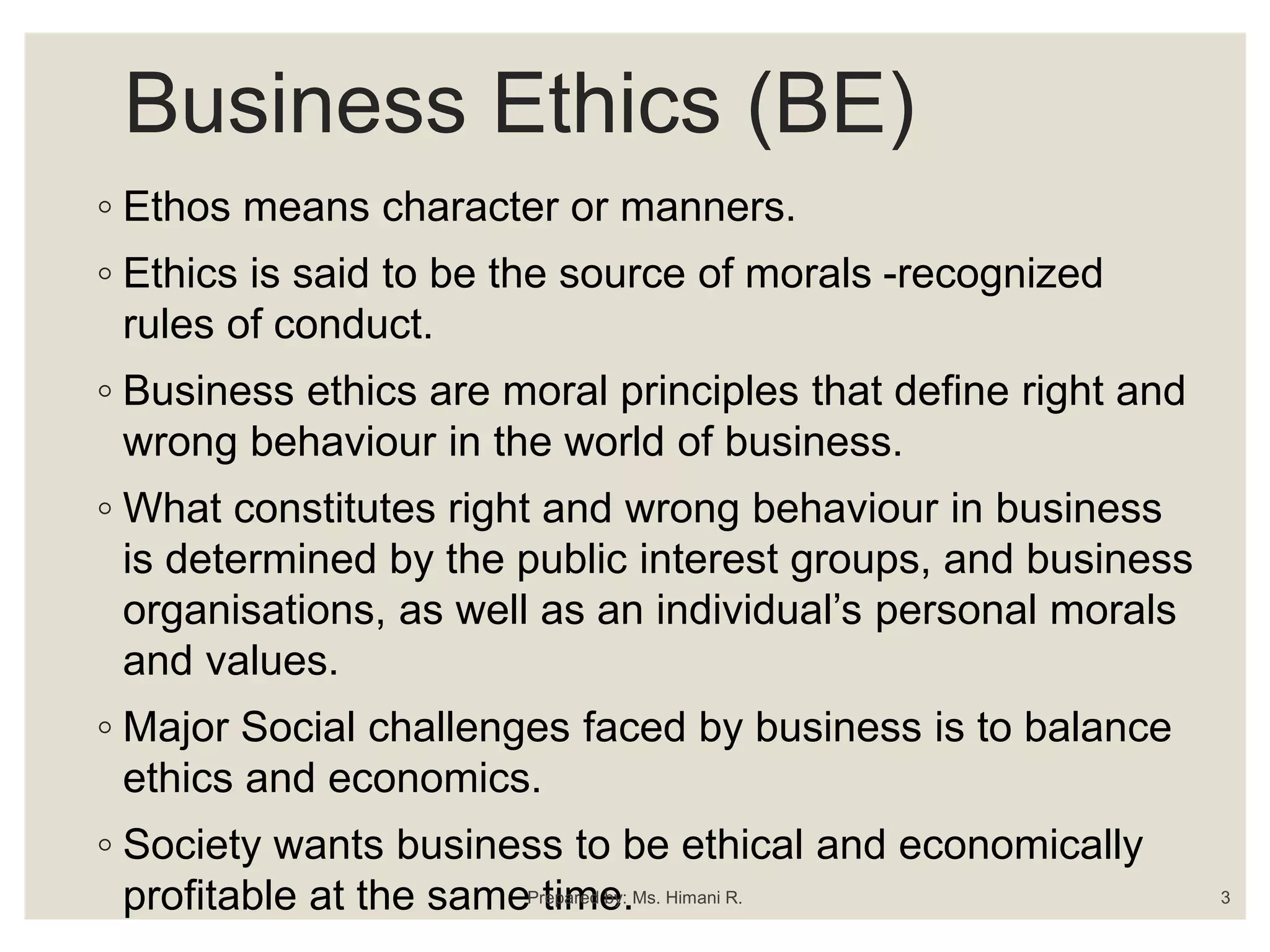
Business Ethics (BE)
◦ Ethos means character or manners.
◦ Ethics is said to be the source of morals -recognized
rules of conduct.
◦ Business ethics are moral principles that define right and
wrong behaviour in the world of business.
◦ What constitutes right and wrong behaviour in business
is determined by the public interest groups, and business
organisations, as well as an individual’s personal morals
and values.
◦ Major Social challenges faced by business is to balance
ethics and economics.
◦ Society wants business to be ethical and economically
profitable at the same time. 3Prepared by: Ms. Himani R.
Scope of business ethics
Stakeholders
level
Personal policy
level
Societal level
Internal policy
level
Scope of
BE
4Prepared by: Ms. Himani R.
Types of ethics
◦ Transactional ethics- Man is a social animal. He has
to act and react with others through different
transactions. The practices of ethics in all these
transactions is called as transactional ethics.
◦ Participatory ethics- Guided by common good, all the
participations follow some ethical practices.
◦ Recognition ethics- As human beings, people are
endowed with the ability to understand the problems of
others. This quality leads to the recognition of
individuals, institutions and societies, conflicting
situations can be solved by the correct recognition of
the situation.
5Prepared by: Ms. Himani R.
Factors influencing BE
Leadership
Strategy &
performance
Environment
Corporate
culture
Individual
characteristics
6Prepared by: Ms. Himani R.
Arguments for and against
business ethics
◦ John is the captain of a submarine. An explosion has caused the sub
to lose most of its oxygen supply and has injured a crewman who is
bleeding badly and is going to die from his wound no matter what
happens. The remaining oxygen is not sufficient for the entire crew to
make it to the surface. The only way to save the other crew members
is for John to shoot dead the injured crewman now. Then there will be
just enough oxygen for the rest of the crew to survive. Is it morally
acceptable for John to shoot the injured crewman?
◦ True or False: If you were in a job interview and an interviewer started
asking you sexually inappropriate questions, you would stand up and
walk out of the interview.
7Prepared by: Ms. Himani R.
◦ There is no incontestably right answer here. But by giving subjects
brain-teasers that tempted them to quickly choose obvious answers
that turned out to be wrong, psychologists prompted them to be more
thoughtful in answering this question. When they did, subjects tended
to answer 'yes' at a meaningfully higher rate than did people who
answered with their gut. When people answer ethical questions
spontaneously, they tend to be more deontological (rule-based) in their
responses ("Thou Shalt Not Kill"). With more reflection, they tend to
take a more utilitarian (consequences-based) approach (taking one life
to save many).
8Prepared by: Ms. Himani R.
◦ In one study, when a group of young women were asked individually
what they would do in this situation, virtually every one predicted that
she would walk out of the interview or protest in some other fashion.
But when other young women were actually put into what they thought
was a real job interview, not a single one protested. They all wanted
the job so much that the ethicality of the situation just faded away. The
Ethics Unwrapped video on Framing illustrates that the kinds of ethical
decisions you are likely to make has a lot to do with how you look at
the issue. For example, if you see it as an ethical issue you will tend to
make different (and more ethical) decisions than if you look at it as
simply a business decision.
9Prepared by: Ms. Himani R.
Corporate Social
Responsibility (CSR)
◦ CSR is the obligation of organization’s management
to make decisions and take actions that will enhance
the welfare and interest of society as well as the
organization.
◦ There are six main areas of CSR:
◦ Employees
◦ Community
◦ Providers
◦ Environment
◦ Consumers
◦ Government
10Prepared by: Ms. Himani R.

Business Ethics

  • 1.
  • 2.
    Layout ◦ Introduction ◦ Meaning ◦Scope ◦ Types of Ethics ◦ Characteristics ◦ Factors influencing Business Ethics ◦ Importance of Business Ethics ◦ Arguments for and against business ethics ◦ Basics of business ethics ◦ Corporate Social Responsibility ◦ Issues of Management ◦ Crisis Management 2Prepared by: Ms. Himani R.
  • 3.
    Business Ethics (BE) ◦Ethos means character or manners. ◦ Ethics is said to be the source of morals -recognized rules of conduct. ◦ Business ethics are moral principles that define right and wrong behaviour in the world of business. ◦ What constitutes right and wrong behaviour in business is determined by the public interest groups, and business organisations, as well as an individual’s personal morals and values. ◦ Major Social challenges faced by business is to balance ethics and economics. ◦ Society wants business to be ethical and economically profitable at the same time. 3Prepared by: Ms. Himani R.
  • 4.
    Scope of businessethics Stakeholders level Personal policy level Societal level Internal policy level Scope of BE 4Prepared by: Ms. Himani R.
  • 5.
    Types of ethics ◦Transactional ethics- Man is a social animal. He has to act and react with others through different transactions. The practices of ethics in all these transactions is called as transactional ethics. ◦ Participatory ethics- Guided by common good, all the participations follow some ethical practices. ◦ Recognition ethics- As human beings, people are endowed with the ability to understand the problems of others. This quality leads to the recognition of individuals, institutions and societies, conflicting situations can be solved by the correct recognition of the situation. 5Prepared by: Ms. Himani R.
  • 6.
    Factors influencing BE Leadership Strategy& performance Environment Corporate culture Individual characteristics 6Prepared by: Ms. Himani R.
  • 7.
    Arguments for andagainst business ethics ◦ John is the captain of a submarine. An explosion has caused the sub to lose most of its oxygen supply and has injured a crewman who is bleeding badly and is going to die from his wound no matter what happens. The remaining oxygen is not sufficient for the entire crew to make it to the surface. The only way to save the other crew members is for John to shoot dead the injured crewman now. Then there will be just enough oxygen for the rest of the crew to survive. Is it morally acceptable for John to shoot the injured crewman? ◦ True or False: If you were in a job interview and an interviewer started asking you sexually inappropriate questions, you would stand up and walk out of the interview. 7Prepared by: Ms. Himani R.
  • 8.
    ◦ There isno incontestably right answer here. But by giving subjects brain-teasers that tempted them to quickly choose obvious answers that turned out to be wrong, psychologists prompted them to be more thoughtful in answering this question. When they did, subjects tended to answer 'yes' at a meaningfully higher rate than did people who answered with their gut. When people answer ethical questions spontaneously, they tend to be more deontological (rule-based) in their responses ("Thou Shalt Not Kill"). With more reflection, they tend to take a more utilitarian (consequences-based) approach (taking one life to save many). 8Prepared by: Ms. Himani R.
  • 9.
    ◦ In onestudy, when a group of young women were asked individually what they would do in this situation, virtually every one predicted that she would walk out of the interview or protest in some other fashion. But when other young women were actually put into what they thought was a real job interview, not a single one protested. They all wanted the job so much that the ethicality of the situation just faded away. The Ethics Unwrapped video on Framing illustrates that the kinds of ethical decisions you are likely to make has a lot to do with how you look at the issue. For example, if you see it as an ethical issue you will tend to make different (and more ethical) decisions than if you look at it as simply a business decision. 9Prepared by: Ms. Himani R.
  • 10.
    Corporate Social Responsibility (CSR) ◦CSR is the obligation of organization’s management to make decisions and take actions that will enhance the welfare and interest of society as well as the organization. ◦ There are six main areas of CSR: ◦ Employees ◦ Community ◦ Providers ◦ Environment ◦ Consumers ◦ Government 10Prepared by: Ms. Himani R.