Strategic Business Analysis:
Ensuring Predictable Results
in IT Projects
• PART 1: UNDERSTANDING BUSINESS ANALYSIS
• PART 2: THE ROLE OF A BUSINESS ANALYST AND
THE RESULTS THEY DELIVER
• PART 3: TOOLS AND TECHNIQUES
• PART 5: SOFT SKILLS OF A BUSINESS ANALYST
• PART 6: BEST PRACTICES IN BUSINESS ANALYSIS
• PART 7: IIBA MEMBERSHIP
Today’s Agenda
Part 1:
Understanding
Business Analysis
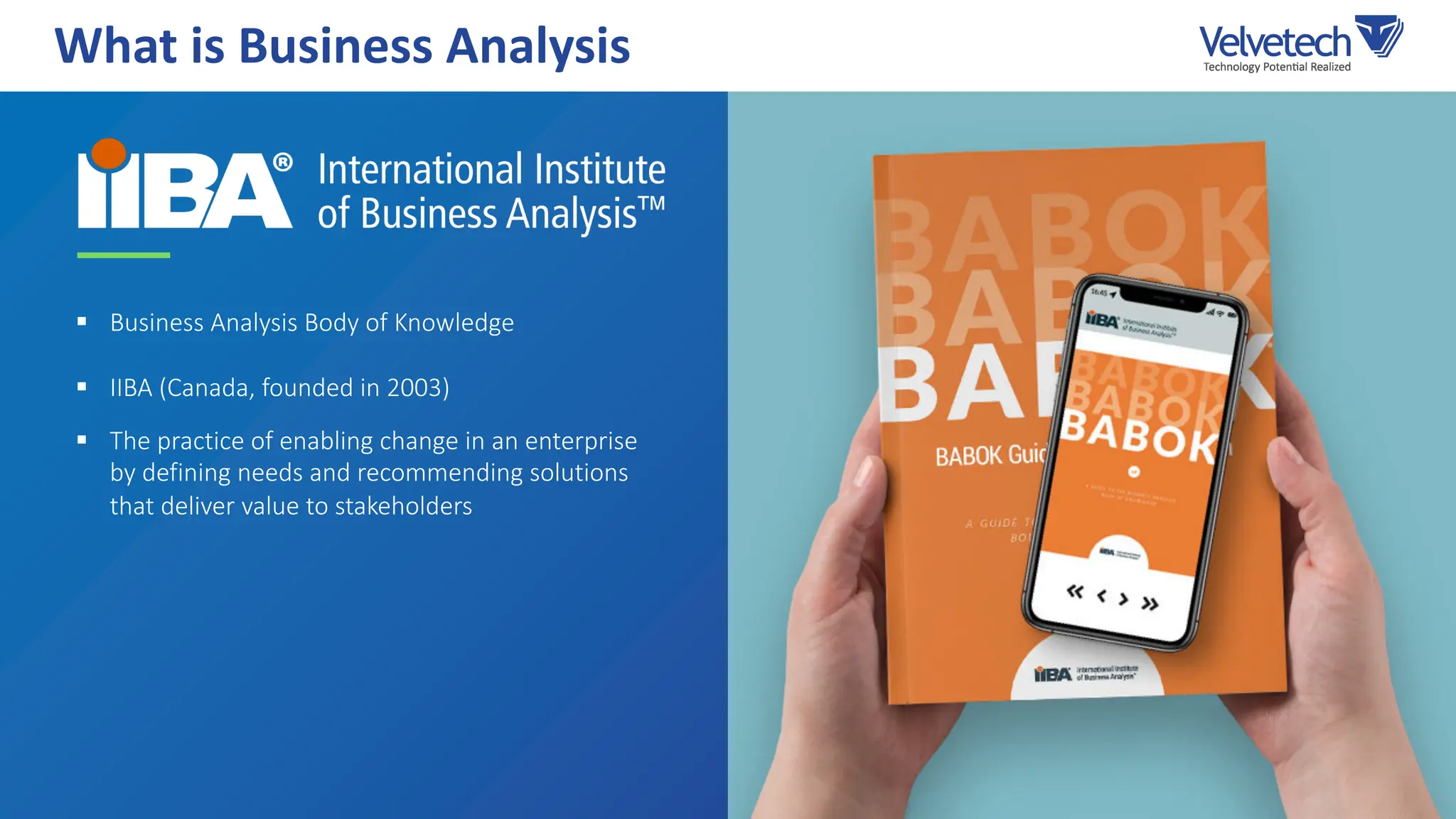
§ Business Analysis Body of Knowledge
§ IIBA (Canada, founded in 2003)
§ The practice of enabling change in an enterprise
by defining needs and recommending solutions
that deliver value to stakeholders
What is Business Analysis
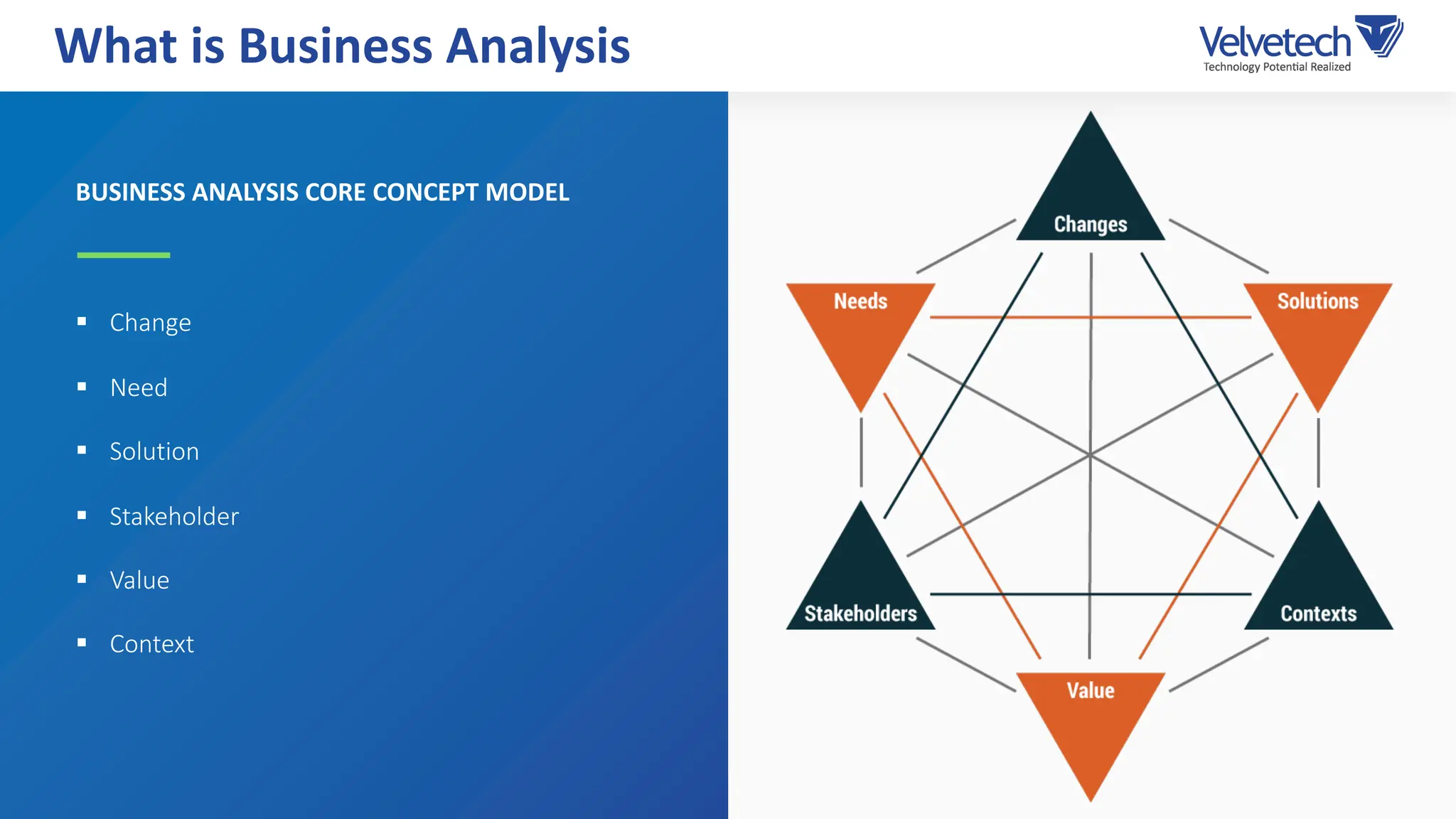
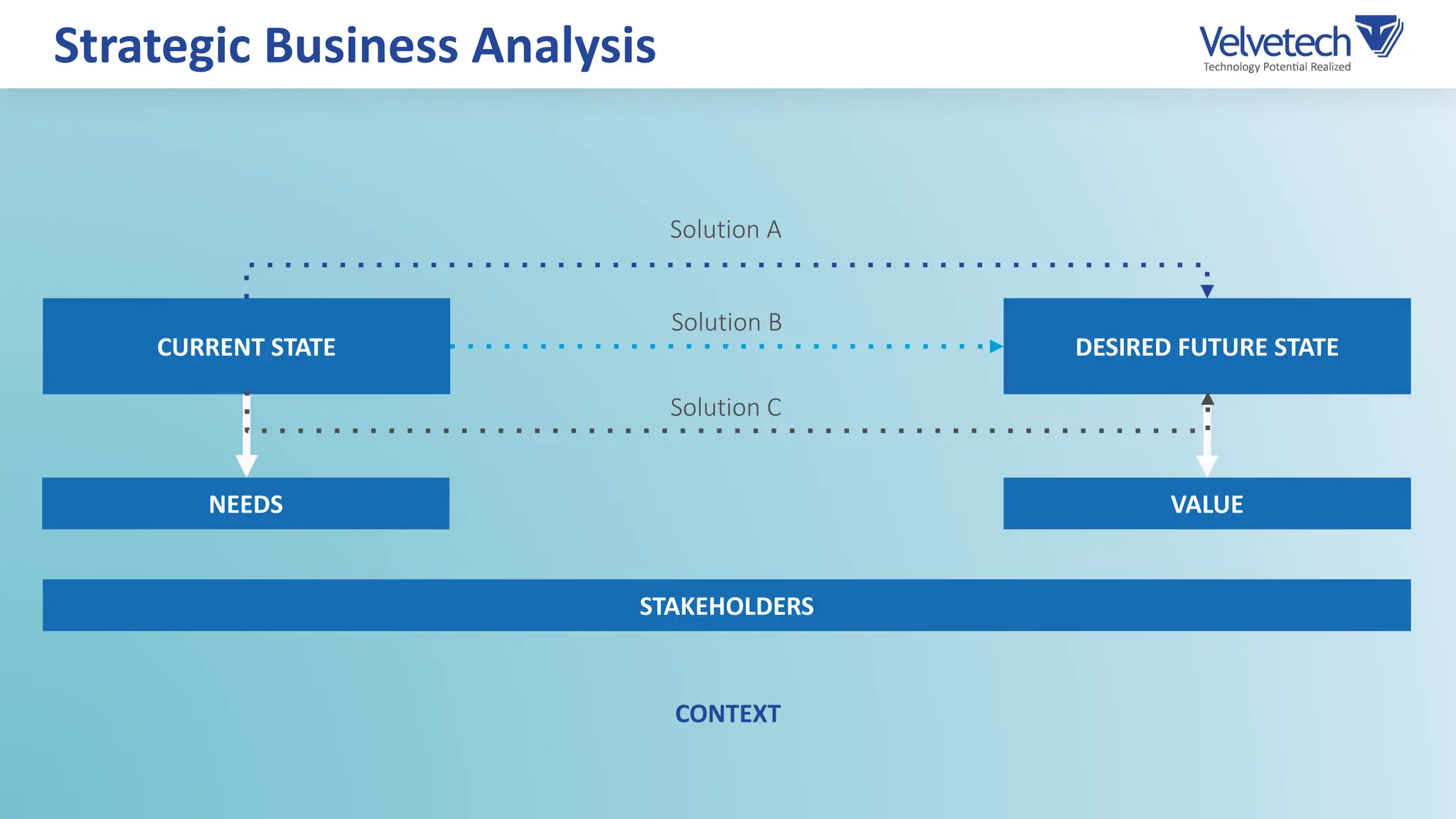
BUSINESS ANALYSIS CORE CONCEPT MODEL
§ Change
§ Need
§ Solution
§ Stakeholder
§ Value
§ Context
What is Business Analysis
CURRENT STATE DESIRED FUTURE STATE
NEEDS VALUE
Solution A
Solution B
Solution C
CONTEXT
STAKEHOLDERS
Strategic Business Analysis
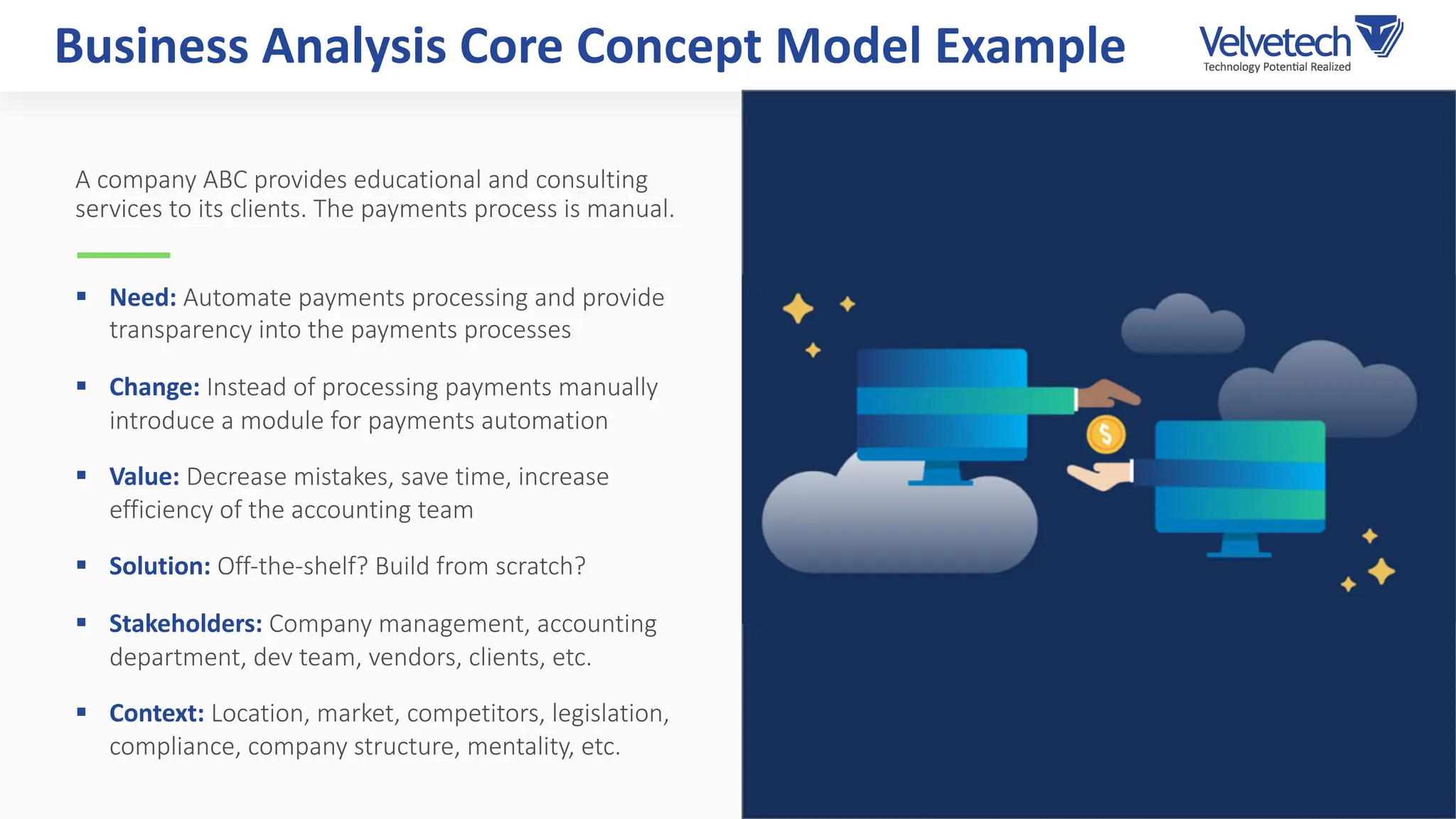
§ Need: Automate payments processing and provide
transparency into the payments processes
§ Change: Instead of processing payments manually
introduce a module for payments automation
§ Value: Decrease mistakes, save time, increase
efficiency of the accounting team
§ Solution: Off-the-shelf? Build from scratch?
§ Stakeholders: Company management, accounting
department, dev team, vendors, clients, etc.
§ Context: Location, market, competitors, legislation,
compliance, company structure, mentality, etc.
A company ABC provides educational and consulting
services to its clients. The payments process is manual.
Business Analysis Core Concept Model Example
Part 2:
The Role of a
Business Analyst
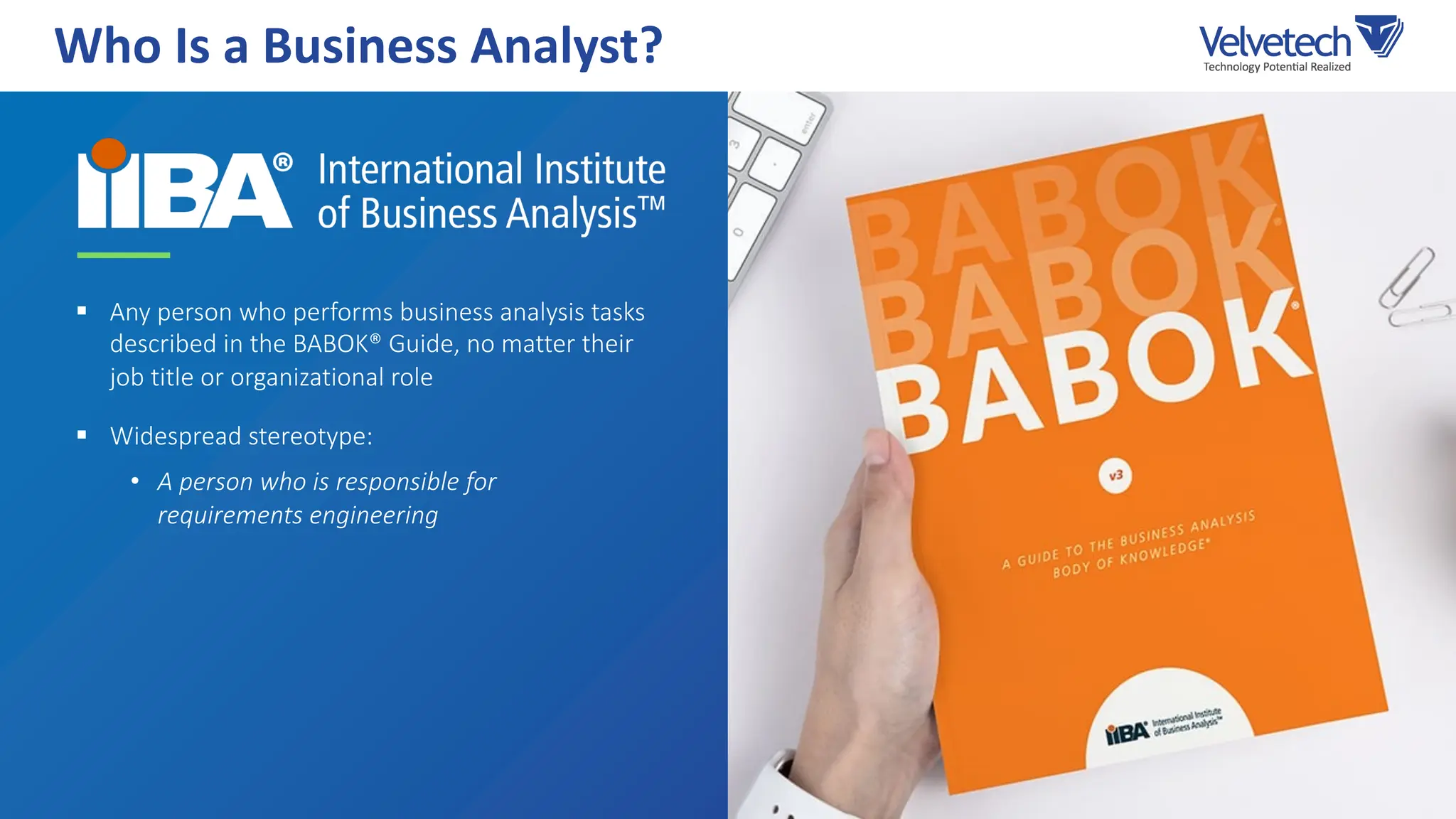
§ Any person who performs business analysis tasks
described in the BABOK® Guide, no matter their
job title or organizational role
§ Widespread stereotype:
• A person who is responsible for
requirements engineering
Who Is a Business Analyst?
HOMEROOM TEACHER
§ Assigns homework to students
§ Provides academic support to their students
§ Responsible for maintaining order and discipline
§ Serves as a primary point of contact between the
school and students' families
§ Maintains records of attendance and punctuality
§ Responsible for the overall well-being of students
§ Serves as mentors, offering guidance, support, and
advice on personal and academic matters
§ Plans and organizes various activities, such as field
trips, class projects, and extracurricular events
§ Often works closely with other subject-specific
teachers to ensure that students are receiving a
well-rounded education, etc.
Analysing Beyond the Surface
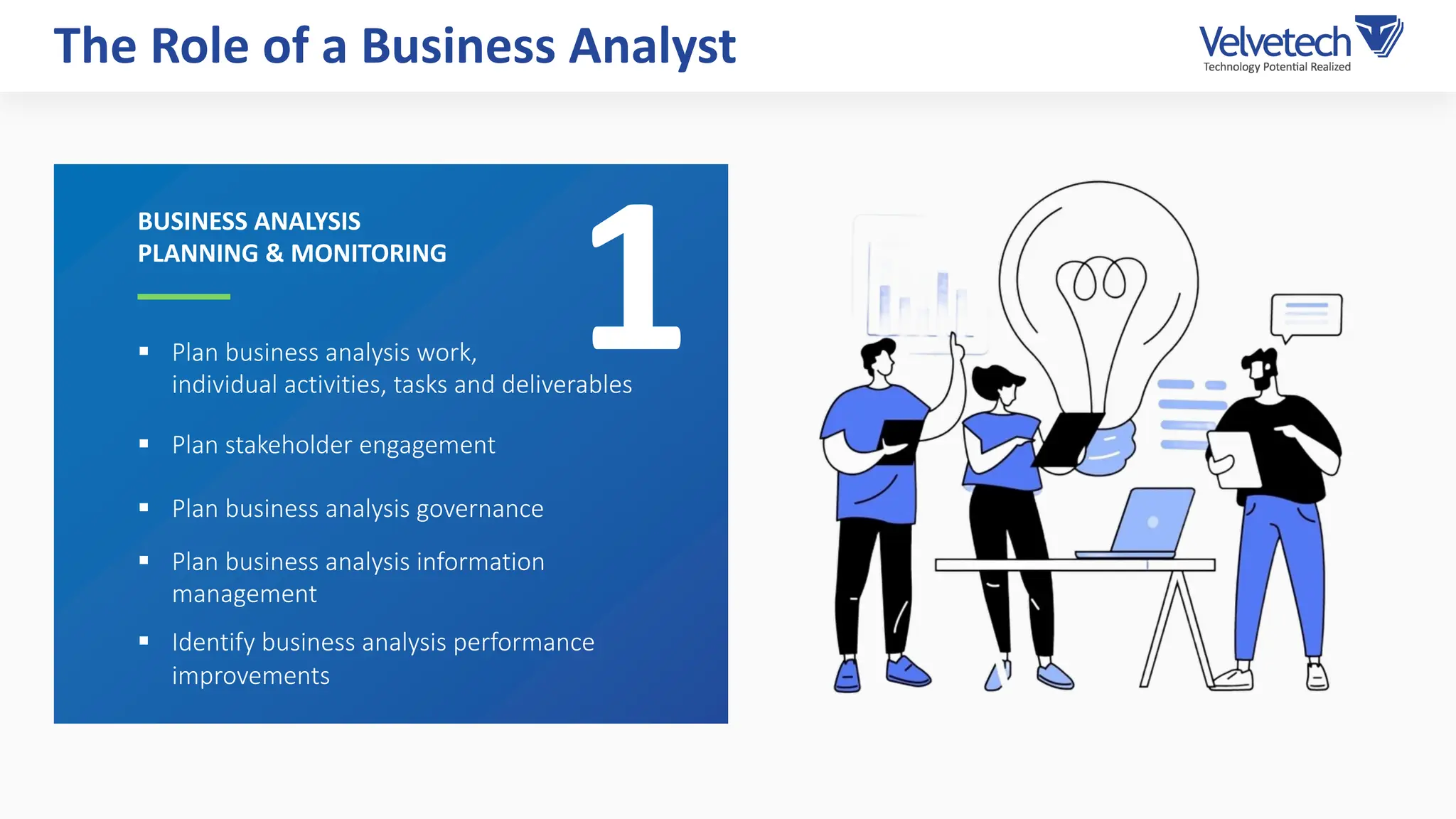
§ Plan business analysis work,
individual activities, tasks and deliverables
§ Plan stakeholder engagement
§ Plan business analysis governance
§ Plan business analysis information
management
§ Identify business analysis performance
improvements
The Role of a Business Analyst
BUSINESS ANALYSIS
PLANNING & MONITORING
1
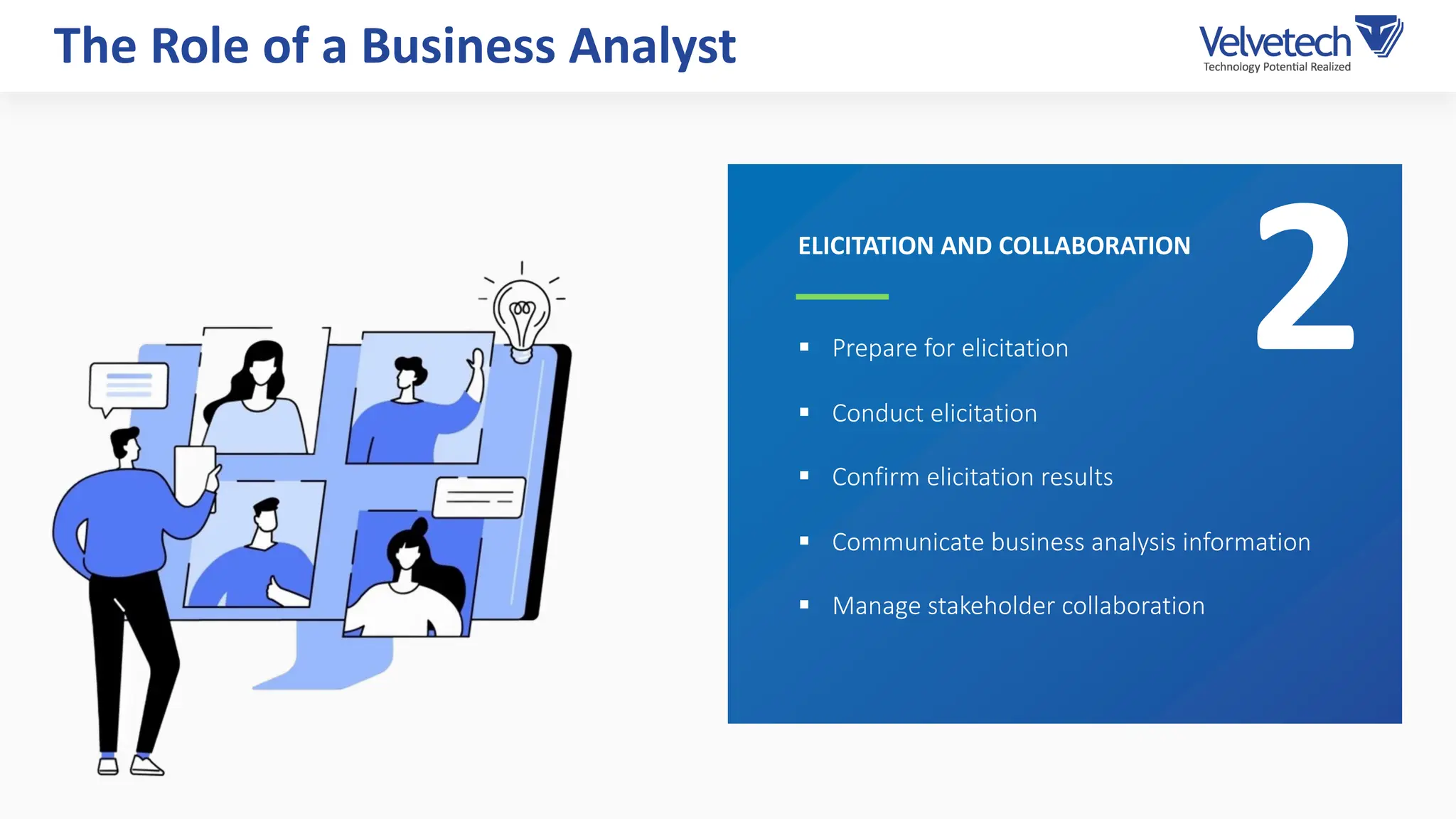
§ Prepare for elicitation
§ Conduct elicitation
§ Confirm elicitation results
§ Communicate business analysis information
§ Manage stakeholder collaboration
The Role of a Business Analyst
ELICITATION AND COLLABORATION
2
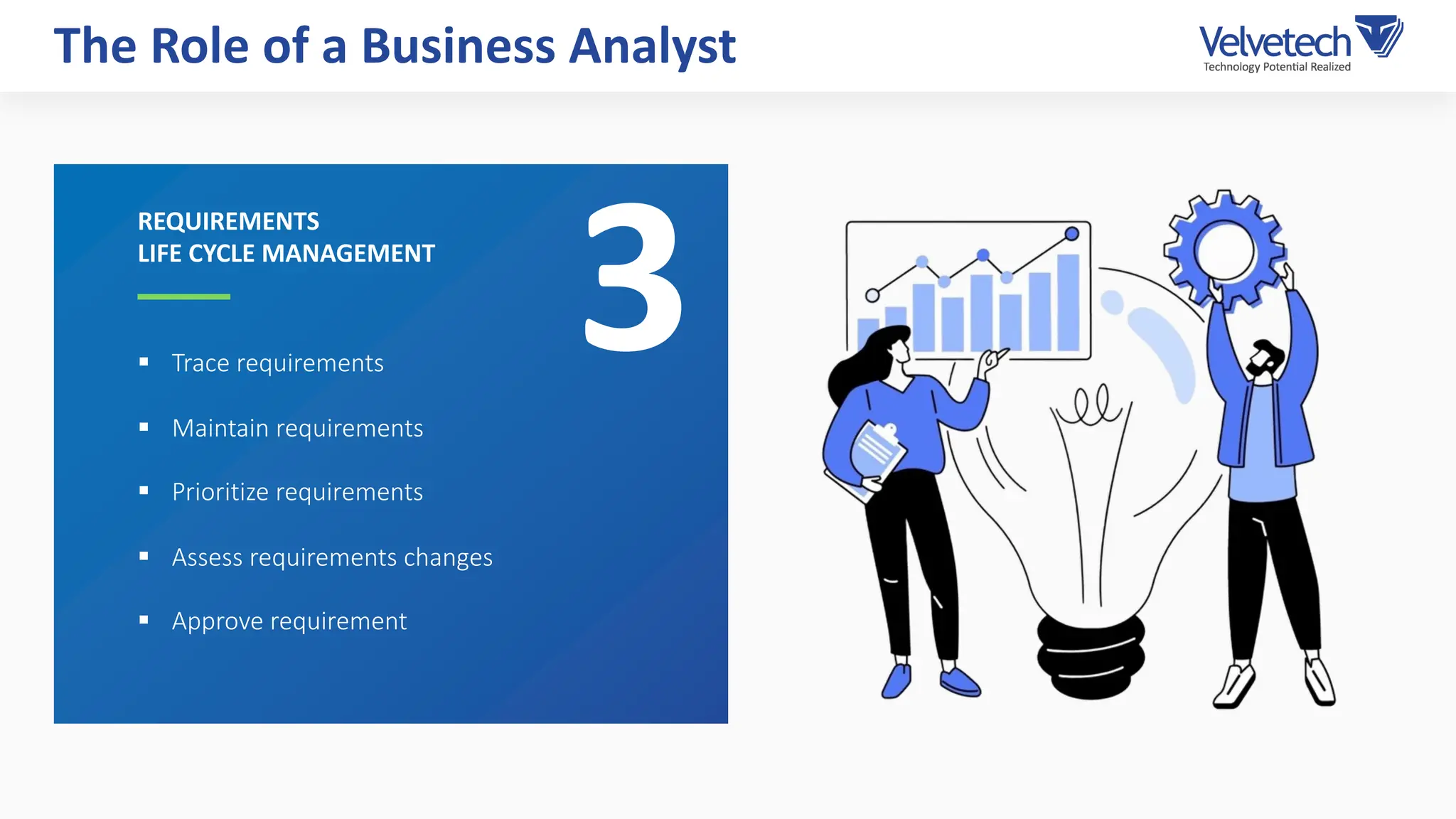
§ Trace requirements
§ Maintain requirements
§ Prioritize requirements
§ Assess requirements changes
§ Approve requirement
The Role of a Business Analyst
REQUIREMENTS
LIFE CYCLE MANAGEMENT
3
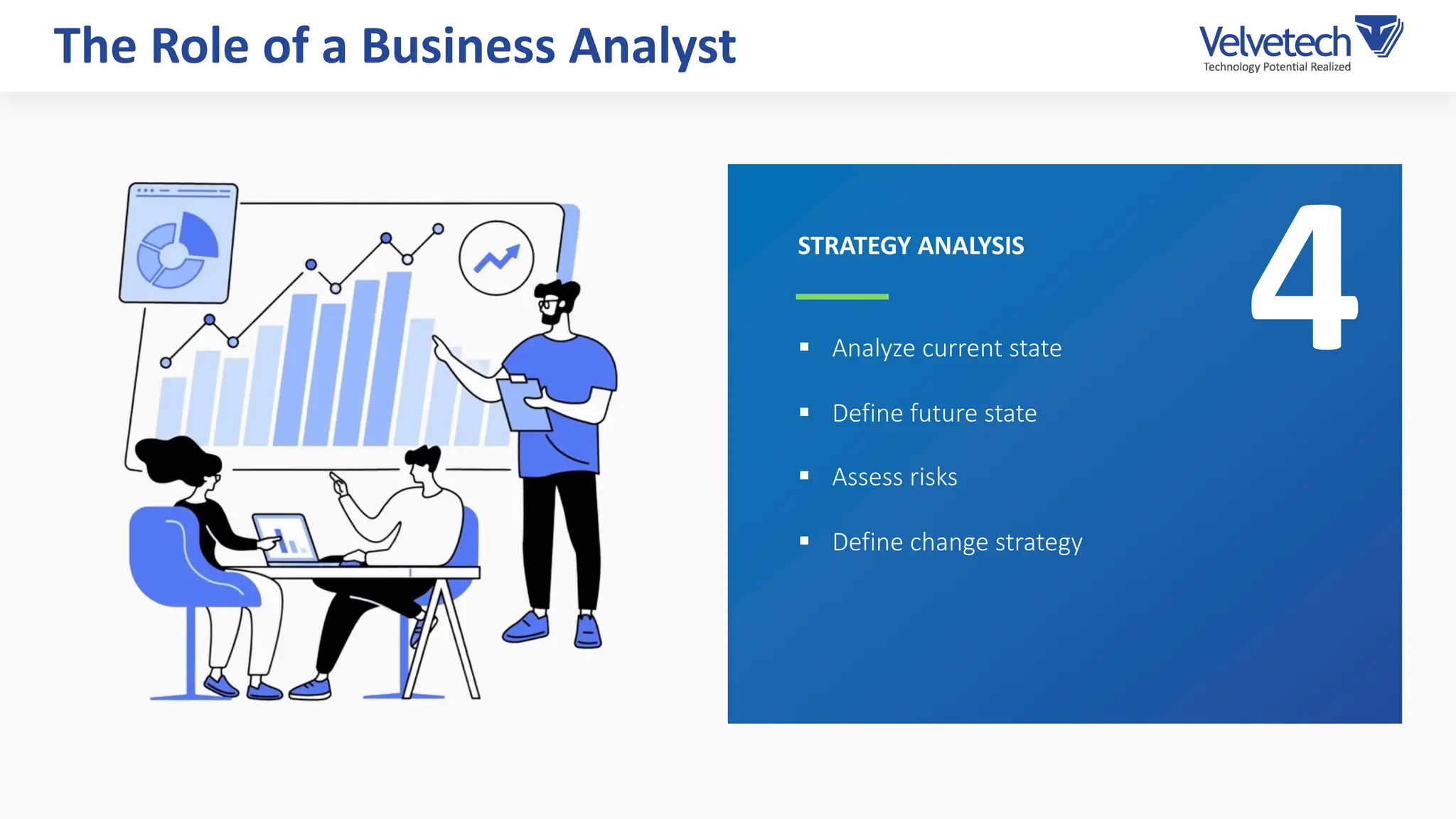
§ Analyze current state
§ Define future state
§ Assess risks
§ Define change strategy
The Role of a Business Analyst
STRATEGY ANALYSIS
4
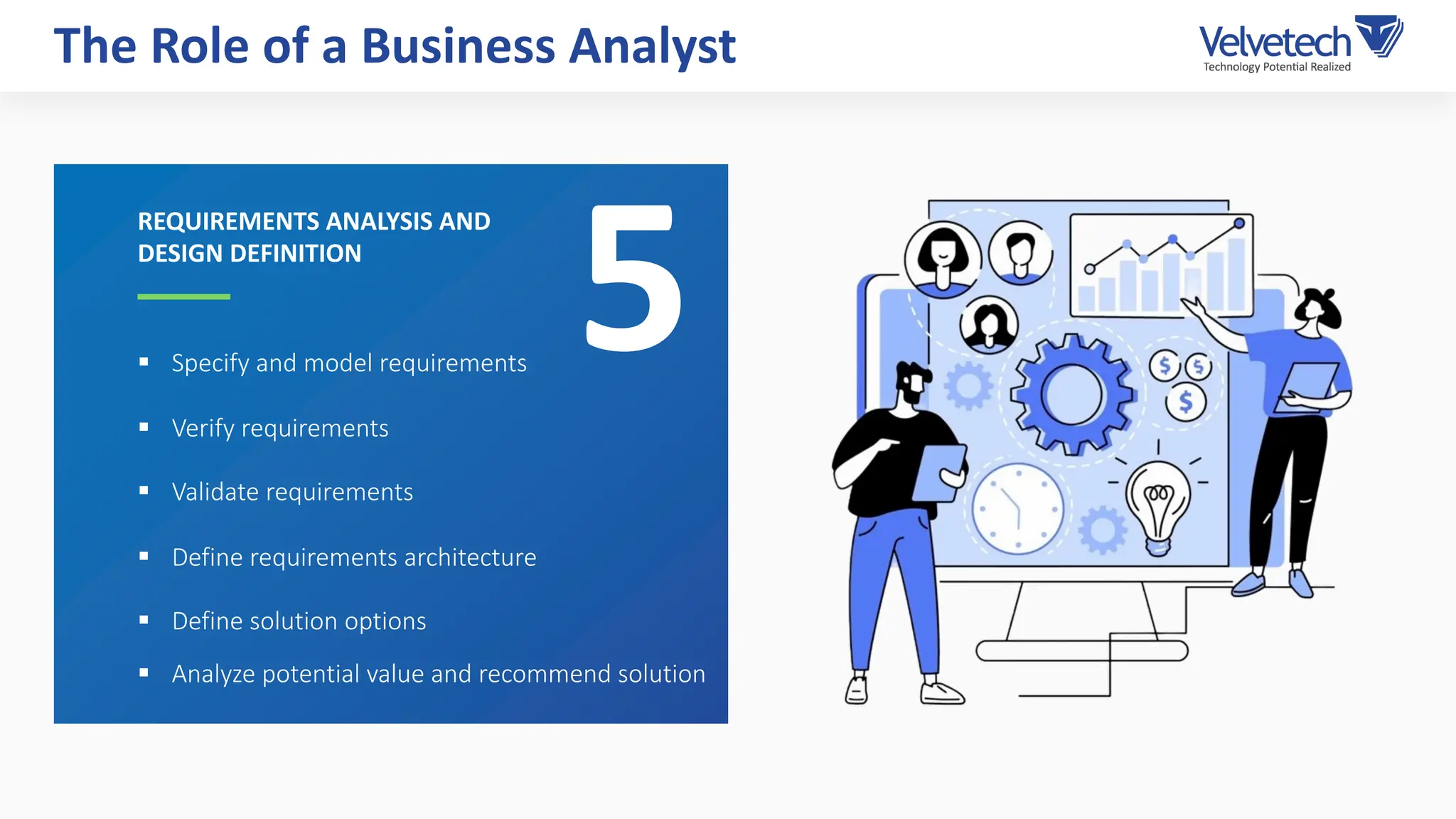
§ Specify and model requirements
§ Verify requirements
§ Validate requirements
§ Define requirements architecture
§ Define solution options
§ Analyze potential value and recommend solution
The Role of a Business Analyst
REQUIREMENTS ANALYSIS AND
DESIGN DEFINITION
5
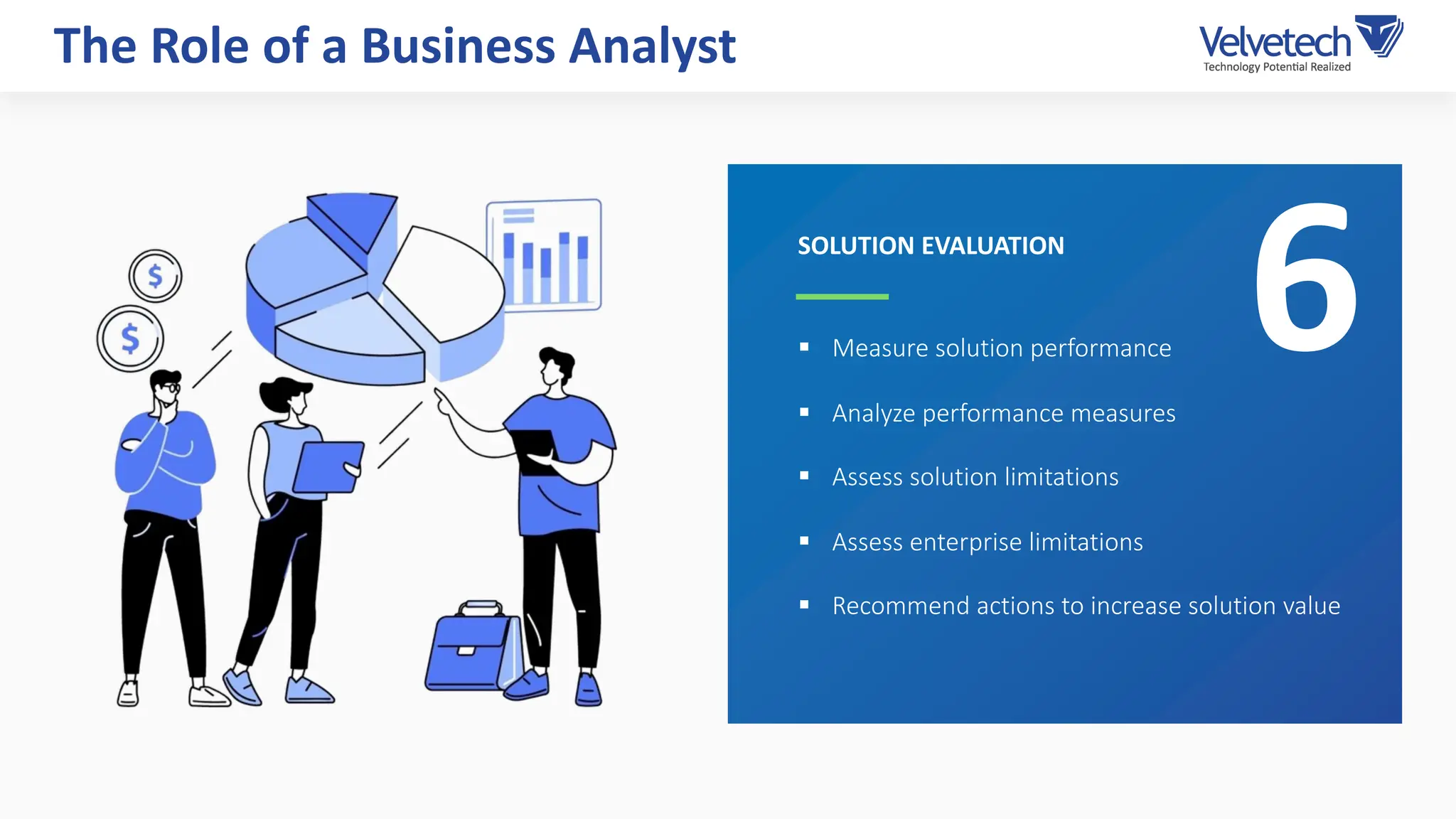
§ Measure solution performance
§ Analyze performance measures
§ Assess solution limitations
§ Assess enterprise limitations
§ Recommend actions to increase solution value
The Role of a Business Analyst
6
SOLUTION EVALUATION
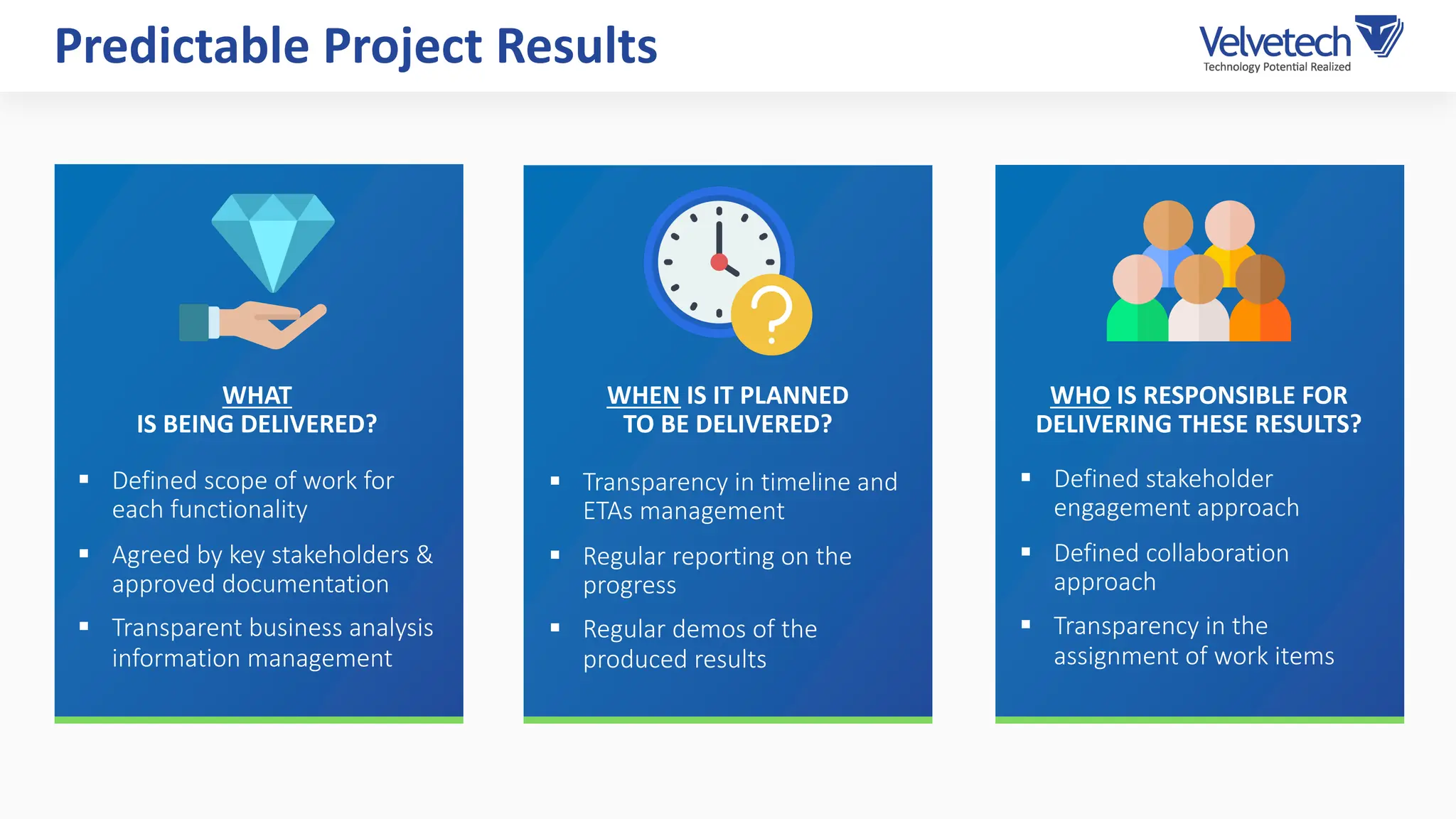
§ Defined scope of work for
each functionality
§ Agreed by key stakeholders &
approved documentation
§ Transparent business analysis
information management
§ Transparency in timeline and
ETAs management
§ Regular reporting on the
progress
§ Regular demos of the
produced results
§ Defined stakeholder
engagement approach
§ Defined collaboration
approach
§ Transparency in the
assignment of work items
WHAT
IS BEING DELIVERED?
WHEN IS IT PLANNED
TO BE DELIVERED?
WHO IS RESPONSIBLE FOR
DELIVERING THESE RESULTS?
Predictable Project Results
Part 3:
Tools and
Techniques
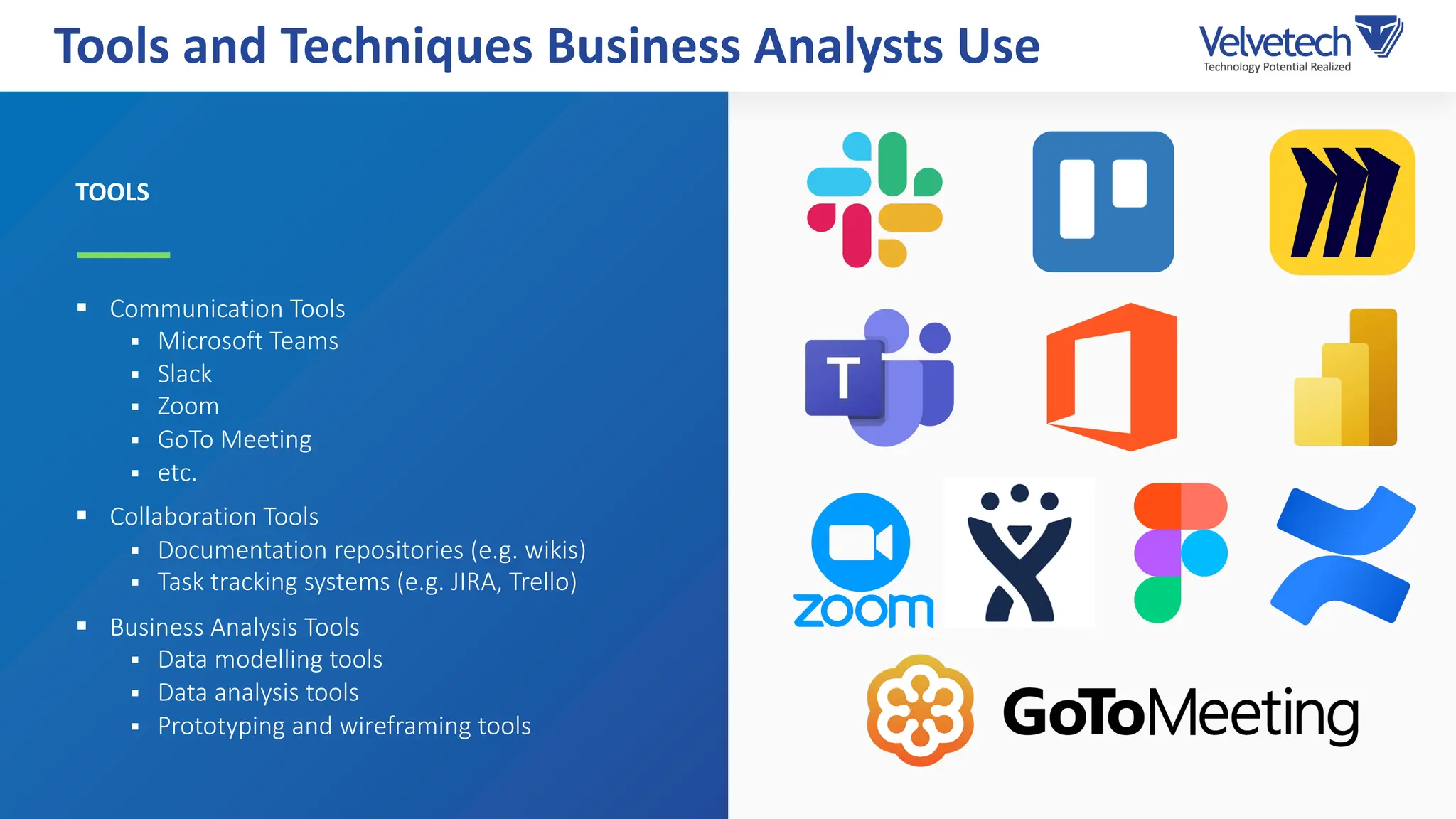
TOOLS
§ Communication Tools
§ Microsoft Teams
§ Slack
§ Zoom
§ GoTo Meeting
§ etc.
§ Collaboration Tools
§ Documentation repositories (e.g. wikis)
§ Task tracking systems (e.g. JIRA, Trello)
§ Business Analysis Tools
§ Data modelling tools
§ Data analysis tools
§ Prototyping and wireframing tools
Tools and Techniques Business Analysts Use
§ Acceptance and Evaluation
Criteria
§ Backlog Management
§ Brainstorming
§ Business Case
§ Business Rules Analysis
§ Concept Modelling
§ Data Dictionary
§ Non-Functional
Requirements
§ Decision Modelling
§ Functional Decomposition
§ Mind Mapping
§ Prototyping
§ Process Modelling
§ Organizational Modelling
§ Data Flow Diagrams
§ User Stories
§ Vendor Assessment
§ Survey or Questionnaire
§ SWOT Analysis
§ Scope Modelling
§ Prioritization
§ …
Tools and Techniques Business Analysts Use
MORE THAN 50 TECHNIQUES
Key Traits for Business Analysts
Part 4:
Soft Skills of a
Business Analyst
BEHAVIOURAL CHARACTERISTICS COMMUNICATION SKILLS INTERACTION SKILLS
§ Ethics
§ Personal Accountability
§ Trustworthiness
§ Organization & Time Management
§ Adaptability
§ Verbal Communication
§ Non-verbal Communication
§ Written Communication
§ Listening
§ Facilitation
§ Leadership and Influencing
§ Teamwork
§ Negotiation & Conflict Resolution
§ Teaching
The Soft Skills of a Business Analyst
Part 5:
Business Analysis
Best Practices
PREDICTABILITY TRANSPARENCY TRUSTWORTHINESS
Business Analysis Best Practices
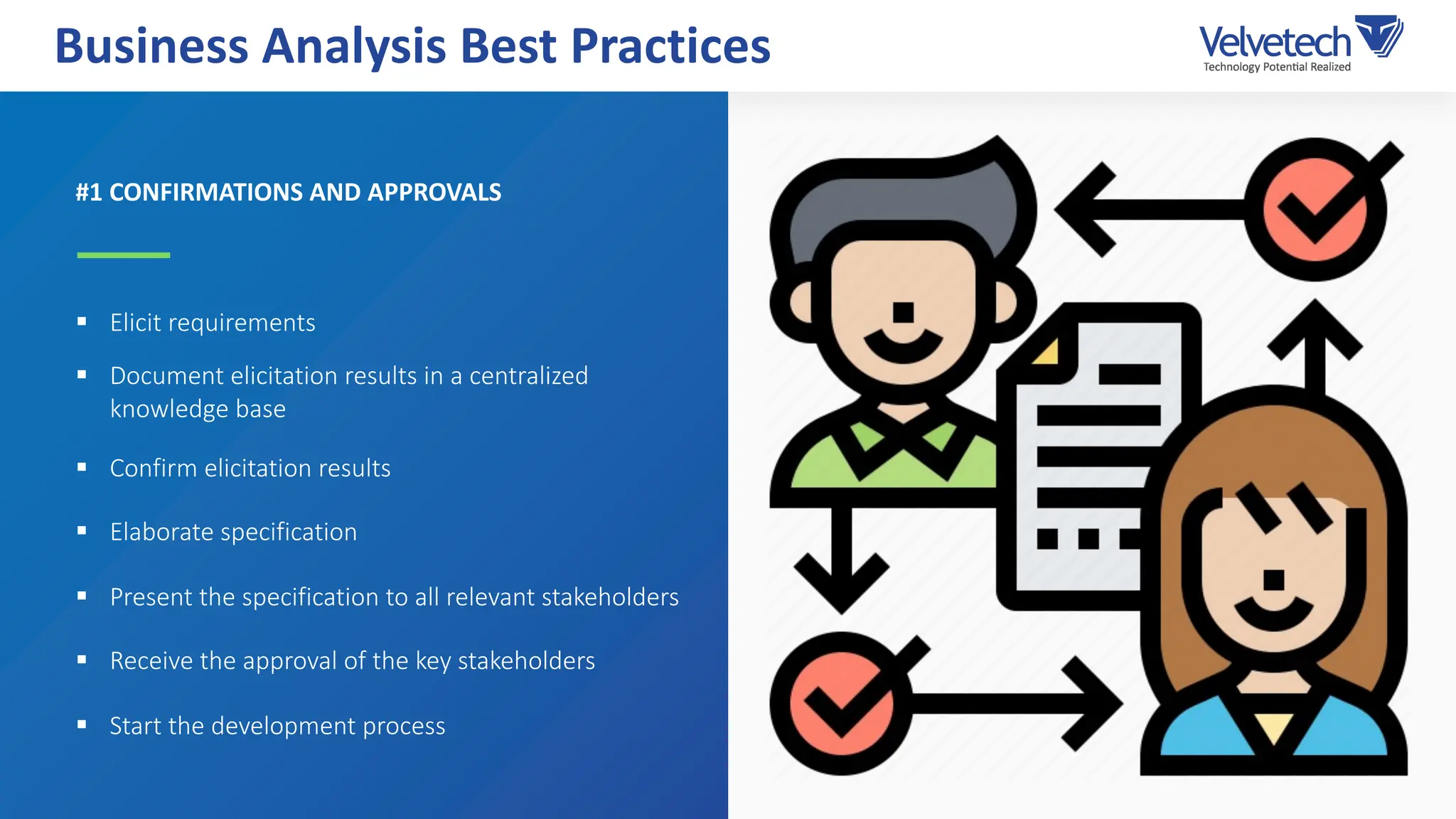
#1 CONFIRMATIONS AND APPROVALS
§ Elicit requirements
§ Document elicitation results in a centralized
knowledge base
§ Confirm elicitation results
§ Elaborate specification
§ Present the specification to all relevant stakeholders
§ Receive the approval of the key stakeholders
§ Start the development process
Business Analysis Best Practices
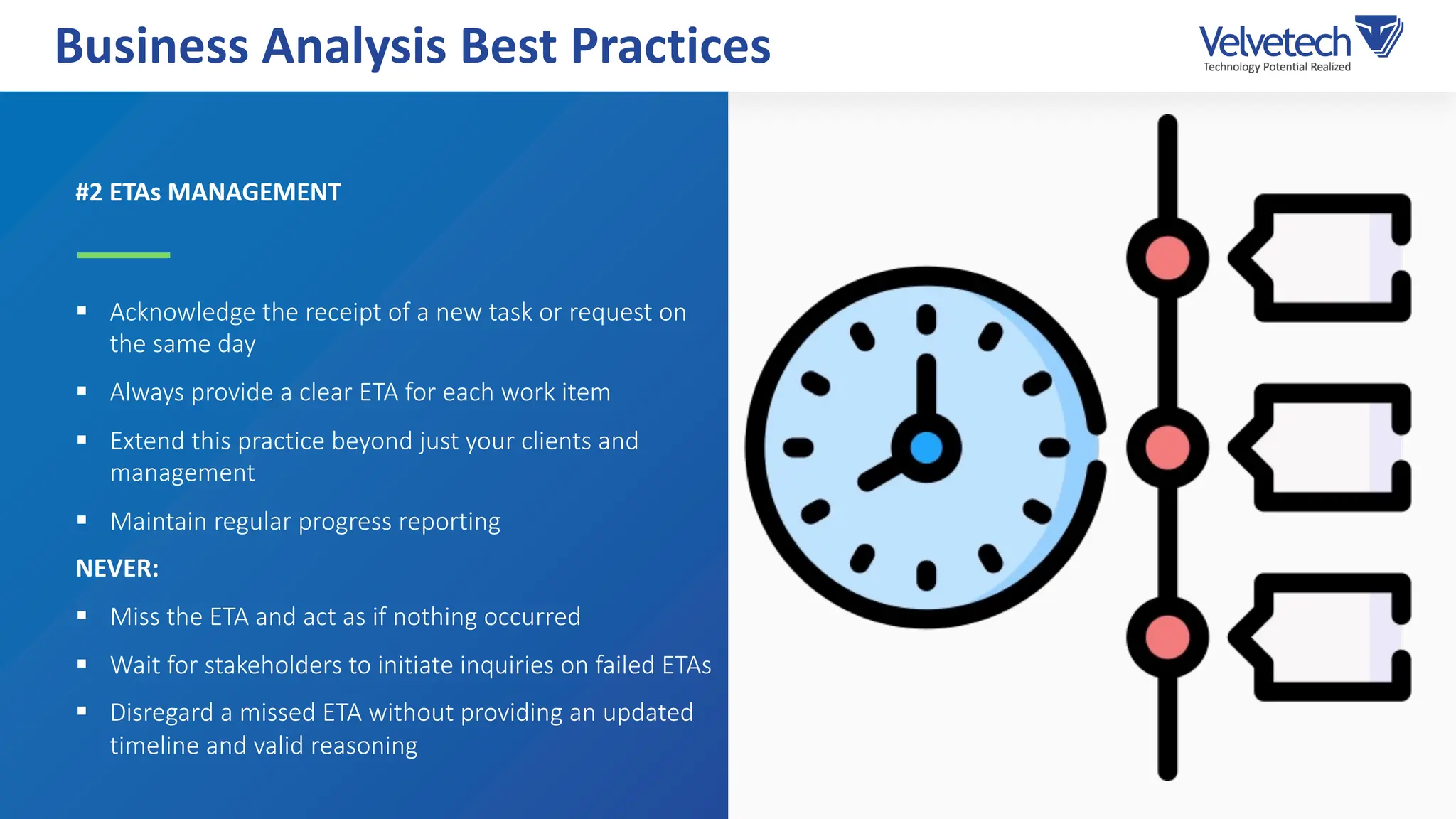
#2 ETAs MANAGEMENT
§ Acknowledge the receipt of a new task or request on
the same day
§ Always provide a clear ETA for each work item
§ Extend this practice beyond just your clients and
management
§ Maintain regular progress reporting
NEVER:
§ Miss the ETA and act as if nothing occurred
§ Wait for stakeholders to initiate inquiries on failed ETAs
§ Disregard a missed ETA without providing an updated
timeline and valid reasoning
Business Analysis Best Practices
#3 BUSINESS ANALYSIS INFORMATION MANAGEMENT
§ Document all business analysis information in a
centralized knowledge base:
§ Meeting agendas
§ Meeting notes
§ Discovery questions and the client’s answers
§ Any materials provided by the client or
produced by the development team
§ All approvals and confirmations
§ Etc.
§ All relevant stakeholders should have access to the
centralized knowledge base
§ Never keep the information in emails or messages
or on a personal computer only
Business Analysis Best Practices
Part 6:
IIBA
Membership
VELVTECH — IIBA EEP
§ Velvetech has the status of Endorsed Education
Provider of the International Institute of Business
Analysis
§ Developed IIBA certified business analysis course
§ Continuous learning and development activities
for Velvetech Business Analysts
§ Support in obtaining IIBA certifications
§ More than 40% of Velvetech Business Analysts
hold IIBA certifications
IIBA Partnership
Subscribe to Our Newsletter on LinkedIn
DON’T MISS THE
NEXT EDITION!
Thank You!
+1 (847) 559-0864
sales@velvetech.com
www.velvetech.com
601 Skokie Blvd.,
Suite105,
Northbrook, IL 60062

Strategic Business Analysis: Ensuring Predictable Results in IT Projects

  • 1.
    Strategic Business Analysis: EnsuringPredictable Results in IT Projects
  • 2.
    • PART 1:UNDERSTANDING BUSINESS ANALYSIS • PART 2: THE ROLE OF A BUSINESS ANALYST AND THE RESULTS THEY DELIVER • PART 3: TOOLS AND TECHNIQUES • PART 5: SOFT SKILLS OF A BUSINESS ANALYST • PART 6: BEST PRACTICES IN BUSINESS ANALYSIS • PART 7: IIBA MEMBERSHIP Today’s Agenda
  • 3.
  • 4.
    § Business AnalysisBody of Knowledge § IIBA (Canada, founded in 2003) § The practice of enabling change in an enterprise by defining needs and recommending solutions that deliver value to stakeholders What is Business Analysis
  • 5.
    BUSINESS ANALYSIS CORECONCEPT MODEL § Change § Need § Solution § Stakeholder § Value § Context What is Business Analysis
  • 6.
    CURRENT STATE DESIREDFUTURE STATE NEEDS VALUE Solution A Solution B Solution C CONTEXT STAKEHOLDERS Strategic Business Analysis
  • 7.
    § Need: Automatepayments processing and provide transparency into the payments processes § Change: Instead of processing payments manually introduce a module for payments automation § Value: Decrease mistakes, save time, increase efficiency of the accounting team § Solution: Off-the-shelf? Build from scratch? § Stakeholders: Company management, accounting department, dev team, vendors, clients, etc. § Context: Location, market, competitors, legislation, compliance, company structure, mentality, etc. A company ABC provides educational and consulting services to its clients. The payments process is manual. Business Analysis Core Concept Model Example
  • 8.
    Part 2: The Roleof a Business Analyst
  • 9.
    § Any personwho performs business analysis tasks described in the BABOK® Guide, no matter their job title or organizational role § Widespread stereotype: • A person who is responsible for requirements engineering Who Is a Business Analyst?
  • 10.
    HOMEROOM TEACHER § Assignshomework to students § Provides academic support to their students § Responsible for maintaining order and discipline § Serves as a primary point of contact between the school and students' families § Maintains records of attendance and punctuality § Responsible for the overall well-being of students § Serves as mentors, offering guidance, support, and advice on personal and academic matters § Plans and organizes various activities, such as field trips, class projects, and extracurricular events § Often works closely with other subject-specific teachers to ensure that students are receiving a well-rounded education, etc. Analysing Beyond the Surface
  • 11.
    § Plan businessanalysis work, individual activities, tasks and deliverables § Plan stakeholder engagement § Plan business analysis governance § Plan business analysis information management § Identify business analysis performance improvements The Role of a Business Analyst BUSINESS ANALYSIS PLANNING & MONITORING 1
  • 12.
    § Prepare forelicitation § Conduct elicitation § Confirm elicitation results § Communicate business analysis information § Manage stakeholder collaboration The Role of a Business Analyst ELICITATION AND COLLABORATION 2
  • 13.
    § Trace requirements §Maintain requirements § Prioritize requirements § Assess requirements changes § Approve requirement The Role of a Business Analyst REQUIREMENTS LIFE CYCLE MANAGEMENT 3
  • 14.
    § Analyze currentstate § Define future state § Assess risks § Define change strategy The Role of a Business Analyst STRATEGY ANALYSIS 4
  • 15.
    § Specify andmodel requirements § Verify requirements § Validate requirements § Define requirements architecture § Define solution options § Analyze potential value and recommend solution The Role of a Business Analyst REQUIREMENTS ANALYSIS AND DESIGN DEFINITION 5
  • 16.
    § Measure solutionperformance § Analyze performance measures § Assess solution limitations § Assess enterprise limitations § Recommend actions to increase solution value The Role of a Business Analyst 6 SOLUTION EVALUATION
  • 17.
    § Defined scopeof work for each functionality § Agreed by key stakeholders & approved documentation § Transparent business analysis information management § Transparency in timeline and ETAs management § Regular reporting on the progress § Regular demos of the produced results § Defined stakeholder engagement approach § Defined collaboration approach § Transparency in the assignment of work items WHAT IS BEING DELIVERED? WHEN IS IT PLANNED TO BE DELIVERED? WHO IS RESPONSIBLE FOR DELIVERING THESE RESULTS? Predictable Project Results
  • 18.
  • 19.
    TOOLS § Communication Tools §Microsoft Teams § Slack § Zoom § GoTo Meeting § etc. § Collaboration Tools § Documentation repositories (e.g. wikis) § Task tracking systems (e.g. JIRA, Trello) § Business Analysis Tools § Data modelling tools § Data analysis tools § Prototyping and wireframing tools Tools and Techniques Business Analysts Use
  • 20.
    § Acceptance andEvaluation Criteria § Backlog Management § Brainstorming § Business Case § Business Rules Analysis § Concept Modelling § Data Dictionary § Non-Functional Requirements § Decision Modelling § Functional Decomposition § Mind Mapping § Prototyping § Process Modelling § Organizational Modelling § Data Flow Diagrams § User Stories § Vendor Assessment § Survey or Questionnaire § SWOT Analysis § Scope Modelling § Prioritization § … Tools and Techniques Business Analysts Use MORE THAN 50 TECHNIQUES
  • 21.
    Key Traits forBusiness Analysts
  • 22.
    Part 4: Soft Skillsof a Business Analyst
  • 23.
    BEHAVIOURAL CHARACTERISTICS COMMUNICATIONSKILLS INTERACTION SKILLS § Ethics § Personal Accountability § Trustworthiness § Organization & Time Management § Adaptability § Verbal Communication § Non-verbal Communication § Written Communication § Listening § Facilitation § Leadership and Influencing § Teamwork § Negotiation & Conflict Resolution § Teaching The Soft Skills of a Business Analyst
  • 24.
  • 25.
  • 26.
    #1 CONFIRMATIONS ANDAPPROVALS § Elicit requirements § Document elicitation results in a centralized knowledge base § Confirm elicitation results § Elaborate specification § Present the specification to all relevant stakeholders § Receive the approval of the key stakeholders § Start the development process Business Analysis Best Practices
  • 27.
    #2 ETAs MANAGEMENT §Acknowledge the receipt of a new task or request on the same day § Always provide a clear ETA for each work item § Extend this practice beyond just your clients and management § Maintain regular progress reporting NEVER: § Miss the ETA and act as if nothing occurred § Wait for stakeholders to initiate inquiries on failed ETAs § Disregard a missed ETA without providing an updated timeline and valid reasoning Business Analysis Best Practices
  • 28.
    #3 BUSINESS ANALYSISINFORMATION MANAGEMENT § Document all business analysis information in a centralized knowledge base: § Meeting agendas § Meeting notes § Discovery questions and the client’s answers § Any materials provided by the client or produced by the development team § All approvals and confirmations § Etc. § All relevant stakeholders should have access to the centralized knowledge base § Never keep the information in emails or messages or on a personal computer only Business Analysis Best Practices
  • 29.
  • 30.
    VELVTECH — IIBAEEP § Velvetech has the status of Endorsed Education Provider of the International Institute of Business Analysis § Developed IIBA certified business analysis course § Continuous learning and development activities for Velvetech Business Analysts § Support in obtaining IIBA certifications § More than 40% of Velvetech Business Analysts hold IIBA certifications IIBA Partnership
  • 31.
    Subscribe to OurNewsletter on LinkedIn DON’T MISS THE NEXT EDITION!
  • 32.
    Thank You! +1 (847)559-0864 sales@velvetech.com www.velvetech.com 601 Skokie Blvd., Suite105, Northbrook, IL 60062