By
Ajay Kumar (PhD. IIT(ISM))
Assistant Professor, GITAM School of Business- Hyd
Introduction to Business Analysis
References
 Business analysis - Cadle James, Eva Malcom,
Hindle Keith, Paul Debra, et al., BCS, The Chartered
Institute for IT
 Pendse Pradeep Hari (2015), Business Analysis :
Solving Business Problems By Visualizing Effective
Processes and It Solutions, New Delhi : Prentice Hall
of India.
 Paul Mulvey, Kate Mcgoey, Kupe Kupersmith (2013),
Business Analysis for Dummies, New Delhi : Wiley
India.
Objectives
 Know main idea about Business analysis
 Know who is the business analysts
 Understand the basic roles of business analysts.
WHAT IS BUSINESS ANALYSIS?
 A relatively new discipline that promises to offer
great benefit to organizations by ensuring that
business needs are aligned with implemented
business change solutions.
WHAT IS BUSINESS ANALYSIS?
 in the absence of a standard definition of business
analysis and a standard business analysis process
model, problems have arisen:
1. Organisations have introduced business analysis so as to make sure that
business needs are paramount when new information technology (IT)
systems are introduced.
2. Some business analysts were experienced IT systems analysts and have
been less comfortable considering the business requirements.
3. Many business analysts come from a business background and have a
limited understanding of IT
4. Some business analysit Have felt that they could offer beneficial advice to
their organisations – but a lack of understanding of their role has caused
organisations to reject or ignore this advice.
WHAT IS BUSINESS ANALYSIS?
 Business analysis is the practice of enabling
change in an enterprise by defining needs and
recommending solutions that deliver value to
stakeholders.
 Business analysis enables an enterprise to
articulate needs and the rationale for change , and
to design and describe solutions that can deliver
value.
THE ORIGINS OF BUSINESS
ANALYSIS
 Developments in IT have enabled organisations to create
information systems that have improved business
operations and management decision-making
 What can IT do to exploit business opportunities
and enhance the portfolio of products and
services?’
 the technology enables the development of
information systems, but these often fail to meet the
requirements of the business and deliver the service
that will bring competitive advantage to the
organisation
THE DEVELOPMENT OF BUSINESS
ANALYSIS
 The impact of outsourcing
 Competitive advantage of using IT
 Successful business change
 The importance of the business analyst
 The use of consultants
THE DEVELOPMENT OF BUSINESS
ANALYSIS
 The impact of outsourcing
 many organisations have outsourced their IT services
rather than employ their own internal IT staff.
 The communication and clarification of
requirements is key to ensuring the success of any IT
 The outsourcing business model has undoubtedly been
a catalyst for the development of the business
analysis function as more and more
THE DEVELOPMENT OF BUSINESS
ANALYSIS
 Competitive advantage of using IT
 A parallel development that has helped to increase
the profile of business analysis and define the
business analyst role
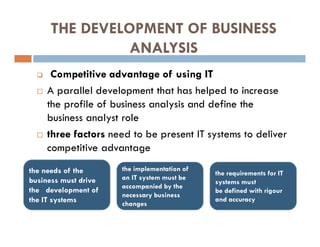
 three factors need to be present IT systems to deliver
competitive advantage
the requirements for IT
systems must
be defined with rigour
and accuracy
the implementation of
an IT system must be
accompanied by the
necessary business
changes
the needs of the
business must drive
the development of
the IT systems
THE DEVELOPMENT OF BUSINESS
ANALYSIS
 Successful business change
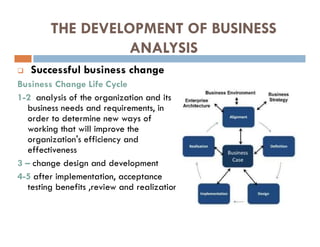
Business Change Life Cycle
1-2 analysis of the organization and its
business needs and requirements, in
order to determine new ways of
working that will improve the
organization's efficiency and
effectiveness
3 – change design and development
4-5 after implementation, acceptance
testing benefits ,review and realization
THE DEVELOPMENT OF BUSINESS
ANALYSIS
Successful business change
 Clearly, extensive analysis is required throughout
the life cycle if the change are to be successful to
deliver the desire benefits.
 The lack of clarity and alignment can result in
development that fail to deliver business benefits
and waste investment funds.
THE DEVELOPMENT OF BUSINESS
ANALYSIS
 The importance of the business analyst
 Who is a Business Analyst?
 business analyst is any person who performs
business analysis tasks, no matter their job title or
organizational role.
 Help Organizations to finding potential solutions to
business issues and opportunities
 delivering the business benefits predicted for
business change
THE DEVELOPMENT OF BUSINESS
ANALYSIS
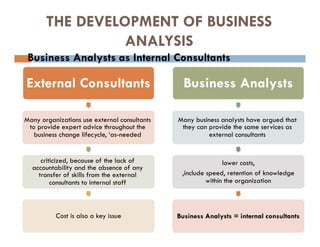
 Business Analysts as Internal Consultants
External Consultants
Many organizations use external consultants
to provide expert advice throughout the
business change lifecycle, ‘as-needed
criticized, because of the lack of
accountability and the absence of any
transfer of skills from the external
consultants to internal staff
Cost is also a key issue
Business Analysts
Many business analysts have argued that
they can provide the same services as
external consultants
lower costs,
,include speed, retention of knowledge
within the organization
Business Analysts = internal consultants
THE SCOPE OF BUSINESS ANALYSIS
WORK
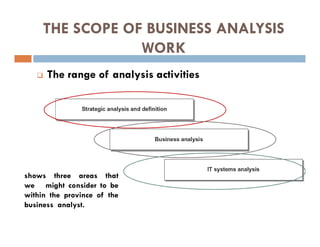
 The range of analysis activities
shows three areas that
we might consider to be
within the province of the
business analyst.
THE SCOPE OF BUSINESS ANALYSIS
WORK
 Strategic analysis and definition
 is typically the work of senior management
 Business analysts often have to define the tactics
that will deliver the business objectives and strategy,
typically the process and IT solutions.
THE SCOPE OF BUSINESS ANALYSIS
WORK
 IT systems analysis
 Systems analysts are responsible for analyzing and
specifying the IT system requirements in sufficient
detail to provide a basis for the evaluation of
software packages or the development of a bespoke
IT system.
 what data the computer system will record, what
processing will be applied to that data and how the
user interface will operate.
 in some organizations the term ‘IT business analyst’ or
System analyst.
THE SCOPE OF BUSINESS ANALYSIS
WORK
 Business analysis
1. It may be that the analysts are asked to resolve a
localized business issue
2. investigation into several issues, or perhaps ideas,
regarding increased efficiency or effectiveness
3. is asked to focus specifically on enhancing or replacing
an existing IT system in line with business requirements
4. More senior business analysts may working cross-
functionality. Require analysis of a work stream and
activities.
Realising business benefits
 defining the business case is only part of the
picture; the delivery or ‘realisation’ of these
business benefits once the solution has been
delivered is also gaining increasing focus.
 predicted business benefits have been delivered is
a key element of the role.
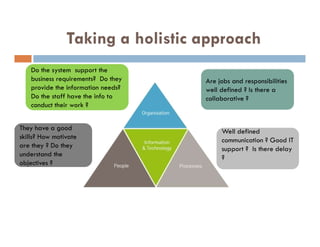
Taking a holistic approach
Are jobs and responsibilities
well defined ? Is there a
collaborative ?
Do the system support the
business requirements? Do they
provide the information needs?
Do the staff have the info to
conduct their work ?
Well defined
communication ? Good IT
support ? Is there delay
?
They have a good
skills? How motivate
are they ? Do they
understand the
objectives ?
Supporting business change
 The implementation of business change may require
extensive support from business analysts, including tasks
such as:
1. writing procedure manuals and user guides;
2. training business staff in the use of new processes
and IT systems;
3. defining job roles and writing job role descriptions;
4. providing ongoing support as the business staff
begin to adopt the new, unfamiliar approaches.
THE ROLE AND RESPONSIBILITIES OF
A BUSINESS ANALYST
 The core BUSINESS ANALYST ROLE define as:
the responsibility for investigating business situations, identifying and
evaluating options for improving business systems, defining
requirements and ensuring the effective use of information systems in
meeting the needs of the business.
1. investigate business systems
2. evaluate actions to improve the operation of a
business system
3. document the business requirements
4. Elaborate requirements.
THE ROLE AND RESPONSIBILITIES OF
A BUSINESS ANALYST
 The guiding principles for business analysis are:
1. Root causes, not symptoms
2. Business improvement, not IT change
3. Options, not solutions
4. Feasible, contributing requirements, not all requests
5. The entire business change lifecycle, not just
requirements definition
6. Negotiation, not avoidance
THE BUSINESS ANALYSIS MATURITY
MODEL
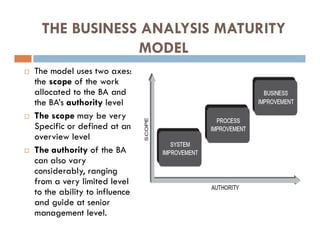
 The model uses two axes:
the scope of the work
allocated to the BA and
the BA’s authority level
 The scope may be very
Specific or defined at an
overview level
 The authority of the BA
can also vary
considerably, ranging
from a very limited level
to the ability to influence
and guide at senior
management level.
THE BUSINESS ANALYSIS MATURITY
MODEL
1. The first of these level is where the business analysis work is
concerned with defining the requirements for an IT system
improvement
2. The next level is where the business analysis work has moved
beyond a specific area or project, so that the analysts work
cross functionally on the business processes that give rise to
the requirements
3. The third level is where the scope and authority of the
analysts are at their greatest, working with senior
management to do this.
Professionalism And Business
Analysis
 Qualifications: that determine the standard of skills and abilities
of the individual professional
 Standards: techniques and documentation
 Continuing professional development: a requirement for the
continuing development of skills and knowledge
 Professional body: a body with responsibility for defining
technical standards and the code of conduct, promoting the
profession and carrying out disciplinary action where necessary. This
might require the removal of members where they do not reach the
standard required by the code of conduct.
Unit 1 Notes.pdf

Unit 1 Notes.pdf

  • 1.
    By Ajay Kumar (PhD.IIT(ISM)) Assistant Professor, GITAM School of Business- Hyd Introduction to Business Analysis
  • 2.
    References  Business analysis- Cadle James, Eva Malcom, Hindle Keith, Paul Debra, et al., BCS, The Chartered Institute for IT  Pendse Pradeep Hari (2015), Business Analysis : Solving Business Problems By Visualizing Effective Processes and It Solutions, New Delhi : Prentice Hall of India.  Paul Mulvey, Kate Mcgoey, Kupe Kupersmith (2013), Business Analysis for Dummies, New Delhi : Wiley India.
  • 3.
    Objectives  Know mainidea about Business analysis  Know who is the business analysts  Understand the basic roles of business analysts.
  • 4.
    WHAT IS BUSINESSANALYSIS?  A relatively new discipline that promises to offer great benefit to organizations by ensuring that business needs are aligned with implemented business change solutions.
  • 5.
    WHAT IS BUSINESSANALYSIS?  in the absence of a standard definition of business analysis and a standard business analysis process model, problems have arisen: 1. Organisations have introduced business analysis so as to make sure that business needs are paramount when new information technology (IT) systems are introduced. 2. Some business analysts were experienced IT systems analysts and have been less comfortable considering the business requirements. 3. Many business analysts come from a business background and have a limited understanding of IT 4. Some business analysit Have felt that they could offer beneficial advice to their organisations – but a lack of understanding of their role has caused organisations to reject or ignore this advice.
  • 6.
    WHAT IS BUSINESSANALYSIS?  Business analysis is the practice of enabling change in an enterprise by defining needs and recommending solutions that deliver value to stakeholders.  Business analysis enables an enterprise to articulate needs and the rationale for change , and to design and describe solutions that can deliver value.
  • 7.
    THE ORIGINS OFBUSINESS ANALYSIS  Developments in IT have enabled organisations to create information systems that have improved business operations and management decision-making  What can IT do to exploit business opportunities and enhance the portfolio of products and services?’  the technology enables the development of information systems, but these often fail to meet the requirements of the business and deliver the service that will bring competitive advantage to the organisation
  • 8.
    THE DEVELOPMENT OFBUSINESS ANALYSIS  The impact of outsourcing  Competitive advantage of using IT  Successful business change  The importance of the business analyst  The use of consultants
  • 9.
    THE DEVELOPMENT OFBUSINESS ANALYSIS  The impact of outsourcing  many organisations have outsourced their IT services rather than employ their own internal IT staff.  The communication and clarification of requirements is key to ensuring the success of any IT  The outsourcing business model has undoubtedly been a catalyst for the development of the business analysis function as more and more
  • 10.
    THE DEVELOPMENT OFBUSINESS ANALYSIS  Competitive advantage of using IT  A parallel development that has helped to increase the profile of business analysis and define the business analyst role  three factors need to be present IT systems to deliver competitive advantage the requirements for IT systems must be defined with rigour and accuracy the implementation of an IT system must be accompanied by the necessary business changes the needs of the business must drive the development of the IT systems
  • 11.
    THE DEVELOPMENT OFBUSINESS ANALYSIS  Successful business change Business Change Life Cycle 1-2 analysis of the organization and its business needs and requirements, in order to determine new ways of working that will improve the organization's efficiency and effectiveness 3 – change design and development 4-5 after implementation, acceptance testing benefits ,review and realization
  • 12.
    THE DEVELOPMENT OFBUSINESS ANALYSIS Successful business change  Clearly, extensive analysis is required throughout the life cycle if the change are to be successful to deliver the desire benefits.  The lack of clarity and alignment can result in development that fail to deliver business benefits and waste investment funds.
  • 13.
    THE DEVELOPMENT OFBUSINESS ANALYSIS  The importance of the business analyst  Who is a Business Analyst?  business analyst is any person who performs business analysis tasks, no matter their job title or organizational role.  Help Organizations to finding potential solutions to business issues and opportunities  delivering the business benefits predicted for business change
  • 14.
    THE DEVELOPMENT OFBUSINESS ANALYSIS  Business Analysts as Internal Consultants External Consultants Many organizations use external consultants to provide expert advice throughout the business change lifecycle, ‘as-needed criticized, because of the lack of accountability and the absence of any transfer of skills from the external consultants to internal staff Cost is also a key issue Business Analysts Many business analysts have argued that they can provide the same services as external consultants lower costs, ,include speed, retention of knowledge within the organization Business Analysts = internal consultants
  • 15.
    THE SCOPE OFBUSINESS ANALYSIS WORK  The range of analysis activities shows three areas that we might consider to be within the province of the business analyst.
  • 16.
    THE SCOPE OFBUSINESS ANALYSIS WORK  Strategic analysis and definition  is typically the work of senior management  Business analysts often have to define the tactics that will deliver the business objectives and strategy, typically the process and IT solutions.
  • 17.
    THE SCOPE OFBUSINESS ANALYSIS WORK  IT systems analysis  Systems analysts are responsible for analyzing and specifying the IT system requirements in sufficient detail to provide a basis for the evaluation of software packages or the development of a bespoke IT system.  what data the computer system will record, what processing will be applied to that data and how the user interface will operate.  in some organizations the term ‘IT business analyst’ or System analyst.
  • 19.
    THE SCOPE OFBUSINESS ANALYSIS WORK  Business analysis 1. It may be that the analysts are asked to resolve a localized business issue 2. investigation into several issues, or perhaps ideas, regarding increased efficiency or effectiveness 3. is asked to focus specifically on enhancing or replacing an existing IT system in line with business requirements 4. More senior business analysts may working cross- functionality. Require analysis of a work stream and activities.
  • 20.
    Realising business benefits defining the business case is only part of the picture; the delivery or ‘realisation’ of these business benefits once the solution has been delivered is also gaining increasing focus.  predicted business benefits have been delivered is a key element of the role.
  • 21.
    Taking a holisticapproach Are jobs and responsibilities well defined ? Is there a collaborative ? Do the system support the business requirements? Do they provide the information needs? Do the staff have the info to conduct their work ? Well defined communication ? Good IT support ? Is there delay ? They have a good skills? How motivate are they ? Do they understand the objectives ?
  • 22.
    Supporting business change The implementation of business change may require extensive support from business analysts, including tasks such as: 1. writing procedure manuals and user guides; 2. training business staff in the use of new processes and IT systems; 3. defining job roles and writing job role descriptions; 4. providing ongoing support as the business staff begin to adopt the new, unfamiliar approaches.
  • 23.
    THE ROLE ANDRESPONSIBILITIES OF A BUSINESS ANALYST  The core BUSINESS ANALYST ROLE define as: the responsibility for investigating business situations, identifying and evaluating options for improving business systems, defining requirements and ensuring the effective use of information systems in meeting the needs of the business. 1. investigate business systems 2. evaluate actions to improve the operation of a business system 3. document the business requirements 4. Elaborate requirements.
  • 24.
    THE ROLE ANDRESPONSIBILITIES OF A BUSINESS ANALYST  The guiding principles for business analysis are: 1. Root causes, not symptoms 2. Business improvement, not IT change 3. Options, not solutions 4. Feasible, contributing requirements, not all requests 5. The entire business change lifecycle, not just requirements definition 6. Negotiation, not avoidance
  • 25.
    THE BUSINESS ANALYSISMATURITY MODEL  The model uses two axes: the scope of the work allocated to the BA and the BA’s authority level  The scope may be very Specific or defined at an overview level  The authority of the BA can also vary considerably, ranging from a very limited level to the ability to influence and guide at senior management level.
  • 26.
    THE BUSINESS ANALYSISMATURITY MODEL 1. The first of these level is where the business analysis work is concerned with defining the requirements for an IT system improvement 2. The next level is where the business analysis work has moved beyond a specific area or project, so that the analysts work cross functionally on the business processes that give rise to the requirements 3. The third level is where the scope and authority of the analysts are at their greatest, working with senior management to do this.
  • 27.
    Professionalism And Business Analysis Qualifications: that determine the standard of skills and abilities of the individual professional  Standards: techniques and documentation  Continuing professional development: a requirement for the continuing development of skills and knowledge  Professional body: a body with responsibility for defining technical standards and the code of conduct, promoting the profession and carrying out disciplinary action where necessary. This might require the removal of members where they do not reach the standard required by the code of conduct.