
BUNGEE JUMPING
 Submitted to: Mrs Suman Kohli
INTRODUCTION
• Bungee jumping is an activity that involves jumping
  from a tall structure while connected to a large elastic
  cord. The tall structure is usually a fixed object, such as
  a building, bridge or crane; but it is also possible to
  jump from a movable object, such as a hot-air-
  balloon or helicopter, that has the ability
  to hover above the ground. The thrill comes from
  the free-falling and the rebound. When the person
  jumps, the cord stretches and the jumper flies upwards
  again as the cord recoils, and continues to oscillate up
  and down until all the energy is dissipated.
HISTORY
• The word "bungee" originates from West Country
  dialect of English language, meaning "Anything thick and squat",
  as defined by James Jennings in his book "Observations of Some
  of the Dialects in The West of England" published 1825. Around
  1930, the name became used for a rubber eraser. The word bungy,
  as used by A J Hackett, is "Kiwi slang for an Elastic Strap". Cloth-
  covered rubber cords with hooks on the ends have been available
  for decades under the generic name bungy cords.
• In the 1950s, David Attenborough and a BBC film crew brought
  back footage of the "land divers" of Pentecost Island in Vanuatu,
  young men who jumped from tall wooden platforms with vines
  tied to their ankles as a test of their courage and passage into
  manhood. A similar practice, only with a much slower pace for
  falling, has been practised as the Danza de los Voladores de
  Papantla or the 'Papantla flyers' of central Mexico, a tradition
  dating back to the days of the Aztecs.
EQUIPMENT
• The elastic rope first used in bungee jumping, and still
  used by many commercial operators, is factory-
  produced braided shock cord. This consists of
  many latex strands enclosed in a tough outer cover.
  The outer cover may be applied when the latex is pre-
  stressed, so that the cord's resistance to extension is
  already significant at the cord's natural length. This
  gives a harder, sharper bounce. The braided cover also
  provides significant durability benefits. Other
  operators, including A. J. Hackett and most southern-
  hemisphere operators, use unbraided cords with
  exposed latex strands. These give a softer, longer
  bounce and can be home-produced.
IN POPULAR CULTURES
• Several major movies have featured naked bungee jumps, most
  famously the opening sequence of the 1995 where Jordan Wellman
  performed the highest nude bungee jump ever recorded James
  Bond film GoldenEye in which Bond makes a jump over the edge of a
  dam in Russia (in reality the dam is in Switzerland: Verzasca Dam, and
  the jump was genuine, not an animated special effect). The jump in the
  dam later makes an appearance as a Roadblock task in the 14th
  season of the reality competition series The Amazing Race.
• It appears in the title of the South Korean film Bungee Jumping of Their
  Own , although it does not play a large part in the film.
• A fictional proto-bungee jump is a plot point in the Michael
  Chabon novel The Amazing Adventures of Kavalier and Clay.
• In the film Selena, in which Jennifer Lopez plays Selena Quintanilla-
  Perez, she is shown bungee jumping at a carnival. This actual event
  took place shortly before Selena's death in 1995.
VARIATIONS
• Catapult
• In "Catapult" (Reverse Bungee or Bungee Rocket) the 'jumper' starts on the
  ground. The jumper is secured and the cord stretched, then released and
  shooting the jumper up into the air. This is often achieved using either a
  crane or a hoist attached to a (semi-)perma structure. This simplifies the
  action of stretching the cord and later lowering the participant to the
  ground.
• Twin Tower
• "Twin Tower" is similar with two oblique cords. There are two towers, each
  with a cord leading the jumper. When the cords are stretched the jumper
  is released and shoots straight up.
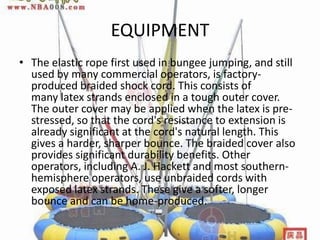
• Trampoline
• "Bungy Trampoline" uses, as its name suggests, elements from bungy and
  trampolining. The participant begins on a trampoline and is fitted into a
  body harness, which is attached via bungy cords to two high poles on
  either side of the trampoline. As they begin to jump, the bungy cords are
  tightened, allowing a higher jump than could normally be made from a
  trampoline alone.
• Running
• "Bungee Running" involves no jumping as such. It merely consists
  of, as the name suggests, running along a track (often inflatable)
  with a bungee cord attached. One often has a velcro-backed
  marker that marks how far the runner got before the bungee cord
  pulled back. This activity can often be found at fairs and carnivals
  and is often most popular with children.
• Ramp
• Bungee jumping off a ramp. Two rubber cords - the "bungees" - are
  tied around the participant's waist to a harness. Those bungee
  cords are linked to steel cables along which they can slide due to
  stainless pulleys. The participants bicycle, sled or ski before
  jumping.
• Suspended Catch Air Device
• SCAD diving is similar to bungee jumping in that participant is
  dropped from a height, but in this variation there is not a cord,
  instead the participant falls into a net.
SAFETY
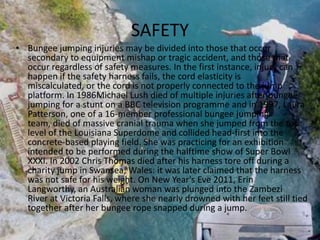
• Bungee jumping injuries may be divided into those that occur
  secondary to equipment mishap or tragic accident, and those that
  occur regardless of safety measures. In the first instance, injury can
  happen if the safety harness fails, the cord elasticity is
  miscalculated, or the cord is not properly connected to the jump
  platform. In 1986Michael Lush died of multiple injuries after bungee
  jumping for a stunt on a BBC television programme and in 1997, Laura
  Patterson, one of a 16-member professional bungee jumping
  team, died of massive cranial trauma when she jumped from the top
  level of the Louisiana Superdome and collided head-first into the
  concrete-based playing field. She was practicing for an exhibition
  intended to be performed during the halftime show of Super Bowl
  XXXI. In 2002 Chris Thomas died after his harness tore off during a
  charity jump in Swansea, Wales: it was later claimed that the harness
  was not safe for his weight. On New Year's Eve 2011, Erin
  Langworthy, an Australian woman was plunged into the Zambezi
  River at Victoria Falls, where she nearly drowned with her feet still tied
  together after her bungee rope snapped during a jump.
POSSIBLE INJURIES
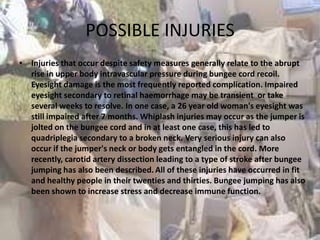
• Injuries that occur despite safety measures generally relate to the abrupt
  rise in upper body intravascular pressure during bungee cord recoil.
  Eyesight damage is the most frequently reported complication. Impaired
  eyesight secondary to retinal haemorrhage may be transient or take
  several weeks to resolve. In one case, a 26 year old woman's eyesight was
  still impaired after 7 months. Whiplash injuries may occur as the jumper is
  jolted on the bungee cord and in at least one case, this has led to
  quadriplegia secondary to a broken neck. Very serious injury can also
  occur if the jumper's neck or body gets entangled in the cord. More
  recently, carotid artery dissection leading to a type of stroke after bungee
  jumping has also been described. All of these injuries have occurred in fit
  and healthy people in their twenties and thirties. Bungee jumping has also
  been shown to increase stress and decrease immune function.
THE HIGHEST JUMP
•   In August 2005, AJ Hackett added a
    SkyJump to the Macau Tower, making it
    the world's highest jump at 233 metres
    (764 ft). The SkyJump did not qualify as
    the world's highest bungee as it is not
    strictly speaking a bungee jump, but
    instead what is referred to as a
    'Decelerator-Descent' jump, using a steel
    cable and decelerator system, rather than
    an elastic rope. On 17 December 2006,
    The Macau Tower started operating a
    proper bungee jump, which became the
    "Highest Commercial Bungee Jump In
    The World" according to the Guinness
    Book of Records. The Macau Tower
    Bungy has a "Guide cable" system that
    limits swing (the jump is very close to the
    structure of the tower itself) but does not
    have any effect on the speed of descent,
    so this still qualifies the jump for the
    World Record.
Made by : Samyak Jain-04
Class: VIIID

Bungee jumping

  • 1.
    BUNGEE JUMPING Submittedto: Mrs Suman Kohli
  • 2.
    INTRODUCTION • Bungee jumpingis an activity that involves jumping from a tall structure while connected to a large elastic cord. The tall structure is usually a fixed object, such as a building, bridge or crane; but it is also possible to jump from a movable object, such as a hot-air- balloon or helicopter, that has the ability to hover above the ground. The thrill comes from the free-falling and the rebound. When the person jumps, the cord stretches and the jumper flies upwards again as the cord recoils, and continues to oscillate up and down until all the energy is dissipated.
  • 3.
    HISTORY • The word"bungee" originates from West Country dialect of English language, meaning "Anything thick and squat", as defined by James Jennings in his book "Observations of Some of the Dialects in The West of England" published 1825. Around 1930, the name became used for a rubber eraser. The word bungy, as used by A J Hackett, is "Kiwi slang for an Elastic Strap". Cloth- covered rubber cords with hooks on the ends have been available for decades under the generic name bungy cords. • In the 1950s, David Attenborough and a BBC film crew brought back footage of the "land divers" of Pentecost Island in Vanuatu, young men who jumped from tall wooden platforms with vines tied to their ankles as a test of their courage and passage into manhood. A similar practice, only with a much slower pace for falling, has been practised as the Danza de los Voladores de Papantla or the 'Papantla flyers' of central Mexico, a tradition dating back to the days of the Aztecs.
  • 4.
    EQUIPMENT • The elasticrope first used in bungee jumping, and still used by many commercial operators, is factory- produced braided shock cord. This consists of many latex strands enclosed in a tough outer cover. The outer cover may be applied when the latex is pre- stressed, so that the cord's resistance to extension is already significant at the cord's natural length. This gives a harder, sharper bounce. The braided cover also provides significant durability benefits. Other operators, including A. J. Hackett and most southern- hemisphere operators, use unbraided cords with exposed latex strands. These give a softer, longer bounce and can be home-produced.
  • 5.
    IN POPULAR CULTURES •Several major movies have featured naked bungee jumps, most famously the opening sequence of the 1995 where Jordan Wellman performed the highest nude bungee jump ever recorded James Bond film GoldenEye in which Bond makes a jump over the edge of a dam in Russia (in reality the dam is in Switzerland: Verzasca Dam, and the jump was genuine, not an animated special effect). The jump in the dam later makes an appearance as a Roadblock task in the 14th season of the reality competition series The Amazing Race. • It appears in the title of the South Korean film Bungee Jumping of Their Own , although it does not play a large part in the film. • A fictional proto-bungee jump is a plot point in the Michael Chabon novel The Amazing Adventures of Kavalier and Clay. • In the film Selena, in which Jennifer Lopez plays Selena Quintanilla- Perez, she is shown bungee jumping at a carnival. This actual event took place shortly before Selena's death in 1995.
  • 6.
    VARIATIONS • Catapult • In"Catapult" (Reverse Bungee or Bungee Rocket) the 'jumper' starts on the ground. The jumper is secured and the cord stretched, then released and shooting the jumper up into the air. This is often achieved using either a crane or a hoist attached to a (semi-)perma structure. This simplifies the action of stretching the cord and later lowering the participant to the ground. • Twin Tower • "Twin Tower" is similar with two oblique cords. There are two towers, each with a cord leading the jumper. When the cords are stretched the jumper is released and shoots straight up. • Trampoline • "Bungy Trampoline" uses, as its name suggests, elements from bungy and trampolining. The participant begins on a trampoline and is fitted into a body harness, which is attached via bungy cords to two high poles on either side of the trampoline. As they begin to jump, the bungy cords are tightened, allowing a higher jump than could normally be made from a trampoline alone.
  • 7.
    • Running • "BungeeRunning" involves no jumping as such. It merely consists of, as the name suggests, running along a track (often inflatable) with a bungee cord attached. One often has a velcro-backed marker that marks how far the runner got before the bungee cord pulled back. This activity can often be found at fairs and carnivals and is often most popular with children. • Ramp • Bungee jumping off a ramp. Two rubber cords - the "bungees" - are tied around the participant's waist to a harness. Those bungee cords are linked to steel cables along which they can slide due to stainless pulleys. The participants bicycle, sled or ski before jumping. • Suspended Catch Air Device • SCAD diving is similar to bungee jumping in that participant is dropped from a height, but in this variation there is not a cord, instead the participant falls into a net.
  • 8.
    SAFETY • Bungee jumpinginjuries may be divided into those that occur secondary to equipment mishap or tragic accident, and those that occur regardless of safety measures. In the first instance, injury can happen if the safety harness fails, the cord elasticity is miscalculated, or the cord is not properly connected to the jump platform. In 1986Michael Lush died of multiple injuries after bungee jumping for a stunt on a BBC television programme and in 1997, Laura Patterson, one of a 16-member professional bungee jumping team, died of massive cranial trauma when she jumped from the top level of the Louisiana Superdome and collided head-first into the concrete-based playing field. She was practicing for an exhibition intended to be performed during the halftime show of Super Bowl XXXI. In 2002 Chris Thomas died after his harness tore off during a charity jump in Swansea, Wales: it was later claimed that the harness was not safe for his weight. On New Year's Eve 2011, Erin Langworthy, an Australian woman was plunged into the Zambezi River at Victoria Falls, where she nearly drowned with her feet still tied together after her bungee rope snapped during a jump.
  • 9.
    POSSIBLE INJURIES • Injuriesthat occur despite safety measures generally relate to the abrupt rise in upper body intravascular pressure during bungee cord recoil. Eyesight damage is the most frequently reported complication. Impaired eyesight secondary to retinal haemorrhage may be transient or take several weeks to resolve. In one case, a 26 year old woman's eyesight was still impaired after 7 months. Whiplash injuries may occur as the jumper is jolted on the bungee cord and in at least one case, this has led to quadriplegia secondary to a broken neck. Very serious injury can also occur if the jumper's neck or body gets entangled in the cord. More recently, carotid artery dissection leading to a type of stroke after bungee jumping has also been described. All of these injuries have occurred in fit and healthy people in their twenties and thirties. Bungee jumping has also been shown to increase stress and decrease immune function.
  • 10.
    THE HIGHEST JUMP • In August 2005, AJ Hackett added a SkyJump to the Macau Tower, making it the world's highest jump at 233 metres (764 ft). The SkyJump did not qualify as the world's highest bungee as it is not strictly speaking a bungee jump, but instead what is referred to as a 'Decelerator-Descent' jump, using a steel cable and decelerator system, rather than an elastic rope. On 17 December 2006, The Macau Tower started operating a proper bungee jump, which became the "Highest Commercial Bungee Jump In The World" according to the Guinness Book of Records. The Macau Tower Bungy has a "Guide cable" system that limits swing (the jump is very close to the structure of the tower itself) but does not have any effect on the speed of descent, so this still qualifies the jump for the World Record.
  • 11.
    Made by :Samyak Jain-04 Class: VIIID