What is Bullying?
1. Bullying is intentional aggressive behavior. It can take the form of physical or
verbal harassment and involves an imbalance of power (a group of children
can gang up on a victim or someone who is physically bigger or more
aggressive can intimidate someone else, for instance).
2. Bullying behavior can include teasing, insulting someone (particularly about
their weight or height, race, sexuality, religion or other personal traits),
shoving, hitting, excluding someone, or gossiping about someone.
3. Bullying can cause a victim to feel upset, afraid, ashamed, embarrassed, and
anxious about going to school. It can involve children of any age, including
younger elementary grade-schoolers and even kindergarteners.
The End of Bullying Begins with Me
http://www.brainpop.com/socialstudies/culture/bullying/preview.weml
http://www.pacerkidsagainstbullying.org/#/share/videos
What is Cyberbullying?
• Cyberbullying is just what it sounds like - bullying through
Internet pplications and technologies such as instant
messaging (IM), social networking sites, and cell phones.
• It can start easily—with a rumor, a photo, or a forwarded
message—and just as easily spiral out of control.
• An embarrassing video posted to a social 
networking site by
someone in Kansas tonight may be watched by someone in
Japan tomorrow.
• Cyberbullying victims may be targeted anywhere, at any time.
http://stopcyberbullying.org/
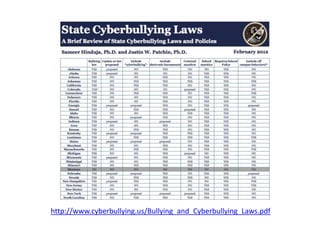
http://www.cyberbullying.us/Bullying_and_Cyberbullying_Laws.pdf
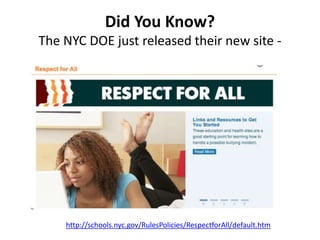
Did You Know?
The NYC DOE just released their new site -
http://schools.nyc.gov/RulesPolicies/RespectforAll/default.htm
http://schools.nyc.gov/NR/rdonlyres/188AF3E2-F12B-4754-8471-F2EFB344AE2B/0/DiscCodebooklet2013final.pdf
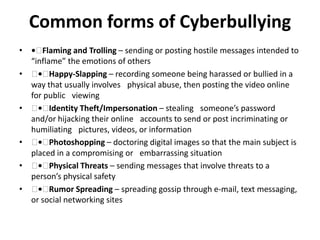
Common forms of Cyberbullying
• • Flaming and Trolling – sending or posting hostile messages intended to
“inflame” the emotions of others
•  • Happy-Slapping – recording someone being harassed or bullied in a
way that usually involves 
physical abuse, then posting the video online
for public 
viewing
•  • Identity Theft/Impersonation – stealing 
someone’s password
and/or hijacking their online 
accounts to send or post incriminating or
humiliating 
pictures, videos, or information
•  • Photoshopping – doctoring digital images so that the main subject is
placed in a compromising or 
embarrassing situation
•  • Physical Threats – sending messages that involve threats to a
person’s physical safety
•  • Rumor Spreading – spreading gossip through e-mail, text messaging,
or social networking sites
http://stopcyberbullying.org/kids/index.html
http://www.brainpop.com/technology/computersandinternet/cyberbullying/preview.weml
http://www.pacer.org/bullying/nbpm/
http://pbskids.org/itsmylife/index.html
The UFT launched its anti-bullying
hotline, 212-709-3222
http://www.uft.org/our-rights/brave
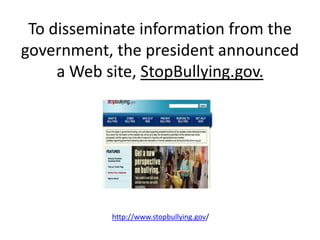
To disseminate information from the
government, the president announced
a Web site, StopBullying.gov.
http://www.stopbullying.gov/
Examples of Anti-Bullying PSA's
http://www.youtube.com/watch?v=nWJut7KQhI4
http://www.youtube.com/watch?v=wY7Gvq0P4hc
The Price of Silence
Discussion Questions
• Why do you think people cyberbully?
•  • How does your school deal with cyberbullying?
•  • Have you ever sent a mean message because you

were upset?
•  • What would you do if someone created a mean,
fake 
profile for you or one of your friends?
•  • How can you stop yourself from being
cyberbullied?
•  • Who would you talk to if it happened to you?
Tips for Handling Cyberbulling
• Do not respond to rude e-mails, messages, and comments.
•  • Save the evidence, such as e-mail and text messages, and 
take screenshots
of comments and images. Also, take note of the 
date and time when the
harassment occurs.
•  • Contact your Internet service provider (ISP) or cell phone 
provider. Ask the
website administrator or ISP to remove any 
Web page that was created to hurt.
•  • If harassment is via e-mail, social networking sites, IM, and chat rooms,
“block” bullies or delete your current account and open a new one.
•  • If harrassment is via text and phone messages, change 
the phone number
and then only share the new number with 
trustworthy people. Also, check out
phone features that may 
allow the number to be blocked.
•  • Get the school involved. Learn the school’s policy on 
cyberbullying. Here is
the NYCDOE policy
•  • Make a report to www.cybertipline.com, and if you feel something illegal has
occurred, inform law enforcement.
Bullying

Bullying

  • 1.
    What is Bullying? 1.Bullying is intentional aggressive behavior. It can take the form of physical or verbal harassment and involves an imbalance of power (a group of children can gang up on a victim or someone who is physically bigger or more aggressive can intimidate someone else, for instance). 2. Bullying behavior can include teasing, insulting someone (particularly about their weight or height, race, sexuality, religion or other personal traits), shoving, hitting, excluding someone, or gossiping about someone. 3. Bullying can cause a victim to feel upset, afraid, ashamed, embarrassed, and anxious about going to school. It can involve children of any age, including younger elementary grade-schoolers and even kindergarteners.
  • 2.
    The End ofBullying Begins with Me
  • 4.
  • 5.
  • 6.
    What is Cyberbullying? •Cyberbullying is just what it sounds like - bullying through Internet pplications and technologies such as instant messaging (IM), social networking sites, and cell phones. • It can start easily—with a rumor, a photo, or a forwarded message—and just as easily spiral out of control. • An embarrassing video posted to a social 
networking site by someone in Kansas tonight may be watched by someone in Japan tomorrow. • Cyberbullying victims may be targeted anywhere, at any time. http://stopcyberbullying.org/
  • 7.
  • 8.
    Did You Know? TheNYC DOE just released their new site - http://schools.nyc.gov/RulesPolicies/RespectforAll/default.htm
  • 9.
  • 10.
    Common forms ofCyberbullying • • Flaming and Trolling – sending or posting hostile messages intended to “inflame” the emotions of others •  • Happy-Slapping – recording someone being harassed or bullied in a way that usually involves 
physical abuse, then posting the video online for public 
viewing •  • Identity Theft/Impersonation – stealing 
someone’s password and/or hijacking their online 
accounts to send or post incriminating or humiliating 
pictures, videos, or information •  • Photoshopping – doctoring digital images so that the main subject is placed in a compromising or 
embarrassing situation •  • Physical Threats – sending messages that involve threats to a person’s physical safety •  • Rumor Spreading – spreading gossip through e-mail, text messaging, or social networking sites
  • 11.
  • 12.
  • 13.
  • 14.
  • 15.
    The UFT launchedits anti-bullying hotline, 212-709-3222 http://www.uft.org/our-rights/brave
  • 16.
    To disseminate informationfrom the government, the president announced a Web site, StopBullying.gov. http://www.stopbullying.gov/
  • 17.
    Examples of Anti-BullyingPSA's http://www.youtube.com/watch?v=nWJut7KQhI4
  • 18.
  • 19.
    Discussion Questions • Whydo you think people cyberbully? •  • How does your school deal with cyberbullying? •  • Have you ever sent a mean message because you 
were upset? •  • What would you do if someone created a mean, fake 
profile for you or one of your friends? •  • How can you stop yourself from being cyberbullied? •  • Who would you talk to if it happened to you?
  • 20.
    Tips for HandlingCyberbulling • Do not respond to rude e-mails, messages, and comments. •  • Save the evidence, such as e-mail and text messages, and 
take screenshots of comments and images. Also, take note of the 
date and time when the harassment occurs. •  • Contact your Internet service provider (ISP) or cell phone 
provider. Ask the website administrator or ISP to remove any 
Web page that was created to hurt. •  • If harassment is via e-mail, social networking sites, IM, and chat rooms, “block” bullies or delete your current account and open a new one. •  • If harrassment is via text and phone messages, change 
the phone number and then only share the new number with 
trustworthy people. Also, check out phone features that may 
allow the number to be blocked. •  • Get the school involved. Learn the school’s policy on 
cyberbullying. Here is the NYCDOE policy •  • Make a report to www.cybertipline.com, and if you feel something illegal has occurred, inform law enforcement.