Cyberbullying Detective Sergeant Brent Maguire Fairfield Police Department
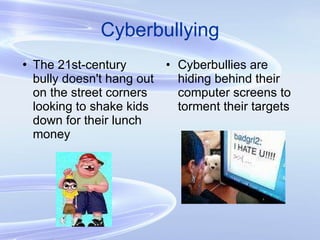
Cyberbullying The 21st-century bully doesn't hang out on the street corners looking to shake kids down for their lunch money Cyberbullies are hiding behind their computer screens to torment their targets
How is Cyberbullying Different from Traditional Bullying? Victims often don’t know who the bully is or why they are targeted Viral – large number of people can find out about it very quickly Can be done from a distance and the bully doesn’t have to see the person’s response (impersonal) Many adults don’t have technical skills to monitor or respond This has caused adults to be slow to respond which, in turn, gives the cyberbullying the belief that there are little to no consequences
What is Cyberbullying? Cyberbullying is the use of e-mail, instant messaging, chat rooms, pagers, cell phones, or other forms of information technology to deliberately harass, threaten, or intimidate someone The problem is compounded by the fact that a bully can hide behind an electronic veil, disguising his or her true identity This makes it difficult to trace the source, and encourages bullies to behave more aggressively than they might face-to-face
What is Cyberbullying? Cyberbullying can include such acts as making threats, sending provocative insults or racial or ethnic slurs, gay bashing, attempting to infect the victim's computer with a virus, and flooding an e-mail inbox with nonsense messages
 
Types of Cyberbullying According to Nancy Willard, author of Cyber-Safe Kids and Cyber-Savvy Teens, there are seven forms of cyberbullying Flaming Harassment Denigration Impersonation Outing and Trickery Exclusion Cyberstalking
Types of Cyberbullying Flaming Online “fights” using electronic messages with angry and vulgar language Harassment Repeatedly sending offensive, rude and insulting messages
 
Types of Cyberbullying Denigration “ Dissing” someone online.  Sending or posting cruel gossip or rumors about a person to damage his/her reputation or friendships Impersonation Breaking into someone’s account, posing as that person and sending messages to make the person look bad, get that person in trouble or danger, or damage that person’s reputation or friendships
 
Types of Cyberbullying Outing and Trickery Sharing someone’s secrets or embarrassing information or images online Tricking someone into revealing secrets or embarrassing information, which is then shared online Exclusion Intentionally excluding someone from an online group, such as a “buddy list”
Types of Cyberbullying Cyberstalking Repeatedly sending messages that include threats of harm or are highly intimidating Engaging in other online activities that make a person afraid for his/her safety
Who is the Cyberbully? According to  www.stopcyberbullying.org , there are generally five types of people who cyberbully: Power Hungry Retaliating Victim Mean Girl Vengeful Angel Inadvertent Cyberbully
Who is the Cyberbully? 1. Power Hungry Seeks attention from peers Maintains control by intimidating victim
Who is the Cyberbully? 2. Retaliating Victim Was cyberbullied or bullied in past Seeks revenge on bullies May be less popular, but usually has above-average  computer skills
Who is the Cyberbully? 3. Mean Girl Bullies for entertainment value and to alleviate  boredom (i.e. @ slumber party) Aims to increase her own popularity by putting others down
Who is the Cyberbully? 4. Vengeful Angel Seeks revenge on behalf of those who have been bullied Aims to protect friends Doesn’t see themselves as a cyberbully
Who is the Cyberbully? 5. Inadvertent Cyberbully Uses internet carelessly, without considering potential  impact on others Does not intentionally hurt others
Why are some teens making not-so-good choices? Brain Development Teens are in process of developing frontal lobes that allow for reasoned and ethical decision-making Learning to make reasoned and ethical decisions requires attention to the connection between actions and consequences
Why are some teens making not-so-good choices? Disinhibition Use of technologies interferes with recognition of connection between action and consequences Perception of invisibility, creation of anonymity removes concerns of detection and resulting disapproval or punishment Lack of intangible feedback of impact of online actions interferes with recognition of harm caused and resulting empathy and remorse
Why are some teens making not-so-good choices? Exploration of Identity Social networking profile becomes vehicle to present emerging self-image, which includes sexuality Teens are using social networking as vehicle to establish their “place” within their social community
Why are some teens making not-so-good choices? Online Social Norms “ Everybody does it” “ What happens online, stays online” “ Life online is just a game”
Cyberbullying Insight Material, text or images, may be posted on personal web pages, blogs, transmitted via email, discussion groups. message boards, chat, IM, or cell phones A significant amount occurs off-campus but impacts students on-campus Students could be using school’s internet system or personal cell phones to engage in cyberbullying
Cyberbullying Insight According to 2006 survey conducted by Fight Crime, a non-profit organization: 1/3 of teens ages 12 – 17 1/6 of all children ages 6 -11 Had mean, threatening or embarrassing things said  about them online 2. 45% of children and 30% of teens said cyberbullying occurred at school
Relation to School Bullying Continuation of in-school bullying Retaliation for in-school bullying DO NOT immediately assume that the student posting the harmful material is the originator of the problem
Boys vs. Girls Girls tend to be more actively involved in online communications, which is the venue for cyberbullying Boys tend to be interested in gaming, violence against fictional characters
Personal Relationships Harassment in the context of “flirting” Relationship break-ups Online fights about relationships
Recognition School officials must recognize that what initially appears to be an online threat could be any of the following: A joke, parody, or game A rumor that got started and has grown and spread Material posted by someone impersonating another person for the purpose of getting that person in trouble Distressing material posted by a depressed or angry youth that could foretell a violent or suicidal intention, but does not represent an imminent threat A legitimate imminent threat
Recognition The problem is that when school officials or law enforcement are first appraised of an online threat, it may difficult to tell which of the previously mentioned might be involved Highest priority is doing what is necessary to protect against a possible legitimate threat
Recognition Students must understand the following: Don’t make threats online  – adults may not be able to tell whether the threat is real.  They must understand that they could be suspended, expelled or even arrested. Report threats or distressing material  – if they see a threat or distressing material, it could be very real.  It is extremely important to report this to an adult as someone could be seriously injured.
Impact Online communications can be extremely vicious No escape – victimization is ongoing, 24/7 Material can be distributed worldwide and is often irretrievable Cyberbullies can be anonymous and can solicity the involvement of unknown “friends” Teens may be reluctant to tell adults because they are emotionally traumatized, thing it is their fault, fear greater retribution or fear online activities or cell phone use will be restricted
Targeting Staff Staff person is targeted because of some perceived status issue, such as sexual orientation or obesity Obnoxious attention-seeking student Legitimate objections to the actions or policies of the school or staff Student feels that he/she has been bullied/mistreated by teacher
Monitoring Internet Use at School Users should have a limited expectation of privacy on the school’s internet system Routine maintenance and monitoring (technical and by staff) may lead to discovery that user has violated school policy or law Clear notice to students that internet use is monitored can enhance deterrence
Tips for Teachers Discuss online behavior with your students – if you wouldn’t say something in person, don’t say it online Encourage students to report cyberbullying Teach students to think before they post and not to let their emotions get the best of them Warn students of the danger of responding when angry or upset
 
Tips for Teachers Keep anonymous comment box in classroom where students can report incidents of cyberbullying Have a classroom policy that addresses inappropriate computer and cell phone use Post class rules regarding acceptable internet behavior If you already have a school policy regarding this, enforce it! Students need to know that all forms of bullying are wrong and that those who engage in harassing or threatening behavior will be subject to discipline
Warning Signs - Victim Unexpectedly stops using computer or cell phone Nervous or jumpy when IM or email appears Uneasy about going to school or doesn’t want to go to school Appears to be angry, depressed or frustrated after using computer or cell phone Avoids discussions about what they are doing on computer or cell phone Becomes abnormally withdrawn; loss of friends
Warning Signs - Bully Quickly switches screens or closes programs Gets unusually upset if computer or phone privileges are restricted (That’s every teen isn’t it! LOL) Avoids discussions about what they are doing on computer or cell phone Appears to be using multiple accounts or ones not their own
Responding to Cyberbullying Save evidence – emails, IM, blogs, web pages (print out all instances + don’t delete any messages received) Try to identify cyberbully, if possible Ignore – block or delete them Calmly and strongly tell them to stop Stop or remove material – contact ISP, website, etc. Contact parents of cyberbully Contact school Contact police
Responding to Cyberbullying Encourage students to contact a trusted adult if: They are really upset and not sure what to do Attempts to stop cyberbullying on their own have not worked It could be a crime It is occurring through the internet at school Cyberbully is anonymous Cyberbully is bullying other teens who may be more vulnerable and too afraid to get help
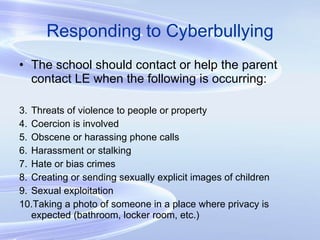
Responding to Cyberbullying The school should contact or help the parent contact LE when the following is occurring: Threats of violence to people or property Coercion is involved Obscene or harassing phone calls Harassment or stalking Hate or bias crimes Creating or sending sexually explicit images of children Sexual exploitation Taking a photo of someone in a place where privacy is expected (bathroom, locker room, etc.)
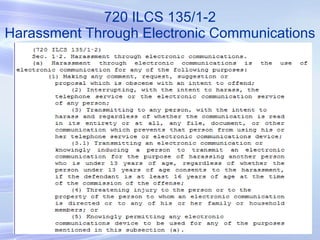
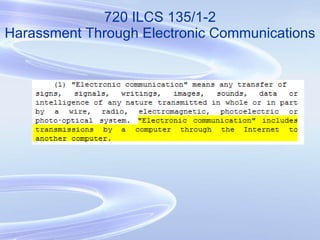
720 ILCS 135/1-2 Harassment Through Electronic Communications
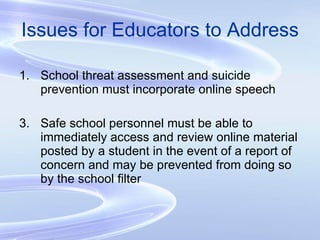
Issues for Educators to Address School threat assessment and suicide prevention must incorporate online speech Safe school personnel must be able to immediately access and review online material posted by a student in the event of a report of concern and may be prevented from doing so by the school filter
Issues for Educators to Address 3. School officials should realize that in most cases harmful or dangerous speech posted in these sites or an underage registration is a violation of the Use Agreement. These concerns will be addressed upon the filing of a complaint. Sites will also work with law enforcement to identity anonymous users and preserve material.
Issues for Educators to Address Relying solely on school’s internet filtering services to block access to these sites will likely not prevent student involvement on these sites from the school campus.  Better monitoring is necessary.
Issues for Educators to Address Off-campus activities of students can have a damaging impact on the well-being of students and the school climate and could lead to school violence. Students and parents should be encouraged to report online concerns. A process must be in place to effectively respond to reports.
Issues for Educators to Address 6. Educating staff, students and parent about safe and responsible internet use is of critical importance.
School’s Approach to Cyberbullying “ Research-guided” Based on best practices in bullying, violence and suicide prevention programs Traditional threat assessment processes Insight into online behavior of youth Legal analysis Comprehensive approach to manage internet use in school and at home
School’s Approach to Cyberbullying Comprehensive Planning Safe schools committee Policies, overall district internet use management, needs assessment, professional development, electronic communications to support school level personnel, online reporting system, evaluation, funding Communication of policies to students, ensuring effective internet use practices and monitoring, establishment of reporting and intervention process, professional development, student education, parent education, evaluation
School’s Approach to Cyberbullying Needs Assessment Student survey  On-campus or off-campus instances Relationship to on-campus actions Impacts Reporting concerns Attitudes, risk factors, and protective factors
School’s Approach to Cyberbullying Needs Assessment (cont.) Administrative Survey Extent of perceived problems Issues around current school policies Internet use management issues Reporting and response
School’s Approach to Cyberbullying Policy and Practice Review Expand bullying/threat report to process to incorporate cyberbullying and cyberthreats Should be anonymous and/or confidential Establish online reporting form or email report Make sure students know to provide downloaded material and/or the URL where the harmful material has been found
School’s Approach to Cyberbullying Policy and Practice Review (cont.) Review policies and practices addressing cell phones and personal digital devices Review policies and practices address internet use Establish cyberbully/cyberthreat situation review and intervention plan Overall threat assessment process and suicide prevention planning should also address internet communications
School’s Approach to Cyberbullying Professional Development Key person in district needs high level of training Safe schools planning committee members and all “first responders” need insight into problem and ways to detect, review, and intervene, with back-up from key person All other staff need general awareness
School’s Approach to Cyberbullying Parent Outreach Provide information on how to: Prevent, detect and intervene if their child is a victim Prevent their child from being a cyberbully Possible consequences if a child is a cyberbully
School’s Approach to Cyberbullying Parent Outreach (cont.) Provide information to parents through: General information through newsletters Parent workshops “ Just-in-time” comprehensive resources in office and online because parents likely will not pay attention until they need information
School’s Approach to Cyberbullying Community Outreach Provide information and training to others, such as mental health and law enforcement professionals Provide an additional avenue for communication to parents and students by involving community and youth organizations Involve the media
School’s Approach to Cyberbullying Student Education Prerequisite to addressing cyberbullying is effective social skills education Students must understand internet safety and responsible use issues and know how to prevent, detect, and respond to problems
School’s Approach to Cyberbullying Evaluation and Assessment Must be in continuous improvement approach Technologies are always changing Must constantly evaluate and modify the approach based on new insight and results of local efforts
Internet Use Management Concerns Legalistic internet use policy Filtering software Fear-based, simplistic education
Internet Use Management Problems Policies are not generally read – or understood Filtering software can be easily bypassed (Google: bypass, internet, filter) Younger students need better protection
Internet Use Management Education Purpose Internet use in schools should be for educational purposes only Increased professional and curriculum development is essential
Internet Use Management Internet Use Policies Tied to disciplinary code Clearly communicated to staff and students Foundation for student education
Internet Use Management Internet Use Practices Provide access to previewed educational research resources sites Allow access outside of educational sites for specific projects Establish controlled communications environment Specifically provide access to reviewed sites for sensitive health and well-being information
Internet Use Management Effective Monitoring Must shift from “blocking” approach to effective “monitoring” Monitoring must be sufficient to detect most instances of misuse Supervision of students by teachers is essential Technology-facilitated monitoring strongly advised
Resources www.commonsense.com www.cyberbully.org www.isafe.org www.wiredsafety.org www.stoptextbully.com www.haltabuse.org

Cyberbullying for Teachers

  • 1.
    Cyberbullying Detective SergeantBrent Maguire Fairfield Police Department
  • 2.
    Cyberbullying The 21st-centurybully doesn't hang out on the street corners looking to shake kids down for their lunch money Cyberbullies are hiding behind their computer screens to torment their targets
  • 3.
    How is CyberbullyingDifferent from Traditional Bullying? Victims often don’t know who the bully is or why they are targeted Viral – large number of people can find out about it very quickly Can be done from a distance and the bully doesn’t have to see the person’s response (impersonal) Many adults don’t have technical skills to monitor or respond This has caused adults to be slow to respond which, in turn, gives the cyberbullying the belief that there are little to no consequences
  • 4.
    What is Cyberbullying?Cyberbullying is the use of e-mail, instant messaging, chat rooms, pagers, cell phones, or other forms of information technology to deliberately harass, threaten, or intimidate someone The problem is compounded by the fact that a bully can hide behind an electronic veil, disguising his or her true identity This makes it difficult to trace the source, and encourages bullies to behave more aggressively than they might face-to-face
  • 5.
    What is Cyberbullying?Cyberbullying can include such acts as making threats, sending provocative insults or racial or ethnic slurs, gay bashing, attempting to infect the victim's computer with a virus, and flooding an e-mail inbox with nonsense messages
  • 6.
  • 7.
    Types of CyberbullyingAccording to Nancy Willard, author of Cyber-Safe Kids and Cyber-Savvy Teens, there are seven forms of cyberbullying Flaming Harassment Denigration Impersonation Outing and Trickery Exclusion Cyberstalking
  • 8.
    Types of CyberbullyingFlaming Online “fights” using electronic messages with angry and vulgar language Harassment Repeatedly sending offensive, rude and insulting messages
  • 9.
  • 10.
    Types of CyberbullyingDenigration “ Dissing” someone online. Sending or posting cruel gossip or rumors about a person to damage his/her reputation or friendships Impersonation Breaking into someone’s account, posing as that person and sending messages to make the person look bad, get that person in trouble or danger, or damage that person’s reputation or friendships
  • 11.
  • 12.
    Types of CyberbullyingOuting and Trickery Sharing someone’s secrets or embarrassing information or images online Tricking someone into revealing secrets or embarrassing information, which is then shared online Exclusion Intentionally excluding someone from an online group, such as a “buddy list”
  • 13.
    Types of CyberbullyingCyberstalking Repeatedly sending messages that include threats of harm or are highly intimidating Engaging in other online activities that make a person afraid for his/her safety
  • 14.
    Who is theCyberbully? According to www.stopcyberbullying.org , there are generally five types of people who cyberbully: Power Hungry Retaliating Victim Mean Girl Vengeful Angel Inadvertent Cyberbully
  • 15.
    Who is theCyberbully? 1. Power Hungry Seeks attention from peers Maintains control by intimidating victim
  • 16.
    Who is theCyberbully? 2. Retaliating Victim Was cyberbullied or bullied in past Seeks revenge on bullies May be less popular, but usually has above-average computer skills
  • 17.
    Who is theCyberbully? 3. Mean Girl Bullies for entertainment value and to alleviate boredom (i.e. @ slumber party) Aims to increase her own popularity by putting others down
  • 18.
    Who is theCyberbully? 4. Vengeful Angel Seeks revenge on behalf of those who have been bullied Aims to protect friends Doesn’t see themselves as a cyberbully
  • 19.
    Who is theCyberbully? 5. Inadvertent Cyberbully Uses internet carelessly, without considering potential impact on others Does not intentionally hurt others
  • 20.
    Why are someteens making not-so-good choices? Brain Development Teens are in process of developing frontal lobes that allow for reasoned and ethical decision-making Learning to make reasoned and ethical decisions requires attention to the connection between actions and consequences
  • 21.
    Why are someteens making not-so-good choices? Disinhibition Use of technologies interferes with recognition of connection between action and consequences Perception of invisibility, creation of anonymity removes concerns of detection and resulting disapproval or punishment Lack of intangible feedback of impact of online actions interferes with recognition of harm caused and resulting empathy and remorse
  • 22.
    Why are someteens making not-so-good choices? Exploration of Identity Social networking profile becomes vehicle to present emerging self-image, which includes sexuality Teens are using social networking as vehicle to establish their “place” within their social community

  • 23.
    Why are someteens making not-so-good choices? Online Social Norms “ Everybody does it” “ What happens online, stays online” “ Life online is just a game”
  • 24.
    Cyberbullying Insight Material,text or images, may be posted on personal web pages, blogs, transmitted via email, discussion groups. message boards, chat, IM, or cell phones A significant amount occurs off-campus but impacts students on-campus Students could be using school’s internet system or personal cell phones to engage in cyberbullying
  • 25.
    Cyberbullying Insight Accordingto 2006 survey conducted by Fight Crime, a non-profit organization: 1/3 of teens ages 12 – 17 1/6 of all children ages 6 -11 Had mean, threatening or embarrassing things said about them online 2. 45% of children and 30% of teens said cyberbullying occurred at school
  • 26.
    Relation to SchoolBullying Continuation of in-school bullying Retaliation for in-school bullying DO NOT immediately assume that the student posting the harmful material is the originator of the problem
  • 27.
    Boys vs. GirlsGirls tend to be more actively involved in online communications, which is the venue for cyberbullying Boys tend to be interested in gaming, violence against fictional characters
  • 28.
    Personal Relationships Harassmentin the context of “flirting” Relationship break-ups Online fights about relationships
  • 29.
    Recognition School officialsmust recognize that what initially appears to be an online threat could be any of the following: A joke, parody, or game A rumor that got started and has grown and spread Material posted by someone impersonating another person for the purpose of getting that person in trouble Distressing material posted by a depressed or angry youth that could foretell a violent or suicidal intention, but does not represent an imminent threat A legitimate imminent threat
  • 30.
    Recognition The problemis that when school officials or law enforcement are first appraised of an online threat, it may difficult to tell which of the previously mentioned might be involved Highest priority is doing what is necessary to protect against a possible legitimate threat
  • 31.
    Recognition Students mustunderstand the following: Don’t make threats online – adults may not be able to tell whether the threat is real. They must understand that they could be suspended, expelled or even arrested. Report threats or distressing material – if they see a threat or distressing material, it could be very real. It is extremely important to report this to an adult as someone could be seriously injured.
  • 32.
    Impact Online communicationscan be extremely vicious No escape – victimization is ongoing, 24/7 Material can be distributed worldwide and is often irretrievable Cyberbullies can be anonymous and can solicity the involvement of unknown “friends” Teens may be reluctant to tell adults because they are emotionally traumatized, thing it is their fault, fear greater retribution or fear online activities or cell phone use will be restricted
  • 33.
    Targeting Staff Staffperson is targeted because of some perceived status issue, such as sexual orientation or obesity Obnoxious attention-seeking student Legitimate objections to the actions or policies of the school or staff Student feels that he/she has been bullied/mistreated by teacher
  • 34.
    Monitoring Internet Useat School Users should have a limited expectation of privacy on the school’s internet system Routine maintenance and monitoring (technical and by staff) may lead to discovery that user has violated school policy or law Clear notice to students that internet use is monitored can enhance deterrence
  • 35.
    Tips for TeachersDiscuss online behavior with your students – if you wouldn’t say something in person, don’t say it online Encourage students to report cyberbullying Teach students to think before they post and not to let their emotions get the best of them Warn students of the danger of responding when angry or upset
  • 36.
  • 37.
    Tips for TeachersKeep anonymous comment box in classroom where students can report incidents of cyberbullying Have a classroom policy that addresses inappropriate computer and cell phone use Post class rules regarding acceptable internet behavior If you already have a school policy regarding this, enforce it! Students need to know that all forms of bullying are wrong and that those who engage in harassing or threatening behavior will be subject to discipline
  • 38.
    Warning Signs -Victim Unexpectedly stops using computer or cell phone Nervous or jumpy when IM or email appears Uneasy about going to school or doesn’t want to go to school Appears to be angry, depressed or frustrated after using computer or cell phone Avoids discussions about what they are doing on computer or cell phone Becomes abnormally withdrawn; loss of friends
  • 39.
    Warning Signs -Bully Quickly switches screens or closes programs Gets unusually upset if computer or phone privileges are restricted (That’s every teen isn’t it! LOL) Avoids discussions about what they are doing on computer or cell phone Appears to be using multiple accounts or ones not their own
  • 40.
    Responding to CyberbullyingSave evidence – emails, IM, blogs, web pages (print out all instances + don’t delete any messages received) Try to identify cyberbully, if possible Ignore – block or delete them Calmly and strongly tell them to stop Stop or remove material – contact ISP, website, etc. Contact parents of cyberbully Contact school Contact police
  • 41.
    Responding to CyberbullyingEncourage students to contact a trusted adult if: They are really upset and not sure what to do Attempts to stop cyberbullying on their own have not worked It could be a crime It is occurring through the internet at school Cyberbully is anonymous Cyberbully is bullying other teens who may be more vulnerable and too afraid to get help
  • 42.
    Responding to CyberbullyingThe school should contact or help the parent contact LE when the following is occurring: Threats of violence to people or property Coercion is involved Obscene or harassing phone calls Harassment or stalking Hate or bias crimes Creating or sending sexually explicit images of children Sexual exploitation Taking a photo of someone in a place where privacy is expected (bathroom, locker room, etc.)
  • 43.
    720 ILCS 135/1-2Harassment Through Electronic Communications
  • 44.
    720 ILCS 135/1-2Harassment Through Electronic Communications
  • 45.
    Issues for Educatorsto Address School threat assessment and suicide prevention must incorporate online speech Safe school personnel must be able to immediately access and review online material posted by a student in the event of a report of concern and may be prevented from doing so by the school filter
  • 46.
    Issues for Educatorsto Address 3. School officials should realize that in most cases harmful or dangerous speech posted in these sites or an underage registration is a violation of the Use Agreement. These concerns will be addressed upon the filing of a complaint. Sites will also work with law enforcement to identity anonymous users and preserve material.
  • 47.
    Issues for Educatorsto Address Relying solely on school’s internet filtering services to block access to these sites will likely not prevent student involvement on these sites from the school campus. Better monitoring is necessary.
  • 48.
    Issues for Educatorsto Address Off-campus activities of students can have a damaging impact on the well-being of students and the school climate and could lead to school violence. Students and parents should be encouraged to report online concerns. A process must be in place to effectively respond to reports.
  • 49.
    Issues for Educatorsto Address 6. Educating staff, students and parent about safe and responsible internet use is of critical importance.
  • 50.
    School’s Approach toCyberbullying “ Research-guided” Based on best practices in bullying, violence and suicide prevention programs Traditional threat assessment processes Insight into online behavior of youth Legal analysis Comprehensive approach to manage internet use in school and at home
  • 51.
    School’s Approach toCyberbullying Comprehensive Planning Safe schools committee Policies, overall district internet use management, needs assessment, professional development, electronic communications to support school level personnel, online reporting system, evaluation, funding Communication of policies to students, ensuring effective internet use practices and monitoring, establishment of reporting and intervention process, professional development, student education, parent education, evaluation
  • 52.
    School’s Approach toCyberbullying Needs Assessment Student survey On-campus or off-campus instances Relationship to on-campus actions Impacts Reporting concerns Attitudes, risk factors, and protective factors
  • 53.
    School’s Approach toCyberbullying Needs Assessment (cont.) Administrative Survey Extent of perceived problems Issues around current school policies Internet use management issues Reporting and response
  • 54.
    School’s Approach toCyberbullying Policy and Practice Review Expand bullying/threat report to process to incorporate cyberbullying and cyberthreats Should be anonymous and/or confidential Establish online reporting form or email report Make sure students know to provide downloaded material and/or the URL where the harmful material has been found
  • 55.
    School’s Approach toCyberbullying Policy and Practice Review (cont.) Review policies and practices addressing cell phones and personal digital devices Review policies and practices address internet use Establish cyberbully/cyberthreat situation review and intervention plan Overall threat assessment process and suicide prevention planning should also address internet communications
  • 56.
    School’s Approach toCyberbullying Professional Development Key person in district needs high level of training Safe schools planning committee members and all “first responders” need insight into problem and ways to detect, review, and intervene, with back-up from key person All other staff need general awareness
  • 57.
    School’s Approach toCyberbullying Parent Outreach Provide information on how to: Prevent, detect and intervene if their child is a victim Prevent their child from being a cyberbully Possible consequences if a child is a cyberbully
  • 58.
    School’s Approach toCyberbullying Parent Outreach (cont.) Provide information to parents through: General information through newsletters Parent workshops “ Just-in-time” comprehensive resources in office and online because parents likely will not pay attention until they need information
  • 59.
    School’s Approach toCyberbullying Community Outreach Provide information and training to others, such as mental health and law enforcement professionals Provide an additional avenue for communication to parents and students by involving community and youth organizations Involve the media
  • 60.
    School’s Approach toCyberbullying Student Education Prerequisite to addressing cyberbullying is effective social skills education Students must understand internet safety and responsible use issues and know how to prevent, detect, and respond to problems
  • 61.
    School’s Approach toCyberbullying Evaluation and Assessment Must be in continuous improvement approach Technologies are always changing Must constantly evaluate and modify the approach based on new insight and results of local efforts
  • 62.
    Internet Use ManagementConcerns Legalistic internet use policy Filtering software Fear-based, simplistic education
  • 63.
    Internet Use ManagementProblems Policies are not generally read – or understood Filtering software can be easily bypassed (Google: bypass, internet, filter) Younger students need better protection
  • 64.
    Internet Use ManagementEducation Purpose Internet use in schools should be for educational purposes only Increased professional and curriculum development is essential
  • 65.
    Internet Use ManagementInternet Use Policies Tied to disciplinary code Clearly communicated to staff and students Foundation for student education
  • 66.
    Internet Use ManagementInternet Use Practices Provide access to previewed educational research resources sites Allow access outside of educational sites for specific projects Establish controlled communications environment Specifically provide access to reviewed sites for sensitive health and well-being information
  • 67.
    Internet Use ManagementEffective Monitoring Must shift from “blocking” approach to effective “monitoring” Monitoring must be sufficient to detect most instances of misuse Supervision of students by teachers is essential Technology-facilitated monitoring strongly advised
  • 68.
    Resources www.commonsense.com www.cyberbully.orgwww.isafe.org www.wiredsafety.org www.stoptextbully.com www.haltabuse.org