Copyright 2007, All Rights Reserved
1
Building Work Packages from
Requirements
Using well formed requirements, Work Packages can be constructed
directly from the Work Breakdown Structure
Copyright 2007, All Rights ReservedCopyright 2007, All Rights Reserved
Agenda
 Building a well structured set of
requirements
 Deriving the Work Break Down
Structure
 Identifying Work Packages
 Constructing the Work Packages
2
Copyright 2007, All Rights ReservedCopyright 2007, All Rights Reserved
Outcomes of today’s presentation
 Assessing the structure of the
current requirements
– Gaps in the topology
– Closure activities
 Getting ready to build the Work
Breakdown Structure (WBS)
– Decomposition tree of the WBS
– Defining business capabilities
– Defining deliverables that enable
those capabilities
3
Copyright 2007, All Rights Reserved
4
Assessing the Current Requirements
Structure
The current requirements process is likely consider well on its way to
completion. But let’s assess the structure of the requirements, rather than the
requirements themselves. The better the structure the better the WBS and the
better the cohesion of the Work Packages
Copyright 2007, All Rights ReservedCopyright 2007, All Rights Reserved
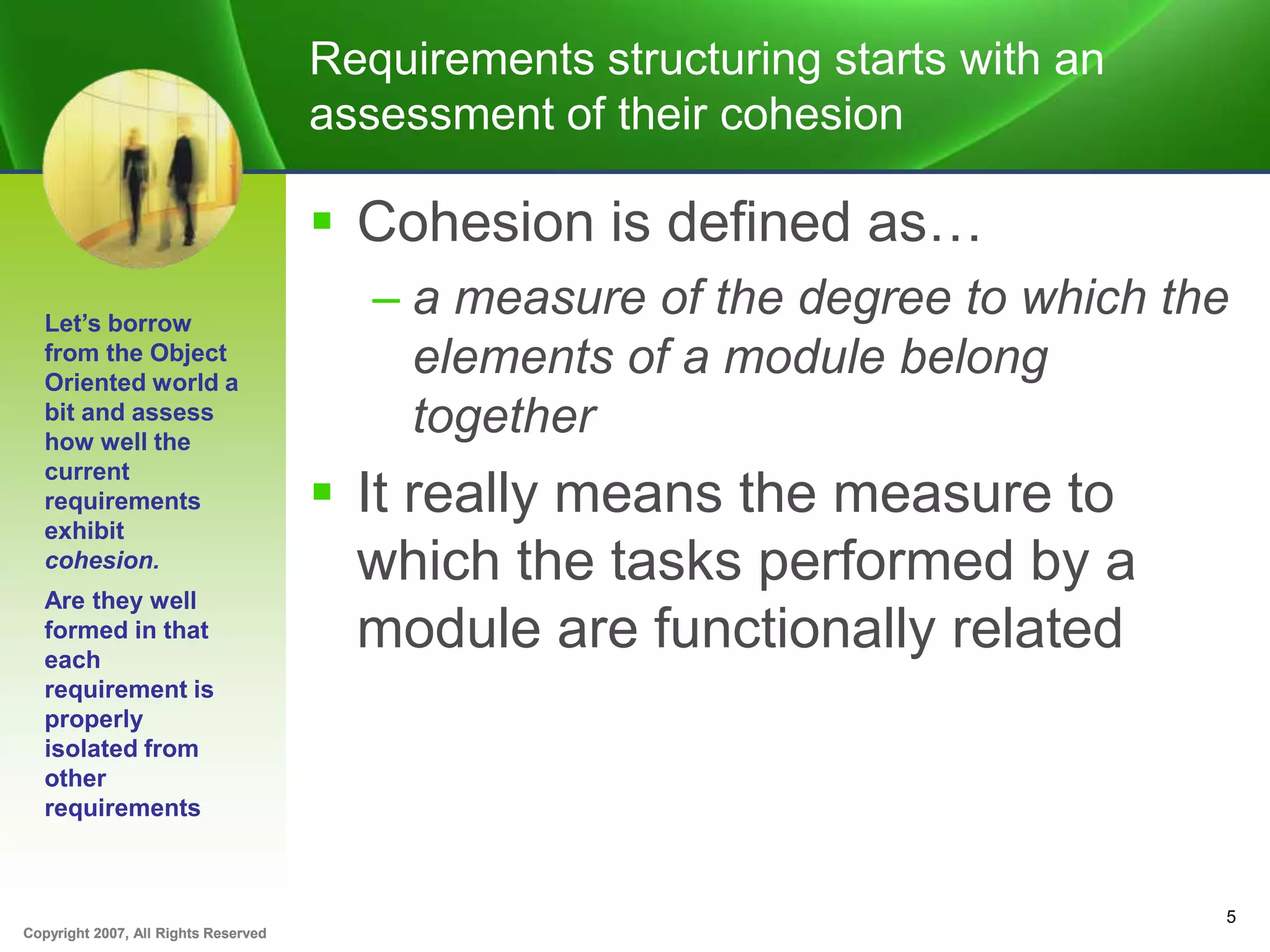
Requirements structuring starts with an
assessment of their cohesion
 Cohesion is defined as…
– a measure of the degree to which the
elements of a module belong
together
 It really means the measure to
which the tasks performed by a
module are functionally related
5
Let’s borrow
from the Object
Oriented world a
bit and assess
how well the
current
requirements
exhibit
cohesion.
Are they well
formed in that
each
requirement is
properly
isolated from
other
requirements
Copyright 2007, All Rights Reserved
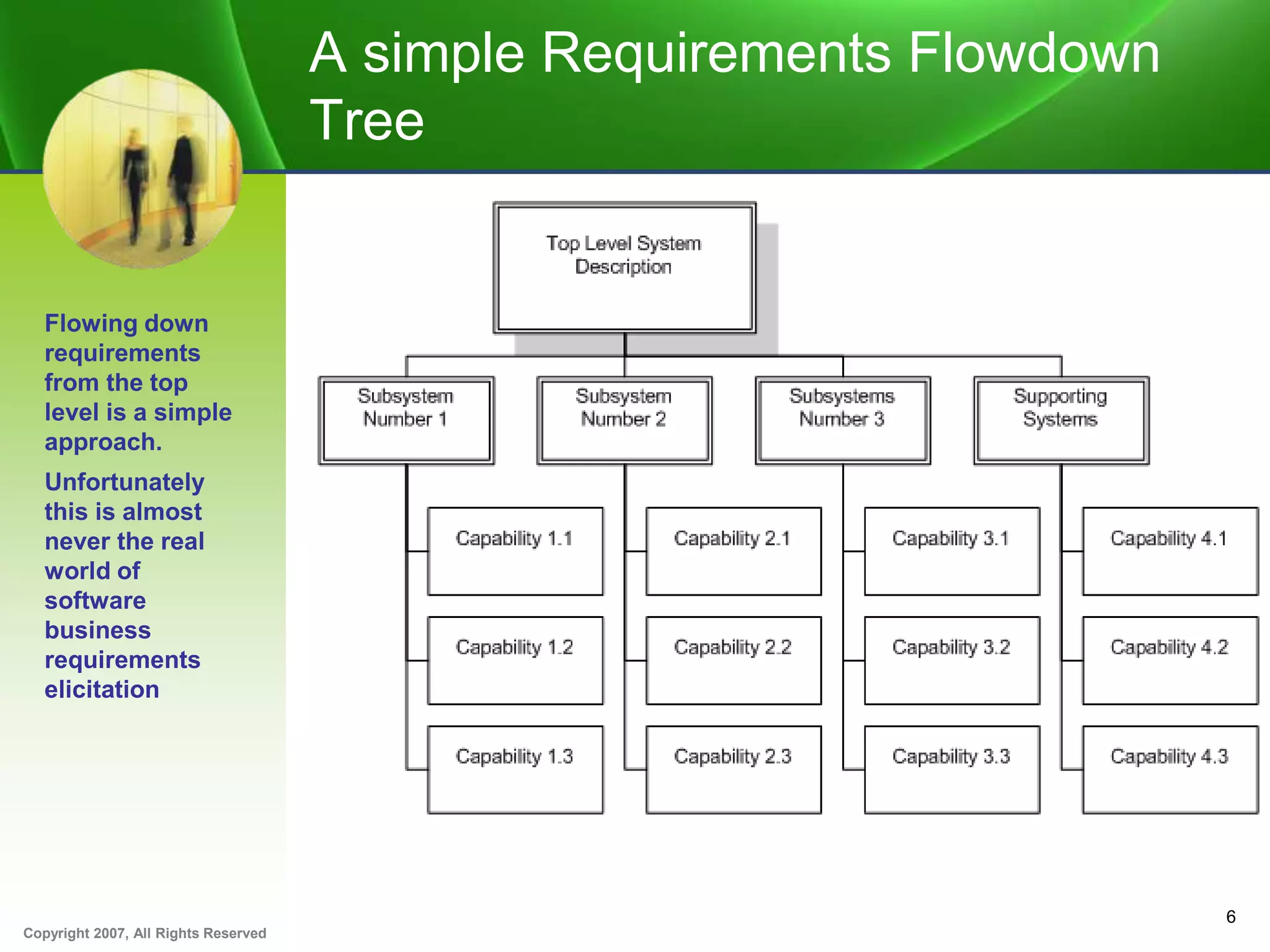
A simple Requirements Flowdown
Tree
6
Flowing down
requirements
from the top
level is a simple
approach.
Unfortunately
this is almost
never the real
world of
software
business
requirements
elicitation
Copyright 2007, All Rights Reserved
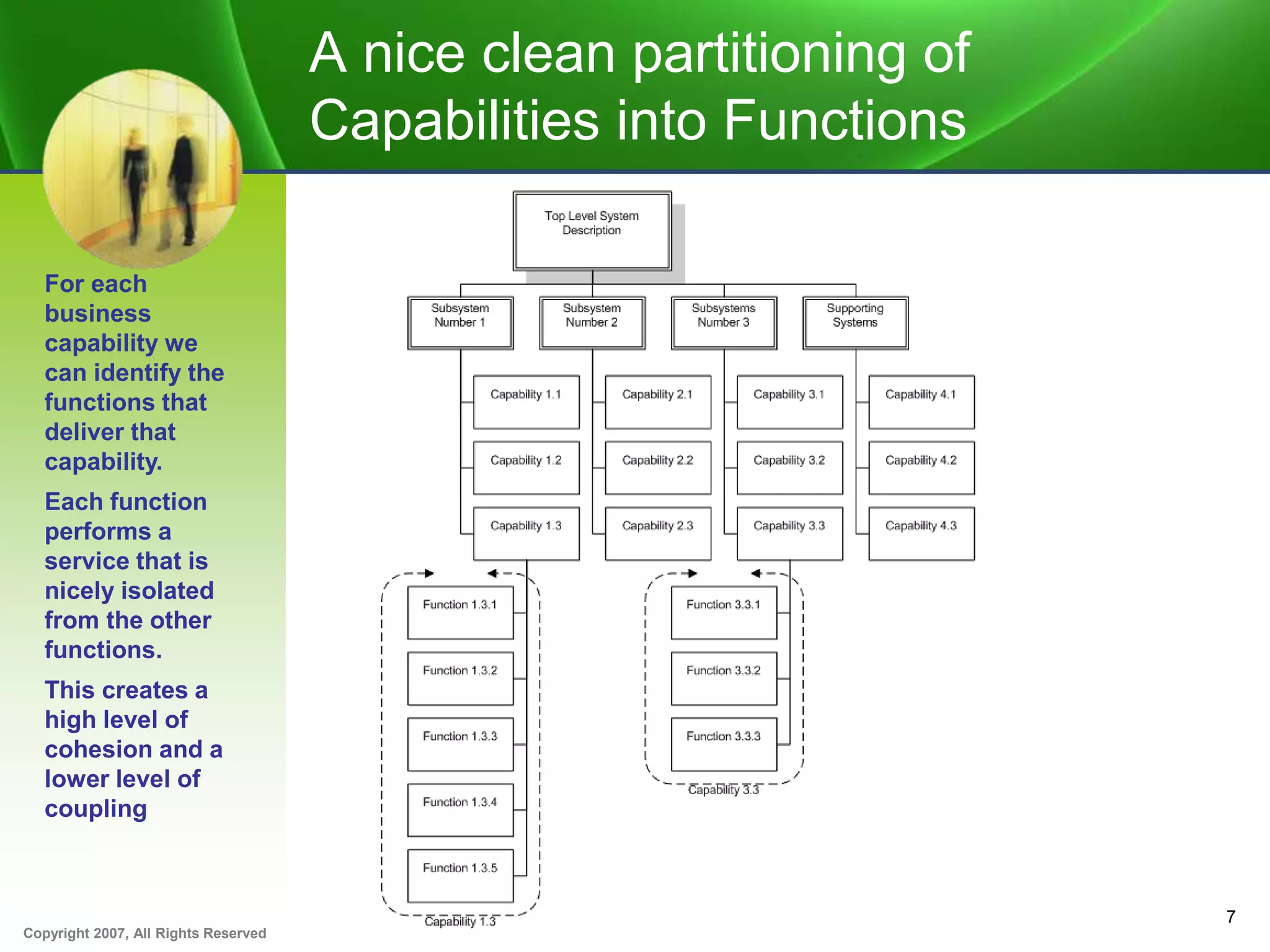
A nice clean partitioning of
Capabilities into Functions
7
For each
business
capability we
can identify the
functions that
deliver that
capability.
Each function
performs a
service that is
nicely isolated
from the other
functions.
This creates a
high level of
cohesion and a
lower level of
coupling
Copyright 2007, All Rights Reserved
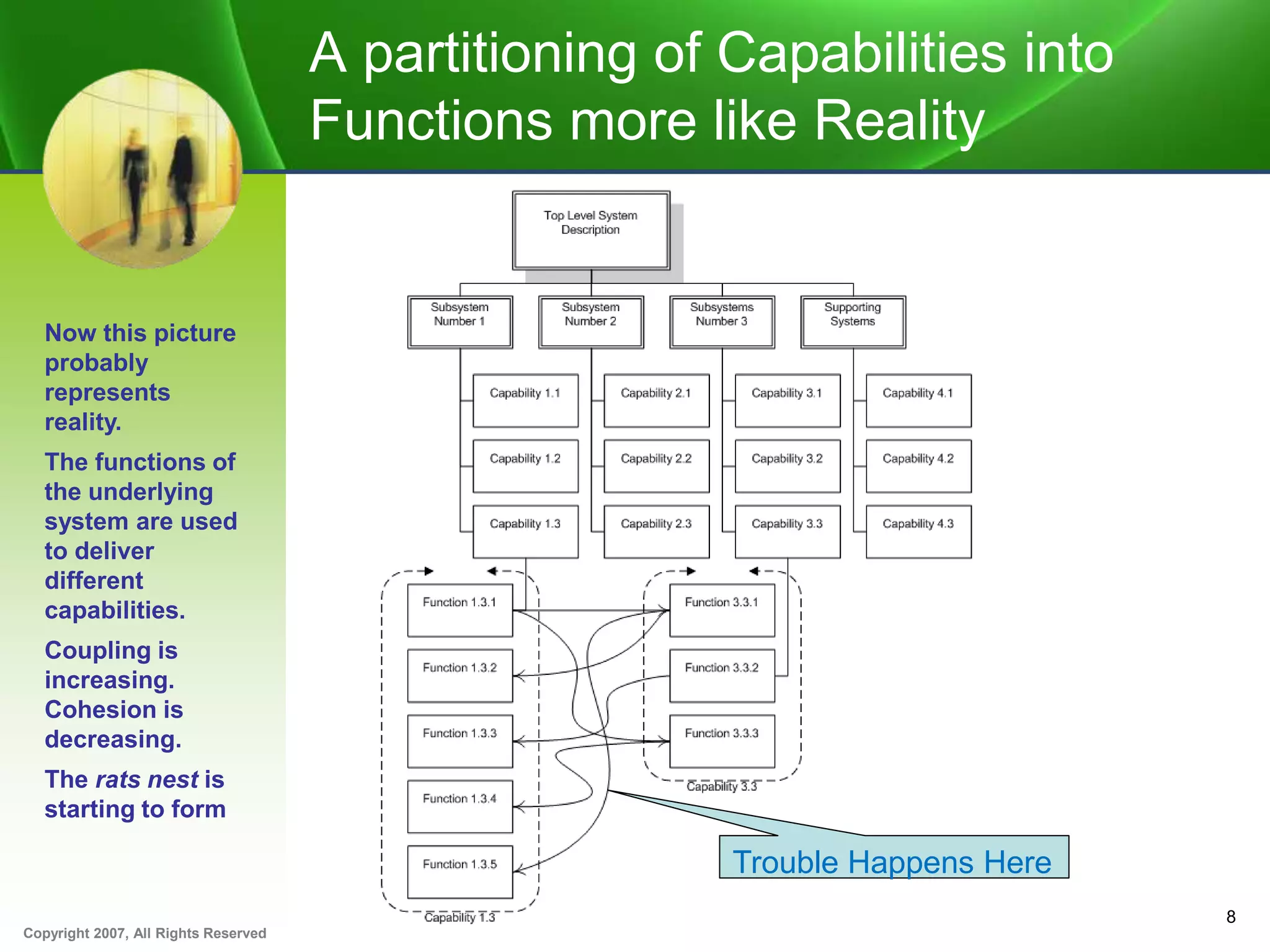
A partitioning of Capabilities into
Functions more like Reality
8
Now this picture
probably
represents
reality.
The functions of
the underlying
system are used
to deliver
different
capabilities.
Coupling is
increasing.
Cohesion is
decreasing.
The rats nest is
starting to form
Trouble Happens Here
Copyright 2007, All Rights ReservedCopyright 2007, All Rights Reserved
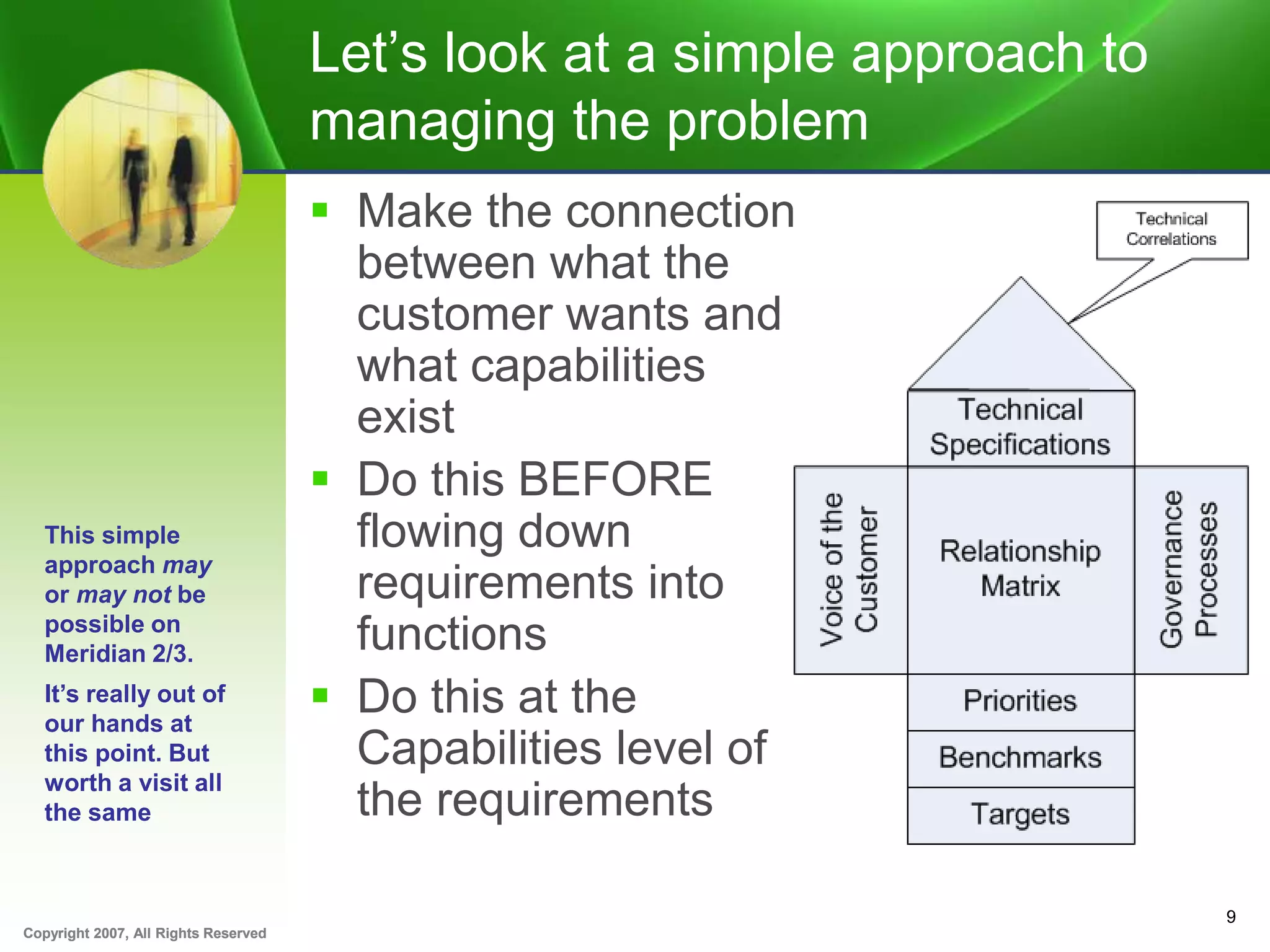
Let’s look at a simple approach to
managing the problem
 Make the connection
between what the
customer wants and
what capabilities
exist
 Do this BEFORE
flowing down
requirements into
functions
 Do this at the
Capabilities level of
the requirements
9
This simple
approach may
or may not be
possible on
Meridian 2/3.
It’s really out of
our hands at
this point. But
worth a visit all
the same
Copyright 2007, All Rights Reserved
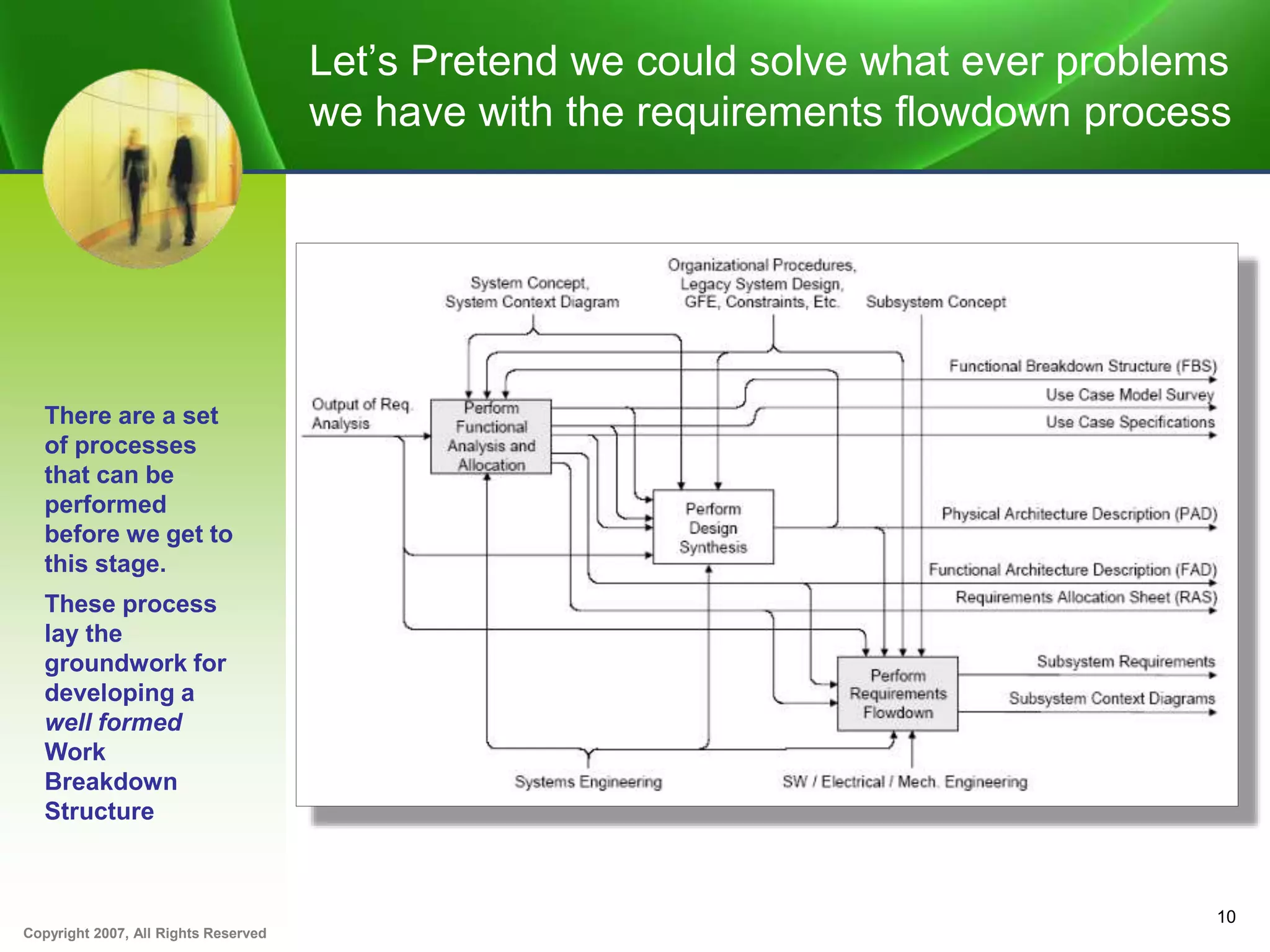
Let’s Pretend we could solve what ever problems
we have with the requirements flowdown process
10
There are a set
of processes
that can be
performed
before we get to
this stage.
These process
lay the
groundwork for
developing a
well formed
Work
Breakdown
Structure
Copyright 2007, All Rights ReservedCopyright 2007, All Rights Reserved
Continuing to play Let’s Pretend
 What does the coupling and
cohesion of the current
requirements look like?
 Are the current requirements
capable of identifying a clear and
concise partitioning of the work?
11
Let’s take a
break for a
moment and
look through the
current
requirements
Structure to see
where we are
regarding
coupling and
cohesion
Copyright 2007, All Rights ReservedCopyright 2007, All Rights Reserved
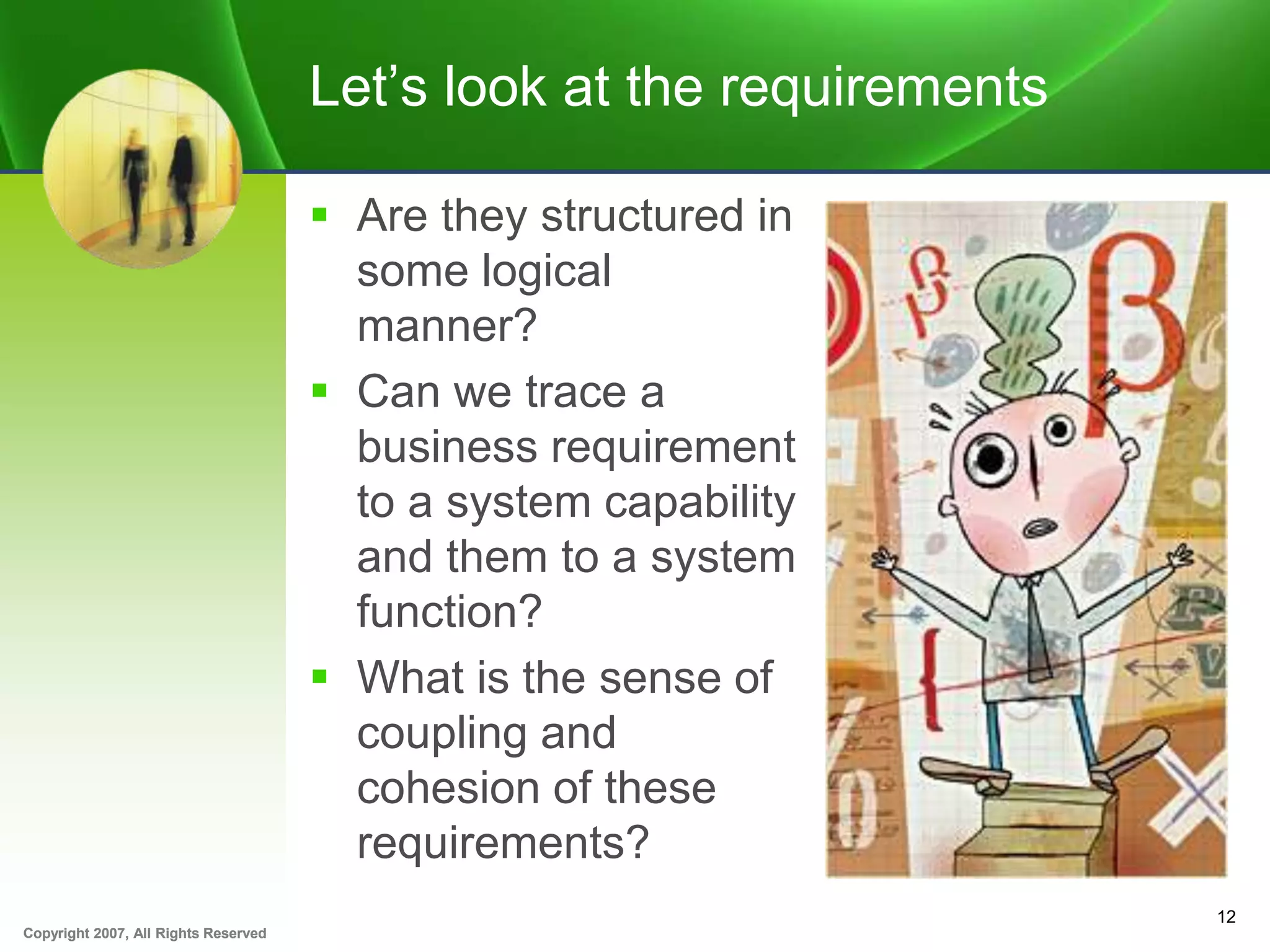
Let’s look at the requirements
 Are they structured in
some logical
manner?
 Can we trace a
business requirement
to a system capability
and them to a system
function?
 What is the sense of
coupling and
cohesion of these
requirements?
12
Copyright 2007, All Rights Reserved
13
Building our 1st Work Breakdown
Structure
Building the WBS is an iterative and incremental process, so let’s take a
cut at the first iteration
Copyright 2007, All Rights ReservedCopyright 2007, All Rights Reserved
Getting to a Work Breakdown Structure
(WBS) starts with well formed requirements
 Mapping requirements to a WBS
starts with an assessment of the
requirements topology
 Coupling minimized
 Cohesion maximized
 Parent child relationships defined
14
The assumption
that there is a
set of well
formed
requirements
needs to be
tested before
proceeding.
This can be
done with a
simple test
Copyright 2007, All Rights ReservedCopyright 2007, All Rights Reserved
What does a good WBS look like?
 It’s not a laundry list of work to be
done
 It’s not a functional decomposition
 It’s not a direct map of the
requirements
 It’s not a reflection of the
underlying software partitioning
 It’s not the first structure you might
thinks of…
15
Let’s start with
what a good
WBS should not
look like.
This is the easy
part
Copyright 2007, All Rights ReservedCopyright 2007, All Rights Reserved
Some attributes of a good WBS
 All terminal nodes describe some
end item in the project
 This physical deliverable is
testable in some manner
 The WBS is an increasing fidelity
description of the deliverables
produced by the project
 The WBS articulates what the
customer wants in terms of
deliverables
16
This are all
simple minded
attributes of
course. But they
should stimulate
some
conversation
about what does
good look like?
Copyright 2007, All Rights ReservedCopyright 2007, All Rights Reserved
A Deliverables Focused WBS
 From the requirements Tree
construct a list of Capabilities needed
to satisfy the customer needs
 From this list of Capabilities construct
a list of Deliverables that will fulfill the
customer needs
 Arrange these deliverables into major
systems
 This has likely already been
done…so let’s have a hands on
exercise to draw this out
17
Building the first
cut at the Work
Breakdown
Structure is a
hands on,
iterative and
incremental
process.
Let’s not skip
the hard part
and assume we
have a WBS we
want to move
forward with
Copyright 2007, All Rights Reserved
18
The Physical Act of Building the
Work Breakdown Structure
Let’s build a WBS using what we current know about the requirements
Copyright 2007, All Rights ReservedCopyright 2007, All Rights Reserved
Step by Step to the 1st Instance of
the Work Breakdown Structure
1. What major partitions do we have?
 This should be easy
2. What sub–capabilities do we have
 Name 3 to 5 capabilities that can be
represented as deliverables
3. Some thoughts before we start
 Can we test for 100% completion?
 Can we trace this deliverable to a
business requirement?
 Can the deliverable be provided in
some independent sequence?
19
The Mind Jet
tool will be used
to capture the
first instance of
the WBS.
Copyright 2007, All Rights Reserved
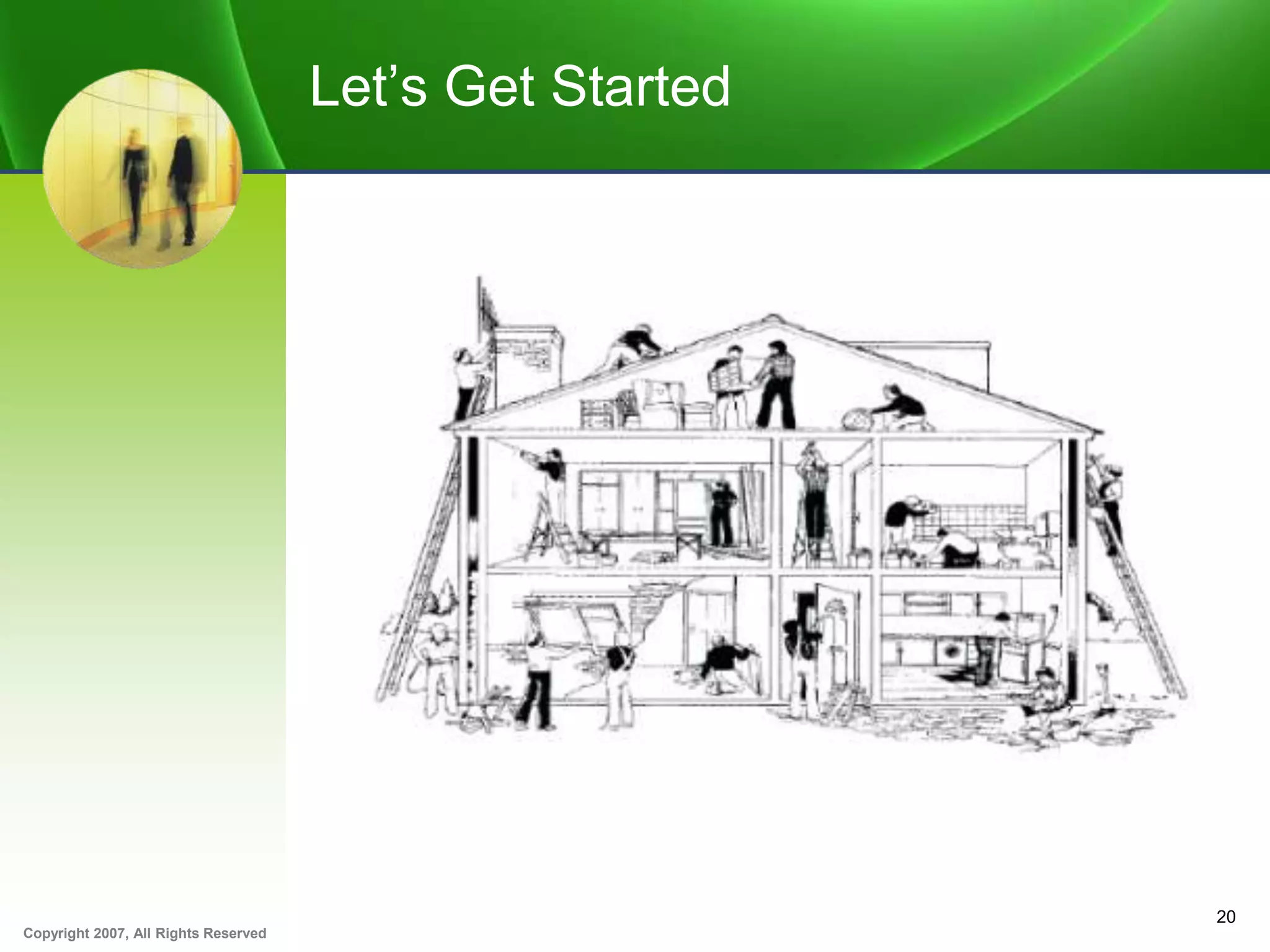
Let’s Get Started
20
Copyright 2007, All Rights Reserved
21
Using the First Instance of the WBS
to Construct some Work Packages
Copyright 2007, All Rights Reserved
Contents of a Work Package
 Description
 Assumptions
 Earned Value
Method
 Basis of Estimate
 Predecessors
and successors
 Strategy for
delivery
 Contents of the
deliverables
 Responsibilities
22
The Work
Package
Template used
on Meridian 1A
and 1B will be
our guide
Copyright 2007, All Rights ReservedCopyright 2007, All Rights Reserved
Description
 A clear and concise description of
what the Work Package produces
in terms of deliverables
 This is your elevator pitch when
some asks “what does the Work
Package you’re working on do
when its all done?”
 Deliverables are meaning to the
customer – speak in deliverables
terms
23
Copyright 2007, All Rights ReservedCopyright 2007, All Rights Reserved
Assumptions
 Make it clear (and concise) what
you expect to be in place before
the Work Package starts
 State these in terms of
deliverables themselves
– What they are
– Who you’re getting them from
– A little bit of why you need them
24
Copyright 2007, All Rights ReservedCopyright 2007, All Rights Reserved
Earned Value Method
 Think about how you would message
100% done.
– Done, done
– Not almost done
– Not “I’ll be done soon”
 If the Work Package is contained and
100% done occurs at the end of the
WP then use that
 If the Work Package has more than
one deliverable or the deliverable has
incremental functionality then
Apportioned Milestones can be used
25
The concept of
Earned Value is
a separate topic
– coming soon.
But thinking in
Deliverables,
means thinking
about
measuring
physical
progress.
Physical
progress is not
the same of
effort.
Physical
progress is
deliverables
Copyright 2007, All Rights ReservedCopyright 2007, All Rights Reserved
Basis of Estimate
 A short description of how you got
to the estimate of effort
– “I’ve done this before”
– “I asked someone who has done this
before”
– “I ran an experiment to determine
how long it would take”
– “I took a guess and multiplied it by 2”
26
Copyright 2007, All Rights ReservedCopyright 2007, All Rights Reserved
Predecessors and Successors
 Give some thought about the
sequence of the Work Packages
– What comes first
– What comes next
 The reason for this is the obvious
dependencies
 But as well Work Authorization
processes will be used in Meridian
2/3
27
Copyright 2007, All Rights ReservedCopyright 2007, All Rights Reserved
Strategy for Delivery
 What is the “story” you’re going to
tell the Work Package team about
how you’re going to get this work
done on time, on schedule and on
budget
 This is your strategy
– It’s a PLAN
– It’s not the Schedule
28
Copyright 2007, All Rights ReservedCopyright 2007, All Rights Reserved
Contents of the Deliverables
 What to the deliverables “do” when
they are “doing what they do?”
– This is the basis of the Work
Breakdown Dictionary
 The WBS Dictionary sounds
redundant, but it is not
– The WBS is a deliverables structure
– The dictionary describes each
element in simple terms
29
WBS Element 1.5.4.5. - Systems Integration Test Equipment Planning - This element includes
the effort to identify requirements and specify types and quantities of test equipment needed to
support the System Integration and Test process. It does not include the design or
procurement of such equipment, which is covered in Element 1.5.4.6.
Copyright 2007, All Rights ReservedCopyright 2007, All Rights Reserved
Responsibilities
 Each Work Package has one and
only one person Accountable for
the successful delivery of the Work
Package
– Put that persons name on the Work
Package
 We’ll build a Responsibility
Assignment Matrix (RAM) from the
Clarity files
– For now naming the person is a start
30

Building work packages from requirements (from mm)(larger version)

  • 1.
    Copyright 2007, AllRights Reserved 1 Building Work Packages from Requirements Using well formed requirements, Work Packages can be constructed directly from the Work Breakdown Structure
  • 2.
    Copyright 2007, AllRights ReservedCopyright 2007, All Rights Reserved Agenda  Building a well structured set of requirements  Deriving the Work Break Down Structure  Identifying Work Packages  Constructing the Work Packages 2
  • 3.
    Copyright 2007, AllRights ReservedCopyright 2007, All Rights Reserved Outcomes of today’s presentation  Assessing the structure of the current requirements – Gaps in the topology – Closure activities  Getting ready to build the Work Breakdown Structure (WBS) – Decomposition tree of the WBS – Defining business capabilities – Defining deliverables that enable those capabilities 3
  • 4.
    Copyright 2007, AllRights Reserved 4 Assessing the Current Requirements Structure The current requirements process is likely consider well on its way to completion. But let’s assess the structure of the requirements, rather than the requirements themselves. The better the structure the better the WBS and the better the cohesion of the Work Packages
  • 5.
    Copyright 2007, AllRights ReservedCopyright 2007, All Rights Reserved Requirements structuring starts with an assessment of their cohesion  Cohesion is defined as… – a measure of the degree to which the elements of a module belong together  It really means the measure to which the tasks performed by a module are functionally related 5 Let’s borrow from the Object Oriented world a bit and assess how well the current requirements exhibit cohesion. Are they well formed in that each requirement is properly isolated from other requirements
  • 6.
    Copyright 2007, AllRights Reserved A simple Requirements Flowdown Tree 6 Flowing down requirements from the top level is a simple approach. Unfortunately this is almost never the real world of software business requirements elicitation
  • 7.
    Copyright 2007, AllRights Reserved A nice clean partitioning of Capabilities into Functions 7 For each business capability we can identify the functions that deliver that capability. Each function performs a service that is nicely isolated from the other functions. This creates a high level of cohesion and a lower level of coupling
  • 8.
    Copyright 2007, AllRights Reserved A partitioning of Capabilities into Functions more like Reality 8 Now this picture probably represents reality. The functions of the underlying system are used to deliver different capabilities. Coupling is increasing. Cohesion is decreasing. The rats nest is starting to form Trouble Happens Here
  • 9.
    Copyright 2007, AllRights ReservedCopyright 2007, All Rights Reserved Let’s look at a simple approach to managing the problem  Make the connection between what the customer wants and what capabilities exist  Do this BEFORE flowing down requirements into functions  Do this at the Capabilities level of the requirements 9 This simple approach may or may not be possible on Meridian 2/3. It’s really out of our hands at this point. But worth a visit all the same
  • 10.
    Copyright 2007, AllRights Reserved Let’s Pretend we could solve what ever problems we have with the requirements flowdown process 10 There are a set of processes that can be performed before we get to this stage. These process lay the groundwork for developing a well formed Work Breakdown Structure
  • 11.
    Copyright 2007, AllRights ReservedCopyright 2007, All Rights Reserved Continuing to play Let’s Pretend  What does the coupling and cohesion of the current requirements look like?  Are the current requirements capable of identifying a clear and concise partitioning of the work? 11 Let’s take a break for a moment and look through the current requirements Structure to see where we are regarding coupling and cohesion
  • 12.
    Copyright 2007, AllRights ReservedCopyright 2007, All Rights Reserved Let’s look at the requirements  Are they structured in some logical manner?  Can we trace a business requirement to a system capability and them to a system function?  What is the sense of coupling and cohesion of these requirements? 12
  • 13.
    Copyright 2007, AllRights Reserved 13 Building our 1st Work Breakdown Structure Building the WBS is an iterative and incremental process, so let’s take a cut at the first iteration
  • 14.
    Copyright 2007, AllRights ReservedCopyright 2007, All Rights Reserved Getting to a Work Breakdown Structure (WBS) starts with well formed requirements  Mapping requirements to a WBS starts with an assessment of the requirements topology  Coupling minimized  Cohesion maximized  Parent child relationships defined 14 The assumption that there is a set of well formed requirements needs to be tested before proceeding. This can be done with a simple test
  • 15.
    Copyright 2007, AllRights ReservedCopyright 2007, All Rights Reserved What does a good WBS look like?  It’s not a laundry list of work to be done  It’s not a functional decomposition  It’s not a direct map of the requirements  It’s not a reflection of the underlying software partitioning  It’s not the first structure you might thinks of… 15 Let’s start with what a good WBS should not look like. This is the easy part
  • 16.
    Copyright 2007, AllRights ReservedCopyright 2007, All Rights Reserved Some attributes of a good WBS  All terminal nodes describe some end item in the project  This physical deliverable is testable in some manner  The WBS is an increasing fidelity description of the deliverables produced by the project  The WBS articulates what the customer wants in terms of deliverables 16 This are all simple minded attributes of course. But they should stimulate some conversation about what does good look like?
  • 17.
    Copyright 2007, AllRights ReservedCopyright 2007, All Rights Reserved A Deliverables Focused WBS  From the requirements Tree construct a list of Capabilities needed to satisfy the customer needs  From this list of Capabilities construct a list of Deliverables that will fulfill the customer needs  Arrange these deliverables into major systems  This has likely already been done…so let’s have a hands on exercise to draw this out 17 Building the first cut at the Work Breakdown Structure is a hands on, iterative and incremental process. Let’s not skip the hard part and assume we have a WBS we want to move forward with
  • 18.
    Copyright 2007, AllRights Reserved 18 The Physical Act of Building the Work Breakdown Structure Let’s build a WBS using what we current know about the requirements
  • 19.
    Copyright 2007, AllRights ReservedCopyright 2007, All Rights Reserved Step by Step to the 1st Instance of the Work Breakdown Structure 1. What major partitions do we have?  This should be easy 2. What sub–capabilities do we have  Name 3 to 5 capabilities that can be represented as deliverables 3. Some thoughts before we start  Can we test for 100% completion?  Can we trace this deliverable to a business requirement?  Can the deliverable be provided in some independent sequence? 19 The Mind Jet tool will be used to capture the first instance of the WBS.
  • 20.
    Copyright 2007, AllRights Reserved Let’s Get Started 20
  • 21.
    Copyright 2007, AllRights Reserved 21 Using the First Instance of the WBS to Construct some Work Packages
  • 22.
    Copyright 2007, AllRights Reserved Contents of a Work Package  Description  Assumptions  Earned Value Method  Basis of Estimate  Predecessors and successors  Strategy for delivery  Contents of the deliverables  Responsibilities 22 The Work Package Template used on Meridian 1A and 1B will be our guide
  • 23.
    Copyright 2007, AllRights ReservedCopyright 2007, All Rights Reserved Description  A clear and concise description of what the Work Package produces in terms of deliverables  This is your elevator pitch when some asks “what does the Work Package you’re working on do when its all done?”  Deliverables are meaning to the customer – speak in deliverables terms 23
  • 24.
    Copyright 2007, AllRights ReservedCopyright 2007, All Rights Reserved Assumptions  Make it clear (and concise) what you expect to be in place before the Work Package starts  State these in terms of deliverables themselves – What they are – Who you’re getting them from – A little bit of why you need them 24
  • 25.
    Copyright 2007, AllRights ReservedCopyright 2007, All Rights Reserved Earned Value Method  Think about how you would message 100% done. – Done, done – Not almost done – Not “I’ll be done soon”  If the Work Package is contained and 100% done occurs at the end of the WP then use that  If the Work Package has more than one deliverable or the deliverable has incremental functionality then Apportioned Milestones can be used 25 The concept of Earned Value is a separate topic – coming soon. But thinking in Deliverables, means thinking about measuring physical progress. Physical progress is not the same of effort. Physical progress is deliverables
  • 26.
    Copyright 2007, AllRights ReservedCopyright 2007, All Rights Reserved Basis of Estimate  A short description of how you got to the estimate of effort – “I’ve done this before” – “I asked someone who has done this before” – “I ran an experiment to determine how long it would take” – “I took a guess and multiplied it by 2” 26
  • 27.
    Copyright 2007, AllRights ReservedCopyright 2007, All Rights Reserved Predecessors and Successors  Give some thought about the sequence of the Work Packages – What comes first – What comes next  The reason for this is the obvious dependencies  But as well Work Authorization processes will be used in Meridian 2/3 27
  • 28.
    Copyright 2007, AllRights ReservedCopyright 2007, All Rights Reserved Strategy for Delivery  What is the “story” you’re going to tell the Work Package team about how you’re going to get this work done on time, on schedule and on budget  This is your strategy – It’s a PLAN – It’s not the Schedule 28
  • 29.
    Copyright 2007, AllRights ReservedCopyright 2007, All Rights Reserved Contents of the Deliverables  What to the deliverables “do” when they are “doing what they do?” – This is the basis of the Work Breakdown Dictionary  The WBS Dictionary sounds redundant, but it is not – The WBS is a deliverables structure – The dictionary describes each element in simple terms 29 WBS Element 1.5.4.5. - Systems Integration Test Equipment Planning - This element includes the effort to identify requirements and specify types and quantities of test equipment needed to support the System Integration and Test process. It does not include the design or procurement of such equipment, which is covered in Element 1.5.4.6.
  • 30.
    Copyright 2007, AllRights ReservedCopyright 2007, All Rights Reserved Responsibilities  Each Work Package has one and only one person Accountable for the successful delivery of the Work Package – Put that persons name on the Work Package  We’ll build a Responsibility Assignment Matrix (RAM) from the Clarity files – For now naming the person is a start 30