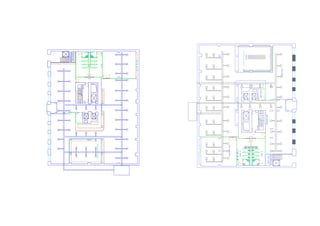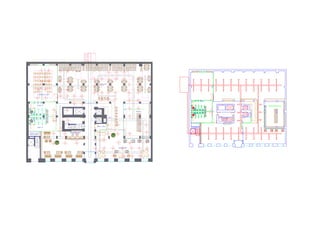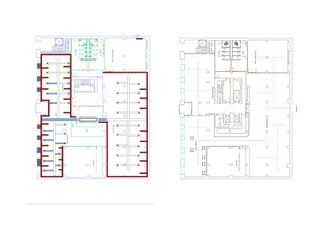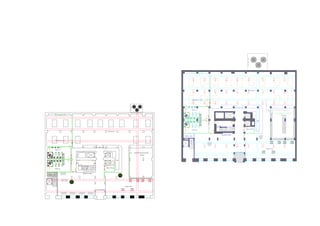
ARA3013 BUILDING SERVICES-II
PORTFOLIO
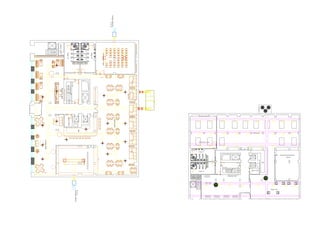
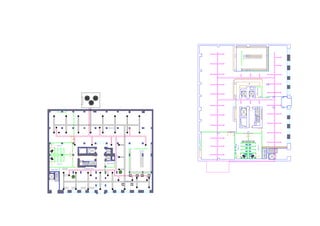
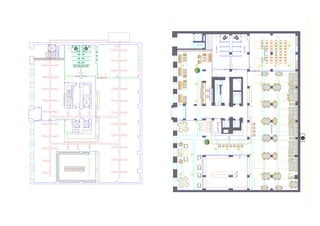
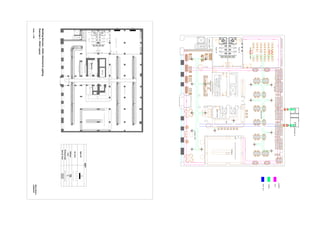
HVAC | ELECTRICAL | LIGHTING
BATCH: 2022-2027 | 2021-2026
E
L
E
C
T
R
I
C
A
L
L
A
Y
O
U
T
H
V
A
C
L
A
Y
O
U
T
A
I
R
C
O
N
D
I
T
I
O
N
I
N
G
E
L
E
C
T
R
I
C
A
L
S
Y
S
T
E
M
O
N
S
I
T
E
S
K
E
T
C
H
E
S
S
I
T
E
V
I
S
I
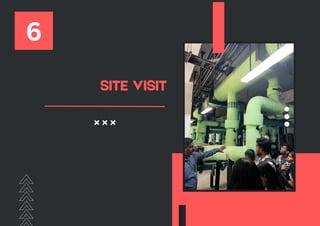
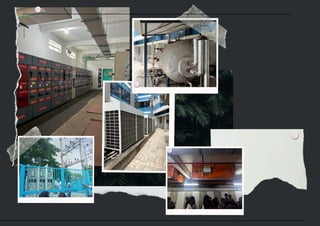
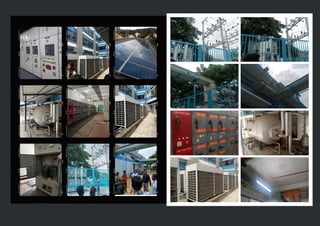
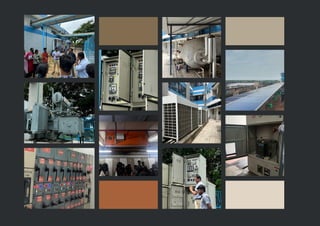
T
1
2
3
4 6
5
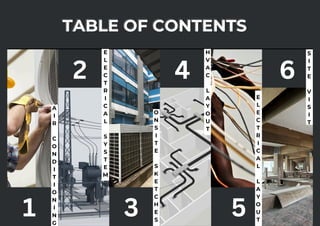
TABLE OF CONTENTS
TABLE OF CONTENTS
w w w . r e a l l y g r e a t s i t e . c o m
AIR CONDITIONING
WINDOW & SPLIT AC | FLOOR MOUNTED & CASSETTE AC | PACKAGED UNIT | DIRECT
EXPANSION | DISTRICT COOLING | CHILLED BEAM | FAN COIL UNIT | COOLANT
SYSTEM
1
WORKING
PRINCIPLE
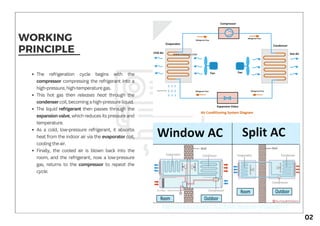
The refrigeration cycle begins with the
compressor compressing the refrigerant into a
high-pressure,high-temperaturegas.
This hot gas then releases heat through the
condensercoil,becomingahigh-pressureliquid.
The liquid refrigerant then passes through the
expansion valve, which reduces its pressure and
temperature.
As a cold, low-pressure refrigerant, it absorbs
heat from the indoor air via the evaporator coil,
coolingtheair.
Finally, the cooled air is blown back into the
room, and the refrigerant, now a low-pressure
gas, returns to the compressor to repeat the
cycle.
02
https://youtu.be/abcOV22bAfk?feature=shared&t=7
APPLICATION
Window air conditioners are favored for their low cost, ease of maintenance compared to split A.C., and effectiveness in cooling
specific areas. Split air conditioners are popular in residential and commercial buildings for their versatility, efficiency, and ease of
installation.
03
COMMONLYUSED
ResidentialBuildings
CommercialBuildings
InstitutionalBuildings
IndustrialBuildings
HospitalityIndustry
TemporaryBuildings
STANDARDSIZE[Brand:LG]
SplitAC:99.8x32.2x22.3cm
WindowAC: 66.6x 45x65.9cm
PLACEMENT(Interiors)
SplitAC:2.1to2.4m FromFFL
WindowAC: 1to1.2mFromFFL
04
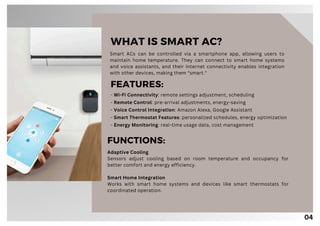
Smart ACs can be controlled via a smartphone app, allowing users to
maintain home temperature. They can connect to smart home systems
and voice assistants, and their internet connectivity enables integration
with other devices, making them "smart."
WHAT IS SMART AC?
FEATURES:
- Wi-Fi Connectivity: remote settings adjustment, scheduling
- Remote Control: pre-arrival adjustments, energy-saving
- Voice Control Integration: Amazon Alexa, Google Assistant
- Smart Thermostat Features: personalized schedules, energy optimization
- Energy Monitoring: real-time usage data, cost management
FUNCTIONS:
Adaptive Cooling
Sensors adjust cooling based on room temperature and occupancy for
better comfort and energy efficiency.
Smart Home Integration
Works with smart home systems and devices like smart thermostats for
coordinated operation.
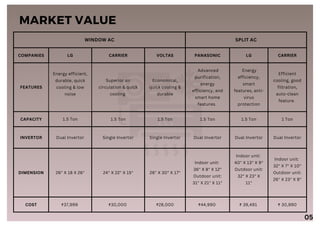
WINDOW AC SPLIT AC
COMPANIES LG CARRIER VOLTAS PANASONIC LG CARRIER
FEATURES
Energy efficient,
durable, quick
cooling & low
noise
Superior air
circulation & quick
cooling
Economical,
quick cooling &
durable
Advanced
purification,
energy
efficiency, and
smart home
features.
Energy
efficiency,
smart
features, anti-
virus
protection
Efficient
cooling, good
filtration,
auto-clean
feature.
CAPACITY 1.5 Ton 1.5 Ton 1.5 Ton 1.5 Ton 1.5 Ton 1 Ton
INVERTOR Dual Invertor Single Invertor Single Invertor Dual Invertor Dual Invertor Dual Invertor
DIMENSION 26" X 18 X 26" 24" X 22" X 15" 26" X 30" X 17"
Indoor unit:
36" X 8" X 12"
Outdoor unit:
31" X 21" X 11"
Indoor unit:
40" X 13" X 9"
Outdoor unit:
32" X 23" X
11"
Indoor unit:
32" X 7" X 10"
Outdoor unit:
26" X 23" X 9"
COST ₹37,999 ₹30,000 ₹28,000 ₹44,990 ₹ 39,491 ₹ 30,990
MARKET VALUE
05
06
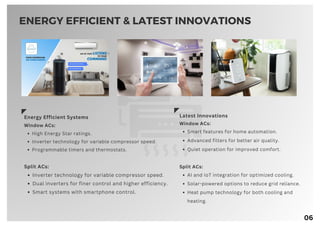
Energy Efficient Systems
Window ACs:
High Energy Star ratings.
Inverter technology for variable compressor speed.
Programmable timers and thermostats.
Split ACs:
Inverter technology for variable compressor speed.
Dual inverters for finer control and higher efficiency.
Smart systems with smartphone control.
Latest Innovations
Window ACs:
Smart features for home automation.
Advanced filters for better air quality.
Quiet operation for improved comfort.
Split ACs:
AI and IoT integration for optimized cooling.
Solar-powered options to reduce grid reliance.
Heat pump technology for both cooling and
heating.
ENERGY EFFICIENT & LATEST INNOVATIONS
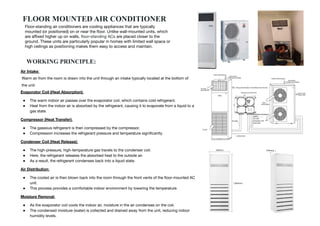
Air Intake:
Warm air from the room is drawn into the unit through an intake typically located at the bottom of
the unit.
Evaporator Coil (Heat Absorption):
● The warm indoor air passes over the evaporator coil, which contains cold refrigerant.
● Heat from the indoor air is absorbed by the refrigerant, causing it to evaporate from a liquid to a
gas state.
Compressor (Heat Transfer):
● The gaseous refrigerant is then compressed by the compressor.
● Compression increases the refrigerant pressure and temperature significantly.
Condenser Coil (Heat Release):
● The high-pressure, high-temperature gas travels to the condenser coil.
● Here, the refrigerant releases the absorbed heat to the outside air.
● As a result, the refrigerant condenses back into a liquid state.
Air Distribution:
● The cooled air is then blown back into the room through the front vents of the floor-mounted AC
unit.
● This process provides a comfortable indoor environment by lowering the temperature.
Moisture Removal:
● As the evaporator coil cools the indoor air, moisture in the air condenses on the coil.
● The condensed moisture (water) is collected and drained away from the unit, reducing indoor
humidity levels.
FLOOR MOUNTED AIR CONDITIONER
WORKING PRINCIPLE:
Floor-standing air conditioners are cooling appliances that are typically
mounted (or positioned) on or near the floor. Unlike wall-mounted units, which
are affixed higher up on walls, floor-standing ACs are placed closer to the
ground. These units are particularly popular in homes with limited wall space or
high ceilings as positioning makes them easy to access and maintain.
FLOOR MOUNTED AIR CONDITIONER
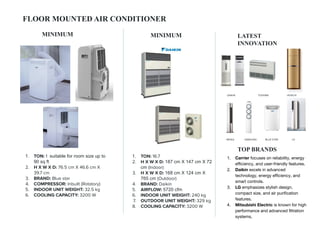
1. TON: 1 suitable for room size up to
90 sq ft
2. H X W X D: 76.5 cm X 46.6 cm X
39.7 cm
3. BRAND: Blue star
4. COMPRESSOR: Inbuilt (Rotatory)
5. INDOOR UNIT WEIGHT: 32.5 kg
6. COOLING CAPACITY: 3200 W
MINIMUM MINIMUM
1. TON: 16.7
2. H X W X D: 187 cm X 147 cm X 72
cm (Indoor)
3. H X W X D: 168 cm X 124 cm X
765 cm (Outdoor)
4. BRAND: Daikin
5. AIRFLOW: 5720 cfm
6. INDOOR UNIT WEIGHT: 240 kg
7. OUTDOOR UNIT WEIGHT: 329 kg
8. COOLING CAPACITY: 3200 W
LATEST
INNOVATION
TOP BRANDS
1. Carrier focuses on reliability, energy
efficiency, and user-friendly features.
2. Daikin excels in advanced
technology, energy efficiency, and
smart controls.
3. LG emphasizes stylish design,
compact size, and air purification
features.
4. Mitsubishi Electric is known for high
performance and advanced filtration
systems.
HITACHI
TOSHIBA
DAIKIN
MIDEA SAMSUNG BLUE STAR LG
APPLICATION IN BUILDING:
Residential Settings
● Living Rooms: Ideal for spaces with limited wall space or aesthetic concerns.
● Bedrooms: Effective cooling for high ceilings or unique layouts.
● Basements: Efficient cooling for areas lacking sufficient wall space.
Commercial Locations
● Offices: Maintains comfort in open-plan offices or areas with limited wall access.
● Restaurants and Cafes: Effective cooling without compromising decor.
● Hotels: Efficient climate control in lobbies and guest rooms.
● Retail Stores: Enhances customer comfort without interfering with displays.
Specialized Environments
● Hospitals: Precise temperature control in waiting areas and patient rooms.
● Server Rooms: Effective cooling for equipment-heavy environments.
● Canteens and Break Rooms: Provides cooling in employee rest areas.
FMACs (Floor-Mounted Air Conditioners) are versatile cooling solutions that find application in various settings:
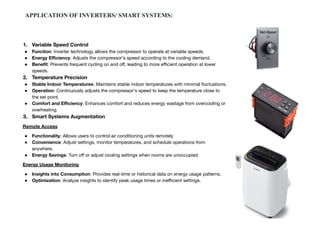
1. Variable Speed Control
● Function: Inverter technology allows the compressor to operate at variable speeds.
● Energy Efficiency: Adjusts the compressor's speed according to the cooling demand.
● Benefit: Prevents frequent cycling on and off, leading to more efficient operation at lower
speeds.
2. Temperature Precision
● Stable Indoor Temperatures: Maintains stable indoor temperatures with minimal fluctuations.
● Operation: Continuously adjusts the compressor's speed to keep the temperature close to
the set point.
● Comfort and Efficiency: Enhances comfort and reduces energy wastage from overcooling or
overheating.
3. Smart Systems Augmentation
Remote Access
● Functionality: Allows users to control air conditioning units remotely
● Convenience: Adjust settings, monitor temperatures, and schedule operations from
anywhere.
● Energy Savings: Turn off or adjust cooling settings when rooms are unoccupied.
Energy Usage Monitoring
● Insights into Consumption: Provides real-time or historical data on energy usage patterns.
● Optimization: Analyze insights to identify peak usage times or inefficient settings.
APPLICATION OF INVERTERS/ SMART SYSTEMS:
ENERGY EFFICIENT SYSTEM, ENVIRONMENTALASPECTS, LATEST INNOVATION
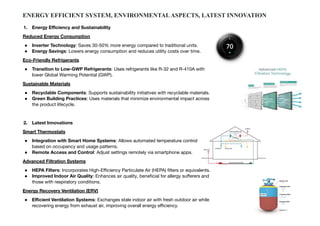
1. Energy Efficiency and Sustainability
Reduced Energy Consumption
● Inverter Technology: Saves 30-50% more energy compared to traditional units.
● Energy Savings: Lowers energy consumption and reduces utility costs over time.
Eco-Friendly Refrigerants
● Transition to Low-GWP Refrigerants: Uses refrigerants like R-32 and R-410A with
lower Global Warming Potential (GWP).
Sustainable Materials
● Recyclable Components: Supports sustainability initiatives with recyclable materials.
● Green Building Practices: Uses materials that minimize environmental impact across
the product lifecycle.
2. Latest Innovations
Smart Thermostats
● Integration with Smart Home Systems: Allows automated temperature control
based on occupancy and usage patterns.
● Remote Access and Control: Adjust settings remotely via smartphone apps.
Advanced Filtration Systems
● HEPA Filters: Incorporates High-Efficiency Particulate Air (HEPA) filters or equivalents.
● Improved Indoor Air Quality: Enhances air quality, beneficial for allergy sufferers and
those with respiratory conditions.
Energy Recovery Ventilation (ERV)
● Efficient Ventilation Systems: Exchanges stale indoor air with fresh outdoor air while
recovering energy from exhaust air, improving overall energy efficiency.
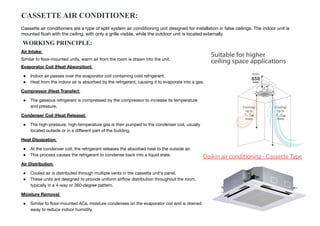
Daikin air conditioning - Cassette Type
Cassette air conditioners are a type of split system air conditioning unit designed for installation in false ceilings. The indoor unit is
mounted flush with the ceiling, with only a grille visible, while the outdoor unit is located externally
Air Intake:
Similar to floor-mounted units, warm air from the room is drawn into the unit.
Evaporator Coil (Heat Absorption):
● Indoor air passes over the evaporator coil containing cold refrigerant.
● Heat from the indoor air is absorbed by the refrigerant, causing it to evaporate into a gas.
Compressor (Heat Transfer):
● The gaseous refrigerant is compressed by the compressor to increase its temperature
and pressure.
Condenser Coil (Heat Release):
● The high-pressure, high-temperature gas is then pumped to the condenser coil, usually
located outside or in a different part of the building.
Heat Dissipation:
● At the condenser coil, the refrigerant releases the absorbed heat to the outside air.
● This process causes the refrigerant to condense back into a liquid state.
Air Distribution:
● Cooled air is distributed through multiple vents in the cassette unit's panel.
● These units are designed to provide uniform airflow distribution throughout the room,
typically in a 4-way or 360-degree pattern.
Moisture Removal:
● Similar to floor-mounted ACs, moisture condenses on the evaporator coil and is drained
away to reduce indoor humidity.
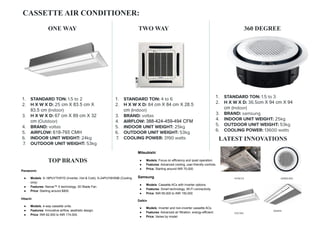
CASSETTE AIR CONDITIONER:
WORKING PRINCIPLE:
CASSETTE AIR CONDITIONER:
360 DEGREE
TWO WAY
ONE WAY
1. STANDARD TON: 1.5 to 2
2. H X W X D: 25 cm X 83.5 cm X
83.5 cm (Indoor)
3. H X W X D: 67 cm X 89 cm X 32
cm (Outdoor)
4. BRAND: voltas
5. AIRFLOW: 618-765 CMH
6. INDOOR UNIT WEIGHT: 24kg
7. OUTDOOR UNIT WEIGHT: 53kg
1. STANDARD TON: 4 to 6
2. H X W X D: 84 cm X 84 cm X 28.5
cm (Indoor)
3. BRAND: voltas
4. AIRFLOW: 388-424-459-494 CFM
5. INDOOR UNIT WEIGHT: 25kg
6. OUTDOOR UNIT WEIGHT: 53kg
7. COOLING POWER: 3190 watts
1. STANDARD TON: 1.5 to 3
2. H X W X D: 36.5cm X 94 cm X 94
cm (Indoor)
3. BRAND: samsung
4. INDOOR UNIT WEIGHT: 25kg
5. OUTDOOR UNIT WEIGHT: 53kg
6. COOLING POWER: 13600 watts
Panasonic
● Models: S-18PUY7H5YD (Inverter, Hot & Cold), S-24PUY6H59B (Cooling
only)
● Features: Nanoe™ X technology, 3D Blade Fan.
● Price: Starting around $800.
Hitachi
● Models: 4-way cassette units.
● Features: Innovative airflow, aesthetic design.
● Price: INR 62,000 to INR 174,000.
Mitsubishi
● Models: Focus on efficiency and quiet operation.
● Features: Advanced cooling, user-friendly controls.
● Price: Starting around INR 70,000.
Samsung
● Models: Cassette ACs with inverter options.
● Features: Smart technology, Wi-Fi connectivity.
● Price: INR 65,000 to INR 150,000
Daikin
● Models: Inverter and non-inverter cassette ACs.
● Features: Advanced air filtration, energy-efficient.
● Price: Varies by model.
TOP BRANDS
LATEST INNOVATIONS
HITACHI SAMSUNG
VOLTAS
DAIKIN
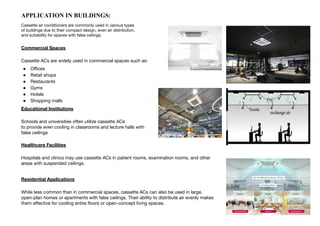
Commercial Spaces
Cassette ACs are widely used in commercial spaces such as:
● Offices
● Retail shops
● Restaurants
● Gyms
● Hotels
● Shopping malls
Educational Institutions
Schools and universities often utilize cassette ACs
to provide even cooling in classrooms and lecture halls with
false ceilings
Healthcare Facilities
Hospitals and clinics may use cassette ACs in patient rooms, examination rooms, and other
areas with suspended ceilings.
Residential Applications
While less common than in commercial spaces, cassette ACs can also be used in large,
open-plan homes or apartments with false ceilings. Their ability to distribute air evenly makes
them effective for cooling entire floors or open-concept living spaces.
APPLICATION IN BUILDINGS:
Cassette air conditioners are commonly used in various types
of buildings due to their compact design, even air distribution,
and suitability for spaces with false ceilings.
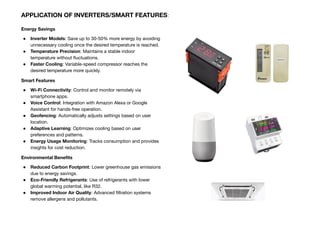
Energy Savings
● Inverter Models: Save up to 30-50% more energy by avoiding
unnecessary cooling once the desired temperature is reached.
● Temperature Precision: Maintains a stable indoor
temperature without fluctuations.
● Faster Cooling: Variable-speed compressor reaches the
desired temperature more quickly.
Smart Features
● Wi-Fi Connectivity: Control and monitor remotely via
smartphone apps.
● Voice Control: Integration with Amazon Alexa or Google
Assistant for hands-free operation.
● Geofencing: Automatically adjusts settings based on user
location.
● Adaptive Learning: Optimizes cooling based on user
preferences and patterns.
● Energy Usage Monitoring: Tracks consumption and provides
insights for cost reduction.
Environmental Benefits
● Reduced Carbon Footprint: Lower greenhouse gas emissions
due to energy savings.
● Eco-Friendly Refrigerants: Use of refrigerants with lower
global warming potential, like R32.
● Improved Indoor Air Quality: Advanced filtration systems
remove allergens and pollutants.
APPLICATION OF INVERTERS/SMART FEATURES:
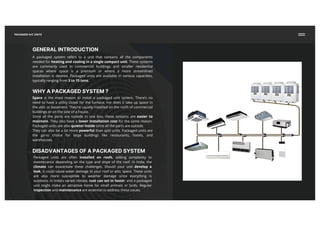
GENERAL INTRODUCTION
A packaged system refers to a unit that contains all the components
needed for heating and cooling in a single compact unit. These systems
are commonly used in commercial buildings and smaller residential
spaces where space is a premium or where a more streamlined
installation is desired. Packaged units are available in various capacities,
typically ranging from 3 to 15 tons.
WHY A PACKAGED SYSTEM ?
Space is the main reason to install a packaged unit system. There’s no
need to have a utility closet for the furnace, nor does it take up space in
the attic or basement. They’re usually installed on the roofs of commercial
buildings or on the side of a house.
Since all the parts are outside in one box, these systems are easier to
maintain. They also have a lower installation cost for the same reason.
Packaged units are also quieter inside since all the parts are outside.
They can also be a lot more powerful than split units. Packaged units are
the go-to choice for large buildings like restaurants, hotels, and
warehouses.
DISADVANTAGES OF A PACKAGED SYSTEM
Packaged units are often installed on roofs, adding complexity to
maintenance depending on the type and slope of the roof. In India, the
climate can exacerbate these challenges. Should your unit develop a
leak, it could cause water damage to your roof or attic space. These units
are also more susceptible to weather damage since everything is
outdoors. In India’s varied climate, rust can set in faster, and a packaged
unit might make an attractive home for small animals or birds. Regular
inspection and maintenance are essential to address these issues.
PACKAGED A/C UNITS
WORKING PRINCIPLES
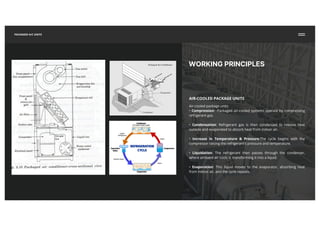
AIR-COOLED PACKAGE UNITS
Air-cooled package units
• Compression: ·Packaged air-cooled systems operate by compressing
refrigerant gas.
• Condensation: Refrigerant gas is then condensed to release heat
outside and evaporated to absorb heat from indoor air.
• Increase in Temperature & Pressure:The cycle begins with the
compressor raising the refrigerant's pressure and temperature.
• Liquidation: The refrigerant then passes through the condenser,
where ambient air cools it, transforming it into a liquid.
• Evaporation: This liquid moves to the evaporator, absorbing heat
from indoor air, and the cycle repeats.
PACKAGED A/C UNITS
WORKING PRINCIPLES
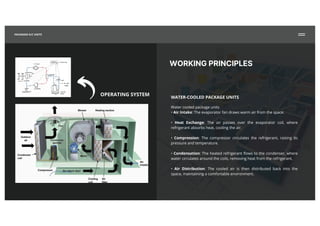
Water cooled package units
• Air Intake: The evaporator fan draws warm air from the space.
• Heat Exchange: The air passes over the evaporator coil, where
refrigerant absorbs heat, cooling the air.
• Compression: The compressor circulates the refrigerant, raising its
pressure and temperature.
• Condensation: The heated refrigerant flows to the condenser, where
water circulates around the coils, removing heat from the refrigerant.
• Air Distribution: The cooled air is then distributed back into the
space, maintaining a comfortable environment.
WATER-COOLED PACKAGE UNITS
OPERATING SYSTEM
PACKAGED A/C UNITS
APPLICATIONS
1. Commercial Buildings:
• Offices: Ideal for small to medium-sized office spaces where central
air conditioning is required but space for separate indoor and outdoor
units is limited.
• Retail Stores: Used in stores and showrooms to provide consistent
cooling and heating, enhancing the shopping experience.
2. Hospitality Industry:
• Hotels and Restaurants: Packaged units are used to maintain
comfortable temperatures in guest rooms, dining areas, and conference
rooms.
3. Healthcare Facilities:
• Hospitals and Clinics: Ensure a controlled and sterile environment,
crucial for patient care areas and operating rooms.
4. Educational Institutions:
• Schools and Colleges: Provide a comfortable learning environment in
classrooms, auditoriums, and administrative offices.
5. Industrial and Manufacturing Units:
• Factories and Warehouses: Maintain specific temperatures to ensure
optimal working conditions and to protect sensitive equipment and
materials.
6. Residential Complexes:
• Apartments and Villas: In multi-story residential buildings where
central air conditioning is preferred over individual split units.
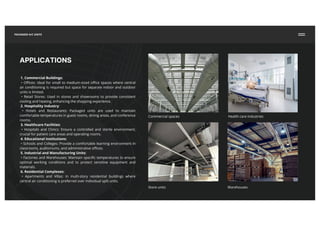
Commercial spaces Health care industries
Store units Warehouses
PACKAGED A/C UNITS
GENERAL
DIMENSIONS
-
CARRIER
RTU
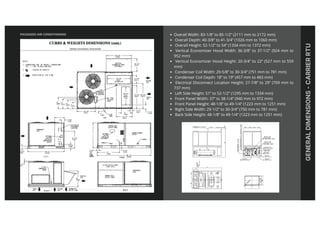
Overall Width: 83-1/8” to 85-1/2” (2111 mm to 2172 mm)
Overall Depth: 40-3/8” to 41-3/4” (1026 mm to 1060 mm)
Overall Height: 52-1/2” to 54” (1334 mm to 1372 mm)
Vertical Economizer Hood Width: 36-3/8” to 37-1/2” (924 mm to
952 mm)
Vertical Economizer Hood Height: 20-3/4” to 22” (527 mm to 559
mm)
Condenser Coil Width: 29-5/8” to 30-3/4” (751 mm to 781 mm)
Condenser Coil Depth: 18” to 19” (457 mm to 483 mm)
Electrical Disconnect Location Height: 27-7/8” to 29” (709 mm to
737 mm)
Left Side Height: 51” to 52-1/2” (1295 mm to 1334 mm)
Front Panel Width: 37” to 38-1/4” (940 mm to 972 mm)
Front Panel Height: 48-1/8” to 49-1/4” (1223 mm to 1251 mm)
Right Side Width: 29-1/2” to 30-3/4” (750 mm to 781 mm)
Back Side Height: 48-1/8” to 49-1/4” (1223 mm to 1251 mm)
PACKAGED AIR CONDITIONING
Working Principles
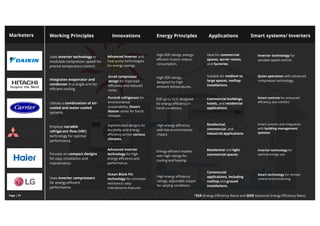
Marketers
Uses inverter technology to
modulate compressor speed for
precise temperature control.
Innovations Energy Principles Applications Smart systems/ Inverters
Integrates evaporator and
condenser in a single unit for
efficient cooling.
Utilizes a combination of air-
cooled and water-cooled
systems.
Employs variable
refrigerant flow (VRF)
technology for optimal
performance.
Focuses on compact designs
for easy installation and
maintenance.
Uses inverter compressors
for energy-efficient
performance.
Advanced inverter and
heat pump technologies
for energy savings.
Scroll compressor
design for improved
efficiency and reduced
noise.
Puron® refrigerant for
environmental
sustainability; Desert
Master series for harsh
climates.
Sophisticated designs for
durability and energy
efficiency across various
climates.
Advanced inverter
technology for high
energy efficiency and
performance.
Ocean Black Fin
technology for corrosion
resistance; easy
maintenance features.
High EER ratings, energy-
efficient motors reduce
consumption.
*EER (Energy Efficiency Ratio) and SEER (Seasonal Energy Efficiency Ratio)
High EER ratings,
designed for high
ambient temperatures.
EER up to 12.5, designed
for energy efficiency in
harsh conditions.
High energy efficiency
with low environmental
impact.
Energy-efficient models
with high ratings for
cooling and heating.
High energy efficiency
ratings, adjustable output
for varying conditions.
Ideal for commercial
spaces, server rooms,
and factories.
Suitable for medium to
large spaces, rooftop
installations.
Commercial buildings,
hotels, and residential
applications.
Residential,
commercial, and
industrial applications.
Residential and light
commercial spaces.
Commercial
applications, including
rooftop and ground
installations.
Inverter technology for
variable speed control.
Quiet operation with advanced
compressor technology.
Smart controls for enhanced
efficiency and comfort.
Smart controls and integration
with building management
systems.
Inverter technology for
optimal energy use.
Smart technology for remote
control and monitoring.
Page | 07
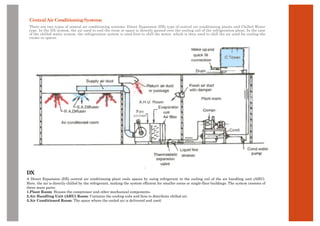
Central Air ConditioningSystems
There are two types of central air conditioning systems: Direct Expansion (DX) type of central air conditioning plants and Chilled Water
type. In the DX system, the air used to cool the room or space is directly passed over the cooling coil of the refrigeration plant. In the case
of the chilled water system, the refrigeration system is used first to chill the water, which is then used to chill the air used for cooling the
rooms or spaces.
A Direct Expansion (DX) central air conditioning plant cools spaces by using refrigerant in the cooling coil of the air handling unit (AHU).
Here, the air is directly chilled by the refrigerant, making the system efficient for smaller areas or single-floor buildings. The system consists of
three main parts:
1.Plant Room: Houses the compressor and other mechanical components.
2.Air Handling Unit (AHU) Room: Contains the cooling coils and fans to distribute chilled air.
3.Air Conditioned Room: The space where the cooled air is delivered and used.
DX
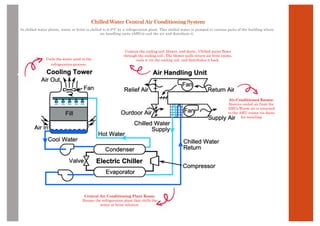
Chilled Water Central Air Conditioning System
In chilled water plants, water or brine is chilled to 6-8°C by a refrigeration plant. This chilled water is pumped to various parts of the building where
air handling units (AHUs) cool the air and distribute it.
Central Air Conditioning Plant Room:
Houses the refrigeration plant that chills the
water or brine solution.
Contain the cooling coil, blower, and ducts.; Chilled water flows
through the cooling coil.; The blower pulls return air from rooms,
cools it via the cooling coil, and distributes it back.
Cools the water used in the
refrigeration process.
Air-Conditioned Rooms:
Receive cooled air from the
AHUs.Warm air is returned
to the AHU rooms via ducts
for recooling
Direct Expansion
• Direct expansion, or DX cooling, uses the principles of thermodynamics to
transfer heat from one area to another through the evaporation and
condensation of a refrigerant, which serves as the medium through which
heat is captured and removed from one area and released in another.
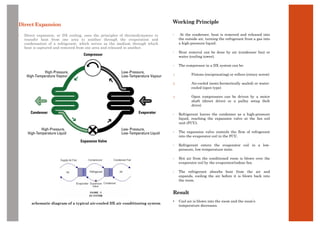
Working Principle
• At the condenser, heat is removed and released into
the outside air, turning the refrigerant from a gas into
a high-pressure liquid.
• Heat removal can be done by air (condenser fan) or
water (cooling tower).
• The compressor in a DX system can be:
1. Pistons (reciprocating) or rollers (rotary screw)
2. Air-cooled (semi-hermetically sealed) or water-
cooled (open type)
3. Open compressors can be driven by a motor
shaft (direct drive) or a pulley setup (belt
drive)
• Refrigerant leaves the condenser as a high-pressure
liquid, reaching the expansion valve at the fan coil
unit (FCU).
• The expansion valve controls the flow of refrigerant
into the evaporator coil in the FCU.
• Refrigerant enters the evaporator coil in a low-
pressure, low-temperature state.
• Hot air from the conditioned room is blown over the
evaporator coil by the evaporator/indoor fan.
• The refrigerant absorbs heat from the air and
expands, cooling the air before it is blown back into
the room.
• Cool air is blown into the room and the room’s
temperature decreases.
Result
schematic diagram of a typical air-cooled DX air conditioning system
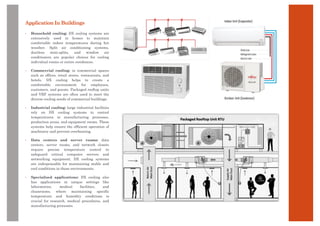
Application In Buildings
• Household cooling: DX cooling systems are
extensively used in homes to maintain
comfortable indoor temperatures during hot
weather. Split air conditioning systems,
ductless mini-splits, and window air
conditioners are popular choices for cooling
individual rooms or entire residences.
• Commercial cooling: in commercial spaces
such as offices, retail stores, restaurants, and
hotels, DX cooling helps to create a
comfortable environment for employees,
customers, and guests. Packaged rooftop units
and VRF systems are often used to meet the
diverse cooling needs of commercial buildings.
• Industrial cooling: large industrial facilities
rely on DX cooling systems to control
temperatures in manufacturing processes,
production areas, and equipment rooms. These
systems help ensure the efficient operation of
machinery and prevent overheating.
• Data centers and server rooms: data
centers, server rooms, and network closets
require precise temperature control to
safeguard critical computer servers and
networking equipment. DX cooling systems
are indispensable for maintaining stable and
cool conditions in these environments.
• Specialised applications: DX cooling also
has applications in unique settings like
laboratories, medical facilities, and
cleanrooms, where maintaining specific
temperature and humidity conditions is
crucial for research, medical procedures, and
manufacturing processes.
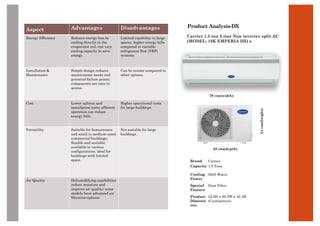
Product Analysis-DX
Carrier 1.5 ton 3 star Non inverter split AC
(MODEL: 18K EMPERIA DX) e
79 cm(width)
54
cm(height)
28 cm(depth)
Brand Carrier
Capacity 1.5 Tons
Cooling
Power
5200 Watts
Special
Feature
Dust Filter
Product
Dimensi
ons
22.8D x 96.5W x 32.4H
(Centimeters)
Aspect Advantages Disadvantages
Energy Efficiency Reduces energy loss by
cooling directly in the
evaporator coil; can vary
cooling capacity to save
energy.
Limited capability in large
spaces; higher energy bills
compared to variable
refrigerant flow (VRF)
systems.
Installation &
Maintenance
Simple design reduces
maintenance needs and
potential failure points;
components are easy to
access.
Can be noisier compared to
other options.
Cost Lower upfront and
installation costs; efficient
operation can reduce
energy bills.
Higher operational costs
for large buildings.
Versatility Suitable for homeowners
and small to medium-sized
commercial buildings;
flexible and scalable;
available in various
configurations; ideal for
buildings with limited
space.
Not suitable for large
buildings.
Air Quality Dehumidifying capabilities
reduce moisture and
improve air quality; some
models have advanced air
filtration options.
APPLICATION OF INVERTERS IN DX SYSTEMS
1. Remote Monitoring and Control:
1. Application: Allows control and monitoring of the AC unit via
mobile devices or computers.
2. Benefits: Convenience and flexibility in managing the system
from anywhere.
2. Programmable Schedules:
1. Application: Enables setting cooling schedules based on when
the space is occupied.
2. Benefit: Optimizes energy use and reduces waste.
APPLICATION OF SMART SYSTEM IN DX SYSTEMS
1. Variable Speed Control:
1. Application: Adjusts compressor speed based on cooling needs for
precise temperature control.
2. Benefit: Reduces energy consumption and improves comfort.
2. Energy Efficiency:
1. Application: Operates more efficiently by reducing frequent on-off
cycles.
2. Benefits: Lower electricity bills and longer equipment lifespan.
3. Quieter Operation:
1. Application: Runs smoothly without noisy start-stop cycles.
2. Benefit: Quieter indoor environment
LATEST INNOVATION
1. Wireless Sensors and Controls
• Innovation: Use of wireless sensors for real-time monitoring of
temperature, humidity, and system performance.
• Benefit: Provides flexible and easy-to-install monitoring solutions,
improving system management and efficiency.
2. Self-Cleaning Coils and Filters
• Innovation: DX systems are incorporating self-cleaning
technologies for coils and filters.
• Benefit: Reduces maintenance needs and improves air quality and
system efficiency.
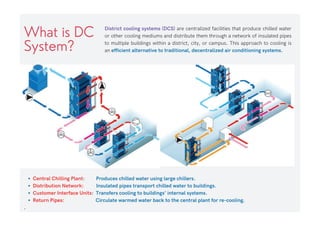
What is DC
System?
District cooling systems (DCS) are centralized facilities that produce chilled water
or other cooling mediums and distribute them through a network of insulated pipes
to multiple buildings within a district, city, or campus. This approach to cooling is
an efficient alternative to traditional, decentralized air conditioning systems.
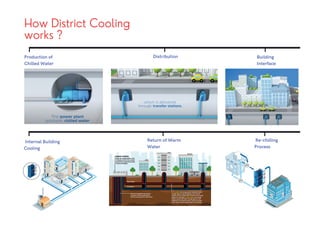
Central Chilling Plant: Produces chilled water using large chillers.
Distribution Network: Insulated pipes transport chilled water to buildings.
Customer Interface Units: Transfers cooling to buildings' internal systems.
Return Pipes: Circulate warmed water back to the central plant for re-cooling.
.
Production of
Chilled Water
How District Cooling
works ?
Distribution Building
Interface
Internal Building
Cooling
Return of Warm
Water
Re-chilling
Process
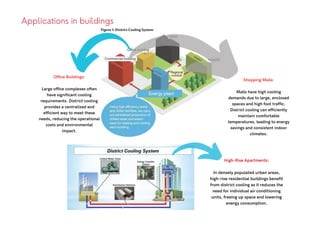
Shopping Malls:
Malls have high cooling
demands due to large, enclosed
spaces and high foot traffic.
District cooling can efficiently
maintain comfortable
temperatures, leading to energy
savings and consistent indoor
climates.
Office Buildings:
Large office complexes often
have significant cooling
requirements. District cooling
provides a centralized and
efficient way to meet these
needs, reducing the operational
costs and environmental
impact.
High-Rise Apartments:
In densely populated urban areas,
high-rise residential buildings benefit
from district cooling as it reduces the
need for individual air conditioning
units, freeing up space and lowering
energy consumption.
Applications in buildings
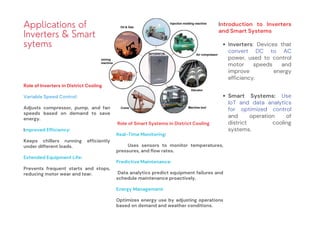
Applications of
Inverters & Smart
sytems
Introduction to Inverters
and Smart Systems
Inverters: Devices that
convert DC to AC
power, used to control
motor speeds and
improve energy
efficiency.
Smart Systems: Use
IoT and data analytics
for optimized control
and operation of
district cooling
systems.
Role of Inverters in District Cooling
Variable Speed Control:
Adjusts compressor, pump, and fan
speeds based on demand to save
energy.
Improved Efficiency:
Keeps chillers running efficiently
under different loads.
Extended Equipment Life:
Prevents frequent starts and stops,
reducing motor wear and tear.
Role of Smart Systems in District Cooling
Real-Time Monitoring:
Uses sensors to monitor temperatures,
pressures, and flow rates.
Predictive Maintenance:
Data analytics predict equipment failures and
schedule maintenance proactively.
Energy Management:
Optimizes energy use by adjusting operations
based on demand and weather conditions.
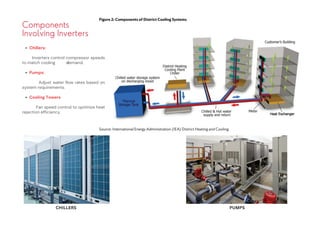
Components
Involving Inverters
Chillers:
Inverters control compressor speeds
to match cooling demand.
Pumps:
Adjust water flow rates based on
system requirements.
Cooling Towers
Fan speed control to optimize heat
rejection efficiency.
PUMPS
CHILLERS
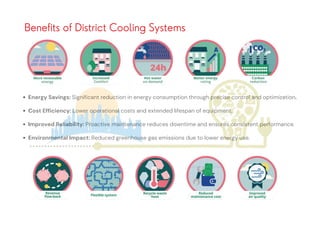
Energy Savings: Significant reduction in energy consumption through precise control and optimization.
Cost Efficiency: Lower operational costs and extended lifespan of equipment.
Improved Reliability: Proactive maintenance reduces downtime and ensures consistent performance.
Environmental Impact: Reduced greenhouse gas emissions due to lower energy use.
Benefits of District Cooling Systems
Energy Savings: Sig
g
g
g
g
g
g
g
gn
nificant reduc
c
c
c
c
c
ct
tion in energy consumption through p
p
p
p
p
p
p
p
p
p
p
pr
r
r
r
r
r
r
r
r
re
e
e
e
e
e
e
e
ec
c
c
c
c
c
c
c
c
cis
s
s
s
s
s
s
s
s
s
s
s
se
e
e
e
e
e
e
e
e
e c
c
c
c
c
c
c
c
con
n
n
n
n
n
n
n
n
n
n
nt
t
t
t
t
t
t
t
tro
o
o
o
o
o
o
o
o
o
o
ol
l
l
l
l
l
l
l a
a
a
a
a
a
a
a
a
a
an
n
n
n
n
n
n
n
n
nd
d
d
d
d
d
d
d
d
d optimization.
Cost Efficiency: L
L
L
L
L
L
L
L
L
L
L
L
L
L
L
Lo
o
o
o
o
o
ow
we
e
e
e
e
e
e
e
e
e
e
er
r
r
r
r
r
r
r
r
r
r
r
r
r
r
r
r
r
r
r o
o
o
o
o
o
o
o
o
o
o
o
o
o
op
p
p
p
p
p
p
p
p
pe
e
e
e
e
e
e
e
e
e
e
e
e
er
r
r
r
r
r
r
r
ra
a
at
t
ti
iona
a
a
a
a
al
l
l
l
l
l
l
l costs and extended lifespan of equ
u
u
u
u
u
u
u
u
u
ui
i
i
i
i
i
i
i
ip
p
p
p
p
p
p
p
pm
m
m
m
m
m
m
m
m
m
m
m
me
e
e
e
e
e
e
e
e
e
e
e
e
en
n
n
n
n
n
n
n
n
n
nt
t
t
t
t
t
t
t
t
t
t..
Improved R
R
R
R
R
R
R
R
R
R
R
R
Re
e
e
e
e
e
e
e
e
e
e
el
l
l
l
l
l
l
l
l
li
i
i
ia
ab
b
b
b
b
b
b
bil
li
it
t
ty
y
y
y
y
y:
:
:
:
: P
P
P
P
P
P
P
P
P
P
P
P
P
P
P
Pr
r
r
r
ro
o
o
o
o
o
o
oa
a
ac
c
c
ct
t
t
ti
iv
ve
e
e
e
e
e
e
e
e
e
e
e m
m
ma
a
a
a
ai
i
in
n
n
n
n
n
nt
te
e
e
e
e
e
e
e
e
e
e
e
en
n
n
n
n
n
n
n
n
n
na
anc
c
c
c
c
c
ce reduces downtime and ens
s
s
s
s
su
u
u
u
u
u
u
u
u
ur
r
r
r
r
r
r
r
r
r
re
e
e
e
e
e
e
e
e
e
es
s
s
s
s
s
s
s
s c
c
c
c
c
c
c
c
c
c
c
co
o
o
o
o
o
o
o
o
on
n
n
n
n
n
n
ns
s
s
s
s
s
s
s
s
s
s
si
i
i
i
i
i
i
i
i
i
i
is
s
s
s
s
s
s
s
s
s
s
s
st
t
t
t
t
t
t
t
t
t
te
e
e
e
e
e
e
e
ent
t
t
t
t
t
t
t p
p
p
p
p
p
p
p
p
pe
e
e
e
e
e
e
e
e
er
r
r
r
r
rf
f
f
f
f
f
f
f
fo
o
o
o
o
o
o
o
o
o
ormance.
Environm
m
m
m
m
m
m
m
me
e
e
e
e
e
e
e
e
en
n
n
n
n
n
n
n
n
n
nt
t
t
t
t
t
t
t
t
ta
a
a
a
a
al
l
l
l
l
l
l
l I
Impact: Reduced gree
e
e
en
n
n
n
n
n
n
n
n
n
nh
h
h
h
h
h
h
h
h
h
ho
o
o
o
o
o
o
o
o
ous
s
s
s
s
se gas emissions due to lower en
n
n
n
n
n
n
n
n
ne
e
e
e
e
e
e
e
e
e
er
r
r
r
r
r
r
r
r
r
rg
g
g
g
g
g
g
g
g
gy
y
y
y
y
y
y
y
y
y
y
y u
u
u
u
u
u
u
u
u
us
s
s
s
s
s
s
s
s
s
se.
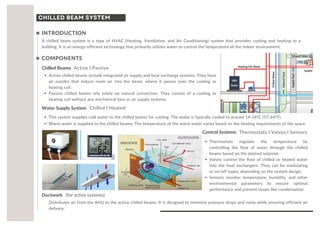
CHILLED BEAM SYSTEM
A chilled beam system is a type of HVAC (Heating, Ventilation, and Air Conditioning) system that provides cooling and heating to a
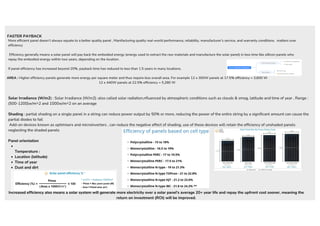
building. It is an energy-efficient technology that primarily utilizes water to control the temperature of the indoor environment.
Chilled Beams
INTRODUCTION
Active l Passive
COMPONENTS
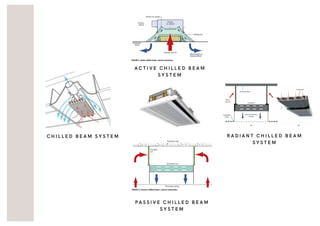
Active chilled beams include integrated air supply and heat exchange systems. They have
air nozzles that induce room air into the beam, where it passes over the cooling or
heating coil.
Passive chilled beams rely solely on natural convection. They consist of a cooling or
heating coil without any mechanical fans or air supply systems.
Water Supply System Chilled l Heated
This system supplies cold water to the chilled beams for cooling. The water is typically cooled to around 14-18°C (57-64°F).
Warm water is supplied to the chilled beams. The temperature of the warm water varies based on the heating requirements of the space.
Control Systems Thermostats l Valves l Sensors
Ductwork (for active systems)
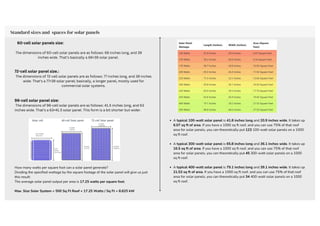
Distributes air from the AHU to the active chilled beams. It is designed to minimize pressure drops and noise while ensuring efficient air
delivery.
Thermostats regulate the temperature by
controlling the flow of water through the chilled
beams based on the desired setpoint.
Valves control the flow of chilled or heated water
into the heat exchangers. They can be modulating
or on/off types, depending on the system design.
Sensors monitor temperature, humidity, and other
environmental parameters to ensure optimal
performance and prevent issues like condensation.
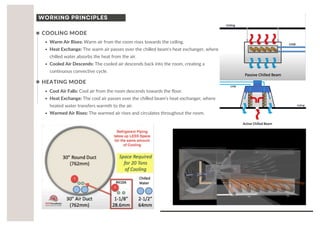
Cool Air Falls: Cool air from the room descends towards the floor.
Heat Exchange: The cool air passes over the chilled beam's heat exchanger, where
heated water transfers warmth to the air.
Warmed Air Rises: The warmed air rises and circulates throughout the room.
Warm Air Rises: Warm air from the room rises towards the ceiling.
Heat Exchange: The warm air passes over the chilled beam's heat exchanger, where
chilled water absorbs the heat from the air.
Cooled Air Descends: The cooled air descends back into the room, creating a
continuous convective cycle.
WORKING PRINCIPLES
COOLING MODE
HEATING MODE
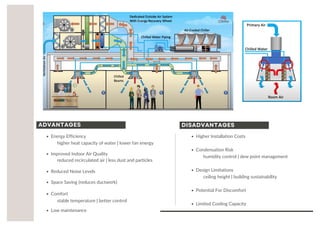
ADVANTAGES
Energy Efficiency
higher heat capacity of water | lower fan energy
Improved Indoor Air Quality
reduced recirculated air | less dust and particles
Reduced Noise Levels
Space Saving (reduces ductwork)
Comfort
stable temperature | better control
Low maintenance
DISADVANTAGES
Higher Installation Costs
Condensation Risk
humidity control | dew point management
Design Limitations
ceiling height | building sustainability
Potential For Discomfort
Limited Cooling Capacity
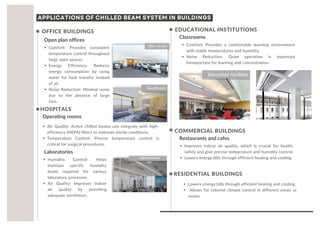
Comfort: Provides a comfortable learning environment
with stable temperatures and humidity.
Noise Reduction: Quiet operation is important
forimportant for learning and concentration.
Comfort: Provides consistent
temperature control throughout
large open spaces.
Energy Efficiency: Reduces
energy consumption by using
water for heat transfer instead
of air.
Noise Reduction: Minimal noise
due to the absence of large
fans.
Open plan offices
OFFICE BUILDINGS
HOSPITALS
Operating rooms
Air Quality: Active chilled beams can integrate with high-
efficiency (HEPA) filters to maintain sterile conditions.
Temperature Control: Precise temperature control is
critical for surgical procedures.
Laboratories
Humidity Control: Helps
maintain specific humidity
levels required for various
laboratory processes.
Air Quality: Improves indoor
air quality by providing
adequate ventilation.
EDUCATIONAL INSTITUTIONS
Classrooms
COMMERCIAL BUILDINGS
Restaurants and cafes
Improves indoor air quality, which is crucial for health,
safety and give precise temperature and humidity control.
Lowers energy bills through efficient heating and cooling.
RESIDENTIAL BUILDINGS
Lowers energy bills through efficient heating and cooling.
Allows for tailored climate control in different zones or
rooms.
APPLICATIONS OF CHILLED BEAM SYSTEM IN BUILDINGS
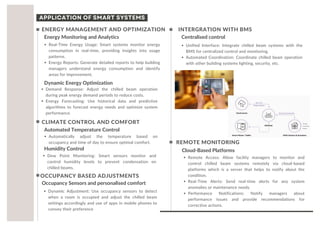
Real-Time Energy Usage: Smart systems monitor energy
consumption in real-time, providing insights into usage
patterns.
Energy Reports: Generate detailed reports to help building
managers understand energy consumption and identify
areas for improvement.
Energy Monitoring and Analytics
ENERGY MANAGEMENT AND OPTIMIZATION
Dynamic Energy Optimization
Demand Response: Adjust the chilled beam operation
during peak energy demand periods to reduce costs.
Energy Forecasting: Use historical data and predictive
algorithms to forecast energy needs and optimize system
performance.
INTERGRATION WITH BMS
Centralised control
Unified Interface: Integrate chilled beam systems with the
BMS for centralized control and monitoring.
Automated Coordination: Coordinate chilled beam operation
with other building systems lighting, security, etc.
CLIMATE CONTROL AND COMFORT
Automated Temperature Control
Automatically adjust the temperature based on
occupancy and time of day to ensure optimal comfort.
Humidity Control
Dew Point Monitoring: Smart sensors monitor and
control humidity levels to prevent condensation on
chilled beams.
OCCUPANCY BASED ADJUSTMENTS
Occupancy Sensors and personalised comfort
Dynamic Adjustment: Use occupancy sensors to detect
when a room is occupied and adjust the chilled beam
settings accordingly and use of apps in mobile phones to
convey their preference
REMOTE MONITORING
Cloud-Based Platforms
Remote Access: Allow facility managers to monitor and
control chilled beam systems remotely via cloud-based
platforms which is a server that helps to notify about the
condition.
Real-Time Alerts: Send real-time alerts for any system
anomalies or maintenance needs.
Performance Notifications: Notify managers about
performance issues and provide recommendations for
corrective actions.
APPLICATION OF SMART SYSTEMS
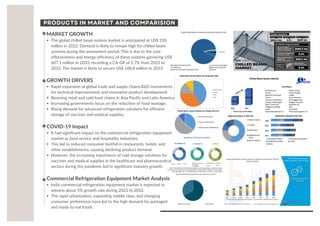
PRODUCTS IN MARKET AND COMPARISION
MARKET GROWTH
The global chilled beam system market is anticipated at US$ 330
million in 2022. Demand is likely to remain high for chilled beam
systems during the assessment period. This is due to the cost-
effectiveness and energy efficiency of these systems garnering US$
607.1 million in 2033, recording a CA-GR of 5.7% from 2023 to
2033. The market is likely to secure US$ 348.8 million in 2023.
GROWTH DRIVERS
Rapid expansion of global trade and supply chains.R&D investments
for technical improvements and innovative product development
Booming retail and cold food chains in Asia Pacific and Latin America
Increasing governments focus on the reduction of food wastage.
Rising demand for advanced refrigeration solutions for efficient
storage of vaccines and medical supplies.
COVID-19 Impact
It had significant impact on the commercial refrigeration equipment
market as food service and hospitality industries.
This led to reduced consumer footfall in restaurants, hotels, and
other establishments, causing declining product demand.
However, the increasing importance of cold storage solutions for
vaccines and medical supplies in the healthcare and pharmaceutical
sectors during the pandemic led to significant industry growth.
Commercial Refrigeration Equipment Market Analysis
India commercial refrigeration equipment market is expected to
witness about 5% growth rate during 2023 to 2032.
The rapid urbanization, expanding middle class, and changing
consumer preferences have led to the high demand for packaged
and ready-to-eat foods.
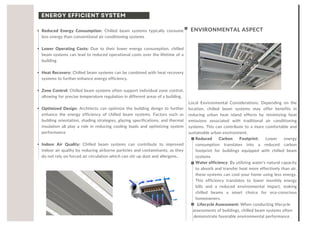
Reduced Energy Consumption: Chilled beam systems typically consume
less energy than conventional air conditioning systems
Lower Operating Costs: Due to their lower energy consumption, chilled
beam systems can lead to reduced operational costs over the lifetime of a
building
Heat Recovery: Chilled beam systems can be combined with heat recovery
systems to further enhance energy efficiency.
Zone Control: Chilled beam systems often support individual zone control,
allowing for precise temperature regulation in different areas of a building.
Optimized Design: Architects can optimize the building design to further
enhance the energy efficiency of chilled beam systems. Factors such as
building orientation, shading strategies, glazing specifications, and thermal
insulation all play a role in reducing cooling loads and optimizing system
performance
Indoor Air Quality: Chilled beam systems can contribute to improved
indoor air quality by reducing airborne particles and contaminants, as they
do not rely on forced air circulation which can stir up dust and allergens..
Local Environmental Considerations: Depending on the
location, chilled beam systems may offer benefits in
reducing urban heat island effects by minimizing heat
emissions associated with traditional air conditioning
systems. This can contribute to a more comfortable and
sustainable urban environment.
Reduced Carbon Footprint: Lower energy
consumption translates into a reduced carbon
footprint for buildings equipped with chilled beam
systems
Water efficiency: By utilizing water's natural capacity
to absorb and transfer heat more effectively than air,
these systems can cool your home using less energy.
This efficiency translates to lower monthly energy
bills and a reduced environmental impact, making
chilled beams a smart choice for eco-conscious
homeowners.
Lifecycle Assessment: When conducting lifecycle
assessments of buildings, chilled beam systems often
demonstrate favorable environmental performance .
ENERGY EFFICIENT SYSTEM
ENVIRONMENTAL ASPECT
DESIGN CONSIDERATION
LATEST INNOVATIONS
Ceiling Integration: Chilled beams are typically integrated into the
ceiling structure. Architects need to plan the ceiling heights and
layouts to accommodate the chilled beam
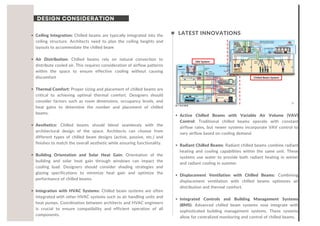
Air Distribution: Chilled beams rely on natural convection to
distribute cooled air. This requires consideration of airflow patterns
within the space to ensure effective cooling without causing
discomfort
Thermal Comfort: Proper sizing and placement of chilled beams are
critical to achieving optimal thermal comfort. Designers should
consider factors such as room dimensions, occupancy levels, and
heat gains to determine the number and placement of chilled
beams.
Aesthetics: Chilled beams should blend seamlessly with the
architectural design of the space. Architects can choose from
different types of chilled beam designs (active, passive, etc.) and
finishes to match the overall aesthetic while ensuring functionality.
Building Orientation and Solar Heat Gain: Orientation of the
building and solar heat gain through windows can impact the
cooling load. Designers should consider shading strategies and
glazing specifications to minimize heat gain and optimize the
performance of chilled beams.
Integration with HVAC Systems: Chilled beam systems are often
integrated with other HVAC systems such as air handling units and
heat pumps. Coordination between architects and HVAC engineers
is crucial to ensure compatibility and efficient operation of all
components.
Active Chilled Beams with Variable Air Volume (VAV)
Control: Traditional chilled beams operate with constant
airflow rates, but newer systems incorporate VAV control to
vary airflow based on cooling demand.
Radiant Chilled Beams: Radiant chilled beams combine radiant
heating and cooling capabilities within the same unit. These
systems use water to provide both radiant heating in winter
and radiant cooling in summer
Displacement Ventilation with Chilled Beams: Combining
displacement ventilation with chilled beams optimizes air
distribution and thermal comfort.
Integrated Controls and Building Management Systems
(BMS): Advanced chilled beam systems now integrate with
sophisticated building management systems. These systems
allow for centralized monitoring and control of chilled beams,
A C T I V E C H I L L E D B E A M
S Y S T E M
R A D I A N T C H I L L E D B E A M
S Y S T E M
C H I L L E D B E A M S Y S T E M
P A S S I V E C H I L L E D B E A M
S Y S T E M
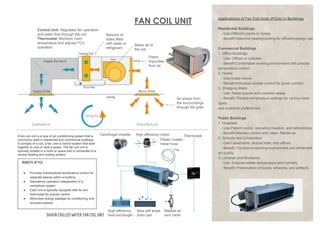
FAN COIL UNIT
Filters
impurities
from air
Blows air to
the coil
Network of
tubes filled
with water or
refrigerant
Applications of Fan Coil Units (FCUs) in Buildings
Residential Buildings
- Use:Different rooms or zones.
- Benefit:Selective heating/cooling for efficient energy use.
Commercial Buildings
1. Office Buildings:
- Use: Offices or cubicles.
- Benefit:Comfortable working environment with precise
temperature control.
2. Hotels:
- Use:Guest rooms.
- Benefit:Individual climate control for guest comfort.
3. Shopping Malls:
- Use: Retail spaces and common areas.
- Benefit: Flexible temperature settings for various store
types
and customer preferences.
Public Buildings
1. Hospitals:
- Use:Patient rooms, operating theaters, and laboratories.
- Benefit:Infection control with clean, filtered air.
2. Schools and Universities:
- Use:Classrooms, lecture halls, and offices.
- Benefit: Conducive learning environment and enhanced
air quality.
3. Libraries and Museums:
- Use: Ensures stable temperature and humidity.
- Benefit: Preservation of books, artworks, and artifacts.
Control Unit: Regulates fan operation
and water flow through the coil.
Thermostat: Monitors room
temperature and adjusts FCU
operation.
Centrifugal impeller High efficiency motor
Plastic coated
metal hose
Thermostat
High efficiency
heat exchanger
New self slope
drain pan
Manual air
vent valve
DAIKIN CHILLED WATER FAN COIL UNIT
A fan coil unit is a type of air conditioning system that is
commonly used in residential and commercial buildings.
It consists of a coil, a fan, and a control system that work
together to cool or heat a space. The fan coil unit is
typically located in a room or space and is connected to a
central heating and cooling system.
BENEFITS OF FCU:
● Provides individualized temperature control for
separate spaces within a building
● Standalone operation independent of a
centralized system
● Each unit is typically equipped with its own
thermostat for precise control
● Minimizes energy wastage by conditioning only
occupied spaces
Air enters from
the surroundings
through the grille
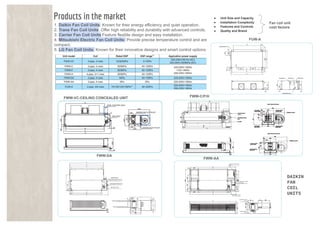
Products in the market
1. Daikin Fan Coil Units: Known for their energy efficiency and quiet operation.
2. Trane Fan Coil Units: Offer high reliability and durability with advanced controls.
3. Carrier Fan Coil Units:Feature flexible design and easy installation.
4. Mitsubishi Electric Fan Coil Units: Provide precise temperature control and are
compact.
5. LG Fan Coil Units: Known for their innovative designs and smart control options.
FWW-VC-CEILING CONCEALED UNIT FWW-C/F/H
FWW-DA
FWW-AA
FUW-A
DAIKIN
FAN
COIL
UNITS
● Unit Size and Capacity
● Installation Complexity
● Features and Controls
● Quality and Brand
Fan coil unit
cost factors
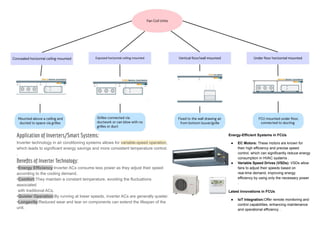
Application of Inverters/Smart Systems:
Inverter technology in air conditioning systems allows for variable-speed operation,
which leads to significant energy savings and more consistent temperature control.
.
Benefits of Inverter Technology:
•Energy Efficiency:Inverter ACs consume less power as they adjust their speed
according to the cooling demand.
•Comfort:They maintain a constant temperature, avoiding the fluctuations
associated
with traditional ACs.
•Quieter Operation:By running at lower speeds, inverter ACs are generally quieter.
•Longevity:Reduced wear and tear on components can extend the lifespan of the
unit.
Energy-Efficient Systems in FCUs
● EC Motors: These motors are known for
their high efficiency and precise speed
control, which can significantly reduce energy
consumption in HVAC systems .
● Variable Speed Drives (VSDs): VSDs allow
fans to adjust their speeds based on
real-time demand, improving energy
efficiency by using only the necessary power
.
Latest Innovations in FCUs
● IoT Integration:Offer remote monitoring and
control capabilities, enhancing maintenance
and operational efficiency .
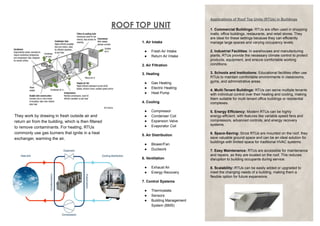
ROOF TOP UNIT 1. Commercial Buildings: RTUs are often used in shopping
malls, office buildings, restaurants, and retail stores. They
are ideal for these settings because they can efficiently
manage large spaces and varying occupancy levels.
2. Industrial Facilities: In warehouses and manufacturing
plants, RTUs provide the necessary climate control to protect
products, equipment, and ensure comfortable working
conditions.
3. Schools and Institutions: Educational facilities often use
RTUs to maintain comfortable environments in classrooms,
gyms, and administrative areas.
4. Multi-Tenant Buildings: RTUs can serve multiple tenants
with individual control over their heating and cooling, making
them suitable for multi-tenant office buildings or residential
complexes.
5. Energy Efficiency: Modern RTUs can be highly
energy-efficient, with features like variable speed fans and
compressors, advanced controls, and energy recovery
systems.
6. Space-Saving: Since RTUs are mounted on the roof, they
save valuable ground space and can be an ideal solution for
buildings with limited space for traditional HVAC systems.
7. Easy Maintenance: RTUs are accessible for maintenance
and repairs, as they are located on the roof. This reduces
disruption to building occupants during service.
8. Scalability: RTUs can be easily added or upgraded to
meet the changing needs of a building, making them a
flexible option for future expansions.
Applications of Roof Top Units (RTUs) in Buildings
They work by drawing in fresh outside air and
return air from the building, which is then filtered
to remove contaminants. For heating, RTUs
commonly use gas burners that ignite in a heat
exchanger, warming the air.
1. Air Intake
● Fresh Air Intake
● Return Air Intake
2. Air Filtration
3. Heating
● Gas Heating
● Electric Heating
● Heat Pump
4. Cooling
● Compressor
● Condenser Coil
● Expansion Valve
● Evaporator Coil
5. Air Distribution
● Blower/Fan
● Ductwork
6. Ventilation
● Exhaust Air
● Energy Recovery
7. Control Systems
● Thermostats
● Sensors
● Building Management
System (BMS)
DAIKIN
ROOF
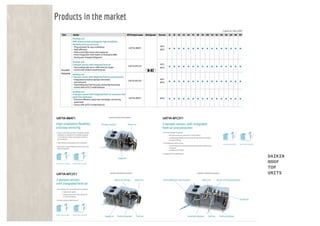
TOP
UNITS
Products in the market
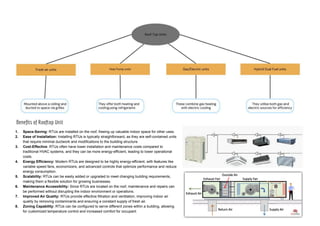
Benefits of Rooftop Unit
1. Space-Saving: RTUs are installed on the roof, freeing up valuable indoor space for other uses.
2. Ease of Installation: Installing RTUs is typically straightforward, as they are self-contained units
that require minimal ductwork and modifications to the building structure.
3. Cost-Effective: RTUs often have lower installation and maintenance costs compared to
traditional HVAC systems, and they can be more energy-efficient, leading to lower operational
costs.
4. Energy Efficiency: Modern RTUs are designed to be highly energy-efficient, with features like
variable speed fans, economizers, and advanced controls that optimize performance and reduce
energy consumption.
5. Scalability: RTUs can be easily added or upgraded to meet changing building requirements,
making them a flexible solution for growing businesses.
6. Maintenance Accessibility: Since RTUs are located on the roof, maintenance and repairs can
be performed without disrupting the indoor environment or operations.
7. Improved Air Quality: RTUs provide effective filtration and ventilation, improving indoor air
quality by removing contaminants and ensuring a constant supply of fresh air.
8. Zoning Capability: RTUs can be configured to serve different zones within a building, allowing
for customized temperature control and increased comfort for occupant.
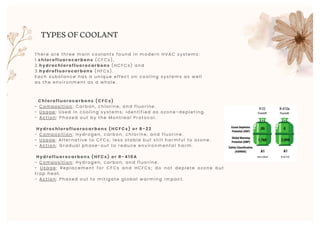
TYPES OF COOLANT
There are three mai n cool ants found i n modern HVAC systems:
1. chlorofluorocarbons (CFCs),
2. hydrochlorofl uorocarbons (HCFCs) and
3. hydrofluorocarbons (HFCs).
Each substance has a uni que effect on cool i ng systems as wel l
as the envi ronment as a whol e.
Chlorofluorocarbons (CFCs)
- Composi ti on : Carbon, chl ori ne, and fl uori ne.
- Usage : Used i n cool i ng systems; i denti fi ed as ozone-depl eti ng.
- Acti on : Phased out by the Montreal Protocol .
Hydrochlorofluorocarbons (HCFCs) or R-22
- Composi ti on : Hydrogen, carbon, chl ori ne, and fl uori ne.
- Usage : Al ternati ve to CFCs; l ess stabl e but sti l l harmful to ozone.
- Acti on : Gradual phase-out to reduce envi ronmental harm.
Hydrofluorocarbons (HFCs) or R-410A
- Composi ti on : Hydrogen, carbon, and fl uori ne.
- Usage : Repl acement for CFCs and HCFCs; do not depl ete ozone but
trap heat.
- Acti on : Phased out to mi ti gate gl obal warmi ng i mpact.
WORKING PRINCIPLES
Al l three types of refri gerants operate under the same basi c refri gerati on cycl e i n HVAC sys tems:
Compressi on : The refri gerant gas i s compressed by the compressor , i ncr easi ng i ts pressur e
and temperature.
1 .
Condensation : The hi gh-pressure, hi gh-temperature gas fl ows to the co ndenser c oil , wh ere i t
rel eases heat and condenses i nto a hi gh-pressure l i qui d.
2 .
Expansion : The hi gh-pressure l i qui d passes through an expansi on valv e or capi l lar y tube,
reduci ng i ts pressure and temperature.
3 .
Evaporation : The l ow-pressure l i qui d enters the evaporator coi l , abs orbs heat fr om the
surroundi ng ai r, and evaporates i nto a l ow-pressure gas, cool i ng the ai r.
4 .
Recycli ng : The l ow-pressure gas returns to the compressor to repeat t he cycl e.
5 .
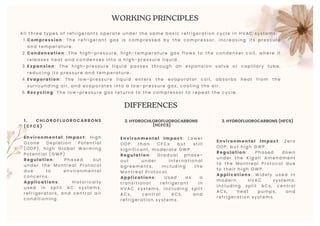
1. CHLOROFLUOROCARBONS
(CFCS)
Environmental Impact : Hi gh
Ozone Depl eti on Potenti al
(ODP), hi gh Gl obal Warmi ng
Potenti al (GWP)
Regulation : Phased out
under the Montreal Protocol
due to envi ronmental
concerns.
Applications : Hi stori cal l y
used i n spl i t AC systems,
refri gerators, and central ai r
condi ti oni ng.
DIFFERENCES
Environmental Impact : Lower
ODP than CFCs but sti l l
si gni fi cant, moderate GWP.
Regulation : Gradual phase-
out under i nternati onal
agreements, i ncl udi ng the
Montreal Protocol .
Applications : Used as a
transi ti onal refri gerant i n
HVAC systems, i ncl udi ng spl i t
ACs, central ACs, and
refri gerati on systems.
2. HYDROCHLOROFLUOROCARBONS
(HCFCS)
3. HYDROFLUOROCARBONS (HFCS)
Environmental Impact : Zero
ODP, but hi gh GWP.
Regulation : Phased down
under the Ki gal i Amendment
to the Montreal Protocol due
to thei r hi gh GWP.
Applications : Wi del y used i n
modern HVAC systems,
i ncl udi ng spl i t ACs, central
ACs, heat pumps, and
refri gerati on systems.
APPLICATION OF INVERTERS/
SMART SYTEM IN COOLING
• Inverters in HVAC Systems:
• Vari abl e Speed Compressors: Adj ust cool i ng
output to match demand, i mprovi ng effi ci ency.
• Energy Savi ngs: Reduce el ectri ci ty
consumpti on by operati ng at l ower speeds
when ful l capaci ty i s not needed.
• Smart Systems:
• I oT I ntegrati on : Use sensors and connecti vi ty
to opti mi ze cool i ng based on occupancy and
weather condi ti ons.
• Remote Moni tori ng and Control : Al l ow users to
manage cool i ng systems vi a smartphones or
computers.
• Predi cti ve Mai ntenance: Use data anal yti cs to
predi ct and prevent system fai l ures.
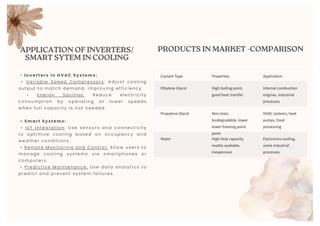
PRODUCTS IN MARKET -COMPARISON
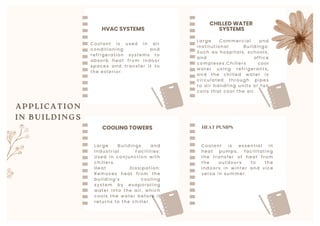
APPL ICAT ION
IN BUI LD IN G S
Cool ant i s used i n ai r
condi ti oni ng and
refri gerati on systems to
absorb heat from i ndoor
spaces and transfer i t to
the exteri or.
Cool ant i s essenti al i n
heat pumps, faci l i tati ng
the transfer of heat from
the outdoors to the
i ndoors i n wi nter and vi ce
versa i n summer.
Large Commerci al and
I nsti tuti onal Bui l di ngs:
Such as hospi tal s, school s,
and offi ce
compl exes. Chi l l ers cool
water usi ng refri gerants,
and the chi l l ed water i s
ci rcul ated through pi pes
to ai r handl i ng uni ts or fan
coi l s that cool the ai r.
Large Bui l di ngs and
I ndustri al Faci l i ti es:
Used i n conj uncti on wi th
chi l l ers.
Heat Di ssi pati on:
Removes heat from the
bui l di ng’ s cool i ng
system by evaporati ng
water i nto the ai r, whi ch
cool s the water before i t
returns to the chi l l er.
HVAC SYSTEMS
HEAT PUMPS
CHILLED WATER
SYSTEMS
COOLING TOWERS
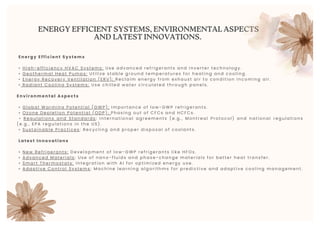
ENERGY EFFICIENT SYSTEMS, ENVIRONMENTAL ASPECTS
AND LATEST INNOVATIONS.
Energy Effi cient Systems
• Hi gh-effi ci ency HVAC Systems: Use advanced refri gerants and i nverter technol ogy.
• Geothermal Heat Pumps: Uti l i ze stabl e ground temperatures for heati ng and c ooli ng.
• Energy Recovery Venti l ati on (ERV): Recl ai m energy from exhaust ai r to condi ti on inc omi ng ai r.
• Radi ant Cool i ng Systems: Use chi l l ed water ci rcul ated through panel s.
Environmental Aspects
• Gl obal Warmi ng Potenti al (GWP): I mportance of l ow-GWP refri gerants.
• Ozone Depl eti on Potenti al (ODP): Phasi ng out of CFCs and HCFCs.
• Regul ati ons and Standards : I nternati onal agreements (e. g. , Montreal Pr otoc ol) and nat ional regul at i ons
(e. g. , EPA regul ati ons i n the US).
• Sustai nabl e Practi ces : Recycl i ng and proper di sposal of cool ants.
Latest I nnovati ons
• New Refri gerants: Devel opment of l ow-GWP refri gerants l i ke HFOs.
• Advanced Materi al s : Use of nano-fl ui ds and phase-change materi al s for bet ter heat tr ans fer .
• Smart Thermostats: I ntegrati on wi th AI for opti mi zed energy use.
• Adapti ve Control Systems : Machi ne l earni ng al gori thms for predi cti ve and adapti ve c ooli ng managemen t.
w w w . r e a l l y g r e a t s i t e . c o m
ELECTRICAL
SYSTEMS
ELECTRICAL CONDUIT | ELECTRICAL DISTRIBUTION BOARD | SOLAR PANEL
GENERATORS | TRANSFORMERS
2
ELECTRICAL CONDUIT
CONDUIT
ELECTRICAL CONDUIT
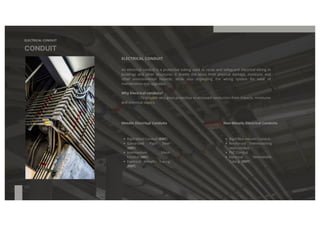
An electrical conduit is a protective tubing used to route and safeguard electrical wiring in
buildings and other structures. It shields the wires from physical damage, moisture, and
other environmental hazards, while also organizing the wiring system for ease of
maintenance and upgrades.
Why Electrical conduits?
To provide very good protection to enclosed conductors from impacts, moistures
and chemical vapors.
Metalic Electrical Conduits Non-Metalic Electrical Conduits
Rigid Metal Conduit (RMC)
Galvanized Rigid Steel
(GRC)
Intermediate Metal
Conduit (IMC)
Electrical Metallic Tubing
(EMT)
Rigid Non metallic Conduit
Reinforced Thermosetting
resin conduit.
PVC Conduit
Electrical Nonmetallic
Tubing (ENT)
TYPES OF ELECTRICAL CONDUITS
Metallic Electrical Conduits
Non Metallic Electrical Conduits
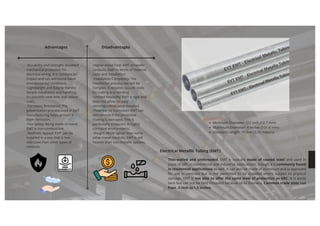
METALLIC ELECTRICAL CONDUIT
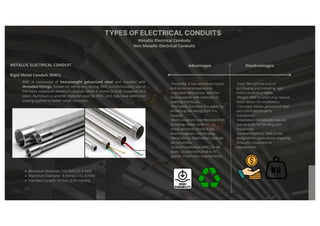
Rigid Metal Conduit (RMC):
RMC is composed of heavyweight galvanized steel and installed with
threaded fittings. Known for being very strong, RMC is unfortunately one of
the more expensive electrical conduits when it comes to both materials and
labor. Aluminum is another material used for RMC, and may have additional
coating applied to better resist corrosion
Advantages Disadvantages
·Durability: It can withstand impact
and extreme temperatures.
·Corrosion Resistance: ideal for
environments with moisture or
cleaning chemicals.
·Fire Safety: Excellent fire safety by
protecting the wiring from fire
hazards.
·Electromagnetic Interference (EMI)
Shielding: Metal conduits can
shield sensitive circuits from
electromagnetic interference.
·Recyclability: Rigid metal conduits
are recyclable.
·Ease of Installation: RMC can be
easily cut and fabricated to fit
specific installation requirements.
·Cost: The upfront cost of
purchasing and installing rigid
metal conduits is higher.
·Weight: RMC is which may require
more labour for installation.
·Corrosion Issues: galvanized steel
can rust if not properly
maintained.
·Installation Complexity: require
special tools for bending and
installation.
·Limited Flexibility: RMC is not
designed for applications requiring
frequent movement or
adjustments.
Minimum Diameter: 1/2 inch (12.7 mm)
Maximum Diameter: 6 inches (152.4 mm)
Standard Length: 10 feet (3.05 meters)
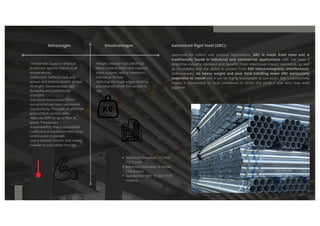
Galvanized Rigid Steel (GRC):
Approved for indoor and outdoor applications, GRC is made from steel and is
traditionally found in industrial and commercial applications, GRC has been a
long-time industry standard and benefits from impressive impact resistance, as well
as UV-stability and the ability to protect from EMI (electromagnetic interference).
Unfortunately, its heavy weight and poor field handling make GRC particularly
expensive to install and it can be highly susceptible to corrosion. GRC’s conductivity
makes it susceptible to fault conditions in which the conduit and wire may weld
together.
Advantages Disadvantages
·Temperate: Superior physical
protection against impact at all
temperatures.
·Deflection: Deflects nails and
screws and doesn't stretch or tear.
·Strength: Demonstrates high
durability and yield/tensile
strengths.
·Corrosion Resistance: Offers
exceptional corrosion resistance.
·Conductivity: Provides an effective
ground fault current path.
·Reduces EMF by up to 95% at
power frequencies.
·Expandability: Has a compatible
coefficient of expansion with most
construction materials.
·Has a smooth interior that makes
it easier to pull cables through.
·Weight: Heavier than Electrical
Metal Conduit (EMC) and requires
more support, with a maximum
interval of 10 feet.
·Refining: All rough edges must be
smoothened when the conduit is
cut.
Minimum Diameter: 1/2 inch
(12.7 mm)
Maximum Diameter: 6 inches
(152.4 mm)
Standard Length: 10 feet (3.05
meters)
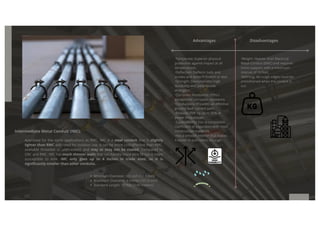
Intermediate Metal Conduit (IMC):
Approved for the same applications as RMC, IMC is a steel conduit that is slightly
lighter than RMC and rated for outdoor use. It can be more cost-effective than RMC,
available threaded or unthreaded, and may or may not be coated. Compared to
GRC and RMC, IMC has much thinner walls that can handle more wire fill but is more
susceptible to kink. IMC only goes up to 4 inches in trade sizes, so it is
significantly smaller than other conduits.
Advantages Disadvantages
·Temperate: Superior physical
protection against impact at all
temperatures.
·Deflection: Deflects nails and
screws and doesn't stretch or tear.
·Strength: Demonstrates high
durability and yield/tensile
strengths.
·Corrosion Resistance: Offers
exceptional corrosion resistance.
·Conductivity: Provides an effective
ground fault current path.
·Reduces EMF by up to 95% at
power frequencies.
·Expandability: Has a compatible
coefficient of expansion with most
construction materials.
·Has a smooth interior that makes
it easier to pull cables through.
·Weight: Heavier than Electrical
Metal Conduit (EMC) and requires
more support, with a maximum
interval of 10 feet.
·Refining: All rough edges must be
smoothened when the conduit is
cut.
Minimum Diameter: 1/2 inch (12.7 mm)
Maximum Diameter: 4 inches (101.6 mm)
Standard Length: 10 feet (3.05 meters)
Electrical Metallic Tubing (EMT):
Thin-walled and unthreaded, EMT is typically made of coated steel and used in
place of GRC in commercial and industrial applications, though it is commonly found
in residential applications as well. It can also be made of aluminum and is approved
for use in concrete but is not permitted to be installed where subject to physical
damage. EMT is not able to offer the same level of protection as GRC. It is easily
bent but can not be field threaded because of its thinness. Common trade sizes run
from .5 inch to 1.5 inches.
·Durability and Strength: Excellent
mechanical protection for
electrical wiring. It is resistant to
impact and can withstand harsh
environmental conditions.
·Lightweight and Easy to Handle:
Simple installation and handling.
It’s possible save time and labour
costs.
·Corrosion Resistance: The
galvanization process used in EMT
manufacturing helps protect it
from corrosion.
·Fire Safety: Being made of metal,
EMT is non-combustible.
·Aesthetic Appeal: EMT can be
installed in a way that is less
obtrusive than other types of
conduits.
Advantages Disadvantages
·Higher Initial Cost: EMT ismetallic
conduits, both in terms of material
costs and installation.
·Installation Complexity: The
installation process can still be
complex. It requires specific tools
for cutting and bending.
·Limited Flexibility: EMT is rigid and
does not allow for easy
reconfiguration once installed.
·Potential for Corrosion: EMT can
still corrode if the protective
coating is damaged. This is
particularly a concern in highly
corrosive environments.
·Weight: While lighter than some
other metal conduits, EMT is still
heavier than non-metallic options.
Minimum Diameter: 1/2 inch (12.7 mm)
Maximum Diameter: 4 inches (101.6 mm)
Standard Length: 10 feet (3.05 meters)
NON-METALLIC ELECTRICAL CONDUIT:
Rigid Nonmetallic Conduit (RNC):
Non-metallic, unthreaded, smooth-walled tubing is available in multiple substrates
including high-density polyethylene, PVC, and RTRC (fiberglass). The capabilities and
specs vary by substrate but several forms of RNC are approved for underground or
direct burial use.
Advantages Disadvantages
Corrosion Resistance: resistant to
corrosion, making them suitable
for environments exposed to
moisture
Moisture Protection: They provide
excellent protection against
moisture.
Lightweight and Easy to Install:
Non-metallic conduits are lighter
than their metallic counterparts.
Cost-Effectiveness: non-metallic
conduits are less expensive than
metallic options.
Flexibility: Many non-metallic
conduits come in flexible forms,
which allows for easy routing
around obstacles.
Lower Temperature
Resistance: Non-metallic
conduits typically have lower
resistance to high
temperatures.
1.
Lack of Electrical Grounding:
conduits do not provide
grounding or shielding for
electrical systems.
2.
Potential for Mechanical
Damage: non-metallic conduits
can be more susceptible to
mechanical damage.
3.
UV Sensitivity: can degrade
when exposed to direct
sunlight over time.
4.
Aesthetics: The appearance of
non-metallic conduits may not
be as visually appealing as
concealed wiring systems.
5.
Minimum Diameter: 1/2 inch (12.7 mm)
Maximum Diameter: 6 inches (152.4 mm)
Standard Length: 10 feet (3.05 meters)
RTRC Conduit:
RTRC (reinforced thermosetting resin conduit) is a high-strength, high-
temperature resistant fiberglass conduit made by winding and curing resin-
impregnated fiberglass strands. It offers excellent corrosion resistance, UV
stability, and temperature range, retaining its shape after impact. RTRC is lighter
than traditional conduits, reducing installation labor costs, and is affordable.
Phenolic RTRC meets NFPA 130 for low smoke, no flame, zero halogen, and 2-
hour fire-rated conduit in Class I Div 2 areas. Preferred for utility and data center
projects, fiberglass conduit elbows offer low friction, no burn-through, and fault
resistance.
Advantages Disadvantages
Higher Cost: More expensive
than alternatives like PVC or
EMT.
Installation Limitations: Cannot
be bent in the field; requires
specific fittings.
Joint Setting Time: Epoxy joints
need time to cure, which can
delay projects.
Grounding Requirements: May
need a separate bonding
conductor for grounding.
Aesthetic Concerns: May not be
visually appealing in residential
settings
Lightweight: Easier and
cheaper to install due to
reduced labor costs.
Corrosion Resistance: Ideal for
moist and chemical
environments.
Durability: Provides good
protection against impact and
moisture.
Design Flexibility: Allows
multiple conductors in a single
conduit.
Fire Safety: Meets certain fire
safety standards.
Versatile Applications: Suitable
for both indoor and outdoor
use
PVC Conduit:
Available in varying wall thicknesses and threaded, PVC is light and commonly used
for applications requiring non-metal electrical conduit. PVC conduit is not
recommended for use in direct sunlight due to poor UV stability. It is relatively easy
to heat and field bend with the use of a hotbox conduit bender, but must be
mounted to allow for expansion and contraction due to a high coefficient of thermal
expansion, and may deform after installation in environments that are too hot.
Traditionally PVC has been an inexpensive conduit, however, in recent years it has
become more expensive and harder to source, due to ongoing supply chain issues. In
these cases, American-made RTRC is often substituted.
Advantages Disadvantages
·Lightweight and easy to install
·Resistant to corrosion and many
highly corrosive chemicals
·Waterproof and ideal for wet
areas in industrial and commercial
structures
·Electrically insulated
·Flexible or semi-flexible, making it
easy to bend and install
·Explosion-proof and insect
resistant
·Typically, less expensive than
other options
·Availablity in a variety of wall
thicknesses and colours
·Provides good protection from
moisture ingress
·Not resistant to high
temperatures
·Vulnerable to bite from animals
·Vulnerable to microbial attack
·Lower structural strength
compared to metal conduits
·Needs to be supported when
installed in longer runs due to
sagging
·Not recommended for use in
areas of direct sun exposure as
sunlight can break down the
material over time
·Flexibility: Easy installation
without the need for special tools.
·Lightweight: lighter than metal
conduits, making it easier to
transport and install.
·Fire Resistance: ENT has been
tested for fire resistance and is
safe in construction and usage.
·Corrosion Resistance: The non-
metallic nature of ENT means it
does not rust.
·Moisture Resistance: ENT is
moisture resistant.
·Safety: The insulation properties
of ENT provide excellent electrical
safety, reducing the risk of
electrical hazards.
·Rigidity Compared to Metal: While
ENT is flexible, it is not as rigid as
metal conduits.
·Sunlight Resistance: ENT can
degrade when exposed to direct
sunlight for extended periods.
·Durability: Metal conduits have a
longer lifespan under normal
conditions.
·Code Compliance Issues: In some
regions, ENT is primarily used for
low-voltage applications.
·Installation Challenges: While ENT
is easy to install, the associated
fittings and connectors may not be
as flexible.
Electrical Nonmetallic Tubing (ENT):
Thin-walled and corrugated, ENT (electrical nonmetallic tubing) is flame retardant
but not fire rated. It is not approved for use in exposed locations but is commonly
used inside walls or within concrete blocks. Known for its extreme flexibility ENT can
be field bent by hand without requiring any special tools or the application of heat.
ENT is available in PVC in trade sizes up to 2 inches. Its support spacing is limited to
3 feet and within 3 feet of terminations.
Advantages Disadvantages
ADVANCED TECHNOLOGIES
HDPE-HIGH DENSITY POLYETHYLENE PIPES:
HDPE pipes are made through a process known as extrusion and in this process ,
HDPE material is heated to a semi-molten state and then it is forced through a
die to form a tube.
This process ensures consistent quality and high durability of the final product.
Thus, the final product is a high-quality, flexible, and durable pipe that can be
used for a variety of applications.
DWC-PIPES:
Double Wall Corrugated ( DWC ) HDPE pipes are similar to normal HDPE pipes except
that they have different external & internal surfaces which gives them additional
strength and stiffness. These are made with High Density Polyethylene which has very
high life expectancy.
https://www.youtube.com/watch?v=Kv9wpOf5iVg
Raw Material Preparation: Polyethylene resin and additives.
Extrusion: Melting and shaping through a die.
Sizing and Cooling: Vacuum sizing and water cooling.
Haul-Off: Continuous pulling for uniformity.
Cutting: Cutting to specific lengths.
Quality Control: Inspection and marking.
Packaging and Storage: Bundling and storage for delivery
P
R
O
C
E
S
S
1. Couplings
• Threaded Couplings: Used with threaded Rigid Metal Conduit (RMC) and Intermediate Metal Conduit (IMC).
The ends of the conduits are threaded, and the coupling is screwed onto the threads to join the sections.
• Compression Couplings: Used with Electrical Metallic Tubing (EMT) and IMC. The coupling is placed over the
ends of the conduits, and a compression nut is tightened to secure the connection.
• Set-Screw Couplings: Also used with EMT. The coupling is placed over the conduit ends, and set screws are
tightened to secure the connection.
• PVC Couplings: For Polyvinyl Chloride (PVC) conduits, PVC cement is applied to the ends of the conduits and
inside the coupling. The conduits are then inserted into the coupling and held until the cement sets.
2. Connectors
• Straight Connectors: Used to connect conduits to electrical boxes, panels, or other enclosures. These are
available in threaded, compression, and set-screw types for different conduit materials.
• Angle Connectors: Used to make a 90-degree connection between a conduit and an electrical box or panel.
These can also be found in threaded, compression, and set-screw types.
3. Elbows
• Pre-Bent Elbows: Factory-made 90-degree or 45-degree bends used to change the direction of the conduit
run. Available in threaded, compression, and PVC types.
• Sweep Elbows: Larger radius bends used in conduit systems to ease wire pulling, especially in longer runs.
4. Bushings
• Insulating Bushings: Placed over the ends of metal conduits to protect wires from abrasion. Commonly used
with RMC and IMC.
• Grounding Bushings: Used to provide a secure grounding connection for metal conduits.
5. Expansion Couplings
• Used to allow for thermal expansion and contraction of conduits. Common in outdoor and large building
installations where temperature changes can cause significant expansion or contraction.
6. Conduit Bodies
• LB (Lateral Bend): Used to make a right-angle turn in the conduit run with an accessible cover for wire pulling.
• T (Tee): Used to create a T-junction in the conduit system.
• C (Straight Through): Used to provide a straight run with an accessible cover for wire pulling.
TYPES OF CONNECTORS AND JOINERIES IN CONDUITS
TOP BRANDS USING IN INDIA
Finolex: Well-known for its range of PVC conduits and accessories.
Polycab: Offers a wide variety of conduits, including flexible and rigid
options.
AKG Group: Specializes in PVC and steel conduits, fittings, and accessories.
Astral Pipes: Known for their comprehensive range of PVC,
GI & MS conduit pipes and fittings.
Duraline: Provides high-density polyethylene (HDPE)
conduits and accessories.
Precision Pipes and Profiles Company Limited (PPAP): Offers a
range of PVC conduits and fittings.
Sanco Plastics: Known for their quality PVC conduit products.
Supreme Industries: Offers a wide range of conduit products,
including PVC and CPVC options.
Jindal: Known for their steel conduits and other electrical
accessories.
Kalinga: Provides a range of electrical conduits and fittings,
including PVC options.
OTHER BRANDS
SQUARE SHAPE CONDUIT PIPE
CIRLCE SHAPE CONDUIT PIPE
RECTANGLE SHAPE CONDUIT PIPE
OVAL SHAPE CONDUIT PIPE
CABLE TRAY
Square Conduits Dimensions:
Small: 1 inch by 1 inch
Medium: 2 inches by 2 inches
Large: 4 inches by 4 inches
Diameters: 1/2 inch, 3/4 inch, 1 inch,
1 1/4 inch, 1 1/2 inch, 2 inch, 2 1/2
inch, 3 inch, 3 1/2 inch, 4 inch, 5 inch,
and 6 inch.
Lengths: Standard lengths are 10
feet and 20 feet, though custom
lengths are available
Small: 1 inch by 1 inch, 1 inch by 2 inches
Medium: 2 inches by 2 inches, 2 inches by 4 inches
Large: 4 inches by 4 inches, 4 inches by 8 inches
Extra Large: 6 inches by 6 inches, 6 inches by 12 inches
Dimensions
Small: 1/2 inch to 1 inch
wideMedium: 1 inch to 2 inches
wideLarge: 2 inches to 4 inches
Cable Tray Widths
4 inches (100 mm)
6 inches (150 mm)
8 inches (200 mm)
12 inches (300 mm)
18 inches (450 mm)
24 inches (600 mm)
30 inches (750 mm)
36 inches (900 mm)
Cable Tray Depths
1 inch (25 mm)
2 inches (50 mm)
3 inches (75 mm)
4 inches (100 mm)
5 inches (125 mm)
6 inches (150 mm)
Cable Tray Lengths
• Standard lengths: 8 feet (2.4 meters), 10 feet (3
meters), or 12 feet (3.6 meters)
Types of Cable Trays
Ladder-Type Cable Tray
1.
2. Perforated Cable Tray
3. Solid-Bottom Cable Tray
4. Wire Mesh Cable Tray
5. Channel Cable Tray
SHAPES AND DIMENSIONS IN CONDUIT
How to Choose an Electrical Conduit
National Electrical Code (NEC) guidelines, local codes, and engineering specifications
most often dictate which conduit to consider for use in a project. Although size and
type are key aspects, there are many characteristics to consider when choosing an
electrical conduit, including:
Cable fault
Toxicity
Weight
Durability
Temperature range
Support spans
Born through
Co-efficient of Friction
Conductivity
Distance between expansion joints
Material cost
Feild Handling
Memory
Labour cost
The correct conduit should:
Be durable and long-lasting
Be fire-resistant as dictated by environment/application
Allow for cables to easily be pulled to areas that may be inaccessible in the future, and
unaffected by any pulling lubricants with limited or no burn-through
Be cost-effective
-Distributes high-voltage power
to various circuits.
-Allows control and switching of
electrical circuits.
-Provides overcurrent protection
with circuit breakers.
-Includes monitoring and
metering for efficient
management.
DISTRIBUTION BOARDS
A distribution board, also known as a breaker panel or electrical panel, is a critical component in an electrical scheme. Its primary
function is to distribute electrical power to different parts of a building through individual circuits.
- Distributes electrical power
from the main supply to branch
circuits using busbars.
- Provides overcurrent protection
with circuit breakers or fuses that
disconnect faulty circuits.
- Includes safety devices like
RCDs or RCCBs to prevent
electrical hazards.
- Ensures safe operation with
neutral and earth connections.
SWITCH BOARDS
A switchboard is the centralized hub that directs and controls power distribution in a building or facility
DISTRIBUTION BOARD SWITCHBOARD
BUSBAR SYSTEM
A busbar is a metallic strip or bar,
typically made of copper, aluminum, or
brass, that conducts electricity within a
switchboard, distribution board
SINGLE BUSBAR SYSTEM
DOUBLE BUSBAR SYSTEM
MAIN AND TRANSFER BUSBAR
SYSTEM
RING BUSBAR SYSTEM
MainCircuit Breakers (MCBs)
Residual Current Circuit
Breakers (RCCBs)
Surge Protection Devices
(SPDs)
Neutral Links and Earth Bars
02 03 04
01
RESIDENTIAL DISTRIBUTION BOARDS
Main distribution
Board (MDB)
Sub distribution
Board (SDB)
Final distribution
Board (FDB)
Lighting distribution Board
(LDB)
Typically installed near the main
power entry point of the house.
Contains the main circuit
breaker that controls the entire
electrical supply to the
residence.
Provides protection against
overcurrent and short circuits.
Installed to manage electrical
distribution to different
sections or floors of the house.
Helps in balancing the load and
ensuring efficient power
distribution.
Used for distributing power to
the final electrical outlets and
fixtures.
Commonly found in each
room or section of the house.
Equipped with miniature
circuit breakers (MCBs) and
residual current circuit
breakers (RCCBs) for added
safety.
Specifically designed for
controlling and distributing
power to lighting circuits
within the house.
Helps in managing the
lighting system efficiently.
Contains circuit breakers
dedicated to lighting circuits,
ensuring easy maintenance
and control.
COMPONENTS
CONSUMER UNITS
Protects the entire electrical system from overloads and short circuits.
Typically rated for 63A, 100A, or higher.
Provides protection against earth faults and leakage currents, reducing the risk of electric shock.
Common ratings are 30mA or 100mA sensitivity.
ovide termination points for neutral and earth wires from various circuits.
Protect the electrical system from voltage spikes and surges.
Commonly used to safeguard sensitive electronic equipment.
The flow of electricity is through a single conductor.
The voltage may reach up to 230 Volts.
For smooth flow of electricity on a single-phase
connection, it requires two separate wires.
One represents the neutral wire and another one
represents a single phase. These are required to
complete the circuit.
Used in most residential settings.
Consists of three separate conductors that are
needed for transmitting electricity.
it can carry a voltage of up to 415 Volts.
The system requires one neutral wire and
three-phase wires to complete the circuit.
Used in larger homes or villas where the load
demand is higher.
Miniature Circuit Breakers
(MCBs)
Residual Current Circuit
Breakers (RCCBs)
Surge Protection Devices
(SPDs)
Neutral Links and Earth Bars
SINGLE PHASE DISTRIBUTION BOARD THREE PHASE DISTRIBUTION BOARD
RESIDENTIAL DISTRIBUTION BOARDS
COMPONENTS
The flow of electricity is through a single conductor.
The voltage may reach up to 230 Volts.
For smooth flow of electricity on a single-phase
connection, it requires two separate wires.
One represents the neutral wire and another one
represents a single phase. These are required to
complete the circuit.
Used in most residential settings.
Consists of three separate conductors that are
needed for transmitting electricity.
it can carry a voltage of up to 415 Volts.
The system requires one neutral wire and
three-phase wires to complete the circuit.
Used in larger homes or villas where the load
demand is higher.
ELECTRICAL HOME
SYSTEM
Electrical grid and
meter
Transmitted
through power lines
Circuit wires lead to
outlets and switches
Main circuit breaker
panel
issue with electrical
system
Main circuit and
breaker panel
Troubleshooting
and maintenance
Outelts,switches
and safety devices
OVERVIEW OF RESIDENTIAL ELECTRICAL SYSTEMS
PLACEMENT AND FUNCTION
Distribution boards are big and clunky. This
means that most people prefer placing
them in concealed spaces.
You can place your
distribution box in your
garage, basement or spaces
under the stairs.
While placing it in any of these areas, do
ensure that the board receives sufficient
ventilation to avoid overheating.
Its main function is to divide the electrical
power evenly among all the electrical
devices.
LOAD DISTRIBUTION
Lighting Circuits
Socket Outlets
Heavy Appliances
Kitchen Appliances
Special Circuits
General Power Circuits
SAFETY CONSIDERATION
Covering
Location
Warning Indication
Dangerous Symptoms
INSTALLATION AND STANDARDS
4.Testing
1.Choosing The Right MCB
2.Preparing The Distribution Board (DB)
3.Wiring The MCB
5.Labelling & Documentation
Neutral and earth bars shall be of copper and
rated as follows:
Neutral Earth Bar
LDB’s Same as phase Same as phase
PDB’s 1.5 x phase bar Same as neutral bar
There shall be one earth terminal for single phase
boards and 2 for 3 phase boards. Circuit diagram
indicating the load distribution shall be pasted on
the inside of the DB as instructed.
Switches and other power control devices are installed on an electrical switchboard,
which can be a single large panel or a collection of smaller electrical panels. The board's
primary function is to regulate electrical current.
It takes the large amount of power that is being given to it and splits it up into
manageable amounts that may be sent to individual gadgets. To be more specific,
transformers, panels, and other devices receive electricity from switchboards before
being distributed further.
SWITCHBOARDS
RESIDENTIAL SWITCHBOARDS
A switchboard is a piece of electrical equipment that allows power to be transferred from one location to another. A vital
part of the power transmission and distribution system. Several electric panels compose it.
FUNCTION
Main Distribution
Board (MDB)
Sub Distribution
Board (SDB)
Final Distribution
Board (FDB)
They are responsible for receiving and
distributing power from the main electrical
supply to all the different sub-circuits within a
building or facility. Main switchboards are
typically located in a central location and are
designed to handle high-voltage power.
distribute power to a specific area or floor
within a building. They receive power from
the main switchboard and distribute it to
different sub-circuits. Commonly used in
larger buildings with multiple levels.
Distributes power to end-use devices and
fixtures. Includes MCBs and sometimes
RCBOs for individual circuits like rooms or
specific appliances.Usually found within
individual rooms or specific sections of
the house.
POWER SUPPLY
MAIN SWITCH
BUSBARS
CIRCUIT BREAKERS
RCDs OR GFCIs
METERS
ISOLATORS
WORKING PRINCIPLE
The electric switchboard is connected to the main power
supply, which is typically provided by the utility company
through a service entrance. The incoming power is
typically high voltage and needs to be stepped down
using transformers before entering the switchboard.
The main switch, often located at the top or side of the
switchboard, allows you to control the entire power
supply to the building. It is a large circuit breaker that can
be manually operated to connect or disconnect the
electricity.
Busbars are conductive metal bars or strips that
distribute electrical power within the switchboard. The
main busbar receives power from the main switch and
distributes it to individual circuit breakers
Circuit breakers monitor the current flowing through the
circuit, and if it excceds safe limits or a fault is detected,
the circuit breaker trips and interrupts the flow of
electricity, effectively disconnecting the circuit from the
power supply. This prevents damage and reduces the risk
of electrical hazards.
RCDs, also known as GP Cl, are safety devices typically
installed in switchboards. They constantly monitor the
flow of electrical current in the circuits. If they deteet an
imbalance between the incoming and outgoing current,
indicating a leakage or fault, the RCD/GFCI quickly cuts off
the power supply, reducing the risk of electric shocks or
fires.
Some switchboards may include meters to measure and
monitor the consumption of electricity. These meters
provide information about energy usage, allowing for
accurate billing and monitoring of powerƢconsumption.
Isolators are manual switches used to disconnect specifie
circuits or electrical equipment from the power supply.
They are often used during maintenance or repairs to
ensure the safcty of technicians working on the circuits.
PLACEMENT AND FUNCTION
Switchboards are usually placed near the main electrical panel of a residence in India. The
main panel is responsible for receiving electricity from the power grid and distributing it to
different circuits within the house. The switchboard is connected to the main panel and
acts as a central point for the distribution of electricity to different appliances and fixtures
in the house.
The main function of a switchboard is to safely and efficiently direct the flow of electricity
to different circuits in the house. It consists of a series of circuit breakers or switches which
can be easily turned on and off to control the flow of electricity. This allows residents to
conveniently and safely turn off power to specific circuits in case of an emergency or for
maintenance purposes.
PURPOSE AND USAGE
The main purpose of a switchboard is to ensure safe and efficient distribution of electricity in a residence. As mentioned earlier, it acts as a
central point for controlling the flow of electricity to different circuits in the house. This allows for better organization and management of
electricity usage, resulting in increased safety and cost-efficiency.
Switchboards also serve as a safety measure against electrical overloads and short circuits. These devices are equipped with circuit
breakers that are designed to detect abnormal levels of electricity flow and cut off the power supply to prevent damage or accidents. This
adds an additional layer of protection to the electrical system of a residence.
LOAD DISTRIBUTION CRITERIA FOR SELECTION
The selection of a switchboard for a residential setting in India should be based on several factors, including the size of the house, the
number of circuits required, and the level of electricity consumption. It is important to select a switchboard that can handle the expected
load and has spare capacity for any future additions to the electrical system.
One of the key criteria for selecting a switchboard is its ampere rating. This determines the amount of electricity that can safely pass
through the switchboard. To accurately determine the appropriate ampere rating, a calculation based on the total expected load in the
house should be done. This involves adding up the wattage of all appliances and fixtures that will be connected to the switchboard.
Power Entry
Main Circuit Breaker (MCB)
Distribution via Busbars
Circuit breakers
RCDs and GFCIs
Surge Protection Devices (SPDs)
Sub-Distribution Boards (SDBs)
Branch Circuits and End-Use
COMMERCIAL DISTRIBUTION BOARDS -
Electrical power enters the building from the
utility service or a step-down transformer
that reduces high voltage to a safer, usable
level for the building.
The power is first routed through the Main
Distribution Board , where it is controlled by
the main circuit breaker.The MCB serves as a
primary safety device, capable of
disconnecting the supply.
Inside MDB, busbars are large conductive bars
typically made of copper or aluminum that
distribute the incoming electrical power to
various outgoing circuits. and manage high
current loads.
From the busbars, power flows to individual
circuit breakers, which are crucial for
protecting the electrical circuits. Circuit
breakers automatically disconnect if they
detect an overload.
These devices detect ground faults or earth
leakages and disconnect the power to prevent
electric shocks and reduce fire risks.
SPDs protect the electrical system and
connected equipment from transient voltage
spikes, such as those caused by lightning
strikes or power surges, by diverting excess
voltage safely to the ground.
Power from the MDB is further distributed to
Sub-Distribution Boards (SDBs) located
throughout the building. SDBs manage and
protect electrical distribution to specific
areas,floors,or departments.
From the MDB or SDBs, electricity is distributed
to branch circuits, which supply power to
specific end-use equipments and devices, such
as lighting fixtures, HVAC systems & office
equipment.
WORKING PRINCIPLE
OVERVIEW OF POWER SUPPLY
COMPONENTS
SINGLE PHASE
DISTRIBUTION BOARD
USAGE
Single-phase distribution boards are used in
specific areas of commercial buildings, where
the electrical loads are relatively small like
lightings circuits etc.
THREE PHASE
DISTRIBUTION BOARD
COMMERCIAL
DISTRIBUTION BOARDS
CURRENT RANGE
The current capacity for single-phase
distribution boards typically ranges from 40A
to 100A or sometimes up to 200A for larger
setups.
They generally handle less power compared
to three-phase boards.
A single-phase system provides only one
alternating current and mostly used for
residential buildings.
CURRENT RANGE
The current capacity of three-phase
distribution boards can range significantly,
from 100A to 1600A depending on the size
and requirements of the building.
A three-phase system provides three
alternating currents which can supply more
power compared to a single-phase system.
Main circuit
boards
Circuit breakers
Residual current
devices
Surg protection
devices
Neutral and
earth bars
USAGE
Three-phase distribution boards are used in
large commercial buildings due to the higher
power demands of these environments.
They are ideal for supplying power to heavy
equipment, HVAC systems, elevators, and
large lighting systems.
DESIGN AND
CONFIGURATION
Load Assessment
and Planning
Distribution
System Layout
Wiring and
Conduit Systems
COMMERCIAL DISTRIBUTION BOARDS
Load calculation
Load distribution
Three phase power
Main Distribution Board (MDB)
Sub Distribution bars (SDB)
Risers and Busbars
Conduits types
EMT
Rigid metal conduits
PVC conduits
LOAD DISTRIBUTION
Load Calculation and Assessment
Main Distribution Board (MDB)
Sub Distribution board (SDB)
Risers and Busbars
Distribution Network Structure
Estimating Total Load
Classification of Loads
Load Distribution Principles
Three-Phase Power Distribution
Balanced Load Distribution
Neutral Conductor Sizing
Load Balancing and Circuit Design
Load Balancing Techniques
Circuit Segregation
Protection and Safety Mechanisms
Circuit Breakers and Fuses
Surge Protection Devices (SPDs)
Monitoring and Control
Building Management Systems (BMS)
Automatic Transfer Switches (ATS) Search protection device
Circuit Breaker
Automatic Transfer Switches Building Management Systems
INDUSTRIAL
DISTRIBUTION
BOARDS
MOTOR CONTROL CENTERS (MCC’s) in INDUSTRIAL SECTOR
FUNCTIONALITY
Centralized Motor Control
Provides a central location for controlling multiple motors.
Efficiency Improvement
Streamlines motor operations, enhancing overall efficiency.
Safety
Incorporates safety features like overload protection and
circuit breakers.
Easy Maintenance
Simplifies maintenance with accessible components and clear
organization.
Automation Integration
Integrates with automation systems for streamlined process
control.
Monitoring and Diagnostics
Allows for real-time monitoring and diagnostics to quickly
identify issues.
A motor control center (MCC) is an
assembly to control some or all electric
motors in a central location.
MCC’s?
COMPONENTS OF MCC’s
BUS BAR
MAGNETIC CONTACTOR
CIRCUIT BREAKER
MOTOR STARTER
Electrical Switch - Controls the flow of
electricity in a circuit.
Remote Control - Operates electrical
circuits remotely
Starting Control - Manages the initiation
and stopping of motors
.
Protection - Safeguards motors from
overloads and electrical faults.
Voltage Regulation - Ensures proper
voltage levels during motor startup.
POWER DISTRIBUTION UNITS PDU’s IN INDUSTRIAL LEVEL
Managing Loads
PDUs distribute electrical power
efficiently to various devices and
systems.
Ensure balanced load distribution to
prevent overloading and power
outages.
Complex Electrical Loads
Handle a variety of electrical loads,
including motors, machinery, and
lighting.
Support stable and reliable power
supply to all connected equipment.
ROLE IN MANAGING ELECTRICAL
LOADS
Customization for Specific Industrial Needs
Tailored Solutions
PDUs can be customized to meet unique requirements of different industrial
applications.
Adaptable to various power ratings, configurations, and control options.
Enhanced Performance
Custom PDUs optimize performance and reliability for specific industrial processes.
Provide flexibility to accommodate future changes or expansions.
PDU’s ?
In an industrial context a
distribution board (or power
distribution unit – PDU) provides
the same functionality, but on a
bigger scale.
SAFETY AND DURABILITY IN INDUSTRIAL ENVIRONMENT
ROBUST CONSTRUCTION AND MATERIAL SELECTION
Durable Materials
Use of high-quality, durable materials to withstand harsh industrial
environments.
Ensure longevity and reliability of distribution boards.
Robust Construction
Designed to endure mechanical stress, vibrations, and impacts.
Enhance safety and operational integrity.
PROTECTION AGAINST ENVIRONMENTAL HAZARDS
Environmental Protection
Shielded against dust, moisture, chemicals, and temperature extremes.
Prevents corrosion and damage, ensuring consistent performance.
Compliance with Standards
Adherence to industry standards and regulations for environmental protection.
Enhance safety and compliance with legal requirements.
MAINTANENCE & UPKEEP
Predictive and Preventive Maintenance Strategies
Predictive Maintenance
Use of monitoring and diagnostic tools to predict potential failures.
Schedule maintenance activities before issues escalate.
Preventive Maintenance
Regular maintenance routines to prevent unexpected breakdowns.
Extend the lifespan of distribution boards and associated equipment.
Importance of Regular Inspections and Upgrades
Regular Inspections
Conduct frequent inspections to identify and address issues promptly.
Maintain optimal performance and safety of the system.
Upgrades
Periodic upgrades to incorporate new technologies and improve efficiency.
Ensure compatibility with evolving industrial requirements and standards.
ENERGY MANAGEMENT SYSTEMS IN DISTRIBUTION SYSTEMS
ENERGY MANAGEMENT SYSTEMS
Siemens Spectrum Power: It helps manage
energy distribution efficiently, integrates
renewable energy sources, and ensures grid
stability.
ABB Ability Network Manager: Load
forecasting, demand response, and fault
management, helping utilities optimize
operations and reduce costs.
GE Grid Solutions Advanced EMS: Tools for
network modeling, state estimation, and
contingency analysis, enabling utilities to
manage complex grid operations effectively.
OpenEMS (Open Source Energy Management
System): Integration with various hardware
and software solutions, making it adaptable to
different needs.
BENEFITS:
Cost Savings: Reduces operational costs and defers the need for new infrastructure.
Improved Reliability: Enhances the grid's ability to handle disturbances.
Sustainability: Supports the transition to cleaner energy sources.
Consumer Engagement: Provides tools to monitor and control their energy usage.
Increasing use of AI and machine learning for predictive analytics, greater focus on cybersecurity, and
more emphasis on integrating distributed energy resources like electric vehicles and home batteries.
The Case of DC Micro-Grid in a Building
The system verified by experiments in a high-rise building named
Zhongheng Design Center Building, which is located in the Dushu Lake
Science and Education Innovation Zone, Suzhou Industrial Park,
Suzhou City (close to Shanghai City).
This building is a high-rise office building with 23 ground floors, three
underground floors
Total construction area of 77,000 sqm
The characteristics of supply-side and demand-side match each other,
so the DC micro-grid system with a small-sized 0.6 kW wind power
generation, 2 kW photovoltaic, gas turbine, etc., was built
On the basis of weather data in Suzhou, the annual power generation
of wind and solar energy is respectively 1971 kWh and 2336 kWh,
which is totally equivalent to the diminution of 6.16 tons of CO2.
There are not all devices (PV, wind turbines, etc.) plugged into the DC
micro-grid.
Key Features of the DC Microgrid
Integration of Renewable Energy
Energy Storage: Battery storage systems are used to
store excess solar energy.
Direct Current Distribution: The microgrid distributes
power in DC form, minimizing the need for conversion
between AC and DC, which reduces energy losses and
increases efficiency.
Efficiency Improvements:
Flexible Energy Management: Allowing for demand-side
management and load balancing to optimize energy
usage.
INNOVATIONS
DISTRIBUTION
BOARDS
SWITCH
BOARDS
Advanced metering infrastructure
Automated fault detection and isolation
Integration of distributed energy resources
Smart grids
Modular and scalable designs
Arc flash detection and mitigation
Digital twin technology
Remote operation and predictive maintenance
Virtual Model: A digital twin is a virtual replica of the physical electrical distribution
system.
Real-Time Data: It uses real-time data from sensors and IoT devices to keep the model
up to date.
Simulation: Allows operators to simulate different scenarios for testing and analysis.
Predictive Maintenance: Helps identify potential equipment failures in advance.
Optimization: Aids in optimizing network performance, energy efficiency, and load
balancing.
Improved Decision-Making: Supports informed decision-making regarding system
operations.
Training Platform: Provides a safe environment for personnel training and testing new
strategies.
DIGITAL TWIN IN ELECTRICAL DISTRIBUTION SYSTEM
OFF-GRID SYSTEMS
In an off-grid setup, a DC microgrid
operates independently of the main
utility grid.
It is completely self-sufficient and
provides power to local users without
any external electricity supply.
An off-grid power source doesn’t require
access to the electrical grid, meaning it’ll
only have power when the system
generates electricity or is charged by an
alternative source.
Off-grid systems need a way to store excess
electricity, which usually takes the form of
batteries. .
Excess electricity produced by on-grid
systems typically goes back to the grid.
Selection Criteria for Residential
Switchboards and Distribution Boards
1. Assessing Current and Future
Electrical Demands
Calculate the total load requirement
Consider high-consumption devices like air
conditioners, water heaters, and kitchen
appliances.
Plan for potential increases in load due to
future expansions
2. Compliance and Standards
Local Standards: Ensure compliance with
local electrical codes and regulations
Indian Electricity Rules, BIS , and NEC
Safety Standards: components that meet
ISI (Indian Standards Institute)
3. Environmental Considerations
Ingress Protection (IP Rating): protect
against dust and moisture. IP44 rating is
usually sufficient.
Temperature Extremes:Can handle typical
temperature variations in residential
settings.
4. Cost and Budget Constraints
Initial Investment: Balance between cost and
quality.
Energy Efficiency: Choose energy-efficient
products to reduce electricity bills and
support sustainability.
5. Technology and Integration
Smart Home Integration: allowing for
integrated control of lighting, security, and
HVAC systems.
Advanced Features: Consider boards with
advanced features like surge protection,
remote monitoring, and control via mobile
apps.
6. Protection and Safety Features
Circuit Breakers: PA overload and short
circuits.
Residual Current Devices (RCDs):PA electric
shocks and ground faults.
Surge Protectors:PA from voltage spikes.
Selection Criteria for COMMERCIAL
Switchboards and Distribution Boards
1. Assessing Current and Future
Electrical Demands
Current Load Assessment: power requirements
for lighting, HVAC systems, office equipment,
elevators, and any specialized equipment.
Higher and more complex load requirements
than residential settings.
Future Expansion:Design the system to
accommodate business growth, additional
office spaces, and new technologies.
2. Compliance and Standards
Local and National Standards.
Safety Compliance
3. Environmental Considerations
Ingress Protection (IP Rating): For
commercial settings, an IP54 rating is
commonly used.
Temperature : proper ventilation and cooling
to prevent overheating, especially in densely
populated electrical rooms.
Initial Investment: higher initial investment,
this should be justified by the reliability and
longevity of the equipment.
Energy Efficiency:
5. Technology and Integration
Building Management Systems (BMS):
centralized control and monitoring of all
building systems.
Advanced Features:
6. Protection and Safety Features
Circuit Breakers:
Residual Current Devices (RCDs):
Surge Protectors:
4. Cost and Budget Constraints
Selection Criteria for Industrial
Switchboards and Distribution Boards
1. Assessing Current and Future
Electrical Demands
2. Compliance and Standards
3. Environmental Considerations
4. Cost and Budget Constraints
5. Technology and Integration
Smart Home Integration: industrial
automation systems like PLC (Programmable
Logic Controllers) and SCADA (Supervisory
Control and Data Acquisition) for seamless
integration and control.
Advanced Features: fault detection, and
predictive maintenance to minimize
downtime
6. Protection and Safety Features
TP&N Vertical Loadline DB
MRP: ₹12,271.00 to MRP: ₹30,155.00
Application: Suitable for Industrial
and Commercial use
Range: 4 W, 8 W & 12 W
Manufactured By : Havells India Ltd
7 Segment DB
MRP: ₹12,000 to MRP:₹20,939.00
Application: Suitable for Industrial and
Commercial use
Range: 4 W, 6 W, 8 W & 12 W
Manufactured By : Havells India Ltd
Designed up to 5000 A
Stringent fault withstand capacity up to 80 kA for 1s
Double deck busbar system
Ingress Protection up to IP54 and IP2X after opening door
Seismic zone V compliance
Internal Arc withstand 70kA for 500msec.
Flexibility in busbar & cable entry
legrand
3 phase
IP Rating 44
MRP: ₹9880
1. Legrand
2. Havells
3. Schneider Electric
4. Siemens.
5. L&T (Larsen & Toubro).
6. ABB
Schneider Lt Panels And Distribution Boards,
3 - Phase
MRP:₹ 1,12,000
Schneider 415V Lt Distribution Panel,
3 - Phase, SPN
MRP:₹ 1,50,000
A solar panel is a device that converts sunlight into electricity by using
photovoltaic (PV) cells. PV cells are made of materials that produce excited
electrons when exposed to light. The electrons flow through a circuit and
produce direct current (DC) electricity, which can be used to power various
devices or be stored in batteries.
INTRODUCTION
Commonly used solar panel
Monocrystalline solar panels are commonly chosen
for corporate offices in India due to their high
efficiency, space-saving benefits, and aesthetically
pleasing design. They offer a reliable and effective
solution for generating solar power, making them a
popular choice among businesses looking to
implement solar energy solutions on their rooftops.
Bifacial Solar Panels
Description: These panels capture sunlight
from both sides, using dual-sided cells to
enhance energy generation by utilizing
reflected light.
Advantages:
Increased Energy Yield: Can produce up to
20-30% more energy compared to
traditional panels due to additional light
capture from reflections.
Durability: Often have a longer lifespan and
better performance in snowy or reflective
environments.
Disadvantages:
Higher Initial Cost: More expensive and
requires precise installation to maximize
benefits.
Applications: Suitable for corporate offices
where high reflectivity on the ground or
surfaces around the building can enhance
energy yield.
Building-Integrated
Photovoltaics (BIPV)
Description: Solar panels that are
integrated into building materials, such as
solar roof tiles or facade panels.
Advantages:
Aesthetic Integration: Blends with the
building’s design, which is ideal for modern
office buildings where appearance is
important.
Dual Functionality: Acts as both building
material and power generator.
Disadvantages:
Higher Cost: Generally more expensive
and may have slightly lower efficiency
compared to traditional panels.
Applications: Best suited for new office
buildings or renovations where seamless
integration into the architecture is desired.
1 2
TYPES OF SOLAR SYSTEM USED IN COPERATE OFFICE
For corporate offices in India, rooftop solar panels are a
popular choice for generating renewable energy. The selection
of the type of solar panel for a rooftop installation depends on
various factors including space, efficiency, aesthetics, and cost.
2
3
3
.
Monocrystalline Solar Panels
Description: Made from single-crystal silicon,
these panels are known for their high efficiency
and sleek black appearance.
Advantages:
High Efficiency: Generally 15-20%,
which is beneficial for maximizing
power output in limited rooftop
space.
Space-Efficient: Requires less space
to produce the same amount of
power as other types of panels.
Aesthetic Appeal: Sleek, uniform
black appearance that often blends
well with modern building designs.
Disadvantages:
Higher Cost: Typically more
expensive than polycrystalline panels.
Applications: Ideal for corporate offices with
limited roof space and where high efficiency is
a priority
. Polycrystalline Solar Panels
Description: Made from silicon crystals
melted together, these panels have a blue
hue and are less efficient than
monocrystalline panels.
Advantages:
Cost-Effective: Generally cheaper
than monocrystalline panels.
Good Efficiency: Typically 13-16%, offering
a decent balance between cost and
performance.
Disadvantages:
Lower Efficiency: Requires more space for
the same energy output compared to
monocrystalline panels.
Appearance: Less uniform and visually
appealing than monocrystalline panels.
Applications: Suitable for corporate offices
with more available rooftop space or where
budget constraints are significant.
4
3
5
Thin-Film Solar Panels
Description: Made from layers of
semiconductor materials Advantages:
Lower Initial Cost: Generally cheaper to
produce and install.
Disadvantages:
Lower Efficiency: Typically 10-12%, requiring
more space to generate the same amount of
power as crystalline panels.
Applications: Used in situations where space
is not a constraint, or for installations on
unconventional rooftops.
USES OF SOLAR PANEL IN CORPORATE OFFICE
5
Electricity Generation:
On-Site Power: Solar panels
installed on rooftops or on the
grounds of corporate offices
generate electricity to power
office equipment, lighting,
HVAC systems, and other
electrical needs.
Rooftop Installations:
Optimal Space Utilization: The
flat roofs of office buildings are
ideal for solar panel
installations, making use of
otherwise underutilized space.
Energy Savings: These
installations can significantly
reduce electricity costs,
especially during peak sunlight
hours.
Grid-Tied Systems: Many
corporate offices use grid-tied
solar systems, allowing them to
use solar power when available
and draw from the grid when
necessary, often selling excess
power back to the grid.
Energy Storage Solutions:
Battery Storage: Solar
panels can be paired with
battery storage systems to
store excess energy
generated during the day
for use during peak hours or
when solar power is not
available.
Backup Power: This
provides a reliable
backup power
source, enhancing
energy security and
resilience.
Smart Energy Management:
Monitoring Systems: Advanced
energy management systems can
monitor solar energy production
and usage, optimizing efficiency
and providing data for
sustainability reporting.
Integration with Building
Management Systems: Solar energy
can be integrated into existing building
management systems for streamlined
control and monitoring.
Financial and Environmental Benefits:
Cost Reduction: Solar energy helps
reduce electricity bills and can
provide a hedge against rising
energy costs.
Sustainability Goals: Using solar
energy helps reduce the corporate
carbon footprint and supports
sustainability initiatives, improving the
company’s environmental profile.
6
Most powerful solar panels now achieving well over 700W power ratings.efficient
solar panels based on high-performance N-type Heterojunction (HJT), TOPcon and Back-contact
(IBC) cells,
Traditional Polycrystalline cells are no longer manufacturedCell efficiency is determined by the cell
structure and type of substrate used, which is generally either P-type or N-type silicon, with N-
type cells being the most efficient.
Solar panel efficiency is measured under standard test conditions (STC) based on a cell
temperature of 25°C, solar irradiance of 1000W/m2 and Air Mass of 1.5.
Cell efficiency is determined by the cell structure and type of substrate used, which is generally either P-type or N-
type silicon, with N-type cells being the most efficient.
Cell efficiency is calculated by what is known as the fill factor (FF), which is the maximum conversion efficiency of a
PV cell at the optimum operating voltage and currentThe cell design plays a significant role in panel efficiency.
CELL EFFICIENCY
(IBC) cells are currently the most efficient (up to 24.1%)
due to the high purity N-type silicon substrate and no
losses from busbar shading. However, panels developed
using the latest N-Type TOPcon and advanced
heterojunction (HJT) cells have achieved
efficiencies above 23%
DIFFERENT TYPE OF CELLS AND THIER
EFFICIENCY
Tata Power Solar is a part of Tata
Power Company. This is one of the
best solar companies in India with a
capacity of 670 MW of solar module
manufacturing capacity and 530 MW
of solar cell manufacturing capacity.
Specifications of Tata Polycrystalline Solar panels:
Overall, finding the best solar panel brand comes down to comparing their efficiency,
temperature coefficient, and warranty. Currently, SunPower, LG, REC, and Panasonic make the
best solar panels due to their high efficiencies, competitive pricing, and 25-year warranty.
The majority of solar panel manufacturers are based in China
The largest solar panel manufacturer is TW-Solar, followed by JA Solar
TW-Solar is the only solar panel company on the Fortune Global 500 list
TATA SOLAR POWER
The efficiency of the Tata solar panels varies for 15-18 % depending upon the
different modules for Off-grid and On-grid systems.
Tata Solar panels have been weighed from 19 -22 kg of solar systems depending
upon the different model and use for Homes and Industrial.
Tata Solar also agrees on all solar industries norms by giving 25 years
performance of warranty with solar power systems in India.
Tata Solar panels are also capable of giving operating temperatures for 44 to 85-
degree Celsius.
Advantages of Tata Polycrystalline Solar panels:
Tata Provides Quality with a unique design
All Modules all Corrosion proof.
Durable and Lightweight.
SOLAR PANEL BRANDS
Adhani Solar panel
VARIOUS BRANDS OF SOLAR PANEL
Microtek Solar panel
Pros
Optimal output
UV-resistant polymer and high transmission toughened glass surface
High conversion efficiency
Affordable
Cons
Delayed customer support and service
Pros:
High performance
Modern technology
High module conversion efficiency
No LID Loss
Cons:
Costly
TATA Power solar panel
Pros :
High performance Modern
technology High module conversion efficiency
No LID Loss
Cons:
Costly
WAARE Solar panel 550 watt
Pros:
Optimal output UV-resistant polymer and high
transmission toughened glass surface High conversion
efficiency Affordable
Cons :
Delayed customer support and service
Solar Irradiance (W/m2) : Solar Irradiance (W/m2) :also called solar radiation,nfluenced by atmospheric conditions such as clouds & smog, latitude and time of year , Range :
(500-1200)w/m^2 and 1000w/m^2 on an average
Shading : partial shading on a single panel in a string can reduce power output by 50% or more, reducing the power of the entire string by a significant amount can cause the
partial diodes to fail
Add-on devices known as optimisers and microinverters , can reduce the negative effect of shading, use of these devices will retain the efficiency of unshaded panels
neglecting the shaded panels
Panel orientation
Temperature :
Location (latitude)
Time of year
Dust and dirt
More efficient panel doesn’t always equate to a better quality panel , Manifacturing quality real-world performance, reliability, manufacturer’s service, and warranty conditions. matters over
efficiency
Efficiency generally means a solar panel will pay back the embodied energy (energy used to extract the raw materials and manufacture the solar panel) in less time like sillicon panels who
repay the embodied energy within two years, depending on the location.
If panel efficiency has increased beyond 20%, payback time has reduced to less than 1.5 years in many locations.
Increased efficiency also means a solar system will generate more electricity over a solar panel's average 20+ year life and repay the upfront cost sooner, meaning the
return on investment (ROI) will be improved.
FASTER PAYBACK
AREA : Higher efficiency panels generate more energy per square meter and thus require less overall area. For example 12 x 300W panels at 17.5% efficiency = 3,600 W
12 x 440W panels at 22.5% efficiency = 5,280 W
60-cell solar panels size:
The dimensions of 60-cell solar panels are as follows: 66 inches long, and 39
inches wide. That’s basically a 66×39 solar panel.
72-cell solar panel size.:
The dimensions of 72-cell solar panels are as follows: 77 inches long, and 39 inches
wide. That’s a 77×39 solar panel; basically, a longer panel, mostly used for
commercial solar systems.
96-cell solar panel size:
The dimensions of 96-cell solar panels are as follows: 41.5 inches long, and 63
inches wide. That’s a 63×41.5 solar panel. This form is a bit shorter but wider.
A typical 100-watt solar panel is 41.8 inches long and 20.9 inches wide. It takes up
6.07 sq ft of area. If you have a 1000 sq ft roof, and you can use 75% of that roof
area for solar panels, you can theoretically put 123 100-watt solar panels on a 1000
sq ft roof.
A typical 300-watt solar panel is 65.8 inches long and 36.1 inches wide. It takes up
16.5 sq ft of area. If you have a 1000 sq ft roof, and you can use 75% of that roof
area for solar panels, you can theoretically put 45 300-watt solar panels on a 1000
sq ft roof.
A typical 400-watt solar panel is 79.1 inches long and 39.1 inches wide. It takes up
21.53 sq ft of area. If you have a 1000 sq ft roof, and you can use 75% of that roof
area for solar panels, you can theoretically put 34 400-watt solar panels on a 1000
sq ft roof.
Standard sizes and spaces for solar panels
How many watts per square foot can a solar panel generate?
Dividing the specified wattage by the square footage of the solar panel will give us just
this result:
The average solar panel output per area is 17.25 watts per square foot.
Max. Size Solar System = 500 Sq Ft Roof × 17.25 Watts / Sq Ft = 8.625 kW
3
A solar panel is a device that converts sunlight into electricity by using
photovoltaic (PV) cells. PV cells are made of materials that produce excited
electrons when exposed to light. The electrons flow through a circuit and
produce direct current (DC) electricity, which can be used to power various
devices or be stored in batteries.
How Solar Panels Work
Sunlight Absorption:
Photon Interaction: When sunlight (photons) hits the solar cells, it
knocks electrons loose from their atoms within the semiconductor
material.
Electric Current Generation:
Photovoltaic Effect: This movement of electrons creates an electric
current. Metal conductive plates on the sides of the cell collect the
electrons and transfer them to wires.
Electricity Flow:
Direct Current (DC): The flow of electrons generates DC electricity, whi
can be used immediately or converted to alternating current (AC) using
an inverter for compatibility with the electric grid or household
appliances.
Applications of Solar Panels
Home Electricity
Corporate Buildings
Large-Scale Power Generation
Portable and Specialized Use
Space Applications
Components of Solar Panels
Solar Cells:
Photovoltaic Cells: The basic building blocks
of solar panels, solar cells are made from
semiconductor materials that convert
sunlight into electrical energy through the
photovoltaic effect.
Glass Cover:
Protective Layer: The top layer of a solar
panel is a durable glass cover that protects
the solar cells from environmental elements
like rain, hail, and dirt.
Encapsulant:
Sealing and Protection: This layer surrounds
the solar cells, providing an adhesive layer
that secures the cells in place and protects
them from moisture and other environmental
factors.
Frame:
Structural Support: Typically made of aluminum, the
frame provides structural integrity and makes it easier
to mount the solar panel.
Back Sheet: Protection from the Rear: The back sheet is
the bottom layer of the panel, which protects the cells
from environmental damage and helps in insulation.
Junction Box: Electrical Connections: Located on the
back of the panel, the junction box contains the
electrical connections and often includes diodes to
prevent backflow of current.
OPERATING MECHANISM OF SOLAR PANEL
AC CURRENT
DC CURRENT
Makes real time adjustments to
meet fluctuating energy need
for storing additional elecriciy generated
Either 42 , 60 , 72 , 96 cells are
present in each panel for maximum
efficiency
Panel are usually connected with
each other with thier positive diode of
one panel and negative diodes
Note : small 1 MW (megawatt) solar plant might use around 3,000-4,000 panels, assuming each panel has a capacity of around 300-350 watts.
GRID SYSTEM and STEP UP TRANSFORMER
COMBINER BOX where wiring
from each string is combined
OPERATING MECHANISM OF SOLAR POWER
CASE STUDIES
Needs to run on electricity and uses DG Set as a backup source for daily usage.
Problems faced:
Erratic Supply and poor quality of Grid
Ever increasing cost of diesel and maintenance of Diesel Generator Sets
DG Set running at less than 30% rated capacity causing a decrease in life of the DG Set
Loss of productivity among employees
A sun exposed terrace causes extra strain on the Air conditioners
Frequent power cuts of 10 minutes to 4 Hours
Increasing cost of electricity with Time-Of-Day (TOD)
Very High fixed charges bringing the electricity bill to > ₹ 9.50 Per Unit ($ 0.14 per unit)
Typically the peak load does not end at 4 pm and electricity charges can be as high as 15-
20% in this TOD of 5pm- 10pm regime.
Financial Analysis:
Initial Investment:
PV Panels: 250×120= 30KW= 11,42,400
Inverter: 100kVA= 9,23,950
Batteries: 2Vx120 /300Ah = 5,83,000
Mounting structure= 73,200
AJB=8,000
Wires=10,000
Installation and commissioning= 60000
TOTAL= 28,00,500
Savings & Payback Period =
Per unit cost of electricity= 9.86
Per unit cost of DG, electricity=22.83
(Note: we are considering 70% from electricity and 30% from DG for per unit cost)
Total energy generated by solar per year (units) = 46530 units or KWH
Total savings per year ( in rupees) = 632436
PAYBACK PERIOD
Project cost: 2800500
Payback period will be around year= 4.43 years
Statcon Energiaa Office Building, Sector 63, Noida
WHAT IS SOLAR ENERGY ?
Solar energy is an energy produced by the sun It is clean, renewable sources of energy.
Harnessed by solar collection methods such as solar cell.
It is converted into usable energy such as electricity.
HOW MUCH
HOW MUCH SOLAR ENERGY ?
SOLAR ENERGY ?
The surface receives about 47% of the total solar energy that reaches the Earth. Only this amount is usable.
How Does Solar Power Work on a House?
When sunlight hits a solar panel, an electric charge is created
through the photovoltaic effect or PV effect (more on that
below)
The solar panel feeds this electric charge into inverters, which
change it from direct current (DC) into alternate current (AC)
electricity
The AC electricity runs through your electrical panel and is
distributed throughout your home — just like grid energy
Excess solar energy is stored in batteries or pushed onto the
grid to power local systems (like your neighbor’s house!)
Through net metering, solar owners get credit for the excess
energy they put on the grid to offset the grid energy they pull
off the grid when their panels aren’t producing
With battery storage, solar owners can store excess production
to power their homes at night
How does solar power work? The photovoltaic effect
Solar panels turn sunlight into electricity through
the photovoltaic (PV) effect, which is why they’re
often referred to as PV panels.
The photovoltaic effect occurs when photons from
the sun’s rays hit the semiconductive material
(typically silicon) in the cell of the solar module. The
photons activate electrons, causing them to free
themselves from the semiconductive material.
The free electrons flow through the solar cells,
down wires along the edge of the panel, and into a
junction box as direct current (DC).
This current travels from the solar panel to an
inverter, where it is changed into alternative current
(AC) that can be used to power homes and
buildings.
How is solar energy used to power your home?
Most home solar systems are “grid-tied” meaning
that the solar system, home electrical system, and
local utility grid are all interconnected, typically
through the main electrical service panel.
Connecting these systems means you can power
your home with solar electricity during the day and
grid electricity at night. It also means your solar
system can push excess electricity onto the local
grid to power surrounding systems, like your
neighbor’s house.
Through net metering, you earn credit for excess
solar production that can be used to offset the grid
electricity you use at night.
WHAT IS SOLAR PANELS
A solar panel is a device that converts sunlight into electricity by using photovoltaic (PV) cells. PV cells are made of
materials that produce excited electrons when exposed to light. The electrons flow through a circuit and produce
direct current (DC) electricity
Monocrystalline panels are the most
advanced of the three types. They are
made from pure silicon, which makes
them the most expensive. The
Czochralski method is used, where a
silicon crystal is placed in molten silicon,
slowly extracted, and allowed to harden
into an ingot. This ingot is then sliced into
thin wafers and assembled into panels.
Monocrystalline cells have a square
shape with rounded edges and gaps
between them, appearing black due to
the pure silicon. You can choose different
colors for the frames and back sheets
1.Monocrystalline Solar Panels
The higher efficiency rating of
monocrystalline panels makes them
ideal for homes with limited roof space,
as you'll need fewer panels to generate
the electricity you need.
Polycrystalline panels are becoming
popular due to their efficiency and cost-
effectiveness. Unlike Monocrystalline
panels, they are made from silicon
fragments rather than a single crystal. The
silicon fragments melt together in molten
silicon, then cool and fragment in their
mold. After cooling, the silicon is sliced
into wafers and assembled into panels.
Polycrystalline cells appear blue when
sunlight reflects off them, and the panels
are square-shaped with no gaps. Frames
typically come in silver.
2.Polycrystalline Solar Panels
They are used in large solar farms to
harness the power of the sun and
supply electricity to nearby areas. They
are used in standalone or self-powered
devices such as traffic lights in remote
areas, off-grid households, etc.
Thin-Film panels are the newest and
most versatile. They are made from
various materials, including copper
indium gallium selenide (CIGS),
cadmium telluride (CdTe), and
amorphous silicon (a-Si). The material is
sandwiched between thin conductive
layers with a protective glass top layer.
Thin-Film panels are about 350 times
thinner than silicon wafer panels.
Despite their thinness, they can have
large frames similar to other types, and
their color depends on the material
used, usually appearing black or blue.
3.Thin-Film Solar Panels
Sheets of thin-films may be used to
generate electricity increasingly in places
where other photovoltaic cells cannot be
used, such as on curved surfaces on
buildings or cars or even on clothing to
charge handheld devices.
SOLAR CELL TYPE EFFICIENCY RATE ADVANTAGES DISADVANTAGES
MONOCRYSTALLINE SOLAR PANELS
(MONO-SI)
~20%
HIGH EFFICIENCY RATE;
OPTIMISED FOR
COMMERCIAL USE;
HIGH LIFE-TIME VALUE
POLYCRYSTALLINE SOLAR PANELS (P-
SI)
~15%
THIN-FILM: AMORPHOUS SILICON
SOLAR PANELS (A-SI)
~7-10%
High efficiency rate;
optimized for commercial use;
high life-time value
Lower price
Relatively low costs : easy to
produce and flexible
Expensive
Sensitive to high
temperature,
lower lifespan and
slightly less space effeciency
shorter warranties
& lifespan
Why Solar Energy?
•Solar energy is available through out the days in most of the year.
•Its free of cost.
•It's a renewable source of energy.
•Solar cells do not produce noise and they are totally silent.
•They have long life time
•They require very little maintenance as there is no moving parts.
Why Solar panel is not much used?
• Solar power cannot be obtained at night.
• Solar cells (or) solar panels are very expensive
• Air pollution and whether can affect the production of electricity
• They need large area of land to produce more efficient power supply
• Due to PV efficiency and low market demand, technological progression is slow.
• Large land areas needed to produce energy on a power plant scale
• Lack of subsidies and tax credits in India.
• Lack of awareness about the benefits of solar energy towards environment.
Solar Panel: A solar panel is a set of solar photovoltaie modules electrically
connected and mounted on a supporting structure which generates electricity
using solar energy
Inverter: Since the electricity generated by solar energy is direct current
(DC), and most household appliances require alternating current (AC), an
inverter is necessary to change the current from direct current (D/C) to
alternating current (A/C).
Battery (for off grid system):
It is used to store electricity so that it can be used as a back up power when
the panel is unable to produce electricity.
•Net Metering (for grid tie system:
A measuring meter which will calculate how much energy you have taken from
the grid and also supplied to the grid.
Solar Charge Controller:
• Controls the flow of electricity between the module, battery, and the loads.
• Prevents battery damage by ensuring that the battery is operating within its
normal charge levels.
• If the charge level in the battery falls below a certain level, a
"low voltage disconnect (LVD) will cut the current to the loads, to prevent
further discharge.
• Likewise, it will also cut the current from the module in cases of overcharging.
Equipments used in Solar Powered Housing
Products in market
High-efficiency Maximum Power.
Point Tracking (MPPT) based inverter for maximum output.
Remote monitoring communication interface available.
Digital display for easy readability.
Active fault monitoring unit for safe operations
Cut down on your electricity bills.
Utilize idle rooftop space.
Hedge against ever increasing electricity tariffs.
Solar array ranging from 1000 to 10,000 Wp.
Safe and secure inverter ranging from 1 kVA to 10 kVA.
Key features
High Module Conversion Efficiency Module efficiency up to 21.2 % achieved
through advanced cell technology and manufacturing process.
Advanced Technology MBB- Multi Busbar (10BB) / Halfcut MONOPERC cells /Ga
Doped Wafers.
Positive Tolerance Cell Output Guaranteed 0~+4.99 Wp positive tolerance to
ensure Power output.
Excellent Weak Light Performance Advanced glass and surface texturing allow
for excellent performance in low-light environment. .
Excellent PID Resistance Excellent Anti-PID performance guarantee limited
power degradation and certified for up-to 288 Hrs.
Rigorous Testing criteria 100% EL inspection ensuring defect-free modules.
Current Sorting to minimize the current mismatch losses to maximize system
power output.
Key features
CYLINDRICAL TABBING WIRE increases cell absorption by enhancing scattering
effects.
Implementation of bypass diodes in split JB series- parallel connections enable
the module to perform in PARTIAL SHADOW CONDITIONS with respect to full-cell
module.
HIGHER NUMBER OF BUSBARS make the PV modules less prone to loss in
efficiency and increases tolerance to micro cracks.
FIELD RELIABILITY is improved due to multiple contact points on the cell which
lowers the cell stress during module fabrication.
LCOE IS CUT BACK by using M10 size solar cell with adding more power output
than lower size cell module.
LOWER INTERNAL RESISTANCE boosts module power helping to achieve minimal
power loss with respect to previous variant modules.
Key features
What is Generator?
Electric generators, also known as dynamos is an
electric machine that converts mechanical energy
into electrical energy.
The electric generator’s mechanical energy is
usually provided by steam turbines, gas turbines,
and wind turbines.
Electrical generators provide nearly all the power
that is required for electric power grids.
The reverse conversion of electrical energy to
mechanical energy is done by an electric motor. .
How do Generators create Electricity?
Generators do not create electricity instead it uses the
mechanical energy supplied to it to force the movement of
electric charges present in the wire of its windings through an
external electric circuit.
This flow of electrons constitutes the output electric current
supplied by the generator.
The modern-day generators work on the principle of
electromagnetic induction discovered by Michael Faraday.
He realized that the above flow of current can be created by
moving an electrical conductor in a magnetic field.
This movement creates a voltage difference between the two
ends of the conductor which causes the electric charges to
flow, hence generating electric current.
Components of Generator
T h e F r a m e –
t h e s t r u c t u r e
A n E n g i n e –
t h e s o u r c e o f
m e c h a n i c a l e n e r g y
T h e A l t e r n a t o r –
p r o d u c e s a n e l e c t r i c a l
o u t p u t f r o m t h e m e c h a n i c a l
i n p u t
A F u e l S y s t e m –
t o k e e p t h e g e n e r a t o r
o p e r a t i o n a l
A V o l t a g e R e g u l a t o r –
t o r e g u l a t e t h e
v o l t a g e o u t p u t
A C o o l i n g S y s t e m –
t o r e g u l a t e h e a t
l e v e l s t h a t b u i l d u p
i n t h e s y s t e m
A L u b r i c a t i o n S y s t e m – f o r
d u r a b l e a n d s m o o t h
o p e r a t i o n s o v e r a s p a n
A n E x h a u s t S y s t e m – t o
d i s p o s e o f t h e w a s t e
e x h a u s t g a s e s p r o d u c e d
i n t h e p r o c e s s
A C h a r g e r – t o
k e e p t h e b a t t e r y
o f t h e g e n e r a t o r
c h a r g e d
M a i n C o n t r o l – t h e
c o n t r o l p a n e l
c o n t r o l l i n g g e n e r a t o r
i n t e r f a c e
FUNCTIONS
Backup Power during
Outages:
Permanent Power:
Standby Power for
Businesses:
Supporting the Main Power
Supply:
Temporary Power Supply:
Main Function
Generators provide electricity
during power cuts and load
shedding.
It is common in rural areas
during peak hours and severe
weather, ensuring uninterrupted
work.
Some facilities, like agricultural
farms, rely on generators for a
continuous power supply due to the
absence of power grids.
Standby generators, including
batteries and other gear, stay idle
during normal power supply but
activate during emergencies to
keep businesses, like hospitals,
running smoothly.
STOR (Short Term Operating
Reserve) generators help meet the
high electricity demand during peak
hours, providing emergency power
to support the grid and ensure
stability.
Essential for places without dedicated
power connections, such as construction
sites and remote event locations,
generators can power equipment, lighting,
and sound systems.
Smaller generators are also useful for
camping and trips.
Generators come in various types
and sizes, mainly providing
electricity to residential and
business facilities.
The bigger the number, the more appliances
they can power up at once.
A 5000-watt model is adequate for covering a
regular household.
Depends on your requirements, the size of
the place, and the number of tools you want
to run.
How to choose a Generator?
Types of generator:
Electric generators are classified by the
type of electrical energy they produce:
AC Generators: Also known as single-
phase generators, typically up to 25
kW.
DC Generators: Include three types:
Shunt: Used in battery chargers.
Series: Used in street lights.
Compound-Wound: Most common
type.
AC generator DC generator
Commonly used generators:
Gasoline Generators
1.
Diesel Fuel Generators
2.
Propane Gas or Vapor Generators
3.
Biodiesel Generators
4.
Emulsified Diesel Generators
5.
Natural Gas Generators
6.
Hydrogen Generator
7.
G a s o l i n e
G e n e r a t o r s
D i e s e l F u e l G e n e r a t o r s
P r o p a n e G a s o r
V a p o r G e n e r a t o r s
B i o d i e s e l
G e n e r a t o r s
E m u l s i f i e d D i e s e l
G e n e r a t o r s
N a t u r a l G a s
G e n e r a t o r s
H y d r o g e n
G e n e r a t o r s
Types of generator based on voltage:
Electric generators are classified by
voltage type:
Portable Generators: Provide
temporary, transportable power.
Inverter Generators: Compact, convert
AC to DC and back to clean AC power.
Standby Generators: Backup power for
businesses and facilities during
outages.
h t t p s : / / w w w . m a h i n d r a p o w e r o l . c o m / d o w n l o a d - b r o c h u r e . h t m l
h t t p s : / / w w w . s u d h i r p o w e r . c o m / M a g z i n e / D g % 2 0 G e n s e t % 2 0 B r
o c h u r e . p d f
h t t p s : / / w w w . h a r i s o n g e n e r a t o r s . c o m / w p -
c o n t e n t / u p l o a d s / 2 0 1 9 / 0 4 / H a r i s o n - G e n e r a t o r s - B r o c h u r e . p d f
h t t p s : / / g e n s e t i n d i a . n e t / V E C V % 2 0 N E W . p d f
h t t p s : / / t a f e p o w e r . c o m / T A F E - P O W E R - S i l e n t - G e n e r a t o r s -
B r o c h u r e . p d f
Brouchers for generators: B r o u c h e r c r e a t e d b y T A T A
Feature Portable Generators Inverter Generators Standby Generators
Power Output Typically 1,000 to 10,000 watts Typically 1,000 to 5,000 watts Typically 5,000 to 20,000+ watts
Fuel Type Gasoline, propane, or diesel Gasoline or propane Natural gas or propane, some diesel models
Portability Highly portable; easy to transport Lightweight and compact Stationary; installed permanently
Dimensions (LxWxH) 20-30 x 15-24 x 18-30 inches 16-24 x 10-16 x 12-18 inches 36-60 x 24-36 x 24-48 inches
Weight 50-150 lbs 30-80 lbs 200-500 lbs
Noise Level Generally louder (60-70 dB) Quieter operation (50-60 dB) Quiet operation (varies, often <60 dB)
Power Quality Produces modified sine wave Produces clean sine wave Produces clean sine wave
Usage Ideal for camping, tailgating, or job sites Best for sensitive electronics (e.g., laptops) Ideal for home backup during outages
Start Mechanism Manual or electric start Electric start (often with remote options) Automatic start with transfer switch
Runtime 8-12 hours on a full tank 6-12 hours on a full tank
Continuous power as long as fuel supply is
available
Installation No installation required No installation required Requires professional installation
Cost Generally lower cost Moderate cost Higher initial cost but long-term savings
Maintenance Regular maintenance needed Lower maintenance needs Minimal maintenance; automatic systems
AC Generator:
An AC generator converts mechanical energy from turbines or engines
into alternating voltage and current. It operates on Faraday’s law, using a
stationary coil to generate voltage in a magnetic field, as it’s easier to
draw current from a stationary coil than from a rotating one.
AC Generator parts and function:
Field: Produces magnetic flux to generate voltage.
Armature: Produces voltage and handles full-load current.
Prime Mover: Drives the generator (engine or turbine).
Rotor: Rotates, driven by the prime mover.
Stator: Stationary part, reduces eddy current losses.
Slip Rings: Transfer power between stationary and rotating
parts.
h t t p s : / / y o u t u . b e / d y N b V 5 S S F R w
Rotation of the Armature: The armature rotates perpendicular
to the magnetic field.
Change in Flux Linkage: Rotation varies magnetic flux, altering
flux linkage.
Induction of EMF: Changing flux linkage induces an EMF in the
armature (Faraday’s Law).
Current Flow: Induced EMF causes current to flow through the
circuit, including the galvanometer, slip rings, and brushes.
Galvanometer Response: The galvanometer needle swings,
indicating alternating current.
Slip Rings and Brushes: Slip rings connect the rotating
armature to the external circuit; brushes transfer current.
Current Direction: Use Fleming’s Right-Hand Rule to determine
direction:
Thumb: armature’s motion
1.
Index Finger: magnetic field direction
2.
Middle Finger: current direction
3.
Working Principle:
DC Generator:
A DC generator converts mechanical energy into electricity. It generates an EMF when a conductor cuts through magnetic flux, based on
Faraday’s Law. This EMF causes current flow when the circuit is closed.
Stator: Provides the magnetic field with opposite
polarity magnets.
Rotor: Features slotted iron laminations to reduce eddy
current losses.
Armature Windings: Connected in series or parallel to
enhance current output.
Yoke: External frame supporting the magnetic flux,
made of cast iron or steel.
Poles: Hold field windings connected with armature
windings.
Pole Shoe: Spreads magnetic flux and supports the field
coil.
Commutator: Converts AC to DC voltage in the
armature, made of copper segments with mica
insulation.
Brushes: Connect the commutator to the external
circuit.
DC Generator parts and function
Faraday’s Law: An EMF is induced in a conductor moving
through a varying magnetic field.
Fleming’s Right-Hand Rule: The induced current direction
changes with the conductor’s motion direction.
Armature Rotation: As the armature rotates, the current
direction in the conductor alternates.
Split-Ring Commutator: Reverses armature connections
during current reversals, converting alternating current (AC)
to unidirectional current (DC) at the terminals.
Working principle:
https://youtu.be/QVrXP1oO78I
Difference between synchronized generator and unsynchronized generator:
Large generators:
Power plants-
Thermal
Hydroelectric
Wind
Solar
Supply electricity to the grid.
For:
Critical facilities
Hospitals
Data Centers
Telecommunications
networks
During outages.
Supply electricity for tools and
equipment where grid power is
unavailable.
Power machinery and equipment in
factories and production facilities.
Provide power for mining operations and
equipment in remote areas.
Used in disaster relief operations
Home generators provide backup power
during emergencies.
Used on ships and submarines to provide
electrical power.
Aircraft use generators to power
onboard systems and instruments.
Wind turbines: Convert wind
energy into electrical power.
Hydroelectric generators:
Convert the kinetic energy of
flowing water into electricity.
Military: Used for mobile power in field
operations and remote bases.
Agriculture: Used to power irrigation
systems, equipment, and other agricultural
operations.
Applications of generators
Industrial Use:
Transportation:
Renewable Energy:
Backup Power:
Power Generation
Specialized Applications:
Portable Power:
Emergency Power:
TYPES AC GENERATORS DC GENERATORS
Synchronized
Generators
Kirloskar Electric Co. Cummins India Sukam Power Systems
Luminous Power
Technologies
Features
Reliable
Durable
Advanced control systems
High efficiency
Robust performance
Renewable energy
applications
High-efficiency needs
Reliable performance
Used in solar and backup
systems.
Unsynchronized
Generators:
Tata Power JCB India Amaron Exide Industries
Features
Reliable performance
used in both residential
and industrial sectors.
Durability
Efficiency
used in construction and
industrial
Durable
Long service life.
Used in different
industrial sectors
MARKET
w w w . r e a l l y g r e a t s i t e . c o m
ON-SITE
SKETCHES
3
w w w . r e a l l y g r e a t s i t e . c o m
HVAC
LAYOUT
4
Utility
room
Reception
desk
Conference
room
Kitchen
Bar
Lounge
zone
Toilet
W
Toilet
M
Utility
room
Back
office
Reception desk
Conference room
Restaurant
Kitchen
Bar
Lounge zone
Toilet W
Toilet M
Utility room
Back office
Reception desk
Reception
Conference
room
Restaurant
Kitchen
Bar
Lounge
zone
Toilet
W
Toilet
M
Utility
room
AHU
Reception
desk
Conference
room
Restaurant
Kitchen
Bar
Lounge
zone
Toilet
W
Toilet
M
Utility
room
Back
office
packaged
Reception desk
Conference room
Restaurant
Kitchen
Bar
Lounge zone
Toilet W
Toilet M
Utility room
Back office
Reception desk
Conference room
Restaurant
Kitchen
Bar
Lounge zone
Toilet W
Toilet M
Utility room
Back office
Reception
desk
Conference
room
Restaurant
Kitchen
Bar
Lounge
zone
Toilet
W
Toilet
M
Utility
room
Back
office
Reception desk
Conference room
Restaurant
Kitchen
Bar
Lounge zone
Toilet W
Toilet M
Utility room
Back office
Reception desk
Restaurant
Kitchen
Bar
Lounge zone
Toilet W
Toilet M
Utility room
Back office
Kitchen
Bar
Toilet
W
Toilet
M
Utility
room
Back
office
Reception
desk
Conference
room
Restaurant
Kitchen
Bar
Toilet
W
Toilet
M
Back
office
Kitchen
Back
office
Reception desk
Conference room
Restaurant
Kitchen
Bar
Lounge zone
Toilet W
Toilet M
Utility room
Back office
Reception
desk
Conference
room
Restaurant
Kitchen
Bar
Lounge
zone
Toilet
W
Toilet
M
Utility
room
Back
office
AHU
Building
Services
-
HVAC,
Electrical
&
Lighting
Exercise
3
-
HVAC
Layout
Scale
-
1:100
Milan
Naidoo
232001016
KEY
Split
AC
Air
Vent
Diffuser
Coil
Exhaust
pipe
Sub
Air
Vent
Reception
desk
Conference
room
Restaurant
Kitchen
Bar
Lounge
zone
Toilet
W
Toilet
M
Utility
room
Back
office
packaged
ac
Duct
LEGEND
Supply
Main
duct
Reception
desk
Conference
room
Kitchen
Bar
Toilet
W
Toilet
M
Utility
room
Back
office
Reception
desk
Conference
room
Restaurant
Kitchen
Bar
Lounge
zone
Toilet
W
Toilet
M
Utility
room
Back
office
PACKAGED
UNIT
FCU
FCU
FCU
FCU
FCU
Reception desk
Kitchen
Bar
Lounge zone
Toilet W
Utility room
Back office
Reception
desk
Conference
room
Restaurant
Kitchen
Bar
Lounge
zone
Toilet
W
Toilet
M
Utility
room
AHU
w w w . r e a l l y g r e a t s i t e . c o m
ELECTRICAL
LAYOUT
5
25'-0"
55'-0"
Up
3'-6"
3'-0"
7'-0"
4'-0"
Fridge
Kitchen
10'0"x9'0"
Bed-1
10'0"x4'0"
Toi.
8'0'x4'0"
O.T.S.
Down
4'-6"
5'-0"
Bal.
13'1.5"x4'0"
Living
18'6"x11'4.5"
FIRST FLOOR PLAN
2'-0"
4'-0"
Store
3'-0"
6'-3"
3'-6"
Puja
Dining
8'1.5"x12'4.5"
2'-6"
2'-6"
7'-0"
16'-41
2"
2'-0"
3'-0"
5'-0"
Balcony
5'-0"
18'6"x10'4.5"
wardrobe
S.No. Date Revision Sign
Drawing Title:
Electrical Drawing
ELECTRICAL SYMBOLS
ELECTRICAL POINTS:-
1. ALL LIGHT POINTS ABOVE LINTEL.
2. ALL SWITCH BOARD 4'6" FROM FINISHED
3. T.V. POINT 2'6" FROM FINISHED FLOOR LEVEL.
4. GEYSER POINT FROM CEILING 2'0" SIDE
1'6" FROM PLUMBING POINT.
Wall mounted light
5 amps
15 amps
Television point T.V.
Switch board
Tubelight
Fan
A.C. POINT 20AMPS
2 sockets extra in each switch board
chandeleier
ceiling lights
distribution board
calling bell
Compound wall lights
wall lights
FLOOR LEVEL.
SB
spot light
SB
SB
SB
SB
SB
SB
SB
SB
SB
SB
SB
SB
SB1
SB
SB
SB
SB
S.No. Date Revision Sign
Drawing Title:
Electrical Drawing
ELECTRICAL SYMBOLS
ELECTRICAL POINTS:-
1. ALL LIGHT POINTS ABOVE LINTEL.
2. ALL SWITCH BOARD 4'6" FROM FINISHED
3. T.V. POINT 2'6" FROM FINISHED FLOOR LEVEL.
4. GEYSER POINT FROM CEILING 2'0" SIDE
1'6" FROM PLUMBING POINT.
Wall mounted light
5 amps
15 amps
Television point T.V.
Switch board
Tubelight
Fan
A.C. POINT 20AMPS
2 sockets extra in each switch board
chandeleier
ceiling lights
distribution board
calling bell
Compound wall lights
wall lights
DB
FLOOR LEVEL.
SB
spot light
25'-0"
55'-0"
Up
3'-6"
3'-0"
7'-0"
Rm
10'4.5"x9'4.5"
Toi.
3'9"x5'0"
3'-6"
Hall
14'6"x11'4.5"
SITE / GROUND FLOOR PLAN
5'-0"
5'-0"
20'-0"
5'-0"
5'-0"
16'-0"
Bore Well
Existing
3'-71
2"
3'-71
2"
Existing Well
4'-0"
4'-0"
4'-0" 7'-6" 7'-6"
WATER SUMP
10'0"x7'0"x7'0"
13,000 litres capacity
2'0" x2'0"
Man Hole
4'-0"
O.T.S.
4'-0"
SB
SB
SB
SB
SB
SB
SB
SB
25'-0"
55'-0"
Up
3'-6"
3'-0"
7'-0"
Rm
10'4.5"x9'4.5"
Toi.
3'9"x5'0"
3'-6"
Hall
14'6"x11'4.5"
SITE / GROUND FLOOR PLAN
5'-0"
5'-0"
20'-0"
5'-0"
5'-0"
16'-0"
Bore Well
Existing
3'-71
2"
3'-71
2"
Existing Well
4'-0"
4'-0"
4'-0" 7'-6" 7'-6"
WATER SUMP
10'0"x7'0"x7'0"
13,000 litres capacity
2'0" x2'0"
Man Hole
4'-0"
O.T.S.
4'-0"
DB
S.No. Date Revision Sign
Drawing Title:
Electrical Drawing
ELECTRICAL SYMBOLS
ELECTRICAL POINTS:-
1. ALL LIGHT POINTS ABOVE LINTEL.
2. ALL SWITCH BOARD 4'6" FROM FINISHED
3. T.V. POINT 2'6" FROM FINISHED FLOOR LEVEL.
4. GEYSER POINT FROM CEILING 2'0" SIDE
1'6" FROM PLUMBING POINT.
Wall mounted light
5 amps
15 amps
Television point T.V.
Switch board
Tubelight
Fan
A.C. POINT 20AMPS
2 sockets extra in each switch board
chandeleier
ceiling lights
distribution board
calling bell
Compound wall lights
wall lights
DB
FLOOR LEVEL.
SB
spot light
Name:
Rhea.E.Charles
Reg.No:
232101008
Course:
HVAC,Electrical and Lighting
S.No. Date Revision Sign
Drawing Title:
Electrical Drawing
ELECTRICAL SYMBOLS
ELECTRICAL POINTS:-
1. ALL LIGHT POINTS ABOVE LINTEL.
2. ALL SWITCH BOARD 4'6" FROM FINISHED
3. T.V. POINT 2'6" FROM FINISHED FLOOR LEVEL.
4. GEYSER POINT FROM CEILING 2'0" SIDE
1'6" FROM PLUMBING POINT.
Wall mounted light
5 amps
15 amps
Television point T.V.
Switch board
Tubelight
Fan
A.C. POINT 20AMPS
2 sockets extra in each switch board
chandeleier
ceiling lights
distribution board
calling bell
Compound wall lights
wall lights
DB
FLOOR LEVEL.
SB
spot light
25'-0"
55'-0"
Up
3'-6"
3'-0"
7'-0"
3'-6"
SITE / GROUND FLOOR PLAN
5'-0"
5'-0"
5'-0"
5'-0"
16'-0"
Bore Well
Existing
3'-71
2"
3'-71
2"
Existing Well
4'-0"
4'-0"
4'-0" 7'-6" 7'-6"
WATER SUMP
10'0"x7'0"x7'0"
13,000 litres capacity
2'0" x2'0"
Man Hole
4'-0"
O.T.S.
4'-0"
DB
S.No. Date Revision Sign
Drawing Title:
Electrical Drawing
ELECTRICAL SYMBOLS
ELECTRICAL POINTS:-
1. ALL LIGHT POINTS ABOVE LINTEL.
2. ALL SWITCH BOARD 4'6" FROM FINISHED
3. T.V. POINT 2'6" FROM FINISHED FLOOR LEVEL.
4. GEYSER POINT FROM CEILING 2'0" SIDE
1'6" FROM PLUMBING POINT.
Wall mounted light
5 amps
15 amps
Television point T.V.
Switch board
Tubelight
Fan
A.C. POINT 20AMPS
2 sockets extra in each switch board
chandeleier
ceiling lights
distribution board
calling bell
Compound wall lights
wall lights
DB
FLOOR LEVEL.
SB
spot light
25'-0"
55'-0"
Up
3'-6"
3'-0"
7'-0"
Rm
10'4.5"x9'4.5"
Toi.
3'9"x5'0"
3'-6"
Hall
14'6"x11'4.5"
SITE / GROUND FLOOR PLAN
5'-0"
5'-0"
20'-0"
5'-0"
5'-0"
16'-0"
Bore Well
Existing
3'-71
2"
3'-71
2"
Existing Well
4'-0"
4'-0"
4'-0" 7'-6" 7'-6"
WATER SUMP
10'0"x7'0"x7'0"
13,000 litres capacity
2'0" x2'0"
Man Hole
4'-0"
O.T.S.
4'-0"
DB
S.No. Date Revision Sign
Drawing Title:
Electrical Drawing
ELECTRICAL SYMBOLS
ELECTRICAL POINTS:-
1. ALL LIGHT POINTS ABOVE LINTEL.
2. ALL SWITCH BOARD 4'6" FROM FINISHED
3. T.V. POINT 2'6" FROM FINISHED FLOOR LEVEL.
4. GEYSER POINT FROM CEILING 2'0" SIDE
1'6" FROM PLUMBING POINT.
Wall mounted light
5 amps
15 amps
Television point T.V.
Switch board
Tubelight
Fan
A.C. POINT 20AMPS
2 sockets extra in each switch board
chandeleier
ceiling lights
distribution board
calling bell
Compound wall lights
wall lights
DB
FLOOR LEVEL.
SB
spot light
25'-0"
55'-0"
Up
3'-6"
3'-0"
7'-0"
4'-0"
Fridge
Kitchen
10'0"x9'0"
Bed-1
10'0"x4'0"
Toi.
8'0'x4'0"
O.T.S.
Down
4'-6"
5'-0"
Bal.
13'1.5"x4'0"
Living
18'6"x11'4.5"
FIRST FLOOR PLAN
2'-0"
4'-0"
Store
3'-0"
6'-3"
3'-6"
Puja
Dining
8'1.5"x12'4.5"
2'-6"
2'-6"
7'-0"
16'-41
2"
2'-0"
3'-0"
5'-0"
Balcony
5'-0"
18'6"x10'4.5"
wardrobe
S.No. Date Revision Sign
Drawing Title:
Electrical Drawing
ELECTRICAL SYMBOLS
ELECTRICAL POINTS:-
1. ALL LIGHT POINTS ABOVE LINTEL.
2. ALL SWITCH BOARD 4'6" FROM FINISHED
3. T.V. POINT 2'6" FROM FINISHED FLOOR LEVEL.
4. GEYSER POINT FROM CEILING 2'0" SIDE
1'6" FROM PLUMBING POINT.
Wall mounted light
5 amps
15 amps
Television point T.V.
Switch board
Tubelight
Fan
A.C. POINT 20AMPS
2 sockets extra in each switch board
chandeleier
ceiling lights
distribution board
calling bell
Compound wall lights
wall lights
DB
FLOOR LEVEL.
SB
spot light
25'-0"
55'-0"
3'-6"
3'-6"
7'-0"
4'-0"
O.T.S.
Down
4'-6"
5'-0"
OPEN
TERRACE
TERRACE FLOOR PLAN
2'-0"
5'-0"
4'-0"
2'-6"
7'-0"
OPEN
TERRACE
14'-9"
18'-6"
18'-6"
23'-9"
9'-31
2"
Up
Rm
10'4.5"x9'4.5" Toi.
3'9"x5'0"
Hall
14'6"x11'4.5" Bore Well
Existing
Existing Well
WATER SUMP
10'0"x7'0"x7'0"
13,000 litres capacity
2'0" x2'0"
Man Hole
O.T.S.
S.No. Date Revision Sign
Drawing Title:
ELECTRICAL SYMBOLS
ELECTRICAL POINTS:-
1. ALL LIGHT POINTS ABOVE LINTEL.
2. ALL SWITCH BOARD 4'6" FROM FINISHED
3. T.V. POINT 2'6" FROM FINISHED FLOOR LEVEL.
4. GEYSER POINT FROM CEILING 2'0" SIDE
1'6" FROM PLUMBING POINT.
Wall mounted light
Meter Board
Tubelight
Fan
A.C. POINT
ceiling lights
distribution board
outlet switch
DB
FLOOR LEVEL.
DB
Ground Floor - Electrical Plan
Scale - 1:100
Socket
Exhaust Fan
Milan Naidoo - 232001016
25'-0"
55'-0"
Up
3'-6"
3'-0"
7'-0"
3'-6"
5'-0"
5'-0"
5'-0"
5'-0"
16'-0"
Bore Well
Existing
3'-71
2"
3'-71
2"
Existing Well
4'-0"
4'-0"
4'-0" 7'-6" 7'-6"
WATER SUMP
10'0"x7'0"x7'0"
13,000 litres capacity
2'0" x2'0"
Man Hole
4'-0"
O.T.S.
4'-0"
S.No. Date Revision Sign
Drawing Title:
Electrical Drawing
ELECTRICAL SYMBOLS
ELECTRICAL POINTS:-
1. ALL LIGHT POINTS ABOVE LINTEL.
2. ALL SWITCH BOARD 4'6" FROM FINISHED
3. T.V. POINT 2'6" FROM FINISHED FLOOR LEVEL.
4. GEYSER POINT FROM CEILING 2'0" SIDE
1'6" FROM PLUMBING POINT.
Wall mounted light
5 amps
15 amps
Television point T.V.
Switch board
Tubelight
Fan
A.C. POINT 20AMPS
2 sockets extra in each switch board
chandeleier
ceiling lights
distribution board
calling bell
Compound wall lights
wall lights
DB
FLOOR LEVEL.
SB
spot light
DB
S.No. Date Revision Sign
Drawing Title:
Electrical Drawing
ELECTRICAL SYMBOLS
ELECTRICAL POINTS:-
1. ALL LIGHT POINTS ABOVE LINTEL.
2. ALL SWITCH BOARD 4'6" FROM FINISHED
3. T.V. POINT 2'6" FROM FINISHED FLOOR LEVEL.
4. GEYSER POINT FROM CEILING 2'0" SIDE
1'6" FROM PLUMBING POINT.
Wall mounted light
5 amps
15 amps
Television point T.V.
Switch board
Tubelight
Fan
A.C. POINT 20AMPS
2 sockets extra in each switch board
chandeleier
ceiling lights
distribution board
calling bell
Compound wall lights
wall lights
DB
FLOOR LEVEL.
SB
spot light
25'-0"
55'-0"
Up
3'-6"
3'-0"
7'-0"
4'-0"
Fridge
Kitchen
10'0"x9'0"
Bed-1
10'0"x4'0"
Toi.
8'0'x4'0"
O.T.S.
Down
4'-6"
5'-0"
Bal.
13'1.5"x4'0"
Living
18'6"x11'4.5"
FIRST FLOOR PLAN
2'-0"
4'-0"
Store
3'-0"
6'-3"
3'-6"
Puja
Dining
8'1.5"x12'4.5"
2'-6"
2'-6"
7'-0"
16'-41
2"
2'-0"
3'-0"
5'-0"
Balcony
5'-0"
18'6"x10'4.5"
wardrobe
S.No. Date Revision Sign
Drawing Title:
Electrical Drawing
ELECTRICAL SYMBOLS
ELECTRICAL POINTS:-
1. ALL LIGHT POINTS ABOVE LINTEL.
2. ALL SWITCH BOARD 4'6" FROM FINISHED
3. T.V. POINT 2'6" FROM FINISHED FLOOR LEVEL.
4. GEYSER POINT FROM CEILING 2'0" SIDE
1'6" FROM PLUMBING POINT.
Wall mounted light
5 amps
15 amps
Television point T.V.
Switch board
Tubelight
Fan
A.C. POINT 20AMPS
2 sockets extra in each switch board
chandeleier
ceiling lights
distribution board
calling bell
Compound wall lights
wall lights
DB
FLOOR LEVEL.
spot light
25'-0"
55'-0"
Up
3'-6"
3'-0"
7'-0"
Rm
10'4.5"x9'4.5"
Toi.
3'9"x5'0"
3'-6"
Hall
14'6"x11'4.5"
SITE / GROUND FLOOR PLAN
5'-0"
5'-0"
20'-0"
5'-0"
5'-0"
16'-0"
Bore Well
Existing
3'-71
2"
3'-71
2"
Existing Well
4'-0"
4'-0"
4'-0" 7'-6" 7'-6"
WATER SUMP
10'0"x7'0"x7'0"
13,000 litres capacity
2'0" x2'0"
Man Hole
4'-0"
O.T.S.
4'-0"
SB
SB
SB
SB
SB
DB
DB
DB
SB
SB
S.No. Date Revision Sign
Drawing Title:
Electrical Drawing
ELECTRICAL SYMBOLS
ELECTRICAL POINTS:-
1. ALL LIGHT POINTS ABOVE LINTEL.
2. ALL SWITCH BOARD 4'6" FROM FINISHED
3. T.V. POINT 2'6" FROM FINISHED FLOOR LEVEL.
4. GEYSER POINT FROM CEILING 2'0" SIDE
1'6" FROM PLUMBING POINT.
Wall mounted light
5 amps
15 amps
Television point T.V.
Switch board
Tubelight
Fan
A.C. POINT 20AMPS
2 sockets extra in each switch board
chandeleier
ceiling lights
distribution board
calling bell
Compound wall lights
wall lights
DB
FLOOR LEVEL.
SB
spot light
25'-0"
55'-0"
Up
3'-6"
3'-0"
7'-0"
3'-6"
SITE / GROUND FLOOR PLAN
5'-0"
5'-0"
5'-0"
5'-0"
16'-0"
Bore Well
Existing
3'-71
2"
3'-71
2"
Existing Well
4'-0"
4'-0"
4'-0" 7'-6" 7'-6"
WATER SUMP
10'0"x7'0"x7'0"
13,000 litres capacity
2'0" x2'0"
Man Hole
4'-0"
O.T.S.
4'-0"
DB
w w w . r e a l l y g r e a t s i t e . c o m
SITE VISIT
6
COURSE FACULTY: PROF. AR. M. SENTHIL
ADEL RAYHAN S
AFFRIL JENEFA P
ALDRICH BENNET
ANBU SELVI U
DEEPIKA R
DEVARAKONDA MURARI
DHIRSHYA D
HAFSA SHARMEEN
ILAKKIYA A
JANE KEERTHI J
JAYACHANDRAN J
JEGATHEESH K
LINGAREDDY TEJDEEP
M DEEPIKA
MERVIN JOSEPH
MILAN NAIDOO
MINIPRABA G
MONISHA T
MRIDULA MURUGAN
PALAK SINGH
RHEA E CHARLES
RIYAZ RAHMAN J
SAMYUKTHA PV
SANIA AZIZ
SENTHILKUMARAN
SHRI ANJHANI S
SRUTHI P S
SUBHAPRADHA P R
SWETHA D
TRISHALINI T S
V SHRISHA
VAISHALI S

Building Services _ HVAC ELECTRICAL AND LIGHTING NOTES

  • 1.
    ARA3013 BUILDING SERVICES-II ARA3013BUILDING SERVICES-II PORTFOLIO HVAC | ELECTRICAL | LIGHTING BATCH: 2022-2027 | 2021-2026
  • 2.
  • 3.
    w w w. r e a l l y g r e a t s i t e . c o m AIR CONDITIONING WINDOW & SPLIT AC | FLOOR MOUNTED & CASSETTE AC | PACKAGED UNIT | DIRECT EXPANSION | DISTRICT COOLING | CHILLED BEAM | FAN COIL UNIT | COOLANT SYSTEM 1
  • 4.
    WORKING PRINCIPLE The refrigeration cyclebegins with the compressor compressing the refrigerant into a high-pressure,high-temperaturegas. This hot gas then releases heat through the condensercoil,becomingahigh-pressureliquid. The liquid refrigerant then passes through the expansion valve, which reduces its pressure and temperature. As a cold, low-pressure refrigerant, it absorbs heat from the indoor air via the evaporator coil, coolingtheair. Finally, the cooled air is blown back into the room, and the refrigerant, now a low-pressure gas, returns to the compressor to repeat the cycle. 02 https://youtu.be/abcOV22bAfk?feature=shared&t=7
  • 5.
    APPLICATION Window air conditionersare favored for their low cost, ease of maintenance compared to split A.C., and effectiveness in cooling specific areas. Split air conditioners are popular in residential and commercial buildings for their versatility, efficiency, and ease of installation. 03 COMMONLYUSED ResidentialBuildings CommercialBuildings InstitutionalBuildings IndustrialBuildings HospitalityIndustry TemporaryBuildings STANDARDSIZE[Brand:LG] SplitAC:99.8x32.2x22.3cm WindowAC: 66.6x 45x65.9cm PLACEMENT(Interiors) SplitAC:2.1to2.4m FromFFL WindowAC: 1to1.2mFromFFL
  • 6.
    04 Smart ACs canbe controlled via a smartphone app, allowing users to maintain home temperature. They can connect to smart home systems and voice assistants, and their internet connectivity enables integration with other devices, making them "smart." WHAT IS SMART AC? FEATURES: - Wi-Fi Connectivity: remote settings adjustment, scheduling - Remote Control: pre-arrival adjustments, energy-saving - Voice Control Integration: Amazon Alexa, Google Assistant - Smart Thermostat Features: personalized schedules, energy optimization - Energy Monitoring: real-time usage data, cost management FUNCTIONS: Adaptive Cooling Sensors adjust cooling based on room temperature and occupancy for better comfort and energy efficiency. Smart Home Integration Works with smart home systems and devices like smart thermostats for coordinated operation.
  • 7.
    WINDOW AC SPLITAC COMPANIES LG CARRIER VOLTAS PANASONIC LG CARRIER FEATURES Energy efficient, durable, quick cooling & low noise Superior air circulation & quick cooling Economical, quick cooling & durable Advanced purification, energy efficiency, and smart home features. Energy efficiency, smart features, anti- virus protection Efficient cooling, good filtration, auto-clean feature. CAPACITY 1.5 Ton 1.5 Ton 1.5 Ton 1.5 Ton 1.5 Ton 1 Ton INVERTOR Dual Invertor Single Invertor Single Invertor Dual Invertor Dual Invertor Dual Invertor DIMENSION 26" X 18 X 26" 24" X 22" X 15" 26" X 30" X 17" Indoor unit: 36" X 8" X 12" Outdoor unit: 31" X 21" X 11" Indoor unit: 40" X 13" X 9" Outdoor unit: 32" X 23" X 11" Indoor unit: 32" X 7" X 10" Outdoor unit: 26" X 23" X 9" COST ₹37,999 ₹30,000 ₹28,000 ₹44,990 ₹ 39,491 ₹ 30,990 MARKET VALUE 05
  • 8.
    06 Energy Efficient Systems WindowACs: High Energy Star ratings. Inverter technology for variable compressor speed. Programmable timers and thermostats. Split ACs: Inverter technology for variable compressor speed. Dual inverters for finer control and higher efficiency. Smart systems with smartphone control. Latest Innovations Window ACs: Smart features for home automation. Advanced filters for better air quality. Quiet operation for improved comfort. Split ACs: AI and IoT integration for optimized cooling. Solar-powered options to reduce grid reliance. Heat pump technology for both cooling and heating. ENERGY EFFICIENT & LATEST INNOVATIONS
  • 9.
    Air Intake: Warm airfrom the room is drawn into the unit through an intake typically located at the bottom of the unit. Evaporator Coil (Heat Absorption): ● The warm indoor air passes over the evaporator coil, which contains cold refrigerant. ● Heat from the indoor air is absorbed by the refrigerant, causing it to evaporate from a liquid to a gas state. Compressor (Heat Transfer): ● The gaseous refrigerant is then compressed by the compressor. ● Compression increases the refrigerant pressure and temperature significantly. Condenser Coil (Heat Release): ● The high-pressure, high-temperature gas travels to the condenser coil. ● Here, the refrigerant releases the absorbed heat to the outside air. ● As a result, the refrigerant condenses back into a liquid state. Air Distribution: ● The cooled air is then blown back into the room through the front vents of the floor-mounted AC unit. ● This process provides a comfortable indoor environment by lowering the temperature. Moisture Removal: ● As the evaporator coil cools the indoor air, moisture in the air condenses on the coil. ● The condensed moisture (water) is collected and drained away from the unit, reducing indoor humidity levels. FLOOR MOUNTED AIR CONDITIONER WORKING PRINCIPLE: Floor-standing air conditioners are cooling appliances that are typically mounted (or positioned) on or near the floor. Unlike wall-mounted units, which are affixed higher up on walls, floor-standing ACs are placed closer to the ground. These units are particularly popular in homes with limited wall space or high ceilings as positioning makes them easy to access and maintain.
  • 10.
    FLOOR MOUNTED AIRCONDITIONER 1. TON: 1 suitable for room size up to 90 sq ft 2. H X W X D: 76.5 cm X 46.6 cm X 39.7 cm 3. BRAND: Blue star 4. COMPRESSOR: Inbuilt (Rotatory) 5. INDOOR UNIT WEIGHT: 32.5 kg 6. COOLING CAPACITY: 3200 W MINIMUM MINIMUM 1. TON: 16.7 2. H X W X D: 187 cm X 147 cm X 72 cm (Indoor) 3. H X W X D: 168 cm X 124 cm X 765 cm (Outdoor) 4. BRAND: Daikin 5. AIRFLOW: 5720 cfm 6. INDOOR UNIT WEIGHT: 240 kg 7. OUTDOOR UNIT WEIGHT: 329 kg 8. COOLING CAPACITY: 3200 W LATEST INNOVATION TOP BRANDS 1. Carrier focuses on reliability, energy efficiency, and user-friendly features. 2. Daikin excels in advanced technology, energy efficiency, and smart controls. 3. LG emphasizes stylish design, compact size, and air purification features. 4. Mitsubishi Electric is known for high performance and advanced filtration systems. HITACHI TOSHIBA DAIKIN MIDEA SAMSUNG BLUE STAR LG
  • 11.
    APPLICATION IN BUILDING: ResidentialSettings ● Living Rooms: Ideal for spaces with limited wall space or aesthetic concerns. ● Bedrooms: Effective cooling for high ceilings or unique layouts. ● Basements: Efficient cooling for areas lacking sufficient wall space. Commercial Locations ● Offices: Maintains comfort in open-plan offices or areas with limited wall access. ● Restaurants and Cafes: Effective cooling without compromising decor. ● Hotels: Efficient climate control in lobbies and guest rooms. ● Retail Stores: Enhances customer comfort without interfering with displays. Specialized Environments ● Hospitals: Precise temperature control in waiting areas and patient rooms. ● Server Rooms: Effective cooling for equipment-heavy environments. ● Canteens and Break Rooms: Provides cooling in employee rest areas. FMACs (Floor-Mounted Air Conditioners) are versatile cooling solutions that find application in various settings:
  • 12.
    1. Variable SpeedControl ● Function: Inverter technology allows the compressor to operate at variable speeds. ● Energy Efficiency: Adjusts the compressor's speed according to the cooling demand. ● Benefit: Prevents frequent cycling on and off, leading to more efficient operation at lower speeds. 2. Temperature Precision ● Stable Indoor Temperatures: Maintains stable indoor temperatures with minimal fluctuations. ● Operation: Continuously adjusts the compressor's speed to keep the temperature close to the set point. ● Comfort and Efficiency: Enhances comfort and reduces energy wastage from overcooling or overheating. 3. Smart Systems Augmentation Remote Access ● Functionality: Allows users to control air conditioning units remotely ● Convenience: Adjust settings, monitor temperatures, and schedule operations from anywhere. ● Energy Savings: Turn off or adjust cooling settings when rooms are unoccupied. Energy Usage Monitoring ● Insights into Consumption: Provides real-time or historical data on energy usage patterns. ● Optimization: Analyze insights to identify peak usage times or inefficient settings. APPLICATION OF INVERTERS/ SMART SYSTEMS:
  • 13.
    ENERGY EFFICIENT SYSTEM,ENVIRONMENTALASPECTS, LATEST INNOVATION 1. Energy Efficiency and Sustainability Reduced Energy Consumption ● Inverter Technology: Saves 30-50% more energy compared to traditional units. ● Energy Savings: Lowers energy consumption and reduces utility costs over time. Eco-Friendly Refrigerants ● Transition to Low-GWP Refrigerants: Uses refrigerants like R-32 and R-410A with lower Global Warming Potential (GWP). Sustainable Materials ● Recyclable Components: Supports sustainability initiatives with recyclable materials. ● Green Building Practices: Uses materials that minimize environmental impact across the product lifecycle. 2. Latest Innovations Smart Thermostats ● Integration with Smart Home Systems: Allows automated temperature control based on occupancy and usage patterns. ● Remote Access and Control: Adjust settings remotely via smartphone apps. Advanced Filtration Systems ● HEPA Filters: Incorporates High-Efficiency Particulate Air (HEPA) filters or equivalents. ● Improved Indoor Air Quality: Enhances air quality, beneficial for allergy sufferers and those with respiratory conditions. Energy Recovery Ventilation (ERV) ● Efficient Ventilation Systems: Exchanges stale indoor air with fresh outdoor air while recovering energy from exhaust air, improving overall energy efficiency.
  • 14.
    Daikin air conditioning- Cassette Type Cassette air conditioners are a type of split system air conditioning unit designed for installation in false ceilings. The indoor unit is mounted flush with the ceiling, with only a grille visible, while the outdoor unit is located externally Air Intake: Similar to floor-mounted units, warm air from the room is drawn into the unit. Evaporator Coil (Heat Absorption): ● Indoor air passes over the evaporator coil containing cold refrigerant. ● Heat from the indoor air is absorbed by the refrigerant, causing it to evaporate into a gas. Compressor (Heat Transfer): ● The gaseous refrigerant is compressed by the compressor to increase its temperature and pressure. Condenser Coil (Heat Release): ● The high-pressure, high-temperature gas is then pumped to the condenser coil, usually located outside or in a different part of the building. Heat Dissipation: ● At the condenser coil, the refrigerant releases the absorbed heat to the outside air. ● This process causes the refrigerant to condense back into a liquid state. Air Distribution: ● Cooled air is distributed through multiple vents in the cassette unit's panel. ● These units are designed to provide uniform airflow distribution throughout the room, typically in a 4-way or 360-degree pattern. Moisture Removal: ● Similar to floor-mounted ACs, moisture condenses on the evaporator coil and is drained away to reduce indoor humidity. CASSETTE AIR CONDITIONER: WORKING PRINCIPLE:
  • 15.
    CASSETTE AIR CONDITIONER: 360DEGREE TWO WAY ONE WAY 1. STANDARD TON: 1.5 to 2 2. H X W X D: 25 cm X 83.5 cm X 83.5 cm (Indoor) 3. H X W X D: 67 cm X 89 cm X 32 cm (Outdoor) 4. BRAND: voltas 5. AIRFLOW: 618-765 CMH 6. INDOOR UNIT WEIGHT: 24kg 7. OUTDOOR UNIT WEIGHT: 53kg 1. STANDARD TON: 4 to 6 2. H X W X D: 84 cm X 84 cm X 28.5 cm (Indoor) 3. BRAND: voltas 4. AIRFLOW: 388-424-459-494 CFM 5. INDOOR UNIT WEIGHT: 25kg 6. OUTDOOR UNIT WEIGHT: 53kg 7. COOLING POWER: 3190 watts 1. STANDARD TON: 1.5 to 3 2. H X W X D: 36.5cm X 94 cm X 94 cm (Indoor) 3. BRAND: samsung 4. INDOOR UNIT WEIGHT: 25kg 5. OUTDOOR UNIT WEIGHT: 53kg 6. COOLING POWER: 13600 watts Panasonic ● Models: S-18PUY7H5YD (Inverter, Hot & Cold), S-24PUY6H59B (Cooling only) ● Features: Nanoe™ X technology, 3D Blade Fan. ● Price: Starting around $800. Hitachi ● Models: 4-way cassette units. ● Features: Innovative airflow, aesthetic design. ● Price: INR 62,000 to INR 174,000. Mitsubishi ● Models: Focus on efficiency and quiet operation. ● Features: Advanced cooling, user-friendly controls. ● Price: Starting around INR 70,000. Samsung ● Models: Cassette ACs with inverter options. ● Features: Smart technology, Wi-Fi connectivity. ● Price: INR 65,000 to INR 150,000 Daikin ● Models: Inverter and non-inverter cassette ACs. ● Features: Advanced air filtration, energy-efficient. ● Price: Varies by model. TOP BRANDS LATEST INNOVATIONS HITACHI SAMSUNG VOLTAS DAIKIN
  • 16.
    Commercial Spaces Cassette ACsare widely used in commercial spaces such as: ● Offices ● Retail shops ● Restaurants ● Gyms ● Hotels ● Shopping malls Educational Institutions Schools and universities often utilize cassette ACs to provide even cooling in classrooms and lecture halls with false ceilings Healthcare Facilities Hospitals and clinics may use cassette ACs in patient rooms, examination rooms, and other areas with suspended ceilings. Residential Applications While less common than in commercial spaces, cassette ACs can also be used in large, open-plan homes or apartments with false ceilings. Their ability to distribute air evenly makes them effective for cooling entire floors or open-concept living spaces. APPLICATION IN BUILDINGS: Cassette air conditioners are commonly used in various types of buildings due to their compact design, even air distribution, and suitability for spaces with false ceilings.
  • 17.
    Energy Savings ● InverterModels: Save up to 30-50% more energy by avoiding unnecessary cooling once the desired temperature is reached. ● Temperature Precision: Maintains a stable indoor temperature without fluctuations. ● Faster Cooling: Variable-speed compressor reaches the desired temperature more quickly. Smart Features ● Wi-Fi Connectivity: Control and monitor remotely via smartphone apps. ● Voice Control: Integration with Amazon Alexa or Google Assistant for hands-free operation. ● Geofencing: Automatically adjusts settings based on user location. ● Adaptive Learning: Optimizes cooling based on user preferences and patterns. ● Energy Usage Monitoring: Tracks consumption and provides insights for cost reduction. Environmental Benefits ● Reduced Carbon Footprint: Lower greenhouse gas emissions due to energy savings. ● Eco-Friendly Refrigerants: Use of refrigerants with lower global warming potential, like R32. ● Improved Indoor Air Quality: Advanced filtration systems remove allergens and pollutants. APPLICATION OF INVERTERS/SMART FEATURES:
  • 18.
    GENERAL INTRODUCTION A packagedsystem refers to a unit that contains all the components needed for heating and cooling in a single compact unit. These systems are commonly used in commercial buildings and smaller residential spaces where space is a premium or where a more streamlined installation is desired. Packaged units are available in various capacities, typically ranging from 3 to 15 tons. WHY A PACKAGED SYSTEM ? Space is the main reason to install a packaged unit system. There’s no need to have a utility closet for the furnace, nor does it take up space in the attic or basement. They’re usually installed on the roofs of commercial buildings or on the side of a house. Since all the parts are outside in one box, these systems are easier to maintain. They also have a lower installation cost for the same reason. Packaged units are also quieter inside since all the parts are outside. They can also be a lot more powerful than split units. Packaged units are the go-to choice for large buildings like restaurants, hotels, and warehouses. DISADVANTAGES OF A PACKAGED SYSTEM Packaged units are often installed on roofs, adding complexity to maintenance depending on the type and slope of the roof. In India, the climate can exacerbate these challenges. Should your unit develop a leak, it could cause water damage to your roof or attic space. These units are also more susceptible to weather damage since everything is outdoors. In India’s varied climate, rust can set in faster, and a packaged unit might make an attractive home for small animals or birds. Regular inspection and maintenance are essential to address these issues. PACKAGED A/C UNITS
  • 19.
    WORKING PRINCIPLES AIR-COOLED PACKAGEUNITS Air-cooled package units • Compression: ·Packaged air-cooled systems operate by compressing refrigerant gas. • Condensation: Refrigerant gas is then condensed to release heat outside and evaporated to absorb heat from indoor air. • Increase in Temperature & Pressure:The cycle begins with the compressor raising the refrigerant's pressure and temperature. • Liquidation: The refrigerant then passes through the condenser, where ambient air cools it, transforming it into a liquid. • Evaporation: This liquid moves to the evaporator, absorbing heat from indoor air, and the cycle repeats. PACKAGED A/C UNITS
  • 20.
    WORKING PRINCIPLES Water cooledpackage units • Air Intake: The evaporator fan draws warm air from the space. • Heat Exchange: The air passes over the evaporator coil, where refrigerant absorbs heat, cooling the air. • Compression: The compressor circulates the refrigerant, raising its pressure and temperature. • Condensation: The heated refrigerant flows to the condenser, where water circulates around the coils, removing heat from the refrigerant. • Air Distribution: The cooled air is then distributed back into the space, maintaining a comfortable environment. WATER-COOLED PACKAGE UNITS OPERATING SYSTEM PACKAGED A/C UNITS
  • 21.
    APPLICATIONS 1. Commercial Buildings: •Offices: Ideal for small to medium-sized office spaces where central air conditioning is required but space for separate indoor and outdoor units is limited. • Retail Stores: Used in stores and showrooms to provide consistent cooling and heating, enhancing the shopping experience. 2. Hospitality Industry: • Hotels and Restaurants: Packaged units are used to maintain comfortable temperatures in guest rooms, dining areas, and conference rooms. 3. Healthcare Facilities: • Hospitals and Clinics: Ensure a controlled and sterile environment, crucial for patient care areas and operating rooms. 4. Educational Institutions: • Schools and Colleges: Provide a comfortable learning environment in classrooms, auditoriums, and administrative offices. 5. Industrial and Manufacturing Units: • Factories and Warehouses: Maintain specific temperatures to ensure optimal working conditions and to protect sensitive equipment and materials. 6. Residential Complexes: • Apartments and Villas: In multi-story residential buildings where central air conditioning is preferred over individual split units. Commercial spaces Health care industries Store units Warehouses PACKAGED A/C UNITS
  • 22.
    GENERAL DIMENSIONS - CARRIER RTU Overall Width: 83-1/8”to 85-1/2” (2111 mm to 2172 mm) Overall Depth: 40-3/8” to 41-3/4” (1026 mm to 1060 mm) Overall Height: 52-1/2” to 54” (1334 mm to 1372 mm) Vertical Economizer Hood Width: 36-3/8” to 37-1/2” (924 mm to 952 mm) Vertical Economizer Hood Height: 20-3/4” to 22” (527 mm to 559 mm) Condenser Coil Width: 29-5/8” to 30-3/4” (751 mm to 781 mm) Condenser Coil Depth: 18” to 19” (457 mm to 483 mm) Electrical Disconnect Location Height: 27-7/8” to 29” (709 mm to 737 mm) Left Side Height: 51” to 52-1/2” (1295 mm to 1334 mm) Front Panel Width: 37” to 38-1/4” (940 mm to 972 mm) Front Panel Height: 48-1/8” to 49-1/4” (1223 mm to 1251 mm) Right Side Width: 29-1/2” to 30-3/4” (750 mm to 781 mm) Back Side Height: 48-1/8” to 49-1/4” (1223 mm to 1251 mm) PACKAGED AIR CONDITIONING
  • 23.
    Working Principles Marketers Uses invertertechnology to modulate compressor speed for precise temperature control. Innovations Energy Principles Applications Smart systems/ Inverters Integrates evaporator and condenser in a single unit for efficient cooling. Utilizes a combination of air- cooled and water-cooled systems. Employs variable refrigerant flow (VRF) technology for optimal performance. Focuses on compact designs for easy installation and maintenance. Uses inverter compressors for energy-efficient performance. Advanced inverter and heat pump technologies for energy savings. Scroll compressor design for improved efficiency and reduced noise. Puron® refrigerant for environmental sustainability; Desert Master series for harsh climates. Sophisticated designs for durability and energy efficiency across various climates. Advanced inverter technology for high energy efficiency and performance. Ocean Black Fin technology for corrosion resistance; easy maintenance features. High EER ratings, energy- efficient motors reduce consumption. *EER (Energy Efficiency Ratio) and SEER (Seasonal Energy Efficiency Ratio) High EER ratings, designed for high ambient temperatures. EER up to 12.5, designed for energy efficiency in harsh conditions. High energy efficiency with low environmental impact. Energy-efficient models with high ratings for cooling and heating. High energy efficiency ratings, adjustable output for varying conditions. Ideal for commercial spaces, server rooms, and factories. Suitable for medium to large spaces, rooftop installations. Commercial buildings, hotels, and residential applications. Residential, commercial, and industrial applications. Residential and light commercial spaces. Commercial applications, including rooftop and ground installations. Inverter technology for variable speed control. Quiet operation with advanced compressor technology. Smart controls for enhanced efficiency and comfort. Smart controls and integration with building management systems. Inverter technology for optimal energy use. Smart technology for remote control and monitoring. Page | 07
  • 24.
    Central Air ConditioningSystems Thereare two types of central air conditioning systems: Direct Expansion (DX) type of central air conditioning plants and Chilled Water type. In the DX system, the air used to cool the room or space is directly passed over the cooling coil of the refrigeration plant. In the case of the chilled water system, the refrigeration system is used first to chill the water, which is then used to chill the air used for cooling the rooms or spaces. A Direct Expansion (DX) central air conditioning plant cools spaces by using refrigerant in the cooling coil of the air handling unit (AHU). Here, the air is directly chilled by the refrigerant, making the system efficient for smaller areas or single-floor buildings. The system consists of three main parts: 1.Plant Room: Houses the compressor and other mechanical components. 2.Air Handling Unit (AHU) Room: Contains the cooling coils and fans to distribute chilled air. 3.Air Conditioned Room: The space where the cooled air is delivered and used. DX
  • 25.
    Chilled Water CentralAir Conditioning System In chilled water plants, water or brine is chilled to 6-8°C by a refrigeration plant. This chilled water is pumped to various parts of the building where air handling units (AHUs) cool the air and distribute it. Central Air Conditioning Plant Room: Houses the refrigeration plant that chills the water or brine solution. Contain the cooling coil, blower, and ducts.; Chilled water flows through the cooling coil.; The blower pulls return air from rooms, cools it via the cooling coil, and distributes it back. Cools the water used in the refrigeration process. Air-Conditioned Rooms: Receive cooled air from the AHUs.Warm air is returned to the AHU rooms via ducts for recooling
  • 26.
    Direct Expansion • Directexpansion, or DX cooling, uses the principles of thermodynamics to transfer heat from one area to another through the evaporation and condensation of a refrigerant, which serves as the medium through which heat is captured and removed from one area and released in another. Working Principle • At the condenser, heat is removed and released into the outside air, turning the refrigerant from a gas into a high-pressure liquid. • Heat removal can be done by air (condenser fan) or water (cooling tower). • The compressor in a DX system can be: 1. Pistons (reciprocating) or rollers (rotary screw) 2. Air-cooled (semi-hermetically sealed) or water- cooled (open type) 3. Open compressors can be driven by a motor shaft (direct drive) or a pulley setup (belt drive) • Refrigerant leaves the condenser as a high-pressure liquid, reaching the expansion valve at the fan coil unit (FCU). • The expansion valve controls the flow of refrigerant into the evaporator coil in the FCU. • Refrigerant enters the evaporator coil in a low- pressure, low-temperature state. • Hot air from the conditioned room is blown over the evaporator coil by the evaporator/indoor fan. • The refrigerant absorbs heat from the air and expands, cooling the air before it is blown back into the room. • Cool air is blown into the room and the room’s temperature decreases. Result schematic diagram of a typical air-cooled DX air conditioning system
  • 27.
    Application In Buildings •Household cooling: DX cooling systems are extensively used in homes to maintain comfortable indoor temperatures during hot weather. Split air conditioning systems, ductless mini-splits, and window air conditioners are popular choices for cooling individual rooms or entire residences. • Commercial cooling: in commercial spaces such as offices, retail stores, restaurants, and hotels, DX cooling helps to create a comfortable environment for employees, customers, and guests. Packaged rooftop units and VRF systems are often used to meet the diverse cooling needs of commercial buildings. • Industrial cooling: large industrial facilities rely on DX cooling systems to control temperatures in manufacturing processes, production areas, and equipment rooms. These systems help ensure the efficient operation of machinery and prevent overheating. • Data centers and server rooms: data centers, server rooms, and network closets require precise temperature control to safeguard critical computer servers and networking equipment. DX cooling systems are indispensable for maintaining stable and cool conditions in these environments. • Specialised applications: DX cooling also has applications in unique settings like laboratories, medical facilities, and cleanrooms, where maintaining specific temperature and humidity conditions is crucial for research, medical procedures, and manufacturing processes.
  • 28.
    Product Analysis-DX Carrier 1.5ton 3 star Non inverter split AC (MODEL: 18K EMPERIA DX) e 79 cm(width) 54 cm(height) 28 cm(depth) Brand Carrier Capacity 1.5 Tons Cooling Power 5200 Watts Special Feature Dust Filter Product Dimensi ons 22.8D x 96.5W x 32.4H (Centimeters) Aspect Advantages Disadvantages Energy Efficiency Reduces energy loss by cooling directly in the evaporator coil; can vary cooling capacity to save energy. Limited capability in large spaces; higher energy bills compared to variable refrigerant flow (VRF) systems. Installation & Maintenance Simple design reduces maintenance needs and potential failure points; components are easy to access. Can be noisier compared to other options. Cost Lower upfront and installation costs; efficient operation can reduce energy bills. Higher operational costs for large buildings. Versatility Suitable for homeowners and small to medium-sized commercial buildings; flexible and scalable; available in various configurations; ideal for buildings with limited space. Not suitable for large buildings. Air Quality Dehumidifying capabilities reduce moisture and improve air quality; some models have advanced air filtration options.
  • 29.
    APPLICATION OF INVERTERSIN DX SYSTEMS 1. Remote Monitoring and Control: 1. Application: Allows control and monitoring of the AC unit via mobile devices or computers. 2. Benefits: Convenience and flexibility in managing the system from anywhere. 2. Programmable Schedules: 1. Application: Enables setting cooling schedules based on when the space is occupied. 2. Benefit: Optimizes energy use and reduces waste. APPLICATION OF SMART SYSTEM IN DX SYSTEMS 1. Variable Speed Control: 1. Application: Adjusts compressor speed based on cooling needs for precise temperature control. 2. Benefit: Reduces energy consumption and improves comfort. 2. Energy Efficiency: 1. Application: Operates more efficiently by reducing frequent on-off cycles. 2. Benefits: Lower electricity bills and longer equipment lifespan. 3. Quieter Operation: 1. Application: Runs smoothly without noisy start-stop cycles. 2. Benefit: Quieter indoor environment LATEST INNOVATION 1. Wireless Sensors and Controls • Innovation: Use of wireless sensors for real-time monitoring of temperature, humidity, and system performance. • Benefit: Provides flexible and easy-to-install monitoring solutions, improving system management and efficiency. 2. Self-Cleaning Coils and Filters • Innovation: DX systems are incorporating self-cleaning technologies for coils and filters. • Benefit: Reduces maintenance needs and improves air quality and system efficiency.
  • 30.
    What is DC System? Districtcooling systems (DCS) are centralized facilities that produce chilled water or other cooling mediums and distribute them through a network of insulated pipes to multiple buildings within a district, city, or campus. This approach to cooling is an efficient alternative to traditional, decentralized air conditioning systems. Central Chilling Plant: Produces chilled water using large chillers. Distribution Network: Insulated pipes transport chilled water to buildings. Customer Interface Units: Transfers cooling to buildings' internal systems. Return Pipes: Circulate warmed water back to the central plant for re-cooling. .
  • 31.
    Production of Chilled Water HowDistrict Cooling works ? Distribution Building Interface Internal Building Cooling Return of Warm Water Re-chilling Process
  • 32.
    Shopping Malls: Malls havehigh cooling demands due to large, enclosed spaces and high foot traffic. District cooling can efficiently maintain comfortable temperatures, leading to energy savings and consistent indoor climates. Office Buildings: Large office complexes often have significant cooling requirements. District cooling provides a centralized and efficient way to meet these needs, reducing the operational costs and environmental impact. High-Rise Apartments: In densely populated urban areas, high-rise residential buildings benefit from district cooling as it reduces the need for individual air conditioning units, freeing up space and lowering energy consumption. Applications in buildings
  • 33.
    Applications of Inverters &Smart sytems Introduction to Inverters and Smart Systems Inverters: Devices that convert DC to AC power, used to control motor speeds and improve energy efficiency. Smart Systems: Use IoT and data analytics for optimized control and operation of district cooling systems. Role of Inverters in District Cooling Variable Speed Control: Adjusts compressor, pump, and fan speeds based on demand to save energy. Improved Efficiency: Keeps chillers running efficiently under different loads. Extended Equipment Life: Prevents frequent starts and stops, reducing motor wear and tear. Role of Smart Systems in District Cooling Real-Time Monitoring: Uses sensors to monitor temperatures, pressures, and flow rates. Predictive Maintenance: Data analytics predict equipment failures and schedule maintenance proactively. Energy Management: Optimizes energy use by adjusting operations based on demand and weather conditions.
  • 34.
    Components Involving Inverters Chillers: Inverters controlcompressor speeds to match cooling demand. Pumps: Adjust water flow rates based on system requirements. Cooling Towers Fan speed control to optimize heat rejection efficiency. PUMPS CHILLERS
  • 35.
    Energy Savings: Significantreduction in energy consumption through precise control and optimization. Cost Efficiency: Lower operational costs and extended lifespan of equipment. Improved Reliability: Proactive maintenance reduces downtime and ensures consistent performance. Environmental Impact: Reduced greenhouse gas emissions due to lower energy use. Benefits of District Cooling Systems Energy Savings: Sig g g g g g g g gn nificant reduc c c c c c ct tion in energy consumption through p p p p p p p p p p p pr r r r r r r r r re e e e e e e e ec c c c c c c c c cis s s s s s s s s s s s se e e e e e e e e e c c c c c c c c con n n n n n n n n n n nt t t t t t t t tro o o o o o o o o o o ol l l l l l l l a a a a a a a a a a an n n n n n n n n nd d d d d d d d d d optimization. Cost Efficiency: L L L L L L L L L L L L L L L Lo o o o o o ow we e e e e e e e e e e er r r r r r r r r r r r r r r r r r r r o o o o o o o o o o o o o o op p p p p p p p p pe e e e e e e e e e e e e er r r r r r r r ra a at t ti iona a a a a al l l l l l l l costs and extended lifespan of equ u u u u u u u u u ui i i i i i i i ip p p p p p p p pm m m m m m m m m m m m me e e e e e e e e e e e e en n n n n n n n n n nt t t t t t t t t t t.. Improved R R R R R R R R R R R R Re e e e e e e e e e e el l l l l l l l l li i i ia ab b b b b b b bil li it t ty y y y y y: : : : : P P P P P P P P P P P P P P P Pr r r r ro o o o o o o oa a ac c c ct t t ti iv ve e e e e e e e e e e e m m ma a a a ai i in n n n n n nt te e e e e e e e e e e e en n n n n n n n n n na anc c c c c c ce reduces downtime and ens s s s s su u u u u u u u u ur r r r r r r r r r re e e e e e e e e e es s s s s s s s s c c c c c c c c c c c co o o o o o o o o on n n n n n n ns s s s s s s s s s s si i i i i i i i i i i is s s s s s s s s s s s st t t t t t t t t t te e e e e e e e ent t t t t t t t p p p p p p p p p pe e e e e e e e e er r r r r rf f f f f f f f fo o o o o o o o o o ormance. Environm m m m m m m m me e e e e e e e e en n n n n n n n n n nt t t t t t t t t ta a a a a al l l l l l l l I Impact: Reduced gree e e en n n n n n n n n n nh h h h h h h h h h ho o o o o o o o o ous s s s s se gas emissions due to lower en n n n n n n n n ne e e e e e e e e e er r r r r r r r r r rg g g g g g g g g gy y y y y y y y y y y y u u u u u u u u u us s s s s s s s s s se.
  • 36.
    CHILLED BEAM SYSTEM Achilled beam system is a type of HVAC (Heating, Ventilation, and Air Conditioning) system that provides cooling and heating to a building. It is an energy-efficient technology that primarily utilizes water to control the temperature of the indoor environment. Chilled Beams INTRODUCTION Active l Passive COMPONENTS Active chilled beams include integrated air supply and heat exchange systems. They have air nozzles that induce room air into the beam, where it passes over the cooling or heating coil. Passive chilled beams rely solely on natural convection. They consist of a cooling or heating coil without any mechanical fans or air supply systems. Water Supply System Chilled l Heated This system supplies cold water to the chilled beams for cooling. The water is typically cooled to around 14-18°C (57-64°F). Warm water is supplied to the chilled beams. The temperature of the warm water varies based on the heating requirements of the space. Control Systems Thermostats l Valves l Sensors Ductwork (for active systems) Distributes air from the AHU to the active chilled beams. It is designed to minimize pressure drops and noise while ensuring efficient air delivery. Thermostats regulate the temperature by controlling the flow of water through the chilled beams based on the desired setpoint. Valves control the flow of chilled or heated water into the heat exchangers. They can be modulating or on/off types, depending on the system design. Sensors monitor temperature, humidity, and other environmental parameters to ensure optimal performance and prevent issues like condensation.
  • 37.
    Cool Air Falls:Cool air from the room descends towards the floor. Heat Exchange: The cool air passes over the chilled beam's heat exchanger, where heated water transfers warmth to the air. Warmed Air Rises: The warmed air rises and circulates throughout the room. Warm Air Rises: Warm air from the room rises towards the ceiling. Heat Exchange: The warm air passes over the chilled beam's heat exchanger, where chilled water absorbs the heat from the air. Cooled Air Descends: The cooled air descends back into the room, creating a continuous convective cycle. WORKING PRINCIPLES COOLING MODE HEATING MODE
  • 38.
    ADVANTAGES Energy Efficiency higher heatcapacity of water | lower fan energy Improved Indoor Air Quality reduced recirculated air | less dust and particles Reduced Noise Levels Space Saving (reduces ductwork) Comfort stable temperature | better control Low maintenance DISADVANTAGES Higher Installation Costs Condensation Risk humidity control | dew point management Design Limitations ceiling height | building sustainability Potential For Discomfort Limited Cooling Capacity
  • 39.
    Comfort: Provides acomfortable learning environment with stable temperatures and humidity. Noise Reduction: Quiet operation is important forimportant for learning and concentration. Comfort: Provides consistent temperature control throughout large open spaces. Energy Efficiency: Reduces energy consumption by using water for heat transfer instead of air. Noise Reduction: Minimal noise due to the absence of large fans. Open plan offices OFFICE BUILDINGS HOSPITALS Operating rooms Air Quality: Active chilled beams can integrate with high- efficiency (HEPA) filters to maintain sterile conditions. Temperature Control: Precise temperature control is critical for surgical procedures. Laboratories Humidity Control: Helps maintain specific humidity levels required for various laboratory processes. Air Quality: Improves indoor air quality by providing adequate ventilation. EDUCATIONAL INSTITUTIONS Classrooms COMMERCIAL BUILDINGS Restaurants and cafes Improves indoor air quality, which is crucial for health, safety and give precise temperature and humidity control. Lowers energy bills through efficient heating and cooling. RESIDENTIAL BUILDINGS Lowers energy bills through efficient heating and cooling. Allows for tailored climate control in different zones or rooms. APPLICATIONS OF CHILLED BEAM SYSTEM IN BUILDINGS
  • 40.
    Real-Time Energy Usage:Smart systems monitor energy consumption in real-time, providing insights into usage patterns. Energy Reports: Generate detailed reports to help building managers understand energy consumption and identify areas for improvement. Energy Monitoring and Analytics ENERGY MANAGEMENT AND OPTIMIZATION Dynamic Energy Optimization Demand Response: Adjust the chilled beam operation during peak energy demand periods to reduce costs. Energy Forecasting: Use historical data and predictive algorithms to forecast energy needs and optimize system performance. INTERGRATION WITH BMS Centralised control Unified Interface: Integrate chilled beam systems with the BMS for centralized control and monitoring. Automated Coordination: Coordinate chilled beam operation with other building systems lighting, security, etc. CLIMATE CONTROL AND COMFORT Automated Temperature Control Automatically adjust the temperature based on occupancy and time of day to ensure optimal comfort. Humidity Control Dew Point Monitoring: Smart sensors monitor and control humidity levels to prevent condensation on chilled beams. OCCUPANCY BASED ADJUSTMENTS Occupancy Sensors and personalised comfort Dynamic Adjustment: Use occupancy sensors to detect when a room is occupied and adjust the chilled beam settings accordingly and use of apps in mobile phones to convey their preference REMOTE MONITORING Cloud-Based Platforms Remote Access: Allow facility managers to monitor and control chilled beam systems remotely via cloud-based platforms which is a server that helps to notify about the condition. Real-Time Alerts: Send real-time alerts for any system anomalies or maintenance needs. Performance Notifications: Notify managers about performance issues and provide recommendations for corrective actions. APPLICATION OF SMART SYSTEMS
  • 41.
    PRODUCTS IN MARKETAND COMPARISION MARKET GROWTH The global chilled beam system market is anticipated at US$ 330 million in 2022. Demand is likely to remain high for chilled beam systems during the assessment period. This is due to the cost- effectiveness and energy efficiency of these systems garnering US$ 607.1 million in 2033, recording a CA-GR of 5.7% from 2023 to 2033. The market is likely to secure US$ 348.8 million in 2023. GROWTH DRIVERS Rapid expansion of global trade and supply chains.R&D investments for technical improvements and innovative product development Booming retail and cold food chains in Asia Pacific and Latin America Increasing governments focus on the reduction of food wastage. Rising demand for advanced refrigeration solutions for efficient storage of vaccines and medical supplies. COVID-19 Impact It had significant impact on the commercial refrigeration equipment market as food service and hospitality industries. This led to reduced consumer footfall in restaurants, hotels, and other establishments, causing declining product demand. However, the increasing importance of cold storage solutions for vaccines and medical supplies in the healthcare and pharmaceutical sectors during the pandemic led to significant industry growth. Commercial Refrigeration Equipment Market Analysis India commercial refrigeration equipment market is expected to witness about 5% growth rate during 2023 to 2032. The rapid urbanization, expanding middle class, and changing consumer preferences have led to the high demand for packaged and ready-to-eat foods.
  • 42.
    Reduced Energy Consumption:Chilled beam systems typically consume less energy than conventional air conditioning systems Lower Operating Costs: Due to their lower energy consumption, chilled beam systems can lead to reduced operational costs over the lifetime of a building Heat Recovery: Chilled beam systems can be combined with heat recovery systems to further enhance energy efficiency. Zone Control: Chilled beam systems often support individual zone control, allowing for precise temperature regulation in different areas of a building. Optimized Design: Architects can optimize the building design to further enhance the energy efficiency of chilled beam systems. Factors such as building orientation, shading strategies, glazing specifications, and thermal insulation all play a role in reducing cooling loads and optimizing system performance Indoor Air Quality: Chilled beam systems can contribute to improved indoor air quality by reducing airborne particles and contaminants, as they do not rely on forced air circulation which can stir up dust and allergens.. Local Environmental Considerations: Depending on the location, chilled beam systems may offer benefits in reducing urban heat island effects by minimizing heat emissions associated with traditional air conditioning systems. This can contribute to a more comfortable and sustainable urban environment. Reduced Carbon Footprint: Lower energy consumption translates into a reduced carbon footprint for buildings equipped with chilled beam systems Water efficiency: By utilizing water's natural capacity to absorb and transfer heat more effectively than air, these systems can cool your home using less energy. This efficiency translates to lower monthly energy bills and a reduced environmental impact, making chilled beams a smart choice for eco-conscious homeowners. Lifecycle Assessment: When conducting lifecycle assessments of buildings, chilled beam systems often demonstrate favorable environmental performance . ENERGY EFFICIENT SYSTEM ENVIRONMENTAL ASPECT
  • 43.
    DESIGN CONSIDERATION LATEST INNOVATIONS CeilingIntegration: Chilled beams are typically integrated into the ceiling structure. Architects need to plan the ceiling heights and layouts to accommodate the chilled beam Air Distribution: Chilled beams rely on natural convection to distribute cooled air. This requires consideration of airflow patterns within the space to ensure effective cooling without causing discomfort Thermal Comfort: Proper sizing and placement of chilled beams are critical to achieving optimal thermal comfort. Designers should consider factors such as room dimensions, occupancy levels, and heat gains to determine the number and placement of chilled beams. Aesthetics: Chilled beams should blend seamlessly with the architectural design of the space. Architects can choose from different types of chilled beam designs (active, passive, etc.) and finishes to match the overall aesthetic while ensuring functionality. Building Orientation and Solar Heat Gain: Orientation of the building and solar heat gain through windows can impact the cooling load. Designers should consider shading strategies and glazing specifications to minimize heat gain and optimize the performance of chilled beams. Integration with HVAC Systems: Chilled beam systems are often integrated with other HVAC systems such as air handling units and heat pumps. Coordination between architects and HVAC engineers is crucial to ensure compatibility and efficient operation of all components. Active Chilled Beams with Variable Air Volume (VAV) Control: Traditional chilled beams operate with constant airflow rates, but newer systems incorporate VAV control to vary airflow based on cooling demand. Radiant Chilled Beams: Radiant chilled beams combine radiant heating and cooling capabilities within the same unit. These systems use water to provide both radiant heating in winter and radiant cooling in summer Displacement Ventilation with Chilled Beams: Combining displacement ventilation with chilled beams optimizes air distribution and thermal comfort. Integrated Controls and Building Management Systems (BMS): Advanced chilled beam systems now integrate with sophisticated building management systems. These systems allow for centralized monitoring and control of chilled beams,
  • 44.
    A C TI V E C H I L L E D B E A M S Y S T E M R A D I A N T C H I L L E D B E A M S Y S T E M C H I L L E D B E A M S Y S T E M P A S S I V E C H I L L E D B E A M S Y S T E M
  • 45.
    FAN COIL UNIT Filters impurities fromair Blows air to the coil Network of tubes filled with water or refrigerant Applications of Fan Coil Units (FCUs) in Buildings Residential Buildings - Use:Different rooms or zones. - Benefit:Selective heating/cooling for efficient energy use. Commercial Buildings 1. Office Buildings: - Use: Offices or cubicles. - Benefit:Comfortable working environment with precise temperature control. 2. Hotels: - Use:Guest rooms. - Benefit:Individual climate control for guest comfort. 3. Shopping Malls: - Use: Retail spaces and common areas. - Benefit: Flexible temperature settings for various store types and customer preferences. Public Buildings 1. Hospitals: - Use:Patient rooms, operating theaters, and laboratories. - Benefit:Infection control with clean, filtered air. 2. Schools and Universities: - Use:Classrooms, lecture halls, and offices. - Benefit: Conducive learning environment and enhanced air quality. 3. Libraries and Museums: - Use: Ensures stable temperature and humidity. - Benefit: Preservation of books, artworks, and artifacts. Control Unit: Regulates fan operation and water flow through the coil. Thermostat: Monitors room temperature and adjusts FCU operation. Centrifugal impeller High efficiency motor Plastic coated metal hose Thermostat High efficiency heat exchanger New self slope drain pan Manual air vent valve DAIKIN CHILLED WATER FAN COIL UNIT A fan coil unit is a type of air conditioning system that is commonly used in residential and commercial buildings. It consists of a coil, a fan, and a control system that work together to cool or heat a space. The fan coil unit is typically located in a room or space and is connected to a central heating and cooling system. BENEFITS OF FCU: ● Provides individualized temperature control for separate spaces within a building ● Standalone operation independent of a centralized system ● Each unit is typically equipped with its own thermostat for precise control ● Minimizes energy wastage by conditioning only occupied spaces Air enters from the surroundings through the grille
  • 46.
    Products in themarket 1. Daikin Fan Coil Units: Known for their energy efficiency and quiet operation. 2. Trane Fan Coil Units: Offer high reliability and durability with advanced controls. 3. Carrier Fan Coil Units:Feature flexible design and easy installation. 4. Mitsubishi Electric Fan Coil Units: Provide precise temperature control and are compact. 5. LG Fan Coil Units: Known for their innovative designs and smart control options. FWW-VC-CEILING CONCEALED UNIT FWW-C/F/H FWW-DA FWW-AA FUW-A DAIKIN FAN COIL UNITS ● Unit Size and Capacity ● Installation Complexity ● Features and Controls ● Quality and Brand Fan coil unit cost factors
  • 47.
    Application of Inverters/SmartSystems: Inverter technology in air conditioning systems allows for variable-speed operation, which leads to significant energy savings and more consistent temperature control. . Benefits of Inverter Technology: •Energy Efficiency:Inverter ACs consume less power as they adjust their speed according to the cooling demand. •Comfort:They maintain a constant temperature, avoiding the fluctuations associated with traditional ACs. •Quieter Operation:By running at lower speeds, inverter ACs are generally quieter. •Longevity:Reduced wear and tear on components can extend the lifespan of the unit. Energy-Efficient Systems in FCUs ● EC Motors: These motors are known for their high efficiency and precise speed control, which can significantly reduce energy consumption in HVAC systems . ● Variable Speed Drives (VSDs): VSDs allow fans to adjust their speeds based on real-time demand, improving energy efficiency by using only the necessary power . Latest Innovations in FCUs ● IoT Integration:Offer remote monitoring and control capabilities, enhancing maintenance and operational efficiency .
  • 48.
    ROOF TOP UNIT1. Commercial Buildings: RTUs are often used in shopping malls, office buildings, restaurants, and retail stores. They are ideal for these settings because they can efficiently manage large spaces and varying occupancy levels. 2. Industrial Facilities: In warehouses and manufacturing plants, RTUs provide the necessary climate control to protect products, equipment, and ensure comfortable working conditions. 3. Schools and Institutions: Educational facilities often use RTUs to maintain comfortable environments in classrooms, gyms, and administrative areas. 4. Multi-Tenant Buildings: RTUs can serve multiple tenants with individual control over their heating and cooling, making them suitable for multi-tenant office buildings or residential complexes. 5. Energy Efficiency: Modern RTUs can be highly energy-efficient, with features like variable speed fans and compressors, advanced controls, and energy recovery systems. 6. Space-Saving: Since RTUs are mounted on the roof, they save valuable ground space and can be an ideal solution for buildings with limited space for traditional HVAC systems. 7. Easy Maintenance: RTUs are accessible for maintenance and repairs, as they are located on the roof. This reduces disruption to building occupants during service. 8. Scalability: RTUs can be easily added or upgraded to meet the changing needs of a building, making them a flexible option for future expansions. Applications of Roof Top Units (RTUs) in Buildings They work by drawing in fresh outside air and return air from the building, which is then filtered to remove contaminants. For heating, RTUs commonly use gas burners that ignite in a heat exchanger, warming the air. 1. Air Intake ● Fresh Air Intake ● Return Air Intake 2. Air Filtration 3. Heating ● Gas Heating ● Electric Heating ● Heat Pump 4. Cooling ● Compressor ● Condenser Coil ● Expansion Valve ● Evaporator Coil 5. Air Distribution ● Blower/Fan ● Ductwork 6. Ventilation ● Exhaust Air ● Energy Recovery 7. Control Systems ● Thermostats ● Sensors ● Building Management System (BMS)
  • 49.
  • 50.
    Benefits of RooftopUnit 1. Space-Saving: RTUs are installed on the roof, freeing up valuable indoor space for other uses. 2. Ease of Installation: Installing RTUs is typically straightforward, as they are self-contained units that require minimal ductwork and modifications to the building structure. 3. Cost-Effective: RTUs often have lower installation and maintenance costs compared to traditional HVAC systems, and they can be more energy-efficient, leading to lower operational costs. 4. Energy Efficiency: Modern RTUs are designed to be highly energy-efficient, with features like variable speed fans, economizers, and advanced controls that optimize performance and reduce energy consumption. 5. Scalability: RTUs can be easily added or upgraded to meet changing building requirements, making them a flexible solution for growing businesses. 6. Maintenance Accessibility: Since RTUs are located on the roof, maintenance and repairs can be performed without disrupting the indoor environment or operations. 7. Improved Air Quality: RTUs provide effective filtration and ventilation, improving indoor air quality by removing contaminants and ensuring a constant supply of fresh air. 8. Zoning Capability: RTUs can be configured to serve different zones within a building, allowing for customized temperature control and increased comfort for occupant.
  • 51.
    TYPES OF COOLANT Thereare three mai n cool ants found i n modern HVAC systems: 1. chlorofluorocarbons (CFCs), 2. hydrochlorofl uorocarbons (HCFCs) and 3. hydrofluorocarbons (HFCs). Each substance has a uni que effect on cool i ng systems as wel l as the envi ronment as a whol e. Chlorofluorocarbons (CFCs) - Composi ti on : Carbon, chl ori ne, and fl uori ne. - Usage : Used i n cool i ng systems; i denti fi ed as ozone-depl eti ng. - Acti on : Phased out by the Montreal Protocol . Hydrochlorofluorocarbons (HCFCs) or R-22 - Composi ti on : Hydrogen, carbon, chl ori ne, and fl uori ne. - Usage : Al ternati ve to CFCs; l ess stabl e but sti l l harmful to ozone. - Acti on : Gradual phase-out to reduce envi ronmental harm. Hydrofluorocarbons (HFCs) or R-410A - Composi ti on : Hydrogen, carbon, and fl uori ne. - Usage : Repl acement for CFCs and HCFCs; do not depl ete ozone but trap heat. - Acti on : Phased out to mi ti gate gl obal warmi ng i mpact.
  • 52.
    WORKING PRINCIPLES Al lthree types of refri gerants operate under the same basi c refri gerati on cycl e i n HVAC sys tems: Compressi on : The refri gerant gas i s compressed by the compressor , i ncr easi ng i ts pressur e and temperature. 1 . Condensation : The hi gh-pressure, hi gh-temperature gas fl ows to the co ndenser c oil , wh ere i t rel eases heat and condenses i nto a hi gh-pressure l i qui d. 2 . Expansion : The hi gh-pressure l i qui d passes through an expansi on valv e or capi l lar y tube, reduci ng i ts pressure and temperature. 3 . Evaporation : The l ow-pressure l i qui d enters the evaporator coi l , abs orbs heat fr om the surroundi ng ai r, and evaporates i nto a l ow-pressure gas, cool i ng the ai r. 4 . Recycli ng : The l ow-pressure gas returns to the compressor to repeat t he cycl e. 5 . 1. CHLOROFLUOROCARBONS (CFCS) Environmental Impact : Hi gh Ozone Depl eti on Potenti al (ODP), hi gh Gl obal Warmi ng Potenti al (GWP) Regulation : Phased out under the Montreal Protocol due to envi ronmental concerns. Applications : Hi stori cal l y used i n spl i t AC systems, refri gerators, and central ai r condi ti oni ng. DIFFERENCES Environmental Impact : Lower ODP than CFCs but sti l l si gni fi cant, moderate GWP. Regulation : Gradual phase- out under i nternati onal agreements, i ncl udi ng the Montreal Protocol . Applications : Used as a transi ti onal refri gerant i n HVAC systems, i ncl udi ng spl i t ACs, central ACs, and refri gerati on systems. 2. HYDROCHLOROFLUOROCARBONS (HCFCS) 3. HYDROFLUOROCARBONS (HFCS) Environmental Impact : Zero ODP, but hi gh GWP. Regulation : Phased down under the Ki gal i Amendment to the Montreal Protocol due to thei r hi gh GWP. Applications : Wi del y used i n modern HVAC systems, i ncl udi ng spl i t ACs, central ACs, heat pumps, and refri gerati on systems.
  • 53.
    APPLICATION OF INVERTERS/ SMARTSYTEM IN COOLING • Inverters in HVAC Systems: • Vari abl e Speed Compressors: Adj ust cool i ng output to match demand, i mprovi ng effi ci ency. • Energy Savi ngs: Reduce el ectri ci ty consumpti on by operati ng at l ower speeds when ful l capaci ty i s not needed. • Smart Systems: • I oT I ntegrati on : Use sensors and connecti vi ty to opti mi ze cool i ng based on occupancy and weather condi ti ons. • Remote Moni tori ng and Control : Al l ow users to manage cool i ng systems vi a smartphones or computers. • Predi cti ve Mai ntenance: Use data anal yti cs to predi ct and prevent system fai l ures. PRODUCTS IN MARKET -COMPARISON
  • 54.
    APPL ICAT ION INBUI LD IN G S Cool ant i s used i n ai r condi ti oni ng and refri gerati on systems to absorb heat from i ndoor spaces and transfer i t to the exteri or. Cool ant i s essenti al i n heat pumps, faci l i tati ng the transfer of heat from the outdoors to the i ndoors i n wi nter and vi ce versa i n summer. Large Commerci al and I nsti tuti onal Bui l di ngs: Such as hospi tal s, school s, and offi ce compl exes. Chi l l ers cool water usi ng refri gerants, and the chi l l ed water i s ci rcul ated through pi pes to ai r handl i ng uni ts or fan coi l s that cool the ai r. Large Bui l di ngs and I ndustri al Faci l i ti es: Used i n conj uncti on wi th chi l l ers. Heat Di ssi pati on: Removes heat from the bui l di ng’ s cool i ng system by evaporati ng water i nto the ai r, whi ch cool s the water before i t returns to the chi l l er. HVAC SYSTEMS HEAT PUMPS CHILLED WATER SYSTEMS COOLING TOWERS
  • 55.
    ENERGY EFFICIENT SYSTEMS,ENVIRONMENTAL ASPECTS AND LATEST INNOVATIONS. Energy Effi cient Systems • Hi gh-effi ci ency HVAC Systems: Use advanced refri gerants and i nverter technol ogy. • Geothermal Heat Pumps: Uti l i ze stabl e ground temperatures for heati ng and c ooli ng. • Energy Recovery Venti l ati on (ERV): Recl ai m energy from exhaust ai r to condi ti on inc omi ng ai r. • Radi ant Cool i ng Systems: Use chi l l ed water ci rcul ated through panel s. Environmental Aspects • Gl obal Warmi ng Potenti al (GWP): I mportance of l ow-GWP refri gerants. • Ozone Depl eti on Potenti al (ODP): Phasi ng out of CFCs and HCFCs. • Regul ati ons and Standards : I nternati onal agreements (e. g. , Montreal Pr otoc ol) and nat ional regul at i ons (e. g. , EPA regul ati ons i n the US). • Sustai nabl e Practi ces : Recycl i ng and proper di sposal of cool ants. Latest I nnovati ons • New Refri gerants: Devel opment of l ow-GWP refri gerants l i ke HFOs. • Advanced Materi al s : Use of nano-fl ui ds and phase-change materi al s for bet ter heat tr ans fer . • Smart Thermostats: I ntegrati on wi th AI for opti mi zed energy use. • Adapti ve Control Systems : Machi ne l earni ng al gori thms for predi cti ve and adapti ve c ooli ng managemen t.
  • 56.
    w w w. r e a l l y g r e a t s i t e . c o m ELECTRICAL SYSTEMS ELECTRICAL CONDUIT | ELECTRICAL DISTRIBUTION BOARD | SOLAR PANEL GENERATORS | TRANSFORMERS 2
  • 57.
    ELECTRICAL CONDUIT CONDUIT ELECTRICAL CONDUIT Anelectrical conduit is a protective tubing used to route and safeguard electrical wiring in buildings and other structures. It shields the wires from physical damage, moisture, and other environmental hazards, while also organizing the wiring system for ease of maintenance and upgrades. Why Electrical conduits? To provide very good protection to enclosed conductors from impacts, moistures and chemical vapors. Metalic Electrical Conduits Non-Metalic Electrical Conduits Rigid Metal Conduit (RMC) Galvanized Rigid Steel (GRC) Intermediate Metal Conduit (IMC) Electrical Metallic Tubing (EMT) Rigid Non metallic Conduit Reinforced Thermosetting resin conduit. PVC Conduit Electrical Nonmetallic Tubing (ENT)
  • 58.
    TYPES OF ELECTRICALCONDUITS Metallic Electrical Conduits Non Metallic Electrical Conduits METALLIC ELECTRICAL CONDUIT Rigid Metal Conduit (RMC): RMC is composed of heavyweight galvanized steel and installed with threaded fittings. Known for being very strong, RMC is unfortunately one of the more expensive electrical conduits when it comes to both materials and labor. Aluminum is another material used for RMC, and may have additional coating applied to better resist corrosion Advantages Disadvantages ·Durability: It can withstand impact and extreme temperatures. ·Corrosion Resistance: ideal for environments with moisture or cleaning chemicals. ·Fire Safety: Excellent fire safety by protecting the wiring from fire hazards. ·Electromagnetic Interference (EMI) Shielding: Metal conduits can shield sensitive circuits from electromagnetic interference. ·Recyclability: Rigid metal conduits are recyclable. ·Ease of Installation: RMC can be easily cut and fabricated to fit specific installation requirements. ·Cost: The upfront cost of purchasing and installing rigid metal conduits is higher. ·Weight: RMC is which may require more labour for installation. ·Corrosion Issues: galvanized steel can rust if not properly maintained. ·Installation Complexity: require special tools for bending and installation. ·Limited Flexibility: RMC is not designed for applications requiring frequent movement or adjustments. Minimum Diameter: 1/2 inch (12.7 mm) Maximum Diameter: 6 inches (152.4 mm) Standard Length: 10 feet (3.05 meters)
  • 59.
    Galvanized Rigid Steel(GRC): Approved for indoor and outdoor applications, GRC is made from steel and is traditionally found in industrial and commercial applications, GRC has been a long-time industry standard and benefits from impressive impact resistance, as well as UV-stability and the ability to protect from EMI (electromagnetic interference). Unfortunately, its heavy weight and poor field handling make GRC particularly expensive to install and it can be highly susceptible to corrosion. GRC’s conductivity makes it susceptible to fault conditions in which the conduit and wire may weld together. Advantages Disadvantages ·Temperate: Superior physical protection against impact at all temperatures. ·Deflection: Deflects nails and screws and doesn't stretch or tear. ·Strength: Demonstrates high durability and yield/tensile strengths. ·Corrosion Resistance: Offers exceptional corrosion resistance. ·Conductivity: Provides an effective ground fault current path. ·Reduces EMF by up to 95% at power frequencies. ·Expandability: Has a compatible coefficient of expansion with most construction materials. ·Has a smooth interior that makes it easier to pull cables through. ·Weight: Heavier than Electrical Metal Conduit (EMC) and requires more support, with a maximum interval of 10 feet. ·Refining: All rough edges must be smoothened when the conduit is cut. Minimum Diameter: 1/2 inch (12.7 mm) Maximum Diameter: 6 inches (152.4 mm) Standard Length: 10 feet (3.05 meters)
  • 60.
    Intermediate Metal Conduit(IMC): Approved for the same applications as RMC, IMC is a steel conduit that is slightly lighter than RMC and rated for outdoor use. It can be more cost-effective than RMC, available threaded or unthreaded, and may or may not be coated. Compared to GRC and RMC, IMC has much thinner walls that can handle more wire fill but is more susceptible to kink. IMC only goes up to 4 inches in trade sizes, so it is significantly smaller than other conduits. Advantages Disadvantages ·Temperate: Superior physical protection against impact at all temperatures. ·Deflection: Deflects nails and screws and doesn't stretch or tear. ·Strength: Demonstrates high durability and yield/tensile strengths. ·Corrosion Resistance: Offers exceptional corrosion resistance. ·Conductivity: Provides an effective ground fault current path. ·Reduces EMF by up to 95% at power frequencies. ·Expandability: Has a compatible coefficient of expansion with most construction materials. ·Has a smooth interior that makes it easier to pull cables through. ·Weight: Heavier than Electrical Metal Conduit (EMC) and requires more support, with a maximum interval of 10 feet. ·Refining: All rough edges must be smoothened when the conduit is cut. Minimum Diameter: 1/2 inch (12.7 mm) Maximum Diameter: 4 inches (101.6 mm) Standard Length: 10 feet (3.05 meters)
  • 61.
    Electrical Metallic Tubing(EMT): Thin-walled and unthreaded, EMT is typically made of coated steel and used in place of GRC in commercial and industrial applications, though it is commonly found in residential applications as well. It can also be made of aluminum and is approved for use in concrete but is not permitted to be installed where subject to physical damage. EMT is not able to offer the same level of protection as GRC. It is easily bent but can not be field threaded because of its thinness. Common trade sizes run from .5 inch to 1.5 inches. ·Durability and Strength: Excellent mechanical protection for electrical wiring. It is resistant to impact and can withstand harsh environmental conditions. ·Lightweight and Easy to Handle: Simple installation and handling. It’s possible save time and labour costs. ·Corrosion Resistance: The galvanization process used in EMT manufacturing helps protect it from corrosion. ·Fire Safety: Being made of metal, EMT is non-combustible. ·Aesthetic Appeal: EMT can be installed in a way that is less obtrusive than other types of conduits. Advantages Disadvantages ·Higher Initial Cost: EMT ismetallic conduits, both in terms of material costs and installation. ·Installation Complexity: The installation process can still be complex. It requires specific tools for cutting and bending. ·Limited Flexibility: EMT is rigid and does not allow for easy reconfiguration once installed. ·Potential for Corrosion: EMT can still corrode if the protective coating is damaged. This is particularly a concern in highly corrosive environments. ·Weight: While lighter than some other metal conduits, EMT is still heavier than non-metallic options. Minimum Diameter: 1/2 inch (12.7 mm) Maximum Diameter: 4 inches (101.6 mm) Standard Length: 10 feet (3.05 meters)
  • 62.
    NON-METALLIC ELECTRICAL CONDUIT: RigidNonmetallic Conduit (RNC): Non-metallic, unthreaded, smooth-walled tubing is available in multiple substrates including high-density polyethylene, PVC, and RTRC (fiberglass). The capabilities and specs vary by substrate but several forms of RNC are approved for underground or direct burial use. Advantages Disadvantages Corrosion Resistance: resistant to corrosion, making them suitable for environments exposed to moisture Moisture Protection: They provide excellent protection against moisture. Lightweight and Easy to Install: Non-metallic conduits are lighter than their metallic counterparts. Cost-Effectiveness: non-metallic conduits are less expensive than metallic options. Flexibility: Many non-metallic conduits come in flexible forms, which allows for easy routing around obstacles. Lower Temperature Resistance: Non-metallic conduits typically have lower resistance to high temperatures. 1. Lack of Electrical Grounding: conduits do not provide grounding or shielding for electrical systems. 2. Potential for Mechanical Damage: non-metallic conduits can be more susceptible to mechanical damage. 3. UV Sensitivity: can degrade when exposed to direct sunlight over time. 4. Aesthetics: The appearance of non-metallic conduits may not be as visually appealing as concealed wiring systems. 5. Minimum Diameter: 1/2 inch (12.7 mm) Maximum Diameter: 6 inches (152.4 mm) Standard Length: 10 feet (3.05 meters)
  • 63.
    RTRC Conduit: RTRC (reinforcedthermosetting resin conduit) is a high-strength, high- temperature resistant fiberglass conduit made by winding and curing resin- impregnated fiberglass strands. It offers excellent corrosion resistance, UV stability, and temperature range, retaining its shape after impact. RTRC is lighter than traditional conduits, reducing installation labor costs, and is affordable. Phenolic RTRC meets NFPA 130 for low smoke, no flame, zero halogen, and 2- hour fire-rated conduit in Class I Div 2 areas. Preferred for utility and data center projects, fiberglass conduit elbows offer low friction, no burn-through, and fault resistance. Advantages Disadvantages Higher Cost: More expensive than alternatives like PVC or EMT. Installation Limitations: Cannot be bent in the field; requires specific fittings. Joint Setting Time: Epoxy joints need time to cure, which can delay projects. Grounding Requirements: May need a separate bonding conductor for grounding. Aesthetic Concerns: May not be visually appealing in residential settings Lightweight: Easier and cheaper to install due to reduced labor costs. Corrosion Resistance: Ideal for moist and chemical environments. Durability: Provides good protection against impact and moisture. Design Flexibility: Allows multiple conductors in a single conduit. Fire Safety: Meets certain fire safety standards. Versatile Applications: Suitable for both indoor and outdoor use
  • 64.
    PVC Conduit: Available invarying wall thicknesses and threaded, PVC is light and commonly used for applications requiring non-metal electrical conduit. PVC conduit is not recommended for use in direct sunlight due to poor UV stability. It is relatively easy to heat and field bend with the use of a hotbox conduit bender, but must be mounted to allow for expansion and contraction due to a high coefficient of thermal expansion, and may deform after installation in environments that are too hot. Traditionally PVC has been an inexpensive conduit, however, in recent years it has become more expensive and harder to source, due to ongoing supply chain issues. In these cases, American-made RTRC is often substituted. Advantages Disadvantages ·Lightweight and easy to install ·Resistant to corrosion and many highly corrosive chemicals ·Waterproof and ideal for wet areas in industrial and commercial structures ·Electrically insulated ·Flexible or semi-flexible, making it easy to bend and install ·Explosion-proof and insect resistant ·Typically, less expensive than other options ·Availablity in a variety of wall thicknesses and colours ·Provides good protection from moisture ingress ·Not resistant to high temperatures ·Vulnerable to bite from animals ·Vulnerable to microbial attack ·Lower structural strength compared to metal conduits ·Needs to be supported when installed in longer runs due to sagging ·Not recommended for use in areas of direct sun exposure as sunlight can break down the material over time
  • 65.
    ·Flexibility: Easy installation withoutthe need for special tools. ·Lightweight: lighter than metal conduits, making it easier to transport and install. ·Fire Resistance: ENT has been tested for fire resistance and is safe in construction and usage. ·Corrosion Resistance: The non- metallic nature of ENT means it does not rust. ·Moisture Resistance: ENT is moisture resistant. ·Safety: The insulation properties of ENT provide excellent electrical safety, reducing the risk of electrical hazards. ·Rigidity Compared to Metal: While ENT is flexible, it is not as rigid as metal conduits. ·Sunlight Resistance: ENT can degrade when exposed to direct sunlight for extended periods. ·Durability: Metal conduits have a longer lifespan under normal conditions. ·Code Compliance Issues: In some regions, ENT is primarily used for low-voltage applications. ·Installation Challenges: While ENT is easy to install, the associated fittings and connectors may not be as flexible. Electrical Nonmetallic Tubing (ENT): Thin-walled and corrugated, ENT (electrical nonmetallic tubing) is flame retardant but not fire rated. It is not approved for use in exposed locations but is commonly used inside walls or within concrete blocks. Known for its extreme flexibility ENT can be field bent by hand without requiring any special tools or the application of heat. ENT is available in PVC in trade sizes up to 2 inches. Its support spacing is limited to 3 feet and within 3 feet of terminations. Advantages Disadvantages
  • 66.
    ADVANCED TECHNOLOGIES HDPE-HIGH DENSITYPOLYETHYLENE PIPES: HDPE pipes are made through a process known as extrusion and in this process , HDPE material is heated to a semi-molten state and then it is forced through a die to form a tube. This process ensures consistent quality and high durability of the final product. Thus, the final product is a high-quality, flexible, and durable pipe that can be used for a variety of applications. DWC-PIPES: Double Wall Corrugated ( DWC ) HDPE pipes are similar to normal HDPE pipes except that they have different external & internal surfaces which gives them additional strength and stiffness. These are made with High Density Polyethylene which has very high life expectancy. https://www.youtube.com/watch?v=Kv9wpOf5iVg Raw Material Preparation: Polyethylene resin and additives. Extrusion: Melting and shaping through a die. Sizing and Cooling: Vacuum sizing and water cooling. Haul-Off: Continuous pulling for uniformity. Cutting: Cutting to specific lengths. Quality Control: Inspection and marking. Packaging and Storage: Bundling and storage for delivery P R O C E S S
  • 67.
    1. Couplings • ThreadedCouplings: Used with threaded Rigid Metal Conduit (RMC) and Intermediate Metal Conduit (IMC). The ends of the conduits are threaded, and the coupling is screwed onto the threads to join the sections. • Compression Couplings: Used with Electrical Metallic Tubing (EMT) and IMC. The coupling is placed over the ends of the conduits, and a compression nut is tightened to secure the connection. • Set-Screw Couplings: Also used with EMT. The coupling is placed over the conduit ends, and set screws are tightened to secure the connection. • PVC Couplings: For Polyvinyl Chloride (PVC) conduits, PVC cement is applied to the ends of the conduits and inside the coupling. The conduits are then inserted into the coupling and held until the cement sets. 2. Connectors • Straight Connectors: Used to connect conduits to electrical boxes, panels, or other enclosures. These are available in threaded, compression, and set-screw types for different conduit materials. • Angle Connectors: Used to make a 90-degree connection between a conduit and an electrical box or panel. These can also be found in threaded, compression, and set-screw types. 3. Elbows • Pre-Bent Elbows: Factory-made 90-degree or 45-degree bends used to change the direction of the conduit run. Available in threaded, compression, and PVC types. • Sweep Elbows: Larger radius bends used in conduit systems to ease wire pulling, especially in longer runs. 4. Bushings • Insulating Bushings: Placed over the ends of metal conduits to protect wires from abrasion. Commonly used with RMC and IMC. • Grounding Bushings: Used to provide a secure grounding connection for metal conduits. 5. Expansion Couplings • Used to allow for thermal expansion and contraction of conduits. Common in outdoor and large building installations where temperature changes can cause significant expansion or contraction. 6. Conduit Bodies • LB (Lateral Bend): Used to make a right-angle turn in the conduit run with an accessible cover for wire pulling. • T (Tee): Used to create a T-junction in the conduit system. • C (Straight Through): Used to provide a straight run with an accessible cover for wire pulling. TYPES OF CONNECTORS AND JOINERIES IN CONDUITS
  • 68.
    TOP BRANDS USINGIN INDIA Finolex: Well-known for its range of PVC conduits and accessories. Polycab: Offers a wide variety of conduits, including flexible and rigid options. AKG Group: Specializes in PVC and steel conduits, fittings, and accessories. Astral Pipes: Known for their comprehensive range of PVC, GI & MS conduit pipes and fittings. Duraline: Provides high-density polyethylene (HDPE) conduits and accessories. Precision Pipes and Profiles Company Limited (PPAP): Offers a range of PVC conduits and fittings. Sanco Plastics: Known for their quality PVC conduit products. Supreme Industries: Offers a wide range of conduit products, including PVC and CPVC options. Jindal: Known for their steel conduits and other electrical accessories. Kalinga: Provides a range of electrical conduits and fittings, including PVC options. OTHER BRANDS
  • 69.
    SQUARE SHAPE CONDUITPIPE CIRLCE SHAPE CONDUIT PIPE RECTANGLE SHAPE CONDUIT PIPE OVAL SHAPE CONDUIT PIPE CABLE TRAY Square Conduits Dimensions: Small: 1 inch by 1 inch Medium: 2 inches by 2 inches Large: 4 inches by 4 inches Diameters: 1/2 inch, 3/4 inch, 1 inch, 1 1/4 inch, 1 1/2 inch, 2 inch, 2 1/2 inch, 3 inch, 3 1/2 inch, 4 inch, 5 inch, and 6 inch. Lengths: Standard lengths are 10 feet and 20 feet, though custom lengths are available Small: 1 inch by 1 inch, 1 inch by 2 inches Medium: 2 inches by 2 inches, 2 inches by 4 inches Large: 4 inches by 4 inches, 4 inches by 8 inches Extra Large: 6 inches by 6 inches, 6 inches by 12 inches Dimensions Small: 1/2 inch to 1 inch wideMedium: 1 inch to 2 inches wideLarge: 2 inches to 4 inches Cable Tray Widths 4 inches (100 mm) 6 inches (150 mm) 8 inches (200 mm) 12 inches (300 mm) 18 inches (450 mm) 24 inches (600 mm) 30 inches (750 mm) 36 inches (900 mm) Cable Tray Depths 1 inch (25 mm) 2 inches (50 mm) 3 inches (75 mm) 4 inches (100 mm) 5 inches (125 mm) 6 inches (150 mm) Cable Tray Lengths • Standard lengths: 8 feet (2.4 meters), 10 feet (3 meters), or 12 feet (3.6 meters) Types of Cable Trays Ladder-Type Cable Tray 1. 2. Perforated Cable Tray 3. Solid-Bottom Cable Tray 4. Wire Mesh Cable Tray 5. Channel Cable Tray SHAPES AND DIMENSIONS IN CONDUIT
  • 70.
    How to Choosean Electrical Conduit National Electrical Code (NEC) guidelines, local codes, and engineering specifications most often dictate which conduit to consider for use in a project. Although size and type are key aspects, there are many characteristics to consider when choosing an electrical conduit, including: Cable fault Toxicity Weight Durability Temperature range Support spans Born through Co-efficient of Friction Conductivity Distance between expansion joints Material cost Feild Handling Memory Labour cost The correct conduit should: Be durable and long-lasting Be fire-resistant as dictated by environment/application Allow for cables to easily be pulled to areas that may be inaccessible in the future, and unaffected by any pulling lubricants with limited or no burn-through Be cost-effective
  • 71.
    -Distributes high-voltage power tovarious circuits. -Allows control and switching of electrical circuits. -Provides overcurrent protection with circuit breakers. -Includes monitoring and metering for efficient management. DISTRIBUTION BOARDS A distribution board, also known as a breaker panel or electrical panel, is a critical component in an electrical scheme. Its primary function is to distribute electrical power to different parts of a building through individual circuits. - Distributes electrical power from the main supply to branch circuits using busbars. - Provides overcurrent protection with circuit breakers or fuses that disconnect faulty circuits. - Includes safety devices like RCDs or RCCBs to prevent electrical hazards. - Ensures safe operation with neutral and earth connections. SWITCH BOARDS A switchboard is the centralized hub that directs and controls power distribution in a building or facility
  • 72.
    DISTRIBUTION BOARD SWITCHBOARD BUSBARSYSTEM A busbar is a metallic strip or bar, typically made of copper, aluminum, or brass, that conducts electricity within a switchboard, distribution board SINGLE BUSBAR SYSTEM DOUBLE BUSBAR SYSTEM MAIN AND TRANSFER BUSBAR SYSTEM RING BUSBAR SYSTEM
  • 73.
    MainCircuit Breakers (MCBs) ResidualCurrent Circuit Breakers (RCCBs) Surge Protection Devices (SPDs) Neutral Links and Earth Bars 02 03 04 01 RESIDENTIAL DISTRIBUTION BOARDS Main distribution Board (MDB) Sub distribution Board (SDB) Final distribution Board (FDB) Lighting distribution Board (LDB) Typically installed near the main power entry point of the house. Contains the main circuit breaker that controls the entire electrical supply to the residence. Provides protection against overcurrent and short circuits. Installed to manage electrical distribution to different sections or floors of the house. Helps in balancing the load and ensuring efficient power distribution. Used for distributing power to the final electrical outlets and fixtures. Commonly found in each room or section of the house. Equipped with miniature circuit breakers (MCBs) and residual current circuit breakers (RCCBs) for added safety. Specifically designed for controlling and distributing power to lighting circuits within the house. Helps in managing the lighting system efficiently. Contains circuit breakers dedicated to lighting circuits, ensuring easy maintenance and control. COMPONENTS CONSUMER UNITS Protects the entire electrical system from overloads and short circuits. Typically rated for 63A, 100A, or higher. Provides protection against earth faults and leakage currents, reducing the risk of electric shock. Common ratings are 30mA or 100mA sensitivity. ovide termination points for neutral and earth wires from various circuits. Protect the electrical system from voltage spikes and surges. Commonly used to safeguard sensitive electronic equipment.
  • 74.
    The flow ofelectricity is through a single conductor. The voltage may reach up to 230 Volts. For smooth flow of electricity on a single-phase connection, it requires two separate wires. One represents the neutral wire and another one represents a single phase. These are required to complete the circuit. Used in most residential settings. Consists of three separate conductors that are needed for transmitting electricity. it can carry a voltage of up to 415 Volts. The system requires one neutral wire and three-phase wires to complete the circuit. Used in larger homes or villas where the load demand is higher. Miniature Circuit Breakers (MCBs) Residual Current Circuit Breakers (RCCBs) Surge Protection Devices (SPDs) Neutral Links and Earth Bars SINGLE PHASE DISTRIBUTION BOARD THREE PHASE DISTRIBUTION BOARD RESIDENTIAL DISTRIBUTION BOARDS COMPONENTS The flow of electricity is through a single conductor. The voltage may reach up to 230 Volts. For smooth flow of electricity on a single-phase connection, it requires two separate wires. One represents the neutral wire and another one represents a single phase. These are required to complete the circuit. Used in most residential settings. Consists of three separate conductors that are needed for transmitting electricity. it can carry a voltage of up to 415 Volts. The system requires one neutral wire and three-phase wires to complete the circuit. Used in larger homes or villas where the load demand is higher.
  • 75.
    ELECTRICAL HOME SYSTEM Electrical gridand meter Transmitted through power lines Circuit wires lead to outlets and switches Main circuit breaker panel issue with electrical system Main circuit and breaker panel Troubleshooting and maintenance Outelts,switches and safety devices OVERVIEW OF RESIDENTIAL ELECTRICAL SYSTEMS PLACEMENT AND FUNCTION Distribution boards are big and clunky. This means that most people prefer placing them in concealed spaces. You can place your distribution box in your garage, basement or spaces under the stairs. While placing it in any of these areas, do ensure that the board receives sufficient ventilation to avoid overheating. Its main function is to divide the electrical power evenly among all the electrical devices. LOAD DISTRIBUTION Lighting Circuits Socket Outlets Heavy Appliances Kitchen Appliances Special Circuits General Power Circuits SAFETY CONSIDERATION Covering Location Warning Indication Dangerous Symptoms INSTALLATION AND STANDARDS 4.Testing 1.Choosing The Right MCB 2.Preparing The Distribution Board (DB) 3.Wiring The MCB 5.Labelling & Documentation Neutral and earth bars shall be of copper and rated as follows: Neutral Earth Bar LDB’s Same as phase Same as phase PDB’s 1.5 x phase bar Same as neutral bar There shall be one earth terminal for single phase boards and 2 for 3 phase boards. Circuit diagram indicating the load distribution shall be pasted on the inside of the DB as instructed.
  • 76.
    Switches and otherpower control devices are installed on an electrical switchboard, which can be a single large panel or a collection of smaller electrical panels. The board's primary function is to regulate electrical current. It takes the large amount of power that is being given to it and splits it up into manageable amounts that may be sent to individual gadgets. To be more specific, transformers, panels, and other devices receive electricity from switchboards before being distributed further. SWITCHBOARDS RESIDENTIAL SWITCHBOARDS A switchboard is a piece of electrical equipment that allows power to be transferred from one location to another. A vital part of the power transmission and distribution system. Several electric panels compose it. FUNCTION Main Distribution Board (MDB) Sub Distribution Board (SDB) Final Distribution Board (FDB) They are responsible for receiving and distributing power from the main electrical supply to all the different sub-circuits within a building or facility. Main switchboards are typically located in a central location and are designed to handle high-voltage power. distribute power to a specific area or floor within a building. They receive power from the main switchboard and distribute it to different sub-circuits. Commonly used in larger buildings with multiple levels. Distributes power to end-use devices and fixtures. Includes MCBs and sometimes RCBOs for individual circuits like rooms or specific appliances.Usually found within individual rooms or specific sections of the house.
  • 77.
    POWER SUPPLY MAIN SWITCH BUSBARS CIRCUITBREAKERS RCDs OR GFCIs METERS ISOLATORS WORKING PRINCIPLE The electric switchboard is connected to the main power supply, which is typically provided by the utility company through a service entrance. The incoming power is typically high voltage and needs to be stepped down using transformers before entering the switchboard. The main switch, often located at the top or side of the switchboard, allows you to control the entire power supply to the building. It is a large circuit breaker that can be manually operated to connect or disconnect the electricity. Busbars are conductive metal bars or strips that distribute electrical power within the switchboard. The main busbar receives power from the main switch and distributes it to individual circuit breakers Circuit breakers monitor the current flowing through the circuit, and if it excceds safe limits or a fault is detected, the circuit breaker trips and interrupts the flow of electricity, effectively disconnecting the circuit from the power supply. This prevents damage and reduces the risk of electrical hazards. RCDs, also known as GP Cl, are safety devices typically installed in switchboards. They constantly monitor the flow of electrical current in the circuits. If they deteet an imbalance between the incoming and outgoing current, indicating a leakage or fault, the RCD/GFCI quickly cuts off the power supply, reducing the risk of electric shocks or fires. Some switchboards may include meters to measure and monitor the consumption of electricity. These meters provide information about energy usage, allowing for accurate billing and monitoring of powerƢconsumption. Isolators are manual switches used to disconnect specifie circuits or electrical equipment from the power supply. They are often used during maintenance or repairs to ensure the safcty of technicians working on the circuits.
  • 78.
    PLACEMENT AND FUNCTION Switchboardsare usually placed near the main electrical panel of a residence in India. The main panel is responsible for receiving electricity from the power grid and distributing it to different circuits within the house. The switchboard is connected to the main panel and acts as a central point for the distribution of electricity to different appliances and fixtures in the house. The main function of a switchboard is to safely and efficiently direct the flow of electricity to different circuits in the house. It consists of a series of circuit breakers or switches which can be easily turned on and off to control the flow of electricity. This allows residents to conveniently and safely turn off power to specific circuits in case of an emergency or for maintenance purposes. PURPOSE AND USAGE The main purpose of a switchboard is to ensure safe and efficient distribution of electricity in a residence. As mentioned earlier, it acts as a central point for controlling the flow of electricity to different circuits in the house. This allows for better organization and management of electricity usage, resulting in increased safety and cost-efficiency. Switchboards also serve as a safety measure against electrical overloads and short circuits. These devices are equipped with circuit breakers that are designed to detect abnormal levels of electricity flow and cut off the power supply to prevent damage or accidents. This adds an additional layer of protection to the electrical system of a residence. LOAD DISTRIBUTION CRITERIA FOR SELECTION The selection of a switchboard for a residential setting in India should be based on several factors, including the size of the house, the number of circuits required, and the level of electricity consumption. It is important to select a switchboard that can handle the expected load and has spare capacity for any future additions to the electrical system. One of the key criteria for selecting a switchboard is its ampere rating. This determines the amount of electricity that can safely pass through the switchboard. To accurately determine the appropriate ampere rating, a calculation based on the total expected load in the house should be done. This involves adding up the wattage of all appliances and fixtures that will be connected to the switchboard.
  • 79.
    Power Entry Main CircuitBreaker (MCB) Distribution via Busbars Circuit breakers RCDs and GFCIs Surge Protection Devices (SPDs) Sub-Distribution Boards (SDBs) Branch Circuits and End-Use COMMERCIAL DISTRIBUTION BOARDS - Electrical power enters the building from the utility service or a step-down transformer that reduces high voltage to a safer, usable level for the building. The power is first routed through the Main Distribution Board , where it is controlled by the main circuit breaker.The MCB serves as a primary safety device, capable of disconnecting the supply. Inside MDB, busbars are large conductive bars typically made of copper or aluminum that distribute the incoming electrical power to various outgoing circuits. and manage high current loads. From the busbars, power flows to individual circuit breakers, which are crucial for protecting the electrical circuits. Circuit breakers automatically disconnect if they detect an overload. These devices detect ground faults or earth leakages and disconnect the power to prevent electric shocks and reduce fire risks. SPDs protect the electrical system and connected equipment from transient voltage spikes, such as those caused by lightning strikes or power surges, by diverting excess voltage safely to the ground. Power from the MDB is further distributed to Sub-Distribution Boards (SDBs) located throughout the building. SDBs manage and protect electrical distribution to specific areas,floors,or departments. From the MDB or SDBs, electricity is distributed to branch circuits, which supply power to specific end-use equipments and devices, such as lighting fixtures, HVAC systems & office equipment. WORKING PRINCIPLE
  • 80.
  • 81.
    COMPONENTS SINGLE PHASE DISTRIBUTION BOARD USAGE Single-phasedistribution boards are used in specific areas of commercial buildings, where the electrical loads are relatively small like lightings circuits etc. THREE PHASE DISTRIBUTION BOARD COMMERCIAL DISTRIBUTION BOARDS CURRENT RANGE The current capacity for single-phase distribution boards typically ranges from 40A to 100A or sometimes up to 200A for larger setups. They generally handle less power compared to three-phase boards. A single-phase system provides only one alternating current and mostly used for residential buildings. CURRENT RANGE The current capacity of three-phase distribution boards can range significantly, from 100A to 1600A depending on the size and requirements of the building. A three-phase system provides three alternating currents which can supply more power compared to a single-phase system. Main circuit boards Circuit breakers Residual current devices Surg protection devices Neutral and earth bars USAGE Three-phase distribution boards are used in large commercial buildings due to the higher power demands of these environments. They are ideal for supplying power to heavy equipment, HVAC systems, elevators, and large lighting systems.
  • 82.
    DESIGN AND CONFIGURATION Load Assessment andPlanning Distribution System Layout Wiring and Conduit Systems COMMERCIAL DISTRIBUTION BOARDS Load calculation Load distribution Three phase power Main Distribution Board (MDB) Sub Distribution bars (SDB) Risers and Busbars Conduits types EMT Rigid metal conduits PVC conduits LOAD DISTRIBUTION Load Calculation and Assessment Main Distribution Board (MDB) Sub Distribution board (SDB) Risers and Busbars Distribution Network Structure Estimating Total Load Classification of Loads Load Distribution Principles Three-Phase Power Distribution Balanced Load Distribution Neutral Conductor Sizing Load Balancing and Circuit Design Load Balancing Techniques Circuit Segregation Protection and Safety Mechanisms Circuit Breakers and Fuses Surge Protection Devices (SPDs) Monitoring and Control Building Management Systems (BMS) Automatic Transfer Switches (ATS) Search protection device Circuit Breaker Automatic Transfer Switches Building Management Systems
  • 83.
  • 84.
    MOTOR CONTROL CENTERS(MCC’s) in INDUSTRIAL SECTOR FUNCTIONALITY Centralized Motor Control Provides a central location for controlling multiple motors. Efficiency Improvement Streamlines motor operations, enhancing overall efficiency. Safety Incorporates safety features like overload protection and circuit breakers. Easy Maintenance Simplifies maintenance with accessible components and clear organization. Automation Integration Integrates with automation systems for streamlined process control. Monitoring and Diagnostics Allows for real-time monitoring and diagnostics to quickly identify issues. A motor control center (MCC) is an assembly to control some or all electric motors in a central location. MCC’s?
  • 85.
    COMPONENTS OF MCC’s BUSBAR MAGNETIC CONTACTOR CIRCUIT BREAKER MOTOR STARTER Electrical Switch - Controls the flow of electricity in a circuit. Remote Control - Operates electrical circuits remotely Starting Control - Manages the initiation and stopping of motors . Protection - Safeguards motors from overloads and electrical faults. Voltage Regulation - Ensures proper voltage levels during motor startup.
  • 86.
    POWER DISTRIBUTION UNITSPDU’s IN INDUSTRIAL LEVEL Managing Loads PDUs distribute electrical power efficiently to various devices and systems. Ensure balanced load distribution to prevent overloading and power outages. Complex Electrical Loads Handle a variety of electrical loads, including motors, machinery, and lighting. Support stable and reliable power supply to all connected equipment. ROLE IN MANAGING ELECTRICAL LOADS Customization for Specific Industrial Needs Tailored Solutions PDUs can be customized to meet unique requirements of different industrial applications. Adaptable to various power ratings, configurations, and control options. Enhanced Performance Custom PDUs optimize performance and reliability for specific industrial processes. Provide flexibility to accommodate future changes or expansions. PDU’s ? In an industrial context a distribution board (or power distribution unit – PDU) provides the same functionality, but on a bigger scale.
  • 87.
    SAFETY AND DURABILITYIN INDUSTRIAL ENVIRONMENT ROBUST CONSTRUCTION AND MATERIAL SELECTION Durable Materials Use of high-quality, durable materials to withstand harsh industrial environments. Ensure longevity and reliability of distribution boards. Robust Construction Designed to endure mechanical stress, vibrations, and impacts. Enhance safety and operational integrity. PROTECTION AGAINST ENVIRONMENTAL HAZARDS Environmental Protection Shielded against dust, moisture, chemicals, and temperature extremes. Prevents corrosion and damage, ensuring consistent performance. Compliance with Standards Adherence to industry standards and regulations for environmental protection. Enhance safety and compliance with legal requirements.
  • 88.
    MAINTANENCE & UPKEEP Predictiveand Preventive Maintenance Strategies Predictive Maintenance Use of monitoring and diagnostic tools to predict potential failures. Schedule maintenance activities before issues escalate. Preventive Maintenance Regular maintenance routines to prevent unexpected breakdowns. Extend the lifespan of distribution boards and associated equipment. Importance of Regular Inspections and Upgrades Regular Inspections Conduct frequent inspections to identify and address issues promptly. Maintain optimal performance and safety of the system. Upgrades Periodic upgrades to incorporate new technologies and improve efficiency. Ensure compatibility with evolving industrial requirements and standards.
  • 89.
    ENERGY MANAGEMENT SYSTEMSIN DISTRIBUTION SYSTEMS ENERGY MANAGEMENT SYSTEMS Siemens Spectrum Power: It helps manage energy distribution efficiently, integrates renewable energy sources, and ensures grid stability. ABB Ability Network Manager: Load forecasting, demand response, and fault management, helping utilities optimize operations and reduce costs. GE Grid Solutions Advanced EMS: Tools for network modeling, state estimation, and contingency analysis, enabling utilities to manage complex grid operations effectively. OpenEMS (Open Source Energy Management System): Integration with various hardware and software solutions, making it adaptable to different needs. BENEFITS: Cost Savings: Reduces operational costs and defers the need for new infrastructure. Improved Reliability: Enhances the grid's ability to handle disturbances. Sustainability: Supports the transition to cleaner energy sources. Consumer Engagement: Provides tools to monitor and control their energy usage. Increasing use of AI and machine learning for predictive analytics, greater focus on cybersecurity, and more emphasis on integrating distributed energy resources like electric vehicles and home batteries.
  • 90.
    The Case ofDC Micro-Grid in a Building The system verified by experiments in a high-rise building named Zhongheng Design Center Building, which is located in the Dushu Lake Science and Education Innovation Zone, Suzhou Industrial Park, Suzhou City (close to Shanghai City). This building is a high-rise office building with 23 ground floors, three underground floors Total construction area of 77,000 sqm The characteristics of supply-side and demand-side match each other, so the DC micro-grid system with a small-sized 0.6 kW wind power generation, 2 kW photovoltaic, gas turbine, etc., was built On the basis of weather data in Suzhou, the annual power generation of wind and solar energy is respectively 1971 kWh and 2336 kWh, which is totally equivalent to the diminution of 6.16 tons of CO2. There are not all devices (PV, wind turbines, etc.) plugged into the DC micro-grid. Key Features of the DC Microgrid Integration of Renewable Energy Energy Storage: Battery storage systems are used to store excess solar energy. Direct Current Distribution: The microgrid distributes power in DC form, minimizing the need for conversion between AC and DC, which reduces energy losses and increases efficiency. Efficiency Improvements: Flexible Energy Management: Allowing for demand-side management and load balancing to optimize energy usage. INNOVATIONS DISTRIBUTION BOARDS SWITCH BOARDS Advanced metering infrastructure Automated fault detection and isolation Integration of distributed energy resources Smart grids Modular and scalable designs Arc flash detection and mitigation Digital twin technology Remote operation and predictive maintenance
  • 91.
    Virtual Model: Adigital twin is a virtual replica of the physical electrical distribution system. Real-Time Data: It uses real-time data from sensors and IoT devices to keep the model up to date. Simulation: Allows operators to simulate different scenarios for testing and analysis. Predictive Maintenance: Helps identify potential equipment failures in advance. Optimization: Aids in optimizing network performance, energy efficiency, and load balancing. Improved Decision-Making: Supports informed decision-making regarding system operations. Training Platform: Provides a safe environment for personnel training and testing new strategies. DIGITAL TWIN IN ELECTRICAL DISTRIBUTION SYSTEM OFF-GRID SYSTEMS In an off-grid setup, a DC microgrid operates independently of the main utility grid. It is completely self-sufficient and provides power to local users without any external electricity supply. An off-grid power source doesn’t require access to the electrical grid, meaning it’ll only have power when the system generates electricity or is charged by an alternative source. Off-grid systems need a way to store excess electricity, which usually takes the form of batteries. . Excess electricity produced by on-grid systems typically goes back to the grid.
  • 92.
    Selection Criteria forResidential Switchboards and Distribution Boards 1. Assessing Current and Future Electrical Demands Calculate the total load requirement Consider high-consumption devices like air conditioners, water heaters, and kitchen appliances. Plan for potential increases in load due to future expansions 2. Compliance and Standards Local Standards: Ensure compliance with local electrical codes and regulations Indian Electricity Rules, BIS , and NEC Safety Standards: components that meet ISI (Indian Standards Institute) 3. Environmental Considerations Ingress Protection (IP Rating): protect against dust and moisture. IP44 rating is usually sufficient. Temperature Extremes:Can handle typical temperature variations in residential settings. 4. Cost and Budget Constraints Initial Investment: Balance between cost and quality. Energy Efficiency: Choose energy-efficient products to reduce electricity bills and support sustainability. 5. Technology and Integration Smart Home Integration: allowing for integrated control of lighting, security, and HVAC systems. Advanced Features: Consider boards with advanced features like surge protection, remote monitoring, and control via mobile apps. 6. Protection and Safety Features Circuit Breakers: PA overload and short circuits. Residual Current Devices (RCDs):PA electric shocks and ground faults. Surge Protectors:PA from voltage spikes.
  • 93.
    Selection Criteria forCOMMERCIAL Switchboards and Distribution Boards 1. Assessing Current and Future Electrical Demands Current Load Assessment: power requirements for lighting, HVAC systems, office equipment, elevators, and any specialized equipment. Higher and more complex load requirements than residential settings. Future Expansion:Design the system to accommodate business growth, additional office spaces, and new technologies. 2. Compliance and Standards Local and National Standards. Safety Compliance 3. Environmental Considerations Ingress Protection (IP Rating): For commercial settings, an IP54 rating is commonly used. Temperature : proper ventilation and cooling to prevent overheating, especially in densely populated electrical rooms. Initial Investment: higher initial investment, this should be justified by the reliability and longevity of the equipment. Energy Efficiency: 5. Technology and Integration Building Management Systems (BMS): centralized control and monitoring of all building systems. Advanced Features: 6. Protection and Safety Features Circuit Breakers: Residual Current Devices (RCDs): Surge Protectors: 4. Cost and Budget Constraints
  • 94.
    Selection Criteria forIndustrial Switchboards and Distribution Boards 1. Assessing Current and Future Electrical Demands 2. Compliance and Standards 3. Environmental Considerations 4. Cost and Budget Constraints 5. Technology and Integration Smart Home Integration: industrial automation systems like PLC (Programmable Logic Controllers) and SCADA (Supervisory Control and Data Acquisition) for seamless integration and control. Advanced Features: fault detection, and predictive maintenance to minimize downtime 6. Protection and Safety Features
  • 95.
    TP&N Vertical LoadlineDB MRP: ₹12,271.00 to MRP: ₹30,155.00 Application: Suitable for Industrial and Commercial use Range: 4 W, 8 W & 12 W Manufactured By : Havells India Ltd 7 Segment DB MRP: ₹12,000 to MRP:₹20,939.00 Application: Suitable for Industrial and Commercial use Range: 4 W, 6 W, 8 W & 12 W Manufactured By : Havells India Ltd Designed up to 5000 A Stringent fault withstand capacity up to 80 kA for 1s Double deck busbar system Ingress Protection up to IP54 and IP2X after opening door Seismic zone V compliance Internal Arc withstand 70kA for 500msec. Flexibility in busbar & cable entry legrand 3 phase IP Rating 44 MRP: ₹9880 1. Legrand 2. Havells 3. Schneider Electric 4. Siemens. 5. L&T (Larsen & Toubro). 6. ABB
  • 96.
    Schneider Lt PanelsAnd Distribution Boards, 3 - Phase MRP:₹ 1,12,000 Schneider 415V Lt Distribution Panel, 3 - Phase, SPN MRP:₹ 1,50,000
  • 97.
    A solar panelis a device that converts sunlight into electricity by using photovoltaic (PV) cells. PV cells are made of materials that produce excited electrons when exposed to light. The electrons flow through a circuit and produce direct current (DC) electricity, which can be used to power various devices or be stored in batteries. INTRODUCTION Commonly used solar panel Monocrystalline solar panels are commonly chosen for corporate offices in India due to their high efficiency, space-saving benefits, and aesthetically pleasing design. They offer a reliable and effective solution for generating solar power, making them a popular choice among businesses looking to implement solar energy solutions on their rooftops. Bifacial Solar Panels Description: These panels capture sunlight from both sides, using dual-sided cells to enhance energy generation by utilizing reflected light. Advantages: Increased Energy Yield: Can produce up to 20-30% more energy compared to traditional panels due to additional light capture from reflections. Durability: Often have a longer lifespan and better performance in snowy or reflective environments. Disadvantages: Higher Initial Cost: More expensive and requires precise installation to maximize benefits. Applications: Suitable for corporate offices where high reflectivity on the ground or surfaces around the building can enhance energy yield. Building-Integrated Photovoltaics (BIPV) Description: Solar panels that are integrated into building materials, such as solar roof tiles or facade panels. Advantages: Aesthetic Integration: Blends with the building’s design, which is ideal for modern office buildings where appearance is important. Dual Functionality: Acts as both building material and power generator. Disadvantages: Higher Cost: Generally more expensive and may have slightly lower efficiency compared to traditional panels. Applications: Best suited for new office buildings or renovations where seamless integration into the architecture is desired. 1 2 TYPES OF SOLAR SYSTEM USED IN COPERATE OFFICE For corporate offices in India, rooftop solar panels are a popular choice for generating renewable energy. The selection of the type of solar panel for a rooftop installation depends on various factors including space, efficiency, aesthetics, and cost.
  • 98.
    2 3 3 . Monocrystalline Solar Panels Description:Made from single-crystal silicon, these panels are known for their high efficiency and sleek black appearance. Advantages: High Efficiency: Generally 15-20%, which is beneficial for maximizing power output in limited rooftop space. Space-Efficient: Requires less space to produce the same amount of power as other types of panels. Aesthetic Appeal: Sleek, uniform black appearance that often blends well with modern building designs. Disadvantages: Higher Cost: Typically more expensive than polycrystalline panels. Applications: Ideal for corporate offices with limited roof space and where high efficiency is a priority . Polycrystalline Solar Panels Description: Made from silicon crystals melted together, these panels have a blue hue and are less efficient than monocrystalline panels. Advantages: Cost-Effective: Generally cheaper than monocrystalline panels. Good Efficiency: Typically 13-16%, offering a decent balance between cost and performance. Disadvantages: Lower Efficiency: Requires more space for the same energy output compared to monocrystalline panels. Appearance: Less uniform and visually appealing than monocrystalline panels. Applications: Suitable for corporate offices with more available rooftop space or where budget constraints are significant. 4 3 5 Thin-Film Solar Panels Description: Made from layers of semiconductor materials Advantages: Lower Initial Cost: Generally cheaper to produce and install. Disadvantages: Lower Efficiency: Typically 10-12%, requiring more space to generate the same amount of power as crystalline panels. Applications: Used in situations where space is not a constraint, or for installations on unconventional rooftops.
  • 99.
    USES OF SOLARPANEL IN CORPORATE OFFICE 5 Electricity Generation: On-Site Power: Solar panels installed on rooftops or on the grounds of corporate offices generate electricity to power office equipment, lighting, HVAC systems, and other electrical needs. Rooftop Installations: Optimal Space Utilization: The flat roofs of office buildings are ideal for solar panel installations, making use of otherwise underutilized space. Energy Savings: These installations can significantly reduce electricity costs, especially during peak sunlight hours. Grid-Tied Systems: Many corporate offices use grid-tied solar systems, allowing them to use solar power when available and draw from the grid when necessary, often selling excess power back to the grid. Energy Storage Solutions: Battery Storage: Solar panels can be paired with battery storage systems to store excess energy generated during the day for use during peak hours or when solar power is not available. Backup Power: This provides a reliable backup power source, enhancing energy security and resilience. Smart Energy Management: Monitoring Systems: Advanced energy management systems can monitor solar energy production and usage, optimizing efficiency and providing data for sustainability reporting. Integration with Building Management Systems: Solar energy can be integrated into existing building management systems for streamlined control and monitoring. Financial and Environmental Benefits: Cost Reduction: Solar energy helps reduce electricity bills and can provide a hedge against rising energy costs. Sustainability Goals: Using solar energy helps reduce the corporate carbon footprint and supports sustainability initiatives, improving the company’s environmental profile.
  • 100.
    6 Most powerful solarpanels now achieving well over 700W power ratings.efficient solar panels based on high-performance N-type Heterojunction (HJT), TOPcon and Back-contact (IBC) cells, Traditional Polycrystalline cells are no longer manufacturedCell efficiency is determined by the cell structure and type of substrate used, which is generally either P-type or N-type silicon, with N- type cells being the most efficient. Solar panel efficiency is measured under standard test conditions (STC) based on a cell temperature of 25°C, solar irradiance of 1000W/m2 and Air Mass of 1.5. Cell efficiency is determined by the cell structure and type of substrate used, which is generally either P-type or N- type silicon, with N-type cells being the most efficient. Cell efficiency is calculated by what is known as the fill factor (FF), which is the maximum conversion efficiency of a PV cell at the optimum operating voltage and currentThe cell design plays a significant role in panel efficiency. CELL EFFICIENCY (IBC) cells are currently the most efficient (up to 24.1%) due to the high purity N-type silicon substrate and no losses from busbar shading. However, panels developed using the latest N-Type TOPcon and advanced heterojunction (HJT) cells have achieved efficiencies above 23% DIFFERENT TYPE OF CELLS AND THIER EFFICIENCY
  • 101.
    Tata Power Solaris a part of Tata Power Company. This is one of the best solar companies in India with a capacity of 670 MW of solar module manufacturing capacity and 530 MW of solar cell manufacturing capacity. Specifications of Tata Polycrystalline Solar panels: Overall, finding the best solar panel brand comes down to comparing their efficiency, temperature coefficient, and warranty. Currently, SunPower, LG, REC, and Panasonic make the best solar panels due to their high efficiencies, competitive pricing, and 25-year warranty. The majority of solar panel manufacturers are based in China The largest solar panel manufacturer is TW-Solar, followed by JA Solar TW-Solar is the only solar panel company on the Fortune Global 500 list TATA SOLAR POWER The efficiency of the Tata solar panels varies for 15-18 % depending upon the different modules for Off-grid and On-grid systems. Tata Solar panels have been weighed from 19 -22 kg of solar systems depending upon the different model and use for Homes and Industrial. Tata Solar also agrees on all solar industries norms by giving 25 years performance of warranty with solar power systems in India. Tata Solar panels are also capable of giving operating temperatures for 44 to 85- degree Celsius. Advantages of Tata Polycrystalline Solar panels: Tata Provides Quality with a unique design All Modules all Corrosion proof. Durable and Lightweight. SOLAR PANEL BRANDS
  • 102.
    Adhani Solar panel VARIOUSBRANDS OF SOLAR PANEL Microtek Solar panel Pros Optimal output UV-resistant polymer and high transmission toughened glass surface High conversion efficiency Affordable Cons Delayed customer support and service Pros: High performance Modern technology High module conversion efficiency No LID Loss Cons: Costly TATA Power solar panel Pros : High performance Modern technology High module conversion efficiency No LID Loss Cons: Costly WAARE Solar panel 550 watt Pros: Optimal output UV-resistant polymer and high transmission toughened glass surface High conversion efficiency Affordable Cons : Delayed customer support and service
  • 103.
    Solar Irradiance (W/m2): Solar Irradiance (W/m2) :also called solar radiation,nfluenced by atmospheric conditions such as clouds & smog, latitude and time of year , Range : (500-1200)w/m^2 and 1000w/m^2 on an average Shading : partial shading on a single panel in a string can reduce power output by 50% or more, reducing the power of the entire string by a significant amount can cause the partial diodes to fail Add-on devices known as optimisers and microinverters , can reduce the negative effect of shading, use of these devices will retain the efficiency of unshaded panels neglecting the shaded panels Panel orientation Temperature : Location (latitude) Time of year Dust and dirt More efficient panel doesn’t always equate to a better quality panel , Manifacturing quality real-world performance, reliability, manufacturer’s service, and warranty conditions. matters over efficiency Efficiency generally means a solar panel will pay back the embodied energy (energy used to extract the raw materials and manufacture the solar panel) in less time like sillicon panels who repay the embodied energy within two years, depending on the location. If panel efficiency has increased beyond 20%, payback time has reduced to less than 1.5 years in many locations. Increased efficiency also means a solar system will generate more electricity over a solar panel's average 20+ year life and repay the upfront cost sooner, meaning the return on investment (ROI) will be improved. FASTER PAYBACK AREA : Higher efficiency panels generate more energy per square meter and thus require less overall area. For example 12 x 300W panels at 17.5% efficiency = 3,600 W 12 x 440W panels at 22.5% efficiency = 5,280 W
  • 104.
    60-cell solar panelssize: The dimensions of 60-cell solar panels are as follows: 66 inches long, and 39 inches wide. That’s basically a 66×39 solar panel. 72-cell solar panel size.: The dimensions of 72-cell solar panels are as follows: 77 inches long, and 39 inches wide. That’s a 77×39 solar panel; basically, a longer panel, mostly used for commercial solar systems. 96-cell solar panel size: The dimensions of 96-cell solar panels are as follows: 41.5 inches long, and 63 inches wide. That’s a 63×41.5 solar panel. This form is a bit shorter but wider. A typical 100-watt solar panel is 41.8 inches long and 20.9 inches wide. It takes up 6.07 sq ft of area. If you have a 1000 sq ft roof, and you can use 75% of that roof area for solar panels, you can theoretically put 123 100-watt solar panels on a 1000 sq ft roof. A typical 300-watt solar panel is 65.8 inches long and 36.1 inches wide. It takes up 16.5 sq ft of area. If you have a 1000 sq ft roof, and you can use 75% of that roof area for solar panels, you can theoretically put 45 300-watt solar panels on a 1000 sq ft roof. A typical 400-watt solar panel is 79.1 inches long and 39.1 inches wide. It takes up 21.53 sq ft of area. If you have a 1000 sq ft roof, and you can use 75% of that roof area for solar panels, you can theoretically put 34 400-watt solar panels on a 1000 sq ft roof. Standard sizes and spaces for solar panels How many watts per square foot can a solar panel generate? Dividing the specified wattage by the square footage of the solar panel will give us just this result: The average solar panel output per area is 17.25 watts per square foot. Max. Size Solar System = 500 Sq Ft Roof × 17.25 Watts / Sq Ft = 8.625 kW
  • 105.
    3 A solar panelis a device that converts sunlight into electricity by using photovoltaic (PV) cells. PV cells are made of materials that produce excited electrons when exposed to light. The electrons flow through a circuit and produce direct current (DC) electricity, which can be used to power various devices or be stored in batteries. How Solar Panels Work Sunlight Absorption: Photon Interaction: When sunlight (photons) hits the solar cells, it knocks electrons loose from their atoms within the semiconductor material. Electric Current Generation: Photovoltaic Effect: This movement of electrons creates an electric current. Metal conductive plates on the sides of the cell collect the electrons and transfer them to wires. Electricity Flow: Direct Current (DC): The flow of electrons generates DC electricity, whi can be used immediately or converted to alternating current (AC) using an inverter for compatibility with the electric grid or household appliances. Applications of Solar Panels Home Electricity Corporate Buildings Large-Scale Power Generation Portable and Specialized Use Space Applications Components of Solar Panels Solar Cells: Photovoltaic Cells: The basic building blocks of solar panels, solar cells are made from semiconductor materials that convert sunlight into electrical energy through the photovoltaic effect. Glass Cover: Protective Layer: The top layer of a solar panel is a durable glass cover that protects the solar cells from environmental elements like rain, hail, and dirt. Encapsulant: Sealing and Protection: This layer surrounds the solar cells, providing an adhesive layer that secures the cells in place and protects them from moisture and other environmental factors. Frame: Structural Support: Typically made of aluminum, the frame provides structural integrity and makes it easier to mount the solar panel. Back Sheet: Protection from the Rear: The back sheet is the bottom layer of the panel, which protects the cells from environmental damage and helps in insulation. Junction Box: Electrical Connections: Located on the back of the panel, the junction box contains the electrical connections and often includes diodes to prevent backflow of current.
  • 106.
  • 107.
    AC CURRENT DC CURRENT Makesreal time adjustments to meet fluctuating energy need for storing additional elecriciy generated Either 42 , 60 , 72 , 96 cells are present in each panel for maximum efficiency Panel are usually connected with each other with thier positive diode of one panel and negative diodes Note : small 1 MW (megawatt) solar plant might use around 3,000-4,000 panels, assuming each panel has a capacity of around 300-350 watts. GRID SYSTEM and STEP UP TRANSFORMER COMBINER BOX where wiring from each string is combined OPERATING MECHANISM OF SOLAR POWER
  • 108.
    CASE STUDIES Needs torun on electricity and uses DG Set as a backup source for daily usage. Problems faced: Erratic Supply and poor quality of Grid Ever increasing cost of diesel and maintenance of Diesel Generator Sets DG Set running at less than 30% rated capacity causing a decrease in life of the DG Set Loss of productivity among employees A sun exposed terrace causes extra strain on the Air conditioners Frequent power cuts of 10 minutes to 4 Hours Increasing cost of electricity with Time-Of-Day (TOD) Very High fixed charges bringing the electricity bill to > ₹ 9.50 Per Unit ($ 0.14 per unit) Typically the peak load does not end at 4 pm and electricity charges can be as high as 15- 20% in this TOD of 5pm- 10pm regime. Financial Analysis: Initial Investment: PV Panels: 250×120= 30KW= 11,42,400 Inverter: 100kVA= 9,23,950 Batteries: 2Vx120 /300Ah = 5,83,000 Mounting structure= 73,200 AJB=8,000 Wires=10,000 Installation and commissioning= 60000 TOTAL= 28,00,500 Savings & Payback Period = Per unit cost of electricity= 9.86 Per unit cost of DG, electricity=22.83 (Note: we are considering 70% from electricity and 30% from DG for per unit cost) Total energy generated by solar per year (units) = 46530 units or KWH Total savings per year ( in rupees) = 632436 PAYBACK PERIOD Project cost: 2800500 Payback period will be around year= 4.43 years Statcon Energiaa Office Building, Sector 63, Noida
  • 109.
    WHAT IS SOLARENERGY ? WHAT IS SOLAR ENERGY ? Solar energy is an energy produced by the sun It is clean, renewable sources of energy. Harnessed by solar collection methods such as solar cell. It is converted into usable energy such as electricity.
  • 110.
    HOW MUCH HOW MUCHSOLAR ENERGY ? SOLAR ENERGY ? The surface receives about 47% of the total solar energy that reaches the Earth. Only this amount is usable.
  • 111.
    How Does SolarPower Work on a House? How Does Solar Power Work on a House? When sunlight hits a solar panel, an electric charge is created through the photovoltaic effect or PV effect (more on that below) The solar panel feeds this electric charge into inverters, which change it from direct current (DC) into alternate current (AC) electricity The AC electricity runs through your electrical panel and is distributed throughout your home — just like grid energy Excess solar energy is stored in batteries or pushed onto the grid to power local systems (like your neighbor’s house!) Through net metering, solar owners get credit for the excess energy they put on the grid to offset the grid energy they pull off the grid when their panels aren’t producing With battery storage, solar owners can store excess production to power their homes at night
  • 112.
    How does solarpower work? The photovoltaic effect How does solar power work? The photovoltaic effect Solar panels turn sunlight into electricity through the photovoltaic (PV) effect, which is why they’re often referred to as PV panels. The photovoltaic effect occurs when photons from the sun’s rays hit the semiconductive material (typically silicon) in the cell of the solar module. The photons activate electrons, causing them to free themselves from the semiconductive material. The free electrons flow through the solar cells, down wires along the edge of the panel, and into a junction box as direct current (DC). This current travels from the solar panel to an inverter, where it is changed into alternative current (AC) that can be used to power homes and buildings.
  • 113.
    How is solarenergy used to power your home? How is solar energy used to power your home? Most home solar systems are “grid-tied” meaning that the solar system, home electrical system, and local utility grid are all interconnected, typically through the main electrical service panel. Connecting these systems means you can power your home with solar electricity during the day and grid electricity at night. It also means your solar system can push excess electricity onto the local grid to power surrounding systems, like your neighbor’s house. Through net metering, you earn credit for excess solar production that can be used to offset the grid electricity you use at night.
  • 114.
    WHAT IS SOLARPANELS WHAT IS SOLAR PANELS A solar panel is a device that converts sunlight into electricity by using photovoltaic (PV) cells. PV cells are made of materials that produce excited electrons when exposed to light. The electrons flow through a circuit and produce direct current (DC) electricity
  • 115.
    Monocrystalline panels arethe most advanced of the three types. They are made from pure silicon, which makes them the most expensive. The Czochralski method is used, where a silicon crystal is placed in molten silicon, slowly extracted, and allowed to harden into an ingot. This ingot is then sliced into thin wafers and assembled into panels. Monocrystalline cells have a square shape with rounded edges and gaps between them, appearing black due to the pure silicon. You can choose different colors for the frames and back sheets 1.Monocrystalline Solar Panels The higher efficiency rating of monocrystalline panels makes them ideal for homes with limited roof space, as you'll need fewer panels to generate the electricity you need.
  • 116.
    Polycrystalline panels arebecoming popular due to their efficiency and cost- effectiveness. Unlike Monocrystalline panels, they are made from silicon fragments rather than a single crystal. The silicon fragments melt together in molten silicon, then cool and fragment in their mold. After cooling, the silicon is sliced into wafers and assembled into panels. Polycrystalline cells appear blue when sunlight reflects off them, and the panels are square-shaped with no gaps. Frames typically come in silver. 2.Polycrystalline Solar Panels They are used in large solar farms to harness the power of the sun and supply electricity to nearby areas. They are used in standalone or self-powered devices such as traffic lights in remote areas, off-grid households, etc.
  • 117.
    Thin-Film panels arethe newest and most versatile. They are made from various materials, including copper indium gallium selenide (CIGS), cadmium telluride (CdTe), and amorphous silicon (a-Si). The material is sandwiched between thin conductive layers with a protective glass top layer. Thin-Film panels are about 350 times thinner than silicon wafer panels. Despite their thinness, they can have large frames similar to other types, and their color depends on the material used, usually appearing black or blue. 3.Thin-Film Solar Panels Sheets of thin-films may be used to generate electricity increasingly in places where other photovoltaic cells cannot be used, such as on curved surfaces on buildings or cars or even on clothing to charge handheld devices.
  • 118.
    SOLAR CELL TYPEEFFICIENCY RATE ADVANTAGES DISADVANTAGES MONOCRYSTALLINE SOLAR PANELS (MONO-SI) ~20% HIGH EFFICIENCY RATE; OPTIMISED FOR COMMERCIAL USE; HIGH LIFE-TIME VALUE POLYCRYSTALLINE SOLAR PANELS (P- SI) ~15% THIN-FILM: AMORPHOUS SILICON SOLAR PANELS (A-SI) ~7-10% High efficiency rate; optimized for commercial use; high life-time value Lower price Relatively low costs : easy to produce and flexible Expensive Sensitive to high temperature, lower lifespan and slightly less space effeciency shorter warranties & lifespan
  • 119.
    Why Solar Energy? •Solarenergy is available through out the days in most of the year. •Its free of cost. •It's a renewable source of energy. •Solar cells do not produce noise and they are totally silent. •They have long life time •They require very little maintenance as there is no moving parts. Why Solar panel is not much used? • Solar power cannot be obtained at night. • Solar cells (or) solar panels are very expensive • Air pollution and whether can affect the production of electricity • They need large area of land to produce more efficient power supply • Due to PV efficiency and low market demand, technological progression is slow. • Large land areas needed to produce energy on a power plant scale • Lack of subsidies and tax credits in India. • Lack of awareness about the benefits of solar energy towards environment.
  • 120.
    Solar Panel: Asolar panel is a set of solar photovoltaie modules electrically connected and mounted on a supporting structure which generates electricity using solar energy Inverter: Since the electricity generated by solar energy is direct current (DC), and most household appliances require alternating current (AC), an inverter is necessary to change the current from direct current (D/C) to alternating current (A/C). Battery (for off grid system): It is used to store electricity so that it can be used as a back up power when the panel is unable to produce electricity. •Net Metering (for grid tie system: A measuring meter which will calculate how much energy you have taken from the grid and also supplied to the grid. Solar Charge Controller: • Controls the flow of electricity between the module, battery, and the loads. • Prevents battery damage by ensuring that the battery is operating within its normal charge levels. • If the charge level in the battery falls below a certain level, a "low voltage disconnect (LVD) will cut the current to the loads, to prevent further discharge. • Likewise, it will also cut the current from the module in cases of overcharging. Equipments used in Solar Powered Housing
  • 121.
  • 122.
    High-efficiency Maximum Power. PointTracking (MPPT) based inverter for maximum output. Remote monitoring communication interface available. Digital display for easy readability. Active fault monitoring unit for safe operations Cut down on your electricity bills. Utilize idle rooftop space. Hedge against ever increasing electricity tariffs. Solar array ranging from 1000 to 10,000 Wp. Safe and secure inverter ranging from 1 kVA to 10 kVA. Key features
  • 124.
    High Module ConversionEfficiency Module efficiency up to 21.2 % achieved through advanced cell technology and manufacturing process. Advanced Technology MBB- Multi Busbar (10BB) / Halfcut MONOPERC cells /Ga Doped Wafers. Positive Tolerance Cell Output Guaranteed 0~+4.99 Wp positive tolerance to ensure Power output. Excellent Weak Light Performance Advanced glass and surface texturing allow for excellent performance in low-light environment. . Excellent PID Resistance Excellent Anti-PID performance guarantee limited power degradation and certified for up-to 288 Hrs. Rigorous Testing criteria 100% EL inspection ensuring defect-free modules. Current Sorting to minimize the current mismatch losses to maximize system power output. Key features
  • 126.
    CYLINDRICAL TABBING WIREincreases cell absorption by enhancing scattering effects. Implementation of bypass diodes in split JB series- parallel connections enable the module to perform in PARTIAL SHADOW CONDITIONS with respect to full-cell module. HIGHER NUMBER OF BUSBARS make the PV modules less prone to loss in efficiency and increases tolerance to micro cracks. FIELD RELIABILITY is improved due to multiple contact points on the cell which lowers the cell stress during module fabrication. LCOE IS CUT BACK by using M10 size solar cell with adding more power output than lower size cell module. LOWER INTERNAL RESISTANCE boosts module power helping to achieve minimal power loss with respect to previous variant modules. Key features
  • 127.
    What is Generator? Electricgenerators, also known as dynamos is an electric machine that converts mechanical energy into electrical energy. The electric generator’s mechanical energy is usually provided by steam turbines, gas turbines, and wind turbines. Electrical generators provide nearly all the power that is required for electric power grids. The reverse conversion of electrical energy to mechanical energy is done by an electric motor. . How do Generators create Electricity? Generators do not create electricity instead it uses the mechanical energy supplied to it to force the movement of electric charges present in the wire of its windings through an external electric circuit. This flow of electrons constitutes the output electric current supplied by the generator. The modern-day generators work on the principle of electromagnetic induction discovered by Michael Faraday. He realized that the above flow of current can be created by moving an electrical conductor in a magnetic field. This movement creates a voltage difference between the two ends of the conductor which causes the electric charges to flow, hence generating electric current.
  • 128.
    Components of Generator Th e F r a m e – t h e s t r u c t u r e A n E n g i n e – t h e s o u r c e o f m e c h a n i c a l e n e r g y T h e A l t e r n a t o r – p r o d u c e s a n e l e c t r i c a l o u t p u t f r o m t h e m e c h a n i c a l i n p u t A F u e l S y s t e m – t o k e e p t h e g e n e r a t o r o p e r a t i o n a l A V o l t a g e R e g u l a t o r – t o r e g u l a t e t h e v o l t a g e o u t p u t A C o o l i n g S y s t e m – t o r e g u l a t e h e a t l e v e l s t h a t b u i l d u p i n t h e s y s t e m A L u b r i c a t i o n S y s t e m – f o r d u r a b l e a n d s m o o t h o p e r a t i o n s o v e r a s p a n A n E x h a u s t S y s t e m – t o d i s p o s e o f t h e w a s t e e x h a u s t g a s e s p r o d u c e d i n t h e p r o c e s s A C h a r g e r – t o k e e p t h e b a t t e r y o f t h e g e n e r a t o r c h a r g e d M a i n C o n t r o l – t h e c o n t r o l p a n e l c o n t r o l l i n g g e n e r a t o r i n t e r f a c e
  • 129.
    FUNCTIONS Backup Power during Outages: PermanentPower: Standby Power for Businesses: Supporting the Main Power Supply: Temporary Power Supply: Main Function Generators provide electricity during power cuts and load shedding. It is common in rural areas during peak hours and severe weather, ensuring uninterrupted work. Some facilities, like agricultural farms, rely on generators for a continuous power supply due to the absence of power grids. Standby generators, including batteries and other gear, stay idle during normal power supply but activate during emergencies to keep businesses, like hospitals, running smoothly. STOR (Short Term Operating Reserve) generators help meet the high electricity demand during peak hours, providing emergency power to support the grid and ensure stability. Essential for places without dedicated power connections, such as construction sites and remote event locations, generators can power equipment, lighting, and sound systems. Smaller generators are also useful for camping and trips. Generators come in various types and sizes, mainly providing electricity to residential and business facilities. The bigger the number, the more appliances they can power up at once. A 5000-watt model is adequate for covering a regular household. Depends on your requirements, the size of the place, and the number of tools you want to run. How to choose a Generator?
  • 130.
    Types of generator: Electricgenerators are classified by the type of electrical energy they produce: AC Generators: Also known as single- phase generators, typically up to 25 kW. DC Generators: Include three types: Shunt: Used in battery chargers. Series: Used in street lights. Compound-Wound: Most common type. AC generator DC generator Commonly used generators: Gasoline Generators 1. Diesel Fuel Generators 2. Propane Gas or Vapor Generators 3. Biodiesel Generators 4. Emulsified Diesel Generators 5. Natural Gas Generators 6. Hydrogen Generator 7. G a s o l i n e G e n e r a t o r s D i e s e l F u e l G e n e r a t o r s P r o p a n e G a s o r V a p o r G e n e r a t o r s B i o d i e s e l G e n e r a t o r s E m u l s i f i e d D i e s e l G e n e r a t o r s N a t u r a l G a s G e n e r a t o r s H y d r o g e n G e n e r a t o r s Types of generator based on voltage: Electric generators are classified by voltage type: Portable Generators: Provide temporary, transportable power. Inverter Generators: Compact, convert AC to DC and back to clean AC power. Standby Generators: Backup power for businesses and facilities during outages.
  • 131.
    h t tp s : / / w w w . m a h i n d r a p o w e r o l . c o m / d o w n l o a d - b r o c h u r e . h t m l h t t p s : / / w w w . s u d h i r p o w e r . c o m / M a g z i n e / D g % 2 0 G e n s e t % 2 0 B r o c h u r e . p d f h t t p s : / / w w w . h a r i s o n g e n e r a t o r s . c o m / w p - c o n t e n t / u p l o a d s / 2 0 1 9 / 0 4 / H a r i s o n - G e n e r a t o r s - B r o c h u r e . p d f h t t p s : / / g e n s e t i n d i a . n e t / V E C V % 2 0 N E W . p d f h t t p s : / / t a f e p o w e r . c o m / T A F E - P O W E R - S i l e n t - G e n e r a t o r s - B r o c h u r e . p d f Brouchers for generators: B r o u c h e r c r e a t e d b y T A T A Feature Portable Generators Inverter Generators Standby Generators Power Output Typically 1,000 to 10,000 watts Typically 1,000 to 5,000 watts Typically 5,000 to 20,000+ watts Fuel Type Gasoline, propane, or diesel Gasoline or propane Natural gas or propane, some diesel models Portability Highly portable; easy to transport Lightweight and compact Stationary; installed permanently Dimensions (LxWxH) 20-30 x 15-24 x 18-30 inches 16-24 x 10-16 x 12-18 inches 36-60 x 24-36 x 24-48 inches Weight 50-150 lbs 30-80 lbs 200-500 lbs Noise Level Generally louder (60-70 dB) Quieter operation (50-60 dB) Quiet operation (varies, often <60 dB) Power Quality Produces modified sine wave Produces clean sine wave Produces clean sine wave Usage Ideal for camping, tailgating, or job sites Best for sensitive electronics (e.g., laptops) Ideal for home backup during outages Start Mechanism Manual or electric start Electric start (often with remote options) Automatic start with transfer switch Runtime 8-12 hours on a full tank 6-12 hours on a full tank Continuous power as long as fuel supply is available Installation No installation required No installation required Requires professional installation Cost Generally lower cost Moderate cost Higher initial cost but long-term savings Maintenance Regular maintenance needed Lower maintenance needs Minimal maintenance; automatic systems
  • 132.
    AC Generator: An ACgenerator converts mechanical energy from turbines or engines into alternating voltage and current. It operates on Faraday’s law, using a stationary coil to generate voltage in a magnetic field, as it’s easier to draw current from a stationary coil than from a rotating one. AC Generator parts and function: Field: Produces magnetic flux to generate voltage. Armature: Produces voltage and handles full-load current. Prime Mover: Drives the generator (engine or turbine). Rotor: Rotates, driven by the prime mover. Stator: Stationary part, reduces eddy current losses. Slip Rings: Transfer power between stationary and rotating parts. h t t p s : / / y o u t u . b e / d y N b V 5 S S F R w Rotation of the Armature: The armature rotates perpendicular to the magnetic field. Change in Flux Linkage: Rotation varies magnetic flux, altering flux linkage. Induction of EMF: Changing flux linkage induces an EMF in the armature (Faraday’s Law). Current Flow: Induced EMF causes current to flow through the circuit, including the galvanometer, slip rings, and brushes. Galvanometer Response: The galvanometer needle swings, indicating alternating current. Slip Rings and Brushes: Slip rings connect the rotating armature to the external circuit; brushes transfer current. Current Direction: Use Fleming’s Right-Hand Rule to determine direction: Thumb: armature’s motion 1. Index Finger: magnetic field direction 2. Middle Finger: current direction 3. Working Principle:
  • 133.
    DC Generator: A DCgenerator converts mechanical energy into electricity. It generates an EMF when a conductor cuts through magnetic flux, based on Faraday’s Law. This EMF causes current flow when the circuit is closed. Stator: Provides the magnetic field with opposite polarity magnets. Rotor: Features slotted iron laminations to reduce eddy current losses. Armature Windings: Connected in series or parallel to enhance current output. Yoke: External frame supporting the magnetic flux, made of cast iron or steel. Poles: Hold field windings connected with armature windings. Pole Shoe: Spreads magnetic flux and supports the field coil. Commutator: Converts AC to DC voltage in the armature, made of copper segments with mica insulation. Brushes: Connect the commutator to the external circuit. DC Generator parts and function Faraday’s Law: An EMF is induced in a conductor moving through a varying magnetic field. Fleming’s Right-Hand Rule: The induced current direction changes with the conductor’s motion direction. Armature Rotation: As the armature rotates, the current direction in the conductor alternates. Split-Ring Commutator: Reverses armature connections during current reversals, converting alternating current (AC) to unidirectional current (DC) at the terminals. Working principle: https://youtu.be/QVrXP1oO78I
  • 134.
    Difference between synchronizedgenerator and unsynchronized generator:
  • 135.
    Large generators: Power plants- Thermal Hydroelectric Wind Solar Supplyelectricity to the grid. For: Critical facilities Hospitals Data Centers Telecommunications networks During outages. Supply electricity for tools and equipment where grid power is unavailable. Power machinery and equipment in factories and production facilities. Provide power for mining operations and equipment in remote areas. Used in disaster relief operations Home generators provide backup power during emergencies. Used on ships and submarines to provide electrical power. Aircraft use generators to power onboard systems and instruments. Wind turbines: Convert wind energy into electrical power. Hydroelectric generators: Convert the kinetic energy of flowing water into electricity. Military: Used for mobile power in field operations and remote bases. Agriculture: Used to power irrigation systems, equipment, and other agricultural operations. Applications of generators Industrial Use: Transportation: Renewable Energy: Backup Power: Power Generation Specialized Applications: Portable Power: Emergency Power:
  • 136.
    TYPES AC GENERATORSDC GENERATORS Synchronized Generators Kirloskar Electric Co. Cummins India Sukam Power Systems Luminous Power Technologies Features Reliable Durable Advanced control systems High efficiency Robust performance Renewable energy applications High-efficiency needs Reliable performance Used in solar and backup systems. Unsynchronized Generators: Tata Power JCB India Amaron Exide Industries Features Reliable performance used in both residential and industrial sectors. Durability Efficiency used in construction and industrial Durable Long service life. Used in different industrial sectors MARKET
  • 147.
    w w w. r e a l l y g r e a t s i t e . c o m ON-SITE SKETCHES 3
  • 150.
    w w w. r e a l l y g r e a t s i t e . c o m HVAC LAYOUT 4
  • 151.
  • 152.
    Reception desk Conference room Restaurant Kitchen Bar Loungezone Toilet W Toilet M Utility room Back office Reception desk
  • 153.
  • 154.
    Reception desk Conference room Restaurant Kitchen Bar Loungezone Toilet W Toilet M Utility room Back office Reception desk Conference room Restaurant Kitchen Bar Lounge zone Toilet W Toilet M Utility room Back office
  • 155.
  • 156.
    Reception desk Restaurant Kitchen Bar Lounge zone ToiletW Toilet M Utility room Back office Kitchen Bar Toilet W Toilet M Utility room Back office
  • 157.
  • 158.
  • 159.
  • 160.
  • 161.
    Reception desk Kitchen Bar Lounge zone ToiletW Utility room Back office Reception desk Conference room Restaurant Kitchen Bar Lounge zone Toilet W Toilet M Utility room AHU
  • 162.
    w w w. r e a l l y g r e a t s i t e . c o m ELECTRICAL LAYOUT 5
  • 163.
    25'-0" 55'-0" Up 3'-6" 3'-0" 7'-0" 4'-0" Fridge Kitchen 10'0"x9'0" Bed-1 10'0"x4'0" Toi. 8'0'x4'0" O.T.S. Down 4'-6" 5'-0" Bal. 13'1.5"x4'0" Living 18'6"x11'4.5" FIRST FLOOR PLAN 2'-0" 4'-0" Store 3'-0" 6'-3" 3'-6" Puja Dining 8'1.5"x12'4.5" 2'-6" 2'-6" 7'-0" 16'-41 2" 2'-0" 3'-0" 5'-0" Balcony 5'-0" 18'6"x10'4.5" wardrobe S.No.Date Revision Sign Drawing Title: Electrical Drawing ELECTRICAL SYMBOLS ELECTRICAL POINTS:- 1. ALL LIGHT POINTS ABOVE LINTEL. 2. ALL SWITCH BOARD 4'6" FROM FINISHED 3. T.V. POINT 2'6" FROM FINISHED FLOOR LEVEL. 4. GEYSER POINT FROM CEILING 2'0" SIDE 1'6" FROM PLUMBING POINT. Wall mounted light 5 amps 15 amps Television point T.V. Switch board Tubelight Fan A.C. POINT 20AMPS 2 sockets extra in each switch board chandeleier ceiling lights distribution board calling bell Compound wall lights wall lights FLOOR LEVEL. SB spot light SB SB SB SB SB SB SB SB SB SB SB SB SB1 SB SB SB SB S.No. Date Revision Sign Drawing Title: Electrical Drawing ELECTRICAL SYMBOLS ELECTRICAL POINTS:- 1. ALL LIGHT POINTS ABOVE LINTEL. 2. ALL SWITCH BOARD 4'6" FROM FINISHED 3. T.V. POINT 2'6" FROM FINISHED FLOOR LEVEL. 4. GEYSER POINT FROM CEILING 2'0" SIDE 1'6" FROM PLUMBING POINT. Wall mounted light 5 amps 15 amps Television point T.V. Switch board Tubelight Fan A.C. POINT 20AMPS 2 sockets extra in each switch board chandeleier ceiling lights distribution board calling bell Compound wall lights wall lights DB FLOOR LEVEL. SB spot light 25'-0" 55'-0" Up 3'-6" 3'-0" 7'-0" Rm 10'4.5"x9'4.5" Toi. 3'9"x5'0" 3'-6" Hall 14'6"x11'4.5" SITE / GROUND FLOOR PLAN 5'-0" 5'-0" 20'-0" 5'-0" 5'-0" 16'-0" Bore Well Existing 3'-71 2" 3'-71 2" Existing Well 4'-0" 4'-0" 4'-0" 7'-6" 7'-6" WATER SUMP 10'0"x7'0"x7'0" 13,000 litres capacity 2'0" x2'0" Man Hole 4'-0" O.T.S. 4'-0" SB SB SB SB SB SB SB SB
  • 164.
    25'-0" 55'-0" Up 3'-6" 3'-0" 7'-0" Rm 10'4.5"x9'4.5" Toi. 3'9"x5'0" 3'-6" Hall 14'6"x11'4.5" SITE / GROUNDFLOOR PLAN 5'-0" 5'-0" 20'-0" 5'-0" 5'-0" 16'-0" Bore Well Existing 3'-71 2" 3'-71 2" Existing Well 4'-0" 4'-0" 4'-0" 7'-6" 7'-6" WATER SUMP 10'0"x7'0"x7'0" 13,000 litres capacity 2'0" x2'0" Man Hole 4'-0" O.T.S. 4'-0" DB S.No. Date Revision Sign Drawing Title: Electrical Drawing ELECTRICAL SYMBOLS ELECTRICAL POINTS:- 1. ALL LIGHT POINTS ABOVE LINTEL. 2. ALL SWITCH BOARD 4'6" FROM FINISHED 3. T.V. POINT 2'6" FROM FINISHED FLOOR LEVEL. 4. GEYSER POINT FROM CEILING 2'0" SIDE 1'6" FROM PLUMBING POINT. Wall mounted light 5 amps 15 amps Television point T.V. Switch board Tubelight Fan A.C. POINT 20AMPS 2 sockets extra in each switch board chandeleier ceiling lights distribution board calling bell Compound wall lights wall lights DB FLOOR LEVEL. SB spot light Name: Rhea.E.Charles Reg.No: 232101008 Course: HVAC,Electrical and Lighting S.No. Date Revision Sign Drawing Title: Electrical Drawing ELECTRICAL SYMBOLS ELECTRICAL POINTS:- 1. ALL LIGHT POINTS ABOVE LINTEL. 2. ALL SWITCH BOARD 4'6" FROM FINISHED 3. T.V. POINT 2'6" FROM FINISHED FLOOR LEVEL. 4. GEYSER POINT FROM CEILING 2'0" SIDE 1'6" FROM PLUMBING POINT. Wall mounted light 5 amps 15 amps Television point T.V. Switch board Tubelight Fan A.C. POINT 20AMPS 2 sockets extra in each switch board chandeleier ceiling lights distribution board calling bell Compound wall lights wall lights DB FLOOR LEVEL. SB spot light 25'-0" 55'-0" Up 3'-6" 3'-0" 7'-0" 3'-6" SITE / GROUND FLOOR PLAN 5'-0" 5'-0" 5'-0" 5'-0" 16'-0" Bore Well Existing 3'-71 2" 3'-71 2" Existing Well 4'-0" 4'-0" 4'-0" 7'-6" 7'-6" WATER SUMP 10'0"x7'0"x7'0" 13,000 litres capacity 2'0" x2'0" Man Hole 4'-0" O.T.S. 4'-0" DB
  • 165.
    S.No. Date RevisionSign Drawing Title: Electrical Drawing ELECTRICAL SYMBOLS ELECTRICAL POINTS:- 1. ALL LIGHT POINTS ABOVE LINTEL. 2. ALL SWITCH BOARD 4'6" FROM FINISHED 3. T.V. POINT 2'6" FROM FINISHED FLOOR LEVEL. 4. GEYSER POINT FROM CEILING 2'0" SIDE 1'6" FROM PLUMBING POINT. Wall mounted light 5 amps 15 amps Television point T.V. Switch board Tubelight Fan A.C. POINT 20AMPS 2 sockets extra in each switch board chandeleier ceiling lights distribution board calling bell Compound wall lights wall lights DB FLOOR LEVEL. SB spot light 25'-0" 55'-0" Up 3'-6" 3'-0" 7'-0" Rm 10'4.5"x9'4.5" Toi. 3'9"x5'0" 3'-6" Hall 14'6"x11'4.5" SITE / GROUND FLOOR PLAN 5'-0" 5'-0" 20'-0" 5'-0" 5'-0" 16'-0" Bore Well Existing 3'-71 2" 3'-71 2" Existing Well 4'-0" 4'-0" 4'-0" 7'-6" 7'-6" WATER SUMP 10'0"x7'0"x7'0" 13,000 litres capacity 2'0" x2'0" Man Hole 4'-0" O.T.S. 4'-0" DB S.No. Date Revision Sign Drawing Title: Electrical Drawing ELECTRICAL SYMBOLS ELECTRICAL POINTS:- 1. ALL LIGHT POINTS ABOVE LINTEL. 2. ALL SWITCH BOARD 4'6" FROM FINISHED 3. T.V. POINT 2'6" FROM FINISHED FLOOR LEVEL. 4. GEYSER POINT FROM CEILING 2'0" SIDE 1'6" FROM PLUMBING POINT. Wall mounted light 5 amps 15 amps Television point T.V. Switch board Tubelight Fan A.C. POINT 20AMPS 2 sockets extra in each switch board chandeleier ceiling lights distribution board calling bell Compound wall lights wall lights DB FLOOR LEVEL. SB spot light 25'-0" 55'-0" Up 3'-6" 3'-0" 7'-0" 4'-0" Fridge Kitchen 10'0"x9'0" Bed-1 10'0"x4'0" Toi. 8'0'x4'0" O.T.S. Down 4'-6" 5'-0" Bal. 13'1.5"x4'0" Living 18'6"x11'4.5" FIRST FLOOR PLAN 2'-0" 4'-0" Store 3'-0" 6'-3" 3'-6" Puja Dining 8'1.5"x12'4.5" 2'-6" 2'-6" 7'-0" 16'-41 2" 2'-0" 3'-0" 5'-0" Balcony 5'-0" 18'6"x10'4.5" wardrobe
  • 166.
    S.No. Date RevisionSign Drawing Title: Electrical Drawing ELECTRICAL SYMBOLS ELECTRICAL POINTS:- 1. ALL LIGHT POINTS ABOVE LINTEL. 2. ALL SWITCH BOARD 4'6" FROM FINISHED 3. T.V. POINT 2'6" FROM FINISHED FLOOR LEVEL. 4. GEYSER POINT FROM CEILING 2'0" SIDE 1'6" FROM PLUMBING POINT. Wall mounted light 5 amps 15 amps Television point T.V. Switch board Tubelight Fan A.C. POINT 20AMPS 2 sockets extra in each switch board chandeleier ceiling lights distribution board calling bell Compound wall lights wall lights DB FLOOR LEVEL. SB spot light 25'-0" 55'-0" 3'-6" 3'-6" 7'-0" 4'-0" O.T.S. Down 4'-6" 5'-0" OPEN TERRACE TERRACE FLOOR PLAN 2'-0" 5'-0" 4'-0" 2'-6" 7'-0" OPEN TERRACE 14'-9" 18'-6" 18'-6" 23'-9" 9'-31 2" Up Rm 10'4.5"x9'4.5" Toi. 3'9"x5'0" Hall 14'6"x11'4.5" Bore Well Existing Existing Well WATER SUMP 10'0"x7'0"x7'0" 13,000 litres capacity 2'0" x2'0" Man Hole O.T.S. S.No. Date Revision Sign Drawing Title: ELECTRICAL SYMBOLS ELECTRICAL POINTS:- 1. ALL LIGHT POINTS ABOVE LINTEL. 2. ALL SWITCH BOARD 4'6" FROM FINISHED 3. T.V. POINT 2'6" FROM FINISHED FLOOR LEVEL. 4. GEYSER POINT FROM CEILING 2'0" SIDE 1'6" FROM PLUMBING POINT. Wall mounted light Meter Board Tubelight Fan A.C. POINT ceiling lights distribution board outlet switch DB FLOOR LEVEL. DB Ground Floor - Electrical Plan Scale - 1:100 Socket Exhaust Fan Milan Naidoo - 232001016
  • 167.
    25'-0" 55'-0" Up 3'-6" 3'-0" 7'-0" 3'-6" 5'-0" 5'-0" 5'-0" 5'-0" 16'-0" Bore Well Existing 3'-71 2" 3'-71 2" Existing Well 4'-0" 4'-0" 4'-0"7'-6" 7'-6" WATER SUMP 10'0"x7'0"x7'0" 13,000 litres capacity 2'0" x2'0" Man Hole 4'-0" O.T.S. 4'-0" S.No. Date Revision Sign Drawing Title: Electrical Drawing ELECTRICAL SYMBOLS ELECTRICAL POINTS:- 1. ALL LIGHT POINTS ABOVE LINTEL. 2. ALL SWITCH BOARD 4'6" FROM FINISHED 3. T.V. POINT 2'6" FROM FINISHED FLOOR LEVEL. 4. GEYSER POINT FROM CEILING 2'0" SIDE 1'6" FROM PLUMBING POINT. Wall mounted light 5 amps 15 amps Television point T.V. Switch board Tubelight Fan A.C. POINT 20AMPS 2 sockets extra in each switch board chandeleier ceiling lights distribution board calling bell Compound wall lights wall lights DB FLOOR LEVEL. SB spot light DB S.No. Date Revision Sign Drawing Title: Electrical Drawing ELECTRICAL SYMBOLS ELECTRICAL POINTS:- 1. ALL LIGHT POINTS ABOVE LINTEL. 2. ALL SWITCH BOARD 4'6" FROM FINISHED 3. T.V. POINT 2'6" FROM FINISHED FLOOR LEVEL. 4. GEYSER POINT FROM CEILING 2'0" SIDE 1'6" FROM PLUMBING POINT. Wall mounted light 5 amps 15 amps Television point T.V. Switch board Tubelight Fan A.C. POINT 20AMPS 2 sockets extra in each switch board chandeleier ceiling lights distribution board calling bell Compound wall lights wall lights DB FLOOR LEVEL. SB spot light 25'-0" 55'-0" Up 3'-6" 3'-0" 7'-0" 4'-0" Fridge Kitchen 10'0"x9'0" Bed-1 10'0"x4'0" Toi. 8'0'x4'0" O.T.S. Down 4'-6" 5'-0" Bal. 13'1.5"x4'0" Living 18'6"x11'4.5" FIRST FLOOR PLAN 2'-0" 4'-0" Store 3'-0" 6'-3" 3'-6" Puja Dining 8'1.5"x12'4.5" 2'-6" 2'-6" 7'-0" 16'-41 2" 2'-0" 3'-0" 5'-0" Balcony 5'-0" 18'6"x10'4.5" wardrobe
  • 168.
    S.No. Date RevisionSign Drawing Title: Electrical Drawing ELECTRICAL SYMBOLS ELECTRICAL POINTS:- 1. ALL LIGHT POINTS ABOVE LINTEL. 2. ALL SWITCH BOARD 4'6" FROM FINISHED 3. T.V. POINT 2'6" FROM FINISHED FLOOR LEVEL. 4. GEYSER POINT FROM CEILING 2'0" SIDE 1'6" FROM PLUMBING POINT. Wall mounted light 5 amps 15 amps Television point T.V. Switch board Tubelight Fan A.C. POINT 20AMPS 2 sockets extra in each switch board chandeleier ceiling lights distribution board calling bell Compound wall lights wall lights DB FLOOR LEVEL. spot light 25'-0" 55'-0" Up 3'-6" 3'-0" 7'-0" Rm 10'4.5"x9'4.5" Toi. 3'9"x5'0" 3'-6" Hall 14'6"x11'4.5" SITE / GROUND FLOOR PLAN 5'-0" 5'-0" 20'-0" 5'-0" 5'-0" 16'-0" Bore Well Existing 3'-71 2" 3'-71 2" Existing Well 4'-0" 4'-0" 4'-0" 7'-6" 7'-6" WATER SUMP 10'0"x7'0"x7'0" 13,000 litres capacity 2'0" x2'0" Man Hole 4'-0" O.T.S. 4'-0" SB SB SB SB SB DB DB DB SB SB S.No. Date Revision Sign Drawing Title: Electrical Drawing ELECTRICAL SYMBOLS ELECTRICAL POINTS:- 1. ALL LIGHT POINTS ABOVE LINTEL. 2. ALL SWITCH BOARD 4'6" FROM FINISHED 3. T.V. POINT 2'6" FROM FINISHED FLOOR LEVEL. 4. GEYSER POINT FROM CEILING 2'0" SIDE 1'6" FROM PLUMBING POINT. Wall mounted light 5 amps 15 amps Television point T.V. Switch board Tubelight Fan A.C. POINT 20AMPS 2 sockets extra in each switch board chandeleier ceiling lights distribution board calling bell Compound wall lights wall lights DB FLOOR LEVEL. SB spot light 25'-0" 55'-0" Up 3'-6" 3'-0" 7'-0" 3'-6" SITE / GROUND FLOOR PLAN 5'-0" 5'-0" 5'-0" 5'-0" 16'-0" Bore Well Existing 3'-71 2" 3'-71 2" Existing Well 4'-0" 4'-0" 4'-0" 7'-6" 7'-6" WATER SUMP 10'0"x7'0"x7'0" 13,000 litres capacity 2'0" x2'0" Man Hole 4'-0" O.T.S. 4'-0" DB
  • 169.
    w w w. r e a l l y g r e a t s i t e . c o m SITE VISIT 6
  • 176.
    COURSE FACULTY: PROF.AR. M. SENTHIL ADEL RAYHAN S AFFRIL JENEFA P ALDRICH BENNET ANBU SELVI U DEEPIKA R DEVARAKONDA MURARI DHIRSHYA D HAFSA SHARMEEN ILAKKIYA A JANE KEERTHI J JAYACHANDRAN J JEGATHEESH K LINGAREDDY TEJDEEP M DEEPIKA MERVIN JOSEPH MILAN NAIDOO MINIPRABA G MONISHA T MRIDULA MURUGAN PALAK SINGH RHEA E CHARLES RIYAZ RAHMAN J SAMYUKTHA PV SANIA AZIZ SENTHILKUMARAN SHRI ANJHANI S SRUTHI P S SUBHAPRADHA P R SWETHA D TRISHALINI T S V SHRISHA VAISHALI S