



Just Do It: Prototyping Toward Progressive
     Renovation of Learning Spaces


                   Prof. Phillip D. Long
                         Director
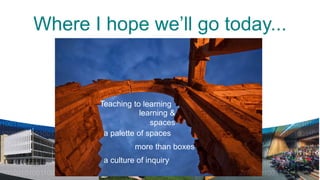
Where I hope we‟ll go today...


                   learning &
                      spaces
        a palette of spaces
                 more than boxes
        a culture of inquiry
The Shift from teaching to learning
      (Barr & Tagg, 1995)
                   http://critical.tamucc.edu/~blalock/readings/tch2learn.htm


Instructional paradigm to the learning paradigm.

              Begin with what we want students to
                learning & spaces
              be able to do at the end
                      a palette of spaces

                                              and design to get there
The Problem of Learning
  How do we make formal learning
environments more like practice-based
       learning& environments?
          learning spaces

             a palette of spaces
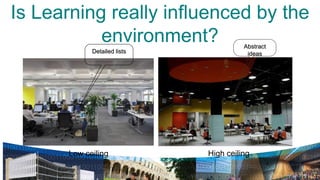
Is Learning really influenced by the
           environment?                 Abstract
             Detailed lists              ideas


       Low ceiling            High ceiling
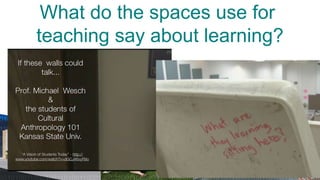
What do the spaces use for
teaching say about learning?
“A Vision of Students Today” - http://www.youtube.com/watch?v=dGCJ46vyR9o
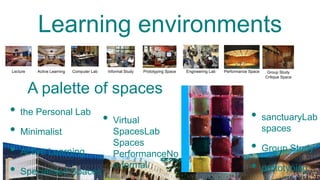
Learning environments
Lecture    Active Learning   Computer Lab   Informal Study   Prototyping Space   Engineering Lab   Performance Space    Group Study
                                                                                                                       Critique Space


          A palette of spaces
•   the Personal Lab
                                                                                                               •
                                            •   Virtual                                                                sanctuaryLab
•   Minimalist                                  SpacesLab                                                              spaces

•   Active Learning
                                                Spaces
                                                PerformanceNo
                                                                                                               •       Group Study

•   Specialised Spaces
                                                n-formal                                                       •       prototyping
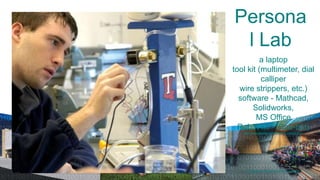
Persona
 l Lab
          a laptop
tool kit (multimeter, dial
          calliper
  wire strippers, etc.)
  software - Mathcad,
       Solidworks,
        MS Office
  Robot kit - (Boe-bot)
   http://www.parallax.com/tabid/411/Default.aspx


    Louisiana Technical University
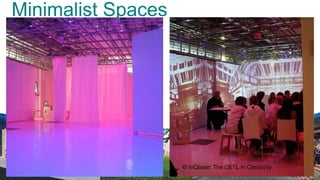
Minimalist Spaces
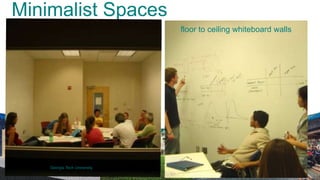
Minimalist Spaces
                              floor to ceiling whiteboard walls


    Georgia Tech University
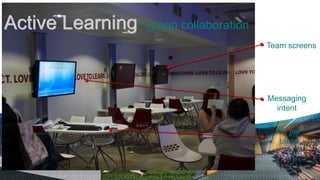
Active Learning- group collaboration
                                                   Team screens


                                                   Messaging
                                                     intent

                                                     PC per
                                                      table


                    University of Birmingham, UK
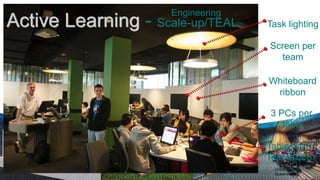
Engineering
Active Learning - Scale-up/TEAL     Task lighting

                                    Screen per
                                      team

                                    Whiteboard
                                     ribbon

                                     3 PCs per
                                        table

                                    Tables of 9
                                    Teams of 3
                            Math     University of
                                     Queensland
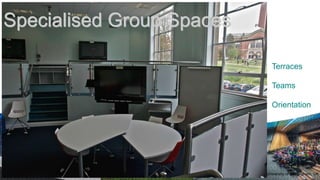
Specialised Group Spaces

                                               Terraces

                                               Teams

                   QuickTime™ and a
                 mpeg4 decompressor
           are needed to see this picture.
                                               Orientation


                                             University of Birmingham, UK
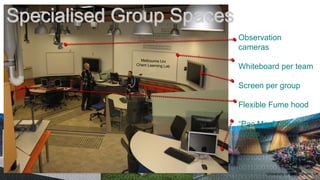
Specialised Group Spaces
                           Observation
                           cameras

                           Whiteboard per team

                           Screen per group

                           Flexible Fume hood

                           “Pac Man” orienting
                           tables


                                  University of Birmingham, UK
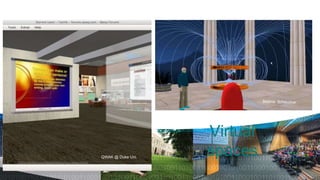
Virtual
QWAK @ Duke Uni.
                   spaces
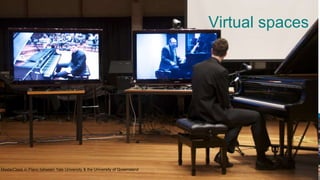
Virtual spaces


MasterClass in Piano between Yale University & the University of Queensland
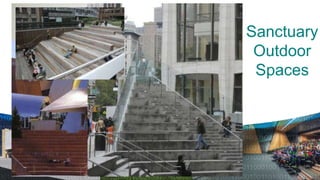
Sanctuary
 Outdoor
 Spaces
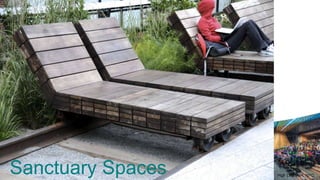
Sanctuary Spaces   High Line Park, NYC
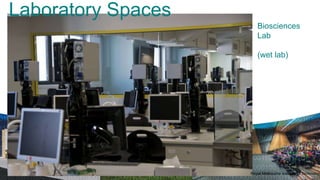
Laboratory Spaces
                       Biosciences
                       Lab

                       (wet lab)


                    Royal Melbourne Institute of Technology
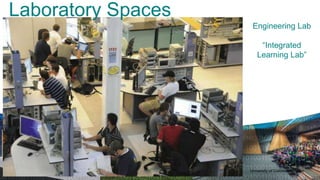
Laboratory Spaces
                     Engineering Lab

                        “Integrated
                       Learning Lab”


                    University of Colorado Boulder
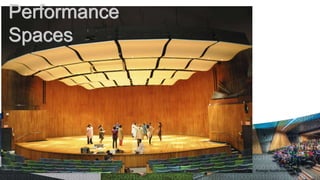
Performance
Spaces


              Kresge Auditorium, MIT
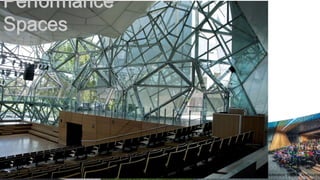
Performance
Spaces


              Federation Square, Melbourne
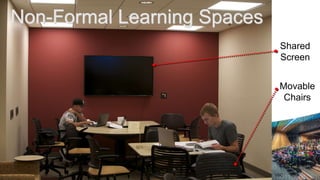
Non-Formal Learning Spaces
                              Shared
                              Screen


                              Movable
                               Chairs


                             USC
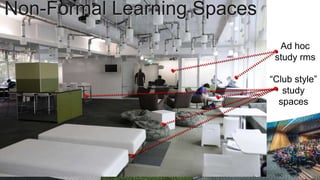
Non-Formal Learning Spaces
                               Ad hoc
                              study rms

                             “Club style”
                                study
                               spaces


                              USC
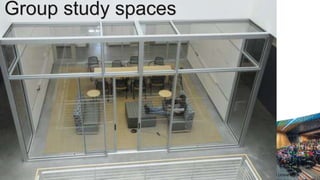
Group study spaces


                     Stanford University
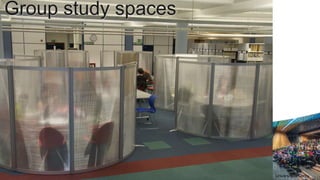
Group study spaces


                     University of Derby
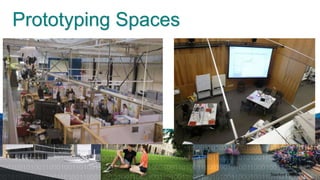
Prototyping Spaces


                     Stanford University
Pause
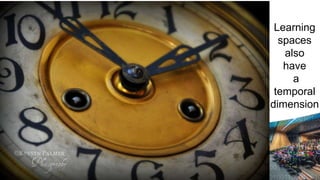
Learning
  spaces
   also
   have
     a
 temporal
dimension
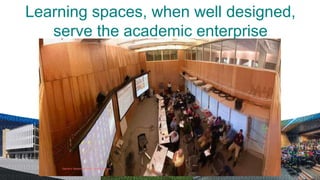
Learning spaces, when well designed,
   serve the academic enterprise


    Stanford Wallenberg Hall - during the day
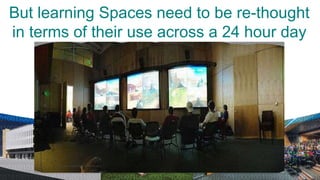
But learning Spaces need to be re-thought
in terms of their use across a 24 hour day


       Stanford Wallenberg Hall - at night
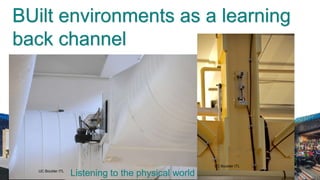
BUilt environments as a learning
back channel


                                                      UC Boulder ITL
   UC Boulder ITL
                    Listening to the physical world
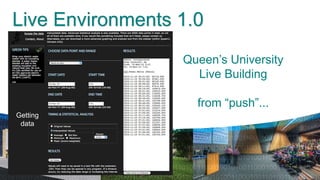
Live Environments 1.0
                  Queen‟s University
                    Live Building

                    from “push”...
Getting
 data
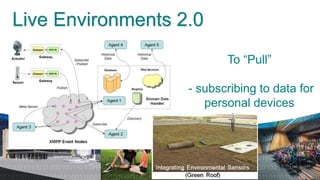
Live Environments 2.0
                          To “Pull”

                   - subscribing to data for
                      personal devices
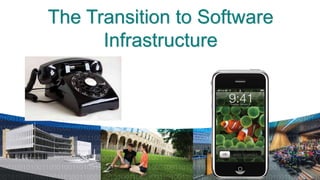
The Transition to Software
      Infrastructure
The Transition to Software
      Infrastructure
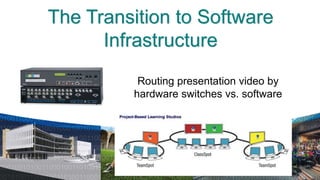
The Transition to Software
      Infrastructure
          Routing presentation video by
         hardware switches vs. software
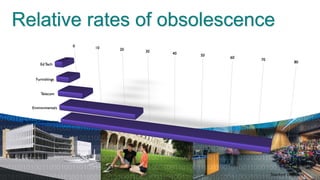
Relative rates of obsolescence


                             Stanford University
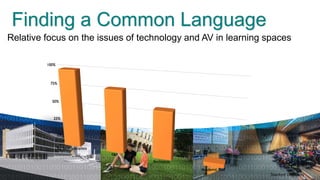
Finding a Common Language
Relative focus on the issues of technology and AV in learning spaces


                                                               Stanford University
Pause
Building a Culture of Active Inquiry

Built on passion in spaces that inspire itWhere recreation becomes
  an act of re-creation & remix through engaged learning (JSB)
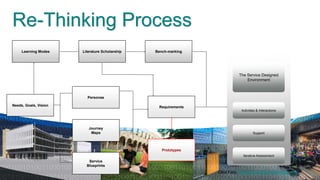
Re-Thinking Process
     Learning Modes    Literature Scholarship   Bench-marking


                                                                            The Service Designed
                                                                                Environment


                         Personas

Needs, Goals, Vision                             Requirements
                                                                             Activities & Interactions


                          Journey
                           Maps                                                      Support


                                                   Prototypes
                                                                              Iterative Assessment
                          Service
                         Blueprints
                                                                Elliot Felix, http://www.brightspotstrategy.com/
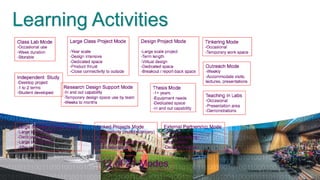
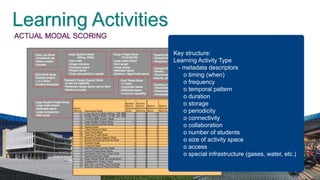
Learning Activities


                      Courtesy of Ed Crawley, MIT
Learning Activities
                      Key structure:
                      Learning Activity Type
                       - metadata descriptors
                         o timing (when)
                         o frequency
                         o temporal pattern
                         o duration
                         o storage
                         o periodicity
                         o connectivity
                         o collaboration
                         o number of students
                         o size of activity space
                         o access
                         o special infrastructure (gases, water, etc.)
Nouns of Learning Spaces

 Work surfaces -- Smartboards, whiteboards, tack boards, flip
 charts, blackboards Display outputs -- Flat panels, projectors,
optiputers Mobile devices -- Tablet PCs, smartphones, laptops,
    iPods Audio channels -- Microphone, outputs Artifacts --
 Inspirational objects, displays, posters Furnishings -- Tables,
                      a palette of spaces
                               a design process
chairs, couches, partitions Capture / Re-use systems -- Lecture
                    learning spaces as instruments

capture, LMS, personal podcasts, web Architectural elements --
                                   lessons learned

   Finishes, carpeting, room geometry, lighting configuration
VERBS of Learning Spaces


Connecting socially -- Peer-to-peer, faculty-to-student Discussing
  / Arguing -- Dyads, small group, "in the round" Commenting --
      Anchored discussion, annotation from multiple sources
 Demonstrating Presenting / Demonstrating Searching -- ad hoc,
                        a palette of spaces
                                 a design process
across resources Capturing -- Faculty, student, group work (long-
                      learning spaces as instruments

 term, e-folios) Thinking/conceiving Debating/negotiating space
                                     lessons learned
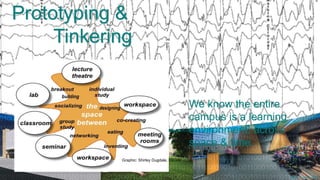
Prototyping &
     Tinkering


                                             We know the entire
                                             campus is a learning
                                             environment, across
                                             space & time.
            Graphic: Shirley Dugdale, DEGW


                                                                    http://bigthink.com/ideas/38119
Prototyping &
     Tinkering

 If buildings are „built pedagogy‟, and inquiry
 & discovery are fundamental components of
        learning, how are these elements
   represented in the way we plan and make
      available spaces for learning on our
                   campuses?


                                                  http://bigthink.com/ideas/38119
Thank You


Prof. Phillip D. Long, longpd@uq.edu.au
                      CEIT
          The University of Queensland
                        &
            Visiting Researcher, MIT

Test Slides for Hangouts for SCUP

  • 1.
    Just Do It:Prototyping Toward Progressive Renovation of Learning Spaces Prof. Phillip D. Long Director
  • 2.
    Where I hopewe‟ll go today... learning & spaces a palette of spaces more than boxes a culture of inquiry
  • 3.
    The Shift fromteaching to learning (Barr & Tagg, 1995) http://critical.tamucc.edu/~blalock/readings/tch2learn.htm Instructional paradigm to the learning paradigm. Begin with what we want students to learning & spaces be able to do at the end a palette of spaces and design to get there
  • 4.
    The Problem ofLearning How do we make formal learning environments more like practice-based learning& environments? learning spaces a palette of spaces
  • 5.
    Is Learning reallyinfluenced by the environment? Abstract Detailed lists ideas Low ceiling High ceiling
  • 6.
    What do thespaces use for teaching say about learning?
  • 7.
    “A Vision ofStudents Today” - http://www.youtube.com/watch?v=dGCJ46vyR9o
  • 8.
    Learning environments Lecture Active Learning Computer Lab Informal Study Prototyping Space Engineering Lab Performance Space Group Study Critique Space A palette of spaces • the Personal Lab • • Virtual sanctuaryLab • Minimalist SpacesLab spaces • Active Learning Spaces PerformanceNo • Group Study • Specialised Spaces n-formal • prototyping
  • 9.
    Persona l Lab a laptop tool kit (multimeter, dial calliper wire strippers, etc.) software - Mathcad, Solidworks, MS Office Robot kit - (Boe-bot) http://www.parallax.com/tabid/411/Default.aspx Louisiana Technical University
  • 10.
  • 11.
    Minimalist Spaces floor to ceiling whiteboard walls Georgia Tech University
  • 12.
    Active Learning- groupcollaboration Team screens Messaging intent PC per table University of Birmingham, UK
  • 13.
    Engineering Active Learning -Scale-up/TEAL Task lighting Screen per team Whiteboard ribbon 3 PCs per table Tables of 9 Teams of 3 Math University of Queensland
  • 14.
    Specialised Group Spaces Terraces Teams QuickTime™ and a mpeg4 decompressor are needed to see this picture. Orientation University of Birmingham, UK
  • 15.
    Specialised Group Spaces Observation cameras Whiteboard per team Screen per group Flexible Fume hood “Pac Man” orienting tables University of Birmingham, UK
  • 16.
  • 17.
    Virtual spaces MasterClass inPiano between Yale University & the University of Queensland
  • 18.
  • 19.
    Sanctuary Spaces High Line Park, NYC
  • 20.
    Laboratory Spaces Biosciences Lab (wet lab) Royal Melbourne Institute of Technology
  • 21.
    Laboratory Spaces Engineering Lab “Integrated Learning Lab” University of Colorado Boulder
  • 22.
    Performance Spaces Kresge Auditorium, MIT
  • 23.
    Performance Spaces Federation Square, Melbourne
  • 24.
    Non-Formal Learning Spaces Shared Screen Movable Chairs USC
  • 25.
    Non-Formal Learning Spaces Ad hoc study rms “Club style” study spaces USC
  • 26.
    Group study spaces Stanford University
  • 27.
    Group study spaces University of Derby
  • 28.
    Prototyping Spaces Stanford University
  • 29.
  • 30.
    Learning spaces also have a temporal dimension
  • 31.
    Learning spaces, whenwell designed, serve the academic enterprise Stanford Wallenberg Hall - during the day
  • 32.
    But learning Spacesneed to be re-thought in terms of their use across a 24 hour day Stanford Wallenberg Hall - at night
  • 33.
    BUilt environments asa learning back channel UC Boulder ITL UC Boulder ITL Listening to the physical world
  • 34.
    Live Environments 1.0 Queen‟s University Live Building from “push”... Getting data
  • 35.
    Live Environments 2.0 To “Pull” - subscribing to data for personal devices
  • 36.
    The Transition toSoftware Infrastructure
  • 37.
    The Transition toSoftware Infrastructure
  • 38.
    The Transition toSoftware Infrastructure Routing presentation video by hardware switches vs. software
  • 39.
    Relative rates ofobsolescence Stanford University
  • 40.
    Finding a CommonLanguage Relative focus on the issues of technology and AV in learning spaces Stanford University
  • 41.
  • 42.
    Building a Cultureof Active Inquiry Built on passion in spaces that inspire itWhere recreation becomes an act of re-creation & remix through engaged learning (JSB)
  • 43.
    Re-Thinking Process Learning Modes Literature Scholarship Bench-marking The Service Designed Environment Personas Needs, Goals, Vision Requirements Activities & Interactions Journey Maps Support Prototypes Iterative Assessment Service Blueprints Elliot Felix, http://www.brightspotstrategy.com/
  • 44.
    Learning Activities Courtesy of Ed Crawley, MIT
  • 45.
    Learning Activities Key structure: Learning Activity Type - metadata descriptors o timing (when) o frequency o temporal pattern o duration o storage o periodicity o connectivity o collaboration o number of students o size of activity space o access o special infrastructure (gases, water, etc.)
  • 46.
    Nouns of LearningSpaces Work surfaces -- Smartboards, whiteboards, tack boards, flip charts, blackboards Display outputs -- Flat panels, projectors, optiputers Mobile devices -- Tablet PCs, smartphones, laptops, iPods Audio channels -- Microphone, outputs Artifacts -- Inspirational objects, displays, posters Furnishings -- Tables, a palette of spaces a design process chairs, couches, partitions Capture / Re-use systems -- Lecture learning spaces as instruments capture, LMS, personal podcasts, web Architectural elements -- lessons learned Finishes, carpeting, room geometry, lighting configuration
  • 47.
    VERBS of LearningSpaces Connecting socially -- Peer-to-peer, faculty-to-student Discussing / Arguing -- Dyads, small group, "in the round" Commenting -- Anchored discussion, annotation from multiple sources Demonstrating Presenting / Demonstrating Searching -- ad hoc, a palette of spaces a design process across resources Capturing -- Faculty, student, group work (long- learning spaces as instruments term, e-folios) Thinking/conceiving Debating/negotiating space lessons learned
  • 48.
    Prototyping & Tinkering We know the entire campus is a learning environment, across space & time. Graphic: Shirley Dugdale, DEGW http://bigthink.com/ideas/38119
  • 49.
    Prototyping & Tinkering If buildings are „built pedagogy‟, and inquiry & discovery are fundamental components of learning, how are these elements represented in the way we plan and make available spaces for learning on our campuses? http://bigthink.com/ideas/38119
  • 50.
    Thank You Prof. PhillipD. Long, longpd@uq.edu.au CEIT The University of Queensland & Visiting Researcher, MIT