©2015CengageLearning.AllRightsReserved.Maynotbescanned,copiedorduplicated,orpostedtoapubliclyaccessiblewebsite,inwholeorinpart.
Mary Ellen Guffey & Dana Loewy, Business Communication: Process and Product, 8e
©2015CengageLearning.AllRightsReserved.Maynotbescanned,copiedorduplicated,orpostedtoapubliclyaccessiblewebsite,inwholeorinpart.
Ch. 1, Slide 1
Chapter 1
Business Communication in the
Digital Age
Business Communication:
Process and Product, 8e
Mary Ellen Guffey & Dana Loewy
©2015CengageLearning.AllRightsReserved.Maynotbescanned,copiedorduplicated,orpostedtoapubliclyaccessiblewebsite,inwholeorinpart.
Mary Ellen Guffey & Dana Loewy, Business Communication: Process and Product, 8e
Communication Skills: Your
Ticket to Work
Ch. 1, Slide 2
Traditional abilities
Reading
Listening
Nonverbal
Speaking
Writing
New requirements
Media savvy
Good judgment online:
• Maintaining
positive image and
presence
• Protecting employer’s
reputation
©2015CengageLearning.AllRightsReserved.Maynotbescanned,copiedorduplicated,orpostedtoapubliclyaccessiblewebsite,inwholeorinpart.
Mary Ellen Guffey & Dana Loewy, Business Communication: Process and Product, 8e
Writing in the Digital Age
• Writing matters more than ever; online
media require more of it, not less.
• Communicating clearly and effectively
has never been more important than it is
today.
• Life-changing critical judgments about
people are being made based solely on
their writing ability.
Ch. 1, Slide 3
©2015CengageLearning.AllRightsReserved.Maynotbescanned,copiedorduplicated,orpostedtoapubliclyaccessiblewebsite,inwholeorinpart.
Mary Ellen Guffey & Dana Loewy, Business Communication: Process and Product, 8e
Tools for Success in the 21st
Century Workplace
• Knowledge and information workers
engage in mind work.
• Workers of the future must make sense
of words, figures, and data.
• Knowledge available in the digital
universe doubles every year.
• Talent shortages plague even a bleak
U.S. labor market.
Ch. 1, Slide 4
©2015CengageLearning.AllRightsReserved.Maynotbescanned,copiedorduplicated,orpostedtoapubliclyaccessiblewebsite,inwholeorinpart.
Mary Ellen Guffey & Dana Loewy, Business Communication: Process and Product, 8e
Thinking Critically in the
Digital Age
• Having opinions backed up by reasons
and evidence
• Anticipating and solving problems
• Making decisions and communicating
them effectively
Ch. 1, Slide 5
Thinking creatively and critically means:
©2015CengageLearning.AllRightsReserved.Maynotbescanned,copiedorduplicated,orpostedtoapubliclyaccessiblewebsite,inwholeorinpart.
Mary Ellen Guffey & Dana Loewy, Business Communication: Process and Product, 8e
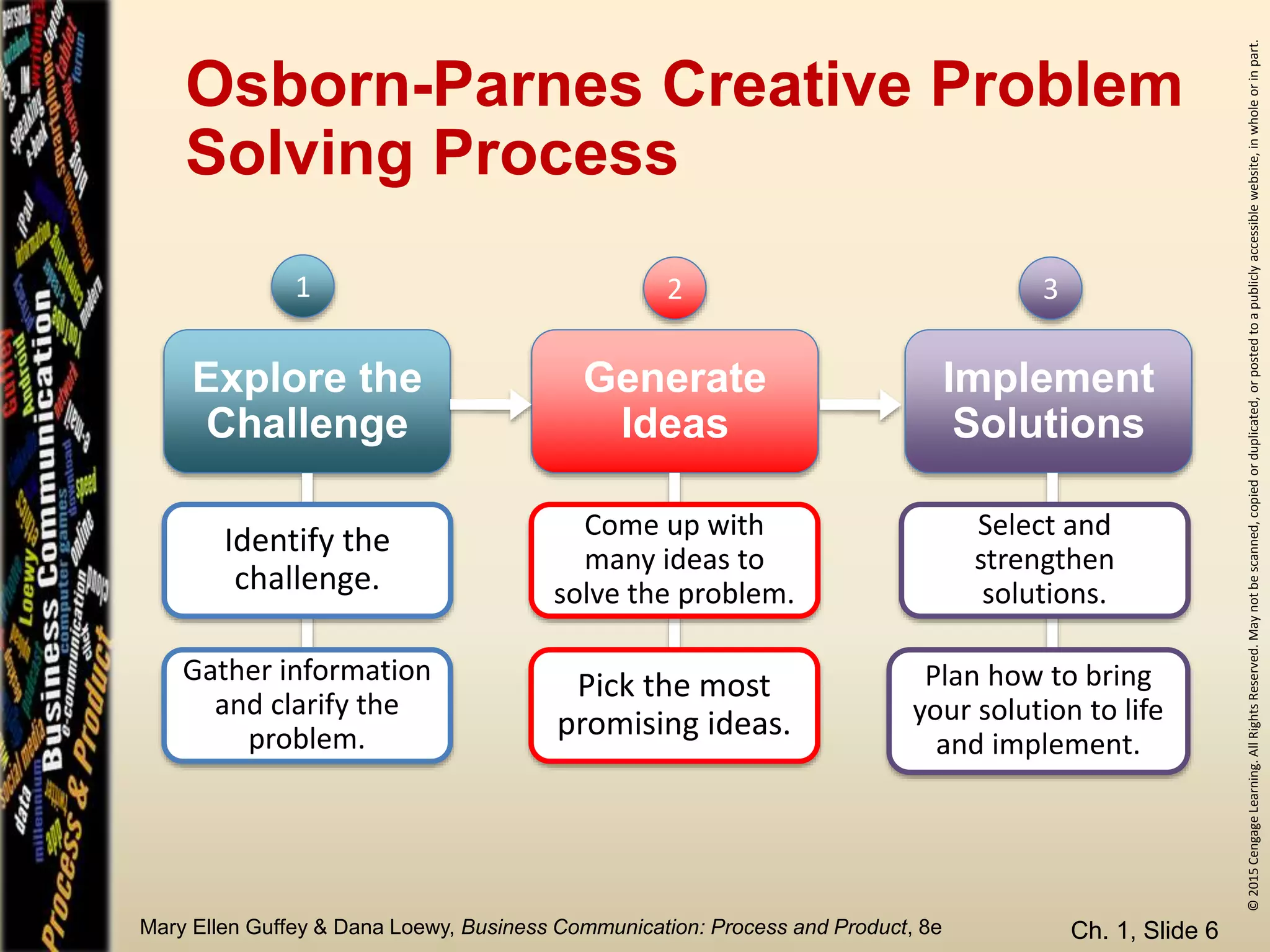
Osborn-Parnes Creative Problem
Solving Process
Ch. 1, Slide 6
Explore the
Challenge
1
Identify the
challenge.
Gather information
and clarify the
problem.
2
Generate
Ideas
Come up with
many ideas to
solve the problem.
Pick the most
promising ideas.
3
Implement
Solutions
Select and
strengthen
solutions.
Plan how to bring
your solution to life
and implement.
©2015CengageLearning.AllRightsReserved.Maynotbescanned,copiedorduplicated,orpostedtoapubliclyaccessiblewebsite,inwholeorinpart.
Mary Ellen Guffey & Dana Loewy, Business Communication: Process and Product, 8e
Social Media and Changing
Communication Technologies
Ch. 1, Slide 7
• To connect with consumers
• To invite feedback
• To improve products and services
• To announce promotions and events
• To draw traffic to blogs, tweets, the company
website, and online communities
• To respond to crises
Savvy organizations are “plugged in” and use
both old and new media
Word of mouth, positive and negative, can travel
instantly at the speed of a few mouse clicks.
©2015CengageLearning.AllRightsReserved.Maynotbescanned,copiedorduplicated,orpostedtoapubliclyaccessiblewebsite,inwholeorinpart.
Mary Ellen Guffey & Dana Loewy, Business Communication: Process and Product, 8e
Anytime, Anywhere:
24/7/365 Availability
Ch. 1, Slide 8
• Working long hours without extra compensation
• Being available practically anywhere and anytime
• Living with an increasingly blurry line between
work and leisure
• Remaining tethered to the workplace with
electronic devices around the clock
The challenges of relentless connectedness
across time zones and distances:
©2015CengageLearning.AllRightsReserved.Maynotbescanned,copiedorduplicated,orpostedtoapubliclyaccessiblewebsite,inwholeorinpart.
Mary Ellen Guffey & Dana Loewy, Business Communication: Process and Product, 8e
Anytime, Anywhere:
24/7/365 Availability
Ch. 1, Slide 9
• The physical office extending its reach by
becoming mobile and always “on.”
• Americans work 50 percent more than their
colleagues in other industrialized nations while
enjoying the shortest paid vacations.
• A networked, information-driven workforce never
goes “off-duty” in an organization that “never
sleeps.”
The challenges of relentless connectedness across
time zones and distances:
©2015CengageLearning.AllRightsReserved.Maynotbescanned,copiedorduplicated,orpostedtoapubliclyaccessiblewebsite,inwholeorinpart.
Mary Ellen Guffey & Dana Loewy, Business Communication: Process and Product, 8e
The Global Marketplace and
Competition
Ch. 1, Slide 10
• Rise of new communication
technologies
• Removal of trade barriers
• Advanced forms of transportation
• Saturated local markets
Factors that prompted companies to
move to emerging markets around the
world:
©2015CengageLearning.AllRightsReserved.Maynotbescanned,copiedorduplicated,orpostedtoapubliclyaccessiblewebsite,inwholeorinpart.
Mary Ellen Guffey & Dana Loewy, Business Communication: Process and Product, 8e
The Global Marketplace and
Competition
Ch. 1, Slide 11
• Understanding different customs, lifestyles,
and business practices
• Coping with challenges of multiple time
zones, vast distances, and different
languages
• Developing new skills and attitudes
• Practicing cultural awareness, flexibility,
and patience
Requirements for successful
communicators in new markets:
©2015CengageLearning.AllRightsReserved.Maynotbescanned,copiedorduplicated,orpostedtoapubliclyaccessiblewebsite,inwholeorinpart.
Mary Ellen Guffey & Dana Loewy, Business Communication: Process and Product, 8e
Shrinking Management Layers:
Advantages
• Cost savings and efficiency
• Fewer layers between managers and
line workers
• Shorter lines of communication
• Faster decision making
• Quick response to market changes
Ch. 1, Slide 12
©2015CengageLearning.AllRightsReserved.Maynotbescanned,copiedorduplicated,orpostedtoapubliclyaccessiblewebsite,inwholeorinpart.
Mary Ellen Guffey & Dana Loewy, Business Communication: Process and Product, 8e
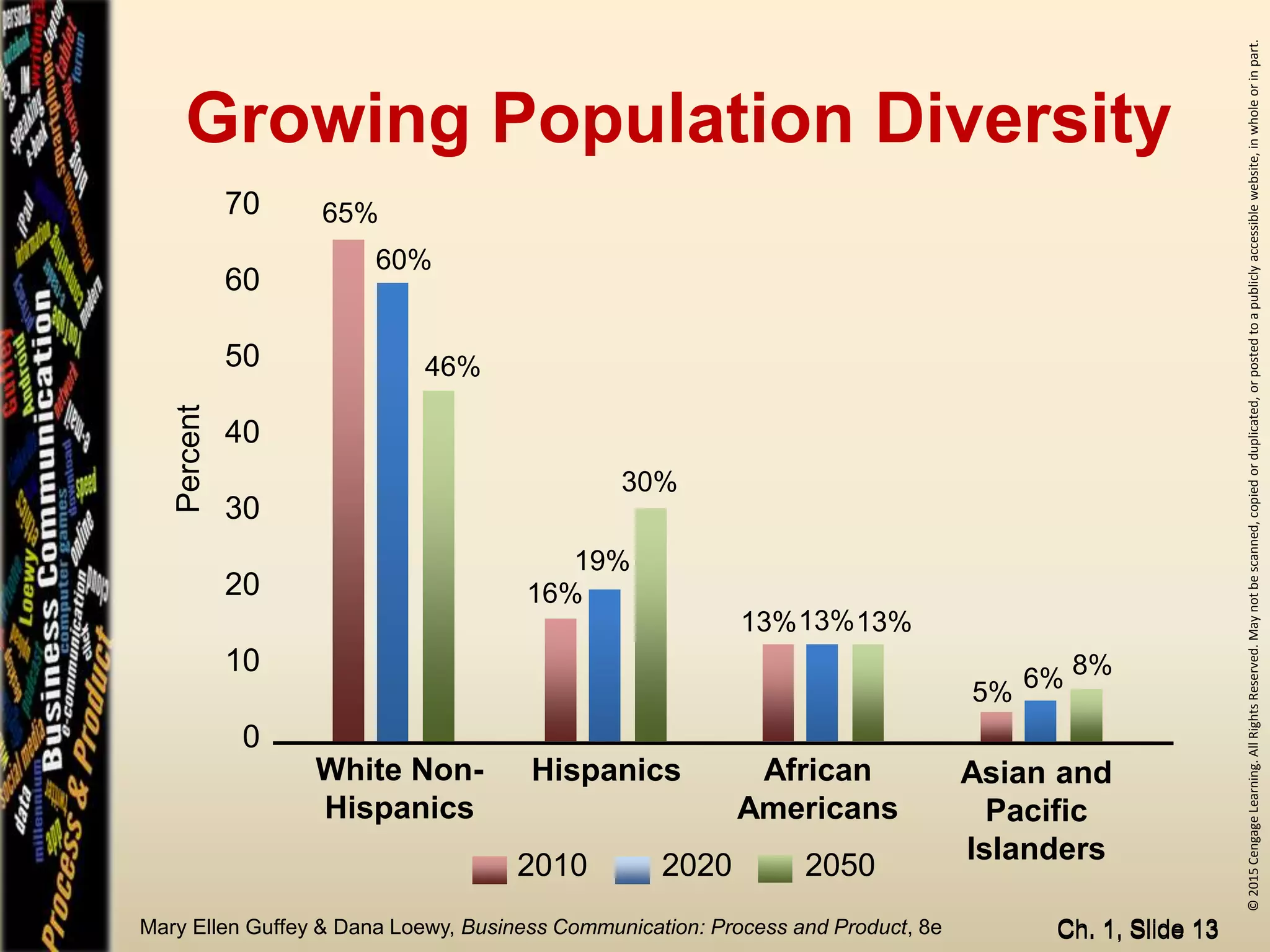
Growing Population Diversity
Ch. 1, Slide 13Ch. 1, Slide 13
70
60
50
40
30
20
10
0
Percent
65%
60%
46%
16%
19%
30%
13%13%13%
5% 6% 8%
2010 2020 2050
White Non-
Hispanics
Hispanics African
Americans
Asian and
Pacific
Islanders
©2015CengageLearning.AllRightsReserved.Maynotbescanned,copiedorduplicated,orpostedtoapubliclyaccessiblewebsite,inwholeorinpart.
Mary Ellen Guffey & Dana Loewy, Business Communication: Process and Product, 8e
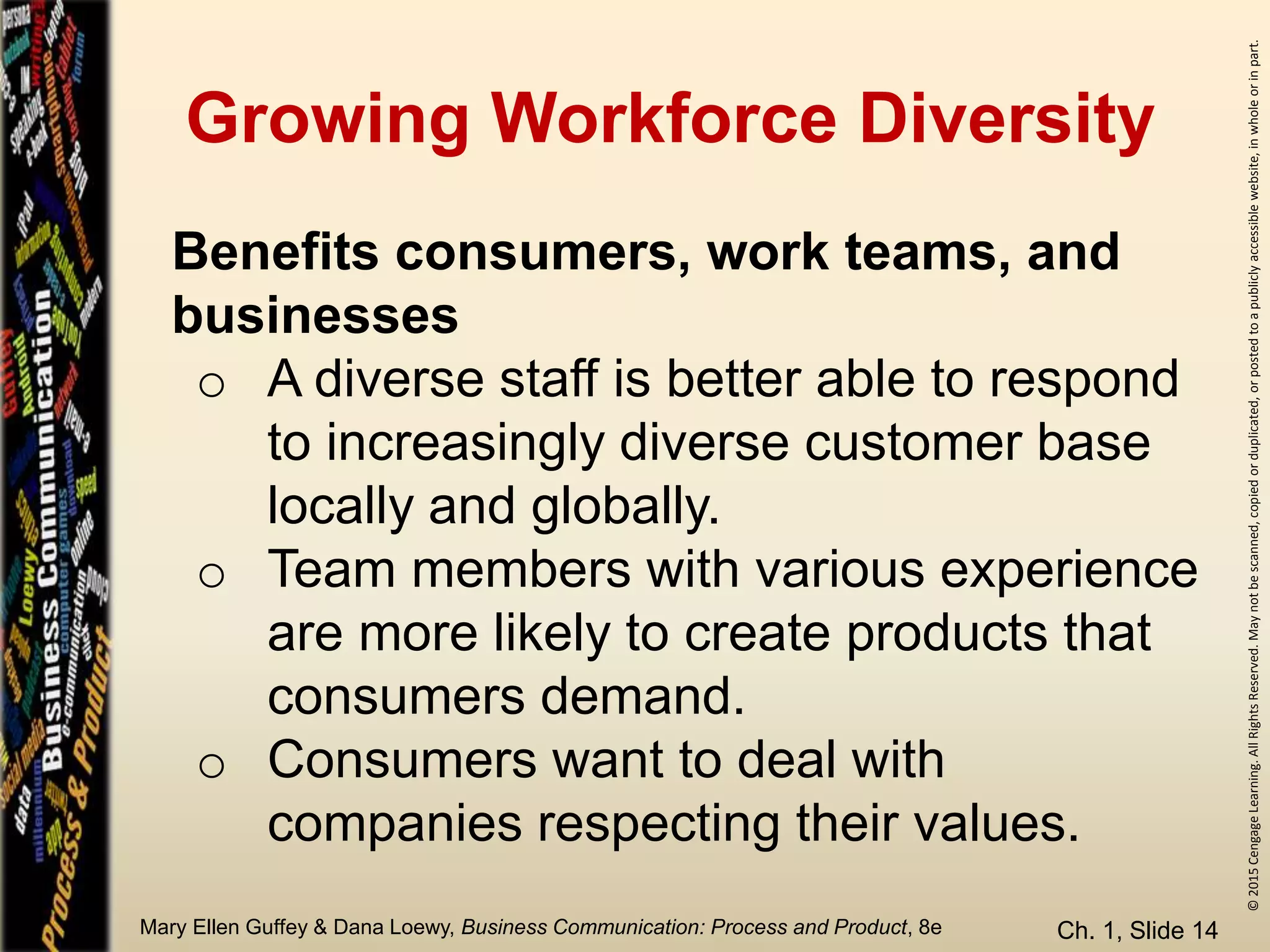
Growing Workforce Diversity
Ch. 1, Slide 14
Benefits consumers, work teams, and
businesses
o A diverse staff is better able to respond
to increasingly diverse customer base
locally and globally.
o Team members with various experience
are more likely to create products that
consumers demand.
o Consumers want to deal with
companies respecting their values.
©2015CengageLearning.AllRightsReserved.Maynotbescanned,copiedorduplicated,orpostedtoapubliclyaccessiblewebsite,inwholeorinpart.
Mary Ellen Guffey & Dana Loewy, Business Communication: Process and Product, 8e
Virtual and Nonterritorial Offices
Ch. 1, Slide 15
• Mobile and decentralized workspaces
• Flexible work arrangements
• “Work shifters,” a new breed of
telecommuter
• “Coworking,” sharing communal office
space as needed
• Anytime, anywhere office enabled by
technology
©2015CengageLearning.AllRightsReserved.Maynotbescanned,copiedorduplicated,orpostedtoapubliclyaccessiblewebsite,inwholeorinpart.
Mary Ellen Guffey & Dana Loewy, Business Communication: Process and Product, 8e
The Networked Office in a
Hyperconnected World
Ch. 1, Slide 16
• Smart electronic devices => Mobility
• Social media networks, Web 2.0 =>
Interactivity
• Biggest Shift: one-sided, slow forms of
communication (hard-copy, memos, and
letters) => interactive, instant, paperless
communication (e-mail, instant messaging,
texting, social media)
©2015CengageLearning.AllRightsReserved.Maynotbescanned,copiedorduplicated,orpostedtoapubliclyaccessiblewebsite,inwholeorinpart.
Mary Ellen Guffey & Dana Loewy, Business Communication: Process and Product, 8e
Media Richness
Ch. 1, Slide 17
The more helpful cues and immediate feedback the
medium provides, the richer and less ambiguous it
is:
RICH: Face-to-face and telephone conversation
=> complex issues, sensitive subjects
LEAN: Written media (e-mail, letter, memo, note,
report) => routine, unambiguous problems
©2015CengageLearning.AllRightsReserved.Maynotbescanned,copiedorduplicated,orpostedtoapubliclyaccessiblewebsite,inwholeorinpart.
Mary Ellen Guffey & Dana Loewy, Business Communication: Process and Product, 8e
Social Presence
Ch. 1, Slide 18
Definition: How much awareness of the sender is
conveyed with the message. Media with high social
presence convey warmth and are personal.
HIGH in synchronous communication: face to
face, video conference, live chat
LOW in asynchronous communication: e-mail,
social media post
©2015CengageLearning.AllRightsReserved.Maynotbescanned,copiedorduplicated,orpostedtoapubliclyaccessiblewebsite,inwholeorinpart.
Mary Ellen Guffey & Dana Loewy, Business Communication: Process and Product, 8e
Informal Communication
Channels
Ch. 1, Slide 19
The grapevine: gossip from the break room
to the water cooler to social media
• Carries unofficial messages
• Flows haphazardly
• Can be remarkably accurate
• Is mostly disliked by management
• Thrives where official information is
limited
©2015CengageLearning.AllRightsReserved.Maynotbescanned,copiedorduplicated,orpostedtoapubliclyaccessiblewebsite,inwholeorinpart.
Mary Ellen Guffey & Dana Loewy, Business Communication: Process and Product, 8e
Goals of Ethical Business
Communicators
Ch. 1, Slide 20
• Abide by the law
• Tell the truth
• Label opinions
• Be objective
• Communicate clearly
• Use inclusive language
• Give credit
©2015CengageLearning.AllRightsReserved.Maynotbescanned,copiedorduplicated,orpostedtoapubliclyaccessiblewebsite,inwholeorinpart.
Mary Ellen Guffey & Dana Loewy, Business Communication: Process and Product, 8e
Overcoming Obstacles to Ethical
Decision Making
Ch. 1, Slide 21
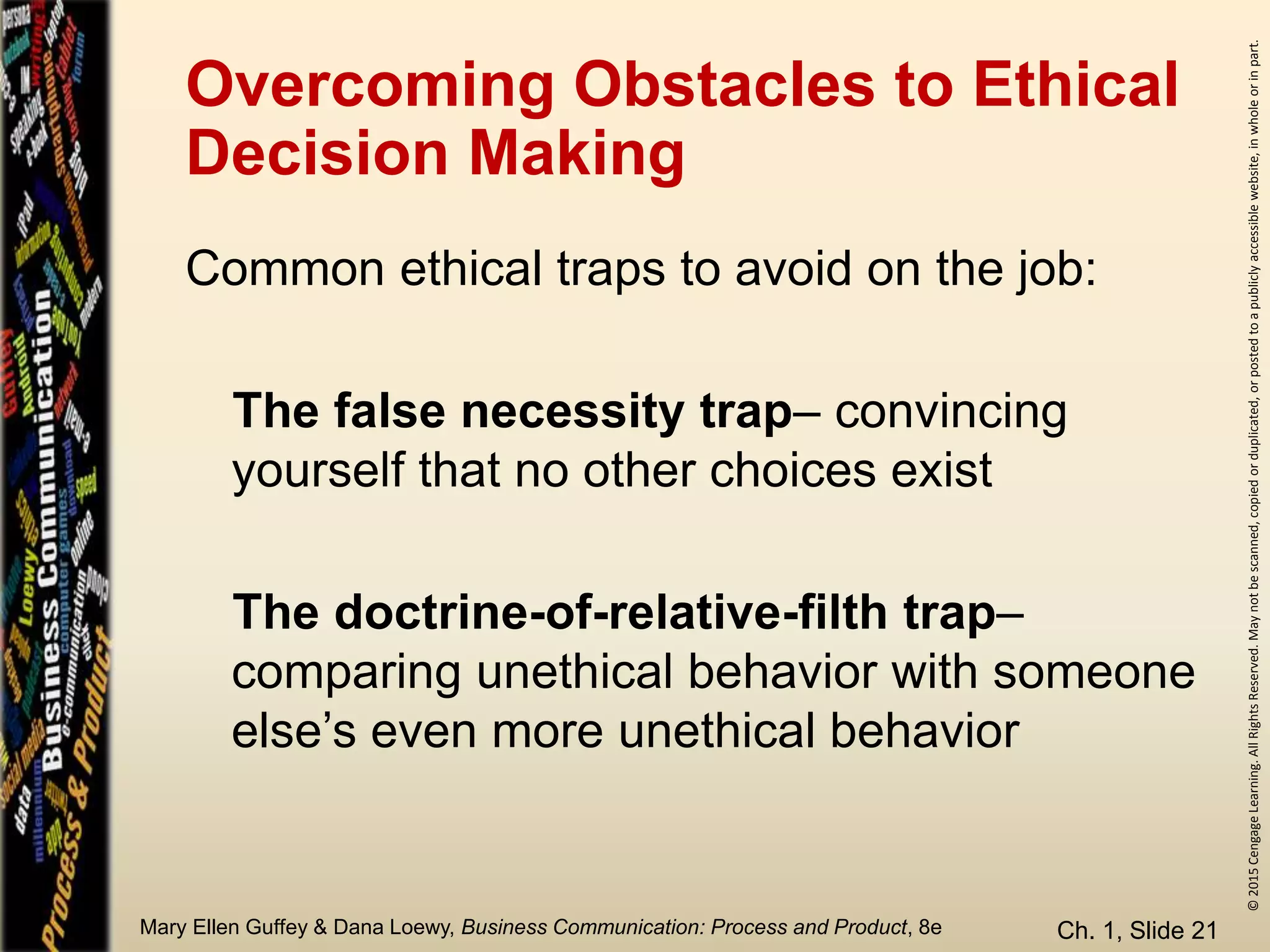
Common ethical traps to avoid on the job:
The false necessity trap– convincing
yourself that no other choices exist
The doctrine-of-relative-filth trap–
comparing unethical behavior with someone
else’s even more unethical behavior
©2015CengageLearning.AllRightsReserved.Maynotbescanned,copiedorduplicated,orpostedtoapubliclyaccessiblewebsite,inwholeorinpart.
Mary Ellen Guffey & Dana Loewy, Business Communication: Process and Product, 8e
Overcoming Obstacles to Ethical
Decision Making
Ch. 1, Slide 22
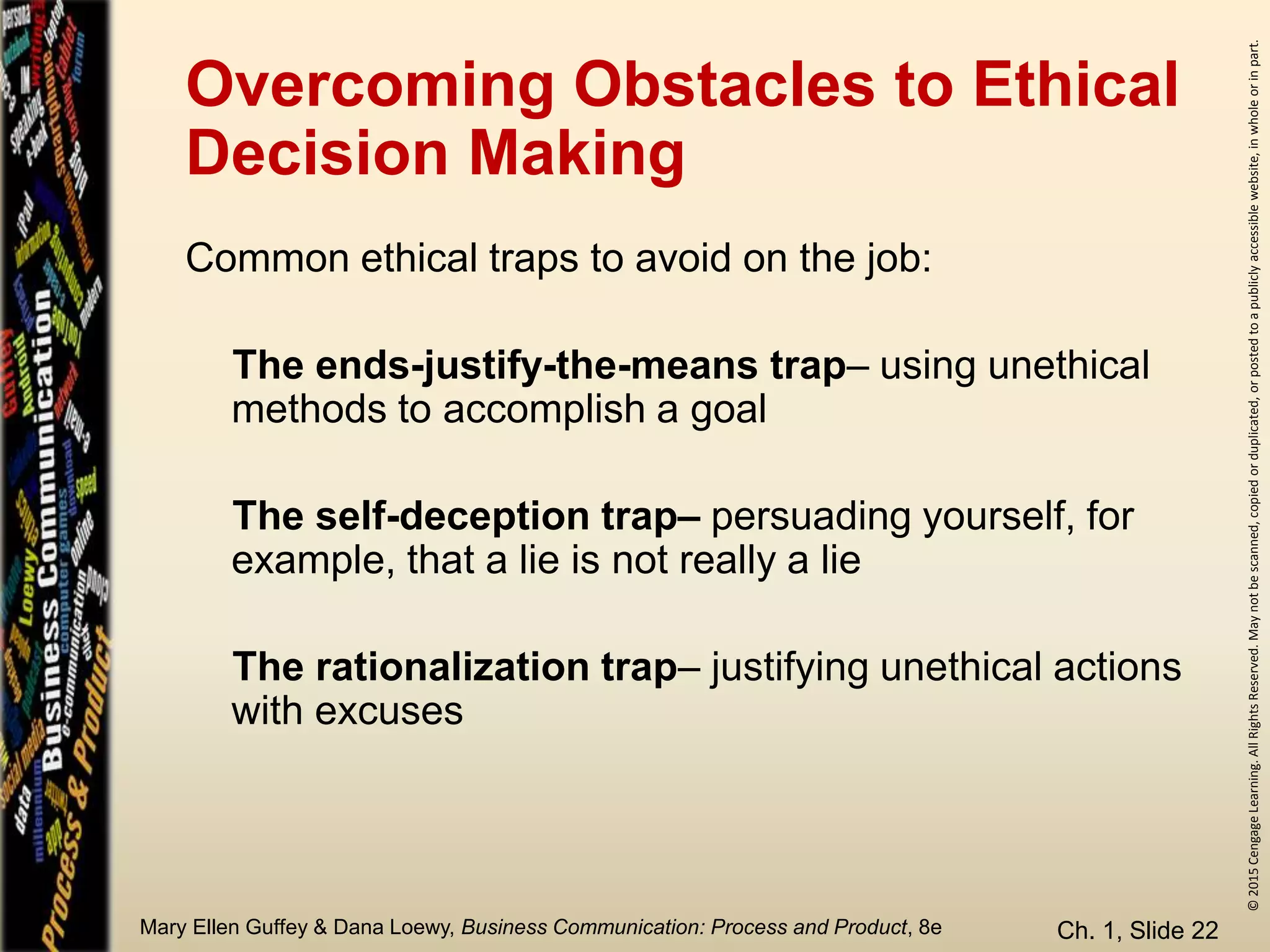
Common ethical traps to avoid on the job:
The ends-justify-the-means trap– using unethical
methods to accomplish a goal
The self-deception trap– persuading yourself, for
example, that a lie is not really a lie
The rationalization trap– justifying unethical actions
with excuses
©2015CengageLearning.AllRightsReserved.Maynotbescanned,copiedorduplicated,orpostedtoapubliclyaccessiblewebsite,inwholeorinpart.
Mary Ellen Guffey & Dana Loewy, Business Communication: Process and Product, 8e
Choosing Tools for Doing the
Right Thing
Ch. 1, Slide 23
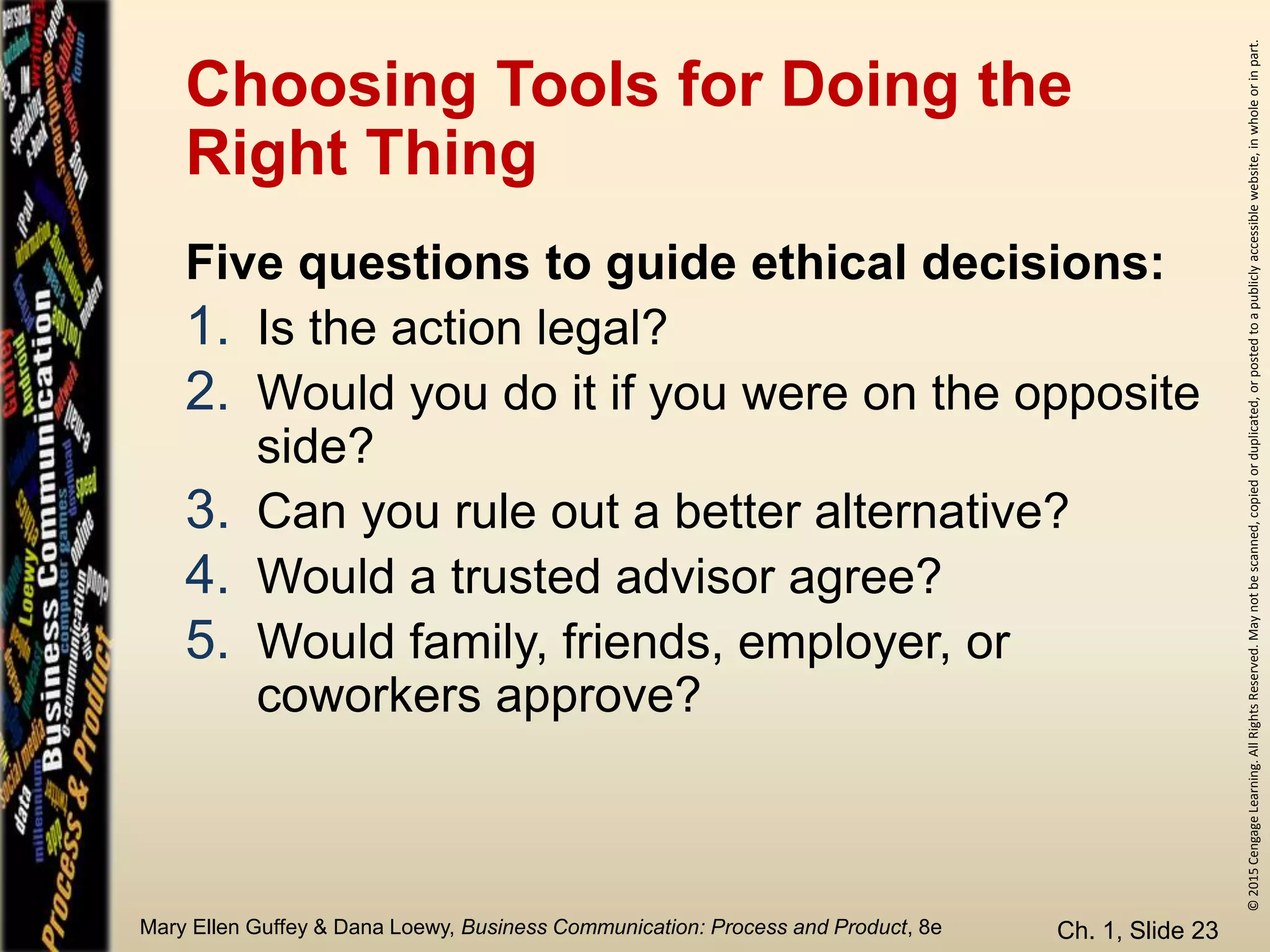
Five questions to guide ethical decisions:
1. Is the action legal?
2. Would you do it if you were on the opposite
side?
3. Can you rule out a better alternative?
4. Would a trusted advisor agree?
5. Would family, friends, employer, or
coworkers approve?

Ch01 ppt- Business Communication in the Digital Age