A new method for developing true
         partnership in universities
                                     Teemu Ylikoski
                                   Mika J. Kortelainen
             Presented at the Learning by Developing Conference, May 2012.
                                   Updated Nov-2012

                                       11/24/2012


24.11.2012
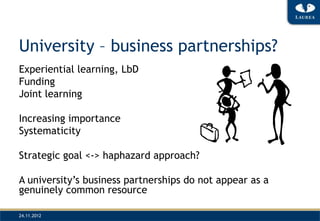
University – business partnerships?
Experiential learning, LbD
Funding
Joint learning

Increasing importance
Systematicity

Strategic goal <-> haphazard approach?

A university’s business partnerships do not appear as a
genuinely common resource

24.11.2012
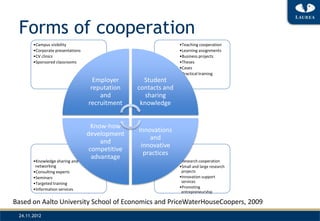
Forms of cooperation
       •Campus visibility                                       •Teaching cooperation
       •Corporate presentations                                 •Learning assignments
       •CV clinics                                              •Business projects
       •Sponsored classrooms                                    •Theses
                                                                •Cases
                                                                •Practical training
                                    Employer       Student
                                   reputation    contacts and
                                      and           sharing
                                  recruitment     knowledge


                                    Know-how
                                                 Innovations
                                  development
                                                     and
                                       and
                                                  innovative
                                   competitive
                                                   practices
                                    advantage
       •Knowledge sharing and                                   •Research cooperation
        networking                                              •Small and large research
       •Consulting experts                                       projects
       •Seminars                                                •Innovation support
       •Targeted training                                        services
                                                                •Promoting
       •Information services
                                                                 entrepreneurship

Based on Aalto University School of Economics and PriceWaterHouseCoopers, 2009
 24.11.2012
How are partnerships managed?
1.  Relationship management is a strategic concern. It is related
    to long-term competitive advantage, and is a top management
    issue.
2. The ultimate purpose of relationship management is to
    increase value for the organisation, and its stakeholders.
3. The process of relationship management is about identifying
    key “customers” (such as partners), and developing the
    relationships with them.
4. Systematic building of relationships results in various
    benefits, such as profitability, retention, and customer
    (partner) satisfaction.
5. All of this depends on documenting and sharing knowledge
    about the key “customers”.
(Adapted from Payne & Frow 2005)


24.11.2012
Problems…
A university is not a business:
• autonomy of organisational units and individuals
• internal competition
• government-funding and non-profit operation

Who OWNS the partner?
• individual, research unit, faculty?
• more rarely are they common to the entire
  school.

24.11.2012
Case Lohja
•     Lohja Yrityslabra “Business Lab” has started
      managing a partnership program for local businesses
•     The Business Lab is a blended learning environment
      that coordinates learning projects for the students
•     …and knowledge-producing commissions for local
      clients
•     Represents expansive learning: tasks are complex,
      with no set correct outcome, and there are several
      participants making the learning collective


24.11.2012
Skills
Participating students learn skills:
• project management and
• customer relationship management
while coordinating the projects. At the same time,
students learn to expand their knowledge in
theoretical issues, such as marketing, strategy or e-
commerce, when they collect data and write
reports for the commissioning companies.


24.11.2012
A partnership program
As partner organisations are vital for this type of operation,
the Lab has initiated a partnership program to manage local
partners itself. Much like a “real world” customer
relationship program, the Business Lab hosts a database of
potential and current partner organisations. These
partnerships can be used as the learning context for any
relevant course in the entire Lohja unit.

Since the partnerships are systematically nurtured, over time
cooperation will become more strategic. For example, future
development projects with the aforementioned company
might focus on its e-commerce strategy – something that
would not be possible without a successful history of working
together.

24.11.2012
Students run the program
business students are responsible for:
1. Contacting the “customers”, i.e. local companies and
    organisations who are potential partners for the Lab,
2. “Selling the service”, i.e. introducing the partners to the
    idea of continuous cooperation with the Lab,
3. And following up on the “customers”, i.e. keeping in
    touch to make sure mutual needs are covered.
4. Also, as in a “real” CRM, the students document
    everything in the database. Hence, when one student
    graduates and a new one enters the Lab, the partner
    history stays available. As a consequence, knowledge
    accumulates, is shared and future projects can build on
    previous ones.

24.11.2012
Benefits
• improved learning for the students: first hand
  experience in customer relationship management
• deeper partnerships, as relationships evolve over
  time
• The partnership program does not assume or
  require individual educators to relinquish their
  “private” partners. Rather, it offers an
  alternative route for cooperation, parallel to the
  more conventional method of maintaining
  partnerships.

24.11.2012
Full results of the case are
available:
Teemu Ylikoski, Mika J. Kortelainen, (2012) "A new
approach for managing university-workplace
partnerships", Industrial and Commercial Training,
Vol. 44 Iss: 6, pp.349 - 356


24.11.2012

Partnerships

  • 1.
    A new methodfor developing true partnership in universities Teemu Ylikoski Mika J. Kortelainen Presented at the Learning by Developing Conference, May 2012. Updated Nov-2012 11/24/2012 24.11.2012
  • 2.
    University – businesspartnerships? Experiential learning, LbD Funding Joint learning Increasing importance Systematicity Strategic goal <-> haphazard approach? A university’s business partnerships do not appear as a genuinely common resource 24.11.2012
  • 3.
    Forms of cooperation •Campus visibility •Teaching cooperation •Corporate presentations •Learning assignments •CV clinics •Business projects •Sponsored classrooms •Theses •Cases •Practical training Employer Student reputation contacts and and sharing recruitment knowledge Know-how Innovations development and and innovative competitive practices advantage •Knowledge sharing and •Research cooperation networking •Small and large research •Consulting experts projects •Seminars •Innovation support •Targeted training services •Promoting •Information services entrepreneurship Based on Aalto University School of Economics and PriceWaterHouseCoopers, 2009 24.11.2012
  • 4.
    How are partnershipsmanaged? 1. Relationship management is a strategic concern. It is related to long-term competitive advantage, and is a top management issue. 2. The ultimate purpose of relationship management is to increase value for the organisation, and its stakeholders. 3. The process of relationship management is about identifying key “customers” (such as partners), and developing the relationships with them. 4. Systematic building of relationships results in various benefits, such as profitability, retention, and customer (partner) satisfaction. 5. All of this depends on documenting and sharing knowledge about the key “customers”. (Adapted from Payne & Frow 2005) 24.11.2012
  • 5.
    Problems… A university isnot a business: • autonomy of organisational units and individuals • internal competition • government-funding and non-profit operation Who OWNS the partner? • individual, research unit, faculty? • more rarely are they common to the entire school. 24.11.2012
  • 6.
    Case Lohja • Lohja Yrityslabra “Business Lab” has started managing a partnership program for local businesses • The Business Lab is a blended learning environment that coordinates learning projects for the students • …and knowledge-producing commissions for local clients • Represents expansive learning: tasks are complex, with no set correct outcome, and there are several participants making the learning collective 24.11.2012
  • 7.
    Skills Participating students learnskills: • project management and • customer relationship management while coordinating the projects. At the same time, students learn to expand their knowledge in theoretical issues, such as marketing, strategy or e- commerce, when they collect data and write reports for the commissioning companies. 24.11.2012
  • 8.
    A partnership program Aspartner organisations are vital for this type of operation, the Lab has initiated a partnership program to manage local partners itself. Much like a “real world” customer relationship program, the Business Lab hosts a database of potential and current partner organisations. These partnerships can be used as the learning context for any relevant course in the entire Lohja unit. Since the partnerships are systematically nurtured, over time cooperation will become more strategic. For example, future development projects with the aforementioned company might focus on its e-commerce strategy – something that would not be possible without a successful history of working together. 24.11.2012
  • 9.
    Students run theprogram business students are responsible for: 1. Contacting the “customers”, i.e. local companies and organisations who are potential partners for the Lab, 2. “Selling the service”, i.e. introducing the partners to the idea of continuous cooperation with the Lab, 3. And following up on the “customers”, i.e. keeping in touch to make sure mutual needs are covered. 4. Also, as in a “real” CRM, the students document everything in the database. Hence, when one student graduates and a new one enters the Lab, the partner history stays available. As a consequence, knowledge accumulates, is shared and future projects can build on previous ones. 24.11.2012
  • 10.
    Benefits • improved learningfor the students: first hand experience in customer relationship management • deeper partnerships, as relationships evolve over time • The partnership program does not assume or require individual educators to relinquish their “private” partners. Rather, it offers an alternative route for cooperation, parallel to the more conventional method of maintaining partnerships. 24.11.2012
  • 11.
    Full results ofthe case are available: Teemu Ylikoski, Mika J. Kortelainen, (2012) "A new approach for managing university-workplace partnerships", Industrial and Commercial Training, Vol. 44 Iss: 6, pp.349 - 356 24.11.2012