By:
ERNESTO M. SEROTE
Professor and Director of Training
School of Urban and Regional Planning
University of the Philippines
RATIONALIZED LOCAL
PLANNING SYSTEM
Selected Features
• Faithful compliance with LGC provisions
• Limit LGU-mandated plans to the CLUP
and CDP
• NGAs to dovetail their requirements with
the local planning system
• Less technocratic, more participatory and
consultative
Components of the Local Planning System
• Planning structure
• Planning mandates
• Planning process
• LGU Authority Levers
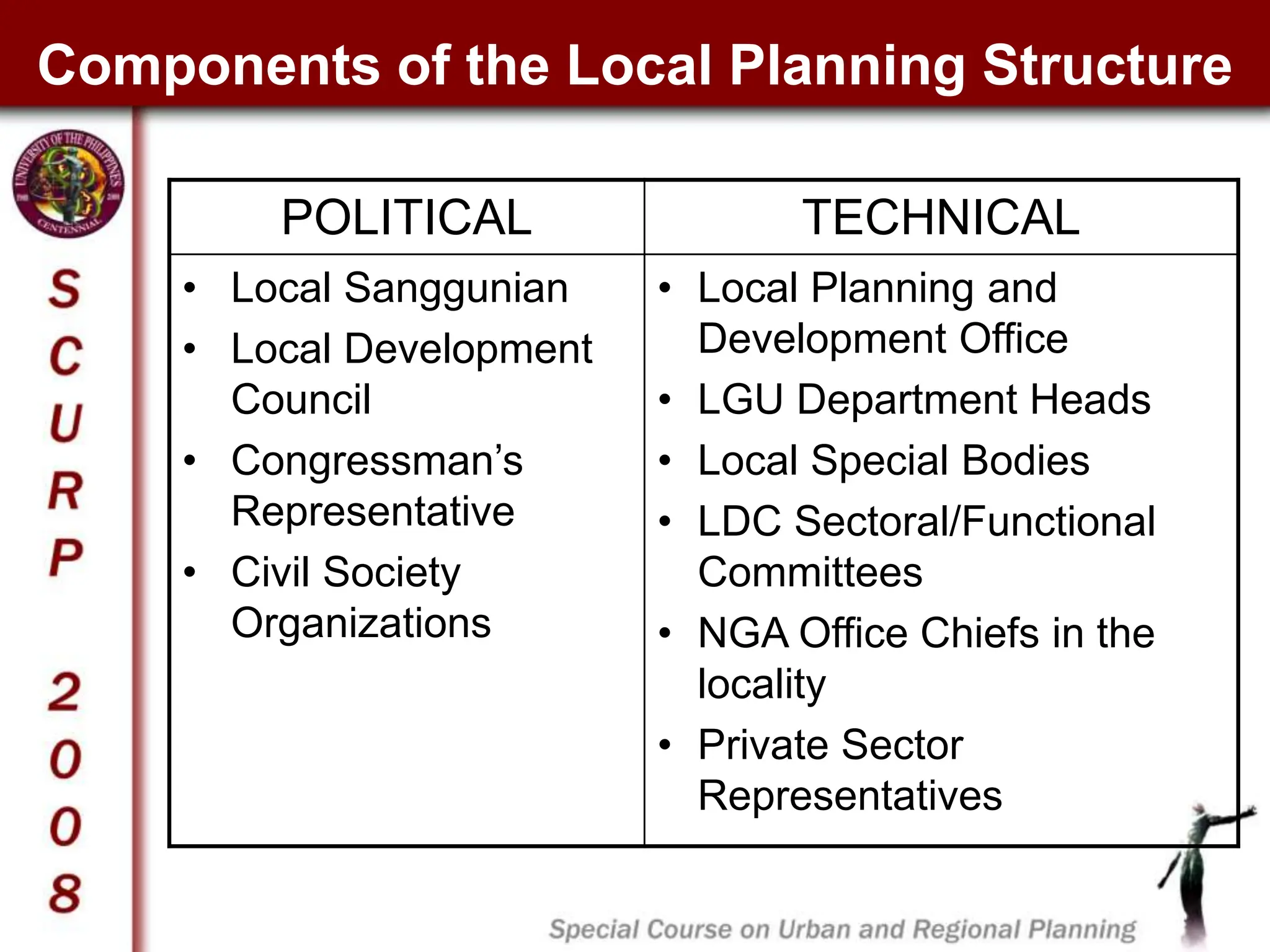
LOCAL PLANNING STRUCTURE
POLITICAL TECHNICAL
• Local Sanggunian
• Local Development
Council
• Congressman’s
Representative
• Civil Society
Organizations
• Local Planning and
Development Office
• LGU Department Heads
• Local Special Bodies
• LDC Sectoral/Functional
Committees
• NGA Office Chiefs in the
locality
• Private Sector
Representatives
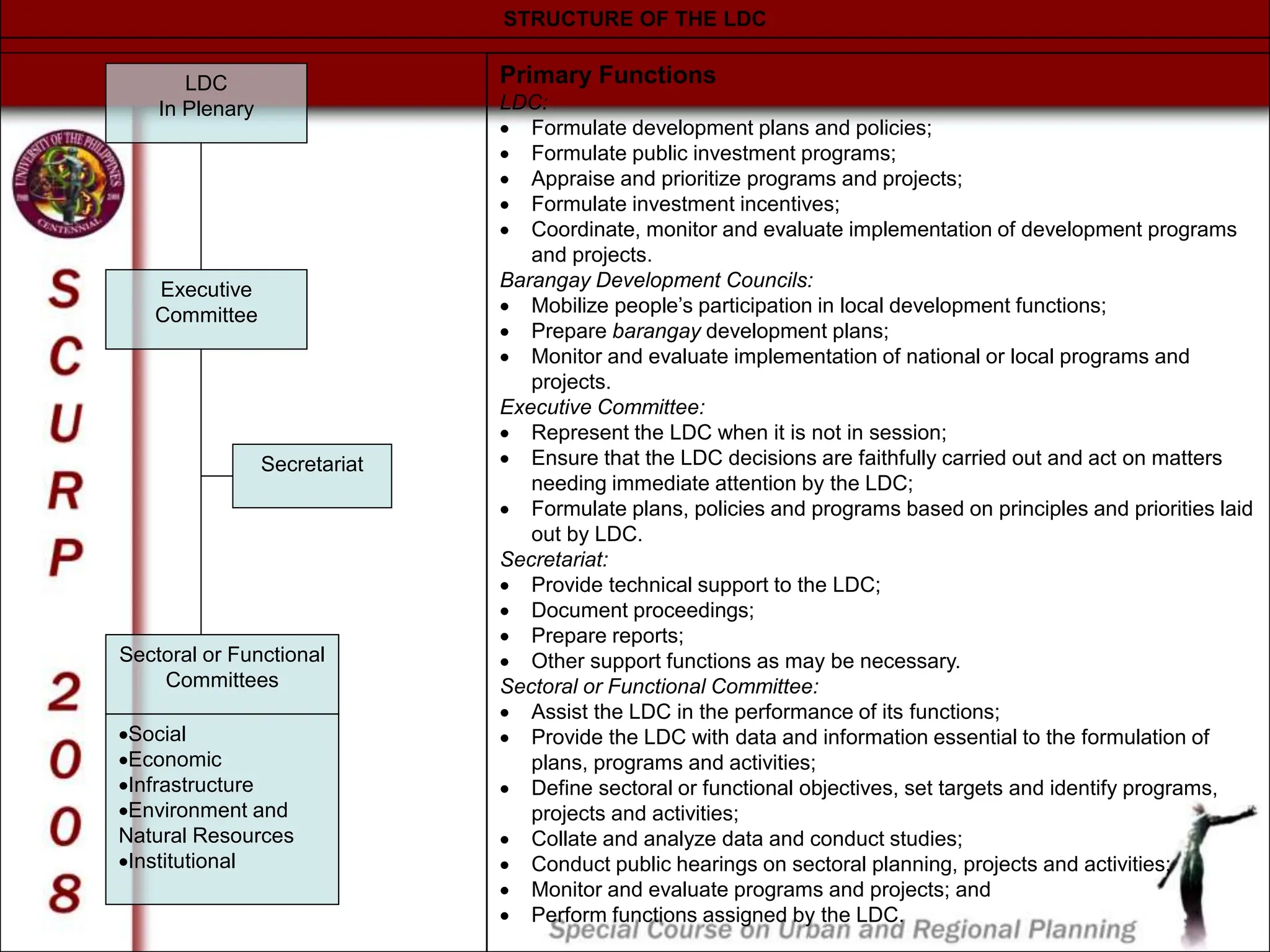
Components of the Local Planning Structure
LDC
In Plenary
Executive
Committee
Secretariat
Sectoral or Functional
Committees
Social
Economic
Infrastructure
Environment and
Natural Resources
Institutional
STRUCTURE OF THE LDC
Primary Functions
LDC:
 Formulate development plans and policies;
 Formulate public investment programs;
 Appraise and prioritize programs and projects;
 Formulate investment incentives;
 Coordinate, monitor and evaluate implementation of development programs
and projects.
Barangay Development Councils:
 Mobilize people’s participation in local development functions;
 Prepare barangay development plans;
 Monitor and evaluate implementation of national or local programs and
projects.
Executive Committee:
 Represent the LDC when it is not in session;
 Ensure that the LDC decisions are faithfully carried out and act on matters
needing immediate attention by the LDC;
 Formulate plans, policies and programs based on principles and priorities laid
out by LDC.
Secretariat:
 Provide technical support to the LDC;
 Document proceedings;
 Prepare reports;
 Other support functions as may be necessary.
Sectoral or Functional Committee:
 Assist the LDC in the performance of its functions;
 Provide the LDC with data and information essential to the formulation of
plans, programs and activities;
 Define sectoral or functional objectives, set targets and identify programs,
projects and activities;
 Collate and analyze data and conduct studies;
 Conduct public hearings on sectoral planning, projects and activities;
 Monitor and evaluate programs and projects; and
 Perform functions assigned by the LDC.
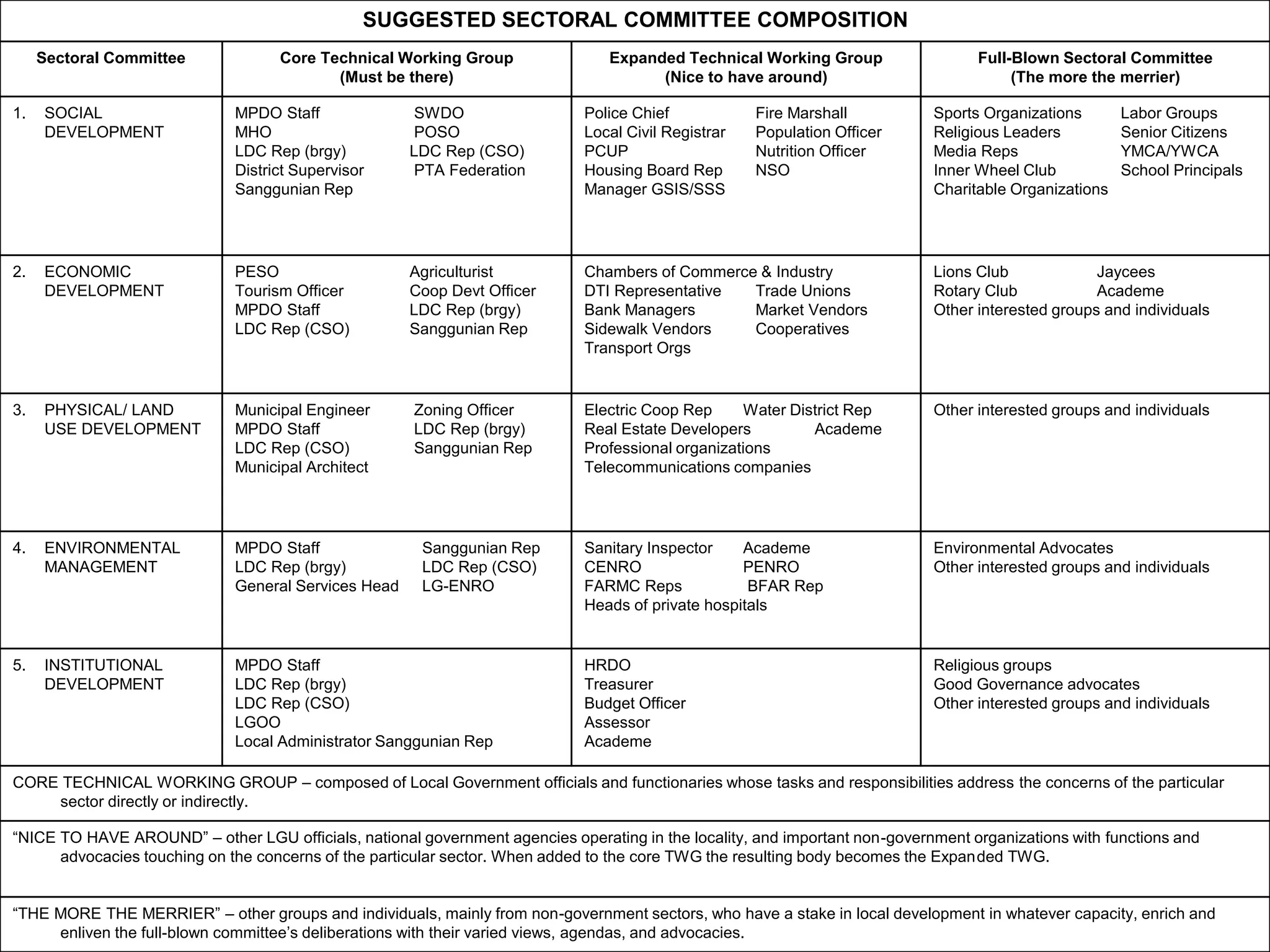
SUGGESTED SECTORAL COMMITTEE COMPOSITION
Sectoral Committee Core Technical Working Group
(Must be there)
Expanded Technical Working Group
(Nice to have around)
Full-Blown Sectoral Committee
(The more the merrier)
1. SOCIAL
DEVELOPMENT
MPDO Staff SWDO
MHO POSO
LDC Rep (brgy) LDC Rep (CSO)
District Supervisor PTA Federation
Sanggunian Rep
Police Chief Fire Marshall
Local Civil Registrar Population Officer
PCUP Nutrition Officer
Housing Board Rep NSO
Manager GSIS/SSS
Sports Organizations Labor Groups
Religious Leaders Senior Citizens
Media Reps YMCA/YWCA
Inner Wheel Club School Principals
Charitable Organizations
2. ECONOMIC
DEVELOPMENT
PESO Agriculturist
Tourism Officer Coop Devt Officer
MPDO Staff LDC Rep (brgy)
LDC Rep (CSO) Sanggunian Rep
Chambers of Commerce & Industry
DTI Representative Trade Unions
Bank Managers Market Vendors
Sidewalk Vendors Cooperatives
Transport Orgs
Lions Club Jaycees
Rotary Club Academe
Other interested groups and individuals
3. PHYSICAL/ LAND
USE DEVELOPMENT
Municipal Engineer Zoning Officer
MPDO Staff LDC Rep (brgy)
LDC Rep (CSO) Sanggunian Rep
Municipal Architect
Electric Coop Rep Water District Rep
Real Estate Developers Academe
Professional organizations
Telecommunications companies
Other interested groups and individuals
4. ENVIRONMENTAL
MANAGEMENT
MPDO Staff Sanggunian Rep
LDC Rep (brgy) LDC Rep (CSO)
General Services Head LG-ENRO
Sanitary Inspector Academe
CENRO PENRO
FARMC Reps BFAR Rep
Heads of private hospitals
Environmental Advocates
Other interested groups and individuals
5. INSTITUTIONAL
DEVELOPMENT
MPDO Staff
LDC Rep (brgy)
LDC Rep (CSO)
LGOO
Local Administrator Sanggunian Rep
HRDO
Treasurer
Budget Officer
Assessor
Academe
Religious groups
Good Governance advocates
Other interested groups and individuals
CORE TECHNICAL WORKING GROUP – composed of Local Government officials and functionaries whose tasks and responsibilities address the concerns of the particular
sector directly or indirectly.
“NICE TO HAVE AROUND” – other LGU officials, national government agencies operating in the locality, and important non-government organizations with functions and
advocacies touching on the concerns of the particular sector. When added to the core TWG the resulting body becomes the Expanded TWG.
“THE MORE THE MERRIER” – other groups and individuals, mainly from non-government sectors, who have a stake in local development in whatever capacity, enrich and
enliven the full-blown committee’s deliberations with their varied views, agendas, and advocacies.
PLANNING MANDATES OF
LOCAL GOVERNMENTS
Sec. 15, LGC
Political and Corporate Nature of LGUs
Every LGU is a body politic & corporate
endowed with powers to be exercised by it
in conformity with law. As such, it shall
exercise powers as a political subdivision
of the National Government and as a
corporate entity representing the
inhabitants of its territory.
Sec. 2 (a), LGC
Declaration of Policy
That the territorial & political subdivisions of
the State shall enjoy genuine & meaningful
local autonomy to enable them to attain
their fullest development as self-reliant
communities & make them more effective
partners in the attainment of national goals.
Planning Implication for the LGU
• To manage its territory on behalf of the
National State
• To promote the general welfare of its
inhabitants
Two Comprehensive Plans Mandated in LGC
• CLUP to manage the entire territory (Sec.
20, c)
• CDP to promote the general welfare
(Sec.106)
Sec. 20(c), RA 7160
• The local government units shall, in
conformity with existing laws, continue to
prepare their respective comprehensive
land use plans enacted through zoning
ordinances which shall be the primary and
dominant bases for the future use of land
resources: Provided, That the requirements
for food production, human settlements, and
industrial expansion shall be taken into
consideration in the preparation of such
plans.
Sec. 3(i), RA 7160
• Local government units shall share with the
National Government the responsibility in
the management and maintenance of
ecological balance within their territorial
jurisdiction, subject to the provisions of this
Code and national policies;
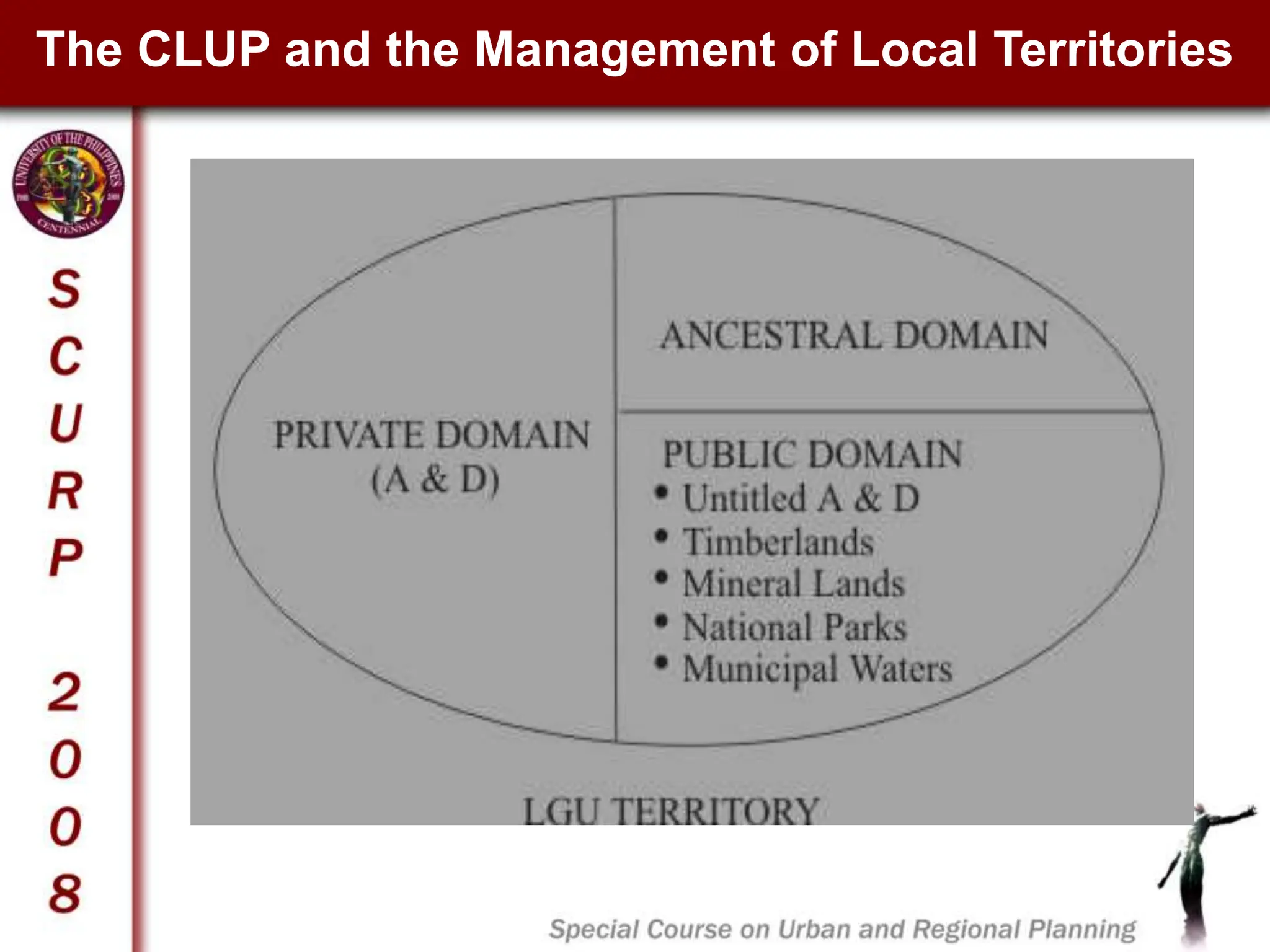
The CLUP and the Management of Local Territories
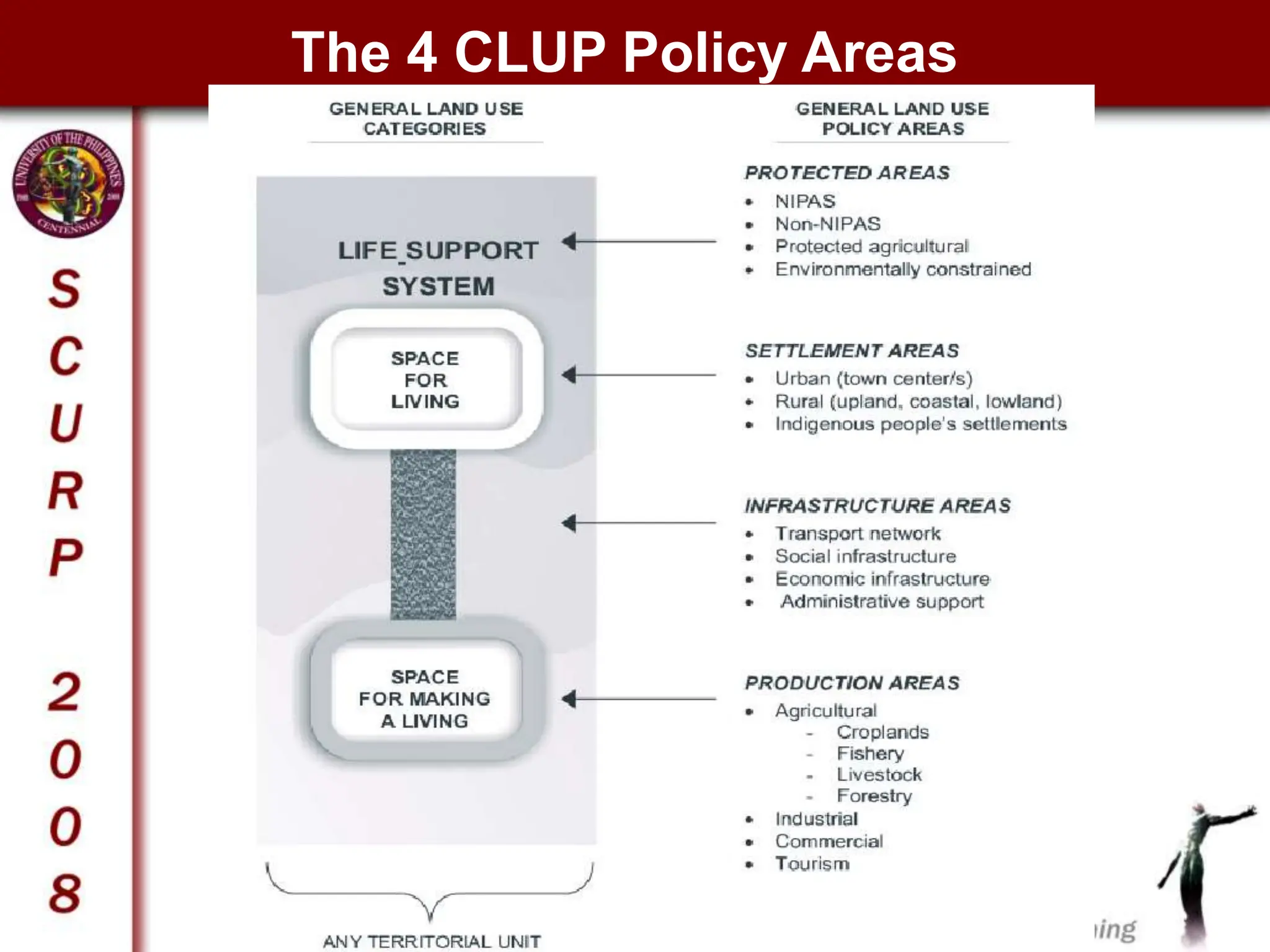
The 4 CLUP Policy Areas
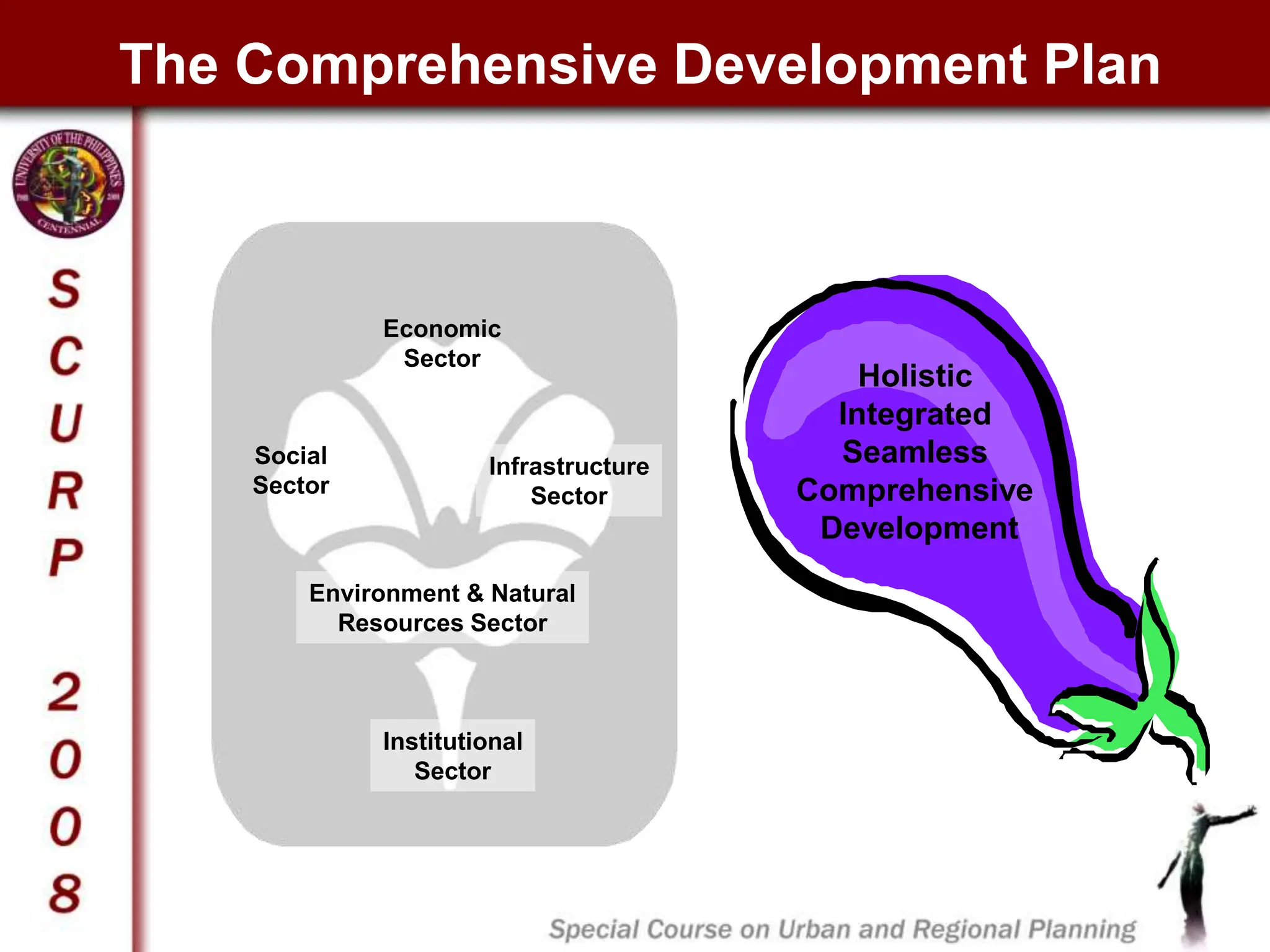
The Comprehensive Development Plan
Holistic
Integrated
Seamless
Comprehensive
Development
Infrastructure
Sector
Economic
Sector
Social
Sector
Environment & Natural
Resources Sector
Institutional
Sector
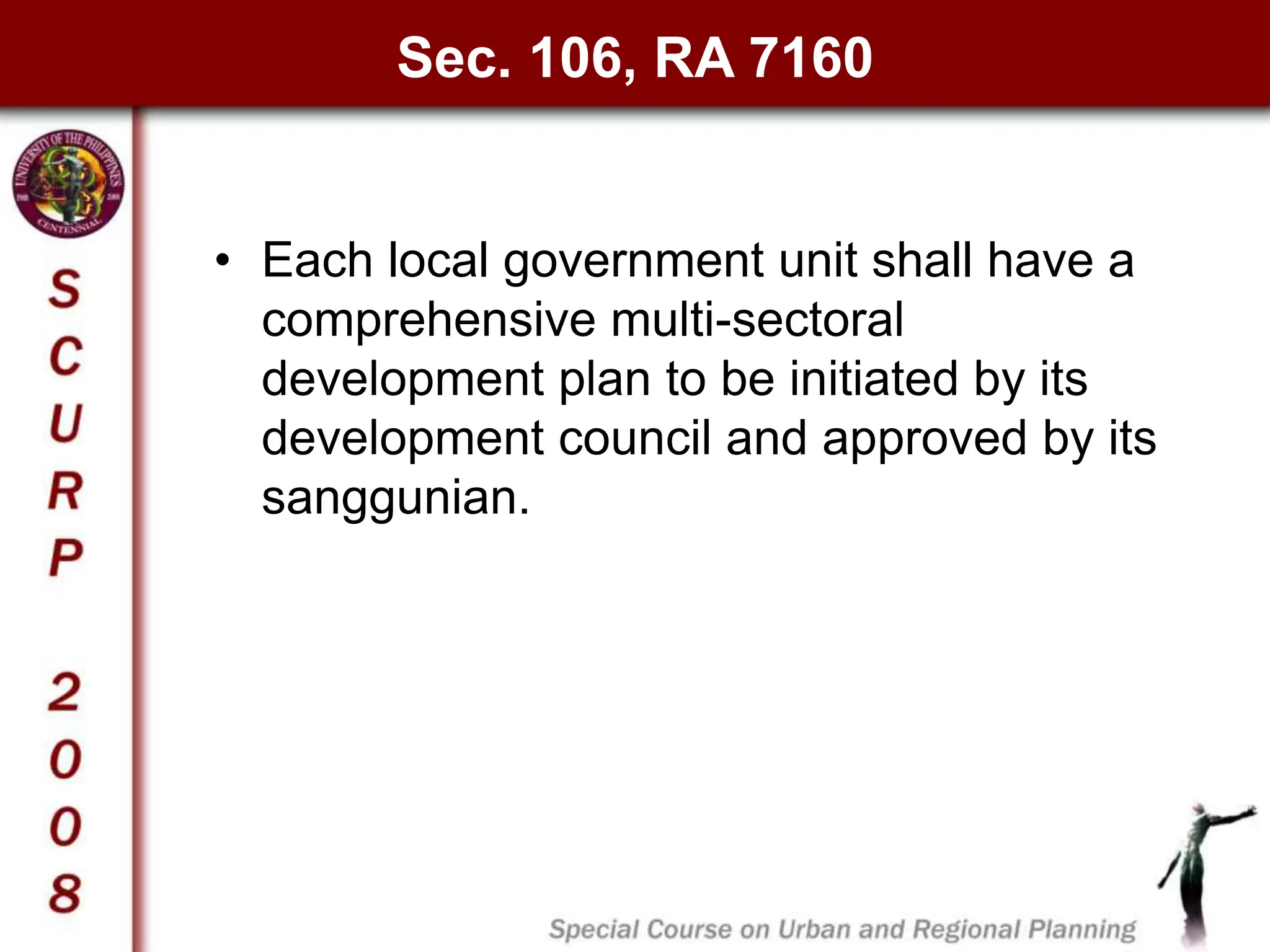
Sec. 106, RA 7160
• Each local government unit shall have a
comprehensive multi-sectoral
development plan to be initiated by its
development council and approved by its
sanggunian.
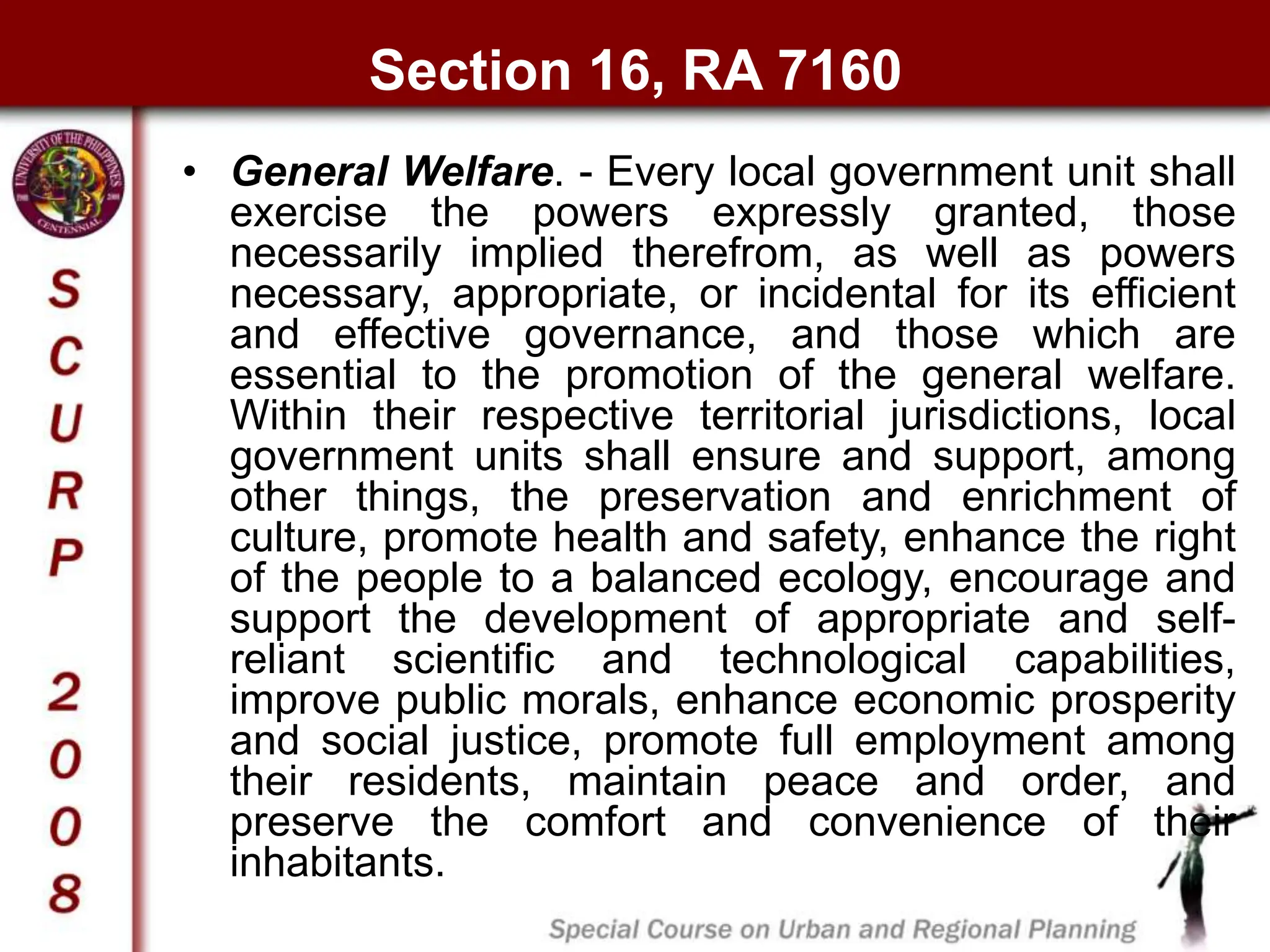
Section 16, RA 7160
• General Welfare. - Every local government unit shall
exercise the powers expressly granted, those
necessarily implied therefrom, as well as powers
necessary, appropriate, or incidental for its efficient
and effective governance, and those which are
essential to the promotion of the general welfare.
Within their respective territorial jurisdictions, local
government units shall ensure and support, among
other things, the preservation and enrichment of
culture, promote health and safety, enhance the right
of the people to a balanced ecology, encourage and
support the development of appropriate and self-
reliant scientific and technological capabilities,
improve public morals, enhance economic prosperity
and social justice, promote full employment among
their residents, maintain peace and order, and
preserve the comfort and convenience of their
inhabitants.
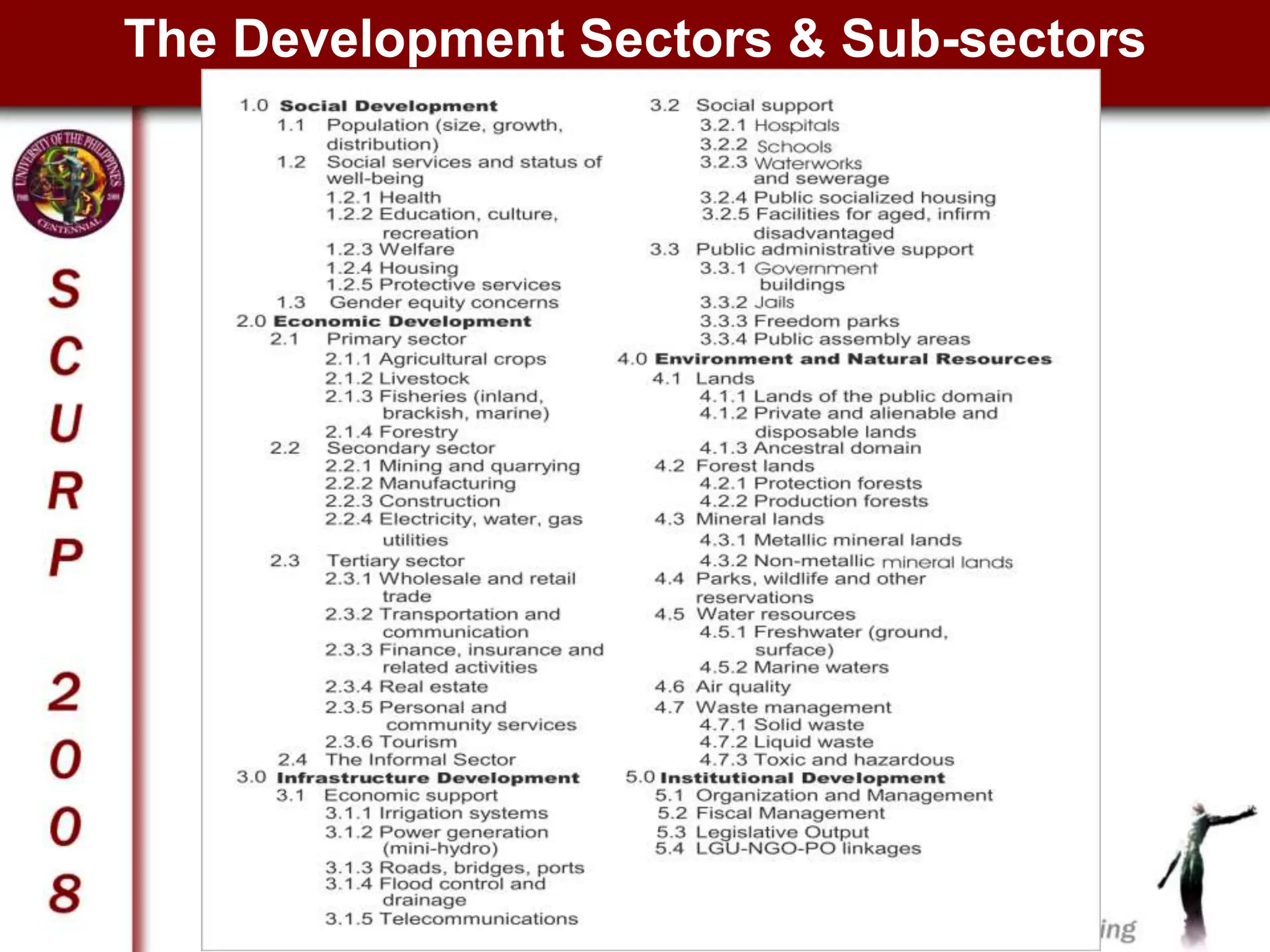
The Development Sectors & Sub-sectors
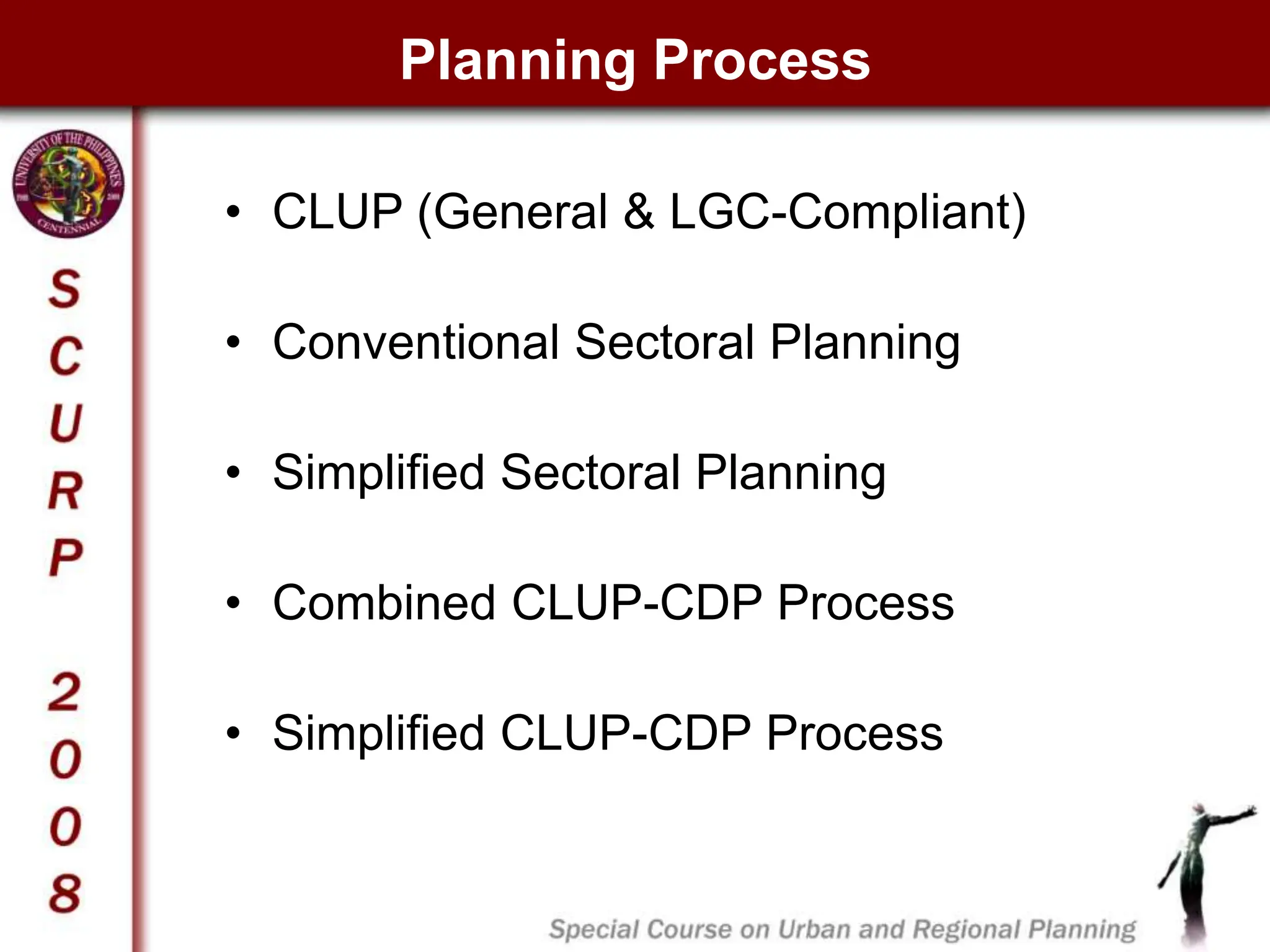
Planning Process
• CLUP (General & LGC-Compliant)
• Conventional Sectoral Planning
• Simplified Sectoral Planning
• Combined CLUP-CDP Process
• Simplified CLUP-CDP Process
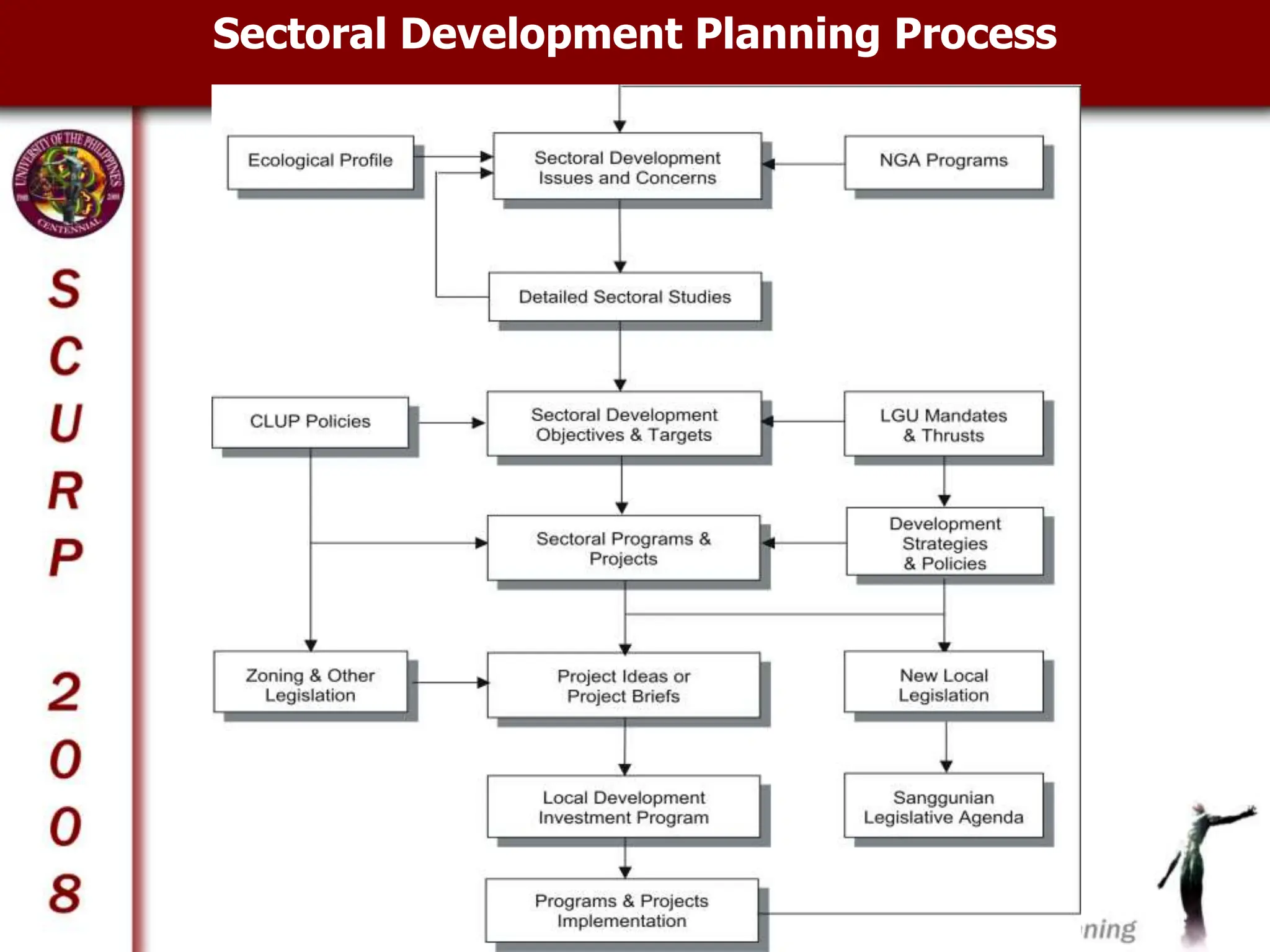
Sectoral Development Planning Process
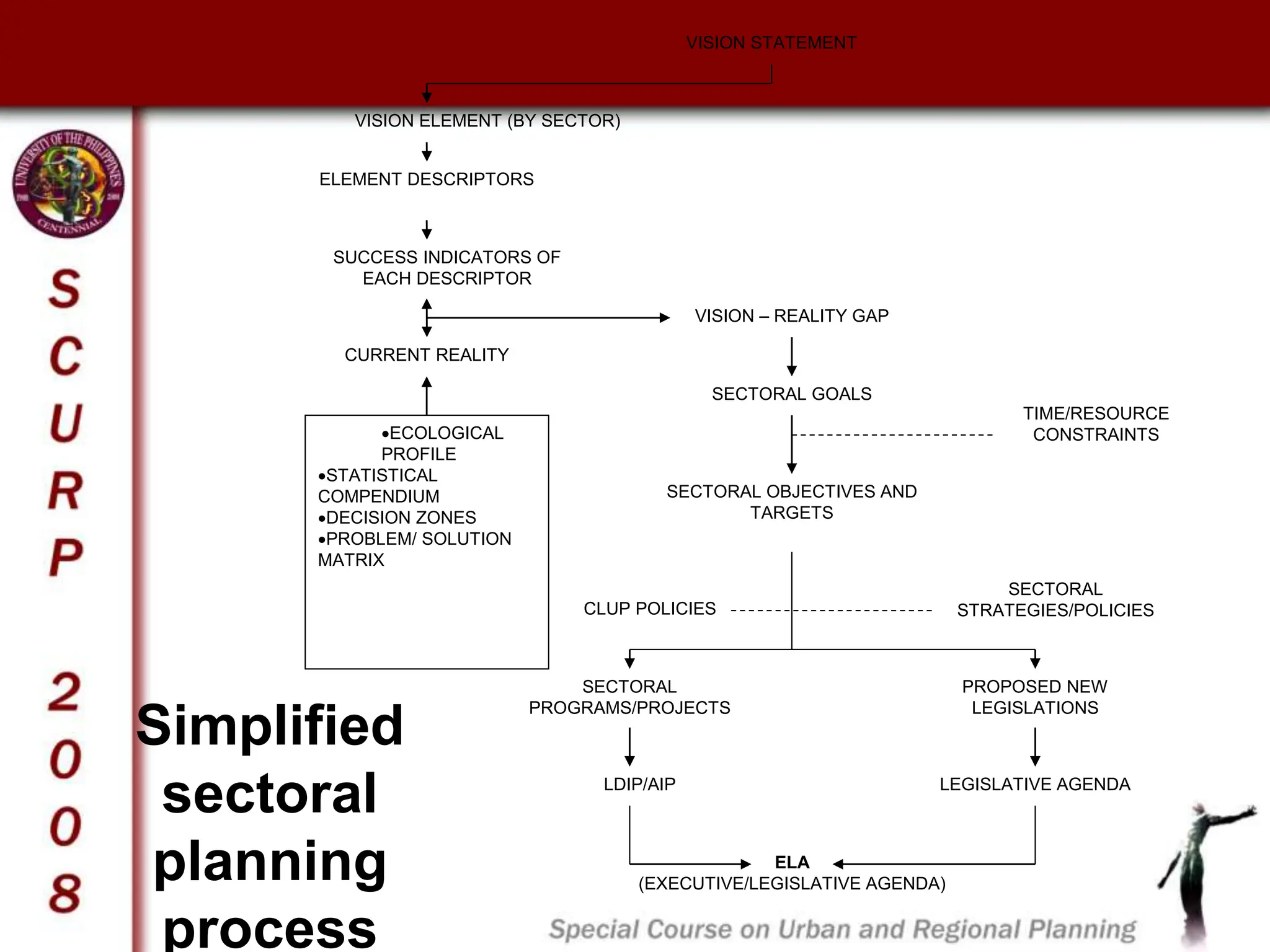
VISION STATEMENT
VISION ELEMENT (BY SECTOR)
ELEMENT DESCRIPTORS
SUCCESS INDICATORS OF
EACH DESCRIPTOR
CURRENT REALITY
VISION – REALITY GAP
SECTORAL GOALS
SECTORAL OBJECTIVES AND
TARGETS
TIME/RESOURCE
CONSTRAINTS
SECTORAL
STRATEGIES/POLICIES
CLUP POLICIES
SECTORAL
PROGRAMS/PROJECTS
LDIP/AIP
PROPOSED NEW
LEGISLATIONS
LEGISLATIVE AGENDA
ELA
(EXECUTIVE/LEGISLATIVE AGENDA)
ECOLOGICAL
PROFILE
STATISTICAL
COMPENDIUM
DECISION ZONES
PROBLEM/ SOLUTION
MATRIX
Simplified
sectoral
planning
process
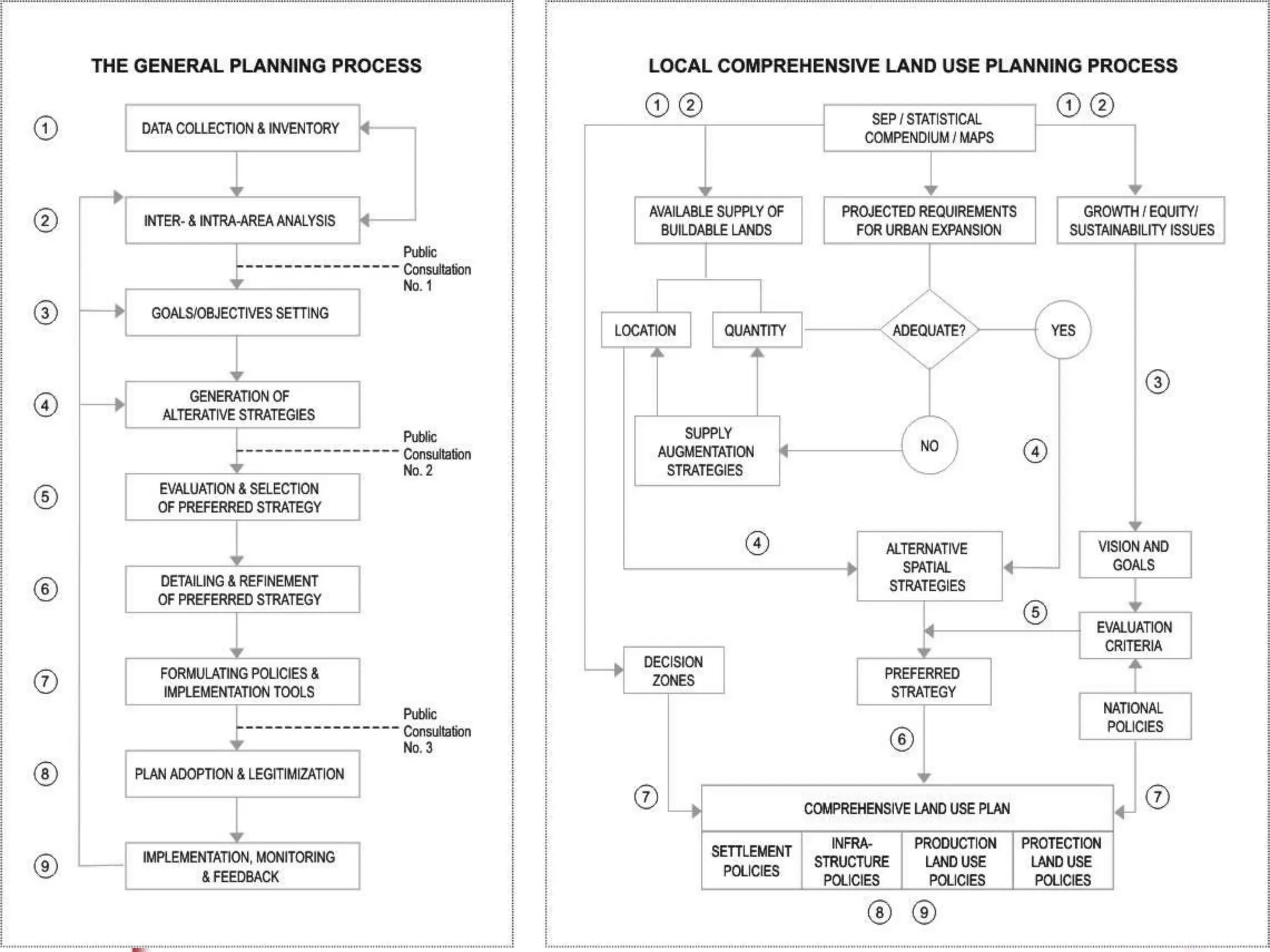
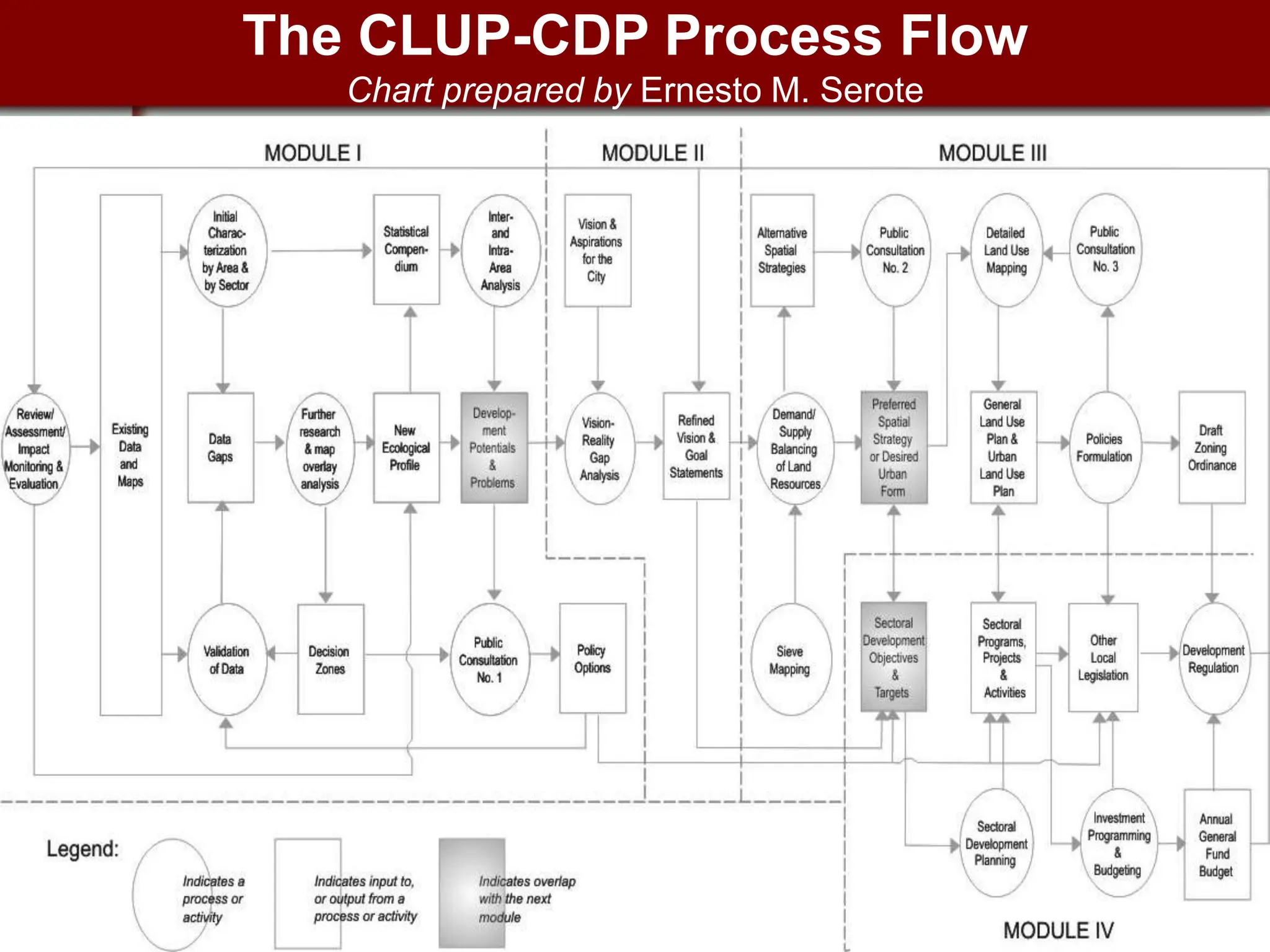
The CLUP-CDP Process Flow
Chart prepared by Ernesto M. Serote
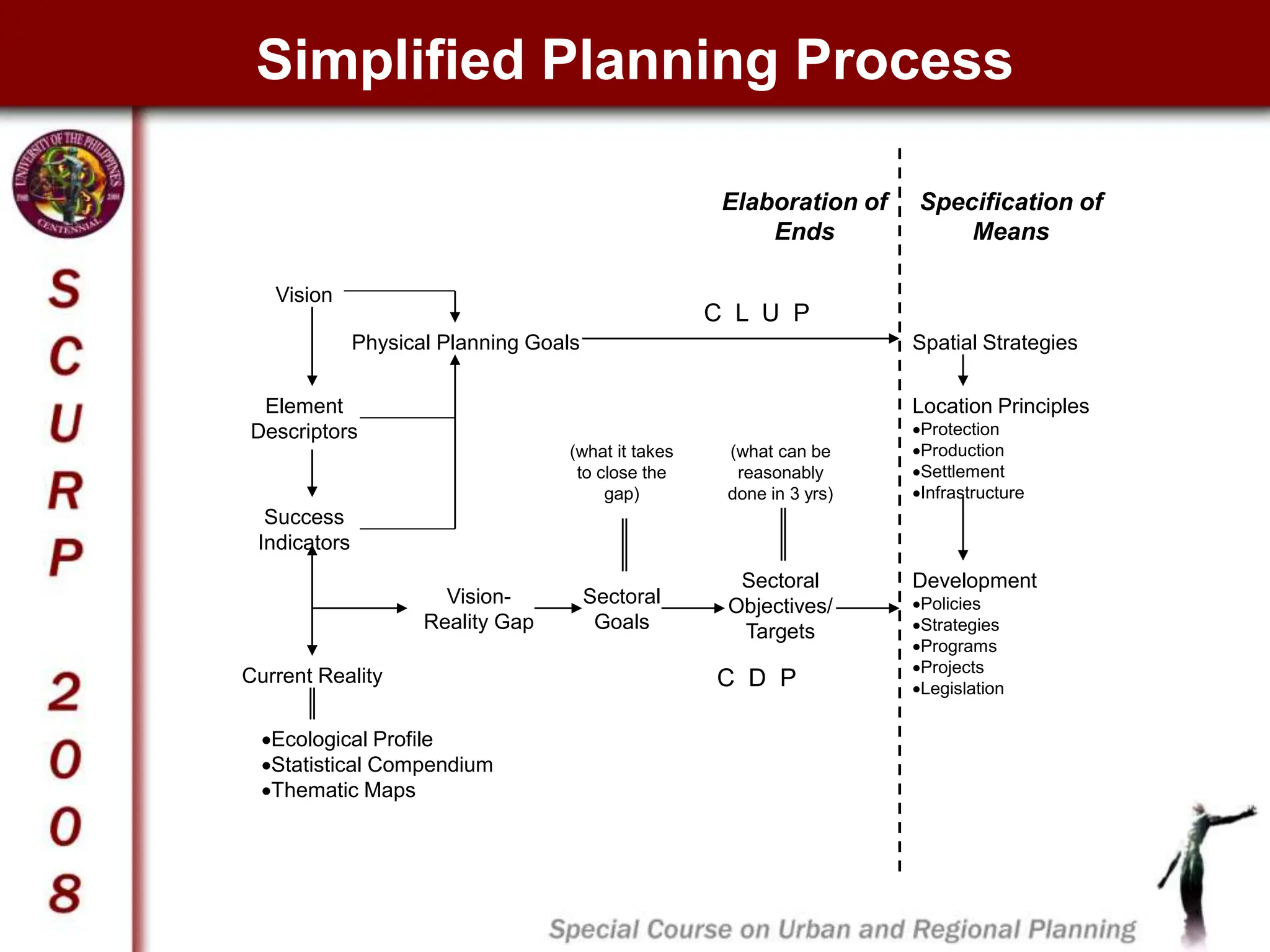
Simplified Planning Process
Current Reality
Success
Indicators
Vision
Element
Descriptors
Sectoral
Goals
Vision-
Reality Gap
(what can be
reasonably
done in 3 yrs)
Sectoral
Objectives/
Targets
Physical Planning Goals Spatial Strategies
(what it takes
to close the
gap)
Specification of
Means
Elaboration of
Ends
Location Principles
Protection
Production
Settlement
Infrastructure
Development
Policies
Strategies
Programs
Projects
Legislation
Ecological Profile
Statistical Compendium
Thematic Maps
C D P
C L U P
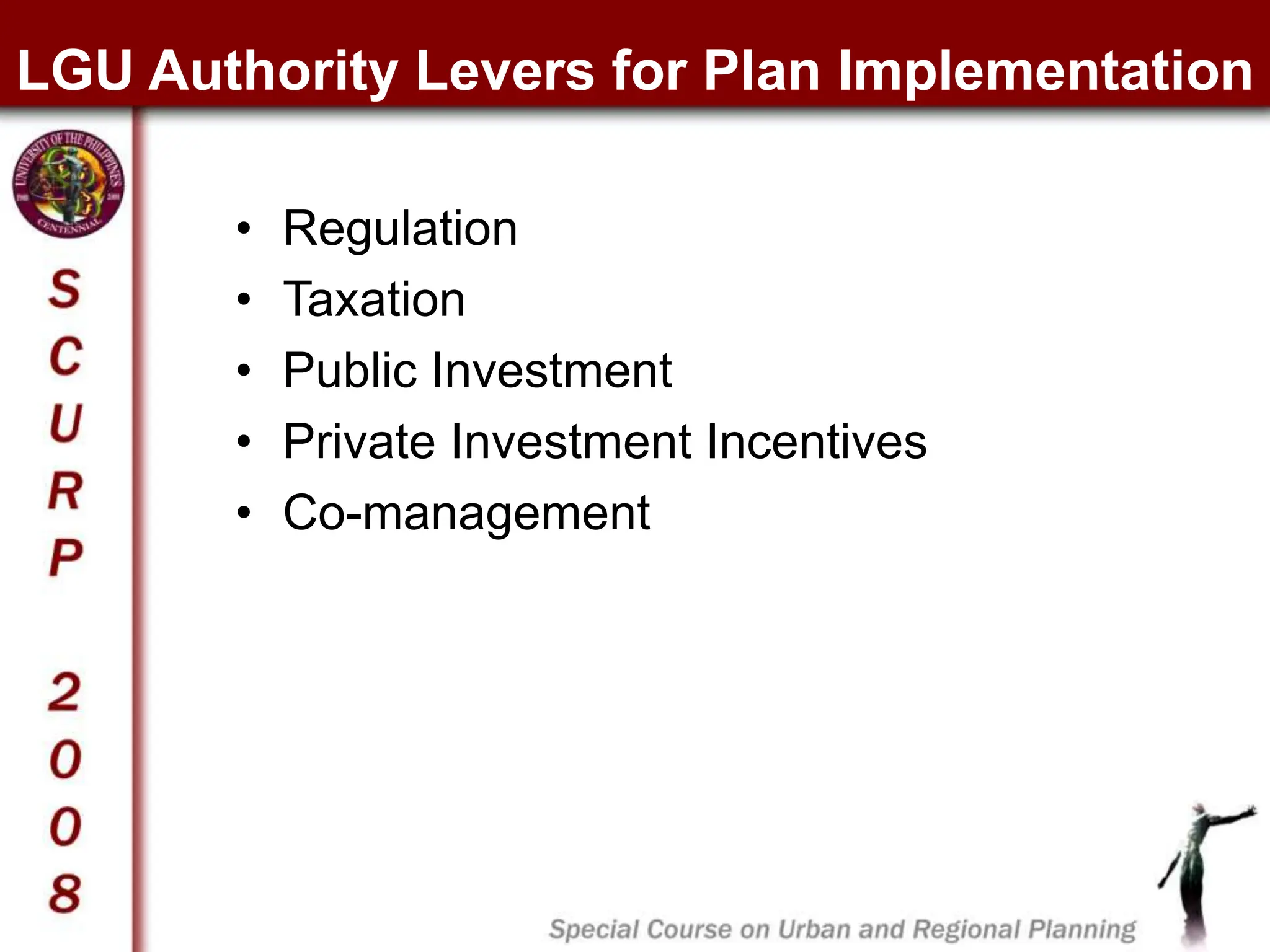
LGU Authority Levers for Plan Implementation
• Regulation
• Taxation
• Public Investment
• Private Investment Incentives
• Co-management
Regulation
• Zoning
• Subdivision Regulation
• Building Regulation
• Environmental Law Enforcement
Taxation
• Basic Taxes
• Special Levies on Property
- Special Education Fund
- Idle Lands Tax
- Special Benefit Levy
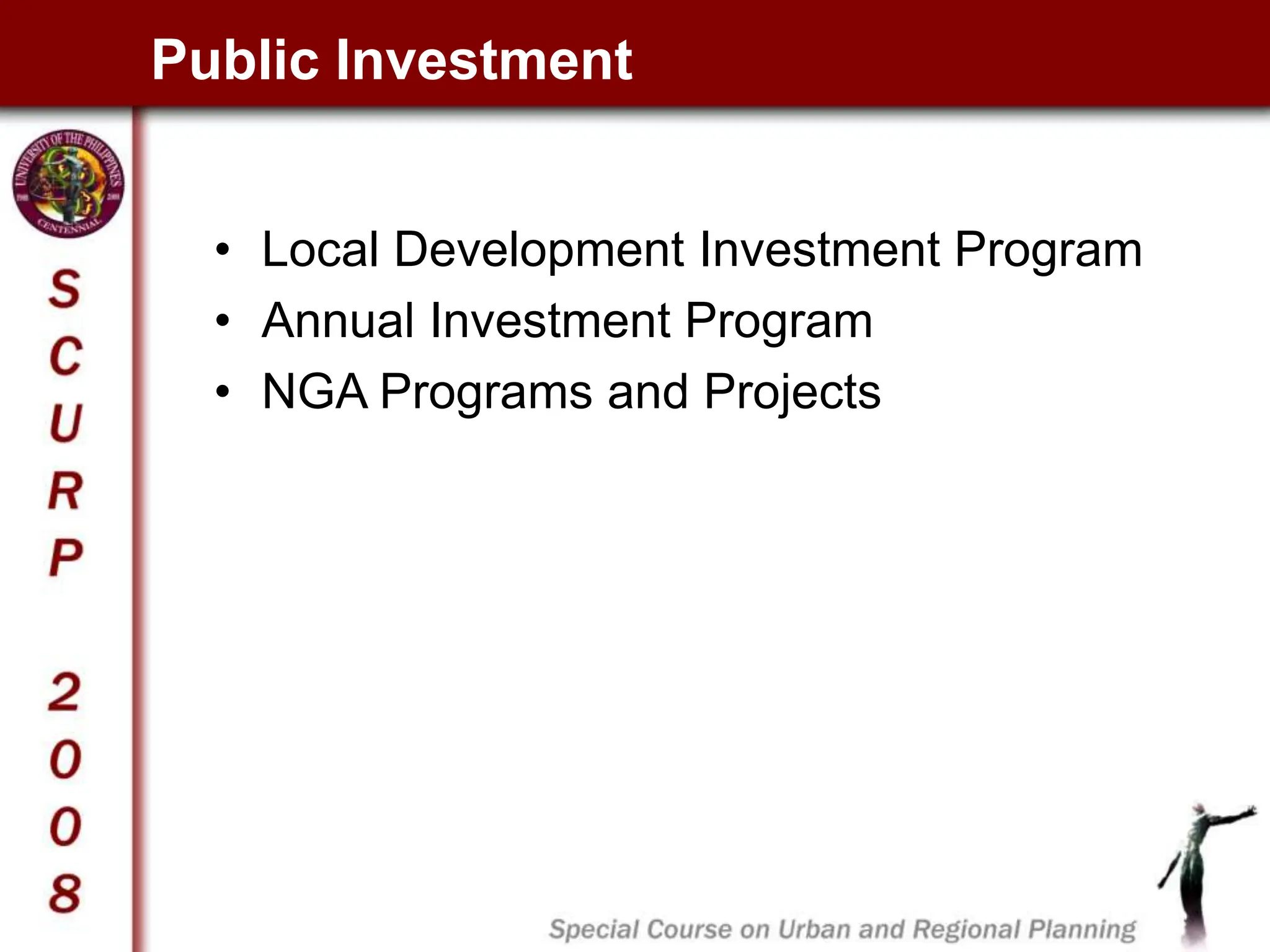
Public Investment
• Local Development Investment Program
• Annual Investment Program
• NGA Programs and Projects
Private Investment Incentives
• Fiscal Policies
• Joint Ventures
• B-O-T Schemes
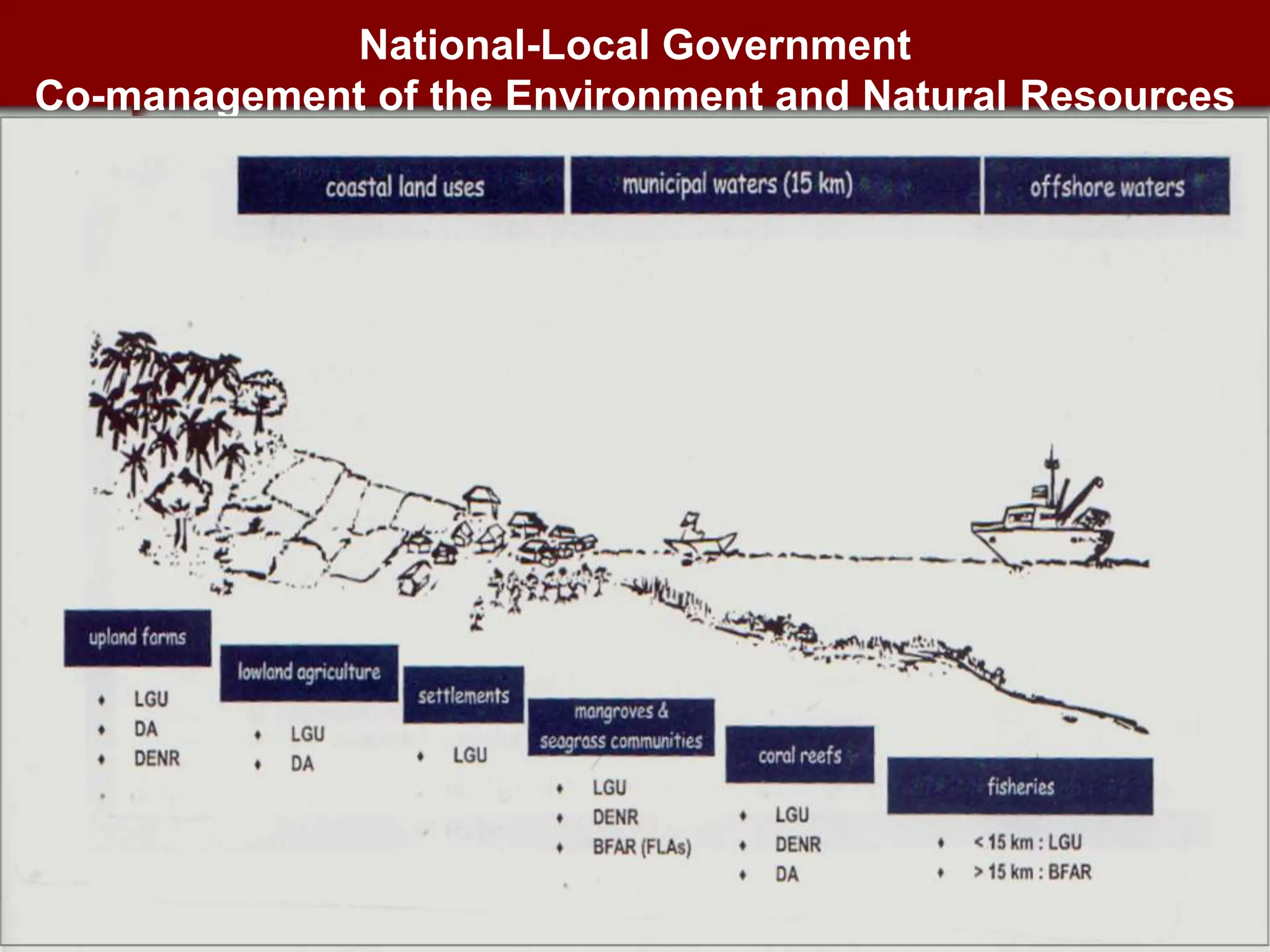
National-Local Government
Co-management of the Environment and Natural Resources

Local_planning_system_Planning structure , Planning mandates , Planning process , LGU Authority Levers

  • 1.
    By: ERNESTO M. SEROTE Professorand Director of Training School of Urban and Regional Planning University of the Philippines RATIONALIZED LOCAL PLANNING SYSTEM
  • 2.
    Selected Features • Faithfulcompliance with LGC provisions • Limit LGU-mandated plans to the CLUP and CDP • NGAs to dovetail their requirements with the local planning system • Less technocratic, more participatory and consultative
  • 3.
    Components of theLocal Planning System • Planning structure • Planning mandates • Planning process • LGU Authority Levers
  • 4.
  • 5.
    POLITICAL TECHNICAL • LocalSanggunian • Local Development Council • Congressman’s Representative • Civil Society Organizations • Local Planning and Development Office • LGU Department Heads • Local Special Bodies • LDC Sectoral/Functional Committees • NGA Office Chiefs in the locality • Private Sector Representatives Components of the Local Planning Structure
  • 6.
    LDC In Plenary Executive Committee Secretariat Sectoral orFunctional Committees Social Economic Infrastructure Environment and Natural Resources Institutional STRUCTURE OF THE LDC Primary Functions LDC:  Formulate development plans and policies;  Formulate public investment programs;  Appraise and prioritize programs and projects;  Formulate investment incentives;  Coordinate, monitor and evaluate implementation of development programs and projects. Barangay Development Councils:  Mobilize people’s participation in local development functions;  Prepare barangay development plans;  Monitor and evaluate implementation of national or local programs and projects. Executive Committee:  Represent the LDC when it is not in session;  Ensure that the LDC decisions are faithfully carried out and act on matters needing immediate attention by the LDC;  Formulate plans, policies and programs based on principles and priorities laid out by LDC. Secretariat:  Provide technical support to the LDC;  Document proceedings;  Prepare reports;  Other support functions as may be necessary. Sectoral or Functional Committee:  Assist the LDC in the performance of its functions;  Provide the LDC with data and information essential to the formulation of plans, programs and activities;  Define sectoral or functional objectives, set targets and identify programs, projects and activities;  Collate and analyze data and conduct studies;  Conduct public hearings on sectoral planning, projects and activities;  Monitor and evaluate programs and projects; and  Perform functions assigned by the LDC.
  • 7.
    SUGGESTED SECTORAL COMMITTEECOMPOSITION Sectoral Committee Core Technical Working Group (Must be there) Expanded Technical Working Group (Nice to have around) Full-Blown Sectoral Committee (The more the merrier) 1. SOCIAL DEVELOPMENT MPDO Staff SWDO MHO POSO LDC Rep (brgy) LDC Rep (CSO) District Supervisor PTA Federation Sanggunian Rep Police Chief Fire Marshall Local Civil Registrar Population Officer PCUP Nutrition Officer Housing Board Rep NSO Manager GSIS/SSS Sports Organizations Labor Groups Religious Leaders Senior Citizens Media Reps YMCA/YWCA Inner Wheel Club School Principals Charitable Organizations 2. ECONOMIC DEVELOPMENT PESO Agriculturist Tourism Officer Coop Devt Officer MPDO Staff LDC Rep (brgy) LDC Rep (CSO) Sanggunian Rep Chambers of Commerce & Industry DTI Representative Trade Unions Bank Managers Market Vendors Sidewalk Vendors Cooperatives Transport Orgs Lions Club Jaycees Rotary Club Academe Other interested groups and individuals 3. PHYSICAL/ LAND USE DEVELOPMENT Municipal Engineer Zoning Officer MPDO Staff LDC Rep (brgy) LDC Rep (CSO) Sanggunian Rep Municipal Architect Electric Coop Rep Water District Rep Real Estate Developers Academe Professional organizations Telecommunications companies Other interested groups and individuals 4. ENVIRONMENTAL MANAGEMENT MPDO Staff Sanggunian Rep LDC Rep (brgy) LDC Rep (CSO) General Services Head LG-ENRO Sanitary Inspector Academe CENRO PENRO FARMC Reps BFAR Rep Heads of private hospitals Environmental Advocates Other interested groups and individuals 5. INSTITUTIONAL DEVELOPMENT MPDO Staff LDC Rep (brgy) LDC Rep (CSO) LGOO Local Administrator Sanggunian Rep HRDO Treasurer Budget Officer Assessor Academe Religious groups Good Governance advocates Other interested groups and individuals CORE TECHNICAL WORKING GROUP – composed of Local Government officials and functionaries whose tasks and responsibilities address the concerns of the particular sector directly or indirectly. “NICE TO HAVE AROUND” – other LGU officials, national government agencies operating in the locality, and important non-government organizations with functions and advocacies touching on the concerns of the particular sector. When added to the core TWG the resulting body becomes the Expanded TWG. “THE MORE THE MERRIER” – other groups and individuals, mainly from non-government sectors, who have a stake in local development in whatever capacity, enrich and enliven the full-blown committee’s deliberations with their varied views, agendas, and advocacies.
  • 8.
  • 9.
    Sec. 15, LGC Politicaland Corporate Nature of LGUs Every LGU is a body politic & corporate endowed with powers to be exercised by it in conformity with law. As such, it shall exercise powers as a political subdivision of the National Government and as a corporate entity representing the inhabitants of its territory.
  • 10.
    Sec. 2 (a),LGC Declaration of Policy That the territorial & political subdivisions of the State shall enjoy genuine & meaningful local autonomy to enable them to attain their fullest development as self-reliant communities & make them more effective partners in the attainment of national goals.
  • 11.
    Planning Implication forthe LGU • To manage its territory on behalf of the National State • To promote the general welfare of its inhabitants
  • 12.
    Two Comprehensive PlansMandated in LGC • CLUP to manage the entire territory (Sec. 20, c) • CDP to promote the general welfare (Sec.106)
  • 13.
    Sec. 20(c), RA7160 • The local government units shall, in conformity with existing laws, continue to prepare their respective comprehensive land use plans enacted through zoning ordinances which shall be the primary and dominant bases for the future use of land resources: Provided, That the requirements for food production, human settlements, and industrial expansion shall be taken into consideration in the preparation of such plans.
  • 14.
    Sec. 3(i), RA7160 • Local government units shall share with the National Government the responsibility in the management and maintenance of ecological balance within their territorial jurisdiction, subject to the provisions of this Code and national policies;
  • 15.
    The CLUP andthe Management of Local Territories
  • 16.
    The 4 CLUPPolicy Areas
  • 17.
    The Comprehensive DevelopmentPlan Holistic Integrated Seamless Comprehensive Development Infrastructure Sector Economic Sector Social Sector Environment & Natural Resources Sector Institutional Sector
  • 18.
    Sec. 106, RA7160 • Each local government unit shall have a comprehensive multi-sectoral development plan to be initiated by its development council and approved by its sanggunian.
  • 19.
    Section 16, RA7160 • General Welfare. - Every local government unit shall exercise the powers expressly granted, those necessarily implied therefrom, as well as powers necessary, appropriate, or incidental for its efficient and effective governance, and those which are essential to the promotion of the general welfare. Within their respective territorial jurisdictions, local government units shall ensure and support, among other things, the preservation and enrichment of culture, promote health and safety, enhance the right of the people to a balanced ecology, encourage and support the development of appropriate and self- reliant scientific and technological capabilities, improve public morals, enhance economic prosperity and social justice, promote full employment among their residents, maintain peace and order, and preserve the comfort and convenience of their inhabitants.
  • 20.
  • 21.
    Planning Process • CLUP(General & LGC-Compliant) • Conventional Sectoral Planning • Simplified Sectoral Planning • Combined CLUP-CDP Process • Simplified CLUP-CDP Process
  • 23.
  • 24.
    VISION STATEMENT VISION ELEMENT(BY SECTOR) ELEMENT DESCRIPTORS SUCCESS INDICATORS OF EACH DESCRIPTOR CURRENT REALITY VISION – REALITY GAP SECTORAL GOALS SECTORAL OBJECTIVES AND TARGETS TIME/RESOURCE CONSTRAINTS SECTORAL STRATEGIES/POLICIES CLUP POLICIES SECTORAL PROGRAMS/PROJECTS LDIP/AIP PROPOSED NEW LEGISLATIONS LEGISLATIVE AGENDA ELA (EXECUTIVE/LEGISLATIVE AGENDA) ECOLOGICAL PROFILE STATISTICAL COMPENDIUM DECISION ZONES PROBLEM/ SOLUTION MATRIX Simplified sectoral planning process
  • 25.
    The CLUP-CDP ProcessFlow Chart prepared by Ernesto M. Serote
  • 26.
    Simplified Planning Process CurrentReality Success Indicators Vision Element Descriptors Sectoral Goals Vision- Reality Gap (what can be reasonably done in 3 yrs) Sectoral Objectives/ Targets Physical Planning Goals Spatial Strategies (what it takes to close the gap) Specification of Means Elaboration of Ends Location Principles Protection Production Settlement Infrastructure Development Policies Strategies Programs Projects Legislation Ecological Profile Statistical Compendium Thematic Maps C D P C L U P
  • 27.
    LGU Authority Leversfor Plan Implementation • Regulation • Taxation • Public Investment • Private Investment Incentives • Co-management
  • 28.
    Regulation • Zoning • SubdivisionRegulation • Building Regulation • Environmental Law Enforcement
  • 29.
    Taxation • Basic Taxes •Special Levies on Property - Special Education Fund - Idle Lands Tax - Special Benefit Levy
  • 30.
    Public Investment • LocalDevelopment Investment Program • Annual Investment Program • NGA Programs and Projects
  • 31.
    Private Investment Incentives •Fiscal Policies • Joint Ventures • B-O-T Schemes
  • 32.
    National-Local Government Co-management ofthe Environment and Natural Resources