What You Need to Know about the
New Energy Standard for Commercial
Buildings: Standard 90.1-2016
Appendix G – Performance Rating Method
A New Path for Compliance with ASHRAE
Standard 90.1-2016
Background
Performance Paths in Standard
90.1 Through 2013
Compliance with Standard 90.1
Through 2013 Standard 90.1 Includes Two Paths for Compliance:
Prescriptive Performance – Energy Cost
Budget (ECB)
HAP
EnergyInsights™
73
$
Proposed
Design
$
Baseline
Design
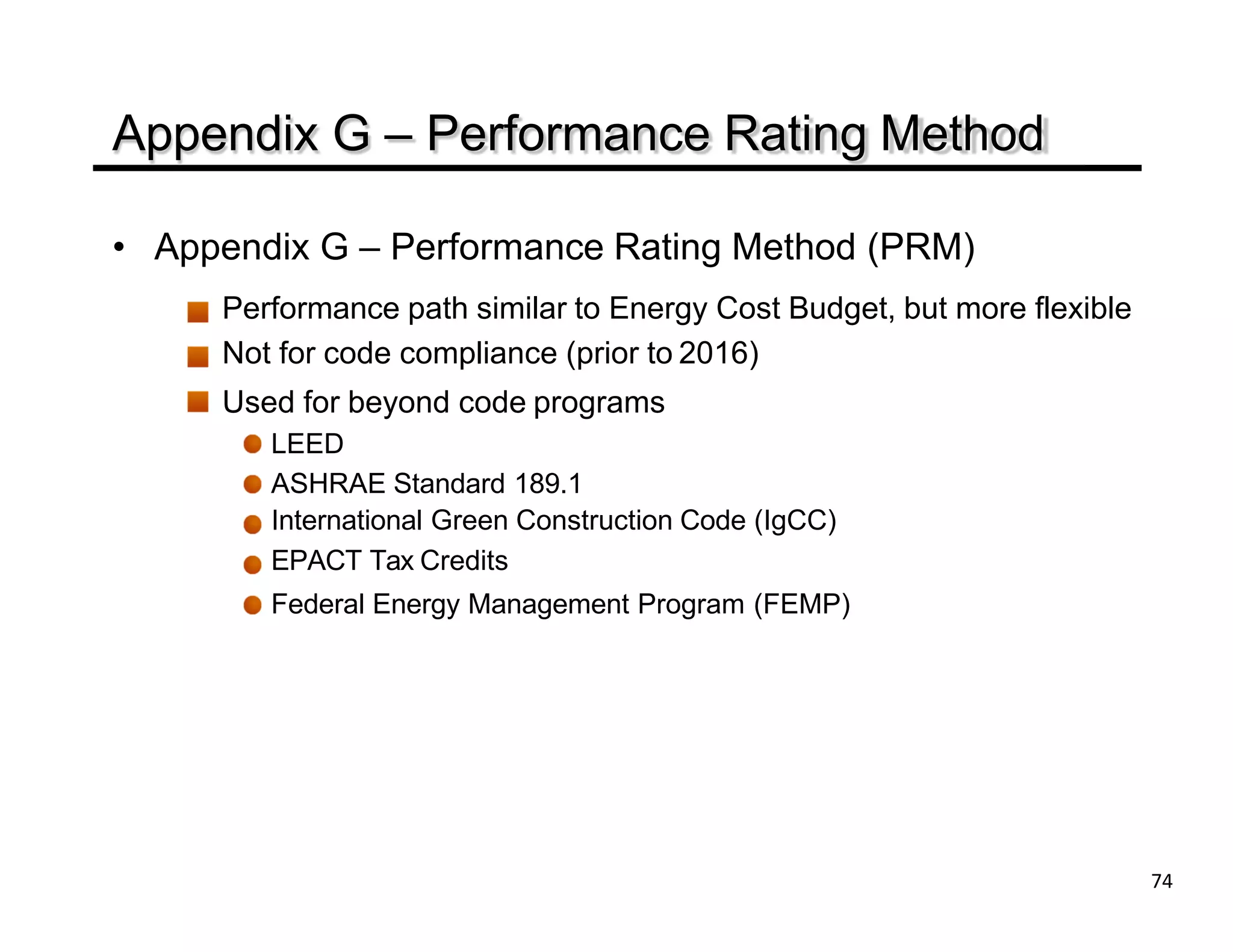
Appendix G – Performance Rating Method
• Appendix G – Performance Rating Method (PRM)
Performance path similar to Energy Cost Budget, but more flexible
Not for code compliance (prior to 2016)
Used for beyond code programs
LEED
ASHRAE Standard 189.1
International Green Construction Code (IgCC)
EPACT Tax Credits
Federal Energy Management Program (FEMP)
74
ECB – Dependent Baseline
• Current Performance Path (ECB) Baseline is Dependent on the
Proposed Design
 Baseline matches the proposed design in most ways, except backed
down to prescriptive limits
Design Parameter
75
Baseline ModelingAssumption
Energy Cost Budget
Window Area Matches proposed design
(up to 40%)
HVAC System Type Matches proposed design
HVAC System Sizing Matches proposed design
Orientation Matches proposed design
Fan power Matches proposed design
(up to limit)
Air Tightness Matches proposed design
Use of Thermal Mass Matches proposed design
ECB – Dependent Baseline
ECB compliance path does not prescribe energy use
 Multitude of prescriptive options – with it’s baseline
 Each combination chosen results in very different energy use
76
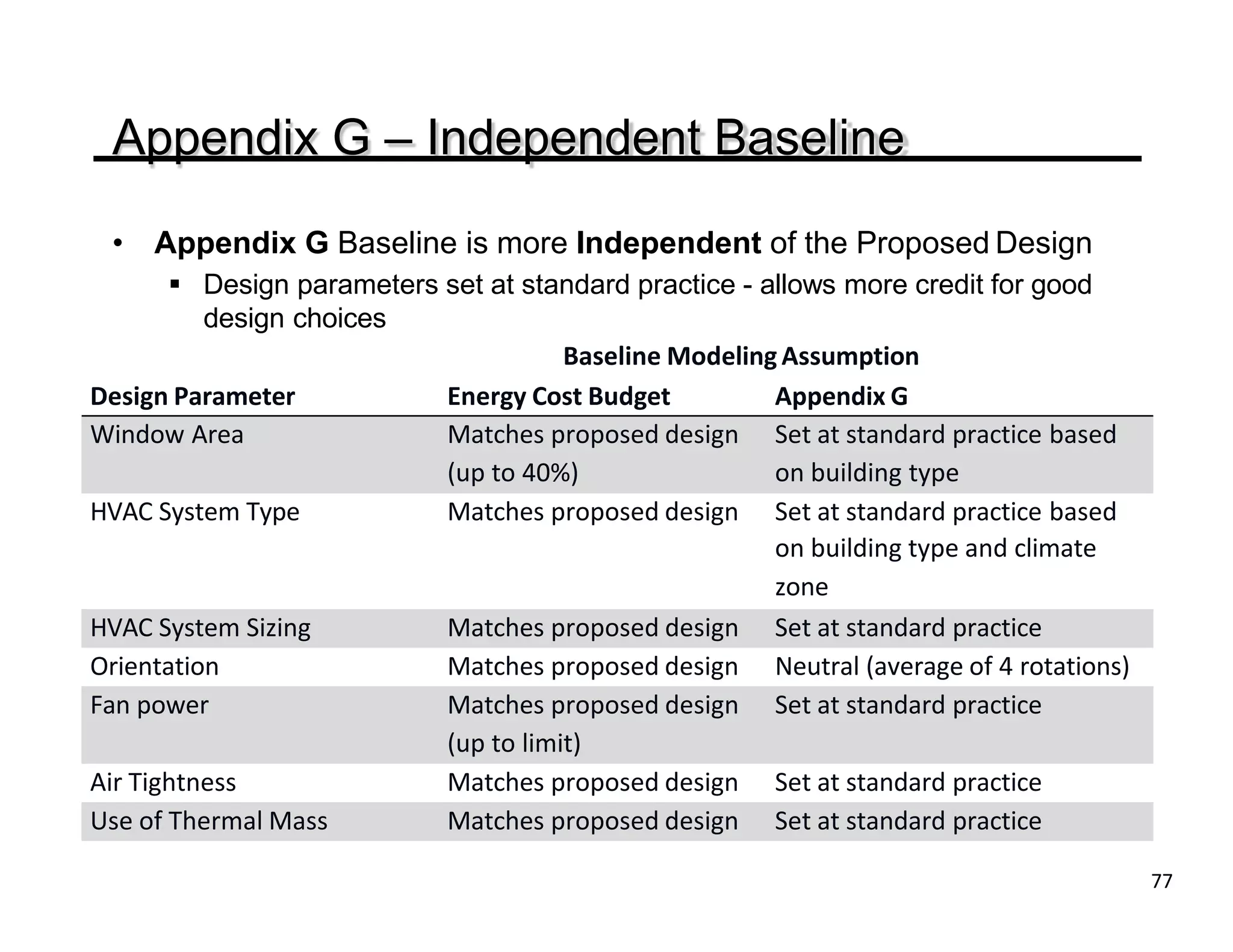
Appendix G – Independent Baseline
77
Design Parameter Energy Cost Budget Appendix G
Window Area Matches proposed design
(up to 40%)
Set at standard practice based
on building type
HVAC System Type Matches proposed design Set at standard practice based
on building type and climate
zone
HVAC System Sizing Matches proposed design Set at standard practice
Orientation Matches proposed design Neutral (average of 4 rotations)
Fan power Matches proposed design
(up to limit)
Set at standard practice
Air Tightness Matches proposed design Set at standard practice
Use of Thermal Mass Matches proposed design Set at standard practice
• Appendix G Baseline is more Independent of the Proposed Design
 Design parameters set at standard practice - allows more credit for good
design choices
Baseline Modeling Assumption
Appendix G – Independent Baseline
78
Multiple Performance Rulesets for
Codes and Beyond Code Programs
79
Multiple Performance Rulesets for Codes
and Beyond Code Programs
• Each program and code requires different rules
 One project could require 3 different baseline models:
 Compliance, LEED, incentives
 Confusing, expensive, difficult to master
 Limited software to properly implement performance
path
 Market share is diluted
 Not financially attractive for a software developer
80
Baseline is a Moving Target
• Baseline stringency changes
with each new version of the
Standard
 Comparisons between buildings
using different versions of the
standard are very difficult
 Which is better, 40% below
2004 or 30% below 2007?
Moving Baseline
81
Summary through 90.1-2013
82
• Two paths for compliance – prescriptive and ECB
• 2nd performance path – Appendix G PRM for “beyond code programs”
• ECB baseline is dependent on proposed design – limited credits
available
• Appendix G is more independent – increased credit for good design
choice
• For both – baseline changes with new prescriptive requirements
• Limited software
• Difficult to learn and QC multiple performance paths
• Expensive
The Future
Performance Paths in Standard
90.1 Beginning 2016
Addendum BM – Third Compliance Path
• New Compliance Path for 2016
1. Prescriptive
2. Energy Cost Budget
3. Appendix G
2. Compliance
1. Compliance Paths
1. New Buildings
New buildings shall comply with either the provisions of
a. Section 5, “Building Envelope”; Section 6, Heating,
Ventilating, and Air Conditioning”; Section 7,
“Service Water Heating”; Section 8, “Power”;
Section 9, “Lighting”; and Section 10, “Other
Equipment,” or
b. Section 11, “Energy Cost Budget Method,” or
c. Appendix G, “Performance Rating Method.”
84
Addendum BM – Third Compliance Path
• Requires a Performance Cost Index (PCI) specific
to building type and climate zone
 Performance Cost Index of 1.0 = baseline building
 Performance Cost Index of 0.0 = zero net energy
 For compliance, PCI < PCIt
 PCIt specific for building type, climate zone, and
proportion of regulated loads : unregulatedload
0.75
0.50
0.25
0
1.0 Baseline
Net Zero
85
Definitions
• Unregulated Energy End Uses – i.e. IT equipment,
receptacle/plug loads, refrigeration, cooking, etc.
• Regulated Energy End Uses – i.e. Interior Lighting, Heating,
Cooling, Elevators, Fans, etc.
Addendum BM – Third Compliance Path
Building type and climate zone adjustment by Building
Performance Factor
87
Addendum BM – Appendix G - Fixed Baseline
0.75
0.50
0.25
0
1.0 Baseline
90.1-2004
Net Zero
• Appendix G - Fixed Baseline
• Baseline set ~ 90.1-2004
 Intent is that the stringency of the baseline
doesn’t change
 PCI target changes with each version of a
code
 Beyond code programs can choose a PCI
to meet their needs
189.1-2017
(estimate)
Future Codes
90.1-2010
90.1-2016
88
Model Codes Historic Savings
Energy Savings Analysis Method
90.1-2016 Energy Savings Preliminary Results
Preliminary Results
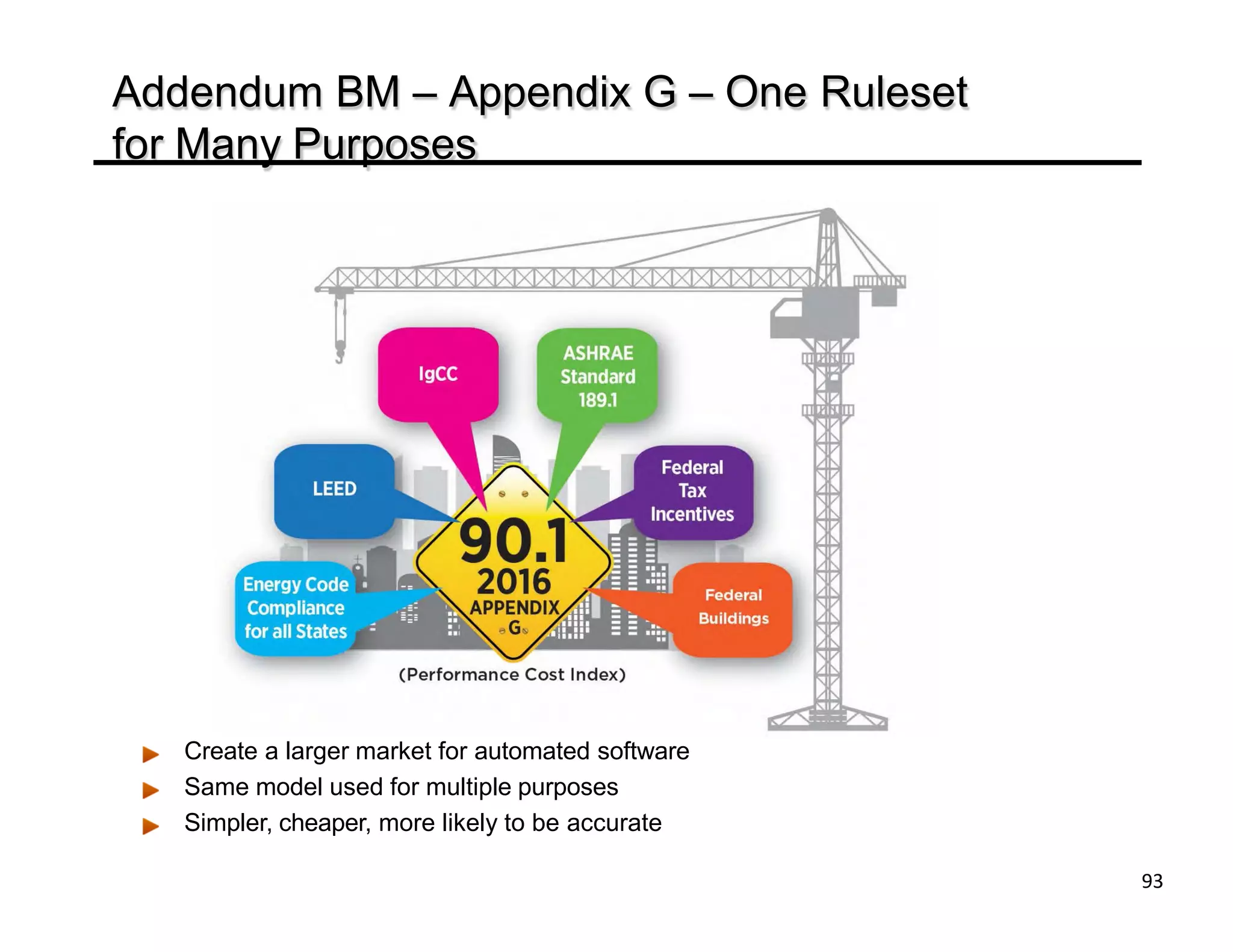
Addendum BM – Appendix G – One Ruleset
for Many Purposes
Create a larger market for automated software
Same model used for multiple purposes
Simpler, cheaper, more likely to be accurate
93
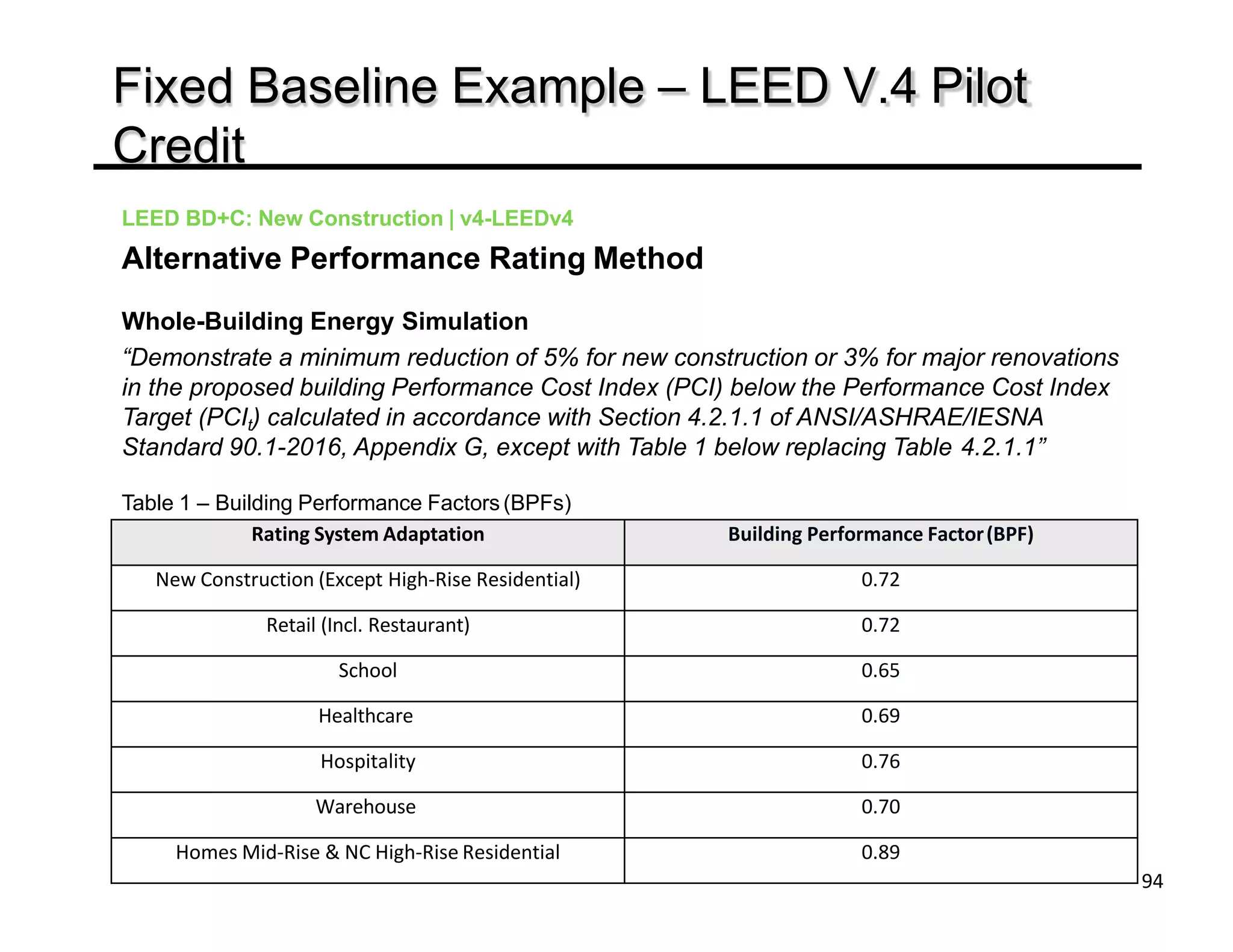
Fixed Baseline Example – LEED V.4 Pilot
Credit
94
LEED BD+C: New Construction | v4-LEEDv4
Alternative Performance Rating Method
Whole-Building Energy Simulation
“Demonstrate a minimum reduction of 5% for new construction or 3% for major renovations
in the proposed building Performance Cost Index (PCI) below the Performance Cost Index
Target (PCIt) calculated in accordance with Section 4.2.1.1 of ANSI/ASHRAE/IESNA
Standard 90.1-2016, Appendix G, except with Table 1 below replacing Table 4.2.1.1”
Table 1 – Building Performance Factors(BPFs)
Rating System Adaptation Building Performance Factor(BPF)
New Construction (Except High-Rise Residential) 0.72
Retail (Incl. Restaurant) 0.72
School 0.65
Healthcare 0.69
Hospitality 0.76
Warehouse 0.70
Homes Mid-Rise & NC High-Rise Residential 0.89
Addendum BM Summary
95
• 2016 Version of Appendix G with Addendum bm
offers these benefits:
 A new third option for compliance for increased
flexibility
 Saves time and money dedicated to energy modeling
by allowing a single modeling approach to be used for
multiple functions
 Encourages the creation of tools that automate the
simulation process as the market is increased
 Provides credit for good design practices that were
previously not recognized for code compliance

Energy Modeling with ASHRAE 90.1-2016

  • 1.
    What You Needto Know about the New Energy Standard for Commercial Buildings: Standard 90.1-2016
  • 2.
    Appendix G –Performance Rating Method A New Path for Compliance with ASHRAE Standard 90.1-2016
  • 3.
    Background Performance Paths inStandard 90.1 Through 2013
  • 4.
    Compliance with Standard90.1 Through 2013 Standard 90.1 Includes Two Paths for Compliance: Prescriptive Performance – Energy Cost Budget (ECB) HAP EnergyInsights™ 73 $ Proposed Design $ Baseline Design
  • 5.
    Appendix G –Performance Rating Method • Appendix G – Performance Rating Method (PRM) Performance path similar to Energy Cost Budget, but more flexible Not for code compliance (prior to 2016) Used for beyond code programs LEED ASHRAE Standard 189.1 International Green Construction Code (IgCC) EPACT Tax Credits Federal Energy Management Program (FEMP) 74
  • 6.
    ECB – DependentBaseline • Current Performance Path (ECB) Baseline is Dependent on the Proposed Design  Baseline matches the proposed design in most ways, except backed down to prescriptive limits Design Parameter 75 Baseline ModelingAssumption Energy Cost Budget Window Area Matches proposed design (up to 40%) HVAC System Type Matches proposed design HVAC System Sizing Matches proposed design Orientation Matches proposed design Fan power Matches proposed design (up to limit) Air Tightness Matches proposed design Use of Thermal Mass Matches proposed design
  • 7.
    ECB – DependentBaseline ECB compliance path does not prescribe energy use  Multitude of prescriptive options – with it’s baseline  Each combination chosen results in very different energy use 76
  • 8.
    Appendix G –Independent Baseline 77 Design Parameter Energy Cost Budget Appendix G Window Area Matches proposed design (up to 40%) Set at standard practice based on building type HVAC System Type Matches proposed design Set at standard practice based on building type and climate zone HVAC System Sizing Matches proposed design Set at standard practice Orientation Matches proposed design Neutral (average of 4 rotations) Fan power Matches proposed design (up to limit) Set at standard practice Air Tightness Matches proposed design Set at standard practice Use of Thermal Mass Matches proposed design Set at standard practice • Appendix G Baseline is more Independent of the Proposed Design  Design parameters set at standard practice - allows more credit for good design choices Baseline Modeling Assumption
  • 9.
    Appendix G –Independent Baseline 78
  • 10.
    Multiple Performance Rulesetsfor Codes and Beyond Code Programs 79
  • 11.
    Multiple Performance Rulesetsfor Codes and Beyond Code Programs • Each program and code requires different rules  One project could require 3 different baseline models:  Compliance, LEED, incentives  Confusing, expensive, difficult to master  Limited software to properly implement performance path  Market share is diluted  Not financially attractive for a software developer 80
  • 12.
    Baseline is aMoving Target • Baseline stringency changes with each new version of the Standard  Comparisons between buildings using different versions of the standard are very difficult  Which is better, 40% below 2004 or 30% below 2007? Moving Baseline 81
  • 13.
    Summary through 90.1-2013 82 •Two paths for compliance – prescriptive and ECB • 2nd performance path – Appendix G PRM for “beyond code programs” • ECB baseline is dependent on proposed design – limited credits available • Appendix G is more independent – increased credit for good design choice • For both – baseline changes with new prescriptive requirements • Limited software • Difficult to learn and QC multiple performance paths • Expensive
  • 14.
    The Future Performance Pathsin Standard 90.1 Beginning 2016
  • 15.
    Addendum BM –Third Compliance Path • New Compliance Path for 2016 1. Prescriptive 2. Energy Cost Budget 3. Appendix G 2. Compliance 1. Compliance Paths 1. New Buildings New buildings shall comply with either the provisions of a. Section 5, “Building Envelope”; Section 6, Heating, Ventilating, and Air Conditioning”; Section 7, “Service Water Heating”; Section 8, “Power”; Section 9, “Lighting”; and Section 10, “Other Equipment,” or b. Section 11, “Energy Cost Budget Method,” or c. Appendix G, “Performance Rating Method.” 84
  • 16.
    Addendum BM –Third Compliance Path • Requires a Performance Cost Index (PCI) specific to building type and climate zone  Performance Cost Index of 1.0 = baseline building  Performance Cost Index of 0.0 = zero net energy  For compliance, PCI < PCIt  PCIt specific for building type, climate zone, and proportion of regulated loads : unregulatedload 0.75 0.50 0.25 0 1.0 Baseline Net Zero 85
  • 17.
    Definitions • Unregulated EnergyEnd Uses – i.e. IT equipment, receptacle/plug loads, refrigeration, cooking, etc. • Regulated Energy End Uses – i.e. Interior Lighting, Heating, Cooling, Elevators, Fans, etc.
  • 18.
    Addendum BM –Third Compliance Path Building type and climate zone adjustment by Building Performance Factor 87
  • 19.
    Addendum BM –Appendix G - Fixed Baseline 0.75 0.50 0.25 0 1.0 Baseline 90.1-2004 Net Zero • Appendix G - Fixed Baseline • Baseline set ~ 90.1-2004  Intent is that the stringency of the baseline doesn’t change  PCI target changes with each version of a code  Beyond code programs can choose a PCI to meet their needs 189.1-2017 (estimate) Future Codes 90.1-2010 90.1-2016 88
  • 20.
  • 21.
  • 22.
    90.1-2016 Energy SavingsPreliminary Results
  • 23.
  • 24.
    Addendum BM –Appendix G – One Ruleset for Many Purposes Create a larger market for automated software Same model used for multiple purposes Simpler, cheaper, more likely to be accurate 93
  • 25.
    Fixed Baseline Example– LEED V.4 Pilot Credit 94 LEED BD+C: New Construction | v4-LEEDv4 Alternative Performance Rating Method Whole-Building Energy Simulation “Demonstrate a minimum reduction of 5% for new construction or 3% for major renovations in the proposed building Performance Cost Index (PCI) below the Performance Cost Index Target (PCIt) calculated in accordance with Section 4.2.1.1 of ANSI/ASHRAE/IESNA Standard 90.1-2016, Appendix G, except with Table 1 below replacing Table 4.2.1.1” Table 1 – Building Performance Factors(BPFs) Rating System Adaptation Building Performance Factor(BPF) New Construction (Except High-Rise Residential) 0.72 Retail (Incl. Restaurant) 0.72 School 0.65 Healthcare 0.69 Hospitality 0.76 Warehouse 0.70 Homes Mid-Rise & NC High-Rise Residential 0.89
  • 26.
    Addendum BM Summary 95 •2016 Version of Appendix G with Addendum bm offers these benefits:  A new third option for compliance for increased flexibility  Saves time and money dedicated to energy modeling by allowing a single modeling approach to be used for multiple functions  Encourages the creation of tools that automate the simulation process as the market is increased  Provides credit for good design practices that were previously not recognized for code compliance