Net Zero and Beyond

Jim Schwartz
Director, Global Strategic Marketing
Johnson Controls Building Efficiency
October 2013
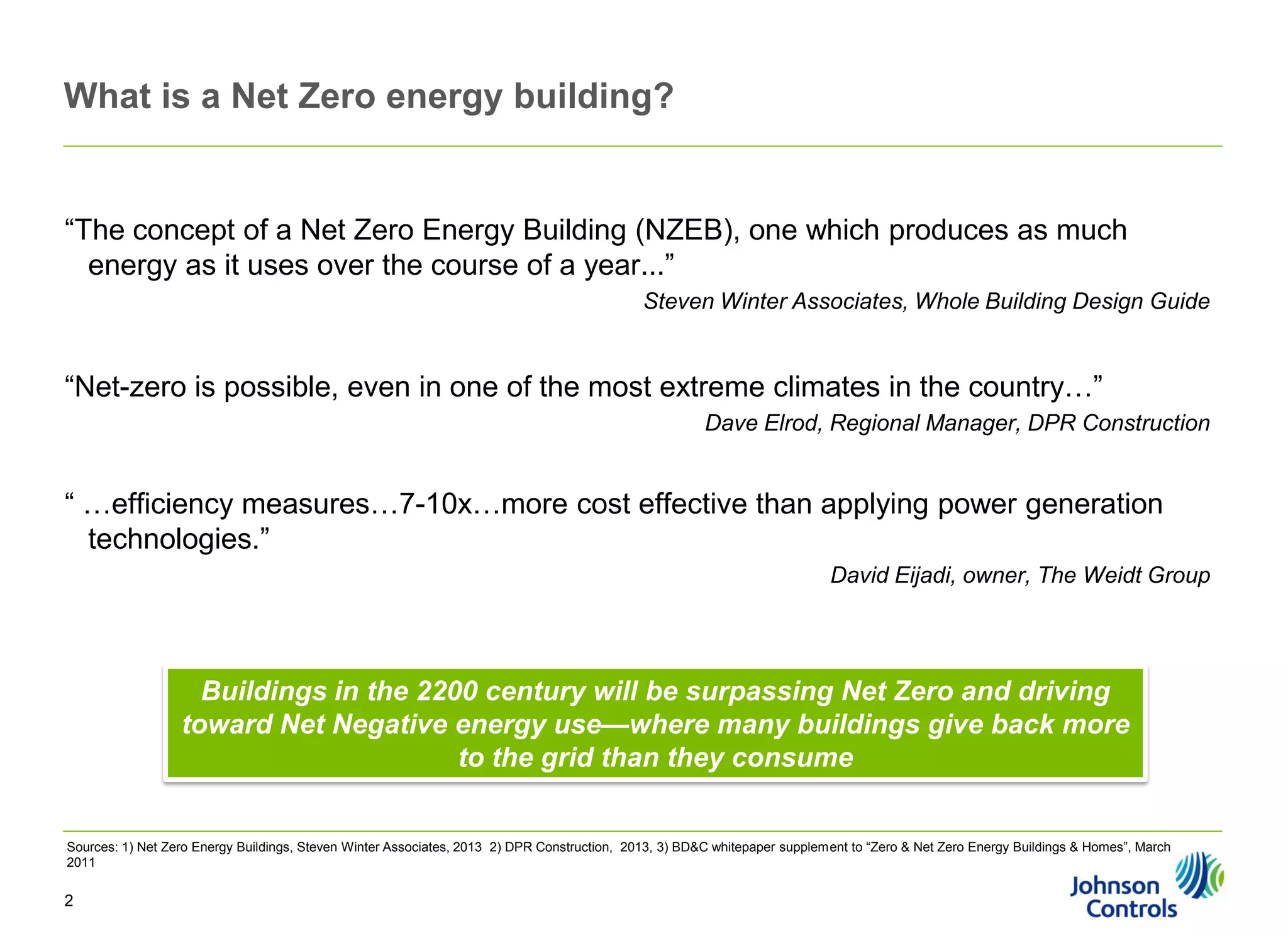
What is a Net Zero energy building?

“The concept of a Net Zero Energy Building (NZEB), one which produces as much
energy as it uses over the course of a year...”
Steven Winter Associates, Whole Building Design Guide

“Net-zero is possible, even in one of the most extreme climates in the country…”
Dave Elrod, Regional Manager, DPR Construction

“ …efficiency measures…7-10x…more cost effective than applying power generation
technologies.”
David Eijadi, owner, The Weidt Group

Buildings in the 2200 century will be surpassing Net Zero and driving
toward Net Negative energy use—where many buildings give back more
to the grid than they consume
Sources: 1) Net Zero Energy Buildings, Steven Winter Associates, 2013 2) DPR Construction, 2013, 3) BD&C whitepaper supplement to “Zero & Net Zero Energy Buildings & Homes”, March
2011

2
Focusing on Net Zero in commercial buildings
US Energy Consumption by Sector

• Macro drivers for energy efficiency
– Rising energy costs
– Growing GHG emissions
– Sustainability goals/image

~5 M bldgs … highest
energy intensity

Identified as top 3
issues for building
owners
[Energy Efficiency
Indicator survey]

• Buildings consume more energy
than any other sector … ~40%
• Commercial buildings are the most
energy intense

Transportation
28%

Commercial
18%

250 M+
vehicles
Residential
22%

– 4.5X residential energy use per sq-ft

• Commercial building energy use
growing faster than other sectors

~115 M
households
Industrial
32%

Buildings 40%

Commercial building sector has highest energy intensity
Sources: 1) Architecture 2030; 2) US Energy Information Administration; 3) US Environmental Protection Agency; 4) Institute for Building Efficiency’s Energy Efficiency

3
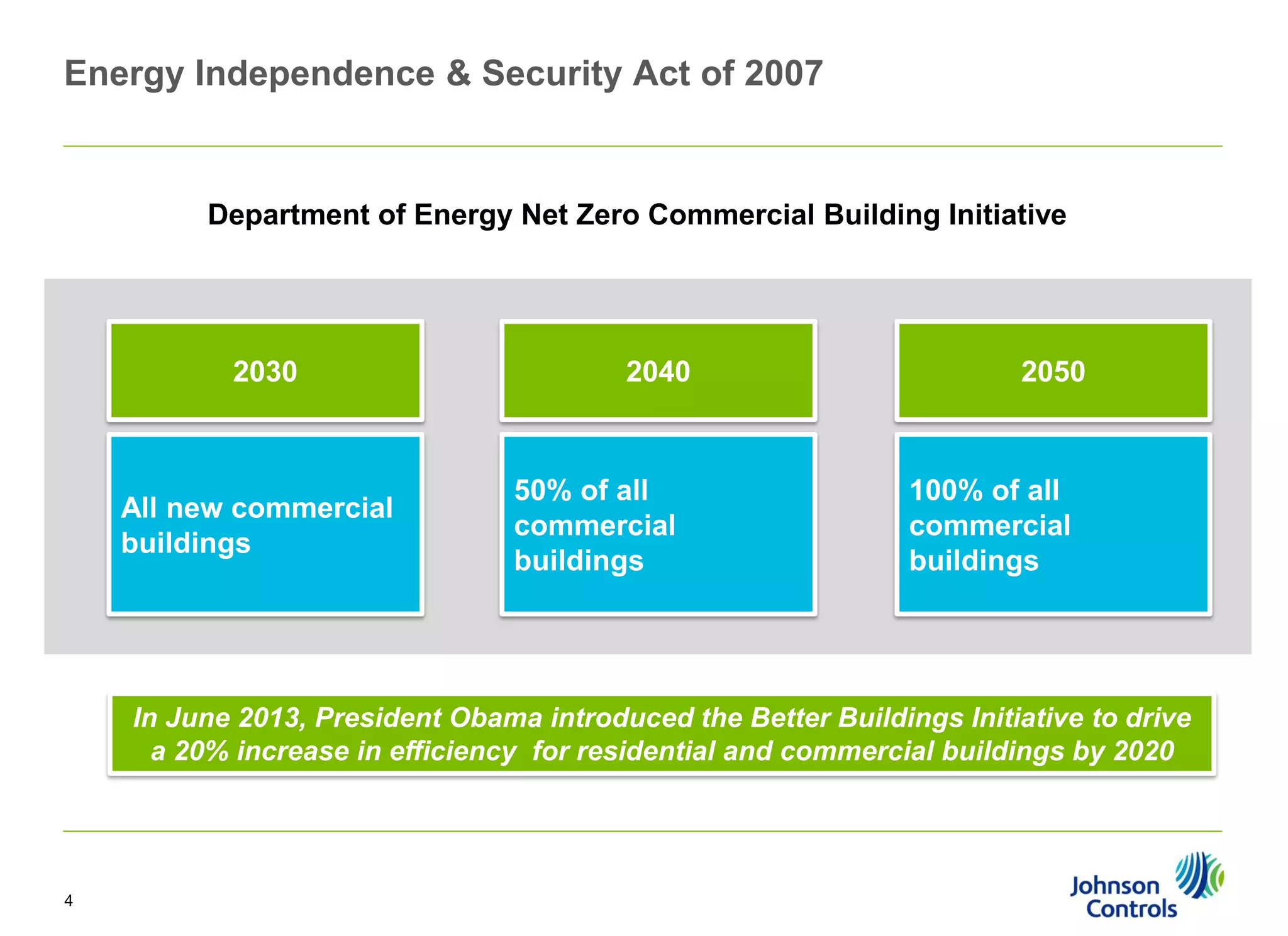
Energy Independence & Security Act of 2007

Department of Energy Net Zero Commercial Building Initiative

2030

All new commercial
buildings

2040

50% of all
commercial
buildings

2050

100% of all
commercial
buildings

In June 2013, President Obama introduced the Better Buildings Initiative to drive
a 20% increase in efficiency for residential and commercial buildings by 2020

4
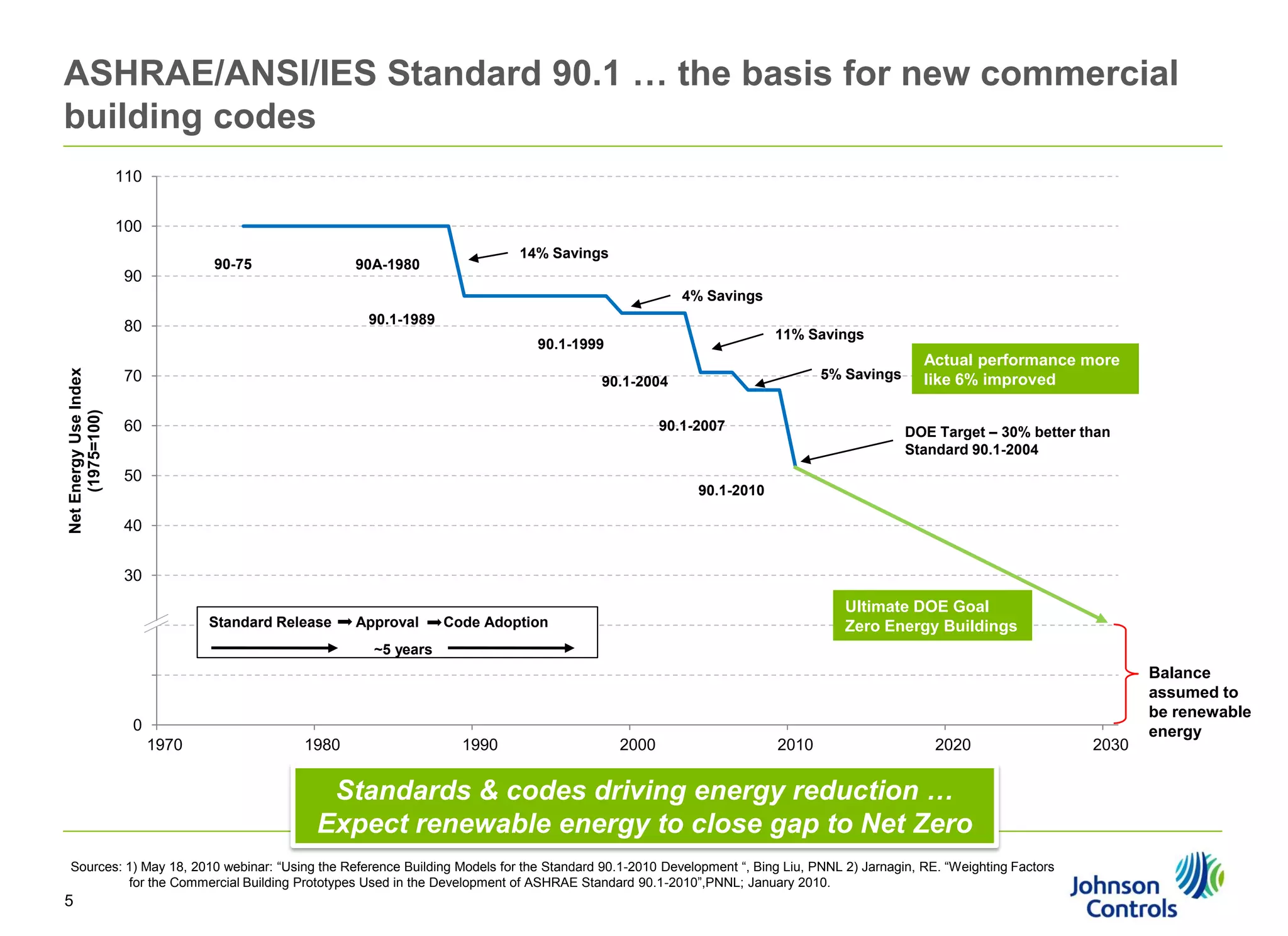
ASHRAE/ANSI/IES Standard 90.1 … the basis for new commercial
building codes
110

100
90-75

90

14% Savings

90A-1980

4% Savings
90.1-1989

80

11% Savings

Net Energy Use Index
(1975=100)

90.1-1999

70

5% Savings

90.1-2004

60

90.1-2007

Actual performance more
like 6% improved
DOE Target – 30% better than
Standard 90.1-2004

50
90.1-2010

40
30
Standard Release

20

Approval

Ultimate DOE Goal
Zero Energy Buildings

Code Adoption

~5 years

10
0
1970

1980

1990

2000

2010

2020

Standards & codes driving energy reduction …
Expect renewable energy to close gap to Net Zero
Sources: 1) May 18, 2010 webinar: “Using the Reference Building Models for the Standard 90.1-2010 Development “, Bing Liu, PNNL 2) Jarnagin, RE. “Weighting Factors
for the Commercial Building Prototypes Used in the Development of ASHRAE Standard 90.1-2010”,PNNL; January 2010.

5

2030

Balance
assumed to
be renewable
energy
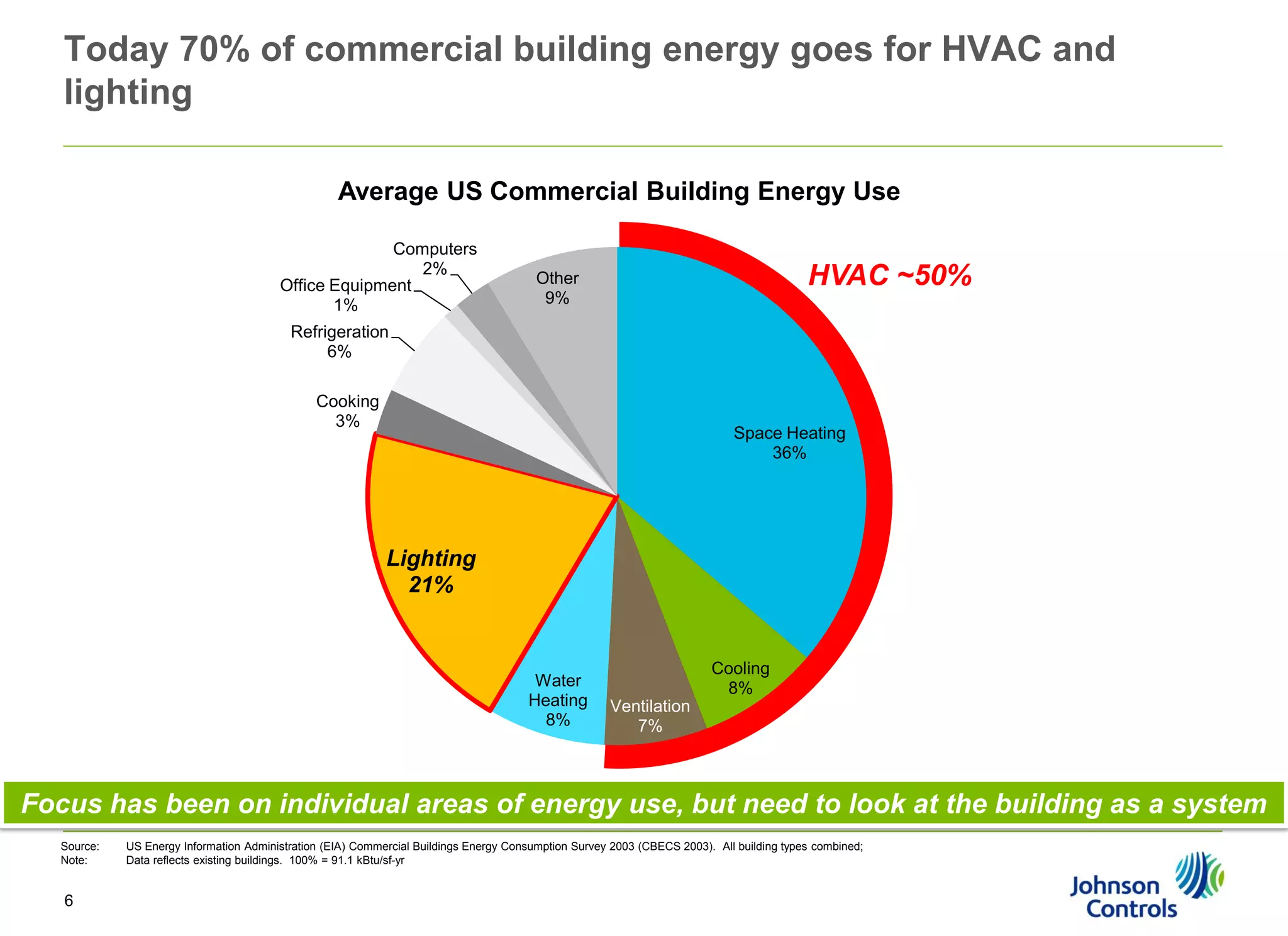
Today 70% of commercial building energy goes for HVAC and
lighting
Average US Commercial Building Energy Use
Computers
2%
Office Equipment
1%

HVAC ~50%

Other
9%

Refrigeration
6%
Cooking
3%

Space Heating
36%

Lighting
21%

Water
Heating
8%

Cooling
8%
Ventilation
7%

Focus has been on individual areas of energy use, but need to look at the building as a system
Source:
Note:

6

US Energy Information Administration (EIA) Commercial Buildings Energy Consumption Survey 2003 (CBECS 2003). All building types combined;
Data reflects existing buildings. 100% = 91.1 kBtu/sf-yr
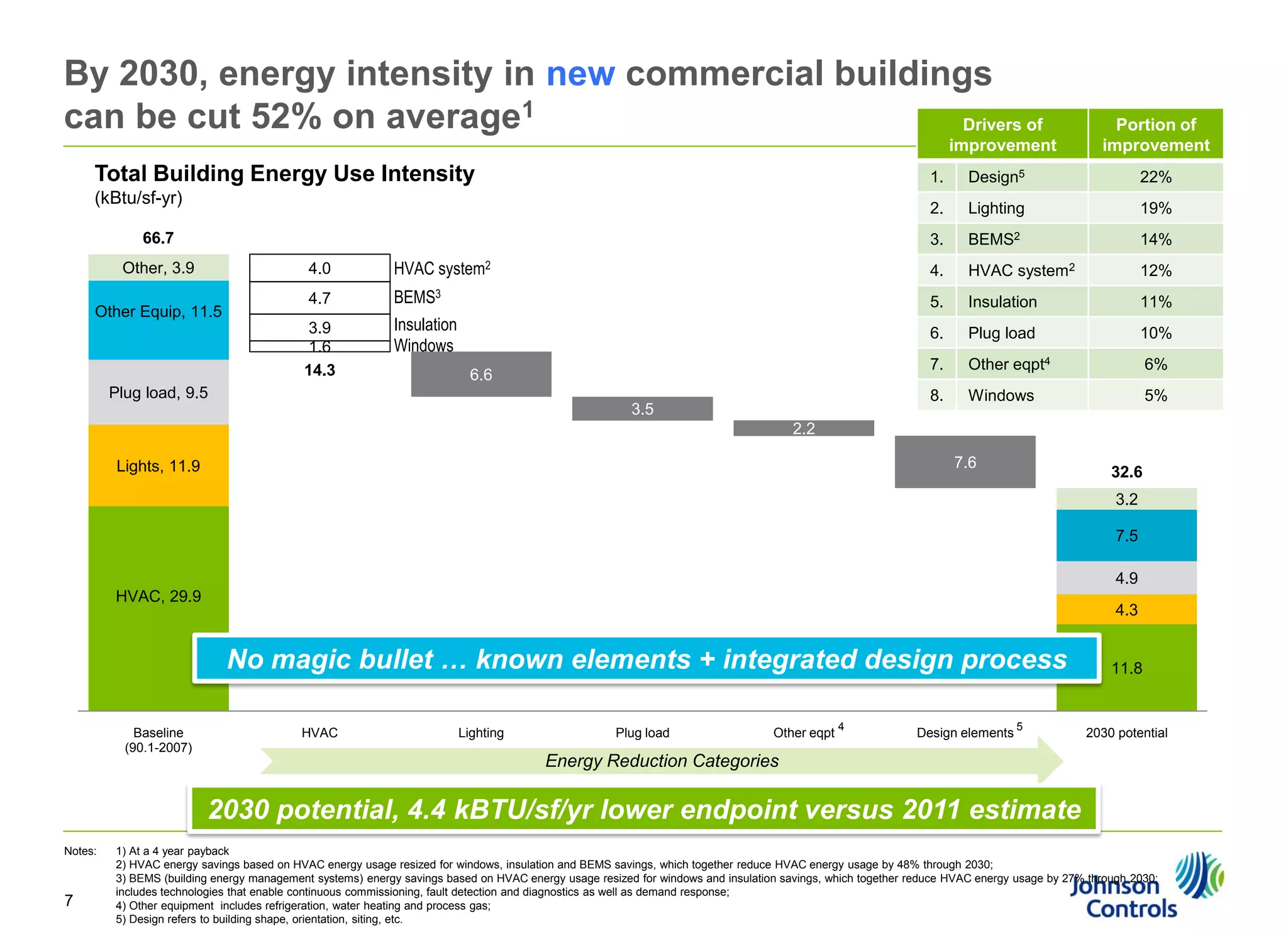
By 2030, energy intensity in new commercial buildings
can be cut 52% on average1
Drivers of
improvement

Total Building Energy Use Intensity

Portion of
improvement

1.

Lighting

19%

3.

66.7

22%

2.

(kBtu/sf-yr)

Design5

BEMS2

14%

4.0

Other Equip, 11.5

HVAC system2

4.

HVAC system2

12%

4.7

BEMS3

5.

Insulation

11%

3.9
1.6
14.3

Other, 3.9

Insulation
Windows

6.

Plug load

10%

7.

Other eqpt4

6%

8.

Windows

5%

6.6

Plug load, 9.5
3.5
2.2

7.6

Lights, 11.9

32.6
3.2
7.5
4.9

HVAC, 29.9

4.3

No magic bullet … known elements + integrated design process
Baseline
(90.1-2007)

HVAC

Lighting

Plug load

Other eqpt

4

Design elements

5

11.8

2030 potential

Energy Reduction Categories

2030 potential, 4.4 kBTU/sf/yr lower endpoint versus 2011 estimate
Notes:

7

1) At a 4 year payback
2) HVAC energy savings based on HVAC energy usage resized for windows, insulation and BEMS savings, which together reduce HVAC energy usage by 48% through 2030;
3) BEMS (building energy management systems) energy savings based on HVAC energy usage resized for windows and insulation savings, which together reduce HVAC energy usage by 27% through 2030;
includes technologies that enable continuous commissioning, fault detection and diagnostics as well as demand response;
4) Other equipment includes refrigeration, water heating and process gas;
5) Design refers to building shape, orientation, siting, etc.
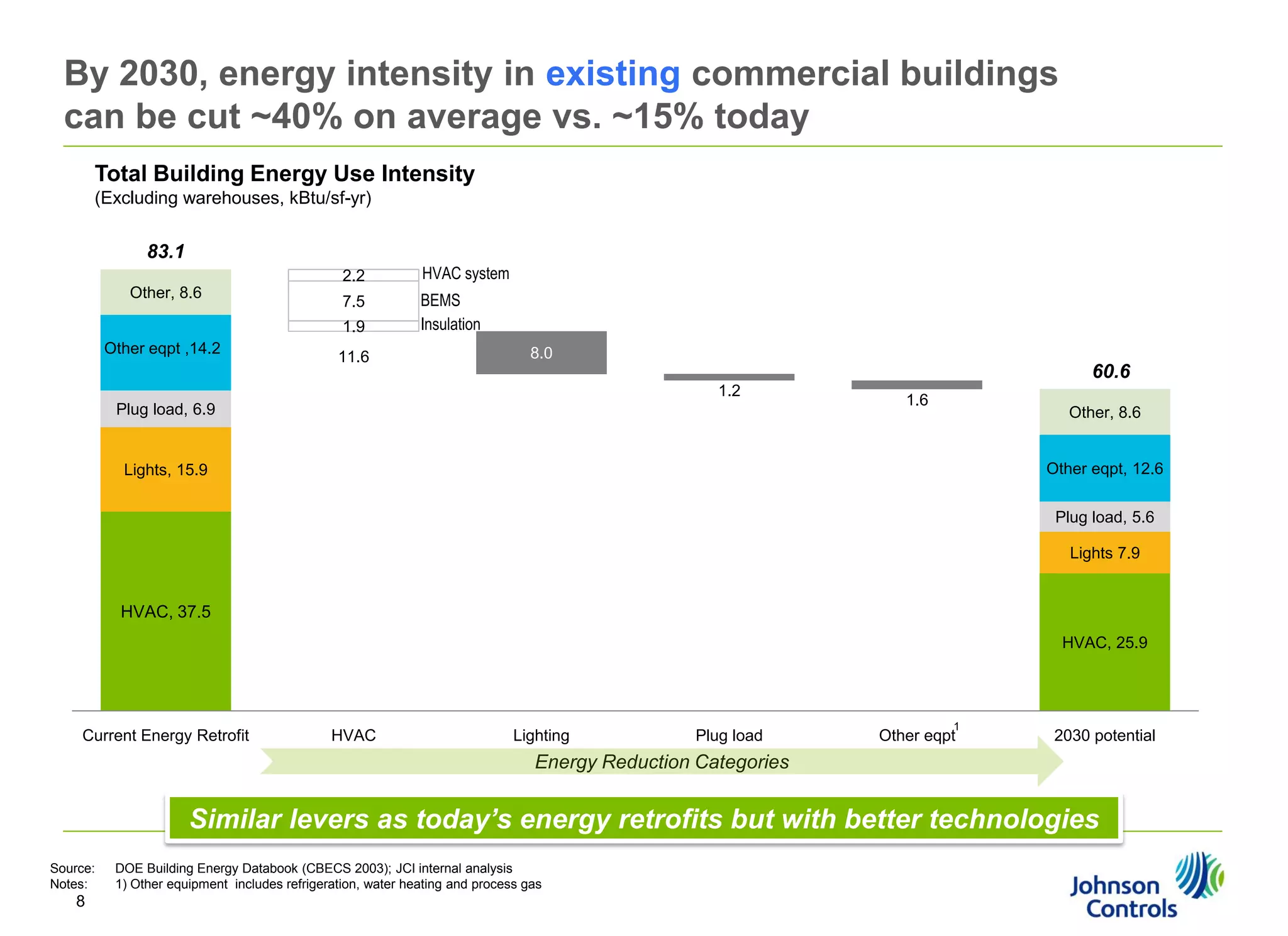
By 2030, energy intensity in existing commercial buildings
can be cut ~40% on average vs. ~15% today
Total Building Energy Use Intensity
(Excluding warehouses, kBtu/sf-yr)

83.1
2.2
Other, 8.6

HVAC system

7.5

BEMS
Insulation

1.9
Other eqpt ,14.2

11.6

8.0

60.6
1.2

Plug load, 6.9

1.6

Other, 8.6

Other eqpt, 12.6

Lights, 15.9

Plug load, 5.6
Lights 7.9

HVAC, 37.5
HVAC, 25.9

Current Energy Retrofit

HVAC

Lighting

Plug load

1

Other eqpt

2030 potential

Energy Reduction Categories

Similar levers as today’s energy retrofits but with better technologies
Source:
Notes:

8

DOE Building Energy Databook (CBECS 2003); JCI internal analysis
1) Other equipment includes refrigeration, water heating and process gas
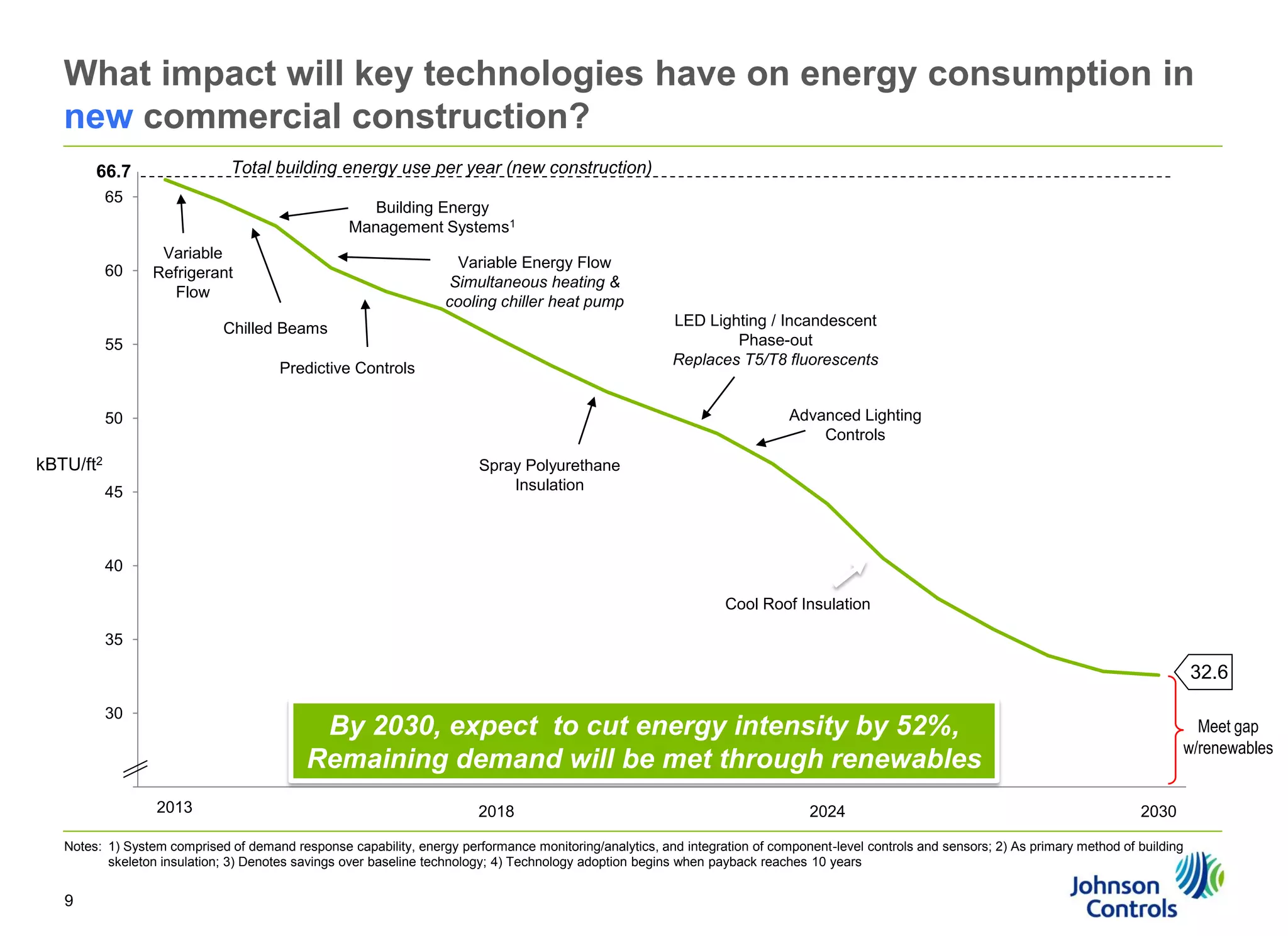
What impact will key technologies have on energy consumption in
new commercial construction?
Total building energy use per year (new construction)

66.7
65

60

Building Energy
Management Systems1
Variable
Refrigerant
Flow

Variable Energy Flow
Simultaneous heating &
cooling chiller heat pump
LED Lighting / Incandescent
Phase-out
Replaces T5/T8 fluorescents

Chilled Beams
55
Predictive Controls

Advanced Lighting
Controls

50

kBTU/ft2

Spray Polyurethane
Insulation

45

40
Cool Roof Insulation
35

32.6
30

By 2030, expect to cut energy intensity by 52%,
Remaining demand will be met through renewables

Meet gap
w/renewables

25
2013
2012

2018

2024

2030

Notes: 1) System comprised of demand response capability, energy performance monitoring/analytics, and integration of component-level controls and sensors; 2) As primary method of building
skeleton insulation; 3) Denotes savings over baseline technology; 4) Technology adoption begins when payback reaches 10 years

9
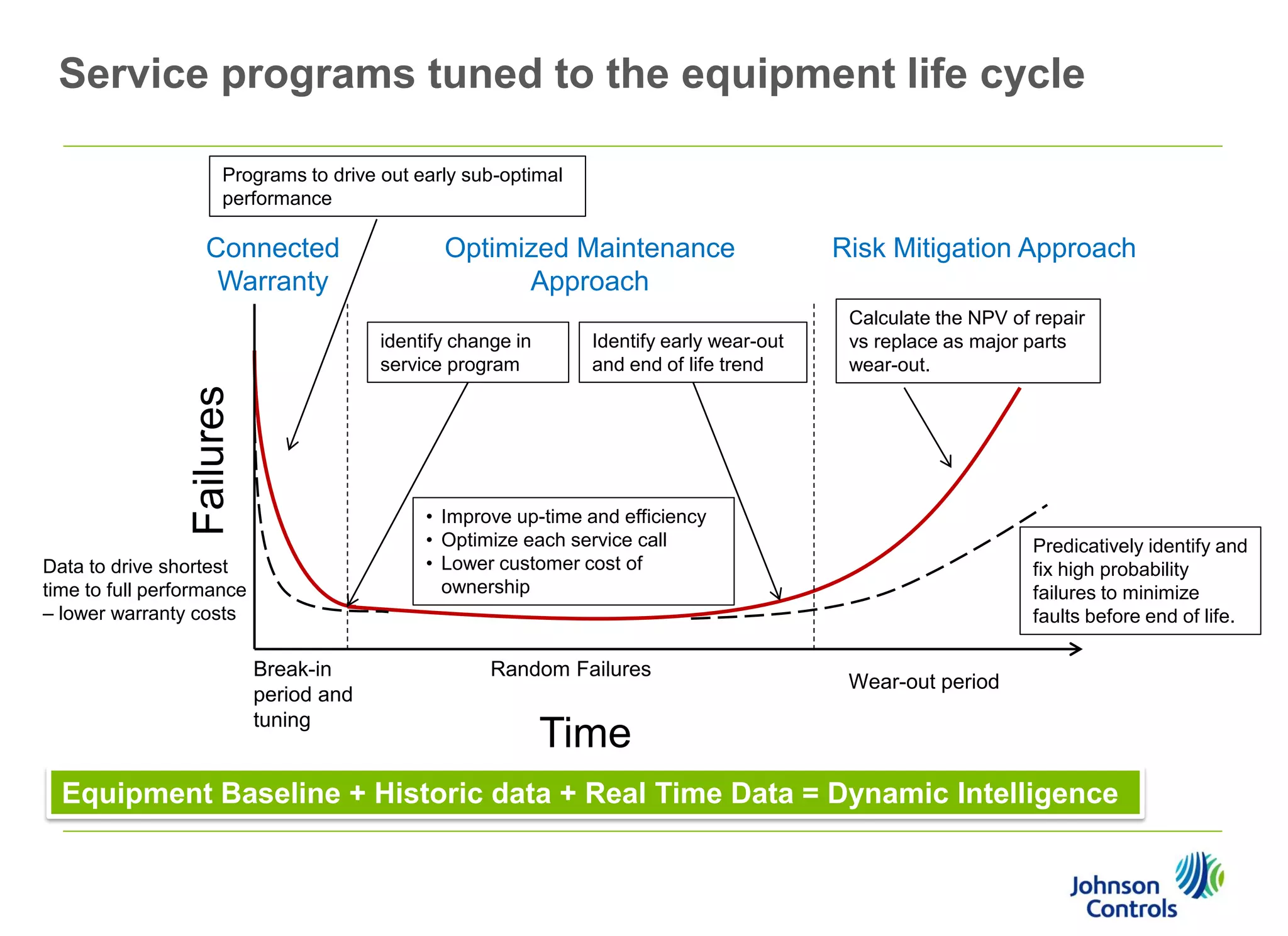
Service programs tuned to the equipment life cycle
Programs to drive out early sub-optimal
performance

Connected
Warranty

Optimized Maintenance
Approach

Failures

identify change in
service program

Identify early wear-out
and end of life trend

Risk Mitigation Approach
Calculate the NPV of repair
vs replace as major parts
wear-out.

• Improve up-time and efficiency
• Optimize each service call
• Lower customer cost of
ownership

Data to drive shortest
time to full performance
– lower warranty costs

Break-in
period and
tuning

Random Failures

Predicatively identify and
fix high probability
failures to minimize
faults before end of life.

Wear-out period

Time

Equipment Baseline + Historic data + Real Time Data = Dynamic Intelligence
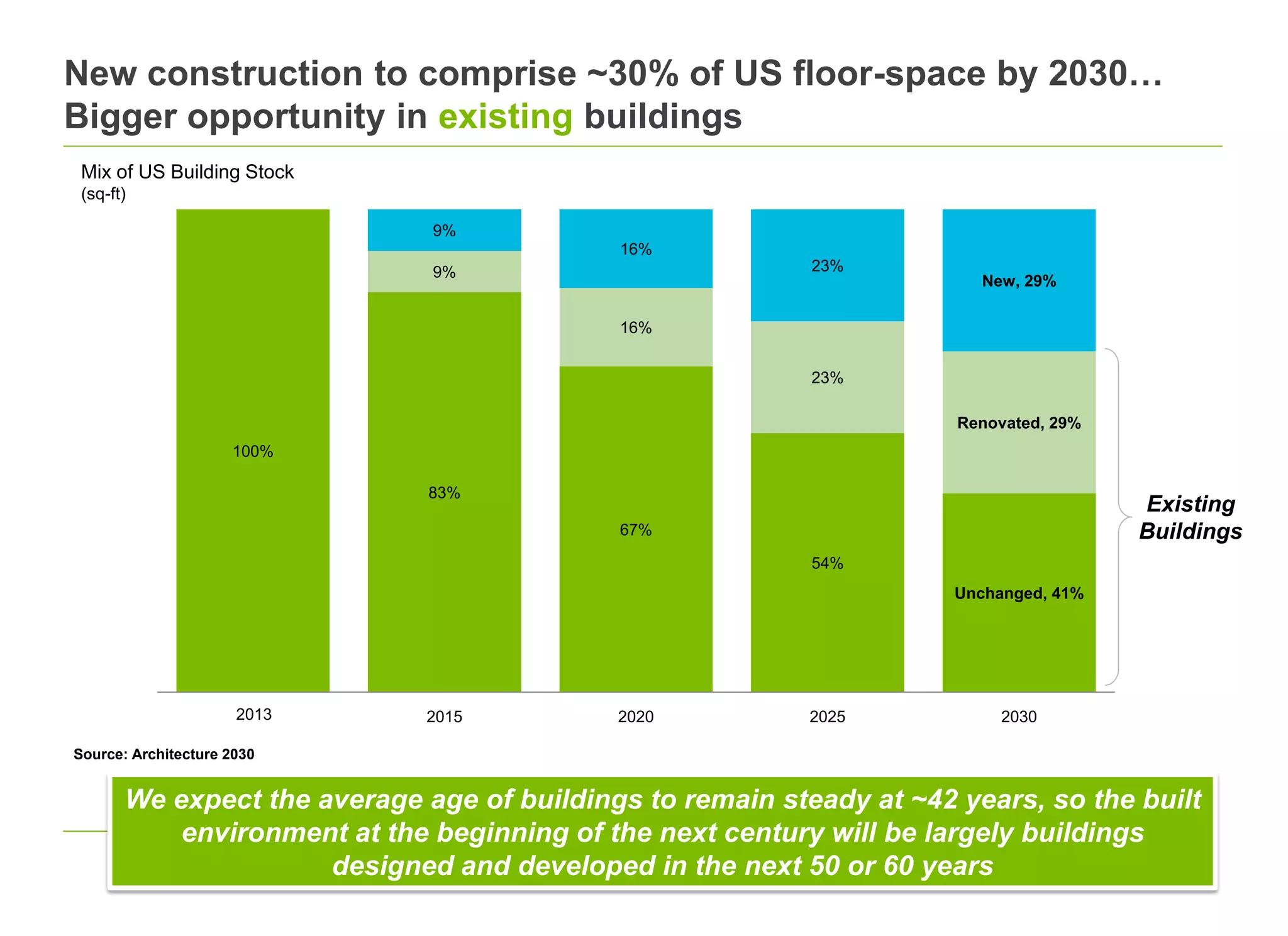
New construction to comprise ~30% of US floor-space by 2030…
Bigger opportunity in existing buildings
Mix of US Building Stock
(sq-ft)
9%
16%
23%

9%

New, 29%
16%
23%
Renovated, 29%

100%
83%

Existing
Buildings

67%
54%
Unchanged, 41%

2013
2010

2015

2020

2025

2030

Source: Architecture 2030

We expect the average age of buildings to remain steady at ~42 years, so the built
environment at the beginning of the next century will be largely buildings
designed and developed in the next 50 or 60 years
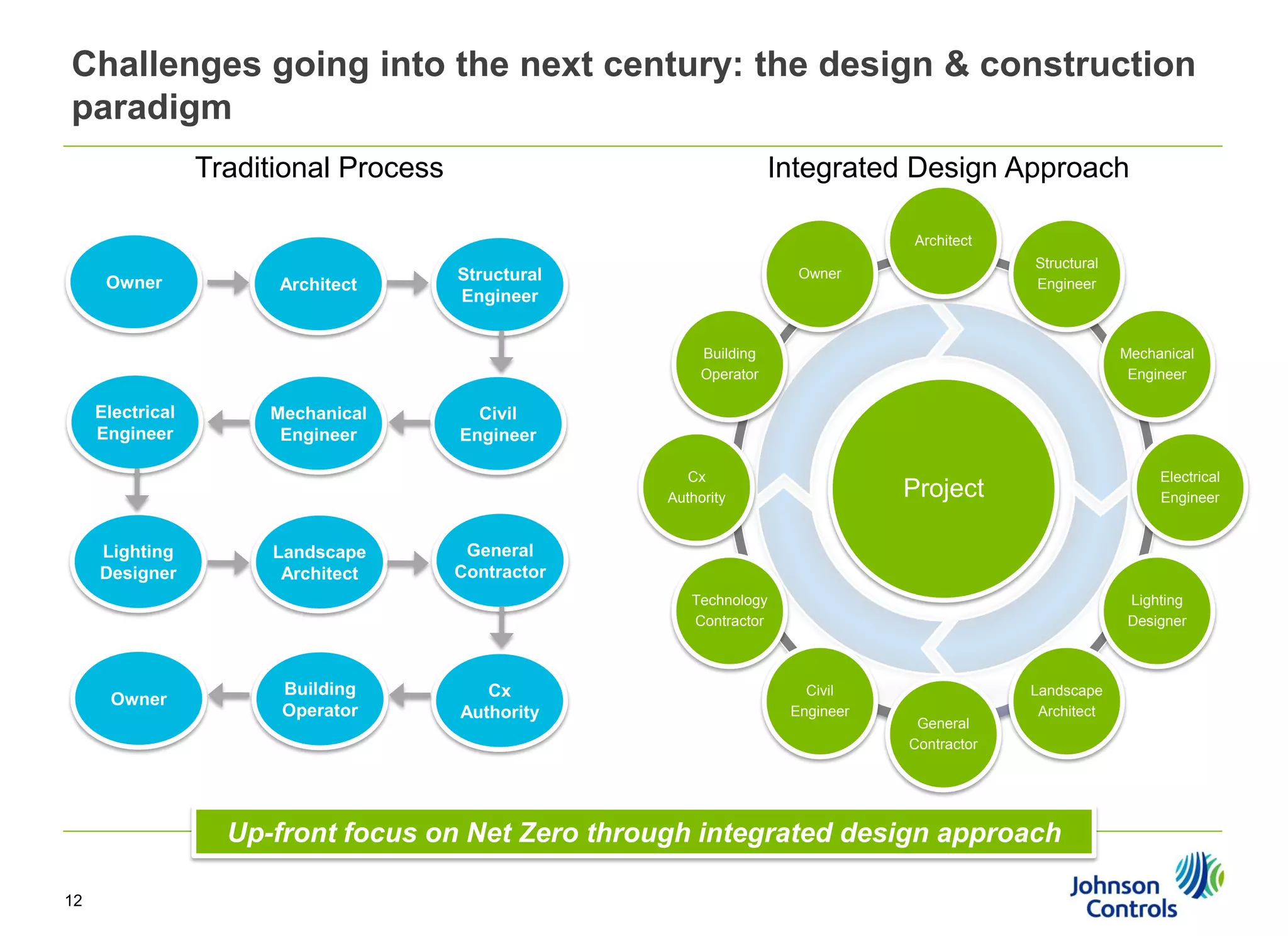
Challenges going into the next century: the design & construction
paradigm
Traditional Process

Integrated Design Approach
Architect

Owner

Architect

Structural
Engineer

Structural
Engineer

Owner

Building
Operator

Electrical
Engineer

Mechanical
Engineer

Mechanical
Engineer

Civil
Engineer
Cx
Authority

Lighting
Designer

Landscape
Architect

Electrical
Engineer

Project

General
Contractor
Technology
Contractor

Owner

Building
Operator

Cx
Authority

Lighting
Designer

Civil
Engineer

General
Contractor

Landscape
Architect

Up-front focus on Net Zero through integrated design approach
12
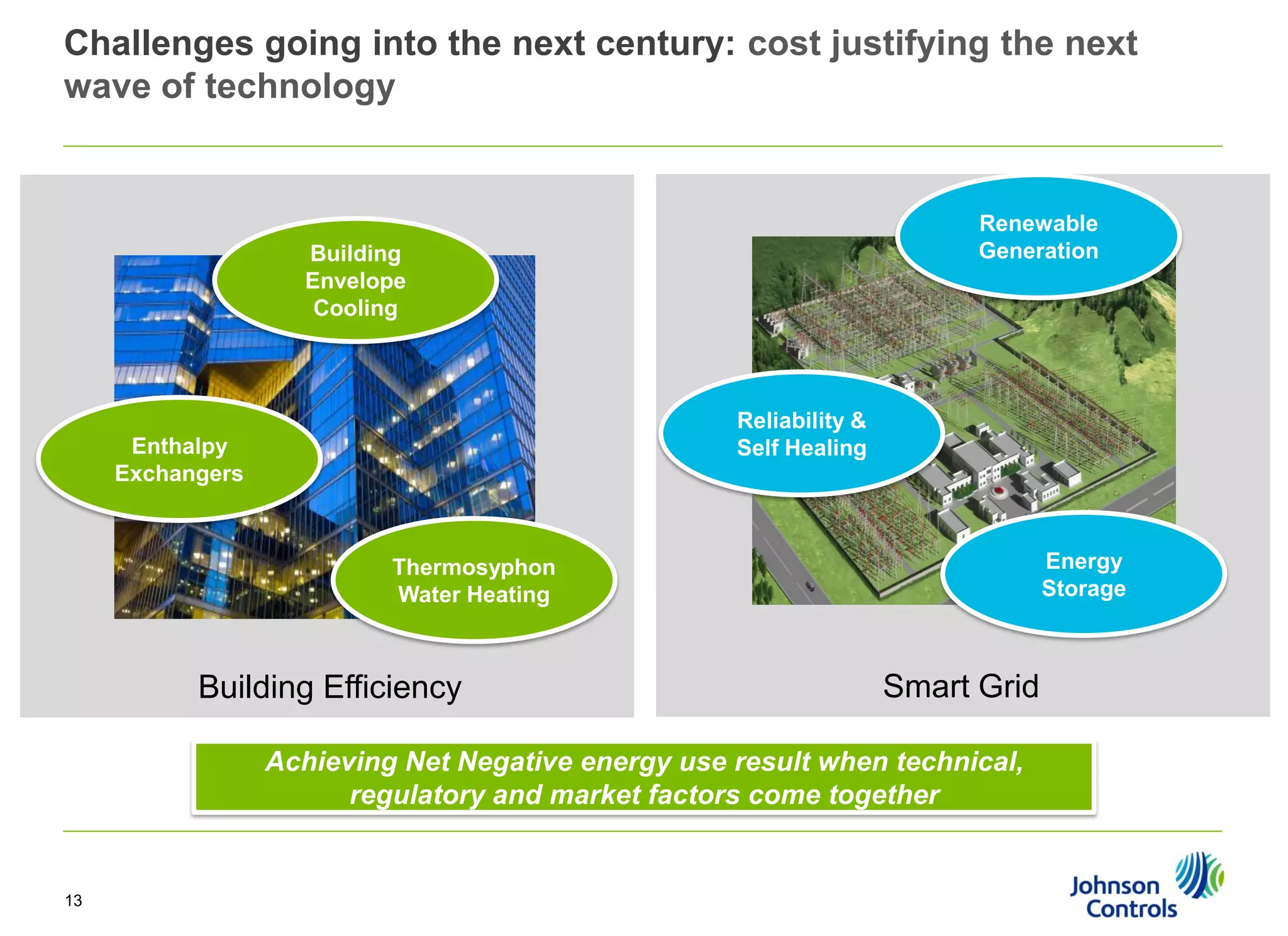
Challenges going into the next century: cost justifying the next
wave of technology

Renewable
Generation

Building
Envelope
Cooling

Reliability &
Self Healing

Enthalpy
Exchangers

Energy
Storage

Thermosyphon
Water Heating

Building Efficiency

Smart Grid

Achieving Net Negative energy use result when technical,
regulatory and market factors come together

13

Net zero energy and beyond

  • 1.
    Net Zero andBeyond Jim Schwartz Director, Global Strategic Marketing Johnson Controls Building Efficiency October 2013
  • 2.
    What is aNet Zero energy building? “The concept of a Net Zero Energy Building (NZEB), one which produces as much energy as it uses over the course of a year...” Steven Winter Associates, Whole Building Design Guide “Net-zero is possible, even in one of the most extreme climates in the country…” Dave Elrod, Regional Manager, DPR Construction “ …efficiency measures…7-10x…more cost effective than applying power generation technologies.” David Eijadi, owner, The Weidt Group Buildings in the 2200 century will be surpassing Net Zero and driving toward Net Negative energy use—where many buildings give back more to the grid than they consume Sources: 1) Net Zero Energy Buildings, Steven Winter Associates, 2013 2) DPR Construction, 2013, 3) BD&C whitepaper supplement to “Zero & Net Zero Energy Buildings & Homes”, March 2011 2
  • 3.
    Focusing on NetZero in commercial buildings US Energy Consumption by Sector • Macro drivers for energy efficiency – Rising energy costs – Growing GHG emissions – Sustainability goals/image ~5 M bldgs … highest energy intensity Identified as top 3 issues for building owners [Energy Efficiency Indicator survey] • Buildings consume more energy than any other sector … ~40% • Commercial buildings are the most energy intense Transportation 28% Commercial 18% 250 M+ vehicles Residential 22% – 4.5X residential energy use per sq-ft • Commercial building energy use growing faster than other sectors ~115 M households Industrial 32% Buildings 40% Commercial building sector has highest energy intensity Sources: 1) Architecture 2030; 2) US Energy Information Administration; 3) US Environmental Protection Agency; 4) Institute for Building Efficiency’s Energy Efficiency 3
  • 4.
    Energy Independence &Security Act of 2007 Department of Energy Net Zero Commercial Building Initiative 2030 All new commercial buildings 2040 50% of all commercial buildings 2050 100% of all commercial buildings In June 2013, President Obama introduced the Better Buildings Initiative to drive a 20% increase in efficiency for residential and commercial buildings by 2020 4
  • 5.
    ASHRAE/ANSI/IES Standard 90.1… the basis for new commercial building codes 110 100 90-75 90 14% Savings 90A-1980 4% Savings 90.1-1989 80 11% Savings Net Energy Use Index (1975=100) 90.1-1999 70 5% Savings 90.1-2004 60 90.1-2007 Actual performance more like 6% improved DOE Target – 30% better than Standard 90.1-2004 50 90.1-2010 40 30 Standard Release 20 Approval Ultimate DOE Goal Zero Energy Buildings Code Adoption ~5 years 10 0 1970 1980 1990 2000 2010 2020 Standards & codes driving energy reduction … Expect renewable energy to close gap to Net Zero Sources: 1) May 18, 2010 webinar: “Using the Reference Building Models for the Standard 90.1-2010 Development “, Bing Liu, PNNL 2) Jarnagin, RE. “Weighting Factors for the Commercial Building Prototypes Used in the Development of ASHRAE Standard 90.1-2010”,PNNL; January 2010. 5 2030 Balance assumed to be renewable energy
  • 6.
    Today 70% ofcommercial building energy goes for HVAC and lighting Average US Commercial Building Energy Use Computers 2% Office Equipment 1% HVAC ~50% Other 9% Refrigeration 6% Cooking 3% Space Heating 36% Lighting 21% Water Heating 8% Cooling 8% Ventilation 7% Focus has been on individual areas of energy use, but need to look at the building as a system Source: Note: 6 US Energy Information Administration (EIA) Commercial Buildings Energy Consumption Survey 2003 (CBECS 2003). All building types combined; Data reflects existing buildings. 100% = 91.1 kBtu/sf-yr
  • 7.
    By 2030, energyintensity in new commercial buildings can be cut 52% on average1 Drivers of improvement Total Building Energy Use Intensity Portion of improvement 1. Lighting 19% 3. 66.7 22% 2. (kBtu/sf-yr) Design5 BEMS2 14% 4.0 Other Equip, 11.5 HVAC system2 4. HVAC system2 12% 4.7 BEMS3 5. Insulation 11% 3.9 1.6 14.3 Other, 3.9 Insulation Windows 6. Plug load 10% 7. Other eqpt4 6% 8. Windows 5% 6.6 Plug load, 9.5 3.5 2.2 7.6 Lights, 11.9 32.6 3.2 7.5 4.9 HVAC, 29.9 4.3 No magic bullet … known elements + integrated design process Baseline (90.1-2007) HVAC Lighting Plug load Other eqpt 4 Design elements 5 11.8 2030 potential Energy Reduction Categories 2030 potential, 4.4 kBTU/sf/yr lower endpoint versus 2011 estimate Notes: 7 1) At a 4 year payback 2) HVAC energy savings based on HVAC energy usage resized for windows, insulation and BEMS savings, which together reduce HVAC energy usage by 48% through 2030; 3) BEMS (building energy management systems) energy savings based on HVAC energy usage resized for windows and insulation savings, which together reduce HVAC energy usage by 27% through 2030; includes technologies that enable continuous commissioning, fault detection and diagnostics as well as demand response; 4) Other equipment includes refrigeration, water heating and process gas; 5) Design refers to building shape, orientation, siting, etc.
  • 8.
    By 2030, energyintensity in existing commercial buildings can be cut ~40% on average vs. ~15% today Total Building Energy Use Intensity (Excluding warehouses, kBtu/sf-yr) 83.1 2.2 Other, 8.6 HVAC system 7.5 BEMS Insulation 1.9 Other eqpt ,14.2 11.6 8.0 60.6 1.2 Plug load, 6.9 1.6 Other, 8.6 Other eqpt, 12.6 Lights, 15.9 Plug load, 5.6 Lights 7.9 HVAC, 37.5 HVAC, 25.9 Current Energy Retrofit HVAC Lighting Plug load 1 Other eqpt 2030 potential Energy Reduction Categories Similar levers as today’s energy retrofits but with better technologies Source: Notes: 8 DOE Building Energy Databook (CBECS 2003); JCI internal analysis 1) Other equipment includes refrigeration, water heating and process gas
  • 9.
    What impact willkey technologies have on energy consumption in new commercial construction? Total building energy use per year (new construction) 66.7 65 60 Building Energy Management Systems1 Variable Refrigerant Flow Variable Energy Flow Simultaneous heating & cooling chiller heat pump LED Lighting / Incandescent Phase-out Replaces T5/T8 fluorescents Chilled Beams 55 Predictive Controls Advanced Lighting Controls 50 kBTU/ft2 Spray Polyurethane Insulation 45 40 Cool Roof Insulation 35 32.6 30 By 2030, expect to cut energy intensity by 52%, Remaining demand will be met through renewables Meet gap w/renewables 25 2013 2012 2018 2024 2030 Notes: 1) System comprised of demand response capability, energy performance monitoring/analytics, and integration of component-level controls and sensors; 2) As primary method of building skeleton insulation; 3) Denotes savings over baseline technology; 4) Technology adoption begins when payback reaches 10 years 9
  • 10.
    Service programs tunedto the equipment life cycle Programs to drive out early sub-optimal performance Connected Warranty Optimized Maintenance Approach Failures identify change in service program Identify early wear-out and end of life trend Risk Mitigation Approach Calculate the NPV of repair vs replace as major parts wear-out. • Improve up-time and efficiency • Optimize each service call • Lower customer cost of ownership Data to drive shortest time to full performance – lower warranty costs Break-in period and tuning Random Failures Predicatively identify and fix high probability failures to minimize faults before end of life. Wear-out period Time Equipment Baseline + Historic data + Real Time Data = Dynamic Intelligence
  • 11.
    New construction tocomprise ~30% of US floor-space by 2030… Bigger opportunity in existing buildings Mix of US Building Stock (sq-ft) 9% 16% 23% 9% New, 29% 16% 23% Renovated, 29% 100% 83% Existing Buildings 67% 54% Unchanged, 41% 2013 2010 2015 2020 2025 2030 Source: Architecture 2030 We expect the average age of buildings to remain steady at ~42 years, so the built environment at the beginning of the next century will be largely buildings designed and developed in the next 50 or 60 years
  • 12.
    Challenges going intothe next century: the design & construction paradigm Traditional Process Integrated Design Approach Architect Owner Architect Structural Engineer Structural Engineer Owner Building Operator Electrical Engineer Mechanical Engineer Mechanical Engineer Civil Engineer Cx Authority Lighting Designer Landscape Architect Electrical Engineer Project General Contractor Technology Contractor Owner Building Operator Cx Authority Lighting Designer Civil Engineer General Contractor Landscape Architect Up-front focus on Net Zero through integrated design approach 12
  • 13.
    Challenges going intothe next century: cost justifying the next wave of technology Renewable Generation Building Envelope Cooling Reliability & Self Healing Enthalpy Exchangers Energy Storage Thermosyphon Water Heating Building Efficiency Smart Grid Achieving Net Negative energy use result when technical, regulatory and market factors come together 13