
1 
Sector-based Energy Efficiency 
Leonardo Energy 
Webinar 
Pierre Baillargeon (pbaillargeon@econoler.com)
TOPICS 
Most common EE measures by sector: 
› Industrial 
› Commercial and Institutional 
› Residential 
2
INDUSTRIAL SECTOR 
MOTOR 
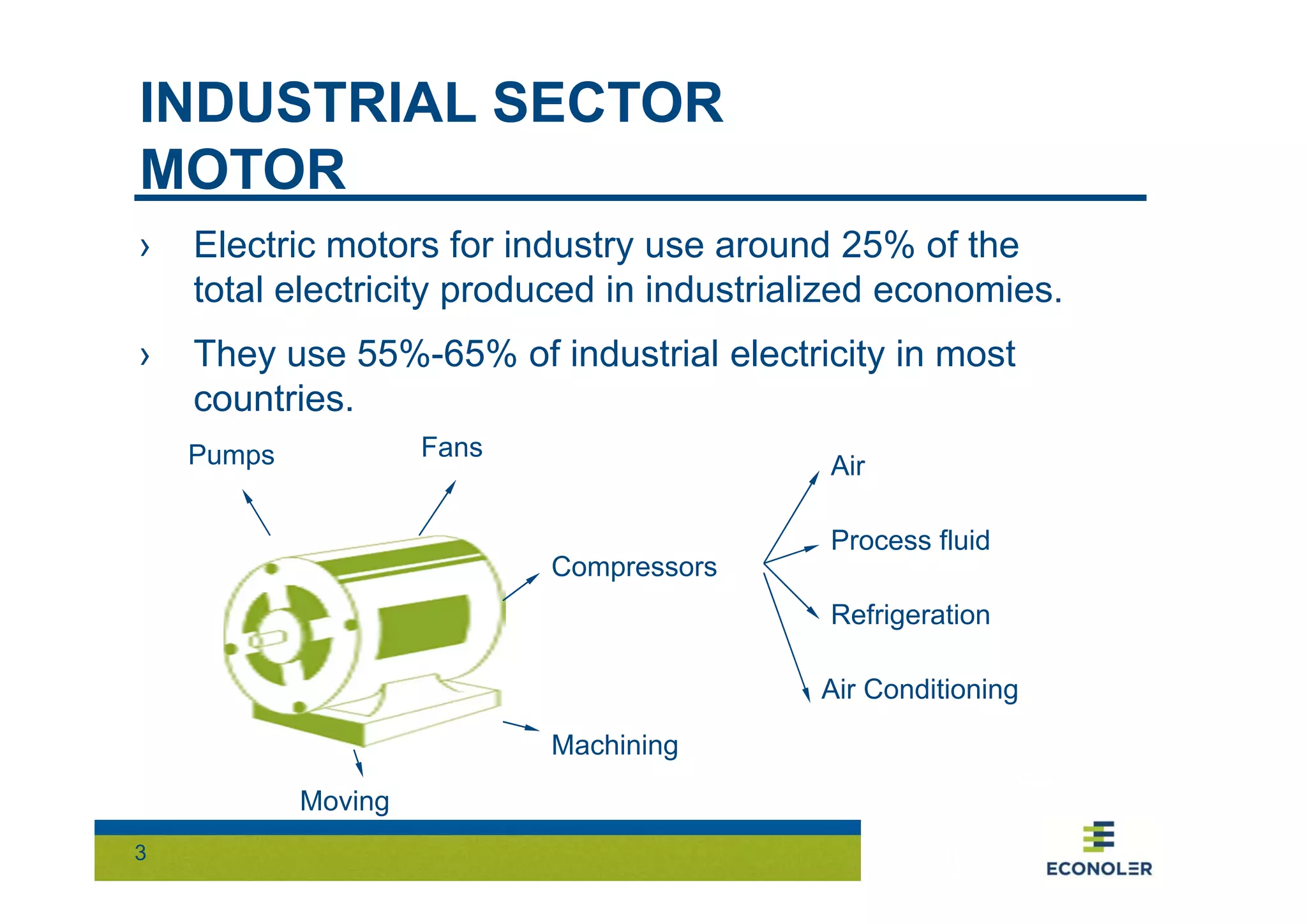
› Electric motors for industry use around 25% of the 
› They use 55%-65% of industrial electricity in most 
3 
total electricity produced in industrialized economies. 
Pumps Fans 
Compressors 
Air 
Process fluid 
Refrigeration 
Air Conditioning 
Moving 
Machining 
countries.
INDUSTRIAL SECTOR 
VARIABLE SPEED DRIVE 
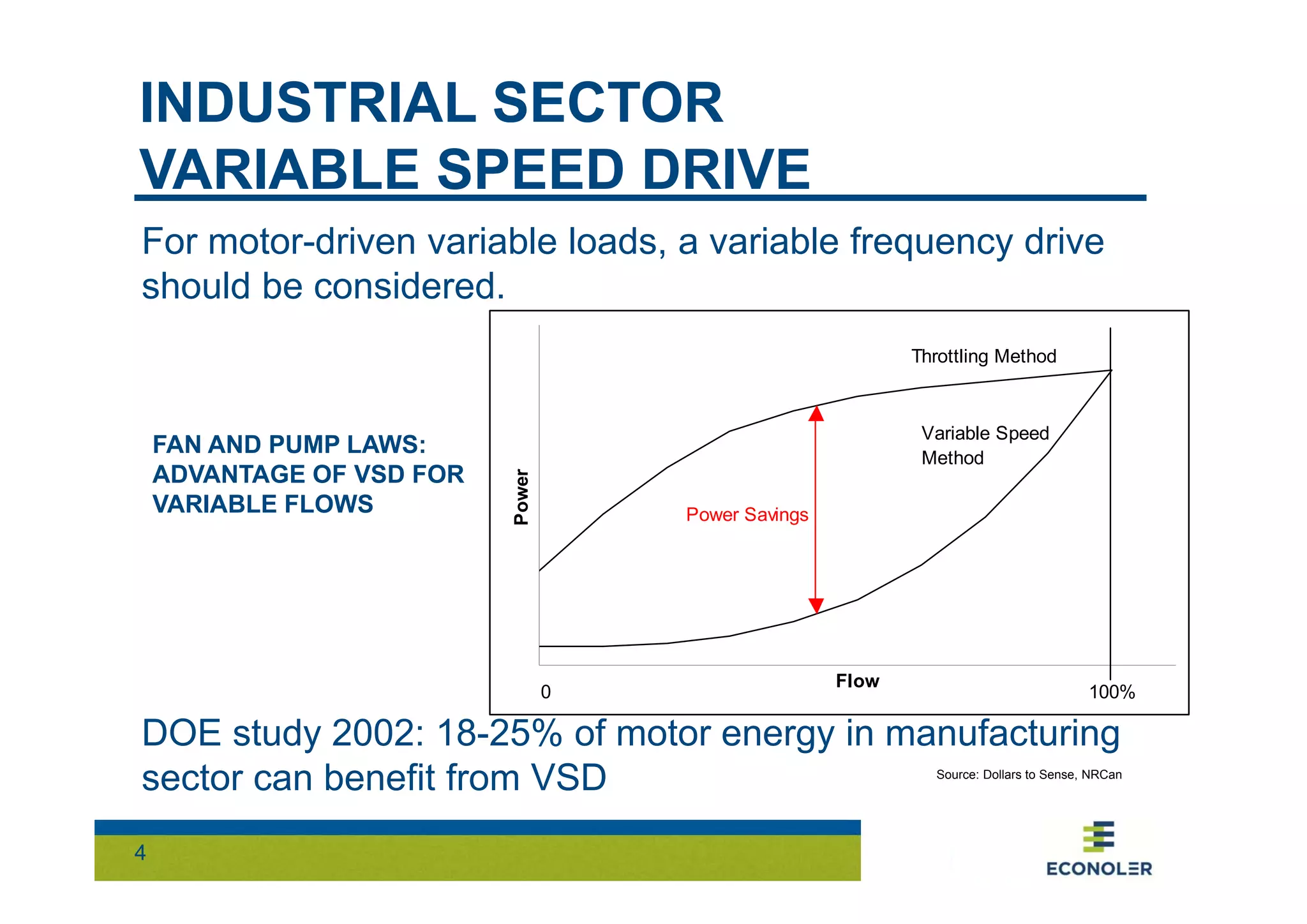
For motor-driven variable loads, a variable frequency drive 
should be considered. 
Throttling Method 
Variable Speed 
Method 
Power Savings 
DOE study 2002: 18-25% of motor energy in manufacturing 
sector can benefit from VSD 
4 
Flow 
Power 
0 100% 
Source: Dollars to Sense, NRCan 
FAN AND PUMP LAWS: 
ADVANTAGE OF VSD FOR 
VARIABLE FLOWS
INDUSTRIAL SECTOR 
IMPROVING MOTOR PERFORMANCE 
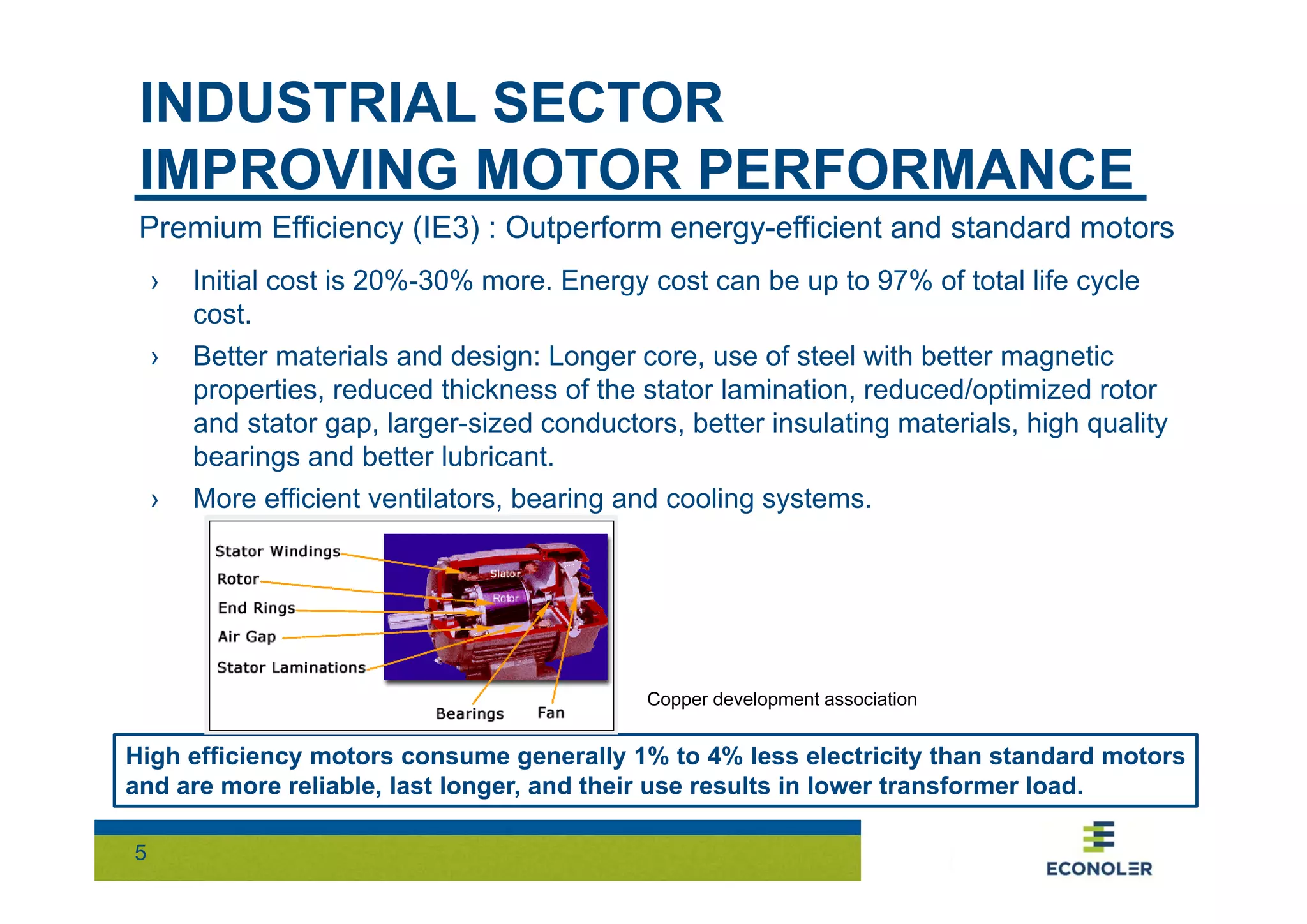
Premium Efficiency (IE3) : Outperform energy-efficient and standard motors 
› Initial cost is 20%-30% more. Energy cost can be up to 97% of total life cycle 
5 
cost. 
› Better materials and design: Longer core, use of steel with better magnetic 
properties, reduced thickness of the stator lamination, reduced/optimized rotor 
and stator gap, larger-sized conductors, better insulating materials, high quality 
bearings and better lubricant. 
› More efficient ventilators, bearing and cooling systems. 
Copper development association 
High efficiency motors consume generally 1% to 4% less electricity than standard motors 
and are more reliable, last longer, and their use results in lower transformer load.
COMMERCIAL AND INSTITUTIONAL 
EE MEASURE – ELECTRICAL SYSTEMS 
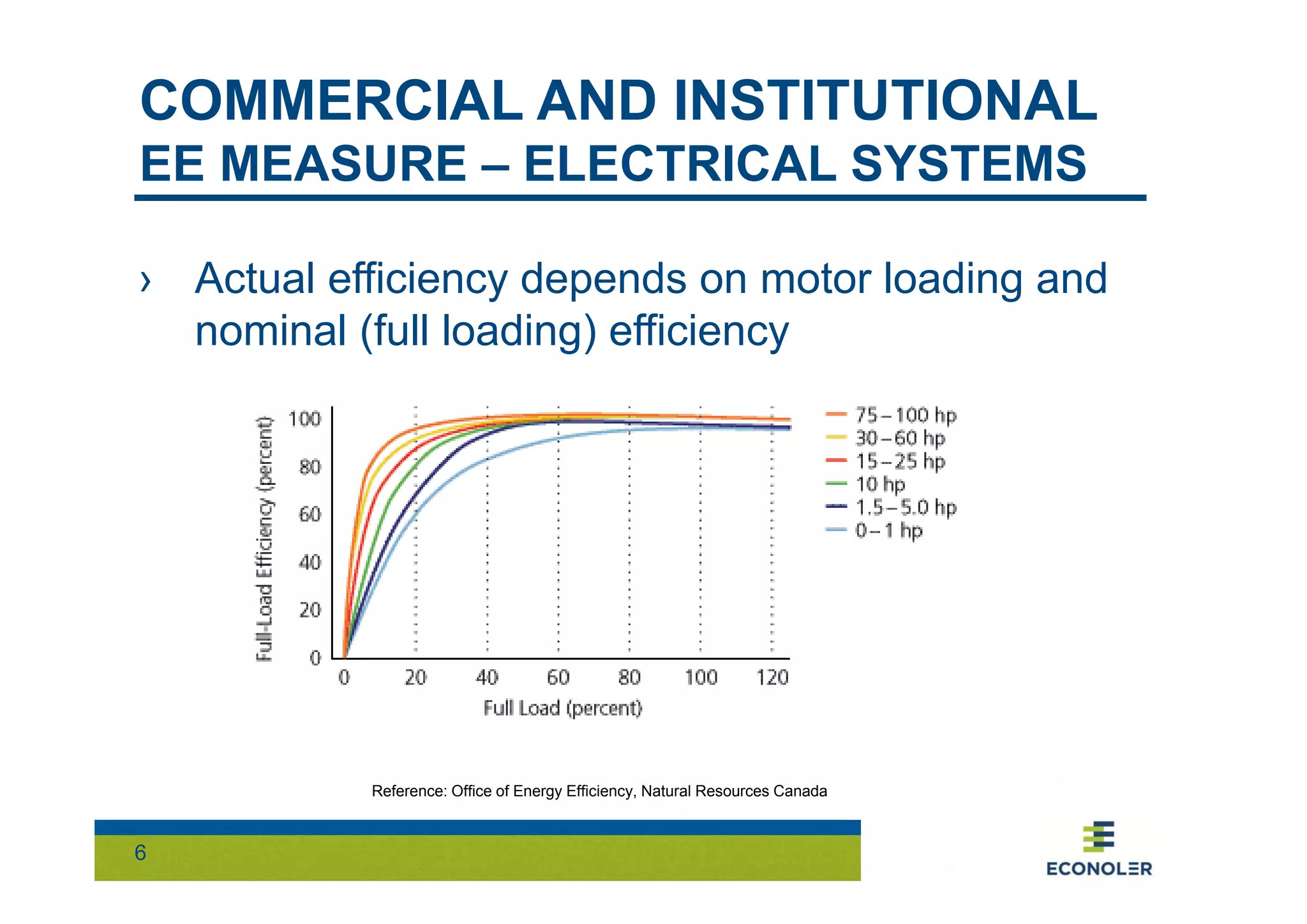
› Actual efficiency depends on motor loading and 
nominal (full loading) efficiency 
6 
Reference: Office of Energy Efficiency, Natural Resources Canada
INDUSTRIAL SECTOR 
IMPROVING MOTOR PERFORMANCE 
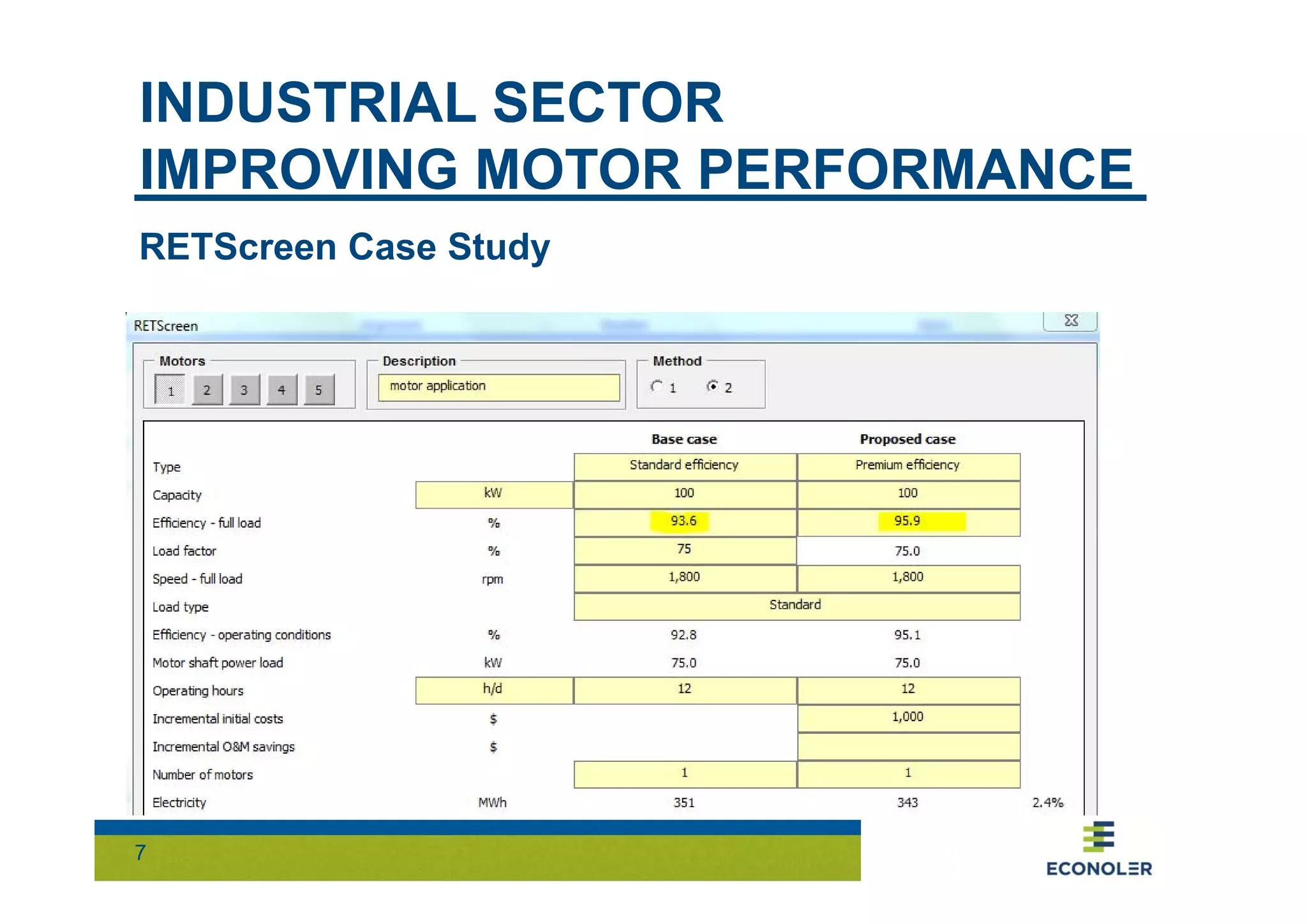
RETScreen Case Study 
7
INDUSTRIAL SECTOR 
IMPROVING MOTOR PERFORMANCE 
› Avoid oversizing (inefficient) and undersizing 
(overheats): target is 60%-80% load factor 
˗ Motor management program 
› Up to 2% in efficiency reduction after non 
optimum rewinding: ~1% reduction with best 
practices 
› Keep motor cool 
8 
˗ Clean air vents 
˗ Balance three-phase voltages 
˗ Power factor correction (capacitors on the motor side 
of distribution system)
INDUSTRIAL SECTOR 
COMPRESSED AIR SYSTEMS 
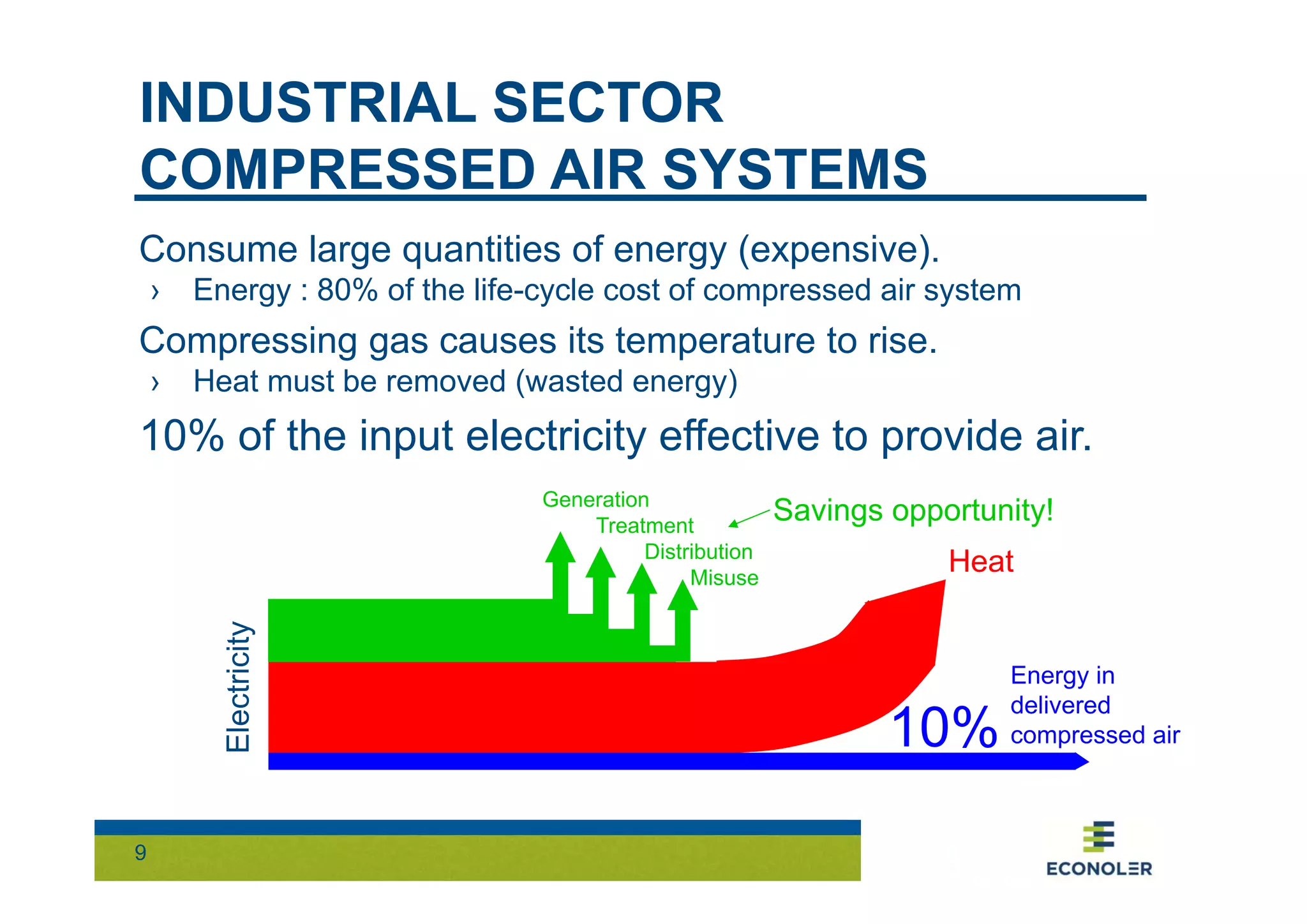
Consume large quantities of energy (expensive). 
› Energy : 80% of the life-cycle cost of compressed air system 
Compressing gas causes its temperature to rise. 
› Heat must be removed (wasted energy) 
10% of the input electricity effective to provide air. 
9 
Savings opportunity! 
Heat 
Energy in 
delivered 
compressed air 
Generation 
Treatment 
Distribution 
Misuse 
Electricity 
10%
INDUSTRIAL SECTOR 
EE IN COMPRESSED AIR SYSTEMS 
› Reduction of air losses – very often 20%-30% of 
total production 
10 
˗ ¼” (6.4 mm) leak at 100 psig (700 kPa gauge) consumes as 
much electricity as 300 x 60-watt bulbs 
› Distribution System Modifications 
› Optimization of Distribution Pressure 
› Compressor Control 
› Compressor Efficiency 
› Multiple-Stage Compressors
INDUSTRIAL SECTOR 
EE IN COMPRESSED AIR SYSTEMS 
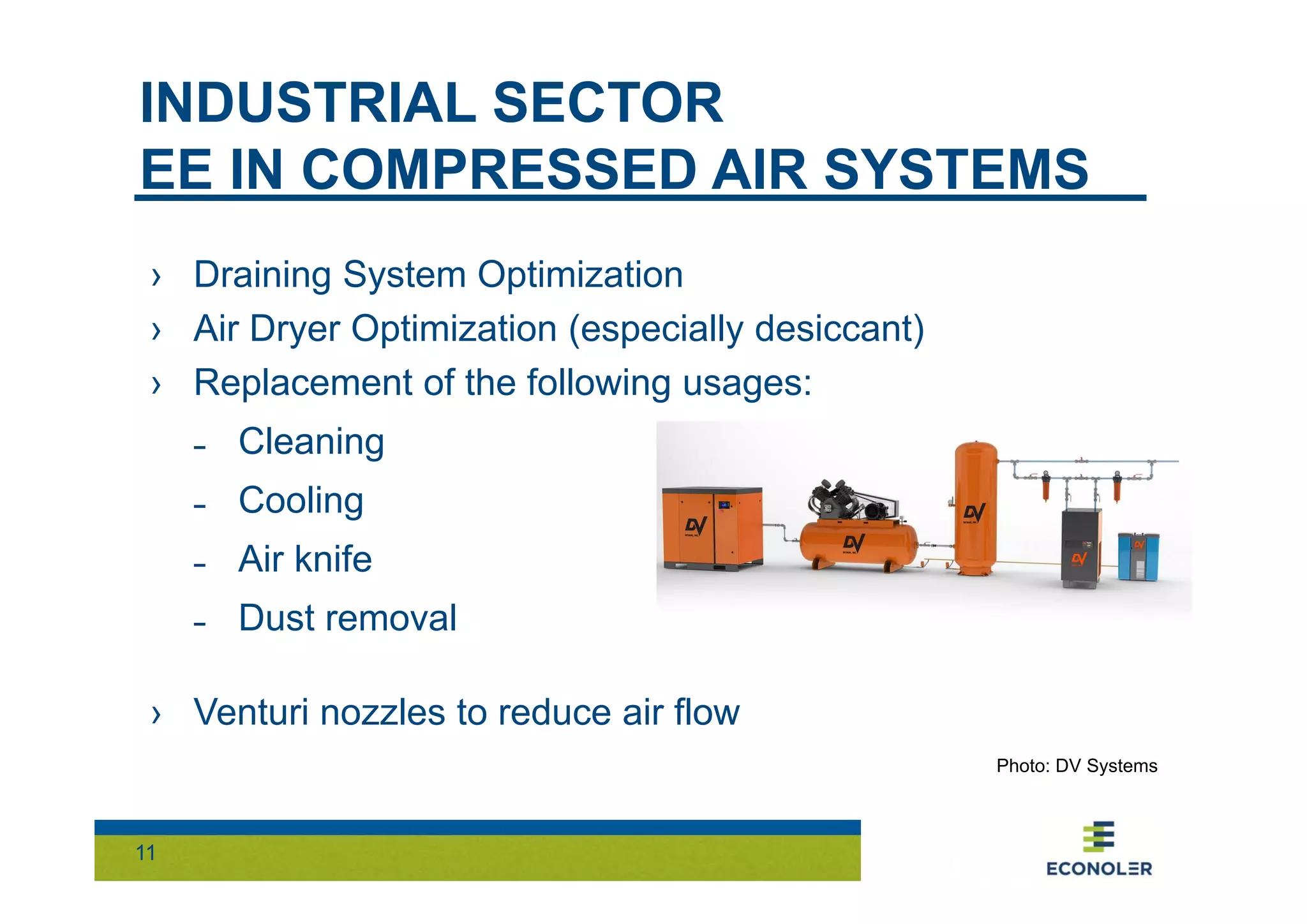
› Draining System Optimization 
› Air Dryer Optimization (especially desiccant) 
› Replacement of the following usages: 
˗ Cleaning 
˗ Cooling 
˗ Air knife 
˗ Dust removal 
› Venturi nozzles to reduce air flow 
11 
Photo: DV Systems
INDUSTRIAL SECTOR 
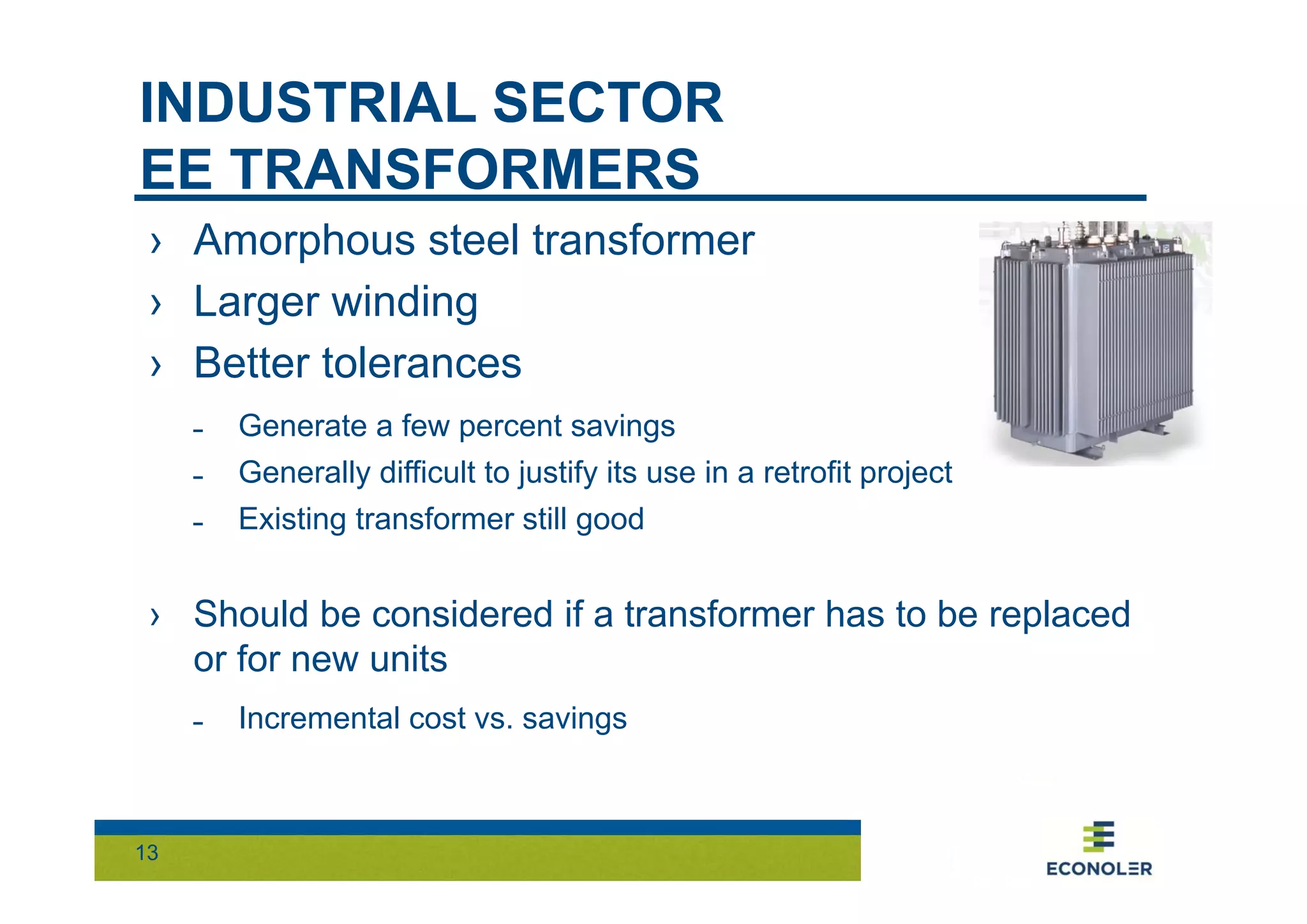
EE TRANSFORMERS 
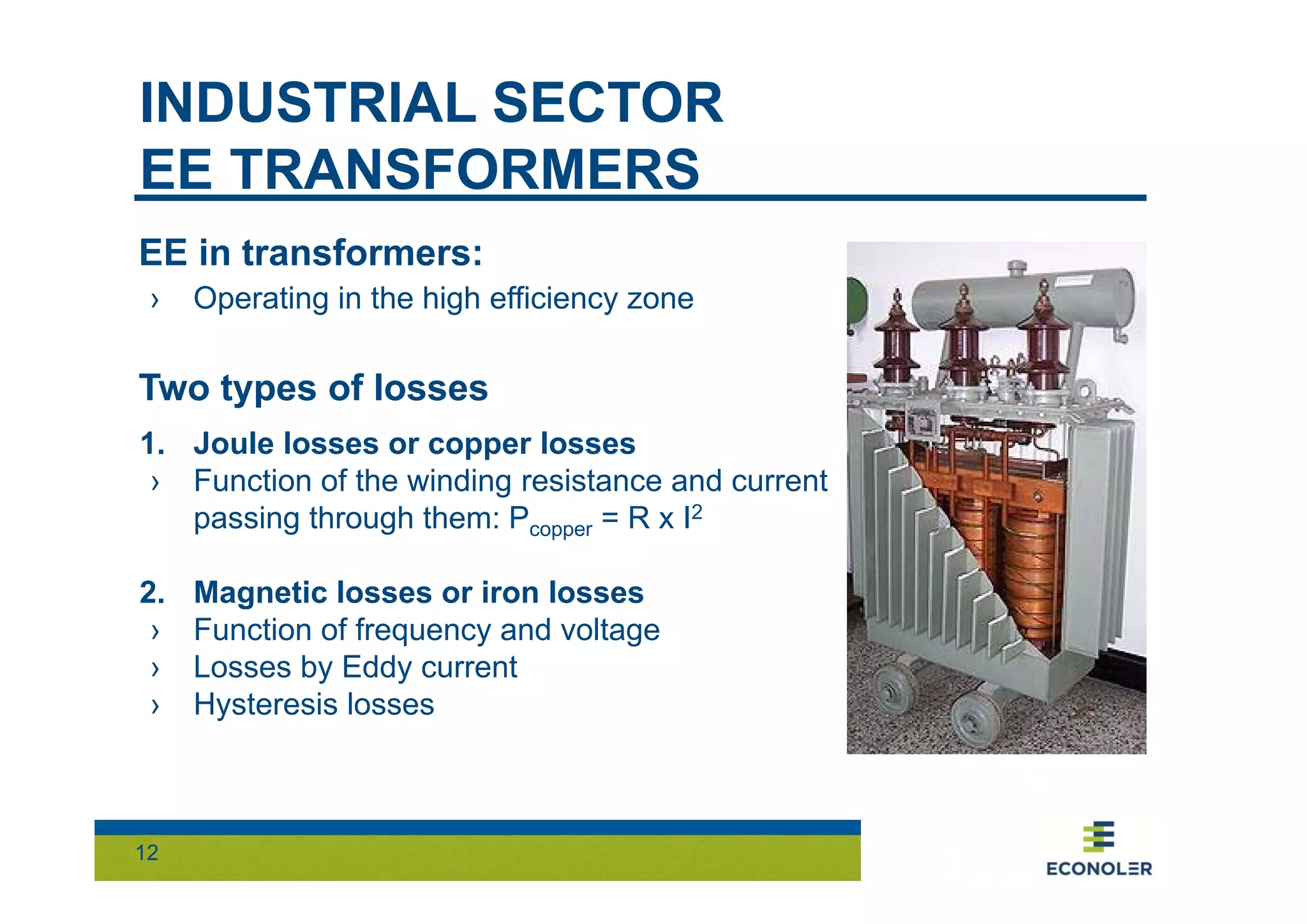
EE in transformers: 
› Operating in the high efficiency zone 
Two types of losses 
1. Joule losses or copper losses 
› Function of the winding resistance and current 
12 
passing through them: Pcopper = R x I2 
2. Magnetic losses or iron losses 
› Function of frequency and voltage 
› Losses by Eddy current 
› Hysteresis losses
INDUSTRIAL SECTOR 
EE TRANSFORMERS 
› Amorphous steel transformer 
› Larger winding 
› Better tolerances 
˗ Generate a few percent savings 
˗ Generally difficult to justify its use in a retrofit project 
˗ Existing transformer still good 
› Should be considered if a transformer has to be replaced 
or for new units 
13 
˗ Incremental cost vs. savings
INDUSTRIAL SECTOR 
ELECTRICITY DISTRIBUTION 
› Average electricity losses in non-residential 
buildings : Around 2% 
› Upsizing the electric cable size : Limiting losses 
to 0.7% 
› Potential EU region: 20 TWh/year 
(industry and tertiary sectors) 
Source: Copper Alliance 
14
INDUSTRIAL SECTOR 
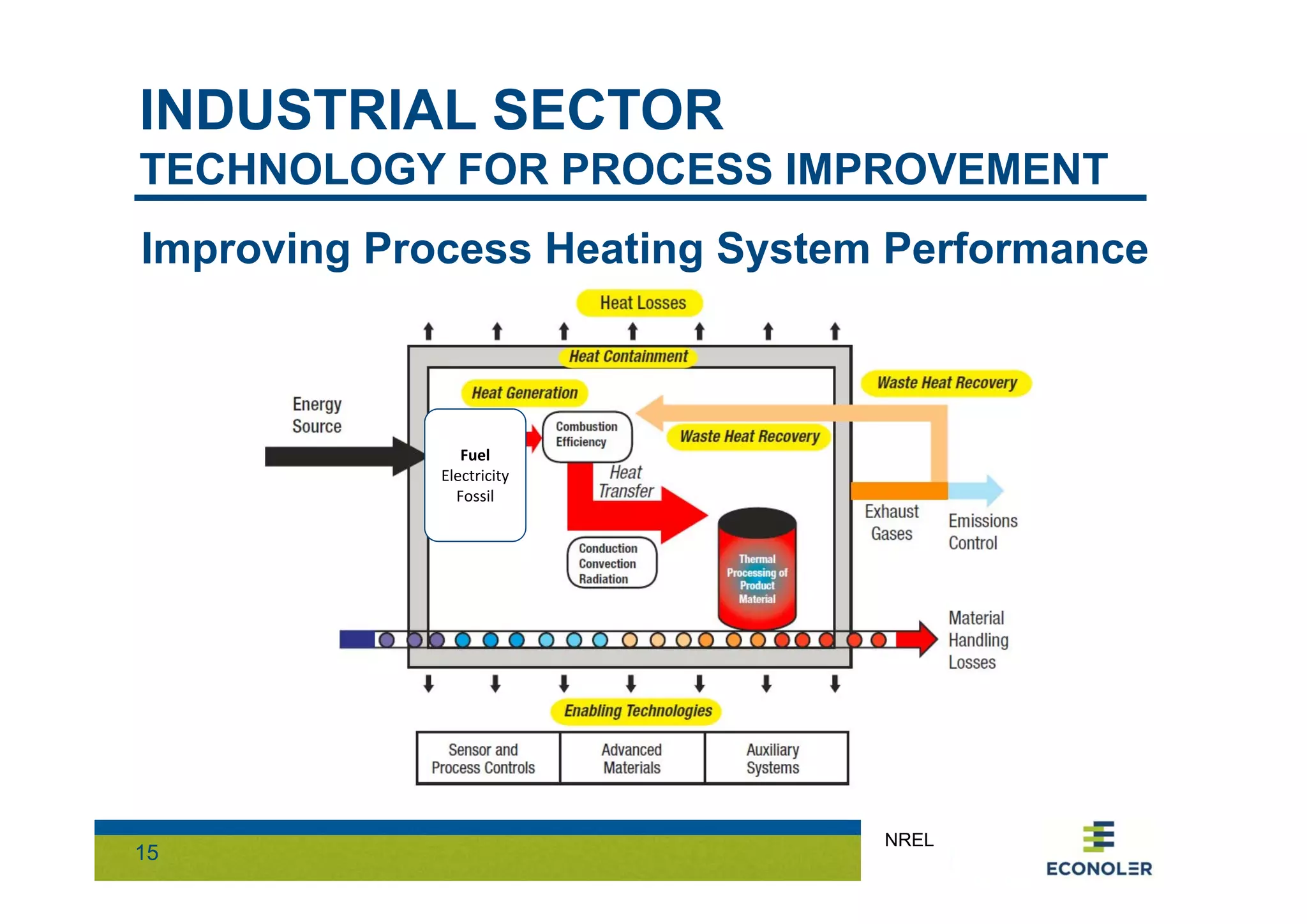
TECHNOLOGY FOR PROCESS IMPROVEMENT 
Improving Process Heating System Performance 
15 
NREL 
Fuel 
Electricity 
Fossil
INDUSTRIAL SECTOR 
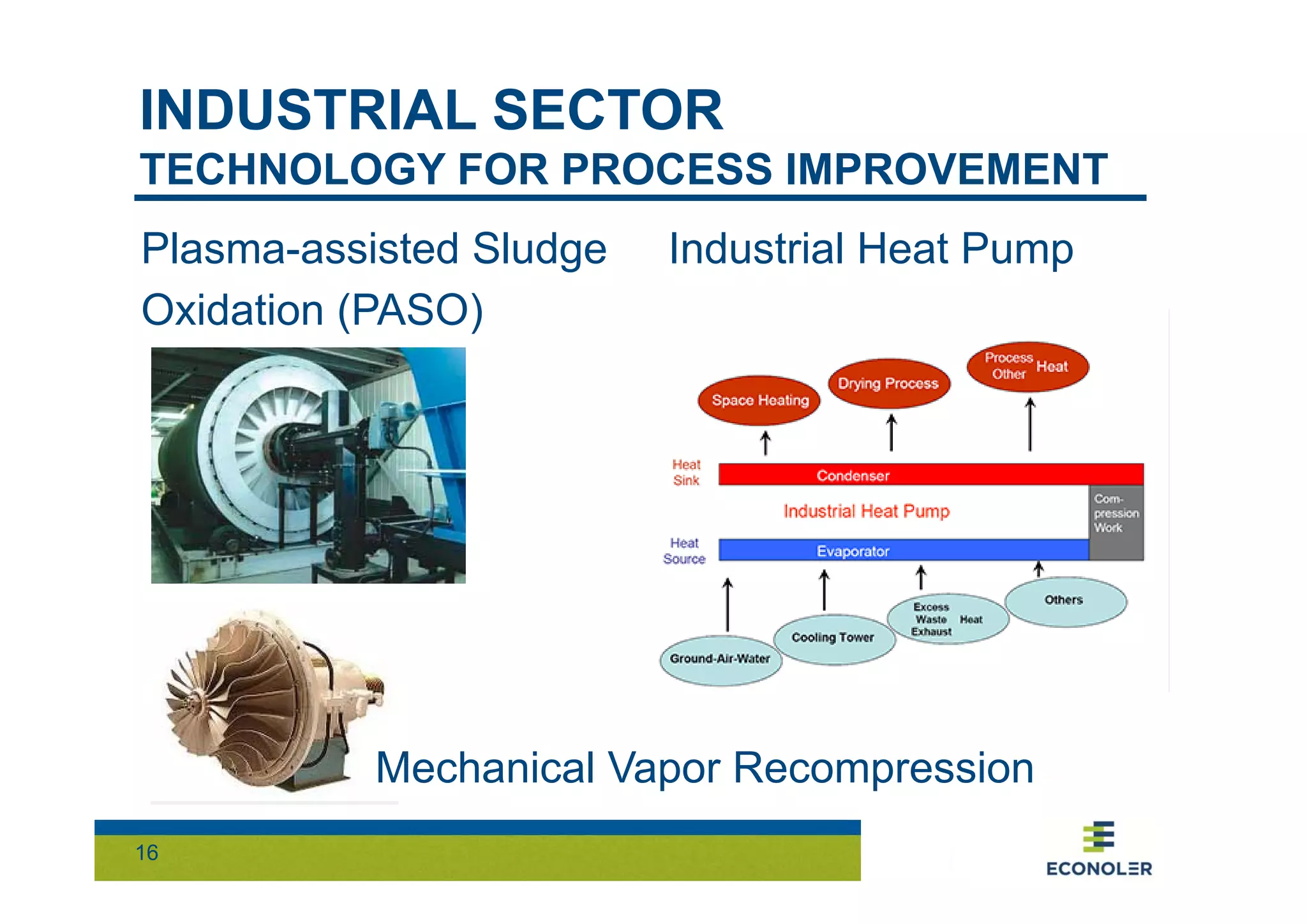
TECHNOLOGY FOR PROCESS IMPROVEMENT 
Plasma-assisted Sludge Industrial Heat Pump 
Oxidation (PASO) 
16 
Mechanical Vapor Recompression
INDUSTRIAL SECTOR 
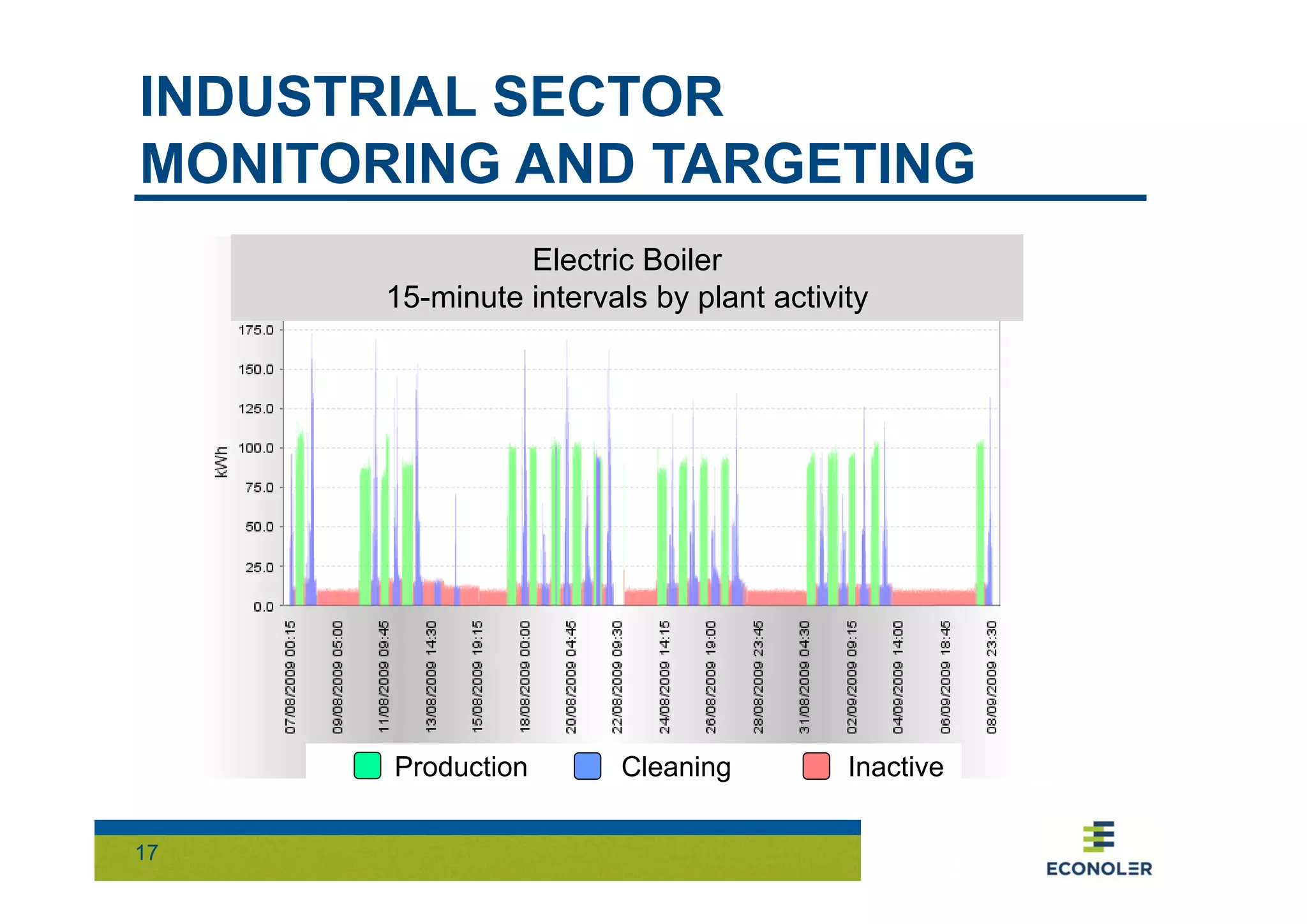
MONITORING AND TARGETING 
17 
Electric Boiler 
15-minute intervals by plant activity 
Production Cleaning Inactive
INDUSTRIAL SECTOR 
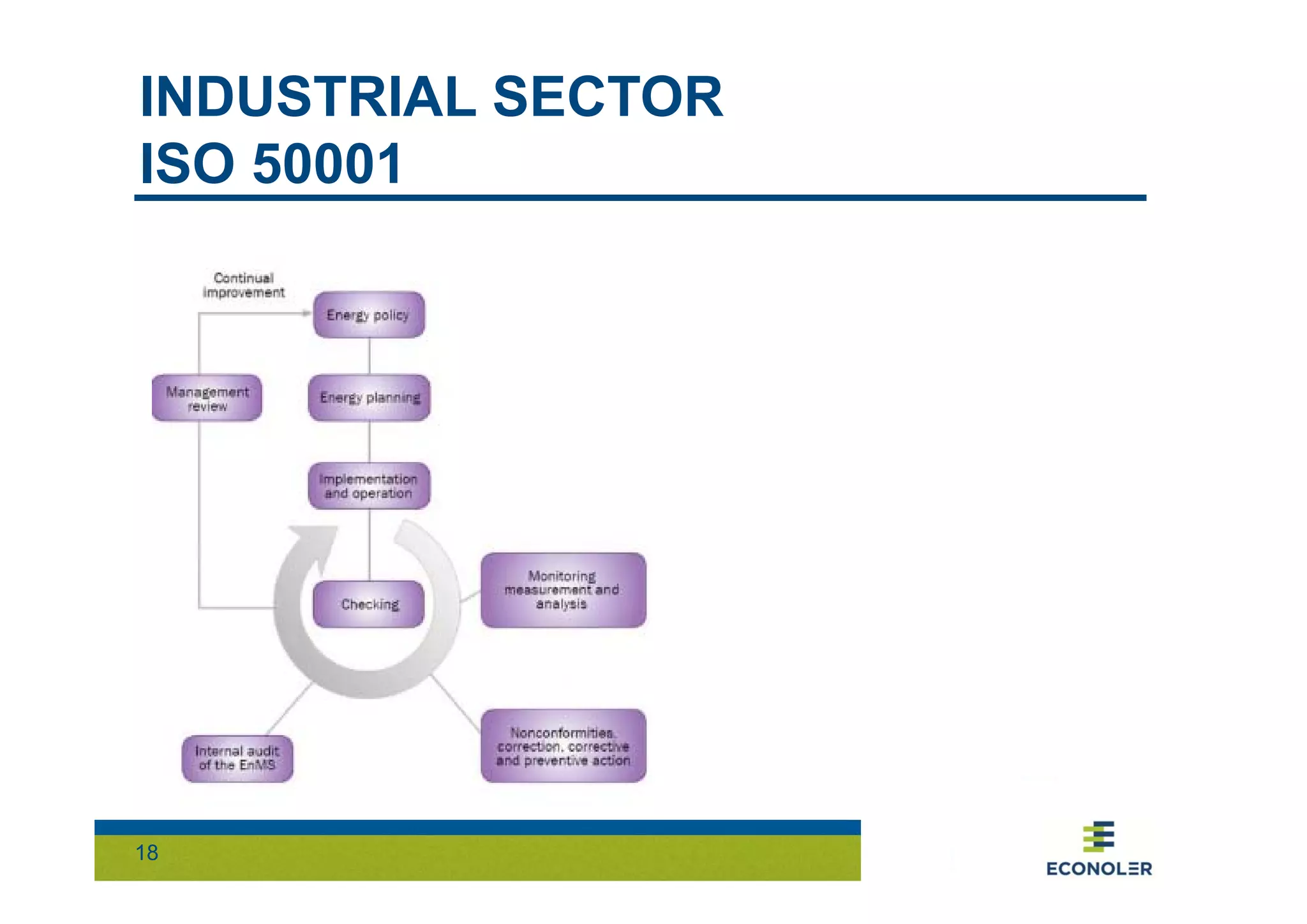
ISO 50001 
18
COMMERCIAL AND INSTITUTIONAL 
EE MEASURE 
Building envelope and bioclimatic architecture 
19 
Research Support Facility at the NREL Federal Center South Building 1202
COMMERCIAL AND INSTITUTIONAL 
EE MEASURE 
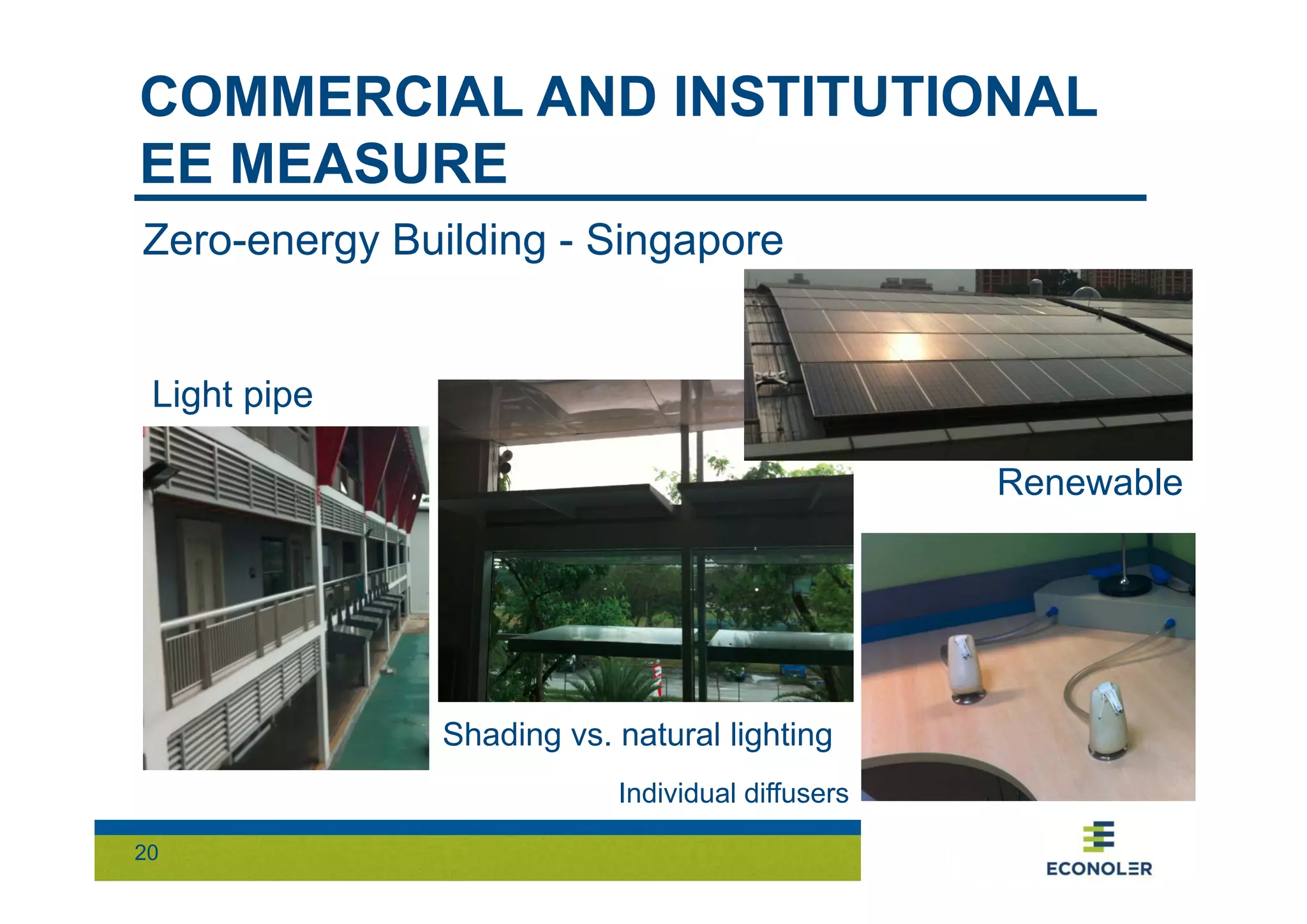
Zero-energy Building - Singapore 
Light pipe 
20 
Shading vs. natural lighting 
Renewable 
Individual diffusers
COMMERCIAL AND INSTITUTIONAL 
EE MEASURE 
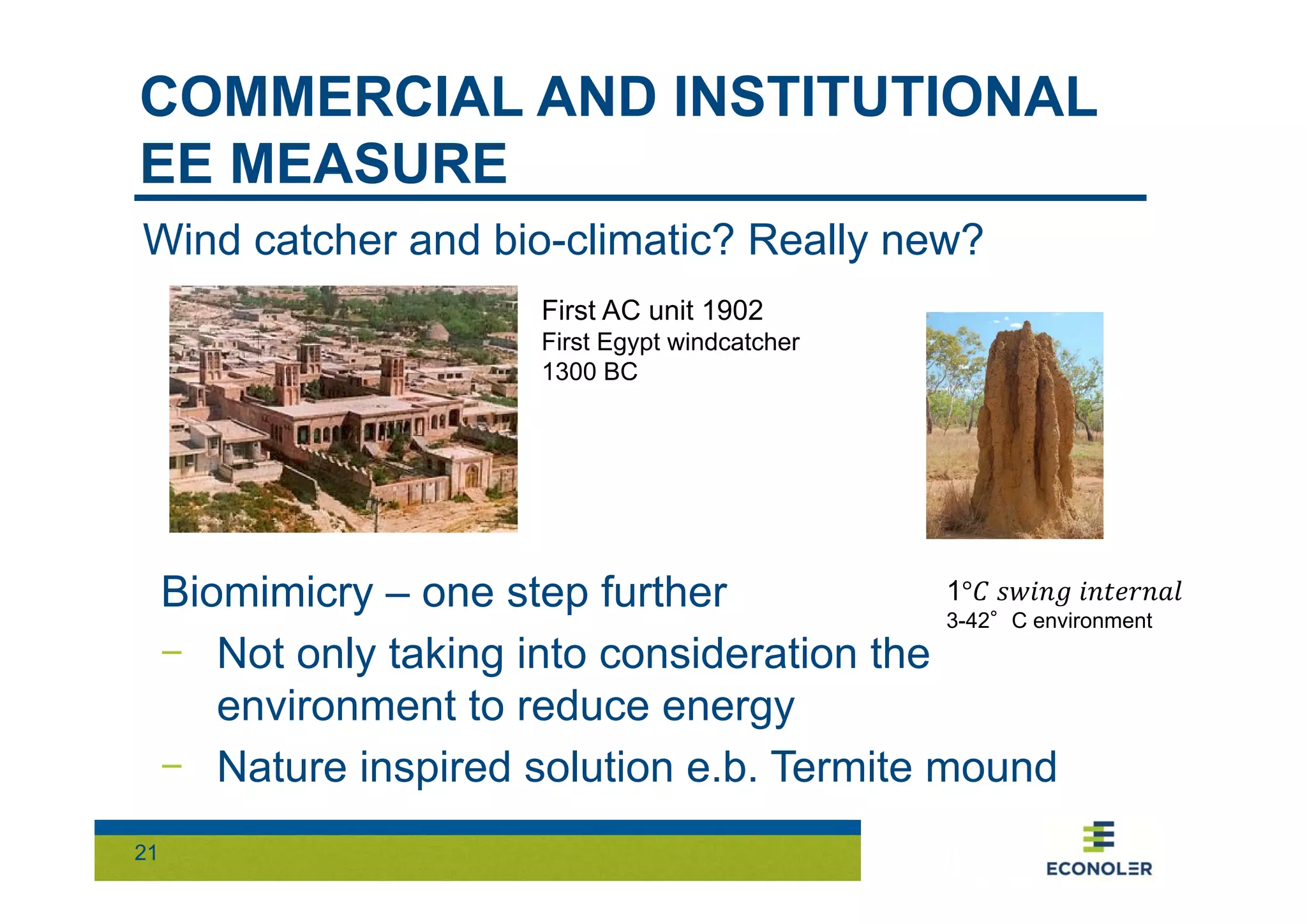
Wind catcher and bio-climatic? Really new? 
21 
Biomimicry – one step further 
- Not only taking into consideration the 
environment to reduce energy 
- Nature inspired solution e.b. Termite mound 
1°ܥ ݏݓ݅݊݃ ݅݊ݐ݁ݎ݈݊ܽ 
3-42°C environment 
First AC unit 1902 
First Egypt windcatcher 
1300 BC
COMMERCIAL AND INSTITUTIONAL 
EE MEASURE - HVAC 
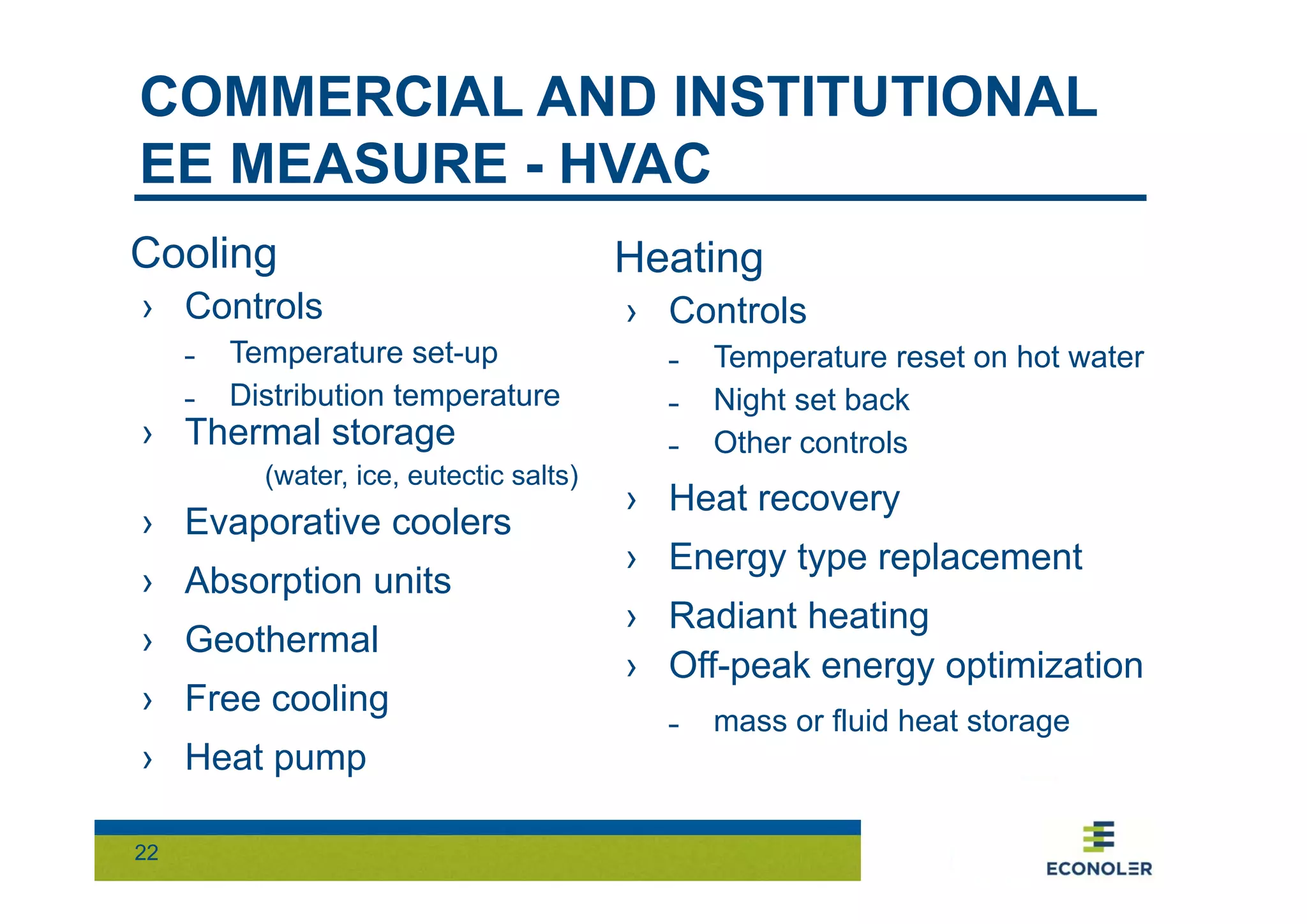
Cooling 
› Controls 
˗ Temperature set-up 
˗ Distribution temperature 
› Thermal storage 
22 
(water, ice, eutectic salts) 
› Evaporative coolers 
› Absorption units 
› Geothermal 
› Free cooling 
› Heat pump 
Heating 
› Controls 
˗ Temperature reset on hot water 
˗ Night set back 
˗ Other controls 
› Heat recovery 
› Energy type replacement 
› Radiant heating 
› Off-peak energy optimization 
˗ mass or fluid heat storage
COMMERCIAL AND INSTITUTIONAL 
EE MEASURE - HVAC 
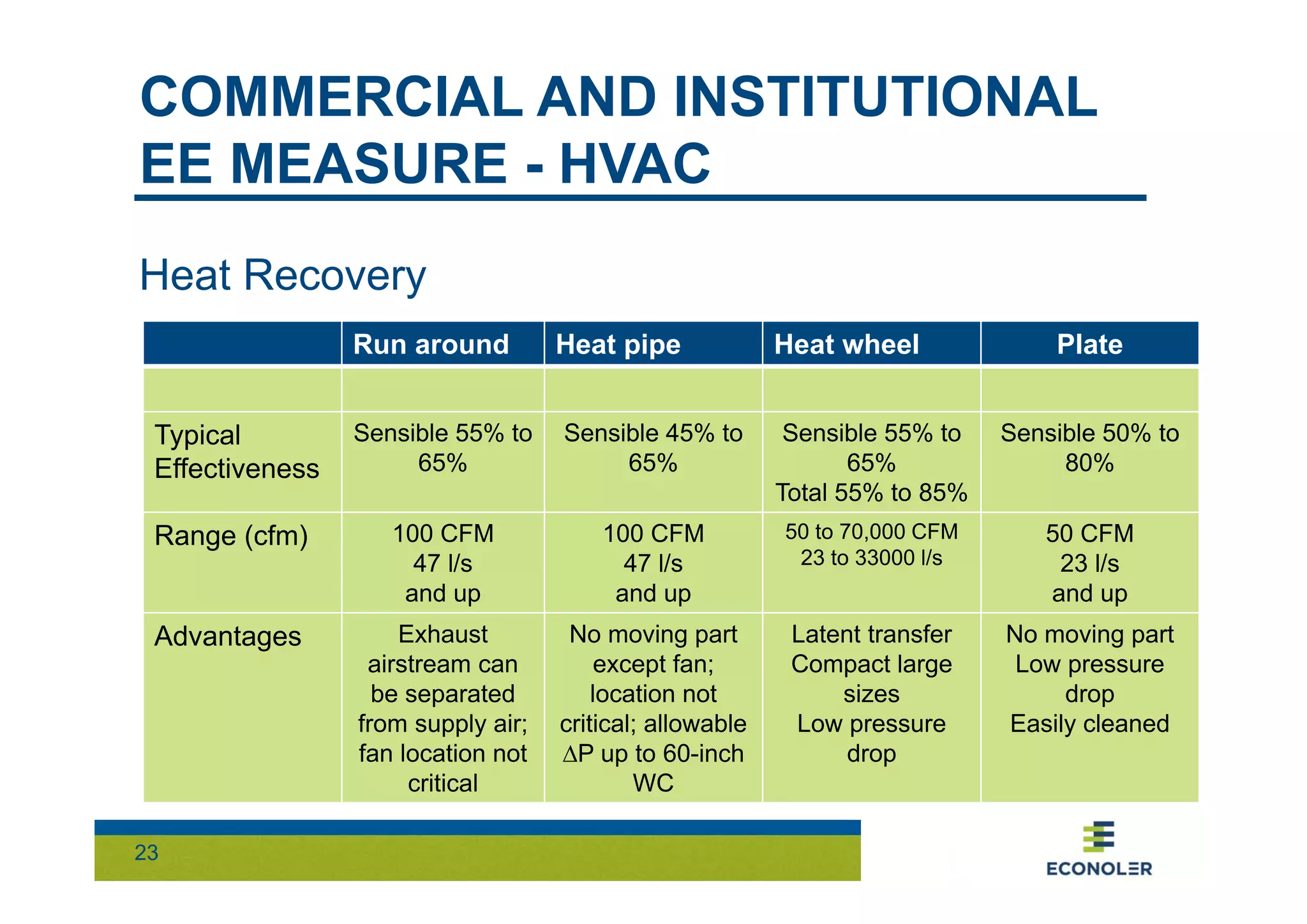
Heat Recovery 
23 
Run around Heat pipe Heat wheel Plate 
Typical 
Effectiveness 
Sensible 55% to 
65% 
Sensible 45% to 
65% 
Sensible 55% to 
65% 
Total 55% to 85% 
Sensible 50% to 
80% 
Range (cfm) 100 CFM 
47 l/s 
and up 
100 CFM 
47 l/s 
and up 
50 to 70,000 CFM 
23 to 33000 l/s 
50 CFM 
23 l/s 
and up 
Advantages Exhaust 
airstream can 
be separated 
from supply air; 
fan location not 
critical 
No moving part 
except fan; 
location not 
critical; allowable 
P up to 60-inch 
WC 
Latent transfer 
Compact large 
sizes 
Low pressure 
drop 
No moving part 
Low pressure 
drop 
Easily cleaned
COMMERCIAL AND INSTITUTIONAL 
EE MEASURE - HVAC 
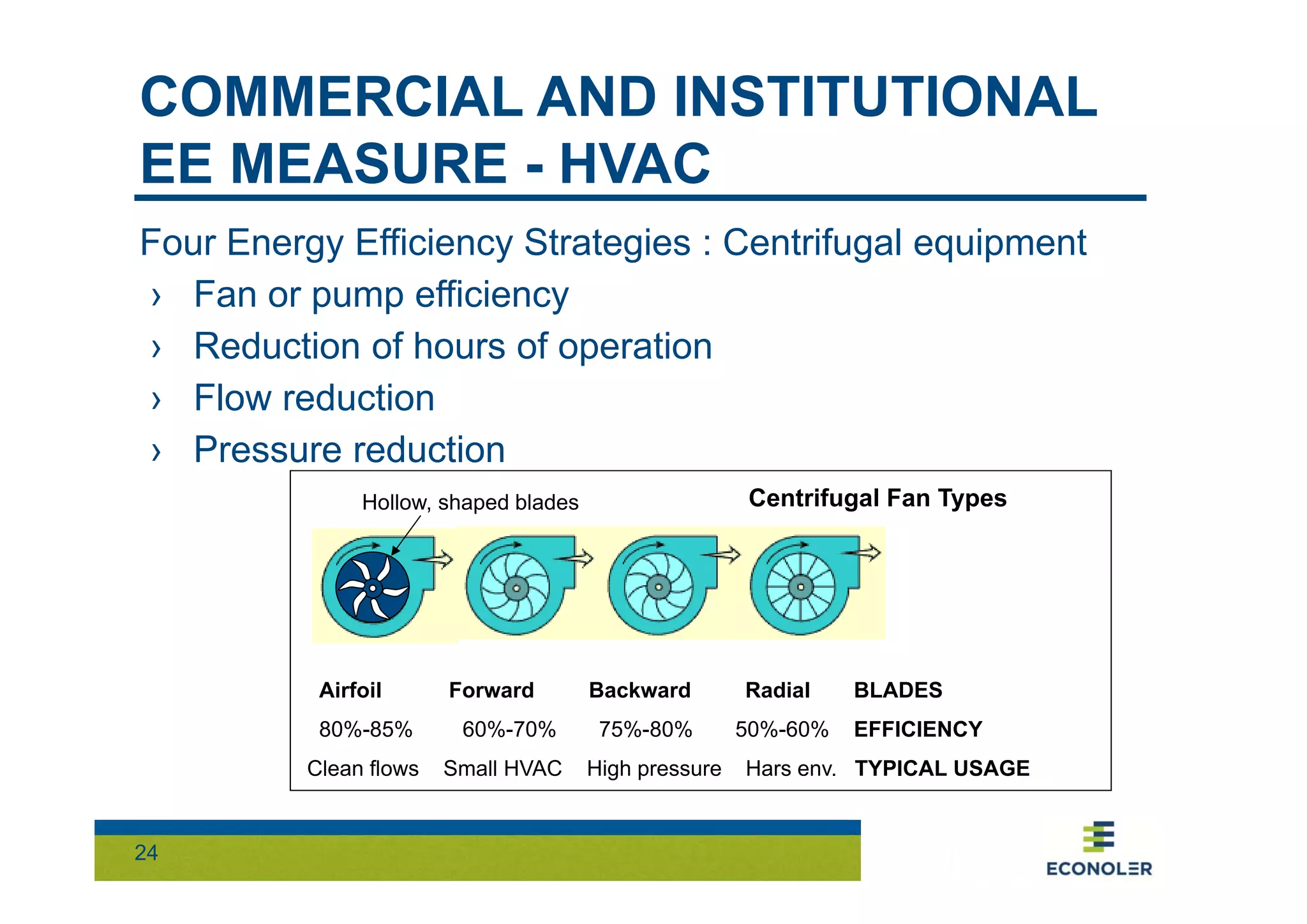
Four Energy Efficiency Strategies : Centrifugal equipment 
› Fan or pump efficiency 
› Reduction of hours of operation 
› Flow reduction 
› Pressure reduction 
24 
Hollow, shaped blades Centrifugal Fan Types 
Airfoil Forward Backward Radial BLADES 
80%-85% 60%-70% 75%-80% 50%-60% EFFICIENCY 
Clean flows Small HVAC High pressure Hars env. TYPICAL USAGE
COMMERCIAL AND INSTITUTIONAL 
EE MEASURE – LIGHTING 
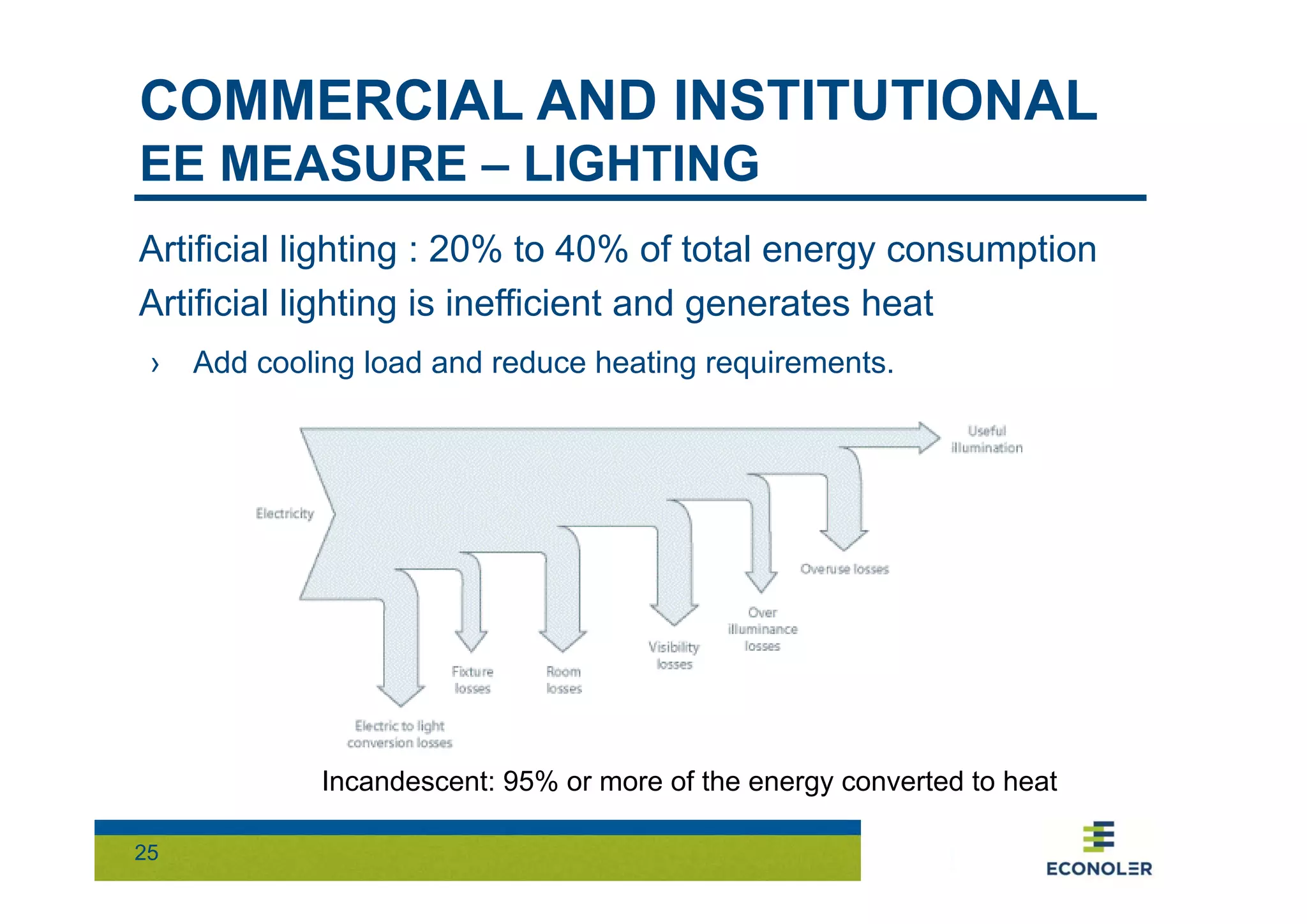
Artificial lighting : 20% to 40% of total energy consumption 
Artificial lighting is inefficient and generates heat 
› Add cooling load and reduce heating requirements. 
25 
Incandescent: 95% or more of the energy converted to heat
COMMERCIAL AND INSTITUTIONAL 
EE MEASURE – LIGHTING 
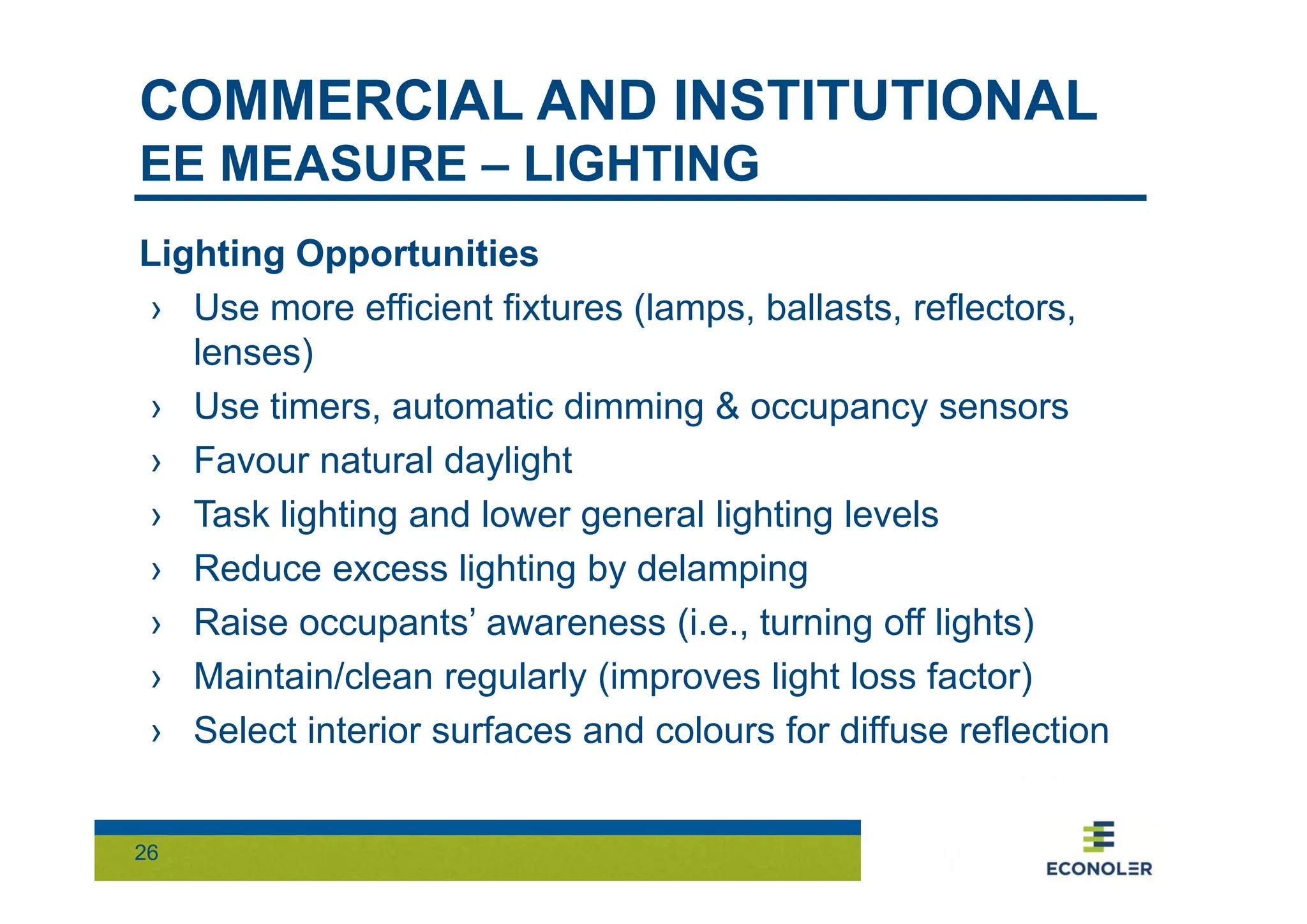
Lighting Opportunities 
› Use more efficient fixtures (lamps, ballasts, reflectors, 
lenses) 
› Use timers, automatic dimming & occupancy sensors 
› Favour natural daylight 
› Task lighting and lower general lighting levels 
› Reduce excess lighting by delamping 
› Raise occupants’ awareness (i.e., turning off lights) 
› Maintain/clean regularly (improves light loss factor) 
› Select interior surfaces and colours for diffuse reflection 
26
RESIDENTIAL SECTOR 
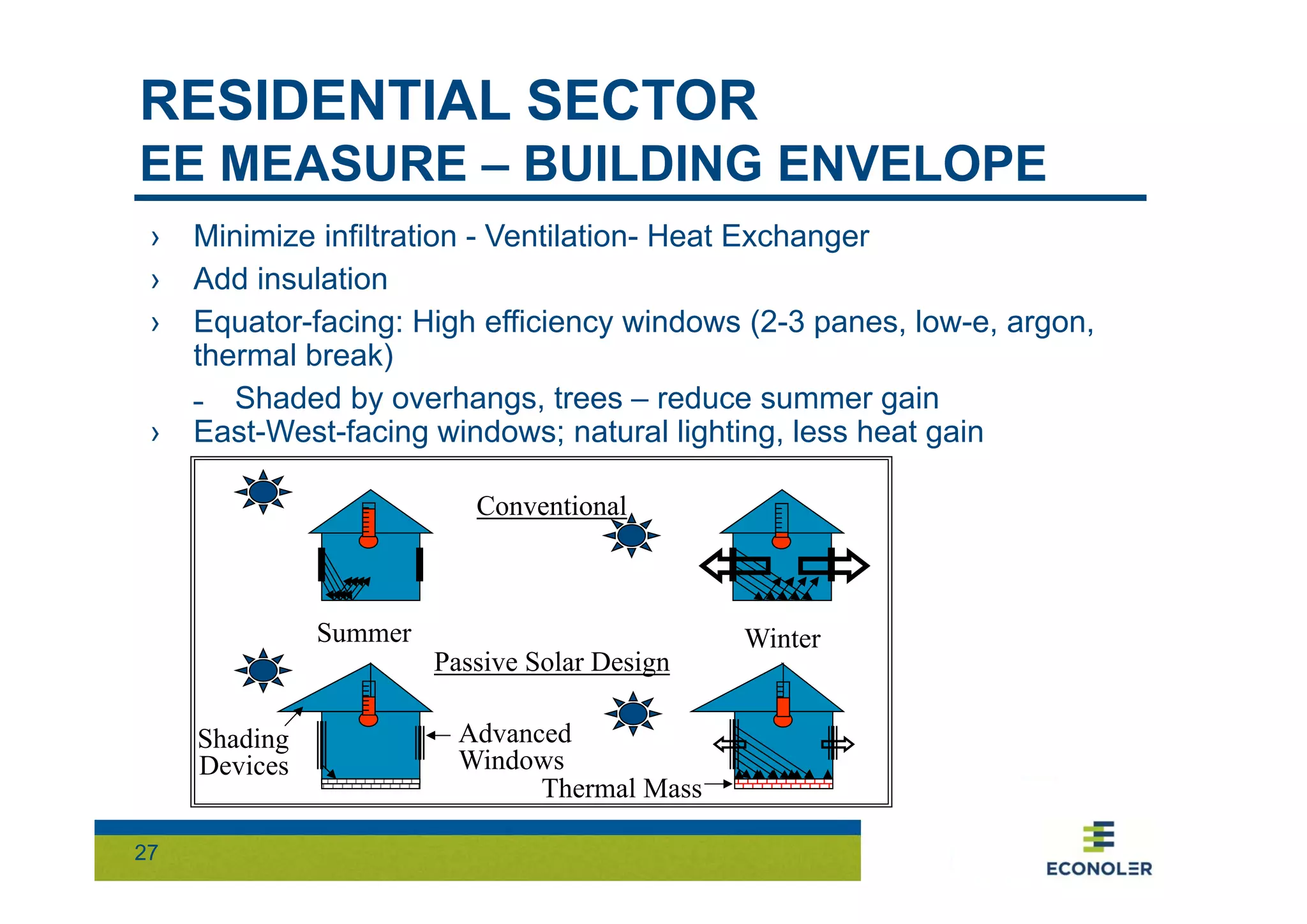
EE MEASURE – BUILDING ENVELOPE 
› Minimize infiltration - Ventilation- Heat Exchanger 
› Add insulation 
› Equator-facing: High efficiency windows (2-3 panes, low-e, argon, 
27 
thermal break) 
˗ Shaded by overhangs, trees – reduce summer gain 
› East-West-facing windows; natural lighting, less heat gain 
Conventional 
Summer Winter 
Shading 
Devices 
Passive Solar Design 
Advanced 
Windows 
Thermal Mass
RESIDENTIAL SECTOR 
EE MEASURE – LIGHTING 
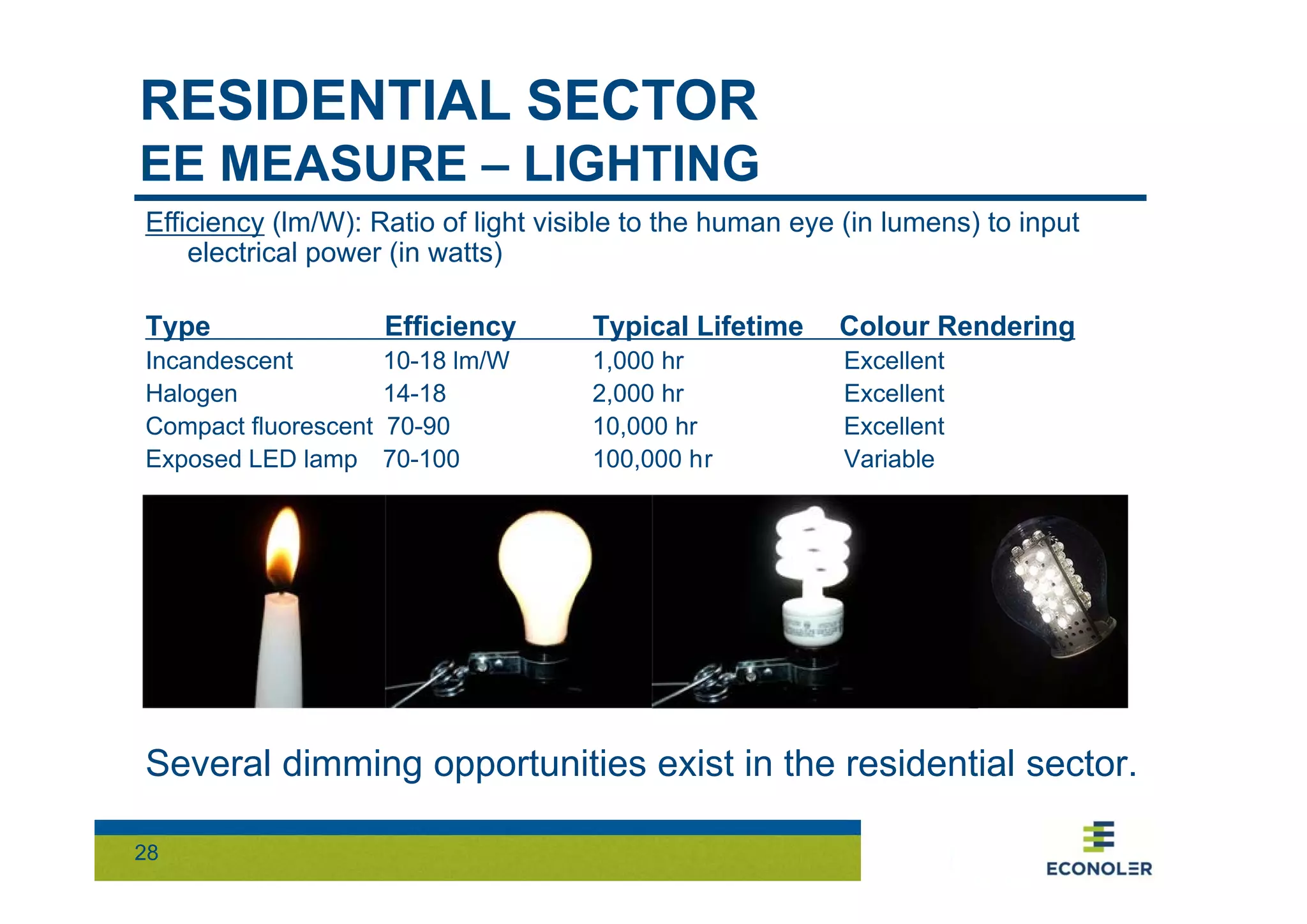
Efficiency (lm/W): Ratio of light visible to the human eye (in lumens) to input 
28 
electrical power (in watts) 
Type Efficiency Typical Lifetime Colour Rendering 
Incandescent 10-18 lm/W 1,000 hr Excellent 
Halogen 14-18 2,000 hr Excellent 
Compact fluorescent 70-90 10,000 hr Excellent 
Exposed LED lamp 70-100 100,000 hr Variable 
Several dimming opportunities exist in the residential sector.
RESIDENTIAL SECTOR 
EE MEASURE – APPLIANCES 
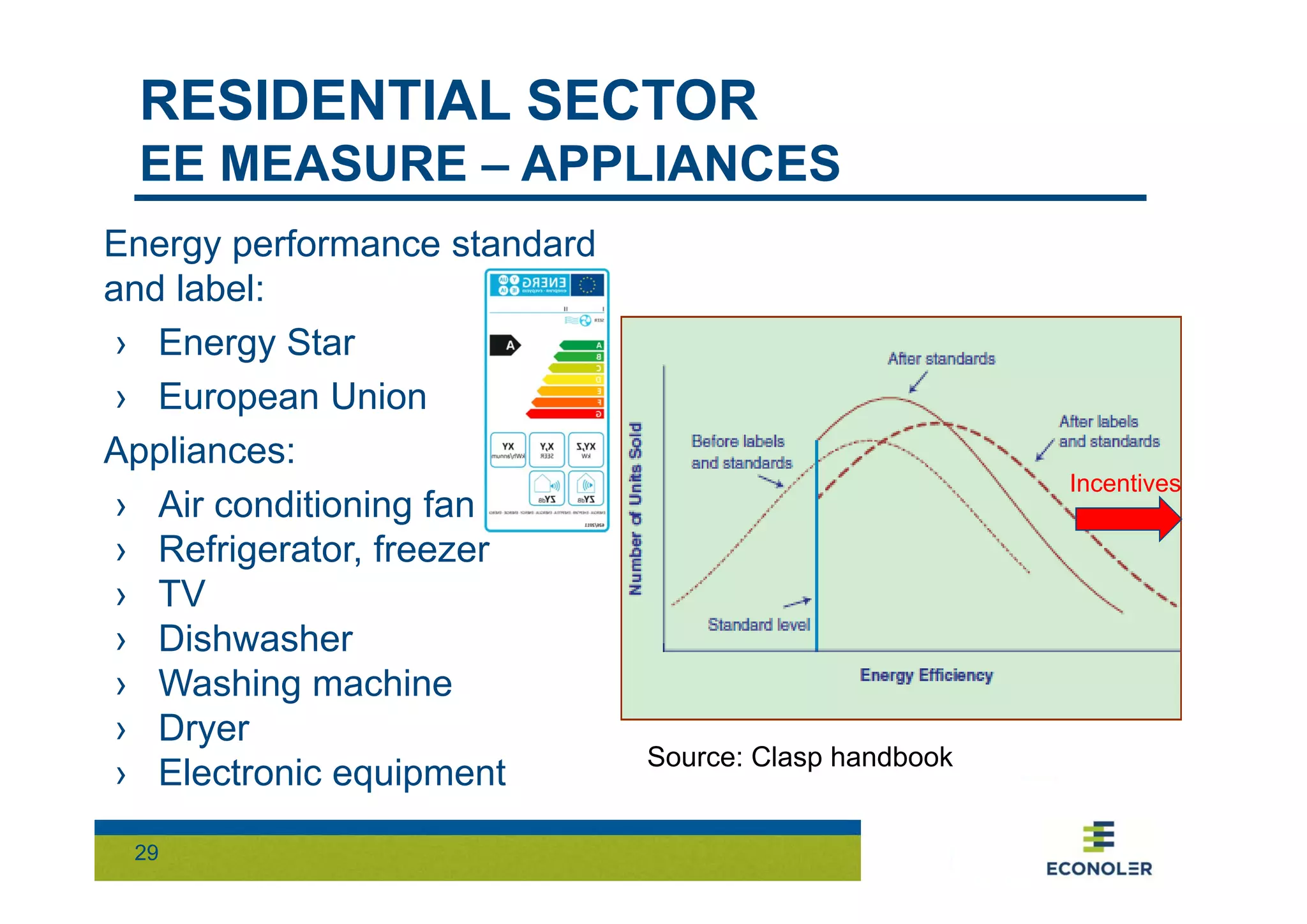
Energy performance standard 
and label: 
› Energy Star 
› European Union 
Appliances: 
› Air conditioning fan 
› Refrigerator, freezer 
› TV 
› Dishwasher 
› Washing machine 
› Dryer 
› Electronic equipment Source: Clasp handbook 
29 
Incentives
RESIDENTIAL SECTOR 
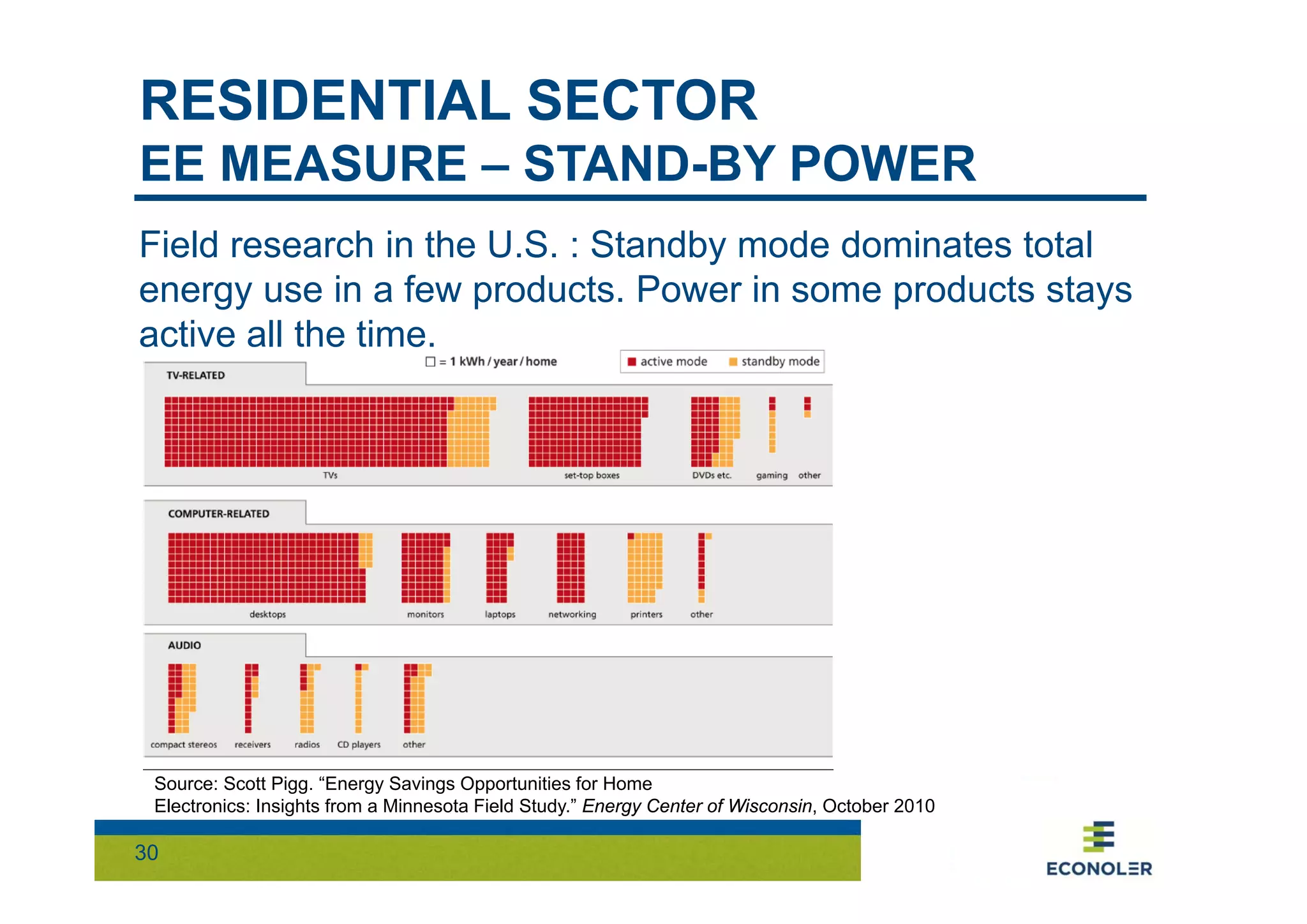
EE MEASURE – STAND-BY POWER 
Field research in the U.S. : Standby mode dominates total 
energy use in a few products. Power in some products stays 
active all the time. 
Source: Scott Pigg. “Energy Savings Opportunities for Home 
Electronics: Insights from a Minnesota Field Study.” Energy Center of Wisconsin, October 2010 
30
RESIDENTIAL SECTOR 
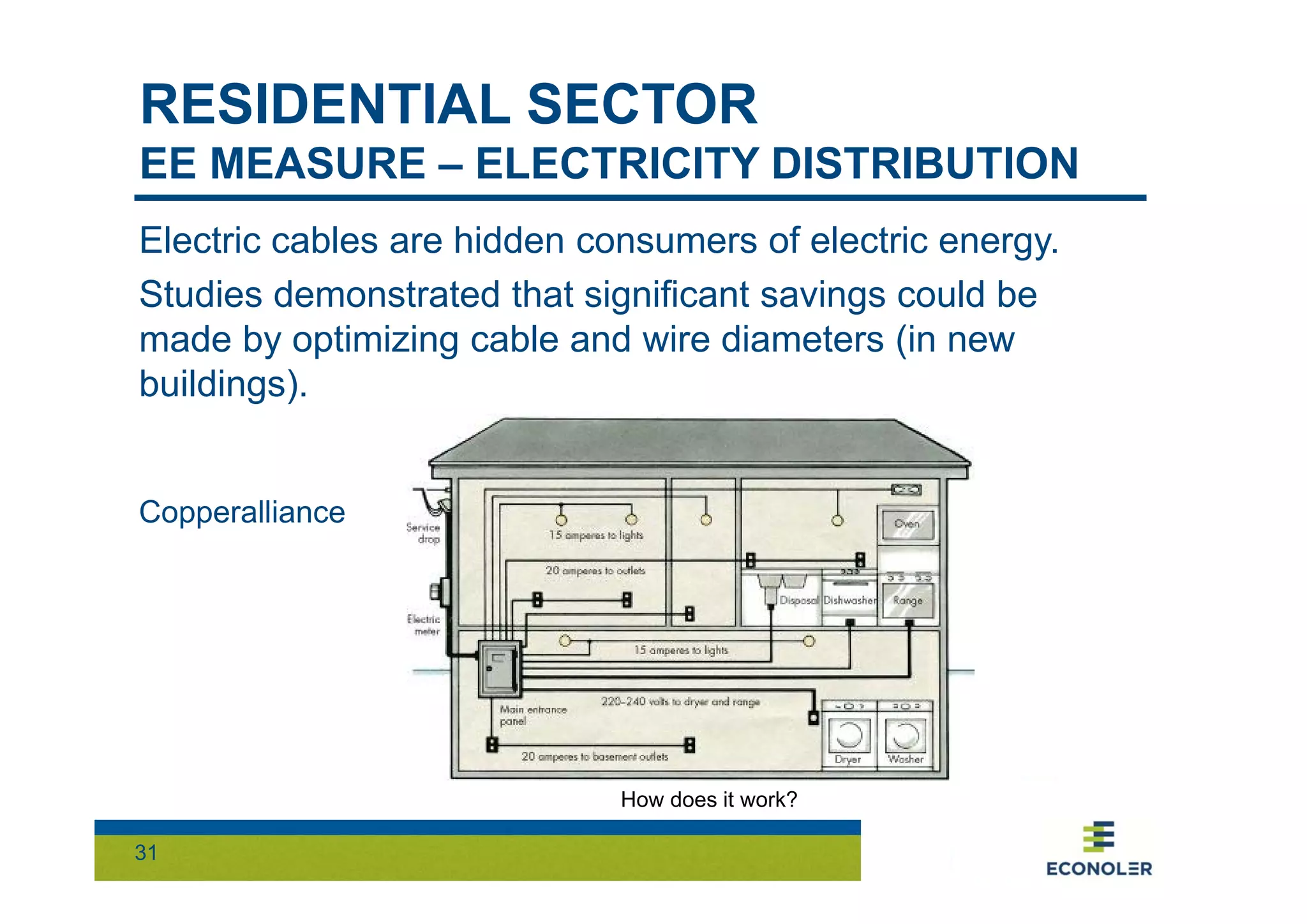
EE MEASURE – ELECTRICITY DISTRIBUTION 
Electric cables are hidden consumers of electric energy. 
Studies demonstrated that significant savings could be 
made by optimizing cable and wire diameters (in new 
buildings). 
Copperalliance 
31 
How does it work?
RESIDENTIAL SECTOR 
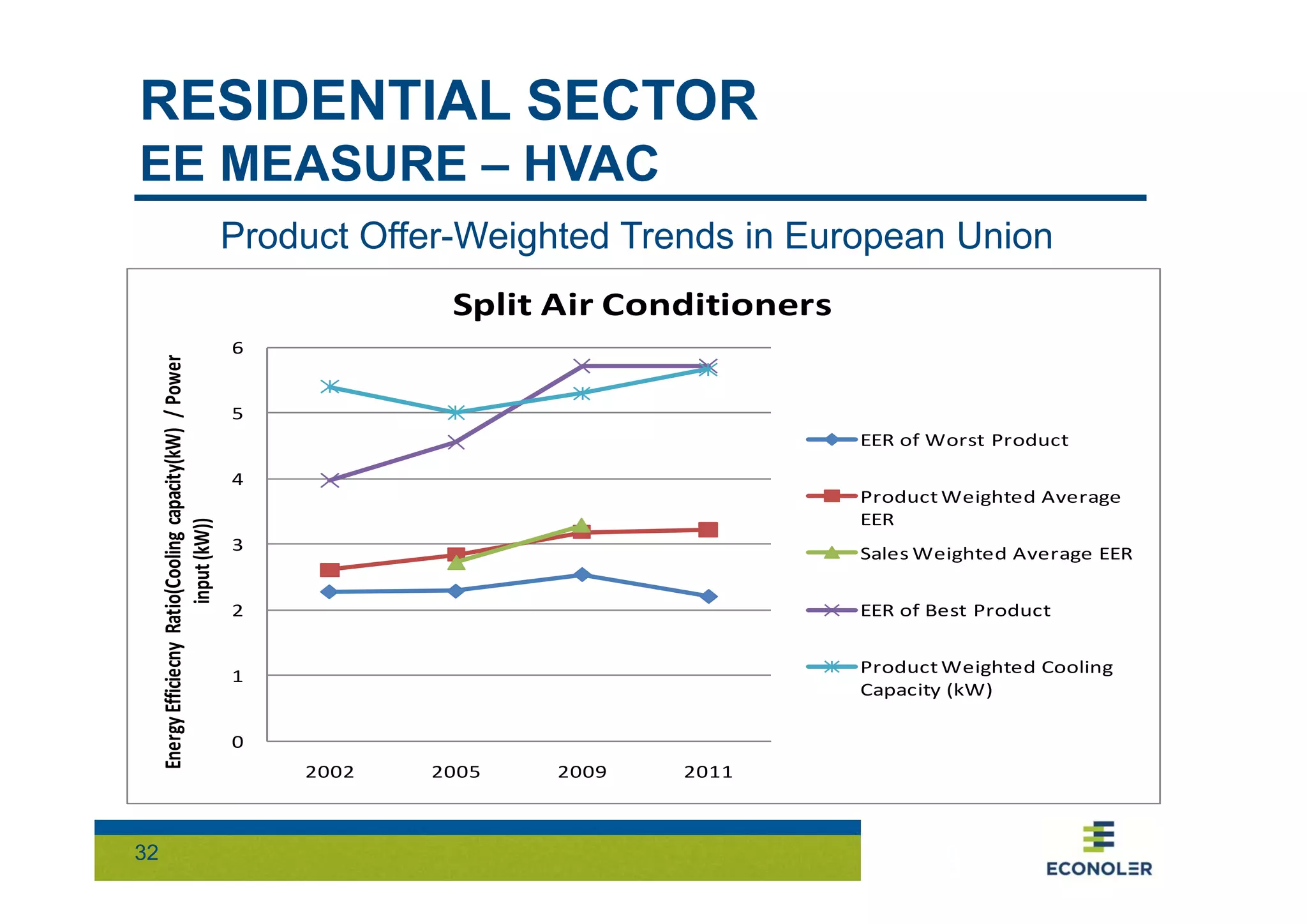
EE MEASURE – HVAC 
32 
Product Offer-Weighted Trends in European Union 
6 
5 
4 
3 
2 
1 
0 
2002 2005 2009 2011 
Energy Efficiecny Ratio(Cooling capacity(kW) / Power 
input (kW)) 
Split Air Conditioners 
EER of Worst Product 
Product Weighted Average 
EER 
Sales Weighted Average EER 
EER of Best Product 
Product Weighted Cooling 
Capacity (kW)
RESIDENTIAL SECTOR 
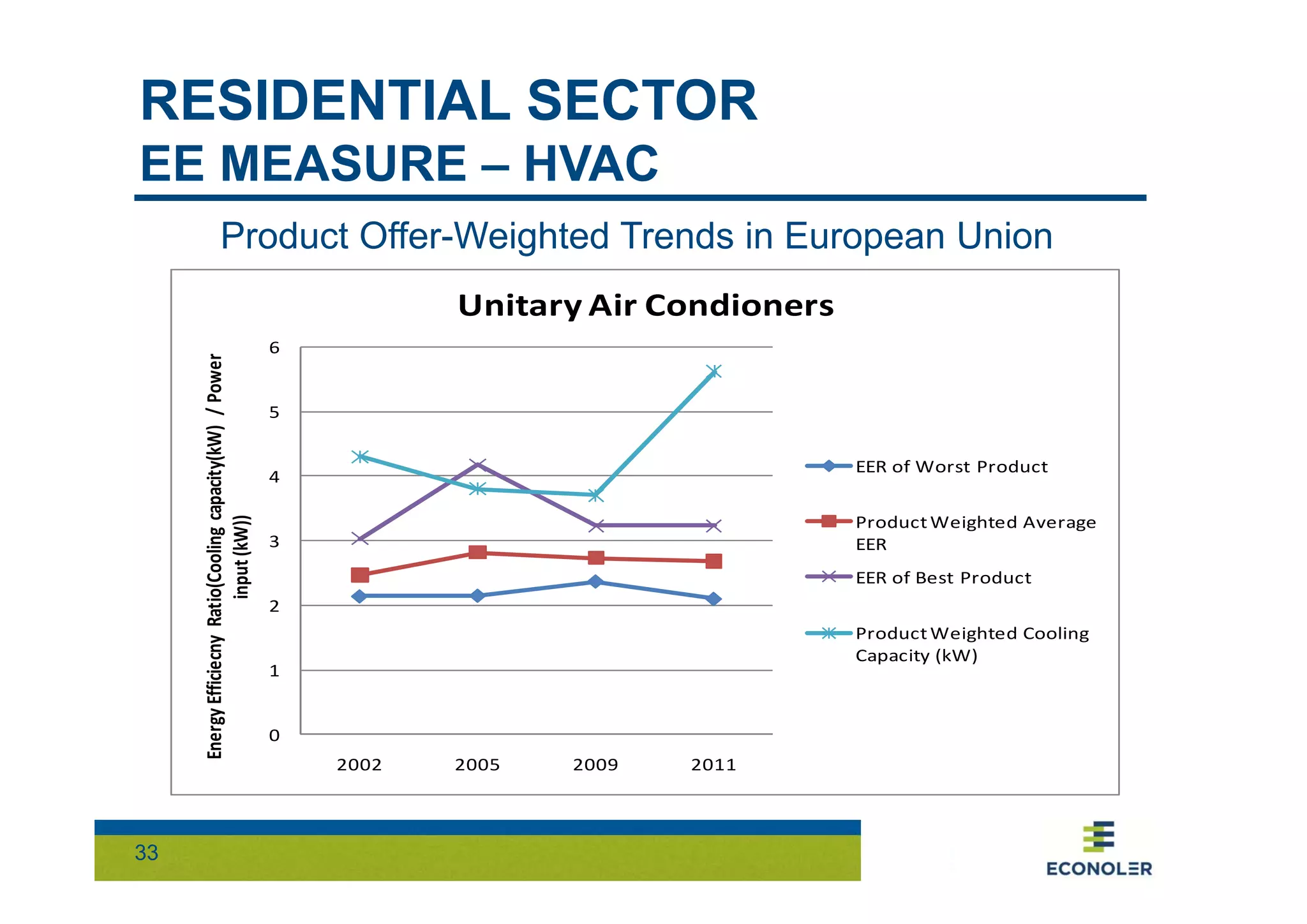
EE MEASURE – HVAC 
33 
Product Offer-Weighted Trends in European Union 
6 
5 
4 
3 
2 
1 
0 
2002 2005 2009 2011 
Energy Efficiecny Ratio(Cooling capacity(kW) / Power 
input (kW)) 
Unitary Air Condioners 
EER of Worst Product 
Product Weighted Average 
EER 
EER of Best Product 
Product Weighted Cooling 
Capacity (kW)
THANK YOU 
Pierre Baillargeon 
pbaillargeon@econoler.com 
34

Energy Efficiency Based on Sectors

  • 1.
    1 Sector-based EnergyEfficiency Leonardo Energy Webinar Pierre Baillargeon (pbaillargeon@econoler.com)
  • 2.
    TOPICS Most commonEE measures by sector: › Industrial › Commercial and Institutional › Residential 2
  • 3.
    INDUSTRIAL SECTOR MOTOR › Electric motors for industry use around 25% of the › They use 55%-65% of industrial electricity in most 3 total electricity produced in industrialized economies. Pumps Fans Compressors Air Process fluid Refrigeration Air Conditioning Moving Machining countries.
  • 4.
    INDUSTRIAL SECTOR VARIABLESPEED DRIVE For motor-driven variable loads, a variable frequency drive should be considered. Throttling Method Variable Speed Method Power Savings DOE study 2002: 18-25% of motor energy in manufacturing sector can benefit from VSD 4 Flow Power 0 100% Source: Dollars to Sense, NRCan FAN AND PUMP LAWS: ADVANTAGE OF VSD FOR VARIABLE FLOWS
  • 5.
    INDUSTRIAL SECTOR IMPROVINGMOTOR PERFORMANCE Premium Efficiency (IE3) : Outperform energy-efficient and standard motors › Initial cost is 20%-30% more. Energy cost can be up to 97% of total life cycle 5 cost. › Better materials and design: Longer core, use of steel with better magnetic properties, reduced thickness of the stator lamination, reduced/optimized rotor and stator gap, larger-sized conductors, better insulating materials, high quality bearings and better lubricant. › More efficient ventilators, bearing and cooling systems. Copper development association High efficiency motors consume generally 1% to 4% less electricity than standard motors and are more reliable, last longer, and their use results in lower transformer load.
  • 6.
    COMMERCIAL AND INSTITUTIONAL EE MEASURE – ELECTRICAL SYSTEMS › Actual efficiency depends on motor loading and nominal (full loading) efficiency 6 Reference: Office of Energy Efficiency, Natural Resources Canada
  • 7.
    INDUSTRIAL SECTOR IMPROVINGMOTOR PERFORMANCE RETScreen Case Study 7
  • 8.
    INDUSTRIAL SECTOR IMPROVINGMOTOR PERFORMANCE › Avoid oversizing (inefficient) and undersizing (overheats): target is 60%-80% load factor ˗ Motor management program › Up to 2% in efficiency reduction after non optimum rewinding: ~1% reduction with best practices › Keep motor cool 8 ˗ Clean air vents ˗ Balance three-phase voltages ˗ Power factor correction (capacitors on the motor side of distribution system)
  • 9.
    INDUSTRIAL SECTOR COMPRESSEDAIR SYSTEMS Consume large quantities of energy (expensive). › Energy : 80% of the life-cycle cost of compressed air system Compressing gas causes its temperature to rise. › Heat must be removed (wasted energy) 10% of the input electricity effective to provide air. 9 Savings opportunity! Heat Energy in delivered compressed air Generation Treatment Distribution Misuse Electricity 10%
  • 10.
    INDUSTRIAL SECTOR EEIN COMPRESSED AIR SYSTEMS › Reduction of air losses – very often 20%-30% of total production 10 ˗ ¼” (6.4 mm) leak at 100 psig (700 kPa gauge) consumes as much electricity as 300 x 60-watt bulbs › Distribution System Modifications › Optimization of Distribution Pressure › Compressor Control › Compressor Efficiency › Multiple-Stage Compressors
  • 11.
    INDUSTRIAL SECTOR EEIN COMPRESSED AIR SYSTEMS › Draining System Optimization › Air Dryer Optimization (especially desiccant) › Replacement of the following usages: ˗ Cleaning ˗ Cooling ˗ Air knife ˗ Dust removal › Venturi nozzles to reduce air flow 11 Photo: DV Systems
  • 12.
    INDUSTRIAL SECTOR EETRANSFORMERS EE in transformers: › Operating in the high efficiency zone Two types of losses 1. Joule losses or copper losses › Function of the winding resistance and current 12 passing through them: Pcopper = R x I2 2. Magnetic losses or iron losses › Function of frequency and voltage › Losses by Eddy current › Hysteresis losses
  • 13.
    INDUSTRIAL SECTOR EETRANSFORMERS › Amorphous steel transformer › Larger winding › Better tolerances ˗ Generate a few percent savings ˗ Generally difficult to justify its use in a retrofit project ˗ Existing transformer still good › Should be considered if a transformer has to be replaced or for new units 13 ˗ Incremental cost vs. savings
  • 14.
    INDUSTRIAL SECTOR ELECTRICITYDISTRIBUTION › Average electricity losses in non-residential buildings : Around 2% › Upsizing the electric cable size : Limiting losses to 0.7% › Potential EU region: 20 TWh/year (industry and tertiary sectors) Source: Copper Alliance 14
  • 15.
    INDUSTRIAL SECTOR TECHNOLOGYFOR PROCESS IMPROVEMENT Improving Process Heating System Performance 15 NREL Fuel Electricity Fossil
  • 16.
    INDUSTRIAL SECTOR TECHNOLOGYFOR PROCESS IMPROVEMENT Plasma-assisted Sludge Industrial Heat Pump Oxidation (PASO) 16 Mechanical Vapor Recompression
  • 17.
    INDUSTRIAL SECTOR MONITORINGAND TARGETING 17 Electric Boiler 15-minute intervals by plant activity Production Cleaning Inactive
  • 18.
  • 19.
    COMMERCIAL AND INSTITUTIONAL EE MEASURE Building envelope and bioclimatic architecture 19 Research Support Facility at the NREL Federal Center South Building 1202
  • 20.
    COMMERCIAL AND INSTITUTIONAL EE MEASURE Zero-energy Building - Singapore Light pipe 20 Shading vs. natural lighting Renewable Individual diffusers
  • 21.
    COMMERCIAL AND INSTITUTIONAL EE MEASURE Wind catcher and bio-climatic? Really new? 21 Biomimicry – one step further - Not only taking into consideration the environment to reduce energy - Nature inspired solution e.b. Termite mound 1°ܥ ݏݓ݅݊݃ ݅݊ݐ݁ݎ݈݊ܽ 3-42°C environment First AC unit 1902 First Egypt windcatcher 1300 BC
  • 22.
    COMMERCIAL AND INSTITUTIONAL EE MEASURE - HVAC Cooling › Controls ˗ Temperature set-up ˗ Distribution temperature › Thermal storage 22 (water, ice, eutectic salts) › Evaporative coolers › Absorption units › Geothermal › Free cooling › Heat pump Heating › Controls ˗ Temperature reset on hot water ˗ Night set back ˗ Other controls › Heat recovery › Energy type replacement › Radiant heating › Off-peak energy optimization ˗ mass or fluid heat storage
  • 23.
    COMMERCIAL AND INSTITUTIONAL EE MEASURE - HVAC Heat Recovery 23 Run around Heat pipe Heat wheel Plate Typical Effectiveness Sensible 55% to 65% Sensible 45% to 65% Sensible 55% to 65% Total 55% to 85% Sensible 50% to 80% Range (cfm) 100 CFM 47 l/s and up 100 CFM 47 l/s and up 50 to 70,000 CFM 23 to 33000 l/s 50 CFM 23 l/s and up Advantages Exhaust airstream can be separated from supply air; fan location not critical No moving part except fan; location not critical; allowable P up to 60-inch WC Latent transfer Compact large sizes Low pressure drop No moving part Low pressure drop Easily cleaned
  • 24.
    COMMERCIAL AND INSTITUTIONAL EE MEASURE - HVAC Four Energy Efficiency Strategies : Centrifugal equipment › Fan or pump efficiency › Reduction of hours of operation › Flow reduction › Pressure reduction 24 Hollow, shaped blades Centrifugal Fan Types Airfoil Forward Backward Radial BLADES 80%-85% 60%-70% 75%-80% 50%-60% EFFICIENCY Clean flows Small HVAC High pressure Hars env. TYPICAL USAGE
  • 25.
    COMMERCIAL AND INSTITUTIONAL EE MEASURE – LIGHTING Artificial lighting : 20% to 40% of total energy consumption Artificial lighting is inefficient and generates heat › Add cooling load and reduce heating requirements. 25 Incandescent: 95% or more of the energy converted to heat
  • 26.
    COMMERCIAL AND INSTITUTIONAL EE MEASURE – LIGHTING Lighting Opportunities › Use more efficient fixtures (lamps, ballasts, reflectors, lenses) › Use timers, automatic dimming & occupancy sensors › Favour natural daylight › Task lighting and lower general lighting levels › Reduce excess lighting by delamping › Raise occupants’ awareness (i.e., turning off lights) › Maintain/clean regularly (improves light loss factor) › Select interior surfaces and colours for diffuse reflection 26
  • 27.
    RESIDENTIAL SECTOR EEMEASURE – BUILDING ENVELOPE › Minimize infiltration - Ventilation- Heat Exchanger › Add insulation › Equator-facing: High efficiency windows (2-3 panes, low-e, argon, 27 thermal break) ˗ Shaded by overhangs, trees – reduce summer gain › East-West-facing windows; natural lighting, less heat gain Conventional Summer Winter Shading Devices Passive Solar Design Advanced Windows Thermal Mass
  • 28.
    RESIDENTIAL SECTOR EEMEASURE – LIGHTING Efficiency (lm/W): Ratio of light visible to the human eye (in lumens) to input 28 electrical power (in watts) Type Efficiency Typical Lifetime Colour Rendering Incandescent 10-18 lm/W 1,000 hr Excellent Halogen 14-18 2,000 hr Excellent Compact fluorescent 70-90 10,000 hr Excellent Exposed LED lamp 70-100 100,000 hr Variable Several dimming opportunities exist in the residential sector.
  • 29.
    RESIDENTIAL SECTOR EEMEASURE – APPLIANCES Energy performance standard and label: › Energy Star › European Union Appliances: › Air conditioning fan › Refrigerator, freezer › TV › Dishwasher › Washing machine › Dryer › Electronic equipment Source: Clasp handbook 29 Incentives
  • 30.
    RESIDENTIAL SECTOR EEMEASURE – STAND-BY POWER Field research in the U.S. : Standby mode dominates total energy use in a few products. Power in some products stays active all the time. Source: Scott Pigg. “Energy Savings Opportunities for Home Electronics: Insights from a Minnesota Field Study.” Energy Center of Wisconsin, October 2010 30
  • 31.
    RESIDENTIAL SECTOR EEMEASURE – ELECTRICITY DISTRIBUTION Electric cables are hidden consumers of electric energy. Studies demonstrated that significant savings could be made by optimizing cable and wire diameters (in new buildings). Copperalliance 31 How does it work?
  • 32.
    RESIDENTIAL SECTOR EEMEASURE – HVAC 32 Product Offer-Weighted Trends in European Union 6 5 4 3 2 1 0 2002 2005 2009 2011 Energy Efficiecny Ratio(Cooling capacity(kW) / Power input (kW)) Split Air Conditioners EER of Worst Product Product Weighted Average EER Sales Weighted Average EER EER of Best Product Product Weighted Cooling Capacity (kW)
  • 33.
    RESIDENTIAL SECTOR EEMEASURE – HVAC 33 Product Offer-Weighted Trends in European Union 6 5 4 3 2 1 0 2002 2005 2009 2011 Energy Efficiecny Ratio(Cooling capacity(kW) / Power input (kW)) Unitary Air Condioners EER of Worst Product Product Weighted Average EER EER of Best Product Product Weighted Cooling Capacity (kW)
  • 34.
    THANK YOU PierreBaillargeon pbaillargeon@econoler.com 34