Building DSLs with
  The Spoofax Language Workbench

                                 Eelco Visser
                       Delft University of Technology
                            http://eelcovisser.org


Joint work with Lennart Kats, Karl-Trygve Kalleberg, Maartje de Jonge, and many others
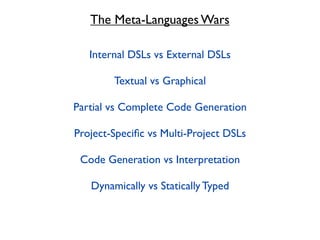
The Meta-Languages Wars

   Internal DSLs vs External DSLs

        Textual vs Graphical

Partial vs Complete Code Generation

Project-Specific vs Multi-Project DSLs

 Code Generation vs Interpretation

   Dynamically vs Statically Typed
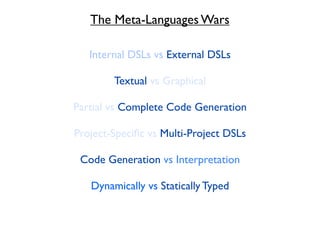
The Meta-Languages Wars

   Internal DSLs vs External DSLs

        Textual vs Graphical

Partial vs Complete Code Generation

Project-Specific vs Multi-Project DSLs

 Code Generation vs Interpretation

   Dynamically vs Statically Typed
WebDSL
                                   http://webdsl.org


      separation of concerns & linguistic integration


Eelco Visser. WebDSL: A Case Study in Domain-Specific Language Engineering. GTTSE 2007: 291-373
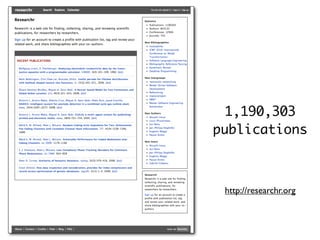
1,190,303
publications


 http://researchr.org
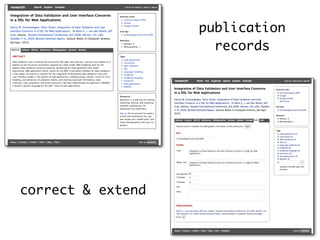
publication
                     records


correct & extend
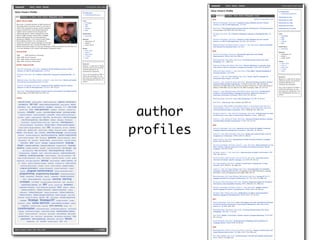
author
profiles
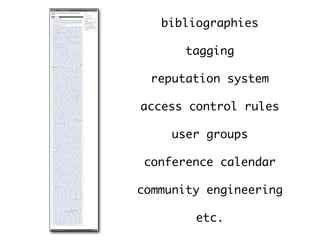
bibliographies

       tagging

  reputation system

access control rules

     user groups

 conference calendar

community engineering

        etc.
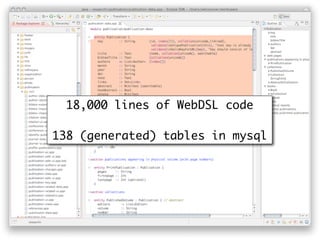
18,000 lines of WebDSL code

138 (generated) tables in mysql
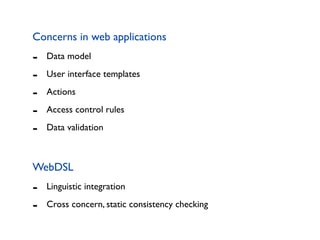
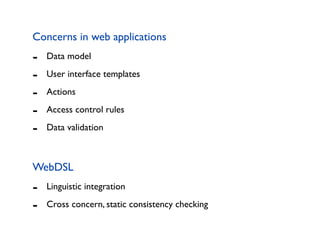
Concerns in web applications
-   Data model

-   User interface templates

-   Actions

-   Access control rules

-   Data validation


WebDSL
-   Linguistic integration

-   Cross concern, static consistency checking
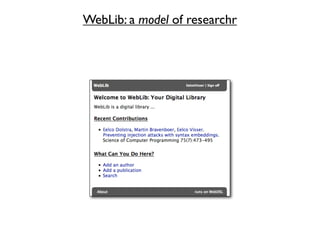
WebLib: a model of researchr
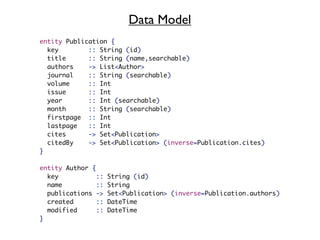
Data Model
entity Publication {
  key        :: String (id)
  title      :: String (name,searchable)
  authors    -> List<Author>
  journal    :: String (searchable)
  volume     :: Int
  issue      :: Int
  year       :: Int (searchable)
  month      :: String (searchable)
  firstpage :: Int
  lastpage   :: Int
  cites      -> Set<Publication>
  citedBy    -> Set<Publication> (inverse=Publication.cites)
}

entity Author {
  key           ::   String (id)
  name          ::   String
  publications ->    Set<Publication> (inverse=Publication.authors)
  created       ::   DateTime
  modified      ::   DateTime
}
User Interface
Full Text Search
define page search() {
  var query : String
  action show() {
  	var pubs : List<Publication> := searchPublication(query);
  	if(pubs.length > 0) {
      replace(results, results(query,pubs));
    } else {
      replace(results, noresults());           entity Publication {
                                                 title      :: String (name,searchable)
    }
                                                 journal    :: String (searchable)
  }                                              year       :: Int (searchable)
  main{                                          month      :: String (searchable)
  	 section{                                     ...
                                               }
  	   header{"Search"}
  	   form{ input(query)[onkeyup:=show()] }
  	   placeholder results{}
  	 }
  }
}
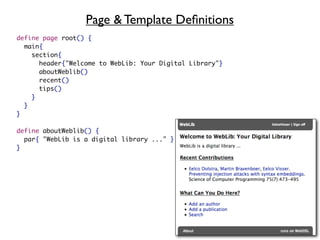
Page & Template Definitions
define page root() {
  main{
    section{
      header{"Welcome to WebLib: Your Digital Library"}
      aboutWeblib()
      recent()
      tips()
    }
  }
}

define aboutWeblib() {
  par{ "WebLib is a digital library ..." }
}
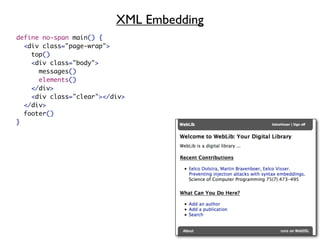
XML Embedding
define no-span main() {
  <div class="page-wrap">
    top()
    <div class="body">
      messages()
      elements()
    </div>
    <div class="clear"></div>
  </div>
  footer()
}
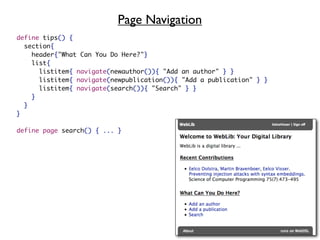
Page Navigation
define tips() {
  section{
    header{"What Can You Do Here?"}
    list{
      listitem{ navigate(newauthor()){ "Add an author" } }
      listitem{ navigate(newpublication()){ "Add a publication" } }
      listitem{ navigate(search()){ "Search" } }
    }
  }
}

define page search() { ... }
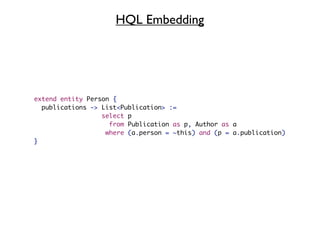
HQL Embedding


extend entity Person {
  publications -> List<Publication> :=
                  select p
                    from Publication as p, Author as a
                   where (a.person = ~this) and (p = a.publication)
}
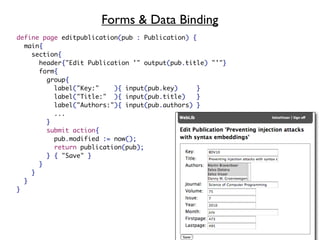
Forms & Data Binding
define page editpublication(pub : Publication) {
  main{
    section{
      header{"Edit Publication '" output(pub.title) "'"}
      form{
        group{
          label("Key:"    ){ input(pub.key)      }
          label("Title:" ){ input(pub.title)     }
          label("Authors:"){ input(pub.authors) }
          ...
        }
        submit action{
          pub.modified := now();
          return publication(pub);
        } { "Save" }
      }
    }
  }
}
Access Control

Danny M. Groenewegen, Eelco Visser. Declarative Access Control for WebDSL:
Combining Language Integration and Separation of Concerns. ICWE 2008: 175-188
Access Control Rules
                       define showReview(review : Review) {
                         action delete() { ... }
                         section{ ...
                           navigate(editReview(review)){"[Edit]"}
                           submitlink delete() {"[X]"}
                         }
                       }
Access Control Rules
                                     define showReview(review : Review) {
                                       action delete() { ... }
                                       section{ ...
                                         navigate(editReview(review)){"[Edit]"}
                                         submitlink delete() {"[X]"}
                                       }
                                     }
access control rules

  principal is User with credentials username, password

 predicate isReviewer(review : Review) {
 	 review.reviewer == securityContext.principal
 }
 rule template showReview(review : Review, pubLink : Bool) {
   review.public || isReviewer(review)
   rule action delete() {
     loggedIn() && isReviewer(review)
   }
 }
 rule page editReview(review : Review) {
   loggedIn() && isReviewer(review)
 }
Data Validation


Danny M. Groenewegen, Eelco Visser. Integration of Data Validation and
User Interface Concerns in a DSL for Web Applications. SLE 2009: 164-173
Data Validation: Form Input Validation


label("Acronym (without year)"){
  input(acronym){

        validate(!isEmptyString(acronym),
                 "Provide acronym")

        validate(!(/[ ]/.find(acronym)),
                 "Acronym should not contain spaces")

        validate(!(/[0-9][0-9][0-9][0-9]/.find(acronym)),
                 "Acronym should not contain year")

    }
}
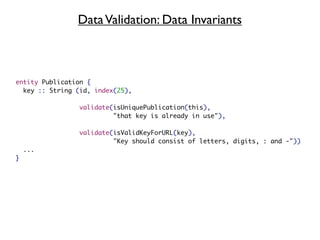
Data Validation: Data Invariants


entity Publication {
  key :: String (id, index(25),

                 validate(isUniquePublication(this),
                          "that key is already in use"),

                 validate(isValidKeyForURL(key),
                          "Key should consist of letters, digits, : and -"))
    ...
}
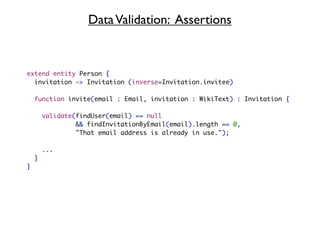
Data Validation: Assertions


extend entity Person {
  invitation -> Invitation (inverse=Invitation.invitee)

    function invite(email : Email, invitation : WikiText) : Invitation {

        validate(findUser(email) == null
                 && findInvitationByEmail(email).length == 0,
                 "That email address is already in use.");

        ...
    }
}
Concerns in web applications
-   Data model

-   User interface templates

-   Actions

-   Access control rules

-   Data validation


WebDSL
-   Linguistic integration

-   Cross concern, static consistency checking
IDEs for DSLs
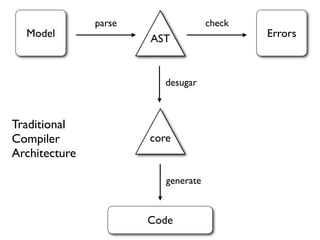
parse                 check
  Model                AST                   Errors


                         desugar


Traditional
Compiler               core
Architecture

                          generate


                       Code
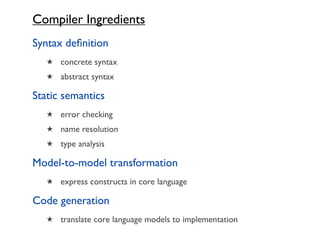
Compiler Ingredients
Syntax definition
   ★ concrete syntax
   ★ abstract syntax

Static semantics
   ★ error checking
   ★ name resolution
   ★ type analysis

Model-to-model transformation
   ★ express constructs in core language

Code generation
   ★ translate core language models to implementation
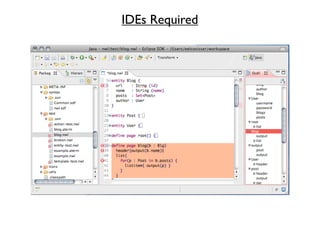
IDEs Required
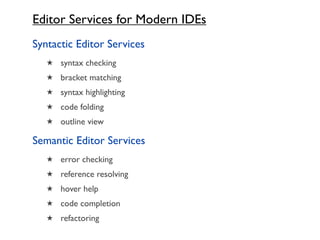
Editor Services for Modern IDEs
Syntactic Editor Services
   ★ syntax checking
   ★ bracket matching
   ★ syntax highlighting
   ★ code folding
   ★ outline view

Semantic Editor Services
   ★ error checking
   ★ reference resolving
   ★ hover help
   ★ code completion
   ★ refactoring
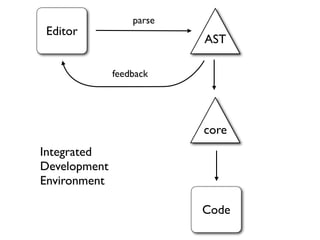
parse
Editor
                          AST

              feedback


                          core
Integrated
Development
Environment

                          Code
Architectural Requirements for IDEs


Editor services are based on AST
   ★ services analyze structure, not text of source

Error recovery
   ★ continue services in presence of syntactic errors

Incremental processing
   ★ effort of applying analysis, transformation, generation should be
      proportional to change in source

Separate compilation (analysis, transformation)
   ★ keep track of dependencies
Holy Grail of Software Language Definition


  Automatically derive efficient,
scalable, incremental compiler +
 usable IDE from high-level,
 declarative language
      definition
The Spoofax
Language Workbench
The Spoofax/IMP Language Workbench


Syntax definition: SDF
   ★ declarative, modular syntax definition

Transformation, analysis, generation: Stratego
   ★ rewrite rules, strategies, dynamic rules

Editor services
   ★ domain-specific languages for configuration

Based on IMP framework by IBM Research
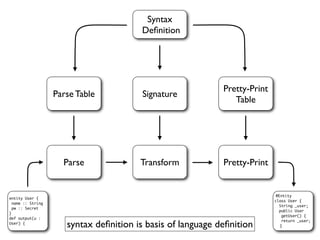
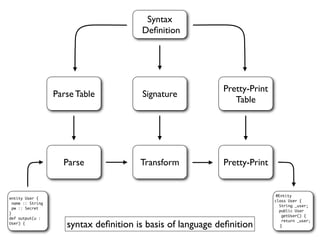
Syntax Definition
Syntax
                                        Definition


                                                            Pretty-Print
                  Parse Table           Signature
                                                               Table


                    Parse              Transform            Pretty-Print


                                                                            @Entity
entity User {
                                                                           class User {
 name :: String
                                                                             String _user;
 pw :: Secret
                                                                             public User
}
                                                                               getUser() {
def output(u :

                     syntax definition is basis of language definition
                                                                               return _user;
User) {
                                                                              }
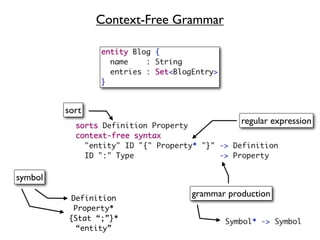
Lexical & Context-Free Syntax
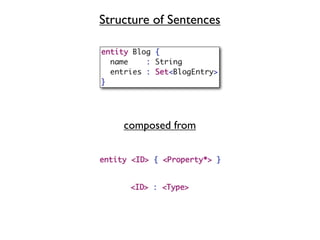
Structure of Sentences


    composed from
Context-Free Grammar


         sort
                                          regular expression


symbol

          Definition
                               grammar production
           Property*
         {Stat “;”}*
            “entity”
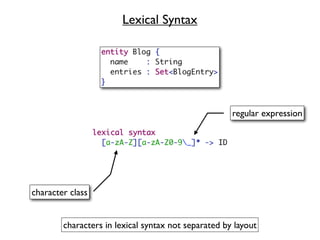
Lexical Syntax


                                                     regular expression


character class


        characters in lexical syntax not separated by layout
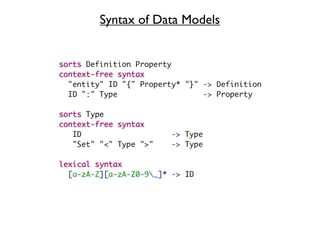
Syntax of Data Models
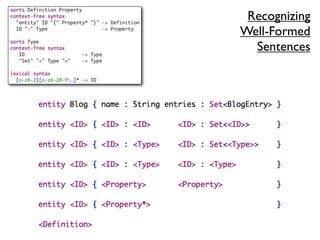
Recognizing
Well-Formed
  Sentences
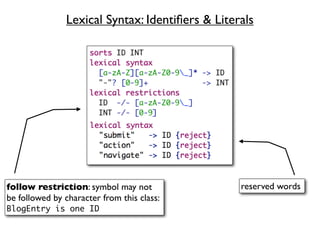
Lexical Syntax: Identifiers & Literals


follow restriction: symbol may not               reserved words
be followed by character from this class:
BlogEntry is one ID
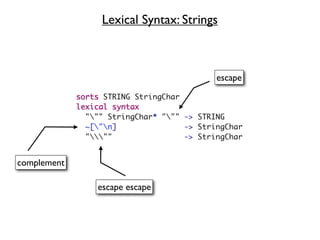
Lexical Syntax: Strings


                                    escape


complement

             escape escape
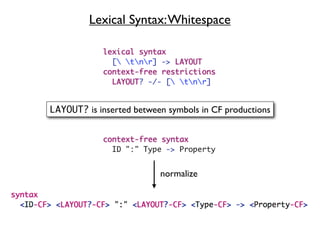
Lexical Syntax: Whitespace


LAYOUT? is inserted between symbols in CF productions


                          normalize
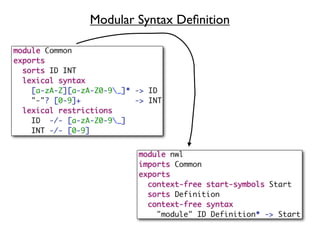
Modular Syntax Definition
Parsing & Abstract Syntax


building structured representation of sentence
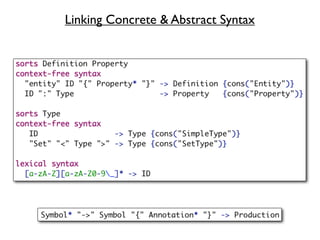
Linking Concrete & Abstract Syntax
Terms to Represent Abstract Syntax


Entity(“Blog”,
  [Property(“name”,SimpleType(“String”)),
   Property(“author”, SimpleType(“User”))]
)
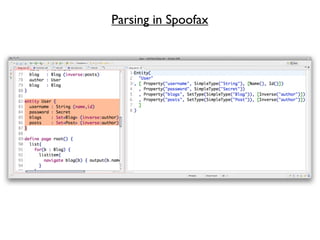
Parsing in Spoofax
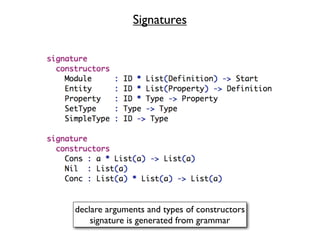
Signatures


defining the structure of abstract syntax terms
Syntax
                                        Definition


                                                            Pretty-Print
                  Parse Table           Signature
                                                               Table


                    Parse              Transform            Pretty-Print


                                                                            @Entity
entity User {
                                                                           class User {
 name :: String
                                                                             String _user;
 pw :: Secret
                                                                             public User
}
                                                                               getUser() {
def output(u :

                     syntax definition is basis of language definition
                                                                               return _user;
User) {
                                                                              }
Signatures


declare arguments and types of constructors
    signature is generated from grammar
Disambiguation
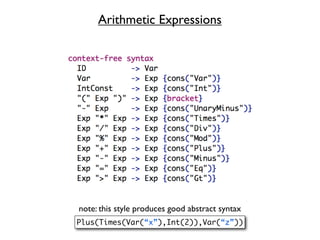
Arithmetic Expressions


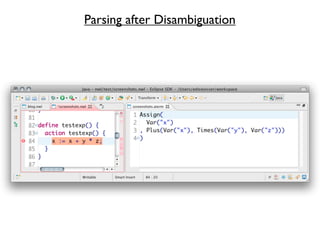
note: this style produces good abstract syntax
Plus(Times(Var(“x”),Int(2)),Var(“z”))
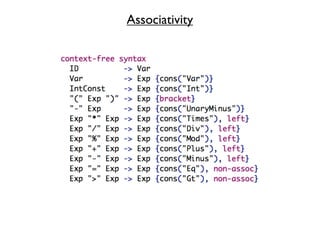
Associativity
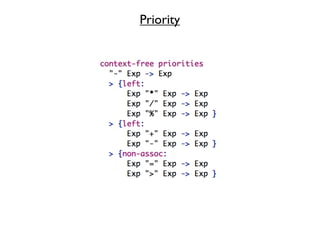
Priority
Parsing after Disambiguation
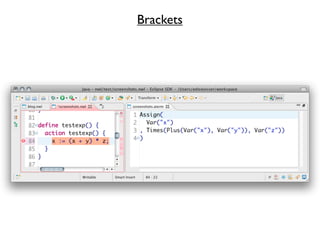
Brackets
Language Composition
Embedding HQL
                                                      module expressions
                                                      imports Common
                                                      imports HQL
                                                      exports
                                                        context-free syntax
                                                          SelectStatement -> Exp
define page index() {
  list{
    for(p : Post in select p from Post as p order by (p.title)) {
      listitem{ output(p) }
    }
  }
}

            ForElem("p", SimpleType("Post")
            , QueryRule(
                SelectFrom(
                  Some(Select(None(), [AliasedExpression(Path(["p"]), None())]))
                , FromClause([FromRangeJoin(FromClass(Path(["Post"]), Some(AsAlias(Alias("p"
                )
              , Some(OrderByClause([OrderElement(Paren([Path(["p", "title"])]), None())]))
              )
            , [CallElems("listitem", [CallArgs("output", [Var("p")])])]
            )
Presentational
Editor Services
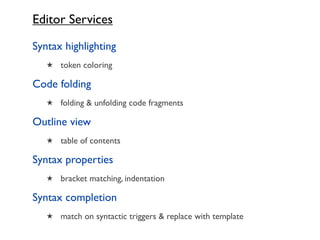
Editor Services

Syntax highlighting
   ★ token coloring

Code folding
   ★ folding & unfolding code fragments

Outline view
   ★ table of contents

Syntax properties
   ★ bracket matching, indentation

Syntax completion
   ★ match on syntactic triggers & replace with template
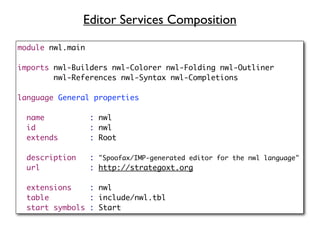
Editor Services Composition

module nwl.main

imports nwl-Builders nwl-Colorer nwl-Folding nwl-Outliner
        nwl-References nwl-Syntax nwl-Completions

language General properties

  name            : nwl
  id              : nwl
  extends         : Root

  description     : "Spoofax/IMP-generated editor for the nwl language"
  url             : http://strategoxt.org

  extensions    : nwl
  table         : include/nwl.tbl
  start symbols : Start
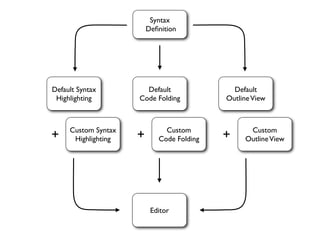
Syntax
                         Definition


Default Syntax         Default               Default
 Highlighting        Code Folding          Outline View


     Custom Syntax            Custom             Custom
+     Highlighting   +      Code Folding   +    Outline View


                          Editor
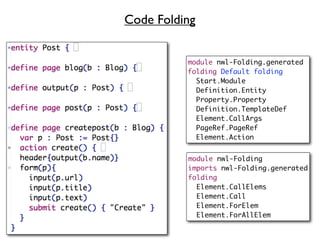
Code Folding


          module nwl-Folding.generated
          folding Default folding
            Start.Module
            Definition.Entity
            Property.Property
            Definition.TemplateDef
            Element.CallArgs
            PageRef.PageRef
            Element.Action


          module nwl-Folding
          imports nwl-Folding.generated
          folding
            Element.CallElems
            Element.Call
            Element.ForElem
            Element.ForAllElem
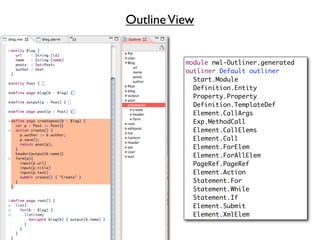
Outline View


          module nwl-Outliner.generated
          outliner Default outliner
            Start.Module
            Definition.Entity
            Property.Property
            Definition.TemplateDef
            Element.CallArgs
            Exp.MethodCall
            Element.CallElems
            Element.Call
            Element.ForElem
            Element.ForAllElem
            PageRef.PageRef
            Element.Action
            Statement.For
            Statement.While
            Statement.If
            Element.Submit
            Element.XmlElem
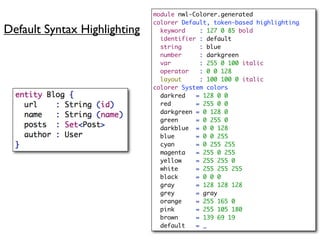
module nwl-Colorer.generated
                              colorer Default, token-based highlighting
Default Syntax Highlighting     keyword    : 127 0 85 bold
                                identifier : default
                                string     : blue
                                number     : darkgreen
                                var        : 255 0 100 italic
                                operator   : 0 0 128
                                layout     : 100 100 0 italic
                              colorer System colors
                                darkred   = 128 0 0
                                red       = 255 0 0
                                darkgreen = 0 128 0
                                green     = 0 255 0
                                darkblue = 0 0 128
                                blue      = 0 0 255
                                cyan      = 0 255 255
                                magenta   = 255 0 255
                                yellow    = 255 255 0
                                white     = 255 255 255
                                black     = 0 0 0
                                gray      = 128 128 128
                                grey      = gray
                                orange    = 255 165 0
                                pink      = 255 105 180
                                brown     = 139 69 19
                                default   = _
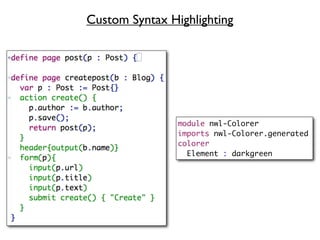
Custom Syntax Highlighting


                module nwl-Colorer
                imports nwl-Colorer.generated
                colorer
                  Element : darkgreen
Syntax Properties

module nwl-Syntax.generated
language Syntax properties (static defaults)

 // Comment constructs:
 line comment                            : "//"
 block comment                           : "/*" * "*/"

 // Fences (used for matching,
 // inserting, indenting brackets):
 fences                                  : [ ]
                                           ( )
                                           { }
 // Automatic indent hints
 // (indent after these tokens):
 indent after                            : "="
                                           ":"
 // Regular expression for identifiers:
 identifier lexical                     : "[A-Za-z0-9_]+"
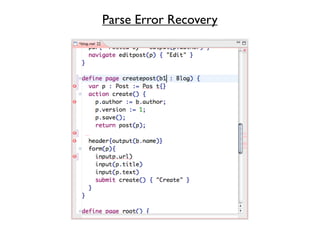
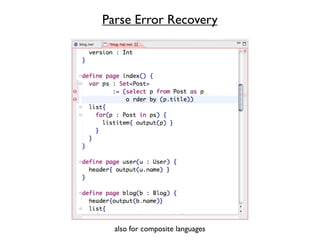
Parse Error Recovery


  also for composite languages
Builders
Semantic Editor Services
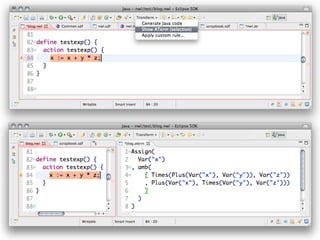
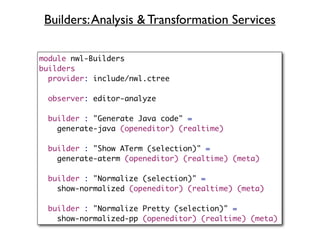
Builders: Analysis & Transformation Services

module nwl-Builders
builders
  provider: include/nwl.ctree

  observer: editor-analyze

  builder : "Generate Java code" =
    generate-java (openeditor) (realtime)

  builder : "Show ATerm (selection)" =
    generate-aterm (openeditor) (realtime) (meta)

  builder : "Normalize (selection)" =
    show-normalized (openeditor) (realtime) (meta)

  builder : "Normalize Pretty (selection)" =
    show-normalized-pp (openeditor) (realtime) (meta)
Term Rewriting
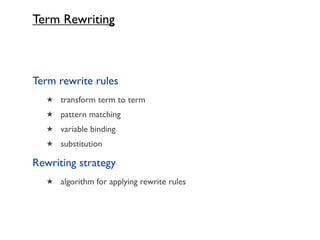
Term Rewriting


Term rewrite rules
   ★ transform term to term
   ★ pattern matching
   ★ variable binding
   ★ substitution

Rewriting strategy
   ★ algorithm for applying rewrite rules
Term Rewrite Rule


                         left-hand side pattern
label/name


      desugar :
        Property(x, t) -> Property(x, t, [])


             variable
                                                  right-hand side pattern
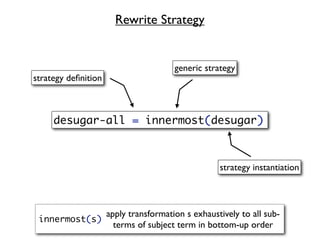
Rewrite Strategy


                                  generic strategy
strategy definition


     desugar-all = innermost(desugar)


                                              strategy instantiation


              apply transformation s exhaustively to all sub-
 innermost(s)
                terms of subject term in bottom-up order
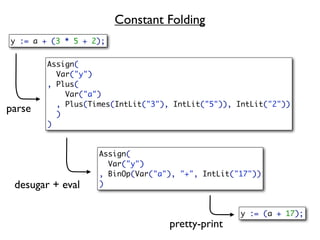
Constant Folding
y := a + (3 * 5 + 2);


        Assign(
          Var("y")
        , Plus(
            Var("a")
          , Plus(Times(IntLit("3"), IntLit("5")), IntLit("2"))
parse     )
        )


                   Assign(
                     Var("y")
                   , BinOp(Var("a"), "+", IntLit("17"))
 desugar + eval    )


                                                  y := (a + 17);
                                   pretty-print
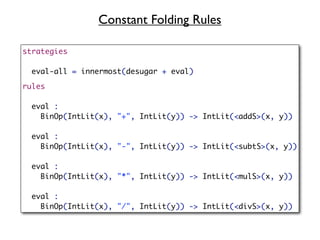
Constant Folding Rules

strategies

 eval-all = innermost(desugar + eval)

rules

 eval :
   BinOp(IntLit(x), "+", IntLit(y)) -> IntLit(<addS>(x, y))

 eval :
   BinOp(IntLit(x), "-", IntLit(y)) -> IntLit(<subtS>(x, y))

 eval :
   BinOp(IntLit(x), "*", IntLit(y)) -> IntLit(<mulS>(x, y))

 eval :
   BinOp(IntLit(x), "/", IntLit(y)) -> IntLit(<divS>(x, y))
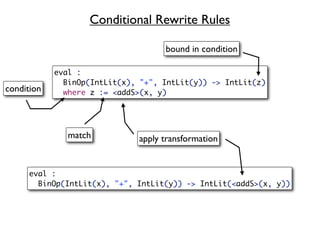
Conditional Rewrite Rules

                                    bound in condition

            eval :
              BinOp(IntLit(x), "+", IntLit(y)) -> IntLit(z)
condition     where z := <addS>(x, y)


               match          apply transformation


     eval :
       BinOp(IntLit(x), "+", IntLit(y)) -> IntLit(<addS>(x, y))
Code Generation by
Model Transformation
Rewriting with Concrete Object Syntax


elem-to-java-servlet :
  tc@elem|[ x(e)[passign*]{elem*} ]| ->
  <wrap-input-render-java-code>
  bstm* |[
    String x_temp = ident+"~inputident"+uniqueid;
     ~*<render-error-messages-with-error-template(|java:expr|[ x_temp ]|,
            <ErrorTemplateInput>)> bstm*|[
        bstm_call*
     ]|
  ]|
  where <is-input-template> tc
  with inputident := <get-inputnumber> tc
        ; x_temp := <newname> "temp"
        ; bstm_call* := <control-flow-tcall-helper(|"render",expr|[ x_temp ]|)> tc


                        Stratego + embedded Java
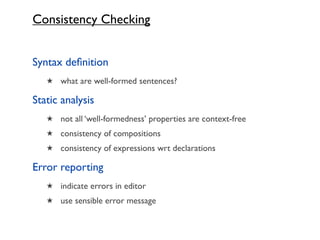
Consistency Checking


Syntax definition
   ★ what are well-formed sentences?

Static analysis
   ★ not all ‘well-formedness’ properties are context-free
   ★ consistency of compositions
   ★ consistency of expressions wrt declarations

Error reporting
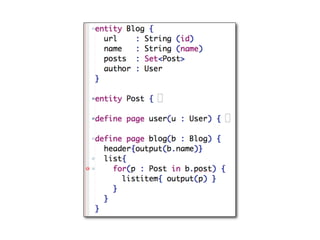
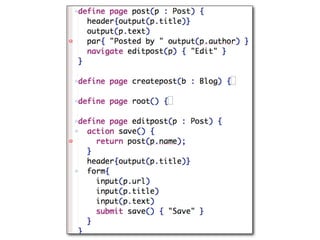
   ★ indicate errors in editor
   ★ use sensible error message
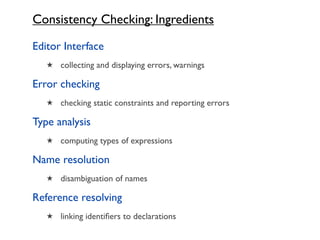
Consistency Checking: Ingredients

Editor Interface
   ★ collecting and displaying errors, warnings

Error checking
   ★ checking static constraints and reporting errors

Type analysis
   ★ computing types of expressions

Name resolution
   ★ disambiguation of names

Reference resolving
   ★ linking identifiers to declarations
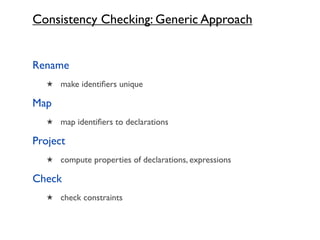
Consistency Checking: Generic Approach


Rename
   ★ make identifiers unique

Map
   ★ map identifiers to declarations

Project
   ★ compute properties of declarations, expressions

Check
   ★ check constraints
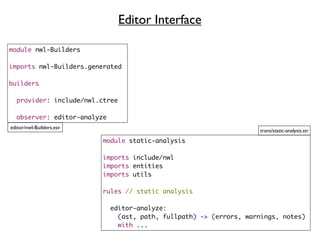
Editor Interface

module nwl-Builders

imports nwl-Builders.generated

builders

  provider: include/nwl.ctree

  observer: editor-analyze
editor/nwl-Builders.esv
                                                                    trans/static-analysis.str
                          module static-analysis

                          imports include/nwl
                          imports entities
                          imports utils

                          rules // static analysis

                             editor-analyze:
                               (ast, path, fullpath) -> (errors, warnings, notes)
                               with ...
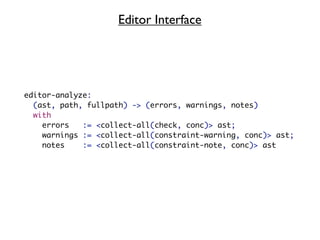
Editor Interface


editor-analyze:
  (ast, path, fullpath) -> (errors, warnings, notes)
  with
    errors   := <collect-all(check, conc)> ast;
    warnings := <collect-all(constraint-warning, conc)> ast;
    notes    := <collect-all(constraint-note, conc)> ast
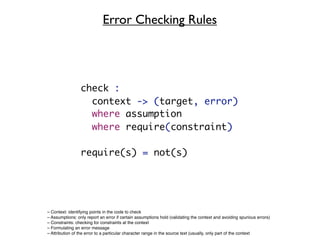
Error Checking Rules


                 check :
                   context -> (target, error)
                   where assumption
                   where require(constraint)

                 require(s) = not(s)


– Context: identifying points in the code to check
– Assumptions: only report an error if certain assumptions hold (validating the context and avoiding spurious errors)
– Constraints: checking for constraints at the context
– Formulating an error message
– Attribution of the error to a particular character range in the source text (usually, only part of the context
Error Checking: Binary Operators


check :
  e@BinOp(e1, op, e2) ->
    (e, $[operator [op] not defined for [<pp>t1] and [<pp>t2]])
  where t1 := <type-of> e1
  where t2 := <type-of> e2
  where require(<type-of> e)
Pretty-Printing with String Interpolation


 pp : Entity(x, prop*) ->
      $[entity [x] {
           [<map(pp)>prop*]
        }]
 pp : Property(x,t) ->
      $[[x] : [<pp>t]
       ]
 pp : SimpleType(x) -> x
 pp : SetType(t) -> $[Set<[<pp> t]>]
 pp : [] -> $[]
 pp : [t] -> <pp>t
 pp : [t1,t2|ts] -> $[[<pp>t1],[<pp>[t2|ts]]]
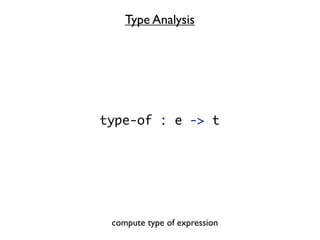
Type Analysis


type-of : e -> t


 compute type of expression
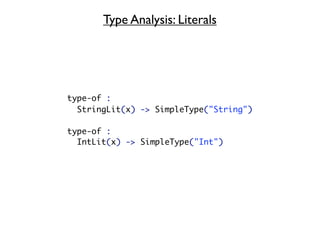
Type Analysis: Literals


type-of :
  StringLit(x) -> SimpleType("String")

type-of :
  IntLit(x) -> SimpleType("Int")
Type Analysis: Binary Operators


type-of :
  BinOp(e1, op, e2) -> t
  where t := <function-type>(op, [<type-of>e1, <type-of>e2])

function-type :
  ("+", [SimpleType("String"), SimpleType("String")]) -> SimpleType("String")

function-type :
  ("+", [SimpleType("Int"), SimpleType("Int")]) -> SimpleType("Int")

function-type :
  ("-", [SimpleType("Int"), SimpleType("Int")]) -> SimpleType("Int")
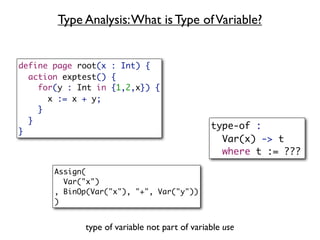
Type Analysis: What is Type of Variable?


define page root(x : Int) {
  action exptest() {
    for(y : Int in {1,2,x}) {
      x := x + y;
    }
  }
                                               type-of :
}
                                                 Var(x) -> t
                                                 where t := ???

       Assign(
         Var("x")
       , BinOp(Var("x"), "+", Var("y"))
       )


             type of variable not part of variable use
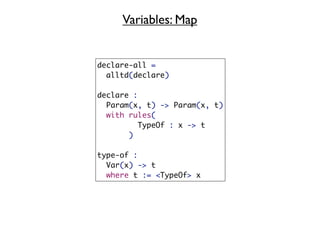
Variables: Map


declare-all =
  alltd(declare)

declare :
  Param(x, t) -> Param(x, t)
  with rules(
         TypeOf : x -> t
       )

type-of :
  Var(x) -> t
  where t := <TypeOf> x
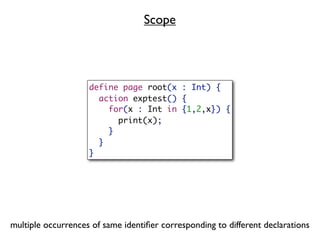
Scope


                    define page root(x : Int) {
                      action exptest() {
                        for(x : Int in {1,2,x}) {
                          print(x);
                        }
                      }
                    }


multiple occurrences of same identifier corresponding to different declarations
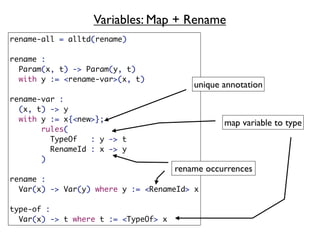
Variables: Map + Rename
rename-all = alltd(rename)

rename :
  Param(x, t) -> Param(y, t)
  with y := <rename-var>(x, t)
                                          unique annotation
rename-var :
  (x, t) -> y
  with y := x{<new>};
                                                 map variable to type
       rules(
         TypeOf   : y -> t
         RenameId : x -> y
       )
                                      rename occurrences
rename :
  Var(x) -> Var(y) where y := <RenameId> x

type-of :
  Var(x) -> t where t := <TypeOf> x
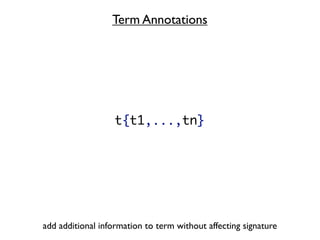
Term Annotations


                   t{t1,...,tn}


add additional information to term without affecting signature
Variables: Check


check :
  e@Var(x) -> (e, $[Variable '[x]' not declared])
  where require(<type-of>e)
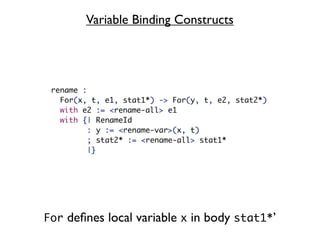
Variable Binding Constructs


 rename :
   For(x, t, e1, stat1*) -> For(y, t, e2, stat2*)
   with e2 := <rename-all> e1
   with {| RenameId
          : y := <rename-var>(x, t)
          ; stat2* := <rename-all> stat1*
          |}


For defines local variable x in body stat1*’
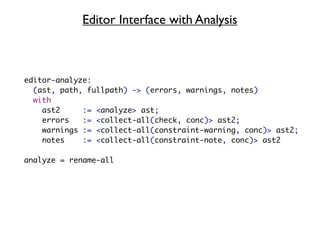
Editor Interface with Analysis


editor-analyze:
  (ast, path, fullpath) -> (errors, warnings, notes)
  with
    ast2     := <analyze> ast;
    errors   := <collect-all(check, conc)> ast2;
    warnings := <collect-all(constraint-warning, conc)> ast2;
    notes    := <collect-all(constraint-note, conc)> ast2

analyze = rename-all
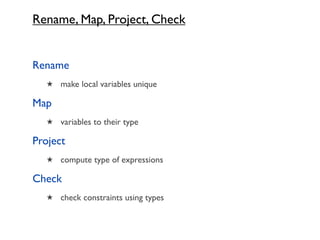
Rename, Map, Project, Check


Rename
   ★ make local variables unique

Map
   ★ variables to their type

Project
   ★ compute type of expressions

Check
   ★ check constraints using types
Reference Resolution


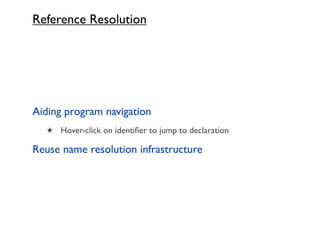
Aiding program navigation
  ★ Hover-click on identifier to jump to declaration

Reuse name resolution infrastructure
Reference Resolution

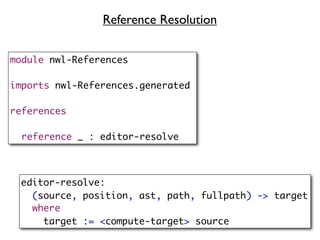
module nwl-References

imports nwl-References.generated

references

  reference _ : editor-resolve


 editor-resolve:
   (source, position, ast, path, fullpath) -> target
   where
     target := <compute-target> source
From Use to Declaration


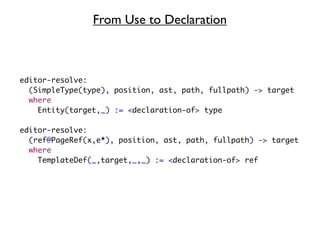
editor-resolve:
  (SimpleType(type), position, ast, path, fullpath) -> target
  where
    Entity(target,_) := <declaration-of> type

editor-resolve:
  (ref@PageRef(x,e*), position, ast, path, fullpath) -> target
  where
    TemplateDef(_,target,_,_) := <declaration-of> ref
Experience
Experience
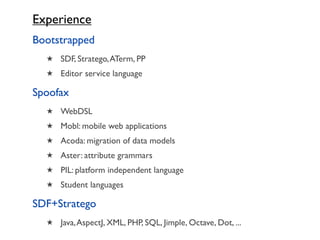
Bootstrapped
  ★ SDF, Stratego, ATerm, PP
  ★ Editor service language

Spoofax
  ★ WebDSL
  ★ Mobl: mobile web applications
  ★ Acoda: migration of data models
  ★ Aster: attribute grammars
  ★ PIL: platform independent language
  ★ Student languages

SDF+Stratego
  ★ Java, AspectJ, XML, PHP, SQL, Jimple, Octave, Dot, ...
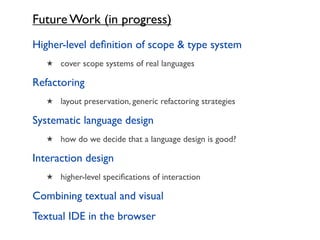
Future Work (in progress)
Higher-level definition of scope & type system
   ★ cover scope systems of real languages

Refactoring
   ★ layout preservation, generic refactoring strategies

Systematic language design
   ★ how do we decide that a language design is good?

Interaction design
   ★ higher-level specifications of interaction

Combining textual and visual
Textual IDE in the browser
- the end -
   Lennart C. L. Kats, Eelco Visser. The Spoofax Language Workbench. Rules
   for Declarative Specification of Languages and IDEs. OOPSLA 2010


                   http://spoofax.org


http://webdsl.org                                   http://mobl.org
Context-sensitive
 Transformation
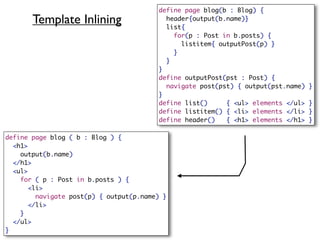
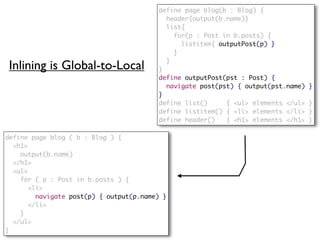
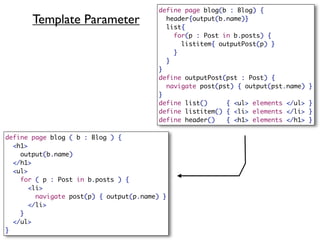
define page blog(b : Blog) {
       Template Inlining                   header{output(b.name)}
                                           list{
                                             for(p : Post in b.posts) {
                                               listitem{ outputPost(p) }
                                             }
                                           }
                                         }
                                         define outputPost(pst : Post) {
                                           navigate post(pst) { output(pst.name)   }
                                         }
                                         define list()     { <ul> elements </ul>   }
                                         define listitem() { <li> elements </li>   }
                                         define header()   { <h1> elements </h1>   }

define page blog ( b : Blog ) {
  <h1>
    output(b.name)
  </h1>
  <ul>
    for ( p : Post in b.posts ) {
       <li>
         navigate post(p) { output(p.name) }
       </li>
    }
  </ul>
}
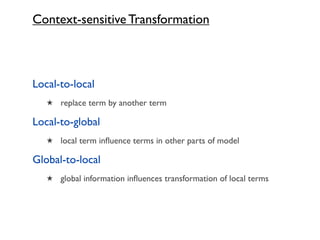
Context-sensitive Transformation


Local-to-local
   ★ replace term by another term

Local-to-global
   ★ local term influence terms in other parts of model

Global-to-local
   ★ global information influences transformation of local terms
define page blog(b : Blog) {
                                           header{output(b.name)}
                                           list{
                                             for(p : Post in b.posts) {
                                               listitem{ outputPost(p) }
                                             }
                                           }
 Inlining is Global-to-Local             }
                                         define outputPost(pst : Post) {
                                           navigate post(pst) { output(pst.name)   }
                                         }
                                         define list()     { <ul> elements </ul>   }
                                         define listitem() { <li> elements </li>   }
                                         define header()   { <h1> elements </h1>   }

define page blog ( b : Blog ) {
  <h1>
    output(b.name)
  </h1>
  <ul>
    for ( p : Post in b.posts ) {
       <li>
         navigate post(p) { output(p.name) }
       </li>
    }
  </ul>
}
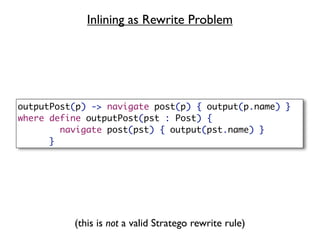
Inlining as Rewrite Problem


outputPost(p) -> navigate post(p) { output(p.name) }
where define outputPost(pst : Post) {
        navigate post(pst) { output(pst.name) }
      }


          (this is not a valid Stratego rewrite rule)
Rewrite Rules are Context-free


desugar :
  Property(x, t) -> Property(x, t, [])
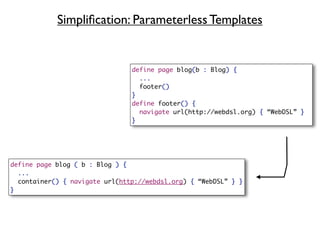
Simplification: Parameterless Templates


                                define page blog(b : Blog) {
                                  ...
                                  footer()
                                }
                                define footer() {
                                  navigate url(http://webdsl.org) { “WebDSL” }
                                }


define page blog ( b : Blog ) {
  ...
  container() { navigate url(http://webdsl.org) { “WebDSL” } }
}
Rewrite in Context


Inline :
  [def@TemplateDef(f,[],elem1*) | def1*] -> [def | def2*]
  where def2* := <alltd((Call(f) -> Call("container", elem1*)))> def1*


    local traversal              bound in context


      container needed to replace single call with multiple elements
Intermezzo:
Rewriting Strategies
transformation
                              is
partial* function from terms to terms


          * transformation may fail to apply to a term
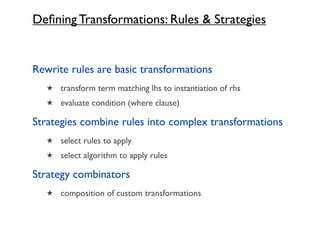
Defining Transformations: Rules & Strategies


Rewrite rules are basic transformations
   ★ transform term matching lhs to instantiation of rhs
   ★ evaluate condition (where clause)

Strategies combine rules into complex transformations
   ★ select rules to apply
   ★ select algorithm to apply rules

Strategy combinators
   ★ composition of custom transformations
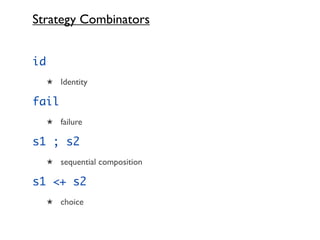
Strategy Combinators


id
     ★ Identity

fail
     ★ failure

s1 ; s2
     ★ sequential composition

s1 <+ s2
     ★ choice
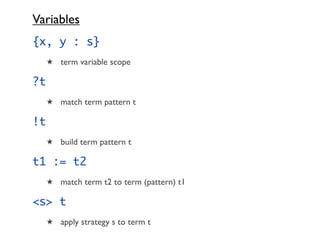
Variables
{x, y : s}
     ★ term variable scope

?t
     ★ match term pattern t

!t
     ★ build term pattern t

t1 := t2
     ★ match term t2 to term (pattern) t1

<s> t
     ★ apply strategy s to term t
Rewrite Rules


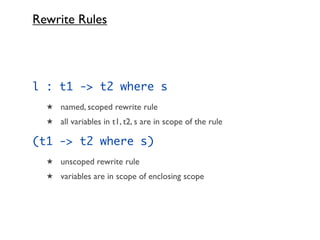
l : t1 -> t2 where s
  ★ named, scoped rewrite rule
  ★ all variables in t1, t2, s are in scope of the rule

(t1 -> t2 where s)
  ★ unscoped rewrite rule
  ★ variables are in scope of enclosing scope
Rewrite in Context


Inline :
  [def@TemplateDef(f,[],elem1*) | def1*] -> [def | def2*]
  where def2* := <alltd((Call(f) -> Call("container", elem1*)))> def1*


                                bound in context
Inline :
  [def@TemplateDef(f,[],elem*) | def1*] -> [def | def2*]
  where def2* := <alltd((Call(f) -> Call("container", elem*)))> def1*


f                            elem*


      [ TemplateDef(
          "footer"
        , []
        , [Navigate(PageRef("webdsl", []), [String("WebDSL")])]
        )
      , TemplateDef(
          "blog"
        , [Param("b", SimpleType("Blog"))]
        , [Call("footer")]
        )
      ]

                      Call(f)
def1*
Strategy Definitions

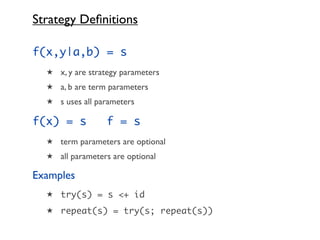
f(x,y|a,b) = s
  ★ x, y are strategy parameters
  ★ a, b are term parameters
  ★ s uses all parameters

f(x) = s          f = s
  ★ term parameters are optional
  ★ all parameters are optional

Examples
  ★ try(s) = s <+ id

  ★ repeat(s) = try(s; repeat(s))
Rules with Parameters

Transform all elements of a list
 map(s) : [] -> []

 map(s) : [x|xs] -> [<s>x | <map(s)> xs]


Invert order of elements of a list
 inverse(|ys) : [] -> ys

 inverse(|ys) : [x|xs] -> <inverse(|[x|ys])> xs


Pair elements of two lists
 zip(s) : ([],[]) -> []

 zip(s) : ([x|xs],[y|ys]) -> [<s>(x,y) | <zip(s)>(xs,ys)]
Traversal Combinators


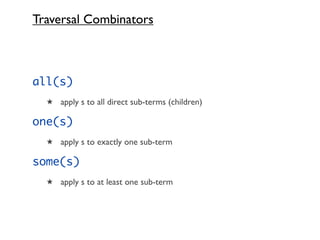
all(s)
  ★ apply s to all direct sub-terms (children)

one(s)
  ★ apply s to exactly one sub-term

some(s)
  ★ apply s to at least one sub-term
Traversal Strategies


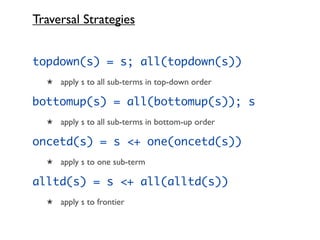
topdown(s) = s; all(topdown(s))
  ★ apply s to all sub-terms in top-down order

bottomup(s) = all(bottomup(s)); s
  ★ apply s to all sub-terms in bottom-up order

oncetd(s) = s <+ one(oncetd(s))
  ★ apply s to one sub-term

alltd(s) = s <+ all(alltd(s))
  ★ apply s to frontier
Rewrite in Context: Local Traversal


Inline :
  [def@TemplateDef(f,[],elem1*) | def1*] -> [def | def2*]
  where def2* := <alltd((Call(f) -> Call("container", elem1*)))> def1*


    local traversal
Dynamic Rewrite Rules
Rewrite in Context: Not Optimal
Inline :
  [def@TemplateDef(f,[],elem1*) | def1*] -> [def | def2*]
  where def2* := <alltd((Call(f) -> Call("container", elem1*)))> def1*


                 requires def before use
                 local traversal for each declaration
Dynamic Rewrite Rules
Inline :
  [def@TemplateDef(f,[],elem1*) | def1*] -> [def | def2*]
  where def2* := <alltd((Call(f) -> Call("container", elem1*)))> def1*


declare-inline :
  TemplateDef(f,[],elem1*) -> TemplateDef(f,[],elem1*)
  where rules(
    InlineTemplate : Call(f) -> Call("container", elem1*)
  )

inline =
  alltd(declare-inline);
  topdown(try(InlineTemplate))


        separate traversal from rule definition (binding closures)
Inlining as Rewrite Problem (Revisited)


  outputPost(p) -> navigate post(p) { output(p.name) }
  where define outputPost(pst : Post) {
          navigate post(pst) { output(pst.name) }
        }

                            (informal)


declare-inline :
  TemplateDef(f,[],elem1*) -> TemplateDef(f,[],elem1*)
  where rules(
    InlineTemplate : Call(f) -> Call("container", elem1*)
  )

                  (formal; but not yet complete)
define page blog(b : Blog) {
       Template Parameter                  header{output(b.name)}
                                           list{
                                             for(p : Post in b.posts) {
                                               listitem{ outputPost(p) }
                                             }
                                           }
                                         }
                                         define outputPost(pst : Post) {
                                           navigate post(pst) { output(pst.name)   }
                                         }
                                         define list()     { <ul> elements </ul>   }
                                         define listitem() { <li> elements </li>   }
                                         define header()   { <h1> elements </h1>   }

define page blog ( b : Blog ) {
  <h1>
    output(b.name)
  </h1>
  <ul>
    for ( p : Post in b.posts ) {
       <li>
         navigate post(p) { output(p.name) }
       </li>
    }
  </ul>
}
Inlining Templates with Parameters
declare-inline :
  def@TemplateDef(mod*,f,param*,elem1*) -> def
  where rules(
    InlineTemplate :
      Call(f, e*, []) -> Call("container", [], elem3*)
      where elem3* := <substitute> (param*, e*, elem1*)
  )

substitute :
  (param*, e*, elem1*) -> elem2*
  where {| Subst
         : <zip(bind-arg)> (param*, e*)
         ; elem2* := <alltd(Subst)> elem1*
         |}

bind-arg :
  (Param(x, t), e) -> (Param(x, t), e)
  where rules( Subst : Var(x) -> e )
Element Parameters

              define list() { <ul> elements </ul> }


declare-inline :
  def@TemplateDef(mod*,f,param*,elem1*) -> def
  where rules(
    InlineTemplate :
      Call(f, e*, elem2*) -> Call("container", [], elem3*)
      where {| Subst
             : rules(
                 Subst : Elements() -> Call("container",[],elem2*)
               )
             ; elem3* := <substitute> (param*, e*, elem1*)
             |}
  )
Removing Intermediate Structures


rules // remove containers

 desugar-container :
   [Call("container",[], elem1*) | elem2*] -> [elem1*, elem2*]

 desugar :
   elem1* -> elem2*
   where elem2* := <at-suffix(desugar-container)> elem1*


     container needed to replace single call with multiple elements
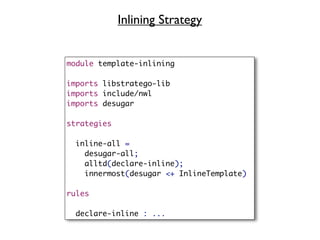
Inlining Strategy


module template-inlining

imports libstratego-lib
imports include/nwl
imports desugar

strategies

  inline-all =
    desugar-all;
    alltd(declare-inline);
    innermost(desugar <+ InlineTemplate)

rules

  declare-inline : ...
module template-inlining

                    imports libstratego-lib
                    imports include/nwl
                    imports desugar

                    strategies

                     inline-all =
                       desugar-all;
                       alltd(declare-inline);
                       innermost(desugar <+ InlineTemplate)

                    rules

                     declare-inline :
                       TemplateDef(mod*,f,param*,elem1*) -> TemplateDef(mod*,f,param*,elem1*)
                       where rules(
                         InlineTemplate :
                           Call(f, e*, elem2*) -> Call("container", [], elem3*)

Template Inlining          where {| Subst
                                  : rules( Subst : Elements() -> Call("container", [], elem2*) )
                                  ; elem3* := <substitute> (param*, e*, elem1*)

 Transformation        )
                                  |}


                     substitute :
                       (param*, e*, elem1*) -> elem2*
                       where {| Subst
                              : <zip(bind-arg)> (param*, e*)
                              ; elem2* := <alltd(Subst)> elem1*
                              |}

                     bind-arg :
                       (Param(x, t), e) -> (Param(x, t), e)
                       where rules( Subst : Var(x) -> e )

                    rules // remove containers

                     desugar-container :
                       [Call("container",[], elem1*) | elem2*] -> [elem1*, elem2*]

                     desugar :
                       elem1* -> elem2*
                       where elem2* := <at-suffix(desugar-container)> elem1*

Building DSLs with the Spoofax Language Workbench

  • 1.
    Building DSLs with The Spoofax Language Workbench Eelco Visser Delft University of Technology http://eelcovisser.org Joint work with Lennart Kats, Karl-Trygve Kalleberg, Maartje de Jonge, and many others
  • 2.
    The Meta-Languages Wars Internal DSLs vs External DSLs Textual vs Graphical Partial vs Complete Code Generation Project-Specific vs Multi-Project DSLs Code Generation vs Interpretation Dynamically vs Statically Typed
  • 3.
    The Meta-Languages Wars Internal DSLs vs External DSLs Textual vs Graphical Partial vs Complete Code Generation Project-Specific vs Multi-Project DSLs Code Generation vs Interpretation Dynamically vs Statically Typed
  • 4.
    WebDSL http://webdsl.org separation of concerns & linguistic integration Eelco Visser. WebDSL: A Case Study in Domain-Specific Language Engineering. GTTSE 2007: 291-373
  • 5.
  • 6.
    publication records correct & extend
  • 7.
  • 8.
    bibliographies tagging reputation system access control rules user groups conference calendar community engineering etc.
  • 9.
    18,000 lines ofWebDSL code 138 (generated) tables in mysql
  • 10.
    Concerns in webapplications - Data model - User interface templates - Actions - Access control rules - Data validation WebDSL - Linguistic integration - Cross concern, static consistency checking
  • 11.
    WebLib: a modelof researchr
  • 12.
    Data Model entity Publication{ key :: String (id) title :: String (name,searchable) authors -> List<Author> journal :: String (searchable) volume :: Int issue :: Int year :: Int (searchable) month :: String (searchable) firstpage :: Int lastpage :: Int cites -> Set<Publication> citedBy -> Set<Publication> (inverse=Publication.cites) } entity Author { key :: String (id) name :: String publications -> Set<Publication> (inverse=Publication.authors) created :: DateTime modified :: DateTime }
  • 13.
  • 14.
    Full Text Search definepage search() { var query : String action show() { var pubs : List<Publication> := searchPublication(query); if(pubs.length > 0) { replace(results, results(query,pubs)); } else { replace(results, noresults()); entity Publication { title :: String (name,searchable) } journal :: String (searchable) } year :: Int (searchable) main{ month :: String (searchable) section{ ... } header{"Search"} form{ input(query)[onkeyup:=show()] } placeholder results{} } } }
  • 15.
    Page & TemplateDefinitions define page root() { main{ section{ header{"Welcome to WebLib: Your Digital Library"} aboutWeblib() recent() tips() } } } define aboutWeblib() { par{ "WebLib is a digital library ..." } }
  • 16.
    XML Embedding define no-spanmain() { <div class="page-wrap"> top() <div class="body"> messages() elements() </div> <div class="clear"></div> </div> footer() }
  • 17.
    Page Navigation define tips(){ section{ header{"What Can You Do Here?"} list{ listitem{ navigate(newauthor()){ "Add an author" } } listitem{ navigate(newpublication()){ "Add a publication" } } listitem{ navigate(search()){ "Search" } } } } } define page search() { ... }
  • 18.
    HQL Embedding extend entityPerson { publications -> List<Publication> := select p from Publication as p, Author as a where (a.person = ~this) and (p = a.publication) }
  • 19.
    Forms & DataBinding define page editpublication(pub : Publication) { main{ section{ header{"Edit Publication '" output(pub.title) "'"} form{ group{ label("Key:" ){ input(pub.key) } label("Title:" ){ input(pub.title) } label("Authors:"){ input(pub.authors) } ... } submit action{ pub.modified := now(); return publication(pub); } { "Save" } } } } }
  • 20.
    Access Control Danny M.Groenewegen, Eelco Visser. Declarative Access Control for WebDSL: Combining Language Integration and Separation of Concerns. ICWE 2008: 175-188
  • 21.
    Access Control Rules define showReview(review : Review) { action delete() { ... } section{ ... navigate(editReview(review)){"[Edit]"} submitlink delete() {"[X]"} } }
  • 22.
    Access Control Rules define showReview(review : Review) { action delete() { ... } section{ ... navigate(editReview(review)){"[Edit]"} submitlink delete() {"[X]"} } } access control rules principal is User with credentials username, password predicate isReviewer(review : Review) { review.reviewer == securityContext.principal } rule template showReview(review : Review, pubLink : Bool) { review.public || isReviewer(review) rule action delete() { loggedIn() && isReviewer(review) } } rule page editReview(review : Review) { loggedIn() && isReviewer(review) }
  • 23.
    Data Validation Danny M.Groenewegen, Eelco Visser. Integration of Data Validation and User Interface Concerns in a DSL for Web Applications. SLE 2009: 164-173
  • 24.
    Data Validation: FormInput Validation label("Acronym (without year)"){ input(acronym){ validate(!isEmptyString(acronym), "Provide acronym") validate(!(/[ ]/.find(acronym)), "Acronym should not contain spaces") validate(!(/[0-9][0-9][0-9][0-9]/.find(acronym)), "Acronym should not contain year") } }
  • 25.
    Data Validation: DataInvariants entity Publication { key :: String (id, index(25), validate(isUniquePublication(this), "that key is already in use"), validate(isValidKeyForURL(key), "Key should consist of letters, digits, : and -")) ... }
  • 26.
    Data Validation: Assertions extendentity Person { invitation -> Invitation (inverse=Invitation.invitee) function invite(email : Email, invitation : WikiText) : Invitation { validate(findUser(email) == null && findInvitationByEmail(email).length == 0, "That email address is already in use."); ... } }
  • 27.
    Concerns in webapplications - Data model - User interface templates - Actions - Access control rules - Data validation WebDSL - Linguistic integration - Cross concern, static consistency checking
  • 28.
  • 29.
    parse check Model AST Errors desugar Traditional Compiler core Architecture generate Code
  • 30.
    Compiler Ingredients Syntax definition ★ concrete syntax ★ abstract syntax Static semantics ★ error checking ★ name resolution ★ type analysis Model-to-model transformation ★ express constructs in core language Code generation ★ translate core language models to implementation
  • 31.
  • 32.
    Editor Services forModern IDEs Syntactic Editor Services ★ syntax checking ★ bracket matching ★ syntax highlighting ★ code folding ★ outline view Semantic Editor Services ★ error checking ★ reference resolving ★ hover help ★ code completion ★ refactoring
  • 33.
    parse Editor AST feedback core Integrated Development Environment Code
  • 34.
    Architectural Requirements forIDEs Editor services are based on AST ★ services analyze structure, not text of source Error recovery ★ continue services in presence of syntactic errors Incremental processing ★ effort of applying analysis, transformation, generation should be proportional to change in source Separate compilation (analysis, transformation) ★ keep track of dependencies
  • 35.
    Holy Grail ofSoftware Language Definition Automatically derive efficient, scalable, incremental compiler + usable IDE from high-level, declarative language definition
  • 36.
  • 37.
    The Spoofax/IMP LanguageWorkbench Syntax definition: SDF ★ declarative, modular syntax definition Transformation, analysis, generation: Stratego ★ rewrite rules, strategies, dynamic rules Editor services ★ domain-specific languages for configuration Based on IMP framework by IBM Research
  • 38.
  • 39.
    Syntax Definition Pretty-Print Parse Table Signature Table Parse Transform Pretty-Print @Entity entity User { class User { name :: String String _user; pw :: Secret public User } getUser() { def output(u : syntax definition is basis of language definition return _user; User) { }
  • 40.
  • 41.
  • 42.
    Context-Free Grammar sort regular expression symbol Definition grammar production Property* {Stat “;”}* “entity”
  • 43.
    Lexical Syntax regular expression character class characters in lexical syntax not separated by layout
  • 44.
  • 45.
  • 46.
    Lexical Syntax: Identifiers& Literals follow restriction: symbol may not reserved words be followed by character from this class: BlogEntry is one ID
  • 47.
    Lexical Syntax: Strings escape complement escape escape
  • 48.
    Lexical Syntax: Whitespace LAYOUT?is inserted between symbols in CF productions normalize
  • 49.
  • 50.
    Parsing & AbstractSyntax building structured representation of sentence
  • 51.
    Linking Concrete &Abstract Syntax
  • 52.
    Terms to RepresentAbstract Syntax Entity(“Blog”, [Property(“name”,SimpleType(“String”)), Property(“author”, SimpleType(“User”))] )
  • 53.
  • 54.
    Signatures defining the structureof abstract syntax terms
  • 55.
    Syntax Definition Pretty-Print Parse Table Signature Table Parse Transform Pretty-Print @Entity entity User { class User { name :: String String _user; pw :: Secret public User } getUser() { def output(u : syntax definition is basis of language definition return _user; User) { }
  • 56.
    Signatures declare arguments andtypes of constructors signature is generated from grammar
  • 57.
  • 58.
    Arithmetic Expressions note: thisstyle produces good abstract syntax Plus(Times(Var(“x”),Int(2)),Var(“z”))
  • 60.
  • 61.
  • 62.
  • 63.
  • 64.
  • 65.
    Embedding HQL module expressions imports Common imports HQL exports context-free syntax SelectStatement -> Exp define page index() { list{ for(p : Post in select p from Post as p order by (p.title)) { listitem{ output(p) } } } } ForElem("p", SimpleType("Post") , QueryRule( SelectFrom( Some(Select(None(), [AliasedExpression(Path(["p"]), None())])) , FromClause([FromRangeJoin(FromClass(Path(["Post"]), Some(AsAlias(Alias("p" ) , Some(OrderByClause([OrderElement(Paren([Path(["p", "title"])]), None())])) ) , [CallElems("listitem", [CallArgs("output", [Var("p")])])] )
  • 66.
  • 67.
    Editor Services Syntax highlighting ★ token coloring Code folding ★ folding & unfolding code fragments Outline view ★ table of contents Syntax properties ★ bracket matching, indentation Syntax completion ★ match on syntactic triggers & replace with template
  • 68.
    Editor Services Composition modulenwl.main imports nwl-Builders nwl-Colorer nwl-Folding nwl-Outliner nwl-References nwl-Syntax nwl-Completions language General properties name : nwl id : nwl extends : Root description : "Spoofax/IMP-generated editor for the nwl language" url : http://strategoxt.org extensions : nwl table : include/nwl.tbl start symbols : Start
  • 69.
    Syntax Definition Default Syntax Default Default Highlighting Code Folding Outline View Custom Syntax Custom Custom + Highlighting + Code Folding + Outline View Editor
  • 70.
    Code Folding module nwl-Folding.generated folding Default folding Start.Module Definition.Entity Property.Property Definition.TemplateDef Element.CallArgs PageRef.PageRef Element.Action module nwl-Folding imports nwl-Folding.generated folding Element.CallElems Element.Call Element.ForElem Element.ForAllElem
  • 71.
    Outline View module nwl-Outliner.generated outliner Default outliner Start.Module Definition.Entity Property.Property Definition.TemplateDef Element.CallArgs Exp.MethodCall Element.CallElems Element.Call Element.ForElem Element.ForAllElem PageRef.PageRef Element.Action Statement.For Statement.While Statement.If Element.Submit Element.XmlElem
  • 72.
    module nwl-Colorer.generated colorer Default, token-based highlighting Default Syntax Highlighting keyword : 127 0 85 bold identifier : default string : blue number : darkgreen var : 255 0 100 italic operator : 0 0 128 layout : 100 100 0 italic colorer System colors darkred = 128 0 0 red = 255 0 0 darkgreen = 0 128 0 green = 0 255 0 darkblue = 0 0 128 blue = 0 0 255 cyan = 0 255 255 magenta = 255 0 255 yellow = 255 255 0 white = 255 255 255 black = 0 0 0 gray = 128 128 128 grey = gray orange = 255 165 0 pink = 255 105 180 brown = 139 69 19 default = _
  • 73.
    Custom Syntax Highlighting module nwl-Colorer imports nwl-Colorer.generated colorer Element : darkgreen
  • 74.
    Syntax Properties module nwl-Syntax.generated languageSyntax properties (static defaults) // Comment constructs: line comment : "//" block comment : "/*" * "*/" // Fences (used for matching, // inserting, indenting brackets): fences : [ ] ( ) { } // Automatic indent hints // (indent after these tokens): indent after : "=" ":" // Regular expression for identifiers: identifier lexical : "[A-Za-z0-9_]+"
  • 75.
  • 76.
    Parse Error Recovery also for composite languages
  • 77.
  • 78.
    Builders: Analysis &Transformation Services module nwl-Builders builders provider: include/nwl.ctree observer: editor-analyze builder : "Generate Java code" = generate-java (openeditor) (realtime) builder : "Show ATerm (selection)" = generate-aterm (openeditor) (realtime) (meta) builder : "Normalize (selection)" = show-normalized (openeditor) (realtime) (meta) builder : "Normalize Pretty (selection)" = show-normalized-pp (openeditor) (realtime) (meta)
  • 79.
  • 80.
    Term Rewriting Term rewriterules ★ transform term to term ★ pattern matching ★ variable binding ★ substitution Rewriting strategy ★ algorithm for applying rewrite rules
  • 81.
    Term Rewrite Rule left-hand side pattern label/name desugar : Property(x, t) -> Property(x, t, []) variable right-hand side pattern
  • 82.
    Rewrite Strategy generic strategy strategy definition desugar-all = innermost(desugar) strategy instantiation apply transformation s exhaustively to all sub- innermost(s) terms of subject term in bottom-up order
  • 83.
    Constant Folding y :=a + (3 * 5 + 2); Assign( Var("y") , Plus( Var("a") , Plus(Times(IntLit("3"), IntLit("5")), IntLit("2")) parse ) ) Assign( Var("y") , BinOp(Var("a"), "+", IntLit("17")) desugar + eval ) y := (a + 17); pretty-print
  • 84.
    Constant Folding Rules strategies eval-all = innermost(desugar + eval) rules eval : BinOp(IntLit(x), "+", IntLit(y)) -> IntLit(<addS>(x, y)) eval : BinOp(IntLit(x), "-", IntLit(y)) -> IntLit(<subtS>(x, y)) eval : BinOp(IntLit(x), "*", IntLit(y)) -> IntLit(<mulS>(x, y)) eval : BinOp(IntLit(x), "/", IntLit(y)) -> IntLit(<divS>(x, y))
  • 85.
    Conditional Rewrite Rules bound in condition eval : BinOp(IntLit(x), "+", IntLit(y)) -> IntLit(z) condition where z := <addS>(x, y) match apply transformation eval : BinOp(IntLit(x), "+", IntLit(y)) -> IntLit(<addS>(x, y))
  • 86.
  • 87.
    Rewriting with ConcreteObject Syntax elem-to-java-servlet : tc@elem|[ x(e)[passign*]{elem*} ]| -> <wrap-input-render-java-code> bstm* |[ String x_temp = ident+"~inputident"+uniqueid; ~*<render-error-messages-with-error-template(|java:expr|[ x_temp ]|, <ErrorTemplateInput>)> bstm*|[ bstm_call* ]| ]| where <is-input-template> tc with inputident := <get-inputnumber> tc ; x_temp := <newname> "temp" ; bstm_call* := <control-flow-tcall-helper(|"render",expr|[ x_temp ]|)> tc Stratego + embedded Java
  • 88.
  • 89.
    Consistency Checking Syntax definition ★ what are well-formed sentences? Static analysis ★ not all ‘well-formedness’ properties are context-free ★ consistency of compositions ★ consistency of expressions wrt declarations Error reporting ★ indicate errors in editor ★ use sensible error message
  • 92.
    Consistency Checking: Ingredients EditorInterface ★ collecting and displaying errors, warnings Error checking ★ checking static constraints and reporting errors Type analysis ★ computing types of expressions Name resolution ★ disambiguation of names Reference resolving ★ linking identifiers to declarations
  • 93.
    Consistency Checking: GenericApproach Rename ★ make identifiers unique Map ★ map identifiers to declarations Project ★ compute properties of declarations, expressions Check ★ check constraints
  • 94.
    Editor Interface module nwl-Builders importsnwl-Builders.generated builders provider: include/nwl.ctree observer: editor-analyze editor/nwl-Builders.esv trans/static-analysis.str module static-analysis imports include/nwl imports entities imports utils rules // static analysis editor-analyze: (ast, path, fullpath) -> (errors, warnings, notes) with ...
  • 95.
    Editor Interface editor-analyze: (ast, path, fullpath) -> (errors, warnings, notes) with errors := <collect-all(check, conc)> ast; warnings := <collect-all(constraint-warning, conc)> ast; notes := <collect-all(constraint-note, conc)> ast
  • 96.
    Error Checking Rules check : context -> (target, error) where assumption where require(constraint) require(s) = not(s) – Context: identifying points in the code to check – Assumptions: only report an error if certain assumptions hold (validating the context and avoiding spurious errors) – Constraints: checking for constraints at the context – Formulating an error message – Attribution of the error to a particular character range in the source text (usually, only part of the context
  • 97.
    Error Checking: BinaryOperators check : e@BinOp(e1, op, e2) -> (e, $[operator [op] not defined for [<pp>t1] and [<pp>t2]]) where t1 := <type-of> e1 where t2 := <type-of> e2 where require(<type-of> e)
  • 98.
    Pretty-Printing with StringInterpolation pp : Entity(x, prop*) -> $[entity [x] { [<map(pp)>prop*] }] pp : Property(x,t) -> $[[x] : [<pp>t] ] pp : SimpleType(x) -> x pp : SetType(t) -> $[Set<[<pp> t]>] pp : [] -> $[] pp : [t] -> <pp>t pp : [t1,t2|ts] -> $[[<pp>t1],[<pp>[t2|ts]]]
  • 99.
    Type Analysis type-of :e -> t compute type of expression
  • 100.
    Type Analysis: Literals type-of: StringLit(x) -> SimpleType("String") type-of : IntLit(x) -> SimpleType("Int")
  • 101.
    Type Analysis: BinaryOperators type-of : BinOp(e1, op, e2) -> t where t := <function-type>(op, [<type-of>e1, <type-of>e2]) function-type : ("+", [SimpleType("String"), SimpleType("String")]) -> SimpleType("String") function-type : ("+", [SimpleType("Int"), SimpleType("Int")]) -> SimpleType("Int") function-type : ("-", [SimpleType("Int"), SimpleType("Int")]) -> SimpleType("Int")
  • 102.
    Type Analysis: Whatis Type of Variable? define page root(x : Int) { action exptest() { for(y : Int in {1,2,x}) { x := x + y; } } type-of : } Var(x) -> t where t := ??? Assign( Var("x") , BinOp(Var("x"), "+", Var("y")) ) type of variable not part of variable use
  • 103.
    Variables: Map declare-all = alltd(declare) declare : Param(x, t) -> Param(x, t) with rules( TypeOf : x -> t ) type-of : Var(x) -> t where t := <TypeOf> x
  • 104.
    Scope define page root(x : Int) { action exptest() { for(x : Int in {1,2,x}) { print(x); } } } multiple occurrences of same identifier corresponding to different declarations
  • 105.
    Variables: Map +Rename rename-all = alltd(rename) rename : Param(x, t) -> Param(y, t) with y := <rename-var>(x, t) unique annotation rename-var : (x, t) -> y with y := x{<new>}; map variable to type rules( TypeOf : y -> t RenameId : x -> y ) rename occurrences rename : Var(x) -> Var(y) where y := <RenameId> x type-of : Var(x) -> t where t := <TypeOf> x
  • 106.
    Term Annotations t{t1,...,tn} add additional information to term without affecting signature
  • 107.
    Variables: Check check : e@Var(x) -> (e, $[Variable '[x]' not declared]) where require(<type-of>e)
  • 108.
    Variable Binding Constructs rename : For(x, t, e1, stat1*) -> For(y, t, e2, stat2*) with e2 := <rename-all> e1 with {| RenameId : y := <rename-var>(x, t) ; stat2* := <rename-all> stat1* |} For defines local variable x in body stat1*’
  • 109.
    Editor Interface withAnalysis editor-analyze: (ast, path, fullpath) -> (errors, warnings, notes) with ast2 := <analyze> ast; errors := <collect-all(check, conc)> ast2; warnings := <collect-all(constraint-warning, conc)> ast2; notes := <collect-all(constraint-note, conc)> ast2 analyze = rename-all
  • 110.
    Rename, Map, Project,Check Rename ★ make local variables unique Map ★ variables to their type Project ★ compute type of expressions Check ★ check constraints using types
  • 111.
  • 112.
    Reference Resolution Aiding programnavigation ★ Hover-click on identifier to jump to declaration Reuse name resolution infrastructure
  • 113.
    Reference Resolution module nwl-References importsnwl-References.generated references reference _ : editor-resolve editor-resolve: (source, position, ast, path, fullpath) -> target where target := <compute-target> source
  • 114.
    From Use toDeclaration editor-resolve: (SimpleType(type), position, ast, path, fullpath) -> target where Entity(target,_) := <declaration-of> type editor-resolve: (ref@PageRef(x,e*), position, ast, path, fullpath) -> target where TemplateDef(_,target,_,_) := <declaration-of> ref
  • 115.
  • 116.
    Experience Bootstrapped ★SDF, Stratego, ATerm, PP ★ Editor service language Spoofax ★ WebDSL ★ Mobl: mobile web applications ★ Acoda: migration of data models ★ Aster: attribute grammars ★ PIL: platform independent language ★ Student languages SDF+Stratego ★ Java, AspectJ, XML, PHP, SQL, Jimple, Octave, Dot, ...
  • 117.
    Future Work (inprogress) Higher-level definition of scope & type system ★ cover scope systems of real languages Refactoring ★ layout preservation, generic refactoring strategies Systematic language design ★ how do we decide that a language design is good? Interaction design ★ higher-level specifications of interaction Combining textual and visual Textual IDE in the browser
  • 118.
    - the end- Lennart C. L. Kats, Eelco Visser. The Spoofax Language Workbench. Rules for Declarative Specification of Languages and IDEs. OOPSLA 2010 http://spoofax.org http://webdsl.org http://mobl.org
  • 119.
  • 120.
    define page blog(b: Blog) { Template Inlining header{output(b.name)} list{ for(p : Post in b.posts) { listitem{ outputPost(p) } } } } define outputPost(pst : Post) { navigate post(pst) { output(pst.name) } } define list() { <ul> elements </ul> } define listitem() { <li> elements </li> } define header() { <h1> elements </h1> } define page blog ( b : Blog ) { <h1> output(b.name) </h1> <ul> for ( p : Post in b.posts ) { <li> navigate post(p) { output(p.name) } </li> } </ul> }
  • 121.
    Context-sensitive Transformation Local-to-local ★ replace term by another term Local-to-global ★ local term influence terms in other parts of model Global-to-local ★ global information influences transformation of local terms
  • 122.
    define page blog(b: Blog) { header{output(b.name)} list{ for(p : Post in b.posts) { listitem{ outputPost(p) } } } Inlining is Global-to-Local } define outputPost(pst : Post) { navigate post(pst) { output(pst.name) } } define list() { <ul> elements </ul> } define listitem() { <li> elements </li> } define header() { <h1> elements </h1> } define page blog ( b : Blog ) { <h1> output(b.name) </h1> <ul> for ( p : Post in b.posts ) { <li> navigate post(p) { output(p.name) } </li> } </ul> }
  • 123.
    Inlining as RewriteProblem outputPost(p) -> navigate post(p) { output(p.name) } where define outputPost(pst : Post) { navigate post(pst) { output(pst.name) } } (this is not a valid Stratego rewrite rule)
  • 124.
    Rewrite Rules areContext-free desugar : Property(x, t) -> Property(x, t, [])
  • 125.
    Simplification: Parameterless Templates define page blog(b : Blog) { ... footer() } define footer() { navigate url(http://webdsl.org) { “WebDSL” } } define page blog ( b : Blog ) { ... container() { navigate url(http://webdsl.org) { “WebDSL” } } }
  • 126.
    Rewrite in Context Inline: [def@TemplateDef(f,[],elem1*) | def1*] -> [def | def2*] where def2* := <alltd((Call(f) -> Call("container", elem1*)))> def1* local traversal bound in context container needed to replace single call with multiple elements
  • 127.
  • 128.
    transformation is partial* function from terms to terms * transformation may fail to apply to a term
  • 129.
    Defining Transformations: Rules& Strategies Rewrite rules are basic transformations ★ transform term matching lhs to instantiation of rhs ★ evaluate condition (where clause) Strategies combine rules into complex transformations ★ select rules to apply ★ select algorithm to apply rules Strategy combinators ★ composition of custom transformations
  • 130.
    Strategy Combinators id ★ Identity fail ★ failure s1 ; s2 ★ sequential composition s1 <+ s2 ★ choice
  • 131.
    Variables {x, y :s} ★ term variable scope ?t ★ match term pattern t !t ★ build term pattern t t1 := t2 ★ match term t2 to term (pattern) t1 <s> t ★ apply strategy s to term t
  • 132.
    Rewrite Rules l :t1 -> t2 where s ★ named, scoped rewrite rule ★ all variables in t1, t2, s are in scope of the rule (t1 -> t2 where s) ★ unscoped rewrite rule ★ variables are in scope of enclosing scope
  • 133.
    Rewrite in Context Inline: [def@TemplateDef(f,[],elem1*) | def1*] -> [def | def2*] where def2* := <alltd((Call(f) -> Call("container", elem1*)))> def1* bound in context
  • 134.
    Inline : [def@TemplateDef(f,[],elem*) | def1*] -> [def | def2*] where def2* := <alltd((Call(f) -> Call("container", elem*)))> def1* f elem* [ TemplateDef( "footer" , [] , [Navigate(PageRef("webdsl", []), [String("WebDSL")])] ) , TemplateDef( "blog" , [Param("b", SimpleType("Blog"))] , [Call("footer")] ) ] Call(f) def1*
  • 135.
    Strategy Definitions f(x,y|a,b) =s ★ x, y are strategy parameters ★ a, b are term parameters ★ s uses all parameters f(x) = s f = s ★ term parameters are optional ★ all parameters are optional Examples ★ try(s) = s <+ id ★ repeat(s) = try(s; repeat(s))
  • 136.
    Rules with Parameters Transformall elements of a list map(s) : [] -> [] map(s) : [x|xs] -> [<s>x | <map(s)> xs] Invert order of elements of a list inverse(|ys) : [] -> ys inverse(|ys) : [x|xs] -> <inverse(|[x|ys])> xs Pair elements of two lists zip(s) : ([],[]) -> [] zip(s) : ([x|xs],[y|ys]) -> [<s>(x,y) | <zip(s)>(xs,ys)]
  • 137.
    Traversal Combinators all(s) ★ apply s to all direct sub-terms (children) one(s) ★ apply s to exactly one sub-term some(s) ★ apply s to at least one sub-term
  • 138.
    Traversal Strategies topdown(s) =s; all(topdown(s)) ★ apply s to all sub-terms in top-down order bottomup(s) = all(bottomup(s)); s ★ apply s to all sub-terms in bottom-up order oncetd(s) = s <+ one(oncetd(s)) ★ apply s to one sub-term alltd(s) = s <+ all(alltd(s)) ★ apply s to frontier
  • 139.
    Rewrite in Context:Local Traversal Inline : [def@TemplateDef(f,[],elem1*) | def1*] -> [def | def2*] where def2* := <alltd((Call(f) -> Call("container", elem1*)))> def1* local traversal
  • 140.
  • 141.
    Rewrite in Context:Not Optimal Inline : [def@TemplateDef(f,[],elem1*) | def1*] -> [def | def2*] where def2* := <alltd((Call(f) -> Call("container", elem1*)))> def1* requires def before use local traversal for each declaration
  • 142.
    Dynamic Rewrite Rules Inline: [def@TemplateDef(f,[],elem1*) | def1*] -> [def | def2*] where def2* := <alltd((Call(f) -> Call("container", elem1*)))> def1* declare-inline : TemplateDef(f,[],elem1*) -> TemplateDef(f,[],elem1*) where rules( InlineTemplate : Call(f) -> Call("container", elem1*) ) inline = alltd(declare-inline); topdown(try(InlineTemplate)) separate traversal from rule definition (binding closures)
  • 143.
    Inlining as RewriteProblem (Revisited) outputPost(p) -> navigate post(p) { output(p.name) } where define outputPost(pst : Post) { navigate post(pst) { output(pst.name) } } (informal) declare-inline : TemplateDef(f,[],elem1*) -> TemplateDef(f,[],elem1*) where rules( InlineTemplate : Call(f) -> Call("container", elem1*) ) (formal; but not yet complete)
  • 144.
    define page blog(b: Blog) { Template Parameter header{output(b.name)} list{ for(p : Post in b.posts) { listitem{ outputPost(p) } } } } define outputPost(pst : Post) { navigate post(pst) { output(pst.name) } } define list() { <ul> elements </ul> } define listitem() { <li> elements </li> } define header() { <h1> elements </h1> } define page blog ( b : Blog ) { <h1> output(b.name) </h1> <ul> for ( p : Post in b.posts ) { <li> navigate post(p) { output(p.name) } </li> } </ul> }
  • 145.
    Inlining Templates withParameters declare-inline : def@TemplateDef(mod*,f,param*,elem1*) -> def where rules( InlineTemplate : Call(f, e*, []) -> Call("container", [], elem3*) where elem3* := <substitute> (param*, e*, elem1*) ) substitute : (param*, e*, elem1*) -> elem2* where {| Subst : <zip(bind-arg)> (param*, e*) ; elem2* := <alltd(Subst)> elem1* |} bind-arg : (Param(x, t), e) -> (Param(x, t), e) where rules( Subst : Var(x) -> e )
  • 146.
    Element Parameters define list() { <ul> elements </ul> } declare-inline : def@TemplateDef(mod*,f,param*,elem1*) -> def where rules( InlineTemplate : Call(f, e*, elem2*) -> Call("container", [], elem3*) where {| Subst : rules( Subst : Elements() -> Call("container",[],elem2*) ) ; elem3* := <substitute> (param*, e*, elem1*) |} )
  • 147.
    Removing Intermediate Structures rules// remove containers desugar-container : [Call("container",[], elem1*) | elem2*] -> [elem1*, elem2*] desugar : elem1* -> elem2* where elem2* := <at-suffix(desugar-container)> elem1* container needed to replace single call with multiple elements
  • 148.
    Inlining Strategy module template-inlining importslibstratego-lib imports include/nwl imports desugar strategies inline-all = desugar-all; alltd(declare-inline); innermost(desugar <+ InlineTemplate) rules declare-inline : ...
  • 149.
    module template-inlining imports libstratego-lib imports include/nwl imports desugar strategies inline-all = desugar-all; alltd(declare-inline); innermost(desugar <+ InlineTemplate) rules declare-inline : TemplateDef(mod*,f,param*,elem1*) -> TemplateDef(mod*,f,param*,elem1*) where rules( InlineTemplate : Call(f, e*, elem2*) -> Call("container", [], elem3*) Template Inlining where {| Subst : rules( Subst : Elements() -> Call("container", [], elem2*) ) ; elem3* := <substitute> (param*, e*, elem1*) Transformation ) |} substitute : (param*, e*, elem1*) -> elem2* where {| Subst : <zip(bind-arg)> (param*, e*) ; elem2* := <alltd(Subst)> elem1* |} bind-arg : (Param(x, t), e) -> (Param(x, t), e) where rules( Subst : Var(x) -> e ) rules // remove containers desugar-container : [Call("container",[], elem1*) | elem2*] -> [elem1*, elem2*] desugar : elem1* -> elem2* where elem2* := <at-suffix(desugar-container)> elem1*