Building capability for new digital leadership, pedagogy and efficiency
Building digital capability27/04/2015
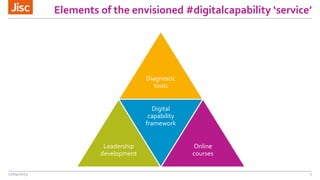
Elements of the envisioned #digitalcapability ‘service’
Diagnostic
tools
Leadership
development
Digital
capability
framework
Online
courses
27/04/2015 2
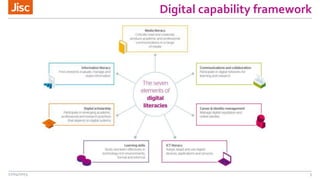
Digital capability framework
27/04/2015 3
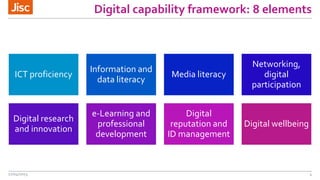
Digital capability framework: 8 elements
27/04/2015 4
ICT proficiency
Information and
data literacy
Media literacy
Networking,
digital
participation
Digital research
and innovation
e-Learning and
professional
development
Digital
reputation and
ID management
Digital wellbeing
27/04/2015 5
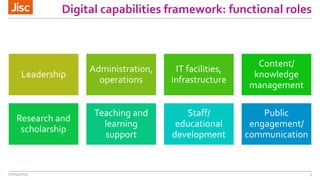
Leadership
Administration,
operations
IT facilities,
infrastructure
Content/
knowledge
management
Research and
scholarship
Teaching and
learning
support
Staff/
educational
development
Public
engagement/
communication
Digital capabilities framework: functional roles
27/04/2015 6
Questions (pick those that interest you)
»What paths can you envisage taking through the
proposed elements of the service (as an individual and for
your university or college)?
»Do the definitions of the eight elements look right?
»What behaviours would demonstrate competence in
each of the eight elements for the role group you
represent or support (eg teaching and learning support;
staff/educational development)
Get involved
» Join the building digital capability user group: be a critical
friend, input your experiences and needs, and comment on
early releases of any of the Jisc outputs
» Put forward your university or college as an early adopter of
the new outputs/services
» See jisc.ac.uk/rd/get-involved (essentially, mail me!)
» For announcements, join the mailing list:
jisc-diglit-public@jiscmail.ac.uk
» Read and comment on emerging findings:
digitalcapability.jiscinvolve.org
» #digitalcapability
27/04/2015 7
Find out more…
27/04/2015 8
Building digital capability
Sarah Davies
Head of change: student
experience
sarah.davies@jisc.ac.uk
jisc.ac.uk
Except where otherwise noted, this
work is licensed under CC-BY-NC-ND

Building digital capability

  • 1.
    Building capability fornew digital leadership, pedagogy and efficiency Building digital capability27/04/2015
  • 2.
    Elements of theenvisioned #digitalcapability ‘service’ Diagnostic tools Leadership development Digital capability framework Online courses 27/04/2015 2
  • 3.
  • 4.
    Digital capability framework:8 elements 27/04/2015 4 ICT proficiency Information and data literacy Media literacy Networking, digital participation Digital research and innovation e-Learning and professional development Digital reputation and ID management Digital wellbeing
  • 5.
    27/04/2015 5 Leadership Administration, operations IT facilities, infrastructure Content/ knowledge management Researchand scholarship Teaching and learning support Staff/ educational development Public engagement/ communication Digital capabilities framework: functional roles
  • 6.
    27/04/2015 6 Questions (pickthose that interest you) »What paths can you envisage taking through the proposed elements of the service (as an individual and for your university or college)? »Do the definitions of the eight elements look right? »What behaviours would demonstrate competence in each of the eight elements for the role group you represent or support (eg teaching and learning support; staff/educational development)
  • 7.
    Get involved » Jointhe building digital capability user group: be a critical friend, input your experiences and needs, and comment on early releases of any of the Jisc outputs » Put forward your university or college as an early adopter of the new outputs/services » See jisc.ac.uk/rd/get-involved (essentially, mail me!) » For announcements, join the mailing list: jisc-diglit-public@jiscmail.ac.uk » Read and comment on emerging findings: digitalcapability.jiscinvolve.org » #digitalcapability 27/04/2015 7
  • 8.
    Find out more… 27/04/20158 Building digital capability Sarah Davies Head of change: student experience sarah.davies@jisc.ac.uk jisc.ac.uk Except where otherwise noted, this work is licensed under CC-BY-NC-ND

Editor's Notes

  • #2 Go to ‘View’ menu > ‘Header and Footer…’ to edit the footers on this slide (click ‘Apply’ to change only the currently selected slide, or ‘Apply to All’ to change the footers on all slides). To add a background image to this slide; drag a picture to the placeholder or click the icon in the centre of the placeholder to browse for and add another image. Once added, the image can be cropped, resized or repositioned to suit.
  • #3 Lots of potential starting points and paths through – could ask them to draw on their likely paths. Though probably not cold – will need more discussion about the elements
  • #4 Found that this was well-used and liked in the sector, adopted as a de facto structure by many people. Decided to build on it.
  • #5 Key differences – addition of data literacy to information literacy, renaming of digital scholarship to digital research and innovation; addition of digital wellbeing as new item.
  • #6 Can see that start to get a lot of richness when you map the roles against the capabilities in potentially 8x8 matrix.
  • #7 If sufficient spread, move people to tables to discuss
  • #9 Go to ‘View’ menu > ‘Header and Footer…’ to edit the footers on this slide (click ‘Apply’ to change only the currently selected slide, or ‘Apply to All’ to change the footers on all slides).