POLITICAL ISSUES
CORRUPTION
Dishonest or illegal behavior
especially by powerful people
(such as government officials or
police officers) through means
that are illegitimate, immoral, or
incompatible with ethical
standards.
SPECIFIC TYPES OF CORRUPTION
• Tax evasion - Politicians do not
honestly declare their annual
incomes to avoid paying for their
corresponding taxes in the
government.
Ex: Manny Pacquiao
•Ghost projects and payrolls - this is
done by high officials of the
government whereby non-existing
projects are financed by the
government while non-existing
personnel are being paid salaries and
allowances.
Ex: Janet Napoles
SPECIFIC TYPES OF CORRUPTION
Positive effect: NONE
 High levels of corruption
reduce economic growth. It
can distort the allocation of
resources and the
performance of government
in many ways.
It has a pervasive and
troubling impact on the
poor, since it distorts public
choices in favor of the
wealthy and powerful, and
reduces the state’s capacity
to provide social safety nets.
IMPLEMENTATION OF LAWS
Implementation: The process of
putting a decision or plan into
effect;
Laws: the whole system or set of
rules made by the government
of a town, state, country, etc.
POSITIVE
1. Instils discipline and sense of order in
society
2. Sets standards of living
3. Establishes norms and boundaries that
are acceptable and agreeable for the people
to know what to do and how to do them
4. Protects and reinforces our rights
5. Offers/provides people a sense of security
NEGATIVE
1. For the inherently narrow-minded, laws
are restrictive and may curtail their
freedom.
2. Some laws can have selective beneficial
effects. They can lean more towards some
people, but come across as unfair to others.
3. Some implemented laws are not suitable
or compatible with the wants and needs of
people and the natural status of the country.
Padrino System, or patronage in
the Filipino culture and politics is
the value system where one gains
favor, promotion, or political
appointment through family
affiliation (nepotism)
PALAKASAN SYSTEM
or friendship (cronyism), as
opposed to one`s merit. The
Padrino System in the Philippines
has been the source of many
controversies and corruption.
PALAKASAN SYSTEM
NEGATIVE
Family members or friends of
government officials are appointed or
employed even if they are not
qualified or eligible to discharge the
functions of that office. This is one of
the root causes of inefficiency and
the overflowing of government
employees in the bureaucracy.
POSITIVE
• Gives employment
PLUNDER
• Plunder is committed when a
public officer who, by himself or
in connivance with members of
his family, relatives by affinity or
consanguinity, business
associates, subordinates or other
persons, amasses, accumulates
PLUNDER
or acquires ill-gotten wealth
through a combination or series
of overt or criminal acts as
described in Section 1 (d) of RA
7080 in the aggregate amount
or total value of at least Fifty
million pesos (P50,000,000.00).
PLUNDER
In addition, any person who
participated with the said
public officer in
the commission of plunder
shall likewise be punished.
Positive effect: NONE
 High levels of corruption
reduce economic growth. It
can distort the allocation of
resources and the
performance of government
in many ways.
It has a pervasive and
troubling impact on the
poor, since it distorts public
choices in favor of the
wealthy and powerful, and
reduces the state’s capacity
to provide social safety nets.
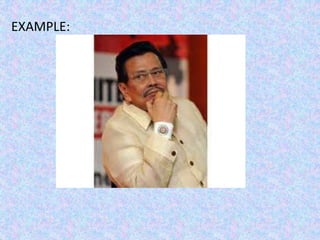
EXAMPLE:
POLITICAL DYNASTY
*A succession of rulers from
the same family or line.
* A family or group that
maintains power for several
generations: a political dynasty
controlling the state.
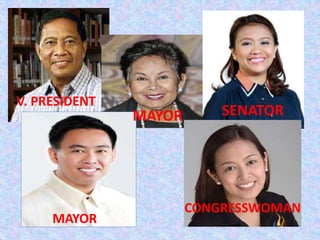
V. PRESIDENT
MAYOR SENATOR
MAYOR
CONGRESSWOMAN
POLITICAL DYNASTY
EXAMPLES:
Binay Family (Makati City)
Jejomar Binay - Vice President of the Philippines (2010–present),
former Mayor of Makati (1986-1987, 1988-1998, 2001–2010)
Elenita Binay- former Mayor of Makati (1998-2001)
Maria Lourdes "Nancy" Binay- Senator of the Philippines (2013–
present)
Mar-Len Abigail "Abby" Binay - Congresswoman of Makati's 2nd
District (2007–present)
Jejomar Erwin "Junjun" Binay, Jr. - Mayor of Makati (2010–
present), Member of the Makati City Council from the 1st district (2001-
2010), former Sangguniang Kabataan Chairman of Barangay San
Antonio, Makati (1992-2001)
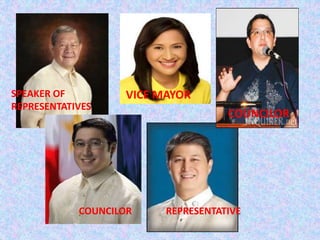
SPEAKER OF
REPRESENTATIVES
VICE MAYOR
REPRESENTATIVE
COUNCILOR
COUNCILOR
Belmonte Family (Quezon City)
Feliciano "Sonny" Belmonte, Jr.– Speaker of the House of
Representatives, Representative of the 4th District and Mayor
(2001–2010)
Josefina "Joy" Belmonte – Vice Mayor; daughter of Sonny
Belmonte
Christopher "Kit" Belmonte – Representative, 6th District; son of
Sonny Belmonte's brother Dennis
Ricardo "RJ" Belmonte – Councilor, 1st District; son of Sonny
Belmonte's brother Reicardo
Vincent Belmonte – Councilor, 4th District; son of Sonny
Belmonte's brother Eri
POSITIVE EFFECTS
The power of politicians will be
kept so they are given a chance to
prove their worth and fulfill their
promises since in a political
dynasty, the line of thought of the
politicians is pretty much the same.
Conflicting interests would be
avoided.
NEGATIVE EFFECTS
• The inherited power of the
recipients might not be used
responsibly.
• Political dynasties are
deemed to have inimical
effects on the development
and welfare of the populace.
NEGATIVE EFFECTS
• In many parts of the
country, the concentration of
political and economic power
that political families
represent makes it harder for
newcomers to join the
playing field of both business
and politics.
NEGATIVE EFFECTS
• They also have an economic
base – large chunks of industrial
and agricultural lands and diverse
businesses that fund their
incursion into electoral politics.
The big clans possessed a great
deal of influence and their
political and business power feed
on each other.
NEGATIVE EFFECTS
• To this day, incumbents
whose terms are about to
expire evade them by fielding
their spouses, children and
seemingly endless streams of
other relatives to ensure
profitable posts remain within
the control of their clans.
The foundation of political families is
based in power and wealth; the more
wealth, the more power. That is precisely
the reason why it is more difficult to
dislodge members of such families from
their posts. This time, even President
Benigno Aquino III, himself part of a
major political clan is deep into the
game. Perhaps he has the most number
of relatives trying to hop into public
office.

Political issues

  • 1.
  • 2.
    CORRUPTION Dishonest or illegalbehavior especially by powerful people (such as government officials or police officers) through means that are illegitimate, immoral, or incompatible with ethical standards.
  • 3.
    SPECIFIC TYPES OFCORRUPTION • Tax evasion - Politicians do not honestly declare their annual incomes to avoid paying for their corresponding taxes in the government. Ex: Manny Pacquiao
  • 4.
    •Ghost projects andpayrolls - this is done by high officials of the government whereby non-existing projects are financed by the government while non-existing personnel are being paid salaries and allowances. Ex: Janet Napoles SPECIFIC TYPES OF CORRUPTION
  • 5.
    Positive effect: NONE High levels of corruption reduce economic growth. It can distort the allocation of resources and the performance of government in many ways.
  • 6.
    It has apervasive and troubling impact on the poor, since it distorts public choices in favor of the wealthy and powerful, and reduces the state’s capacity to provide social safety nets.
  • 7.
    IMPLEMENTATION OF LAWS Implementation:The process of putting a decision or plan into effect; Laws: the whole system or set of rules made by the government of a town, state, country, etc.
  • 8.
    POSITIVE 1. Instils disciplineand sense of order in society 2. Sets standards of living 3. Establishes norms and boundaries that are acceptable and agreeable for the people to know what to do and how to do them 4. Protects and reinforces our rights 5. Offers/provides people a sense of security
  • 9.
    NEGATIVE 1. For theinherently narrow-minded, laws are restrictive and may curtail their freedom. 2. Some laws can have selective beneficial effects. They can lean more towards some people, but come across as unfair to others. 3. Some implemented laws are not suitable or compatible with the wants and needs of people and the natural status of the country.
  • 10.
    Padrino System, orpatronage in the Filipino culture and politics is the value system where one gains favor, promotion, or political appointment through family affiliation (nepotism) PALAKASAN SYSTEM
  • 11.
    or friendship (cronyism),as opposed to one`s merit. The Padrino System in the Philippines has been the source of many controversies and corruption. PALAKASAN SYSTEM
  • 12.
    NEGATIVE Family members orfriends of government officials are appointed or employed even if they are not qualified or eligible to discharge the functions of that office. This is one of the root causes of inefficiency and the overflowing of government employees in the bureaucracy.
  • 13.
  • 14.
    PLUNDER • Plunder iscommitted when a public officer who, by himself or in connivance with members of his family, relatives by affinity or consanguinity, business associates, subordinates or other persons, amasses, accumulates
  • 15.
    PLUNDER or acquires ill-gottenwealth through a combination or series of overt or criminal acts as described in Section 1 (d) of RA 7080 in the aggregate amount or total value of at least Fifty million pesos (P50,000,000.00).
  • 16.
    PLUNDER In addition, anyperson who participated with the said public officer in the commission of plunder shall likewise be punished.
  • 17.
    Positive effect: NONE High levels of corruption reduce economic growth. It can distort the allocation of resources and the performance of government in many ways.
  • 18.
    It has apervasive and troubling impact on the poor, since it distorts public choices in favor of the wealthy and powerful, and reduces the state’s capacity to provide social safety nets.
  • 19.
  • 20.
    POLITICAL DYNASTY *A successionof rulers from the same family or line. * A family or group that maintains power for several generations: a political dynasty controlling the state.
  • 21.
  • 22.
    POLITICAL DYNASTY EXAMPLES: Binay Family(Makati City) Jejomar Binay - Vice President of the Philippines (2010–present), former Mayor of Makati (1986-1987, 1988-1998, 2001–2010) Elenita Binay- former Mayor of Makati (1998-2001) Maria Lourdes "Nancy" Binay- Senator of the Philippines (2013– present) Mar-Len Abigail "Abby" Binay - Congresswoman of Makati's 2nd District (2007–present) Jejomar Erwin "Junjun" Binay, Jr. - Mayor of Makati (2010– present), Member of the Makati City Council from the 1st district (2001- 2010), former Sangguniang Kabataan Chairman of Barangay San Antonio, Makati (1992-2001)
  • 23.
  • 24.
    Belmonte Family (QuezonCity) Feliciano "Sonny" Belmonte, Jr.– Speaker of the House of Representatives, Representative of the 4th District and Mayor (2001–2010) Josefina "Joy" Belmonte – Vice Mayor; daughter of Sonny Belmonte Christopher "Kit" Belmonte – Representative, 6th District; son of Sonny Belmonte's brother Dennis Ricardo "RJ" Belmonte – Councilor, 1st District; son of Sonny Belmonte's brother Reicardo Vincent Belmonte – Councilor, 4th District; son of Sonny Belmonte's brother Eri
  • 25.
    POSITIVE EFFECTS The powerof politicians will be kept so they are given a chance to prove their worth and fulfill their promises since in a political dynasty, the line of thought of the politicians is pretty much the same. Conflicting interests would be avoided.
  • 26.
    NEGATIVE EFFECTS • Theinherited power of the recipients might not be used responsibly. • Political dynasties are deemed to have inimical effects on the development and welfare of the populace.
  • 27.
    NEGATIVE EFFECTS • Inmany parts of the country, the concentration of political and economic power that political families represent makes it harder for newcomers to join the playing field of both business and politics.
  • 28.
    NEGATIVE EFFECTS • Theyalso have an economic base – large chunks of industrial and agricultural lands and diverse businesses that fund their incursion into electoral politics. The big clans possessed a great deal of influence and their political and business power feed on each other.
  • 29.
    NEGATIVE EFFECTS • Tothis day, incumbents whose terms are about to expire evade them by fielding their spouses, children and seemingly endless streams of other relatives to ensure profitable posts remain within the control of their clans.
  • 30.
    The foundation ofpolitical families is based in power and wealth; the more wealth, the more power. That is precisely the reason why it is more difficult to dislodge members of such families from their posts. This time, even President Benigno Aquino III, himself part of a major political clan is deep into the game. Perhaps he has the most number of relatives trying to hop into public office.