Political
Dynasty
Prepared by Raizza P. Corpuz
POLITICAL DYNASTY
 understood as a lineage of hereditary succession to
an essentially same position or various positions at the
same time.
 Family member’s one another to the position.
 Relationship is established via succession or marriage
 Supreme Court (SC) Justice Antonio Carpio in a ruling in 2011
defined the term political dynasties in the case of Navarro v.
Ermita (GR No. 180050; April 12, 2011) as a “phenomenon
that concentrates political power and public resources within
the control of a few families whose members alternately
hold elective offices, deftly skirting term limits.”
 William Safire, political lexicographer, defines “dynasty” as the
“recurrence of political power in generations of a single family;
previously, the passing of power among a small group of political
elite
In History (STORY TO TELL)
 Establishing a political dynasty, history attests, is a very human
craving that very few can resist or not find ways to implement. A
story is told—apocryphal, of course—of Roman Emperor Caligula,
one of the most vicious madmen in history. Caligula did not want
the family dynasty to end with him. The problem was he had no
kinsman to pass power to as earlier he had all of them murdered to
avert any plot to replace him prematurely, or when he was not yet
good and ready, through his assassination.

Was Caligula fazed by this problem? Not a bit. The guy may have had
episodes of madness, but he was no fool; he could weave fantastic
solutions to unimaginable political problems.
Just like our politicos.
So how did Caligula solve the problem of preserving his dynasty with no
one to whom he could pass the torch in sight?
Simple.
He marched to the royal stable and named his favorite
horse senator and heir!
What gives rise to a political dynasty?
It’s a natural phenomenon no different from when
a banana plant begins to age and one or two shoots
spring up beside it.
Do political dynasties rise up from political
heavyweights? Not necessarily. Sociologist C.
Wright Mills points out that “throughout US history,
well over half of the American political elite have
come from families not previously connected with
political affairs. They come from families highly
placed in terms of money and position than political
influence.”
IN THE PHILIPPINES
We have had a number of recorded dynasties in the
past 100 years or so.
1.The Josons of Nueva Ecija;
2.the Laurels, Rectos and Levistes of Batangas;
3.the Remullas and Revillas of Cavite;
4.the Dys and Albanos of Isabela;
5.the Osmeñas, Cuencos and Duranos of Cebu;
6.the Singsons of Ilocos Sur;
7.the Ortegas of La Union;
8. the Marcoses of Ilocos Norte;
9. the Espinosas of Masbate;
10. the Villafuertes of Bicol;
11. the Buluts of Apayao;
12. the Cuas of Quirino;
13. the Ejercito-Estradas of San Juan;
14. the Binays of Makati…
15. Cojuangco of Tarlac
KINDS
 Thick - simultaneous
 Thin – successive
A “thin” dynasty is a political clan that only has two members
– like a father and son – swapping certain positions, as when
a mayor-father, at the end of his maximum three terms, lets
his son, who may also have reached his three-year term
either as vice mayor, councilor, provincial governor or vice
governor, running for each other’s position,
A fat dynasty monopolizing power is an
undesirable situation, as checks and balances
among elected officials in a certain local
government are difficult if they are all from one
family.
In Maguindanao, the “fat” Ampatuan dynasty held
eight out of the 37 mayoralty posts in the
province’s 37 municipalities, Mendoza said.
CONSTITUTIONAL PROVISION
 This provision clearly prohibits the
existence of political dynasties in the country
to preclude equal access to public service
and the right of people to choose in the local
election.
 However, it is not self-executory, meaning
the provision needs an implementing law
before it can be applied.
The 1987 Constitution of the Republic of the
Philippines: Article 2 - Declaration of
Principles and State Policies, Section 26
states that:
What is the proposal of the Congress
as of 16th
congress
 “A political dynasty exists when two or more individuals who
are related within the second degree of consanguinity(by
blood) or affinity hold or run for national or local office in
successive, simultaneous or overlapping terms,” the bill
said.
 it said that: “No spouse, or person, elevated within the
second civil degree of consanguinity or affinity, whether
legitimate of illegitimate, full or half blood, to an
incumbent elective official seeking re-election shall be
allowed to hold to run for any local or national elective
office in the same election,”
Conclusion
There is no definite and decisive LAW until today (2016) that
mandates the unlawful stance of Political dynasty in the
Philippines thus, is an ethical issue that need to be address. It is
not the question of how many family members who will run or
who are in the political arena but how transparent they are in
the field of public service.
It is still vested in democratic government that those who are
qualified to run in office have both the right and the duty to be
elected, but at the end of the day the quandary is still the same ;
what is the effect of too much complacency and familiarity ?
The answer, (may or may not be) greed and abuse that leads to
corruption.
It is within the power of suffrage, good substantive laws and
equal protection that can be the light to shed the doubt.
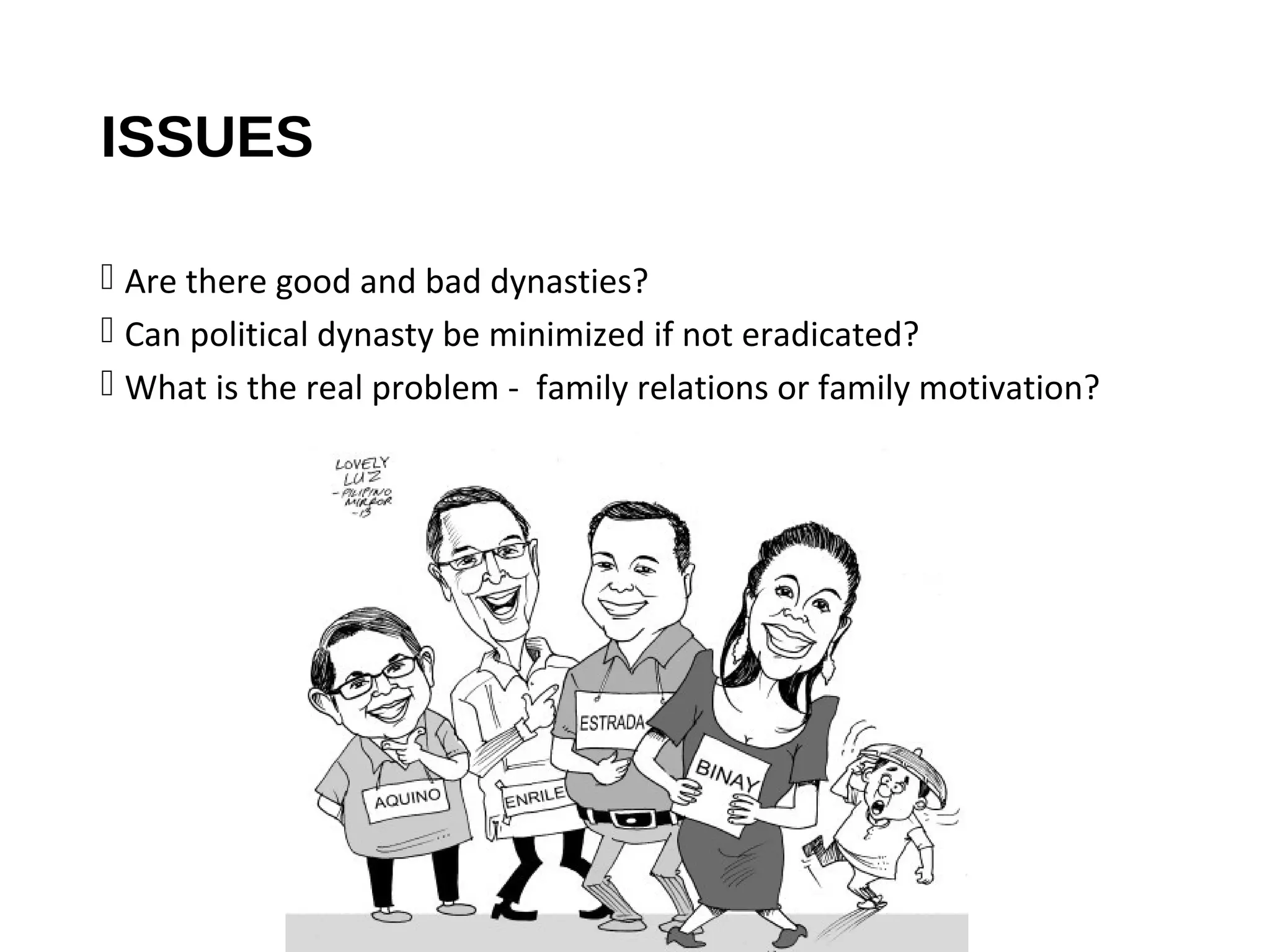
ISSUES
 Are there good and bad dynasties?
 Can political dynasty be minimized if not eradicated?
 What is the real problem - family relations or family motivation?
References
 http://www.philstar.com/headlines/2013/03/09/917449/political-dynasties-
 Gualberto B. Lumauig (lumauigbert@yahoo.com) is past president of
the UST Philosophy and Letters Foundation and former
governor/congressman of Ifugao.

Philippine Political dynasty

  • 1.
  • 2.
    POLITICAL DYNASTY  understoodas a lineage of hereditary succession to an essentially same position or various positions at the same time.  Family member’s one another to the position.  Relationship is established via succession or marriage  Supreme Court (SC) Justice Antonio Carpio in a ruling in 2011 defined the term political dynasties in the case of Navarro v. Ermita (GR No. 180050; April 12, 2011) as a “phenomenon that concentrates political power and public resources within the control of a few families whose members alternately hold elective offices, deftly skirting term limits.”
  • 3.
     William Safire,political lexicographer, defines “dynasty” as the “recurrence of political power in generations of a single family; previously, the passing of power among a small group of political elite In History (STORY TO TELL)  Establishing a political dynasty, history attests, is a very human craving that very few can resist or not find ways to implement. A story is told—apocryphal, of course—of Roman Emperor Caligula, one of the most vicious madmen in history. Caligula did not want the family dynasty to end with him. The problem was he had no kinsman to pass power to as earlier he had all of them murdered to avert any plot to replace him prematurely, or when he was not yet good and ready, through his assassination.
  • 4.
     Was Caligula fazedby this problem? Not a bit. The guy may have had episodes of madness, but he was no fool; he could weave fantastic solutions to unimaginable political problems. Just like our politicos. So how did Caligula solve the problem of preserving his dynasty with no one to whom he could pass the torch in sight? Simple. He marched to the royal stable and named his favorite horse senator and heir!
  • 5.
    What gives riseto a political dynasty? It’s a natural phenomenon no different from when a banana plant begins to age and one or two shoots spring up beside it. Do political dynasties rise up from political heavyweights? Not necessarily. Sociologist C. Wright Mills points out that “throughout US history, well over half of the American political elite have come from families not previously connected with political affairs. They come from families highly placed in terms of money and position than political influence.”
  • 6.
    IN THE PHILIPPINES Wehave had a number of recorded dynasties in the past 100 years or so. 1.The Josons of Nueva Ecija; 2.the Laurels, Rectos and Levistes of Batangas; 3.the Remullas and Revillas of Cavite; 4.the Dys and Albanos of Isabela; 5.the Osmeñas, Cuencos and Duranos of Cebu; 6.the Singsons of Ilocos Sur; 7.the Ortegas of La Union;
  • 7.
    8. the Marcosesof Ilocos Norte; 9. the Espinosas of Masbate; 10. the Villafuertes of Bicol; 11. the Buluts of Apayao; 12. the Cuas of Quirino; 13. the Ejercito-Estradas of San Juan; 14. the Binays of Makati… 15. Cojuangco of Tarlac
  • 8.
    KINDS  Thick -simultaneous  Thin – successive A “thin” dynasty is a political clan that only has two members – like a father and son – swapping certain positions, as when a mayor-father, at the end of his maximum three terms, lets his son, who may also have reached his three-year term either as vice mayor, councilor, provincial governor or vice governor, running for each other’s position,
  • 9.
    A fat dynastymonopolizing power is an undesirable situation, as checks and balances among elected officials in a certain local government are difficult if they are all from one family. In Maguindanao, the “fat” Ampatuan dynasty held eight out of the 37 mayoralty posts in the province’s 37 municipalities, Mendoza said.
  • 10.
    CONSTITUTIONAL PROVISION  Thisprovision clearly prohibits the existence of political dynasties in the country to preclude equal access to public service and the right of people to choose in the local election.  However, it is not self-executory, meaning the provision needs an implementing law before it can be applied.
  • 11.
    The 1987 Constitutionof the Republic of the Philippines: Article 2 - Declaration of Principles and State Policies, Section 26 states that:
  • 12.
    What is theproposal of the Congress as of 16th congress  “A political dynasty exists when two or more individuals who are related within the second degree of consanguinity(by blood) or affinity hold or run for national or local office in successive, simultaneous or overlapping terms,” the bill said.  it said that: “No spouse, or person, elevated within the second civil degree of consanguinity or affinity, whether legitimate of illegitimate, full or half blood, to an incumbent elective official seeking re-election shall be allowed to hold to run for any local or national elective office in the same election,”
  • 13.
    Conclusion There is nodefinite and decisive LAW until today (2016) that mandates the unlawful stance of Political dynasty in the Philippines thus, is an ethical issue that need to be address. It is not the question of how many family members who will run or who are in the political arena but how transparent they are in the field of public service. It is still vested in democratic government that those who are qualified to run in office have both the right and the duty to be elected, but at the end of the day the quandary is still the same ; what is the effect of too much complacency and familiarity ? The answer, (may or may not be) greed and abuse that leads to corruption. It is within the power of suffrage, good substantive laws and equal protection that can be the light to shed the doubt.
  • 14.
    ISSUES  Are theregood and bad dynasties?  Can political dynasty be minimized if not eradicated?  What is the real problem - family relations or family motivation?
  • 15.
    References  http://www.philstar.com/headlines/2013/03/09/917449/political-dynasties-  GualbertoB. Lumauig (lumauigbert@yahoo.com) is past president of the UST Philosophy and Letters Foundation and former governor/congressman of Ifugao.